
YT-09944 - Scissors Yato - Free user manual and instructions
Find the device manual for free YT-09944 Yato in PDF.


User questions about YT-09944 Yato
0 question about this device. Answer the ones you know or ask your own.
Ask a new question about this device
Download the instructions for your Scissors in PDF format for free! Find your manual YT-09944 - Yato and take your electronic device back in hand. On this page are published all the documents necessary for the use of your device. YT-09944 by Yato.
USER MANUAL YT-09944 Yato
natural_image
Black YATO-branded industrial tool with no visible text or symbols on the device itselfCE
natural_image
Black YATO 3D printer with no visible text or symbols on the device bodyPL EN DE RU UA LT LV CZ SK HU RO ES FR IT NL GR
natural_image
Close-up of a hand holding a metal wrench and a small mechanical component (no visible text or symbols)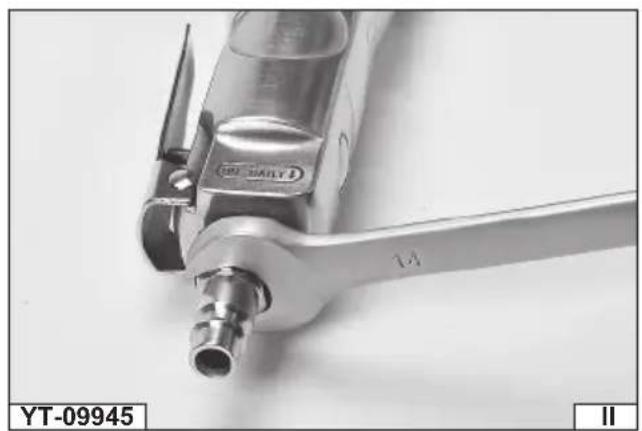
natural_image
Close-up of a metallic mechanical tool with a handle and connector (no visible text or symbols)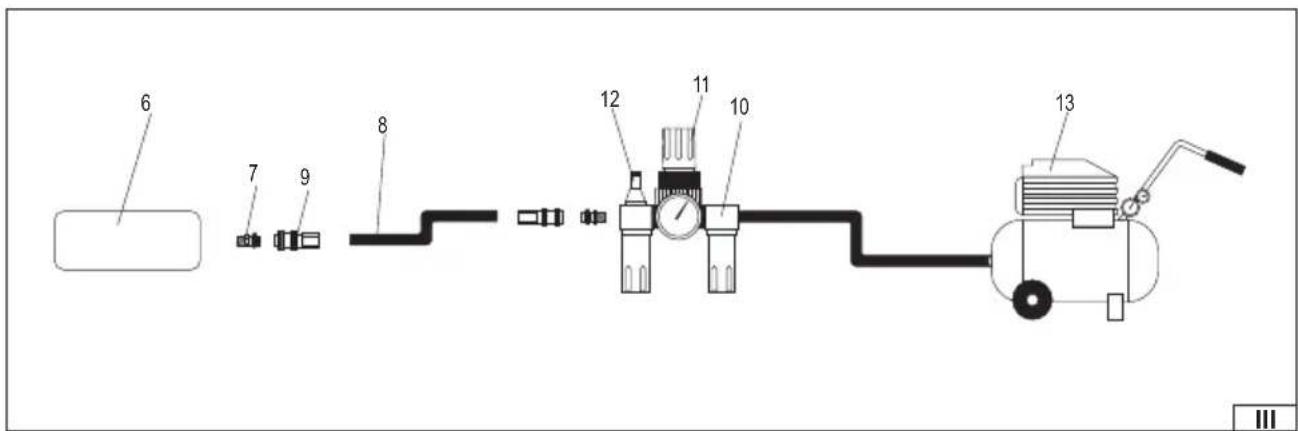
Read the operating instruction
Wear protective goggles
Schutzbrille tragen
Wear hearing protectors
Gehörschutz tragen
Maximum air pressure
Max. Betriebsdruck
Required air supply rate
Air connection diameter
WYPOSAŻENIE PRODUKTU
PRODUCT CHARACTERISTICS
Pneumatic shear is a tool powered by compressed air jet, it is used for for cutting sheets of steel and aluminium. Thanks to the special system of blades, the edges of cut metal sheet do not bend during cutting. Tools are designed to operate indoors and they should not be exposed to the influence of precipitation. The tool is not designed for continuous operation. Recommended mode of operation is casual work during 5 minutes, then you should wait for 30 minutes, to cool the tool. Correct, reliable, and safe operation of the device is dependent on its proper use, therefore:
Prior to working with the tool, you should read all the instruction and keep it around.
For any damages or injuries caused by the tool misuse, resulting from failure to comply with its designation, non compliance with safety regulations and recommendations included in this manual, the supplier does not accept any liability. Using the product without compliance to its intended to sign, results also in the loss of user's rights to the guarantee, as it would be a non-compliance with the contract.
EQUIPMENT OF THE PRODUCT
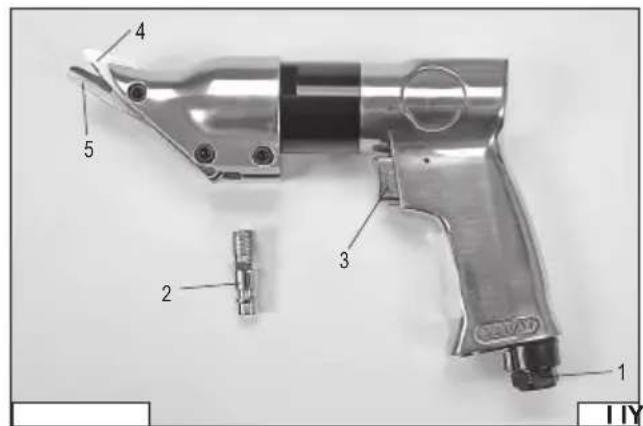
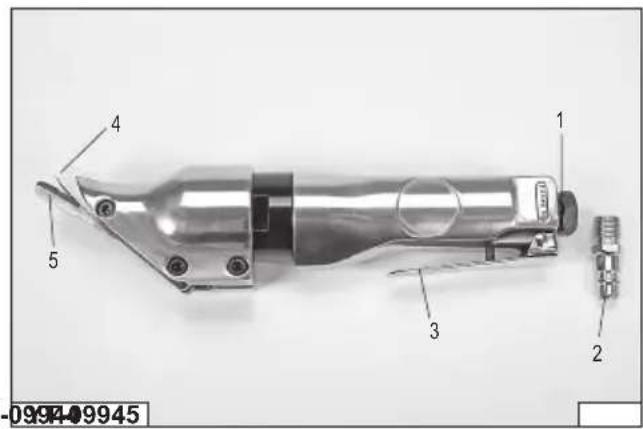
The product has been equipped with a connector for connecting the product to the pneumatic system.
TECHNICAL DATA
| Parameter Unit Value | |||
| Catalog number YT-09944 YT-09945 | |||
| Weight [kg] 1.3 1.0 | |||
| The diameter of the air connection (PT) [" / mm] 6.3 / 1/4 6.3 / 1/4 | |||
| The diameter of the air inlet hose (internal) | [" / mm] | 10 / 3/8 | 10 / 3/8 |
| Number of cuts | [min-1] | 1800 | 2500 |
| Cutting thickness | |||
| - in steel | [mm] | 1.2 1.2 | |
| - aluminium | [mm] | 1.4 1.4 | |
| Cutting width | [mm] | 5.5 5.5 | |
| Maximum operation pressure: | [MPa] | 0.63 | 0.63 |
| Required air flow (at 0.63 MPa) | [l/min] | 141 | 141 |
| Sound pressure (ISO 15744) | [dB(A)] | 80 ± 3 | 90 ± 3 |
| Sound pressure (ISO 15744) | [dB(A)] | 91 ± 3 | 101 ± 3 |
| Vibration (ISO 28927-9) | [m/s2] | 6.5 ± 1.5 4.6 ± 1.5 | |
GENERAL SAFETY CONDITIONS
WARNING! When you are working with a pneumatic tool, we recommend that you always comply with the basic principles of occupational safety, including the principles presented below, in order to reduce the risk of fire, electric shock and to prevent injuries.
Prior to working with the tool, you should read all the instruction and keep it around.
ATTENTION! Read all the instructions below. Failure to comply with them can lead to electrical shock, fire or personal injury. The concept of “pneumatic tool”, which is used in the instructions, refers to all tools, which are driven by a stream of air compressed at the right pressure.
COMPLY WITH THE FOLLOWING INSTRUCTIONS
General safety conditions
Before starting the installation, work, repair, maintenance and changing of accessories, or when you are working near pneumatic tool, because of many risks, you should read and understand the safety instructions. if the above mentioned steps are not taken, it may result in serious injury. Installation adjustment and installation of pneumatic tools may be performed only by qualified and trained staff. Do not modify the pneumatic tool. Modifications can reduce the efficiency and level of security, and increase the risk for a tool operator. Do not discard the safety instructions, you must pass them to the tool operator. Do not use pneumatic tool, when it is damaged. The tool should be subject to periodic inspections for visibility of the data required by ISO 11148. The employer/user should contact the manufacturer for replacement of a rating plate whenever it is necessary.
Hazards associated with moving parts
Disconnect tool from the power supply before changing the inserted tool or accessory. Damage to the workpiece, accessories
EN
or even the inserted tool can cause the ejection of parts at high speed. Always use the eye protection which is impact-resistant. Degree of protection should be selected depending on the work to be done. You should make sure, that the work piece is securely clamped. When you are working over your head, use protective helmet. You should also take into account the risk to bystanders. You should make sure, that the work piece is securely clamped. Make sure, that the blades are directed in such a way, that they cannot cause a hazard.
The risks associated with the work
Use of the tool may expose the operator's hands for threats, such as crushing, impact, cut-off, abrasion and heat. Avoid contact with the tool blade every time when the tool is connected to the power supply. Cutting by the shear creates sharp edges. You should dress appropriate gloves to protect your hands. The operator and maintenance personnel should be physically able to cope with the quantity, the weight and power of the tool. Grip the tool properly. Be ready to resist normal or rapid movements and have both hands available. Keep balance and to ensure safe foot positioning. Release the device for starting and stopping in the case of interruption in the power supply. Use only the lubricants, which are recommended by the manufacturer. Avoid direct contact with the inserted tool during or immediately after work, may be hot. The used tools should always be sharp. Avoid awkward postures, and also postures, which will not allow you to prevent the normal or sudden movement of the tool. Unexpected movement of the tool or rupture of the blades may cause injury. Cutting of some metals can cause sparks or high temperature, which can cause a fire or explosion. Before you start cutting the walls of the container in which flammable liquid has been previously stored, you should empty the tank completely, and then ventilate the vapours. There is a risk of electrostatic discharges when you are cutting plastic or other non-conductive materials.
The risks associated with repetitive movements
During the application of the pneumatic tool for work consisting of the repetition of movements, the operator is exposed to experience discomfort in hands, arms, shoulders, neck or other parts of the body. In the case of use of pneumatic tool, the operator should take a comfortable posture for correct setting of feet and should avoid postures, that are strange or not providing the balance. The operator should change posture during the long work periods, this will help to avoid discomfort and fatigue. If the operator is experiencing symptoms such as persistent or recurring discomfort, pain, pulsed pain, tingling, numbness, burning or stiffness. Operator should not ignore them, should tell the employer about it and consult a doctor.
The risks associated with accessories
Disconnect tool from the power supply before changing the inserted tool or accessory. Use accessories and supplies only in sizes and types, which are recommended by the manufacturer. The blade may become hot during its use, do not touch it. Do not use cracked or distorted accessories or inserted tools.
Risks associated with the workplace
Slips, trips and falls are the main causes of injuries. Beware of slippery surfaces, caused by the use of tools, and threats of tripping caused by the pneumatic system. Proceed with caution in an unknown environment. There may be hidden threats, such as electricity or other utility lines. Pneumatic tool is not intended for use in potentially explosive atmospheres and is not isolated from contact with electricity. Make sure, that there are no electric wires, gas pipes, etc., that can cause a threat in the event of their damage by using the tool.
Hazards arising from vapors and dust
Dust and fumes caused by using a pneumatic tool can cause bad health condition (such as cancer, birth defects, asthma and/or inflammation of the skin). There are necessary: a risk assessment and implementation of appropriate control measures in relation to those risks. The risk assessment should include the effect of dust created by using tools and the possibility of excitation of the existing dust. You should operate and maintain air tool in accordance with the recommendations of this manual, to minimize the emission of dust and fumes. The air outlet must be aimed to minimise generating dust in a dusty environment. Where dust or fumes are created, priority should be to control them at the source of their emission. All integrated functions and equipment for collection, extraction or reduction of dust or vapours should be properly operated and maintained in accordance with manufacturer's recommendations. You should select, maintain and exchange inserted tools according to the manual, to prevent increase of and dust. Wear suitable respiratory protective equipment, in accordance with the instructions of an employer and in accordance with the requirements of hygiene and safety. Service and maintenance of the pneumatic tool should be carried out according to the recommendations of the manual. This will minimize the emission of fumes and dust.
Noise hazard
high noise levels can cause permanent and irreversible hearing loss and other problems, such as tinnitus (ringing, buzz, whistling or humming in the ears). It is necessary to perform the risk assessment and implement appropriate control measures in relation to those risks. The appropriate checks, performed in order to reduce the risk, may include activities such as: application of insulation materials to prevent the “ringing” of the workpiece. Use hearing protection in accordance with the instructions of employer and in accordance with the requirements of hygiene and safety. Service and maintenance of the pneumatic tool should be carried out according to the recommendations of the manual, to avoid the unnecessary increase of noise level. Selection, maintenance and replacement of worn items / tinserted ools should be carried out in accordance with the recommendations of the service manual,
EN
in order to prevent unnecessary increase in noise. If the pneumatic tool has a muffler, you should always make sure that it is correctly mounted when you use the tool.
Risks of vibrations
Exposure to vibration may cause permanent damage to the nerves and blood supply to the hands and arms. You should wear warm clothing when working at low temperatures and you should keep your hands warm and dry. If you experience numbness, tingling, pain or skin whitening in the fingers and hands, you should discontinue the use of pneumatic tool, and then inform your employer and seek medical advice. Operation and maintenance pneumatic tool according to the recommendations of the manual, will allow to avoid the unnecessary increase of vibration. Hold the tool, with light but a firm grip, taking into account the required reaction forces, because the risk from vibration is usually much larger, when the grip force is higher.
Additional safety instructions for pneumatic tools
Air under pressure can cause serious injury:
- always shut off the air supply, drain hose of air pressure and detach tool from air supply, when it is not in use, before changing accessories or performing repairs;
- never direct the air stream at yourself or anyone else.
Hose hitting can cause serious injury. You should always check for damaged or loose hoses and fittings. Cold air should be directed away from the hands Every time when there are used universal screwed connections (claw couplings), you should apply the protecting pins and connectors against the possibility of damage to the connections between the hoses and between the hose and tool. Do not exceed the maximum air pressure specified for the tool. Never carry the tool, by holding it by the hose.
OPERATING CONDITIONS
You should make sure that the source of compressed air allows you to create the proper working pressure and that it provides the required air flow. In the case of a too high air pressure, a reducer should be used together with a safety valve. The pneumatic tool must be powered by the system of a filter and lubricator. This will ensure, at the same time, the air, which is pure and moistured by oil. The state of the filter and lubricator should be checked before each use, and possibly clean the filter or refill shortage of oil in the lubricator. This will ensure proper operation of the tool and will extend its service life.
In the case of high loads, there can be created a recoil force, which is directed towards the person, who is working with the tool.
You should adopt such an posture when you are working, to be able to effectively counter these forces.
Unexpected movement of the tool or rupture of inserted tool can cause injury.
If you use any additional handles or supporting racks, you should make sure, that the tool is mounted correctly and securely.
You should keep the body parts and clothing away from the working tool. There is a risk of being drawn or caught. You should always make sure, that all keys and tools, which are used for adjustment and fastening of blades, have been removed before you start work.
During work dust can develop, Depending on the workpiece it can be harmful for the operator.
During cutting or demolition works there may be thrown out elements of the workpiece.
Do not hold the inserted tool by unprotected hand. This may be the cause of an injury caused by vibrations.
USE OF THE PRODUCT
Before each use, you should check that none of the components of the product is damaged. If you notice any damage, you should replace the element immediately with new one, undamaged system component.
Before each use of the the pneumatic system, you should dry the moisture condensed inside the tool, compressor and pipes.
Connecting the tool to pneumatic system
The figure shows the recommended connection of tool to the pneumatic system. Presented method will ensure the most efficient use of tool, and also it will extend the service life of the tool.
Let a few drops of oil with viscosity SAE 10 to the air intake.
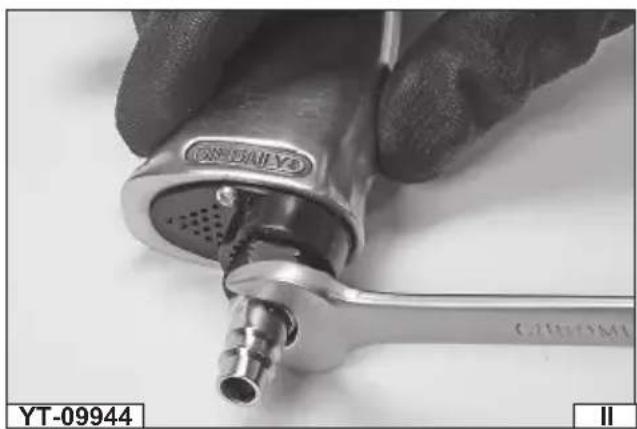
To the thread of air inlet tightly and firmly screw the appropriate tip allowing for the connection of air supply hose. (II)
On the tool driver you should mount an appropriate tipl. When you work with pneumatic tools you should use only equipment designed to work with the impact tools.
Speed / power of the tool can be adjusted by changing the air pressure for its powering. It is forbidden to excess the maximum pressure, which is specified in the table with technical data.
Connect the tool to air system using the hose with an inner diameter of 10 mm / 3/8". Make sure, that the strength of the hose is at least 1.38 MPa. (III)
Start the tool for a few seconds, making sure that it does not issue any suspicious sounds or vibrations.
Preparation for tool operation
The cut material should be clamped in such a way, so it does not move during work. To do this, use clamps, grips or vises. If the
EN
we cut material with of a large surface area, we should support it on both sides, near its outer edges and near the cut line in such a way, that the cut material parts slant outside of the cut line. This will prevent jamming the blades.
Make sure, that the thickness of material does not exceed the margin thickness of shear, which is quoted in the table with technical data.
You should always draw the cut line. This will facilitate work. Shear is designed to cut in a straight line and to cut gentle curves. It is not suitable for cutting corners.
Shear is equipped with three blades, the outer blades are stationary, and only the middle blade is moving. This arrangement provides, that both edges of the cut material are not deformed during cutting. However, there is formed a material strap of width given in the technical data table, which is folded towards the fixed blades. When you are preparing the workplace you should consider a place for this strap of material, which is formed during cutting.
Work with the tool,
Grasp the tool with both hands, by light, but firm grip. By pressing and holding the trigger you may start the tool and allow it to reach its full speed. Attach the tool to the edge of the cut material, start cutting, then lead the tool along the previously drawn cutting line. When you are cutting, you should exercise only the pressure, which is needed for cutting, do not guide the tool with the use of excessive force. The use of excessive force to guide the shear can result in jamming of its blades, rupture of them, as well as damage to the material, which is being cut.
After the cutting, you may release the trigger and allow the blade to stop. Being catious, turn off the air supply to the tool, and then disconnect it from the pneumatic system. Proceed to maintenance.
Attention! You should not allow for too long idle operation of the movable blade, as this will lead to premature dulling of blades.
If during work the blades jam in the cut material, you should release the pressure on the trigger and stop your operation, then release the blades from their jam. When you are resuming the cut you should first start the shear, let them reach their full speed and then slowly guide them on the cut line. It is forbidden to start cutting by the application of the arrested shear of the material edge.
MAINTENANCE
Never use gasoline, or any other flammable liquid to clean the tool. The vapors can be ignited, causing the tool explosion and serious injury.
Solvents, which are used to clean the tool holder and the body, can cause seals softening. Thoroughly clean the tool before starting your work.
In case of finding any irregularities in the tool operation, the tool you should be immediately disconnect from the pneumatic system.
All the elements of the pneumatic system must be protected against contamination. Contamination, that enters the pneumatic system, can damage the tool and other air system components.
Maintenance the tool before each use
Disconnect the tool from the pneumatic system.
Before each use, let a small amount of liquid preservative (e.g.. WD-40) through the air intake.
Connect the tool to pneumatic system and run it for about 30 seconds on its low speed. This will distribute the liquid preservative inside the tool interior and will clean it.
Again, disconnect the tool from the pneumatic system.
Let small amount of oil SAE 10 to the inside of the tool, through the air inlet and the holes intended for this purpose. It is recommended to use oil SAE 10 intended for maintenance of pneumatic tools. Connect the tool and run it for a short time on its low speed.
Attention! WD-40 may not be used as an appropriate lubricating oil.
Remove excess of oil, that spill out through the holes. Left oil may damage the tool seals.
Other maintenance operations
Before each use, you should check whether the tool shows any traces of damages. The blades must be kept clean.
Every 6 months or after 100 hours of operation, you must pass the tool for inspection by the qualified personnel in the repair shop. If the tool was used without the application of recommended air supply system, you should increase the frequency of the tool inspections.
Troubleshooting
You should stop using the tool immediately after the disguardy of any fault. Work with a defective tool can cause injury. Any repair or replacement of tool components must be carried out by qualified personnel in authorized repair facility.
EN
| Failure Possible solution | |
| The tool has too slow rotations or it does not start | Let a small amount of WD-40 through the air inlet. Run the tool for a few seconds. The blades may stick to the rotor. Run the tool for about 30 seconds. Lubricate the tool with small amount of oil. Attention! The excess of oil can cause a decrease in power of tool. In this case, you should clean the drive. |
| The tool starts and then slows down | The compressor does not provide proper air supply. The tool starts by the air collected in the tank of compressor. As the tank is emptying, the compressor has not kept pace with the refilling of air shortages. Connect the device to a more efficient compressor. |
| Insufficient power | Make sure, that your hoses have an internal diameter, at least such as it is specified in the table in paragraph 3. Check the set point of pressure, whether it is set to the maximum value. Make sure, that the tool is properly cleaned and lubricated. In the absence of results, you should pass the tool for repair. |
Replacement parts
In order to obtain the information on spare parts for pneumatic tools, you must contact the manufacturer or its representative.
After completion of the work, the housing, ventilation slots switches, should be cleaned, for example, by air stream (pressure not more than 0.3 MPa), with a brush or dry cloth without chemicals and cleaning fluids. Tools and handles should be cleaned with a dry, clean cloth.
Worn tools are secondary raw materials, it is forbidden to dispose of them together with household waste. because they contain substances harmful to human health and the environment! Please actively support the cost-effective management of natural resources and environmental protection by passing the used equipment to the point of storage for worn out devices. To reduce the amount of disposed waste it is necessary to re-use them, recycle or recover in another form.
DE
CHARAKTERISTIK DES PRODUKTES
PRODUKTA RAKSTUROJUMS
EQUIPEMENT DU PRODUIT
CONDITIONS D'EXPLOITATION
DECLARATION OF CONFORMITY
1024/YT-09944/EC/2024
We declare and guarantee with full responsibility that the following products:
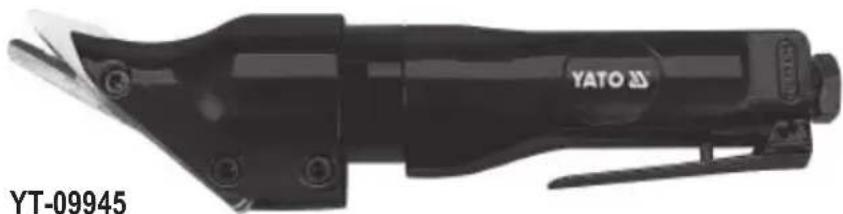
Pneumatic angle shear; 0,63 MPa; 1800 min ^-1 ; 1,2 mm; item no. YT-09944
Pneumatic shear; 0,63 MPa; 2500 min ^-1 ; 1,2 mm; item no. YT-09945
meet requirements of the following European Standards / Technical Specifications:
EN ISO 11148-11:2011
and fulfill requirements of the following European Directives:
2006/42/EC Machinery and safety elements
Serial number: concern all serials numbers of item(s) mentioned in this declaration
The person authorized to compile the technical file:
Agnieszka Rędziak
(Place and date of issue)
V-CE_PREZES ZARZADU
JAN SZMIDT
(Name and signature of authorized person)
TOYA S.A.