YT-82905 - Saw Yato - Free user manual and instructions
Find the device manual for free YT-82905 Yato in PDF.


| Product type | Cordless angle grinder (portable electric saw) |
| Brand | Yato |
| Model | YT-82905 |
| Rated voltage | 12 V DC |
| No-load speed | 19,500 rpm |
| Wheel diameter | 76 mm |
| Bore diameter | 10 mm |
| Spindle thread | M5 |
| Weight | 1.6 kg |
| Sound pressure level (LpA) | 68.5 dB(A) ± 3 dB |
| Sound power level (LwA) | 79.5 dB(A) ± 3 dB |
| Vibration level (ah, AG) | 1.23 m/s² ± 1.5 m/s² |
| Insulation class | III |
| Protection degree | IPX0 |
| Battery type | Li-Ion (not included) |
| Compatible materials | Metals, brick, natural and artificial stone, concrete, tile |
| Main functions | Cutting, grinding, sanding, wire brushing |
| Required protective equipment | Safety glasses, hearing protection, protective gloves |
| Maintenance and cleaning | Regularly clean ventilation openings with compressed air or a brush |
| Spare parts and repairability | Grinding wheels, brushes, diamond discs; repair by authorized service only |
Frequently Asked Questions - YT-82905 Yato
User questions about YT-82905 Yato
0 question about this device. Answer the ones you know or ask your own.
Ask a new question about this device
Download the instructions for your Saw in PDF format for free! Find your manual YT-82905 - Yato and take your electronic device back in hand. On this page are published all the documents necessary for the use of your device. YT-82905 by Yato.
USER MANUAL YT-82905 Yato
natural_image
Close-up of a hand holding a mechanical component, showing internal components and a close-up view (no visible text or symbols)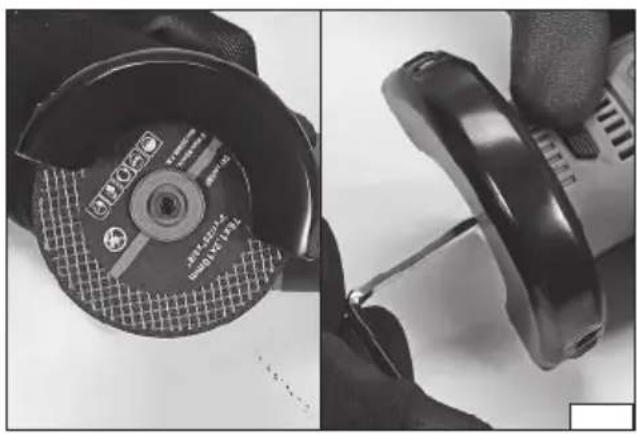
natural_image
Close-up of a mechanical component with a circular dial and textured surface, partially held by hands (no visible text or symbols)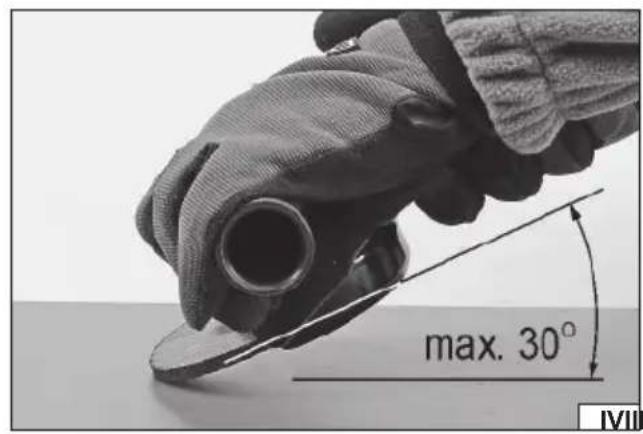
natural_image
Close-up of hands using a power tool to cut a circular mechanical part, with rotation arrows indicating clockwise motion (no text or symbols visible)- housing
- battery socket
- grinding wheel guard
- spindle
- spindle lock
- power switch
- hex key for fi xing the grinding
wheel - grinding wheel
- battery charge indicator
DE
Read the operating instruction
Wear protective goggles
Schutzbrille tragen
Wear hearing protectors
Gehörschutz tragen
This symbol indicates that waste electrical and electronic equipment (including batteries and storage cells) cannot be disposed of with other types of waste. Waste equipment should be collected and handed over separately to a collection point for recycling and recovery, in order to reduce the amount of waste and the use of natural resources. Uncontrolled release of hazardous components contained in electrical and electronic equipment may pose a risk to human health and have adverse effects for the environment. The household plays an important role in contributing to reuse and recovery, including recycling of waste equipment. For more information about the appropriate recycling methods, contact your local authority or retailer.
The angular grinder is an electric tool designed for grinding and cutting metals as well as mineral construction materials, such as bricks, natural and artificial stone, concrete, glaze, etc. with abrasive disks and grinding wheels selected for the given material. The tool must not be used for processing other materials than those mentioned above, e.g. for grinding and cutting wood or polishing. A correct, reliable and safe functioning of the grinder depends on its proper use, so:
Before you proceed to operate the grinder, read the manual thoroughly and keep it.
Always use protective goggles!
Do not use grinding wheels whose maximum acceptable tangential velocity is lower than 80 m/s!
Do not use grinding wheels whose maximum acceptable rotational speed is lower than the rotational speed of the grinder.
The supplier will not be held responsible for any damage resulting from the safety regulations and the recommendations indicated hereby not being observed.
EQUIPMENT
The product is supplied complete and does not require assembly. The battery and charging station are not included.
TECHNICAL PARAMETERS
| Parameter Unit Value | ||
| Catalog number YT-82905 | ||
| Mains voltage [V] 12 DC | ||
| Rated revs [min | ^-1 ] 19500 | |
| Diameter of the abrasive disk [mm] 76 | ||
| Diameter of the abrasive disk hole [mm] 10 | ||
| Spindle tip M5 | ||
| Weight [kg] 1,6 | ||
| Noise level | ||
| - acoustic pressure LpA ± KpA [dB (A)] | 68,5 ± 3,0 | |
| - power L_wA ± K | [dB (A)] | 79,5 ± 3,0 |
| Vibration level _ab,AG ± K | [m/s ^2 ] | 1,23 ± 1,5 |
| Insulation class | III | |
| Degree of protection | IPX0 | |
| Type of the battery | Li-Ion |
GENERAL SAFETY CONDITIONS
NOTE! Get acquainted with all the instructions below. Failure to observe them may lead to an electric shock, fire or injuries. The notion of electric tool used in the instructions applies to all the tools which are powered with electric current, both wire tools and wireless ones.
OBSERVE THE FOLLOWING INSTRUCTIONS
Place of work
The place of work must be properly illuminated and clean. Disorder and poor illumination may be a cause of accidents.
Do not work with electric tools in explosive environments, or those which contain inflammable liquids, gases or vapours. Electric tools generate sparks, which may cause a fire in case of contact with inflammable gases or vapours.
Do not allow children and outsiders to the place of work. A lack of concentration may result in a loss of control over the tool.
Electric safety
The plug of the power supply cable must fit the mains socket. Do not modify the plug. Do not use any adapters whatsoever in order to adapt the plug to the socket. Unmodified plug which fits the socket reduces the risk of an electric shock.
Avoid contact with grounded surfaces, such as pipes, heaters and refrigerators. Grounding of the body increases the risk of an electric shock.
Do not expose electric tools to precipitation or humidity. Water and humidity which gets into the electric tool increases the risk of an electric shock.
Do not overload the power supply cable. Do not use the power supply cable in order to carry the tool or to connect and disconnect the plug from the mains socket. Avoid contact of the power supply cable with heat, oils, sharp tools and moving elements. Damage to the power supply cable increases the risk of an electric shock.
EN
In case work is realised outside closed areas, it is necessary to use extension cords designed for applications outside closed areas. Using a correct extension cord permits to reduce the risk of an electric shock.
If operating a power tool in a damp location is unavoidable, use a residual current device (RDC) protected supply. Use of an RCD reduces the risk of electric shock.
Personal safety
Commence work in good physical and psychological conditions. Pay attention to what you do. Do not work if you are tired or under effects of medicines or alcohol. Even a moment's inattention during work may lead to serious injuries.
Always use individual means of protection. Always wear goggles. Using individual means of protection, such as dust-masks, protective shoes, helmets and hearing protections permits to reduce the risk of serious injuries.
Avoid accidental activation of the tool. Make sure the switch is in the OFF position, before you connect the tool to the mains. Holding the tool with a finger on the switch or connecting an electric tool when the switch is in the ON position may lead to serious injuries.
Before you turn an electric tool on remove all the spanners and other tools, which have been used for adjustments. A spanner left on rotating elements of the tool may lead to serious injuries.
Keep your balance. Maintain an appropriate position. It will permit to control the electric tool in case of unpredicted situations during its operation.
Use protective clothes. Do not wear loose clothes or jewellery. Keep your hair, clothes and gloves away from moving elements of the electric tool. Loose clothes, jewellery or long hair may get caught on moving elements of the tool.
Use dust extractors or dust containers, if the tool is equipped with any. Make sure they are properly connected. Using of dust extractors permits to reduce the risk of serious injuries.
Safety precautions while using the electric tool
Before the battery is installed, make sure the switch is off. Installation of the battery when the switch is on may lead to accidents. Use solely the charger recommended by the manufacturer. Using a charger designed for another type of battery may be a cause of fi re.
The electric tool must be operated exclusively with the battery indicated by the manufacturer. Using another battery may be a cause of fire or injuries.
When the battery is not used, it must be stored away from such metal objects as paper clips, coins, nails, screws or other small metal elements, which might short-circuit the terminals. Short-circuited terminals of the battery may cause burns or fire.
Under adverse circumstances liquid may leak from the battery; avoid any contact. In case of accidental contact with the liquid, rinse it with water. In case of eye contact, seek medical. The liquid leaking from the battery may cause irritation or burns.
During work when the tool may touch a hidden live conductor, the electric tool must be held by insulated handles. The installed bit in case of contact with a live conductor may conduct electricity to the metal elements of the tool, which may cause electric shock to the operator.
Repairs
The tool may be repaired only by authorised service centres, which must use solely original spare parts. It will guarantee a proper level of safety of operation of the electric tool.
ADDITIONAL SAFETY INSTRUCTIONS
The tool has been designed exclusively for grinding, grinding with abrasive paper, grinding with wire brushes and cutting. Get acquainted with all the warnings, instructions, illustrations and specifications supplied along with the electric tool. If the instructions below are not observed, there is a risk of electric shock, fire and / or serious injuries.
It is prohibited to use the tool as a polishing machine or in a way which does not comply with the manual. Using the tool for jobs it is not designed for implies a risk and may cause injuries.
Do not use accessories which have not been designed and are not recommended by the manufacturer. The fact that accessories may be installed in the tool does not mean work with them is safe.
The maximum rotational speed of the accessories must be higher than or equal to the maximum rotational speed of the tool. Accessories of a lower rotational speed than the speed of the tool may break during work.
The outer diameter and the thickness of accessories must fall within the range of dimensions indicated for the tool.
Accessories of incorrect dimensions cannot be properly protected and operated.
Threaded mounting of accessories must match the grinder spindle thread. The dimensions of the hole in which wheels, disks, flanges and other accessories are installed must comply with the dimensions of the spindle of the tool. Accessories in which the dimensions of the fixing hole do not comply with the dimensions of the spindle of the tool, will vibrate after start, which may preclude a proper control of the tool.
Do not use damaged accessories. Before each use, make sure the accessories are not splintered, broken or excessively worn. If accessories are dropped make sure they are not damaged or install new accessories. Once accessories have been inspected and installed, all persons must remain away from the plane of rotation of the accessories, and start the tool for a minute with the maximum rotational speed. During the test damaged accessories will be destroyed.
EN
Use individual protection means. Depending on the job, wear face protections or safety goggles. If it is required use dust masks, hearing protectors, gloves and aprons protecting from small fragments of the accessories or materials generated during work. Eye protection must stop flying pieces generated during work. The dust mask must filter dust generated during work. Excessive exposition to noise may lead to hearing impairment.
While realising tasks during which the disc may come into contact with a hidden live electric wire or a power supply cable hold the grinder by insulated handles. If the disc touches a live wire, the metal elements of the tool may cause electric shock to the operator of the tool.
Maintain a safe distance between the place of work and third persons. Persons who approach the place of work must use individual protection means. Chips generated during work or fragments of damaged accessories may be ejected beyond the direct vicinity of the place of work.
Place the power supply cord away from the rotating wheels. In case the operator loses the control over the tool, the cord may be cut or caught, and the hand or arm of the operator may be drawn into the rotating elements of the machine.
Never put down the tool until the rotating elements have stopped completely. The rotating elements may „catch“ the ground and impede the control of the tool.
Do not start the tool while carrying it. Accidental contact with the rotating elements may cause drawing clothes and contact of the tool with the body of the operator.
Clean the ventilating holes of the tool regularly. The ventilator of the motor pulls the dust generated during work into the tool. Excessive accumulation of metal particles contained in the dust increase the risk of electric shock.
Do not operate the tool in the vicinity of inflammable materials. The sparks generated during work may cause a fire. Do not use accessories which require cooling with liquids. Water or cooling liquid may cause an electric shock.
Warnings related to the possibility of the tool rebounding towards the operator
Rebounding of the tool towards the operator is caused by a sudden reaction to blocked or seized discs or polishing belts or another accessory, which causes a sudden stop of the rotating accessory and a turn of the electric tool opposite to the direction of rotation.
For example, if the grinding disc is seized by the object being processed, the edge of the disc, which is at the point of seizure may get deeper into the surface of the material, and thus get ejected.
The disc may also move towards or away from the operator, depending on the direction of movement of the grinding wheel at the place of seizure. Grinding wheels may also break.
Rebounding of the tool towards the operator is caused by incorrect operation and / or inobservance of the indications contained in the operating manual. It may be prevented if the following recommendations are followed.
Hold the tool firmly and adopt an adequate position of the body and the hands, which will permit you resist the force generated when the tool rebounds. Always use the additional handle, if it has been supplied with the tool, which will ensure a maximum control when the tool rebounds or turns inadvertently during start. The operator is able to control the turning or rebound of the tool, if adequate safety measures have been taken.
Do not ever place hands close to the rotating elements of the tool. The rotating elements may, in case the machine rebounds, get into contact with the hand.
Do not remain within the area into which the tool will move in case of rebound. A rebound will propel the tool in the direction opposite to the rotation of the grinding disk, where it is seized.
Be particularly careful during work close to corners, sharp edges, etc. Avoid flicking up and seizure of the grinding disk. During work on corners or edges there is an increased risk of seizure of the grinding disk, which may imply a loss of control over the tool or rebound of the tool.
Do not use disks with cutting chains or disk saws. The edges cause frequent rebounds, which may lead to a loss of control over the tool.
Warnings related to grinding and cutting with abrasive disks
Use only disks which are adequate for the tool and guards designed for the given type of disk. Disks which are not compatible with the tool cannot be properly protected and are not safe.
The grinding surface of centre depressed wheels must be mounted below the plane of the guard lip. An improperly mounted wheel that projects through the plane of the guard lip cannot be adequately protected.
The guard must be secured to the tool and placed in a position which ensures maximum safety, so that the smallest possible area of the disk is unprotected towards the operator. The guard helps to protect the operator from broken fragments of the disk and prevents accidental contact with the disk.
The disk must be used as intended. For example: do not grind with disks designed for cutting. Abrasive disks for cutting are designed for circumferential load, and the lateral forces applied to such a disk may destroy it.
Always use undamaged fixing disks, whose dimensions must be compatible with the grinding disk. Adequate fixing disks for the abrasive disk reduce the risk of damaging the grinding disk. The fixing disks for cutting disks may differ from the fixing disks designed for grinding disks.
Do not use worn abrasive disks from bigger tools. An abrasive disk of a bigger diameter is not adapted to a bigger rotational speed of smaller tools and may break.
EN
Warnings related to grinding with abrasive paper
Do not use discs with abrasive papers of an excessive size. While selecting the grinding wheel, follow the guidelines of the manufacturer. Abrasive paper which significantly exceeds the size of the disc may cause injuries and increases the risk of seizure, tearing or rebounding towards the operator.
Warnings related to work with wire brushes
Be careful, since fragments of wires are ejected from the brush also during normal work. Do not overload the wires exerting excessive force on the brush. The wires may easily perforate light clothes and/or the skin.
If it is recommended to use guards while working with wire brushes, preclude any contact of the brush with the guard.
The diameter of the wire brush may increase due to the load and the centrifugal force.
HANDLING OF THE GRINDING WHEELS
CAUTION! Only assemble, disassemble and handle the grinding wheels when the supply voltage is disconnected. Remove the battery from the power tool socket!
Grinding wheel assembly
Disconnect the supply voltage from the tool. Remove the battery from the power tool socket!
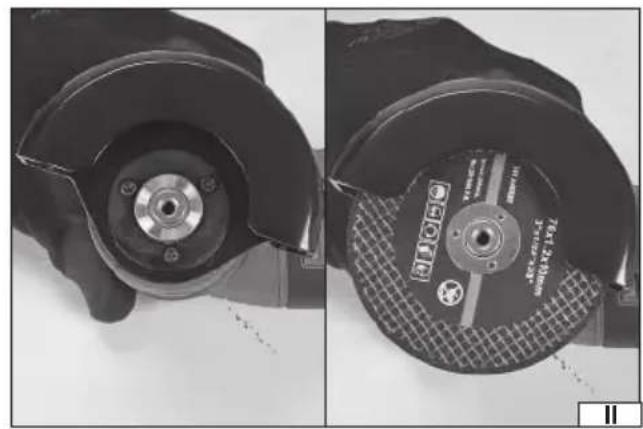
The tool is equipped with a wheel and a wheel guard intended for cutting. The wheel is not designed for grinding with a side surface. If the wheel is not assembled for the first time, the old wheel must be disassembled in reverse order to the assembly described below. After disassembling the wheel, clean the spindle, fixing flanges and the inside of the guard of dirt created during operation with a brushing tool or a brush with soft plastic bristles.
Assemble the internal fixing flange and put the cutting wheel (II) on it. Apply the external fixing flange and fix the wheel by tightening the fixing screw with the hex key (III).
The tool is equipped with a spindle lock actuated by a button. To use the lock, press the button and rotate the spindle slowly with a hex key until its rotation is locked by the spindle; the lock button will be then pressed deeper. After locking the spindle rotation, tighten the cutting wheel fixing screw. Releasing the lock button will automatically unlock the spindle movement.
After assembling the wheel, rotate it by hand, at least one full rotation, to ensure that the wheel does not get blocked or rub against the guard or other elements of the tool.
After performing the manual test, install the battery in the tool, make sure that the wheel does not come into contact with any object.
Start the tool and observe its operation without any load for about 1 minute. Remove the battery and check the wheel assembly.
Types of grinding wheels
Any grinding wheel intended for use with angle grinders with a permissible circumferential speed of at least 80 m/s and fixing and external diameters specified in the technical data table may be used with the grinder.
If the grinding wheel is provided with a non-threaded hole for its assembly, use the fixing flanges.
It is also possible to assemble wheels with an external diameter specified in the technical data table, equipped with a M5 threaded hole. In this case, do not use fixing flanges and screw the wheel directly to the spindle, locking it with a button, and tightening the wheel firmly and securely using a flat wrench (not included with the grinder).
In the case of wheels enabling the installation of the sandpaper disc with Velcro, only sandpaper discs with the diameter specified in the technical data table should be used. The disc should be placed concentrically on the wheel. The edge of the disc must not project beyond the edge of the wheel.
It is also possible to use diamond grinding wheels with the dimensions specified in the technical data table intended for dry cutting and grinding. Perform the assembly in the same manner as in the case of grinding wheels.
It is recommended to use grinding wheels made of materials intended for machining a given type of metal. Refer to the documentation provided with the grinding wheel.
Grinding wheels intended for machining stone or diamond grinding wheels for dry working can be used for the machining of ceramic materials.
It is recommended to use wire brushes and sandpaper discs to remove old paint coats from metal parts.
It is forbidden to modify the fixing hole, spindle or use reduction rings to adjust the diameter of the fixing hole to the spindle diameter. It is forbidden to use grinding wheels with a fixing hole diameter other than specified in the technical data table. It is forbidden to use chainsaw grinding wheels or cutting discs because they increase the risk of tool kickback towards the operator.
Caution! It is forbidden to use wheels other than those allowed for use in this manual, even if they can be assembled on the grinder spindle. Improper wheels may not withstand the loads generated during the operation of the angle grinder. Damaged or decaying grinding wheels present a risk of serious injury or death.
GRINDER OPERATION
Remove the battery from the power tool socket!
Before starting work with the tool, make sure that the housing, guard, and battery are not damaged.
Do not operate the grinder if any damage is visible!
EN
Never use the grinder without the grinding wheel guard installed!
Select the type of grinding wheel appropriate for the type of work and assemble it on the grinder spindle.
Suitably mount the workpiece so that it does not move during machining, for example using vices or clamps. The grinder wheel rotates at a high speed and, if the workpiece is not properly secured, it may move uncontrollably during work, which would increase the risk of serious injury.
In the case of cutting, support the cut material on both sides of the cutting line, but in such a way that it does not cause the cutting wheel to jam during cutting. The supports should be placed close to the edge of the cut material and close to the cutting line.
Wear eye protection, hearing protection, and protective gloves.
The tool is turned on by moving the power switch towards the front of the tool so that the symbol - I is visible. The power switch can be locked in this position in case of prolonged operation. To turn off the tool, release the power switch if the power switch is not locked or press the button in the rear part in case the power switch is locked. The power switch will automatically return to the off position - O.
Install the battery in the tool socket in such a way that the latches prevent it from slipping out of the socket automatically. The tool has a battery charge indicator. The more status lamps are lit when the tool is turned on, the more charged the battery is.
Stand in a suitable position to maintain balance and turn on the grinder with the power switch.
Start work by applying the proper surface of the wheel to the workpiece:
- in the case of grinding wheels, grind with a side or face surface,
- in the case of flap wheels, grind with the side surface so that the sheets of sandpaper move parallel to the workpiece,
- in the case of wheels with Velcro enabling the attachment of sandpaper, grind with a side surface,
- in the case of wire brushes, machine the workpiece with the wire ends; do not use their side surface,
- in the case of cutting wheels, cut with the face surface, do not grind with the face surface of the cutting wheels.
When grinding with the side surface, keep the grinder at an angle of not more than 30 degrees to the machined surface (IV). Move the grinder to and from with smooth movements.
When cutting, the cutting wheel should be at a right angle to the cut surface. Do not cut at a different angle. It is forbidden to change the angle of the cutting wheel in relation to the workpiece during the cutting itself. Cut only in a straight line. Failure to comply with the above recommendations increases the risk of jamming the cutting wheel in the workpiece, which can cause the tool to kickback towards the operator, cracking of the wheel, or its decaying.
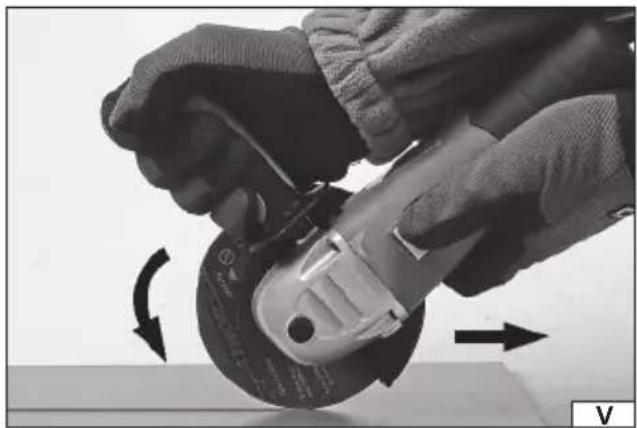
When cutting, guide the grinder in the direction of wheel rotation (V). The disc rotation direction is indicated by an arrow on the tool housing.
When working with the grinder, do not exert too much pressure on the workpiece and do not make sudden movements so as not to cause jamming, cracking, and tearing of the grinding wheel.
Do not overload the grinder, the temperature of the external surface must never exceed 60°C.
The grinder is turned off by releasing the power switch.
After finishing work, turn off the grinder, remove the battery and carry out an inspection.
Caution! The wheel may still rotate for some time after the grinder is turned off. Wait until the grinding wheel has stopped rotating before putting down the grinder. Allow the wheel to cool down before carrying out the inspection. Both the wheel and the workpiece can become hot during operation.
Remember! When working with the angle grinder:
Always wear eye protection.
Do not use the grinding wheels with a maximum permissible circumferential speed of less than 80 m/s.
Do not use grinding wheels with a maximum permissible rotational speed lower than the rotational speed of the grinder.
The declared total vibration value has been measured using the standard test method and can be used to compare one tool to another. The declared total vibration value can be used in the initial exposure assessment.
Caution! The vibration emission during tool operation may differ from the declared value, depending on the manner the tool is used.
Caution! Safety measures to protect the operator, which are based on an assessment of exposure under actual
conditions of use (including all parts of the work cycle, such as the time when the tool is turned off or idle and the activation time), must be specified.
MAINTENANCE AND OVERHAUL
ATTENTION! Before any adjustment, technical service or maintenance operations unplug the tool. Once the operations have been finished, the technical conditions of the tool must be assessed by means of external evaluation and inspection of the following elements: body and handle, conductor with a plug and deflection, functioning of the electric switch, patency of ventilation slots, sparking of brushes, noise level of functioning of bearings and gears, start-up and smoothness of operation. During the guarantee period, the user cannot dismantle the electric tools or change any sub-assemblies or elements, since it will cancel any guarantee rights. All irregularities detected at overhaul or during functioning of the tools are a signal to have the tool repaired at a service shop. Once the functioning has been concluded, the casing, ventilation slots, switches, additional handle and protections must be cleansed with a stream of air (at a pressure not exceeding 0.3 MPa), with a brush or a cloth without any chemical substances or cleaning liquids. Tools and handles must be cleansed with a clean cloth.
CHARAKTERISTIK DES WERKZEUGES
EN IEC 62841-2-3:2021 + A11:2021
EN 55014-1:2017 + A11:2020
EN 55014-2:1997 + A1:2021 + A2:2008
EN IEC 55014-1:2021
EN IEC 55014-2:2021
DECLARATION OF CONFORMITY
0125/YT-82905/EC/2025
We declare and guarantee with full responsibility that the following products:
Cordless angle grinder 12 V d.c.; 19500 min ^-1 ; 76 mm; M5; item no. YT-82905
meet requirements of the following European Standards / Technical Specifications:
EN 62841-1:2015 + A11:2022
EN IEC 62841-2-3:2021 + A11:2021
EN 55014-1:2017 + A11:2020
EN 55014-2:1997 + A1:2021 + A2:2008
EN IEC 55014-1:2021
EN IEC 55014-2:2021
and fulfill requirements of the following European Directives:
2006/42/EC Machinery and safety elements
2014/30/EU Electromagnetic compatibility (EMC) Directive
2011/65/EU Restriction of the Use of Certain Hazardous Substances
Serial number: concern all serials numbers of item(s) mentioned in this declaration
The person authorized to compile the technical file:
Agnieszka Rędziak
(Place and date of issue)
V-CE PREZES ZARZADU
JAN SZMIDT
(Name and signature of authorized person)
TOYA S.A.
EN IEC 62841-2-3:2021 + A11:2021
EN 55014-1:2017 + A11:2020
EN 55014-2:1997 + A1:2021 + A2:2008
EN IEC 55014-1:2021
EN IEC 55014-2:2021