
YT-84877 - Saw Yato - Free user manual and instructions
Find the device manual for free YT-84877 Yato in PDF.


| Brand | Yato |
| Model | YT-84877 |
| Product Type | Electric Chainsaw |
| Rated Voltage | 230-240 V~ |
| Rated Frequency | 50 Hz |
| Rated Power | 750 W |
| Chain Travel Speed | 12 m/s |
| Cutting Length | 235 mm / 10 inches |
| Chain Pitch | 9.52 mm / 3/8 inch |
| Number of Drive Sprocket Teeth | 6 teeth |
| Guide Bar Groove Width | 1.1 mm / 0.043 inch |
| Electrical Protection Class | II |
| Weight (without bar and chain) | 4.1 kg |
| Sound Pressure Level (L_dA) | 89.5 ± 3.0 dB(A) |
| Sound Power Level (L_wA) | 102.7 ± 2.47 dB(A) |
| Vibration (front handle) | 2.67 ± 1.5 m/s² |
| Vibration (rear handle) | 3.32 ± 1.5 m/s² |
| Power Supply | Mains (with extension cord recommended) |
| Main Functions | Wood cutting, pruning, felling (by experienced user) |
| Maintenance and Cleaning | Clean with a soft dry cloth; check and lubricate chain regularly; sharpening by a specialized service |
| Safety | Anti-kickback device, trigger lock, mandatory personal protection (goggles, gloves, etc.) |
| Spare Parts and Repairability | Use only original replacement parts; repairs by an authorized service center |
| General Information | Supplied with guide bar, cutting chain, bar cover, handle extension and auxiliary strap |
Frequently Asked Questions - YT-84877 Yato
User questions about YT-84877 Yato
0 question about this device. Answer the ones you know or ask your own.
Ask a new question about this device
Download the instructions for your Saw in PDF format for free! Find your manual YT-84877 - Yato and take your electronic device back in hand. On this page are published all the documents necessary for the use of your device. YT-84877 by Yato.
USER MANUAL YT-84877 Yato
natural_image
Two YATO 10-inch chain-linking tools shown from different angles (no text or symbols on the devices themselves)PL EN DE RU UA LT LV CZ SK HU RO ES FR IT NL GR BG
TOYA S.A. ul. Sołtysowicka 13-15, 51-168 Wrocław, Polska
PL EN DE RU UA LT LV CZ SK HU RO ES FR IT NL GR BG
natural_image
Close-up of a white electric shaver tool with black adjustment knobs and a metallic shaft (no text or symbols visible)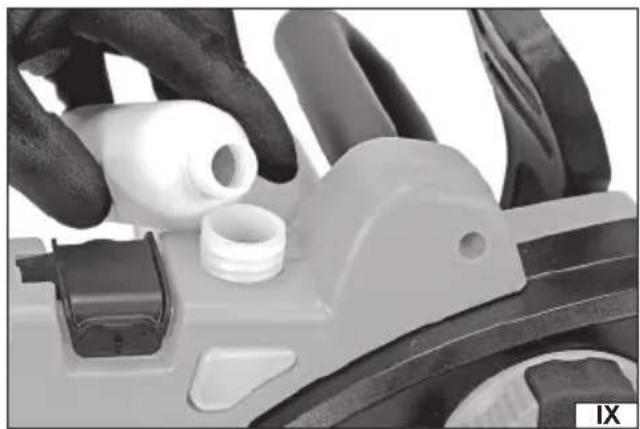
natural_image
Close-up of hands assembling a plastic mechanical component with white plastic parts (no visible text or symbols)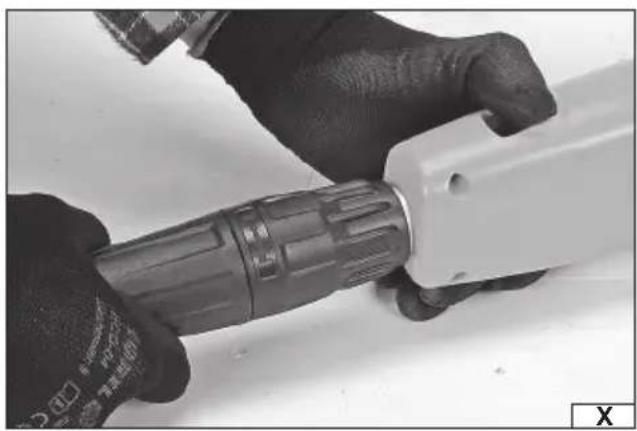
natural_image
Close-up of hands holding a flashlight and a white tool (no visible text or symbols)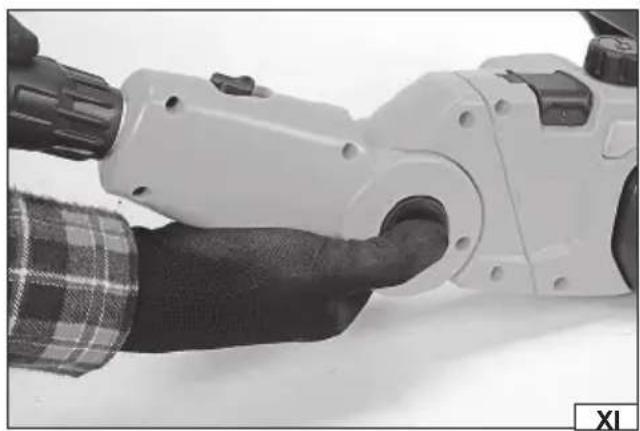
natural_image
Close-up of a robotic hand gripping a white mechanical device with a plaid sleeve (no visible text or symbols)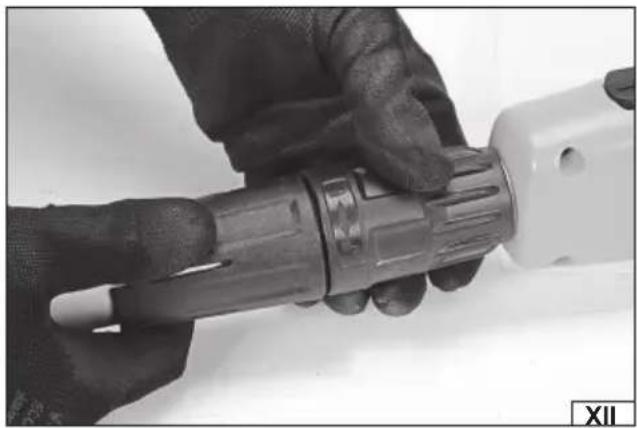
natural_image
Close-up of hands holding a handheld device with a metallic handle (no visible text or symbols)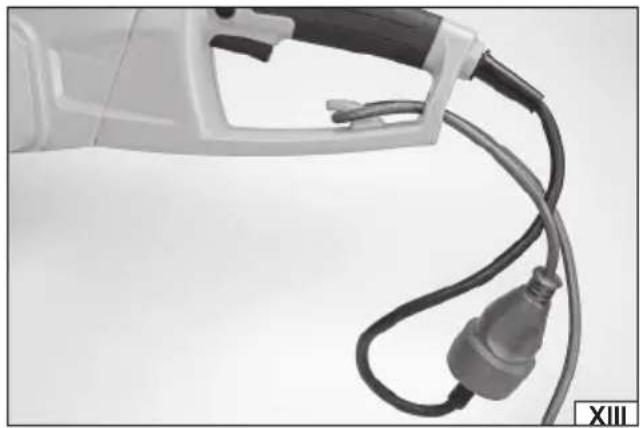
natural_image
Close-up of an electric vehicle charging plug with black cables (no visible text or symbols)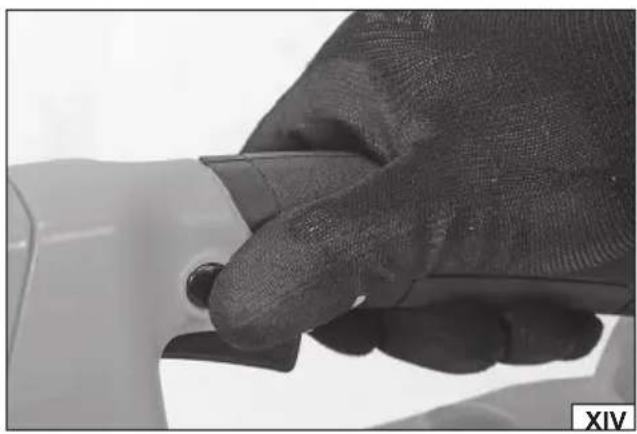
natural_image
Close-up of a hand gripping a small object, possibly a tool or device, with no visible text or symbols.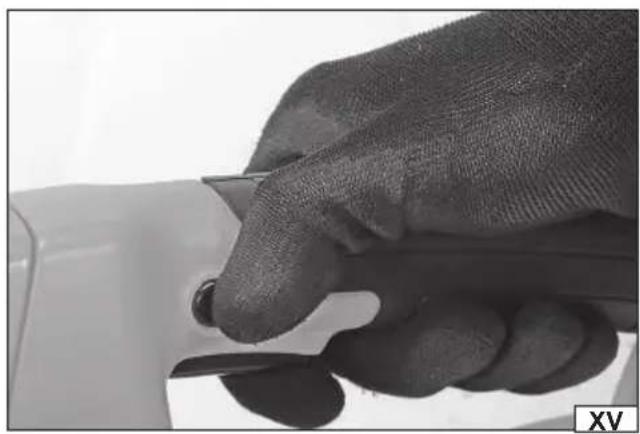
natural_image
Close-up of a hand using a tool to press or adjust a component, no visible text or symbolsPL EN DE RU UA LT LV CZ SK HU RO ES FR IT NL GR BG
natural_image
Diagram of a chain saw with gear and blade, showing cutting process (no text or symbols)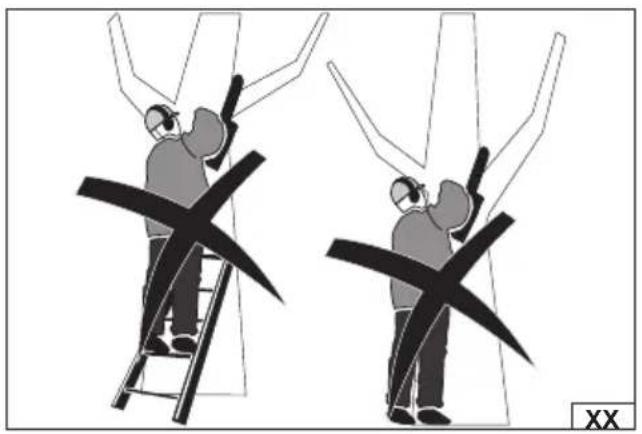
natural_image
Two figures climbing a ladder, one with arms raised and the other with a bandaged handle (no text or symbols)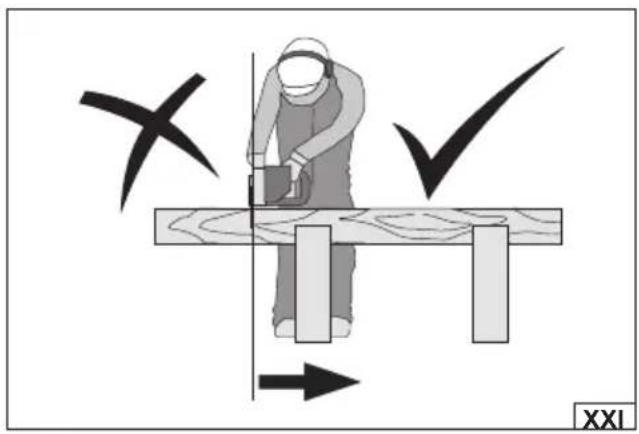
DE
- Säge
2.Seitenpanel
-
chain saw
-
side panel
-
locking knob
-
kickback brake
-
electric power switch
-
electric power switch lock
-
main handle
-
additional handle
-
guide bar
-
chain
-
chain drive wheel
-
handle extension arm
-
auxiliary belt
LT
Read the operating instruction
Wear protective goggles
Wear hearing protectors
Wear protective footwear
Wear protective clothing
Always hold the chain saw with both hands
Do not expose to precipitation
Keep a distance of at least 10 meters from electrical lines
Beware of the power saw kickback towards the operator and avoid contact with the tip of the guide bar
Second class of insulation
Before adjusting or cleaning, in case of cable braiding or damage, switch off the device and pull the plug out of the socket.
This symbol indicates that waste electrical and electronic equipment (including batteries and storage cells) cannot be disposed of with other types of waste. Waste equipment should be collected and handed over separately to a collection point for recycling and recovery, in order to reduce the amount of waste and the use of natural resources. Uncontrolled release of hazardous components contained in electrical and electronic equipment may pose a risk to human health and have adverse effects for the environment. The household plays an important role in contributing to reuse and recovery, including recycling of waste equipment. For more information about the appropriate recycling methods, contact your local authority or retailer.
WYPOSAŻENIE PRODUKTU
The chainsaw is only intended for cutting wood. The chainsaw electric drive allows it to be used under a canopy or near buildings. The saw has an extension included which allows it to be transformed into a pruner for branches. The saw is used to cut branches, and trim shrubs and bushes. It can be used for cutting trees, but due to the hazard, it is required that an experienced user performs the cutting operation. Proper, reliable and safe operation of the tool depends on appropriate use, that is why you should
Read and keep the entire manual before the first use of the tool.
The supplier shall not be held liable for any damage or injury resulting from improper use of the tool and failure to observe the safety regulations and recommendations specified in this manual. Use of the tool for purposes other than those for which it was intended shall cause the loss of the user's rights to a warranty and statutory warranty.
PRODUCT EQUIPMENT
The power saw is supplied complete but requires assembly before first use. The following elements are supplied with the saw: a chain guide bar, a cutting chain and a guard for the guide bar with chain and the extension.
TECHNICAL DATA
| Parameter Unit Value | ||
| Catalogue No. YT-84877 | ||
| Rated voltage [V~] 230 - 240 | ||
| Rated frequency [Hz] 50 | ||
| Rated power [W] 750 | ||
| Chain speed [m/s] 12 | ||
| Cutting length [mm / " ] 235 / 10 | ||
| Chain scale | [mm / " ] | 9,52 / 3/8 |
| Number chain drive wheel teeth and scale | 6 teeth x 9,52 mm | |
| Guide slot width | [mm / " ] | 1,1 / 0.043 |
| Protection class | II | |
| Weight (without the guide bar and chain) | [kg] | 4,1 |
| Noise level | ||
| - L_pA (pressure) | [dB] (A) | 89,5 ± 3,0 |
| - L_pA (power) | [dB] (A) | 102,7 ± 2,47 |
| Vibration a_h (front/rear handle) | [m/s2] | 2,67 ± 1,5 / 3,32 ± 1,5 |
The declared noise emission value has been measured using the standard test method and can be used to compare one tool to another. The declared noise emission value can be used in the preliminary exposure assessment.
The declared total vibration value has been measured using the standard test method and can be used to compare one tool to another. The declared total vibration value can be used in the initial exposure assessment.
Note! The vibration emission during tool operation may differ from the declared value, depending on the manner the tool is used. Note! Safety measures to protect the operator, which are based on an assessment of exposure under actual conditions of use (including all parts of the work cycle, such as the time when the tool is switched off or idle and the activation time), must be specified.
GENERAL WARNINGS FOR THE SAFETY OF POWER TOOLS
Warning! Read all safety warnings, illustrations and specifications provided with this power tool. Failure to do so may result in electric shock, fi re or serious injury.
Keep all warnings and instructions for future reference.
The term “power tool” used in warnings applies to all tools driven by power both wired and wireless.
Workplace safety
Keep the workplace well-lit and clean. Disorder and poor lighting can be causes of accidents.
Do not work with power tools in an environment with an increased risk of explosion, containing flammable liquids, gases or vapors. Power tools generate sparks that can ignite dust or fumes.
Children and third persons should not be allowed to enter the workplace. Loss of concentration can result in loss of control.
EN
Electrical safety
The plug of the electric cable must match the power socket. You must not modify the plug in any way. Do not use any plug adapters with earthed power tools. An unmodified plug that fits the outlet reduces the risk of electric shock.
Avoid contact with earthed surfaces such as pipes, radiators and coolers. Grounding the body increases the risk of electric shock.
Do not expose power tools to contact with atmospheric precipitation or moisture. Water and moisture that gets inside the power tool increases the risk of electric shock.
Do not overload the power cable. Do not use the power cord to carry, pull or unplug the power plug from the power outlet.
Avoid contact of the power cable with heat, oils, sharp edges and moving parts. Damage or entanglement of the power cord increases the risk of electric shock.
In the case of working outside closed rooms, use extension cords intended for work outside closed rooms. The use of an extension cord adapted for outdoor use reduces the risk of electric shock.
When using a power tool in a humid environment is unavoidable as a protection against supply voltage use a residual current device (RCD). The use of RCD reduces the risk of electric shock.
Personal safety
Stay alert, pay attention to what you do and keep common sense while working with the power tool. Do not use a power tool when you are tired or under the influence of alcohol or medication. Even a moment of inattention while working can lead to serious personal injury.
Use personal protective equipment. Always wear eye protection. The use of personal protective equipment such as dust masks, anti-slip safety shoes, helmets and hearing protection reduce the risk of serious personal injury.
Prevent accidental operation. Make sure that the electric switch is in the “off” position before connecting to the power supply and / or battery, lifting or moving the power tool. Moving the power tool with the finger on the switch or powering the power tool, when the switch is in the “on” position can lead to serious injuries.
Before turning on the power tool remove any keys and other tools that were used to adjust it. The key left on the rotating parts of the power tool can lead to serious injuries.
Do not reach and do not lean too far. Keep the right attitude and balance all the time. This will allow easier control over the power tool in case of unexpected work situations.
Dress accordingly. Do not wear loose clothing or jewelry. Keep your hair and clothing away from moving parts of the power tool. Loose clothing, jewelry or long hair can be caught by moving parts.
If the devices are fitted for the connection of dust extraction or dust collection, make sure that they are connected and used properly. The use of dust extraction reduces the risk of dust hazards.
Do not let the experience acquired from frequent use of the tool resulted in carelessness and ignoring safety rules.
Carefree action can cause serious injuries in a fraction of a second.
Use and care of the power tool
Do not overload the power tool. Use the power tool appropriate for the selected application. The right power tool will provide a better and safer job if used according to the designed load.
Do not use the power tool, if the electric switch does not allow switching on and off. Power tool, which cannot be controlled by means of a power switch is dangerous and must be returned for repair.
Disconnect the plug from the power socket and / or remove the battery if it is detachable from the power tool before adjusting, changing accessories or storing the tool. Such preventive measures will allow you to avoid accidentally turning on the power tool.
Keep the tool out of the reach of children, do not let people who do not know how to operate the power tool or these instructions use a power tool. Power tools are dangerous in the hands of untrained users.
Maintain power tools and accessories. Check the tool for mismatches or jams of moving parts, damage to parts and any other conditions that may affect the operation of the power tool. Damage must be repaired before using the power tool. Many accidents are caused by incorrectly maintained tools.
Keep cutting tools sharp and clean. Properly maintained cutting tools with sharp edges are less prone to jamming and are easier to control when working.
Use power tools, accessories and inserted tools etc. in accordance with these instructions, taking into account the type and conditions of work. The use of tools for work other than designed is likely to result in a dangerous situation.
Handles and gripping surfaces must be dry, clean and free from oil and grease. Slippery handles and gripping surfaces do not allow for safe operation and control of the tool in dangerous situations.
Repairs
Repair the power tool only in authorized facilities using only original spare parts. This ensures proper operation safety of the power tool.
SAFETY INSTRUCTIONS FOR CHAINSAWS
While working with the chainsaw, keep all parts of the body away from the chain. Make sure that the chain is not in contact with anything before starting the chainsaw. A moment's distraction while working with a chainsaw can lead to cloth or body part entangling in the chainsaw chain.
EN
Always hold the chainsaw with your right hand by the back handle and with your left hand by the front handle. Holding the chainsaw in the opposite way should never happen, as it increases the risk of injury.
Hold the power saw by the insulated grips only, as the chain may come into contact with a concealed wire or the chainsaw's power cord. The chain contacting a "live" wire may make metal parts become "live" and could give the operator an electric shock.
Wear eye protection. It is also recommended to use protective equipment for hearing, head, hands, legs and feet. Adequate protective equipment will reduce personal injury by contact with waste or accidental contact with the chain.
Do not operate the power saw on a tree, ladder, from the roof or on any unstable support. Working with the power saw while on the tree may result in injuries.
Always maintain a proper posture and work with the chainsaw standing on a still, safe, and level surface. A slippery or unstable surface, e.g., a ladder, may result in a loss of balance or control of the chainsaw.
Exercise caution in terms of a kickback when cutting a tensioned branch. If the tension accumulated in the wood fibres is released, the branch may strike the operator or make him/her lose control of the chainsaw.
Take special care when cutting shrubs and saplings. Slim material can nip the chain and push the chainsaw towards the operator or unbalance him/her.
Handle the chainsaw by the front handle, turned off and away from the body. Always put on the chain guide bar guard when transporting or storing the chainsaw. Correct holding of the chainsaw reduces the likelihood of accidental contact with moving parts of the chainsaw.
Observe the instructions for lubricating, tensioning the chain, and changing accessories. An improperly tensioned or lubricated chain can break and increase the chance of kickback towards the operator.
Cut wood only. The use of the chainsaw for other purposes than that intended is not allowed. For example: do not cut plastic, concrete, or non-wooden construction materials. Using the chainsaw for works other than that intended may result in dangerous situations.
Do not attempt to cut down trees until you understand the risk and how to avoid it. During the cutting of the tree, the operator and bystanders are exposed to serious injuries.
Causes and prevention of kickback towards the operator.
A kickback towards the operator may occur when the guide bar's end is in contact with an object or the cut wood jams the chain-saw in the kerf. In some cases, contact between the end of a guide bar and an object can cause a violent reaction driving the guide bar up and towards the operator. Jam in the guide bar upper edge kerf can suddenly point the guide bar towards the operator.
These reactions can result in a loss of control of the chainsaw, leading to serious injuries. Do not rely only on safety elements built in the chainsaw. The chainsaw operator should take some steps to prevent accidents and injuries during work.
A kickback towards the operator is the result of improper use or incorrect operating procedures or conditions. This can be avoided by taking the appropriate precautions listed below:
Keep a firm grip of both hands with thumbs and fingers closing around the chainsaw handles. The position of the body and shoulders should allow withstanding forces arising during the kickback. If appropriate precautions are taken, the kickback forces can be controlled by the operator. Do not allow the chainsaw to move freely.
Do not reach too far and cut above shoulder height. This will help prevent unintentional contact with the end of the guide bar and allow better control of the chainsaw in unexpected situations.
Use guide bar and chain replacements only as specified by the manufacturer. Incorrect replacement of the guide bar and chain may cause chain breakage or kickback.
Observe the instructions given by the manufacturer regarding the chain sharpening and maintenance. Reducing the depth of the chain guide bar groove can lead to an increased probability of kickback.
Other safety instructions
It is forbidden to expose the power saw to precipitation and use it in an atmosphere of increased humidity. It is also forbidden to use the power saw in an atmosphere with an increased risk of fire or explosion.
Avoid contact with grounded, conductive, and non-insulated objects such as pipes, radiators, or refrigerators during operation.
When not in use, store the power saw in a dry and closed room inaccessible to unauthorised persons.
Use the cutting chain adapted to the given load. Do not use cutting chains designed for light or heavy-duty work.
Always wear protective gloves when replacing, repairing, and adjusting the cutting chain.
Make sure that the power saw has been disconnected from the power supply during transport. Disconnect the mains-powered power saws from the socket. In the case of the battery-powered power saws, disconnect their battery. A guide must be fitted on the cutting chain guide bar. Handle the power saw with the guide bar pointing back.
Do not handle the mains-powered power saw by its power cord. Do not disconnect the plug from the socket by pulling the power cord.
Avoid accidental starting of the power saw. When handling the power saw connected to the mains or with the battery connected, keep your fingers away from the power switch.
Always wear suitable protective clothing adhering to the body.
If the power saw is equipped with two handles, always operate the power saw with both hands. When working, secure loose pieces of wood so that they cannot move, for example, by placing them in a saw-horse. Avoid cutting wood that lies on the ground.
Avoid processing wood that is not protected against movement during cutting.
The person who will be cutting with the power saw for the first time should at least practice cutting the logs placed on the saw-horse.
EN
Do not hold the power saw above your arms during operation. Do not operate the power saw while standing on the ladder. During work, adopt such a posture to eliminate the need to extend the hands to the full length.
Keep the chain clean. The chain must be sharpened and lubricated. This will ensure more efficient and safer work. The chain can be sharpened at a specialised service centre. Check the condition of the chain before each use. In the event of cracks, broken teeth, or any other damage, replace the chain with a new one before starting work.
In case of finding any damaged or broken power saw parts, stop working or do not start working. It is essential to replace damaged parts before starting work.
Use the power saw as intended. The power saw is designed only for cutting wood. When working, watch out for metal elements or stones that may be in the processed wood.
Use original spare parts only. Failure to use original spare parts may increase the risk of failure and lead to injuries.
The power saw should be repaired only at service centres authorised by the manufacturer using original spare parts. This will minimise the risk of accidents and damage to the equipment.
PRODUCT OPERATION
Warning! Unplug the chainsaw from the power supply before performing any assembly and adjustment work. The power cord must be unplugged from the socket.
Preparing the chainsaw for operation
Mount the guide bar and cutting chain before first use.
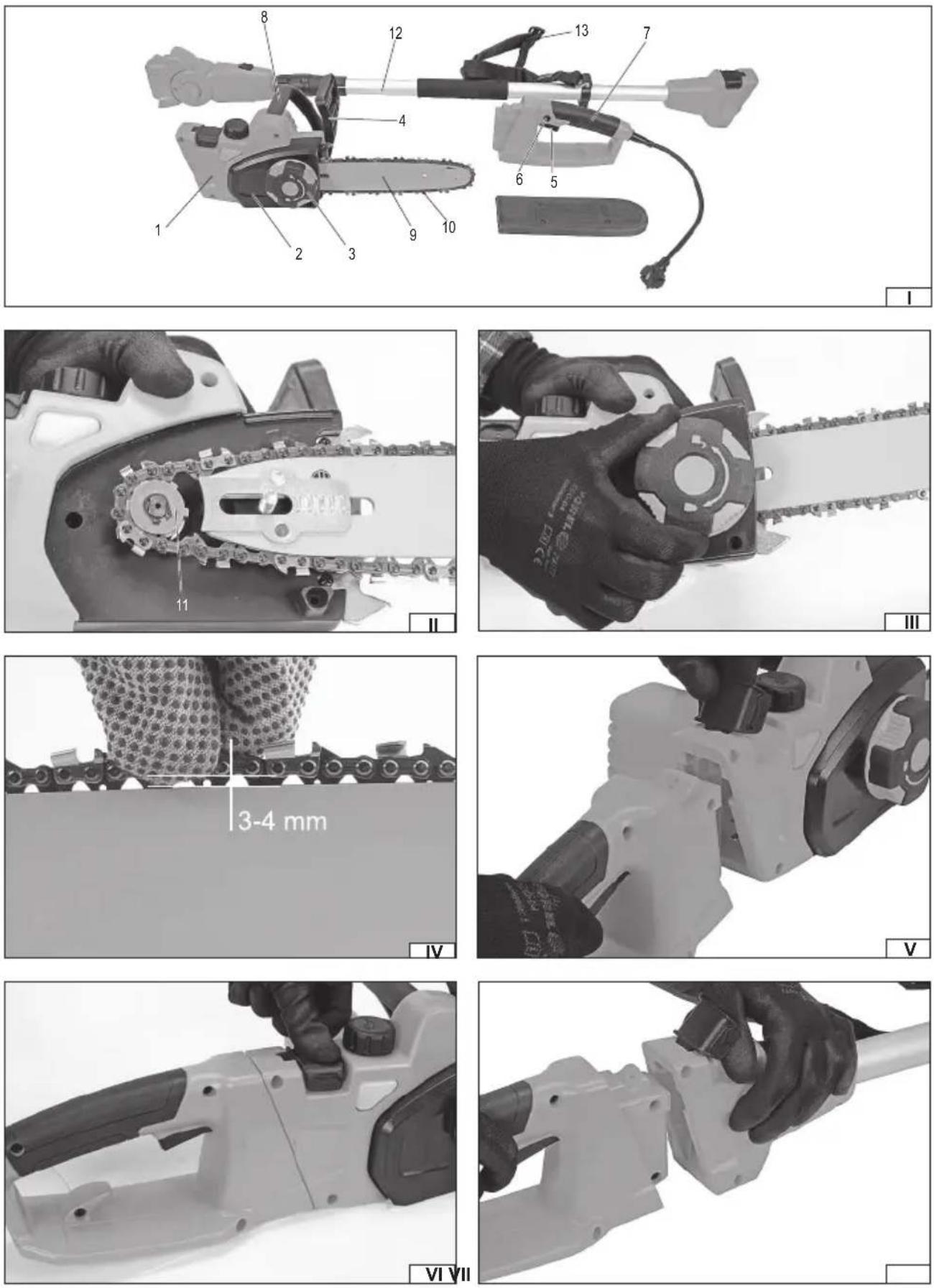
Turn the locking knob in the direction indicated by the arrow marked with the open padlock symbol and remove the side panel.
Mount the guide bar and chain as shown in the picture (II).
Make sure that the chain and guide bar are fitted in the correct direction. The direction of the chain movement is indicated on the housing after disassembling the side panel. The blades on the chain links should face in the same direction as the link visible on the power saw housing.
Install the side panel and turn the locking knob in the direction indicated by the arrow marked with the closed padlock symbol (III). This will fix the side panel and tension the chain.
Check the chain tension. To do so, pull the chain away from the guide bar (IV). During this test, the chain should lift above the guide bar by 3 to 4 mm in the spot where it is held. If the chain is too tight or too weak, turn the locking knob in the direction indicated by the arrow marked with a closed padlock symbol. The chain tension should also be checked every 10 minutes of operation.
Check the technical condition of the power saw before connecting it to the power supply. If any damage is detected, it is forbidden to connect it to the power supply before rectifying the damage.
Chain saw assembly
The saw can be assembled in two versions – with an extension of the handle and with a regular handle.
Open the locking tab on the saw body and insert the handle (V) so that the edges of the handle and the housing adhere to each other all around the machine. Then secure the connection by closing the latch (VI).
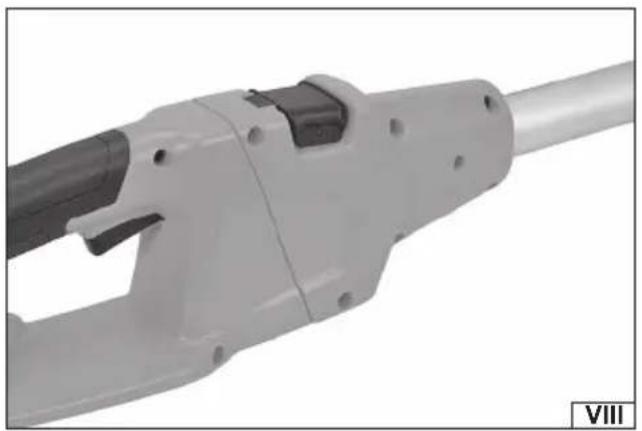
If the handle extension is installed, it must be placed between the handle and the housing. Open the latches on the chain saw housing and on the extension. Insert the extension into the housing and secure it with the latch (VII), and insert the handle into the extension and also secure it with the latch (VIII).
Chain lubrication (IX)
The saw has an oil reservoir for chain lubrication. Unscrew the reservoir cover and pour oil inside. The oil level shall be between the "OIL min." minimum level mark and the top edge of the inspection window. Check the oil level regularly during operation. For lubricating the chain and chainsaw mechanisms, use only oil intended for such purposes. It is forbidden to use worn-out motor oil. It does not fulfil its purpose, which can lead to damage to the chainsaw mechanism.
Setting the angle of the cutting head
If the handle extension is used, the saw can be set at an angle to the handle. The angle adjustment ensures easier and safer cutting of branches with the extension. The angle adjustment is possible both, around and across the extension axis.
To adjust the angle around the extension axis, move in the direction indicated by the arrow and hold the locking latch (X) in this position, and then turn the saw. It is possible to turn it clockwise by 180 degrees and counter clockwise by 90 degrees. After releasing the lock latch, it must return to the initial position, only then the saw will be locked at the set angle. The saw can only be locked in a few positions.
To adjust the angle across the extension axis, press and hold the latch located in the hinge (XI), then turn the saw. It is possible to rotate it up to 60 degrees upwards and downwards up to 20 degrees in relation to the neutral position (0 degrees). After setting the angle, the latch button must automatically return to the rest position. It is possible to lock the head only at a few angles marked on the hinge housing. Before starting work, make sure that the saw has been locked at the set angles and does not change the setting automatically during work.
EN
Extension length setting
The extension can be adjusted in length. Turn the lock ring in the direction indicated by the arrow marked with the open padlock symbol (XII) and then adjust the length by sliding or sliding the extension in and out. Once the selected length has been set, tighten the locking ring firmly and securely in the direction indicated by the arrow marked with the closed padlock symbol. Make sure that the locking ring has been tightened firmly enough that the extension does not change its length on its own during operation.
Preparing the workplace
Before cutting with the chainsaw, properly prepare the workplace to minimise the risks associated with the chainsaw's operation. Make sure that only authorised persons are present at the workplace.
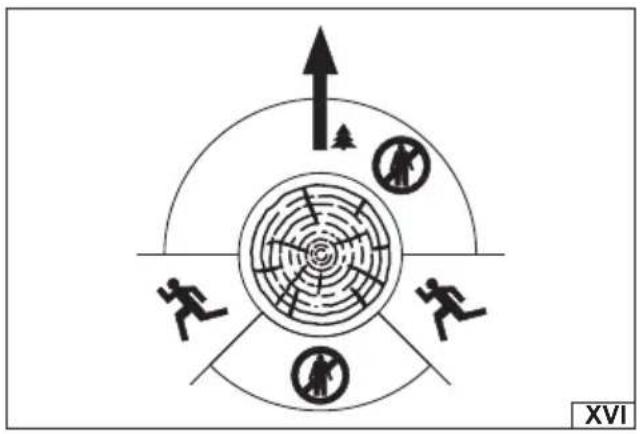
In the case of tree felling, danger zones and escape routes should be designated. A zone with a radius of 180^ around the planned tree fall plane and a zone with a radius of 90^ in the opposite direction to the planned tree fall plane are treated as danger zones.
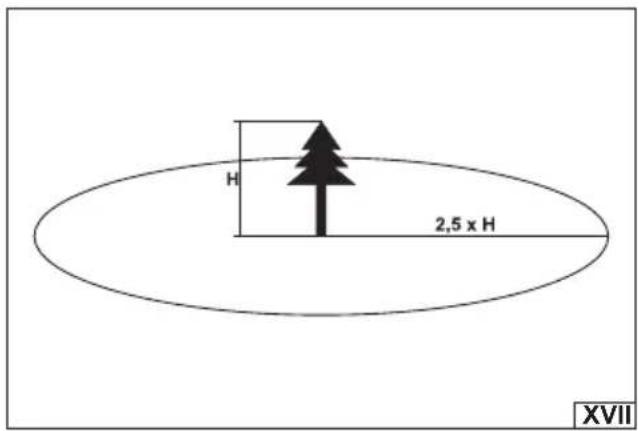
The remaining zones form escape routes (XVI). Remember that a falling tree can also overturn other trees. Therefore, the next workstation must not be closer than 2,5 x the height of the felled tree (XVII).
Ensure good visibility from the workplace; that is why take special care when cutting trees in difficult terrain conditions, e.g., mountains.
It is forbidden to start work during precipitation and in case of high air humidity, e.g., fog.
Wear protective clothing and personal protective equipment.
Before starting cutting, perform a trial wood cut in safe conditions, e.g., cutting wood placed on the saw-horse.
Avoid cutting wires, young trees, and wooden beams.
Do not stand on cut wood.
In the case of cutting tree branches, the workplace should be planned in such a way that the falling branches do not pose a threat to the operator and bystanders. Designate a zone at least 15 meters from the workplace and mark it in a way that clearly indicates the threat.
Make sure that there are no electrical wires or any other cables in the branches. There must be a distance of at least 10 meters between the cutting point of the branches and the electrical lines.
Connecting to the power supply
The machine has only a short cord with a power plug. Use an electric extension cord to power the appliance. Always use cords intended for outdoor use due to the nature of the machine work. The power cord should have a single socket matching the machine's plug. It is forbidden to modify the plug or socket to make them fit. The electrical parameters of the power cord should correspond to the electrical parameters of the device, listed on the rating plate. It should be noted that the power cord's cross-section depends on the length of the cord. Follow the instructions below regarding the power cord cross-section:
- 1.5 mm ^2 – cable length of not more than 40 m;
- 2.5 mm ^2 – cable length of not more than 60 m;
When preparing for the operation and during operation, pay attention to the power cord. Protect the power cord from water, moisture, oils, heat sources and sharp objects. Lay the cord so as to avoid cutting. Cutting the cord may result in electric shock and serious injury or death. Make sure that you do not become entangled in the cord. This can lead to a fall and serious injury.
Do not overload the power cord, and do not cause any of the cord's section to become tensioned. Do not pull the cord when moving the device. Always disconnect the power cord plug from the socket by pulling by the plug and socket housing, never pull by the cord.
The tool has a special hook to which the extension cord (XIII) must be attached. This connection will prevent the power cord from being torn out in the event of a sudden jerk.
Starting the chainsaw
Remove the guard from the guide bar and chain.
Make sure that the kickback brake is in the rear position.
Grip the main handle with the right hand and the additional handle with the left hand.
Make sure that the guide bar and chain do not come into contact with any object or surface.
Press and hold the power switch lock button on the handle in this position (XIV) with your thumb.
Press and hold the power switch in this position (XV). When the saw starts up, the lock button can be released.
Before cutting, wait until the motor is at full speed and make sure that the chain runs smoothly along the guide bar. If you hear any suspicious sounds or vibration, turn the chainsaw off immediately by releasing the power switch.
The chainsaw is turned off by releasing the power switch.
Unplug the power saw from the power supply and proceed with maintenance once the chain has stopped.
Working with the power saw
Persons who intend to work with a chainsaw for the first time should seek advice on work and safety from a qualified chainsaw operator before starting work. The first works with the chainsaw should consist of cutting the prepared logs placed on the saw-horse.
During work, observe the basic occupational safety principles. Consider also the possibility of kickback in the operator's direction.
The chainsaw may kickback in the operator's direction when the cutting chain encounters resistance.
To reduce this risk:
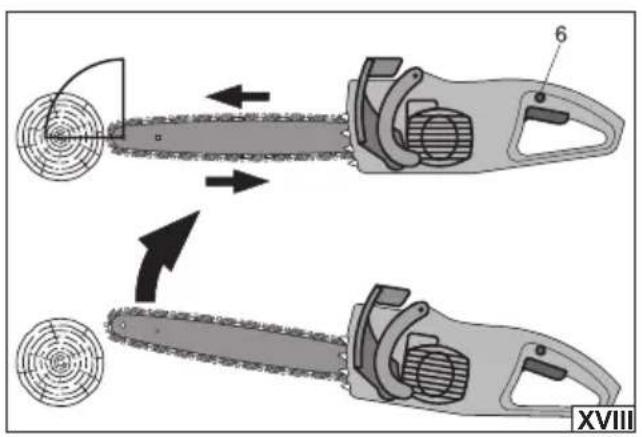
Pay attention to the placement of the guide bar top when cutting. It is forbidden to cut with the upper quarter of the guide bar top
EN
(XVIII).
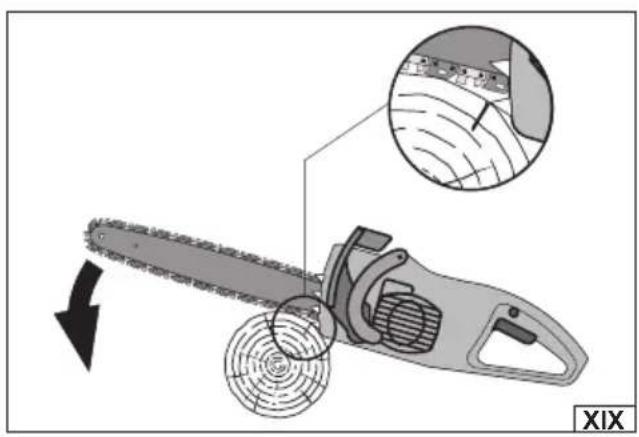
Cut only with the chain which moves along the bottom part of the guide bar (XIX). The lower spike should be used as the axis of rotation of the saw when cutting.
Only apply the started chainsaw to the wood to be cut. Do not start the chainsaw after having applied it to the wood being processed. When working, do not lift the chainsaw to arm height or higher (XX).
Do not stand in the cutting plane. This will reduce the risk of injury in case of kickback (XXI).
During work, always hold the power saw with both hands.
Make sure that the chain is always sharp and appropriately tensioned.
TIPS FOR WORKING WITH THE CHAINSAW
Take a comfortable position and ensure full freedom of movement when cutting.
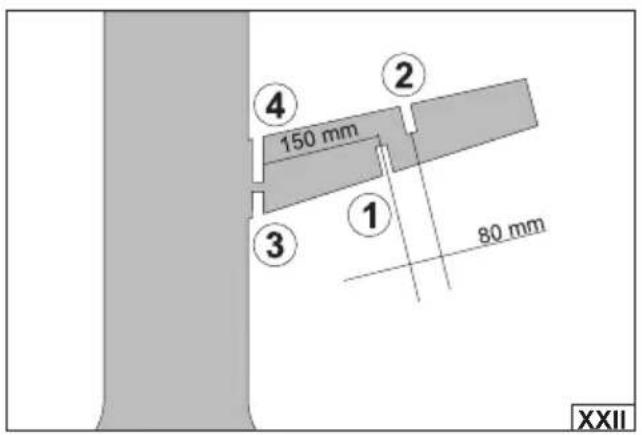
When cutting branches and boughs, do not cut them at the trunk, but at a distance of about 15 cm from the trunk. Make two cuts to a depth of 1/3 of the branch diameter, approximately 8 cm apart. One cut from below, one from above. Then cut the branch just at the trunk to a depth equal to 1/3 of the branch diameter. Finish the process by cutting the branch at the trunk from above. Do not cut the branches by cutting from the bottom (XXII).
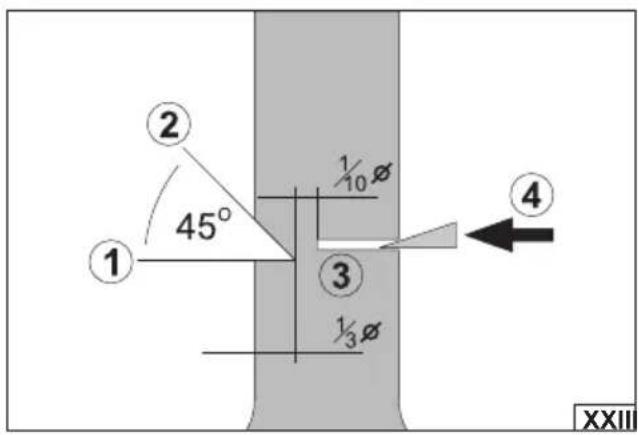
When cutting a tree, prepare the felling site in advance as described above. Additionally, prepare a safe substrate for tree felling. When a tree falls, stand at a safe distance to the plane of the tree fall, on the side. When choosing the path of wood fall, take into account factors such as terrain topography, tree centre of gravity, tree crown pattern, and wind direction. To properly prepare the tree for felling, make a cut in the trunk to a depth of 1/3 of the trunk diameter on the side to which the tree is to fall, and then cut another at an angle of 45 degrees to the first so as to cut a “wedge” in the trunk. On the other side of the trunk, start cutting perpendicular to the trunk axis, slightly higher (approx. 4 cm) than the cut “wedge” base. Do not cut the trunk. Leave a section of approximately 1/10 of the trunk diameter. Then insert the wedge for splitting the tree into the cut on the opposite side to the planned side of the tree fall (XXIII).
If the tree already falls during cutting, pull the chainsaw out of the trunk and move away along the prepared escape route to a safe distance.
If the power saw gets stuck while cutting, never leave it in this position with the motor running. Turn off the power saw motor, unplug the power saw from the power supply, and use wedges to extract the power saw from the trunk.
When cutting a tree that has already been felled into pieces, follow the rules indicated below. Place the wood on the saw-horse or a stand so the cut piece can freely fall off to the ground without causing the chainsaw to jam. If the chainsaw is jammed, proceed as described above. Do not touch the ground with the chainsaw or allow it to be contaminated with soil.
When working on a slope, stay above the cut wood.
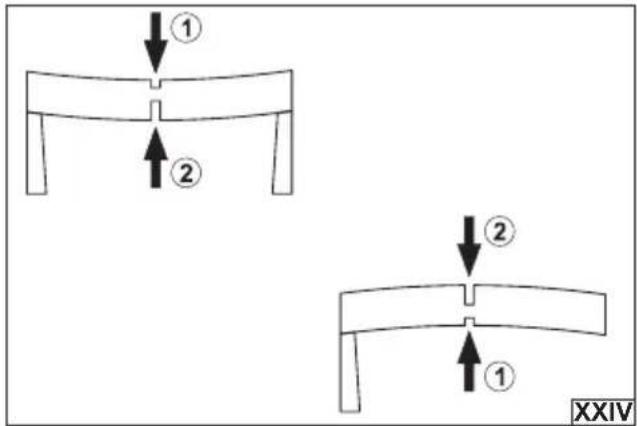
Exercise particular caution when cutting a tensioned tree and entrust this activity to a qualified lumberjack, if possible. When cutting tensioned wood and supported on both ends, cut it from above to a depth of 1/3 of the diameter, and then finish the cut from the bottom. If the wood is supported only at one end, cut the wood from the bottom to a depth equal to 1/3 of the diameter, and then finish the process by cutting from the top (XXIII). This will reduce the risk of the power saw jamming during cutting.
Always cut the branches by cutting the wood from the top. Do not cut the branches by cutting the wood from below.
When cutting larger branches, first cut off all smaller branchings from the branch, and then cut off the larger one.
Longer branches should be cut bye gradually shortening them. Do not cut long branches at their entire length. It is easier to predict the path of the fall of a shorter branch.
Cut branches from the bottom of the tree upwards.
Always use an auxiliary belt when working with the extension. The operator should move the belt diagonally across the chest so that the attachment point for extension is on the right side of the body at hip height. The length of the belt can be adjusted by means of the buckles.
PRODUCT MAINTENANCE AND STORAGE
Warning! Before starting any activities described below, disconnect the power saw from the power supply. Disconnect the mains-powered chainsaws from the socket. In the case of the battery-powered chainsaws, disconnect their battery.
After each use, inspect the condition of the power saw with particular attention to the patency of ventilation openings.
Check the placement of all of the power saw's components. Tighten all loose screw connections, if any. Check the tension and condition of the chain. If any damage is observed, replace the chain with a new one. It is forbidden to use the power saw with a damaged chain!
If the chain is too loose, it may fall from the guide bar, which may cause injury to the person operating the power saw. The chain must also be properly sharpened, because it requires appropriate experience and tools. It is recommended to carry out sharpening at specialised service centres. Clean the power saw's housing with a soft, dry cloth. Clean the housing from residues of wood, oil, grease, and other contaminants. Coat the chain with a thin layer of oil or preservative agent. The power saw should be stored in a dry, closed room, disconnected from the mains.
Store the power saw in shaded and dry places with appropriate ventilation preventing steam condensation. Such a place should not be accessible to unauthorised persons, especially children. During storage, the guide bar and chain must always be secured with a guide.
During storage, there may be a slight oil leakage from the chain or guide.
DE
GERÄTEBESCHREIBUNG
Mazanie ret'aze (IX)
CARACTÉRISTIQUES DU PRODUIT
DECLARATION OF CONFORMITY
1124/YT-84877/EC/2024
We declare and guarantee with full responsibility that the following products:
Electric chainsaw 2 in 1; 230-240 V\~; 50 Hz; 750 W; 12 m/s; 235 mm; item no. YT-84877
meet requirements of the following European Standards / Technical Specifications:
EN 62841-1:2015 + A11:2022
EN 62841-4-1:2020
EN ISO 11680-1:2021
EN IEC 55014-1:2021
EN IEC 55014-2:2021
EN 61000-3-2:2019 + A1:2021
EN 61000-3-3:2013 + A1:2019 + A2:2021
and fulfill requirements of the following European Directives:
2006/42/EC Machinery and safety elements
2014/30/EU Electromagnetic compatibility (EMC) Directive
2011/65/EU Restriction of the Use of Certain Hazardous Substances
Notified body:
TÜV SÜD Product Service GmbH; notification no. 0123
Ridlerstraße 65, 80339 MÜNCHEN, Germany
Serial number: concern all serials numbers of item(s) mentioned in this declaration
The person authorized to compile the technical file:
Agnieszka Rędziak
(Place and date of issue)
V-CE PREZES ZARZADU
JAN SZMIDT
(Name and signature of authorized person)
TOYA S.A.
DECLARATION OF CONFORMITY
1124/YT-84877/EC/2024
We declare and guarantee with full responsibility that the following products:
Electric chainsaw 2 in 1; 230-240 V\~; 50 Hz; 750 W; 12 m/s; 235 mm; item no. YT-84877
fulfil requirements of the following European Directive: 2000/14/WE
Conformity assessment procedure:
Manufacturer quality-control system, examination of the manufacturer's technical file and periodical inspection by notified body
Notified body:
TÜV SÜD Product Service GmbH; notification no. 0123
Ridlerstraße 65, 80339 MÜNCHEN, Germany
Measured sound power level on an equipment representative for this type: 89,5 dB(A)
Guaranteed sound power level for this equipment: 105 dB(A)
conformity and references of the other Community Directives applied:
2006/42/EC Machinery and safety elements
2014/30/EU Electromagnetic compatibility (EMC) Directive
2011/65/EU Restriction of the Use of Certain Hazardous Substances
Wrocław, 2024.11.15
(Place and date of issue)
V-CE_PREZES ZARZADU
JAN SZMIDT
(Name and signature of authorized person)
TOYA S.A.