
YT-82854 - Glue gun Yato - Free user manual and instructions
Find the device manual for free YT-82854 Yato in PDF.


| Product type | Cordless glue gun |
| Brand | Yato |
| Model | YT-82854 |
| Working voltage | 18 V DC |
| Protection degree | IPX0 |
| Insulation class | III |
| Glue stick diameter | 11.2 mm |
| Operating temperature | 200 °C |
| Heating time | 25 s |
| Maximum working time | 60 min |
| Efficiency | 25 g/min |
| Weight | 0.3 kg |
| Battery type | Li-Ion |
| Battery capacity | 2 Ah |
| Charger input voltage | 220-240 V~ |
| Charger output voltage | 21.4 V DC |
| Charger output current | 2.4 A |
| Charging time | ~1 h |
| Intended use | Assembly of various materials with hot melt glue |
| Safety | Wear safety goggles, avoid contact with hot glue |
| Maintenance | Clean with compressed air or dry cloth; do not use chemicals |
| Repairability | Refer to an authorized service; use original parts |
Frequently Asked Questions - YT-82854 Yato
User questions about YT-82854 Yato
0 question about this device. Answer the ones you know or ask your own.
Ask a new question about this device
Download the instructions for your Glue gun in PDF format for free! Find your manual YT-82854 - Yato and take your electronic device back in hand. On this page are published all the documents necessary for the use of your device. YT-82854 by Yato.
USER MANUAL YT-82854 Yato
natural_image
YATO 18V power tool with black and gray body, no visible text or symbols on the device itself.PL EN DE RU UA LT LV CZ SK HU RO ES FR IT NL GR
natural_image
Three-panel photo showing hands operating a battery pack and charging case, with no visible text or symbols.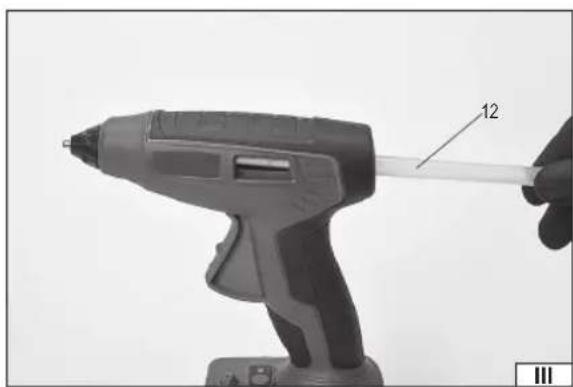
natural_image
Close-up of a hand holding a glue gun with a labeled component (no text or symbols visible)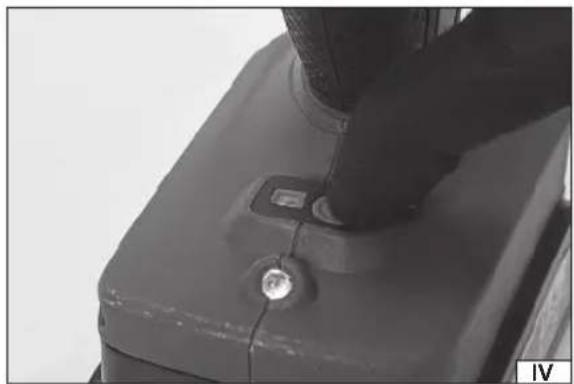
natural_image
Close-up of a mechanical component with a bolt and screw, no visible text or symbols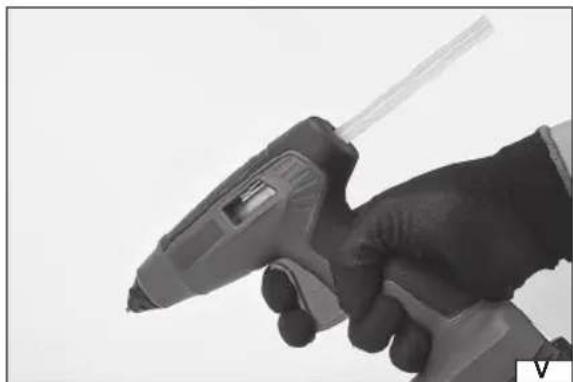
natural_image
Close-up of a gloved hand holding a glue gun with a probe (no text or symbols visible)Przeczytać instrukcję Read the operating instruction Bedienungsanleitung durchgelesen Прочитать инструкцию Прочитать инструкцию Perskaityti instrukciją Jälasa instrukciju Přečtet návod k použití Prečitať návod k obsluhe Olvasni utasítást Citeşti instrucțiunile Lea la instrucción Lisez la notice d’utilisation Leggere il manuale d’uso Lees de instructies Диаβάστε τις οδηγίες χρήσης
PL EN DE RU UA LT LV CZ SK HU RO ES FR IT NL GR
PL
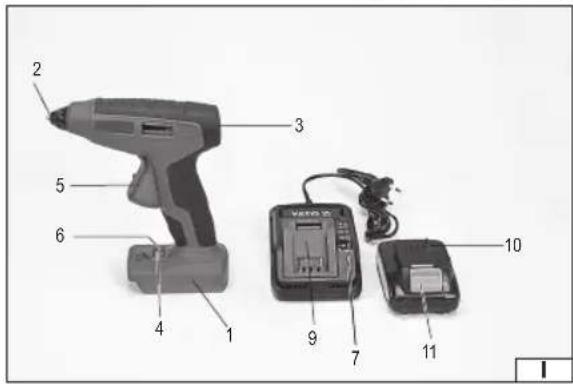
- base
- outlet nozzle
- feeding hole
- switch
- release mechanism
- power indicator
- charge indicator
- battery charge indicator
- battery charger
- battery
- battery latch
- glue cartridge
LT
- pagrindas
- išėjimo anga
- jèjimo anga
- jungiklis
- gaidukas
- maitinimo indikatorius
- krovimo indikatorius
- akumuliatoriaus jkrovimo indikatorius
- akumuliatoriaus jkroviklis
- akumuliatorius
- akumuliatoriaus spragtukas
- kliju lazdelè
HU
This symbol indicates that waste electrical and electronic equipment (including batteries and storage cells) cannot be disposed of with other types of waste. Waste equipment should be collected and handed over separately to a collection point for recycling and recovery, in order to reduce the amount of waste and the use of natural resources. Uncontrolled release of hazardous components contained in electrical and electronic equipment may pose a risk to human health and have adverse effects for the environment. The household plays an important role in contributing to reuse and recovery, including recycling of waste equipment. For more information about the appropriate recycling methods, contact your local authority or retailer.
WYPOSAŻENIE PRODUKTU
PRODUCT CHARACTERISTICS
EN
A battery glue gun is designed for bonding different materials by means of hot-melt glue cartridges. Thanks to efficient battery of high capacity it is possible to work with the product wherever it is not possible to work with guns with external power supply. The product has not been designed for commercial applications. Correct, reliable and safe operation of the product depends on proper operation, therefore:
Before starting the work with this product, please read this manual and keep it properly.
The supplier does not assume any liability for any damages resulting from misuse of the tool, failure to follow safety regulations and recommendations specified in this manual. Misuse of the tool will also result in loss of guarantee and warranty rights of the user.
PRODUCT ACCESSORIES
The product is supplied in a complete state and requires no assembly. Together with the product there are provided: the rechargeable battery and charging station (charger).
TECHNICAL DATA
| Parameter Measuring unit Value | ||
| Catalogue number YT-82854 | ||
| Operating voltage [V d.c.] 18 | ||
| Protection class IPX0 | ||
| Insulation class III | ||
| Glue cartridge diameter [mm] 11,2 | ||
| Operating temperature [ | °C] | 200 |
| Heating time | [s] | 25 |
| Max. operating time | [min] | 60 |
| Capacity | [g/min] 25 | |
| Weight | [kg] | 0,3 |
| Battery type | Li-Ion | |
| Battery capacity | [Ah] | 2 |
| Charger | ||
| Input voltage: | [V~] | 220 - 240 |
| Mains frequency | [Hz] | 50 / 60 |
| Rated power | [W] | 50 |
| Input current: | [A] | 0,8 |
| Output voltage: | [V d.c.] | 21,4 |
| Output current: | [A] | 2,4 |
| Charging time | [h] | ~1 |
GENERAL SAFETY CONDITIONS
NOTE! Get acquainted with all the instructions below. Failure to observe them may lead to an electric shock, fire or injuries. The notion of electric tool used in the instructions applies to all the tools which are powered with electric current, both wire tools and wireless ones.
OBSERVE THE FOLLOWING INSTRUCTIONS
Place of work
The place of work must be properly illuminated and clean. Disorder and poor illumination may be a cause of accidents.
Do not work with electric tools in explosive environments, or those which contain inflammable liquids, gases or vapours. Electric tools generate sparks, which may cause a fire in case of contact with inflammable gases or vapours.
Do not allow children and outsiders to the place of work. A lack of concentration may result in a loss of control over the tool.
Electric safety
The plug of the power supply cable must fit the mains socket. Do not modify the plug. Do not use any adapters whatsoever in order to adapt the plug to the socket. Unmodified plug which fits the socket reduces the risk of an electric shock.
Avoid contact with grounded surfaces, such as pipes, heaters and refrigerators. Grounding of the body increases the risk of an electric shock.
Do not expose electric tools to precipitation or humidity. Water and humidity which gets into the electric tool increases the risk of an electric shock.
Do not overload the power supply cable. Do not use the power supply cable in order to carry the tool or to connect and disconnect the plug from
EN
the mains socket. Avoid contact of the power supply cable with heat, oils, sharp tools and moving elements. Damage to the power supply cable increases the risk of an electric shock.
In case work is realised outside closed areas, it is necessary to use extension cords designed for applications outside closed areas. Using a correct extension cord permits to reduce the risk of an electric shock.
If operating a power tool in a damp location is unavoidable, use a residual current device (RDC) protected supply. Use of an RCD reduces the risk of electric shock.
Personal safety
Commence work in good physical and psychological conditions. Pay attention to what you do. Do not work if you are tired or under effects of medicines or alcohol. Even a moment's inattention during work may lead to serious injuries.
Always use individual means of protection. Always wear goggles. Using individual means of protection, such as dust-masks, protective shoes, helmets and hearing protections permits to reduce the risk of serious injuries.
Avoid accidental activation of the tool. Make sure the switch is in the OFF position, before you connect the tool to the mains. Holding the tool with a finger on the switch or connecting an electric tool when the switch is in the ON position may lead to serious injuries.
Before you turn an electric tool on remove all the spanners and other tools, which have been used for adjustments. A spanner left on rotating elements of the tool may lead to serious injuries.
Keep your balance. Maintain an appropriate position. It will permit to control the electric tool in case of unpredicted situations during its operation.
Use protective clothes. Do not wear loose clothes or jewellery. Keep your hair, clothes and gloves away from moving elements of the electric tool. Loose clothes, jewellery or long hair may get caught on moving elements of the tool.
Use dust extractors or dust containers, if the tool is equipped with any. Make sure they are properly connected. Using of dust extractors permits to reduce the risk of serious injuries.
Caution when using a power tool.
Before inserting a battery pack make sure that the switch stays in "OFF" position. Inserting a battery pack into a power tool, when the switch is in "ON" position may cause accidents.
Use only chargers recommended by the manufacturer. Using a charger designed for only one type of battery pack, to charge other types of battery pack may be a cause of fire.
Use power tools only with battery pack specified by the manufacturer. Use of other battery pack may be a cause of injuries or fire.
When the battery pack is not used, it should be stored away from metal objects, such as paper clips, coins, nails, bolts or other small metal elements, that may short the terminals. Shorting terminals of a battery may cause burns or fire.
In adverse conditions, a liquid may escape from a battery; avoid any contact with this liquid. In case of accidental contact with a liquid, rinse with water. If a liquid gets into your eyes, please seek medical advice. A liquid escaping from a battery may cause irritations or burns.
Repairs
The tool may be repaired only by authorised service centres, which must use solely original spare parts. It will guarantee a proper level of safety of operation of the electric tool.
SPECIAL SAFETY CONDITIONS
Glue to be used only in form of a cartridge of diameter specified in the table with technical data.
The maximum operating time specified in the table with technical data applies to appliance with battery fully charged.
Since the glue gun operates at high temperature, special care should be taken during work.
During brakes and after completion of work the gun should stay in vertical position. Do not put the gun aside during work or place it in such position that the glue outlet is directed upwards. Such position of gun may result in irreversible damage.
If brake in work lasts more than 30 minutes, wait a moment so that the cold glue cartridge could heat up.
Under no circumstances you may slide in the cartridge by force, the excessive pressure put on the cartridge may lead to glue cartridge being jammed inside the gun. If the cartridge is jammed inside the gun, heat the gun for 10 minutes and then carefully remove the cartridge. If the cartridge is jammed deep inside the gun, then heat up the new cartridge by applying it to gun outlet, apply the melted cartridge tip to glue cartridge that blocks the gun and after a while pull off the whole by turning it slowly.
In no case it is allowed to clean the glue line with sharp tools.
A device must not be operated by children below 8 years of age and by persons with limited physical, sensor and mental capacity or persons with no experience and knowledge, if they stay under supervision or have been instructed how to use it safely and information about existing risk.
PREPARATION TO WORK
Note! All operations described in this chapter should be carried out with power supply off. Make sure, that the switch remains in "OFF" position - power indicator does not light.
EN
Safety recommendations for battery loading
Attention! Before loading may start make sure the body of the charger, the cable and the plug are not broken or damaged. It is prohibited to use a damaged loading dock and charger! For the purpose of loading batteries only the charging dock and the charger provided may be used. Using another charger may be a cause of fire or damage the tool. Batteries may be charged only in a dry room, protected from unauthorised persons, particularly children. Do not use the charging dock and the charger without permanent supervision of an adult! If it is necessary to leave the room where loading is taking place, it is required to disconnect the charger from the mains, removing the charger from the mains socket. In case when smoke comes out of the charger, or a strange smell is emitted, etc., it is required to immediately remove the plug of the charger from the mains socket!
The drill and automatic return screwdriver is provided with an unloaded battery, so before work may commence, it is required to charge it following the procedure below, using the charger and charging dock provided. Li-ION batteries do not show the so called "memory effect", so it is allowed to charge them at any moment. However, it is recommended to discharge them during normal work, and then load them to their full capacity. If due to the nature of the task it is not possible to do so each time, then it is required to do it at least from time to time. Under no circumstances is it allowed to discharge the batteries short-circuiting the electrodes, since this would cause irreversible damage! It is also prohibited to check the load of the batteries, short-circuiting the electrodes for sparking.
Storage of the battery
In order to prolong the life of the battery, it is required to provide adequate storage conditions. The batteries can go through approximately 500 „loading - discharging" cycles. The battery must be stored between 0 and 30°C, at the relative humidity of 50%. In order to store the battery for a prolonged period, it is required to charge it to approximately 70% of its capacity. In case of prolonged storage, it is required to recharge the battery once a year. Do not permit excessive discharging of the battery, since this would reduce its life and may cause irreversible damage.
During storage, the battery will be gradually unloading due to leakage conductance. The process of automatic unloading depends on the temperature of storage, since the higher the temperature, the fastest the process. In case of incorrect storage of batteries, there is a danger of electrolyte leakage. In case of leakage, it is required to protect the leakage with neutralizing agent. In case of contact of electrolyte with the eyes, it is required to rinse the eyes abundantly, and then immediately seek medical assistance. It is prohibited to use a tool with a damaged battery.
In case the battery is completely worn out, it is required to deposit it at a special point dedicated to disposal of such waste.
Transport of the batteries
Lithium-ion batteries are in accordance with legal regulations treated as dangerous waste. The user of the tool may transport the tool with the battery or only batteries by land. Then no additional conditions must be complied with. In transport is realised by third parties (for example dispatch through courier service), then it is required to proceed in accordance with regulations for transport of dangerous materials. Before shipment, contact an authorised person.
It is prohibited to transport damaged batteries. During transport the battery must be removed from the tool, and the exposed contacts protected, e.g. with insulating tape. Protect the batteries so that they do not move inside the package during transport. It is also required comply with the national regulations for transport of dangerous materials.
Charging the battery
Attention! Before charging you should disconnect the charger from the mains by unplugging the power supply plug from the mains. In addition, you should clean the battery and its terminals of dirt and dust with a soft, dry cloth.
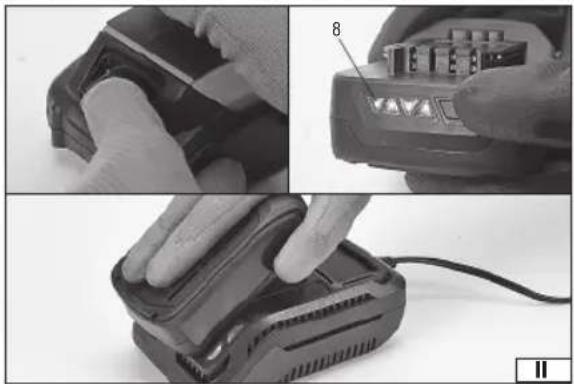
The battery has a built-in charge indicator. When you press the button, LEDs will light up (II), the more LEDs will light up, the more fully the battery pack is charged. If the button is pressed and the LEDs are off it means that the battery is discharged.
Disconnect the battery from the tool.
Push the battery in the charger socket (II).
Plug the charger into a mains socket.
When the red LED lights up, it means the loading process.
When charging is complete, the red LED goes off, and green LED lights up, indicating a full charge of the battery.
Unplug the charger from the mains outlet.
Remove the battery from the charging station, by pressing the battery latch button.
Attention! If, when the charger is connected to the power supply, the green LED is on, this indicates a fully charged battery. In this case, the charger does not start charging.
WORKING WITH PRODUCT
Note! It is recommended prior to normal operation to make a test on waste material.
Insert the adhesive cartridge as far as it will go into the gun's feed opening. Do not use excessive force for this (II).
Pressing the trigger only activates the mechanism feeding the adhesive cartridge towards the discharge nozzle.
The gun should be started by pressing and holding the gun switch (IV) for approx. 3 seconds. The nozzle backlighting lamp and the power indicator light next to the switch will come on. The red indicator light indicates the heating process, green indicates readiness for work.
Point the gun nozzle in the place of the adhesive application (V), press the trigger, the melted adhesive will start flowing out of the gun nozzle. Subsequent pressing of the trigger will cause subsequent portions of glue to flow out of the gun nozzle.
Apply glue to the glued surfaces, press them together and wait. After approx. 1-2 minutes the connection is ready.
EN
Warning! Do not touch hot glue. High temperatures can cause burns.
Heater interruption occurs after releasing the pressure on the trigger.
Due to the thermal inertia, adhesive may still be released from the nozzle for some time after the trigger pressure is released.
Pressing the switch will turn off the gun. The power light and the lamp that illuminates the gun nozzle will turn off.
Let the gun cool down, then proceed to maintenance.
Hints useful for operation of the product
Do not apply glue on products that are sensitive to high temperatures.
Foam products (e.g. foamed polystyrene) may be bonded provided they have protective coating. It is forbidden to apply glue directly on foam products!
Bonded surfaces must be clean, dry and degreased. If the bonded surface permits, it is recommended to make it matt e.g. by using sand paper. This will increase roughness of surface resulting in better contact of glue with bonded surface.
For large surfaces, point gluing is recommended. This consists in evenly distributing points of glue on entire surface. The glue upon flowing out of nozzle starts to cure fast; this should be taken into account when bonding large surfaces. If it is possible, materials that require using large quantity of glue should be bonded in stages.
When bonding textile or similar materials, apply glue in "S" pattern.
MAINTENANCE AND OVERHAUL
ATTENTION! Before any adjustment, technical service or maintenance operations unplug the tool. Once the operations have been finished, the technical conditions of the tool must be assessed by means of external evaluation and inspection of the following elements: body and handle, conductor with a plug and deflection, functioning of the electric switch, patency of ventilation slots, sparking of brushes, noise level of functioning of bearings and gears, start-up and smoothness of operation. During the guarantee period, the user cannot dismantle the electric tools or change any sub-assemblies or elements, since it will cancel any guarantee rights. All irregularities detected at overhaul or during functioning of the tools are a signal to have the tool repaired at a service shop. Once the functioning has been concluded, the casing, ventilation slots, switches, additional handle and protections must be cleansed with a stream of air (at a pressure not exceeding 0.3 MPa), with a brush or a cloth without any chemical substances or cleaning liquids. Tools and handles must be cleansed with a clean cloth.
PRODUKTBESCHREIBUNG
DE


