MS SL 10S - Saw DEXTER - Free user manual and instructions
Find the device manual for free MS SL 10S DEXTER in PDF.


User questions about MS SL 10S DEXTER
0 question about this device. Answer the ones you know or ask your own.
Ask a new question about this device
Download the instructions for your Saw in PDF format for free! Find your manual MS SL 10S - DEXTER and take your electronic device back in hand. On this page are published all the documents necessary for the use of your device. MS SL 10S by DEXTER.
USER MANUAL MS SL 10S DEXTER
- Introduction 20
- Device description 20
- Scope of delivery 20
- Intended use 21
- Safety information 21
- Technical data 24
- Before starting the equipment 24
- Attachment and operation 25
- Transport 27
- Maintenance 27
- Storage 27
- Electrical connection 27
- Disposal and recycling 28
- Troubleshooting 28
- Declaration of conformity 83
Explanation of the symbols on the equipment


Caution - Read the operating instructions to reduce the risk of inquiry


Wear safety goggles!


Wear ear-muffs!


Wear a breathing mask!


Important! Risk of injury. Never reach into the running saw blade!


Important! Laser radiation


Protection class II
1. Introduction
MANUFACTURER:
LEROY MERLIN
Rue Chanzy
Lezennes 59712 LILLE Cedex 9
France
DEAR CUSTOMER,
We hope your new tool brings you much enjoyment and success.
NOTE:
According to the applicable product liability laws, the manufacturer of the device does not assume liability for damages to the product or damages caused by the product that occurs due to:
- Improper handling,
Non-compliance of the operating instructions, - Repairs by third parties, not by authorized service technicians,
- Installation and replacement of non-original spare parts,
Application other than specified, - A breakdown of the electrical system that occurs due to the non-compliance of the electric regulations and VDE regulations 0100, DIN 57113 / VDE0113.
Important!
When using electric tools safety precautions should always be followed to reduce the risk of fire, electric shock and personal injury including the following. Read all these instructions before attempting to operate this product and save these instructions. Keep this manual in a safe place, so that the information is available at all times. If you give the equipment to any other person, hand over these operating instructions and safety regulations as well. We cannot accept any liability for damage or accidents which arise due to a failure
In addition to the safety regulations in the operating instructions, you have to meet the applicable regulations that apply for the operation of the machine in your country. Keep the operating instructions package with the machine at all times and store it in a plastic cover to protect it from dirt and moisture. Read the instruction manual each time before operating the machine and carefully follow its information. The machine can only be operated by persons who were instructed concerning the operation of the machine and who are informed about the associated dangers. The minimum age requirement must be complied with.
2. Layout (Fig. 1-19)
-
Handle
-
ON/OFF switch
-
Release lever
-
Saw shaft lock
-
Machine head
-
Movable blade guard
-
Saw blade
-
Clamping device
-
Workpiece support
-
Locking screw for workpiece support
-
Table insert
-
Indexed position lever
-
Locking lever
-
Pointer
-
Scale
-
Turntable
-
Fixed saw table
-
Stop rail
-
Scale
-
Pointer
-
Sawdust bag
-
Locking screw
-
Locking screw for drag guide
-
Fastening bolt
-
Drag guide
-
Screw for cutting depth limiter
-
Stop for cutting depth limiter
-
Movable stop rail
-
Set screw for moveable stop rail
-
Adjustment screw (90^)
-
Adjustment screw (45^)
-
Flange screw
-
Outer flange
-
Laser
-
ON/OFF switch for laser
-
Battery compartment
-
Battery compartment cover
-
Screw
-
Inner flange
-
Guide bar
-
Spring
-
Switch for switching speeds
a) 90^ stop angle (not supplied)
b) 45^ stop angle (not supplied)
c) Allen key, 6 mm
3. Scope of delivery
- Open the packaging and remove the device carefully.
- Remove the packaging material as well as the packaging and transport bracing (if available).
- Check that the delivery is complete.
- Check the device and accessory parts for transport damage.
- If possible, store the packaging until the warranty period has expired.
ATTENTION
The device and packaging materials are not toys! Children must not be allowed to play with plastic bags, film and small parts! There is a risk of swallowing and suffocation!
Drag, crosscut and litre Saw
- 1 x Clamping device (8)
- 2 x Workpiece support (9)
- Sawdust bag (21)
- Allen key (c)
- 3 x LR44 Battery
- Operating manual
4. Intended use
The trim, litre and bevel saw is used to litre wood, materials similar to wood, plastics and non-ferrous metals, with the exception of magnesium and alloys containing magnesium, according to the machine size.
Warning! The saw is not intended for cutting firewood.
The equipment is to be used only for its prescribed purpose. Any other use is deemed to be a case of misuse. The user / operator and not the manufacturer will be liable for any damage or injuries of any kind caused as a result of this.
The equipment is to be operated only with suitable saw blades. It is prohibited to use any type of cutting-off wheel.
To use the equipment properly you must also observe the safety information, the assembly instructions and the operating instructions to be found in this manual.
All persons who use and service the equipment have to be acquainted with this manual and must be informed about the equipment's potential hazards. It is also imperative to observe the accident prevention regulations in force in your area. The same applies for the general rules of health and safety at work.
The manufacturer will not be liable for any changes made to the equipment nor for any damage resulting from such changes. Even when the equipment is used as prescribed it is still impossible to eliminate certain residual risk factors. The following hazards may arise in connection with the machine's construction and design:
- Contact with the saw blade in the uncovered saw zone.
- Reaching into the running saw blade (cut injuries).
- Kick-back of workpieces and parts of workpieces.
- Saw blade fracturing.
- Catapulting of faulty carbide tips from the saw blade.
- Damage to hearing if ear-muffs are not used as necessary.
- Harmful emissions of wood dust when used in closed rooms.
Please note that our equipment has not been designed for use in commercial, trade or industrial applications.
Our warranty will be voided if the equipment is used in commercial, trade or industrial businesses or for equivalent purposes.
5. Safety information
Attention! The following basic safety measures must be observed when using electric tools for protection against electric shock, and the risk of injury and fire. Read all these notices before using the electric tool and keep the safety instructions for later reference.
Safe work
1 Keep the work area orderly
- Disorder in the work area can lead to accidents.
2 Take environmental influences into account
-
Do not expose electric tools to rain.
-
Do not use electric tools in a damp or wet environment.
- Make sure that the work area is well-illuminated.
- Do not use electric tools where there is a risk of fire or explosion.
3 Protect yourself from electric shock
- Avoid physical contact with earthed parts (e.g. pipes, radiators, electric ranges, cooling units).
4 Keep children away
- Do not allow other persons to touch the equipment or cable, keep them away from your work area.
5 Securely store unused electric tools
- Unused electric tools should be stored in a dry, elevated or closed location out of the reach of children.
6 Do not overload your electric tool
- They work better and more safely in the specified output range.
7 Use the correct electric tool
- Do not use low-output electric tools for heavy work.
- Do not use the electric tool for purposes for which it is not intended. For example, do not use handheld circular saws for the cutting of branches or logs.
- Do not use the electric tool to cut firewood.
8 Wear suitable clothing
- Do not wear wide clothing or jewellery, which can become entangled in moving parts.
- When working outdoors, anti-slip footwear is recommended.
- Tie long hair back in a hair net.
9 Use protective equipment
Wear protective goggles.
- Wear a mask when carrying out dust-creating work.
10 Connect the dust extraction device if you will be processing wood, materials similar to wood, or plastics.
- ATTENTION! The dust extractor must not be connected when processing metals. Risk of fire and explosion due to hot swarf or flying sparks! When processing metals, also remove the dust bag (21).
- If connections for dust extraction and a collecting device are present, make sure that they are connected and used properly.
- When processing wood, materials similar to wood, and plastics. Operation in enclosed spaces is only permitted with the use of a suitable extraction system.
11 Do not use the cable for purposes for which it is not intended
- Do not use the cable to pull the plug out of the outlet. Protect the cable from heat, oil and sharp edges.
12 Secure the workpiece
-
Use the clamping devices or a vice to hold the workpiece in place. In this manner, it is held more securely than with your hand.
-
An additional support is necessary for long workpieces (table, trestle, etc.) in order to prevent the machine from tipping over.
-
Always press the workpiece firmly against the working plate and stop in order to prevent bouncing and twisting of the workpiece.
13 Avoid abnormal posture
-
Make sure that you have secure footing and always maintain your balance.
-
Avoid awkward hand positions in which a sudden slip could cause one or both hands to come into contact with the saw blade.
14 Take care of your tools
-
Keep cutting tools sharp and clean in order to be able to work better and more safely.
-
Follow the instructions for lubrication and for tool replacement.
-
Check the connection cable of the electric tool regularly and have it replaced by a recognised specialist when damaged.
-
Check extension cables regularly and replace them when damaged.
-
Keep the handle dry, clean and free of oil and grease.
15 Pull the plug out of the outlet
-
Never remove loose splinters, chips or jammed wood pieces from the running saw blade.
-
During non-use of the electric tool or prior to maintenance and when replacing tools such as saw blades, bits, milling heads.
-
When the saw blade is blocked due to abnormal feed force during cutting, turn the machine off and disconnect it from power supply. Remove the work piece and ensure that the saw blade runs free. Turn the machine on and start new cutting operation with reduced feed force.
16 Do not leave a tool key inserted
Before switching on, make sure that keys and adjusting tools are removed.
17 Avoid inadvertent starting
- Make sure that the switch is switched off when plugging the plug into an outlet.
18 Use extension cables for outdoors
-
Only use approved and appropriately identified extension cables for use outdoors.
-
Only use cable reels in the unrolled state.
19 Remain attentive
Pay attention to what you are doing. Remain sensible when working. Do not use the electric tool when you are distracted.
20 Check the electric tool for potential damage
- Protective devices and other parts must be carefully inspected to ensure that they are fault-free and function as intended prior to continued use of the electric tool.
- Check whether the moving parts function faultlessly and do not jam or whether parts are damaged. All parts must be correctly mounted and all conditions must be fulfilled to ensure fault-free operation of the electric tool.
- The moving protective hood may not be fixed in the open position.
- Damaged protective devices and parts must be properly repaired or replaced by a recognised workshop, insofar as nothing different is specified in the operating manual.
- Damaged switches must be replaced at a customer service workshop.
- Do not use any faulty or damaged connection cables.
- Do not use any electric tool on which the switch cannot be switched on and off.
21 ATTENTION!
Exercise elevated caution for double litre cuts.
22 ATTENTION!
- The use of other insertion tools and other accessories can entail a risk of injury.
23 Have your electric tool repaired by a qualified electrician
- This electric tool conforms to the applicable safety regulations. Repairs may only be performed by an electrician using original spare parts. Otherwise accidents can occur.
ADDITIONAL SAFETY INSTRUCTIONS
1 Safety precautions
- Warning! Do not use damaged or deformed saw blades.
- Replace a worn table insert.
Only use saw blades recommended by the manufacturer which conform to EN 847-1.
- Make sure that a suitable saw blade for the material to be cut is selected.
- Wear suitable personal protective equipment. This includes:
- Hearing protection to avoid the risk of becoming hearing impaired,
-
Respiratory protection to avoid the risk of inhaling harmful dust,
-
Wear gloves when handling saw blades and rough materials. Carry saw blades in a container whenever practical.
-
Wear goggles. Sparks generated during work or splinters, chippings and dust coming from the device can lead to loss of eyesight.
-
Connect a dust collecting device to the electric tool when sawing wood. The emission of dust is influenced, among other things, by the type of material to be processed, the significance of local separation (collection or source) and the correct setting of the hood/guide plates/guides.
-
Do not use saw blades made of high-speed alloy steel (HSS steel).
2 Maintenance and repair
- Pull out the mains plug for any adjustment or repair tasks.
- The generation of noise is influenced by various factors, including the characteristics of saw blades, condition of saw blade and electric tool. Use saw blades which were designed for reduced noise development, insofar as possible. Maintain the electric tool and tool attachments regularly and if necessary, initiate repairs in order to reduce noise.
Report faults on the electric tool, protective devices or the tool attachment to the person responsible for safety as soon as they are discovered.
3 Safe work
Only use saw blades for which the maximum permissible speed is not lower than the maximum spindle speed of table saws and which are suitable for the material to be cut.
- Make sure that the saw blade does not touch the rotary table in any position by pulling out the mains plug and rotating the saw blade by hand in the 45^ and 90^ position. If necessary, readjust the saw head.
- When transporting the electric tool, only use the transport devices. Never use the protective devices for handling or transport.
- Make sure that the lower part of the saw blade is covered during transport, e.g. by the protective device.
- Be sure to only use spacers and spindle rings specified by the manufacturer as suitable for the intended purpose.
- The floor around the machine must be level, clean and free of loose particles, such as chips and cutting residues.
- Do not remove any cutting residues or other parts of workpieces from the cutting zone while the machine is running and the saw unit is not at rest.
- Make sure that the machine is always secured on a workbench or a table if at all possible.
Support long workpieces (e.g. with a roller table) to prevent them sagging at the end of a cut.
Warning! This electric tool generates an electromagnetic field during operation. This field can impair active or passive medical implants under certain conditions. In order to prevent the risk of serious or deadly injuries, we recommend that persons with medical implants consult with their physician and the manufacturer of the medical implant prior to operating the electric tool.
SAFETY INSTRUCTIONS FOR THE HANDLING OF SAW BLADES
1 Only use insertion tools if you have mastered their use.
2. Observe the maximum speed. The maximum speed specified on the insertion tool may not be exceeded. If specified, observe the speed range.
3 Observe the motor / saw blade direction of rotation.
4 Do not use any insertion tools with cracks. Sort out cracked insertion tools. Repairs are not permitted.
5 Clean grease, oil and water off of the clamping surfaces.
6 Do not use any loose reducing rings or bushes for the reducing of holes on saw blades.
7 Make sure that fixed reducer rings for securing the insertion tool have the same diameter and have at least 1/3 of the cutting diameter.
8 Make sure that fixed reducer rings are parallel to each other.
9 Handle insertion tool with caution. They are ideally stored in the originally package or special containers. Wear protective gloves in order to improve grip and to further reduce the risk of injury.
10 Prior to the use of insertion tools, make sure that all protective devices are properly fastened.
11 Prior to use, make sure that the insertion tool meets the technical requirements of this electric tool and is properly fastened.
12 Only use the supplied saw blade for sawing operations in wood, materials similar to wood, plastics and non-ferrous metals (except for magnesium and alloys containing magnesium).

Attention: Laser radiation Do not stare into the beam Class 2 laser
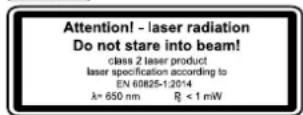
Protect yourself and you environment from accidents using suitable precautionary measures!
- Do not look directly into the laser beam with unprotected eyes.
- Never look into the path of the beam.
- Never point the laser beam towards reflecting surfaces and persons or animals. Even a laser beam with a low output can cause damage to the eyes.
- Caution - methods other than those specified here can result in dangerous radiation exposure.
- Never open the laser module. Unexpected exposure to the beam can occur.
- If the litre saw is not used for an extended period of time, the batteries should be removed.
- The laser may not be replaced with a different type of laser.
- Repairs of the laser may only be carried out by the laser manufacturer or an authorised representative.
Safety instructions for handling batteries
1 Always make sure that the batteries are inserted with the correct polarity (+ and -), as indicated on the battery.
2 Do not short-circuit batteries.
3 Do not charge non-rechargeable batteries.
4 Do not overcharge batteries!
5 Do not mix old and new batteries or batteries of different types or manufacturers! Replace an entire set of batteries at the same time.
6 Immediately remove used batteries from the device and dispose of them properly!
7 Do not allow batteries to heat up!
8 Do not weld or solder directly on batteries!
9 Do not dismantle batteries!
10 Do not allow batteries to deform!
11 Do not throw batteries into fire!
12 Keep batteries out of the reach of children.
13 Do not allow children to replace batteries without supervision!
14 Do not keep batteries near fire, ovens or other sources of heat. Do not use batteries in direct sunlight or store them in vehicles in hot weather.
15 Keep unused batteries in the original packaging and keep them away from metal objects. Do not mix unpacked batteries or toss them together! This can lead to a short-circuit of the battery and thus damage, burns or even the risk of fire.
16 Remove batteries from the equipment when it will not be used for an extended period of time, unless it is for emergencies!
17 NEVER handle batteries that have leaked without appropriate protection. If the leaked fluid comes into contact with your skin, the skin in this area should be rinsed off under running water immediately. Always prevent the fluid from coming into contact with the eyes and mouth. In the event of contact, please seek immediate medical attention.
18 Clean the battery contacts and corresponding contacts in the device prior to inserting the batteries:
6. Technical data
| AC motor 230 - 240 V~ 50Hz | |
| Power 2150 Watt | |
| Operating mode S6 20% 5 Min* | |
| Idle speed n0 | 3200 / 4500 min-1 |
| Carbide saw bladeø 216 xø 30 x 1,26 mm | ø 255 xø 30 x 2,8 mm |
| Number of teeth 48 | |
| Swivel range -45° / 0°/+45° | |
| Mitre cut | 0° bis 45° nach links |
| Saw width at 90° | 305 x 90 mm |
| Saw width at 45° | 215 x 90 mm |
| Saw width at 2 x 45°(double metre cut) | 215 x 47 mm |
| Protection class | II |
| Weight | 15,5 kg |
| Laser class | 2 |
| Wavelength of laser | 650 nm |
| Laser output | ≤ 1 mW |
| Laser module powersupply | 3 x LR44button cell |
- S6, continuous operation periodic duty. Identical duty cycles with a period at load followed by a period at no load. Running time 5 minutes; duty cycle is 20% of the running time.
The work piece must have a minimum height of 3 mm and a minimum width of 10 mm.
Make sure that the workpiece is always secured with the clamping device.
Noise and vibration
Total vibration values determined in accordance with EN 61029.
| Sound pressure level LpA | 95.23 dB(A) |
| Uncertainty KpA | 3 dB |
| Sound power level LWA | 108.23 dB(A) |
| Uncertainty KWA | 3 dB |
Wear hearing protection.
The effects of noise can cause a loss of hearing. Total vibration values (vector sum - three directions) determined in accordance with EN 61029.
Residual risks
The machine has been built according to the state of the art and the recognised technical safety requirements. However, individual residual risks can arise during operation.
- Health hazard due to electrical power, with the use of improper electrical connection cables.
- Furthermore, despite all precautions having been met, some non-obvious residual risks may still remain.
- Residual risks can be minimised if the "safety instructions" and the "Proper use" are observed along with the whole of the operating instructions.
- Do not load the machine unnecessarily: excessive pressure when sawing will quickly damage the saw blade, which results in reduced output of the machine in the processing and in cut precision.
- When cutting plastic material, please always use clamps: the parts which should be cut must always be fixed between the clamps.
- Avoid accidental starting of the machine: the operating button may not be pressed when inserting the plug in an outlet.
- Use the tool that is recommended in this manual. In doing so, your litre saw provides optimal performance.
- Hands may never enter the processing zone when the machine is in operation. Release the handle button and switch off the machine prior to any operations.
7. Before starting the equipment
- The equipment must be set up where it can stand securely, i.e. it should be bolted to a workbench, a universal base frame or similar.
-
All covers and safety devices have to be properly fitted before the equipment is switched on.
-
It must be possible for the blade to run freely.
- When working with wood that has been processed before, watch out for foreign bodies such as nails or screws, etc.
- Before you press the ON/OFF switch check that the saw blade is fitted correctly. Moving parts must run smoothly.
- Before you connect the equipment to the power supply make sure the data on the rating plate are dentical to the mains data.
8. Attachment and operation
8.1 Attaching the saw (Fig. 1-6)
To adjust the rotary table (16), push the locking lever (13) downwards and pull the lower indexed position lever (12) upwards with your index finger.
- Rotate the rotary table (16) and pointer (14) to the desired angle on the scale (15) and lock in place by folding up the locking lever (13).
- Pressing the machine head (5) lightly downwards and removing the locking bolt (24) from the motor bracket at the same time disengages the saw from the lowest position.
- Swing the machine head (5) up until the release lever (3) latches into place.
- It is possible to secure the clamping device (8) to the left or right on the stationary saw bench (17).
- Attach the workpiece supports (9) to the fixed saw table (17) as shown in Figure 6a,b,c and push all the way through. Secure the shafts with the retaining springs to prevent them from slipping out accidentally. The fasten in the desired position with the screw (10).
- It is possible to tilt the machine head (5) a max. 45^ to the left by loosening the set screw (22).
8.2 Precision adjustment of the stop for crosscut 90^ (Fig. 3,5,18)
- No stop angle included.
- Lower the machine head (5) and secure using the locking bolt (24).
- Loosen the set screw (22).
- Position the angle stop (a) between the saw blade (7) and the rotary table (16).
- Slacken the counternut (d). Adjust the adjusting screw (30) until the angle between the saw blade (7) and rotary table (16) is 90^ .
- Retighten the counternut (d) to secure this setting.
- Subsequently check the position of the angle indicator. If necessary loosen the pointer (20) using a Philips screwdriver, set to position 0^ on the angle scale (19) and re-tighten the retaining screw.
8.3 Precision adjustment of the stop for litre cut 45^ (Fig. 1,3,5,19)
- No stop angle included.
- Lower the machine head (5) and secure using the locking bolt (24).
Fix the rotary table (16) in the 0^ position. -
Loosen the set screw (22) and use the handle (1) to angle the machine head (5) 45^ to the left.
-
45^ - position angle stop (b) between the saw blade (7) and rotary table (16).
- Slacken the counternut (c). Adjust the adjusting screw (31) until the angle between the saw blade (7) and rotary table (16) is precisely 45^ .
- Retighten the counternut (d) to secure this setting.
8.4 Cross cut 90^ and turntable 0^ (Fig.1,2,6,7)
In the case of cutting widths up to approx. 100mm it is possible to fix the traction function of the saw with the set screw (23) in the rear position. In this position the machine can be operated in cross cutting mode. If the cutting width is over 100mm then it is necessary to ensure that the set screw (23) is loose and the machine head (5) can move.
Attention! For 90^ litre cuts, the moveable stop rail (28) must be fixed in the inner position.
- Open the set screw (29) on the moveable stop rail (28) and push the moveable stop rail (28) inwards.
- The moveable stop rail (28) must be locked in a position far enough from the inner position that the distance between the stop rail (28) and the saw blade (7) is no more than 5mm .
- Before making the cut, check that no collision could occur between the stop rail (28) and the saw blade (7).
- Tighten the set screw (29) again. (2 × 8.3 + 8.4)
- Move the machine head (5) to its upper position.
- Use the handle (1) to push back the machine head (5) and fix it in this position if required (dependent on the cutting width).
- Place the piece of wood to be cut at the stop rail (18) and on the turntable (16).
- Lock the material with the clamping device (8) on the fixed saw table (16) to prevent the material from moving during the cutting operation.
- Push down the release lever (3) to release the machine head (5).
- Press the ON/OFF switch (2) to start the motor.
- With the drag guide (23) fixed in place: use the handle (1) to move the machine head (5) steadily and with light pressure downwards until the saw blade (7) has completely cut through the work piece.
- With the drag guide (23) not fixed in place: pull the machine head (5) all the way to the front. Lower the handle (1) to the very bottom by applying steady and light downward pressure. Now push the machine head (5) slowly and steadily to the very back until the saw blade (7) has completely cut through the work piece.
- When the cutting operation is completed, move the machine head (5) back to its upper (home) position and release the ON/OFF button (2).
Attention! The machine executes an upward stroke automatically due to the return spring, i.e. do not release the handle (1) after completing the cut; instead allow the machine head to move upwards slowly whilst applying light counter pressure.
8.5 Cross cut 90^ and turntable 0^ - 45^ (Fig. 1,6,7)
The crosscut saw can be used to make crosscuts of 0^ - 45^ to the left and 0^ - 45^ to the right in relation to the stop rail.
Attention! For bevel cuts (inclined saw head), the moveable stop rail (28) must be fixed in the outer position.
- Open the set screw (29) on the moveable stop rail (28) and push the moveable stop rail (28) outwards.
- The moveable stop rail (28) must be locked in a position far enough from the inner position that the distance between the stop rail (28) and the saw blade (7) is no more than 5mm .
- Before making the cut, check that no collision could occur between the stop rail (28) and the saw blade (7).
- Tighten the set screw (29) again. (2 × 8.6 + 8.7)
- Use the handle (13) to adjust the rotary table (16) to the desired angle. The pointer (14) on the rotary table (16) must match the desired angle on the scale (15) on the fixed saw table (17).
- Tilt the locking lever (13) back up again to fix the rotary table (16) in place.
- Cut as described under section 8.3.
8.6 Mitre cut 0^ - 45^ and turntable 0^ (Fig. 1,2,6,8)
The crosscut saw can be used to make mitre cuts of 0^
- 45^ in relation to the work face.
Important. To make miter cuts (inclined saw head), the adjustable stop rail (28) must be fixed at the outer position.
- Open the locking lever (29) for the adjustable stop rail (28) and push the adjustable stop rail outwards.
- The adjustable stop rail (28) must be fixed far enough in front of the innermost position that the distance between the stop rail (28) and the saw blade (7) amounts to a maximum of 5mm .
- Before making a cut, check that the stop rail (28) and the saw blade (7) cannot collide.
- Secure the locking lever (29) again.
- Move the machine head (5) to the top position.
Fix the rotary table (16) in the 0^ position. - Loosen the set screw (22) and use the handle (1) to angle the machine head (5) to the left, until the pointer (20) indicates the desired angle measurement on the scale (19).
- Re-tighten the fixing screw (22).
- Cut as described in section 8.3.
8.7 Mitre cut 0^ - 45^ and turntable 0^ - 45^ (Fig. 1,2,6,9)
The crosscut saw can be used to make metre cuts to the left of 0^ - 45^ in relation to the work face and, at the same time, 0^ - 45^ to the left or 0^ - 45^ to the right in relation to the stop rail (double metre cut).
Important. To make miter cuts (inclined saw head), the adjustable stop rail (28) must be fixed at the outer position.
- Open the locking lever (29) for the adjustable stop rail (28) and push the adjustable stop rail outwards.
- The adjustable stop rail (28) must be fixed far enough in front of the innermost position that the distance
between the stop rail (28) and the saw blade (7) amounts to a maximum of 5mm .
- Before making a cut, check that the stop rail (28) and the saw blade (7) cannot collide.
- Secure the locking lever (29) again.
- Move the machine head (5) to its upper position.
- Release the rotary table (16) by loosening the set screw (26).
- Using the handle (13), set the rotary table (16) to the desired angle (refer also to point 8.4 in this regard).
- Re-tighten the set screw (26) in order to secure the rotary table.
- Undo the locking screw (22) and use the handle (1) to tilt the machine head (5) to the left until it coincides with the required angle value (in this connection see also section 8.6).
- Re-tighten the fixing screw (22).
- Cut as described under section 8.3.
8.8 Limiting the cutting depth (Fig. 3)
- The cutting depth can be infinitely adjusted using the screw (26). To do this loosen the knurled nut on the screw (26). Turn the screw (26) in or out to set the required cutting depth. Then re-tighten the knurled nut on the screw (26).
- Check the setting by completing a test cut.
8.9 Sawdust bag (Fig. 2)
The saw is equipped with a debris bag (21) for sawdust and chips.
Squeeze together the metal ring on the dust bag and attach it to the outlet opening in the motor area.
The debris bag (21) can be emptied by means of a zipper at the bottom.
8.10 Changing the saw blade (Fig. 11-15)
Remove the power plug! Important.
Wear safety gloves when changing the saw blade. Risk of injury!
- Remove the spring (41) from the pin by pushing together the two ends.
- Release the guide bar (40) from the pin.
- Firmly press the saw shaft lock (4), and slowly turn the flange screw (32) clockwise. After max. one turn, the saw shaft lock (4) engages.
- Then undo the flange screw (32), by applying a slightly greater force in a clockwise direction.
- Fully unscrew the flange screw (32) and remove the outer flange (33).
- Press the unlocking lever (3) to slide back the saw blade guard (6), then remove the saw blade (7) from the inner flange (39) and pull out in a downwards direction.
- Carefully clean the flange screw (32), outer flange (33) and inner flange (39).
- Insert the new saw blade (7) in the reverse sequence and tighten.
-
Position the guide bar (40) on the pin again, and secure with the spring (41).
-
Important! The cutting angle of the teeth, in other words the direction of rotation of the saw blade (7) must coincide with the direction of the arrow on the housing.
- Before continuing your work make sure that all safety devices are in good working condition.
- Important! Every time that you change the saw blade (7), check to see that it spins freely in the table insert (11) in both perpendicular and 45^ angle settings.
- Important! The work to change and align the saw blade (7) must be carried out correctly.
8.11 Using the laser (Fig. 16,17)
- To switch on: Move the ON/OFF switch of the laser (35) to the "1" position. A laser line is projected onto the material you wish to process, providing an exact guide for the cut.
- To switch off: Move the ON/OFF switch of the laser (35) to the "0" position.
- Replacing the battery: Switch off the laser (34). Remove the battery compartment cover (37). Remove the batteries and replace with new batteries (3 x LR44). Check that the battery terminals are positioned correctly when inserting new batteries. Close the battery compartment (36) again.
8.12 Changing the speed (Fig. 2)
The saw has 2 speed ranges:
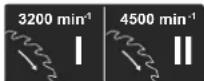
To operate the saw at a speed of 3200 rpm (metal), set the switch (42) to position I.
To operate the saw at a speed of 4500rpm (wood), set the switch (42) to position II.
9. Transport (Fig. 1,2)
- Tighten the set screw (26) in order to lock the rotary table (16)
- Activate the release lever (3), press the machine head (5) downwards and secure with the safety pin (24). The saw is now locked in its bottom position.
Fix the saw's drag function with the locking screw for drag guide (23) in rear position. - Carry the equipment by the fixed saw table (17).
- When reassembling the equipment proceed as described under section 7.1.
10. Maintenance
Warning! Prior to any adjustment, maintenance or service work disconnect the mains power plug!
General maintenance measures
Wipe chips and dust off the machine from time to time using a cloth. In order to extend the service life of the tool, oil the rotary parts once monthly. Do not oil the motor.
When cleaning the plastic do not use corrosive products.
Brush inspection
Check the carbon brushes after the first 50 operating hours with a new machine, or when new brushes have been fitted.
After carrying out the first check, repeat the check every 10 operating hours.
If the carbon is worn to a length of 6mm or if the spring or contact wire are burned or damaged, it is necessary to replace both brushes. If the brushes are found to be usable following removal, it is possible to reinstall them.
Service information
Please note that the following parts of this product are subject to normal or natural wear and that the following parts are therefore also required for use as consumables.
Wear parts*: Carbon brush, saw blade, Battery, table liners, Sawdust bag, V-belts
- Not necessarily included in the scope of delivery!
11. Storage
Store the device and its accessories in a dark, dry and frost-proof place that is inaccessible to children. The optimum storage temperature is between 5 and 30^ . Store the electrical tool in its original packaging.
Cover the electrical tool in order to protect it from dust and moisture.
Store the operating manual with the electrical tool.
12. Electrical connection
The electrical motor installed is connected and ready for operation. The connection complies with the applicable VDE and DIN provisions.
The customer's mains connection as well as the extension cable used must also comply with these regulations.
Important information
In the event of an overloading the motor will switch itself off. After a cool-down period (time varies) the motor can be switched back on again.
Damaged electrical connection cable
The insulation on electrical connection cables is often damaged.
This may have the following causes:
Passage points, where connection cables are passed through windows or doors.
- Kinks where the connection cable has been improperly fastened or routed.
- Places where the connection cables have been cut due to being driven over.
Insulation damage due to being ripped out of the wall outlet.
- Cracks due to the insulation ageing.
Such damaged electrical connection cables must not be used and are life-threatening due to the insulation damage.
Check the electrical connection cables for damage regularly. Make sure that the connection cable does not hang on the power network during the inspection. Electrical connection cables must comply with the applicable VDE and DIN provisions. Only use connection cables with the marking "H05VV-F". The printing of the type designation on the connection cable is mandatory.
AC motor
The mains voltage must be 230V
- Extension cables up to 25m long must have a cross-section of 1.5mm^2
Connections and repairs of electrical equipment may only be carried out by an electrician.
Please provide the following information in the event of any enquiries:
Type of current for the motor
Machine data - type plate
- Machine data - type plate
13. Disposal and recycling
The equipment is supplied in packaging to prevent it from being damaged in transit. The raw materials in this packaging can be reused or recycled. The equipment and its accessories are made of various types of material, such as metal and plastic. Defective components must be disposed of as special waste. Ask your dealer or your local council.
Old devices must not be disposed of with household waste!
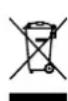
This symbol indicates that this product must not be disposed of together with domestic waste in compliance with the Directive (2012/19/EU) pertaining to waste electrical and electronic equip
ment (WEEE). This product must be disposed of at a designated collection point. This can occur, for example, by handing it in at an authorised collecting point for the recycling of waste electrical and electronic equipment. Improper handling of waste equipment may have negative consequences for the environment and human health due to potentially hazardous substances that are often contained in electrical and electronic equipment. By properly disposing of this product, you are also contributing to the effective use of natural resources. You can obtain information on collection points for waste equipment from your municipal administration, public waste disposal authority, an authorised body for the disposal of waste electrical and electronic equipment or your waste disposal company.
Batteries and rechargeable batteries do not belong in the household waste!

As the consumer you are required by law to bring all batteries and rechargeable batteries, regardless whether they contain harmful substances*
or not, to a collection point run by the local authority or to a retailer, so that they can be disposed of in an environmentally friendly manner.
*labelled with: Cd = cadmium, Hg = mercury, Pb = lead Remove the batteries from the laser before disposing of the machine and the batteries.
14. Troubleshooting
| Fault Possible cause Remedy | ||
| Motor does not work | Motor, cable or plug defective, fuses burnt | Arrange for inspection of the machine by a specialist. Never repair the motor yourself. Danger! Check fuses and replace as necessary |
| The motor starts up slowly and does not reach operating speed. | Voltage too low, coils damaged, capacitor burnt | Contact the utility provider to check the voltage Arrange for inspection of the motor by a specialist. Arrange for replacement of the capacitor by a specialist |
| Motor makes excessive noise | Coils damaged, motor defective Arrange for inspection of the motor by a specialist | |
| The motor does not reach its full power. | Circuits in the network are overloaded (lamps, other motors, etc.) | Do not use any other equipment or motors on the same circuit |
| Motor overheats easily. | Overloading of the motor, insufficient cooling of the motor | Avoid overloading the motor while cutting, remove dust from the motor in order to ensure optimal cooling of the motor |
| Reduced cutting power when sawing | Saw blade too small (ground too much) Readjust end stop of the saw unit | |
| Saw cut is rough or wavy | Saw blade dull, tooth shape not appropriate for the material thickness | Resharpen saw blade and/or use suitable saw blade |
| Workpiece pulls away and/or splinters | Excessive cutting pressure and/or saw blade not suitable for use | Insert suitable saw blade |
Table des matieres:
Page:
8.11 Service laser (figure 16,17)
9. Transport (Rys. 1, 2)
1 PpOpaIaeic aopaaeia
IpoeiOToiOn!Mn xnpoiOtioeIe Iauec TpiOviou Tou exouv UTOoTei nmu nTapauopwpwTei.
- Na avtikaiotate to evto tpaneioou otav exe aepi.
- Na xpnoiopoioie tmoV aae sTpioviuou ou uviotao kataaKeuaoTns, oI OTIOe OUmuoppwovvtaI e TpOtuTO EN 847-1.
- Pooéxetva Etnieyete aua Tpioviou Tou eivai kataaan yia To uAiko TOn TPoketaita va KoyeTe.
- Na φopáte κατάληλο ατομίκό Εξοπλισό μπροστασίας. Σ ευτόν περλαβάνονται:
- PpOoTaia TnC akOns yiT nEiOnn Tou KIVduvou PpokAnonBapKnaiag,
- PpOaTia Tc avantvoN yia eWOn Tou KIVduvou EITVOnEIKivDuvns OKovns,
- Na φopate yávtia kata to xεiipioó λεπiδωv προνiou kai uikov μe tpayia επiipaveia. Otav εíval εφιkó, va μεαφερēte TIC λεπiδες προνiou μεσa σε μia θηκη.
- Na φοράτε προστατεική γυλία. Αθηνθήρες του παράγονται κατα τήν εργαία ἡ τα θραύματα, τα πρίονίδα καλοι σκόνες του εξέρχονται από τη συοκεύμιν τόντορούν vα προλέσουν απώλεία τής ὄρασης.
Kata tyn kottn fauouva uovbete To nAektpiko epyaieo oeia diatae knatakappatnong tsokovnc. H aTeauehepwn oKovnc eTnpaezetai metaalwavtoTTO TUPOCS ETESEpyaia UAIKOU (atoknon n TINy),TN OToubaotnta Tou TOTIKOBIAXPiooukai TOnOWtnpuBmuon Kaaumuatow/ ekptontewv/oNYW.
-Mn xnpaioTIOIERE AETIDEC Tpioviou aTO XALUba uynAns TaxuNTtac (XALUba HSS).
2 Suvtnpnon kai EITIOKEun
- Piv a oioiaotne epyaia puohianc kai ouvtnpnans va aioouvdeete to qic a tio nTv pica.
-H npaywyh OpuBou Etnpeacetai aTIO diapopouc TnpayovTe, eTaTuW oToiW aTTO nV uPn Tns lacas pioviou kai Tnv kataotaon Tns lacas pioviou kai Tou nEeKtpiokou epyaieiou.
Otav eivai epiKTo, va xpoiioTOIEte λaueS TPI-ovoiou kataoKeuaaueves yia leiwn ts npaywYngbou, va ouvtnpite TAKIKA to nEKTpiko epyaleio kai ta TPOoaptnmuT epyaleiwv kai va ta ETIOKEUaZETe otav XpeiaZetai, wote va leiwVetai o OOpuBoc.
- Na avapepete aoeos cto atoou eivai UTEuBOv yia nV aopaAeia, tuxov bAbeC 0To nAekptiko epyaieio, TIC PPOoTATEUTIKc diataeic n 0TO TTPOaPTnA epyaieiou, aoeowc moiTc avakalTTETE.
8.11 Aetoupyia aeizep (EK. 16,17)
- Evepytooin: Kivnote Tov diakottn Evepytoinog/antEvepytoinongs leiεp (35) 0tn θean "1". Sto επεεpyaçóμεν ανιkeμενο προβαλεται μia ypaμμn λainερ, Tou deixvei T nV akpiβn δiaδpoun Tns KOttnc.
- ATEVEpyoToin: KIVNATE TOV dIaKOTIN EepeyToiInOns/aTVEpyTOinOns λειερ (35) σTN θεon,0"
Aaayn nts mataipias: 2hote to aeep (34). Atoaakpvte To kaumu Tns oKnnc ts mtataipiae (37). AapoeTe Tc mtatapiecs KaiavikataoTne Tc me Kaivoupyies (3 x LR44). PooEke Kata tnv toto- etnon tn oswn th eon twv noaw twv mtataipw. Eaakaeote tn hkn mtaataipw (36).
8.12 TpoTTOIOINrou apiOpu OToPOWv (Eik. 2)
To TpiOvi diaotei 2 Tepoxc apioou oTpoov:
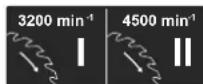
- Ia va xpnaiouoioeTo Tpiovi e apiOo oTpo- 3200 1/min (EtaA) OeTe to diaKOTn (42) θeon I.
Ia va xpnoiotoinoTe To Tpiovi e apioo oToPaw 4500 1/min (5uO) Teote To diaKOTTN (42) Otn θeon II.
9. Metaopα (Eik. 1,2)
- Ia va eivai aopaaioevn n TepiotpeoEvn bao (16), TpEe i naopaaionc va eivai otnv avebaouevn eo.
XeipioTeite tov moxAo antoavrtaWOns (3), TIEOTy KepaHn ts unxavns (5) npoc ta kato aaoaiaote me toulovi aoaiaion (24).Twpa to piovi elva uabawmuvo stny katwepn thon.
Aopaiion nC LEioupyia EAnc Tou Tpioviou u Tn Bida aopaiionc yia ohyon EAnc (23) Otnv Tiow Theoan. - Na μεταφέρετη μηχανή μαζι με τον πάγκο εργασίας (17).
Tn vta uvaipmooyon tnc mnxavns aokouen-ote Tn diaikacia TOU TEpiypapetai OTo Eaio 7.1.
10. ţuvτήροση
A Poooxn! Piv aTROKAe puOmuon, ouvtnpnAn n ETIIOKEuH, aTOouvOeETo QIC aTTO TIV TpiCa!
Evika μεtpa ouvtnpnong
ZKOUTIcTe TEPiotaiaKa eEv aTavi piviojata Ka Okovn ato Epyaieio. Aawve Teia opa tov miva Ta TEPiAtpeopeva epn yia TAPataon nC diapkeias Zwns Tou Epyaieiou. Mny Aawve ToV KIntnpa.
Tia ToV kaBapioo Tov TTAAOTIKWv, mV xpoaiotIOeTE KAaOTiKa UAIKA.
Eπεωρηση ψκτρύν
EeYxTe Tc WnKtpes Eva Kaivoupyo Epyaaleio meta TIS PwTEc 50 wpe c Aitoupyiac n otav toTtoetouvtai Kaivoupyie WnKtpes. Meta Tov TpWTo EeVyxo, EeVxETe Kae10 wpe c Aitoupyia.
Eav to Kapbovaki exi oapei kai exi ptaceoi unkoc 6 mm, evxexi kaei n exi utoatei znua to elatnpio nto oupu, npetie va avikataotneTE KAI TIS duo yktpes. Eav oynktpes eewpnouv meta tny apaipoeon Ikavcs ia xpon, mTIOpeite va tic entavaottoehtnoete.
Evnpwn yia to oepis
IpoaEte oTOn OuaKeun autn ta akoloutheta eaptnmuata utokevtai oe Koivn 0pOa n otXpeiaovtai taakoloua avawaija.
- Est conforme aux directives:
2006/42/CE Directive Machine;
2014/30/UE Directive Compatibleité Electromagnetique
2011/65/UE Directive RoHS
Apparent defects must be notified within 8 days from the receipt of the goods. Otherwise, the buyeris rights of claim due to such defects are invalidated. We guarantee for our machines in case of proper treatment for the time of the statutory warranty period from delivery in such a way that we replace any machine part free of charge which provably becomes unusable due to faulty material or defects of fabrication within such period of time. With respect to parts not manufac
tured by us we only warrant insofar as we are entitled to warranty claims against the upstream suppliers. The costs for the installation of the new parts shall be borne by the buyer. The cancellation of sale or the reduction of purchase price as well as any other claims for damages shall be excluded. The saw blade is a consumable item and explicitly excluded from any warranty.