
Garden Hero - Robot mower Blumfeldt - Free user manual and instructions
Find the device manual for free Garden Hero Blumfeldt in PDF.


| Product Type | Robotic mower |
| Brand | Blumfeldt |
| Model | Garden Hero (Smart) |
| Article Number | 10045967 |
| Adapter Power Supply | 25.5 V / 2.0 A, 100-240 V |
| Battery | Lithium-ion 22.2 V / 5200 mAh |
| Max. Mowing Area | 1400 m² |
| Cutting Motor Speed | 3000 rpm |
| Cutting Height | 2.5 cm to 5.5 cm (adjustable) |
| Weight | 18 kg |
| Travel Speed | 22 m/min |
| Number of Blades | 9 blades + 10 screws supplied |
| Boundary Wire Length | 150 m |
| Boundary Wire Pegs | 180 supplied |
| Charging Station | Included with charging bars |
| Programming Functions | Time programming (daily, weekly), rain mode, edge cutting (1-5x/week), spiral mode, zones (max 5), control via smartphone app (Wi-Fi 2.4 GHz) |
| Safety | PIN code, emergency stop (STOP button), lift/tilt detection, obstacle sensor |
| Maintenance and Cleaning | Weekly check, regular cleaning, winter storage with full charge, blade replacement every two worn edges |
| Operating Temperature | 1 °C to 50 °C (charging 0-45 °C) |
| Warranty and Compliance | Directive 2014/53/EU, declaration of conformity available online (use.berlin/10045967) |
Frequently Asked Questions - Garden Hero Blumfeldt
User questions about Garden Hero Blumfeldt
0 question about this device. Answer the ones you know or ask your own.
Ask a new question about this device
Download the instructions for your Robot mower in PDF format for free! Find your manual Garden Hero - Blumfeldt and take your electronic device back in hand. On this page are published all the documents necessary for the use of your device. Garden Hero by Blumfeldt.
USER MANUAL Garden Hero Blumfeldt


INHALTSVERZEICHNIS
Technische Daten 4
überkreuzen
Berlin Brands Group UK Limited PO Box 42
272 Kensington High Street
London, W8 6ND
United Kingdom
Congratulations on purchasing this device. Please read the following instructions carefully and follow them to prevent possible damages. We assume no liability for damage caused by disregard of the instructions and improper use. Scan the QR code to get access to the latest user manual and more product information.

CONTENTS
Technical Data 50
Explanation of the Warning Symbols 51
Safety Instructions 52
Appliance and Accessories 56
Installation 57
Control Panel 68
Start-Up and Operation 69
Repair, Cleaning and Maintenance 83
Troubleshooting 88
Device Control by Smartphone 90
Disposal Considerations 92
Declaration of Conformity 92
TECHNICAL DATA
| Item number 10045967 | |
| Adapter power supply 25,5 V/2,0 A, 100-240 V | |
| Battery power supply 22,2 V/5200 mAh | |
| Battery type Lithium-ion battery | |
| Blade motor speed 3000 rpm | |
| Weight 18 kg | |
| Working capacity Max. 1400 m2 | |
| Moving speed 22 m/min | |
EXPLANATION OF THE WARNING SYMBOLS
Symbols on the robot mower
 |  |  |  |  |  |
| 1234 | 56 |
 |  |  |  |  |
| 7891011 | ||||
1 WARNING/CAUTION
2 Beware of severing toes or hands. Do not put hands or feet near a rotating blade.
3 Dangerous voltage!
4 Always keep the robot mover on the ground when mowing. Tilting or lifting the robot mover may cause stones to be thrown out.
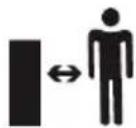
5 Keep bystanders at a safe distance (at least 5 m).
6 Read the instruction manual.
7 Pick up sticks, stones and foreign objects before using.
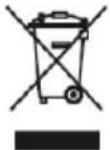
8 Do not dispose electrical products with general household waste. Please check with your local authorities for recycling advice.
9 CAUTION - Wait until blades stop rotating when switched off.
10 Do not ride on the robot mower or allow children or pets to do so.
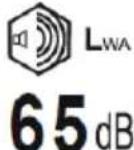
11 Guaranteed sound power level
SAFETY INSTRUCTIONS

WARNING
Risk of fire, electric shock and injury! Basic safety precautions should always be observed when using an electrical appliance to reduce the risk of fire, electrical shock or serious injury.
- Read all instructions before use. Retain instructions for future reference.
- Please read this manual carefully. Familiarise yourself thoroughly with the controls and proper use of this machine. You should know how the machine works and how to immediately switch it off.
- Never let children use this robot mower. Never let adults work with this robot mower if not properly trained.
- Do not let any persons, especially small children, or pets near you while the robot mower is in operation.
Personal safety
- Only use the robot mower on grass and lawns, as described in this manual.
- Keep the appliance out of reach of children and animals at all times.
- Do not use the appliance while there are other people, especially children, nearby.
- Stay alert, watch what you are doing and use common sense when operating the robot mower.
- Do not use the robot mower while you are tired or under the influence of drugs, alcohol or medication. This may result in serious personal injury.
- Use protective personal equipment such as safety glasses, non-skid safety shoes, sturdy gloves to reduce the risk of personal injury.
- Do not operate when barefoot or wearing open toed shoes.
- Dress appropriately. Do not wear loose clothing or jewellery and keep hair, clothing and gloves away from moving parts.
- Never touch the rotating blade.
- Never operate the robot mower over gravel, as this risks flicking stones.
- Check the area where the robot mower is to be used and remove any objects that could jam or be thrown by the robot mower, such as stones and sticks.
- Avoid operating the robot mower on wet grass.
- Remove any dog mess before mowing.
- Visually check the cutting tools and their fasteners for any damage before each use.
- To prevent imbalance, any damaged or worn-out parts should be replaced.
- Do not operate the robot mower if it is incomplete or has unauthorised modifications.
- Keep all body parts, especially hands and feet, away from the blade at all times.

WARNING
Risk of injury! The blade will continue to move after the motor is switched off.
- Ensure that the blade has fully stopped before:
– clearing a blockage,
- adjusting the cutting height,
- lifting or carrying the robot mower,
- tilting the robot mower to move,
- checking or cleaning the robot mower,
- carrying out any maintenance.
- If the robot mower vibrates intensively, stop the motor fully and identify the cause.
- The operator is responsible for accidents or hazards occurring to other people at their property.
- This appliance is not intended for use by persons (including children) with reduced physical, sensory or mental capabilities or lack of experience or knowledge.
- Never modify the robot mower in any way.
- It is recommended to program the appliance for use during hours when the area is free from activity, e.g. at night. But consider that certain animals, e.g. hedgehogs and moles are active at night. They can potentially be harmed by the appliance.
- The appliance must never be allowed to collide with persons or other living creatures. If a person or other living creature comes in the way of the appliance, it shall be stopped immediately.
- Do not put anything on top of the appliance or its charging station.
- Do not allow the appliance to be used with a defective guard, blade disc or body. Neither should it be used with defective blades, screws, nuts or cables. Never connect a damaged cable, or touch a damaged cable before it is disconnected from the supply.
- Do not use the appliance if the STOP button does not work.
- Always switch off the appliance when it is not in use. The appliance can only start when the correct PIN code has been entered.
- The appliance must never be used at the same time as a sprinkler. Use the Schedule function so the appliance and sprinkler never run simultaneously.
- Metal objects in the ground (for example buried electrical cables) can result in a stoppage. The metal objects can cause interference with the loop signal which then can lead to a stoppage.
- Be aware that pets may dig or disrupt the perimeter wire, so check regularly.
- The manufacturer does not guarantee full compatibility between the appliance and other types of wireless systems such as remote controls, radio transmitters, hearing loops, underground electric animal fencing or similar.
Electrical safety
- Do not operate the robot mower in explosive atmospheres, such as in the presence of flammable liquids, gases or dust. Mowers can sometimes create sparks, which may ignite the dust and fumes.
- Avoid body contact with earthed or grounded surfaces, such as pipes. There is an increased risk of electric shock if your body is earthed or grounded.
- In the event of a thunderstorm: To reduce the risk of damage to electrical components in the appliance and the charging station, we recommend that all connections to the charging station are disconnected (power supply, boundary wire and guide wire) if there is a risk of a thunderstorm.
- Do not handle the charge station or the robot mower with wet hands.
- Regularly check the power supply and charge station cables for signs of damage or ageing.
- Do not expose the robot mower to temperatures exceeding 80 °C, for example leaving the robot mower in direct sunlight or in the hot boot of a car for prolonged periods.
Battery safety
- This appliance contains Li-ion batteries. Do not incinerate batteries or expose to high temperatures, as they may explode.
- After heavy use or in high temperatures the battery may become warm. Allow the appliance to cool for 30 minutes before charging.
- Operation and storage temperature is 1-50 °C (32-122 °F). Temperature range for charging is 0-45 °C (32-113 °F). Too high temperatures might cause damage to the appliance.
Maintenance
- Check all visible fixing screws and nuts, especially on the cutter disc, to ensure they are tightened properly.
- The robot mower and its charge station should be periodically checked and cleaned and kept free of debris and obstructions. Note that some garden creatures such as spiders, insects, snails and slugs can nest or hibernate within crevices of the robot mower. These can attract small creatures/rodents that can damage the robot mower if not deterred.
- Before using the robot mower and after any impact, check for signs of wear and damage and repair or replace as necessary.
- Use only genuine replacement parts. This will ensure that the safety of the robot mower is maintained.
- Do not attempt to repair any damaged parts on the robot mower unless you are qualified to do so.
Description
Robot mowers work by making regular small cuts of the grass to maintain a set height. To do this they must be able to mow the grass multiple times per day every day. This will keep the grass level constantly in check. As it is cutting small amounts regularly the clipping will fall to the ground and are not collected. Over time these small clippings will compost and add nitrogen to the lawn. Eventually this will leave the lawn looking more green and lush and enhance the general health of the lawn.
APPLIANCE AND ACCESSORIES
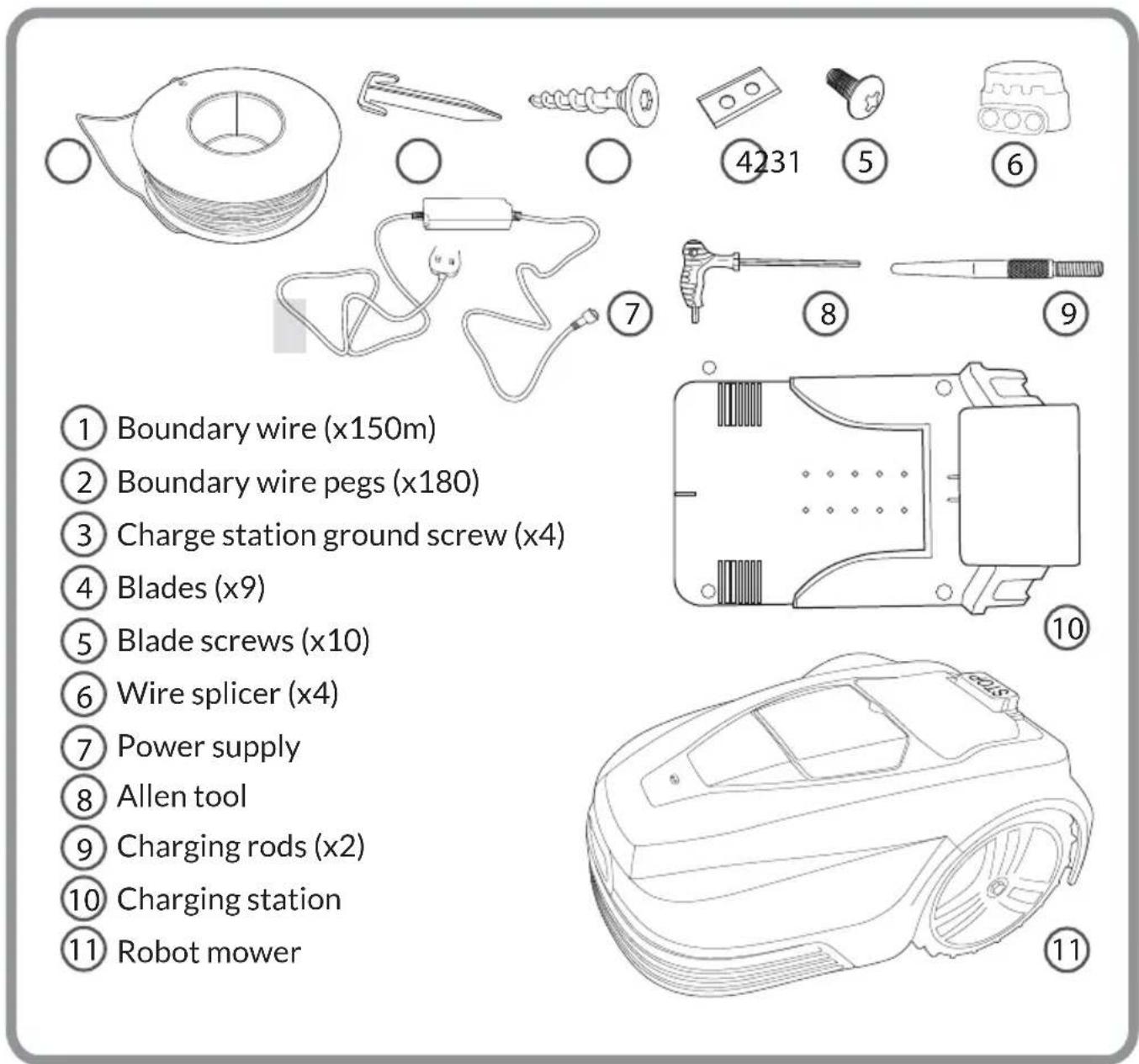
1. Preparing the lawn for the robot mower
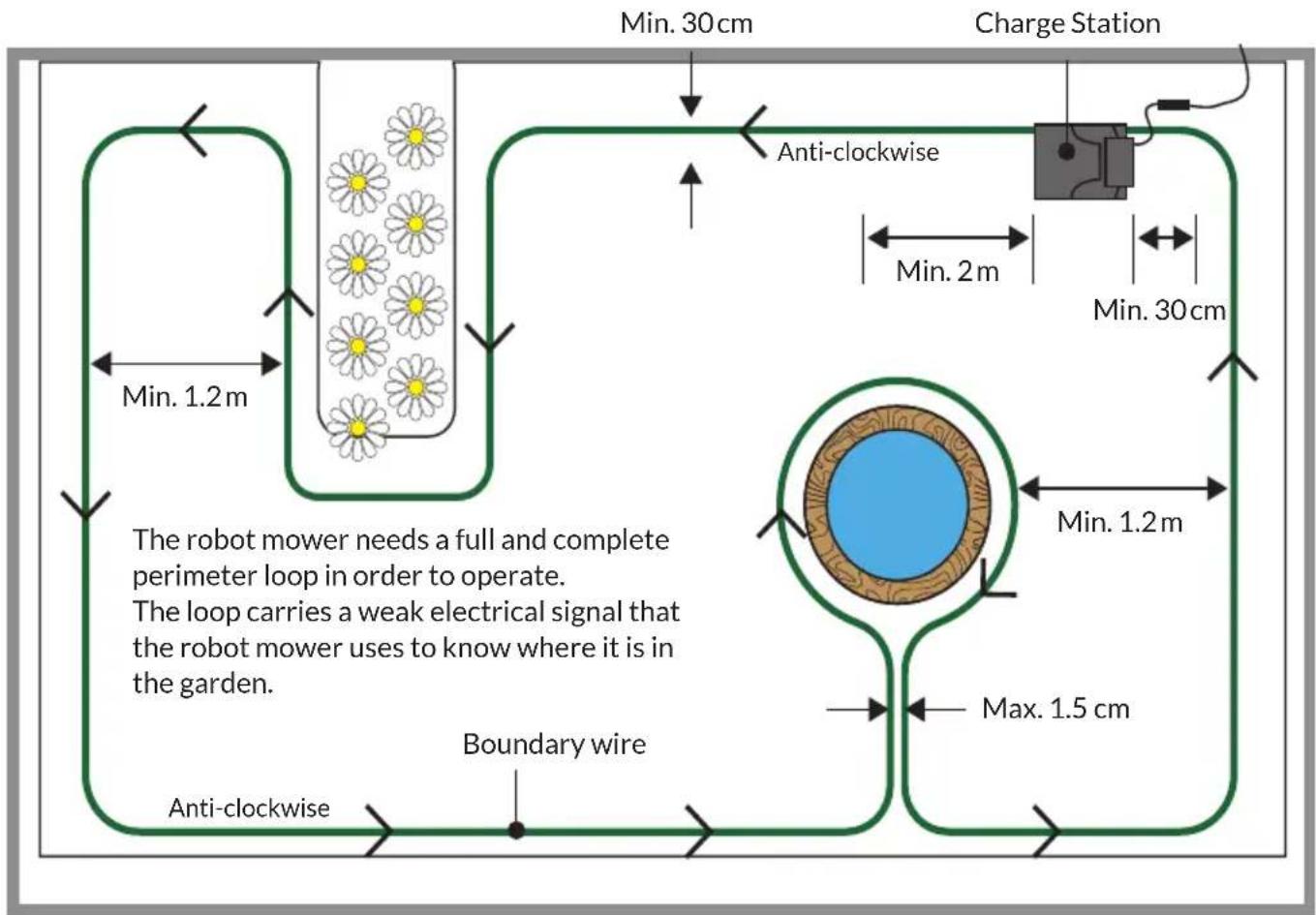

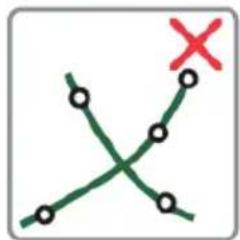
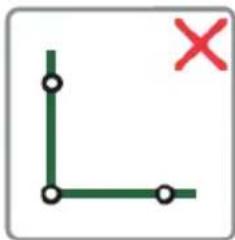
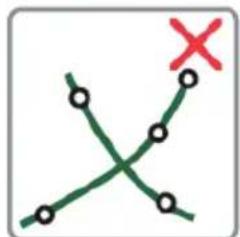
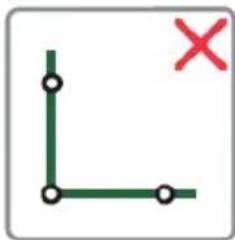
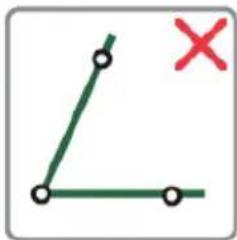
Obtuse angles Curves Don't cross wires No right angles No acute angles
There may be parts of your garden which will be challenging or even impossible for your robot mower. Your robot mower will not stray beyond the boundary wire you must lay around your garden. It will change direction on making contact with things like:
- Posts and poles (e.g. washing lines)
- Fences and walls around trees
But it will need to be kept away from:
- Dug borders
- Trees with exposed roots
- Flower beds
- Ponds and water features
• Excessively uneven terrain.
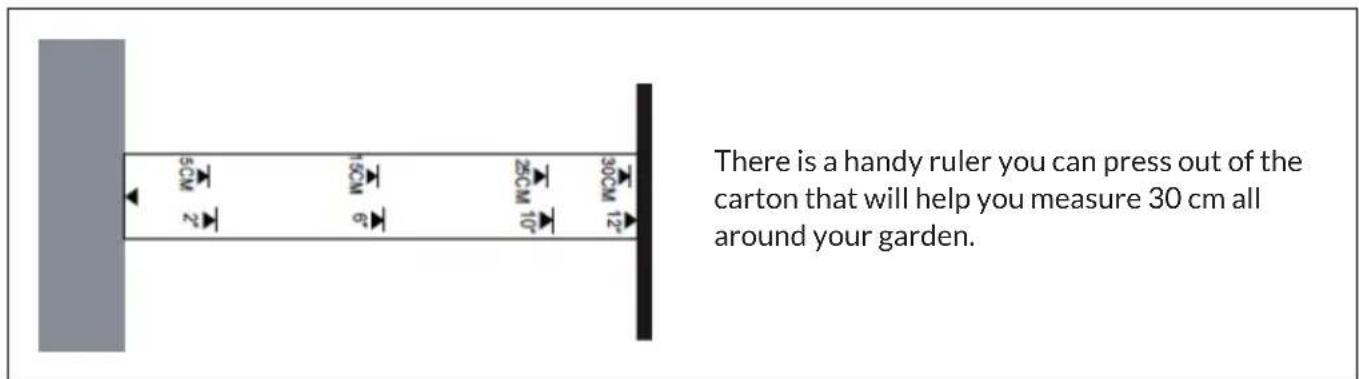
The wire must be kept taut and never be allowed to loop or cross over itself. Ideally if ground is particularly uneven the wire can be buried up to 40 mm deep and pegged down to secure. This can be achieved easily with a manual edging tool. If this is not desired or possible then the wire should be firmly pegged around the garden with pegs at a minimum of 1 m intervals, keeping the cable taut to avoid it being cut by the robot mower, more so at corners and over uneven terrain. The cable should be positioned a minimum of 30 cm from the edge of the garden, as the robot mower will overlap the wire, although it will not stray past it.
On corners the wire should not be laid at a sharp angle or right angle, but curved or a series of obtuse angles. The robot mower can detect a signal from the wire from as much as 18 m away. It should be noted that due to this set up some areas of the lawn will not get mowed such as outside the perimeter edges. These can be maintained using a suitable grass trimmer. If the ground where the wires are to be laid is particularly dry and the soil hard from lack of rain, it will help to thoroughly water the garden before attempting to lay your perimeter wire.
2. Rectifying or avoiding problem areas
Obstacles such as tree roots on lawn
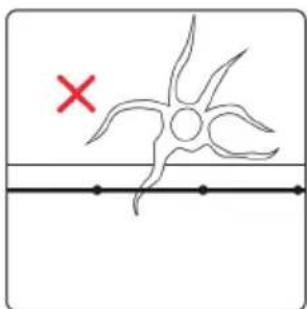
If a tree root is protruding into the perimeter of your cutting area it would present a problem for the robot mower.
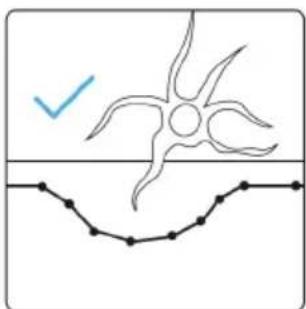
One solution is to take the perimeter around the tree root, leaving area unmowed.
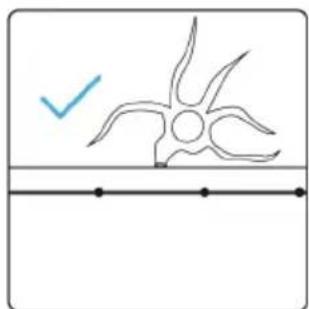
Alternatively, cut the tree root back with a saw and fill any resulting uneven surface, then set the perimeter over it.
Excessively uneven areas of lawn
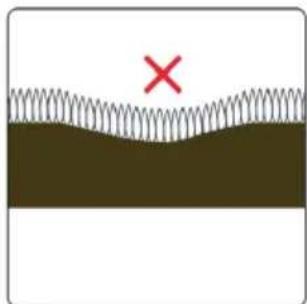
A deep enough dip in the surface of your lawn will also present problems, possibly causing the robot mower's wheels to lose their grip and skid.

If you don't want to avoid mowing this area, it's best to fill it with soil, compact it down and re-seed it with grass.
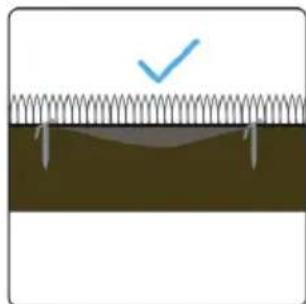
If the area is on the perimeter line this can be pegged out as normal. If it is within the mowing area it should no longer be a problem.
Extra long grass
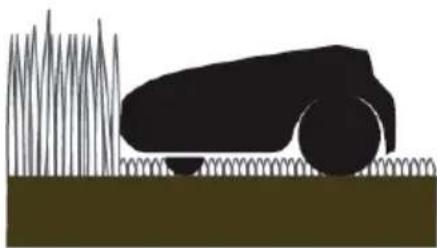
If your robot mower encounters particularly long grass it may treat it as an obstacle as it could bump the robot mower's obstacle sensor. The grass needs to be at a reasonable level before the robot mower can function correctly.
3. Installing the charging station
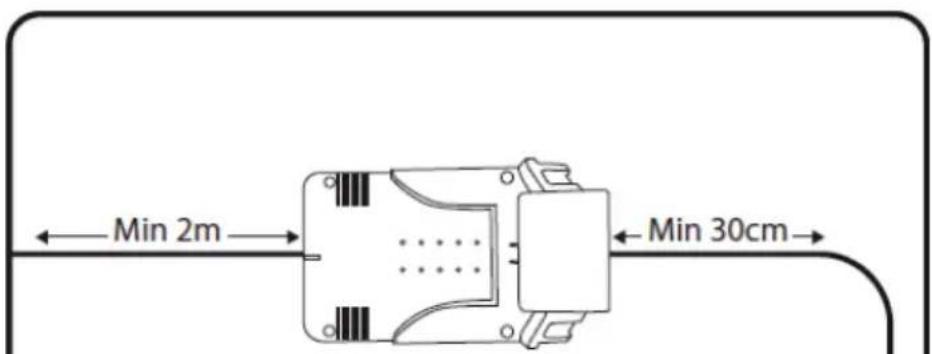
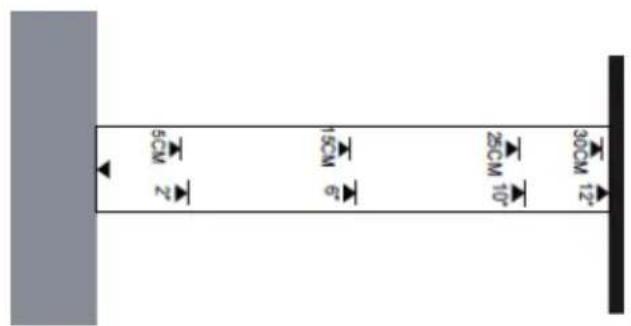
Ensure a minimum of 2 m straight perimeter from the front of the charging station, and 30 cm straight from the rear.
- Find a location with access to power, ensuring the robot mower can leave the charging station in an anti-clockwise direction. Don't peg the plate down yet.
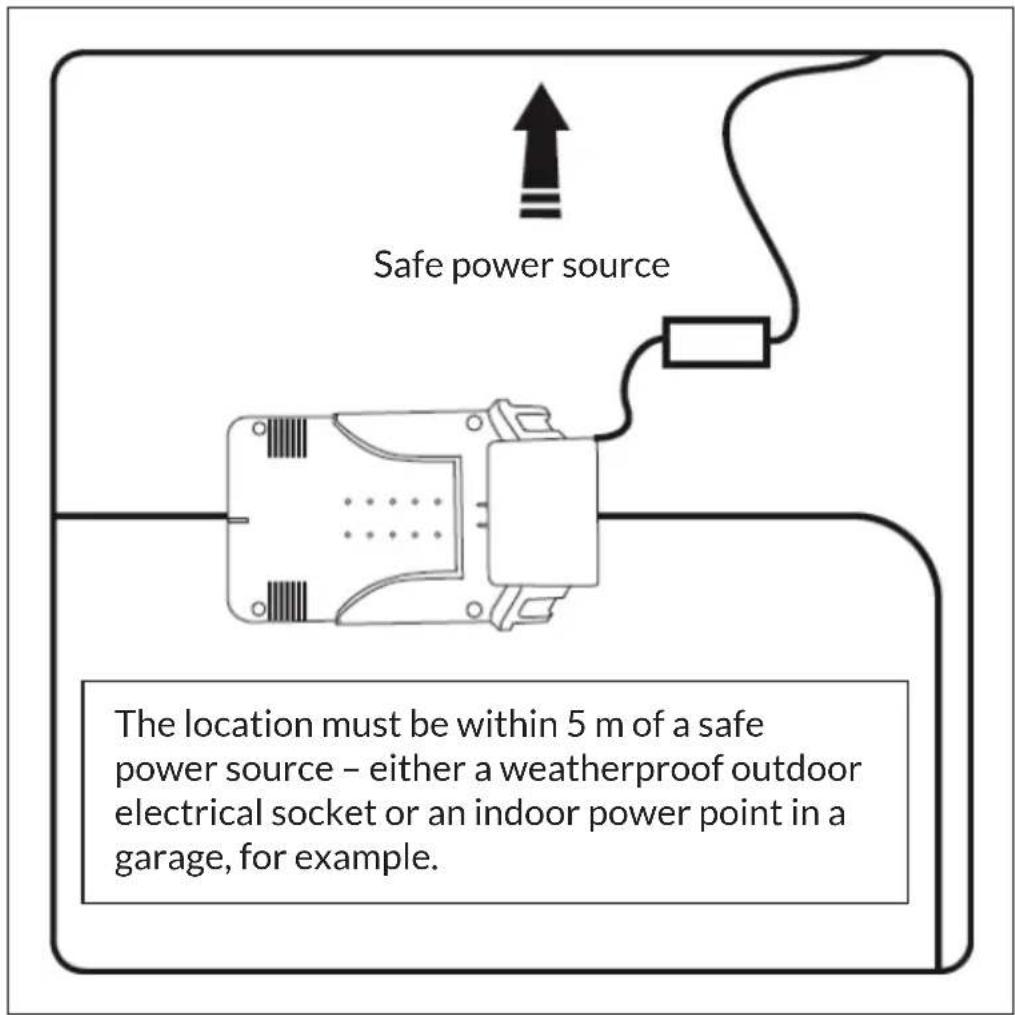
- The location of the charging station should be flat at and secure, without risk of movement, if placed next to a border edge that is unstable it can slump and cause the station to be uneven, this will cause problems for the robot mower when returning to charge.

WARNING
Risk of tripping! Trailing wires are a trip hazard. Take care when choosing your location.
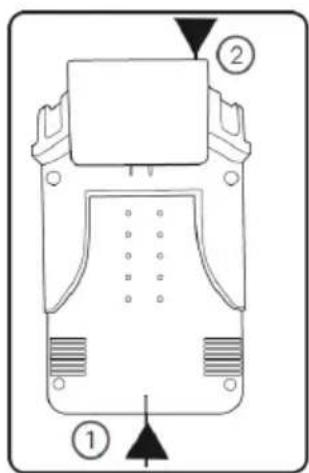
The boundary wire goes into the front (1) of the charging station and comes out at the back (2).
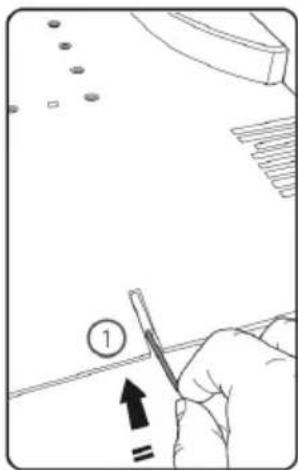
Push the boundary wire into the tube at the front (1) of the charging station.
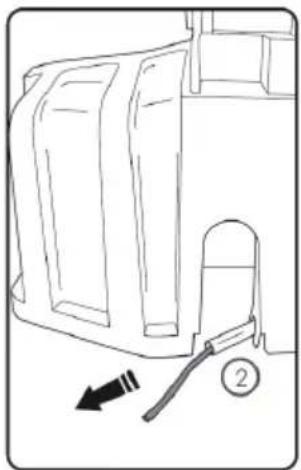
It will emerge at the rear of the unit (2).
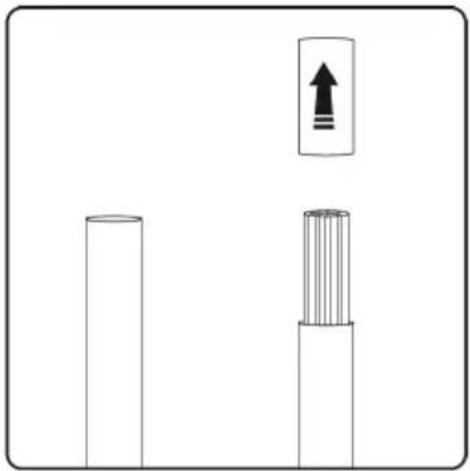
You will need to strip the plastic sheath from the end of the wire before connecting.
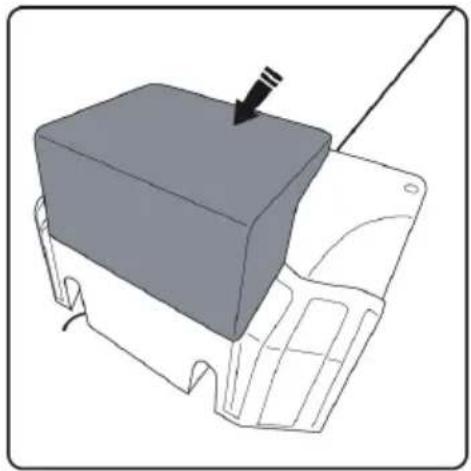
The charging stand has a hood at the back (shown in grey) that hinges forwards.
Twisting the exposed wires after exposing helps ensure a good connection.
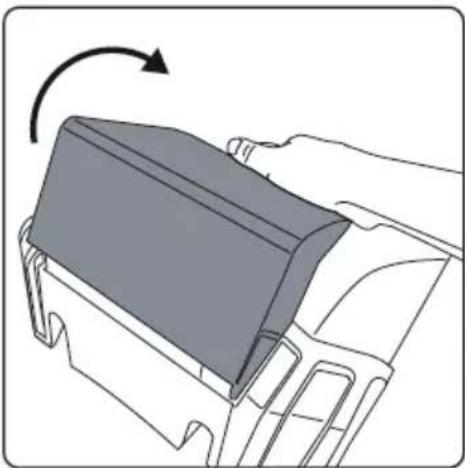
Push the charging station hood forward to uncover the wiring terminals.
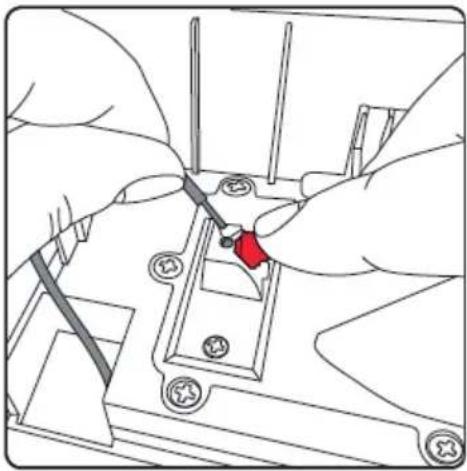
The sprung terminal will need lifting to expose the hole, ensure the wire is full inserted before releasing the red terminal clip.
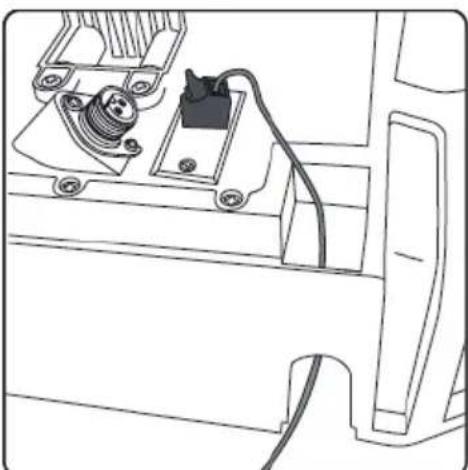
When you have completed your boundary wire it must return to the charging station and be fed up through the unit and plugs in at the black terminal.
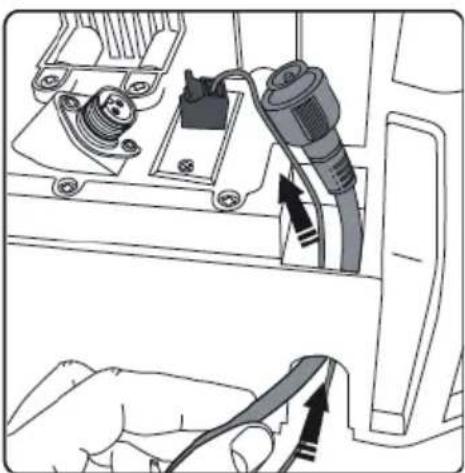
Feed the power lead up through the other side of the base station
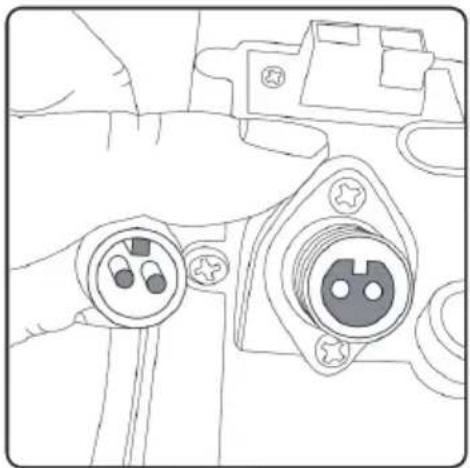
Pay attention to the cable fittings as there is a keyway orientation detail to ensure correct connection.
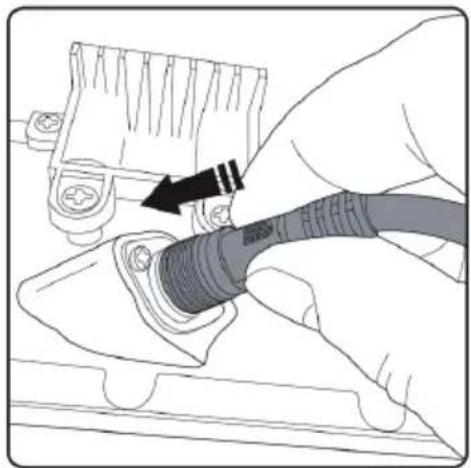
Push the power cable into place.
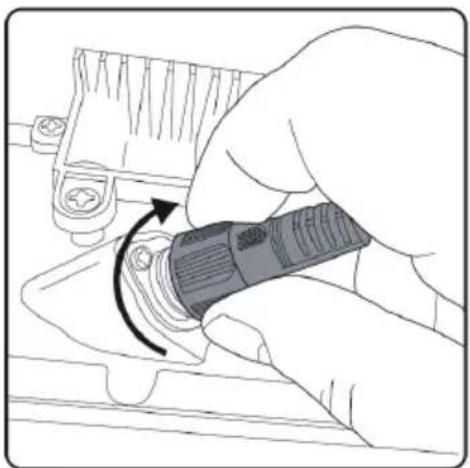
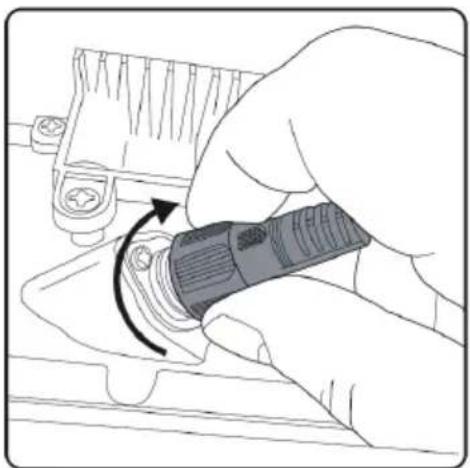
Then screw on the outer ring to secure the cable in place and prevent water ingress.
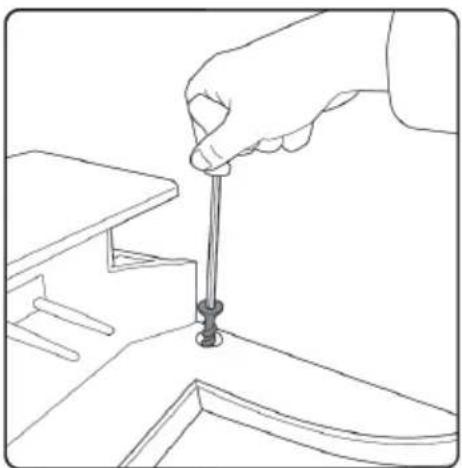
Once the base station has been fully wired, it can be secured in place with the four screws provided. Use the Allen key provided to screw them in securely ensuring they are fully inserted and flush with the station base. Protruding screws can hinder the robot mower from locating correctly.
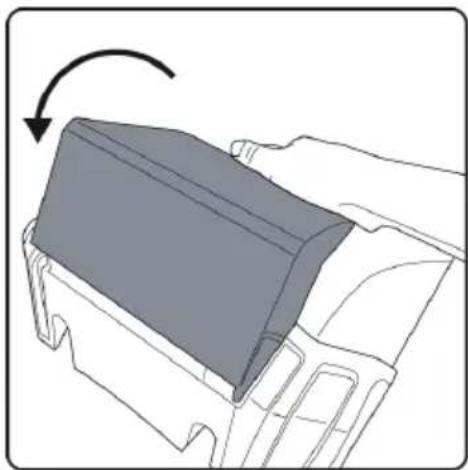
Push the cover back to its original position to cover the wires and connections from water ingress.
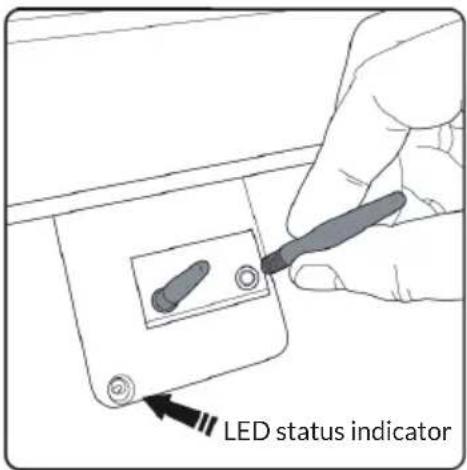
Making sure the power is switched off at the socket, screw the two charging rods into the holes just below the cover of the base station. (Note: This is where the LED status indicator is situated.)
4. Laying the boundary wire
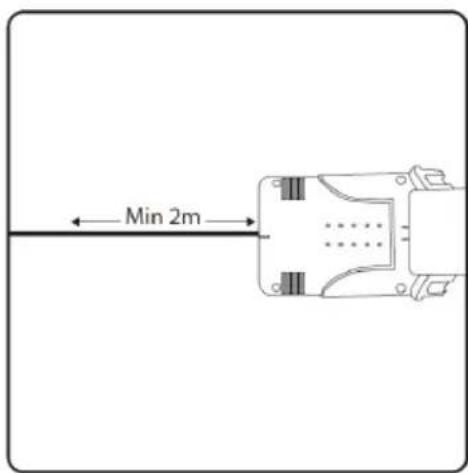
Keep the wire straight for at least the first 2 m. This is to allow the robot mower to return to the charging stand with ease.
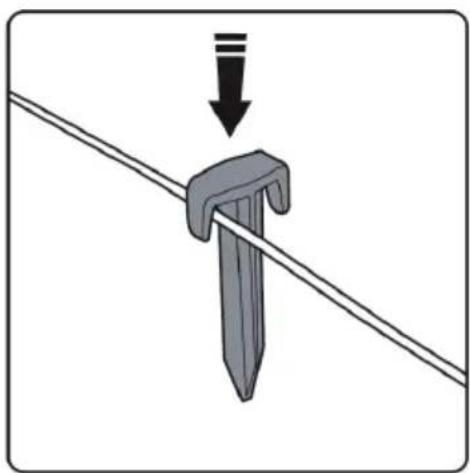
Place the pegs at intervals of about 1 m on straight and even ground, 30 cm to 50 cm on bends and corners. Uneven ground and obstacles will require more pegs.
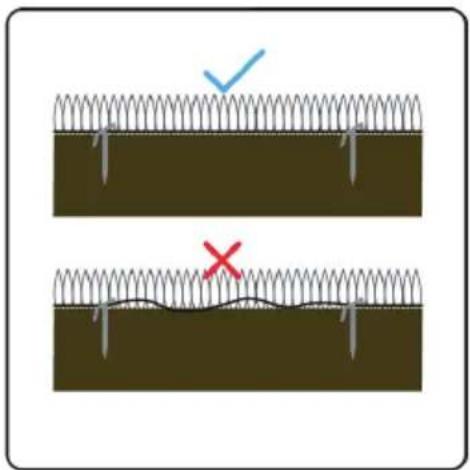
The perimeter wire must be kept tight. If it is loose it may well end up being cut by the robot mower as it passes over it.
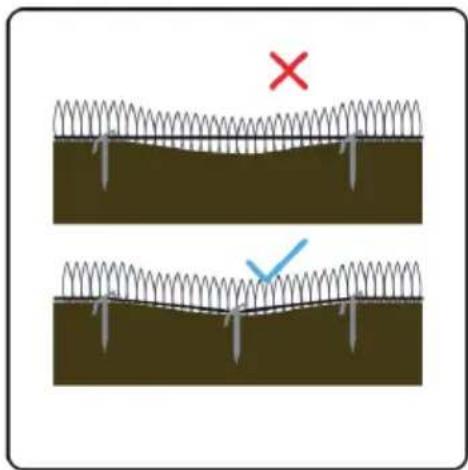
If the wire passes over a moderate dip in the lawn, more pegs will be required to keep the wire firmly pegged at ground level, or it risks being cut.
5. Installing the robot mower
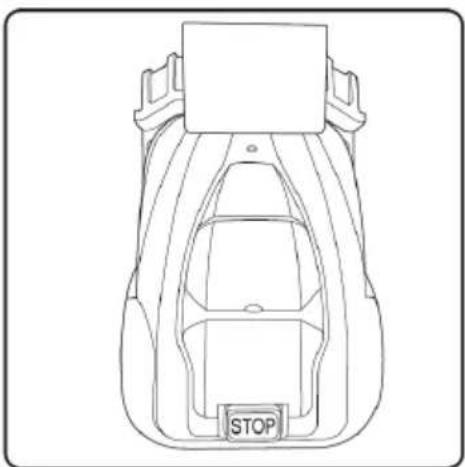
Place the robot mower on the base station with the wheels on the grips and the two pins engaged into the front of the robot mower.
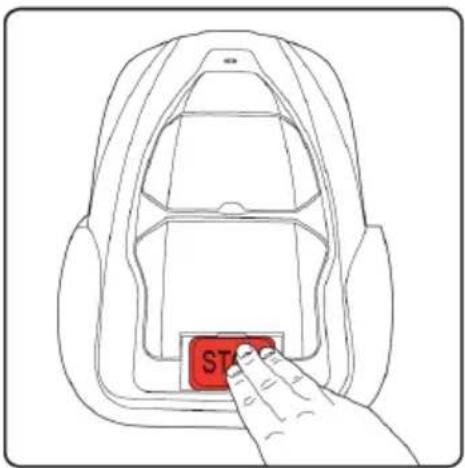
Press the STOP button.
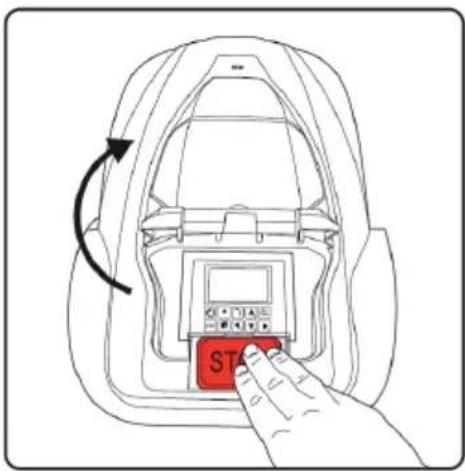
This will flip open the control panel and LCD display cover.
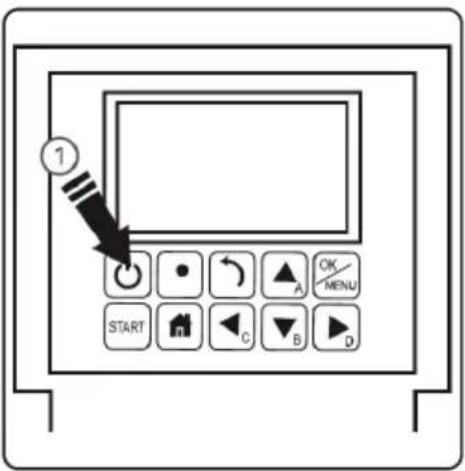
Hold the power button (1) down for three seconds to activate the LCD display.
CONTROL PANEL
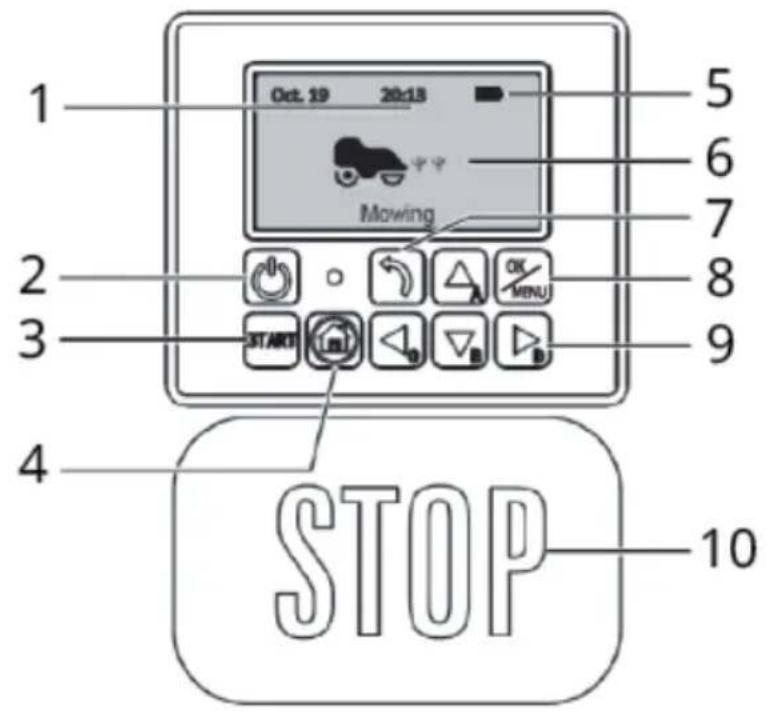
1 Time, date 5 Battery
2 POWER button: Power on/off
6 Status
3 START button: Start mowing 7 RETURN button
4 HOME button: Back to station.
8 OK/MENU button
9 UP, DOWN, LEFT, RIGHT button, A, B, C, D for PIN code
10 STOP button: Emergency stop and open the control panel hatch
START-UP AND OPERATION
Cutting height adjustment
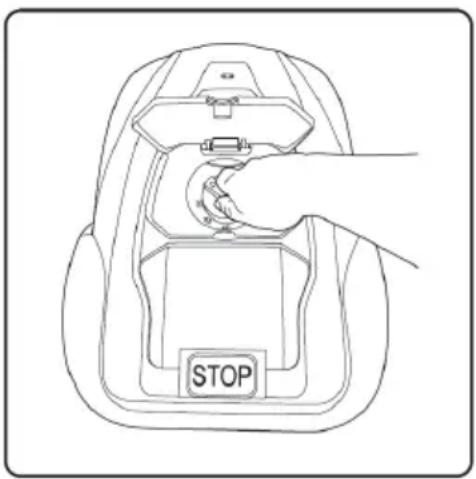
- Open the knob lid.
- Cutting height can be adjusted from 2.5 cm to 5.5 cm by rotating the adjustment knob.
Set the cutting height
The first cut of the season or long thick wet grass will need the highest setting (5.5 cm).
Gradually reduce to desired height once all ground has been covered. This may take a few days or a few weeks. If the perimeter wire is pegged to the surface of the garden rather than buried, it is a good idea to let the wire “bed in” to the surface of the lawn, during which time it is advisable to keep the robot mower on an elevated blade setting.
Note: During first few days of mowing the grass may look stripy or patchy where the robot mower has covered/not covered. This is normal and will become even after several days once the full lawn area has been mowed.
First use
When you turn it on for the first time, the control panel will ask you to enter a PIN code. Please remember the PIN code you set. When you press the START button and close the flap, the robot mower begins a circuit and mows the lawn randomly.
The first mowing passes
The first few mowing passes will seem random and unfinished. This is normal. The more often the lawn is mowed, the more even it will become. By setting zones (see “Zone” section) and mowing in a spiral pattern at a location you select (see “Spiral mowing” section), this effect can be achieved more quickly.
New season mowing
Between mowing seasons when the robot mower is not operating (during winter months) the grass can become unkempt and thickets emerge. On new season setup review mowing pass and address any problem areas.
| Status Meaning | |
| Standby The robot mower is ready to work. | |
| Mowing The robot mower is mowing automatically. | |
| Spot Mow The robot mower is mowing spirally. | |
| Returning The robot mower is going back to station. | |
| Charging The robot mower is charging. | |
| Charge to work The robot mower is charging and will continue program when charged. | |
| Emergency stop The robot mower is stopped manually. | |
| Error The robot mower cannot work. | |
| Firmware update The firmware is updating. | |
Switching the robot mower on and off
| Power on Power off | |
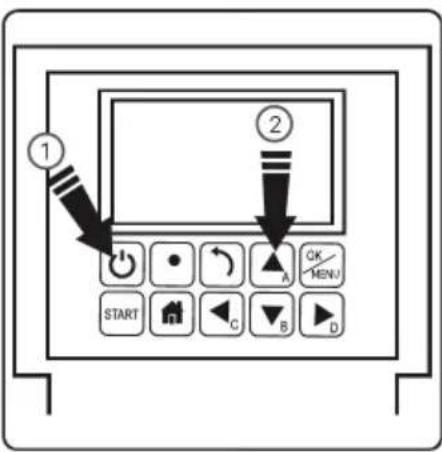 | 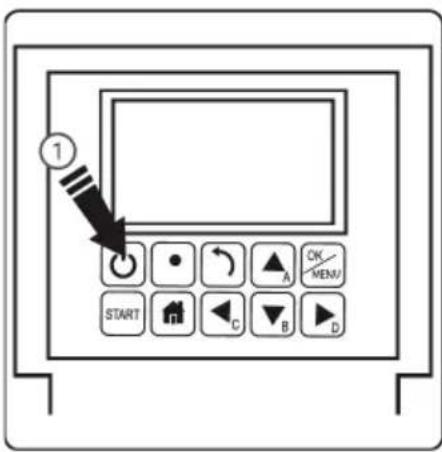 |
| 1. Press the POWER button for 3 seconds.2. Enter the four-digit PIN code you specified.3. The robot mower will now await further instruction in standby mode. | 1. Press the POWER button for 3 seconds. |
Start mowing
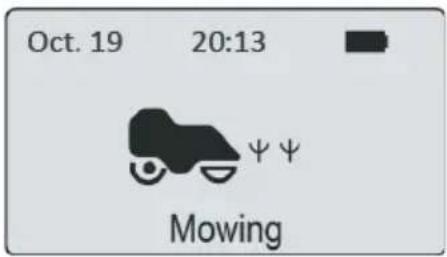 | 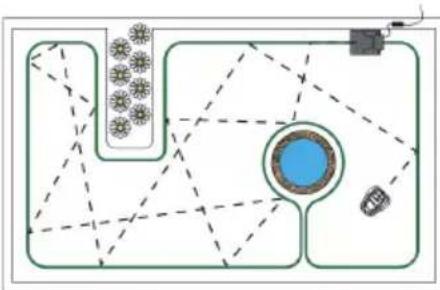 |
| 1. Press START button.2. Close the cover to start. | In standard mowing mode the robot mower will proceed in a random fashion around your garden, changing direction each time it reaches the boundary wire. |
Work time setting
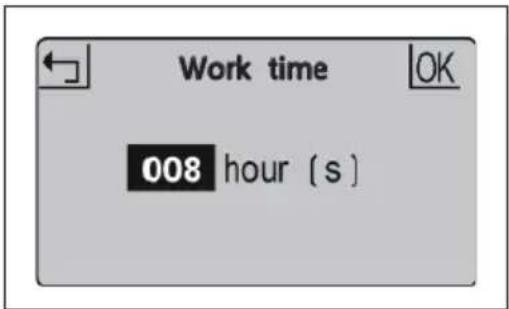
This is the amount of time the robot mower will be active. This includes charging time.
For example: If set to 8 hours and the robot mower is set to operate from 8:00 pm it will operate until 4:00 am. In this time it may mow for 1 hour charge for 2 hours mow again for 1 hour; charge for 2 hours, mow for one hours and return to charge ready for the next cycle.
- Press OK button to enter sub-menu 1.
- Select "setting" to enter sub-menu 2.
- Select "work time".
- Set work time by UP ▲ and DOWN ▼ buttons (default is 8 hours).
- Press OK button to confirm setting.
You may want to stop the robot mower during its cutting cycle. To do this:
| Stop Back to station | |
 | 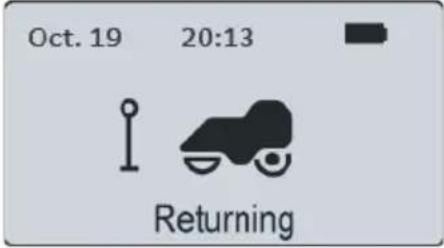 |
| 1. Press the STOP button.2. The robot mower stops immediately and the control panel hatch opens.3. The screen shows “emergency stop”.4. Press the OK button or the RETURN button.5. Enter the PIN code.6. If the robot mower was in operation when the STOP button was pressed, the screen will display “Continue working?” You can either confirm this with the OK button or press the RETURN button to cancel. | 1. Press the HOME button for 3 seconds.2. Close the cover and the robot mower will return to station for charging. |
Charging
- Place the robot mower in the station (or press the HOME button).
- The robot mower will charge up to 100 % and then go into standby.
- The robot mower will get charged again if battery is lower than 75%.
The robot mower charges on its station through the two charging rods. These insert into the front of the robot mower. Ensure the holes are free of debris or obstructions and that the robot mower aligns when approaching the charge station. Uneven ground on approach can cause the robot mower to not make a positive connection first time. If this happens consider levelling the ground or moving the station to a more suitable area.
Schedule
- Press the OK button to enter sub-menu 1.
- Select "schedule".
- Press the OK button to select the desired day.
- Press the UP▲, DOWN ▼, LEFT ◀ and RIGHT ▶ buttons to set the start and end time.
- Press the OK button to confirm the daily setting.
- Repeat step 3 to 5 to complete the weekly plan.
- Press the OK button to confirm the weekly setting.
This allows you to change mowing schedules for different days of the week, for example if you want to prevent mowing to occur on any given day or if other scheduled activity in the garden would prevent effective mowing during normal daily schedule.
Zone
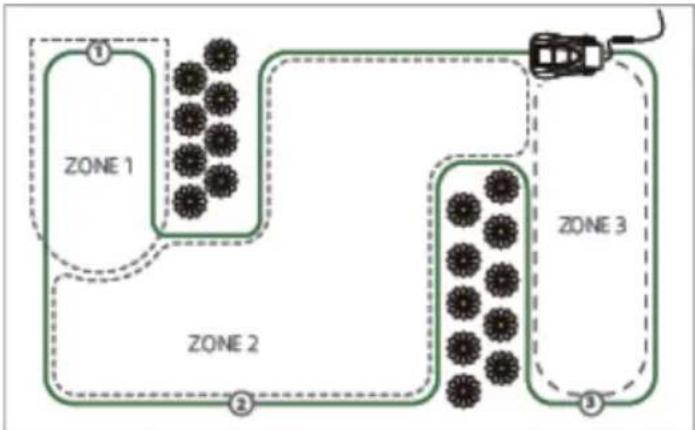 | |
| 1. Press the OK button to enter sub-menu 1.2. Select “zone”.3. Press the OK button to select the desired zone.4. Press the UP▲, DOWN▼, LEFT ◀ and RIGHT▶ buttons to select the distance and percentage.5. Press the OK button to confirm each zone.6. Repeat step 3 to 5.7. Press the OK button to confirm the setting of all the zones. | You can set up to 5 zones in your garden. This enables you to decide areas of your garden that need more or less attention. A zone is set by how far along the boundary wire from the base station. The distance should be 0 to 200 m and the percentages should add up to 100 % or the setting cannot be completed. |
Spiral mowing (spiral mode)
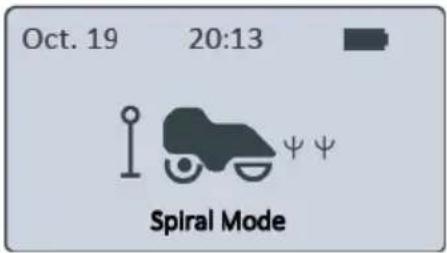 | 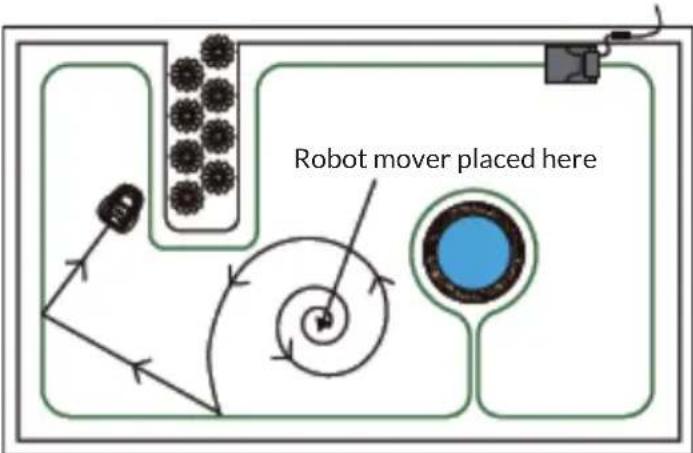 |
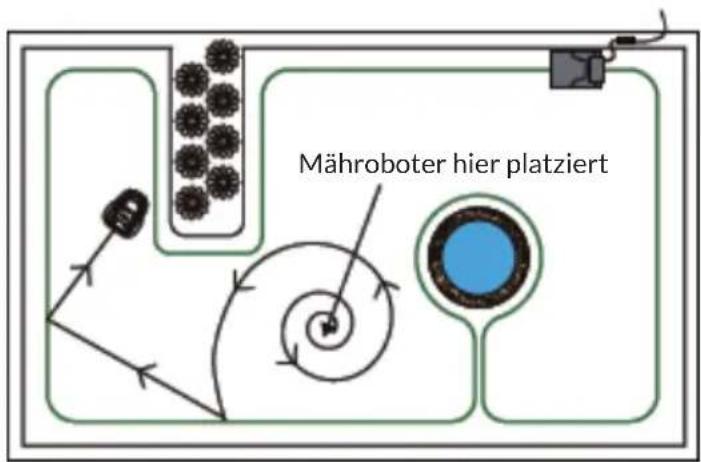
| 1. Place the robot mower in the garden.2. Press the OK button to enter sub-menu 1.3. Select “Spiral mode”.4. Close the cover to start. | The robot mower can be placed within the perimeter boundary and that the spiral mow function will mow in relatively uniform spiral pattern for 5 minutes. This is useful when you want to cover a specific area or clear grass on the first mow more quickly. |
Edge cutting
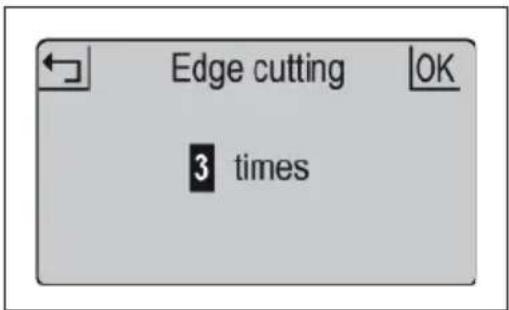
- Press the OK button to enter sub-menu 1.
- Select "setting" to enter sub-menu 2.
- Select "Edge cutting".
- Set the weekly execution frequency, 1-5 times (factory default is 3 times).
- Press the OK button to confirm the setting.
Rain mode
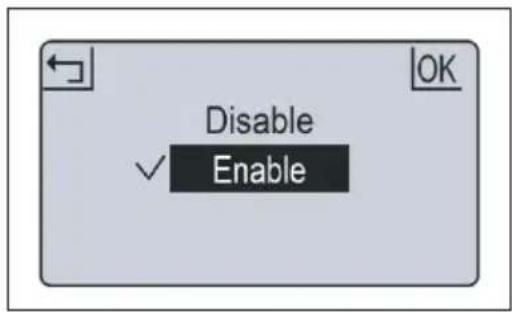
Rain mode sets if the robot mower will go out in rain or not. Disabling this will allow the robot mower to continue to work in the rain.
Note: Avoid activation during heavy rain and storms. Wet grass will cause additional load for the robot mower and mowing time may be reduced. In some cases the robot mower may not return to the charge base in rain.
- Press the OK button to enter sub-menu 1.
- Select "setting" to enter sub-menu 2.
- Select "rain mode".
- Press the UP ▲ and DOWN ▼ buttons to enable the rain mode.
- Press the OK button to confirm setting.
| Language Date and time | |
 | 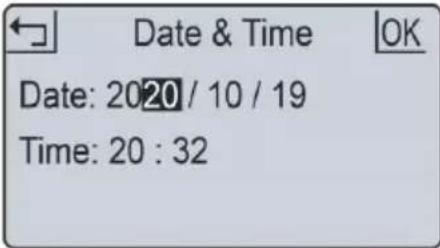 |
| 1. Press the OK button to enter sub-menu 1.2. Select “setting” to enter sub-menu 2.3. Select “Language”.4. Press the UP ▲ and DOWN ▼ buttons to select the desired language.5. Press the OK button to confirm setting. | 1. Press the OK button to enter sub-menu 1.2. Select “setting” to enter sub-menu 2.3. Select “date & time”.4. Press the UP ▲, DOWN ▼, LEFT ◀ and RIGHT ▶ buttons to set the date and time.5. Press the OK button to confirm setting. |
Note: Setting date and time accurately ensures scheduling is accurate.
| PIN code Change PIN code | |
| Enter PIN Code——— —— —— | UP= 'A'DOWN= 'B'LEFT= 'C'RIGHT= 'D'Old: _ _ _ _New: _ _ _ _Confirm: _ _ _ _ _ |
| 1. The PIN code should be entered after powering on, pressing the STOP button, and before clearing error status and changing the PIN code.2. If the PIN code is entered incorrectly, the screen will display "PIN incorrect, please retry" and the PIN code will need to be entered again.3. If the PIN code is entered incorrectly 3 times, the screen will be locked for 15 seconds. The lock time will double for further incorrect entries. | 1. Press the OK button to enter sub-menu 1.2. Select "setting" to enter sub-menu 2.3. Select "change PIN".4. Enter the original PIN code.5. Enter the new PIN code.6. Enter the new PIN code again. ("New passwords do not match" will be shown for inconsistent passwords.)7. Press the OK button to confirm. |
| Factory reset Error log | |
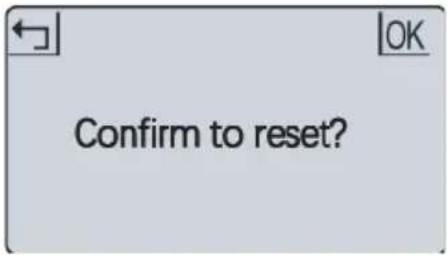 | 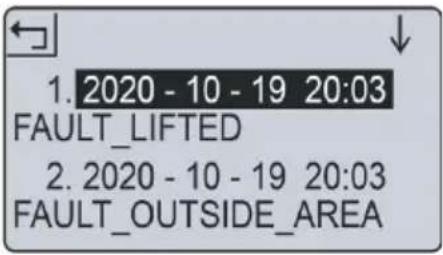 |
| 1. Press the OK button to enter sub-menu 1.2. Select “setting” to enter sub-menu 2.3. Select “Factory reset”.4. The screen will display “Confirm to reset?”5. Press the OK button to confirm. | 1. Press the OK button to enter sub-menu 1.2. Select “setting” to enter sub-menu 2.3. Select “information” to enter sub-menu 3.4. Select “error log”.5. The past 10 records (including date, time and error message) will be shown. |
Note: In the event of malfunction the error log will record all actions and can be used for service maintenance and fault finding.
Work log Save power & LED indicator
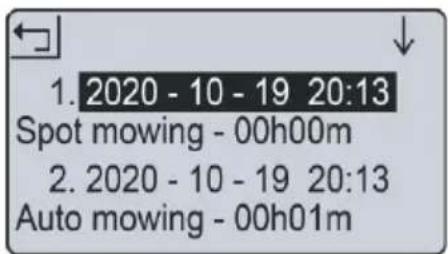
- Press the OK button to enter sub-menu 1.
- Select "setting" to enter sub-menu 2.
- Select "information" to enter sub-menu 3.
- Select "work log".
- The past 10 records (including date, time and work mode and work time) will be shown.
The backlight will switch off after 2 minutes and the robot mower will power off after 8 minutes, respectively, without user interference.
| LED on charge station Status | ||
| Solid red light Broken boundary wire | ||
| Flashing blue light Robot mower charging | ||
| Solid blue light Loop signal normal or fully charged | ||
| Sub-menu 1 Sub-menu 2 Sub-menu 3 | ||
| Spiral mode | ||
| Schedule | ||
| Zone | ||
| Setting | Work time | |
| Rain mode | ||
| WiFi setting | ||
| Change PIN | ||
| Date & time | ||
| Language | English | |
| Norsk | ||
| Svenska | ||
| Dansk | ||
| ... | ||
| Information | Error log | |
| Work log | ||
| About | ||
| Factory reset | ||
| Edge cutting | ||
REPAIR, CLEANING AND MAINTENANCE

WARNING
Risk of injury! Remove the safety key when the robot mower is not in use and before it is transported, cleaned or stored.
Repairing the boundary wire
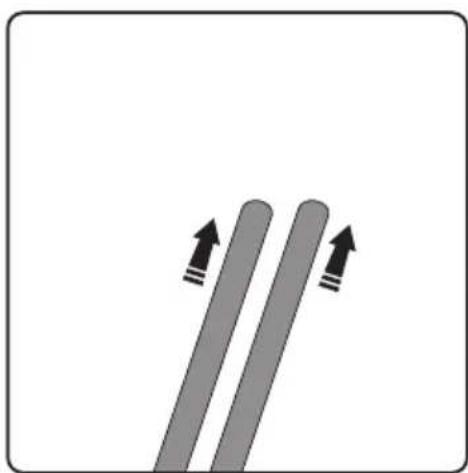
If the boundary wire gets cut or breaks for any reason (indicated by solid red light on charging station), you need to locate and repair it. You will need to use one of the splicing clips provided. First take up the slack in the wire so there is some overlap.
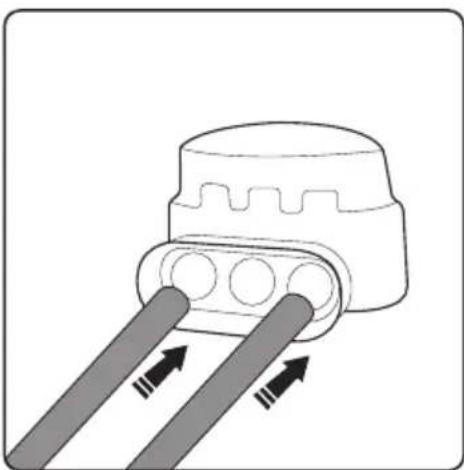
The clip has two channels in it. Push one end into one channel and the other end into the other. The wire needs to go right in, and can even protrude from the other end.
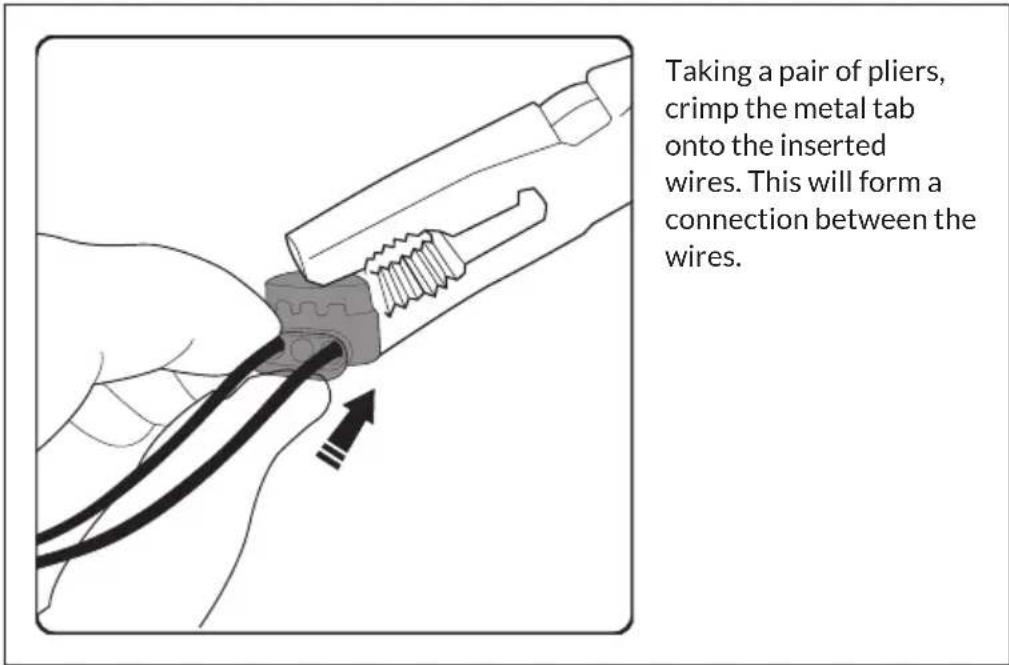
When the boundary wire is repaired the charging station will display a solid blue light. If the light is still red there are more breaks in the loop, which will need locating and repairing.
Replacing the blades

WARNING
Risk of injury! Wear protective gloves when handling, cleaning or replacing the blade.
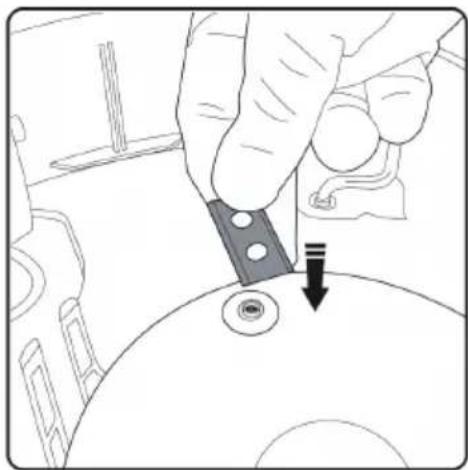
- Switch the robot mower off.
- Wear protective gloves.
- Turn the robot mower upside-down.
- Place blade over raised screw-hole.
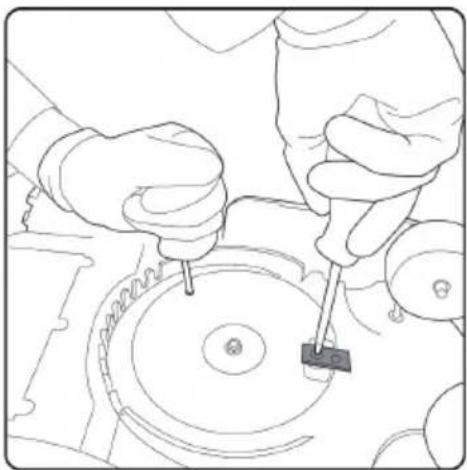
- Use a second screwdriver to anchor the blade plate while you attach the blade.
- Using a cross head screwdriver, secure the blade on the blade plate. The blade should be able to rotate freely once fitted.
- Repeat for other blades.
EN
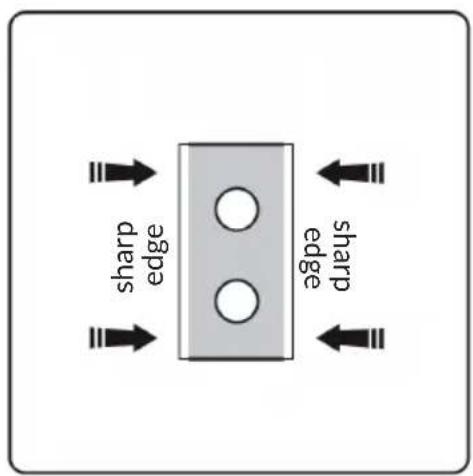
Re-orientate the blade (turn it around or turn it upside down) as each corner wears out until all four quarters of the blade have been used. If all four quarters have been used, then replace blade.
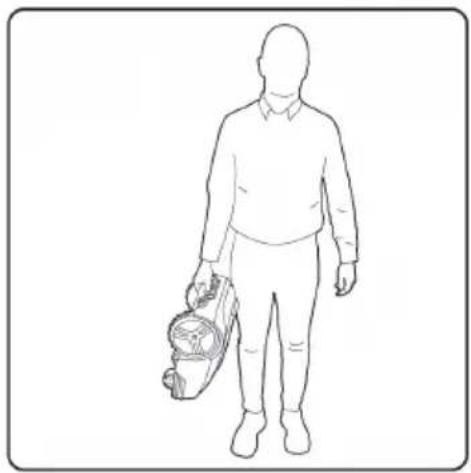
Carry the robot mower by the handle between the two rear wheels with the blades pointing outwards.
Cleaning and maintenance
- Check and clean the robot mower regularly once a week.
- When you first start using the robot mower, the blade plate, protections plate and blades should be checked once a month.
- It is important that the blades and blade plate rotate easily.
- Blade edges should not be damaged. Blade life depends on the type of grass, soil, lawn etc.
- Working with dull blades gives a poor mowing result, which needs more power to mow, meaning the robot mower covers a smaller area at a time.
- Charge the battery fully at the end of the season before winter storage. If storage time is longer than one year you will need to recharge the robot mower before use.
Winter storage
- The robot mower must be carefully cleaned before winter storage. Charge the battery fully before storage.
- Store the robot mower in the station and place in a dry area to protect from frost, preferably stored in the original packaging.
- Boundary wire can be left in your lawn. As the charging station is removed you should protect boundary wire end from moisture with electrical tape.
After winter storage
-
Check whether the robot mower, boundary wire and charging rods need to be cleaned before use. If the charging strips appear to be rusty, clean them by using an emery cloth or suitable abrasive cloth. Check whether the robot mower time and date are setting correctly.
-
Check whether the blades need to be changed.
-
Check whether the blades and blade plate turn easily.
TROUBLESHOOTING
| Error message Cause Solution | ||
| Mower outside The robot | mover is outside the perimeter. | Place the robot mover inside the perimeter. |
| Mower lifted The robot | mover is lifted away from the ground. | Move the robot mover to a flat part of the lawn. |
| Mower tilted The robot | mover is tilted too much. | Move the robot mover to a flat part of the lawn. |
| Mower overturned The robot | robot mover is upside down. | Return the robot mover to its normal position. |
| Mower trapped The robot | mover is trapped by obstacles. | Remove the obstacles. |
| Loop signal lost Power supply or the wire is not connected to the station, or wire is broken. | Check the power supply, station and wire are connected normally. Identify wire break and repair with wire splicer. | |
| Motor fault Blade motor | or drive motor is stuck. The motor current is too high. | Clear the grass or soil in cutting means and driving wheels. Cut the high and thick grass with a conventional lawn mower. |
| High temp The battery | temperature is too high. | Wait until the temperature decreases. |
| Battery abnormal The battery | battery is damaged. | Contact the manufacturer or the customer service. |
Wheel spinning faults where the robot mower will stop in a single spot and wheel(s) spin is a combination of uneven and/or wet ground. The solution is to add soil to level the ground. Ensure good drainage of the lawn before mowing, and not to mow during heavy rain and water logging.
If the boundary wires are in the wrong connectors (so the signal is clockwise not counter-clockwise) then the robot mower will attempt to be outside the perimeter. If the robot mower leaves the area constantly then change the wires around at the charging station (moving the wire in red connector to black and vice versa).
DEVICE CONTROL BY SMARTPHONE
If you integrate the device into your home WiFi, you can conveniently operate it via the associated Blumfeldt app. The app not only allows you to remotely control the device via your smartphone, but also gives you access to recipes and additional information.
Follow these steps to connect your smartphone to your Blumfeldt device:
1 Download the Blumfeldt app first by scanning the QR code with your smartphone (see below), or download it directly from App Store or Google Play.
2 Make sure your smartphone is connected to the same WiFi network that your Blumfeldt device is to be connected to.
3 Open the Blumfeldt app.
4 Sign in to your account. If you do not have an account, sign up in the Blumfeldt app.
5 Follow the instructions from the app.
App Download
Use the scan function of your smartphone to scan the QR code and save the app on your smartphone.
Note: The app provides further information on how to use the app and help on how to connect to your device as soon as you open it for the first time.

Troubleshooting connection problems
If your Blumfeldt device cannot be found in the WLAN, check the following:
1 The device is not plugged in. Make sure that your device is plugged into an electric socket.
2 The device is not in pairing mode. Make sure that the WiFi indicator (LED) on the smart device control panel is blinking as described in the 'Reset WiFi settings' instruction of your smart device (instructions are usually available on device connection process).
3 The WiFi access point does not operate on 2.4 GHz. Make sure that your access point operates on 2.4 GHz band and you have a separate SSID on 2.4 GHz band. If you are not sure about the operating band of your access point, please contact your internet provider company.
Important: please note that if your WiFi router is dual band - operating on both 2.4 GHz and 5 GHz band - you need to separate the SSIDs for each band and use the 2.4 GHz SSID for connection.
4 Firewall settings of your WiFi network; the firewall setting of your WiFi network may not allow the Blumfeldt app to configure the WiFi settings on your smart device. Please make sure that you are not using a public WiFi network, e.g. airports, dormitories, companies, etc.
5 Different credentials used in smartphone and the app. Make sure that the WiFi credentials entered in the Blumfeldt app are the same as the ones that your smartphone is connected to.
Following the above mentioned points, if your smart device still fails to connect to the app, please contact us via email for support: appsupport@go-bbg.com
DISPOSAL CONSIDERATIONS
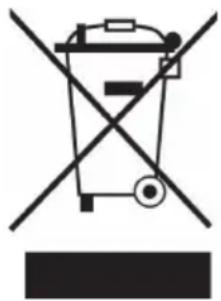
If there is a legal regulation for the disposal of electrical and electronic devices in your country, this symbol on the product or on the packaging indicates that this product must not be disposed of with household waste. Instead, it must be taken to a collection point for the recycling of electrical and electronic equipment. By disposing of it in accordance with the rules, you are protecting the environment and the health of your fellow human beings from negative consequences. For information about the recycling and disposal of this product, please contact your local authority or your household waste disposal service.
This product contains batteries. If there is a legal regulation for the disposal of batteries in your country, the batteries must not be disposed of with household waste. Find out about local regulations for disposing of batteries. By disposing of them in accordance with the rules, you are protecting the environment and the health of your fellow human beings from negative consequences.
DECLARATION OF CONFORMITY

Manufacturer:
Chal-Tec GmbH, Wallstrasse 16, 10179 Berlin, Germany.
Importer for Great Britain:
Berlin Brands Group UK Limited PO Box 42
272 Kensington High Street
London, W8 6ND
United Kingdom
Hereby, Chal-Tec GmbH declares that the radio equipment type Garden Hero Smart is in compliance with Directive 2014/53/EU. The full text of the EU declaration of conformity is available at the following internet address: use.berlin/10045967
For Great Britain: Hereby, Chal-Tec GmbH declares that the radio equipment type Garden Hero Smart is in compliance with the relevant statutory requirements. The full text of the declaration of conformity is available at the following internet address: use.berlin/10045967
Cher client, chère cliente,
SOMMAIRE
Fiche technique 94
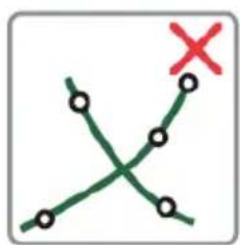
câbles
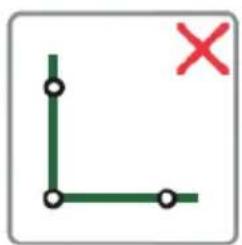
Petits angles aigus
Enfoncez le câble.
DÉCLARATION DE CONFORMITÉ

Fabricant :
Chal-Tec GmbH, Wallstraße 16, 10179 Berlin, Allemagne.
Berlin Brands Group UK Limited PO Box 42
272 Kensington High Street
London, W8 6ND
United Kingdom
ÍNDICE
Datos técnicos 138
![graph TD A["Colocar aíquí el robot cortacésped."] --> B["Cell with circular structures"] B --> C["Cell with spiral structure"] C --> D["Cell with circular structure"] D --> E["Cell with circular structure"] E --> F["Cell with circular structure"] style A fill:#f9f,stroke:#333 style B fill:#ccf,strok…](/content/2026/04/740971/images/a0b77487ee308749fc3a399f6c564c15df13e1e7b5565c7558ba0885743e4933.jpg)
Berlin Brands Group UK Limited PO Box 42
272 Kensington High Street
London, W8 6ND
United Kingdom
INDICE
Dati tecnici 182
cavi
nessun angolo retto
nessun angolo acuto
![graph TD A["Robot tagliaerba posizionato qui"] --> B["Central circular component"] B --> C["Arrow indicating direction"] C --> D["Arrow pointing inward"] D --> E["Arrow pointing inward"] E --> F["Arrow pointing inward"] F --> G["Arrow pointing inward"] G --> H["Arrow pointing inward"] H --> I["Arrow…](/content/2026/04/740971/images/892af1197453e6f5ffa56b2ffbbde029d44686ae68a14fccee4d90ac96a6daf7.jpg)
Berlin Brands Group UK Limited PO Box 42
272 Kensington High Street
London, W8 6ND
United Kingdom





- INHALTSVERZEICHNIS
- CONTENTS
- EXPLANATION OF THE WARNING SYMBOLS
- SYMBOLS ON THE ROBOT MOWER
- SAFETY INSTRUCTIONS
- WARNING
- PERSONAL SAFETY
- ELECTRICAL SAFETY
- BATTERY SAFETY
- MAINTENANCE
- DESCRIPTION
- APPLIANCE AND ACCESSORIES
- PREPARING THE LAWN FOR THE ROBOT MOWER
- RECTIFYING OR AVOIDING PROBLEM AREAS
- EXTRA LONG GRASS
- INSTALLING THE CHARGING STATION
- LAYING THE BOUNDARY WIRE
- INSTALLING THE ROBOT MOWER
- CONTROL PANEL
- START-UP AND OPERATION
- CUTTING HEIGHT ADJUSTMENT
- SET THE CUTTING HEIGHT
- FIRST USE
- THE FIRST MOWING PASSES
- NEW SEASON MOWING
- SWITCHING THE ROBOT MOWER ON AND OFF
- START MOWING
- WORK TIME SETTING
- CHARGING
- SCHEDULE
- ZONE
- SPIRAL MOWING (SPIRAL MODE)
- EDGE CUTTING
- RAIN MODE
- WORK LOG SAVE POWER & LED INDICATOR
- REPAIR, CLEANING AND MAINTENANCE
- REPAIRING THE BOUNDARY WIRE
- REPLACING THE BLADES
- CLEANING AND MAINTENANCE
- WINTER STORAGE
- AFTER WINTER STORAGE
- DEVICE CONTROL BY SMARTPHONE
- APP DOWNLOAD
- TROUBLESHOOTING CONNECTION PROBLEMS
- DISPOSAL CONSIDERATIONS
- DECLARATION OF CONFORMITY
- MANUFACTURER
- IMPORTER FOR GREAT BRITAIN
- CHER CLIENT, CHÈRE CLIENTE
- SOMMAIRE
- DÉCLARATION DE CONFORMITÉ
- FABRICANT
- ÍNDICE
- INDICE
Brand : Blumfeldt
Model : Garden Hero
Category : Robot mower