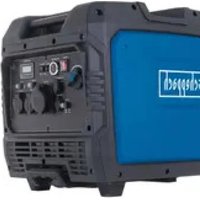
GE2900SE - Generator SCHEPPACH - Free user manual and instructions
Find the device manual for free GE2900SE SCHEPPACH in PDF.


| Product type | Generator |
| Brand | Scheppach |
| Model | GE2900SE |
| Continuous power (S1) | 2600 W |
| Max. power (S2 5 min) | 2900 W |
| Rated voltage | 2 x 230 V~ |
| Rated current | 11.3 A |
| Frequency | 50 Hz |
| Voltage regulator | AVR (Automatic Voltage Regulator) |
| Protection class | IP23M |
| Engine | 4-stroke, 1 cylinder, air-cooled |
| Displacement | 212 cm³ |
| Engine speed | 3000 min⁻¹ |
| Max. engine power | 4.15 kW (5.6 HP) |
| Fuel | Unleaded gasoline (octane rating ≥ 90) |
| Tank volume | 13.7 L |
| Recommended engine oil type | 10W30 / 15W40 |
| Oil quantity | 0.6 L |
| Consumption (2/3 load) | 1.4 L/h |
| Starter | Recoil starter |
| Weight | 40.0 kg |
| Sound power level (L_WA) | 93.6 dB(A) |
| Sound pressure level (L_pA) | 80.3 dB(A) |
| Spark plug | F7RTC |
| Power factor (cos φ) | 1 |
| Quality class | B |
| Operating mode S1 | Continuous operation at rated power |
| Operating mode S2 | Short-time operation (5 min) at max. power |
| Max. ambient temperature | 40 °C |
| Max. operating altitude | 1000 m |
| Included accessories | Manual, spark plug wrench, handles, wheels, rubber feet |
Frequently Asked Questions - GE2900SE SCHEPPACH
User questions about GE2900SE SCHEPPACH
0 question about this device. Answer the ones you know or ask your own.
Ask a new question about this device
Download the instructions for your Generator in PDF format for free! Find your manual GE2900SE - SCHEPPACH and take your electronic device back in hand. On this page are published all the documents necessary for the use of your device. GE2900SE by SCHEPPACH.
USER MANUAL GE2900SE SCHEPPACH
natural_image
Black portable electricity generator with visible control panel and wheels (no text or symbols)
GE2900SE
| DE | Benzin-StromgeneratorOriginalbedienungsanleitung | 6 |
| GB | Petrol power generatorTranslation of original instruction manual | 20 |
| FR | Groupe électrogèneTraduction des instructions d'origine | 31 |
natural_image
Technical line drawing of a portable electricity cooker with wheels and labeled component G (no text or symbols beyond labels)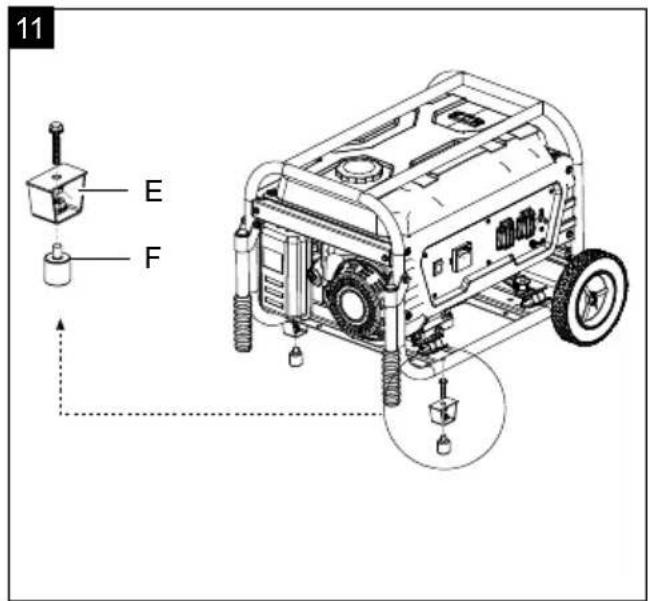
Günzburger Straße 69
D-89335 Ichenhausen
Verehrter Kunde
Homepage: https://www.scheppach.com/de/service
Explanation of the symbols on the device
 | Read the operating manual. Before using the device, always refer to the relevant section in the user manual. |
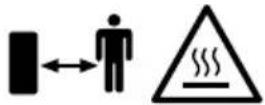 | Important. Hot parts. Keep your distance. |
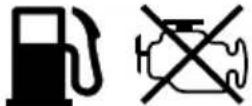 | Important. Always switch off the engine before refuelling. Do not refill during operation. |
 | Important. The exhaust gases are toxic. Do not operate the engine in areas that are not ventilated. |
 | Wear hearing protection. |
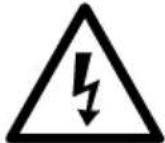 | Warning against electrical voltage |
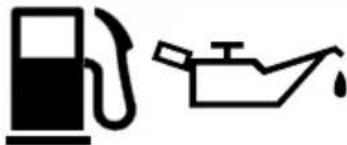 | Be very careful when dealing with fuels and lubricants! |
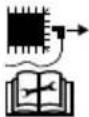 | Remove the ignition cable before carrying out maintenance work and read the instructions. |
 | Do not expose the device to rain. |
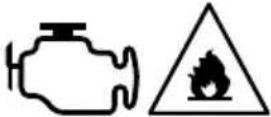 | Sparks are produced when the engine is started. These can ignite nearby flammable gases. |
 | Naked flames or smoking near the device is strictly prohibited! |
 | Guaranteed sound power level of the product. |
| △ Attention! | We have marked points in these operating instructions that impact your safety with this symbol |
Table of contents: Page:
- Introduction....22
- Device description (Fig. 1 - 11)....22
- Scope of delivery (Fig. 3)....22
- Proper use 22
- Safety information....23
- Technical data.... 25
- Unpacking 25
- Assembly / Before commissioning 25
- Start up 26
- Cleaning....27
- Transport....27
- Storage 27
- Maintenance 28
- Disposal and recycling....29
- Troubleshooting 30
- Declaration of conformity .... 51
1. Introduction
Manufacturer:
Scheppach GmbH
Günzburger Straße 69
D-89335 Ichenhausen
Dear Customer
We hope your new tool brings you much enjoyment and success.
Note:
In accordance with the applicable product liability laws, the manufacturer of this device assumes no liability for damage to the device or caused by the device arising from:
- Improper handling,
- Failure to comply with the operating instructions
• Repairs carried out by third parties, unauthorised specialists.
• Installing and replacing non-original spare parts
• Application other than specified - Failure of the electrical system in the event of the electrical regulations and VDE provisions 0100, DIN 13 / VDE0113 not being observed
Please consider:
The operating manual is part of this product.
It includes important instructions for the safe, proper and economic operation of the product, for avoiding danger, for minimising repair costs and downtimes and for increasing the reliability and extending the service life of the product. In addition to the safety instructions in this operating manual, you must also observe the regulations applicable to the operation of the product in your country. Familiarise yourself with all operating and safety instructions before using the product. Only operate the product as described and for the specified areas of application.
Keep the operating manual in a good place and hand over all documents when passing the product on to third parties.
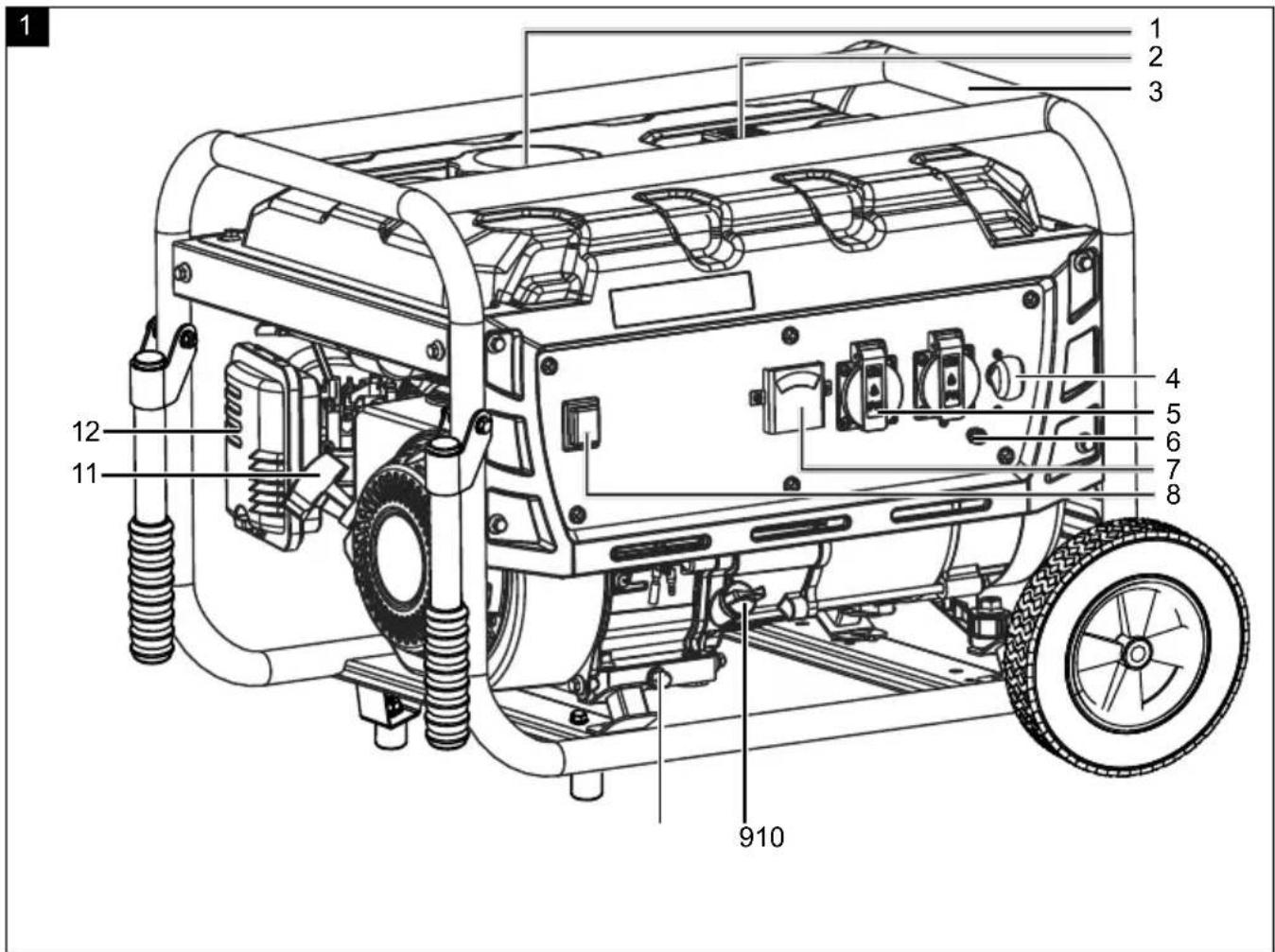
2. Device description (Fig. 1 - 11)
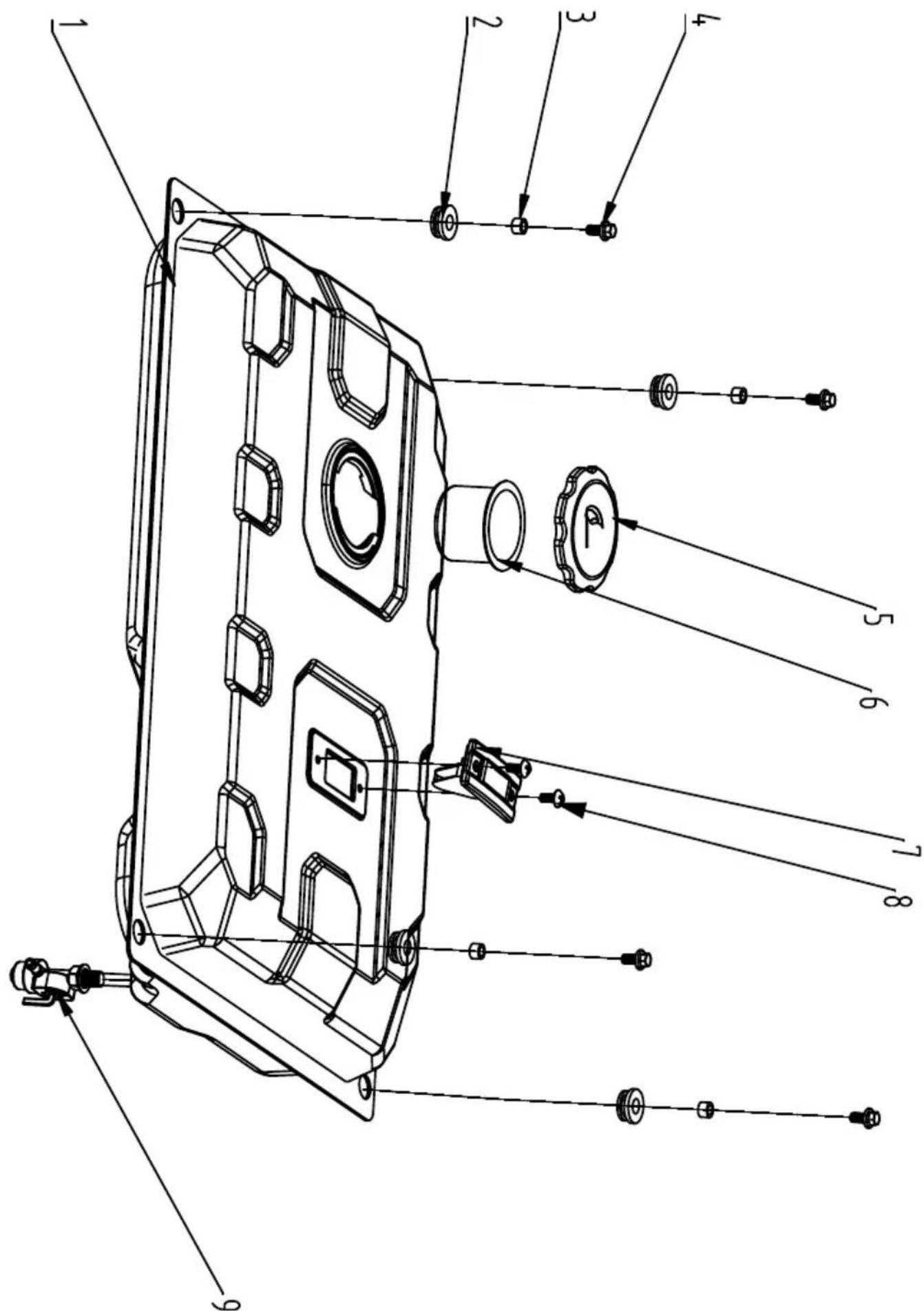
- Tank cover
- Fuel gauge
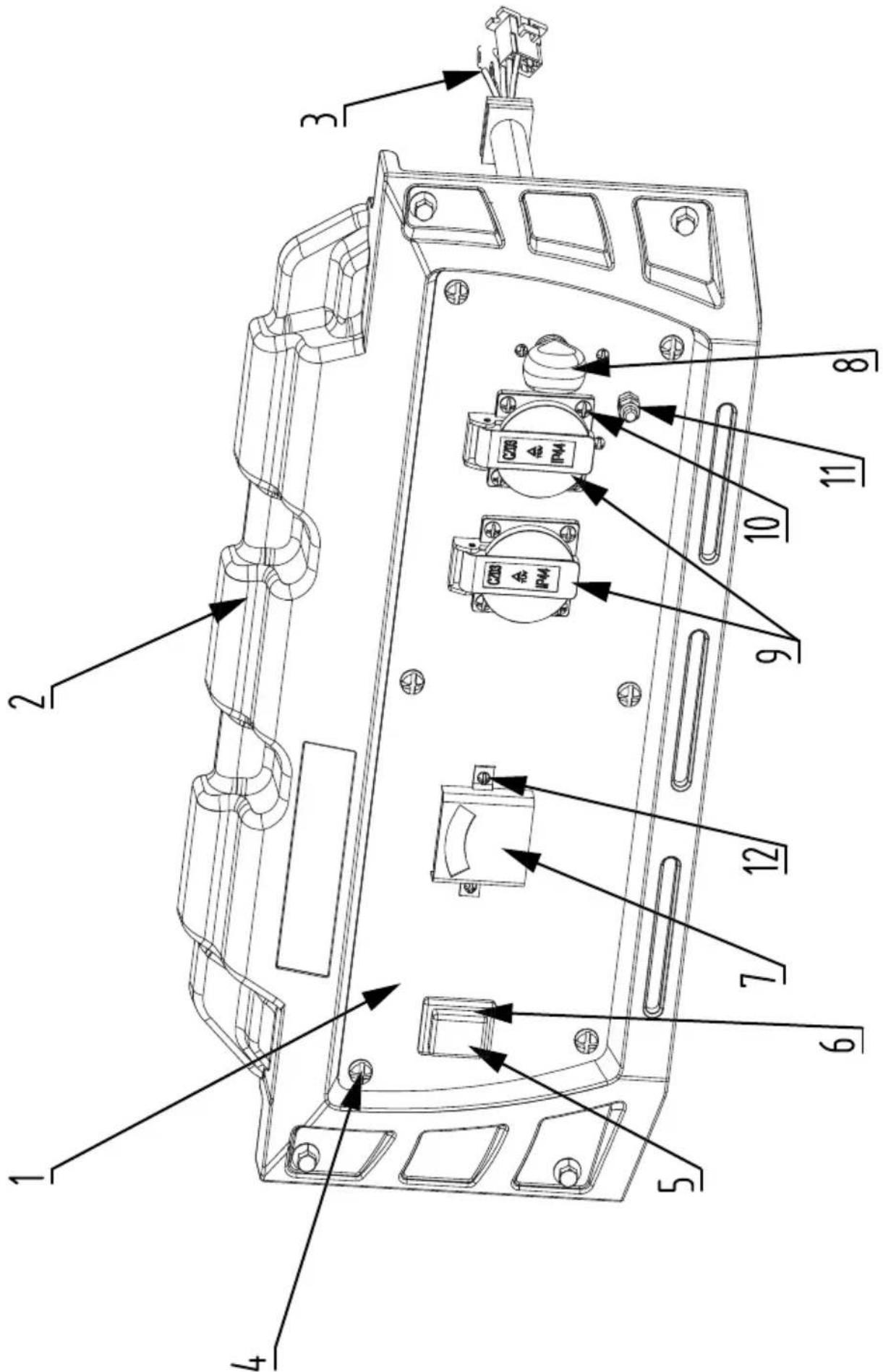
- Frame
- Disconnector
- 230 V socket (2x)
- Earthing screw
- Voltmeter
- On/off switch
- Oil filler cap with dipstick
- Oil drain screw
- Reverse starter
- Air filter cover
- Petrol shut-off valve
- Choke
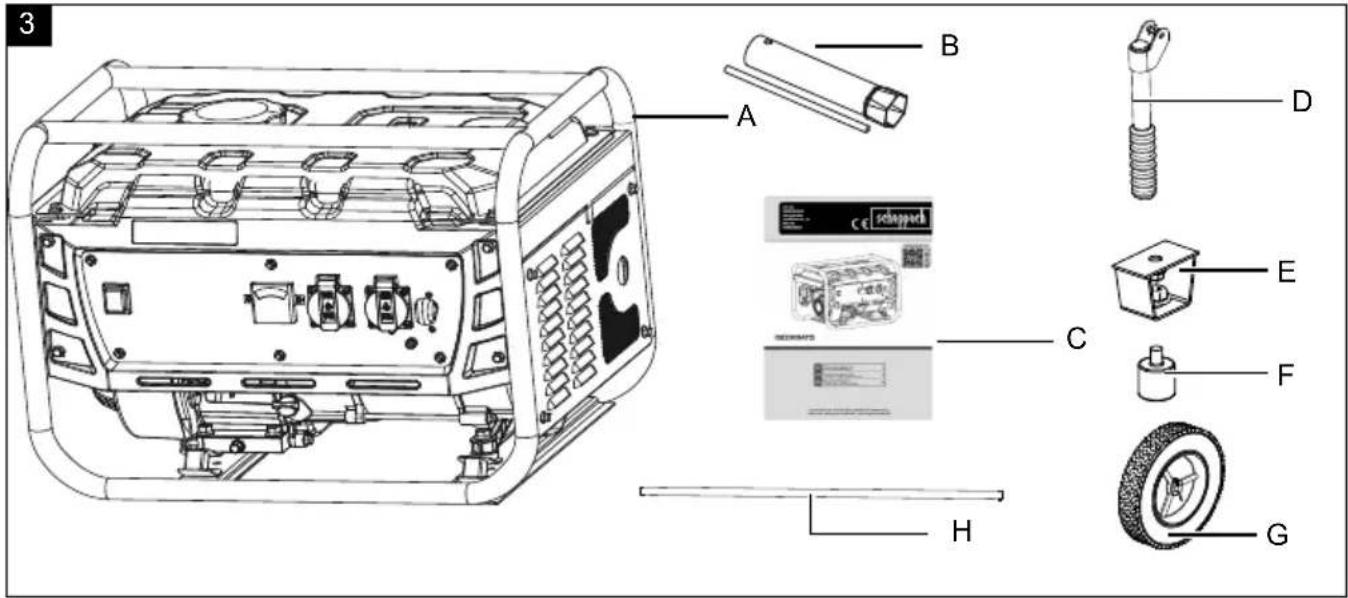
3. Scope of delivery (Fig. 3)
A. Generators
B. Spark plug wrench
C. Operating manual
D. Handles
E. Rubber foot holder
F. Rubber foot
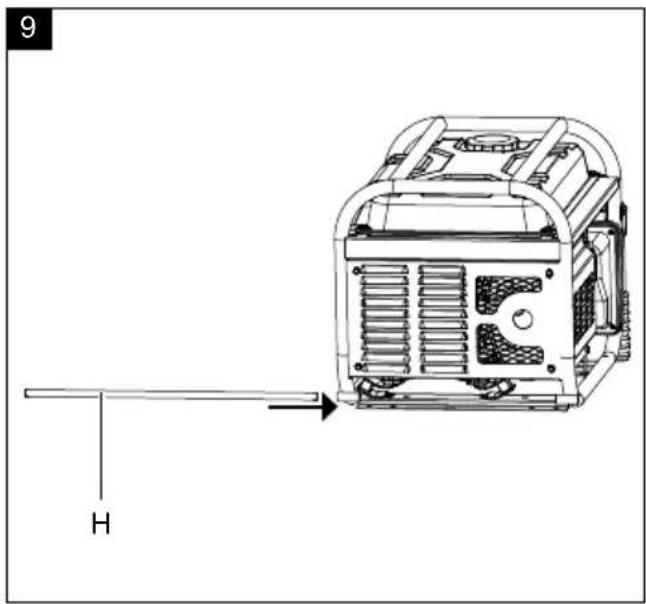
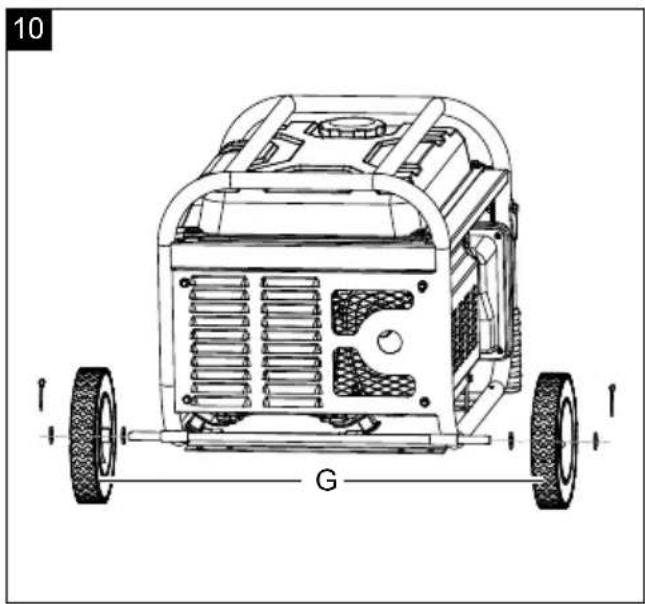
G. Wheels
H. Wheel axle
4. Proper use
The machine may only be used in the intended manner.
Any use beyond this is improper.
The user/operator, not the manufacturer, is responsible for damages or injuries of any type resulting from this.
An element of the intended use is also the observance of the safety instructions, as well as the assembly instructions and operating information in the operating manual.
Persons who operate and maintain the machine must be familiar with it and must be informed about potential dangers.
In addition, the applicable accident prevention regulations must be strictly observed. Other general occupational health and safety-related rules and regulations must be observed. The liability of the manufacturer and resulting damages are excluded in the event of modifications of the machine.
This power unit can power light bulbs, heaters, drills, water pumps, etc. Do not exceed the load limit specified for the power unit.
The power unit may not be used to power devices that have a high power requirement.
The power unit cannot be used for precision devices such as computers. These precision devices may be damaged under certain circumstances by distortions caused by the broad wave when the power unit's power is output. Do not connect the power unit to the electrical installation of a building.
- Only use the generator when in a technically fault-less condition, appropriately and in compliance with the operating manual and with full knowledge of safety and hazards!
- In particular, rectify malfunctions that could impair safety immediately (or commission rectification works accordingly)!
- The safety, operating and maintenance specifications of the manufacturer, as well as the dimensions specified in the technical data, must be observed.
- Relevant accident prevention regulations and other generally recognized safety and technical rules must also be observed.
- The generator may only be used, maintained or repaired by persons who are familiar with it and have been informed of the dangers. The manufacturer shall not be liable for damage resulting from unauthorised changes to the machine.
- The generator may only be used for the work for which it is built and which described in the operating manual.
- The generator may only be operated with original accessories and original tools from the manufacturer.
- Any use beyond this is improper use. The manufacturer is not responsible for the resulting damages; the user solely bears the risk.
Please observe that our equipment was not designed with the intention of use for commercial or industrial purposes. We assume no guarantee if the equipment is used in commercial or industrial applications, or for equivalent work.
5. Safety information
This unit conforms to the prescribed safety regulations for electrical machines
- Read the usage instructions carefully before starting the generator.
- Improper use may lead to personal injury and damage to property. Persons who are unfamiliar with the instructions may not operate the unit. Store the user manual carefully.
• Children and young persons may not use this unit. - The manufacturer does not take any responsibility for damage caused by improper use or changes to the machine.
- Also adhere to the safety information, the assembly and operating instructions, as well as the accident prevention regulations that are generally applicable.
Important note:
Ensure that persons who work with this unit have read and understood these operating instructions before operating the unit.
Never use this unit inside buildings or in an environment that does not have ventilation.
The exhaust gases contain carbon monoxide, which is an odourless, poisonous gas.
Attention!
The voltage of the generator fluctuates; this may cause damage to the following devices:
- Television sets, audio-video devices,
- products or devices with electronic control
Safety information
Read this manual carefully – familiarise yourself with this device. Observe the instructions for use, restrictions and possible dangers that apply to this device.
- Only set up the device on a firm surface.
- The load must not exceed the power specified on the type plate of the generator. Overloading causes damage to the device or shortens the service life.
- The engine may not be operated at an excessive speed. Operating the engine at an excessive speed increases the danger of injury. Parts that influence the standard speed must not be changed.
- Before making any adjustments to the generator or engine, be sure to remove the spark plug or ignition cable to prevent accidental starting.
• Devices with faulty or missing parts or without a protective housing or cover may not be operated.
Information about spare parts can be obtained from your customer service.
- Do not operate or store the device in a wet or damp environment or on highly conductive surfaces such as metal coating or steel structures. When operating the device under conditions such as those mentioned above, always wear rubber gloves and boots as well as an earth circuit breaker.
- Keep the generator clean and free of oil, dirt and other foreign bodies.
- Ensure that extension cables, power cables and all electrical components are in perfect condition. Never operate electrical devices with damaged or defective cables.
- To prevent burns, do not touch the exhaust pipe and other engine and generator parts that heat up during operation.
- Do not connect the device to household sockets.
- Do not connect to other power sources.
Do not operate the generator under the following conditions:
- When changing the engine speed
- When decreasing the electrical power
- When misfiring occurs
• In the event of spark formation
• In the event of excessive vibration - When flames or smoke occur
• In enclosed spaces - When raining or in rough weather
• In enclosed room sections - When raining or in rough weather
• In the event of overheating in connected devices
• In the event of damage to the sockets
Check the fuel system regularly for leaks and signs of wear such as rubbed or porous lines, loose or missing clamps and damage to the tank or tank cover. All faults must be remedied before operation.
The generator may only be operated, maintained and refilled under the following conditions:
- Sufficient ventilation. Avoid environments in which steam can accumulate, e.g. trenches, cellars, excavations and bilges. Observe air flow and temperature. An ambient temperature of 40°C should not be exceeded.
-
In enclosed spaces, discharge hazardous exhaust gases via pipes. The engine exhaust gases contain carbon monoxide, a toxic, odourless and colourless gas that causes serious damage to health or death when inhaled.
-
Only refuel the generator when there is sufficient illumination. Avoid spilling fuel. Never refuel the generator during operation. Allow the engine to cool for approx. two minutes before refuelling.
- Do not carry out fuelling in the vicinity of open flames, control lamps or spark forming electrical devices such as electrical tools, welding machines and grinding machines.
- Check the silencers and air filters for perfect condition. These parts are used as flame protection in the event of backfires.
- Do not smoke near the generators. Do not wear loose clothing, jewellery or similar objects which can get caught by the starter or other rotating parts.
The generator has been built according to the state-of-the-art and the recognised technical safety rules. However, individual residual risks can arise during operation.
Furthermore, despite all precautions having been met, some non-obvious residual risks may still remain.
- Residual risks can be minimised if the "Safety instructions" and the "Proper use" are observed along with the whole of the operating instructions.
Dangers and protective measures
Exhaust gases:
Inhaling of exhaust gases
Only use the device outdoors
Electric shock:
Touching the spark plug
Do not touch the spark plug connector when engine is running
Burns:
Touching the exhaust pipe
Leave the device to cool down
Fire - explosion:
Petrol is flammable
Smoking is prohibited when refuelling and working
⚠ WARNING! This power tool generates an electromagnetic field during operation. This field can impair active or passive medical implants under certain conditions. In order to prevent the risk of serious or deadly injuries, we recommend that persons with medical implants consult with their physician and the manufacturer of the medical implant prior to operating the power tool.
6. Technical data
Voltage control AVR
| Protection category IP23M | |
| Continuous output P_nenn (S1) | 2600 W |
| max. Power P max. (S2 5 min) | 2900 W |
| Rated battery voltage U_nenn | 2 - 230 V~ |
| Rated current I_nenn | 11.3 A |
| Frequency F_nenn | 50 Hz |
| Drive motor type | 4-stroke 1 cylinder air-cooled |
| Displacement | 212 cm ^3 |
| Motor speed | 3000 min ^-1 |
| Max. power (engine) | 4.15 kW |
| Fuel | Unleaded petrol |
| Tank contents | 13.7 l |
| Engine oil type (recommended) 10W30 / 15W40 | |
| Oil volume (approx.) | 0.6 l |
| Consumption at 2/3 load | 1.4 l/h |
| Weight | 40.0 kg |
| Performance class | G1 |
| Power factor cos φ | 1 |
| Quality class | B |
| Max. temperature. | 40 °C |
| Max. altitude (above mean sea level) | 1000 m |
| Starter | Pull cable starter |
| Spark plug | F7RTC |
Technical changes reserved!
Operating mode S1 (continuous operation)
The machine may be operated continuously with the specified power.
Operating mode S2 (short-term operation)
The machine may only be operated at maximum power for a brief time. Then, the machine must be brought to a standstill for a period of time so that it is not allowed to heat up.
Noise
⚠ Warning: Noise can have serious effects on your health. If the machine noise exceeds 85 dB, please wear suitable hearing protection.
Noise data
| Sound power level L_WA | 93.6 dB | |
| Uncertainty K_WA | 1.89 | dB |
| Sound pressure level L_pA | 80.3 dB | |
| Uncertainty K_pA | 3 dB |
7. Unpacking
- Open the packaging and carefully remove the device.
- Remove the packaging material, as well as the packaging and transport safety devices (if present).
- Check whether the scope of delivery is complete.
- Check the device and accessory parts for transport damage.
- If possible, keep the packaging until the expiry of the warranty period.
⚠️ DANGER
The device and the packaging are not children's toys! Do not let children play with plastic bags, films or small parts! There is a danger of choking or suffocating!
8. Assembly / Before commissioning
ATTENTION!
Always make sure the device is fully assembled before commissioning!
Your machine is not fully assembled.
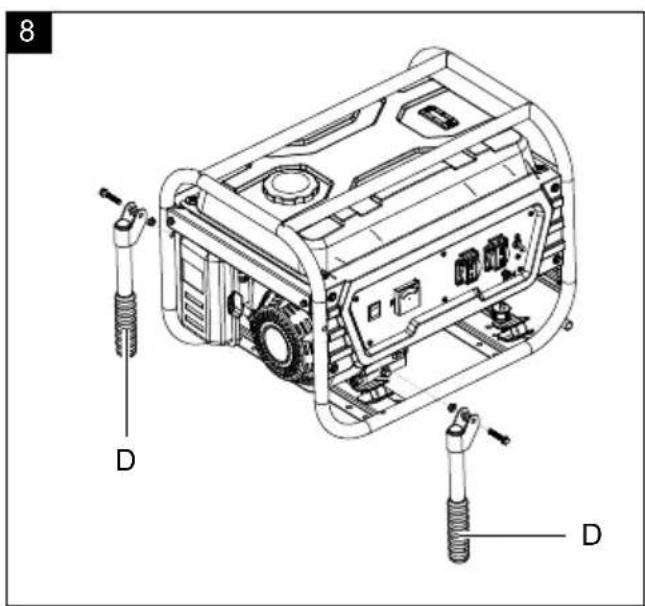
Mounting the transport handles (Fig. 8)
- Mount the transport handles (D) as shown.
Mounting the wheels (Fig. 9, 10)
- Mount the enclosed wheels (G) as shown.
Mounting the feet (Fig. 1)
- Mount the enclosed feet (E, F) as shown.
Attention! Fill the oil before first use.
Before each use, check the oil level with the engine switched off and on a level surface. Use the highest quality four-stroke oil or an HD oil with the same level of quality.
Check the oil level (Fig. 4+5)
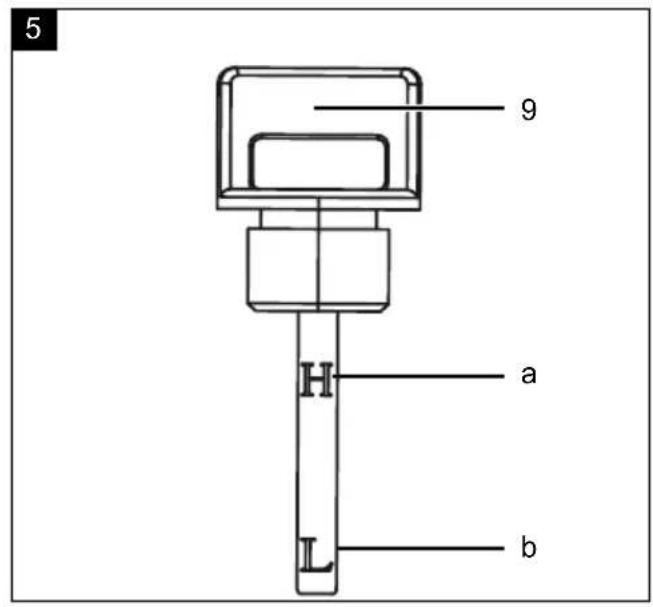
Remove the oil filler cap (9) and wipe the dipstick clean. Check the oil level by inserting the dipstick into the filling nozzle without screwing the cap on. If the oil level is too low, refill with the recommended oil. The oil level must be between marks (a) and (b).
Oil warning system
The oil warning system is configured to avoid damage to the engine due to a lack of oil in the spherical housing. Before the oil level in the spherical housing can drop below the safety level, the oil warning system automatically cuts the engine off. If the oil warning system cuts the engine off, refill the engine oil.
Refuelling
Warning! Petrol is highly inflammable and explosive. When handling fuels, you may suffer burns or other severe injuries. Use petrol with an octane rating of at least 90 octane. Only use fresh, clean fuel. Water or impurities in the petrol damage the fuel system.
Tank volume:13.7 litres
- Only fill the tank up to the marking in the fuel strainer.
• Note that fuel expands. - Refuel in a well-ventilated area with the engine stopped. If the engine was in operation immediately before, allow it to cool first.
- Never refuel the engine in a building where the petrol vapour may come into contact with flames or sparks.
- Do not smoke whilst refuelling or in the area in which the petrol is stored and prevent naked flames or sparks under these circumstances.
• After refuelling, ensure that the tank cover is closed correctly and securely again. Take care! - Mop up spilled petrol immediately.
- If petrol is spilled, ensure that the area is dried before starting the engine.
- Avoid repeated or long contact of the fuel with the skin and avoid breathing in the fumes.
- Keep the fuel out of the reach of children.
- If there are occasional taps or knocks from the engine, you should use a different brand of petrol. If this does not solve the problem, contact an authorised dealer.
WARNING: Operating the engine with continuous ignition tapping or knocking can result in damage to the engine.
Operating the engine with continuous ignition tapping or knocking is considered improper use. The manufacturer is not responsible for the resulting damages; the user solely bears the risk.
9. Start up
Earthing the generator
Earthing the housing is possible to discharge static charging. To do this, connect a cable on one side to the earth connection (6) of the power generator and on the other side to an external mass rising pipe (e.g. rod earth).
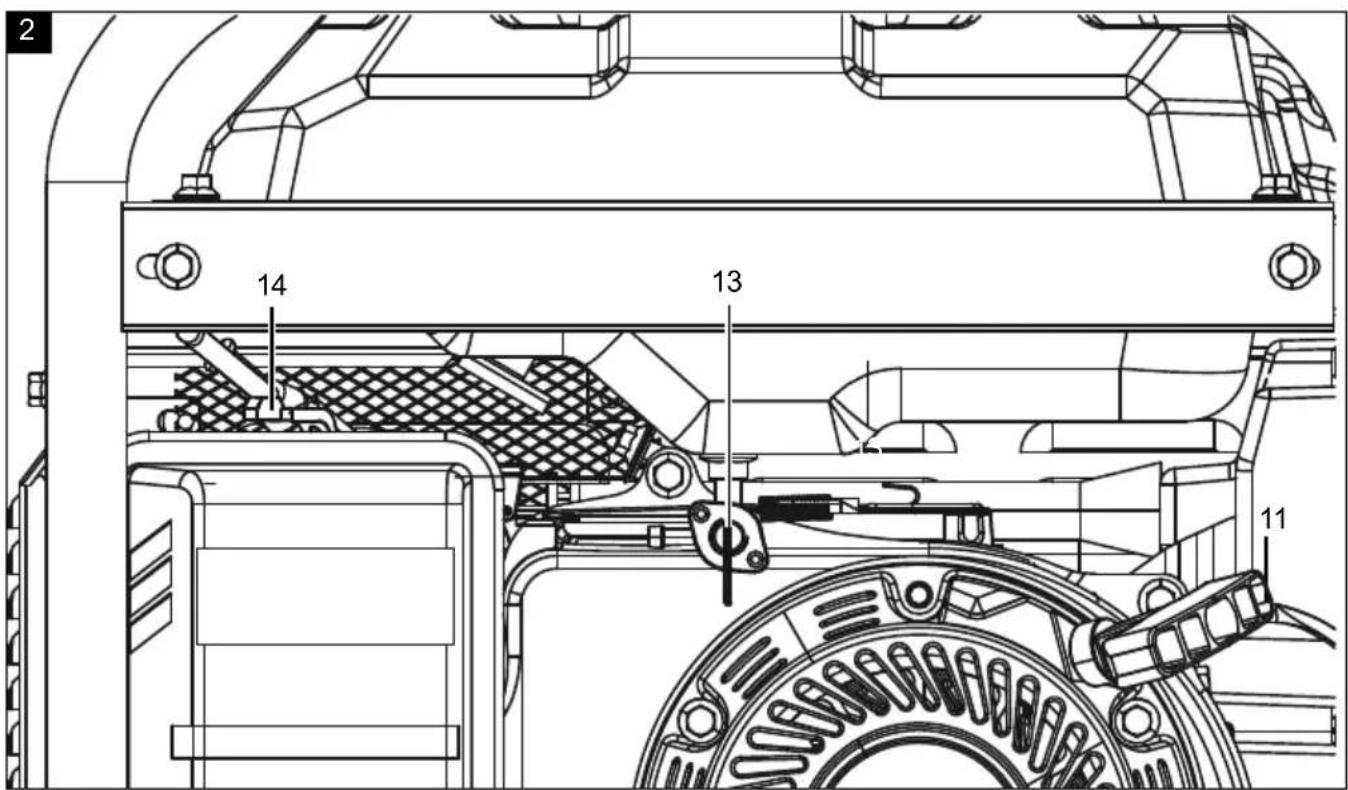
Starting the engine (Fig. 1 + 2)
NOTE: Do not connect the electrical device before starting the engine.
- Turn the fuel valve key (13) to "ON".
When the engine is cold:
- Move the choke lever (14) in the direction of the arrow to CLOSED.
- Turn the engine switch (8) to the ON position.
- Pull the recoil starter (11) slowly until resistance is noticeable. Then pull hard.
- Move the choke lever (14) back to the OPEN position against the direction of the arrow while the engine warms up.
When the engine is warm:
Set the choke lever (14) to OPEN against the direction of the arrow.
- Turn the engine switch (8) to the ON position.
- Pull the recoil starter (11) slowly until resistance is noticeable. Then pull hard.
WARNING: Ensure that you do not injure your fingers. If the motor does not start and a piston was not raised completely, the starter grip may suddenly spring back to the engine. Avoid the starter grip springing back against the engine. Feed it back slowly by hand to ensure that the cover is not damaged.
Shutting the engine off
- Allow the power generator to run for a short time without load before switching it off so that the unit can "cool down".
- Set the on/off switch (8) to the "OFF" position.
- Close the fuel valve (13).
Electrical devices that can be connected
This power unit can power light bulbs, heaters, drills etc. Do not exceed the load limit specified for the power unit.
The power unit may not be used to power devices that have a high power requirement.
The power unit cannot be used for precision devices such as computers. These precision devices may be damaged under certain circumstances by distortions caused by the broad wave when the power unit's power is output. Do not connect the power unit to the electrical installation of a building.
WARNING: Connection to the electrical installation of a building may result in the electric current being returned to the mains supply wires. This return causes a risk of a fatal electric shock for employees of the electricity supplier or other persons who touch the wires during a power failure.
Connection to the electrical installation of a building can also cause the electric current of the electricity supplier to return to the power unit. When the mains supply is restored, the power unit may explode, burn or cause a fire to break out in the electrical installation of the building.
Disconnector (4)
The circuit breaker automatically disconnects the power unit in the event of a short circuit or significant overload of the generator at the socket. If the fuse has automatically popped out to the off position, check that the connected electrical appliance is in good working order and does not exceed the circuit's permissible load limit before pushing the fuse back in.
10. Cleaning
Attention!
Always shut the engine down and remove the spark plug connector before carrying out any cleaning work.
We recommend that you clean the device directly after every use.
Clean the device at regular intervals using a damp cloth and a little soft soap. Do not use any cleaning products or solvents; they could attack the plastic parts of the device. Make sure that no water can penetrate the device interior.
11. Transport
Transport
- Allow the engine to cool before transporting.
- Before transporting the power unit, switch the engine switch (8) to the OFF position and turn the fuel valve (13) to the OFF position
- Keep the power unit level so that no petrol is spilled. Petrol vapour or spilled petrol may ignite.
- Ensure that the power unit does not fall and do not subject it to any blows during transport.
- Use the transport handles (D) and wheels (G) to move the device.
12. Storage
Store the device and its accessories in a dark, dry and frost-free place that is inaccessible to children. The optimum storage temperature lies between 5 and 30 °C. Store the power tool in its original packaging. Cover the power tool to protect it from dust or moisture. Store the operating manual with the power tool.
When storing for a long period of time
- Empty the fuel tank and run the carburettor empty.
- Unscrew the spark plug.
- Pour approximately 20 ml of clean engine oil through the spark plug hole into the cylinder.
- Pull the starter rope out slowly so that the oil distributes itself in the engine and screw the spark plug back in.
- Remove all dirt, deposits and dust from the engine and the cylinder head ridges.
- Clean the air filter or replace it if it is very dirty.
- Store the power generator securely in a dry place that is inaccessible to children.
- The unit may not be stored in the open.
- Cover the unit and the engine to protect against dust and store in a clean, dry place.
When re-commissioning after a long period of storage
- Change the engine oil.
- Fill with fresh petrol before starting the motor after the storage period.
If the engine is not used for more than one month, changes to the petrol quality may result in difficulties starting the engine or in other issues. To prevent this, loosen the carburettor's drain screw and allow the petrol to run out. Also open the fuel valve so that the petrol drains from the tank.
13. Maintenance
Attention!
Always shut the engine down and remove the spark plug connector before carrying out any maintenance work.
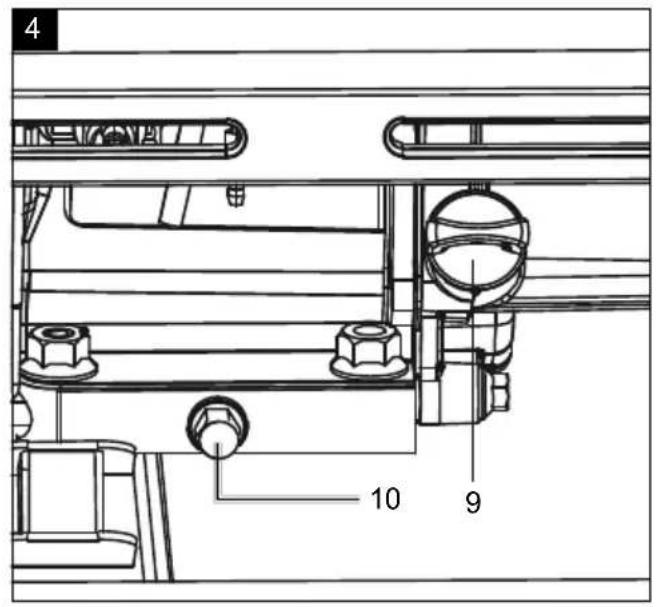
Changing the oil (fig. 4)
Change the engine oil after 25 operating hours, then after 50 hours or every three months.
Drain the engine oil when the engine is hot.
- Warm the engine up.
- Switch the engine off.
- Place a container that is large enough to collect the used oil under the oil drain screw (10).
- To drain the oil, remove the screw-on oil cap (9) and the oil drain screw (10).
- Drain the oil
- Re-attach the oil drain screw (10) with a sealing washer and tighten.
- Pour the recommended engine oil into the oil filler hole.
Note! Tightly screw the oil filler cap with dipstick (9).
Capacity: approximately 0.6 litres
Dispose of the drained oil properly at a local used oil collection point. Dumping used oil in the soil or mixing it with waste is prohibited.
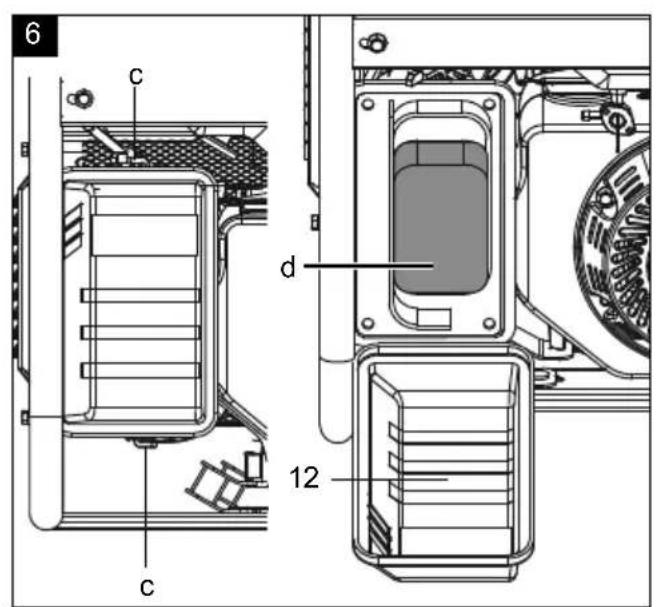
Clean the air filter (Fig. 6)
- Release the brackets (c)
- Remove the air filter cover (12).
- Remove the filter element (d).
Attention: Do not use petrol or cleaning solvents with a low flash point to clean the air filter element.
This could result in fire or explosion.
-
Clean the elements by knocking them out on a flat surface. If heavily soiled, wash with soapy water, then rinse with clean water and allow to air dry.
-
Attach the filter element (d).
-
Hook in air filter cover (12) and close clips (c).
If the engine is operated in very dusty environments, clean the air filter daily or after every ten operating hours.
Never run the engine without an air filter or with a damaged air filter. This would allow dirt into the engine, which would result in severe damage to the engine.
The manufacturer is not responsible for the resulting damages; the user solely bears the risk.
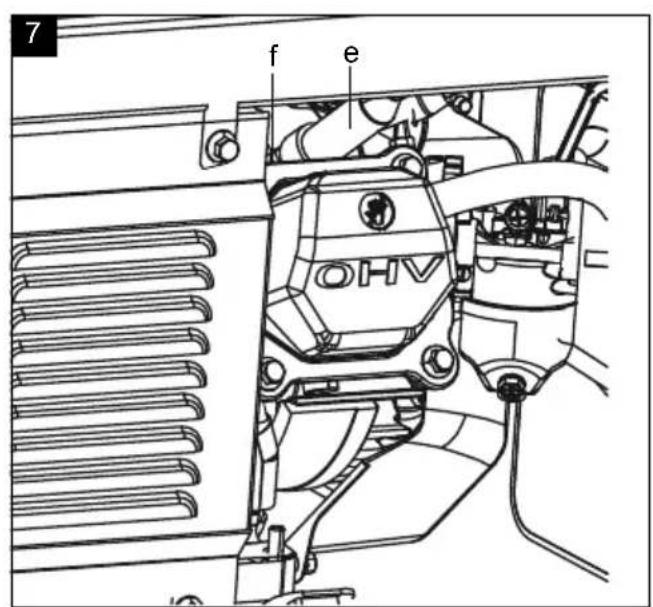
Check the spark plug (fig. 7)
Switch off the engine and allow it to cool.
Caution! Danger of burning
Clean or replace spark plug as required:
- Remove the spark plug connector (e) and clean any dirt from the spark plug area.
- Unscrew the spark plug (f) and check it.
- If there is any damage, e.g. cracks or chips, replace the spark plug.
- Clean the spark plug electrodes with a wire brush.
- Check and set the electrode gap.
- Screw the spark plug in and tighten with the spark plug spanner.
- Place the spark plug connector on the spark plug.
When replacing, ensure that no dirt gets into the cylinder head.
Check the fit of the spark plug.
A loose spark plug can cause damage to the engine by overheating.
Pulling too hard can damage the thread in the cylinder head.
The manufacturer is not responsible for the resulting damages; the user solely bears the risk. Only use the recommended spark plugs or identical spark plugs.
Important note in the case of repairs:
When returning the device for repair, please ensure for safety reasons that it is free of oil and fuel when it is sent to the service centre.
Service information
With this product, it is necessary to note that the following parts are subject to natural or usage-related wear, or that the following parts are required as consumables.
Wearing parts*:spark plug, air filter
* may not be included in the scope of supply!
Spare parts and accessories can be obtained from our Service Centre. To do this, scan the QR code on the cover page.
14. Disposal and recycling
Information on packaging


The packaging materials are recyclable. Please dispose of packaging in an environmentally friendly manner.
Notes on the electrical and electronic equipment act [ElektroG]
![SCHEPPACH GE2900SE - Notes on the electrical and electronic equipment act [ElektroG] - 1](/content/2026/04/738672/images/a0d00fad84fa9c984e5bfa8882b9638ddec22547d0f784d5d98357baab01c565.jpg)
Waste electrical and electronic equipment does not belong in household waste, but must be collected and disposed of separately!
- Used batteries or rechargeable batteries that are not installed permanently in the old appliance must be removed non-destructively before disposal. Their disposal is regulated by the battery law.
- Owners or users of electrical and electronic devices are legally obliged to return them after use.
- The end user is responsible for deleting their personal data from the old device being disposed of!
- The symbol of the crossed-out dustbin means that waste electrical and electronic equipment must not be disposed of with household waste.
-
Waste electrical and electronic equipment can be handed in free of charge at the following places:
-
Public disposal or collection points (e.g. municipal works yards)
- Points of sale of electrical appliances (stationary and online), provided that dealers are obliged to take them back or offer to do so voluntarily.
- Up to three waste electrical devices per type of device, with an edge length of no more than 25 centimetres, can be returned free of charge to the manufacturer without prior purchase of a new device from the manufacturer or taken to another authorised collection point in your vicinity.
- Further supplementary take-back conditions of the manufacturers and distributors can be obtained from the respective customer service.
- If the manufacturer delivers a new electrical appliance to a private household, the manufacturer can arrange for the free collection of the old electrical appliance upon request from the end user. Please contact the manufacturer's customer service for this.
• These statements only apply to devices installed and sold in the countries of the European Union and which are subject to the European Directive 2012/19/EU. In countries outside the European Union, different regulations may apply to the disposal of waste electrical and electronic equipment.
Fuels and oils
- Before disposing of the unit, the fuel tank and the engine oil tank must be emptied!
- Fuel and engine oil do not belong in household waste or drains, but must be collected or disposed of separately!
- Empty oil and fuel tanks must be disposed of in an environmentally friendly manner.
15. Troubleshooting
The following table shows fault symptoms and describes remedial measures in the event of your machine failing to work properly. If you cannot localise and rectify the problem with this, please contact your service workshop.
| Fault Possible cause Remedy | ||
| Engine will not start | No fuel in the tank. Fill the tank up. | |
| Fuel valve closed. Open the fuel valve. | ||
| Air filter dirty. Clean the air filter. | ||
| Engine switch is set to “OFF”. Set the engine switch to “ON”. | ||
| Recoil starter defective. Repair the recoil starter. | ||
| No engine oil. Refill the engine oil. | ||
| Spark plug dirty. Clean the spark plug | ||
| Engine oil level too low (oil warning lamp is flashing). | Refill the engine oil. | |
| On/off switch for motor operation set incorrectly. | Set to the correct position | |
| Engine is running loudly/irregularly | Spark plug dirty Clean/replace the spark plug. | |
| Air filter severely dirty Clean/replace the air filter. | ||
| Fuel contaminated/stale Drain and replace the fuel. | ||
| Choke lever to “CHOKE” | Turn the choke lever to the “RUN” position | |
| Incorrect fuel - diesel instead of petrol | Drain the fuel and fill with the correct fuel | |
| No electrical output | Fault in the a.c. power generator | For service under warranty, inform your representative |
| Engine will not switch off | Ignition switch-off wire defective | Close the fuel valve and wait until the engine shuts off; call customer service |
Günzburger Straße 69
D-89335 Ichenhausen
Cher client,
natural_image
Technical line drawing of a multi-wheeled vehicle chassis with exploded components (no text or labels)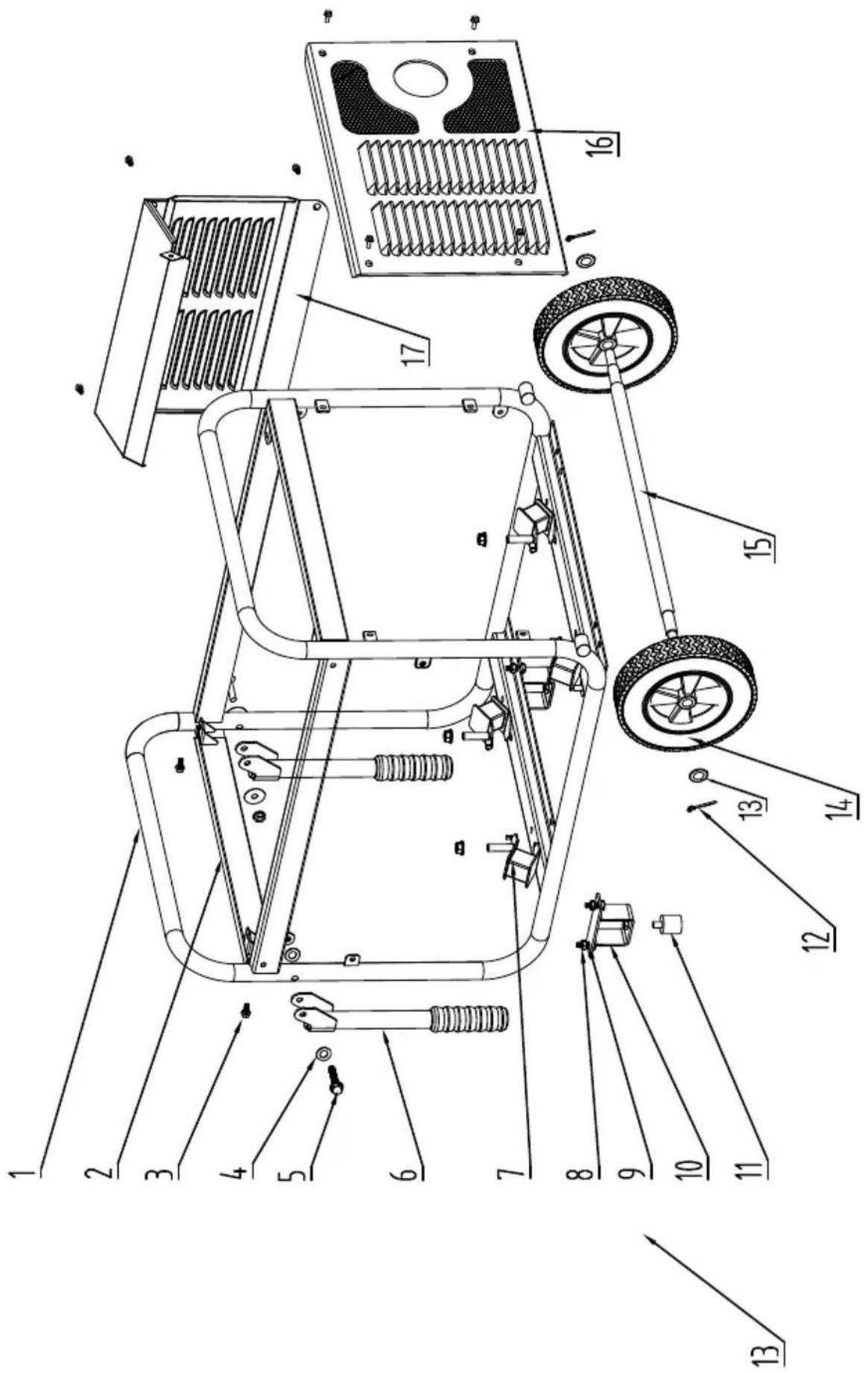
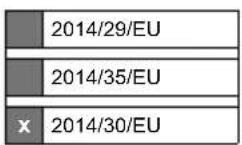
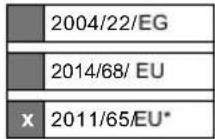
EU Declaration of Conformity
STROMGENERATOR - GE2900SE
POWER GENERATOR - GE2900SE
GROUPE ÉLECTROGÈNE - GE2900SE
5906239952
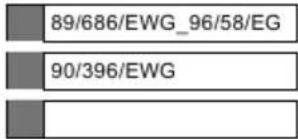
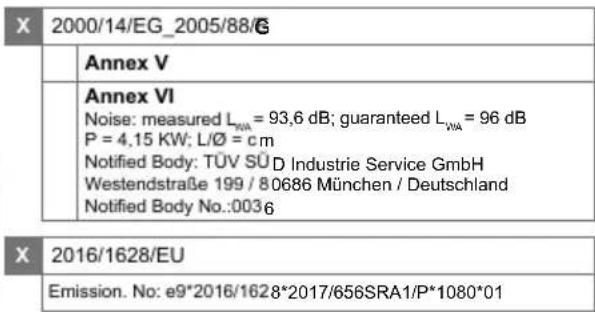
| x 2006/42/EG | |
| Annex IV Notified Body: Notified Body No.: Certificate No.: | |
Standard references:
EN ISO 8528-13:2016; EN 55012:2007/A1:2009; EN IEC 61000-6-1:2019
This declaration of conformity is issued under the sole responsibility of the manufacturer.
The object of the declaration described above fulfils the regulations of the directive 2011/65/EU of the European Parliament and Council from 8th June 2011, on the restriction of the use of certain hazardous substances in electrical and electronic equipment.
Subject to change without notice
Documents registrar: Niko Vraschek
Günzburger Str. 69, D-89335 Ichenhausen
Garantie DE
Apparent defects must be notified within 8 days from the receipt of the goods. Otherwise, the buyer's rights of claim due to such defects are invalidated. We guarantee for our machines in case of proper treatment for the time of the statutory warranty period from delivery in such a way that we replace any machine part free of charge which provably becomes unusable due to faulty material or defects of fabrication within such period of time. With respect to parts not manufactured by us we only warrant insofar as we are entitled to warranty claims against the upstream suppliers. The costs for the installation of the new parts shall be borne by the buyer. The cancellation of sale or the reduction of purchase price as well as any other claims for damages shall be excluded.