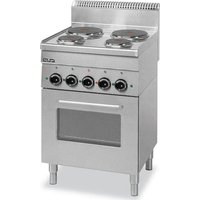
E4F6 - Cooker MBM - Free user manual and instructions
Find the device manual for free E4F6 MBM in PDF.


| Product type | Professional cooker |
| Brand | MBM |
| Model | E4F6 |
| Power supply | Electric (cable connection) |
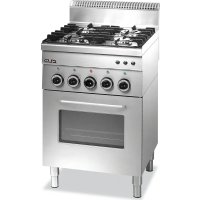
| Hob type | Cooktop with 4 burners (electric) |
| Oven type | Electric oven with grill function |
| Hob adjustment | 6 positions (0 to max) for power |
| Oven adjustment | Thermostat with grill position |
| Indicator lights | Green light (power on) and red light (heating) |
| Oven capacity | Cooking space suitable for standard baking sheets (rack included) |
| Material | Stainless steel |
| Dimensions (W x D x H) | Approximately 900 x 900 x 850 mm (estimate) |
| Weight | Approximately 100 kg (estimate) |
| Operating ambient temperature | +10 °C to +40 °C |
| Max relative humidity | 80% |
| Safety | Safety thermostat, emergency stop, burn protection |
| Daily cleaning | Cleaning with non-abrasive detergent and sponge, rinsing with drinking water |
| Maintenance | Weekly cleaning of burners and grills, annual check by a technician |
| Installation instructions | Installation by a qualified technician, compliance with electrical standards |
| Warranty | 12 months (parts and labor according to terms) |
| Spare parts | Original parts available from the manufacturer |
| Repairability | Repairs reserved to authorized technician |
| Usage | Professional (restaurants, canteens, bakeries) |
Frequently Asked Questions - E4F6 MBM
User questions about E4F6 MBM
0 question about this device. Answer the ones you know or ask your own.
Ask a new question about this device
Download the instructions for your Cooker in PDF format for free! Find your manual E4F6 - MBM and take your electronic device back in hand. On this page are published all the documents necessary for the use of your device. E4F6 by MBM.
USER MANUAL E4F6 MBM
0.1
QUADRO NORMATIVO DI RIFERIMENTO - STANDARDS OF REFERENCE TABLEAU NORMATIF DE REFERENCE - MARCO REGLAMENTARIO DE REFERENCIA - REFERENZNORMEN - QUADRO NORMATIVO DE REFERÊNCIA - RAMY REGULACYJNE ODNIESIENIA - TABEL MET NORMREFERENTIES - СПРАВОЧНЫЕ НОРМАТИВНЫЕ СТАНДАРТЫ - REGELVERK - VONATKOZÓ SZABÁLYOZÁSI KERET
/ Dir. 2014/35/EU (LVD) / EN 62233:2008; EN 60335-2-36:2002 + A1:2004 + A2:2008 + A11 :2012; EN 60335-1:2012 + A11:2014, A13:2017
/ Dir. 2014/30/EU (EMC) / EN 55014-1: 2017 EN 55014-2: 2015
EN 61000-3-12: 11; EN 61000-3-11: 00
/ Dir. 2011/65/EU (ROHS II) / Dir. 2012/19/EU (WEEE)
/ Reg. 1935/2004/CE (MOCA)
natural_image
Line drawing of a cooking stove with two pots on top (no text or symbols)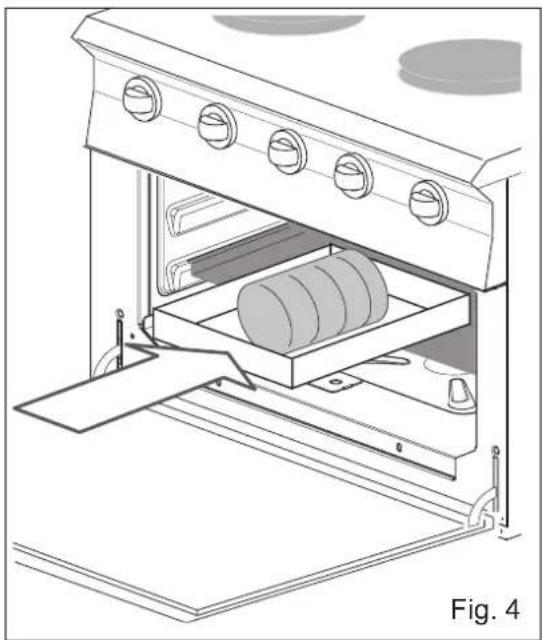
natural_image
Technical line drawing of a mechanical device with a cylindrical component inside, labeled Fig. 4 (no text or symbols on the diagram itself)natural_image
Simple gray icon of a human figure inside a rounded square frame (no text or symbols)• Grille support panier
3.
INSTRUCTIONS POUR L'UTILISATION
natural_image
Line drawing of a cooking stove with two pots on top (no text or symbols)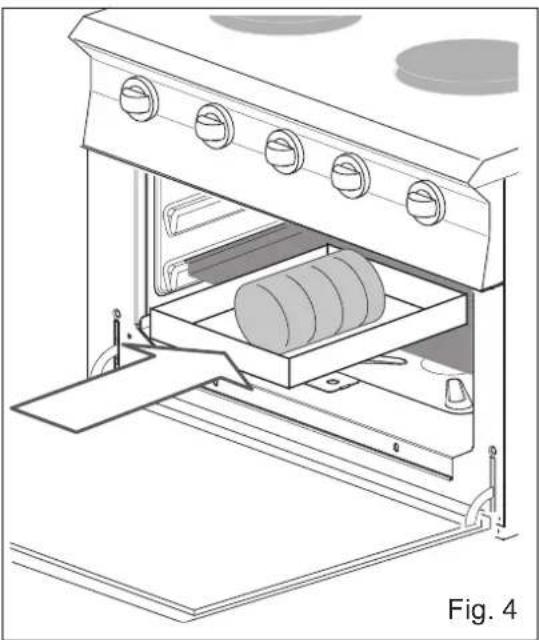
natural_image
Technical line drawing of a mechanical device with a cylindrical component inside, labeled Fig. 4 (no text or symbols on the diagram itself)Obligations - Interdictions - Conseils - Recommendations
natural_image
Simple gray icon of a human figure inside a rounded square frame (no text or symbols)natural_image
Line drawing of a kitchen stove with two pots on top (no text or symbols)
natural_image
Technical line drawing of a mechanical device with a cylindrical component inside, labeled Abb.4 (no text or symbols on the diagram itself)natural_image
Simple gray icon of a human figure inside a rounded square frame (no text or symbols)04/2022 - Ed 2 - Cod. n°187966
Description of pictograms
 | Danger indicationsImmediate hazardous situation which could result in serious injury or death. Possibly dangerous situation that could cause serious injury or death. |
 | High voltage! Caution! Danger of death! Non-observance can cause serious injury or death |
 | Risk of high temperatures, non-compliance may result in serious injury or death. |
 | Danger of leakage of high-temperature materials, non-observance can cause serious injury or death. |
 | Danger of crushing of limbs during handling and/or positioning, non-compliance may result in serious injury or death. |
  | Prohibition indicationsUnauthorised persons (including children, disabled individuals and people with limited physical, sensory and mental abilities) are prohibited from performing any procedures. Children being supervised not to play with the appliance. Cleaning and user maintenance shall not be made by children without supervision. Prohibition for the heterogeneous operator to perform any type of operation (maintenance and/or other) that should instead be carried out by a qualified and authorised technician. Prohibition for the homogeneous operator to perform any type of operation (maintenance and/or other) without having first read the entire documentation. |
      | Obligation indicationsObligation to read the instructions before carrying out any work.Obligation to exclude the power supply upstream of the appliance whenever it is necessary to operate safely.Obligation to use safety goggles.Obligation to use protective gloves.Obligation to use a protective helmet.Obligation to use safety shoes. |
 | Other indications Indications to implement the correct procedure, non-compliance may cause a dangerous situation. |
 | Advice and suggestions to ensure the correct usage procedure |
 | "Homogeneous" Operator (Qualified Technician)Expert operator authorised for handling, transporting, installing, servicing, repairing and scrapping the appliance. |
 | "Heterogeneous" operator (Operator with limited skills and tasks)Person authorised and employed to operate the appliance with guards active, capable of performing simple tasks. |
 | Earthing symbol |
 | Symbol for attachment to the Equipotential system |
 | Obligation to respect the regulations for waste disposal |
THE PRESENT MANUAL IS PROPERTY OF THE MANUFACTURER. ANY REPRODUCTION, EVEN PARTIAL, IS PROHIBITED.
0. DOCUMENT IDENTIFICATION
0.1 STANDARDS OF REFERENCE
1. INFORMATION FOR USERS
Foreword - Purpose of document - How to read the document
Keeping the document - Addressees - Operator training program
Pre-arrangements depending on customer - Contents of supply - Intended use
Allowed operational and environmental conditions
Test inspection and warranty
2. GENERAL SAFETY INFORMATION
Foreword - Obligations - Prohibitions - Advice - Recommendations
Indications concerning residual risks
What to do if you smell gas in the room
3. INSTRUCTIONS FOR USE
Location of main components
Knobs, keys and indicator light modes and functions
Description of stop modes
Stoppage due to faulty operations
Emergency stop
Stoppage during a work phase
Commissioning
Cleaning at commissioning
Daily activation
Daily and prolonged deactivation
Starting production
Switching on
Loading-Unloading the product
Deactivation
4. ROUTINE MAINTENANCE
Obligations - Prohibitions - Advice - Recommendations
Daily cleaning
Cleaning for prolonged deactivation
Summarised table: qualification - operation - frequency
Troubleshooting
5. WASTE DISPOSAL
Deactivation and scrapping of appliance
Waste disposal
Foreword
This document has been drawn up in the mother language of the manufacturer (Italian). The information it contains is for the sole use of the operator authorised to use the appliance in question.
Operators must be trained concerning all aspects regarding functioning and safety. Special safety prescriptions (Obligations-Prohibitions-Dangers) are carried in a specific chapter concerning these issues. This document cannot be handed over to third parties to take vision of it without written consent by the manufacturer. The text cannot be used in other publications without the written consent of the manufacturer. The use of: Figures/Images/Drawings/Layouts inside the document, is purely indicative and can undergo variations. The manufacturer reserves the right to modify it, without being obliged to communicate his acts.
Purpose of the document
Every type of interaction between the operator and the appliance during its entire life cycle has been carefully assessed both during designing and while drawing up this document. We therefore hope that this documentation can help to maintain the characteristic efficiency of the appliance. By strictly keeping to the indications it contains, the risk of injuries while working and/or of economical damage is limited to a minimum.
How to read the document
The document is divided into chapters which gather by topics all the information required to use the appliance in a risk-free way. Each chapter is divided into paragraphs; each paragraph can have titled clarifications with subtitles and descriptions.
Keeping the document
This document is an integral part of the initial supply. It must therefore be kept and used appropriately during the entire operational life of the appliance.
Addressees
This document is structured for the exclusive use of the “Generic” operator (Operator with limited responsibilities and tasks). Person authorised and employed to operate the appliance with guards active and capable of performing routine maintenance (cleaning the appliance).
Operator training program
Upon specific demand by the user, a training course can be held for operators in charge of using the appliance, following the modalities provided in the order confirmation.
Depending on the demand, preparation courses can be held at the site of manufacturer or of the user, for:
• Homogeneous operator in charge of electric/electronic maintenance (Specialised technician).
• Homogeneous operator in charge of mechanical maintenance (Specialised technician).
- Generic operator for simple operations (Operator - Final user).
Pre-arrangements depending on customer
Unless different contractual agreements were made, the following normally depend on the customer:
- setting up the rooms (including masonry work, foundations or channelling that could be requested);
- smooth, slip-proof, perfectly level floor;
- pre-arrangement of installation place and installation of equipment respecting the dimensions indicated in the layout (foundation plan);
- pre-arrangement of auxiliary services adequate for requirements of the system (electrical mains, waterworks, gas network, drainage system);
- pre-arrangement of electrical system in compliance with regulatory provisions in force in the place of installation;
- sufficient lighting, in compliance with standards in force in the place of installation;
- safety devices upstream and downstream the energy supply line (residual current devices, equipotential earthing systems, safety valves, etc.) foreseen by legislation in force in the country of installation;
- earthing system in compliance with standards in force;
- pre-arrangement of a water softening system, if needed (see technical details).
Contents of the supply
- Appliance
- Lid/s
- Metallic rack/s
- Rack support grid
- Pipes and/or wires for connections to energy sources (only when indicated in work order).
The supply may vary depending on the order.
Intended use
Original instructions. This device is intended for professional use. The use of the appliance treated in this document must be considered "Proper Use" if used for cooking or regeneration of goods intended for alimentary use; any other use is to be considered "Improper use" and therefore dangerous. The appliance must be used according to the foreseen conditions stated in the contract within the prescribed capacity limits carried in the respective paragraphs.
These appliances are intended for commercial activities (e.g. restaurant kitchens, canteens etc) and in commercial companies (e.g. bakeries etc.) but not for the continuous food production.
Only use original accessories and spare parts supplied by the manufacturer to maintain regulatory compliance.
Allowed operating conditions
The appliance has been designed to operate only inside of rooms within the prescribed technical and capacity limits. The following indications must be observed in order to attain ideal operation and safe work conditions.
The appliance must be installed in a suitable place, namely, one which allows normal running, routine and extraordinary maintenance operations. The operating area for maintenance must be set up in such a way that the safety of the operator is not endangered.
The room must also be provided with the features required for installation, such as:
• maximum relative humidity: 80%;
• minimum cooling water temperature > + 10 °C ;
- the floor must be anti-slip, and devices positioned perfectly level;
- the room must be equipped with a ventilation system and lighting as prescribed by standards in force in the country of the user;
- the room must be set up for draining greywater, and must have switches and gate valves which cut all types of supply upstream the appliance when needed;
- The walls/surfaces immediately close/contact to the appliance must be fireproof and/or isolated from possible source of heat
Test inspection and warranty
Testing: the equipment has been tested by the manufacturer during the assembly stages at the site of the production plant. All certificates related to the testing performed will be delivered to the customer upon request.
Guarantee: the warranty is 12 months from the date of invoicing of the equipment, this period cannot be extended. It covers the faulty parts only. Carriage and installation charges are for the buyer's account. Electric components, accessories as well as other removable parts are not covered by the guarantee. Labor costs relating to the intervention of authorized by the manufacturer at the customer's premises, for removal of defects under warranty are charged to the dealer. Excluded are all tools and supplies, possibly supplied by the manufacturer together with the machines. Damage occurred in transit or due to incorrect installation or maintenance can't be considered. Guarantee is not transferable and replacement of parts and appliance is at the final discretion of our company. The Manufacturer is responsible for the equipment in its original configuration and only for original spare parts replacement. The manufacturer declines all responsibility for improper use, for damages caused as a result of operations not covered in this manual or not authorized in advance by the manufacturer.
The warranty terminates in case of:
- Damage caused by transport “ex works” (EXW) and / or by handling, should this event occur, the customer must inform the retailer and the carrier (eg. via e-mail and / or website) and write down on the copies of the transport documents what It’s happened. The technician authorized to install the appliance will evaluate the damage and decide if the installation can be carried out. The warranty also terminates in the presence of: • Damage caused by incorrect installation. / • Damage caused by parts worn due to improper use. /* Damage caused by use of non-original spare parts. / • Damage caused by incorrect maintenance and/or lack of maintenance. /
- Damage caused by failure to comply with the procedures described in this document.
Authorisation
Authorisation refers to the permission to operate an activity intrinsic to the appliance.
Authorisation is given to anyone who is responsible for the appliance (manufacturer, purchaser, signer, dealer and/or location owner).
Foreword
 | The operating instructions have been drawn up for the “Generic” operator (Operator with limited responsibilities and tasks). Person authorised and employed to operate the appliance with guards active and capable of performing routine maintenance (cleaning the appliance). |
| [CG8] | The operators who use the appliance must be trained in all aspects concerning its functioning and safety features. They must therefore interact using appropriate methods and instruments, complying with required safety standards. |
 | This document does not include information regarding transportation, installation and extraordinary maintenance which must be performed by technicians qualified for the relevant operation. |
 | The "Generic" operator to whom this document is intended must operate on the appliance after the technician has completed installation (transportation, fixing electrical, water, gas and drain connections). |
 | This document does not include information regarding every modification or variation on the appliance. The manufacturer reserves the right to modify it, without being obliged to communicate his acts. |
Obligations - Prohibitions - Advice - Recommendations
 | Upon reception, open the packaging and make sure that the appliance and accessories have been damaged during transportation. If damage is found, report it promptly to the carrier and do not install the appliance. Contact qualified and authorised personnel to report the problem detected. The manufacturer is not liable for damage caused during transportation. |
 | Unauthorised persons (including children, disabled individuals and people with limited physical, sensory and mental abilities) are prohibited from performing any procedures.Generic operators are prohibited from performing any procedures reserved for qualified and authorised technicians. |
 | Read the instructions before acting. |
 | Disconnect all supplies (electrical - gas - water) upstream the appliance whenever you need to work in safe conditions. |
 | Wear protective equipment suitable for the operations to be performed. As far as personal protective equipment is concerned, the European Community has issued Directives which the operators must comply with. Noise ≤ 70 dB |
 | Do not leave flammable objects or material near the appliance.Do not obstruct the heat extraction and/or dissipation openings. |
 | Refer to standards in force for disposal of special waste. |
 | When loading the product into the appliance and unloading it, there is a residual risk of being burnt; this risk can occur coming into unintentional contact with: surfaces, trays, processed material. |
 | Use the cooking vessels in such a way that while the product is cooking, they are in the operator's sight. Liquid containers can spill during cooking, thus creating dangerous situations. |
 | Failure to keep the appliance in hygienic conditions could cause it to deteriorate quickly, influencing operation and creating dangerous situations. |
 | It is strictly forbidden to tamper with or remove the plates and pictograms applied to the equipment. |
 | Store this document carefully, so that it is available for whoever uses the appliance, consulting it when needed. |
 | The controls on the appliance can only be switched by hand. Damage caused by sharp objects or the likes terminate all and any warranty rights. |
 | In order to minimise the risk of shocks or fire, do not connect or disconnect the unit with wet hands. |
 | Whenever you access the cooking area, always remember that the danger of being burnt persists. It is therefore mandatory to take appropriate measures for personal protection. |
THE PRESENT MANUAL IS PROPERTY OF THE MANUFACTURER. ANY REPRODUCTION, EVEN PARTIAL, IS PROHIBITED.
Indications concerning residual risks
Though the rules for "good manufacturing practice" and the provisions of law which regulate manufacturing and marketing of the product have been implemented, "residual risks" still remain which, due to the very nature of the appliance, were not possible to eliminate. These risks include:
 | Residual risk of electrocution:This risks remains when intervening on live electrical and/or electronic devices. |
 | Residual risk of burning:This risks remains when unintentionally coming into contact with materials at high temperatures. |
 | Residual risk of burning due to leaking materialThis risks remains when coming into contact unintentionally with leaking materials at high temperatures. Containers too full of liquids and/or solids which when heated change morphology (passing from a solid state to a liquid state) can cause burning if used improperly. During work, the containers which are used must be positioned at easily visible levels. |
 | Residual risk of explosionsThis risk remains when:there is smell of gas in the room;appliance used in an atmosphere containing substances which risk exploding;using food in closed containers (such as jars and cans), if they are not suitable for the purpose. |
 | Residual risk of fireThis risk remains when:using with flammable liquids (such as alcohol). |
Location of main components
The layout of the figures is purely indicative and can undergo variations.
- Hotplate switch-on and temperature control knob;
- Oven switch-on and temperature control knob;
- Green indicator light;
- Red indicator light;
- Hotplate;
- Cooking Compartment (Oven).
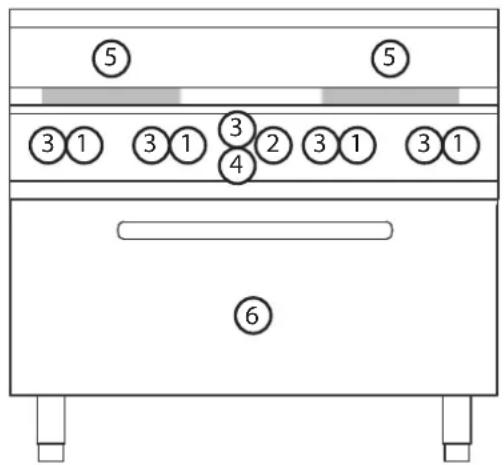
Knobs, keys and indicator light modes and functions
The layout of the figures is purely indicative and can undergo variations.
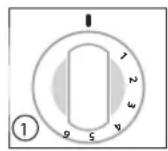
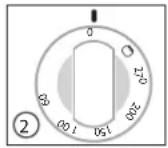
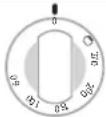 | Thermostat knob (ELECTRIC). It performs three different functions:1. Adjusting cooking temperature.2. Heating phase Start/Stop.3. Grill function. |
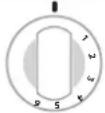 | Switch-on knob (ELECTRIC). Performs one function:1. Switches electricity inside circuit on and off. |
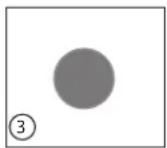
 | Red indicator light (ELECTRIC): When present, the indicator is subordinated to use of the thermostat knob. Lighting of the indicator signals the heating phase. |
 | Green indicator light (ELECTRIC): The indicator is subordinated to use of the switch-on knob. Lighting of the indicator signals the operating phase. |
Description of stop modes

In stoppage conditions caused by faults and emergencies, in the event of imminent danger, it is mandatory to close all the locking devices on the supply lines upstream the appliance (Electrical-Water-Gas).

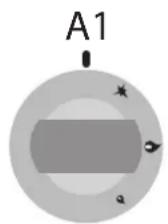
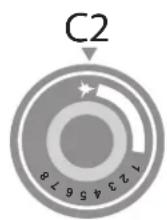
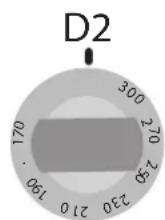
The drawing illustrates the various positions the knobs take on during an emergency stop (A1-B1-C1-D1-E1) and stoppage during a working phase (A2-B2-C2-D2-E2).
Stoppage due to faulty operations
Safety thermostat
Standard supply with following models:
• Fryer (present on all models)
- Pasta cooker (only with Electric model)
- Stove (present on all models with electric oven)
- Frytop (present on all electric models)
- Induction cook tops (present on all models)
• Glass-ceramic hob (present on all models with electric oven)
Stop: In situations or circumstances which can be dangerous, a safety thermostat is triggered, automatically stopping heat generation. The production cycle is interrupted until the cause of the fault is resolved.
Restarting: After the problem that triggered the safety thermostat is resolved, the authorised technician can restart the appliance by means of the specific controls.
Emergency stop
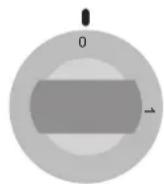
In situations or circumstances which can be dangerous, turn the knob to "Zero" depending on the model (A-B-C-D-E-1). See knobs, keys and indicator light modes and functions.
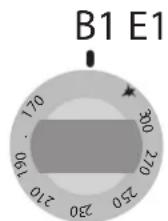


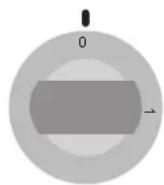
Stoppage during a work phase
In situations or circumstances which require temporary stop of heat generation, act as follows:
- Gas Appliance: Turn the knobs to the piezoelectric position (A-B-C-2), the pilot light remains lit as the gas flow in the burner is not interrupted.
Electric Appliance: Turn the knobs "D2-E2" to "Zero" to stop heat generation.
(See knobs, keys and indicator light modes and functions).
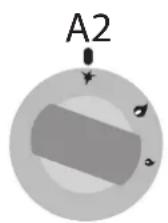
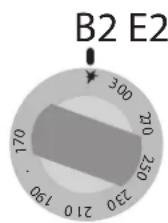
Commissioning
 | When commissioning the appliance and when starting it after a prolonged stop, it must be thoroughly cleaned to eliminate all residue of extraneous material (See Routine Maintenance). |
 | Cleaning at commissioningDo not use pressurised direct water or steam cleaners jets for cleaning operations |
 | Remove the outer protective film by hand and thoroughly clean all the outside parts of the appliance. At the end of the operations described for cleaning the outside parts, proceeded as instructed in “Daily Cleaning” (See Routine Maintenance). |
 |
Daily activation
Procedure:
- Check the cleanliness and hygiene of the appliance.
- Make sure that the room exhaust system works properly.
- When necessary, plug the appliance into the appropriate socket.
- Open the network locks upstream the appliance (Gas - Water - Electric).
- Make sure that the water drain (if present) is not clogged.
- Proceed with the operations described in "Starting production".
Daily and prolonged deactivation
Procedure:
- Close the network locks upstream the appliance (Gas - Water - Electric).
- Make sure that the drain cocks (if present) are "Closed".
- Check the cleanliness and hygiene of the appliance (See Routine Maintenance).

In the event of prolonged inactivity, protect the parts more exposed to oxidation as described in the specific chapter (See Routine Maintenance).
Starting production
 | Before proceeding with these operations, see "Daily activation". |
 | When loading the product into the appliance and unloading it, there is a residual risk of being burnt; this risk can occur coming into unintentional contact with: hob - cooking compartment - recipients or material processed. |
 | Take appropriate measures for personal protection. Wear protective equipment suitable for the operations to be performed. |
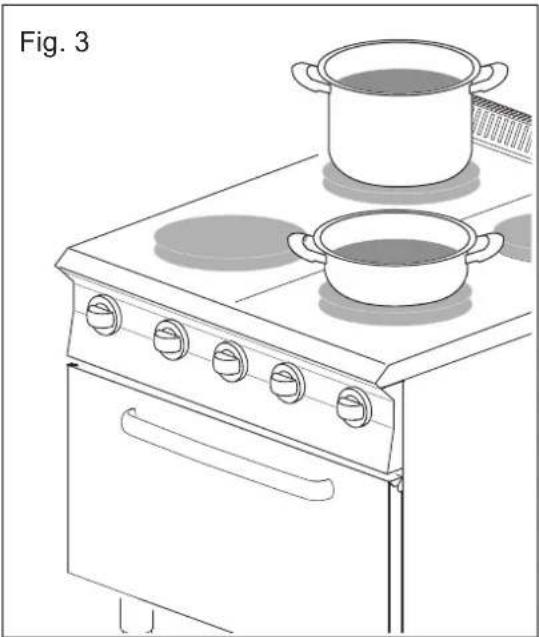
 | The products must be placed in the specific cooking containers and positioned correctly on the hotplates and/or in the cooking compartment of the oven. |
 | Use pots with diameter smaller than cooking plate. |
Switching On/Off
Do as follows to begin the cooking process:
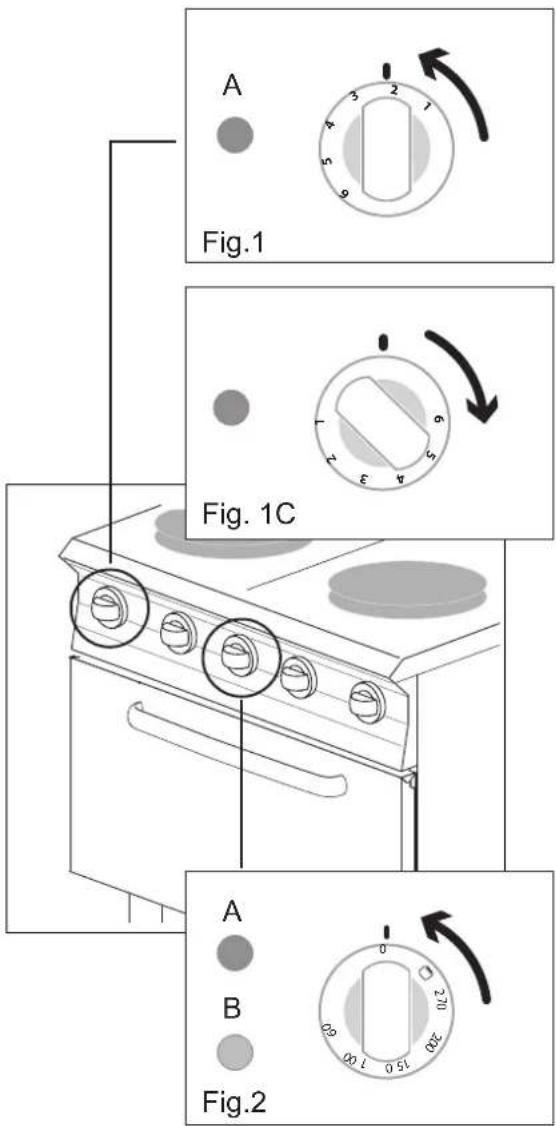
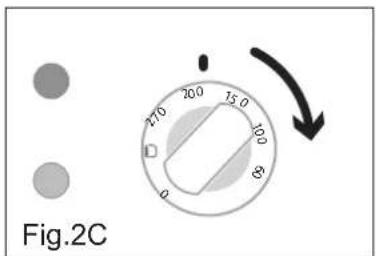
- Turn the knob to adjust the cooking temperature (Fig. 1 HOTPLATES -Fig. 2 OVEN).
- When the green light is on it means operation is in progress (Fig. 1-2 A) When the red light is on it means heating is in progress (Fig. 2 B).
- Turn the knob to "Zero" (Fig. 1-2 C) to stop heat generation.
 | The oven cooking temperature is set by turning the thermostat knob. (See indications on knob). |
 | Hotplate heating speed is set by turning the knob (Position 0-6). Position 6 is the maximum heating speed. |
 | Before using the oven for the first time, it is advisable to pre-heat it at the highest setting for 30-40 minutes with the door closed. This burns any oily residue that could release unpleasant odours. |
 | To switch on only upper heating element (GRILL), turns knob in correct position |
Loading-Unloading the product
 | The amount of the product inside the container must not exceed 3/4 its capacity. |
 | The products to be cooked must be placed in the specific containers away from the appliance area and positioned correctly in the cooking compartment (oven) and/or on the hotplates. |
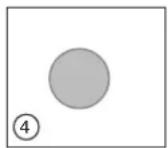
Place the container in the middle of the hotplate (Fig. 3).
When cooking is over, remove the container from the hotplate and put it in a place prepared beforehand.
Open the oven door to load it.
Put the container in the cooking compartment in the middle of the grid (Fig. 4). Close the oven door.
 | When opening the doors, step to the side of the appliance to avoid direct heat. |
When the product is cooked, unload it and put it in a place prepared beforehand.
After the product has been unloaded, load it once again or else perform the operations described in "Deactivation".
Deactivation
At the end of the work cycle, turn the knobs on the appliance to "Zero".
 | The appliance must be cleaned regularly and every incrustation or food deposit removed. See chapter: “Maintenance”. |
 | If present, the indicator lights must be off at the end of the work cycle. |
Check the cleanliness and hygiene of the appliance; see "Maintenance".
Close the network locks upstream the appliance (Gas - Water - Electric).
Make sure that the drain cocks (if present) are "Closed".
natural_image
Line drawing of a cooking stove with two pots on top (no text or symbols)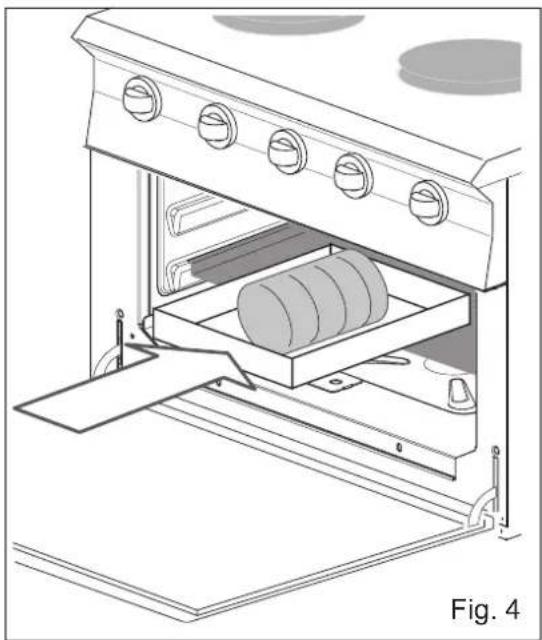
natural_image
Technical line drawing of a mechanical device with a cylindrical component inside, labeled Fig. 4 (no text or symbols on the diagram itself)Obligations - Prohibitions - Advice - Recommendations
 | If the appliance is connected to a flue, the exhaust pipe must be cleaned according to that foreseen by specific regulatory provisions of the country (contact your installer for information). |
 | To make sure that the appliance is in perfect technical conditions; have it serviced at least once a year by an authorised technician of the assistance service. |
 | Unauthorised persons (including children, disabled individuals and people with limited physical, sensory and mental abilities) are prohibited from performing any procedures. Performing any procedures without first having read all the documentation is strictly prohibited. |
 | Whenever you access the cooking area, always remember that the danger of being burnt persists. It is therefore mandatory to take appropriate measures for personal protection. |
 | Disconnect electrical power upstream the appliance whenever you need to work in safe conditions to perform cleaning or maintenance. |
 | Wear protective equipment suitable for the operations to be performed. As far as personal protective equipment is concerned, the European Community has issued Directives which the operators must comply with. |
 | The appliance is used to prepare food products. Keep the appliance and the surrounding area constantly clean. Failure to keep the appliance in ideal hygienic conditions could cause it to deteriorate quickly and create dangerous situations. |
 | Filth deposit built up near heat sources can burn during normal use of the appliance and create dangerous situations. The appliance must be cleaned regularly and every incrustation or food deposit removed. |
 | The chemical effect of salt and/or vinegar or other acid substances can in the long run cause the inside of the cooking compartment to corrode during cooking. At the end of the cooking cycle of such substances, the appliance must be washed thoroughly with detergent, abundantly rinsed and carefully dried. |
 | Be careful not to damage stainless steel surfaces. No not use corrosive products, abrasive material or sharp tools. |
 | The liquid detergent for cleaning the cooking compartment must have certain chemical features: pH greater than 12, without chlorides/ammonia, viscosity and density similar to water. Use non-aggressive products for cleaning the inside and outside of the appliance (use detergents on the market for cleaning steel, glass and enamel). |
 | Carefully read the indications carried on the labels of the products used. Wear protective equipment suitable for the operations to be performed (see the protective equipment carried on the package label). |
 | Do not use pressurised direct water or steam cleaners jets for cleaning operations. Rinse the surfaces with tap water and dry them with an absorbent cloth or other non-abrasive material. |
 | In the event of prolonged inactivity, besides disconnecting the supply lines, you must thoroughly clean all the inside and outside parts of the appliance. |
 | Before performing any of the cleaning operations described hereafter, the operator must have had a look at the whole document. |
 | Refer to standards in force for waste disposal. |
 | Wait for the temperature of the appliance and all its parts to cool off, so that the operator is not burnt |
 | Daily hotplate cleaningUse a standard sprayer to apply the liquid detergent on the whole surface of the cooking compartment and, using a non-abrasive sponge, clean the entire surface thoroughly by hand.When finished, rinse the cooking compartment abundantly with tap water (Do not use pressurised direct water or steam cleaners jets for cleaning operations).When these operations have been performed successfully, dry the cooking compartment carefully using a non-abrasive cloth. If necessary, repeat the operations described above for a new cleaning cycle.Humidity residue deposited on the hotplate/s can damage the appliance and cause the hotplate/s to wear quickly.In order to eliminate all humidity, once routine cleaning has been finished, turn the appliance on and run it at minimum for approximately 2/3' and then turn it back off (see procedure part 3 Instructions for use: Switching On/Off). |
 | |
 | Daily oven cleaningDepending on the appliance, remove: grills, trays or other objects removed from the cooking compartment.Heat up the cooking compartment for about 20'.Open the door to let the cooking compartment cool off for a few seconds.Use a standard sprayer to apply the liquid detergent on the whole surface of the cooking compartment and, using a non-abrasive sponge, clean the entire surface thoroughly by hand.When finished, rinse the cooking compartment abundantly with tap water (Do not use pressurised direct water or steam cleaners jets for cleaning operations).When these operations have been performed successfully, dry the cooking compartment carefully using a non-abrasive cloth.If necessary, repeat the operations described above for a new cleaning cycle.Clean the parts previously removed from the cooking compartment (grills, trays and other removable objects) with detergent and tap water, rinse them carefully and dry them before putting them back.In order to eliminate all humidity, once routine cleaning has been finished, turn the appliance on and run it at minimum for approximately 20' and then turn it back off (see procedure part 3 Instructions for use: Switching On/Off). |
 | |
 | Cleaning for prolonged deactivationWhen the appliance remains idle for a long time, perform all the described daily cleaning procedures.When the operations are over, protect the parts more exposed to oxidation doing as follows.Use lukewarm water with a bit of soap to clean the parts;Rinse the parts thoroughly, without use pressurised direct water or steam cleaners jets for cleaning operations.Dry the surfaces carefully using non-abrasive material;Wipe a non-abrasive cloth lightly soaked with food-safe Vaseline oil over all of the stainless steel surfaces in order to create a protective film.For appliances with doors and rubber gaskets, leave the door slightly ajar to let it air out and spread protective talcum powder on the rubber gasket surfaces.Air out the appliances and rooms regularly. |
 |
ROUTINE MAINTENANCE
Summarised table: qualification - operation - frequency
Generic operator
Person authorised and employed to operate the appliance with guards active, capable of performing routine tasks.
Homogeneous operator
Expert operator authorised for handling, transporting, installing, servicing, repairing and scrapping the equipment.
OPERATION FREQUENCY
Cleaning at commissioning Upon arrival after installation
Cleaning appliance Daily
Cleaning parts in contact with foodstuff Daily
Cleaning flue Yearly
Checking thermostat Upon arrival after installation - Yearly
Checking micro switch Upon arrival after installation - Yearly
Checking supply cable Upon arrival after installation - Yearly
Checking safety valve Upon arrival after installation - Every 6 months
Cleaning hotplates (chromed, cast-iron) Daily
Should a problem occur, the generic operator performs the first search and, if qualified, eliminates the cause of the problem and restores the appliance correctly
If the problem cannot be resolved, turn the appliance off, disconnect it from the electrical mains and shut all the supply valves. Then contact authorized customer service
The maintenance technician intervenes when the generic operator was not able to pinpoint the cause of the problem, or whenever restoration of correct operation of the appliance entails executing operations for which the generic operator is not qualified
If the supply cable should be damaged, contact authorized customer service for replacement
Troubleshooting

Whenever the appliance does not work properly, try to solve the less serious problems using this table.
| FAULT POSSIBLE | CAUSE INTERVENTION | |
| The appliance does not turn on. • | The master switch is not connected.• The residual current device or circuit breaker has tripped. | • Connect the master switch.• Restore the residual current device or circuit breaker. |
| The inner walls of the tank are covered with limestone. | • The water is too hard; the softener is finished. | • Connect the appliance to a water softener.• Regenerate the water softener.• Descale the cooking compartment. |
| The cooking compartment is stained. | • Quality of the water.• Ineffective detergent.• Insufficient rinsing. | • Filter the water (see water softener).• Use the recommended detergent.• Rinse once again. |
| The light indicators do not turn on. | • The master switch is not connected.• The residual current device or circuit breaker has tripped. | • Connect the master switch.• Restore the residual current device or circuit breaker. |

If the problem cannot be resolved, turn the appliance off, disconnect it from the electrical mains and shut all the supply valves. Then contact authorized customer service
Deactivation and scrapping of appliance

OBLIGATION OF DISPOSING OF MATERIALS USING THE LEGISLATIVE PROCEDURE IN FORCE IN THE COUNTRY WHERE THE APPLIANCE IS SCRAPPED.
In compliance with Directives (see n. 0.1 Section), relating to the reduction of use of hazardous substances in electrical and electronic equipment, as well as waste disposal. The symbol of the barred waste bin carried on the appliance or its packaging indicates that the product at the end of its useful life it must be disposed of separately from other waste.
Differentiated waste collection of this appliance at the end of its life is organised and implemented by the manufacturer. The user who wishes to get rid of this appliance must contact the manufacturer and follow the instructions received to separately dispose of the appliance at the end of its life. An appropriate collection and dispatching of exhausted appliances to environmentally compatible recycling, treatment and disposal plants helps to prevent damaging effects on health and environment and also guarantees that the component parts of exhausted appliances are effectively recycled or reused. Holders of exhausted appliances who dispose of them illegally will be prosecuted.

Specialised personnel is in charge of deactivation and scrapping of the appliance.
Waste disposal

During operation and maintenance, do not disperse pollutants (oils, grease, etc.) into the environment and perform differentiated waste disposal depending on the composition of the different materials and in compliance with relevant laws in force.
Illegal waste disposal will be prosecuted by laws in force in the territory where the violation has been ascertained.

natural_image
Gray icon of a finger pressing a button, enclosed in a rounded square frame (no text or symbols)COZINHA
natural_image
Simple gray icon of a human figure inside a rounded square frame (no text or symbols)04/2022 - Ed 2 - Cod. n° 187966
natural_image
Line drawing of a kitchen stove with two pots on top (no text or symbols)
natural_image
Technical line drawing of a mechanical device with a cylindrical component inside, labeled Fig. 4 (no text or symbols on the diagram itself)
- 0.1
- 3.
- INSTRUCTIONS POUR L'UTILISATION
- DOCUMENT IDENTIFICATION
- STANDARDS OF REFERENCE
- INFORMATION FOR USERS
- GENERAL SAFETY INFORMATION
- INSTRUCTIONS FOR USE
- ROUTINE MAINTENANCE
- WASTE DISPOSAL
- Foreword
- Purpose of the document
- How to read the document
- Keeping the document
- Addressees
- Operator training program
- Pre-arrangements depending on customer
- Contents of the supply
- Intended use
- Allowed operating conditions
- Test inspection and warranty
- The warranty terminates in case of:
- Authorisation
- Indications concerning residual risks
- Location of main components
- Knobs, keys and indicator light modes and functions
- Description of stop modes
- Stoppage due to faulty operations
- Safety thermostat
- Emergency stop
- Stoppage during a work phase
- Commissioning
- Daily activation
- Daily and prolonged deactivation
- Starting production
- Switching On/Off
- Loading-Unloading the product
- Deactivation
- Obligations - Prohibitions - Advice - Recommendations
- ROUTINE MAINTENANCE
- Summarised table: qualification - operation - frequency
- Generic operator
- Homogeneous operator
- OPERATION FREQUENCY
- Troubleshooting
- Deactivation and scrapping of appliance
- Waste disposal
Brand : MBM
Model : E4F6
Category : Cooker