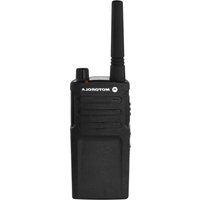
RMU2040 - Talkie Walkie MOTOROLA - Free user manual and instructions
Find the device manual for free RMU2040 MOTOROLA in PDF.


| Product Type | Professional Walkie-Talkie |
| Brand | Motorola |
| Model | RMU2040 |
| Frequency Band | UHF (Ultra High Frequency) |
| Transmission Power | 2 Watts (adjustable 1W/2W) |
| Number of Channels | 4 Programmable Channels |
| Antenna | Fixed Non-Removable Antenna |
| Battery Type | Rechargeable Lithium-Ion (Li-Ion) (Standard or High Capacity) |
| Battery Life (Economy Mode On) | 15 hours (5% transmit/5% receive/90% standby cycle) |
| Standard Charge Time | ≤ 4.5 hours for standard battery |
| Rapid Charge Time | ≤ 2.5 hours for standard battery with rapid charger |
| Indoor Range (Industrial) | Up to 250,000 sq ft (23,000 m²) |
| Floor Range | Up to 20 floors |
| Hands-Free Functions | VOX (with accessory), iVOX (without accessory), hands-free kit |
| Radio Cloning | Via multi-unit charger (MUC), R2R cable, or CPS software |
| Advanced Programming | Screenless configuration mode (frequencies, CTCSS/DPL codes, scanning, active channels) + CPS software |
| Charging Power | Single unit charger (SUC) or multi-unit charger (MUC) - AC adapter included |
| Safety | Compliant with FCC Part 15 and Industry Canada, battery overcharge protection |
| Maintenance | Clean with a soft, damp cloth; do not immerse in water; avoid alcohol and detergents |
| Warranty | 1 year (products and accessories), 90 days for software |
| Included Accessories | Radio, Li-Ion battery, case, charging cradle, AC adapter, user guide, warranty |
Frequently Asked Questions - RMU2040 MOTOROLA
User questions about RMU2040 MOTOROLA
0 question about this device. Answer the ones you know or ask your own.
Ask a new question about this device
Download the instructions for your Talkie Walkie in PDF format for free! Find your manual RMU2040 - MOTOROLA and take your electronic device back in hand. On this page are published all the documents necessary for the use of your device. RMU2040 by MOTOROLA.
USER MANUAL RMU2040 MOTOROLA
Open Source Software Legal Notices:
This Motorola product contains Open Source Software. For information regarding licenses, acknowledgements, required copyright notices and other usage terms, refer to the documentation for this Motorola product at:
http://businessonline.motorolasolutions.com
Go to: Resource Center > Product Information > Manual > Accessories.
CONTENTS
Contents. 1
Product Safety. 4
Introduction 5
FCC Licensing Information 7
Canada Licensing Information. 9
Batteries and Chargers
Safety Information. 8
Operational Safety Guidelines. 9
Radio Overview 10
Parts Of The Radio 10
On/Off/Volume Knob. 11
Accessory Connector 11
Model Label 11
Microphone 11
Antenna. 11
LED Indicator 11
Side Buttons 11
The Lithium-Ion (Li-Ion) Battery 11
Battery Features 13
About the Li-Ion Battery 13
Battery Recycling and Disposal 14
Installing the Lithium-Ion (Li-Ion) Battery 15
Removing the Lithium-Ion (Li-Ion) Battery 15
Holster 16
Power Supply, Adaptor and Drop-in Tray Charger 16
Battery Life Information 17
Charging the Battery 18
Drop-in Tray Charger LED Indicators . . 20
Estimated Charging Time 21
Multi-Unit Charger LED Indicators 23
Getting Started 25
Turning radio ON/OFF 25
Adjusting Volume 25
Selecting a Channel 25
Talking and Monitoring. 25
Receiving a Call 26
Talk Range. 26
RadioLEDIndicators. 28
Hands-Free Use/VOX 29
With Compatible VOX Accessories . . . 29
Setting VOx Sensitivity 30
Microphone Gain. 30
Hands Free Without Accessories (iVOX) 30
Power Up - Tone Mode. 30
Reset to Factory Defaults 30
Toggle Voice Prompt in User Mode . . .31
Programming Features 32
Advanced Configuration Mode 32
Entering Advanced Configuration Mode 33
Entering Frequencies Values 33
Reading CTCSS / DPL Values .34
Reading Auto-Scan Values. 34
Active Channels 34
Saving Settings. 34
Programming Values Example 36
Example of Programming a Frequency 36
Example of Programming a Code. 37
Example of Programming Auto-Scan . . .37
Example of Programming Active Channels 38
Other Programming Features 38
Scan. 38
Editing Scan List 39
Nuisance Channel Delete 39
Customer Programming Software (CPS) . . . 40
Bandwidth Select (Only for Canada models) 41
Time-Out Timer 41
Power Select 41
Call Tones 41
Scramble 41
ReverseBurst 42
Cloning Radios. 42
Cloning with a Multi Unit Charger (MUC) 43
CPS and Cloning Cables (Optional Accessory) 44
Cloning Radio using the Radio to Radio (R2R) Cloning Cable (Optional Accessory) 45
Cloning using the Customer Programming Software (CPS) 47
Troubleshooting. 48
Use and Care 52
Frequency and Code Charts .53
RMU2043-UHF Default Frequencies
Chart. 53
RMU2040-UHF Default Frequencies
Chart. 54
RMM2050 - VHF-MURS Default
Frequencies Chart 55
CTCSS and PL/DPL Codes
Motorola Limited Warranty for the
United States and Canada 62
Accessories 66
Audio Accessories. 66
Battery. 66
Software Applications 66
Cables 66
Chargers 67
Carry Accessories 67
PRODUCT SAFETY
PRODUCT SAFETY AND RF EXPOSURE COMPLIANCE

Caution
Before using this product, read the operating instructions and RF energy awareness information contained in the Product Safety and RF Exposure booklet enclosed with your radio.
ATTENTION!
Models RMU2040 and RMU2043 are restricted to occupational use only to satisfy FCC RF energy exposure requirements. Model RMM2050 complies with general population and uncontrolled environment requirements.
English
Notice to Users (FCC and Industry Canada)
This device complies with Part 15 of the FCC rules and RSS 210 of the Industry Canada rules per the conditions listed below:
- This device may not cause harmful interference.
- This device must accept any interference received including interference that may cause undesired operation.
- Changes or modifications made to this device, not expressly approved by Motorola, could void the user's authority to operate this equipment.
Under Industry Canada regulations, this radio transmitter may only operate using an antenna of a type and maximum (or lesser) gain approved for the transmitter by Industry Canada. To reduce potential radio interference to other users, the antenna type and its gain should be so chosen that the equivalent isotropically radiated power (e.i.r.p.) is not more than that necessary for successful communication.
INTRODUCTION
Thank you for purchasing the Motorola® RM Series™ Radio. This radio is a product of Motorola's 80 plus years of experience as a world leader in the designing and manufacturing of communications equipment. The RM Series™ radios provide cost-effective communications for businesses such as retail stores, restaurants, schools, construction sites, manufacturing, property and hotel management and more. Motorola professional two-way radios are the perfect communications solution for all of today's fast-paced industries. Note: Read this user guide carefully to ensure you know how to properly operate the radio before use
Business Radios,
RPSD 1C15, Motorola
8000 West Sunrise Boulevard
Plantation, Florida 33322
PACKAGE CONTENTS
Radio
- Holster
Lithium-Ion Battery
- Power Supply
- Quick Reference Guide
Warranty Card
- Drop-in Tray Charger
Product Safety & RF Exposure Booklet
English
User Guide can be downloaded from:
www.motorolasolutions.com/RMSeries.For
product-related questions, contact:
1-800-448-6686 in the USA
1-800-461-4575 in Canada
1-888-390-6456 on TTY (Text Telephone)
FCC LICENSING INFORMATION
INTERFERENCE INFORMATION
This device complies with Part 15 of the FCC Rules. Operation is subject to the condition that this device does not cause harmful interference.
RM Series™ Business two-way radios operate on radio frequencies that are regulated by the Federal Communications Commission (FCC).
To transmit on these frequencies, you are required to have a license issued by the FCC. Application is made available on FCC Form 601 and Schedules D, H, and Remittance Form 159.
To obtain these FCC forms, request document 000601 which includes all forms and instructions. If you wish to have the document faxed, mailed or have questions, use the following contact information.
| Faxed contact the Fax-On- Demand system at: | Mailed call the FCC forms hotline at: | Questions regarding FCC license contact the FCC at: |
| 1-202-418-0177 1-800-41 | 8-FORM1-800-418-3676 | 1-888-CALL-FCC1-888-225-5322Or: http://www.fcc.gov |
Before filling out your application, you must decide which frequency(ies) you can operate on. See "Frequencies and Code Charts". For questions on determining the radio frequency, call Motorola Product Services at:
1-800-448-6686
Changes or modifications not expressly approved by Motorola may void the user's authority granted by the FCC to operate this radio and should not be made. To comply with FCC requirements, transmitter adjustments should be made only by or under the supervision of a person certified as technically qualified to perform transmitter maintenance and repairs in the private land mobile and fixed services as certified by an organization representative of the user of those services.
Replacement of any transmitter component (crystal, semiconductor, etc.) not authorized by the FCC equipment authorization for this radio could violate FCC rules.
Use of this radio outside the country where it was intended to be distributed is subject to government regulations and may be prohibited
CANADA LICENSING INFORMATION
GENERAL INFORMATION
The operation of your Motorola radio is subject to the Radiocommunications Act and must comply with rules and regulations of the Federal Government's department of Industry Canada. Industry Canada requires that all operators using Private Land Mobile frequencies obtain a radio license before operating their equipment.
An application for your Industry Canada license is made on the form included with your radio. Additional forms and latest license application versions can be obtained from the nearest Industry Canada District office. A list of these offices is included for your information.
THE LICENSE APPLICATION
General Instructions
- Fill in the items as per the instructions. If you need additional space for any item use the reverse side of the application.
- Be sure to use a typewriter or print legibly.
- Make a copy for your files.
- Prepare a cheque or money order made out to the "Receiver General for Canada", for an amount, which is on the following schedule, for each radio purchased. (License is valid until April 1st of each year, and the renewed.
- Mail your completed application, along with your cheque or money order to the closest Industry Canada District office, according to the list on pages
To obtain the latest Canadian License Application form, please go to:
www.ic.gc.ca
BATTERIES AND CHARGERS SAFETY INFORMATION
This document contains important safety and operating instructions. Read these instructions carefully and save them for future reference. Before using the battery charger, read all the instructions and cautionary markings on
the charger,
the battery, and
- the radio using the battery
- To reduce risk of injury, charge only the rechargeable Motorola-authorized batteries. Other batteries may explode, causing personal injury and damage.
-
Use of accessories not recommended by Motorola may result in risk of fire, electric shock, or injury.
-
To reduce risk of damage to the electric plug and cord, pull by the plug rather than the cord when disconnecting the charger.
- An extension cord should not be used unless absolutely necessary. Use of an improper extension cord could result in risk of fire and electric shock. If an extension cord must be used, make sure that the cord size is 18AWG for lengths up to 100 feet (30.48 m), and 16AWG for lengths up to 150 feet (45.72 m).
- To reduce risk of fire, electric shock, or injury, do not operate the charger if it has been broken or damaged in any way. Take it to a qualified Motorola service representative.
- Do not disassemble the charger; it is not repairable and replacement parts are not available. Disassembly of the charger may result in risk of electrical shock or fire.
- To reduce risk of electric shock, unplug the charger from the AC outlet before attempting any maintenance or cleaning
OPERATIONAL SAFETY GUIDELINES
- Turn the radio OFF when charging battery.
- The charger is not suitable for outdoor use. Use only in dry locations/conditions.
- Connect charger only to an appropriately fused and wired supply of the correct voltage (as specified on the product).
- Disconnect charger from line voltage by removing main plug.
-
The outlet to which this equipment is connected should be nearby and easily accessible.
-
In equipment using fuses, replacements must comply with the type and rating specified in the equipment instructions.
Maximum ambient temperature around the power supply equipment must not exceed 40^ (104^) - Power output from the power supply unit must not exceed the ratings stated on the product label located at the bottom of the charger.
- Make sure that the cord is located where it will not be stepped on, tripped over, or subjected to water, damage, or stress.
RADIO OVERVIEW
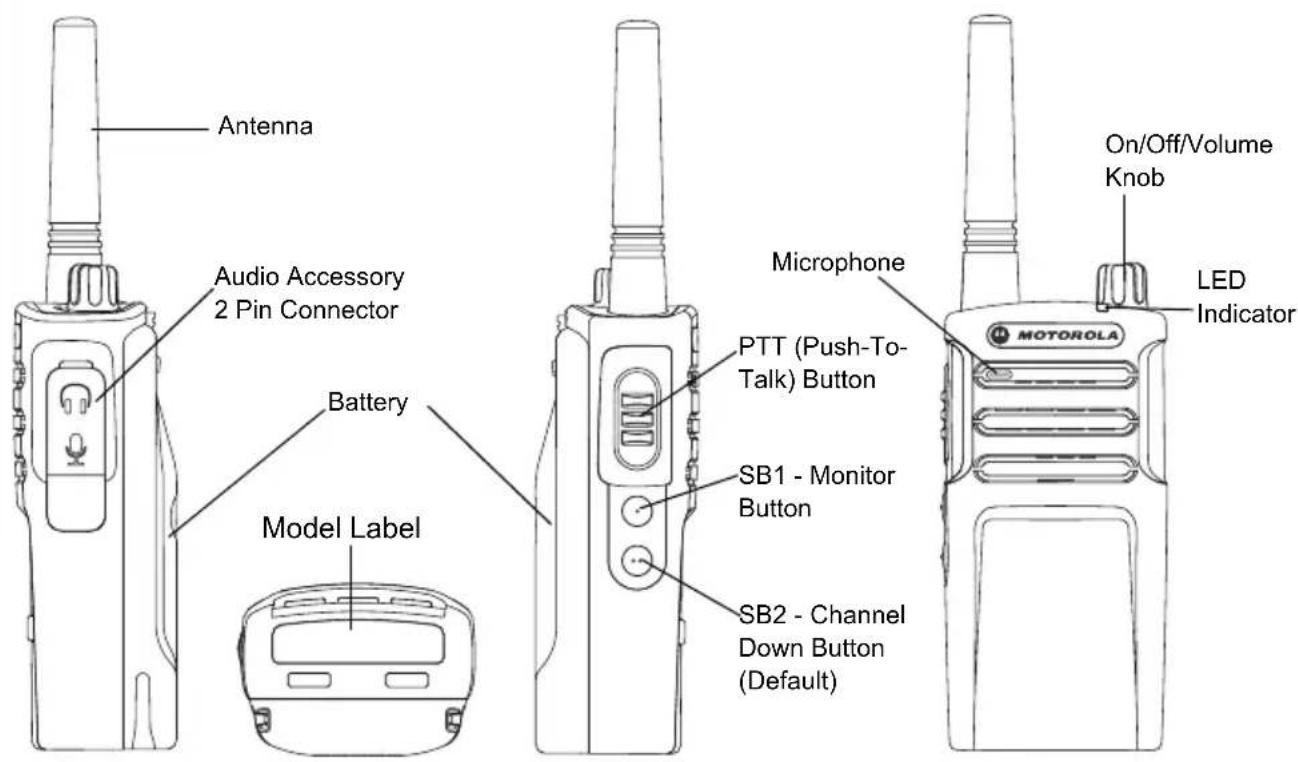
PARTS OF THE RADIO
English
On/Off/Volume Knob
Used to turn the radio ON or OFF and to adjust the radio's volume.
Accessory Connector
Used to connect compatible audio accessories.
Model Label
Indicates the model of the radio.
Microphone
Speak clearly into the microphone when sending a message.
Antenna
On all RM Series radios, the antenna is non-removable.
LED Indicator
Used to give battery status, power-up status, radio call information and scan status.
Side Buttons
Push-to-Talk (PTT) Button
- Press and hold down this button to talk, release it to listen.
Side Button 1 (SB1)
- The Side Button 1 is a general button that can be configured by the Customer Programming Software - CPS. The default setting of SB1 is 'Monitor'.
Side Button 2 (SB2)
- The Side Button 2 is a general button that can be configured by the CPS. The SB2 default setting is 'scroll Down' until the desired channel is selected.
The Lithium-Ion (Li-Ion) Battery
RM Series comes with a Li-1on battery. For more information, see "Battery Features" on page 13.
English
This User Guide covers multiple RM Series models, and may detail some features your radio does not have. The radio's model is shown on the bottom of the radio and provides the following information:
Table 1: RM Series Radio Specifications
| Model | Frequency Band | Transmit Power (Watts) | Number of Channels | Antenna |
| RMU2043 UHF | 2 4 Non-removable | |||
| RMU2043 UHF | 2 4 Non-removable | |||
| RMM2050 VHF | F-MURS 2 5 Non-removable |
BATTERY FEATURES
About the Li-Ion Battery
The RM Series™ radio comes equipped with a rechargeable Li-1on battery. This battery should be charged fully before initial use to ensure optimum capacity and performance.
Battery life is determined by several factors. Among the more critical are the regular overcharge of batteries and the average depth of discharge with each cycle. Typically, the greater the overcharge and the deeper the average discharge, the fewer cycles a battery will last. For example, a battery which is overcharged and discharged 100% several times a day, lasts fewer cycles than a battery that receives less of an overcharge and is discharged to 50% per day. Further, a battery which receives minimal overcharging and averages only 25% discharge, lasts even longer.
Motorola batteries are designed specifically to be used with a Motorola charger and vice versa. Charging in non-Motorola equipment may lead to battery damage and void the battery warranty. The battery should be at about 77^ (25^) (room temperature), whenever possible. Charging a cold battery (below 50^ [10^] ) may result in leakage of electrolyte and ultimately in failure of the battery. Charging a hot battery (above 95^ [35^] ) results in reduced discharge capacity, affecting the performance of the radio. Motorola rapid-rate battery chargers contain a temperature-sensing circuit to ensure that batteries are charged within the temperature limits stated above.
Battery Recycling and Disposal
Li-ON rechargeable batteries can be recycled. However, recycling facilities may not be available in all areas. Under various U.S. state laws and the laws of several other countries, batteries must be recycled and cannot be disposed of in landfills or incinerators. Contact your local waste management agency for specific requirements and information in your area. Motorola fully endorses and encourages the recycling of Li-ON batteries. In the U.S. and Canada, Motorola participates in the nationwide Rechargeable Battery Recycling Corporation (RBRC) program for Li-ON battery collection and recycling.
Many retailers and dealers participate in this program. For the location of the drop-off facility closest to you, access RBRC's Internet web site at:
www.rbrc.com
or call:
1-800-8-BATTERY
This internet site and telephone number also provides other useful information concerning recycling options for consumers, businesses and governmental agencies.
Installing the Lithium-Ion (Li-Ion) Battery
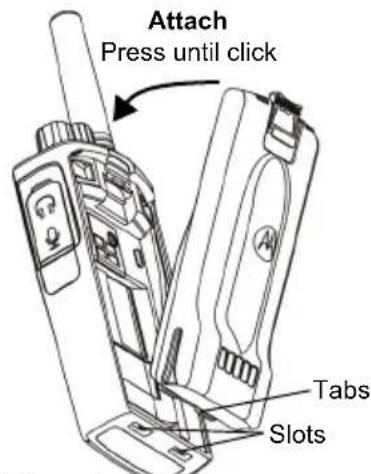
- Turn OFF the radio.
- With the Motorola logo side up on the battery pack, fit the tabs at the bottom of the battery into the slots at the bottom of the radio's body.
- Press the top part of the battery towards the radio until a click is heard.
Note: To learn about the Li-Ion Battery Life features, refer to "About the Li-Ion Battery" on page 13
Removing the Lithium-Ion (Li-Ion) Battery
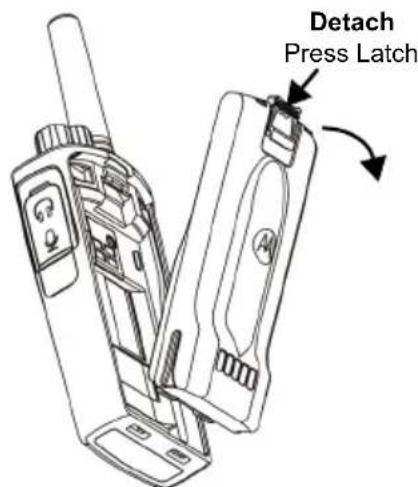
- Tum OFF the radio.
- Push down the battery latch and hold it while removing the battery.
- Pull the battery away from the radio.
Holster
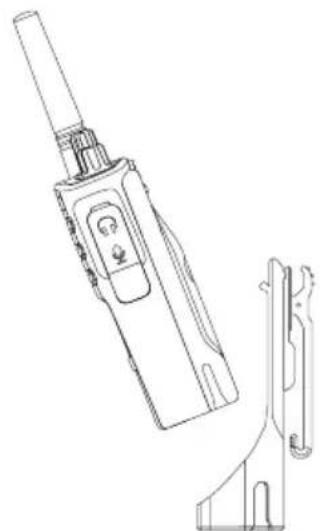
- Insert the radio into the base of the holster at an angle. Press the radio against the back of the holster until the hooks on the holster are inserted in the top recesses of the battery.
- To remove, using the top tab on the holster, detach the hooks of the holster from the top recesses of the battery. Slide the radio at an angle and remove from the holster.
English
Power Supply, Adaptor and Drop-in Tray Charger
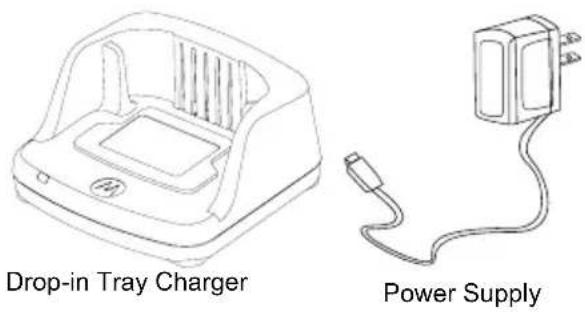
The radio is equipped with one Drop-in Tray Charger and one Power Supply with Adaptor. For more information, refer to "Chargers" on page 67.
Battery Life Information
When the Battery Save feature is set to ON (enabled by default), the battery life lasts longer. The following table summarizes battery life estimations:
Table 2: Li-Ion Battery Life with Tx Power 2 Watts
| Battery Type Battery Save OFF Battery Save ON | ||
| Standard 12 Hours 15 Hours | ||
| High Capacity N/A N/A | ||
Note: Battery life is estimated based on 5% transmit / 5% receive / 90% standby standard duty cycle.
Charging the Battery
The RM Series radio offers two types of Power Supplies:
- Standard Power Supply and,
Rapid Power Supply
Note: The radio comes with a Standard Power Supply.
To charge the battery (with the radio attached), place it in a Motorola-approved Drop-in Tray Single Unit Charger or Drop-in Tray Multi Unit Charger.
Charging with the Drop-in Tray Single Unit Charger (SUC)
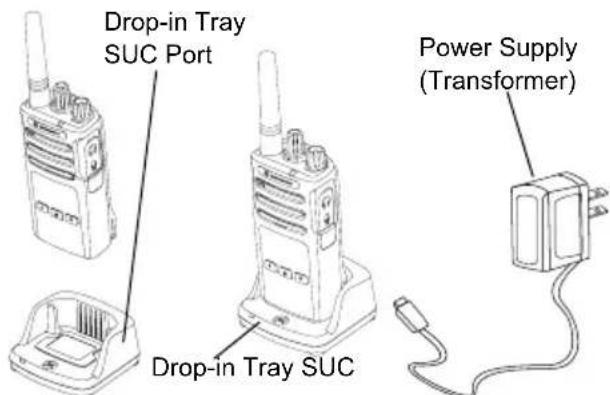
- Place the Drop-in Tray Charger on a flat surface.
- Insert the connector of the Power Supply into the charger port on the back of the Drop-in Tray Charger.
- Plug the AC Adaptor into a power outlet.
- Insert the radio into the Drop-in Tray Single Unit Charger with the radio facing the front, as shown.
Note: When charging a battery attached to the radio, turn the radio OFF to ensure a full charge. See "Operational Safety Guidelines" on page 9 for more information.
Charging A Stand-Alone Battery
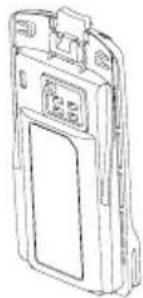
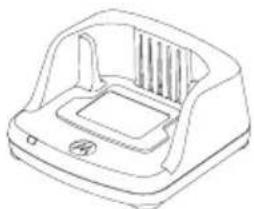
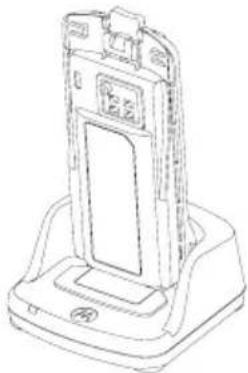
To charge only the battery - at step 4 on page 18, insert the battery into the tray, with the inside surface of the battery facing the front of the Drop-in Tray Single Unit Charger as shown
above. Align the slots in the battery with the alignment ribs in the Drop-in Tray Single Unit Charger.
Table 3: Motorola Authorized Batteries
| Part Number Description | |
| PMNN4434_R Standard Li-Ion Battery | |
| PMNN4453_R | High Capacity Li-Ion Battery |
Drop-in Tray Charger LED Indicators
Table 4: Charger LED Indicator
| Status LED Indicator Comments | ||
| Power On | Green for approximately 1 second | |
| Charging | Steady Red | |
| Charging Complete | Steady Green | |
| Battery Fault (*) | Red Fast Flash | |
| Waiting to Charge (**) | Amber Slow Flash | |
| Battery Level Status | N/A Battery empty | |
| Flash Red 1 Time | Battery low | |
| Flash Amber 2 Times | Battery medium | |
| Flash Green 3 Times | Battery High | |
() Normally, re-positioning the battery pack will correct this issue.
(^*) Battery temperature is too warm or too cold or wrong power voltage is being used.
If there is NO LED indication:
- Check if the radio with battery, or the battery alone, is inserted correctly. (refer to step 4 of "Charging with the Drop-in Tray Single Unit Charger (SUC)" on page 18)
- Ensure that the power supply cable is securely plugged into the charger socket using an appropriate AC outlet and there is power to the outlet.
- Confirm that the battery being used with the radio is listed in Table 3.
Estimated Charging Time
The following table provides the estimated charging time of the battery. For more information, see "Battery" on page 66.
Table 5: Battery Estimated Charging Time
| Charging Solutions | Estimated Charging Time | |
| Standard Battery High Capacity Battery | ||
| Standard ≤ 4.5 Hours N/A | ||
| Rapid ≤ 2.5 Hours N/A | ||
Charging a Radio and Battery using a Multi Unit-Charger - MUC (Optional Accessory)
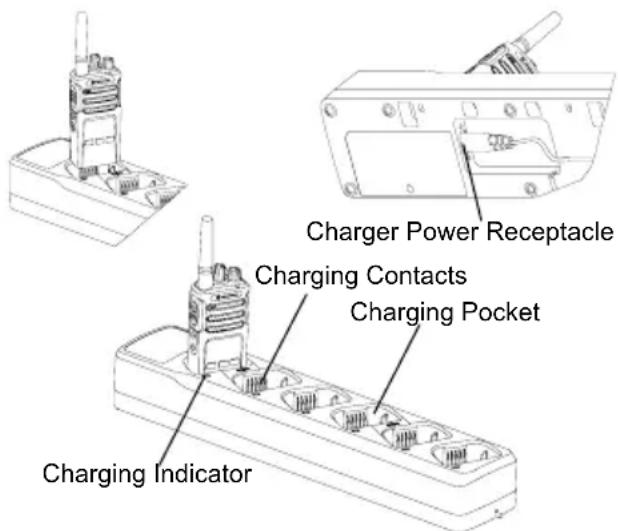
The Multi-Unit Charger (MUC) allows drop-in charging of up to 6 radios or batteries. Batteries can be charged with the radios or removed and placed in the MUC separately. Each of the 6 charging pockets can hold a radio (with or without the Holster) or battery, but not both.
- Place the Multi-Unit Charger on a flat surface.
- Insert the power cord plug into the MUC's dual pin connector at the bottom of the MUC.
- Plug the power cord into an AC outlet.
- Turn the radio OFF.
- Insert the radio or battery into the charging pocket with the radio or battery facing away from the contacts.
Note:
- This Multi-Unit Charger clones up to 2 radios (2 Source radios and 2 Target radios). Refer to "Cloning with a Multi Unit Charger (MUC)" on page 43 for more information.
- More information on the Multi-Unit Charger's operation is available in the Instruction Sheets provided with the MUC. For more information on the parts and their part numbers, refer to Chapter "Accessories" on page 66.
English
Multi-Unit Charger LED Indicators
Table 6: Charger LED Indicator
| Status LED Indicator Comments | ||
| Power On | Green for approximately 1 second | |
| Charging | Steady Red | |
| Charging Complete | Steady Green | |
| Battery Fault (*) | Red Fast Flash | |
| Waiting to Charge (**) | Amber Slow Flash | |
| Battery Level Status | N/A Battery empty | |
| Flash Red 1 Time | Battery low | |
| Flash Amber 2 Times | Battery medium | |
| Flash Green 3 Times | Battery High | |
() Normally, re-positioning the battery pack will correct this issue.
(^*) Battery temperature is too warm or too cold or wrong power voltage is being used.
English
is NO LED indication:
- Check if the radio with battery or the battery alone, is inserted correctly (refer to step 5 of "Charging a Radio and Battery using a Multi Unit-Charger - MUC (Optional Accessory)" on page 22).
- Make sure the power cord is securely plugged into the MUC and the appropriate AC outlet. Make sure there is power to the AC outlet.
- Confirm that the battery being used with the radio is listed in Table 3.
GETTING STARTED
For the following explanations, refer to "Parts Of The Radio" on page 10.
To turn ON the radio, rotate the On/Off/Volume Knob clockwise. The radio plays one of the following:
- Power up tone and channel number announcement, or
- Battery level and channel number announcements, or
- Silent (Audible tones disabled)
The LED blinks red briefly.
To turn the radio OFF, rotate the On/Off/Volume Knob counterclockwise until you hear a 'click' and the radio LED Indicator turns OFF.
ADJUSTING VOLUME
Turn the On/Off/Volume Knob clockwise to increase the volume, or counterclockwise to decrease the volume.
Note: Do not hold the radio too close to the ear when the volume is high or when adjusting the volume
SELECTING A CHANNEL
To select a channel, press the SB2 button until you reach the desired channel. An audible voice indicates the selected channel.
Each channel has its own Frequency, Interference Eliminator Code and Scan Settings.
TALKING AND MONITORING
It is important to monitor for traffic before transmitting to avoid 'talking over' someone who is already transmitting
To monitor, long press and hold the SB1(*) button to access channel traffic. If no activity is present, you will hear 'static'. To release, press SB1 again. Once channel traffic has cleared, proceed with your call by pressing the PTT button. When transmitting, the LED Indicator stays solid red.
Notes:
- To listen to all activity on a current channel, short press the SB1 to set the CTCSS/DPL code to 0. This feature is called 'CTCSS/DPL Defeat (Squelch set to SILENT)'.
- (^*) This assumes SB1 is not being programmed for a different mode.
RECEIVING A CALL
- Select a channel by pressing the SB2 button until you reach the desired channel. An audible voice indicates the selected channel.
- Make sure the PTT button is released and listen for voice activity.
- The LED Indicator stays solid red when the radio is receiving a call.
- To respond, hold the radio vertically 1 to 2 inches (2.5 to 5cm) from mouth. Press the PTT button to talk; release it to listen.
TALK RANGE
| TALK RANGE | ||
| Model | Industrial Multi-Level | |
| Inside steel/concrete Industrial buildings | Inside multi-level buildings | |
| UHF 2W Up to 250,000 Sq. Ft. Up to 20 Floors | ||
| MURS 2W Up to 220,000 Sq. Ft. Up to 13 Floors | ||
To establish a proper two-way communication, the channel, frequency, and interference eliminator codes must be the same on both radios. This depends on the stored profile that has been preprogrammed on the radio:
- Channel: Current channel that the radio is using, depending on radio model.
- Frequency: The frequency the radio uses to transmit/receive.
-
Interference Eliminator Code: These codes help minimize interference by providing a choice of code combinations.
-
Scramble Code: Codes that make the transmissions sound garbled to anyone listening who is not set to that specific code.
- Bandwidth: Some frequencies have selectable channel spacing, which must match other radios for optimum audio quality (only available for RMU2043).
For details on how to set up frequencies and CTCSS/DPL codes in the channels, refer to "Advanced Configuration Mode" on page 32.
RADIO LED INDICATORS
| RADIO STATUS LED INDICATION | |
| Channel Busy Solid Orange | |
| Cloning Mode Double Orange Heartbeats | |
| Cloning In Progress Solid Orange | |
| Fatal Error at Power up | One Green Blink, One Orange Blink, One Green Blink, then repeat for 4 seconds |
| Low Battery Orange Heartbeat | |
| Low Battery Shutdown Fast Orange Heartbeat | |
| Monitor LED is OFF | |
| Power-Up Solid Red for 2 seconds | |
| ‘Idle’ Programming Mode / Channel Mode | Green Heartbeat |
| Scan Mode Fast Red Heartbeat | |
| Transmit (Tx)/Receive (RX) Solid Red | |
| Transmit in Low Power Select Solid Orange | |
| VOX/IVOX Mode Double Red Heartbeats | |
English
HANDS-FREE USE/VOX
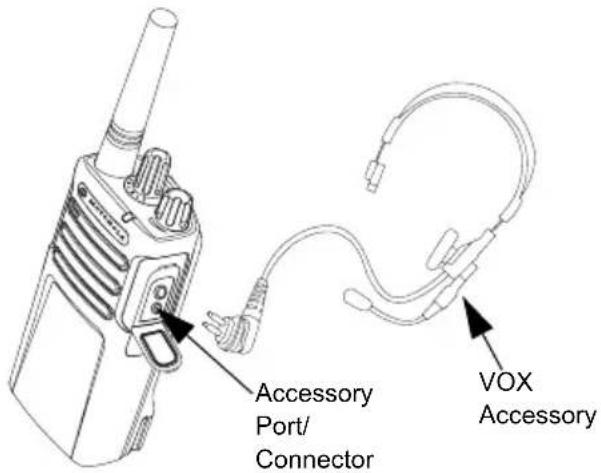
Motorola RM Series™ radios can operate hands-free (VOX) when used with compatible VOX accessories.
With Compatible VOX Accessories
The default factory setting for VOX sensitivity level is OFF (level '0'). Before using VOX, set VOX level to a level different from '0' via the Customer Programming Software (CPS). Then, perform the following steps:
- Turn the radio OFF.
- Open accessory cover.
- Insert the audio accessory's plug firmly into accessory port.
- Turn radio ON. The LED Indicator will blink double red
- Lower radio volume BEFORE placing accessory near ear.
- To transmit, speak into accessory microphone and to receive, stop talking.
- VOX can be temporarily disabled by pressing the PTT button or by removing the audio accessory.
Note: To order accessories, refer to: www.motorolasolutions.com/RMseries, call 1 (800) 448-6686, or contact your Motorola point of purchase
Setting VOX Sensitivity
The sensitivity of the radio's accessory or microphone can be adjusted to suit different operating environments. VOX sensitivity can be programmed via the CPS.
Default value is OFF. If you want to use the VOX feature, VOX level should be set at a value different from OFF.
- 1 = High audio input levels trigger the Tx
- 2 = Medium sensitivity
- 3 = Low audio input levels trigger the Tx
Microphone Gain
The sensitivity of the microphone can be adjusted to fit different users or operating environments.
This feature can be adjusted only through the CPS. Microphone default setting is set to level 2 (medium gain).
Hands Free Without Accessories (iVOX)
- Enable iVOX by pressing the PTT button while
turning ON the radio.
- Pressing the PTT button can temporarily disable the iVOX operation.
Note: There is a short delay between the time when you start stalking and when the radio transmits.
Power Up - Tone Mode
To enable/disable power up tone mode, press SB1 and SB2 buttons simultaneously for 2-3 seconds while powering up the radio until you hear a quick succession of beeps and an audible voice announcement.
Reset to Factory Defaults
Reset to Factory Defaults will set back all radio features to the original factory default settings. To do so, press PTT, SB2 and SB1 simultaneously while turning ON the radio until you hear a high tone chirp.
Toggle Voice Prompt in User Mode
Short press the SB1 button while turning ON the radio to enable/disable Voice Prompt in User mode. This mode is set to ON by default.
PROGRAMMING FEATURES
To easily program all the features in your radio, it is recommended to use the Customer Programming Software (CPS) and the programming cable.
CPS software download is available for free at www.motorolasolutions.com/RMseries.
Advanced Configuration is a configuration mode that allows the customization of additional features via the radio's front panel.
For non-display model radios, the navigation is guided by an audible voice prompt.
When the radio is set to Advanced Configuration, you are able to read and modify four features:
Frequency Selection,
- Codes (CTCSS/DPL),
English
- Auto-Scan and,
Active Channels
The Select Frequencies feature allows you to choose frequencies from a pre-defined list.
The Interference Eliminator Code (CTCSS/DPL) helps minimize interference by providing you with a choice of code combinations that filter out static, noise, and unwanted messages.
The Auto-Scan feature allows you to set a particular channel to automatically enable Scan each time you switch to that channel.
The Active Channels feature allows you to increase or decrease the amount of active channels (In the range of maximum channels allowed).
Entering Advanced Configuration Mode
Note: Before configuring the features, make sure your radio is set to the channel you wish to program. You can do so before entering Advanced Configuration Mode or at any time during the Advanced Configuration Mode by pressing the SB2 button until you reach the desired channel.
To read or modify Frequencies, Codes, AutoScan and Active Channels, set the radio to 'Advanced Configuration Mode' by long pressing both the PTT and the SB1 button simultaneously for 3 to 5 seconds while turning ON the radio until you hear an audible voice saying "Programming Mode" and "Channel Number". The LED Indicator starts blinking a green heartbeat.
Note: 'Idle' Programming Mode is the stage in the Programming Mode where the radio waits for the user to start the radio programming cycle.
Once you are in the 'Idle' Programming Mode, you will be able to hear the Frequencies, Codes, Auto-Scan and Active Channels settings by short pressing the PTT button to navigate along the different programmable features.
Entering Frequencies Values
RM Series radios have 89 frequencies for UHF in USA and 2 frequencies for Canada UHF. In 'Idle' Programming mode, the Channel number becomes the first changeable value. Move the Channel Up or Channel Down using the SB1 and SB2 button. An audible voice indicated the selected channel to configure. Short pressing the PTT button allows you to cycle through the other features available for configuration. Use the SB1 and SB2 button to change the values. An audible voice indicates the value selected.
Reading CTCSS / DPL Values
Cycle through the features available for configuration by short pressing the PTT button until you hear the current code. The radio moves to the programming CTCSS/PL codes mode.
Enter a new code value using the SB1 and SB2 buttons.
The RM Series radios have up to 219 codes available. For more information, refer to "Frequency and Code Charts" on page 53.
Reading Auto-Scan Values
After hearing the CTCSS/DPL codes, short pressing the PTT button moves you to AutoScan mode.
Auto-Scan has only two values:
- Enabled
- Disabled
Active Channels
While in Auto-Scan mode, short pressing the PTT button shifts the radio to 'Active Channels' feature. Modify the amount of channels available using the SB1 and SB2 buttons.
Saving Settings
Once you are satisfied with the settings, you can either:
- short press the PTT button to continue programming,
- long press the PTT button to save and return to 'Idle' Programming Mode, or
- long press the PTT button twice to exit 'Idle' Programming Mode and return to the normal radio operation.
Note:
- To exit the programming mode without saving, turn OFF the radio.
- If you 'roll-over' to the beginning of 'Idle' Programming Mode, you will hear "Channel Number". All changed values will be automatically saved.
Programming Mode FAQ
- I got distracted while programming and forgot which feature I was programming. What should I do?
Return to 'Idle' Programming Mode and start over. You will not be able to return to Programming Mode (the radio does not provide further way to let you know the specific stage you are at in the Programming Mode).
Therefore you can:
- Long press the PTT button. The radio will return to 'Idle' Programming Mode or,
- Turn OFF the radio and enter Programming Mode again. (Refer to "Entering Advanced Configuration Mode" on page 33 for more information)
- I am trying to program a frequency (or a code) value but the radio would not do it. It rolled over and took me back to value '0'.
The radio disallow you to program any value that is not available in the frequencies and
codes pool. For example, if you try to program code 220, the radio would not accept it as the maximum value allowed is 219. Same goes for the frequencies. Refer to the "Frequency and Code Charts" on page 53 to make sure you are programming a valid value.
3. I am trying to enter the Programming Mode but the radio would not do it.
The radio may be locked using the CPS to disallow Front Panel Programming. To re-enable, use the CPS.
- I programmed the wrong value when I was programming. How can I erase or re-program the value?
If you programmed the wrong value, you can either:
-
'Roll-over' the radio. The radio 'roll-over' each time it reaches the maximum value allowed. Keep increasing (short press the SB1 button) or decreasing (short press the SB2 button) until you get the desired value or,
-
Turn OFF the radio and start over.
- I just programmed the value I wanted. How do I exit the Programming Mode?
You can either:
- long press the PTT button twice to exit if you're in the Programming Mode or,
- Long press the PTT button once if you are already in the 'Idle' Programming mode.
- I am done programming the features in this channel. How do I program another channel?
Short press the PTT button several times until you hear "Channel Number". Switch channel using the SB1 and SB2 buttons. If you wish to save the changes, make sure you are in the 'Idle' Programming Mode before switching the channel, otherwise you will lose the changes made.
PROGRAMMING VALUES EXAMPLE
Example of Programming a Frequency
Assuming current frequency value is set to Channel 1, with the UHF default frequency set to '02' (equivalent to 464.5500MHz ), and you want to change it to Frequency Number = '13' (which is mapped to 461.1375MHz ), follow this sequence:
- Enter Advanced Configuration Mode.
- Short press the PTT button to enter Frequency Mode. The radio audible voice announces that the current value is '2'.
- Press the SB1 button eleven times to increase frequencies and you will hear frequency "One, three" (13).
- Long press the PTT button. LED Indicator shows a green heartbeat to indicate 'Idle' Programming Mode.
- Long press the PTT button again to exit Programming Mode or turn OFF the radio.
Example of Programming a Code
Assuming the current code value is set to factory default '001', and you want to change it to CTCSS/DPL Code = 103. Follow the sequence indicated below:
- Enter Advanced Configuration Mode.
- Short press the PTT button twice. The radio audible voice announced "Code Number" (Entering CTCSS/DPL Programming Selection Mode).
- Pressing and holding SB1 or SB2 button fast forwards / rewrites the value at the nearest 10's. When released, the radio audible voice announces the first, second and third digit in full. Keep pressing the SB1 or SB2 button several times until you hear "103".
- Long press the PTT button. LED Indicator shows a green heartbeat to indicate 'Idle' Programming Mode.
- Long press the PTT button again to exit Programming Mode or turn OFF the radio.
Example of Programming Auto-Scan
Auto-Scan is the third available feature in the Programming Mode and can be set to either ON or OFF on a particular channel.
To set Auto-Scan to ON:
- Enter Advanced Configuration Mode and select the desired channel.
- Short press the PTT button three times to enter the Active Channels Programming Selection Mode. The audible voice in the radio announces "Auto-Scan" and the setting (Enabled or Disabled).
- To change the setting, press SB1 or SB2.
- Long press the PTT button. LED Indicator shows a green heartbeat to indicate 'Idle' Programming Mode.
- Long press the PTT button again to exit Programming Mode or turn OFF the radio.
Example of Programming Active Channels
Active Channels is the last Programming Mode. It allows you to modify the number of active channels the radio is programmed to support.
To set Active Channels:
- Enter Advanced Configuration Mode and select the desired channel.
- Short press the PTT button four times to enter the Active Channels Programming Selection Mode. The audible voice in the radio announces "Active Channels" and the current value.
- Short press the SB1 or SB2 button until you the number of channels desired.
- Long press the PTT Button. LED Indicator shows a green heartbeat to indicate 'Idle' Programming Mode.
- Long press the PTT Button to exit Programming Mode or turn OFF the radio.
OTHER PROGRAMMING FEATURES
Scan
Scan allows you to monitor other channels to detect conversations. When the radio detects a transmission, it stops scanning and goes to the active channel. This allows you to listen and talk to people in that channel without having to change channel manually. If there are transmissions on another channel, you will not hear that activity once the radio has stopped scanning. Once the activity on transmitting channel stops, the radio waits for 5 seconds before resuming scan again.
- To start scanning, press the SB1 or SB2 button
Note: Scan has to be programmed either to SB1 or SB2 button via CPS. SB2 is by default Down Button for RMU2040/RMU2043/ RMM2050 models. - To stop scanning, short press the SB1 or SB2 button (programmed for scan) again.
- By pressing the PTT button while the radio is scanning, the radio will transmit on the channel
which was previously selected before Scan is activated. If no transmission occurs within 5 seconds, scanning resumes.
- If you want to scan a channel without the Interference Eliminator Codes (CTCSS/DPL), set the code settings for the channels to '0' in the CTCSS/DPL Programming Selection Mode.
Note: Whenever the radio is set to Scan, the LED Indicator blinks a Red Heartbeat.
Editing Scan List
Scan List can be edited by using the CPS. For more information refer to "Customer Programming Software (CPS)" on page 40.
Nuisance Channel Delete
Nuisance Channel Delete allows you to temporarily remove channels from the Scan List. This feature is useful when irrelevant conversations on a 'nuisance' channel ties up the radio's scanning feature.
To delete a channel from the Scan List:
- Start Scan mode by short pressing the SB1 or SB2 (programmed for scan) button.
- Wait until the radio stops at the channel you wish to eliminate. Long press the SB2 button to delete it. You cannot delete the channel with scan enabled (home channel).
- The channel will not be scanned again until you exit the Scan mode by short pressing the SB1 or SB2 (programmed for scan) button again or by turning OFF the radio and back ON.
CUSTOMER PROGRAMMING SOFTWARE (CPS)
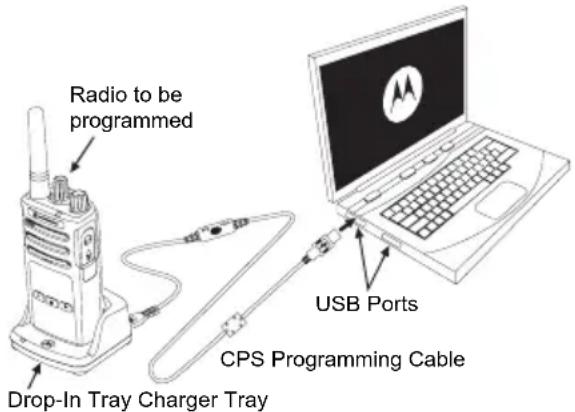
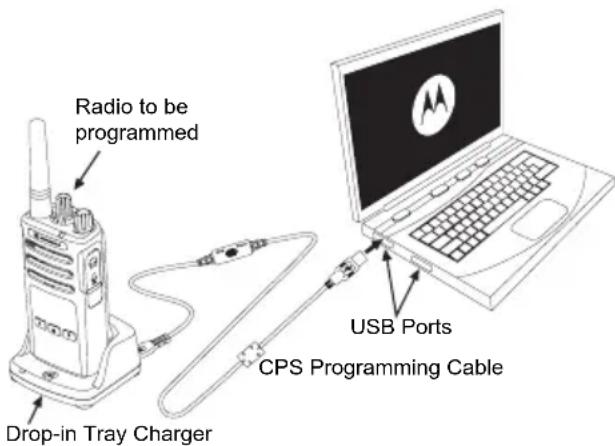
Figure 1: Setting up the radio to the CPS
The easiest way to program or change features in your radio is by using the Customer Programming Software (CPS) and the CPS Programming Cable*. CPS Software is available for free as web based downloadable software at:
www.motorolasolutions.com/RMseries
To program, connect the RM Series radio via the Drop-in Charger Tray and CPS Programming Cable as shown in Figure 1 on page 40.
CPS allows you to program frequencies, PL/ DPL Codes as well as other features such as: Bandwidth Select, Time-out Timer, Power Select, Scan List, Call Tones, Scramble, Reverse Burst, etc. CPS is a very useful tool as it can also lock the Front-Panel Radio Programming or restrict any specific radio feature to be changed (to avoid accidentally erasing the preset radio values). It also provides security by giving the option to set up a password for profile radio's management. For more information, refer to Features Summary Chart Section at the end of the User Guide.
Note: (*) CPS Programming Cable P/N# HKKN4027_is an accessory sold separately. Please contact your Motorola point of purchase for more information.
Bandwidth Select (Only for Canada models)
All US models are compliant with the narrowbandwidth FCC regulation.
Default setting for Bandwidth Select depends on the specific frequency and channel. Some frequencies have selectable channel spacing, which must match with other radios for optimum audio quality.
For details, refer to Frequency and Code Charts section.
Time-Out Timer
When pressing the PTT button, transmissions can be terminated by setting up a 'time-out' timer.
Power Select
Power Select allows you to select between high and low transmission power per frequency in each channel. The power levels for RM Series 2W toggle between 1W and 2W.
Note: Some frequencies may have FCC transmit power restrictions that do not allow them to be set at a higher power level. For details see the Frequencies and Code Chart Section.
Call Tones
Call Tones feature allows you to transmit an audible tone to other radios on the same channel to alert them that you are about to talk or to alert them without speaking.
To use this feature, the Call Tones must be programmed to either SB1 or SB2 and 1 of the 3 pre-recorded tones is selected.
Scramble
The Scramble feature makes transmissions sound garbled to anyone listening without the same code. Scramble default value is OFF. To change the scramble code during radio's normal operation, the Scramble feature must be programmed to either SB1 or SB2.
Reverse Burst
Reverse Burst eliminates unwanted noise (squelch tail) during loss of carrier detection. You can select values of either 180 or 240 to be compatible with other radios. The default value is 180.
Notes:
- The features described in previous pages are just some of the features CPS has. CPS offers more capabilities. For more information refer to the HELP file in the CPS.
CLONING RADIOS
You can clone RM Series radio profiles from one Source radio to a Target radio by using any one of these 3 methods:
- Using a Multi Unit Charger (MUC-optional accessory),
- Using two Single Unit Chargers (SUC) and a Radio-to-Radio cloning cable (optional accessory),
- the CPS (free software download)
Cloning with a Multi Unit Charger (MUC)
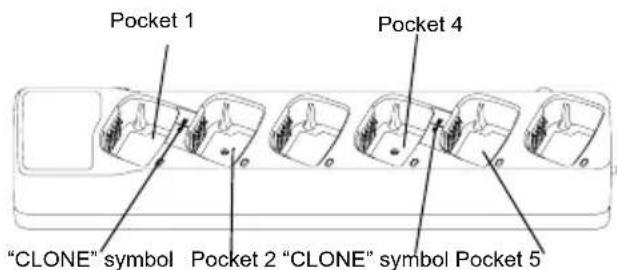
To clone radios using the MUC, there must be at least two radios:
- a Source radio (radio which profiles will be cloned or copied from) and
- a Target radio (the radio which profile will be cloned from the source radio.)
The Source radio has to be in Pocket 1 or 4 while the Target radio has to be in Pocket 2 or 5, matching in the MUCs pockets by pairs as follows:
1 and 2 or,
4 and 5.
When cloning, the MUC does not need to be plugged into a power source, but ALL radios require charged batteries.
- Turn ON the Target radio and place it into one of the MUC Target Pockets
-
Power the Source radio following the sequence below:
-
Press the PTT button and SB2 simultaneously while turning the radio ON.
-
Wait for 3 seconds before releasing the buttons until the audible tone "Cloning" is heard.
-
Place the Source radio in the source pocket that pairs with the target pocket you chose in step 1. Press and release the SB1 button.
- After cloning is completed, the Source radio will announce either "successful" (cloning is successful) or "fail" (cloning has failed). If the Source radio is a display model, it will either
show 'Pass' or 'Fail' on the display (a voice announcement will be played within 5 seconds).
- Once you have completed the cloning process, turn the radios OFF and ON to exit the 'cloning' mode.
Further details on how to clone radios are explained in the Instructions Sheet provided with the MUC.
When ordering the MUC, refer to P/N#
PMLN6384_.
Notes:
- If cloning fails, refer to "What To Do If Cloning Fails" on page 46.
- Paired Target radios and Source radios must be of the same band type in order for the cloning to run successfully.
- MUC pockets numbers should be read from left to right with the Motorola logo facing front.
CPS and Cloning Cables (Optional Accessory)
- Both CPS and Cloning Cables are made to work either with RM Series radios or RDX Series radios. Cloning cable supports a mix of RM and RDX series radios.
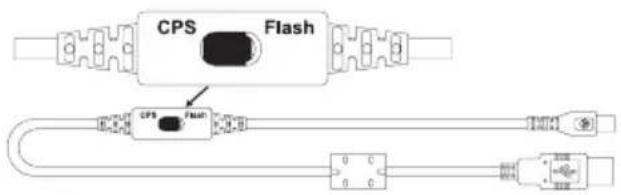
- CPS cable programs RM series radios. Make sure the cable switch is in "Flash" position. To program a RDX radio with the CPS cable, make sure the cable switch is in "CPS" position and the USB converter provided in the CPS cable kit is attached to the cable.
-
Cloning cable allows you to clone:
-
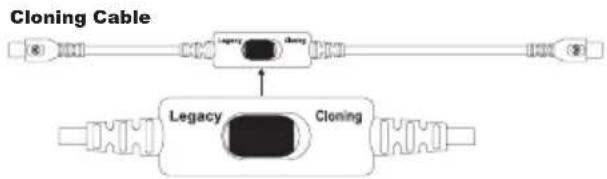
RM Series radios. Make sure the switch is in "Cloning" or "Legacy" position.
-RDX Series radios. Make sure the switch is in "Legacy" position with one USB converter on each end of the cloning cable. - RM Series and RDX Series radios. Make sure the switch is in "Legacy" position and use a USB converter to the RDX Single-Unit Charger. The Cloning Cable Kit provides 1 USB converter.
CPS Cable Cloning Radio using the Radio to Radio

USB Converter
(R2R) Cloning Cable (Optional Accessory)
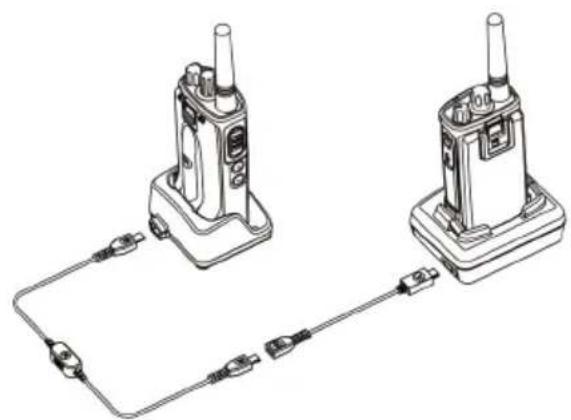
Operating Instructions
-
Before starting the cloning process, make sure you have:
-
A fully charged battery on each of the radios.
- Two Single-Unit Chargers (SUC), or 2 SUC for cloning RM Series radios, or 1 SUC for RM Series radio and 1 SUC for RDX Series radio.
-
Turn OFF the radios and,
-
Unplug any cables (power supply or USB cables) from the SUCs.
- Plug one side of the cloning cable mini USB connector to the first SUC and the other end to the second SUC.
Note: During the cloning process, no power is being applied to the SUC. The batteries will not be charged. Only data communication is being established between the two radios. - Turn ON the Target Radio and place it into one of the SUCs.
- For the Source Radio, power ON the radio with the following sequence:
- Press the PTT button and the SB2 button simultaneously while turning the radio ON.
- Place the Source Radio in its SUC. Press and release the SB1 button.
- Wait 3 seconds before releasing the buttons and you hear a distinctive audible tone saying the word "Cloning".
- When the cloning is completed, the Source Radio audible voice will announce either
"successful" (cloning is successful) or "fail" (cloning process has failed). If the Source Radio is a display model radio, it will either show 'Pass' or 'Fail' on the display (a tone will be heard within 5 seconds).
8. Once the cloning process is completed, turn the Radios OFF and ON or, long press the PTT button to exit the 'cloning' mode.
What To Do If Cloning Fails
The radio audible voice will announce "Fail" indicating that the cloning process has failed. In the event that the cloning fails, perform each of the following steps before attempting to start cloning process again:
- Ensure that the batteries on both radios are fully charged.
- Check the cloning cable connection on both SUCs.
-
Ensure that the battery is engaged properly on the radio.
-
Ensure that there is no debris in the charging tray or on the radio contacts.
- Ensure that the Target radio is turned ON.
- Ensure that the Source radio is in cloning mode.
- Ensure that the two radios are both from the same frequency band, same region and have the same transmission power.
Note: This cloning cable is designed to operate only with compatible Motorola SUC RLN6175 and PMLN6394.
When ordering Cloning Cable, please refer to P/N# HKKN4028_. For more information about the accessories, refer to "Accessories" on page 66.
Cloning using the Customer Programming Software (CPS)
When cloning using this method, you need the CPS software, a Drop-In Tray Charger and the CPS Programming Cable.
To order the CPS Programming Cable, please refer to HKKN4028A.
Information on how to clone using the CPS is available either in:
- the CPS Help File --> Content and Index --> Cloning Radios, or
- in the CPS Programming Cable Accessory Leaflet.
TROUBLESHOOTING
| Symptom Try This... | |
| No Power | Recharge or replace the Li-1on battery. Extreme operating temperatures may affect battery life. Refer to “About the Li-Ion Battery” on page 13 |
| Hearing other noises or conversation on a channel | Confirm Interference Eliminator Code is set. Frequency or Interference Eliminator Code may be in use. Change settings: either change frequencies or codes on all radios. Make sure radio is at the right frequency and code when transmitting. Refer to “Talking and Monitoring” on page 25 |
| Message Scrambled | Scramble Code might be ON, and/or setting does not match the other radios' settings. |
| Audio quality not good enough | Radio settings might not be matching up correctly. Double check frequencies, codes and bandwidths to make sure they are identical in all radios |
| Limited talk range | Steel and/or concrete structures, heavy foliage, buildings or vehicles decrease range. Check for clear line of sight to improve transmission. Wearing radio close to body such as in a pocket or on a belt decreases range. Change location of radio. To increase range and coverage, you can reduce obstructions or increase power. UHF radios provides greater coverage in industrial and commercial buildings. Increasing power provides greater signal range and increased penetration through obstructions. Refer to “Talking and Monitoring” on page 25 |
| Message not transmitted or received | Make sure the PTT button is completely pressed when transmitting. Confirm that the radios have the same Channel, Frequency, Interference Eliminator Code and Scramble Code settings. Refer to “Talking and Monitoring” on page 25 for further information. Recharge, replace and/or reposition batteries. Refer to “About the Li-Ion Battery” on page 13. Obstructions and operating indoors, or in vehicles, may interfere. Change location. Refer to “Talking and Monitoring” on page 25. Verify that the radio is not in Scan. Refer to “Scan” on page 38 and “Nuisance Channel Delete” on page 39. |
| Heavy static or interference | Radios are too close; they must be at least five feet apart. Radios are too far apart or obstacles are interfering with transmission. Refer to "Talking and Monitoring" on page 25. |
| Low batteries | Recharge or replace Li-Ion battery. Extreme operating temperatures affect battery life. Refer to "About the Li-Ion Battery" on page 13. |
| Drop-in Charger LED light does not blink | Check that the radio/battery is properly inserted and check the battery/charger contacts to ensure that they are clean and charging pin is inserted correctly. Refer to "Charging the Battery" on page 18, "Drop-in Tray Charger LED Indicators" on page 20 and "Installing the Lithium-Ion (Li-Ion) Battery" on page 15. |
| Low battery indicator is blinking although new batteries are inserted | Refer to "Installing the Lithium-Ion (Li-Ion) Battery" on page 15, and "About the Li-Ion Battery" on page 13. |
| Cannot activate VOX | VOX feature might be set to OFF. Use the CPS to ensure that the VOX Sensitivity level is not set to ‘0’. Accessory not working or not compatible. Refer to “Hands-Free Use/VOX” on page 29. |
| Battery does not charge although it has been placed in the drop-in charger for a while | Check drop-in tray charger is properly connected and correspond to a compatible power supply. Refer to “Charging with the Drop-in Tray Single Unit Charger (SUC)” on page 18 and “Charging A Stand-Alone Battery” on page 19. Check the charger's LEDs indicators to see if the battery has a problem. Refer to “Drop-in Tray Charger LED Indicators” on page 20. |
Note: Whenever a feature in the radio seems to not correspond to the default or preprogrammed values, check to see if the radio has been programmed using the CPS with a customized profile.
USE AND CARE
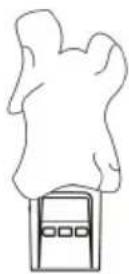
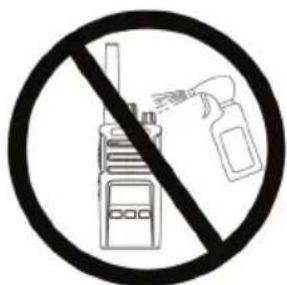
Use a soft damp cloth to clean the exterior
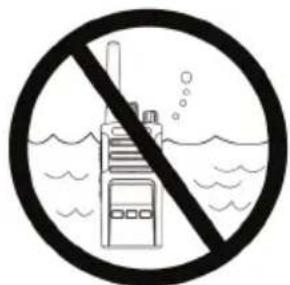
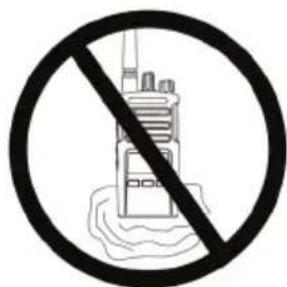
Do not immerse in water Do not use alcohol or cleaning solutions
If the radio is submerged in water...
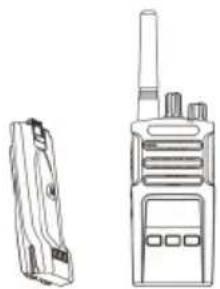
Turn radio OFF and remove batteries
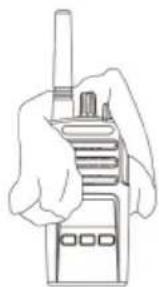
Dry with soft cloth Do not use radio until completely dry
English
FREQUENCY AND CODE CHARTS
RMU2043 - UHF DEFAULT FREQUENCIES CHART
RM UHF 4CH Radios Default Frequencies - RMU2043
| Channel Frequency # | Frequency (MHz) | Code # Code Bandwidth | ||
| 1 1 458.6625 1 67.0 Hz 12.5 kHz | ||||
| 2 2 469.2625 1 67.0 Hz 12.5 kHz | ||||
RMU2040 - UHF DEFAULT FREQUENCIES CHART
RM UHF 4CH Radios Default Frequencies - RMU2040
| Channel Frequency # | Frequency (MHz) | Code # Code Bandwidth | ||
| 1 2 464.5500 1 67.0 Hz 12.5 kHz | ||||
| 2 8 467.9250 1 67.0 Hz 12.5 kHz | ||||
RMM2050 - VHF-MURS DEFAULT FREQUENCIES CHART
RM VHF-MURS 5CH Radios Default Frequencies - RMM2050
| Channel Frequency # | Frequency (MHz) | Code # Code Bandwidth | ||
| 1 1 154.5700 1 67.0 Hz 20.0 kHz | ||||
| 2 2 154.6000 1 67.0 Hz 20.0 kHz | ||||
| 3 3 151.8200 1 67.0 Hz 11.25 kHz | ||||
| 4 4 151.8800 1 67.0 Hz 11.25 kHz | ||||
| 5 5 151.9400 1 67.0 Hz 11.25 kHz | ||||
Especial Features Requirements
- Non repeater capable.
- Non-bandwidth selectable (the FCC defines the specific bandwidth requirement for each of the MURS frequencies).
- No power select feature.
- No direct frequency input (does not support programming of part 90 frequencies).
- No standard frequency pull down MENU (should only have the 5 MURS frequencies).
Cloning should follow standard BL Solomons platform rules; no cloning between radios of different channel distribution (ie. CP110 and RDX) or models from different regions.
CTCSS AND PL/DPL CODES
CTCSS Codes
| CTCSS Hz | CTCSS Hz |
| 1 67.0 | 14 107.2 27 167.9 |
| 2 71.9 | 15 110.928 173.8 |
| 3 74.4 | 16 114.8 29 179.9 |
| 4 77.0 | 17 118.830 186.2 |
| 5 79.7 | 18 123.31 192.8 |
| 6 82.5 | 19 127.3 32 203.5 |
| 7 85.4 | 20 131.8 33 210.7 |
| 8 88.5 | 21 136.5 34 218.1 |
| 9 91.5 | 22 141.3 35 225.7 |
| 10 94.8 | 23 146.2 36 233.6 |
| 11 97.4 | 24 151.4 37 241.8 |
| 12 100.0 | 25 156.7 38 250.3 |
| 13 103.5 | 26 162.2 |
| SS Hz | |
| 122 (*) | 69.3 |
Note: (*) New CTCSS code.
PL/DPL Codes
| DPL Code DPL Code |
| 39 23 55 116 71 243 |
| 40 25 56 125 72 244 |
| 41 26 57 131 73 245 |
| 42 31 58 132 74 251 |
| 43 32 59 134 75 261 |
| 44 43 60 143 76 263 |
| 45 47 61 152 77 265 |
| 46 51 62 155 78 271 |
| 47 54 63 156 79 306 |
| 48 65 64 162 80 311 |
| 49 71 65 165 81 315 |
| 50 72 66 172 82 331 |
| 51 73 67 174 83 343 |
| 52 74 68 205 84 346 |
| 53 114 69 223 85 351 |
| 54 115 70 226 86 364 |
| ode | |
PL/DPL Codes (Continued)
| DPL Code | DPL Code | ||
| 87 365 | 104 565 121 754 | ||
| 88 371 | 105 606 123 645 | ||
| 89 411 | 106 6 | 12 124 Customized PL | |
| 90 412 | 107 624 125 Customized PL | ||
| 91 413 | 108 627 126 Customized PL | ||
| 92 423 | 109 631 127 Customized PL | ||
| 93 431 | 110 632 128 Customized PL | ||
| 94 432 | 111 654 129 Customized PL | ||
| 95 445 | 112 662 130 Inverted DPL | 39 | |
| 96 464 | 113 664 131 Inverted DPL | 40 | |
| 97 465 | 114 703 132 Inverted DPL | 41 | |
| 98 466 | 115 712 133 Inverted DPL | 42 | |
| 99 503 | 116 723 134 Inverted DPL | 43 | |
| 100 506 | 117 731 135 Inverted DPL | 44 | |
| 101 516 | 118 732 136 Inverted DPL | 45 | |
| 102 532 | 119 734 137 Inverted DPL | 46 | |
| 103 546 | 120 743 138 Inverted DPL | 47 | |
| DPL | Code |
English
PL/DPL Codes (Continued)
| DPL Code DPL Code | |
| 139 | Inverted DPL 48 |
| 140 | Inverted DPL 49 |
| 141 | Inverted DPL 50 |
| 142 | Inverted DPL 51 |
| 143 | Inverted DPL 52 |
| 144 | Inverted DPL 53 |
| 145 | Inverted DPL 54 |
| 146 | Inverted DPL 55 |
| 147 | Inverted DPL 56 |
| 148 | Inverted DPL 57 |
| 149 | Inverted DPL 58 |
| 150 | Inverted DPL 59 |
| 151 | Inverted DPL 60 |
| 152 | Inverted DPL 61 |
| 153 | Inverted DPL 62 |
| 154 | Inverted DPL 63 |
| 155 | Inverted DPL 64 |
| ode | |
| 156 | Inverted DPL 65 |
| 157 | Inverted DPL 66 |
| 158 | Inverted DPL 67 |
| 159 | Inverted DPL 68 |
| 160 | Inverted DPL 69 |
| 161 | Inverted DPL 70 |
| 162 | Inverted DPL 71 |
| 163 | Inverted DPL 72 |
| 164 | Inverted DPL 73 |
| 165 | Inverted DPL 74 |
| 166 | Inverted DPL 75 |
| 167 | Inverted DPL 76 |
| 168 | Inverted DPL 77 |
| 169 | Inverted DPL 78 |
| 170 | Inverted DPL 79 |
| 171 | Inverted DPL 80 |
| 172 | Inverted DPL 81 |
| 173 | Inverted DPL 82 |
| 174 | Inverted DPL 83 |
| 175 | Inverted DPL 84 |
| 176 | Inverted DPL 85 |
| 177 | Inverted DPL 86 |
| 178 | Inverted DPL 87 |
| 179 | Inverted DPL 88 |
| 180 | Inverted DPL 89 |
| 181 | Inverted DPL 90 |
| 182 | Inverted DPL 91 |
| 183 | Inverted DPL 92 |
| 184 | Inverted DPL 93 |
| 185 | Inverted DPL 94 |
| 186 | Inverted DPL 95 |
| 187 | Inverted DPL 96 |
| 188 | Inverted DPL 97 |
| 189 | Inverted DPL 98 |
| DPL | Code |
| 190 | Inverted DPL 99 |
| 191 | Inverted DPL 100 |
| 192 | Inverted DPL 101 |
| 193 | Inverted DPL 102 |
| 194 | Inverted DPL 103 |
| 195 | Inverted DPL 104 |
| 196 | Inverted DPL 105 206 |
| 197 | Inverted DPL 106 |
| 198 | Inverted DPL 107 208 |
| 199 | Inverted DPL 108 |
| DPL Code | |
| 200 | Inverted DPL 109 |
| 201 | Inverted DPL 110 |
| 202 | Inverted DPL 111 |
| 203 | Inverted DPL 112 |
| 204 | Inverted DPL 113 |
| 205 | Inverted DPL 114 |
| ed DPL | 115 216 Customize |
| 207 | Inverted DPL 116 |
| ed DPL | 117 218 Customize |
| 209 | Inverted DPL 118 |
| DPL | Code |
| 210 | Inverted DPL 119 |
| 211 | Inverted DPL 120 |
| 212 | Inverted DPL 121 |
| 213 | Inverted DPL 123 |
| 214 | Customized DPL |
| 215 | Customized DPL |
| 217 | Customized DPL |
| 219 | Customized DPL |
English
Notes
MOTOROLA LIMITED WARRANTY FOR THE UNITED STATES AND CANADA
What Does this Warranty Cover?
Subject to the exclusions contained below, Motorola, Inc. warrants its telephones, pagers, and consumer and business two-way radios (excluding commercial, government or industrial radios) that operate via Family Radio Service or General Mobile Radio Service, Motorola-branded or certified accessories sold for use with these Products ("Accessories") and Motorola software contained on CD-ROMs or other tangible media and sold for use with these Products ("Software") to be free from defects in materials and workmanship under normal consumer usage for the period(s) outlined below.
This limited warranty is a consumer's exclusive remedy, and applies as follows to new Motorola Products, Accessories and Software purchased by consumers in the United States, which are accompanied by this written warranty.
Products and Accessories
| Products Covered Length of Coverage | |
| Products and Accessories as defined above, unless otherwise provided for below. | One (1) year from the date of purchase by the first consumer purchaser of the product unless otherwise provided for below. |
| Decorative Accessories and Cases. Decorative covers, bezels, PhoneWrap™ covers and cases. | Limited lifetime warranty for the lifetime of ownership by the first consumer purchaser of the product. |
| Business Two-way Radio Accessories | One (1) year from the date of purchase by the first consumer purchaser of the product. |
| Products and Accessories that are Repaired or Replaced. | The balance of the original warranty or for ninety (90) days from the date returned to the consumer, whichever is longer. |
Exclusions
Normal Wear and Tear. Periodic maintenance, repair and replacement of parts due to normal wear and tear are excluded from coverage.
Batteries. Only batteries whose fully charged capacity falls below 80% of their rated capacity and batteries that leak are covered by this limited warranty.
Abuse & Misuse. Defects or damage that result from: (a) improper operation, storage, misuse or abuse, accident or neglect, such as physical damage (cracks, scratches, etc.) to the surface of the product resulting from misuse; (b) contact with liquid, water, rain, extreme humidity or heavy perspiration, sand, dirt or the like, extreme heat, or food; (c) use of the Products or Accessories for commercial purposes or subjecting the Product or Accessory to abnormal usage or conditions; or (d) other acts which are not the fault of Motorola, are excluded from coverage.
Use of Non-Motorola Products and
Accessories. Defects or damage that result from the use of Non-Motorola branded or certified Products, Accessories, Software or other peripheral equipment are excluded from coverage.
Unauthorized Service or Modification. Defects or damages resulting from service, testing, adjustment, installation, maintenance, alteration, or modification in any way by someone other than Motorola, or its authorized service centers, are excluded from coverage.
Altered Products. Products or Accessories with (a) serial numbers or date tags that have been removed, altered or obliterated; (b) broken seals or that show evidence of tampering; (c) mismatched board serial numbers; or (d) nonconforming or non-Motorola housings, or parts, are excluded form coverage.
Communication Services. Defects, damages, or the failure of Products, Accessories or Software due to any communication service or signal you may subscribe to or use with the Products Accessories or Software is excluded from coverage.
Software
Products Covered Length of Coverage
Software. Applies only to physical defects in the media that embodies the copy of the software (e.g. CD-ROM, or floppy disk).
Ninety (90) days from the date of purchase.
Exclusions
Software Embodied in Physical Media. No warranty is made that the software will meet your requirements or will work in combination with any hardware or software applications provided by third parties, that the operation of the software products will be uninterrupted or error free, or that all defects in the software products will be corrected.
Software NOT Embodied in Physical Media. Software that is not embodied in physical media (e.g. software that is downloaded from the internet), is provided "as is" and without warranty.
WHO IS COVERED?
This warranty extends only to the first consumer purchaser, and is not transferable.
HOW TO OBTAIN WARRANTY SERVICE OR OTHER INFORMATION?
Contact your Motorola point of purchase.
SOFTWARE COPYRIGHT NOTICE
The Motorola products described in this manual may include copyrighted Motorola and third party software stored in semiconductor memories or other media. Laws in the United States and other countries preserve for Motorola and third party software providers certain exclusive rights for copyrighted software, such as the exclusive rights to distribute or reproduce the copyrighted software. Accordingly, any copyrighted software contained in the Motorola products may not be modified, reverse-engineered, distributed, or reproduced in any manner to the extent allowed by law.
Furthermore, the purchase of the Motorola products shall not be deemed to grant either directly or by implication, estoppel, or otherwise, any license under the copyrights, patents, or patent applications of Motorola or any third party software provider, except for the normal, non-exclusive, royalty-free license to use that arises by operation of law in the sale of a product.
PATENT NOTICE
This product is covered by one or more of the following United States patents. 5896277 5894292 5864752 5699006 5742484 D408396 D399821 D387758 D389158 5894592 5893027 5789098 5734975 5861850 D395882 D383745 D389827 D389139 5929825 5926514 5953640 6071640 D413022 D416252 D416893 D433001
EXPORT LAW ASSURANCES
This product is controlled under the export regulations of the United States of America. The Governments of the United States of America may restrict the exportation or re-exportation of this product to certain destinations. For further information contact the U.S. Department of Commerce.
ACCESSIONS
AUDIO ACCESSORIES
Part No. Description
53815 Headset w/Boom Mic BR
HMN9026_R Remote Speaker Mic BR
HKLN4477_Surveillance Earpiece BR
53865 Headset w/Swivel Boom Mic
53866 Earbud w/Clip PTT Mic BR
56517 Earpiece|w/Inline Mic
RLN6423_Swivel Earpiece BR
BATTERY
Part No. Description
PMNN4434_R Standard Li-ion Battery
PMNN4453_R High Capacity Li-ion Battery
SOFTWARE APPLICATIONS
Part No. Description
82012694001
Customer Programming Software (CPS)
CABLES
Part No. Description
HKKN4028_Radio to Radio Cloning Cable
HKKN4027_CPS Programming Cable
CHARGERS
| Part No. Description | |
| PMLN6384_ | Multi-Unit Charger (MUC) Kit - North America |
| PMLN6394_ Standard Drop-In Tray Charger | |
CARRY ACCESSORIES
| Part No. Description | |
| HKLN4510_Swivel Holster |
Notes
TABLE DES MATIÈRES
Table des matieres 1
Produit Sécurité. 4
Introduction 6
RéCEPTION D'UN APPEL
Codes PL/DPL (Suite)
| DPL Code | DPL Code | ||
| 87 365 | 104 565 121 754 | ||
| 88 371 | 105 606 123 645 | ||
| 89 411 | 106 612 12 124 Personnelé PL | ||
| 90 412 | 107 624 125 Personnelé PL | ||
| 91 413 | 108 627 126 Personnelé PL | ||
| 92 423 | 109 631 127 Personnelé PL | ||
| 93 431 | 110 632 128 Personnelé PL | ||
| 94 432 | 111 654 129 Personnelé PL | ||
| 95 445 | 112 662 130 Inversé DPL | 39 | |
| 96 464 | 113 664 131 Inversé DPL | 40 | |
| 97 465 | 114 703 132 Inversé DPL | 41 | |
| 98 466 | 115 712 133 Inversé DPL | 42 | |
| 99 503 | 116 723 134 Inversé DPL | 43 | |
| 100 506 | 117 731 135 Inversé DPL | 44 | |
| 101 516 | 118 732 136 Inversé DPL | 45 | |
| 102 532 | 119 734 137 Inversé DPL | 46 | |
| 103 546 | 120 743 138 Inversé DPL | 47 | |
| DPL | Code |
Codes PL/DPL (Suite)
| DPL Code DPL Code | |
| 139 | Inversé DPL 48 |
| 140 | Inversé DPL 49 |
| 141 | Inversé DPL 50 |
| 142 | Inversé DPL 51 |
| 143 | Inversé DPL 52 |
| 144 | Inversé DPL 53 |
| 145 | Inversé DPL 54 |
| 146 | Inversé DPL 55 |
| 147 | Inversé DPL 56 |
| 148 | Inversé DPL 57 |
| 149 | Inversé DPL 58 |
| 150 | Inversé DPL 59 |
| 151 | Inversé DPL 60 |
| 152 | Inversé DPL 61 |
| 153 | Inversé DPL 62 |
| 154 | Inversé DPL 63 |
| 155 | Inversé DPL 64 |
| ode | |
| 156 | Inversé DPL 65 |
| 157 | Inversé DPL 66 |
| 158 | Inversé DPL 67 |
| 159 | Inversé DPL 68 |
| 160 | Inversé DPL 69 |
| 161 | Inversé DPL 70 |
| 162 | Inversé DPL 71 |
| 163 | Inversé DPL 72 |
| 164 | Inversé DPL 73 |
| 165 | Inversé DPL 74 |
| 166 | Inversé DPL 75 |
| 167 | Inversé DPL 76 |
| 168 | Inversé DPL 77 |
| 169 | Inversé DPL 78 |
| 170 | Inversé DPL 79 |
| 171 | Inversé DPL 80 |
| 172 | Inversé DPL 81 |
| 173 | Inversé DPL 82 |
| 174 | Inversé DPL 83 |
| 175 | Inversé DPL 84 |
| 176 | Inversé DPL 85 |
| 177 | Inversé DPL 86 |
| 178 | Inversé DPL 87 |
| 179 | Inversé DPL 88 |
| 180 | Inversé DPL 89 |
| 181 | Inversé DPL 90 |
| 182 | Inversé DPL 91 |
| 183 | Inversé DPL 92 |
| 184 | Inversé DPL 93 |
| 185 | Inversé DPL 94 |
| 186 | Inversé DPL 95 |
| 187 | Inversé DPL 96 |
| 188 | Inversé DPL 97 |
| 189 | Inversé DPL 98 |
Codes PL/DPL (Suite)
| DPL | Code |
| 190 | Inversé DPL 99 |
| 191 | Inversé DPL 100 |
| 192 | Inversé DPL 101 |
| 193 | Inversé DPL 102 |
| 194 | Inversé DPL 103 |
| 195 | Inversé DPL 104 |
| 196 | Inversé DPL 105 206 |
| 197 | Inversé DPL 106 |
| 198 | Inversé DPL 107 208 |
| 199 | Inversé DPL 108 |
| DPL Code | |
| 200 | Inversé DPL 109 |
| 201 | Inversé DPL 110 |
| 202 | Inversé DPL 111 |
| 203 | Inversé DPL 112 |
| 204 | Inversé DPL 113 |
| 205 | Inversé DPL 114 |
| DPL 1 | 15 216 Personnelé DPL |
| 207 | Inversé DPL 116 |
| DPL 1 | 17 218 Personnelé DPL |
| 209 | Inversé DPL 118 |
ACCESSIONS DE TRANSPORT
| Part No. Description | |
| HKLN4510_Étu | |

MOTOROLA
Motorola Solutions, Inc.
1301 E. Algonquin Rd.
Schaumburg, IL 60196-1078, U.S.A.
http://www.motorolasolutions.com
MOTOROLA, MOTO, MOTOROLA SOLUTIONS and the Stylized M logo are trademarks or registered trademarks of Motorola Trademark Holdings, LLC and are used under license. All other trademarks are the property of their respective owners.
© 2013 Motorola Solutions, Inc.
All rights reserved.

68012009071-A