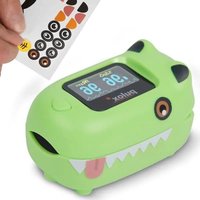
PO-230 - Medical device Pulox - Free user manual and instructions
Find the device manual for free PO-230 Pulox in PDF.


User questions about PO-230 Pulox
0 question about this device. Answer the ones you know or ask your own.
Ask a new question about this device
Download the instructions for your Medical device in PDF format for free! Find your manual PO-230 - Pulox and take your electronic device back in hand. On this page are published all the documents necessary for the use of your device. PO-230 by Pulox.
USER MANUAL PO-230 Pulox
natural_image
Line drawing of two batteries with one partially open and the other closed, showing internal charge distribution (no text or symbols)natural_image
Line drawing of a handheld electronic device with a cable and display screen (no text or symbols)7. Anwendung
Instructions to User
Dear users, thank you very much for purchasing the Pulse Oximeter.
This Manual is written and compiled in accordance with the council directive MDD93/42/EEC for medical devices and harmonized standards. In case of modifications and software upgrades, the information contained in this document is subject to change without notice.
The Manual describes, in accordance with the Pulse Oximeter's features and requirements, main structure, functions, specifications, correct methods for transportation, installation, usage, operation, repair, maintenance and storage, etc. as well as the safety procedures to protect both the user and equipment. Refer to the respective chapters for details.
Please read the User Manual carefully before using this product. The User Manual which describes the operating procedures should be followed strictly. Failure to follow the User Manual may cause measuring abnormality, equipment damage and human injury. The manufacturer is NOT responsible for the safety, reliability and performance issues and any monitoring abnormality, human injury and equipment damage due to users' negligence of the operation instructions. The manufacturer's warranty service does not cover such faults.
Owing to the forthcoming renovation, the specific products you received may not be totally in accordance with the description of this User Manual. We would sincerely regret for that.
This product is a medical device, which can be used repeatedly. Its using life is 3 years.
Warning
! Uncomfortable or painful feeling may appear if using the device ceaselessly, especially for the microcirculation barrier patients. It is recommended that the sensor should not be applied to the same finger for over 2 hours.
! For the individual patients, there should be a more prudent inspecting in the placing process. The device can not be clipped on edema and tender tissue.
EN
! The light (the infrared is invisible) emitted from the device is harmful to the eyes, so the user and the maintenance man should not stare at the light.
! Testee can not use enamel or other makeup.
! Testee's fingernail can not be too long.
! Please refer to the correlative literature about the clinical restrictions and caution.
! This device is not intended for treatment.
The User Manual is published by our company. All rights reserved.
1. Safety
1.1 Instructions for Safe Operations
◇ Check the main unit and all accessories periodically to make sure that there is no visible damage that may affect patient's safety and monitoring performance about cables and transducers. It is recommended that the device should be inspected once a week at least. When there is obvious damage, stop using the device.
◇ Necessary maintenance must be performed by qualified service engineers ONLY. Users are not permitted to maintain it by themselves.
The oximeter cannot be used together with devices not specified in User's Manual. Only the accessory that appointed or recommendatory by manufacture can be used with this device.
◇ This product is calibrated before leaving factory.
1.2 Warning
! Explosive hazard—DO NOT use the oximeter in environment with inflammable gas such as some ignitable anesthetic agents.
! DO NOT use the oximeter while the testee measured by MRI and CT.
! The person who is allergic to rubber can not use this device.
! The disposal of scrap instrument and its accessories and packings (including battery, plastic bags, foams and paper boxes) should follow the local laws and regulations.
! Please check the packing before use to make sure the device and accessories are totally in accordance with the packing list, or else the device may have the possibility of working abnormally.
! Please don't measure this device with functional tester for the device's related information.
1.3 Attention
- Keep the oximeter away from dust, vibration, corrosive substances, explosive materials, high temperature and moisture.
- If the oximeter gets wet, please stop operating it.
- When it is carried from cold environment to warm or humid environment, please do not use it immediately.
- DO NOT operate keys on front panel with sharp materials.
- High temperature or high pressure steam disinfection of the oximeter is not permitted. Refer to User Manual in the relative chapter for instructions of cleaning and disinfection.
- Do not immerse the oximeter in liquid. When it needs cleaning, please wipe its surface with disinfectant solution using a soft cloth. Do not spray any liquid directly onto the device.
- When cleaning the device with water, the temperature should be lower than 60^ C.
- As to the fingers which are too thin or too cold, it would probably affect the normal measure of the patients' SpO2 and pulse rate, please clip the thick finger such as thumb and middle finger deeply enough into the probe.
- Do not use the device on infant or neonatal patients.
- The product is suitable for children (Weight should be between 10 kg to 40 kg).
- Prevent children from swallowing the product or its accessories. Please let the child use the product only under the supervision of an adult.
- The device may not work for all patients. If you are unable to achieve stable readings, discontinue use.
- The update period of data is less than 5 seconds, which is changeable according to different individual pulse rate.
- Please read the measured value when the waveform on screen is equably and steady-going. This measured value is optimal value. And the waveform at the moment is the standard one.
- If some abnormal conditions appear on the screen during test process, pull out the finger and reinsert to restore normal use.
- The device has normal useful life for three years since the first electrified use.
- The hanging rope attached to the device is made from Non-allergy material, if particular group are sensitive to the hanging rope, stop using
it. In addition, pay attention to the use of the hanging rope, do not wear it around the neck on the purpose of avoiding harm to the patient.
- The instrument does not have low-voltage alarm function, it only shows the low-voltage. Please change the battery when the battery energy is used out.
- The instrument does not have alarm function. Do not use the device in situations where alarms are required.
- Batteries must be removed if the device is going to be stored for more than one month, or else batteries may leak.
- A flexible circuit connects the two parts of the device. Do not twist or pull on the connection.
1.4 Indication for Use
The Pulse Oximeter is a non-invasive device intended for the spot-check of oxygen saturation of arterial hemoglobin ( SpO_2 ) and the pulse rate of children in home use. This device is not intended for continuous monitoring.
2. Overview
The pulse oxygen saturation is the percentage of HbO_2 in the total Hb in the blood, so-called the O_2 concentration in the blood. It is an important bi-parameter for the respiration. For the purpose of measuring the SpO_2 more easily and accurately, our company developed the Pulse Oximeter. At the same time, the device can measure the pulse rate simultaneously.
The Pulse Oximeter features in small volume, low power consumption, convenient operation and being portable. It is only necessary for patient to put one of his fingers into a fingertip photoelectric sensor for diagnosis, and a display screen will directly show measured value of Hemoglobin Saturation.
2.1 Classification
Class II b, (MDD93/42/EEC IX Rule 10)
2.2 Features
A. SpO2 value display, Pulse rate value display, bar graph display, Pulse waveform display
B. The display mode can be changed
C. Screen brightness can be changed
D. Power consumption of the product is low and the two originally equipped AAA batteries can be operated continuously for 20 hours.
E. The product will enter standby mode when no signal is in the product within 5 seconds.
2.3 Major Applications and Scope of Application
The Pulse Oximeter can be used to measure human Hemoglobin Saturation and pulse rate through finger, and indicate the pulse intensity by the bar-display. The product is suitable for being used in family, hospital, oxygen bar, community healthcare, and etc.

The product is not suitable for use in continuous supervision for patients.

The problem of overrating would emerge when the patient is suffering from toxicosis which caused by carbon monoxide, the device is not recommended to be used under this circumstance.
2.4 Environment Requirements
Storage Environment
a. Temperature: -40^ +60^
b. Relative humidity : ≤95%
c. Atmospheric pressure : 500hPa\~1060hPa
Operating Environment
a. Temperature: 10^ C \~ 40^ C
b. Relative Humidity : ≤75%
c. Atmospheric pressure: 700hPa\~1060hPa
3. Principle
3.1 Principle of Measurement
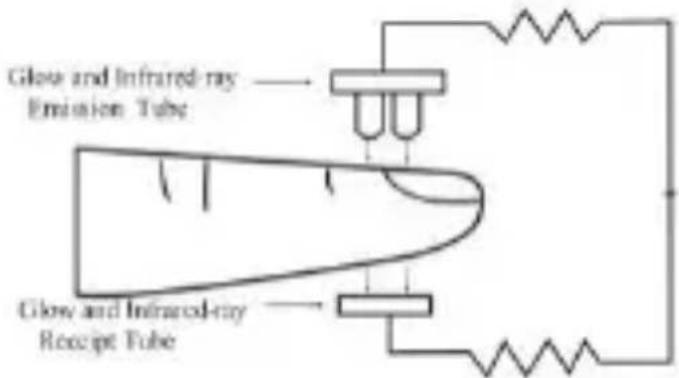
Principle of the Oximeter is as follows: An experience formula of data process is established taking use of Lambert Beer Law according to Spectrum Absorption Characteristics of Reductive Hemoglobin (Hb) and Oxyhemoglobin (HbO2) in glow & near-infrared zones. Operation principle of the device is: Photoelectric Oxyhemoglobin Inspection Technology is adopted in accordance with Capacity Pulse Scanning & Recording Technology, so that two beams of different wavelength of lights can be focused onto human nail tip through perspective clamp finger-type sensor. Then measured signal can be obtained by a photosensitive element, information acquired through which will be shown on screen through treatment in electronic circuits and microprocessor.
text_image
Glow and Infrared-ray Emission Tube Glow and Infrared-ray Receipt TubeFigure 1
3.2 Caution
- The finger should be placed properly (see the attached illustration of this manual, Figure 5), or else it may cause inaccurate measurement.
- The SpO_2 sensor and photoelectric receiving tube should be arranged in a way with the subject's arteriole in a position there between.
- The SpO_2 sensor should not be used at a location or limb tied with arterial canal or blood pressure cuff or receiving intravenous injection.
- Make sure the optical path is free from any optical obstacles like rubberized fabric.
- Excessive ambient light may affect the measuring result. It includes fluorescent lamp, dual ruby light, infrared heater, direct sunlight and etc.
- Strenuous action of the subject or extreme electrosurgical interference may also affect the accuracy.
- Testee can not use enamel or other makeup.
3.3 Clinical Restrictions
-
As the measure is taken on the basis of arteriole pulse, substantial pulsating blood flow of subject is required. For a subject with weak pulse due to shock, low ambient/body temperature, major bleeding, or use of vascular contracting drug, the SpO_2 waveform (PLETH) will decrease. In this case, the measurement will be more sensitive to interference.
-
For those with a substantial amount of staining dilution drug (such as methylene blue, indigo green and acid indigo blue), or carbon monoxide hemoglobin (COHb), or methionine (Me+Hb) or thiosalicylic hemoglobin, and some with icterus problem, the SpO_2 determination by this monitor may be inaccurate.
-
The drugs like dopamine, procaine, prilocaine, lidocaine and butacaine may also be a major factor blamed for serious error of SpO_2 measure.
-
As the SpO_2 value serves as a reference value for judgement of anemic anoxia and toxic anoxia, some patients with serious anemia may also
report good SpO_2 measurement.
4. Technical Specifications
A. Display Format: LCD Display
SpO2 Measuring range: 0 \~100 %
Pulse Measuring range: 30bpm \~250bpm
Pulse Wave Display: columniation display and the waveform display
B. Power Requirements: 2 ×1.5V AAA alkaline battery (or using the rechargeable battery instead), adaptable range: 2.6V\~3.6V.
C. Power Consumption: Smaller than 30mA
D. Resolution: SpO2: 1%, Pulse: 1bpm
E. Measurement Accuracy: ±2% in stage of 70%-100% SpO2, and meaningless when stage being smaller than 70%. ±2 bpm during the pulse rate range of 30-99 bpm and ±2% during the pulse rate range of 100\~250 bpm
F. Measurement Performance in Weak Filling Condition: SpO2 and pulse rate can be shown correctly when pulse-filling ratio is 0.4%. SpO2 error is ±4%, pulse rate error is ±2 bpm or ±2% (select larger).
G. Resistance to surrounding light: The deviation between the value measured in the condition of man-made light or indoor natural light and that of darkroom is less than ±1% .
H. It is equipped with a function switch. The product will enter standby mode when no signal is in the product within 5 seconds.
I. Optical Sensor
Red light (wavelength is 660nm, 6.65mW)
Infrared (wavelength is 880nm, 6.75mW)
5. Accessories
Hanging rope, batteries (optional), user manual
6. Installation
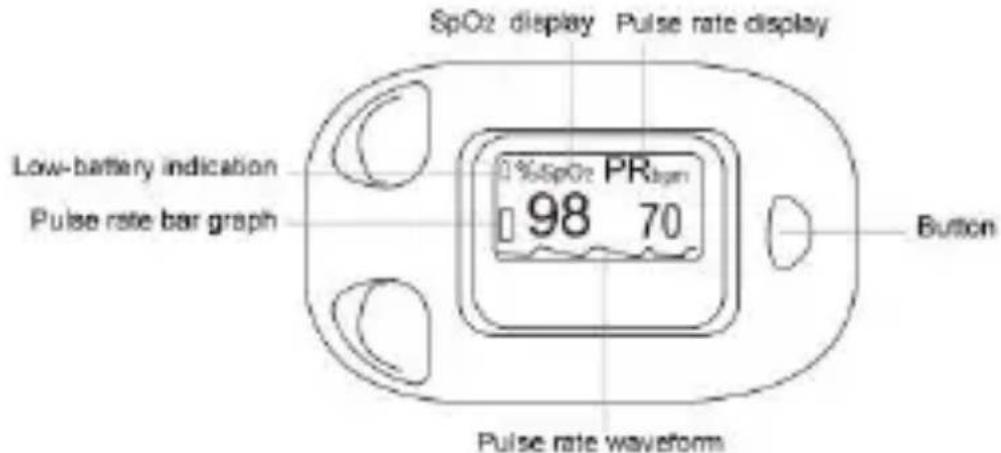
6.1 View of the front panel
text_image
SpO2 display Pulse rate display Low-battery indication Pulse rate bar graph 0%SpO2 PRlogm 98 70 Button Pulse rate waveformFig. 2 Front view
natural_image
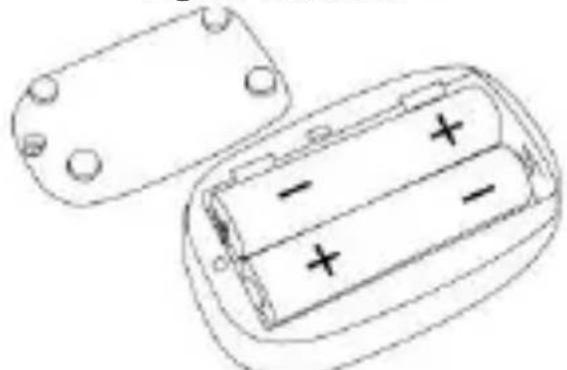
Line drawing of a battery pack with two casing and two battery cells, showing internal charge distribution (no text or symbols)Fig. 3 Batteries installation
6.2 Battery
Step 1. Refer to Figure 3 and insert the two AAA size batteries properly in the right direction.
Step 2. Replace the cover, turn the screw.

Please take care when you insert the batteries for the improper insertion may damage the device.
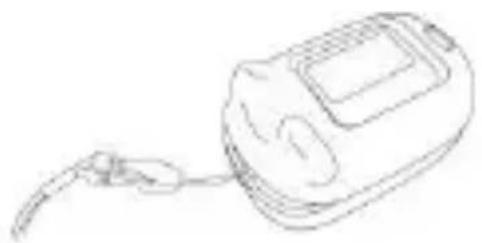
6.3 Mounting the Hanging Rope
Step 1. Put the end of the rope through the hole.
Step 2. Put another end of the rope through the first one and then tighten it.
natural_image
Line drawing of a handheld device with a cable, no text or symbols present7. Operating Guide
1) Insert the two batteries properly to the direction, and then replace the cover.
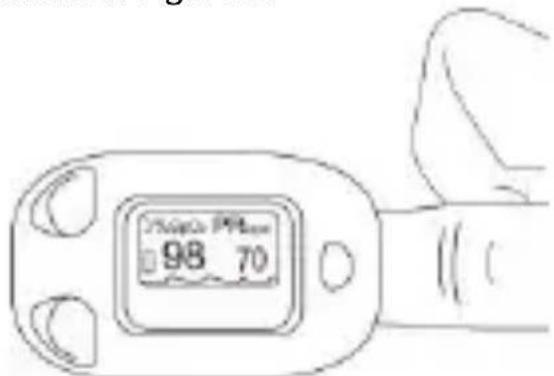
2) Open the clip as shown in Figure 5.
text_image
250000 PPM 98 70Figure 5 Finger Position
3) Let the patient's finger put into the rubber cushions of the clip (make sure the finger is in the right position), and then clip the finger.
4) Press the button once on front panel.
5) Do not shake the finger and keep the patient at ease during the process. Meanwhile, human body is not recommended in movement status.
6) Get the information directly from screen display.
7) The device could change display direction according to the handing direction.

Fingernails and the luminescent tube should be on the same side.
8. Cleaning, Transportation and Storage
- Please change the batteries when the low-voltage displayed on the screen.
- Please clean the surface of the device before using. Wipe the device with medical alcohol first, and then let it dry in air or clean it by dry clean fabric.
- Using the medical alcohol to disinfect the product after use, prevent from cross infection for next time use.
- Please take out the batteries if the oximeter is not in use for a long time.
- The best storage environment of the device is -40°C to 60°C ambient temperature and not higher than 95% relative humidity.

High-pressure sterilization cannot be used on the device.

Do not immerse the device in liquid.

It is recommended that the device should be kept in a dry environment. Humidity may reduce the useful life of the device, or even damage it.
- Troubleshooting
| Trouble | Possible Reason | Solution |
| The SpO2 and Pulse Rate can not be displayed normally | 1. The finger is not properly positioned2. The patient's SpO2 is too low to be detected. | 1. Place the finger properly and try again.2. Try again; Go to a hospital for a diagnosis if you are sure the device works all right. |
| The SpO2 and Pulse Rate are not displayed stably | 1. The finger is not placed inside deep enough.2. The finger is shaking or the patient is moving. | 1. Place the finger properly and try again.2. Let the patient keep calm |
| The device can not be turned on | 1. The batteries are drained or almost drained.2. The batteries are not inserted properly.3. The malfunction of the device | 1. Change batteries2. Reinstall batteries.3. Please contact the local service center. |
| The display is off suddenly | 1. The device will enter standby mode when it gets no signal within 5 seconds.2. The battery is almost drained away. | 1. Normal.2. Change batteries |
- Key of Symbols
| Symbol | Description | Symbol | Description |
 | Type BF applied part |  | WEEE(2002/96/EC) |
 | Refer to instruction manual/booklet | IP22 | International Protection |
| %SpO2 | Pulse oxygen saturation (%) |  0123 0123 | This item is compliant with |
EN
| Medical Device Directive 93/42/EEC of June 14, 1993, a directive of the European Economic Community. | |||
| bpm | Pulse rate (bpm) | DKWZ | Manufacturer |
 | Alarm inhibit | Date of manufacture | |
 | The battery voltage indication is deficient (change the battery in time avoiding the inexact measure) |  | Storage and Transport Temperature limitation |
 | 1. No finger inserted2. An indicator of signal inadequacy |  | Storage and Transport Humidity limitation |
 | Battery anode / Battery cathode |  | Storage and Transport Atmospheric pressure limitation |
 | 1. Change brightness of the screen.2. Exit standby mode. |  | This side UP |
 | Serial number |  | Fragile, handle with care |
 | recovery |  | Keep dry |
- Function Specification
| Display Information | Display Mode |
| The Pulse Oxygen | LCD |
EN
| Saturation (SpO2) | |
| Pulse Rate (PR) | LCD |
| Pulse Intensity (bar-graph) | LCD bar graph display |
| Pulse wave | LCD |
| SpO2Parameter Specification | |
| Measuring range | 0%~100%, (the resolution is 1%). |
| Accuracy | 70%~100%:±2%, below 70% unspecified. |
| Optical Sensor | Red light (wavelength is 660nm)Infrared (wavelength is 880nm) |
| Pulse Parameter Specification | |
| Measuring range | 30bpm~250bpm, (the resolution is 1bpm) |
| Accuracy | ±2bpm or±2% (select larger) |
| Pulse Intensity | |
| Range | Continuous bar-graph display, the higher display indicates the stronger pulse. |
| Battery Requirement | |
| 1.5V (AAA size) alkaline batteries x 2 | |
| Battery useful life | |
| Two batteries can work continually for 20 hours | |
| Dimensions and Weight | |
| Dimensions | 59(L) x 37(W) x 35 (H) mm |
| Weight | About 50g (with the batteries) |
12. Warranty and service
We provide 1 year warranty for material and manufacturing defects of the product.
The warranty does not apply:
- in case of damage caused by improper operation
- for wearing parts
- for defects that were already known to the customer at the time of purchase
- in case of the customer's own fault
The statutory warranties of the customer remain unaffected by the guarantee.
For the assertion of a warranty claim within the warranty period, the
EN
customer must provide proof of purchase.
The guarantee is valid for a period of 1 year from the date of purchase against
Novidion GmbH, Fuggerstr. 30, 51149 Cologne, Germany
to assert its rights. The customer has the right to have the goods repaired by us in case of a warranty claim or at workshops authorised by us.
The customer is not granted any further rights based on the warranty.
Novidion GmbH
natural_image
Line drawing of two batteries with one partially open and the other closed, showing internal charge distribution (no text or symbols)natural_image
Line drawing of a handheld electronic device with a cable (no text or symbols)natural_image
Line drawing of two batteries with one partially open and one closed, showing internal charge distribution (no text or symbols)Fig. 3 Installation des piles
6.2 Installation des piles
natural_image
Line drawing of a handheld device with a cable inserted, no text or symbols presentnatural_image
Line drawing of two batteries with one open and one closed, showing internal charge distribution (no text or symbols)natural_image
Line drawing of a handheld device with a cable and a screen (no text or symbols)7. Guida operativa
text_image
100g/10min 98 70Figure 5 Finger Position
CONTEC MEDICAL SYSTEMS CO, LTD
No.112 Qinhuang West Street, Economic & Technical Development Zone,
Quinhuangdao, Hebei Province
066004, P.R. China
EC Representative
Shanghai International Holding Corp. GmbH(Europe)
Address: Eiffestrasse 80, 20537, Hamburg, Germany
Tel: +49-40-2513175, Fax: +49-40-255726
E-mail: shholding@hotmail.com
Bei Fragen wenden Sie sich bitte an/If you have any questions, please contact:/Si tiene alguna pregunta, póngase en contacto con nosotros/Si vous avez une question s'il vous plaît contacter/Se si dispone di una domanda si prega di contattare:
Guidance and manufacture's declaration-electromagnetic emission for all EQUIPMENT and SYSTEMS
| Guidance and manufacture's declaration –electromagnetic emission | ||
| The CMS50Q1 Pulse Oximeter is tended for use in the electromagnetic environment specified below. The customer of the user of the CMS50Q1 Pulse Oximeter should assure that it is used in such an environment. | ||
| Emission test | compliance | Electromagnetic environment-guidance |
| RF emissions CISPR 11 | Group 1 | The CMS50Q1 Pulse Oximeter uses RF energy only for their internal function. Therefore, its RF emissions are very low and are not likely to cause any interference in nearby electronic equipment. |
| RF emissions CISPR 11 | Class B | The CMS50Q1 Pulse Oximeter is suitable for use in all establishments, including domestic establishments and those directly connected to the public low-voltage power supply network that supplies buildings used for domestic purposes. |
| Harmonic emissions IEC 61000-3-2 | Not applicable | |
| Voltage fluctuations/flicker emission IEC 61000-3-3 | Not applicable | |
Guidance and manufacture's declaration-electromagnetic immunity for all EQUIPMENT and SYSTEMS
| Guidance and manufacture's declaration-electromagnetic immunity | |||
| The CMS50Q1 Pulse Oximeter is intended for use in the electromagnetic environment specified below. The user of CMS50Q1 Pulse Oximeter should assure that it is used in such an environment. | |||
| Immunity test | IEC60601 test level | Compliance level | Electromagnetic environment-guidance |
| Electrostatic discharge (ESD) IEC 61000-4-2 | ±6KV contact ±8KV air | ±6KV contact ±8KV air | Floors should be wood, concrete or ceramic tile. If floor are covered with synthetic material, the relative humidity should be at least 30%. |
| Power frequency (50Hz) magnetic field IEC 61000-4-8 | 3A/m | 3A/m | Power frequency magnetic fields should be at levels characteristic of a typical location in a typical commercial or hospital environment |
Guidance and manufacture's declaration-electromagnetic immunity for EQUIPMENT and SYSTEMS that are not LIFE-SUPPORTING
| Guidance and manufacture's declaration-electromagnetic immunity | |||
| The CMS50Q1 Pulse Oximeter is intended for use in the electromagnetic environment specified below. The customer or the user of CMS50Q1 Pulse Oximeter should assure that it is used in such an environment. | |||
| Immunity test | IEC60601 test level | Compliance level | Electromagnetic environment - guidance |
| Radiated RF ICE 61000-4-3 | 3V/m80MHz to2.5GHz | 3V/m | Portable and mobile RF communication equipment should be used no closer to any part of the CMS50Q1 Pulse Oximeter, including cables, than the recommended separation distance calculated from the equation applicable to the frequency of the transmitter.recommended separation distance d = [ 3.5V_i ] 80MHz to 800MHz d = [ 3.5E_1 ] 800MHz to 2.5GHz d = [ 7E_1 ] Where P is the maximum output power rating of the transmitter in watts (W) according to the transmitter manufacturer and d is the recommended separation distance in meters (m).Field strengths from fixed RF transmitters, as determined by an electromagnetic site survey, ^a should be less than the compliance level in each frequency range. ^b Interference may occur in the vicinity of equipment marked with the following symbol:[IMAGE] |
| NOTE 1 At 80MHz and 800MHz, the higher frequency range applies.NOTE 2 These guidelines may not apply in all situations. Electromagnetic propagation is affected by absorption and reflection from structures, objects and people. | |||
| ^a Field strengths from fixed transmitters, such as base stations for radio (cellular/cordless) telephones and land mobile radios, amateur radio, AM and FM radio broadcast and TV broadcast cannot be predicted theoretically with accuracy. To assess the electromagnetic environment due to fixed RF transmitters, an electromagnetic site survey should be considered. If the measured field strength in the location in which The CMS50Q1 Pulse Oximeter is used exceeds the applicable RF compliance level above, the CMS50Q1 Pulse Oximeter should be observed to verify normal operation. If abnormal performance is observed, additional measures may be necessary, such as reorienting or relocating the CMS50Q1 Pulse Oximeter. ^b Over the frequency range 150 KHz to 80 MHz, field strengths should be | |||
less than 3V/m.
Recommended separation distances between portable and mobile RF communications equipment and the EQUIPMENT or SYSTEM for EQUIPMENT or SYSTEM that not LIFE-SUPPORTING
| Recommended separation distances between portable and mobile RF communications equipment and the CMS50Q1 Pulse Oximeter | |||
| The CMS50Q1 Pulse Oximeter is intended for use in the electromagnetic environment in which radiated RF disturbances are controlled. The customer or the user of the CMS50Q1 Pulse Oximeter can help prevent electromagnetic interference by maintaining a minimum distance between portable and mobile RF communications equipment (transmitters) and the CMS50Q1 Pulse Oximeter as recommended below, according to the maximum output power of the communications equipment. | |||
| Rated maximum output power of transmitter (W) | Separation distance according to frequency of transmitter (m) | ||
| 150KHz to 80MHz d = [ 3.5V_1 ] | 80MHz to 800MHz d = [ 3.5E_1 ] | 800MHz to 2.5GHz d = [ 7E_1 ] | |
| 0.01 | 0.12 | 0.12 | 0.23 |
| 0.1 | 0.37 | 0.37 | 0.74 |
| 1 | 1.17 | 1.17 | 2.33 |
| 10 | 3.69 | 3.69 | 7.38 |
| 100 | 11.67 | 11.67 | 23.33 |
| For transmitters rated at a maximum output power not listed above, the recommended separation distanced in meters (m) can be estimated using the equation applicable to the frequency of the transmitter, where P is the maximum output power rating of the transmitter in watts (W) according to the transmitter manufacturer.NOTE 1 At 80MHz and 800MHz, the separation distance for the higher frequency range applies.NOTE 2 These guidelines may not apply in all situations. Electromagnetic propagation is affected by absorption and reflection from structures, objects and people. | |||