
5H10S0040 - Oven BLAUPUNKT - Free user manual and instructions
Find the device manual for free 5H10S0040 BLAUPUNKT in PDF.
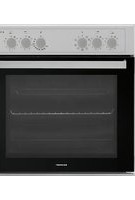


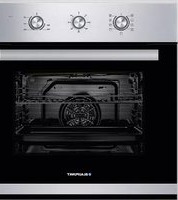
| Product type | Built-in oven |
| Brand | Blaupunkt |
| Model | 5H10S0040 |
| Category | Oven |
| Power supply | 230 V ~ 50 Hz |
| Maximum temperature | 250 °C |
| Control type | 2 rotary knobs (selection and thermostat) and 4 knobs for the hob |
| Cooking functions | Natural convection, Forced convection, Grill, Turbo grill, Defrost, Bottom heat, Fan-assisted heat, Turbo fan |
| Special hob functions | Slow heating, Keep warm, Rapid boiling, Multi zone |
| Included accessories | Metal grid, Drip tray (depending on model) |
| Interior lighting | Incandescent bulb 25-40 W / 230 V type E-14, T300 °C or halogen 20-40 W / 230 V type G9, T300 °C |
| Number of cooking levels | 5 grid supports (numbered from bottom to top) |
| Door | Removable for easy cleaning |
| Cleaning | Exterior surfaces with a microfiber cloth, interior after cooling, washable accessories |
| Safety | Disconnect before maintenance, do not use a steam cleaner, wear protective gloves |
| Residual heat indicator | Yes (on hob) |
| LED thermostat / preheating | Yes (lights up during heating, turns off at temperature) |
| Weight | Not specified |
Frequently Asked Questions - 5H10S0040 BLAUPUNKT
User questions about 5H10S0040 BLAUPUNKT
0 question about this device. Answer the ones you know or ask your own.
Ask a new question about this device
Download the instructions for your Oven in PDF format for free! Find your manual 5H10S0040 - BLAUPUNKT and take your electronic device back in hand. On this page are published all the documents necessary for the use of your device. 5H10S0040 by BLAUPUNKT.
USER MANUAL 5H10S0040 BLAUPUNKT
FRYING PAN (IF PRESENT)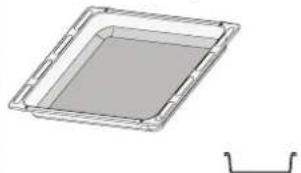
THANK YOU FOR BUYING OUR PRODUCT.

Before using the appliance, carefully read the Safety Instructions.
PRODUCT DESCRIPTION
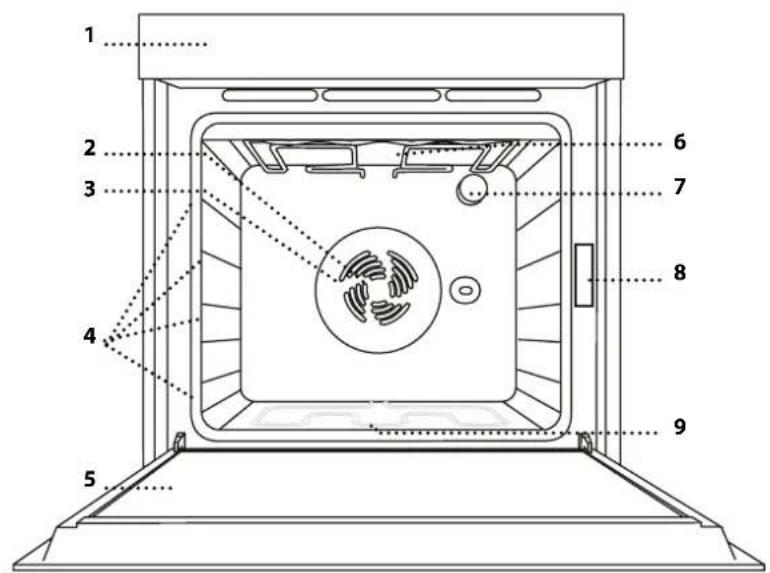
- Control panel 2. Fan
- Circular heating element (non-visible)
- Shelf guides (the level is indicated on the front of the oven)
- Door
- Upper heating element / grill 7. Lamp
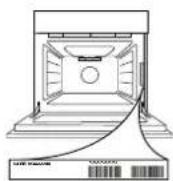
- Identification plate (do not remove)
- Bottom heating element (non-visible)
CONTROL PANEL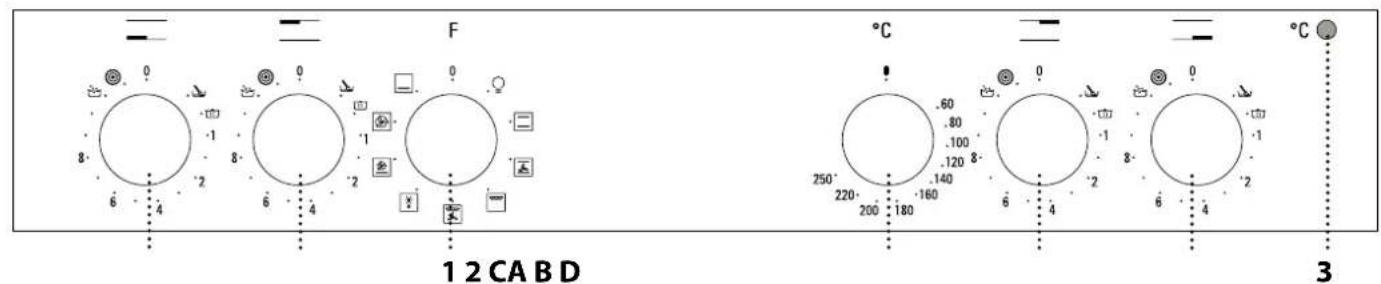
OVEN CONTROLS
1. SELECTION KNOB
For switching the oven on by selecting a function. Turn to the 0 position to switch the oven off.
2. THERMOSTAT KNOB
Turn to select the temperature you require.
3. LED THERMOSTAT / PREHEATING
Switches on during the heating process. Switches off once the desired temperature is reached.
COOKTOP CONTROLS
A. for front left hotplate. B. for rear left hotplate. C. for rear right hotplate. D. for front right hotplate.
ACCESSORIES
WIRE SHELF DRIP TRAY (IF PRESENT)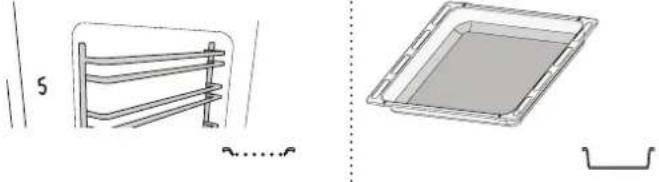
The number of accessories may vary depending on which model is purchased.
Other accessories that are not supplied can be purchased separately from the After-sales Service.
INSERTING THE WIRE SHELF AND OTHER ACCESSORIES
- Insert the wire shelf horizontally by sliding it across the shelf guides, making sure that the side with the raised edge is facing upwards.
- Other accessories, such as the drip tray and the baking tray, are inserted horizontally in the same way as the wire shelf.
REMOVING AND REFITTING THE SHELF GUIDES
• To remove the shelf guides, remove the fixing screws (if present) on both sides with the aid of a coin or a tool. Lift the guides up and pull the lower parts out of their seatings: The shelf guides can now be removed.
To refit the shelf guides, first fit them back into their upper seating. Keeping them held up, slide them into the cooking compartment, then lower them into position in the lower seating. Refit the fixing screws.
FUNCTIONS

OFF
For switching off the oven.

LIGHT
To switch the oven light on/off.

CONVENTIONAL
For cooking any kind of dish on one shelf.

CONVECTION BAKE
For cooking meat and pies with liquid filling (savoury or sweet) on a single shelf, and pizzas on one or two shelves. This function delivers an even, golden, crisp top and base. When cooking on two levels, switch the position of the dishes halfway through cooking to cook food more evenly.

GRILL
For grilling steaks, kebabs and sausages,
cooking vegetables au gratin or toasting bread. When grilling meat, we recommend using a drip tray to collect the cooking juices: Position the pan on any of the levels below the wire shelf and add 500 ml of drinking water.

TURBO GRILL
For roasting large joints of meat (legs, roast beef, chicken). We recommend using a drip tray to collect the cooking juices: Position the pan on any of the levels below the wire shelf and add 500 ml of drinking water. The turnspit (if provided) can be used with this function.

DEFROSTING
To speed up defrosting of food.

BOTTOM
For browning the bottom of the dishes. The function can also be used for slow cooking, to finish cooking very liquid dishes (sweet or savoury) or to thicken sauces and gravies.

FORCED AIR
For cooking different foods that require the same cooking temperature on several shelves (maximum three) at the same time. This function can be used to cook different foods without odours being transferred from one food to another.

TURBOFAN
For food with a crisp base and soft top. Ideal for cooking cakes with liquid filling and no precooked base on a single shelf. This function is also ideal for frozen convenience foods.
USING THE APPLIANCE FOR THE FIRST TIME
A new oven may release odours that have been left behind during manufacturing: this is completely normal.
Before starting to cook food, we therefore recommend heating the oven with it empty in order to remove any possible odours.
Remove any protective cardboard or transparent film from the oven and remove any accessories from inside it.
Heat the oven to 250 °C for about one hour, preferably using the "Convection Bake" function. The
oven must be empty during this time. Follow the instructions for setting the function correctly.
Notes: It is advisable to air the room after using the appliance for the first time.
DAILY USE
1. SELECT A FUNCTION
To select a function, turn the selection knob to the symbol for the function you require.
2. ACTIVATE A FUNCTION
To start the function you have selected, turn the thermostat knob to set the temperature you require.
To interrupt the function at any time, switch off the oven, turn the selection knob and the thermostat knob to 0 and .
3. PREHEATING
Once the function has been activated, the LED thermostat will switch on signalling that the preheating process has begun.
At the end of this process, the LED thermostat switches off indicating that the oven has reached the set temperature: at this point, place the food inside and proceed with cooking.
Please note: Placing the food in the oven before preheating has finished may have an adverse effect on the final cooking result.
. COOKTOP OPERATION
(see the instructions supplied with the cooktop).
Turn the control knob of the relevant hotplate clockwise to the desired power setting.
The oven control panel features 4 adjustable knobs for cooktop operation. The cooktop control knobs are marked with a numerical scale corresponding to different power settings, and a series of function symbols.

GENTLE HEAT To allow dough to rise, to soften butter taken from the fridge, to keep baby bottles or food warm, also for making yoghurt, melting chocolate, etc. This function is only available when the residual heat indicator is on. For this function, make sure the residual heat indicator of the desired hotplate is
on. Turn the knob to 📁. To deselect the function, change the position of the knob.
HEAT MAINTENANCE To maintain a constant temperature of 60°C until the end of cooking. To select this function, turn the knob to ☐.
FAST BOIL This function is used to bring water to the boil rapidly and remains on for a preset time. At the end of the preset time, the cooktop automatically returns to the maximum power setting. This function can be selected even during cooking. Important: before selecting this function, make sure the pot is positioned on the selected hotplate in order to avoid any damage to the cooktop surface. The stated performance values for this function are those guaranteed for all glass ceramic cooktops. For this function, place the pot on the selected hotplate and turn the knob to 📋. To deselect, change the position of the knob.
MULTIZONE This is available on the front left and rear left hotplates. This extends the heating area of the cooktop in order to allow the use of large, oval or rectangular pots or cooking receptacles. To select this function: turn the knob to Ⓞ and wait until the residual heat indicator for the hotplate begins to flash. To switch on the triple zone function (if available), wait until the LED begins flashing quickly. Select the power setting required by turning the knob anticlockwise. The residual heat indicator remains on to indicate that the cooktop is in use. To deselect, turn the knob to 0 by turning the knob anticlockwise.
Please note: The multizone function can only be switched on for the double and triple hotplates of the cooktop.
COOKING TABLE
| RECIPE FUNCTION PREHEAT | TEMPERATURE(°C) | DURATION(MIN) | LEVELAND ACCESSORIES | |||
| Leavened cakes | [X07W] | Yes 160 - 180 35 - 55 | 2 | |||
| [CBBC] | Yes 150 - 170 30 - 90 | 3 1 | ||||
| Filled cakes(cheese cake, strudel, fruit pie) |  | Yes 150 - 190 30 - 85 | 2 | |||
 | Yes 150 - 190 35 - 90 | 3 1 | ||||
| Biscuits / tartlets | [7YGB] | Yes 170 - 180 15 - 40 | 3 | |||
| [2DBY] | Yes 150 - 175 20 - 45 | 3 1 | ||||
| Choux buns | [A6DD] | Yes 180 30 - 40 | 3 | |||
| [KYBH] | Yes 170 - 190 35 - 45 | 3 1 | ||||
| Meringues |  | Yes 90 120 - 130 | 3 | |||
| [WY6B] | Yes 90 130 - 150 | 3 1 | ||||
| Bread / Pizza / Focaccia |  | Yes 190 - 250 15 - 50 | 2 | |||
 | Yes 190 - 250 25 - 50 | 3 1 | ||||
| Frozen pizza | [GS2K] | Yes 250 10 - 15 | 2 | |||
| [HCWS] | Yes 250 10 - 20 | 3 1 | ||||
| Savoury pies(vegetable pie,quiche) | [TZW3] | Yes 175 - 200 40 - 50 | 2 | |||
| [AZSG] | Yes 175 - 190 50 - 65 | 3 1 | ||||
| Vols-au-vent / Puff pastry crackers | [BTZX] | Yes 180 - 200 20 - 30 | 3 | |||
| [28TT] | Yes 175 - 200 25 - 45 | 3 1 | ||||
| Lasagne / baked pasta / cannelloni /flans |  | Yes 190 - 200 40 - 65 | 2 | |||
| Lamb / veal / beef / pork 1 kg |  | Yes 190 - 200 | 90 - 110 | 2 | ||
| Chicken / rabbit / duck 1 kg | [406Z] | Yes 190 - 200 | 65 - 85 | 2 | ||
| Turkey / goose 3 kg | [T2ZY] | Yes 190 - 200 | 140 - 180 | 1 / 2 | ||
| Baked fish / en papillote(Fillet, whole) |  | Yes 180 - 200 40 - 60 | 2 | |||
| Stuffed vegetables(tomatoes, courgettes, aubergines) | [6HTB] | Yes 175 - 200 50 - 60 | 2 | |||
| Toasted bread |  | Yes 200 | 2 - 5 | 4 | ||
| Roast beef rare 1 kg |  | - 200 | 35 - 50 ** | 2 | ||
| RECIPE FUNCTION PREHEAT | TEMPERATURE(°C) | DURATION(MIN) | LEVELAND ACCESSORIES | ||
| Leg of lamb / shanks - 200 60 - 90 ** |  | 2 | |||
| Roast potatoes - 200 45 - 55 ** |  | 2 | |||
| Vegetable gratin - 200 20 - 30 |  | 2 | |||
| Lasagna & meat |  | Yes | 200 | 50 - 100 *** | 3 1 |
| Meat and potatoes |  | Yes | 200 | 45 - 100 *** | 3 1 |
| Fish & vegetables |  | Yes | 175 | 30 - 50 *** | 3 1 |
* Turn food halfway through cooking ** Turn food two-thirds of the way through cooking (if necessary). *** Estimated length of time: dishes can be removed from the oven at different times depending on personal preference.
| FUNCTIONS |  Conventional Conventional |  Grill Grill |  TurboGrill TurboGrill | [23GA]Forced Air |  Convection Bake Convection Bake |
| ACCESSORIES | Wire shelf | Cake tin on wire shelf | Drip tray / Baking tray | ||
USEFUL TIPS
HOW TO READ THE COOKING TABLE
The table lists the best function, accessories and level to use to cook various different types of food. Cooking times start from the moment food is placed in the oven, excluding preheating (where required). Cooking temperatures and times are approximate and depend on the amount of food and the type of accessory used. Use the lowest recommended settings to begin with and, if the food is not cooked enough, then switch to higher settings. Use the accessories supplied and preferably dark-coloured metal cake tins and baking plates. You can also use Pyrex or stoneware pans and accessories, but bear in mind that cooking times will be slightly longer.
COOKING DIFFERENT FOODS AT THE SAME TIME
Using the "Forced Air" function, you can cook different foods which require the same cooking temperature at the same time (for example: fish and vegetables), using different shelves. Remove the food which requires a shorter cooking time and leave the food which requires a longer cooking time in the oven.
CLEANING AND MAINTENANCE
Make sure that the oven has cooled down before carrying out any maintenance or cleaning.
Do not use steam cleaners.
Do not use wire wool, abrasive scourers or abrasive/corrosive cleaning agents, as these could damage the surfaces of the appliance.
Wear protective gloves.
The oven must be disconnected from the mains before carrying out any kind of maintenance work.
EXTERIOR SURFACES
- Clean the surfaces with a damp microfibre cloth. If they are very dirty, add a few drops of pH-neutral detergent. Finish off with a dry cloth.
- Do not use corrosive or abrasive detergents. If any of these products inadvertently comes into contact with the surfaces of the appliance, clean immediately with a damp microfibre cloth.
INTERIOR SURFACES
• After every use, leave the oven to cool and then clean it, preferably while it is still warm, to remove any deposits or stains caused by food residues. To dry any condensation that has formed as a result of cooking foods with a high water content, leave the oven to cool completely and then wipe it with a cloth or sponge.
- Clean the glass in the door with a suitable liquid detergent.
- The oven door can be removed to facilitate cleaning.
ACCESSORIES
Soak the accessories in a washing-up liquid solution after use, handling them with oven gloves if they are still hot. Food residues can be removed using a washing-up brush or a sponge.
REPLACING THE LAMP
- Disconnect the oven from the power supply.
- Unscrew the cover from the light, replace the bulb and screw the cover back on the light.
- Reconnect the oven to the power supply.
Please note: Only use 25-40W/230V type E-14, T300°C incandescent lamps, or 20-40W/230 V type G9, T300°C halogen lamps. The bulb used in the product is specifically designed for domestic appliances and is not suitable for general room lighting within the home (EC Regulation 244/2009). Light bulbs are available from our After-sales Service.
- If using halogen bulbs, do not handle them with your bare hands as your fingerprints could cause damage. Do not use the oven until the light cover has been refitted.
REMOVING AND REFITTING THE DOOR
- To remove the door, open it fully and lower the catches until they are in the unlock position.
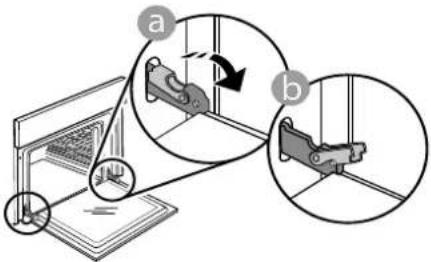
- Close the door as much as you can. Take a firm hold of the door with both hands – do not hold it by the handle. Simply remove the door by continuing to close it while pulling it upwards at the same time until it is released from its seating. Put the door to one side, resting it on a soft surface.
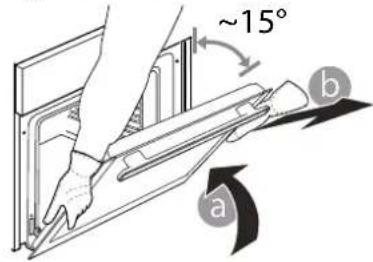
- Refit the door by moving it towards the oven, aligning the hooks of the hinges with their seating and securing the upper part onto its seating.
- Lower the door and then open it fully. Lower the catches into their original position: Make sure that you lower them down completely.
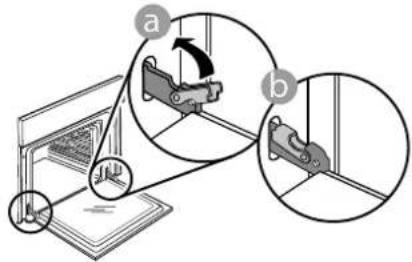
Apply gentle pressure to check that the catches are in the correct position.
- Try closing the door and check to make sure that it lines up with the control panel. If it does not, repeat the steps above: The door could become damaged if it does not work properly.
TROUBLESHOOTING
| Problem Possible cause Solution | ||
| The oven is not working. Power cut. | Disconnection from the mains. | Check for the presence of mains electrical power and whether the oven is connected to the electricity supply.Turn off the oven and restart it to see if the fault persists. |
SUPPORT
When contacting our Service Centre, please state the codes provided on your product's identification plate.
THANK YOU FOR PURCHASING OUR PRODUCT.

REPLACING THE BULB
GREASE FILTER (IF PROVIDED)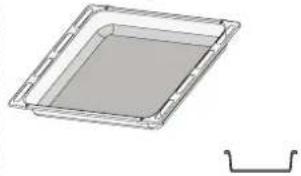

- PRODUCT DESCRIPTION
- OVEN CONTROLS
- SELECTION KNOB
- THERMOSTAT KNOB
- LED THERMOSTAT / PREHEATING
- COOKTOP CONTROLS
- ACCESSORIES
- INSERTING THE WIRE SHELF AND OTHER ACCESSORIES
- REMOVING AND REFITTING THE SHELF GUIDES
- FUNCTIONS
- USING THE APPLIANCE FOR THE FIRST TIME
- DAILY USE
- SELECT A FUNCTION
- ACTIVATE A FUNCTION
- PREHEATING
- COOKTOP OPERATION
- USEFUL TIPS
- HOW TO READ THE COOKING TABLE
- COOKING DIFFERENT FOODS AT THE SAME TIME
- CLEANING AND MAINTENANCE
- EXTERIOR SURFACES
- INTERIOR SURFACES
- REPLACING THE LAMP
- REMOVING AND REFITTING THE DOOR
- TROUBLESHOOTING
- SUPPORT
- REPLACING THE BULB
Brand : BLAUPUNKT
Model : 5H10S0040
Category : Oven