Agent DOG - Board game Schmidt - Free user manual and instructions
Find the device manual for free Agent DOG Schmidt in PDF.


| Product type | Board game |
| Brand | Schmidt |
| Model | Agent DOG |
| Number of players | 2 to 4 |
| Recommended age | Ages 8 and up |
| Box contents | 1 game board, 110 cards, 16 pawns (4 of each color) |
| Board dimensions | Approximately 50 x 50 cm (estimate) |
| Game weight | Approximately 800 g (estimate) |
| Power supply | None (classic board game) |
| Main features | Team game with card exchange and pawn movement, infiltration and capture |
| Care and cleaning | Wipe with a dry cloth; avoid moisture and direct sunlight |
| Safety | Contains small parts; not suitable for children under 3 years |
| Spare parts and repairability | Not applicable |
| Available languages | French, German, English, Italian, and others upon request |
| Manual | 16 pages, available in free PDF |
Frequently Asked Questions - Agent DOG Schmidt
User questions about Agent DOG Schmidt
0 question about this device. Answer the ones you know or ask your own.
Ask a new question about this device
Download the instructions for your Board game in PDF format for free! Find your manual Agent DOG - Schmidt and take your electronic device back in hand. On this page are published all the documents necessary for the use of your device. Agent DOG by Schmidt.
USER MANUAL Agent DOG Schmidt



ZUGZWANGZUGZWANG
KARTENERKLÄRUNGEN
GAME COMPONENTS AND SETUP
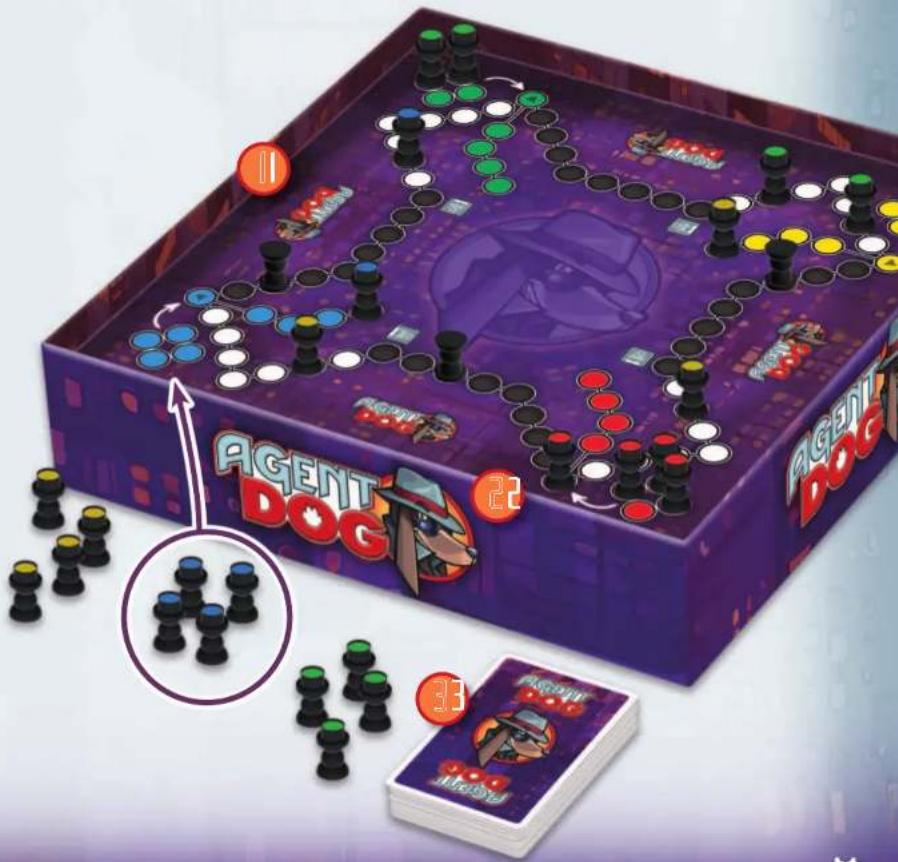
• 1 game board
• 110 cards
• 16 black pieces with coloured dots (4 pieces in each colour)
NEW If you've ever played another game in our DOG range, you'll recognise most of the rules for this game. We've added "NEW" to the margin wherever we've added or updated rules.
Let's start with the rules for 4 players. An explanation of how the game works with 2 or 3 players can be found at the end of these rules.
1 Place the game board in the box, as shown in the picture.
2 Each player chooses a colour and finds the 4 pieces in that colour. Place 3 of your pieces in the starting area for your colour. Put the fourth piece on the starting space in the matching colour.
Make sure your pieces are the right way up – you should be able to see the coloured dot on top.
Each player pairs up with the colour directly opposite them to form two teams, i.e. red and green form one team, while blue and yellow form the other.
3 The player who is the best at keeping secrets shuffles all the cards and puts them face-down in a stack in front of them.
AIM OF THE GAME
Players play in teams of 2. You move the pieces around the game board by playing cards. As a team, try to get all your pieces to your home area. The team that gets all 8 pieces into their home area wins the game. You can not win as an individual. You can only win as a team.
However, you're not allowed to discuss your cards or plan moves with the other player on your team during the game.

Undercover spies on the move
A team game designed by Johannes Schmidauer-König for 2–4 players aged 8 and up.
HOW TO PLAY
1. Dealing and swapping cards
NEW
At the start of each round, the person with the stack in front of them deals 5 cards face-down to each player. (Unlike the original game, you deal 5 cards in each round in this game.) Pick up your cards and look at them.
Swap 1 card with the other player on your team, without allowing the other team to see your cards.
Choose 1 card from your hand and slide it face-down to the other player on your team. You can only look at the card you've been given by the other player after you've given your card to them.
Add your new card to your hand once the swap is complete.
Make the most of this opportunity to help the other player on your team. For example, if they don't have a piece on the track, it would make sense to give them a start card. (Read the instructions on BRINGING NEW PIECES INTO PLAY on the right-hand side of this page.)
2.Moving pieces
The player with the stack of cards in front of them makes the first move.
When it's your turn, you must play a card from your hand. Place your card face-up on the discard pile in the middle of the game board and move a piece. Remember that you're trying to move all your pieces to the home spaces in your colour as quickly as possible. (Find out more about the HOME SPACES on the next page.)
Important: You can only play a card if you can complete the move(s) specified on that card. If you can't play any of the cards in your hand on your turn, you're out of the round. (Read more about the REQUIREMENT TO TAKE YOUR TURN on the next page.)
In most cases, you will have to move one of your pieces forward by the number shown on the card.
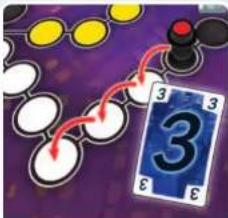
If you play a 3, you have to move a piece forward by exactly 3 spaces.
NEW NEW NEW
You can move pieces in your colour or undercover pieces. (Read more about UNDERCOVER PIECES on the next page.)
In some cases, you can also move pieces for the other player on your team or even one of the players on the other team. (Find out WHICH PIECES YOU'RE ALLOWED TO MOVE on the next page.)
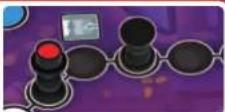
Visible piece
Undercover
piece
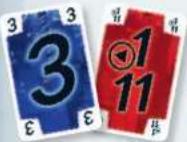
Blue cards allow you to move a piece forward (in a clockwise direction) by the exact number of spaces shown on the card. Red cards are special and allow you to move pieces in different ways. You can find out more about these cards and how they work under CARD DESCRIPTIONS on page 8.
As you move around the board, be aware of the rules for HOPPING OVER OTHER PIECES AND KNOCKING PIECES OUT on the next page.
You start the game with 1 piece on the track. You need a start card to bring an additional piece into play from the starting area. (Read more about BRINGING NEW PIECES INTO PLAY on the right-hand side of this page.)
That's the end of your turn. You don't draw another card.
Play continues in a clockwise direction.
3. End of a round and end of the game
You continue to take turns until all players have played or discarded all their cards (read more about the REQUIREMENT TO TAKE YOUR TURN on the next page). The round is then over.
At the end of a round, the stack of cards is passed to the next person in a clockwise direction and a new round begins. Deal another 5 cards to each player. Players in the same team should swap 1 card. Start moving the pieces. When you run out of cards in the stack, shuffle the discard pile and face the cards down in a new stack.
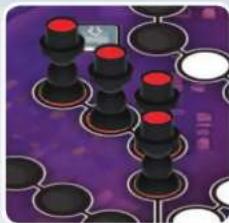
Keep playing until 1 of the 2 teams manages to get all 8 pieces into the corresponding home areas. (Find out more about the HOME SPACES below.)
The team that does so wins the game.

BRINGING NEW PIECES INTO PLAY
You need a card with a start symbol on it to bring an additional piece into play on the track from the starting area.

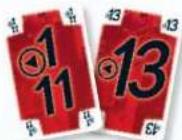
When you play 1 of these cards, you can either
move 1 of your pieces on the track by the number shown on the card
or
move 1 piece from your starting area to your starting space.
If you choose to use a start card to move a new piece to the starting space, you can ignore the number on the card.
HOME SPACES HOME SPACES
The first team to move all their own pieces onto the home spaces in the right colour wins the game.
The following rules apply:
- Pieces can only be moved onto home spaces in their colour.
- You move pieces onto the home spaces via the starting space, but you can't move directly from the starting space to a home space.
- You can't hop over or knock out pieces that are on home spaces.
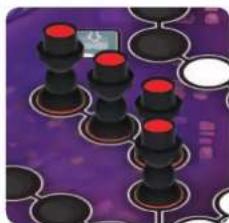
You will usually bring a new piece into play, place it on your starting space, move it once all the way around the board and end up on one of your home spaces.
If you use the red cards strategically, you can speed up the whole process considerably.
However, you should make sure your piece doesn't land back on the starting space, because then you'll have to go all the way around the board again.
You also need to fill up your home spaces from the back because you can't hop over pieces in your home area.

REQUIREMENT TO TAKE YOUR TURN
When it's your turn, you must play a card from your hand.
You can only play a card if you can complete the move(s) specified on that card. This means you must move the full number of spaces shown on the card you play.
If you can carry out the move(s) specified on (at least) 1 card in your hand, you must play that card even if it works to your disadvantage. You can't choose not to play a card.
So, for example, if you were 3 spaces away from your home area but you only had higher cards in your hand (and you couldn't move any other pieces), you would have no choice but to go past your home area and go around the whole board again.
If you cannot complete the move(s) specified on any of your cards, you're out of the round. Place your remaining cards at the bottom of the discard pile. You are back in the game again once the next round begins.
UNDERCOVER PIECESUNDERCOVER PIECES
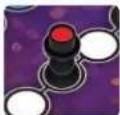
If you move your piece to a normal space, the coloured dot on that piece should be on top for everyone to see.
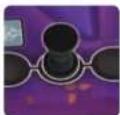
But if your piece lands on a hole in the board, that piece goes undercover. Turn the piece over, so that the coloured dot is on the underside and is no longer visible.
Any player can move an undercover piece.
Exception to the rule: You can't move an undercover piece while one of your pieces is on your own starting space. (Read more about PIECES ON YOUR THEIR STARTING SPACE on the right of this page.)
When you move an undercover piece to a normal space, turn it back over so everyone can see the coloured dot on top again. If you pass normal spaces but still land on another hole in the board, do not reveal the colour of the piece during the move. That piece is still undercover.
WHICH PIECES CAN I MOVE?WHICH PIECES CAN I MOVE?
In Agent DOG, you can move pieces in your colour or undercover pieces.
Reminder: You can't move an undercover piece while one of your pieces is on your own starting space. (Read more about UNDERCOVER PIECES above.)
Once you've moved all of your own pieces to your home spaces, you haven't yet finished the game. You still need to help the other player on your team. You will therefore still be dealt cards and will now move your team mate's pieces around the board (instead of your own pieces).
Some of the special cards also allow you to move pieces belonging to players on the other team.
Just remember that you are forbidden from discussing your cards or moves with the other player on your team.

HOPPING OVER AND KNOCKING OUT PIECES
You can hop over other pieces as you move around the board. You count spaces occupied by other pieces as normal
Exception to the rule: You can't jump over a piece on its own starting space! (Read more about what happens when PIECES ARE ON THEIR OWN STARTING SPACES below.)
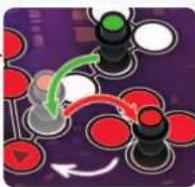
Only one piece is allowed on each space. If you land on a space that is occupied by another piece, you have to knock out that other piece.
When a piece is knocked out, it has to be moved back to the starting area for that colour.
KNOCK OUT WITH CAUTION!
If you knock out one of your own pieces or one of the pieces belonging to the other player on your team, you're out of the round! You have to place all your remaining cards at the bottom of the discard pile.
Just make sure to keep a close eye on any undercover pieces. You don't want to accidentally knock out one of your own team's pieces. You can't change your mind if you knock out an undercover piece and it turns out to be one of your own team's pieces.
PIECES ON THEIR OWN STARTING SPACESPIECES ON THEIR OWN STARTIN
The following rules apply when a piece is on its own starting space:
If a piece is on its own (coloured) starting space, you cannot:
- hop over it,
- knock it out.
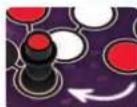
These rules apply even when it's your own piece.
This means that a piece can only be moved from its own starting space if it makes a normal move. (Exception: SPY MEETING POINTS SPY MEETING POINTS below)
While one of your pieces is on your own starting space, you can't move an undercover piece.
You can still move undercover pieces if you're playing a special red card, e.g. by swapping them. (Read the CARD DESCRIPTIONS on page 8.)
SPY MEETING POINTS
When you move a piece to one of the 4 spy meeting points, there is a meeting of 2 spies.
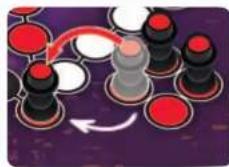
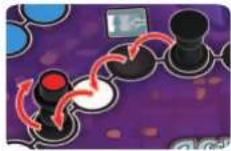
Move the closest piece behind the piece you just moved to the space directly behind the spy meeting point. This could involve moving a piece over a large number of spaces. The piece you move will always land on a hole in the board, so it will immediately go undercover.
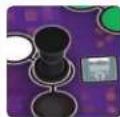
You must always move the closest piece behind the piece you just moved. It doesn't matter which colour the piece is – the piece can even be undercover. You can even move a piece that's on its own starting space.
Example: A spy lands on the meeting point. The closest piece behind this is a red piece that is just about to enter its own home area. The piece is moved past the home area and has to move all the way around the board again.
![graph TD A["Player at position 1"] --> B["Player at position 2"] B --> C["Player at position 3"] C --> D["Player at position 4"] D --> E["Player at position 5"] E --> F["Player at position 6"] F --> G["Player at position 7"] G --> H["Player at position 8"] H --> I["Player at position 9"] I --> J["Pl…](/content/2026/04/708656/images/88dcb07497e006907c4cad902b8f43343a46f77cb0be9d092661cba0f548725c.jpg)
Cards with a blue background
When you play a card with a blue background, you move a piece forward by the exact number of spaces shown on the card.
Cards with a red background
All cards with a red background have a special function:
This is a start card. When you play this card, you have to choose 1 of the following 3 options:
- Move 1 piece forward 1 space or
- Move 1 piece forward 11 spaces or
- Move 1 piece from your starting area to your starting space.
This is a start card. When you play this card, you have to choose 1 of the following 2 options:
- Move 1 piece forward 13 spaces or
- Move 1 piece from your starting area to your starting space.
Swap: When you play this card, you have to swap 2 undercover pieces with one another. Both pieces stay undercover after they have been swapped. You are not allowed to look at the colours of the pieces as you swap them.
You can only play this card if at least 2 pieces are undercover.
Copy: This card allows you to copy the last card that was played before your turn. You don't have to play the card in exactly the same way as the player before you.
For example, if a 1/11 card was played just before your turn, you can still choose between the 3 options available for that card.
The copy card does not carry over to a new round. In other words, you won't be able to play this card as the first card in a new round.
If you play a copy card straight after another copy card, you copy the same card that has just been copied.
Partner: This card allows you to move forward 4 spaces. You can divide those spaces between your own pieces, pieces belonging to the other player on your team and undercover pieces.
You have to move all the spaces one way or another. It's up to you how you divide out the spaces and which order you move pieces in. (Remember that you can't communicate with the other player on your team!)
If all 4 of your pieces or the pieces belonging to the other player on your team are already in the home area, you can even move pieces belonging to players on the other team.
The following modifications and additions are made to the rules described above:
- Every player plays on their own – there are no teams.
- If you can't complete the move(s) specified on any of the cards in your hand, discard 1 card and draw 1 new card. If you still can't play any of your cards, you have to discard 1 card without playing it and without moving any pieces. But you're not out of the round.
- If you play a partner card, you can always divide out the 4 spaces among pieces in the other colours.
- Card swap: At the start of a round, each player chooses 1 of their cards to pass face-down to the player on their left.
- The winner is the first player to get all 4 pieces in their home area.

ZONE D'ARRIVÉE ZONE D'ARRIVÉE
SORPASSARE E BATTERE

SPIEGAZIONE DELLE CARTE


- ZUGZWANGZUGZWANG
- KARTENERKLÄRUNGEN
- GAME COMPONENTS AND SETUP
- AIM OF THE GAME
- UNDERCOVER SPIES ON THE MOVE
- HOW TO PLAY
- DEALING AND SWAPPING CARDS
- NEW
- 2.MOVING PIECES
- NEW NEW NEW
- END OF A ROUND AND END OF THE GAME
- THE TEAM THAT DOES SO WINS THE GAME
- BRINGING NEW PIECES INTO PLAY
- OR
- HOME SPACES HOME SPACES
- REQUIREMENT TO TAKE YOUR TURN
- UNDERCOVER PIECESUNDERCOVER PIECES
- WHICH PIECES CAN I MOVE?WHICH PIECES CAN I MOVE
- HOPPING OVER AND KNOCKING OUT PIECES
- KNOCK OUT WITH CAUTION
- PIECES ON THEIR OWN STARTING SPACESPIECES ON THEIR OWN STARTIN
- SPY MEETING POINTS
- CARDS WITH A BLUE BACKGROUND
- CARDS WITH A RED BACKGROUND
- ZONE D'ARRIVÉE ZONE D'ARRIVÉE
- SORPASSARE E BATTERE
- SPIEGAZIONE DELLE CARTE
Brand : Schmidt
Model : Agent DOG
Category : Board game