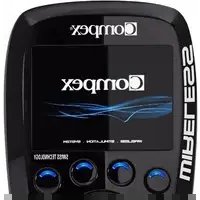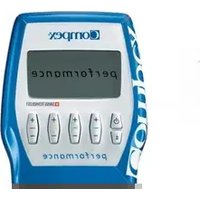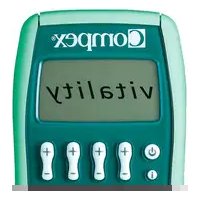
Vitality - Electrostimulation device COMPEX - Free user manual and instructions
Find the device manual for free Vitality COMPEX in PDF.


| Product type | Electrical stimulation device |
| Brand | Compex |
| Model | Vitality |
| Power supply | Rechargeable NiMH battery 4.8 V / 1200 mAh; mains charger included (100-240 V AC) |
| Number of channels | 4 independent, electrically isolated channels |
| Pulse shape | Rectangular, compensated constant current (no DC component) |
| Maximum current per pulse | 80 mA |
| Pulse duration | 50 to 400 microseconds |
| Pulse frequency | 1 to 150 Hz |
| Increment step | Manual adjustment from 0 to 444 (energy); minimum step of 0.5 mA |
| Programs | Pain relief, Massage, Vascular, Rehabilitation, Aesthetic, Fitness (several sub-programs each) |
| Special functions | Backlit screen, contrast and volume adjustment, warm-up sequence, automatic shut-off |
| Included accessories | Charger, 4 electrode cables (colored), electrodes (small 5×5 cm and large 5×10 cm), manual, poster, belt clip |
| Maintenance and cleaning | Clean with a soft cloth dampened with alcohol (no solvent); do not immerse |
| Safety | Contraindications: pacemaker, epilepsy, pregnancy (abdomen), severe arterial circulatory disorders, hernia; do not use in water or within 1.5 m of high-frequency devices |
| Operating conditions | Temperature 0°C to 40°C; humidity 30% to 75%; max altitude 3000 m |
| Storage and transport | -20°C to 45°C; max humidity 75%; pressure 700-1060 hPa |
| Standards | European Directive 93/42/EEC, IEC 60601-1, IEC 60601-1-2, IEC 60601-2-10 |
| Warranty | See enclosed leaflet (not detailed in the manual) |
| Repairability | Repairs only by a Compex authorized service center; do not open |
Frequently Asked Questions - Vitality COMPEX
User questions about Vitality COMPEX
0 question about this device. Answer the ones you know or ask your own.
Ask a new question about this device
Download the instructions for your Electrostimulation device in PDF format for free! Find your manual Vitality - COMPEX and take your electronic device back in hand. On this page are published all the documents necessary for the use of your device. Vitality by COMPEX.
USER MANUAL Vitality COMPEX
Compex ^2 is a registered trademark of DJO, LLC
User and applications manual
Directions for use 11
Programs and specific applications 20
Table with placements of electrodes and stimulation positions 49
Italiano
- Counter-indications 5
- Safety measures 5
II. PRESENTATION 7
- Reception of equipment and accessories 7
- Presentation of the device 8
- Guarantee 8
- Maintenance 9
- Storage and transportation conditions 9
- Use conditions 9
- Elimination 9
- Standards 9
- Patent 10
- Normalised symbols 10
- Technical information 10
III. DIRECTIONS FOR USE 11
- Connections 11
- Preliminary settings: language, light intensity and sound volume 11
- Selecting a program category 12
- Selecting a program 12
- Personalising a program 13
- During the stimulation session 14
- Electricity consumption and recharging 15
- Problems and solutions 16
IV. HOW DOES ELECTROSTIMULATION WORK? 17
V. USE PRINCIPLES 18
- Placement of electrodes 18
- Stimulation position 19
- Setting the stimulation energy level 19
- Progression in the levels 19
VI. PROGRAMS AND SPECIFIC APPLICATIONS 20
Pain relief category 21
Massage category 28
Vascular category 31
Rehabilitation category 35
Aesthetic category 39
Fitness category 44
VII. TABLE WITH PLACEMENTS OF ELECTRODES
AND STIMULATION POSITIONS
49
I. WARNINGS
1. Counter-indications
Important counter-indications
■ Cardiac stimulator (pacemaker)
■ Epilepsy
■ Pregnancy (no positioning in the abdominal area)
■ Serious arterial circulatory problems in the lower limbs
■ Abdominal or inguinal hernia
Precautions when using the Compex
■ After trauma or a recent operation (less than 6 months)
■ Muscular atrophy
■ Persistent pains
■ Need for muscular rehabilitation
Osteosynthesis equipment
The presence of osteosynthesis equipment (metallic equipment in contact with the bone: pins, screws, plates, prostheses, etc.) is not a contra-indication for the use of Compex programs. The electrical current of the Compex is specially designed to have no harmful effect with regard to osteosynthesis equipment.
In all of the above cases, you are advised to:
■ never use the Compex for prolonged periods without medical advice;
■ consult your doctor if you are in any doubt whatsoever;
■ read this manual carefully, in particular chapter VI, which provides information concerning the effects and indications of each stimulation program.
2. Safety measures
What you should not do with the Compex
■ Do not use the Compex in water or in a humid atmosphere (sauna, hydrotherapy, etc.).
■ Never carry out an initial stimulation session on a person who is standing. The first five minutes of stimulation must always be performed on a person who is sitting or lying down. In rare instances, very highly strung people may have a vagal reaction. This is of psychological origin and is connected with a fear of the muscle stimulation as well as surprise at seeing one of their muscles contract without having intentionally contracted it themselves. This vagal reaction produces a feeling of weakness with a fainting tendency, slowing down of the heartrate and a reduction in arterial blood pressure. If this does occur, all that is required is to stop the stimulation and lie down with the legs raised for the time it takes for the feeling of weakness to disappear (5 to 10 minutes).
■ Never allow movement resulting from muscular contraction during a stimulation session. You should always stimulate isometrically; this means that the extremities of the limb in which a muscle is being stimulated must be firmly fixed, so as to prevent the movement that results from contraction.
■ Do not use the device at less than 1.5 metres from a short-wave device, a micro-wave device or high frequency (H.F.) surgical equipment to avoid the risk of causing skin irritations or burns under the electrodes. If you are in any doubt about using the Compex in close proximity to any
other medical device, please consult its manufacturer or your doctor.
■ Only use the electrode cables supplied by Compex.
- Do not disconnect the stimulator electrode cables during the session without first switching off the stimulator.
■ Never connect stimulation cables to an external electric power supply because of risk of electric shock.
■ No not use rechargeable batteries other than the one supplied by Compex.
■ Never recharge the stimulator when cables and electrodes are still connected onto the user.
■ Never recharge the batteries with another charger than the one supplied with the Compex.
■ Never use the Compex or the charger if it is damaged (case, cables, etc.) or if the compartment for the rechargeable battery is open. There is a risk of electric discharge.
■ Disconnect immediately the charger if the Compex “bleeps” continuously, in case of abnormal heating or smell, or if smoke comes from the charger or the Compex. Do not recharge the batteries in a confined area (case, etc.) because of risk of fire or electric discharge.
- Keep the Compex and its accessories out of the reach of children.
- Do not allow any foreign items (soil, water, metal, etc.) to enter into the Compex, the compartment for the rechargeable battery and the charger.
■ Sudden temperature variations can create droplets in the device due to condensation. Use the device only once it reached ambient temperature.
■ Do not use the Compex while driving or operating machinery.
■ Do not use the stimulator in the mountains at an altitude higher than 3.000 metres.
Where you should never apply electrodes...
■ To the head.
■ Counter-laterally: Do not use the two poles of the same channel (one electrode connected to the positive/red pole and one electrode connected to the negative/black pole) on either side of the body centreline (eg: right arm and left arm).
■ To or in the vicinity of skin lesions of any kind (wounds, inflammations, burns, irritations, eczema, etc.).
Precautions when using the electrodes
■ Only use the electrodes supplied by Compex. Other electrodes may have electrical properties that are unsuitable for the Compex stimulator.
■ Do not remove or move the electrodes during a stimulation session without first switching off the instrument.
■ Do not plunge the electrodes into water.
■ Do not apply a solvent of any kind to the electrodes.
■ Before applying the electrodes, it is recommended to wash and degrease the skin, and then dry it.
■ Apply the whole surface of the electrodes to the skin.
■ For very important reasons of hygiene, each user must have his own electrode set. Do not use the same electrodes on different people.
- Do not use a set of electrodes for more than fifteen sessions, as the quality of the contact between the electrode and the skin, which is important for the comfort and effectiveness of stimulation, progressively degrades.
■ In certain people with very sensitive skin, redness may be observed under the electrodes after a
stimulation session. Generally, this redness is completely harmless and disappears after 10 to 20 minutes. However, avoid starting a stimulation session on the same area until the redness is no longer evident.
II. PRESENTATION
1. Reception of equipment and accessories
Your stimulator is supplied with:
| – The stimulator |
| – A battery charger |
| – One set of electrode cables with colour indicators (blue, green, yellow, red) |
| – Bags containing the electrodes (small (5 x 5 cm) and large (5 x 10 cm) electrodes) |
| – A user and applications manual |
| – A poster with the pictures for the placements of electrodes and the stimulation positions |
| – A belt clip |
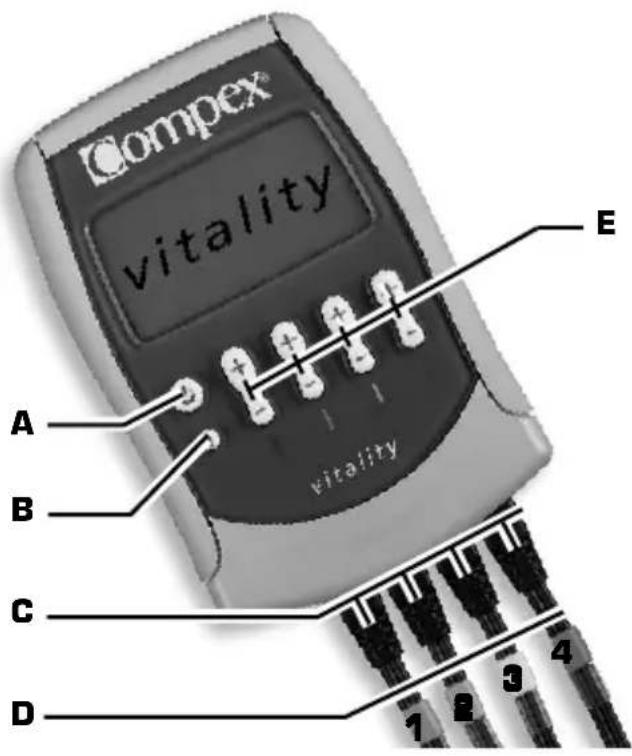
2. Presentation of the device
A - "On/Off" switch
B – “i” button. To increase the energy level of several channels simultaneously
C - Sockets for the 4 electrode cables
D - Electrode cables
channel 1 = blue channel 2 = green channel 3 = yellow channel 4 = red
E - “+”/“-” keys of the 4 stimulation channels
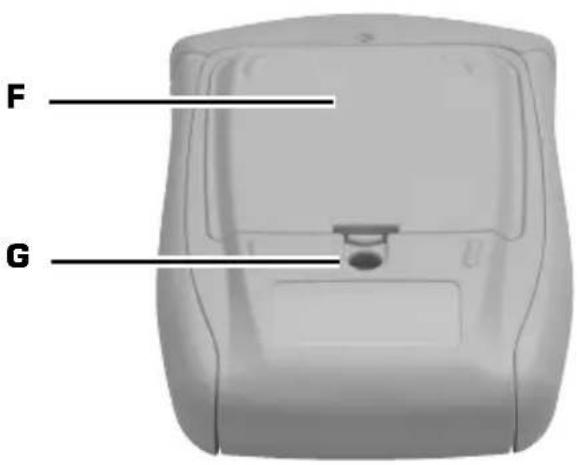
F – Compartment for the rechargeable battery
G - Belt clip socket
3. Guarantee
Refer to the flyer attached.
4. Maintenance
To clean your unit, use a soft duster and an alcohol-based cleaning product, which does not contain any solvents.
The user must not attempt any repairs to the device or any of its accessories. Never dismantle the Compex or the charger containing high-voltage parts because of risk of electric discharge.
Compex Médical SA declines all responsibility for damages and consequences resulting from any attempt to open, modify or repair the device or any of its components by a person or a service centre not officially approved by Compex Médical SA.
Compex stimulators do not require calibration or verification of performance parameters. The characteristics are systematically verified and validated for each device manufactured. These characteristics are stable and do not vary when used under normal conditions.
If your device seems to not function as expected, regardless of the situation, contact an official Compex service centre for assistance.
Medical and health professionals must refer to local legislation for information related to maintenance. Normally, these laws require verification of certain criteria at regular intervals.
5. Storage and transportation conditions
The Compex contains rechargeable batteries and so the storage and transportation conditions must not exceed the following figures:
Storage and transportation temperature: from -20^ to 45^
Max. relative humidity: 75%
Atmospheric pressure: from 700 hPa to 1060 hPa
6. Use conditions
Temperature of use: from 0°C to 40°C
Max. relative humidity: from 30% to 75%
Atmospheric pressure: from 700 hPa to 1060 hPa
Do not use in an explosion risk area.
7. Elimination
The Directive 2002/96/CEE (WEEE) has a first priority, the prevention of waste electrical and electronic equipment, and in addition, the re-use, recycling and other forms of recovery of such wastes so as to reduce the disposal of waste.
The pictogram wheeled bin barred means that the equipment can not be thrown with the household refuse, but that it makes the object of a selective collection.
The equipment has to be given to a suitable collection point for the treatment.
By this way, you contribute to the safeguarding of the natural resources and the human health protection. Batteries must be disposed of in accordance with your country's national laws governing the disposal of such items.
8. Standards
The Compex is based directly on medical technology.
To guarantee your safety, the design, manufacturing and distribution of Compex are in conformity with the requirements of the European Directive 93/42/CEE.
The device is in conformity with the standard for general safety rules for electromedical devices IEC 60601-1, the standard for electromagnetic compatibility IEC 60601-1-2 and the standard for special safety rules for
nerve and muscle stimulators IEC 60601-2-10.
Current international standards (IEC 60601-2-10 AM1 2001) require that a warning be given concerning the application of electrodes to the thorax (increased risk of cardiac fibrillation).
Directive 2002/96/CEE Waste electrical and electronic equipment (WEEE).
9. Patent
Snap electrode: patent pending.
10. Normalised symbols

Important: Under some
conditions, the effective figure
for the stimulation pulses can exceed 10 mA and 10 V. The information given in this handbook must be strictly observed.

The Compex is a class II device unit with its own internal electric er, with type BF applied sections.

Waste electrical and electronic equipment (WEEE).

The “On/Off” switch is a multi-function key:
Functions Symbol N°(according to CEI 878)
On/Off (2 positions, stable) 01-03
Waiting or preparation for part of the unit 01-06
Stop (switching off) 01-10
11. Technical information
General points
Power supply: NIMH rechargeable battery (NIMH) (4,8 V ^a 1200 mA/h).
Chargers: The only chargers used for recharging the battery bear the following information:
Type TR503-02-E-133A03
Input 90-264 VAC / 47-63Hz / 0.5A max.
Output 9V / 400mA / 6W
Type TR1509-06-E-133A03
Input 90-264 VAC / 47-63Hz / 0.5A max.
Output 9V / 1.4A / 15W
Type TR503-02-E-133A03
Input 90-264 VAC / 47-63Hz / 0.5A max.
Output 9V / 400mA / 6W
Type TR1509-06-E-133A03
Input 90-264 VAC / 47-63Hz / 0.5A max.
Output 9V / 1.4A / 15W
Type TR503-02-E-133A03
Input 90-264 VAC / 47-63Hz / 0.5A max.
Output 9V / 400mA / 6W
Type TR1509-06-E-133A03
Input 90-264 VAC / 47-63Hz / 0.5A max.
Output 9V / 1.4A / 15W
Neurostimulation
All electrical specifications are given for a charge between 500 and 1000 ohms per channel.
Channels: four independent and individually adjustable channels electrically insulated from each other and from ground
Impulse shape: constant rectangular current compensated to eliminate any direct current component to avoid any residual skin polarisation
Maximum current of an impulse: 80 milliamperes
Intensity increase interval:
- Manual stimulation intensity adjustment: 0-444 (energy units)
- Impulse duration: 0.5 mA
Impulse duration: from 50 to 400 microseconds
Maximum quantity of electricity per impulse: 80 microcoulombs (2 x 40 C compensated)
Typical rise time for an impulse:
3 microseconds (between 20% and 80% of maximum current)
Impulse frequency:
from 1 to 150 Hertz
III. DIRECTIONS FOR USE
before using the unit for the first time, you are strongly advised to take careful note of the counter-indications and safety measures detailed at the beginning of this manual (chapter I: "Warnings"), as this powerful equipment is neither a toy nor a gadget!
1. Connections
The electrical impulses generated by the Compex are transmitted to the nerves by self-adhesive electrodes. The choice of the size, the connection and the correct positioning of the electrodes are essential factors for ensuring effective and comfortable stimulation. So they require particular care. To do all this – and for information on the recommended stimulation positions – refer to the pictures and pictograms in the poster, and to the “Table with placements of electrodes and stimulation positions” in chapter VII. The specific applications contained in chapter VI also provide useful relevant information.

1a Sockets for the four electrode cables
1b Socket for the battery charger
Connecting the electrodes and cables
The electrode cables are connected to the stimulator through sockets on the base of the device.
Four cables can be connected simultaneously to the four channels of the device.
For easier use and better identification of the four channels, we advise you to follow the colour of the electrode cables and the stimulator sockets:
blue = channel 1 yellow = channel 3 green = channel 2 red = channel 4
It is important to place the electrodes correctly to the cable connectors; in order to do so, press strongly the connector to the electrode until you bear a double click.
Connecting the charger
The Compex has considerable operating autonomy, as it uses rechargeable batteries. To recharge them, use the charger supplied with your device and connect it to the base of the device, then plug the charger in a socket.
To recharge the Compex, first disconnect the electrode cables from the device.
Before using your stimulator for the first time, it is always strongly recommended that you completely charge the battery to improve its autonomy and extend its working life.
2. Preliminary settings: language, light intensity and sound volume
Before using the unit for the first time, you should select the working language of the device which is displayed on the options screen. Proceed as per the instructions described below.
Afterwards, for the greatest comfort, Compex offers you a number of setting options (operating language selection, display contrast setting and sound volume setting).
To do this, display the options screen by pressing the “On/Off” switch on the left of the Compex and hold it down for a few seconds.
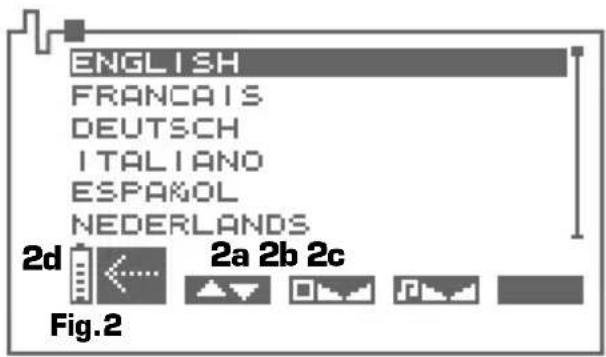
2a To select the language of your choice, press the "+"/-" key of channel 1 (to go up or down), until the desired language is displayed in white characters on a black background.
2b To set the contrast of the display, press the “+”/“-” key of channel 2 (“+” to increase the preferred percentage and “-” to reduce it).
2c To set the sound volume, press the “+”/“-” of channel 3 (“+” to increase the preferred percentage and “-” to reduce it).
2d To confirm the parameters selected, press the "On/Off" switch. Your stimulator saves your options. It is now ready for use with the settings you selected.
3. Selecting a program category
To switch on your stimulator, briefly press the "On/Off" switch on the left of the Compex. A musical signal can be heard and a screen showing the different program categories is displayed.
Before choosing a program, you should select the desired category.
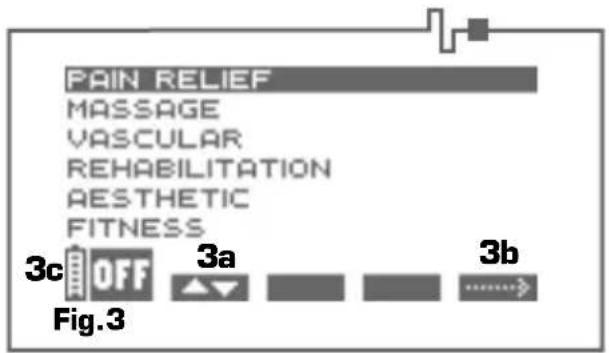
3a To select the desired category, press the "+"/-" key of channel 1 (to go to the left) or channel 3 (to go to the right), until the desired category is displayed in a frame.
3b To confirm your choice and to move on to the program selection screen (see the next section: "Selecting a program"), press the "+"/-" key of channel 4.
3c Press the "On/Off" key to switch off the stimulator.
4. Selecting a program
To choose a program, it is particularly useful to consult chapter VI of this manual (“Programs and specific applications”).
Regardless of the category you selected in the previous step, a list containing a select number of programs appears on the screen.
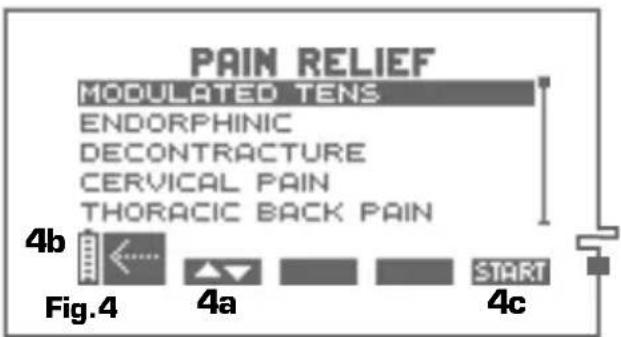
4a To select the desired program, press the "+"/"-" key of channel 1 (to go up or down), until the desired program is displayed in white characters on a black background.
4b Press the "On/Off" key to return to the previous screen.
4c After selecting the desired program, press the "+"/-" key of channel 4 which, depending on the program selected, displays the symbol START
a) the stimulation session starts immediately;
b) = a parameter setting screen displays.
5. Personalising a program

The program personalisation screen is not available for all programs.
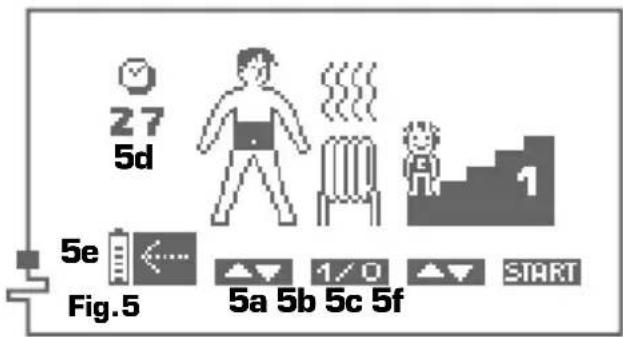
5a Certain programs require manual selection of the muscular group that you want to stimulate and a figurine is displayed above channel 1.
To select your desired group, press the “+”/“-” key of channel 1 (to go up or down). The seven muscular groups are displayed in succession in black on the figurine:
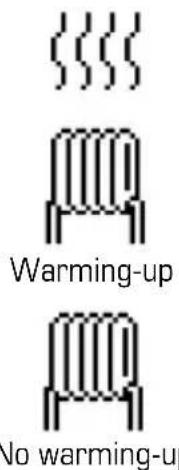
5b The warming-up sequence suggested for some programs is active by default (an animated rising convection symbol above the heater). If you prefer to skip this sequence, press the "+"/-" key of channel 2.
Current international standards require that a warning be given concerning the application of rodes to the thorax (increased risk, cardiac fibrillation).
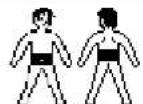
Abdomen and Lower back
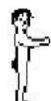
Buttocks
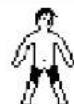
Thighs
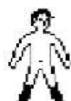
Legs and Feet
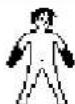
Forearms and Hands
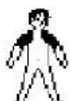
Shoulders and Arms

Thorax and Back
5c Certain programs allow you to adjust the level of work. To do this, press the "+"/-" key of channel 3 (to go up or down), until the desired level of work is displayed.
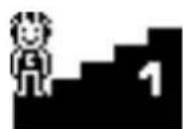
Level 1 Level 2
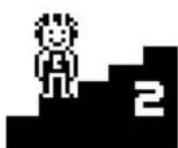
Level 3
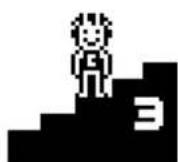
Level 4 Level 5
5d Total program time in minutes.
5e By pressing the "On/Off" key, you can return to the previous screen.
5f To confirm your selection and start the program, press the "+"/-" key of channel 4.
6. During the stimulation session
Setting stimulation energy
When the program starts, the Compex prompts you to increase the stimulation energy, a key factor for the effectiveness of the stimulation.
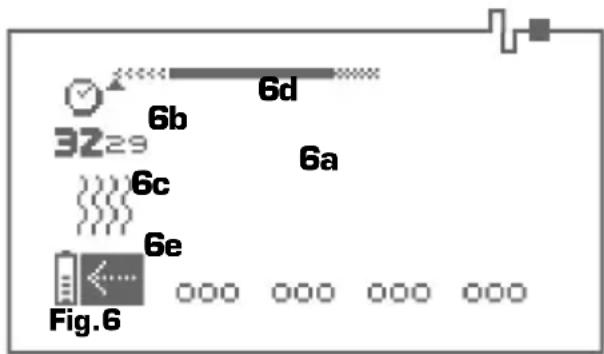
6a The Compex "bleeps" and the symbols of the four channels flash, changing from "+" to "000": the four channels are at 0 energy. You must increase the stimulation energy so that the stimulation can start. To do this, press the "+" of the keys of the relevant channels, until the desired setting is reached. If you want to increase the energy level of all four channels simultaneously, press the "i" button, located below the "On/Off" key. You can also increase the energy level of three first channels, by pressing the "i" button twice, or the energy level of two first channels only, by pressing three times this button. Once you activate the "i" button, the associated channels are highlighted in white on a black background.
6b Remaining time in minutes and seconds.
6c The animated rising convection symbol represented the warming-up sequence.
6d Session progression scale. For details on how it works, see the following section ("Program progression").
6e By pressing the "On/Off" key, you can return to the previous screen.
Program progression
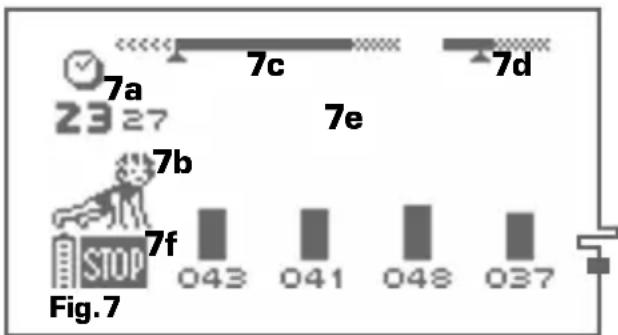
Stimulation does really start when the stimulation energy has been increased. The screens that are displayed during stimulation allow you to observe the progression of the session. These screens may differ from one program to another. The examples reproduced below are sufficient for you to understand the general rules.
bar
| Category | Value | |---|---| | 7a | 23 | | 7b | 27 | | 7c | 7e | | 7d | 7e | | 7f | 043 | | 7f | 041 | | 7f | 048 | | 7f | 037 |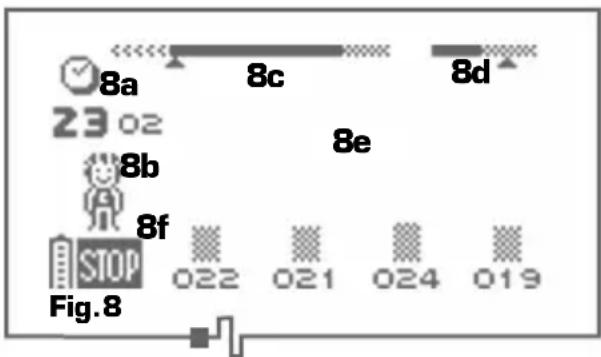
7a-8a Remaining time (in minutes and seconds) before the end of the program.
7b-8b A small animated symbol indicating category to which the program belongs.
7c-8c Session progression scale: The progression scale is composed of three distinct parts: the program consists of three stimulation sequences, i.e., warming up (light hatching /left), the actual work (black area/centre) and relaxation at the end of the program (heavier hatching/right). The progression scale can be also entirely hatched: the program then consists of a single stimulation sequence. The small cursor located just below the scale moves horizontally and indicates precisely the state of progression of the program (here: start of the first sequence, i.e., the work sequence).
7d-8d Contraction and active rest time bar: This bar is displayed at the right of the progression scale, but only during the work sequence. It indicates the duration of the contraction and active rest times.
7d The cursor is located under the black (left) part of the bar: you are in a muscular contraction phase.
8d The cursor is located under the hatched (right) part of the bar: you are in an active rest phase.
The stimulation energy during the active rest phase is automatically set at 50% of the stimulation energy during the muscular contraction.
7e-8e Bar charts:
7e The muscular contraction phase is represented by the bar charts of the stimulation channels used (which become black during the contraction phase).
8e The active rest phase is represented by the bar charts of the stimulation channels used (which become hatched during the active rest phase).
7f-8f You can interrupt the program momentarily (S10:PAUSE")") by pressing the "On/Off" key. If you wish to restart the session, simply press the "+"/-" key of channel 4.
■ After an interruption, stimulation restarts at 80% of the stimulation energy set before the STOP
Adjusting stimulation energy
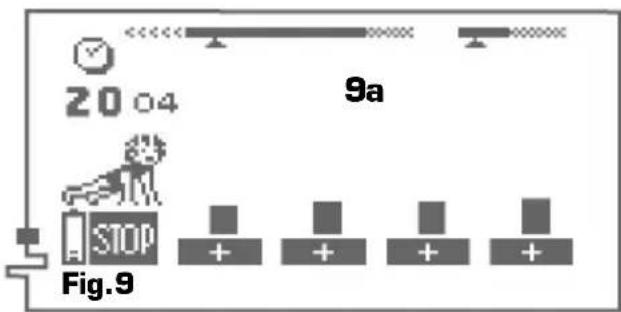
9a During the session, the Compex "bleeps" and some +mbols start to flash above the active channels (over the energy indications): the Compex is prompting you to increase the stimulation energy level. If you cannot support an increase of the energy, just ignore this message.
End of program
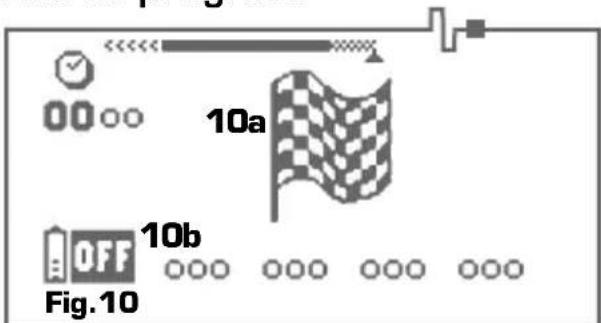
10a At the end of the session, you hear a musical signal and a small flag is displayed.
10b It is then only necessary to switch off the stimulator by pressing the "On/Off" key (OFF
7. Electricity consumption and recharging
Never recharge the stimulator with cables still connected to it. Never recharge the batteries with a charger different from the one supplied by Compex.
The Compex runs on rechargeable batteries. The discharge time depends on the programs and stimulation energy used.
Before using your stimulator for the first time, it is always strongly recommended that you completely charge the battery to improve its autonomy and extend its working life. If you do not use your device for a long period of time, please regularly recharge the battery.
Electricity consumption
The symbol of a small battery indicates the charge level of the batteries.
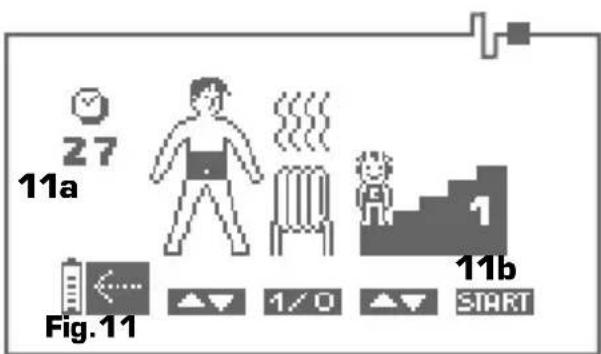
11a The small battery symbol has only two reference marks: The batteries are losing their charge. Interrupt the session and recharge the device (see the following section).
11b The STARimbol normally displayed above the "+"/-" key of channel 4 has disappeared (■d the small battery flashes: The batteries are completely flat. It is no longer possible to use the device. Recharge it immediately (see the following section).
Recharging
To recharge the Compex, first disconnect the electrode cables from the device, then plug the charger in a socket and lastly connect the stimulator to the charger (see in section I: "Connecting the charger"). The charge menu illustrated below appears automatically.
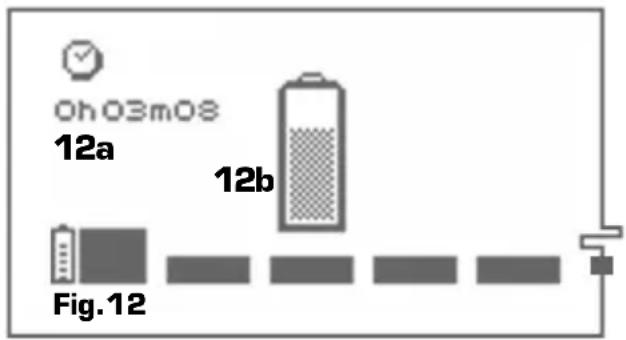
12a The Compex has been charging for 3 minutes and 8 seconds (a full charge may take from 1h30 to 2 hours with the rapid charger delivered with your device).
12b Charging is in progress and the small battery symbol is not completely full. When charging is completed, total charge duration flashes and the small battery is completely full. The Compex switches off automatically as soon as you disconnect the charger.
8. Problems and solutions
Electrode fault
13a-14a The Compex "bleeps" and alternatively displays the symbol of a couple of electrodes and an arrow pointing to the channel where a problem has been detected. Below, the stimulator has detected an electrode fault on channel 2.
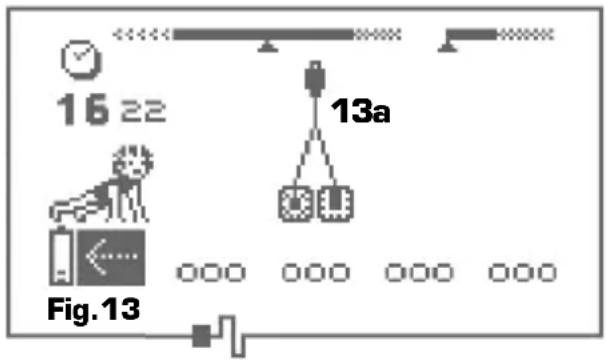
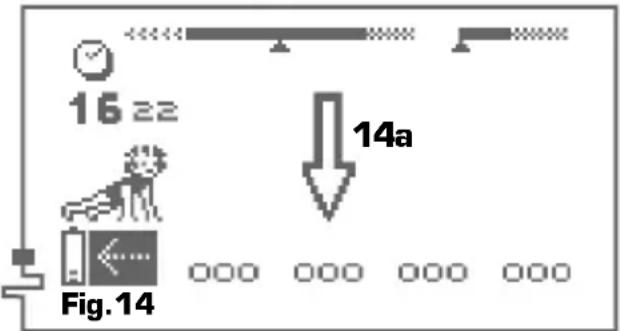
This message may mean that:
1) there is no electrode connected to this channel;
2) the electrodes are old, worn out and/or the contact is poor: try using new electrodes;
3) the electrode cable is defective: try it using another channel. If cable shows a default again, please replace.
Recharging error
A recharging error may happen during charging. The Compex "bleeps" continuously and the following screen is displayed:
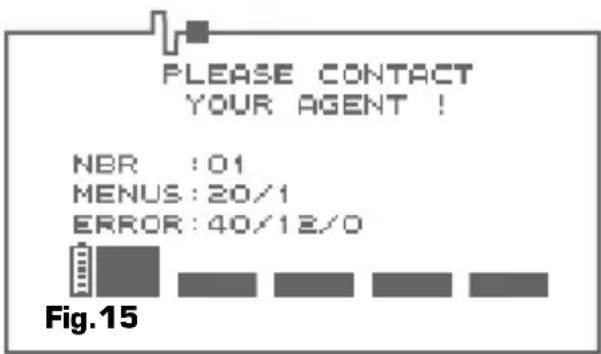
If this message appears, disconnect the charger and the device switches off automatically. Please contact the hotline, noting this error code.
If, for any reason, you experience any other trouble with your device, please contact the hotline mentioned and approved by Compex Médical SA.
IV. HOW DOES ELECTROSTIMULATION WORK?
The principle of electrostimulation is to stimulate nerve fibres by means of electrical impulses transmitted by electrodes.
The electrical impulses generated by Compex stimulators are high-quality impulses – ensuring safety, comfort and efficiency – that stimulate different types of nerve fibres:
-
the motor nerves to stimulate a muscular response. The quantity of work and the benefits obtained depend on the stimulation parameters. This is known as electromuscular stimulation (EMS).
-
certain types of sensitive nerve fibres to obtain analgesic or pain-relieving effects.
1. Motor nerve stimulation (EMS)
In voluntary activity, the order for muscular work comes from the brain, which sends a command to the nerve fibres in the form of an electrical signal. This signal is then transmitted to the muscular fibres, which contract.
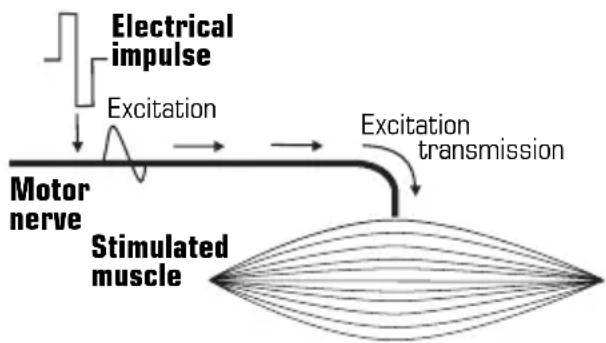
The principle of electrostimulation accurately reproduces the process observed during a voluntary contraction. The stimulator sends an electrical current impulse to the nerve fibres, exciting them. This excitation is then transmitted to the muscular fibres causing a basic mechanical response (= muscular twitch). The latter constitutes the basic requirement for muscular contraction.
This muscular response is completely identical to muscular work controlled by the brain. In other words, the muscle cannot distinguish whether the command comes from the brain or from the stimulator.
The parameters of the Compex programs (number of impulses per second, contraction time, rest time, total program time) subject the
flowchart
graph TD
    A["Electrical impulse"] --> B["Excitation"]
    B --> C["Motor nerve"]
    C --> D["Stimulated muscle"]
    D --> E["Excitation transmission"]
    E --> F["Output"]
Basic mechanical response = muscular twitch
muscles to different types of work, according to muscular fibres. In fact, different types of muscular fibres may be distinguished according to their respective contraction speed: slow, intermediate and fast fibres. The fast fibres will obviously predominate in a sprinter, while a marathon runner will have more slow fibres.
With a good knowledge of human physiology and a perfect mastery of the stimulation parameters of the various programs, the muscular work can be directed very precisely towards the desired goal (muscular reinforcement, increased blood flow, firming up, etc.).
2. Stimulation of the sensitive nerves
The electrical impulses can also excite the sensitive nerve fibres to obtain an analgesic or pain-relieving effect.
The stimulation of the tactile sensitive nerve fibres blocks the transmission of pain by the nervous system.
The stimulation of another type of sensitive fibres creates an increase in the production of endorphins and, therefore, a reduction of pain.
With pain relief programs, electrostimulation can be used to treat localized sharp or chronic pains as well as muscular pains.
Benefits of electrostimulation
Electrostimulation is a very effective way to make your muscles work:
■ with significant improvement of different muscular qualities,
■ without cardio-vascular or mental fatigue,
■ with limited stress on the joints and tendons.
Electrostimulation thus allows a greater quantity of work by the muscles compared with voluntary activity.
To be effective, this work must involve the greatest possible number of muscular fibres. The number of fibres working depends on the stimulation
energy. It will therefore be necessary to use the maximum tolerable energy. The user controls this aspect of stimulation. The higher the stimulation energy, the greater the number of muscular fibres that are working and, therefore, the more significant the progress achieved.
To maximize your results, Compex recommends that you complement your electrostimulation sessions with other efforts, like:
- regular exercise,
■ proper and healthy nutrition, - balanced lifestyle.
V. USE PRINCIPLES
The use principles presented in this section should be considered general rules. For all programs, it is recommended that you read carefully the information and advice on use presented in chapter VI of this manual (“Programs and specific applications”).
1. Placement of electrodes
It is recommended that you comply with the suggested placements. To do this, refer to the pictures and pictograms shown on the poster and to the “Table with placements of electrodes and stimulation positions” in chapter VII.
A stimulation cable consists of two poles:
a positive pole (+) = red connection
a negative pole (−) = black connection
A different electrode must be connected to each of the two poles.
Note: It is possible and normal to have an electrode arrangement that leads one electrode connection free from a cable.
Depending on the characteristics of the current used for each program, the electrode connected to the positive pole (red connection) is more effective when placed in a “strategic” position.
For all muscle electrostimulation programs, i.e., programs involving muscle contractions, it is important to place the positive polarity electrode on the muscle motor point.
The choice of electrodes size (large or small) and the correct positioning of the electrodes on the muscular group to be stimulated are determinant and essential factors for the effectiveness of the stimulation. Therefore, always use the size of electrodes shown in the pictures. Unless you have other specific medical instructions, always follow the placement directions in the pictures. If necessary, find the best position by slightly moving the positive polarity electrode, so as to obtain the best muscle contraction or the position that seems most comfortable.

ompex Group disclaims all responsibility for electrodes positioned in any other manner.
2. Stimulation positions
To determine the stimulation position to adopt depending on the placement of the electrodes and the chosen program, refer to the pictures and pictograms on the poster and to the “Table with placements of electrodes and stimulation positions” in chapter VII.
The stimulation position depends on the muscular group to be stimulated and the program chosen.
For the programs involving powerful muscular contractions, the muscle should always be stimulated in an isometric fashion. Consequently, you should fix the extremity of the stimulated limb(s) firmly. In this way, you provide maximum resistance to the movement and prevent any shortening of the muscle during the contraction, which could create cramp pains and serious stiffness after the session. For example, when stimulating the quadriceps, the user should be in a seated position with the ankles fixed with straps to prevent extension of the knees.
For the other types of programs (for example, the Pain programs and the Active recovery program), which do not involve powerful muscular contractions, position yourself as comfortably as possible.
3. Setting the stimulation energy level
In a stimulated muscle, the number of recruited fibres depends on the stimulation energy. For the programs involving powerful muscular contractions, it is therefore absolutely necessary to use maximum stimulation energy, always at the limit of what you can support, so as to involve the greatest possible number of fibres.
The “Table with placements of electrodes and stimulation positions” in chapter VII provides information on the energy to use, depending on the selected program.
4. Progression in the levels
In general, it is not advisable to go through the different levels quickly with the intention of reaching level 5 as fast as possible. In fact, the different levels correspond to progress with electrostimulation.
The simplest and most usual procedure is to start with level 1 and raise the level when changing to a new stimulation cycle.
At the end of a cycle, you may either start a new cycle at the next level up or do some maintenance at the rate of 1 session a week at the last level reached.
VI. PROGRAMS AND SPECIFIC APPLICATIONS
The applications that follow are given by way of example. They provide a better understanding of how electrostimulation sessions can be combined with voluntary activity. These protocols will help you to determine the best procedure to follow depending on your needs (choice of the program, muscular group, duration, placement of the electrodes, body position).
You can of course choose a muscular group different from the one indicated, depending on the activities you practice or the body area you wish to stimulate.
The specific applications provide you information on the placement of electrodes and the stimulation position to adopt. This information is represented by numbers (placement of electrodes) and letters (stimulation position). They refer to the “Table with placements of electrodes and stimulation positions” in chapter VII and to the
poster with the pictures for the placements of electrodes and the pictograms for the body positions. The table also indicates the stimulation energy to use, according to the program.
You must select in the device the muscular group indicated on the figurine. When no figurine appears (−), it is not necessary to choose the muscular group: the selection is automatic.

Physical pain is an abnormal and unpleasant sensation caused by an injury, a disorder or incorrect functioning of a part of our organism. It is always a signal sent to us by our bodies, one that should not be ignored, and that in all cases requires us to consult a doctor if it does not disappear quickly.
The approach to pain adopted by the medical profession has changed considerably in recent years. Treatment of the cause is always fundamental, however the pain as such must be otherwise removed or at least considerably reduced and made bearable for the patient. The means to combat pain have developed greatly, and there is no longer any hesitation today in using powerful analgesics to improve the quality of life of patients.
It is within this context that recourse to electrotherapy has developed. Excitation of the nerve fibres of sensation by means of electrical micro-impulses is often the preferred method of combatting pain. Today, such analgesic electrotherapy is widely used, particularly in rehabilitation medicine and in specialist pain treatment centres.
The precision of electrical currents allows the analgesic action to be accurately targeted according to the type of pain. It is up to the user to choose the most appropriate program for the type of pain and to follow practical recommendations in order to obtain maximum effect.
If the pain is great and/or persistent, you are advised to consult a doctor. Only a doctor can make an accurate diagnosis and put in place therapeutic actions designed to encourage disappearance of the disorder.
Table of the pathologies
| Pathologies | Programs | References |
| Neuralgia of the upper limb (brachial neuralgia) | Modulated TENS | See application page 24 |
| Chronic muscular pain (polymyalgia) | Endorphinic | See application page 24 |
| Contracture (eg: localized contracture in external side of the calf) | Decontracture | See application page 24 |
| Chronic muscular pain in the back of the neck (cervical pain) | Cervical pain | See application page 24 |
| Muscular pain in the thoracic region (thoracic back pain) | Thoracic back pain | See application page 25 |
| Muscular pain in the low region (low back pain) | Low back pain | See application page 25 |
| Muscular pain in the low back region associated with pain in the buttocks and at the back of the thighs (lumbosciatica) | Lumbosciatica | See application page 25 |
| Sharp and recent muscular pains affecting a muscle in the low back (lumbago) | Lumbago | See application page 26 |
| Chronic elbow pain (epicondylitis = tennis elbow) | Epicondylitis | See application page 26 |
| Recent and acute back of the neck muscle pains (torticollis) | Torticollis | See application page 26 |
| Chronic pain in the joints (eg: arthrosis of the knee = gonarthrosis) | Arthralgia | See application page 27 |
Table of the Pain relief programs
| Programs Effects | Uses | |
| Modulated TENS | Blocks transmission of pain by the nervous system | All acute or chronic localized pain |
| Endorphinic | Analgesic action through the release of endorphinis Increased blood flow | To combat chronic muscular pain |
| Decontracture | Reduced muscular tension Relaxing effect | To combat recent and localized muscular pain |
| Cervical pain | Analgesic action through the release of endorphinis Increased blood flow | Analgesic current specifically adapted to pains in the back of the neck |
| Thoracic back pain | Analgesic action through the release of endorphinis Increased blood flow | Analgesic current specifically adapted to low back pain (lumbar region) |
| Low back pain | Analgesic action through the release of endorphinis Increased blood flow | Analgesic current specifically adapted to low back pain (lumbar region) |
| Lumbosciatica | Analgesic action through the release of endorphinis Increased blood flow | Analgesic current specifically adapted to low back pain (lumbar region) combined with pain in the buttocks running down the rear of the thigh and sometimes into the leg and foot |
| Lumbago | Reduced muscular tension Relaxing effect | Analgesic current specifically adapted to sharp and sudden low back pain (lumar region) |
| Epicondylitis | Blocks transmission of pain by the nervous system | Analgesic current specifically adapted to persistent pain int he elbow |
| Torticollis | Reduced muscular tension Relaxing effect | Analgesic current specifically adapted to acute and sharp pains int he back of the neck |
| Arthralgia | Blocks transmission of pain by the nervous system | Analgesic current specifically adapted to persistent pain in a joint, as in osteoarthritis and rheumatism (all joints in the limbs except the elbow: see the Epi-condylitis program above) |
Specific applications
Neuralgia of the upper limb (brachial neuralgia)
Some people suffer from arthritis in the joints of the vertebrae at the back of the neck, or from arthritis or periarthritis of the shoulder. These situations often give rise to pain that runs down one arm and is known as “brachial neuralgia”. These arm pains that start in the shoulder or the back of the neck can be reduced with the Compex Modulated TENS program by following the practical recommendations outlined below.
Cycle duration: 1 week, 1 x/day minimum, then adapt according to how the pain develops
According to requirements, the Modulated TENS program can be repeated a number of times during the same day
Program: Modulated TENS 35◇
Chronic muscular pain (polymyalgia)
Some people suffer from muscular pain that affects several muscles or parts of different muscles at the same time. The localization of this chronic pain can vary over time. These continual and diffuse muscle pains are the result of chronic contractures in which acids and toxins accumulate, irritating the nerves and causing pain. The Endorphinic program is particularly effective against such pain since, in addition to its pain-reducing effect, it increases the blood flow to the contractured muscular groups and removes from them accumulations of acids and toxins.
Example: localized pain in the biceps. However, the pain may affect other muscular groups. The practical application illustrated below remains valid, but it is then necessary to place the electrodes on the muscular group concerned.
Cycle duration: 4 weeks, 2 x/day, with a 10 minute break between the 2 sessions
You are advised to consult your doctor if no improvement is observed after the first week of use
Program: Endorphinic 20
Contracture (eg: localized contracture in external side of the calf)
After tiring muscle work, intense training or a sporting competition, certain muscles or certain parts of muscles often remain tense and slightly painful. These are known as muscular contractures which should disappear after a few days with rest, good rehydration, a balanced food intake with mineral salts and application of the Decontracture program. The phenomenon of contracture frequently affects the calf muscles, but can also occur with other muscles. In this case, simply follow the same practical recommendations as below, but place the electrodes on the muscular group concerned.
Cycle duration: 1 week, 1 x/day
You are advised to consult your doctor if no improvement is observed after the first week of use
Program: Decontracture 24
Chronic muscular pain in the back of the neck (cervical pain)
Positions in which the muscles of the back of the neck remain tense for long periods of time, for example working in front of a computer screen, may be responsible for the onset of pain in the back of the neck or on either side of the base of the neck, in the upper back. These pains are due to a contracture of the muscles, of which the prolonged tension crushes the blood vessels and prevents the blood from supplying and oxygenating the muscle fibres. If this phenomenon is prolonged, there is an accumulation of acid and the blood vessels atrophy. The pain then becomes continuous or appears after only a few minutes spent working in an unfavourable position.
These chronic pains in the back of the neck can be treated effectively with the Cervical pain program, which reactivates the circulation, drains accumulations of acid, oxygenates the muscles, develops the capillaries and relaxes the contractured muscles.
Cycle duration: 4 weeks, 2 x/day, with a 10 minute break between the 2 sessions
You are advised to consult your doctor if no improvement is observed after the first week of use
Program: Cervical pain 15
Muscular pain in the thoracic region (thoracic back pain)
Vertebral arthritis and positions in which the muscles of the spinal column remain under tension for long periods of time are often responsible for the onset of pain in the middle of the back, which is accentuated with fatigue. Pressure of the fingers on the muscles on either side of the spinal column can often trigger a sharp pain.
These pains are due to a contracture of the muscles, of which the prolonged tension crushes the blood vessels and prevents the blood from supplying and oxygenating the muscle fibres. If the phenomenon is prolonged, there is an accumulation of acid and the blood vessels atrophy. The pain then becomes continuous or can appear after only a few minutes spent working in an unfavourable position.
These chronic back pains can be effectively treated with the Thoracic back pain program which reactivates the circulation, drains accumulations of acid, oxygenates the muscles, develops the capillaries and relaxes the contractured muscles.
Cycle duration: 4 weeks, 2 x/week with a 10 minute break between the 2 sessions
You are advised to consult your doctor if no improvement is observed after the first week of use
Program: Thoracic back pain 13◇
Muscular pain in the low back region (low back pain)
Low-back pain is the most frequently encountered pain. In a standing position, the entire weight of the trunk is concentrated on the joints between the last vertebrae and the sacrum. The low back region is therefore under particular strain. The discs between the vertebrae are crushed and the low back muscles contractured and painful.
There are very many treatments for the relief of low back pain sufferers; among
these, the specific currents of the Compex Low back pain program provide an appreciable improvement and can even resolve the problem if it is essentially muscular in origin.
Cycle duration: 4 weeks, 2 x/day, with a 10 minute break between the 2 sessions
You are advised to consult your doctor if no improvement is observed after the first week of use
Program: Low back pain 12◇
Muscular pain in the low back region associated with pain in the buttocks and at the back of the thighs (lumbosciatica)
Low back pain is the most frequent pain. When standing, the entire weight of the trunk is concentrated on the joints between the last vertebrae and the sacrum. The low back region is therefore placed under particular strain. The discs between the vertebrae are crushed and the low back muscles are contracted and painful.
The discs between the last two vertebrae or between the last vertebra and the sacrum frequently become damaged as a result of the pressure of the vertebrae. This damage can give rise to an irritation, or compression, of the nerve roots which exit the spinal column and continue down the buttocks and legs. The pain not only affects the low back, but also runs down the side of one buttock, the back of the thigh and sometimes into the leg. In this case the condition is known as lumbosciatica, for which it is always necessary to consult a doctor, so that the degree of compression of the nerve roots can be assessed and a suitable treatment prescribed.
The specific currents of the Compex Lumbosciatica program provide an effective treatment against pain, but must always be used as a supplement to other treatments prescribed by your doctor.
Cycle duration: 4 weeks, 3 x/week
You are advised to consult your doctor if no improvement is observed after the first week of use
Program: Lumbosciatica 32◇
Sharp and recent muscular pains affecting a muscle in the low back (lumbago)
During back movement, for example when lifting something, when turning or when standing up straight after bending down, a sudden pain can be triggered in the low back. Those who suffer from this problem present a contracture of the low back muscles and feel a sharp pain in this region; because they cannot stand completely straight, they remain bent over on one side. All of these symptoms indicate what is known as lumbago, which is principally the result of a sharp and intense contracture of the low back muscles (lumbar region).
In a situation such as this, it is always necessary to consult a doctor to receive appropriate treatment.
In addition to such treatment, the specific Compex Lumbago program can help effectively to relax the muscles and remove the pain.
Cycle duration: 4 weeks, 3 x/week
You are advised to consult your doctor if no improvement is observed after the first week of use
Program: Lumbago 33◇
Chronic elbow pain (epicondylitis = tennis elbow)
All tendons of the muscles that allow us to stretch our hand, wrist and fingers end at the small external bone mass of the elbow (epicondyle). Hand and finger movements therefore transmit tensions that are concentrated in the tendon endings at this bone mass.
When hand movements are repetitive, as is the case for painters, tennis players or even those who constantly use the mouse of a computer system, small injuries, accompanied by inflammation and pain, develop in the region of the epicondyle. This is known as "epicondylitis", which is characterised by pain around the external bone mass of the elbow when pressure is applied or when the forearm muscles are contracted.
The Compex Epicondylitis program supplies specific current to combat this type of pain. It acts effectively as a supplement to rest.
However, it is neccary to consult your doctor if the pain gets worse or does not disappear quickly after a few sessions.
Cycle duration: 1 week, 2 x/week minimum, then adapt according to how the pain develops
According to requirements, the Epicondylitis program can be repeated several times during the same day
Program: Epicondylitis 36◇
Torticollis (recent and acute back of the neck muscle pains)
As a consequence of various circumstances, such as, for example, a rather sudden movement of the neck, an incorrect sleeping position or exposure to a cold environment, a sharp pain may be felt in the back of the neck often accompanied by a considerable reduction of the mobility of the cervical region. A person affected by this problem has contracted muscles in the back of the neck and feels a sharp pain there. Together these symptoms represent what is known as “torticollis”, which is mainly the result of a sharp and intense contracture of the muscles in the back of the neck.
In this kind of situation, it is always necessary to consult a doctor in order to receive appropriate treatment.
In addition, Compex' specific Torticollis program can effectively help to relax the muscles and eliminate the pain.
Cycle duration: 1 week, 1 x/day
You are advised to consult your doctor if no improvement is observed after the first week of use
Program: Torticollis 15
Chronic pain in the joints (eg: gonarthrosis = arthrosis of the knee)
Various factors, such as an overweight condition, age, shock, incorrect body positions, compressions, etc., are bad for the joints. Under the action of these unfavourable factors, the joints deteriorate, and become inflamed and painful. This is known as arthritis, mostly affecting the large joints, such as the hip, the knee or the shoulder. The pain in these joints is called “arthralgia”.
The Compex Arthralgia program supplies specific currents to combat this type of pain.
The Arthralgia program does not lead to regeneration of the joint but can be used to supplement treatment prescribed by the doctor, who must always be consulted for this type of pain.
Cycle duration: 1 week, 1 x/day minimum, then adapt according to how the pain develops
According to requirements, the Arthralgia program can be repeated several times during the same day
Program: Arthralgia 26◇
Massage category
The programs of the Compex ≥ category subject the muscles of the stimulated region to moderate activity, which produces beneficial effects that help to improve physical comfort and well-being.
Remaining in the same working position for a long time (for example, sitting in front of a computer screen), conditions of stress, repeated jostling, insufficient muscular conditioning before physical activity are all very frequent situations that are often responsible for uncomfortable bodily sensations.
The automatic progression of the various stimulation sequences, specific to each program of the Massage category, allows each user to adapt the effects of stimulation to his own needs and objectives.
If strong pain persists, the programs of the Massage category should never be used for long periods without first seeking medical advice.
| Programs | Effects Uses | |
| Relaxing massage | Decreased muscular tensionDrainage of the toxins responsible for the exaggerated increase of muscular toneEffect of well-being and relaxation | To eliminate uncomfortable or painful sensations, following an exaggerated increase of muscular tone |
| Reviving massage | Considerable increase of blood flow in the stimulated regionImprovement of tissue oxygenationElimination of free radicals | To contrast effectively sensations of fatigue and localised heaviness |
| Toning massage | Activation of blood circulationRecovery of muscular contractile propertiesInvigorating effect | To prepare the muscles in an ideal manner before an unusual/one-time physical activity |
Specific applications
Treatment of uncomfortable muscular tensions in the back of the neck
Remaining in a seated position for long periods, associated with repetitive movements of the upper limbs (as is frequently the case in front of a computer screen), is often responsible for an uncomfortable – or even painful – increase of muscle tension of the back of the neck muscles.
Any other condition of stress may also create situations leading to a state of excessive muscular tension, which is often responsible for painful or uncomfortable sensations.
The in-depth effects produced by the Relaxing massage program enable to contrast effectively such painful sensations, with a particularly significant result in terms of relaxation.
Cycle duration: To be used on the back of the neck muscles, whenever an occasional sensation of painful muscular tension is felt; to be repeated, if necessary, in cases of particularly strong muscular tension
Program: Relaxing massage 15
Treatment of a localised sensation of heaviness or an occasional state of fatigue
The many stresses of everyday life are often responsible for uncomfortable, or even painful, physical sensations. A circulation slowdown is often the result of insufficient physical activity, frequently aggravated by the need in one's working life to remain in the same position for many hours (in a seated position, for example).
Although not serious, this simple “vascular slowdown” is, however, frequently the cause of unpleasant sensations (for example: a sensation of heaviness, often localised in the lower limbs, but also, at times, in another region of the body).
The program produces, in the greatest comfort, a reactivation of the blood circulation that allows an acceleration of tissue oxygenation and the elimination of painful sensations, due to insufficient physical effort.
Cycle duration: To be used on the calf muscles, whenever an occasional sensation of heaviness is felt; to be repeated, if necessary, in cases of persistent discomfort
Program: Reviving massage 25
Muscular and circulation conditioning before physical activity
People who regularly practise sports are well aware of the transition, which is often painful, between a rest activity and an occasional physical effort.
The objective of the usual warming-up techniques is to respond to this need to activate progressively the physiological functions involved in one-time physical activity. This physiological need is also very desirable for moderate but unusual physical efforts, as is frequently the case for most of us (treks, biking, jogging, etc.).
The Toning massage program offers an ideal benefit in the form of optimal muscular and circulation conditioning before any type of physical effort. It allows us to avoid the uncomfortable sensations – usually experienced during the first few minutes of unusual physical efforts – and to limit the secondary consequences of insufficient preparation (aches, etc.).
Cycle duration: To be used on the muscles most subject to stress in the physical activity involved (in this example: the quadriceps), in the last thirty minutes preceding physical activity
Program: Toning massage 8
Vascular category
The low frequency current used of the Vascular category of Compex programs significantly improves blood circulation in the stimulated area.
Indeed many people, more particularly women who remain standing for long periods, suffer from circulatory problems. These mainly affect the legs and are caused by stagnation of the blood and the lymph and are manifested by a feeling of "heavy legs", swelling, or the dilatation of surface veins. The consequences are multiple: fatigue, tension, pain, lack of oxygenation of tissue and the appearance of varicose veins and oedemas.
According to the program used, the muscular twitches are more or less rapid, separate, and adopt different rhythms. The result is a specific action for each program, and for this reason you are advised to follow closely the indications of the different treatments so that optimum results can be obtained.
If the symptoms are serious and/or persistent, you are advised to consult a doctor. Only a doctor can establish an accurate diagnosis and put in place all therapeutic measures required to cure the disorder.
Programs Effects Uses
| Capillarization | Very marked increase in blood flowDevelopment of capillaries | In the period before competition, for those participating in endurance or resistance sportsAs a supplement to a program of the Aesthetic categoryTo improve endurance in those whose fitness level is not high |
| Heavy legs | Increased venous returnIncreased supply of oxygen to musclesDrop in muscular tensionElimination of tendency to have cramp | To remove the feeling of heaviness in the legs arising in unusual situations (standing for long periods, heat, hormonal imbalance linked to the menstrual cycle, etc.) |
| Cramp prevention | Improved circulation to prevent the onset of nocturnal cramp or cramp after strains | Cramp mainly affects muscles of the lower limbs, in particular the calf muscles |
| Lymphatic drainage | Deep massage of the stimulated areaActivation of return lymphatic circulation | To contrast occasional swelling of the feet and anklesAs a supplement to pressure therapy or manual lymphatic drainageDo not use without medical advice in case of oedemas that are the side effect of a pathological problem |
Specific applications
Preparation for seasonal endurance activity (eg: hiking, bicycle touring)
Sporting physical activities that last a long time (walking, cycling, cross-country skiing, etc.) require strong muscles with a good capillary circulation so that the muscle fibres can be properly oxygenated. When a long-duration physical activity is not practised, or not practised regularly enough, the muscles lose their capacity to effectively consume oxygen and the capillary system becomes rarefied. This lack of muscular quality makes exercising uncomfortable and limits the speed of recuperation, and is responsible for many unpleasant side effects such as drowsiness, contractures, cramp and swelling.
To restore to muscles their endurance and ensure full activation of the capillary system, the Compex offers a very efficient mode of stimulation.
Cycle duration: 6-8 weeks before starting the hike, 3 x/week, alternating muscular groups
Programs: Capillarization 8 and Capillarization 25
Supplement to the Muscle tone, Muscle firming, Shaping or Refinement programs of the Aesthetic category
Voluntary muscle work or work carried out with electrostimulation can be supplemented to good effect by the Capillarization program. Indeed, the marked increase in blood flow in the muscle capillaries produced by the Capillarization treatment allows maximum oxygenation of the muscles and surrounding tissue. Muscle fibres are thus correctly oxygenated and obtain maximum benefit from the exercise they have just carried out. In addition, drainage and oxygenation of the surrounding tissue restores equilibrium and rounds off the work.
Cycle duration: 13 weeks, Follow each session Muscle tone, Muscle firming or Shaping with 1 Capillarization session
Program: Capillarization ◇ on the same muscle group as the program of the Aesthetic category used previously
Prevention of the feeling of heaviness in the legs
The feeling of heaviness in the legs is due to a temporary deficiency in the venous return, and not to major organic lesions. Stagnation of the blood mass in the legs is encouraged in certain situations: prolonged periods in a standing position, long periods continuously seated, intense heat, etc. The insufficient supply of oxygen to the tissue, and in particular the muscles, that results from this situation, causes the feeling of heaviness and discomfort in the legs. Use of the Heavy legs program accelerates the return of blood to the veins and has an important relaxing effect on the painful muscles.
Cycle duration: 6-8 weeks before starting the hike, 3 x/week, alternating muscular groups
Program: Heavy legs 25 JL -
Prevention of cramp in the calf muscles
Many people suffer from cramp in the calf muscles, which can appear spontaneously during rest at night or as a result of prolonged muscular effort. The phenomenon of cramp may in part be caused by a disequilibrium of blood flow in the muscles.
To improve the blood circulation and prevent the onset of cramp, the Compex offers a specific stimulation program. Use of this program in accordance with the procedure below will allow you to obtain positive results and limit the occurrence of cramp.
Cycle duration: 5 weeks, 1 x/day, at the end of the day or at night
Program: Cramp prevention 25
Prevention of occasional swelling of the feet and ankles
Insufficient blood circulation in the veins in unusual circumstances frequently gives rise to an accumulation of blood and lymph in the extremities of the lower limbs.
This phenomenon, which results in swelling of the ankles and feet, brings with it an unpleasant sense of heaviness and tension in the areas concerned. The deep massage caused by the Lymphatic drainage program will effectively activate lymph return circulation and thus encourage the elimination of this disorder.
Cycle duration: 8 weeks, 3 x/week
Use this treatment whenever you experience occasional swelling of the feet and ankles
Program: Lymphatic drainage 25
Rehabilitation category
The muscular consequences of any pathological problem must be treated by means of specific programs. Indeed, improving the qualities of a healthy muscle or restoring the potential of a "convalescent" muscle require appropriate work regimes. In order to "redevelop" a convalescent muscle, it is necessary to use the programs of the Rehabilitation category.
Muscle volume is quickly reduced after trauma to a bone or a joint, particularly if the injury is treated by immobilisation and/or surgical intervention. This muscular atrophy can be much more progressive in the case of a degenerative injury (such as arthrosis, for example), since the reduction of muscle activity then often increases slowly and is superimposed on the developing pathology. The phenomenon of atrophy is accompanied by a reduction of muscle strength; however, these disturbances are the consequence of various alterations at the level of the muscle fibres.
In a rehabilitation process, it is essential, initially, to treat the atrophy (i.e. regain normal muscle volume) before attempting to increase the strength of the muscle using the Reinforcement program.
The use of programs of the Rehabilitation category must under no circumstances replace rehabilitation sessions carried out in the presence of the physiotherapist. Although the restoration of initial muscular qualities is a key factor in the process of rehabilitation, other aspects (joint mobility, vigilance, residual pain, etc.) can only be dealt with effectively by a competent health professional.
Some pathologies and some post-operative rehabilitations require special precautions during use; you are therefore always advised to seek the opinion of your doctor or physiotherapist before using any of the programs of the Rehabilitation category.
| Programs | Effects Uses | |
| Disuse atrophy | Reactivation of the trophic action of muscle fibres damaged during atrophy | Treatment to combat any reduction of muscle volume:- as a result of trauma necessitating immobilisation- accompanying degenerative lesions to joints |
| Muscle growth | Increased diameter and capacity of muscle fibres damaged during under-activity or inactivity imposed by some kind of pathological problemRestoration of muscle volume | To remove the feeling of heaviness in the legs arising in unusual situations (standing for long periods, heat, hormonal imbalance linked to the menstrual cycle, etc.) |
| Reinforcement | Increased the strength of a muscle previously atrophied Increased the strength of a muscle affected by a pathological process | At the end of rehabilitation, when the muscle has regained normal muscle volumeFrom the onset of rehabilita-tion for non-atrophied muscles |
Specific applications
Atrophy of the quadriceps as a result of trauma
The quadriceps is a voluminous muscle located in the anterior part of the thigh. It is the main muscle that allows you to stretch the knee; its role is therefore essential for walking, running, climbing stairs, etc. Any trauma affecting a lower limb therefore results in a wasting of this muscle, the reduction of muscle volume being more or less serious depending on the duration of the period of inactivity.
This atrophy is normally spectacular when it occurs after trauma to the knee, particularly if the trauma was treated by means of surgical intervention.
The programs of the Rehabilitation category are specifically designed to treat the deterioration of muscle fibres that results from such a process. The progressiveness of the work imposed by the different recommended programs is decisive in obtaining optimum results.
Cycle duration: 10 weeks
Weeks 1-2: 1 x/day Disuse atrophy 8G
Weeks 3-8: 1 x/day Muscle growth 8G
Weeks 9-10: 1 x/day Reinforcement 8G
Programs: Disuse atrophy, Muscle growth and Reinforcement 8G
Atrophy of the gluteus as a result of arthrosis of the hip (coxarthrosis)
The pain and stiffening that result from osteoarthrosis of the hip normally lead to under-utilisation of the buttock muscles, causing a reduction of the volume and quality of these muscles.
The main effect of this atrophy is to produce instability of the pelvis, which causes limping and accentuates the pain by increasing the pressures supported by the joint. Lesions affecting the cartilage unfortunately remain irreversible. However, a remedy for atrophy of the gluteus makes it possible to improve the stability of the joint and therefore make the hip less painful by allowing it to maintain a satisfactory mechanical function.
Cycle duration: 10 weeks, then maintenance
| Weeks 1-2: 1 x/day | Disuse atrophy | 9ABL |
| Weeks 3-8: 1 x/day | Muscle growth | 9ABL |
| Weeks 9-10: 1 x/day | Reinforcement | 9ABL |
| Weeks 11 and following weeks: 1 x/week | ||
| Reinforcement | 9ABL | |
Programs: Disuse atrophy, Muscle growth and Reinforcement 9ABL
Development of the latissimus dorsi to treat and prevent tendinous shoulder pain (rotator cuff syndromes)
The shoulder is a complex joint enabling us to make broad gestures (for example, raising our arms in the air). During some of these movements, the tendons in the shoulder can rub against or be compressed against bony fragments of the joint. When this phenomenon is repeated, or occurs in certain patients who have an unfavourable anatomic constitution, such damage to the tendons causes them to become inflamed and thicker, resulting in a considerable increase in their degree of compression. The pain often then becomes very severe, preventing all movement of the shoulder; it can even set in at night and cause serious sleep deprivation.
Appropriate medical treatment can only be put in place by consulting a doctor. However, electrostimulation of the latissimus dorsi by means of specific Compex programs can reduce the distress to which tendons are subjected by increasing their freedom of movement around the shoulder joint.
Cycle duration: 6 weeks, then maintenance
| Weeks 1-2: 1 x/day Disuse atrophy 18C |
| Weeks 3-6: 1 x/day Muscle growth 18C |
| Weeks 6 and following weeks: 1 x/week Muscle growth 18C |
| Programs: Disuse atrophy and Muscle growth 18C |
Development of the abdominal belt to prevent pain in the lumbar region (low back pain)
Low back pain arises most frequently among subjects who do not have sufficient musculature in the abdominal region.
These muscles in fact represent a veritable natural "corset", the role of which is to protect the low back region from excessive stress of all kinds. This is why it is referred to as the abdominal "belt". After a bout of lumbago, when the pain has stopped (see Section "Pain relief category" in Part VI of this manual), a common recommendation is to improve the efficiency of the abdominal and back muscles to prevent any recurrence. The Disuse atrophy program imposes a large amount of work on the abdominal muscles, without requiring the harmful or even dangerous positions often adopted when voluntary exercises are carried out incorrectly. An abdominal belt that has greater strength and endurance can then satisfactorily fulfil its role of protecting the low back region.
Cycle duration: 4 weeks, then maintenance
Weeks 1-4: 1 x/day Disuse atrophy 10l
Weeks 6 and following weeks: 1 x/week
Disuse atrophy 101
Program: Disuse atrophy 101
Development of the low back muscles to prevent pain in the lumbar region (low back pain)
Like the muscles of the abdominal region, the muscles of the low back (lumbar muscles) also play a role in protecting the low back region. Subjects whose low back muscles are inadequately effective are particularly prone to low back pain. Once the pain in the low back has disappeared, patients are often advised to strengthen the low back muscles with a view to preventing the recurrence of painful episodes. However, carrying out voluntary back exercises often presents serious difficulties for patients who suffer from low back pain. That is why electro-stimulation of the low back muscles using the Disuse atrophy program is one of the preferred methods to improve the efficiency of these muscles.
Cycle duration: 4 weeks, then maintenance
Weeks 1-4: 1 x/day Disuse atrophy 14B or C
Weeks 5 and following weeks: 1 x/week
Disuse atrophy 14B or C
Program: Disuse atrophy 14B or C
Strengthening of the lateral peroneus muscles after ankle sprain
The purpose of the lateral peroneus muscles is to maintain the stability of the ankle joint and prevent it from rotating inwardly. After a sprain, these muscles lose their reflex-contraction capacity together with much of their strength. Regaining competent lateral peroneal muscles after a sprain is a fundamental step, without which recurrence is very probable. To do their job correctly, the lateral peroneals must be strong enough to prevent the foot twisting inwards, but they must also contract reflexively at the precise moment when the heel tilts inwards. To develop both of these aspects, strength and speed of contraction, you should use the Reinforcement program, which produces efficient lateral peroneal muscles and therefore helps to prevent recurrence.
Cycle duration: 4 weeks, then maintenance
Weeks 1-4: 1 x/day Reinforcement 2A
Weeks 5 and following weeks: 1 x/week Reinforcement 2A
Program: Reinforcement 2A
Aesthetic category
Thanks to their great diversity and their high specificity, the Compex Aesthetic programs provide the solution for everyone who wants to regain and keep the benefits of intense muscular activity. These programs allow you to restore and maintain a firm body, shapely figure and toned skin.
Indeed a sedentary life-style is very bad for the figure, especially if you have a poorly balanced diet. The muscles which are not used much lose their qualities: loss of strength, reduced tone, slackness. They can no longer carry out their tasks of supporting the body and holding the organs in place. The body becomes soft and loose, with clear consequences on body shape. Insufficient muscular activity also leads to disturbances of blood circulation. Cellular exchanges slow down, fat storage increases and the supportive skin tissues lose their elasticity.
| Programs | Effects Uses | |
| Abs | Combine the beneficial effects of the Toning and Firming programs adapted to the specificities of the muscles of the abdominal belt | To reduce your waist line, while improving the muscular support of the abdominal wall |
| Buttocks | Subjects the buttocks muscles to the most appropriate work for improving the figure | To restore and improve the tone of the buttocks region |
| Toning | To tone the muscles | To be used to begin with in order to tone up and prepare the muscles before more intensive firming work |
| Firming | To regain muscle firmness and restore the support function of the muscles | To be used as the main treatment for muscle firming |
| Shaping | To define and sculpt the body when the muscles are already firm | To be used when the firming phase is finished |
| Elasticity | To improve the circulation and skin elasticity | To be used as a complement to the Firming or Shaping programs |
| Calorilysis | To increase the calorie expenditure | To be used as a complement to a low-calorie diet in order to accentuate the calorie deficit |
| Adipostress | To create intensive electric stress and vasodilatation in fat cell masses or areas of cellulite | To be used in conjunction with other treatments for a more aggressive treatment of cellulite |
At the end of a cycle, you may either start a new cycle at the next level up or do some maintenance at the rate of 1 session a week at the last level reached
Specific applications
To reduce your waist and tone up your abdominal belt
The Abs program is especially appropriate for improving the qualities of support and firmness of the abdominal belt muscles. The various work routines, associated with the tonic massage performed during the rest phases, guarantee beneficial results on the waist line.
Cycle duration: 3-6 weeks, 4 x/week
Program: Abs 491-
To improve the firmness and shape of your buttocks
The considerable amount of progressive and specific work of the buttocks muscles produced by the Buttocks program effectively increases the firmness of these muscles. The shape of the buttocks improves progressively, with beneficial effects on the whole figure.
Cycle duration: 3-6 weeks, 4 x/week
Program: Buttocks 9A, B or L-
To firm and sculpt the body
Toning, Firming and Shaping programs impose perfectly adapted and progressive work on the muscles. This very intensive muscular activity (hundreds of seconds of sustained contractions) first tones and firms your muscles, then redefines their contours to sculpt your body.
In this example, we assume that the fitness enthusiast wants to work on her arms. It is of course possible to stimulate other muscles as well. Also this stimulation routine can be applied to several muscular groups at the same time (e.g. arms then thighs).
Cycle duration: 13 weeks
Weeks 1-3: 4 x Toning 21D /week
Weeks 4-8: 4 x Firming 21D /week
Weeks 9-13: 4 x Shaping 21D /week
Progression in the levels
Weeks 1-3: Toning step to the next level every session
Weeks 4-8: Firming step to the next level every week
Weeks 9-13: Shaping step to the next level every week
Programs: Toning, Firming and Shaping 21D
To firm the body and attack cellulite
The above specific applications is intended for people who are rather slim but whose body lacks firmness and has local accumulations of cellulite. The great efficacy of the, Firming and Shaping programs allows the restoration of strong muscles, a firm body and a shapely figure. The local application of the Adipostress program as a complement to another anti-cellulite treatment (ultrasound, drainage, hydrotherapy, suction, compression rollers, etc.), helps you to correct the localized defects and imperfections of the hypodermis. In this example, we assume that the fitness enthusiast wants to work on her thighs. It is of course possible to stimulate other muscles as well. Also this stimulation routine can be applied to several muscular groups at the same time (e.g. thighs then arms).
Cycle duration: 13 weeks
Weeks 1-3: 3 x Toning 8G
Weeks 4-8: 3 x Firming 8G and 3 x Adipostress 8G /week
Weeks 9-13: 3 x Shaping 8G and 3 x Adipostress 8G /week
Progression in the levels
Weeks 1-3: Toning step to the next level every session
Weeks 4-8: Firming step to the next level every week
Weeks 9-13: Shaping step to the next level every week
Weeks 4-13: Adipostress step to the next level every two weeks
Programs: Toning, Firming, Shaping and Adipostress 8G
To firm the body and improve the elasticity of the skin
These programs are intended for people who have just lost weight or people whose skin has lost its tone and elastic qualities over the years. The great efficacy of the Toning, Firming and Shaping programs allows the restoration of strong muscles, a firm body and a shapely figure. The combination with the Elasticity program increases the oxygen flow in the skin, intensifies cellular exchanges and activates the elastic fibres so as to retighten the skin and restore its elasticity.
In this example, we assume that the fitness enthusiast wants to work on her arms. It is of course possible to stimulate other muscles as well. Also this stimulation routine can be applied to several muscular groups at the same time (e.g. arms then thighs).
Cycle duration: 13 weeks
Weeks 1-3: 3 x Toning 19D, 20D or 21D
Weeks 4-8: 3 x Firming 19D, 20D or 21D
and 3 x Elasticity 19◇, 20◇ or 21◇ /week
Weeks 9-13: 3 x Shaping 19D, 20D or 21D and 3 x Elasticity 19◇, 20◇ or 21◇
/week
Progression in the levels
Weeks 1-3: Toning step to the next level every session
Weeks 4-8: Firming step to the next level every week
Weeks 9-13: Shaping step to the next level every week
Weeks 4-13: Elasticity step to the next level every two weeks
Programs: Toning, Firming, Shaping 19D, 20D or 21D and Elasticity 19◇, 20◇ or 21◇
To burn maximum calories
Electrostimulation causes muscle work and therefore the expenditure of energy, which means calories burnt. However, unless combined with a suitable diet, the calories burnt by physical activity, even intensive, cannot produce significant weight lost. For example, a person of 70 kg who runs a marathon expends about 3,000 kcal, i.e. only one third of a kilo of fat. It is therefore necessary to have a low-calorie diet in order to lose weight. Muscle work will then be useful, because it allows more calories to be burnt. The Compex Calorilysis program was developed with this in mind: it makes large muscle groups work at a rhythm that consumes many calories.
The ideal thing is to have a well-balanced diet, low in calories but rich in vitamins, protein, minerals and trace elements, combined with half an hour of cycling or swimming a day, and to use the Calorilysis program to burn a maximum of calories and consequently make your diet as effective as possible.
Cycle duration: 15 weeks, 3 x/week
Progression in the levels
Week 1: Calorilysis level 1
Weeks 2-3: Calorilysis level 2
Weeks 4-6: Calorilysis level 3
Weeks 7-10: Calorilysis level 4
Weeks 11-15: Calorilysis level 5
Program: In each week, it is advisable to alternate the muscle groups to be stimulated as described below:
1 ^st session of the week: Calorilysis 9ABL
2 ^nd session of the week: Calorilysis 8G
3 ^rd session of the week: Calorilysis 101
To act on local cellulite concentrations
Even slim people with a firm body can have local cellulite accumulations, i.e. areas of skin characterized by infiltration of the tissues and an "orange peel" appearance. Many treatments are available to tackle this problem but, except for surgical intervention, none of them has proved to be really satisfactory in terms of efficacy. On the other hand, a combination of local cutaneous treatments (ultrasound, drainage, mesotherapy, suction, compression rollers, etc.) seems to give the best results.
It is in this context that the Adipostress program is of interest. Used alone, it cannot eliminate cellulite even though it is clearly more effective than the old electrolipolysis. On the other hand, the electric stress applied to the fat deposits and the cutaneous vasodilatation reinforce the actions of other local treatments used simultaneously.
Cycle duration: 5 weeks, 3 x/week
Progression in the levels: Step to the next level every week
Program: Adipostress 341
Fitness category
Today there are more fitness enthusiasts than ever before, and their number is rising. Apart from some rare individuals who have real competitive targets, the vast majority have only one aim: to restore their body to peak physical condition or maintain it at that level.
Cardio training therefore alternates with more specific exercises to develop or maintain a good quality musculature.
With this in mind, the sought-after aims may differ according to who is doing the training: increasing muscle volume to achieve an imposing stature (body-building) or better muscle endurance to improve physical comfort during sustained efforts. Combined with a voluntary physical activity (aerobic exercises in the fitness facility, footing, cycling, swimming, etc.), which becomes more pleasant and therefore more effective, the programs of the Fitness category enable users to obtain a toned and harmonious figure.
The treatments of the Fitness category are intended to make healthy muscles work, they are not suitable for atrophied muscles that have suffered from any kind of pathological process. For such muscles, it is necessary to use the programs of the Rehabilitation category (see this section on this chapter).
| Programs | Effects Uses | |
| Muscle starter | Improvement of the contractile qualities of insufficiently used musclesRestoration and/or improvement of cellular exchanges at the level of the stimulated muscles | To reactivate the muscles of sedentary subjects and restore physiological muscular qualitiesTo complement efficiently a voluntary physical activity practiced to be in good condition |
| Muscle building | HypertrophyIncreased diameter of muscle fibres | For those who wish to gain muscle volume and mass |
| Aerobic | Increased muscle ability to sustain long-lasting effortsImproved consumption of oxygen of the stimulated muscles | To improve physical comfort during aerobic activitiesTo delay the onset of muscle fatigue during long-duration activitiesTo improve well-being during daily life activities |
| Combined workout | Training and preparation of muscles for all kinds of muscular work through different working sequencesMaintaining good general Physical condition | At the beginning of the season to “re-set” the musclesAfter a rest period and before more intensive and specific trainingDuring the season for the persons who do not have any preferences fro a single kind of performance and prefer to exercise their muscles with different work-out methods |
Specific applications
Preparing the thighs prior to a week skiing for a sedentary person
Seasonal physical activity, such as skiing, even if practised as a leisure activity, will subject the organism of sedentary subjects to unusual stresses. The thigh muscles (quadriceps) are the muscles that are most used, and these play an essential role in protecting the knee joints. It is for this reason that the pleasure of the first few days' skiing is frequently spoilt by severe muscle sores, and even knee trauma, which can sometimes be serious.
The Compex Muscle starter and Muscle building programs offer ideal muscular preparation for the thigh muscles. You can then go skiing without fear of over-doing things, with enhanced pleasure and safety.
Cycle duration: 6-8 weeks
Weeks 1-3: 2 x Muscle starter 8G /week
Weeks 3-6: 3 x Muscle building 8G /week
Progression in the levels
Weeks 1-3: Muscle starter step to the next level every session
Weeks 4-6/8: Muscle building step to the next level every week
Programs: Muscle starter and Muscle building 8G
Shaping and developing the shoulders for an active person
Most voluntary physical activities, such as jogging or cycling, do not make intensive use of the shoulder muscles. That is why it is particularly beneficial to offset this under-utilisation by combining Compex sessions with your voluntary training program. The Muscle building program imposes a very large quantity of work specifically on muscles of the upper body, bringing about an increase in volume and harmonious development of the shoulders. As opposed to voluntary exercises carried out with heavy weights, that are liable to damage joints and tendons, stimulation with the Compex causes few, if any, strains to joints and tendons.
Cycle duration: 4 weeks minimum
Eg for 1 week
Mon: 45'-1h of of voluntary physical activity (jogging, swimming, cycling, fitness activity, etc.), then 1 x Muscle building 17H
Tue: Rest
Wed: 1 x Muscle building 18C
Thu: 45'-1h of voluntary physical activity (jogging, swimming, cycling, fitness activity, etc.)
Fri: 1 x Muscle building 17H
Sat: Rest
Sun: 1 x Muscle building 18C
Program: Muscle building 17H and 18C

Improve physical comfort and pleasure during long-lasting activity (eg: jogging, biking, leisure swimming)
Many people, even on a non-competitive basis, regularly practice an aerobic type physical activity involving moderate intensity but long-lasting effort. This method is today unanimously considered to be the healthiest approach: it enables the person to improve and maintain cardiovascular and muscle qualities. Using the
Aerobic program (possibly combined with the Capillarization program), these enthusiasts can develop the ability of their muscles to use efficiently the oxygen provided by the organism. More pleasure, a better physical comfort during leisure activities and the supplementary benefit of achieving objectives are thus obtained.
Cycle duration: 8 weeks 4 x/week
Eg for 1 week
Mon: Rest
Tue: 1 x Aerobic 8G
Wed: 45'-1 h of voluntary activity of aerobic type (footing, cycling, swimming, etc.), then according to your possibilities and optionally, 1 x Capillarization 8
Thu: 1 x Aerobic 8G
Fri: Rest
Sat: 45'-1 h of voluntary activity of aerobic type (footing, cycling, swimming, etc.)
Sun: If possible, 1 h-1h15 of voluntary activity of aerobic type (footing, cycling, swimming, etc.), then, according to your possibilities and optionally, 1 x Capillarization 8
Programs: Aerobic 8G and Capillarization 8G
Resuming activity after a break in training: varied muscle preparation
In this example, the fitness enthusiast wants to work above all on the latissimus dorsi. It is of course possible to stimulate other muscles as well. Also this stimulation routine can be applied to several muscular groups at the same time (e.g. latissimus dorsi then thighs).
An increasing number of people emphasise a diversified training carried on in a natural setting. During training, different work-out routines are alternated and different muscles are stimulated. For example, after a few minutes of slow jogging, the trainee does a series of accelerations followed by some jumps, before resuming a slower jog, and so on. The objective is to work on different muscular qualities without however emphasising any one in particular. This kind of activity is frequently done either at the beginning of the season, for general muscular reactivation, or done regularly by leisure-time sports enthusiasts who do not want to emphasise any particular kind of muscular performance, but rather want to stay fit and reach the right level in all kinds of muscular work.
At the beginning of the season or after a significant break in training, the resumption of physical and/or sports activity should be done progressively and become increasingly specific. It is thus normal to perform a few initial sessions with the aim of making the muscles do all kinds of work to prepare them for later training that will be more intensive and more oriented towards a specific kind of performance.
Through these 8 sequences that automatically follow each other, the Combined workout program imposes different kinds of work to the stimulated muscles and thus makes them used to all kinds of effort.
Cycle duration: 3-6 weeks, 3 x/week
Program: Combined workout 18C

Preparation for a fitness enthusiast who wants to adopt a varied muscle training approach
In this example, the fitness enthusiast wants to work above all on her arms. It is of course possible to stimulate other muscles as well. Also this stimulation routine can be applied to several muscular groups at the same time (e.g. arms then thighs).
An increasing number of people emphasise a diversified training carried on in a natural setting. During training, different work-out routines are alternated and different muscles are stimulated. For example, after a few minutes of slow jogging, the trainee does a series of accelerations followed by some jumps, before resuming a slower jog, and so on. The objective is to work on different muscular qualities without however emphasising any one in particular. This kind of activity is frequently done either at the beginning of the season, for general muscular reactivation, or done regularly by leisure-time sports enthusiasts who do not want to emphasise any particular kind of muscular performance, but rather want to stay fit and reach the right level in all kinds of muscular work.
Most fitness enthusiasts want to improve their muscle qualities and, with this aim in mind, pursue objectives that may be different: improved muscle tone, increased endurance, greater muscle volume, etc. The means used to achieve these different objectives involve different kinds of voluntary training and the use of specific electrostimulation programs.
Other fitness enthusiasts prefer to develop all their muscular qualities, without any emphasis on any one of them in particular. In this case, it is useful to subject the muscles, during the same session, to various kinds of stimulation, such as those produced by the Combined workout program through its 8 routines that automatically form a sequence.
Cycle duration: 3-6 weeks, 2-3 x/week
Eg for 1 week
Mon: 1 x Combined workout 21D
Tue: Normal training in a fitness facility
Wed: 1 x Combined workout 21D
Thu: Normal training in a fitness facility
Fri: 1 x Combined workout 21D
Sat: Normal training in a fitness facility or other outdoor physical activity
Sun: Rest
Program: Combined workout 21D
VII. TABLE WITH PLACEMENTS OF ELECTRODES AND STIMULATION POSITIONS
The following table will help you to determine which electrode placement and associated stimulation position to adopt, depending on the chosen program.
It should be read together with the poster:
■ the numbers on the table refer to the electrode placement pictures in the poster;
■ the letters refer to the pictograms of the corresponding body positions.
The table also indicates the stimulation energy to use, according to the program.
Example:
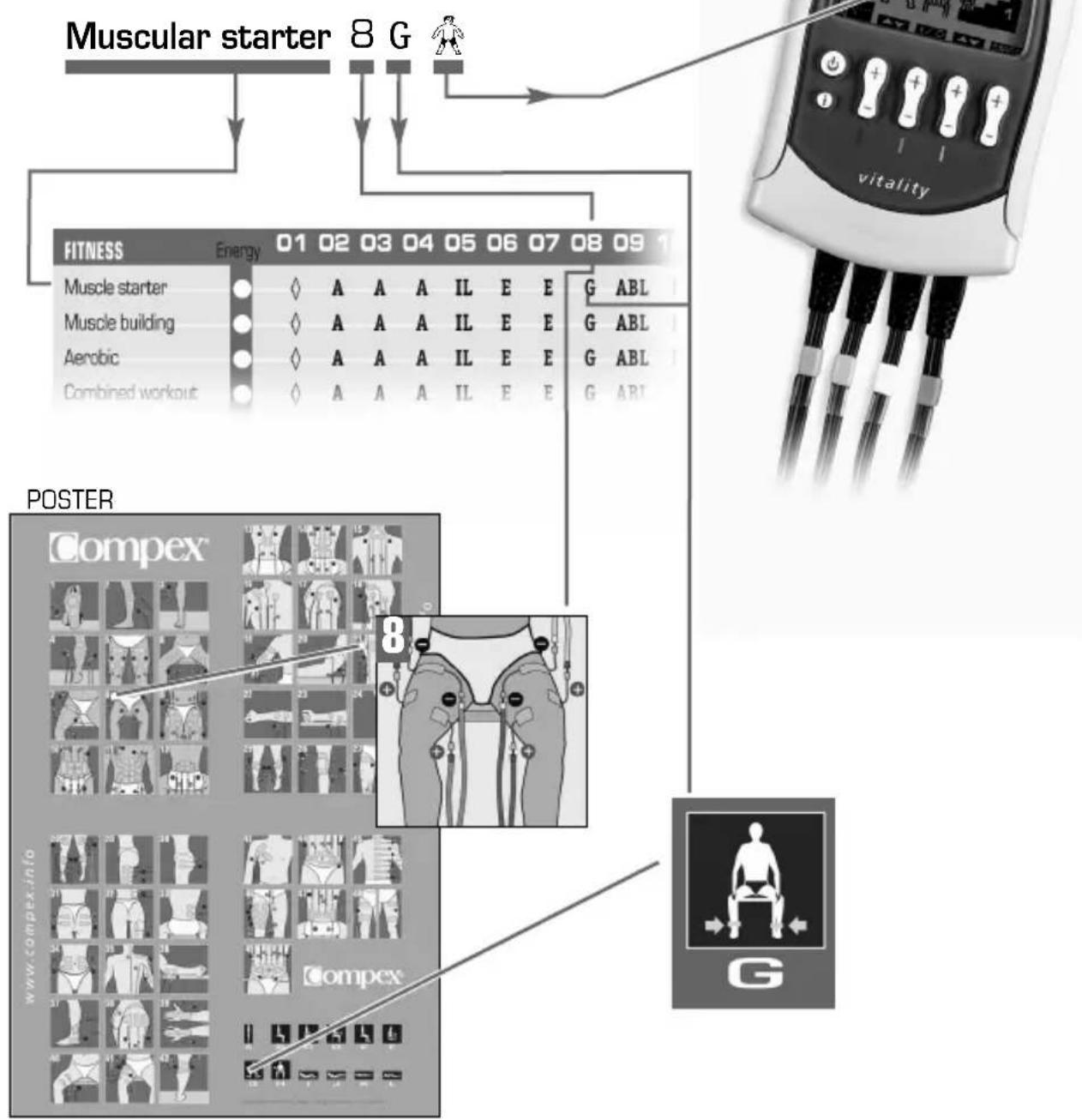
flowchart
graph TD
    A["Muscular starter 8 G"] --> B["FITNESS"]
    B --> C["Energy 01 02 03 04 05 06 07 08 09 1"]
    C --> D["POSTER"]
    D --> E["Compex®"]
    E --> F["www.complex.info"]
    D --> G["8"]
    G --> H["Compex®"]
    H --> I["G"]
    style A fill:#f9f,stroke:#333
    style I fill:#ccf,stroke:#333
Table with placements of electrodes and stimulation positions
| PAIN RELIEF | Energy | 01020304050607080910111213141516171819202122232425 | ||||||||||||||||||||||||||||||||||
| Modulated TENS | Cover the painful area (eg. : 26, 35, 36, 37, 38, 39); Comfortable position | |||||||||||||||||||||||||||||||||||
| Endorphinic | * | Positive electrode on the painful point (eg. : 12, 13, 15); Comfortable position | ||||||||||||||||||||||||||||||||||
| Decontracture | * | Positive electrode on the painful point (eg. : 24) or standard placement (01-23); Comfortable position | ||||||||||||||||||||||||||||||||||
| Cervical pain | * | - - - - - - - - - - - - - - - - - - - - - - - - - - - - - - - - - - - - - - - - - - - - - - - - - - - - - - - - - - - - - - - - - - - - - - - - - - - - - - - - - - - - - - - - - - - - - - - - - - - - - | ||||||||||||||||||||||||||||||||||
| Thoracic pain | * | - - - - - - - - - - - - - - - - - - - - - - - - - - - - - - - - - - - - - - - - - - - - - - - - - - - - - - - - - - - - - - - - - - - - - - - - - - - - - - - - - - - - - - - - - - - - - - - | ||||||||||||||||||||||||||||||||||
| Low back pain | * | - - - - - - - - - - - - - - - - - - - - - - - - - - - - - - - - - - - - - - - - - - - - - - - - - - - - - - - - - - - - - - - - - - - - - - - - - - - - - - - - - - - - - - - - - - - - - - - | ◇ - - - - - - - - - - - - - - - - - - - - - - - - - - - - - - - - - - - - - - - - - - - - - - - - - - - - - - - - - - - - - - - - - - - - - - - - - - - - - - - - - - - - - - - - - - - - - - - - - - - | ◇ - - - | ◇ - - - | ◇ - - - | ◇ - - - | ◇ - - - | ◇ - - - | ◇ - - - | ◇ - - - | ◇ - - - | ◇ - - - | ◇ - - - | ◇ - - - | ◇ - - - | ◇ - - - | ◇ - - - | ◇ - - - | ◇ - - - | ◇ - - - | ◇ - - - | ◇ - - - | - | ||||||||||||
| Lumbosciatica | * | - - - - - - - - - - - - - - - - - - - - - - - - - - - - - - - - - - - - - - - - - - - - - - - - - - - - - - - - - - - - - - - - - - - - - - - - - - - - - - - - - - - - - - - - - - - - - - - - | ◇ - - | - | - | - | - | - | - | - | - | - | - | - | - | - | - | - | - | - | - | - | - | - | ||||||||||||
| Lumbago | * | - | - | - | - | - | - | - | - | - | - | - | - | - | - | - | - | - | - | - | - | - | - | - | - | - | - | - | - | - | - | - | - | - | ||
| Epicondylitis | * | - | - | - | - | - | - | - | - | - | - | - | - | - | - | - | - | - | - | - | - | - | - | - | - | - | - | - | - | - | - | - | - | - | - | |
| Torticollis | * | - | - | - | - | - | - | - | - | - | - | - | - | - | - | - | - | - | ◇ | - | - | - | - | - | - | - | - | - | - | - | - | - | - | - | - | |
| Arthralgia | * | Cover the painful area (eg. : 26, 36, 37); Comfortable position | ||||||||||||||||||||||||||||||||||
| MASSAGE | Energy | 01020304050607080910111213141516171819202122232425 | ||||||||||||||||||||||||||||||||||
| Relaxing massage | * | ◇ | ◇ | ◇ | ◇ | ◇ | ◇ | ◇ | ◇ | ◇ | ◇ | ◇ | ◇ | ◇ | ◇ | ◇ | ◇ | ◇ | ◇ | ◇ | ◇ | ◇ | ◇ | ◇ | ◇ | ◇ | ◇ | ◇ | ◇ | ◇ | ◇ | ◇ | ◇ | ◇ | ◇ | - |
| Reviving massage | * | ◇ | ◇ | ◇ | ◇ | ◇ | ◇ | ◇ | ◇ | ◇ | ◇ | ◇ | ◇ | ◇ | ◇ | ◇ | ◇ | ◇ | ◇ | ◇ | ◇ | ◇ | ◇ | ◇ | ◇ | ◇ | ◇ | ◇ | ◇ | ◇ | ◇ | ◇ | ◇ | ◇ | ◇ | - |
| Toning massage | * | ◇ | ◇ | ◇ | ◇ | ◇ | ◇ | ◇ | ◇ | ◇ | ◇ | ◇ | ◇ | ◇ | ◇ | ◇ | ◇ | ◇ | ◇ | ◇ | ◇ | ◇ | ◇ | ◇ | ◇ | ◇ | ◇ | ◇ | ◇ | ◇ | ◇ | ◇ | ◇ | ◇ | ◇ | - |
| VASCULAR | Energy | 01020304050607080910111213141516171819202122232425 | ||||||||||||||||||||||||||||||||||
| Capillarization | * | ◇ | ◇ | ◇ | ◇ | ◇ | ◇ | ◇ | ◇ | ◇ | ◇ | ◇ | ◇ | ◇ | ◇ | ◇ | ◇ | ◇ | ◇ | ◇ | ◇ | ◇ | ◇ | ◇ | ◇ | ◇ | ◇ | ◇ | ◇ | ◇ | ◇ | ◇ | ◇ | ◇ | ◇ | - |
| Heavy legs | * | - | - | - | - | - | - | - | - | - | - | - | - | - | - | - | - | - | - | - | - | - | - | - | - | - | - | - | - | - | - | - | - | - | - | JL |
| Cramp prevention | * | ◇ | ◇ | ◇ | ◇ | ◇ | ◇ | ◇ | ◇ | ◇ | ◇ | ◇ | ◇ | ◇ | ◇ | ◇ | ◇ | ◇ | ◇ | ◇ | ◇ | ◇ | ◇ | ◇ | ◇ | ◇ | ◇ | ◇ | ◇ | ◇ | ◇ | ◇ | ◇ | ◇ | ◇ | - |
| Lymphatic drainage | * | ◇ | ◇ | ◇ | ◇ | ◇ | ◇ | ◇ | ◇ | ◇ | ◇ | ◇ | ◇ | ◇ | ◇ | ◇ | ◇ | ◇ | ◇ | ◇ | ◇ | ◇ | ◇ | ◇ | ◇ | ◇ | ◇ | ◇ | ◇ | ◇ | ◇ | ◇ | ◇ | ◇ | ◇ | - |
262728293031323334353637383940414243444546474849
| Cover the painful area (eg. : 26, 35, 36, 37, 38, 39); Comfortable position | |||||||||||||||||||
| Positive electrode on the painful point (eg. : 12, 13, 15); Comfortable position | |||||||||||||||||||
| Positive electrode on the painful point (eg. : 24) or standard placement (01-23); Comfortable position | |||||||||||||||||||
| ◇ | |||||||||||||||||||
| ◇ | |||||||||||||||||||
| ◇ | |||||||||||||||||||
| Cover the painful area (eg. : 26, 36, 37); Comfortable position | |||||||||||||||||||
Energy
| * |
| * |
| * |
| * |
| * |
| * |
PAIN RELIEF
| Modulated TENS |
| Endorphinic |
| Decontracture |
| Cervical pain |
| Thoracic pain |
| Low back pain |
| Lumbosciatica |
| Lumbago |
| Epicondylitis |
| Torticollis |
| Arthralgia |
262728293031323334353637383940414243444546474849
| Capillarization |
| Heavy legs |
| Cramp prevention |
| Lymphatic drainage |
Table with placements of electrodes and stimulation positions
| REHABILITATION | Energy | 01020304050607080910111213141516171819202122232425 | ||||||||||||||||||||||||
| Disuse atrophy | ◇ | A | A | A | IL | E | E | G | ABL | I | I | B | B | B | B | B | H | C | D | D | D | F | F | - | - | |
| Muscle growth | ◇ | A | A | A | IL | E | E | G | ABL | I | I | B | B | B | B | B | H | C | D | D | D | F | F | - | - | |
| Reinforcement | ◇ | A | A | A | IL | R | R | G | ABL | I | I | B | B | B | B | B | H | C | D | D | D | F | F | - | - | |
AESTHETIC Energy 01020304050607080910111213141516171819202122232425
| Abs | - | - | - | - | - | - | - | - | - | - | - | - | - | - | - | - | - | - | - | - | - | - | - | - | - | |
| Buttocks | - | - | - | - | - | - | - | - | ABL | - | - | - | - | - | - | - | - | - | - | - | - | - | - | - | - | |
| Toning | ◇ | A | A | A | IL | E | E | G | ABL | I | I | B | B | B | B | B | H | C | D | D | D | F | F | - | - | |
| Firming | ◇ | A | A | A | IL | E | E | G | ABL | I | I | B | B | B | B | B | H | C | D | D | D | F | F | - | - | |
| Shaping | ◇ | A | A | A | IL | E | E | G | ABL | I | I | B | B | B | B | B | H | C | D | D | D | F | F | - | - | |
| Elasticity | * | ◇ | ◇ | ◇ | ◇ | ◇ | ◇ | ◇ | ◇ | ◇ | ◇ | ◇ | ◇ | ◇ | ◇ | ◇ | ◇ | ◇ | ◇ | ◇ | ◇ | ◇ | ◇ | ◇ | - | - |
| Calorilysis | - | - | - | - | - | - | - | G | ABL | I | - | - | - | - | - | - | - | - | - | - | - | - | - | - | - | |
| Adipostress | - | - | - | - | - | ◇ | - | - | - | - | - | - | - | - | - | - | - | - | ◇ | ◇ | ◇ | - | - | - | - |
FITNESS Energy 01020304050607080910111213141516171819202122232425
| Muscle starter | ◇ | A | A | A | IL | E | E | G | ABL | I | I | B | B | B | B | B | H | C | D | D | D | F | F | - | - | |
| Muscle building | ◇ | A | A | A | IL | E | E | G | ABL | I | I | B | B | B | B | B | H | C | D | D | D | F | F | - | - | |
| Aerobic | ◇ | A | A | A | IL | E | E | G | ABL | I | I | B | B | B | B | B | H | C | D | D | D | F | F | - | - | |
| Comibned workout | ◇ | A | A | A | IL | E | E | G | ABL | I | I | B | B | B | B | B | H | C | D | D | D | F | F | - | - |
| REHABILITATION | Energy | 262728293031323334353637383940414243444546474849 | |||||||||||||||||||||||||||||||||||||||||||||||||||||||||||||||||||||||||||||||||||||||||||||||||||||
| Disuse atrophy | - | - | - | - | - | - | - | - | - | - | - | - | - | - | - | - | - | - | - | - | - | - | - | - | - | - | - | - | - | - | - | - | - | - | - | - | - | - | - | - | - | - | - | - | - | - | - | - | - | - | C | I | - | - | - | - | - | - | - | - | - | - | - | - | - | - | - | - | - | - | - | - | - | - | - | - | - | - | - | - | - | - | - | - | - | - | - | - | - | - | - | - | - | - | - | - | - | - | - | - | - | (1) | |
| Muscle growth | - | - | - | - | - | - | - | - | - | - | - | - | - | - | - | - | - | - | - | - | - | - | - | - | - | - | - | - | - | - | - | - | - | - | - | - | - | - | - | - | - | - | - | - | - | - | - | - | - 1 | - | - | - | - | - | - | - | - | - | - | - | - | - | - | - | - | - | - | - | - | - | - | - | - | - | - | - | - | - | - | - | - | - | - | - | - | - | - | - | - | - | - | - | - | - | - | - | - | - | |||||
| Reinforcement | - | - | - | - | - | - | - | - | - | - | - | - | - | - | - | - | - | - | - | - | - | - | - | - | - | - | - | - | - | - | - | - | - | - | - | - | - | - | - | - | - | - | - | - | - | - | - | - | - C | I | - | - | - | - | - | - | - | - | - | - | - | - | - | - | - | - | - | - | - | - | - | - | - | - | - | - | - | - | - | - | - | - | - | - | - | - | - | - | - | - | - | - | - | - | - | - | - | - | (11) | ||||
| AESTHETIC | Energy | 262728293031323334353637383940414243444546474849 | |||||||||||||||||||||||||
| Abs | - | - | - | - | - | - | - | - | - | - | - | - | - | - | - | - | - | - | - | - | - | - | - | - | - | I | |
| Buttocks | - | - | - | - | - | - | - | - | - | - | - | - | - | - | - | - | - | - | - | - | - | - | - | - | - | - | |
| Toning | - | - | - | - | - | L | - | - | I | - | - | - | - | - | - | - | - | - | C | I | - | - | - | - | - | - | |
| Firming | - | - | - | - | - | L | - | - | I | - | - | - | - | - | - | - | - | - | C | I | - | - | - | - | - | - | |
| Shaping | - | - | - | - | - | L | - | - | I | - | - | - | - | - | - | - | - | - | C | I | - | - | - | - | - | - | |
| Elasticity | * | - | - | - | - | - | ◇ | - | - | ◇ | - | - | - | - | - | - | - | - | - | ◇ | ◇ | - | - | - | - | - | - |
| Calorilysis | - | - | - | - | - | L | - | - | I | - | - | - | - | - | - | - | - | - | - | I | - | - | - | - | - | - | |
| Adipostress | - | - | ◇ | ◇ | ◇ | ◇ | - | - | ◇ | - | - | - | - | - | - | - | - | - | - | - | - | - | - | - | - | - | |
| FITNESS | Energy | 262728293031323334353637383940414243444546474849 | ||||||||||||||||||||||||||
| Muscle starter | - | - | - | - | - | - | - | - | - | - | - | - | - | - | - | - | - | C | I | - | - | - | - | - | - | - | - | |
| Muscle building | - | - | - | - | - | - | - | - | - | - | - | - | - | - | - | - | - | C | I | - | - | - | - | - | - | - | - | |
| Aerobic | - | - | - | - | - | - | - | - | - | - | - | - | - | - | - | - | - | C | I | - | - | - | - | - | - | - | - | |
| Comibned workout | - | - | - | - | - | - | - | - | - | - | - | - | - | - | - | - | - | C | I | - | - | - | - | - | - | - | - | |
Letters in the table refer to
pictograms for the body positions in
the poster
◇ = Comfortable position - = Non applicable
= Maximum tolerable energy = Pronounced twitches = Tickling sensation

SOMMARIO
I. AVVERTENZE 55
Type TR1509-06-E-133A03
Input 90-264 VAC / 47-63Hz / 0.5A max.
Output 9V / 1.4A / 15W
USA
Type TR503-02-E-133A03
Input 90-264 VAC / 47-63Hz / 0.5A max.
Output 9V / 400mA / 6W
Type TR1509-06-E-133A03
Input 90-264 VAC / 47-63Hz / 0.5A max.
Output 9V / 1.4A / 15W
UK
Type TR503-02-E-133A03
Input 90-264 VAC / 47-63Hz / 0.5A max.
Output 9V / 400mA / 6W
Type TR1509-06-E-133A03
Input 90-264 VAC / 47-63Hz / 0.5A max.
Output 9V / 1.4A / 15W
Neurostimulation
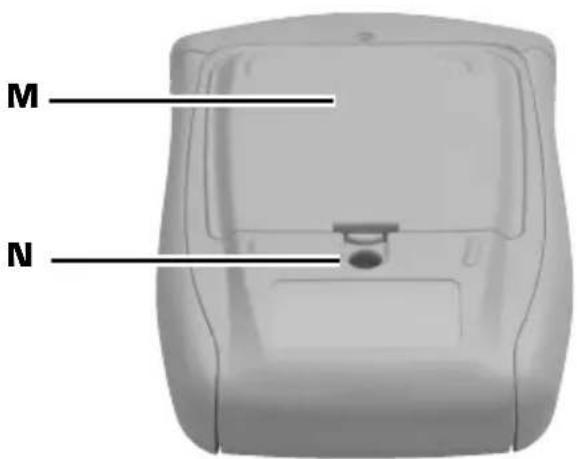
3. Garantie
Siehe Beilage.
4. Wartung
Type TR1509-06-E-133A03
Input 90-264 VAC / 47-63Hz / 0.5A max.
Output 9V / 1.4A / 15W
USA
Type TR503-02-E-133A03
Input 90-264 VAC / 47-63Hz / 0.5A max.
Output 9V / 400mA / 6W
Type TR1509-06-E-133A03
Input 90-264 VAC / 47-63Hz / 0.5A max.
Output 9V / 1.4A / 15W
UK
Type TR503-02-E-133A03
Input 90-264 VAC / 47-63Hz / 0.5A max.
Output 9V / 400mA / 6W
Type TR1509-06-E-133A03
Input 90-264 VAC / 47-63Hz / 0.5A max.
Output 9V / 1.4A / 15W
Neurostimulation
Fr: 1 x Muskeltraining 17H
Sa: Ruhe
So: 1 x Muskeltraining 18C
Type TR1509-06-E-133A03
Input 90-264 VAC / 47-63Hz / 0.5A max.
Output 9V / 1.4A / 15W
USA
Type TR503-02-E-133A03
Input 90-264 VAC / 47-63Hz / 0.5A max.
Output 9V / 400mA / 6W
Type TR1509-06-E-133A03
Input 90-264 VAC / 47-63Hz / 0.5A max.
Output 9V / 1.4A / 15W
UK
Type TR503-02-E-133A03
Input 90-264 VAC / 47-63Hz / 0.5A max.
Output 9V / 400mA / 6W
Type TR1509-06-E-133A03
Input 90-264 VAC / 47-63Hz / 0.5A max.
Output 9V / 1.4A / 15W
Neurostimulatie
Amyotrophie 14B of C
Programma: Amyotrophie 14B of C
Weken 1-3: 4 x Tonus 21D /week
Weken 4-8: 4 x Versteviging 21D /week
Weken 9-13: 4 x Vorming 21D /week
Vooruitgang in de niveaus
Weken 1-3: 3 x Tonus 8G

Weken 4-8: 3 x Versteviging 8G en 3 x Adipostress 8G /week
Weken 9-13: 3 x Vorming 8G 🎨 en 3 x Adipostress 8G 🎨/week
Vooruitgang in de niveaus
Weken 1-3: 3 x Tonus 19D, 20D of 21D
Weken 4-8: 3 x Versteviging 19D, 20D of 21D en 3 x Elasticiteit 19◇, 20◇ of 21◇/week
Weeks 9-13: 3 x Vorming 19D, 20D of 21D en 3 x Elasticiteit 19◇, 20◇ of 21◇/week
Vooruitgang in de niveaus
Programma: Mix training 18C
Fitness
Ma: 1 x Mix training 21D
Di: Normale training in de fitnesszaal
Wo: 1 x Mix training 21D
Do: Normale training in de fitnesszaal
Vr: 1 x Mix training 21D
Programma: Mix training
21D
VII. TABEL VOOR DE PLAATSING VAN DE ELEKTRODEN EN DE STIMULATIEPOSITIES
Type TR1509-06-E-133A03
Input 90-264 VAC / 47-63Hz / 0.5A max.
Output 9V / 1.4A / 15W
SA Type TR503-02-E-133A03
Input 90-264 VAC / 47-63Hz / 0.5A max.
Output 9V / 400mA / 6W
Type TR1509-06-E-133A03
Input 90-264 VAC / 47-63Hz / 0.5A max.
Output 9V / 1.4A / 15W
Type TR503-02-E-133A03
Input 90-264 VAC / 47-63Hz / 0.5A max.
Output 9V / 400mA / 6W
Type TR1509-06-E-133A03
Input 90-264 VAC / 47-63Hz / 0.5A max.
Output 9V / 1.4A / 15W
Neuroestimulación
flowchart
graph TD
    A["Speed icon: 27"] --> B["Person walking"]
    C["Temperature icon: 1"] --> D["Stresser with steam rising"]
    E["Safety icon: START"] --> F["Stresser with person on stairs"]
    G["Device icon: battery with left arrow"] --> H["Control panel with directional indicators"]
natural_image
Hand holding a pen, poised to write on lined paper (no text or symbols visible)
natural_image
Hand holding a pen, writing on lined paper (no text or symbols visible)
natural_image
Hand holding a pen, poised to write on lined paper (no text or symbols visible)