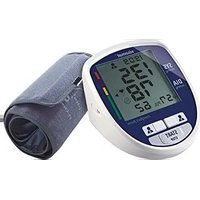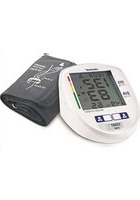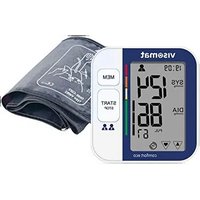
Visomat comfort eco - Blood pressure monitor UEBE - Free user manual and instructions
Find the device manual for free Visomat comfort eco UEBE in PDF.


User questions about Visomat comfort eco UEBE
0 question about this device. Answer the ones you know or ask your own.
Ask a new question about this device
Download the instructions for your Blood pressure monitor in PDF format for free! Find your manual Visomat comfort eco - UEBE and take your electronic device back in hand. On this page are published all the documents necessary for the use of your device. Visomat comfort eco by UEBE.
USER MANUAL Visomat comfort eco UEBE
Instructions for Use
Mode d'emploi
text_image
M 888 888 888 7 No. 88/88- Important instructions for patients 37
- Important technical details 39
C Operating the unit
- Unit description 41
- Displays 42
- Important instructions for use 43
- Initial operation of the unit 44
- Inserting/replacing batteries 44
- Activating and setting the date/time 45
- Attaching the cuff 46
- Body posture when taking measurements 47
- Measuring blood pressure 48
- WHO traffic light function 50
- Pulse pressure 50
- Irregular pulses and cardiac arrhythmia 51
- Using the memory 52
D What you should know about blood pressure
- Systolic and diastolic blood pressure values 54
- Why you measure different values 54
- Why you should measure blood pressure regularly 54
E Technical information
- Failure and error messages 55
- Customer service 57
- Technical data 58
- Original spare parts and accessories 59
- Technical inspection / calibration check 60
- Explanation of symbols 60
- Disposal 61
EN-34 EN-35
Table of contentsTable of contents
F Maintaining the unit 62
G Warranty 63
A
Intended use
Thank you for choosing the visomat® comfort eco upper arm blood pressure monitor (also referred to in the following as the unit).
The device is intended for the non-invasive measurement of systolic and diastolic blood pressure, the pulse, and to calculate pulse pressure in adults as part of home healthcare.
The device uses the oscillometric method of blood pressure and pulse measurement. The cuff is connected to the device and wrapped around the arm. A sensor measures the small pressure oscillations generated by the expansion and contraction of the arteries with each heartbeat. The amplitude of the pressure waves is measured, converted into millimetres of mercury (mmHg) and displayed as a digital value.
These instructions are intended to help you use the unit reliably and effectively. Keep the instructions together with the unit at all times. Please read all instructions carefully before using the device. Take special note of the "Important instructions for use" section on page 43.
The unit must be used in accordance with the methods detailed in these instructions and may not be used for other purposes.
EN-36
Safety instructions
B
1. Important instructions for patients
- Blood pressure measurements on children require specialist knowledge! Please consult your doctor if you wish to measure the blood pressure of a child. Do not under any circumstances use the unit on a baby/infant.
- During pregnancy and in case of pre-eclampsia, the device must be used only after consulting a doctor.
- The cuff has been specially developed for this unit and must not be used with other units.
- The measurement results of automatically measuring blood pressure monitors may be falsified by pregnancy, irregular heartbeat or arteriosclerosis. Measure your own blood pressure in consultation with your doctor.
- The cuff must never be wrapped around a critical point on the arm, such as a wound or aneurysm, etc., or around an arm with an arteriovenous shunt. Risk of injuries! The supply via an intravascular access (infusion) or other medical monitoring devices might be interrupted.
- Do not use the unit without first consulting your doctor if you are undergoing dialysis treatment or taking anticoagulants, platelet aggregation inhibitors or steroids. Internal bleeding may be caused under these conditions.
- If you have had a mastectomy, do not measure blood pressure on the side of the body where the breast has been removed together with the lymph nodes from the armpit.
EN-37
B
- Make sure the air hose is not kinked. A kinked air hose can prevent the cuff from deflating and thereby interrupt the blood flow in the arm for too long.
• In rare cases the cuff can cause bruises on the skin. - Wait a few minutes between successive measurements, otherwise the blood flow in the arm will be interrupted for too long, which could result in injury.
- The unit contains small parts which could be swallowed by children. It should therefore be kept out of the reach of children at all times. The airhose poses a risk of strangulation. Please follow instructions regarding the handling of cuff to avoid such risk.
- Discuss the readings with your doctor. Do not assess them on your own.
- Measuring your own blood pressure does not constitute treatment. On no account modify of your own accord the dosage of drugs/medication prescribed by your doctor.
- Please refer to the chapter "Important instructions for use" (Page 43) before conducting any measurements yourself.
EN-38 EN-39
Safety instructions Safety instructions
B
2. Important technical details
- A consistently good power supply to the unit is essential for trouble-free blood pressure measurements.
- Please use long-life alkaline batteries only (LR6).
- When replacing batteries, always replace all the batteries at the same time.
- You will need 4 x 1.5 V AA/LR6 batteries. Rechargeable batteries have a voltage of only 1.2 V and are thus not suitable.
- When using the unit with a mains adapter, please use only the type A2 mains adapter specially tested for medical devices.
- Make sure when operating the unit with the mains adapter that the unit can be disconnected from the mains power supply at all times.
- If the unit is not used for an extended period of time, please remove the batteries. Essentially, all batteries can leak.
- The unit must only be operated with original parts. The warranty will be invalidated if the unit is damaged by non-approved accessories!
- Using the unit in the immediate vicinity of mobile phones, microwave appliances or other devices with strong electromagnetic fields may result in impaired functioning. Maintain a minimum distance of 3 m from such devices when using this unit.
- The display of the pulse frequency is not suitable for checking the frequency of cardiac pacemakers. Cardiac pacemakers and blood pressure monitors do not influence each other regarding their mode of operation.
- The device is not suitable for use with electrosurgical units.
B
Safety instructions
- Do not use the device in explosive environments such as in the vicinity of flammable anaesthetics or in an oxygen chamber.
- Never open or modify the unit or the cuff - this is a medical device and may only be opened by authorised specialists. (Exception: replacing batteries). If the unit has been opened, it must be subjected to a metrological inspection by an authorised institution.
• The cuff may be inflated on the arm only.
• To avoid inaccurate readings, please follow the intended operating conditions for measurement. See Technical data, Page 58 - The inflating and measuring procedure can be stopped by pressing the Start/Stop button. In this case, the unit stops the inflation procedure and deflates the cuff.
EN-40
Operating the unit
C
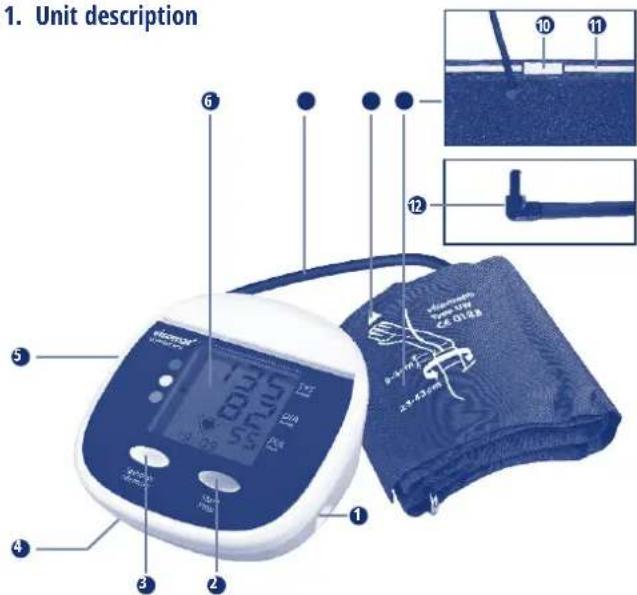
- Unit description
text_image
1. Unit description 6 5 4 3 2 1 10 11 12 Hormone Blood pressure C.E. 0718.8 2× 0.03 mm1 Connecting socket for mains adapter
2 Start/Stop button
3 Memory button (memory recall button)
④ Battery compartment
5 Cuff socket
6 Displays
7 Air hose
⑧ Measurement arrow for arm circumference
9 Cuff
10 Artery marking
⑪ Marking for arm circumference
12 Air connector
EN-41
C
2. Displays
text_image
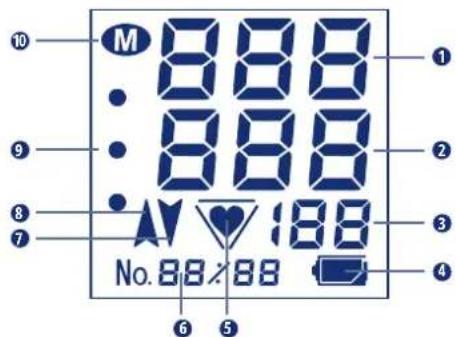
M 888 888 888 No. 88/88 1 2 3 4 5 6① SYS = Systole (upper blood pressure value)
② DIA = Diastole (lower blood pressure value)
3 PUL 1/min = Pulse calculated pulse frequency per minute
④ Battery check display
⑤ Pulse signal display or irregular pulses (Page 51)
⑥ Memory location or date/time
⑦ Deflating cuff
⑧ Inflating cuff
⑨ WHO classification (Page 50)
10 Memory code
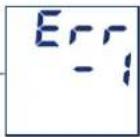
Failure and error messages (Page 55)
EN-42 EN-43
Operating the unitOperating the unit
C
3. Important instructions for use
- The measurement results of automatic blood pressure meters can be affected by where the measurement is taken, your posture, recent physical activity and your physical condition. Observe the usage instructions to ensure correct readings.
- Refrain from drinking alcoholic or caffeinated beverages and smoking at least one hour before measuring.
- Please rest at least 5 minutes before measuring. Depending on the previous degree of stress/exertion, this can even require up to one hour.
- Expose the upper arm. Clothing must not impair the blood flow in or from the arm, as this influences the blood pressure at the measurement point.
- It is absolutely essential to sit still and remain quiet. Irregular movements, vibrations (shaking), talking and breathing heavily will affect and may even falsify the measurement. Look out for irregular pulse signals in the display; if necessary, repeat the measurement under more favourable conditions.
- Blood pressure is not a fixed value. It may fluctuate upwards or downwards by more than 20 mmHg on patients within a few minutes.
- In order to rule out differences between left and right and to obtain comparable measurement results, it is important always to take blood pressure measurements on the same arm. Ask your doctor which arm he/she recommends you take your measurements on.
C
4. Initial operation of the unit
Insert the supplied batteries into the unit.
If the unit is to be operated from the mains power supply, the cable plug of the mains adapter (not included in the scope of delivery) must be inserted into the connection socket of the unit. The batteries are switched off automatically.
Please use only the visomat ^® type A2 mains adapter. See original spare parts and accessories, Page 59.
5. Inserting/replacing batteries
- Opening the battery compartment Open the cover of the battery compartment on the underside of the unit.
- Inserting batteries Remove the old batteries from the unit and insert the new ones. Please observe proper polarity (marking in battery compartment).
- Closing the battery compartment Close the battery compartment by clipping the battery cover back into the unit.
When the display shows the "Flat battery 🔔" symbol for the first time, the unit will still have enough charge for about 30 measurements. Please change the batteries during this period.

EN-44 EN-45
Operating the unitOperating the unit
C
6. Activating and setting the date/time
The unit has a date/time function which you can activate where necessary. This function is deactivated when the unit is delivered.
Activating the date/time function
To activate the date/time function, press the Start/Stop button and then immediately, while the full display is visible, the Memory button. This function can be deactivated at any time in the same way.
Setting the date/time
The four-digit number representing the year appears in the display first (Fig. 1). Press the Memory button to set the year. Press the Start/Stop button to confirm the selected year and proceed to setting the date.
Set the month with the Memory button and confirm this with the Start/Stop button. Set the day, hours and minutes in the same way (Fig. 2, Fig. 3).
Changing the date/time
To change the date/time function, take out a battery and wait until the display goes blank. Now you can reactivate the date/time function and reset the date and time again.
Deactivating the date/time function
To deactivate the date/time function, press the Start/Stop button and then immediately the Memory button.
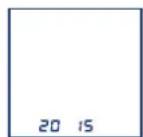
Fig. 1
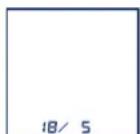
Fig. 2
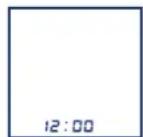
Fig. 3
C
When the date/time function is activated, the time is also shown in the display when the unit is switched off.
7. Attaching the cuff
Before putting on the cuff, please check whether your arm circumference is within the range specified on the cuff. An incorrect cuff size can lead to inaccurate readings.
- Expose the upper arm.
- Push the cuff onto the arm (Fig. 1) until the lower edge of the cuff is 2-3 cm above the crook of the arm (Fig. 2).
- When using the unit on the left arm, the air hose runs to the unit through the middle of the arm so that the 4 cm long artery marking is automatically located centrally above the pulse position (Fig. 3).
arm, the cuff must be rotated to the left until the artery marking is on the pulse position. The air hose then runs along the inside of the upper arm (Fig. 4).
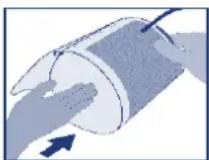
Fig. 1
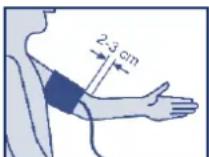
Fig. 2• When using the unit on the right
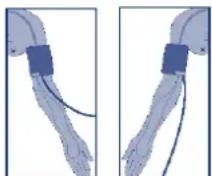
Fig. 3 Fig. 4
Operating the unitOperating the unit
- The cuff should be tightened to such an extent that 2 fingers can still be inserted between arm and cuff. Tip: - Bend your arm slightly.
- The upper arm muscle is tensioned slightly.
-
This slightly increases the circumference of the arm.
-
Now pull the free cuff end tight and close the Velcro fastener (Fig. 5)
- Check if the measurement arrow on the cuff is inside the "marking for arm circumference" at the edge of the cuff.
- Lay your extended and relaxed arm with the cuff on the dining table and do not move it during the measurement; do not talk. The palm should be facing upwards.
- Connect the cuff connector to the cuff socket on the left-hand side of the unit. Make sure the connector is fully inserted into the unit.
8. Body posture when taking measurements
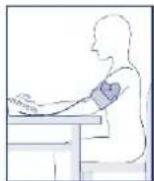
Whenever possible, measurements should be taken while sitting. In exceptional cases it is also permitted to take measurements while lying down. Body posture must be relaxed.
Measurement while sitting
- For this purpose, sit at a table (if possible the height of a dining table, not a coffee table!).
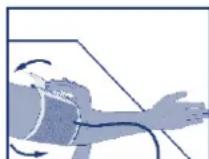
Fig. 5
C
- Rest your back against the backrest of the chair.
- Rest your forearm completely flat, with the palm of your hand facing upwards.
- Place your feet on the floor and do not cross your legs.
Measurement while lying down
- Lie on your back. Look up at the ceiling during the measurement. Remain calm and do not move.
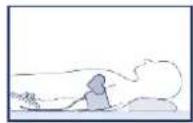
- Make sure that the measuring point on the upper arm is approximately at the level of your heart. A measuring point lower than the heart may result in a higher reading. A measuring point higher than the heart may result in a lower reading.
9. Measuring blood pressure
- Switch on the unit by pressing the Start/Stop button. The following display is visible (Fig. 1):
• After the unit has completed its calibration against the ambient air pressure (Fig. 2), the cuff is automatically inflated to approx. 180 mmHg (Fig. 3). If that cuff pressure is not sufficient for measuring the blood
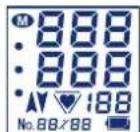
Fig. 1
EN-48 EN-49
Operating the unitOperating the unit
C
pressure level, the device automatically increases the cuff pressure in steps of 30 mmHg until a sufficient cuff pressure has been reached.
- For an inflation pressure exceeding 180 mmHg the inflation process can also be controlled manually: Press the Start/Stop button once again after the inflation has started and release it when the cuff pressure has reached 40 mmHg above the expected maximum systolic blood pressure. The inflation stops with releasing the button.
• The actual measurement takes place with the start of deflation (Fig. 4). The symbol in the display flashes until the pulse frequency is displayed. - A long beep signals the end of measurement, and the cuff automatically deflates. The determined values of systole, diastole and pulse and the pulse pressure (PP) are shown alternately in the display. (Fig. 5, Fig. 6)
- The unit switches off automatically after about 3 minutes.
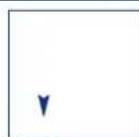
Fig. 2
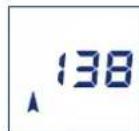
Fig. 3
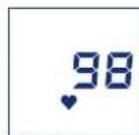
Fig. 4
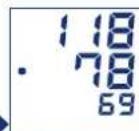
Fig. 5
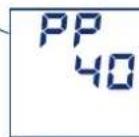
Fig. 6
C
10. WHO traffic light function
The unit categorises the blood pressure readings according to the guidelines of the World Health Organisation (WHO). You can use the coloured fields to read the categorisation of each reading:
- Upper dot (Red) signifies high pressure*
- Middle dot (Yellow) signifies borderline value*
- Lower dot (Green) signifies normal value
| WHO 2003 Systolic pressure= Upper valuemmHg** | Diastolic pressure= Lower valuemmHg** | |
| Red | from 140* from 90* | |
| Yellow | 120 to 139 80 to 89 | |
| Green | below 120 below 80 | |
* It is sufficient for one of the values to be raised.
** millimetres of mercury
The categorisation according to WHO is stored with the readings and can be called up again together with the readings from the memory.
11. Pulse pressure
The pulse pressure - not to be confused with the pulse rate - can provide information on the elasticity of the blood vessels. A rigid vascular system can have a negative effect on the cardiovascular system. Studies show that the cardiovascular risk increases if the pulse pressure value is consistently greater than 65mmHg .
EN-50 EN-51
Operating the unitOperating the unit
C
The heart works in two phases, the contraction phase (systole) and the relaxation phase (diastole). The difference in pressure between systole and diastole is referred to as the pulse pressure or pulse amplitude. The higher the pulse pressure, the more rigid the vessels can be.
| High pulse pressure | above 65 mmHg |
| Increased pulse pressure | 55 to 65 mmHg |
| Normal pulse pressure | below 55 mmHg |
If your pulse pressure is permanently above 55 mmHg, consult your doctor.
12. Irregular pulses and cardiac arrhythmia
If the "symbol for irregular pulses waves flashes after a measurement, the unit has recorded irregular pulses during the measurement. This can be set off by an irregular heartbeat (arrhythmia), disturbance caused by movement, talking or even breathing in deeply. The symbol is stored with the respective measurement.
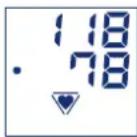
If the symbol appears more frequently, this must be discussed with your doctor! Measurement with irregular pulse waves should therefore be viewed as critical and repeated under more favourable conditions.
C
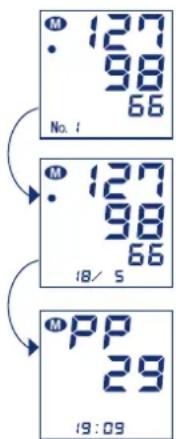
13. Using the memory
Measured results are automatically stored in the memory. The memory can store up to 60 results and the average value. When more than 60 measured values have been stored, the oldest value (No. 60) is deleted to allow the latest value (No. 1) to be recorded.
Recalling data
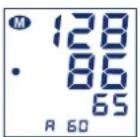
Press the Memory button to call up data. The average value of the stored results is displayed with "A", the values for systole, diastole and pulse and the pulse pressure (PP) are shown alternately in the display.
When the Memory button is pressed again, the value measured last (No. 1) appears.
When the date/time function is activated, systole, diastole and pulse are displayed alternately with memory number and date, followed by the pulse pressure (PP) and the time.
Press the Memory button repeatedly to call up further measured values.
The stored data remain visible in the display for around 30 seconds. The unit then switches itself off.
text_image
M: 127 98 66 No. 1 M: 127 98 66 18 / 5 M: PP 29 19 : 09EN-52 EN-53
Operating the unitOperating the unit
C
Deleting data
To delete individual values, press the Memory button several times to obtain the measured value required. Then press the Memory button again and hold it down for 8-10 seconds until the value first flashes and then disappears.
To delete the entire memory, recall the relevant average value display (A) and press the Memory button again, holding it down until the mean value first flashes and then disappears.
D What you should know about blood pressure
1. Systolic and diastolic blood pressure values
The cardiovascular system has the important function of supplying all organs and tissues in the body with sufficient amounts of blood and of transporting metabolites. To do so, the heart contracts and expands at a regular rate of about 60 to 80 times per minute. The pressure of the flowing blood on the artery walls caused by the heart contracting is termed systolic. The pressure in the ensuing relaxation phase, when the heart refills with blood, is termed diastolic. During daily measurement you determine both values.
2. Why you measure different values
Our blood pressure responds to internal and external influences like a sensitive measuring instrument. It can be affected by even slight changes. This explains why values measured by a doctor or pharmacist are higher than those measured at home in the environment you are used to. Changes in the weather, climate changes, or physical or psychological stress can have effects as well.
3. Why you should measure blood pressure regularly
Even the time of day has an influence on your blood pressure. During the day the values are generally higher than during the periods of rest at night. One-off and irregular measurements therefore say little about your actual blood pressure. A reliable assessment is possible only when measurements are taken regularly. Discuss the measurement values with your doctor.
EN-54
Technical information
E
- Failure and error messages
| Failure encountered | Possible cause Corrective | action |
| Display Err - 300 | Excessive cuff pressure.Cuff inflated to maximum due to movement of the arm or body.The hose may be kinked or the air connector blocked. | - Repeat measurement- Do not move arm- Do not talkCheck that hose with air connector is clear (unobstructed) |
| Display Err - 1 | Measurement error, measurement could not be performed due to movement or speech. | - Repeat measurement- Do not move arm- Do not talk |
| Display Err - 2 | Inflation error, pressure built up too quickly or too slowly. | Check that air connector is correctly fitted, repeat measurement.* |
| Fault was recognised. Cuff is not correctly fitted. | - Repeat measurement- Do not move arm- Do not talk* | |
| Display Err - 3 | Deflation rate too high or too low. | Keep still during measurement.* |
| Display 00 | Start/Stop button accidentally pressed while battery was being changed. | Switch unit off and then on again with Start/Stop button; if necessary. |
*Call the Service Hotline if this fault occurs repeatedly.
EN-55
E
| Failure encountered | Possible cause Corrective action | |
| Irregular heartbeat, disruptive movements, shaking, wobbling (objects), breathing in deeply, etc. | Repeat measurement after 3-5 minutes rest. Possible factors (depending on the severity of the arrhythmia) affecting the measurement results must be discussed with your doctor. | |
| Measured values / pulse values are extremely high or low | Too little rest before the measurement. Movement or talking during measurement. | Repeat measurement after a break of approx. 3-5 mins. Observe instructions for use Page 43. |
| Incorrect measurement position. | Repeat measurement, ensuring correct body posture. (Page 43) | |
| Consecutive measurements produce different measured values (readings). | Blood pressure is not a fixed quantity. It may vary in the upward or downward direction within a few minutes by more than 20 mmHg. | Always take the measurements in the same conditions in order to obtain comparable results. |
| Measurement was interrupted and cuff first deflated and then inflated | Unit detects a fault or that diastolic value is too low. | Unit shows no fault. Repeat measurement. |
| Movement during measurement | If necessary, interrupt measurement, measure again after a break of 5 minutes. | |
EN-56 EN-57
Technical information Technical information
E
| Failure encountered | Possible cause Corrective action | |
| No display after unit is switched on | Batteries inserted incorrectly. | Check position of batteries. |
| Batteries flat. Change batteries. | ||
| Battery contacts dirty. | Clean battery contacts. | |
| No display after Memory button is pressed | No measured values stored. | Take a new measurement. |
| Batteries flat Change batteries. | ||
| Measurement interrupted | Batteries flat Change batteries. | |
| Date/time not shown in display | - Function accidentally deactivated- Function was not reactivated after battery replacement | Activate date and time as described on page 45. |
2. Customer service
The unit may only be repaired by the manufacturer or by an expressly authorised organisation. Please contact:
UEBE Medical GmbH
Phone: +49 (0) 9342/924040
Service Center
Fax: +49 (0) 9342/924080
Zum Ottersberg 9
E-mail: info@uebe.com
97877 Wertheim, Germany
Internet: www.uebe.com
E
- Technical data
| Unit type: Digital | automatic unit with electric pump for measuring blood pressure on upper arm |
| Dimensions: L = 1 | 22,2 mm x W = 116,5 mm x H = 69,9 mm |
| Weight: approx. | 214 g not including batteries |
| Display: LCD display (liquid crystal display) for measured values and check displays | |
| Memory: 60 measured values (stored automatically) and average value (A) | |
| Measurement procedure: | Oscillometric determination of systole, diastole and pulse |
| Reference procedure of clinical testing: | Auscultatory measurement |
| Inflating pressure: | Initially up to approx. 180 mmHg, then in stages of 30 mmHg |
| Pressure display range: | 3-300 mmHg |
| Measurement range | Systolic: 50-250 mmHgDiastolic: 40-150 mmHgPulse: 40-160 pulses/min |
| Error limits: Blood pressure measurement: corresponds to EN 1060 Part 3Pressure measurement: ±3 mmHgPulse measurement: ±5 % | |
| Serial number: The unit bears a serial number which provides clear identification. | |
| Power consumption: | Maximum 4 W |
| Power supply: Battery type: 4 x 1.5 V AA alkali manganese (LR 6) or lithium (FR 6) round cells | |
| Cuff: Cuff UW (for arm circumference 23-43 cm) | |
EN-58 EN-59
Technical information Technical information
E
| Operating conditions: | Ambient temperature 10 to 40 °C, rel. air humidity 15 to 85 % not condensing, air pressure 700 to 1060 hPa |
| Storage and transport conditions: | Ambient temperature -5 to 50 °C, rel. air humidity up to 85 % not condensing, |
| Inflation and deflation: | Automatically controlled |
| Automatic switch-off | approx. 3 minutes after end of measurement |
| IP code: IP 20: Protected against solid foreign particles with a diameter of more than 12.5 mm, no protection against water. | |
| Expected service life: | 5 years |
| Classification: Internal power supply by battery | |
4. Original spare parts and accessories
The following original spare parts and accessories are available from specialist dealers:
Cuff 23-43 cm type UW
Mains adapter type A2
Part. no. 2401601,
Part. no. 2400020,
PZN 10541010
PZN 11870684
Subject to technical modifications.
E
5. Technical inspection / calibration check
Basically, a metrological inspection is recommended at intervals of 2 years. However, professional users in Germany are obligated to comply with the aforementioned according to "Regulation for Operators of Medical Devices".
This can be implemented either by UEBE Medical GmbH, an authority responsible for metrology, or authorised maintenance services. For this, please observe your national provisions.
Upon request, responsible authorities or authorised maintenance services receive a "Test instruction for metrological inspection" from the manufacturer.
Important: No modifications, e.g. opening the unit (except to replace the batteries) may be made to this unit without the manufacturer's prior permission.
6. Explanation of symbols
CE 0123
This product complies with the Council Directive 93/42/EC from 5 September 2007 regarding medical devices and bears the mark CE 0123 (TÜV SÜD Product Service GmbH).

Degree of protection against electric shock: TYPE BF

Please observe instructions for use

Storage and transportation conditions Ambient temperature -5 to +50 °C
EN-60 EN-61
Technical information Technical information
E

Relative humidity up to 85 %, non-condensing
Keep dry
IP20
Protected against solid foreign particles with a diameter of more than 12.5 mm, no protection against water.

Manufacturer
SN
Serial number
REF
Reference number = item number
Mains adapter specifications
If using the optionally available mains adapter:

Equipment class II (double-insulated)
- +
For indoor use only
Internal polarity positive
7. Disposal

Batteries and technical appliances must not be disposed of with domestic waste, but should be handed in at the appropriate collection and disposal points.
F
Maintaining the unit
- The unit contains sensitive parts and must be protected against strong variations in temperature, air humidity, dust and direct sunlight.
- Make sure when storing the unit that no heavy objects are left lying on the unit or on the cuff and that the air hose is not kinked. Do not coil the air hose too tightly.
- Do not fold or bend the cuff using force.
- To separate the cuff from the main device, rather than pulling on the air hose, grip the air plug and pull it out gently.
- If the unit has been stored at temperatures below 0^ , let it stand at room temperature for at least 1 hour before use.
- The unit is neither impact-resistant nor shock-proof. We recommend that you have the intactness and accuracy of the display checked after heavier falls or impacts.
• The unit is not waterproof. - Keep the device clean. Check it for cleanliness after each use. Use a soft, dry cloth to clean the unit. Do not use benzene, thinners or other strong solvents.
- The cuff can absorb sweat and other liquids. Check it for stains and discoloration after each use. Use a synthetic detergent for cleaning and gently wipe the surface clean. Do not brush or wash it in the washing machine. Let the air dry it out thoroughly.
• Make sure that liquid cannot get into the air hose. - If the unit has been opened, it must be subjected to a metrological inspection conducted by an authorised organisation.
EN-62
Warranty
G
The device has been manufactured and tested with great care. However, in the unlikely event of a defect being detected after delivery, we provide warranty in accordance with the following terms and conditions:
- During the warranty period of 3 years from the date of purchase we reserve the right either to repair any such defect at our expense or to supply a perfect replacement unit. The cost of returning the unit to our factory shall be borne by the sender. UEBE shall refuse to accept return deliveries that have not been paid for by the sender.
- Excluded from the warranty are parts subject to normal wear and tear as well as damage caused by non-compliance with the instructions for use, improper handling (e.g. unsuitable power sources, breakages, leaking batteries) and/or disassembly of the unit by the purchaser. Furthermore, no claims for damages against us are substantiated by the warranty.
- Warranty claims can only be advanced in the warranty period and by presenting proof of purchase. In the event of a warranty claim, the unit must be sent to the following address together with the proof of purchase and a description of the complaint:
UEBE Medical GmbH
Service-Center
Zum Ottersberg 9
97877 Wertheim, Germany
The cost of returning the unit to our factory shall be borne by the sender. UEBE shall refuse to accept return deliveries that have not been paid for by the sender.
EN-63
G
Warranty
- The statutory claims and rights of the buyer against the seller (claims for defect, manufacturer's liability, for example) are not restricted by this warranty.
Please note: In the event of a warranty claim it is essential to attach the proof of purchase.
EN-64
EN-65
text_image
M 888 • 888 • 888 • 188 No. 88/88Informations techniques Informations technique
[1]
Informations techniques Informations technique
[1]
Informations techniques Informations technique
[1]
![UEBE Visomat comfort eco - [1] - 1](/content/2026/04/672593/images/391b004c566dca76dc1c5172ec724a164c884a9f369050994ccb279cbb89b481.jpg)
text_image
M 888 • 888 • 888 • 188 No. 88/88© Copyright 2016 UEBE Medical GmbH