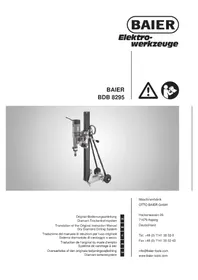
BDB 8295 - Drill Baier - Free user manual and instructions
Find the device manual for free BDB 8295 Baier in PDF.


| Product type | Dry diamond drill / core drill |
| Brand | Baier |
| Model | BDB 8295 |
| Power supply | 230 V / 50-60 Hz |
| Rated power input | 2200 W |
| No-load speed (1st gear) | 480 rpm |
| No-load speed (2nd gear) | 940 rpm |
| Hammer frequency | 9600 / 18800 rpm |
| Core bit diameter (1st gear) | 120 to 250 mm |
| Core bit diameter (2nd gear) | 52 to 120 mm |
| Tool mounting | 1 1/4 UNC and G 1/2 |
| Weight (according to EPTA 01/2003) | 6.02 kg |
| Machine dimensions (L x W x H) | Approx. 460 x 500 x 1060 mm (with BST 420 stand) |
| Protection class | II (double insulation) |
| Sound pressure level (LpA) | 91 dB(A) |
| Sound power level (LwA) | 101 dB(A) |
| Vibration (total value) | 5.5 m/s² |
| Main functions | Dry drilling with hammer, electronic speed control, soft start, optical load indicator (green/red LED) |
| Included accessories | Suction tube, fork wrench SW36 and SW41 |
| Maintenance and cleaning | Clean after each use, blow with compressed air, grease the core bit shank, mandatory annual maintenance |
| Safety | Hearing protection, dust mask, anti-vibration gloves, automatic overload shut-off, double insulation |
| Spare parts and repairability | Original Baier parts mandatory, repair by authorized service center, carbon brushes normal wear |
| Warranty | 12 months for professional use |
| General information | Designed for dry drilling of concrete, reinforced concrete, masonry; do not use on wood, metal, glass; BST 420 stand optional |
Frequently Asked Questions - BDB 8295 Baier
User questions about BDB 8295 Baier
0 question about this device. Answer the ones you know or ask your own.
Ask a new question about this device
Download the instructions for your Drill in PDF format for free! Find your manual BDB 8295 - Baier and take your electronic device back in hand. On this page are published all the documents necessary for the use of your device. BDB 8295 by Baier.
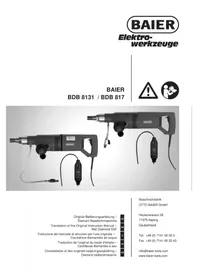
USER MANUAL BDB 8295 Baier
natural_image
Mechanical tool with drill bit and roller assembly (no visible text or symbols)Translation of the Original Instruction Manual
Dry Diamond Drilling System
2
3
natural_image
Technical line drawing of a mechanical device with labeled parts (no text or symbols present)4
5
6
7
8
15
16
natural_image
Diagram of a tool interacting with a surface, showing motion direction (no text or symbols)Inhalt
1 About this instruction manual ..... 28
1.1 Important information 28
1.2 Symbols used in the instruction manual 28
2 Safety Instructions 28
2.1 Workplace safety 29
2.2 Electrical safety 29
2.3 Safety of people 29
2.4 Using and handling the power tool ..... 30
2.5 Service 30
2.6 Safety instructions for dry diamond drilling systems 30
2.6.1 Operating personnel requirements ..... 30
2.6.2 Safety instructions for all work 30
2.6.3 Workplace safety 31
2.6.4 Electrical safety 31
2.6.5 Safety of people 32
2.6.6 Hazards when using and handling the power tool 33
2.6.7 Safety instructions for using long drill bits 33
2.6.8 Hazards when using and handling the drill stand 33
2.6.9 Service / Maintenance / Repair 34
2.6.10 Explanation of the pictograms on the machine 35
3 Technical Characteristics 36
3.1 Drive unit technical specifications ..... 36
3.2 Drill stand technical specifications ..... 37
3.3 EU Declaration of Conformity 37
3.4 Machine characteristics 37
3.5 Machine parts and controls 37
3.6 Intended use 38
4 Before Starting Work 38
4.1 Setting the speed 39
4.2 Connecting the dust extraction 39
4.2.1 Mounting the extraction tube 39
4.2.2 Dismantle extraction tube 39
4.2.3 Connect dust extractor 39
4.3 Fitting or replacing the diamond drill bit . 39
5 Setting up the BST 420 drill stand (optional accessories) .... 39
5.1 Installing the drill rig with plug fixing ..... 40
5.2 Fixing onto the wall 40
5.3 Fixing the drill stand with a quick-action pillar 40
5.4 Installing the drill stand with vacuum kit (accessory) 40
5.5 Adjusting the inclination angle at the drill stand 40
5.6 Fixing the drive unit to the drill rig 41
6 Operation and Control 41
6.1 Starting drilling 41
6.2 Ending the drilling process 42
7 Cleaning 42
7.1 Cleaning the teeth and guide on the drill stand pillar 42
7.2 Cleaning and greasing the eccentric shaft 42
8 Maintenance 43
9 Handling Diamond Core Drill Bits ..... 43
10 Disposal 43
11 Scope of Supply 44
12 Warranty 45
Imprint
Version V01/2021-02
Copyright:
Maschinenfabrik
OTTO BAIER GmbH
Heckenwiesen 26
71679 Asperg
Germany
It is prohibited to forward or reproduce this document or to exploit and disclose its contents, unless expressly permitted. Any infringements will result in liability to pay compensation for damages. All rights reserved in case of patent, utility model or design registration.
This instruction manual has been prepared with the greatest possible care. Nonetheless, OTTO
BAIER GmbH does not accept any liability whatsoever for possible errors in this instruction manual and their consequences. Equally, no liability whatsoever is accepted for direct or consequential damage or losses resulting from improper use of the machine.
The national health and safety regulations and the requirements of this instruction manual are to be observed when using the machine.
All product names and brand names used are the property of the holder and are not explicitly marked as such.
Subject to change without notice.
1 About this instruction manual
This instruction manual contains all important information necessary for safe handling of the dry diamond drilling system.
In this instruction manual the drive unit is also referred to as the "tool" or "machine".
This instruction manual only describes use of the Baier BST 420 drill stand.
If using another drill stand, the corresponding instruction manual must be followed.
Figure references
References to figures, which are located at the beginning of the instruction manual are displayed in the text with this symbol 1 (here, for example, the reference is to Figure number 1).
1.1 Important information

Read the instruction manual
Before starting any work with or on the tool, this instruction manual, the safety instructions and the warnings must be read through carefully and observed.
Always keep this instruction manual together with the equipment.

An approved half-mask with filter must be worn!
1.2 Symbols used in the instruction manual

DANGER
"DANGER" indicates an imminent hazard, which will result in immediate death or severe physical injuries.
→ This arrow indicates appropriate measures to avert the pending hazard.

WARNING
"WARNING" indicates an imminent hazard, which could result in death or severe physical injuries.
→ This arrow indicates appropriate measures to avert the pending hazard.

CAUTION
"CAUTION" indicates an imminent hazard, which can result in minor or moderate physical injuries.
→ This arrow indicates appropriate measures to avert the pending hazard.

NOTE
"NOTE" indicates possible property damage, gives use recommendations and helpful tips.
2 Safety Instructions

WARNING
Read all safety instructions, instruction illustrations and technical specifications provided for this power tool.
Failure to observe the safety instructions and precautions can cause serious injuries.
Keep all safety instructions and precautions for future reference.
The term "power tool" used in the safety instructions refers to mains-operated power tools (with mains power lead) and battery-operated power tools (without mains power cable).
2.1 Workplace safety
a) Keep your work area clean and well illuminated.
Untidiness and unlit work areas can result in accidents.
b) Never use the power tool in potentially explosive environments containing flammable liquids, gases or dusts.
Power tools generate sparks which can ignite dust or vapours.
c) Keep children and other persons away from the power tool during use.
A moment's distraction can cause you to lose control of the machine.
2.2 Electrical safety
a) The connecting plug of the power tool must fit in the plug socket. The plug must not be modified in any way. Do not use adapter plugs in conjunction with power tools with protective earth conductor.
Unmodified plugs and properly fitting plug sockets reduce the risk of electric shock.
b) Avoid physical contact with earthed surfaces such as pipes, heaters, cookers and refrigerators.
There is an increased risk of an electric shock if your body is earthed.
c) Keep power tools away from rain and moisture.
The ingress of water into a power tool increases the risk of an electric shock.
d) Do not misuse the cable in any way by using it to carry or hang up the power tool or to pull the plug out of the socket. Keep the cable away from heat, oil, sharp edges and moving machine parts.
Damaged or kinked cables increase the risk of an electric shock.
e) When working with a power tool outdoors, use only extension leads that are suitable for outdoor use.
Use of an extension lead suitable for outdoor use reduces the risk of electric shock.
f) If the use of the power tool in a damp environment is unavoidable, use a residual-current circuit breaker.
Use of a residual-current circuit breaker (RCCB with 10 mA maximum tripping current) reduces the risk of an electric shock.
2.3 Safety of people
a) Always work carefully, attentively and sensibly when using a power tool. Do not use the power tools if you are tired or are under the influence of drugs, alcohol or medication.
A moment of inattention while using the power tool can result in serious injuries.
b) Wear personal protective equipment and always wear goggles.
The wearing of personal protective equipment, such as dust mask, non-slip safety shoes, helmet or ear protectors, depending on the type and application of the power tools, reduces the risk of injuries.
c) Avoid accidental switching on of the power tool. Ensure that the power tool is switched off before connecting it to the mains power supply and/or connecting the battery and before picking up or carrying the tool.
If you have your finger on the switch when carrying the power tool or you connect the tool to the power supply when it is switched on, this can lead to accidents.
d) Remove the adjusting tools or wrenches before switching on the power tool.
A tool or wrench in a rotating part of the tool can result in injuries.
e) Avoid abnormal postures when working. Ensure you are standing firmly and maintain your balance at all times.
This will enable you to control the power tool better in unexpected situations.
f) Wear suitable clothing. Do not wear loose clothing or jewellery. Keep your hair, clothing and gloves away from moving parts.
Loose clothing, jewellery and long hair can get caught in moving parts.
g) If dust extraction and collection devices can be installed, ensure that these are connected and are used correctly.
Use of a dust extraction system can reduce the hazards caused by dust.
h) Don't be lulled into a false sense of safety and do not break the safety rules for power tools even if, after much use, you are familiar with the power tool.
Careless action can cause severe injuries within fractions of a second.
2.4 Using and handling the power tool
a) Do not overload the tool. Use the intended power tool for your work.
You work better and safer within the given power range if you use the suitable power tool.
b) Do not use a power tool whose switch is defective.
A power tool which can no longer be switched on or off is dangerous and must be repaired.
c) Remove the plug from the plug socket and/or remove the battery before carrying out tool adjustments, changing accessories or placing the tool aside.
This precautionary measure prevents unintentional starting of the power tool.
d) Store power tools out of the reach of children when not in use. Do not allow people to use the tool unless they are familiar with it, or if they have not read this instruction manual.
Power tools are dangerous if they are used by inexperienced people.
e) Maintain power tools and insert tools with care. Check whether moving parts are in proper working order and do not jam, whether parts are broken or damaged in such a way that they impair the function of the power tool. Have damaged parts repaired before using the power tool.
Many accidents are caused by poorly serviced and maintained power tools.
f) Keep cutting tools sharp and clean at all times.
Carefully maintained cutting tools with sharp cutting edges jam less easily and are easier to control.
g) Use the power tool, accessories, insert tools, etc. in accordance with this instruction manual. Take into consideration the working conditions and the work to be carried out.
Use of power tools for other than the intended applications can lead to dangerous situations.
h) Keep the handles and gripping surfaces dry, clean and free from oil and grease.
Slippery handles and gripping surfaces prevent safe operation and control of the power tool in unforeseen situations.
2.5 Service
a) Have your power tool repaired by qualified personnel only and use original spare parts only.
This will ensure that the safety of the power tool is maintained.
2.6 Safety instructions for dry diamond drilling systems
2.6.1 Operating personnel requirements
• People below the age of 18 may not use the machine.
- The operating personnel must be familiar with the content of this instruction manual.
2.6.2 Safety instructions for all work
- Wear hearing protection when hammer drilling/diamond drilling.
Exposure to noise can cause loss of hearing.
• Use the additional handle(s).
Loss of control can result in injuries. - Support the power tool properly before using.
This power tool produces a large torque. If the power tool is not properly supported during use, the use can loose control of it and injuries can occur.
2.6.3 Workplace safety
- Secure the work area also behind openings and cutouts.
Unsecured work areas can endanger you and other people.
- Watch out for open and concealed electricity cables, and water and gas pipes. Use suitable detectors to find concealed utility pipes and cables, or contact the local utility company for advice.
Contact with electricity cables can cause fires and an electric shock. Damage to a gas pipe can cause an explosion. Penetrating a water pipe causes damage to property or could cause an electric shock.
- Do not use the power tool near flammable materials.
Sparks could ignite these materials.
- Avoid causing situations where other people can stumble or trip.
Tripping over cables can cause serious injuries.
- Secure the workpiece.
A workpiece securely held in clamping devices or a vice is more safely held than in the hand.
- Avoid dust accumulation in the workplace.
Dusts can easily ignite.
- Ensure adequate ventilation in closed rooms.
Risk due to dust and impaired vision.
• Inform and consult the responsible structural engineer, architect or the responsible site engineer about planned drilling.
Cut through reinforcement only with the approval of a structural engineer.
- When drilling through walls or ceilings, ensure that people and work areas on the other side are protected.
The core drill bit can extend beyond the drill hole and the drilled core can fall out on the other side.
- Before drilling holes drilling objects, check the rooms concerned for obstructions and block off this area. Use formwork to secure the drill core against falling.
- Dust from materials such as coatings containing lead, several types of wood, minerals and metals can be harmful to health and cause allergic reactions, respiratory diseases and/or cancer.
Asbestos-containing material may only be machined by specialists.
▶ Where possible use dust extraction suitable for the material.
▶ Ensure the workplace is properly ventilated.
▶ We recommend wearing a face mask respirator with filter class P2 or P3 (to EN 149:2001).
Observe the relevant regulations in your country for the materials to be machined.
2.6.4 Electrical safety
- Before each use, check the power tool, connection cable and plug for damage. Damaged equipment is dangerous, and no longer safe to use.
- Note the mains voltage! The power source voltage must match the details given on the rating plate of the power tool.
- If using the power tool with mobile generators, loss of power or atypical behaviour on switching on is possible.
- Do not use the power tool if the cable is damaged. Do not touch the damaged cable and disconnect the mains plug if the cable is damaged while you are working.
Damaged cables increase the risk of an electric shock.
- Only use extension cables suitable for the machine's power consumption and which have a minimum core cross-section of 1.5 mm². If you use a cable drum, always completely unwind the cable.
The rolled up cable can heat up and start to burn.
- Regularly clean the ventilation slots of your power tool by blowing it out. Never use liquids. Never insert screwdrivers or any other objects into the ventilation slits. Do not cover the ventilation slits.
The motor fan draws dust into the housing and a large accumulation of metal dust can cause electrical hazards.
EN
- External electromagnetic interference (e.g. mains voltage fluctuations, electrostatic discharges) can cause the power tool to switch off automatically.
In this case, switch off the power tool and then switch it back on again.
2.6.5 Safety of people
- Wear personal protective equipment and, depending on the work situation, use:

Full-face protection, eye protection or safety glasses/goggles, hard hat and special apron

Protect yourself against debris thrown up by wearing a hard hat, safety goggles or face protection and wear an apron, if necessary.

Hearing protection
The typical A-weighted sound pressure level of this power tool is over 85 dB (A) while working with the tool. If you are exposed to loud noise for lengthy periods, there is a risk of hearing damage or even hearing loss.

Anti-vibration safety glove
At a release value A (8) for arm-hand vibrations of over 2.5 m/s ^2 , the wearing of anti-vibration safety gloves is recommended.

Non-slip safety footwear

Dust mask, half-face filter mask or face mask respirator
Inhaling fine mineral dust can cause health damage. We recommend wearing a face mask respirator with filter class P2 or P3 (to EN 149:2001).
Dry drilling: Working with dry diamond core drill bits is a grinding process in which extremely fine dust is produced. When cutting materials containing quartz there is a very high risk of silicosis; in this case the machine should only be used in conjunction with a suitable dust extractor.
- Ensure other people keep a safe distance from your work area. Any person entering the work area must be wearing personal protective equipment.
Broken pieces of the workpiece or broken insert tools can fly off and cause injuries, even outside the immediate work area.
- Hold the tool at the insulated gripping surfaces only when carrying out work during which the insert tool can hit concealed electricity cables or the tool's own mains power lead.
Contact with a live conductor can also energise metal parts of the tool and cause an electric shock.
- Keep the mains power lead away from rotating insert tools.
If you lose control of the tool, the mains power lead can be cut or caught and your hand or arm can be pulled into the rotating insert tool.
- Never put down the power tool until the insert tool has come to a complete standstill.
The rotating insert tool can come into contact with the surface on which the power tool is placed, which could cause you to lose control of the power tool.
- Do not leave the power tool running while you are carrying it.
Your clothing can get caught by inadvertent contact with the rotating insert tool and the insert tool can drill into your body.
- If the machine is switched on, do not direct insert tools towards your own or other people's bodies. Do not touch or take hold of the tools.
2.6.6 Hazards when using and handling the power tool
- If the insert tool becomes blocked, stop exerting feed and switch off the tool. Check the reason for the jamming and remove the cause of jammed insert tools.
- If you want to restart a diamond drill, which is in the workpiece, before switching on, check whether the insert tool rotates freely. If the insert tool jams, it possibly does not rotate and this can cause overloading of the tool, or can cause the diamond drill to detach itself from the workpiece.
- Do not use any accessories, which have not been especially provided and recommended for this power tool by the manufacturer. Just because you can attach the accessories to your power tool is not a guarantee of safe use.
- The approved speed of the insert tool must be at least as high as the maximum speed given on the power tool. Accessories which rotate faster than approved can break and fly off the tool.
- Change insert tools carefully and only use the mounting tools provided, if they are in perfect condition. Disconnect the mains plug before changing the insert tool. Use of the mounting tool provided prevents damage to the power tool and insert tool.
- Never use damaged insert tools. Before each use, check insert tools for splinters and cracks. If the power tool or insert tool is dropped or falls, check whether it is damaged, or use an undamaged insert tool. If you have checked and inserted the insert tool, keep yourself and other people nearby outside the plane of the rotating insert tool and let the power tool run at maximum speed for one minute.
Most damaged insert tools break during this test period.
- Do not expose power tools to extreme heat or cold.
Mechanical and electrical damage can occur during extreme heat and/or cold.
- Allow the insert tools, tool holders and other parts cool in the immediate vicinity of the work area after use.
The equipment can be very hot after use. Do not touch or grip the parts. Risk of injury.
• Additional signs or other, non BAIER-specific parts may not be screwed or riveted onto the motor, handle, gearbox or protective housing.
This could damage the power tool and cause malfunctions to occur. - Avoid unnecessary noise emissions.
• Note and follow the safety and work instructions for the accessories used.
2.6.7 Safety instructions for using long drill bits
- Never work with a higher speed than the maximum allowable speed of the drill bit
At higher speeds the drill bit can bend easily, if it can twist itself free without contact with the workpiece and result in injuries.
• Always start drilling at a low speed and while the drill has contact with the workpiece.
At higher speeds the drill bit can bend easily, if it can twist itself free without contact with the workpiece and result in injuries.
- Do not exert excessive pressure and only press in the longitudinal direction of the drill bit.
Drill bits can bend and therefore break or result in a loss of control and injuries.
2.6.8 Hazards when using and handling the drill stand
- Before mounting the drill or drive unit, set up the drill stand correctly in accordance with these instructions.
Correct assembly is important to ensure proper, faultless functioning of the stand.
EN
- Fasten the drill stand securely on a firm, flat surface using the specified and undamaged installation materials.
If the drill stand can slip or wobble, the drill or drive unit cannot be guided uniformly and safely.
- Disconnect the plug of the drill or drive unit from the socket before mounting the drill or drive unit on the drill stand, make any unit settings or change accessory parts.
Unintentional starting of drills or drive units causes accidents.
- Fix the drill or drive unit securely onto the drill stand as specified before starting work.
Slipping of the drill or drive unit on the drill stand can cause loss of control and injuries.
- Remove all setting tools, spanners and installation materials not required before switching on the drill or drive unit.
Setting tools, spanners and installation materials located in/on a rotating part of the unit can result in injuries.
- Do not overload the drill stand and do not use it as a ladder or scaffolding.
Overloading or standing on the drill stand can cause the centre of gravity of the drill stand to move upwards and the drill stand overturns.
- When fixing the drill stand on the workpiece using anchors and screws, ensure that the anchoring used is able to hold the machine safely during use.
If the workpiece is not resistant or is porous, the anchor can be pulled out, which causes the drill stand to detach from the workpiece.
- If fixing the drill stand on the workpiece by means of a vacuum plate, ensure that the surface is smooth, clean and not porous. Do not fix the drill stand onto laminated surfaces, such as tiles and facings of composite materials.
If the surface of the workpiece is not smooth, flat or adequately fixed, the vacuum plate can detach from the workpiece.
- Before and while drilling, ensure that the vacuum is sufficient.
If the vacuum is insufficient, the vacuum plate can detach from the workpiece.
- Never carry out overhead drilling and drilling in the wall, if the machine is only fixed by means of a vacuum plate.
In the event of loss of vacuum, the vacuum plate detaches from the workpiece.
- Do not use any accessories that have not been especially provided and recommended for this drill stand by the manufacturer.
Just because you can attach accessories to your drill stand is not a guarantee of safe use.
- Additional signs or other, non-BAIER-specific parts must not be screwed or riveted onto the drill stand.
This could damage the drill stand and cause malfunctions to occur.
- Note and follow all safety and work instructions for the accessories used.
- Never place the feed crank handle on the hexagon of the tapered shaft to tighten it.
Excessive torques could damage it.
2.6.9 Service / Maintenance / Repair
- If the power tool is dropped or becomes wet, have it checked.
A possibly damaged power tool is dangerous and no longer safe to operate. Before using the power tool again, have it checked by our customer service or an authorised service centre of Maschinenfabrik OTTO BAIER GmbH.
• Repair and maintenance work may only be carried out by an authorised workshop of Maschinenfabrik OTTO BAIER GmbH.
Otherwise, all liability and warranty claims against Maschinenfabrik OTTO BAIER GmbH expire.

NOTE
When using new carbon brushes, the machine may only be operated within the green range for the first 15 minutes - observe LED display in the handle.
- Ensure that original BAIER spare parts and original BAIER accessories only are used when needed.
Original parts are available from authorised dealers. Use of non original parts can cause damage to the machine and an increased risk of accidents.
- Regular servicing by Maschinenfabrik OTTO BAIER GmbH or a servicing and repair company authorised by us is specified.
Many accidents are caused by poorly serviced and maintained power tools.
2.6.10 Explanation of the pictograms on the machine

The CE mark on a product means that the product conforms with all the applicable European regulations and has been subjected to the prescribed conformity assessment procedures.

Protection class II equipment
The machine is insulated in such a way that it has no exposed metal parts that could be live in the event of a fault. It does not have a protective earth conductor.
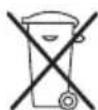
Environmentally friendly disposal of waste equipment
Waste equipment contains valuable recyclable materials which should be reused or recycled. Batteries, lubricants and similar materials must not be allowed to get into the environment.
Therefore, please dispose of waste equipment through suitable collection systems.

Wear hearing protection!
The typical A-weighted sound pressure level of this power tool is over 85 dB (A) – wear ear protectors when working with the tool!

Read the instruction manual!
Before starting any work with or on the machine, this instruction manual, the safety instructions and the warnings must be read through carefully and observed.
3 Technical Characteristics
3.1 Drive unit technical specifications
| Drive unit BDB 8295 | ||
| Manufacturer Maschinenfabrik OTTO BAIER GmbH | ||
| Operating voltage (V/Hz) ~230 / 50/60 | ||
| Power consumption (watt) 2200 | ||
| Protection class | ☐/II | |
| 1. Gear 2. Gear | ||
| No-load speed (min ^-1 ) ^1) | 480 940 | |
| Core drill bit diameter (mm) 120 – 250 52 – 120 | ||
| Impact frequency (min ^1 ) 9600 | 18800 | |
| Bit holder | 1 14 UNC and G 12 | |
| Weight (kg) ^2) | 6.02 | |
| Speed electronics | Yes | |
| Sound measurement ^3) K = 3 dB | ||
| L _pA (sound pressure) dB (A) | 91 | |
| L _WA (sound power) dB (A) | 101 | |
| Vibration measurement (m/s ^2) ) ^4) K = 1.5 m/s ^2 | 5.5 | |
1) The given speeds are to be viewed as maximum speeds for the given diamond drill bit diameters. Depending on the property of the material to be drilled, such as concrete with steel reinforcement of different thicknesses, the speed is set "by feel". When drilling through concreted-in steel with large diamond drill bit diameters the 1st gear is always set.
2) Weight according to EPTA procedure 01/2003.
3) Measured values for noise determined according to EN 60745. Wear hearing protection!
4) Total vibration values (vector sum in three directions) determined according to EN 60745 The vibration emission values given in this instruction manual have been measured according to a method of measurement standardised in EN 60745 and can be used for comparison between power tools. They are also suitable for a preliminary estimate of the vibratory stresses. The vibration emission values given represent the main applications of the power tool. If the power tool is used for other applications, with different insert tools or are insufficiently serviced, this can significantly increase the vibratory stresses over the whole work period. For a precise estimate of the vibration emission values, the times during which the tool is switched off or is running but not actually in use should also be taken into account. This can reduce the vibration stresses over the whole work period significantly.

WARNING
Health risk due to vibrations.
Additional safety measures should be taken to protect the user, e.g. wearing anti-vibration protective gloves, correct maintenance of power tools and insert tools, keeping hands warm and good organisation of work sequences.
3.2 Drill stand technical specifications
| Drill stand BST 420 | |
| Manufacturer Maschinenfabrik OTTO BAIER GmbH | |
| Maximum drilling stroke ∅ 750 mm | |
| Maximum diameter drilled ∅ 420 mm | |
| Maximum usable length ∅ 570 mm | |
| Maximum motor output 3.3 kW | |
| Maximum inclination angle 55° | |
| Height ∅ 1060 mm | |
| Width ∅ 460 mm | |
| Depth ∅ 500 mm | |
| Weight 19 kg | |
| Fastening of drive unit / drill on the feed slide via the mounting plate | Yes |
3.3 EU Declaration of Conformity
CE
We herewith declare, with sole responsibility, that this product conforms to the following standards or normative documents:
EN62841-1:2015+AC:2015
EN62841-2-1:2018
EN55014-1:2017
EN55014-2:2015
EN IEC 61000-3-2:2019
EN61000-3-3:2013
In accordance with the provisions of the Directives
2006/42/EC
2011/65/EU
in conjunction with the safety instructions documented in the instruction manual and the specified intended use.
The head of development is authorised to write the technical documents.
These are available from:
Maschinenfabrik OTTO BAIER GmbH, Heckenwiesen 26, 71679 Asperg Germany
Thomas Schwab Managing Director

Robert Pichl Factory Manager
Asperg, 27.01.2021
3.4 Machine characteristics
The machines are equipped with specially developed electronics with soft start. It monitors the speed and the green / red indicator lights (items 3 and 2, see Figure 1) help to achieve the most favourable work progress and therefore tool-protecting working conditions.
The electronic drilling aid makes spot drilling easier.
Visual display
Green: Speed for optimum drilling performance
Green / red: Speed within the limit range
Red: Speed too low – stopping
If this warning signal is ignored, i.e. the feed is not reduced, the electronics switch off on overload after a time delay. After the diamond core drill bit has stopped, remove it from the drill hole. The machine can be immediately restarted.
3.5 Machine parts and controls
1 Drive unit
1 ON / OFF switch with switch lock
2 Red LED
3 Green LED
4 Output shaft with internal thread G ^1/2 " and external thread 1 ^1/4 " UNC
5 Extraction tube for dust extraction
6 Clip for fastening extraction tube
7 Gear change knob (1st and 2nd gear)
8 Drive unit BDB 8295
9 Spirit level
Drill stand BST 420 (optional accessories)
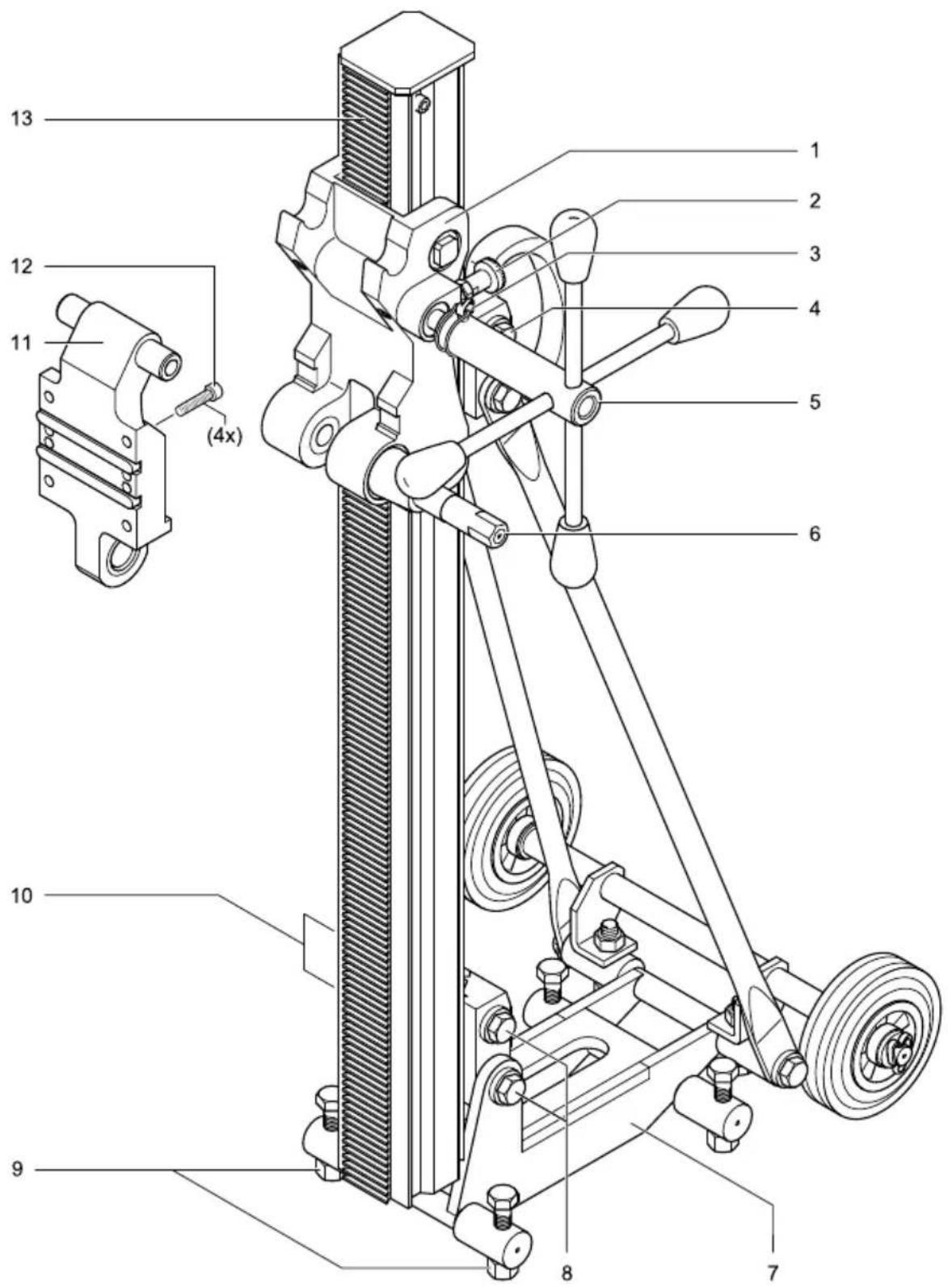
The drill stand is intended for holding diamond drills with a maximum power of 3.3 kW in conjunction with dry diamond drill bits and suitable dust extraction for dry drilling in mineral materials such as concrete, reinforced concrete or masonry. The drill stand can be attached to the floor and to the wall with the help of plugs / anchors or vacuum.
2 Drill stand BST 420
1 Feed slide
2 Locking pin
3 Tube lock
4 Hexagon head screw M12x110
5 Capstan handle
6 Eccentric shaft
7 Steel baseplate
8 Hexagon head screw M12x120
9 Adjustable foot
10 Nut M12 (concealed)
11 Quick-change plate
12 Cheese head screw (4x)
13 Drill stand column with toothing
3.6 Intended use
Dry diamond drilling system
The BDB 8295 drive unit is designed for stand-mounted dry drilling. The BDB 8295 drive unit may not be used for hand-held operation.
The diamond drill is intended to be used in conjunction with a drill stand and diamond core drill bits for drilling in mineral materials such as concrete, reinforced concrete, clay bricks, lime-sand blocks or undressed stone. Never work without extraction.
Do not drill in the following materials: wood, metal and glass, etc.
Observe the relevant regulations in your country for the materials to be machined and extraction.
4 Before Starting Work
To ensure safe working with the dry diamond drilling systems, the following points must always be observed before each use:
- Read through all safety instructions and warnings in this instruction manual.
- Wear protective clothing such as hard hat, face protection or safety goggles, safety gloves and if necessary an apron.
- The voltage on the rating plate must be identical with the mains voltage.
- Before each use, check the machine, connection cable, plug, secure fit of the diamond core drill bit and the fixing of the drill stand.
- Always note follow the thread dimension of the diamond core drill bit arbour. The thread of the diamond core drill bits must fit on the thread of the drive unit (G ^1/2 " internal thread or 1 ^1/4 " UNC external thread) without any clearance. Do not use reducers or adaptors for fitting the diamond core drill bits.
- Visually inspect the condition of the diamond core drill bit.

NOTE
Damaged diamond core drill bits may not be used and must be replaced immediately.
- Only use the diamond core drill bits recommended by OTTO BAIER GmbH for the respective area of use.

NOTE
The diamond core drill bit can become irreparably damaged by overheating or jamming in the drill core hole (Page 43, "Handling diamond core drill bits").
If harmful dust is produced during the work, a suitable dust extractor must be connected to the drive unit.
- Connect a suitable dust extractor.
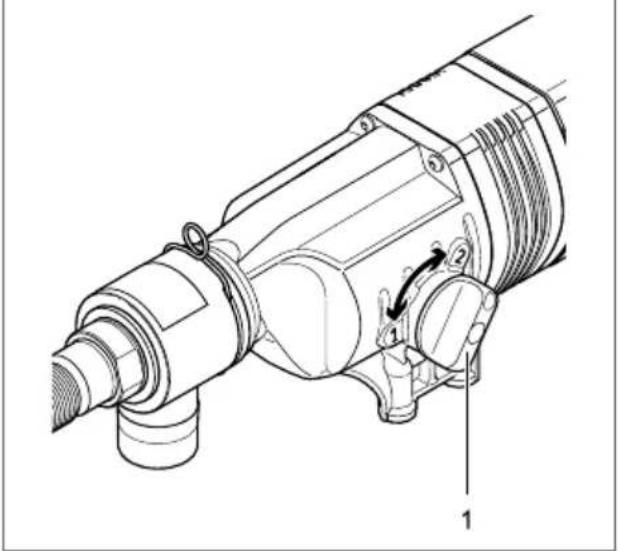
4.1 Setting the speed

NOTE
Changing gear while the machine is running can cause damage to the drill.
Wait for the machine to completely stop.
3 Set the speed depending on the drill bit diameter (see technical specifications Page 36) at the gear change knob (1).
4.2 Connecting the dust extraction
4.2.1 Mounting the extraction tube
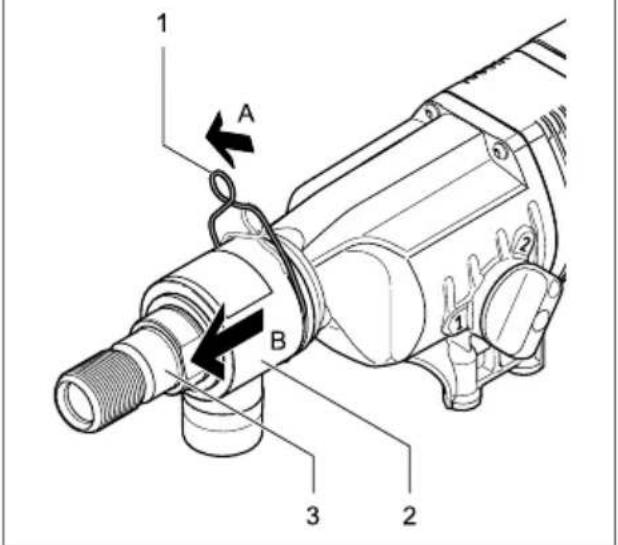
• 4 Mount the extraction tube.
▶ Press the spring clip (2) in the direction of the arrow (A) until the legs of the clip unlatch from the groove of the extraction tube (1).
▶ Push the extraction tube (1) onto the gearbox extension (3) up to the limit stop (B).
▶ Press the spring clip (2) in the opposite direction to the arrow until the clip legs latch into the groove of the gearbox extension (3).
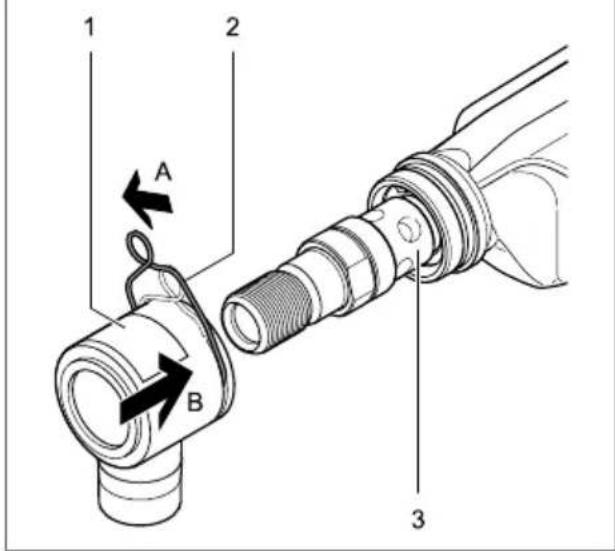
4.2.2 Dismantle extraction tube
• 5 Dismantle extraction tube.
▶ Press the spring clip (1) in the direction of the arrow (A) until the legs of the clip unlatch from the groove of the gearbox extension.
▶ Remove the extraction tube (2) from the front (B) above the output shaft (3).
4.2.3 Connect dust extractor
- Check the dust extractor to ensure that it is working properly.
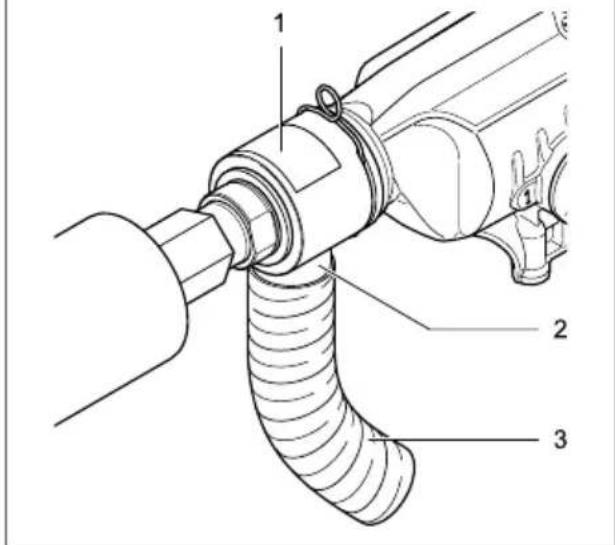
- 6 Push the dust extractor hose (3) firmly onto the nozzle (2) of the extraction tube (1).

NOTE
6 The nozzle (2) is designed to fit the extraction hose (3) of a special dust extractor.
6 When the extraction hose (3) is cold a good deal of effort is required to push it onto the nozzle (2) of the extraction tube (1).
4.3 Fitting or replacing the diamond drill bit

DANGER
Risk of injury due to electric shock.
→ Disconnect the mains plug before carrying out any work on the drive unit.

CAUTION
Risk of injury due to hot drill bits.
→ The drill bits fitted can get hot if used for a lengthy time. Wear safety gloves when changing the drill bits or allow the drill bits to cool first.
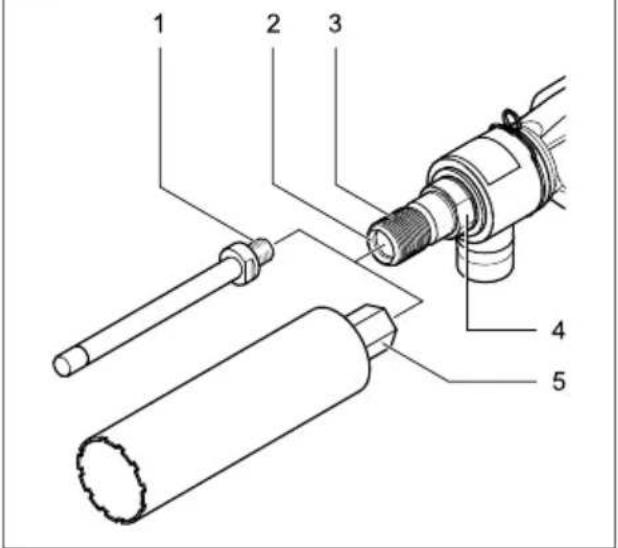
- 7 Diamond core drill bits (1) / (5) are screwed onto the G ^1/2 " internal thread (2) or 1 ^1/4 " UNC external thread (3) of the output shaft (4) depending on the drilling diameter.

NOTE
Check the fit and condition of the diamond core drill bit. A damaged diamond core drill bit may not be used and must be replaced immediately.
5 Setting up the BST 420 drill stand (optional accessories)

NOTE
This instruction manual only describes use of the Baier BST 420 drill stand.
If using another drill stand, the corresponding instruction manual must be followed exactly. The instructions for mounting the drive unit on the quick-change plate described there must be followed exactly.
Note and follow the following points before each use to ensure safe working with the drill stand:
- Before each use, check the fastening of the drill stand.
- Check that the drill fits securely on the drill stand.
EN
Mounting the capstan handle:
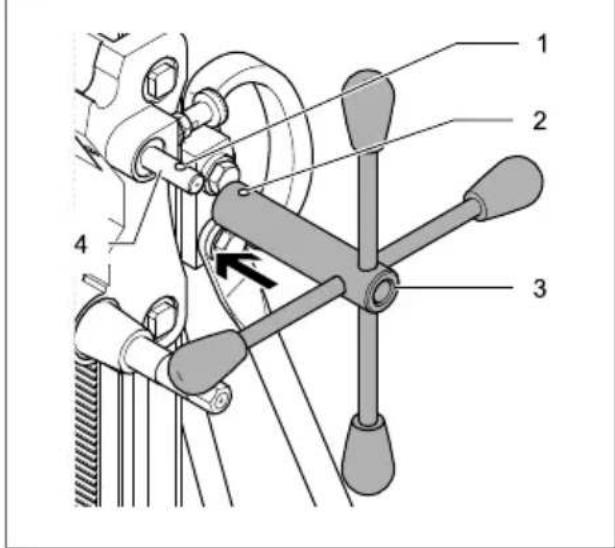
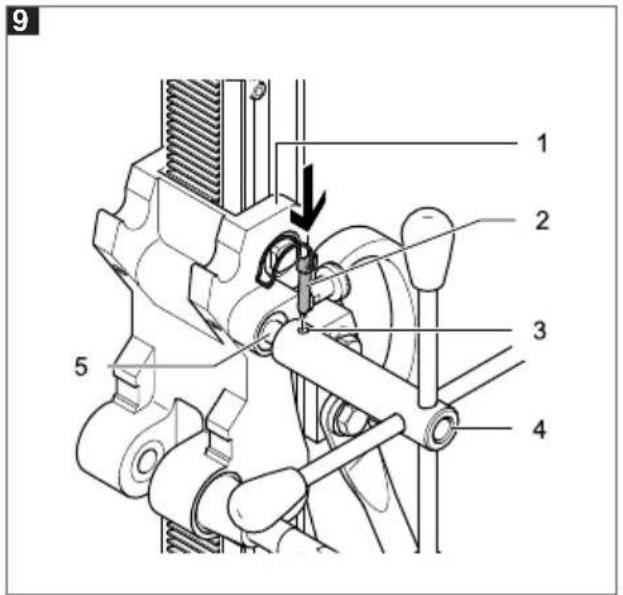
- 8 Push the capstan handle (3), as required, to the left or right onto the feed shaft (1) so that the hole (2) in the capstan handle (3) and the hole in the feed shaft (1) coincide.
- 9 Push the pin of the tube lock (2) through the matching holes (3) and fold over the clip so that the tube lock is secured.
Blocking the feed:
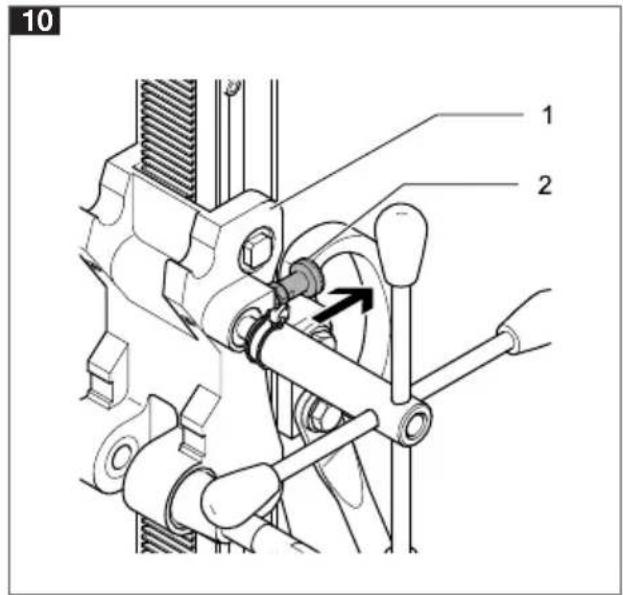
• 10 Pull out the locking pin (2) on the feed slide (1).
- 9 Turn the locking pin through 90^ and allow it to latch into the feed shaft (5). To do this, it may be necessary to move the feed slide (1) up or down slightly using the capstan handle (4).
5.1 Installing the drill rig with plug fixing
The drill stand can be fixed onto the floor or wall using a retaining screw.
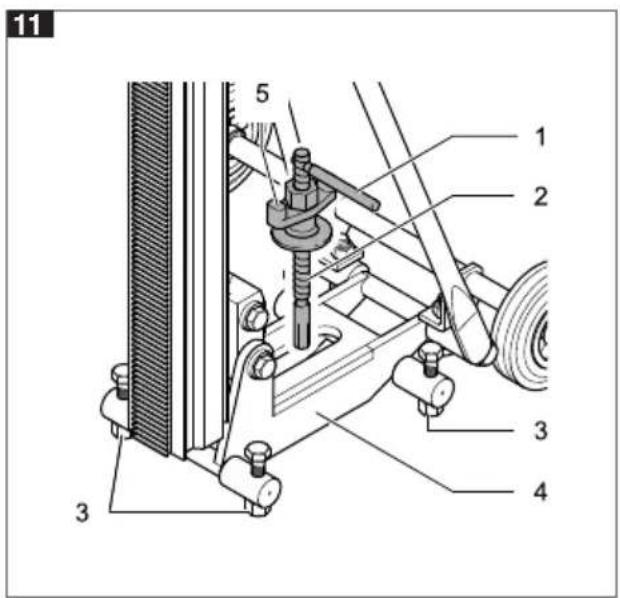
• 11 Use the diamond core drill bit to align the drill stand with the hole to be drilled:
- 11 Mark the plug hole for fixing the drill stand plate (4) through the mounting slot and drill (drill hole: ∅ 15 mm, depth 50 mm).
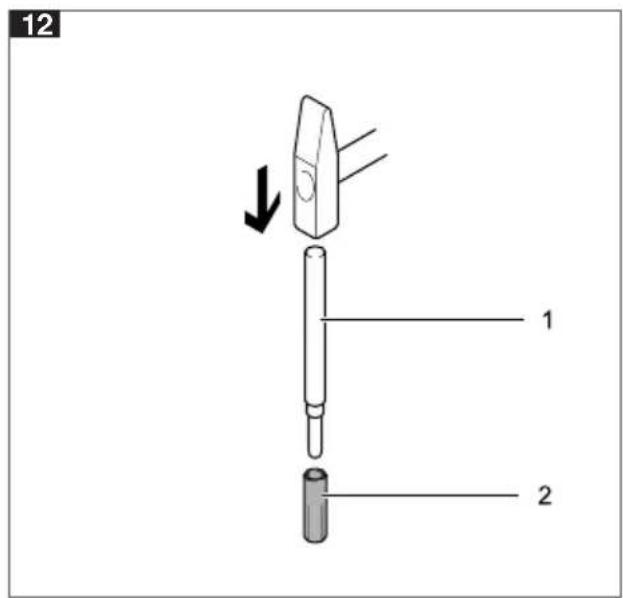
• 12 Insert the retaining screw (1) with attached quick-action plug (2) in the plug hole.
• 11 Align the drill stand plate (4) with the help of the four cap nuts (3).
• 11 Screw in the retaining screw (2) with the help of the spike (1).
• 11 Tighten the quick-action nut (5) with light hammer blows.
5.2 Fixing onto the wall

NOTE
RAWL anchors with diameter 20 mm/M12 are to be used for fixing onto walls.
If fixing on the wall, an external spirit level must be used to adjust the perpendicularity of the drill stand with the drillhole of the diamond drill core bit.
5.3 Fixing the drill stand with a quick-action pillar
The drill stand can be additionally fixed to the ceiling by using an optionally available quick-action pillar (see BAIER catalogue).

NOTE
The ceiling must be checked beforehand to ensure it can withstand a large compressive point load. Secure the pipe against falling or loosening due to vibration.
5.4 Installing the drill stand with vacuum kit (accessory)
If it is not possible to install the drill stand with the anchor fixing, the drill stand can be fixed to the floor using a vacuum kit (order on request). The installation of the vacuum kit is described in the relevant installation instructions.
5.5 Adjusting the inclination angle at the drill stand
The drill stand can be adjusted continuously up to an inclination of 55^ .
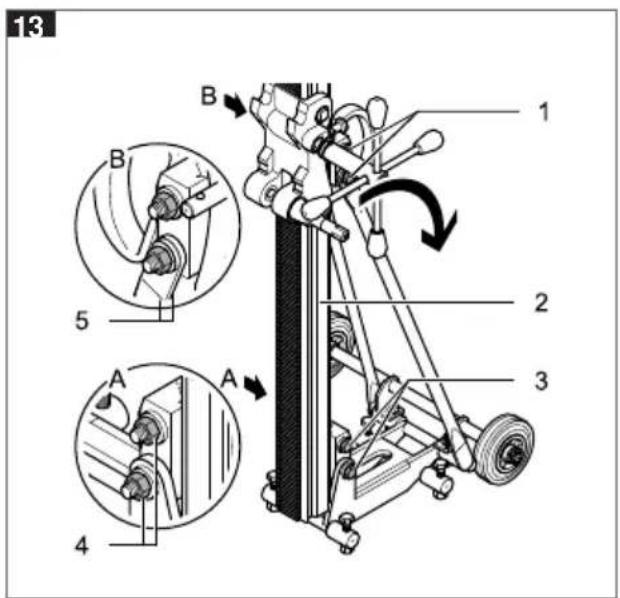
- 13 Undo the two top cheese head screws (1), one after the other. At the same time, hold the two nuts (5) in place.
• 13 Undo the two bottom cheese head screws (3), one after the other. At the same time, hold the two nuts (4) in place. - 13 Set the drill stand column (2) to the required inclination angle.
• 13 Tighten the two bottom cheese head screws (3), one after the other. At the same time, hold the two nuts (4) in place. - 13 Tighten the two top cheese head screws (1), one after the other. At the same time, hold the two nuts (5) in place.

NOTE
The drill stand may not be used again until all four cheese head screws have securely tightened.
5.6 Fixing the drive unit to the drill rig

NOTE
Ensure that the drill stand is securely in position and stable!
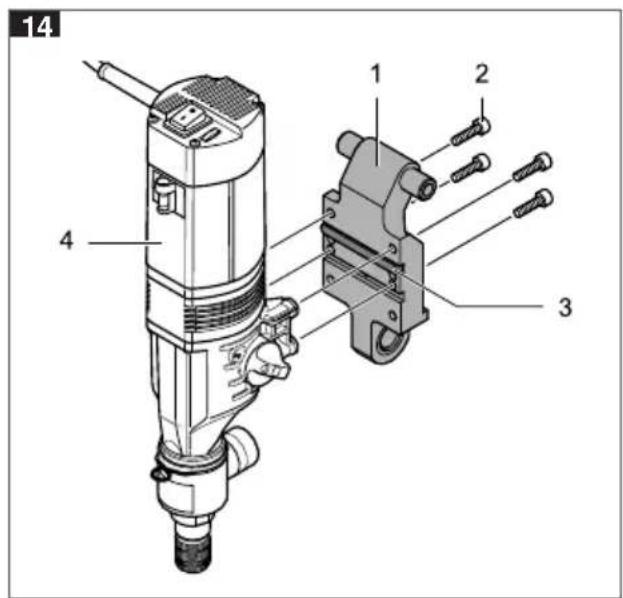
• 14 Insert a feather key (3) into the groove of the quick-change plate (1).
• 14 Align the diamond drill (4) with the four holes and in the correct position.
• 14 Use the 4 retaining screws (2) to screw the diamond drill (4) onto the quick-change plate (1).
- 9 Secure the feed slide (1) with the locking pin (2).
• 10 Pull out the locking pin (2) on the feed slide (1).
- 9 Turn the locking pin through 90^ and allow it to latch into the feed shaft (5). To do this, it may be necessary to move the feed slide (1) up or down slightly using the capstan handle (4).
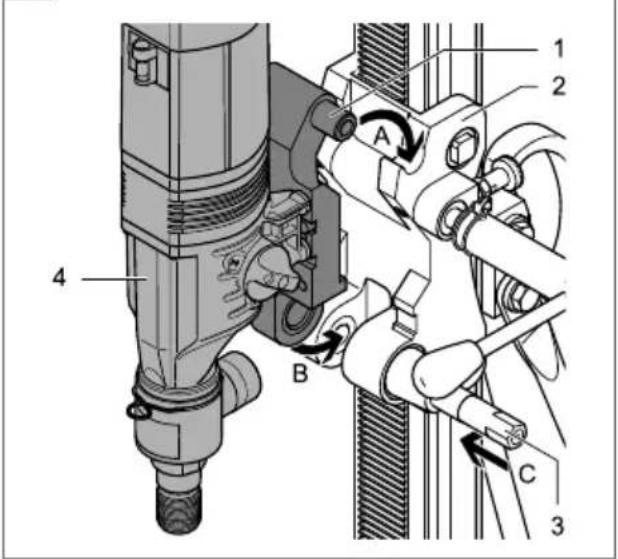
• 15 Pull the eccentric shaft (3) out of the feed slide (2) up to the limit stop.
• 15 Hook the quick-change plate (1) with the diamond drill (4) from above into the holder of the feed slide (2) (A) and swing the quick-change plate (1) towards the rear (B).
• 15 Push the eccentric shaft (3) through the quick-change plate (1) (C) and tighten using an open-ended spanner.
6 Operation and Control
6.1 Starting drilling
- Before starting up the dry diamond drill system, check all the points described in Chapter 4 "Before starting work" (see page 38 ff.) and in Chapter 5 "Setting up the drill stand (optional accessories)" (see page 39 ff.).
- Select the core drill bit and fit (see Chapter "9 Handling Diamond Core Drill Bits" on page 43).
- 3 Set the speed depending on the drill bit diameter (see technical specifications Page 36) at the gear change knob.

NOTE
Changing gear while the machine is running can cause damage to the drill.
Wait for the machine to completely stop.
- 1 Switch on the drive unit and wait until the working speed has been reached – green LED (3) lights up.
- Switch on dust extraction with continuous operation.
• 10 Pull the locking pin (2) on the feed slid (1) out of the feed shaft
• 9 Turn the locking pin through 90^ and allow it to latching into the feed shaft (5). To do this, it may be necessary to move the feed slide (1) up or down slightly using the capstan handle (4).
• 2 Turn the capstan handle (5) to guide the diamond drill / drive unit downwards. - Carefully spot drill the material with the drill bit. Careful spot drilling is required, as the machine is equipped with continuous impact.
- 2 When the core bit has drilled several millimetres into the material, the pressure on the capstan handle (5) can be increased.

NOTE
The diamond core drill bit can become blunt or damaged due to overheating.
The feed may only be as high as the diamond core drill bit can wear away the material. Therefore, do not exert too large a force on the diamond core drill bit (Page 43 "Handling diamond core drill bits").
• 1 If the feed is too fast, the red LED (2) lights up. Then, reduce the feed immediately until the green LED (3) lights up again.
If this warning signal is ignored, i.e. the feed is not reduced, the electronics switch off the drive unit on overload.
The drilling process can then be started and continued as described above.

NOTE
The drive unit also switches off if the diamond core drill bit has insufficient cutting power. In this case, check whether the diamond core drill bit has become blunt (Page 43 "Handling diamond core drill bits").

WARNING
Risk of injury due to falling drill cores.
If drilling openings through objects, always check the rooms below or behind and block off the danger zone. Use formwork to secure the drill core against falling.
6.2 Ending the drilling process
Through-hole

NOTE
Risk of deformation or fracture!
Do not hit the diamond drill bit with hard objects! If the drill core is stuck in the diamond core drill bit, knock the diamond core drill bit with a soft piece of wood or plastic to loosen the drill core.
Non through-hole (blind hole)

NOTE
The diamond core drill bit can be damaged irreparably if it is jammed in the core drill hole. Never use the diamond core drill bit to break out the drill core!
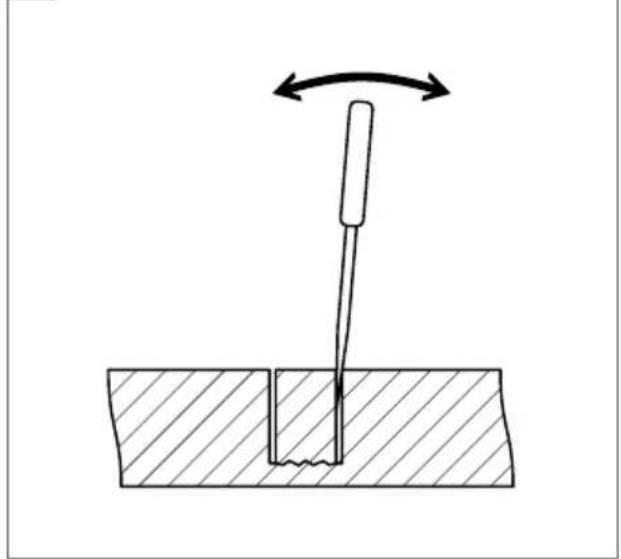
• 16 If the drill core is still stuck in the drill hole after the diamond core drill bit has been removed, it can be broken out using a suitable tool (e.g. chisel).
7 Cleaning

DANGER
Risk of injury due to electric shock.
→ Disconnect the mains plug before carrying out any work on the drive unit.

CAUTION
Risk of injuries due to hot or sharp-edged drill bit.
→ Wear safety gloves.
→ Before carrying out any cleaning work on the drill stand, remove the drill bit and diamond drill first.
The machine and the drill stand must be cleaned after each drilling work session.
- Remove the drive unit from the drill stand.
- Carefully clean the machine and blow out with compressed air.
- Lightly grease the thread of the drill bit holder.
7.1 Cleaning the teeth and guide on the drill stand pillar
- 2 Blow the teeth and the guide of the drill stand pillar (13) with compressed air and rub down with a cloth to remove the drilling dust.
7.2 Cleaning and greasing the eccentric shaft
• 15 Use an open-ended spanner to undo the eccentric shaft (3).
• 15 Pull the eccentric shaft (3) out of the feed slide (2) up to the limit stop.
• 15 Swing the quick-change plate (1) upwards and remove from the feed slide (2) from above.
• 15 Clean and re-grease the thread of the eccentric shaft (3).
• 15 Re-install the quick-change plate (1) and the eccentric shaft (3) in the reverse order.

NOTE
Ensure handles are dry and free from grease.
8 Maintenance

DANGER
Risk of injury due to electric shock.
→ Disconnect the mains plug before carrying out any work on the drive unit.
The drive unit must be serviced at least once a year. Further, servicing will be necessary depending on the wear of the carbon brushes.

NOTE
When using new carbon brushes, the machine may only be operated within the green range for the first 15 minutes – observe LED display in the cap of the drive unit (Item 3, see Figure 1).
Only servicing and repair firms authorised by Maschinenfabrik OTTO BAIER GmbH may carry out maintenance of the machine. Also ensure that original BAIER spare parts and original BAIER accessories only are used.
9 Handling Diamond Core Drill Bits
• Always use and store diamond core drill bits in accordance with the manufacturer's instructions.
• Too soft diamond segments:
Diamond core drill bits wear too quickly at very high removal rate.
Remedy: The material to be machined requires diamond core drill bits with a harder bond.
• Too hard diamond segments:
The diamond grains become blunt and do not break out of the bond. The diamond core drill bits no longer have any cutting power.
Remedy: The material to be machined requires diamond core drill bits with a softer bond.
- If extraction is not used during machining, the diamond core drill bit rubs increasingly against "soft" drill dust. The core drill bit segments heat as a result, they become soft and the diamond splinters sink into the substrate. The diamond core drill bit becomes less sharp. The cutting performance reduces and the user increases the pressure on the diamond core drill bit, which in turn increases the effect. After drilling a few holes, the core drill bit segments are "glazed" or they tear off at the least resistance in the stone and the diamond core drill bit must be replaced.
- Sharpening the diamond core drill bit with a sharpening plate or a soft stone between drilling enables sunken in diamonds to be re-released and the diamond core drill bit is sharp again.
- It is necessary to cool the drill bit segments by extraction to extend the life of the diamond core drill bit and to keep the cutting speed high.
- Excessive drilling pressure can cause material fatigue in the base metal and therefore the formation of cracks. Before use, ensure that there are no cracks in the diamond core drill bit.
• 1 The diamond core drill bit should plunge into the wall only after the working speed has been reached – green LED (3) lights up.
10 Disposal

Recycle the machine and its packaging in an environmentally friendly way in accordance with the provisions applicable in your country.
11 Scope of Supply
Please refer to the enclosed delivery note for the individual scope of supply of a customer-specific order.
Please refer to the table below for the scope of supply of basic models. Please contact your dealer if parts are missing or damaged.
| Dry diamond drilling system ID No. | Drive unit (in the cardboard box) Drill stand | Tool Open-ended spanner SW 36 Open-ended spanner SW 41 | ||
| BDB 8295 9842 x - x | ||||
| BDB 8295 with BST 420 10026 x x (BST 420) x | ||||
| BDB 8295 with BST 450 10024 x x (BST 450) x | ||||
x included in scope of supply
12 Warranty
The power tools placed on the market and distributed by Maschinenfabrik OTTO BAIER GmbH take into account the regulations of the laws concerning engineering tools and equipment to protect against risks to health and safety. We guarantee the perfect quality of our products and accept the costs of subsequent repairs by replacing the damaged parts or replacement with a new tool in case of design, material and/or manufacturing errors within the warranty period. The warranty period for commercial use is 12 months.
The following are prerequisite for a warranty claim due to design, material and/or manufacturing errors:
1. Proof of purchase and compliance with the instruction manual
A mechanically produced original copy of a purchase voucher must always be submitted in order to make a warranty claim. It must contain the complete address, date of purchase and type designation of the product.
The instruction manual for the respective machine and the safety instructions must have been complied with.
Damage due to faulty operation cannot be recognised as a warranty claim.
2. Correct deployment of the machine
Maschinenfabrik OTTO BAIER GmbH's products are developed and produced for specific purposes.
A warranty claim cannot be acknowledged in the event of failure to comply with the intended use in accordance with the instruction manual, misuse or use for another purpose or use of unsuitable accessories. The warranty does not apply if the machine is deployed in continuous and piece-work operation or for rental and hire purposes.
3. Compliance with servicing intervals
Regular servicing by us or a servicing and repair firm authorised by us is prerequisite for warranty claims. Servicing is specified for when the carbon brushes are worn, however at least once a year.
The machine must be cleaned in accordance with the provisions of the instruction manual. All warranty entitlements expire in case of intervention/tampering with the machine by third parties (opening the machine).
Servicing and cleaning work are not generally covered by the warranty.
4. Use of original BAIER spare parts
Ensure that original BAIER spare parts and BAIER accessories only are used. They are available from authorised dealers. The type and quantity of grease are to be used according to the valid grease list. Use of non-original parts can cause consequential damage to the machine and an increased risk of accidents. Dismantled, partly dismantled machines and machines repaired with third party spare parts are excluded from the warranty.
5. Wearing parts
Certain components are subject to use-induced wear or normal wear and tear caused by use of the respective power tool. These components include, among other things, carbon brushes, ball bearings, switches, power cords, seals, shaft sealing rings. Wearing parts are not covered by the warranty.
Indice
Rød: Omdrejningstal for lav – stop

Elektro- werkzeuge
- Inhalt
- Imprint
- About this instruction manual
- Figure references
- Important information
- Read the instruction manual
- Symbols used in the instruction manual
- DANGER
- WARNING
- CAUTION
- NOTE
- Safety Instructions
- Workplace safety
- Electrical safety
- Safety of people
- Using and handling the power tool
- Service
- Safety instructions for dry diamond drilling systems
- Operating personnel requirements
- Safety instructions for all work
- Workplace safety
- Electrical safety
- EN
- Safety of people
- Full-face protection, eye protection or safety glasses/goggles, hard hat and special apron
- Hearing protection
- Anti-vibration safety glove
- Non-slip safety footwear
- Dust mask, half-face filter mask or face mask respirator
- Hazards when using and handling the power tool
- Safety instructions for using long drill bits
- Hazards when using and handling the drill stand
- Service / Maintenance / Repair
- Explanation of the pictograms on the machine
- Protection class II equipment
- Environmentally friendly disposal of waste equipment
- Wear hearing protection!
- Read the instruction manual!
- Technical Characteristics
- Drive unit technical specifications
- Drill stand technical specifications
- EU Declaration of Conformity
- Machine characteristics
- Machine parts and controls
- Drive unit
- Drill stand BST 420 (optional accessories)
- Drill stand BST 420
- Intended use
- Dry diamond drilling system
- Before Starting Work
- Setting the speed
- Connecting the dust extraction
- Mounting the extraction tube
- Dismantle extraction tube
- Connect dust extractor
- Fitting or replacing the diamond drill bit
- Setting up the BST 420 drill stand (optional accessories)
- Mounting the capstan handle:
- Blocking the feed:
- Installing the drill rig with plug fixing
- Fixing onto the wall
- Fixing the drill stand with a quick-action pillar
- Installing the drill stand with vacuum kit (accessory)
- Adjusting the inclination angle at the drill stand
- Fixing the drive unit to the drill rig
- Operation and Control
- Starting drilling
- Ending the drilling process
- Through-hole
- Non through-hole (blind hole)
- Cleaning
- Cleaning the teeth and guide on the drill stand pillar
- Cleaning and greasing the eccentric shaft
- Maintenance
- Handling Diamond Core Drill Bits
- Disposal
- Scope of Supply
- Warranty
- Proof of purchase and compliance with the instruction manual
- Correct deployment of the machine
- Compliance with servicing intervals
- Use of original BAIER spare parts
- Wearing parts
- Indice
- Elektro- werkzeuge
Brand : Baier
Model : BDB 8295
Category : Drill