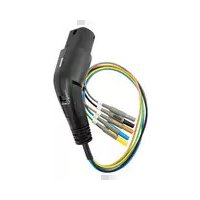
EVSE Adapter - Measuring equipment Testboy - Free user manual and instructions
Find the device manual for free EVSE Adapter Testboy in PDF.



| Product type | EVSE test adapter |
| Brand | Testboy |
| Model | EVSE Adapter |
| Dimensions (estimated) | 15 × 10 × 5 cm |
| Weight (estimated) | 0.5 kg |
| Power supply | 230 / 400 V, 50 / 60 Hz |
| Overvoltage category | CAT II 300 V |
| Connector type | IEC 62196-2 Type 2 |
| PP simulation | Up to 20 A (internal resistance 680 Ω) |
| CP simulation | States A, B, C |
| CP error simulation | State E (short circuit CP-PE) |
| Main functions | Testing EVSE charging stations, measurement of voltage, frequency, phase, RCD, insulation resistance, low impedance, line and loop impedance |
| Operating temperature | 0 °C to 40 °C, < 80 % RH |
| Storage temperature | -10 °C to +50 °C, < 80 % RH |
| Maintenance and cleaning | Clean with a dry or damp cloth and a mild detergent. Do not use abrasive products or solvents. |
| Safety | Observe measurement categories (CAT II), do not exceed input values, use protective equipment if necessary. |
| Included accessories | Instruction manual |
| General information | CE certified, compliant with IEC/EN 61010-1 and IEC/EN 61010-2-031 |
Frequently Asked Questions - EVSE Adapter Testboy
User questions about EVSE Adapter Testboy
0 question about this device. Answer the ones you know or ask your own.
Ask a new question about this device
Download the instructions for your Measuring equipment in PDF format for free! Find your manual EVSE Adapter - Testboy and take your electronic device back in hand. On this page are published all the documents necessary for the use of your device. EVSE Adapter by Testboy.
USER MANUAL EVSE Adapter Testboy
Testboy® EVSE Adapter
Version 1.0

Testboy® EVSE Adapter 3
Bedienungsanleitung

Testboy® EVSE Adapter 12
Operating Instructions
Testboy® EVSE Adapter 21
Mode d'emploi
Testboy® EVSE Adapter 30
Proximity Pilot (PP) Status (Kabel Simulation) 9
Control Pilot (CP) State (Fahrzeug Simulation) 9
CP-Fehler "E" Simulation 10
Messen Terminals 10
Reinigung 10
Technische Daten 11
Hinweise
Sicherheitshinweise

WARNING
Proximity Pilot (PP) Status (Kabel Simulation)
CP-Fehler "E" Simulation
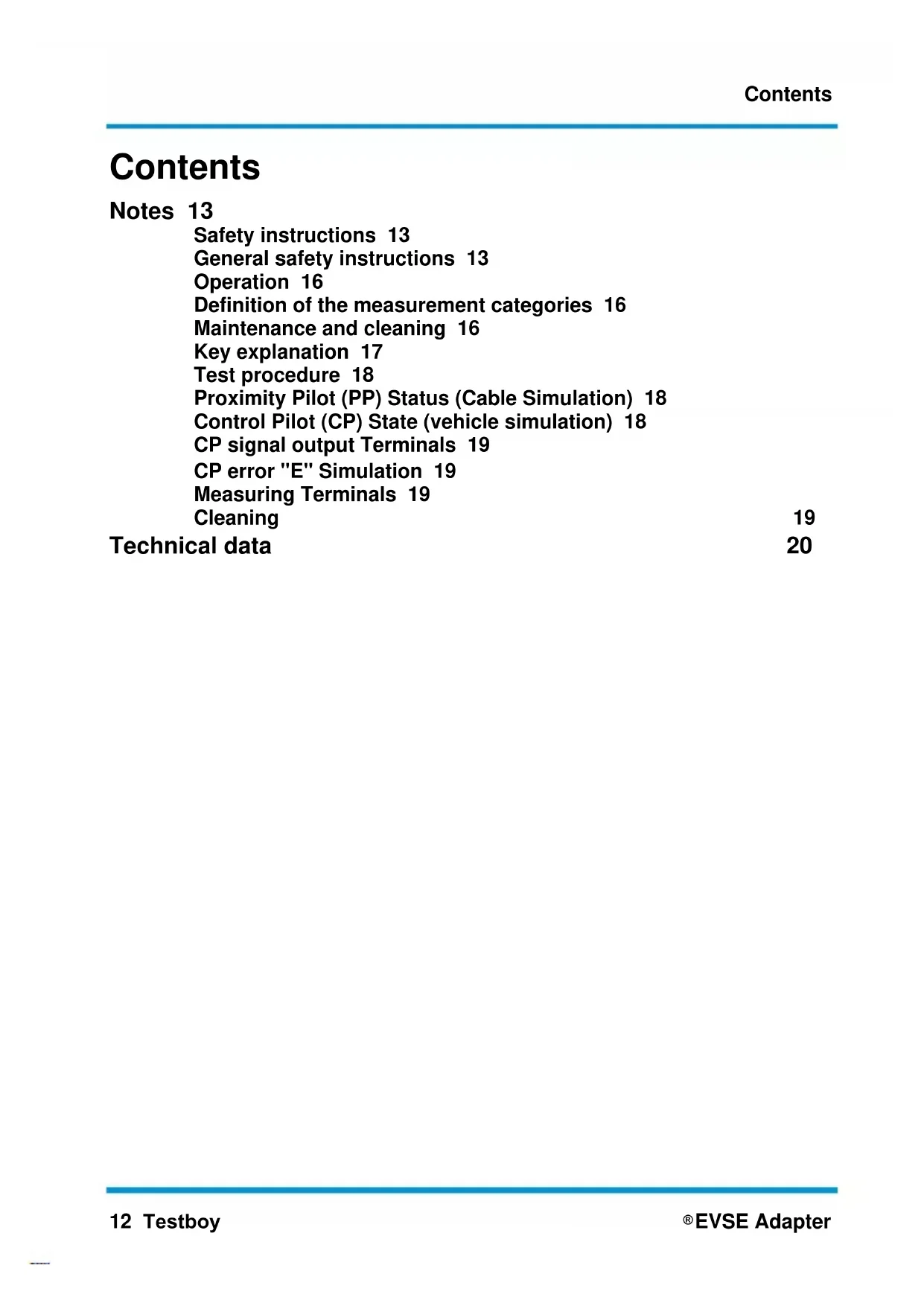
Safety instructions 13
General safety instructions 13
Operation 16
Definition of the measurement categories 16
Maintenance and cleaning 16
Key explanation 17
Test procedure 18
Proximity Pilot (PP) Status (Cable Simulation) 18
Control Pilot (CP) State (vehicle simulation) 18
TCP signal output Terminals 19
CP error "E" Simulation 19
Measuring Terminals 19
Cleaning
Technical data
19
20
Notes
Safety instructions

WARNING
Sources of danger are e.g. mechanical parts that can cause serious injuries to persons.
There is also a risk of damage to objects (e.g. damage to the unit).
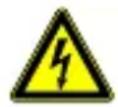
WARNING
Electric shock can cause death or serious injury to persons as well as a hazard to the function of objects (e.g. damage to the appliance).
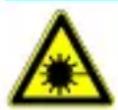
WARNING
Never point the laser beam directly or indirectly at the eye through reflective surfaces. Laser radiation can cause irreparable damage to the eye. When measuring near people, the laser beam must be deactivated.
General safety instructions

WARNING
For safety and approval reasons (CE), unauthorised conversion and/or modification of the unit is not permitted. To ensure safe operation with the unit, it is essential to observe the safety instructions, warnings and the chapter "Intended use".

WARNING
Before using the appliance, please observe the following instructions:
Avoid operating the unit near electric welders, induction heaters and other electromagnetic fields.
After abrupt temperature changes, the unit must be adjusted to the new ambient temperature for approx. 30 minutes to stabilise the IR sensor before use.
Do not expose the unit to high temperatures for a long time.
Avoid dusty and humid environmental conditions.
Measuring instruments and accessories are not toys and do not belong in children's hands!
In commercial facilities, the accident prevention regulations of the Federation of Institutions for Statutory Accident Insurance and Prevention for electrical installations and equipment must be observed.
Intended use
The unit is only intended for the applications described in the operating instructions. Any other use is not permitted and may lead to accidents or destruction of the unit. These applications lead to an immediate expiry of any guarantee and warranty claims of the operator against the manufacturer.

To protect the unit from damage, please remove the batteries if the unit will not be used for a long time.

We accept no liability for damage to property or personal injury caused by improper handling or non-observation of the safety instructions. In such cases, any warranty claim becomes void. An exclamation mark within a triangle refers to safety instructions in the operating manual. Read the instructions completely before using the appliance. This unit is CE-approved and therefore complies with the required directives.
Rights reserved to change specifications without prior notice © 2023 Testboy GmbH, Germany.
Disclaimer

In case of damage caused by non-observation of the instructions, the warranty claim is void!
We accept no liability for consequential damage resulting from this!
Testboy is not liable for damage resulting from
failure to follow the instructions,
changes to the product that have not been approved by Testboy, or
Spare parts not manufactured or approved by Testboy
Are caused by the influence of alcohol, drugs or medication result.
Correctness of the operating instructions
These operating instructions have been prepared with great care. No responsibility is taken for the correctness and completeness of the data, illustrations and drawings. Changes, misprints and errors excepted.
Disposal
Dear Testboy customer, with the purchase of our product you have the option of returning the device to suitable collection points for electronic waste at the end of its life cycle.
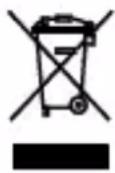
WEEE regulates the take-back and recycling of waste electrical equipment.
Manufacturers of electrical appliances are obliged to take back and recycle electrical appliances that are sold free of charge. Electrical appliances may then no longer be placed in the "normal" waste streams. Electrical equipment must be recycled and disposed of separately. All appliances covered by this directive are marked with this logo.
Disposal of used batteries
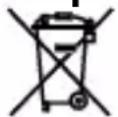
As the end user, you are legally obliged (Battery Act) to return all used batteries and rechargeable batteries; disposal with household waste is prohibited!
Batteries/rechargeable batteries containing harmful substances are marked with the adjacent symbols, which indicate that they must not be disposed of with household waste.
The designations for the decisive heavy metal are:
Cd = cadmium, Hg = mercury, Pb = lead.
You can hand in your used batteries/rechargeable batteries free of charge at the collection points of your municipality or wherever batteries/rechargeable batteries are sold!
Quality certificate
All quality-relevant activities and processes carried out within Testboy GmbH are permanently monitored by a quality management system. Testboy GmbH further confirms that the test equipment and instruments used during calibration are subject to permanent test equipment monitoring.
Declaration of conformity
The product complies with the latest directives. For more information, please visit www.testboy.de
Operation
Allow the unit to acclimatise before taking a measurement.
Use the appliance only as described in this manual, otherwise the protective devices of this appliance may be impaired.
Only use the unit if the housing is in perfect condition.
To avoid damage to the unit, do not exceed the maximum input values specified in the technical data.
Pay attention to the function selector switch and make sure it is in the correct position before each measurement.
Take special care when working on uninsulated conductors or busbars. (Wear protective clothing if necessary)
Any accidental contact with the conductor may result in electric shock.
Take care when working with voltages above 60 V DC or 30 V AC RMS. There is a risk of electric shock at such voltages.
Before each measurement, make sure that the tester is in good working order. Check the function on a known, working power source before using the unit.
| Be careful when working near open exposed ladders or collection ladders. Individual protective equipment should be used.
Definition of the measurement categories
Measurement category II: Measurements on circuits that are electrically connected directly to the low-voltage mains via plugs. Typical short-circuit current < 10kA
Measurement category III: Measurements within the building installation (stationary consumers with non-pluggable connection, distribution connection, permanently installed devices in the distribution board). Typical short-circuit current < 50kA
Measurement category IV: Measurements at the source of the low-voltage installation (meter, main connection, primary overcurrent protection). Typical short-circuit current >> 50 kA
To determine the measuring category for a combination of measuring cable and measuring device, the lowest category of either the measuring cable or the measuring device always applies.
When using this meter, the user must observe all the usual safety rules:
Protection against hazards caused by electric current.
Protection of the meter against misuse.
Maintenance and cleaning
Clean the housing at regular intervals with a dry cloth without cleaning agents. Do not use abrasives, scouring agents or solvents.

To avoid electric shocks, do not allow moisture to enter the housing.
Key explanation
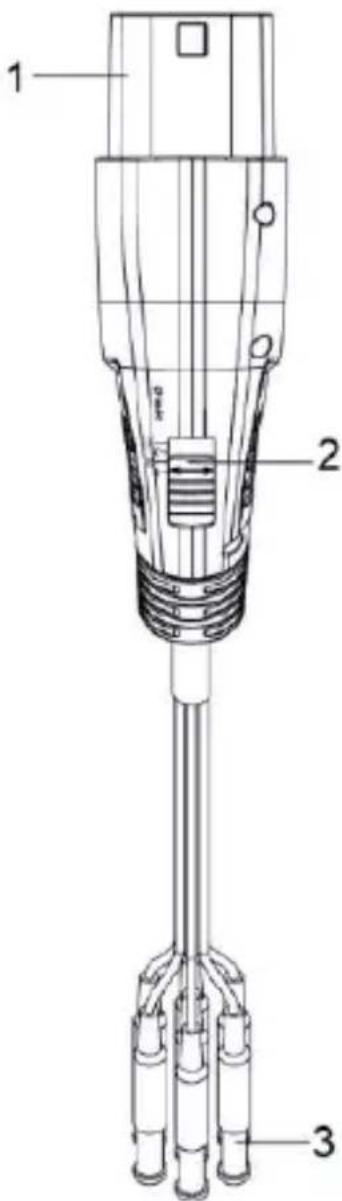
1) Type 2 plug
2) Slide switch for selecting the CP mode
3) Measuring leads with 4mm safety plugs for L1, L2, L3, N, PE, CP and PP
Purpose of the EVSE Active Test Lead
The EVSE measuring lead is an accessory to support all relevant measurements of a TV 456, which is simply connected between the EVSE charging point (type 2 plug) and the measuring inputs of the TV 456. All wires of the charging plug are available: L1, L2, L3, N, PE, CP and PP. Typical installation measurements can be carried out with it: Voltage, frequency, phase indication, phase sequence, various RCD tests and measurements, insulation resistance, low-impedance measurements, line and loop impedances.
Test procedure
- Connect the required 4mm test plugs of the EVSE test lead to your TV 456,
- Select CP mode "A" with the slide switch,
- Connect the EVSE test cable to the type 2 plug of the charging station,
- Select CP mode "B" with the slide switch, the charging station should display "ready to charge",
- Select CP mode "C" with the slide switch, the charging station should start charging,
- carry out all measurements in the active phase of the charging station (voltage and the like),
- after you have performed all measurements, select CP mode "A" with the slide switch to end the charging process,
- Disconnect the test cable from the charging station.
Proximity Pilot (PP) Status (Cable Simulation)
The EVSE test lead is internally configured (680 Ohm between PP and PE) to carry a current of 20 A.
Control Pilot (CP) State (vehicle simulation)
The CP mode slide switch can be used to simulate different vehicle states. The vehicle states are simulated with different resistors connected between the CP and PE conductors. The relationship between resistance and vehicle state is shown in the following table.
| Vehicle condition | State-Creation | CP-PE Resistor | CP voltage |
| A | Vehicle not connected | Open (infinite) | ± 12 V at 1 kHz |
| B | Vehicle connected, not ready for charging | 2.74 kΩ | +9 V / -12 V at 1kHz |
| C | Vehicle ready for charging, connected, ventilation g not required | 882 Ω | +6 / -12 V at 1kHz |
| E | CP error "E | 0 Ω | 0 V |
CP signal output Terminals
CP output terminals are short-circuited with the CP and PE lines
tors of the tested charging station via the test cable. Use an oscilloscope to check the waveform and amplitude of the CP signal.
The Control Pilot function uses pulse width modulation (PWM) to encode the communication between the vehicle and the charging station. The duty cycle of the PWM signal defines the possible charging current available, while the amplitude defines the state of charge.
For details on the communication protocol, please refer to IEC/EN 61851-1 and the charging station manufacturer's documentation.
Important note: If the charging station is wired incorrectly, the small-signal CP test terminals may receive high, dangerous voltages.
CP error "E" Simulation
"E" - CP fault simulation can be realised by sliding the slide switch to the (spring-loaded) position [E]. This simulates the behaviour of the station in the event of a short circuit between CP and PE through the internal diode (according to the IEC/EN 61851-1 standard). In the event of a CP error ("E" is pressed), the charging process should be aborted and a new charging process prevented.
Measuring Terminals
All terminals within the type 2 connector (L1, L2, L3, N, PE, CP and PP) are available on 4mm safety plugs with double insulated wires according to IEC 61010-031. These may only be used for measuring purposes. It is not permitted to draw current or supply anything else for an extended period of time. A suitable measuring device is required.
Cleaning
If the unit is dirty after daily use, it is recommended to clean it with a damp cloth and a mild household cleaner. Before cleaning, make sure that the unit is switched off and disconnected from the external power supply and all other connected devices (e.g. test items, control instruments, etc.).
Never use acidic cleaning agents or solvents for cleaning.
Technical data
| Working temperature | 0-40 °C, < 80 % RH |
| Power supply | 230 / 400 V (50 / 60 Hz) |
| Overvoltage category | CAT II 300 V |
| Test standard | IEC/EN 61010-1 (DIN VDE 0411); IEC/EN 61010-2-031 |
| Plug type | IEC62196-2 type 2 |
| Storage temperature | -10 ~ +50 °C, < 80 % RH |
| PP simulation | Up to 20 A |
| CP simulation | States A, B, C |
| Error simulation | CP error "E" |
| Accessories | Operating instructions |
Table des matières
Utilisation 22
Control Pilot (CP) State (simulation de vehicule) 27
CP Sortie de signal Bornes 28
Erreur CP "E" Simulation 28
Foires Terminaux 28
Nettoyage 28
Control Pilot (CP) State (simulation de vehicule)
Germany info@testboy.de



- TESTBOY® EVSE ADAPTER
- TECHNISCHE DATEN 11
- HINWEISE
- SICHERHEITSHINWEISE
- WARNING
- PROXIMITY PILOT (PP) STATUS (KABEL SIMULATION)
- CP-FEHLER "E" SIMULATION
- TECHNICAL DATA
- NOTES
- SAFETY INSTRUCTIONS
- GENERAL SAFETY INSTRUCTIONS
- INTENDED USE
- DISCLAIMER
- CORRECTNESS OF THE OPERATING INSTRUCTIONS
- DISPOSAL
- DISPOSAL OF USED BATTERIES
- QUALITY CERTIFICATE
- DECLARATION OF CONFORMITY
- OPERATION
- DEFINITION OF THE MEASUREMENT CATEGORIES
- MAINTENANCE AND CLEANING
- KEY EXPLANATION
- PURPOSE OF THE EVSE ACTIVE TEST LEAD
- TEST PROCEDURE
- PROXIMITY PILOT (PP) STATUS (CABLE SIMULATION)
- CONTROL PILOT (CP) STATE (VEHICLE SIMULATION)
- CP SIGNAL OUTPUT TERMINALS
- CP ERROR "E" SIMULATION
- MEASURING TERMINALS
- CLEANING
- TABLE DES MATIÈRES
- UTILISATION 22
- CONTROL PILOT (CP) STATE (SIMULATION DE VEHICULE)
Brand : Testboy
Model : EVSE Adapter
Category : Measuring equipment