 ManualGo.com
Antonia 60 - Basket Klarstein - Free user manual and instructions
Find the device manual for free Antonia 60 Klarstein in PDF.



Download the instructions for your Basket in PDF format for free! Find your manual Antonia 60 - Klarstein and take your electronic device back in hand. On this page are published all the documents necessary for the use of your device. Antonia 60 by Klarstein.
USER MANUAL Antonia 60 Klarstein
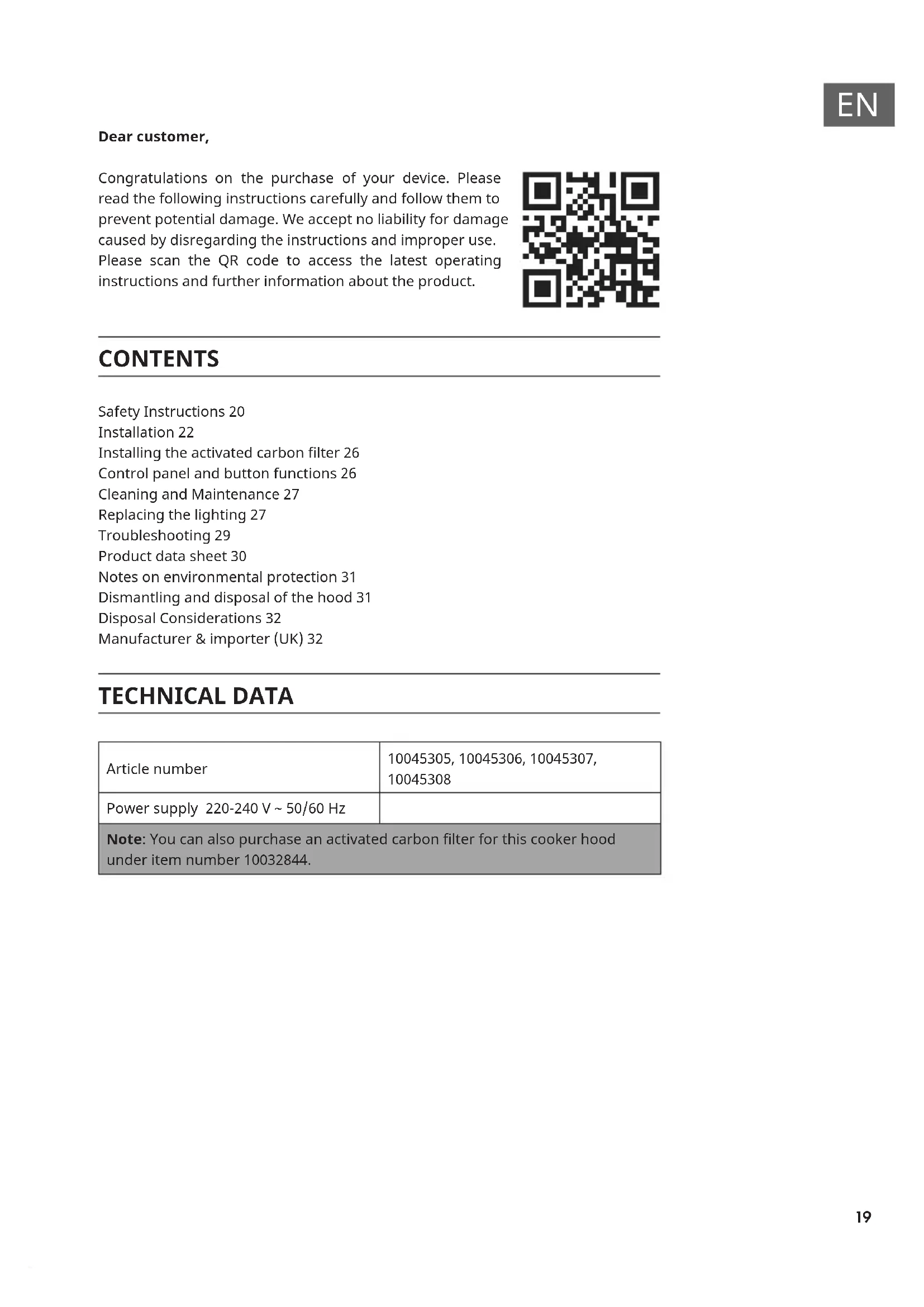
Dear customer, Congratulations on the purchase of your device. Please read the following instructions carefully and follow them to prevent potential damage. We accept no liability for damage caused by disregarding the instructions and improper use. Please scan the QR code to access the latest operating instructions and further information about the product. CONTENTS Safety Instructions 20 Installation 22 Installing the activated carbon lter 26 Control panel and button functions 26 Cleaning and Maintenance 27 Replacing the lighting 27 Troubleshooting 29 Product data sheet 30 Notes on environmental protection 31 Dismantling and disposal of the hood 31 Disposal Considerations 32 Manufacturer & importer (UK) 32 TECHNICAL DATA Article number 10045305, 10045306, 10045307,
Power supply 220-240 V ~ 50/60 Hz Note: You can also purchase an activated carbon lter for this cooker hood under item number 10032844.20
- Read all instructions carefully before use and keep this user manual in a safe place for future reference.
- The installation work may only be carried out by an electrician or a qualied person. Before using the cooker hood, make sure that the voltage (V) and frequency (Hz) indicated on the cooker hood correspond to the voltage and frequency of the power supply in your household.
- We accept no liability for damage caused by improper use or installation.
- Children under 8 years of age must not use the cooker hood.
- The appliance is intended for use in the home and similar environments only. It is not intended for commercial use.
- Clean the appliance and the lter regularly to keep the appliance working eciently.
- Always disconnect the power plug from the socket before cleaning.
- Clean the appliance exactly as indicated in the operating instructions.
- Do not use an open re under the extractor hood.
- If the unit is not functioning normally, contact the manufacturer or a specialist company.
- Children from the age of 8 years and mentally, sensory and physically impaired persons may only use the device if they have been informed in detail about the functions and safety precautions by a supervisor responsible for them beforehand and understand the associated risks.
- If the power cord is damaged, it must be replaced by the manufacturer, an authorised specialist company or a similarly qualied person.
- If the cooker hood is used with cookers that burn gas or other fuels, there must be adequate ventilation in the room.
- Do not ambé under the extractor hood.
- Caution: The surface of the unit may become hot during operation. Important instructions for installation
- The air must not be discharged into a ue used for extracting ue gases from gas or other fuels (does not apply to appliances that only return the air to the room).
- Observe all regional regulations for the installation of ventilation systems.21
Important notes on exhaust air operation WARNING Danger of poisoning from recirculated exhaust gases! Do not operate the appliance in extract air mode if it is operated together with a room air-dependent replace and sucient air circulation is not guaranteed. Room air-dependent replaces such as gas, oil, wood or coal heaters, boilers or instantaneous water heaters draw the air from the room and lead it outdoors through an exhaust pipe or chimney. In extract air mode, air is extracted from the kitchen and neighbouring rooms. Without sucient supply air, negative pressure is created. Toxic gases from the chimney or exhaust pipe can be sucked back into the living rooms.
- Make sure that sucient fresh air supply is guaranteed and that the air can circulate.
- A supply air/exhaust air wall box is not sucient to ensure compliance with the limit value. Safe operation is only possible if the negative pressure at the location of the replace does not exceed 4 Pa (0.04 mbar). This can be achieved if the air required for combustion can ow in through non-closable openings in doors and windows in conjunction with a supply air / exhaust air wall box. In any case, have a master chimney sweep advise you and assess the entire ventilation system of the house. If necessary, they can tell you the necessary measure for ventilation. If the cooker hood is used exclusively in recirculation mode, operation is possible without restriction. Important note on dismantling the unit
- Disassembly is the same as installation/assembly in reverse order.
- Have a second person help you during disassembly to avoid injury.22
INSTALLATION Preparation If you have an extractor to the outside, you can install the extractor hood as shown in the picture on the right. The ue should have a diameter of at least 150 mm and be made of enamel, aluminium or a exible, heat-resistant tube.
- Switch off the device before installation and pull the power plug out.
- The extractor hood should be placed at a height of 65-75 cm above the hob. Installation with exhaust air Note: Observe the safety instructions for operating the unit when the air is discharged to the outside. If the cooker hood is in operation at the same time as an appliance that draws its energy from a source other than electricity, the negative pressure in the room must not exceed 4 Pa (4 x 10⁻⁵ bar). Installation with convection function If you do not have an outside vent, install an activated carbon lter before using the unit. Important notes for the installation of exhaust air pipes The following rules must be strictly observed to guarantee optimum air extraction: Failure to follow these instructions will reduce the performance and increase the noise level of the cooker hood.
- Lay the exhaust pipe as short and straight as possible.
- Do not use a smaller exhaust pipe and do not constrict it.
- When using exible pipes, the pipe must always be installed tightly in order to minimise pressure loss.
- All installation work must only be carried out by a qualied electrician or a qualied person.
- Do not connect the hood's exhaust pipe to an existing ventilation system that is being used for another device, such as a replace.23
- The angle of the bend of the exhaust air pipe should not be less than 120°. Align the pipe horizontally. Alternatively, the pipe should go up from the starting point and be led to an outer wall.
- After installation, make sure that the cooker hood is horizontal in order to prevent grease from collecting on one side.
- Make sure that the exhaust duct selected for installation complies with the relevant standards and is re resistant. Installation of the sloping hood Drill 3 x 8 mm holes for the wall bracket. Fix the wall bracket to the wall with the supplied dowels and screws. Lift the extractor hood and hang it on the wall bracket. Borehole Dowel Holder Screws (4 mm x 30 mm)24
- Open the glass plate (1) and remove the metal grease lter (2-3).
- Mark the four mounting holes on the inside of the hood.
- Remove the extractor hood again. Drill four 8 mm diameter holes in the wall at the marked locations and insert the dowels into the holes.
- Hang the extractor hood on the wall bracket and fasten it to the dowels with the screws from the inside of the hood (4).
- Connect the exhaust hose to the outlet (5). Chimney installation
- Slide the upper chimney section into the lower chimney section. Pay attention to the position of the ventilation slots - depending on the use for exhaust or recirculation (see illustration).
- Attach the lower wall bracket to the lower part of the chimney. Exhaust air Circulating air Upper part of the chimney (inside) Lower part of chimney (outside) Wall mount25
- Place the chimney on the hood.
- Mark the mounting holes for the lower wall bracket on the wall and pre-drill at the marked locations.
- Fix the lower wall bracket to the wall with 2 dowels and screws (4 mm x 30 mm).
- Pull out the upper part of the chimney to the desired height.
- Mark the mounting holes for the upper wall bracket on the wall and pre-drill at the marked locations.
- Fix the upper wall bracket to the drilled positions on the wall using 2 dowels and 2 screws ST4 x 30 mm.
- Fasten the upper part of the chimney to the wall bracket with 2 screws ST4 x 8 mm. Dowel Screw 4 mm x 8 mm Screw 4 mm x 30 mm Wall mount26
Note: An activated carbon lter is only required for recirculation mode. If you are using the hood in extraction mode, remove the activated carbon lter. Remove the metal grease lter. The activated carbon lter is divided into two and is mounted on the right and left of the motor. Check that the teeth correspond with the direction of rotation of the respective side. Turn the activated carbon lter onto the motor housing (normally clockwise). Replace the metal grease lter.
CONTROL PANEL AND BUTTON FUNCTIONS
Switch motor on/off Increase fan speed Decrease fan speed Switch light on/off Displays the fan speed: 1=low, 2=medium, 3=high Activate fast timer: Press the + and + buttons simultaneously and hold the two buttons for 1 second. The digital display will ash and the device will begin a 5 minute countdown. After 5 minutes, the motor and light will turn off automatically and the buzzer will sound for 1 second.27
CLEANING AND MAINTENANCE
Switch off the extractor hood and pull the plug out of the socket before cleaning and maintenance. The outer surfaces are susceptible to scratches and stains. Therefore, do not use scouring agents for cleaning and wipe away residues of alkaline or acidic substances (lemon juice, vinegar) immediately after cleaning. Stainless steel surfaces The stainless steel must be cleaned regularly to ensure a long service life. Use stainless steel cleaner for this purpose. Always wipe along the grain of the stainless steel to prevent criss-crossing scratch marks. Control panel interface The control panel can be cleaned with a damp cloth and mild dishwashing detergent. Before cleaning, make sure the cloth is clean and well wrung out. Use a dry, soft cloth to remove excess moisture after cleaning. Monthly cleaning of the grease lters Clean the lter every month to avoid a re hazard. The lter collects grease, smoke and dust and thus inuences the eciency of the cooker hood. If the lter is not cleaned, grease residues will collect there. Clean the lter with water and a little washing-up liquid and let it air dry afterwards.
- The lighting may only be replaced by a qualied electrician.
- Before opening the device, unplug all power connections.
- Always allow the lighting to cool down before replacing it.
- Always use gloves or a cloth to avoid direct contact with your hands.
- Direct contact can shorten the life of the lighting.28
Replacing E14 bulb Switch off the device immediately and pull the power plug out. Remove the light cover by unscrewing the 2 screws. Unscrew the light bulb. Replace with a bulb of the same type and wattage. Replacing the LED light
- Switch off the device immediately and pull the power plug out.
- Locate the location of the lamp brackets.
- On some models you need to remove the grease lters to nd the lamp holders. On some other models, the lamp holders are covered by a light screen. Unscrew the light screen before replacing.
- Remove the screws on the LED board and brackets, separate and carefully insert the new light. For round LED lights For LED lights with light screen Note: Remember to reassemble everything after replacing the new lamp and x all screws in the same position. Always replace the light with the same type and amperage.29
TROUBLESHOOTING Problem Potential cause Solution The light turns on but the motor does not run. The ventilation is blocked. Remove the blockage. The capacitor is broken. Have the capacitor replaced. The motor is broken. Have the motor replaced. The motor smells strange. Have the motor replaced. The light is off and the motor does not run. The light is broken. Have the light replaced. The plug is loose. Plug the power plug securely into the wall socket. The housing vibrates. The rotor blade of the fan is damaged. Replace the blade. The motor is not rmly seated. Fasten the motor. The casing is loosely hanging. Fasten the housing. The air is not being properly extracted. The distance between the cooker and the extractor hood is too far. Reduce the distance. Too much air circulation through open windows and doors. Make sure that there is no draught.30
Information according to Regulation (EU) No 65/2014 Measurement and calculation methods according to EN 61591:1997+A1:2006+A2:2 011+A11:2014+A12:2015 Article number 10045305, 10045306, 10045307, 10045308 Designation Symbol Value Unit Annual energy consumption AEC hood
Class for grease separation eciency
Air ow at minimum and at maximum speed in normal operation, excluding operation on the intensive or fast speed setting 176.0/246.9 m³/h Air ow when operating on the intensive or fast speed setting
A-rated airborne noise emissions at minimum and maximum available speed during normal operation 49/57 dB A-rated airborne noise emissions during operation at the intensive or high-speed stage - dB Power consumption in off-mode P
Power consumption in standby mode
- Make sure there is sucient air supply during cooking so that the cooker hood can work eciently and with low operating noise.
- Adjust the fan speed to the amount of steam produced while cooking. Use the intensive mode only when necessary. The lower the fan speed, the less energy is consumed.
- If large amounts of steam are produced when cooking, select a higher fan speed in time. If the cooking steam has already spread throughout the kitchen, the cooker hood must be operated for longer.
- Switch off the cooker hood when it is no longer needed.
- Switch off the lighting when it is no longer needed.
- Clean the lter at regular intervals and replace it if necessary to increase the effectiveness of the ventilation system and prevent re hazards.
- Always put the lid on when cooking to reduce cooking steam and condensation.
DISMANTLING AND DISPOSAL OF THE HOOD
- Make sure that the exhaust hood is completely switched off.
- Pull the plug out of the socket.
- Remove the hood from the wall or cabinet.
- Remove the lter. Dispose of the lters at a collection point for the recycling of waste electrical and electronic equipment.
- Remove the motor. Dispose of the motor at a collection point for the recycling of waste electrical and electronic equipment.
- Dispose of the rest of the exhaust hood at your local recycling centre.32
DISPOSAL CONSIDERATIONS If there is a legal regulation in your country regarding the disposal of electrical and electronic equipment, this symbol on the product or on the packaging indicates that this product must not be disposed of with household waste. Instead, it must be taken to a collection point for the recycling of electrical and electronic equipment. By disposing of this product in accordance with the regulations, you protect the environment and the health of those around you from negative consequences. For information on recycling and disposal of this product, contact your local government or household waste disposal service. MANUFACTURER & IMPORTER (UK) Manufacturer: Chal-Tec GmbH, Wallstrasse 16, 10179 Berlin, Germany. Importer for Great Britain: Berlin Brands Group UK Limited PO Box 42 272 Kensington High Street London, W8 6ND United Kingdom33