LDX1 - Measuring tool MAKITA - Free user manual and instructions
Find the device manual for free LDX1 MAKITA in PDF.



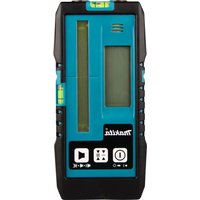
| Product Type | Laser Detector |
| Brand | Makita |
| Model | LDX1 |
| Range | 2 m - 80 m (depending on light conditions) |
| Accuracy (switchable) | ±1.0 mm / ±3.0 mm |
| Detection Field | 85 mm |
| Detectable Spectrum | 635 nm ± 5 nm red, 525 nm ± 5 nm green (Class 2) |
| Auto Shut-off | 30 min without detection |
| Backlight | Front and rear |
| Acoustic Signal | 100 dB / 80 dB / 0 dB (switchable) |
| Protection Class | IP65 |
| Power Supply | 2 x AA 1.5 V (alkaline recommended) |
| Battery Life | More than 40 hours |
| Dimensions (L x W x H) | 158 x 73 x 26 mm |
| Weight (with batteries) | 250 g |
| Operating Temperature | -10 °C to +50 °C |
| Storage Temperature | -25 °C to +70 °C |
| Cleaning | Blow dust off optics, soft lint-free cloth (water or pure alcohol) |
| Safety | Integrated magnets: do not use near a pacemaker |
| Disposal | Do not dispose with household waste; comply with local regulations |
Frequently Asked Questions - LDX1 MAKITA
User questions about LDX1 MAKITA
0 question about this device. Answer the ones you know or ask your own.
Ask a new question about this device
Download the instructions for your Measuring tool in PDF format for free! Find your manual LDX1 - MAKITA and take your electronic device back in hand. On this page are published all the documents necessary for the use of your device. LDX1 by MAKITA.
USER MANUAL LDX1 MAKITA
WARNING:
For your personal safety, READ and UNDERSTAND before using. SAVE THESE INSTRUCTIONS FOR FUTURE REFERENCE.
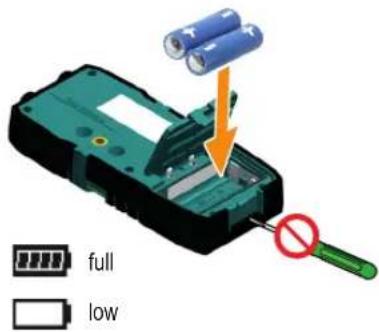
Insert batteries:Overview:
Attach bracket:
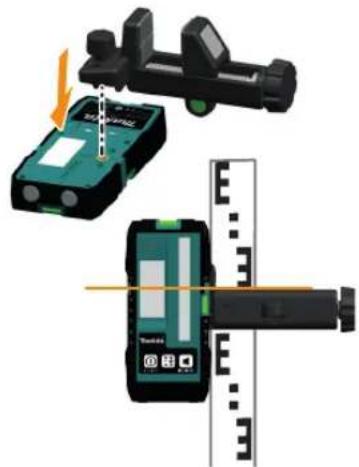
Operation:
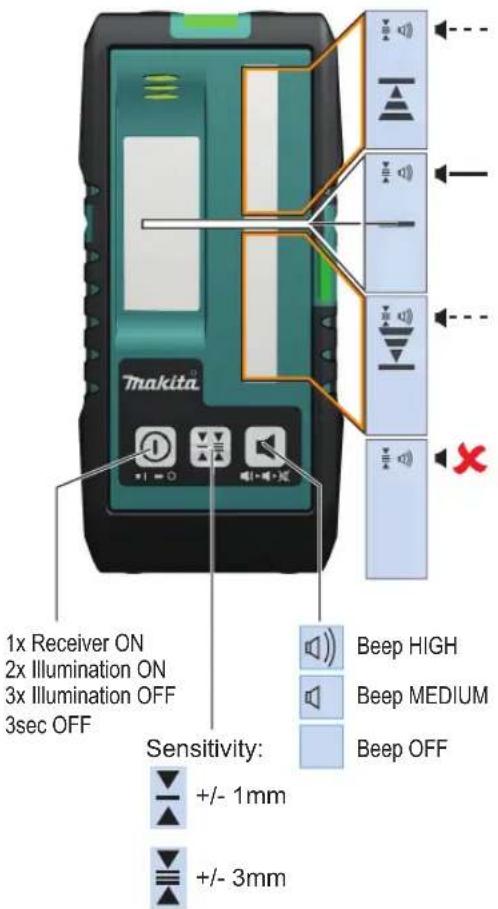
Operating Instructions
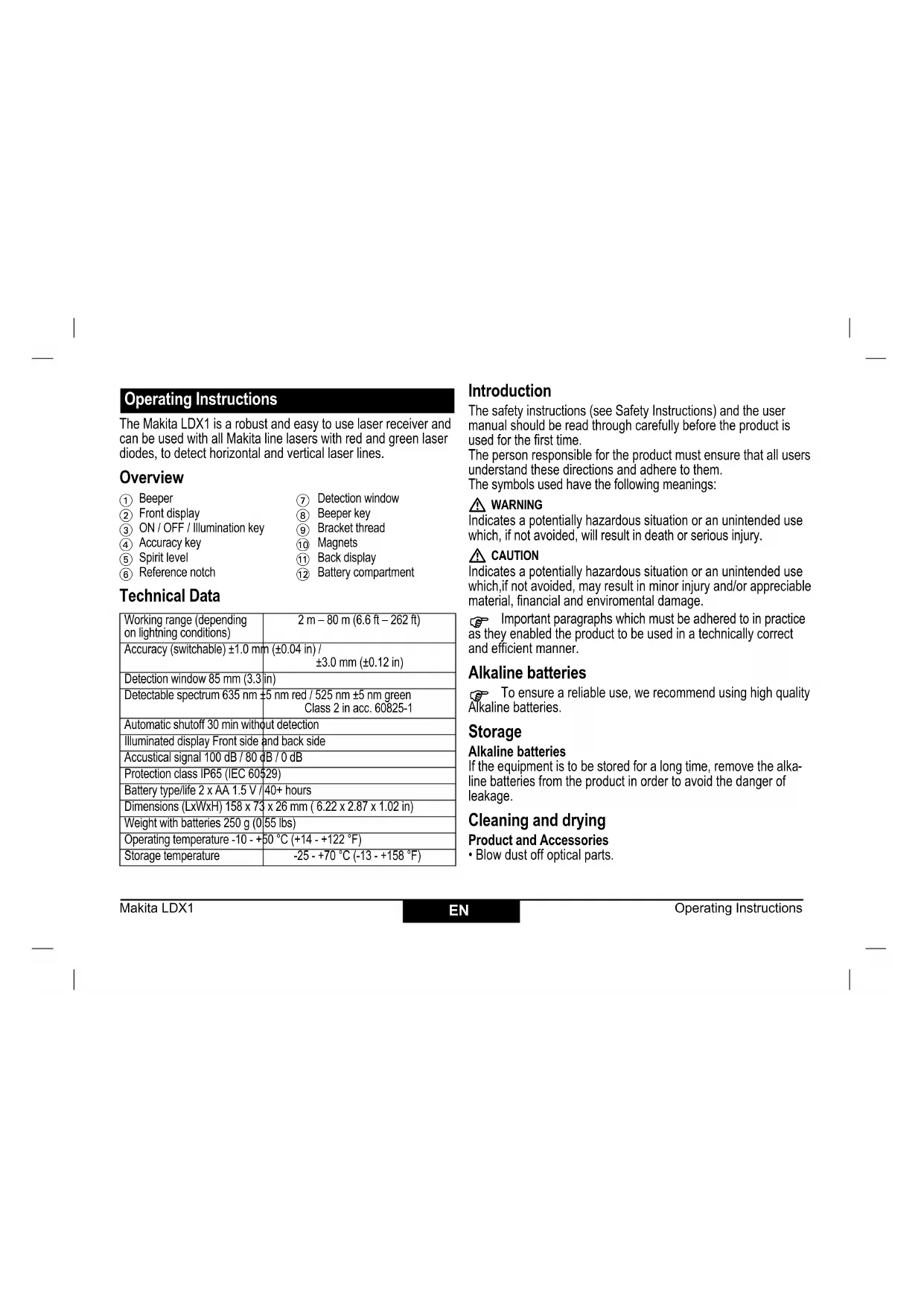
The Makita LDX1 is a robust and easy to use laser receiver and can be used with all Makita line lasers with red and green laser diodes, to detect horizontal and vertical laser lines.
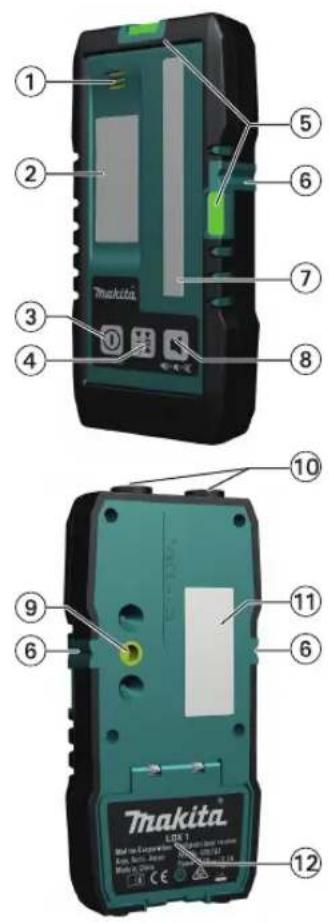
Overview
① Beeper
⑦ Detection window
② Front display
⑧ Beeper key
③ ON / OFF / Illumination key
⑨ Bracket thread
④ Accuracy key
⑩ Magnets
⑤ Spirit level
⑪ Back display
⑥ Reference notch
⑫ Battery compartment
Technical Data
| Working range (depending on lightning conditions) | 2 m – 80 m (6.6 ft – 262 ft) |
| Accuracy (switchable) ±1.0 mm (±0.04 in) / ±3.0 mm (±0.12 in) | |
| Detection window 85 mm (3.3 in) | |
| Detectable spectrum 635 nm ±5 nm red / 525 nm ±5 nm green Class 2 in acc. 60825-1 | |
| Automatic shutoff 30 min without detection | |
| Illuminated display Front side and back side | |
| Accustical signal 100 dB / 80 dB / 0 dB | |
| Protection class IP65 (IEC 60529) | |
| Battery type/life 2 x AA 1.5 V / 40+ hours | |
| Dimensions (LxWxH) 158 x 73 x 26 mm (6.22 x 2.87 x 1.02 in) | |
| Weight with batteries 250 g (0 55 lbs) | |
| Operating temperature -10 - +50 °C (+14 - +122 °F) | |
| Storage temperature | -25 - +70 °C (-13 - +158 °F) |
Introduction
The safety instructions (see Safety Instructions) and the user manual should be read through carefully before the product is used for the first time.
The person responsible for the product must ensure that all users understand these directions and adhere to them.
The symbols used have the following meanings:
WARNING
Indicates a potentially hazardous situation or an unintended use which, if not avoided, will result in death or serious injury.
CAUTION
Indicates a potentially hazardous situation or an unintended use which, if not avoided, may result in minor injury and/or appreciable material, financial and environmental damage.
Important paragraphs which must be adhered to in practice as they enabled the product to be used in a technically correct and efficient manner.
Alkaline batteries
To ensure a reliable use, we recommend using high quality Alkaline batteries.
Storage
Alkaline batteries
If the equipment is to be stored for a long time, remove the alkaline batteries from the product in order to avoid the danger of leakage.
Cleaning and drying
Product and Accessories - Blow dust off optical parts
- Never touch the glass with your fingers.
- Use only a clean, soft, lint-free cloth for cleaning. If necessary, moisten the cloth with water or pure alcohol.
Safety instructions
The person responsible for the instrument must ensure that all users understand these directions and adhere to them.
Areas of responsibility
Responsibilities of the manufacturer:
The manufacturer is responsible for supplying the product, including the User Manual in a completely safe condition. The manufacturer is not responsible for third party accessories.
Responsibilities of the person in charge of the instrument:
The person in charge of the instrument has the following duties:
- To understand the safety instructions on the product and the instructions in the User Manual.
- To be familiar with local safety regulations relating to accident prevention.
Noise emissions
CAUTION
The A-weighted sound pressure level of the signal sound is > 80 db(A) at a distance of one meter.
Do not hold the laser receiver directly to your ear!
Hazards in use
CAUTION

Flat batteries must not be disposed of with household waste. Care for the environment and take them to the collection points provided in accordance with national or local regulations.
The product must not be disposed of with the household waste. Dispose of the product appropriately in accordance with the
national regulations in force in your country. Always prevent access to the product by unauthorized personnel.
WARNING:
Laser receiver should not be used in the vicinity of pacemaker because of integrated magnets which can affect the function of the pacemaker.
Electromagnetic Compatibility (EMC)
WARNING
The device conforms to the most stringent requirements of the relevant standards and regulations. However, the possibility of causing interference in other devices cannot be totally excluded.
FCC statement (applicable in U.S.)
WARNING
This equipment has been tested and found to comply with the limits for a Class B digital device, pursuant to part 15 of the FCC Rules. These limits are designed to provide reasonable protection against harmful interference in a residential installation. This equipment generates, uses and can radiate radio frequency energy and, if not installed and used in accordance with the instructions, may cause harmful interference to radio communications.
However, there is no guarantee that interference will not occur in a particular installation. If this equipment does cause harmful interference to radio or television reception, which can be determined by turning the equipment off and on, the user is encouraged to try to correct the interference by one or more of the following measures:
- Reorient or relocate the receiving antenna.
-
Increase the separation between the equipment and receiver.
-
Connect the equipment into an outlet on a circuit different from that to which the receiver is connected.
- Consult the dealer or an experienced radio/TV technician for help.
This device complies with part 15 of the FCC Rules. Operation is subject to the following two conditions:
• This device may not cause harmful interference, and
- this device must accept any interference received, including interference that may cause undesired operation.
FCC Radiation Exposure Statement
The radiated rf output power of the instrument is below the FCC radio frequency exposure limits for portable devices according to KDB 447498.
ISED Statement (applicable in Canada)
WARNING
This device complies with Industry Canada's license-exempt RSSs. Operation is subject to the following two conditions:
• This device may not cause interference and
- this device must accept any interference, including interference that may cause undesired operation of the device.
Radio Frequency (RF) Exposure Compliance Statement
The radiated rf output power of the instrument is below the Health Canada's Safety Code 6 exclusion limit for portable devices (radiated element separation distance between the radiating element and user and/or bystander is below 20 cm).
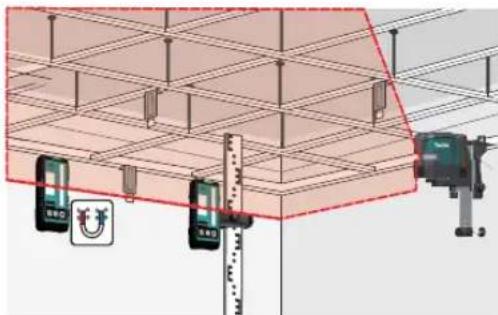
Work vertical & horizontal: Strong attachment:
![graph TD A["Left Image"] --> B["Right Left Device Icon"] B --> C["Device Icon with Red Arrow"] C --> D["Device Icon with Orange Arrow"] D --> E["Device Icon with Green Arrow"] E --> F["Downturn Icon with Red Arrow"] F --> G["Device Icon with Green Arrow"] G --> H["Downturn Icon with Green Arrow"]](/content/2026/04/638358/images/e5887d704be51dae450ff1b7ea883a13cd93f3c2ebd4bba5abbe6c7022e2e758.jpg)
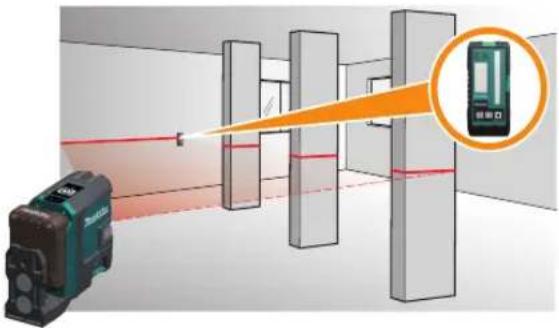
Long range applications:
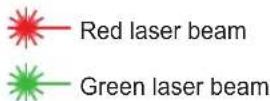
Working spectrum:
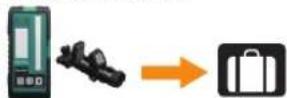
Transportation:
Makita Corporation Anjo, 3-11-8, Sumiyoshi-cho, Aichi 446-8502, Japan
Makita, Jan-Baptist Vinkstraat 2 3070, Belgium

- WARNING
- OPERATING INSTRUCTIONS
- OVERVIEW
- INTRODUCTION
- CAUTION
- ALKALINE BATTERIES
- STORAGE
- CLEANING AND DRYING
- SAFETY INSTRUCTIONS
- AREAS OF RESPONSIBILITY
- RESPONSIBILITIES OF THE MANUFACTURER
- RESPONSIBILITIES OF THE PERSON IN CHARGE OF THE INSTRUMENT
- NOISE EMISSIONS
- HAZARDS IN USE
- ELECTROMAGNETIC COMPATIBILITY (EMC)
- FCC STATEMENT (APPLICABLE IN U.S.)
- FCC RADIATION EXPOSURE STATEMENT
- ISED STATEMENT (APPLICABLE IN CANADA)
- RADIO FREQUENCY (RF) EXPOSURE COMPLIANCE STATEMENT
Brand : MAKITA
Model : LDX1
Category : Measuring tool