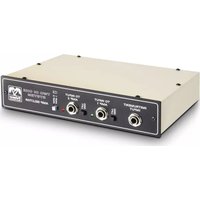
PTINOS - Receiver Palmer - Free user manual and instructions
Find the device manual for free PTINOS Palmer in PDF.



| Product type | Amplifier selector (Two-in-One) |
| Brand | Palmer |
| Model | PTINOS (TINO-SYSTEM) |
| Dimensions (W x D x H) | 220 x 165 x 44 mm (1 U, 1/2 rack width) |
| Weight | 1.26 kg |
| Power supply | 9 V DC regulated, 150 mA (power adapter included) |
| Input impedance | 1 MOhm |
| Maximum input level | 5.5 V RMS (+17 dBu) |
| Signal outputs (AMP1/AMP2) | Galvanic isolation via audio transformer, output impedance < 600 Ohms |
| Speaker selection | Power relay, 16 A max |
| Internal power load | 2 x 8 Ohms, max short-term power 2 x 45 W, long-term 5 W |
| Enclosure | Painted steel, 3 mm metal front panel, black |
| Main functions | Switching two amps to one speaker cabinet, footswitch or external selection, impedance buffering, tube amp protection (dummy load), ground lift (GND Lift) |
| LED indicators | Green (AMP1) and Red (AMP2) for selected amp |
| Connections | Instrument input, TO AMP1/2 outputs, SPK OUT AMP1/2 speaker inputs, SPEAKER CABINET output, REMOTE CONTROL jack (footswitch/external), 9V DC input |
| Maintenance and cleaning | Clean with a dry cloth only |
| Safety instructions | Do not open, disconnect before cleaning, use only with recommended accessories, observe sound pressure levels (hearing damage risk) |
| Spare parts and repairability | No user-serviceable parts; refer repairs to qualified authorized personnel |
| Warranty | 2 years (manufacturer), valid in Europe |
| General information | Designed for professional use; compatible with tube and transistor amps; amp and speaker impedances must match |
Frequently Asked Questions - PTINOS Palmer
User questions about PTINOS Palmer
0 question about this device. Answer the ones you know or ask your own.
Ask a new question about this device
Download the instructions for your Receiver in PDF format for free! Find your manual PTINOS - Palmer and take your electronic device back in hand. On this page are published all the documents necessary for the use of your device. PTINOS by Palmer.
USER MANUAL PTINOS Palmer
PTINOS (TINO-SYSTEM) is a functionally identical version of the PTINO (TWO IN ONE, AMP SELECTOR switch for two amps to one speaker). The operation can also be done either by a footswitch or a switching system.
CONCEPT
Ambitious guitarists often prefer different amps for different basic sounds. For lead and crunch tones, the amp distortion of less powerful amplifiers is especially appreciated. However, for clean settings, this kind of amplifier provides insufficient volume. To meet the different requirements, it would therefore be ideal to use two amplifiers on stage. However, this increases the cost considerably, since each amplifier will have to be associated with compatible loudspeakers to be placed on the stage. In order to reduce the time and effort needed, Palmer has developed the "TWO IN ONE" switching system, or TINO. It allows you to use two amplifiers in turn with only one speaker. The usual problems, such as ground loops between two amplifiers, as well as the requirement that tube amplifiers always need a load on the output, have been solved through clever design. Of course, TWO IN ONE also works with transistor amplifiers, or a combination of tubes and transistor amps. Except for the external power supply, the entire electronics system fits in a 1 U 9.5" chassis. If the switch cannot be done with a switching system, a standard footswitch can be connected to the corresponding 6.3 mm jack. (Requires a switch, not push-buttons!)
P-Tino routes the guitar signal to the chosen amplifier, while the second unused amplifier is turned off to prevent unwanted interference. (As if the potentiometer on the guitar was switched off). The gain from the instrument input to output is one (Unity Gain). The built-in buffer only converts the impedance, so that a high-impedance guitar becomes less prone to interference. When the guitar signal is switched, the speaker is switched simultaneously, while the speaker output from the mute amplifier is connected to a load (Dummy Load). Therefore, tube amplifiers are absolutely safe from dangerous idling.
If you connect two amplifiers with one another, a heavy buzzing sound often overlays the guitar signal. This undesirable effect is known as ground loop and occurs between mains-operated devices because of double grounding. The TWO IN ONE prevents this from happening by decoupling the outputs to the amplifiers using high-quality isolating repeaters. A sliding switch-over between the amplifiers also ensures that the process occurs click-free and without interruption.
SAFETY INFORMATION
- Please read these instructions carefully.
- Keep all information and instructions in a safe place.
- Follow the instructions.
- Observe all safety warnings. Never remove safety warnings or other information from the equipment.
- Use the equipment only in the intended manner and for the intended purpose.
- Use only sufficiently stable and compatible stands and/or mounts (for fixed installations). Make certain that wall mounts are properly installed and secured. Make certain that the equipment is installed securely and cannot fall down.
- During installation, observe the applicable safety regulations for your country.
- Never install and operate the equipment near radiators, heat registers, ovens or other sources of heat. Make certain that the equipment is always installed so that is cooled sufficiently and cannot over-heat.
- Never place sources of ignition, e.g., burning candles, on the equipment.
- Ventilation slits must not be blocked.
- Do not use this equipment in the immediate vicinity of water (does not apply to special outdoor equipment - in this case, observe the special instructions noted below. Do not expose this equipment to flammable materials, fluids or gases.
- Make certain that dripping or splashed water cannot enter the equipment. Do not place containers filled with liquids, such as vases or drinking vessels, on the equipment.
- Make certain that objects cannot fall into the device.
- Use this equipment only with the accessories recommended and intended by the manufacturer.
- Do not open or modify this equipment.
- After connecting the equipment, check all cables in order to prevent damage or accidents, e.g., due to tripping hazards.
- During transport, make certain that the equipment cannot fall down and possibly cause property damage and personal injuries.
- If your equipment is no longer functioning properly, if fluids or objects have gotten inside the equipment or if it has been damaged in another way, switch it off immediately and unplug it from the mains outlet (if it is a powered device). This equipment may only be repaired by authorized, qualified personnel.
- Clean the equipment using a dry cloth.
- Comply with all applicable disposal laws in your country. During disposal of packaging, please separate plastic and paper/cardboard.
- Plastic bags must be kept out of reach of children.
FOREQUIPMENT THAT CONNECTS TO THE POWER MAINS:
-
CAUTION: If the power cord of the device is equipped with an earthing contact, then it must be connected to an outlet with a protective ground. Never deactivate the protective ground of a power cord.
-
If the equipment has been exposed to strong fluctuations in temperature (for example, after transport), do not switch it on immediately. Moisture and condensation could damage the equipment. Do not switch on the equipment until it has reached room temperature.
- Before connecting the equipment to the power outlet, first verify that the mains voltage and frequency match the values specified on the equipment. If the equipment has a voltage selection switch, connect the equipment to the power outlet only if the equipment values and the mains power values match. If the included power cord or power adapter does not fit in your wall outlet, contact your electrician.
- Do not step on the power cord. Make certain that the power cable does not become kinked, especially at the mains outlet and/or power adapter and the equipment connector.
- When connecting the equipment, make certain that the power cord or power adapter is always freely accessible. Always disconnect the equipment from the power supply if the equipment is not in use or if you want to clean the equipment. Always unplug the power cord and power adapter from the power outlet at the plug or adapter and not by pulling on the cord. Never touch the power cord and power adapter with wet hands.
- Whenever possible, avoid switching the equipment on and off in quick succession because otherwise this can shorten the useful life of the equipment.
- IMPORTANT INFORMATION: Replace fuses only with fuses of the same type and rating. If a fuse blows repeatedly, please contact an authorised service centre.
- To disconnect the equipment from the power mains completely, unplug the power cord or power adapter from the power outlet.
- If your device is equipped with a Volex power connector, the mating Volex equipment connector must be unlocked before it can be removed. However, this also means that the equipment can slide and fall down if the power cable is pulled, which can lead to personal injuries and/or other damage. For this reason, always be careful when laying cables.
- Unplug the power cord and power adapter from the power outlet if there is a risk of a lightning strike or before extended periods of disuse.
CAUTION:

Never remove the cover, because otherwise there may be a risk of electric shock. There are no user serviceable parts inside. Have repairs carried out only by qualified service personnel.

The lightning flash with arrowhead symbol within an equilateral triangle is intended to alert the user to the presence of uninsulated "dangerous voltage" within the product's enclosure that may be of sufficient magnitude to constitute a risk of electrical shock.

The exclamation mark within an equilateral triangle is intended to alert the user to the presence of important operating and maintenance instructions.
CAUTION - HIGH VOLUME LEVELS WITH AUDIO PRODUCTS!
This equipment is intended for professional use. Therefore, commercial use of this equipment is subject to the respectively applicable national accident prevention rules and regulations. As a manufacturer, Adam Hall is obligated to notify you formally about the existence of potential health risks.
Hearing damage due to high volume and prolonged exposure: When in use, this product is capable of producing high sound-pressure levels (SPL) that can lead to irreversible hearing damage in performers, employees, and audience members. For this reason, avoid prolonged exposure to volumes in excess of 90 dB.
CAUTION! IMPORTANT INFORMATION ABOUT LIGHTING PRODUCTS
- Do not look into the beam from a distance of less than 40 cm.
- Do not stare into the beam for extended periods at short-to-medium distances.
- Do not view the beam directly with optical instruments such as magnifiers.
- Under some circumstances, stroboscopic effects may trigger epileptic seizures in sensitive individuals! For this reason, persons who suffer from epilepsy should always avoid places where strobe lights are used.
DEFINE YOUR TONE

SETUP


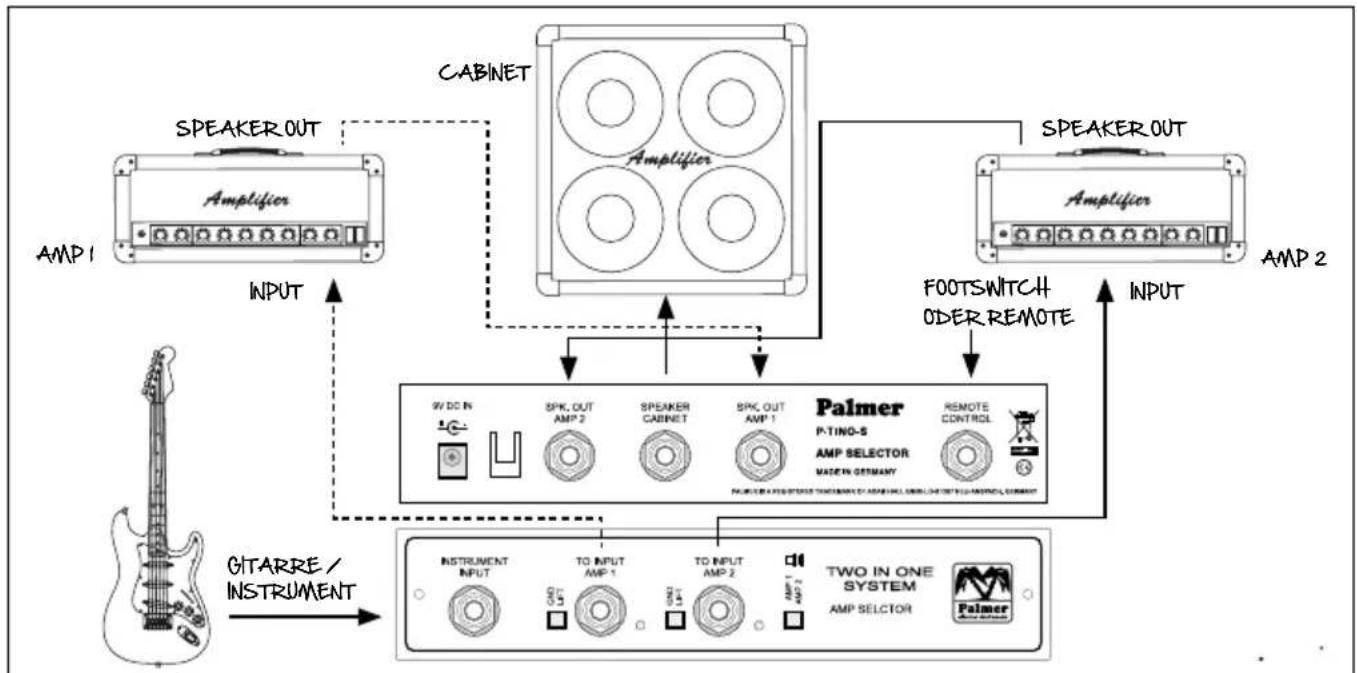
Setup and wiring of the TWO IN ONE switching system require some care to avoid malfunction and as a result, defects to the amplifiers. For tube amplifiers, the connection to the speaker cabinet plays a significant role. For maximum safety, the loudspeaker and both amplifiers should have the same input/output impedance. So, if the cabinet has a input value of 16 ohms, a 16 ohms output should be present or adjusted on both amplifiers.
In addition to the usual guitar cables, the following cables are required:
2 good quality, shielded instrument cables and 3 speaker cables. The required length will be determined by the positioning of the TINO SYSTEM. In general, standard cable lengths of 3 metres should be sufficient. In order to avoid wrong connections, it is advantageous for the cables to be clearly marked, so as not to confuse instrument cables with speaker cables, or the speaker cables and those between the amplifiers and the outputs of the TINO SYSTEM. If the TINO SYSTEM is switched using a SWITCHING SYSTEM (Switcher), a jack to jack cable to connect the two devices is also required. For this purpose, a simple speaker cable or instrument cable can be used. In the interests of short cable runs, the device should be placed as close to the amplifiers as possible; however, a placement immediately on top of an amplifier should be avoided as it may cause a buzzing sound. As mentioned previously, a high quality audio transformer is used to prevent ground loops. Although this transformer is shielded, it will react to the presence of magnetic fields such as those emanating from the power transformer in the amplifier. If after the setup of the switching system, unusual humming sounds occur, which cannot be eliminated by the GND lift switch on the TINO SYSTEM, try to position on the unit in a different place. 50 cm to either side should suffice in most cases.
THE FOLLOWING WIRING SHOULD BE APPLIED WITH DISABLED AMPLIFIERS.
First, connect the supplied plug-in power supply with the TWO IN ONE SYSTEM. The corresponding socket is identified on the back as 2 „9V DC IN". For strain relief, the cable can be looped through the U-shaped cut-out next to the socket.
Once the unit is powered, and depending on the switch position, a green LED (3 AMP 1) or a red LED (3 AMP 2) lights up. Now connect the socket labelled 4 „TO AMP 1“ on the front panel with the input socket of the amplifier #1 To do this, use a shielded instrument cable. Next, the speaker output of this amplifier labelled 5 „SPK OUT AMP 1 (backpanel of the TINO) should be connected. To do this, use a speaker cable. In the same way, connect the amplifier #2. Now connect the speaker to the socket labelled 6 „SPEAKER CABINET“ (backpanel of the TINO).
Lastly, the connection to the switch must be made. On the back of the TINO SYSTEM, the socket 7 „REMOTE CONTROL“ has been provided for that purpose. As already mentioned, a switcher or a (on/off) footswitch can be connected here. Devices using relay outputs are best suited as switchers. The 7 REMOTE CONTROL socket is fitted with a switch contact. As soon as the socket is in use, the manual switch (3 AMP1 / 3 AMP2) on the front panel ceases to function.
Before turning on the amplifier, please double check the wiring. A short play with reduced volume is recommended. In the event of an incorrectly connected cable, the danger of damaging an amplifier is less when playing at low volume.
flowchart
graph TD
    A["AMP 1"] -->|SPEAKER OUT| B["Amplifier"]
    B --> C["CABINET"]
    C --> D["Amplifier"]
    D --> E["Speaker OUT"]
    E --> F["AMP 2"]
    G["GITARRE / INSTRUMENT"] --> H["Instrument INPUT"]
    H --> I["TO INPUT AMP 1"]
    H --> J["TO INPUT AMP 2"]
    H --> K["TWO IN ONE SYSTEM AMP SELECTOR"]
    L["SPK, OUT AMP 2"] --> M["Palmer P-TINO-5 AMP SELECTOR MADE IN GERMANY"]
    N["SPK, OUT AMP 1"] --> M
    O["SPK, OUT AMP 2"] --> M
    P["SPK, OUT AMP 1"] --> M
    Q["SPK, OUT AMP 2"] --> M
    R["SPK, OUT AMP 1"] --> M
    S["SPK, OUT AMP 2"] --> M
    T["SPK, OUT AMP 1"] --> M
    U["SPK, OUT AMP 2"] --> M
    V["SPK, OUT AMP 1"] --> M
    W["SPK, OUT AMP 2"] --> M
    X["SPK, OUT AMP 1"] --> M
    Y["SPK, OUT AMP 2"] --> M
    Z["SPK, OUT AMP 1"] --> M
    AA["SPK, OUT AMP 2"] --> M
    AB["FootSWITCH ODER REMOTE"] --> AC["Palmer P-TINO-5 AMP SELECTOR MADE IN GERMANY"]
    AD["Input"] --> AE["Ground"]
Next to the sockets for the power amplifier inputs, on the front panel, a pressure switch labelled 1 „GND LIFT“ can be found for each amp. In the down position, this switch disconnects the ground connection to the amplifier. As mentioned above, it can be used to prevent ground loops due to dual earthing. Since ground loops always depend on local conditions, it can be difficult to determine in advance which of the pressure switches are best to press. The switch positions that provide the least hum are the right ones. Here, it is a case of trial and error, since there is no danger of fatal damage.
At Palmer, we tested the TINO SYSTEM under various conditions and were always able to achieve a noise free result, unless an amplifier or other device in the chain generated hum internally. It is highly recommended to power the amplifiers and their associated devices from a power strip/distribution.
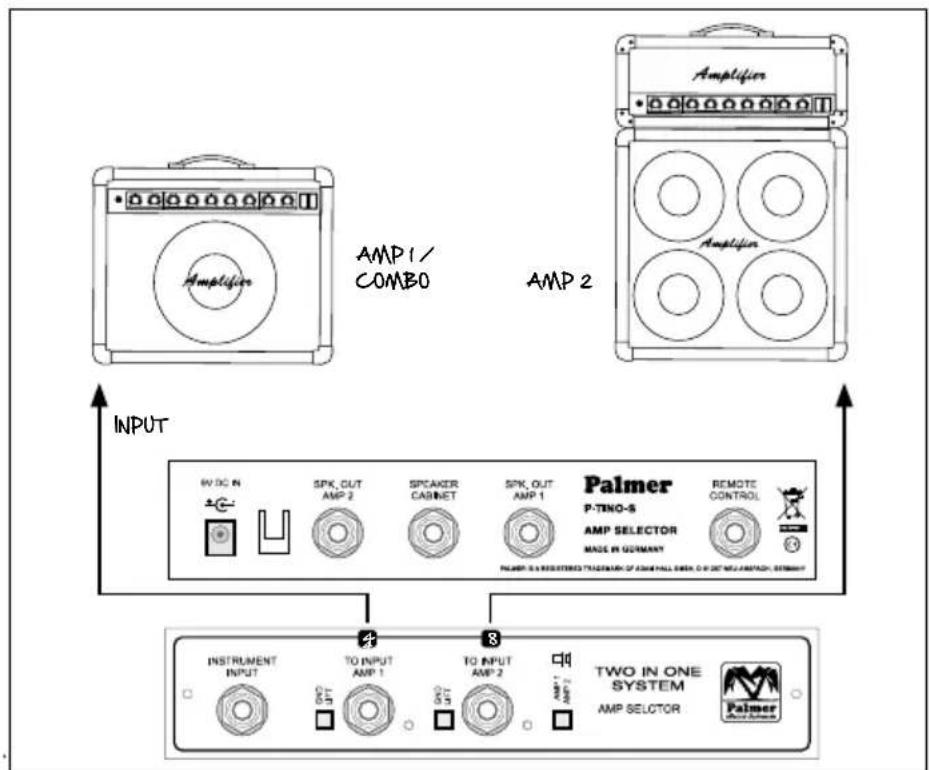
TINO SYSTEM CONNECTED AS SWITCHER A / B BOX
The device can also be used as an A / B box. For example, if you use two combo amplifiers with built-in speakers or amp heads with their own box, using the sockets 4 „TO AMP 1“ and 8 „TO AMP 2“ will provide the amplifiers with signal, while the speaker sockets remain unoccupied. THE FOLLOWING WIRING SHOULD BE APPLIED WITH DISABLED AMPLIFIERS.
flowchart
graph TD
    A["Amplifier"] --> B["AMP 1/ COMBO"]
    B --> C["AMP 2"]
    C --> D["Palmer P-TINO-5 AMP SELECTOR MADE IN GERMANY"]
    D --> E["TWO IN INPUT"]
    E --> F["INSTRUMENT INPUT"]
    F --> G["TO INPUT AMP 1"]
    G --> H["TO INPUT AMP 2"]
    H --> I["TWO IN ONE SYSTEM AMP SELECTOR"]
    I --> J["REMOTE CONTROL"]
    J --> K["OUTPUT INPUT"]
    style A fill:#f9f,stroke:#333
    style C fill:#ccf,stroke:#333
    style D fill:#cfc,stroke:#333
    style E fill:#fcc,stroke:#333
    style F fill:#cff,stroke:#333
    style G fill:#ffc,stroke:#333
    style H fill:#ffc,stroke:#333
    style I fill:#cfc,stroke:#333
    style J fill:#fcc,stroke:#333
TWO-IN-ONE SYSTEM
Active switching system for two guitar amps to one speaker.
Discrete FET-based preamplifier with unity gain (unity gain).
SPECIFICATIONS
Product Type: AMP selector
Input Impedance (Instrument Input: 1M ohm put):
Maximum Input Level: approx 5.5 Vrms (17 dBu)
Signal Outputs: AMP1, AMP2, galvanically isolated via isolating transformers
Output Impedance: 600 ohms
Switching Speakers: power relay 16 A
Internal Dummy Load: 2 x 8 ohm, 2 x 45 Watt Max short term load in operation for about 5 W
Power Supply: 9 V DC stabilised voltage, internally about 32 V Current Consumption approx. 150 mA
Mechanical Data: sheet steel housing, powder coated with 3 mm black eloxided front panel
Dimensions (W x D x H): 220 (9.5 inches) x 165 x 44 mm (1 U)
Weight: 1.26 kg
Subject to technical modifications without prior notice, because all of our products are continually tested and improved.
MANUFACTURER'S WARRANTY
This warranty extends to the Palmer branded product you purchased from Adam Hall. The statutory warranty rights against the vendor shall not be affected by this warranty. Rather, this warranty gives you additional independent claims against Adam Hall.
With this warranty, Adam Hall ensures that products you have purchased from Adam Hall or Adam Hall partners, under normal use, are free of defects in material or workmanship for a period of 5 years from the date of purchase, or 2 years from the date of purchase for tube amplifiers and guitar cabinets. The warranty period begins on the date of purchase. In order to assert a claim for warranty service, the proof of date of purchase is provided by the receipt bearing the date of purchase or the date of purchase on the delivery note. You are entitled to warranty service under the conditions and provisions set out in this document, if a repair within the warranty period is required.
This warranty applies only to the original purchaser of the products supplied by Adam Hall and is not transferable to any person to whom the property is transferred by the original purchaser.
Within the warranty period, the defective parts or the product from Adam Hall will be repaired or replaced. Under the terms of this warranty, all the replaced or removed components become the property of Adam Hall.
In the unlikely event that a product acquired from Adam Hall, repeatedly exhibits a defect, Adam Hall may decide, at its discretion, to replace this product with a comparable product of at least the same performance.
Adam Hall does not guarantee that the operation of this product will be uninterrupted or error-free. Adam Hall accepts no responsibility for any damage due to incorrect compliance with the instructions received in the delivery.
This warranty does not extend to:
- wearing parts (eg battery, tubes).
- devices that have had their serial number removed or damaged, or failed as a result of an accident
- inappropriate or abusive use or other external causes
• devices that were not used in accordance with the operating parameters defined in the user documentation shipped with the product
• devices that have been repaired using parts not made or distributed by Adam Hall
• devices that have been serviced, modified or repaired by someone other than Adam Hall or an authorised service partner.
These terms and conditions constitute the complete and exclusive warranty agreement between you and Adam Hall regarding the Adam Hall branded product you have purchased.
This warranty is valid only within Europe. Outside of Europe please contact our official distributors.
LIMITATION OF LIABILITY
If your Adam Hall branded hardware product fails to work as warranted above, your sole and exclusive remedy shall be repair or replacement. Adam Halls' maximum liability under this limited warranty is expressly limited to the lesser of the price you have paid for the product or the cost of repair or replacement of any components that malfunction under conditions of normal use.
Adam Hall is not liable for any damages caused by the product or the failure of the product, including any lost profits or savings or special, incidental, or consequential damages. Adam Hall is not liable for any claim made by a third party or made by you for a third party.
This limitation of liability applies whether damages are sought, or claims are made, under this Limited Warranty or as a tort claim (including negligence and strict product liability), a contract claim, or any other claim, and cannot be rescinded or changed by anyone. This limitation of liability will be effective even if you have advised Adam Hall or an authorized representative of Adam Hall of the possibility of any such damages, but not, however, in the event of claims for damages in connection with personal injuries.
This manufacturer's warranty grants you specific rights; depending on jurisdiction (nation or state), you may be entitled to additional claims. You are advised to consult applicable state or national laws for a full determination of your rights.
REQUESTING WARRANTY SERVICE
To request warranty service for the product, contact Adam Hall or the Adam Hall authorized reseller from which you purchased the product.
EC DECLARATION OF CONFORMTY
The equipment marketed by Adam Hall complies (where applicable) with the essential requirements and other relevant specifications of Directives 1999/5/EC (R&TTE), 2004/108/EC (EMC) und 2006/95/EC (LVD). Additional information can be found at www.adamhall.com.
PROPER DISPOSAL OF THIS PRODUCT
(WASTE ELECTRICAL AND ELECTRONIC EQUIPMENT)
(Valid in the European Union and other European countries with waste separation)
This symbol on the product, or the documents accompanying the product, indicates that this appliance may not be treated as household waste. This is to avoid environmental damage or personal injury due to uncontrolled waste disposal. Please dispose of this product separately from other waste and have it recycled to promote sustainable economic activity.
Household users should contact either the retailer where they purchased this product, or their local government office, for details on where and how they can recycle this item in an environmentally friendly manner. Business users should contact their supplier and check the terms and conditions of the purchase contract. This product should not be mixed with other commercial wastes for disposal
ENVIRONMENTAL PROTECTION AND ENERGY CONSERVATION
Energy conservation is an active contribution to environmental protection. Please turn off all unneeded electrical devices. To prevent unneeded devices from consuming power in standby mode, disconnect the mains plug.

natural_image
Abstract black ink blot pattern on white background (no text or symbols)DEFINE YOUR TONE
EINFÜHRUNG
flowchart
graph TD
    A["Amplifier"] -->|AMP1/COMBO| B["Palmer P.TINO-S AMP SELECTOR MADE IN OTDMANY"]
    C["Amplifier"] -->|AMP2| B
    D["INSTRUMENT INPUT"] --> E["TWO IN ONE SYSTEM AMP SELECTOR"]
    F["SPK, OUT AMP 2"] --> G["SPK, OUT AMP 1"]
    H["SPK, OUT AMP 2"] --> I["SPK, OUT AMP 1"]
    J["SPK, OUT AMP 2"] --> K["SPK, OUT AMP 1"]
    L["SPK, OUT AMP 2"] --> M["SPK, OUT AMP 1"]
    N["SPK, OUT AMP 2"] --> O["SPK, OUT AMP 1"]
    P["SPK, OUT AMP 2"] --> Q["SPK, OUT AMP 1"]
    R["SPK, OUT AMP 2"] --> S["SPK, OUT AMP 1"]
    T["SPK, OUT AMP 2"] --> U["SPK, OUT AMP 1"]
    V["SPK, OUT AMP 2"] --> W["SPK, OUT AMP 1"]
    X["SPK, OUT AMP 2"] --> Y["SPK, OUT AMP 1"]
    Z["SPK, OUT AMP 2"] --> AA["SPK, OUT AMP 1"]
    AB["SPK, OUT AMP 2"] --> AC["SPK, OUT AMP 1"]
    AD["SPK, OUT AMP 2"] --> AE["SPK, OUT AMP 1"]
    AF["SPK, OUT AMP 2"] --> AG["SPK, OUT AMP 1"]
    AH["SPK, OUT AMP 2"] --> AI["SPK, OUT AMP 1"]
    AJ["SPK, OUT AMP 2"] --> AK["SPK, OUT AMP 1"]
    AL["SPK, OUT AMP 2"] --> AM["SPK, OUT AMP 1"]
    AN["SPK, OUT AMP 2"] --> AO["SPK, OUT AMP 1"]
    AP["SPK, OUT AMP 2"] --> AQ["SPK, OUT AMP 1"]
    AR["SPK, OUT AMP 2"] --> AS["SPK, OUT AMP 1"]
    AT["SPK, OUT AMP 2"] --> AU["SPK, OUT AMP 1"]
    AV["SPK, OUT AMP 2"] --> AW["SPK, OUT AMP 1"]
    AX["SPK, OUT AMP 2"] --> AY["SPK, OUT AMP 1"]
    AZ["SPK, OUT AMP 2"] --> BA["SPK, OUT AMP 1"]
    BB["SPK, OUT AMP 2"] --> BC["SPK, OUT AMP 1"]
    BD["SPK, OUT AMP 2"] --> BE["SPK, OUT AMP 1"]
    BF["SPK, OUT AMP 2"] --> BG["SPK, OUT AMP 1"]
    BH["SPK, OUT AMP 2"] --> BI["SPK, OUT AMP 1"]
    BJ["SPK, OUT AMP 2"] --> BK["SPK, OUT AMP 1"]
    BL["SPK, OUT AMP 2"] --> BM["SPK, OUT AMP 1"]
    BN["SPK, OUT AMP 2"] --> BO["SPK, OUT AMP 1"]
    BP["SPK, OUT AMP 2"] --> BQ["SPK, OUT AMP 1"]
    BR["SPK, OUT AMP 2"] --> BS["SPK, OUT AMP 1"]
    BT["SPK, OUT AMP 2"] --> BU["SPK, OUT AMP 1"]
    BV["SPK, OUT AMP 2"] --> BW["SPK, OUT AMP 1"]
    BX["SPK, OUT AMP 2"] --> BY["SPK, OUT AMP 1"]
    BZ["PALMER P.TINO-S AMPS SELECTOR MADE IN OTDMANY"] --> CA["PALMER P.TINO-S AMPS SELECTOR MADE IN OTDMANY"]
TWO-IN-ONE SYSTEM
natural_image
Abstract black ink blot on white background with scattered dots (no text or symbols)DEFINE YOUR TONE
INTRODUCTION
bubble
| Point ID | X | Y | Size | |---|---|---|---| | 1 | 0.15 | 0.85 | 10 | | 2 | 0.25 | 0.75 | 15 | | 3 | 0.35 | 0.65 | 20 | | 4 | 0.45 | 0.55 | 25 | | 5 | 0.55 | 0.45 | 30 | | 6 | 0.65 | 0.35 | 35 | | 7 | 0.75 | 0.25 | 40 | | 8 | 0.85 | 0.15 | 45 | | 9 | 0.95 | 0.05 | 50 | | 10 | 1.05 | 0.15 | 55 | | 11 | 1.15 | 0.25 | 60 | | 12 | 1.25 | 0.35 | 65 | | 13 | 1.35 | 0.45 | 70 | | 14 | 1.45 | 0.55 | 75 | | 15 | 1.55 | 0.65 | 80 | | 16 | 1.65 | 0.75 | 85 | | 17 | 1.75 | 0.85 | 90 | | 18 | 1.85 | 0.95 | 95 | | 19 | 1.95 | 1.05 | 100 | | 20 | 2.05 | 1.15 | 105 | | 21 | 2.15 | 1.25 | 110 | | 22 | 2.25 | 1.35 | 115 | | 23 | 2.35 | 1.45 | 120 | | 24 | 2.45 | 1.55 | 125 | | 25 | 2.55 | 1.65 | 130 | | 26 | 2.65 | 1.75 | 135 | | 27 | 2.75 | 1.85 | 140 | | 28 | 2.85 | 1.95 | 145 | | 29 | 2.95 | 2.05 | 150 | | 30 | -0.05 | -0.15 | -10 | The chart displays a scatter plot with two data series: 'Value' (Y-axis) and 'Size' (X-axis). The 'Size' values are not explicitly labeled but are inferred from the scatter points for each point's position along the X-axis (labeled 'X'). The 'Value' series is represented by the vertical line between the center and the horizontal line between the left and right of the center, while the 'Size' series is represented by the horizontal line between the center and the vertical line between the left and right of the center, with a vertical line extending downward to the right side of the plot.CONFIGURATION


Circuits discrets, transistors FET, gain unitaire (gain 0 dB)
CARACTERISTIQUES :
flowchart
graph TD
    A["AMP 1"] -->|SPEAKER OUT| B["Amplifier"]
    B --> C["CABINET"]
    C --> D["Amplifier"]
    D --> E["Speaker OUT"]
    E --> F["AMP 2"]
    G[" Guitar"] --> H["Instrument"]
    H --> I["Two in One System"]
    I --> J["Palmer P-TINO-S AMP SELECTOR MADE IN GERMANY"]
    J --> K["FootSwitch ODER REMOTE"]
    K --> L["Speaker OUT"]
    L --> M["AMP 2"]
    N["Input"] --> O["Spk_OUT AMP 2"]
    N --> P["Speaker Cabinet"]
    N --> Q["Spk_OUT AMP 1"]
    N --> R["Remote Control"]
    O --> S["SPK_OUT AMP 1"]
    P --> T["SPK_OUT AMP 2"]
    Q --> U["SPK_OUT AMP 1"]
    R --> V["SPK_OUT AMP 2"]
    S --> W["SPK_OUT AMP 1"]
    T --> X["SPK_OUT AMP 2"]
    U --> Y["SPK_OUT AMP 1"]
    V --> Z["SPK_OUT AMP 2"]
natural_image
Abstract black ink blot pattern on white background, no text or symbols presentDEFINE YOUR TONE

bubble
| x | y | size | |---|---|------| | 0.1 | 0.9 | 100 | | 0.2 | 0.85 | 95 | | 0.3 | 0.8 | 90 | | 0.4 | 0.75 | 85 | | 0.5 | 0.7 | 80 | | 0.6 | 0.65 | 75 | | 0.7 | 0.6 | 70 | | 0.8 | 0.55 | 65 | | 0.9 | 0.5 | 60 | | 1.0 | 0.45 | 55 | | 1.1 | 0.4 | 50 | | 1.2 | 0.35 | 45 | | 1.3 | 0.3 | 40 | | 1.4 | 0.25 | 35 | | 1.5 | 0.2 | 30 | | 1.6 | 0.15 | 25 | | 1.7 | 0.1 | 20 | | 1.8 | 0.05 | 15 | | 1.9 | 0.0 | 10 | | 2.0 | -0.05 | 5 | | 2.1 | -0.1 | 10 | | 2.2 | -0.15 | 15 | | 2.3 | -0.2 | 20 | | 2.4 | -0.25 | 25 | | 2.5 | -0.3 | 30 | | 2.6 | -0.35 | 35 | | 2.7 | -0.4 | 40 | | 2.8 | -0.45 | 45 | | 2.9 | -0.5 | 50 | | 3.0 | -0.55 | 55 | | 3.1 | -0.6 | 60 | | 3.2 | -0.65 | 65 | | 3.3 | -0.7 | 70 | | 3.4 | -0.75 | 75 | | 3.5 | -0.8 | 80 | | 3.6 | -0.85 | 85 | | 3.7 | -0.9 | 90 | | 3.8 | -0.95 | 95 | | 3.9 | -1.0 | 100 | | 4.0 | -1.05 | 105 | | 4.1 | -1.1 | 110 | | 4.2 | -1.15 | 115 | | 4.3 | -1.2 | 120 | | 4.4 | -1.25 | 125 | | 4.5 | -1.3 | 130 | | 4.6 | -1.35 | 135 | | 4.7 | -1.4 | 140 | | 4.8 | -1.45 | 145 | | 4.9 | -1.5 | 150 | | 5.0 | -1.55 | 155 | | 5.1 | -1.6 | 160 | | 5.2 | -1.65 | 165 | | 5.3 | -1.7 | 170 | | 5.4 | -1.75 | 175 | | 5.5 | -1.8 | 180 | | 5.6 | -1.85 | 185 | | 5.7 | -1.9 | 190 | | 5.8 | -1.95 | 195 | | 5.9 | -2.0 | 200 | | 6.0 | -2.05 | 205 | | 6.1 | -2.1 | 210 | | 6.2 | -2.15 | 215 | | 6.3 | -2.2 | 220 | | 6.4 | -2.25 | 225 | | 6.5 | -2.3 | 230 | | 6.6 | -2.35 | 235 | | 6.7 | -2.4 | 240 | | 6.8 | -2.45 | 245 | | 6.9 | -2.5 | 250 | | 7.0 | -2.55 | 255 | | 7.1 | -2.6 | 260 | | 7.2 | -2.65 | 265 | | 7.3 | -2.7 | 270 | | 7.4 | -2.75 | 275 | | 7.5 | -2.8 | 280 | | 7.6 | -2.85 | 285 | | 7.7 | -2.9 | 290 | | 7.8 | -2.95 | 295 | | 7.9 | -3.0 | 300 | | 8.0 | -3.05 | 305 | | 8.1 | -3.1 | 310 | | 8.2 | -3.15 | 315 | | 8.3 | -3.2 | 320 | | 8.4 | -3.25 | 325 | | 8.5 | -3.3 | 330 | | 8.6 | -3.35 | 335 | | 8.7 | -3.4 | 340 | | 8.8 | -3.45 | 345 | | 8.9 | -3.5 | 350 | | 9.0 | -3.55 | 355 | | 9.1 | -3.6 | 360 | | 9.2 | -3.65 | 365 | | 9.3 | -3.7 | 370 | | 9.4 | -3.75 | 375 | | 9.5 | -3.8 | 380 | | 9.6 | -3.85 | 385 | | 9.7 | -3.9 | 390 | | 9.8 | -3.95 | 395 | | 9.9 | -4.0 | 400 | | Note: The actual values for 'x' and 'y' are not provided in the code image, so they are estimated based on the visual scale and the number of dots (e.g., 'x' has zero) to be used to generate the actual values from the code image in the code image library.DEFINE YOUR TONE


natural_image
Abstract black ink blot on white background with scattered dots (no text or symbols)WWW.PALMER-GERMANY.COM
PALMERISTEINE MARKEDER ADAM HALL GMBH
ADAM HALL GMBH. DAIMLERSTRASSE 9 61267 NEU-ANSPACH GERMANY FON: (+49) 6081 / 94 19 - 0 . FAX: (+49) 6081 / 94 19 - 1000 WWW.ADAMHALL.COM


- CONCEPT
- SAFETY INFORMATION
- FOREQUIPMENT THAT CONNECTS TO THE POWER MAINS:
- CAUTION:
- CAUTION - HIGH VOLUME LEVELS WITH AUDIO PRODUCTS!
- CAUTION! IMPORTANT INFORMATION ABOUT LIGHTING PRODUCTS
- DEFINE YOUR TONE
- SETUP
- TINO SYSTEM CONNECTED AS SWITCHER A / B BOX
- TWO-IN-ONE SYSTEM
- SPECIFICATIONS
- MANUFACTURER'S WARRANTY
- LIMITATION OF LIABILITY
- REQUESTING WARRANTY SERVICE
- EC DECLARATION OF CONFORMTY
- PROPER DISPOSAL OF THIS PRODUCT
- (WASTE ELECTRICAL AND ELECTRONIC EQUIPMENT)
- ENVIRONMENTAL PROTECTION AND ENERGY CONSERVATION
- EINFÜHRUNG
- INTRODUCTION
- CONFIGURATION
- CARACTERISTIQUES :
Brand : Palmer
Model : PTINOS
Category : Receiver