
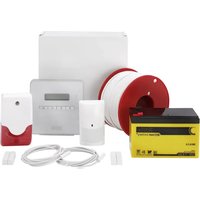
FURM50001 - Alarm system ABUS - Free user manual and instructions
Find the device manual for free FURM50001 ABUS in PDF.


User questions about FURM50001 ABUS
0 question about this device. Answer the ones you know or ask your own.
Ask a new question about this device
Download the instructions for your Alarm system in PDF format for free! Find your manual FURM50001 - ABUS and take your electronic device back in hand. On this page are published all the documents necessary for the use of your device. FURM50001 by ABUS.
USER MANUAL FURM50001 ABUS
natural_image
Line drawing of a circular device with a central logo and three tiers, resembling a fire extinguisher (no text or symbols)(DE) Funk-Rauchwarnmelder
(EN) Wireless smoke alarm device
(FR) Dispositif d'alarme de fumée sans fil
(NL) Draadloze rookmelder
(DK) Trådløs røgalarm
(IT) Rilevatore di fumo senza fili
natural_image
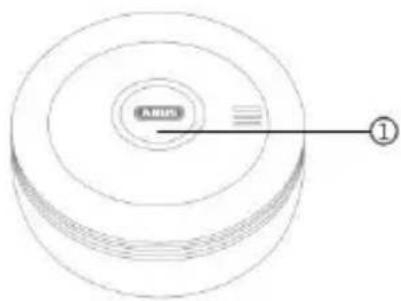
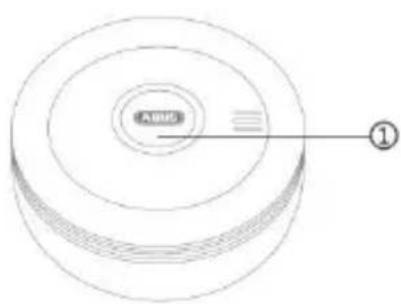
Diagram of a circular electronic device with concentric rings and a central logo labeled 'ABUS' (no text or symbols beyond the label)DE 1 DE

0359
86444 Affing (Germany)
14
0359-CPR-00297
EN14604:2005+Corr:2008
Locked = Verriegelt, Unlocked = Entriegelt
Bild 1
1 = Batterien, 2 = DIP Schalter
Bild 2
DE 14 DE
$$ D I P 1 = O N, D I P 2 = O F F $$

a)
b)
natural_image
Cross-sectional diagram of a mechanical assembly inside a circular housing (no text or labels)Bild 4
natural_image
Close-up of a black electronic component with three metallic pins (no visible text or symbols)Bild 4a
Ceiling=Decke, Wall=Wand, Centre of ceiling=Mitte der Wand, Never here=niemals hier, Best location=bester Standort, Acceptable location=geeigneter Standort
Bild 5
Horizontal distance from peak.
Bild 8
DE 23 DE
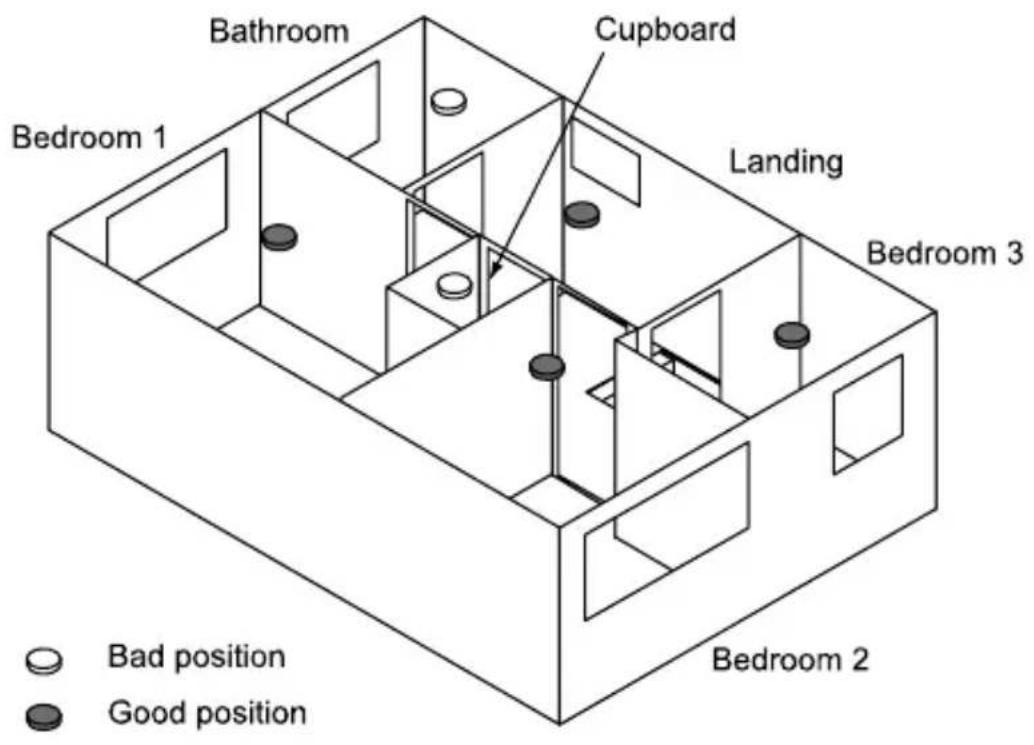
Bad position=schlechte Position, Good position=gute Position
natural_image
Symbol of a trash bin with crossed lines indicating no waste or restriction, and a solid black rectangle below (no text or symbols)Wireless smoke alarm device
FURM50000
(EN) Installation and Operating Instructions
natural_image
Diagram of a circular electronic device with concentric rings and a central logo labeled 'ABUS' (no text or symbols beyond the label)EN 1 EN

0359
86444 Affing, Germany
14
0359-CPR-00297
EN14604:2005+Corr:2008
Wireless smoke alarm device
Model No.: FURM50000
Technical data: see DoP FURM50000#0414 held by ABUS
EN 2 EN
1. Contents
- CONTENTS .... 3
- PREFACE AND INTENDED USE ....6
- LIMITATION OF LIABILITY ......6
- SYMBOL DESCRIPTION ......7
- SAFETY INFORMATION ......7
5.1 GENERAL 7
5.2 BATTERY WARNING 8
5.3 CLEANING 8
5.4 PACKAGING 9
5.5 FUNCTIONING OF THE DEVICE 9
-
SCOPE OF DELIVERY 9
-
TECHNICAL DATA....10
7.1 COMPATIBLE DEVICES 11
7.2 ROHS EC DIRECTIVE 11
-
FUNCTIONAL PRINCIPLE AND FEATURES ...... 11
-
BEHAVIOUR IN CASE OF FIRE 12
EN 3 EN
9.1 WHAT SHOULD YOU DO IF YOU HEAR THE FIRE ALARM SOUND FROM THE DETECTOR OR FROM THE ALARM CONTROL PANEL? 12
9.2 WHAT SHOULD YOU DO IN THE EVENT OF A FALSE ALARM? 12
10. PREPARATION 13
10.1 INSERTING OR CHANGING THE BATTERY 13
10.2 LEARNING IN 15
10.3 LED DISPLAY 15
11. SELECTING THE LOCATION .... 16
11.1 FACTORS INFLUENCING PERFORMANCE 16
11.2 WHERE TO LOCATE.... 18
11.3 WHERE NOT TO LOCATE 20
11.4 EXAMPLES 22
11.5 THINGS THE DETECTOR IS NOT ABLE TO DO 24
12. INSTALLATION 25
13. USE....26
13.1 SILENCING THE ALARM 26
13.2 TESTING 27
14. CLEANING AND MAINTENANCE 27
15. GUARANTEE 28
EN 4 EN
- DECLARATION OF CONFORMITY ......29
- DISPOSAL....29
EN 5 EN
2. Preface and intended use
Dear customer,
Thank you for purchasing this wireless smoke alarm device. This device is built with state-of-the-art technology.
These instructions contain important installation and operation information. Follow the directions and instructions in this manual to ensure safe operation. Store these instructions in a safe place for future reference. These instructions are part of the device. When you pass the device on to third parties, remember to include these instructions with the device.
The ABUS FURM50000 smoke alarm device was designed to operate together with 868 MHz ABUS narrow band receivers. The device contains an integrated transmitter.
The smoke alarm device does not conform to EN54 or to other local standards required by law for fire detection systems which contact the fire service automatically.
Installers should not configure any intruder alarm system with this smoke alarm device which is part a system that must comply with EN54 or other local standards required by law for fire detection systems.
The smoke alarm device has been designed for use in family homes, apartments or small offices. It is less suited for use in business or industrial environments.
The principal function of the smoke alarm device is to detect smoke and to sound a local alarm.
This smoke alarm device also transmits a message to the security alarm system's alarm control panel. The alarm system's alarm control panel can also then sound an alarm tone to inform the occupants in the building. The alarm system's alarm control panel can then also inform individual's remotely (e.g. the landlord or the caretaker) using the respective communication devices installed.
Only use the device for the purpose which it was designed and built for. Any other use is not considered to be the intended use.
3. Limitation of liability
Everything possible has been done to ensure that the content of these instructions is correct. However, neither the author nor ABUS Security-Center GmbH & Co. KG can be held liable for loss or damage caused by incorrect or improper installation and use or failure to observe the safety instructions and
EN 6 EN
warnings. No liability can be accepted for resulting damage. No part of the product may be changed or modified in any way. If you do not follow these instructions, your guarantee claim becomes invalid.
We want you to work only with devices that incorporate state-of-the-art technology. For this reason, we reserve the right to make technical modifications.
We reserve the right to make changes to these instructions without prior notice.
© ABUS Security-Center GmbH & Co. KG, 03 / 2014
4. Symbol description
The following symbols are used in this manual and on the device:
| Symbol | Signal word | Meaning | |
 | Warning | Indicates a risk of injury or health hazards. | |
 | Warning | Indicates a risk of injury or health hazards caused by electrical voltage. | |
 | Important | Indicates possible damage to the device/accessories. | |
| Note | Indicates important information. | ||
5. Safety information
5.1 General

Warning
- The wireless smoke alarm device does not detect gas, steam, heat or fire/flames. Detectors with special sensors are required for this.
- People with hearing impairments may not be able to hear the alarm. Special alarms with optical signalisation are available for such cases.
- Wireless smoke alarm devices help save lives. Therefore, for safety's sake, you should regularly test the battery and the operation of the detector. For day-to-day use, remember that the wireless smoke alarm device cannot prevent fires but simply provides warning in the event of such a fire. For your own safety, please replace the wireless smoke alarm device every 10 years at the latest.
EN 7 EN
- Very high electromagnetic radiation can cause malfunctions. Therefore, avoid installation near devices which produce electromagnetic radiation.
5.2 Battery warning

Warning
Information on handling batteries
The device contains alkaline batteries with 0% cadmium (Cd) and 0% mercury (Hg)
- Make sure that batteries are kept away from small children. Children may put batteries in their mouths and swallow them. This can cause serious harm to their health. If this happens, consult a doctor immediately.
- Do not charge, heat up or throw normal batteries into naked flames (they may explode).
- The battery should not be directly exposed to heat or sunlight, and should not be stored in hot places.
- The battery should not come into contact with water.
- The battery should not be dismantled, pierced or otherwise damaged.
- Leaky or damaged batteries can cause chemical burns on contact with the skin. In this case, wear protective gloves. Clean the battery compartment with a dry cloth.
- The battery contacts should not be short-circuited.
- Change low batteries in good time.
- Always change all the batteries at the same time and use batteries of the same type.
- Do not insert with incorrect polarity (+/-).
5.3 Cleaning
- Dusty devices must be cleaned. You can clean dust from the air vents using a vacuum cleaner or compressed air. If necessary, you can remove the dust with a brush.
- You can clean the surface using a cloth slightly dampened in soapy water. Only use suitable microfibre cloths on high-gloss surfaces.
- Do not allow water to penetrate inside the device.
- Do not clean the device in a dishwasher.
- Do not use sharp, pointed, abrasive, or corrosive cleaning materials or hard brushes.
- Do not use chemicals.
EN 8 EN
- Do not use flammable liquids for cleaning the device.
5.4 Packaging

Warning
- Keep children away from the packaging - there is a risk of suffocation.
- Remove all packaging material before using the device.
5.5 Functioning of the device

Warning
To ensure the perfect functioning of the device, please observe the following points:
- Do not cover the device.
- Do not paint over the device or cover it with wallpaper.
- Do not, on any account, open or repair the device. Failure to observe this instruction will invalidate the warranty.
- Do not use the device if it has been dropped or damaged in any other way.
- If you pass on the device to someone else, you must include this user manual.
6. Scope of delivery
FURM50000 wireless smoke alarm device with base
3 AA alkaline batteries
Installation material
User guide, multilingual
EN 9 EN
- Technical data
| Item No. | FURM50000 |
| Conforms to | EN 14604: 2005+corr:2008 |
| Smoke detection | Optical using (scattered light principle) |
| Power supply | 4.5 V DC, 3 AA alkaline batteriesReplacement batteries: ABUS recommendDuracell MN1500, Eveready Energizer E91 |
| “Low battery” error message | < 3.2 V |
| “Low battery” warning | Approx. 30 days before discharge |
| Operational battery life | Approx. 2 years |
| Dimensions (diameter x height) | 122 mm x 50 mm (∅ x H) |
| Environmental conditions | Only approved for indoor use |
| Operating temperature | -10 °C - +65 °C |
| Max. humidity | Average relative humidity approx. 75% – non-condensing |
| Environmental class | II (EN 50131-1 + A1:2009) |
| Protection class | IP 20 |
| Security level | 2 (EN 50131-1 + A1:2009) |
| Radio frequency | 868.6625 MHz |
| Wireless transmission power | 10mW |
| Wireless range | Approx. 30m indoors (depending on environmental factors) |
| HF immunity | 10 V/m (EN 50130-4:2011) |
| Signals | Acoustic (Piezo) and visual (LED) |
| Volume | Min. 85 dB(A) @ 3 m |
| Sound frequency | 2.7 kHz |
| Optical display | LED |
| Tamper surveillance | No |
| Supervision monitoring | Yes – approx. every 4 minutes |
| Weight | 227,8 g net |
7.1 Compatible devices
| FUAA500XY | Secvest |
| FU80XY | Secvest 2WAY |
| FU500X | Secvest 868 |
| FUAA1001X | Secvest IP |
| CASA1001X | IP alarm module |
| FU821X | Wireless universal module |
| AZ4120 | Terxon MX 8 zone wireless extension |
| AZ4220 | Terxon LX 8-zone wireless extension |
7.2 RoHS EC Directive
The device complies with the RoHS directive. Compliance with the RoHS directive means that the product or component does not contain more than the following maximum concentrations of the following substances in homogeneous materials, unless the substance is part of an application that is excluded from the RoHS directive:
a) 0.1% lead (by weight)
b) Mercury,
c) Hexavalent chromium
d) Polybrominated biphenyl (PBB) and polybrominated diphenyl ether
e) 0.01% cadmium (by weight)
8. Functional principle and features
The detector uses the scattered light principle to detect smoke. A light transmitter and light receiver are both installed in the measurement chamber. Both are separated by an intermediate wall. No optical connection is made between the transmitter and receiver when no smoke is present in the measurement chamber. Penetrating smoke disperses the light so that it hits the receiver. This triggers the detector. It sounds a loud acoustic alarm. The alarm is switched off as soon as the measurement chamber is free of smoke.
• Surveillance area: 30 m ^2 within a room
- Battery operation (3x 1.5 V alkaline batteries)
• Automatic battery state monitoring
EN 11 EN
• Optical and acoustic alarms
- Simple installation
- Battery compartment check - the detector can only be fitted to the mounting plate when the battery is inserted.
9. Behaviour in case of fire
9.1 What should you do if you hear the fire alarm sound from the detector or from the alarm control panel?

Warning
- Leave the premises immediately. Every second counts - there is no time to get dressed or gather valuable belongings. Use the emergency escape routes.
- Warn your fellow residents and make sure they also leave, especially children and people with impaired hearing.
- Do not open doors without first checking the surface. Do not open a door if it is hot or you see smoke under it. Use an alternative escape route. If the surface is cool, push against it with your shoulder, open it slightly and be prepared to close it again if there is heat, smoke or fire behind it.
- If there is smoke in the air, keep close to the floor and breathe through a damp cloth if possible.
- Close the doors after leaving the room.
- Once you have left the building, go to the agreed assembly point and do not go back inside.
- Call the fire brigade from outside the burning building.
- Notify the fire brigade of the situation inside the building.
9.2 What should you do in the event of a false alarm?
- False alarms can be triggered by a range of factors, e.g. very high humidity levels, smoke from cooking or where a lot of dust is created.
- If an alarm is triggered, get yourself to safety first of all. Only once you are sure that it is a false alarm, can you then silence the alarm using the test button. The alarm is also displayed optically via the LED.
- The smoke alarm device resets itself as soon as the smoke particles have moved away from the smoke chamber inside the detector.
EN 12 EN
10. Preparation
10.1 Inserting or changing the battery
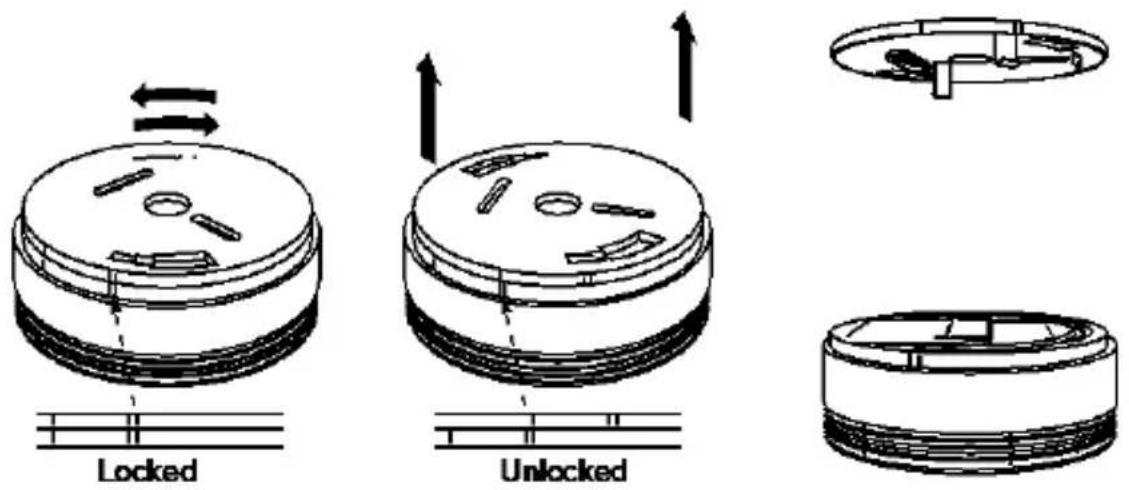
Remove the mounting plate, see Fig. 1
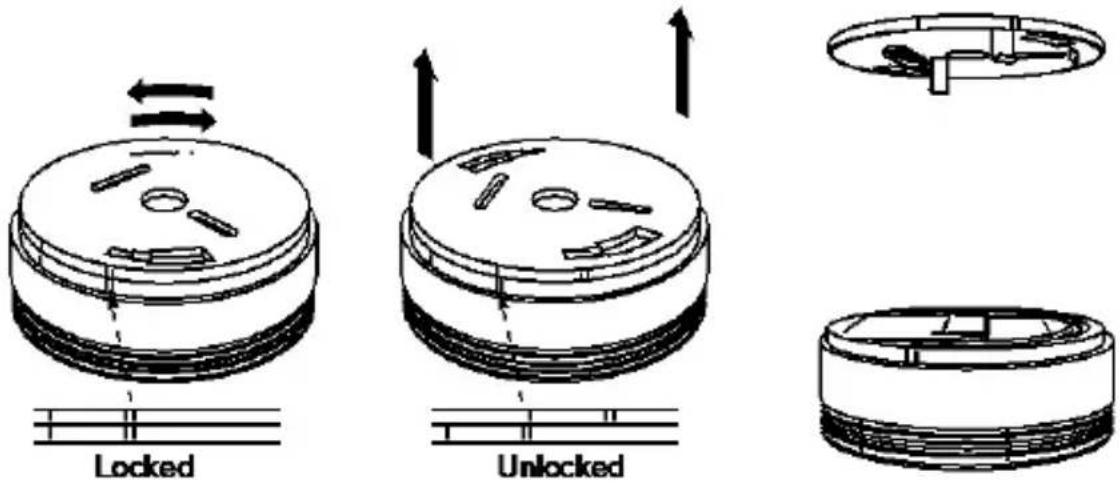
Fig. 1
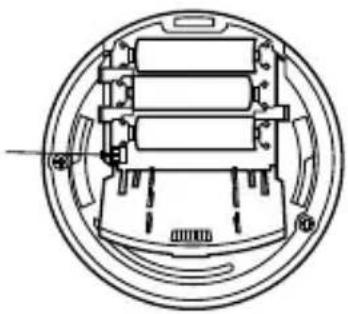
Insert 3 AA alkaline batteries (check polarity!) see Fig. 2
The activity LED now flashes 8 times. This indicates that the detector is working.
i Note
Use good quality batteries ABUS recommend Duracell MN1500, Eveready Energizer E91. There may be a smoke detector symbol shown on the battery packaging. Look out for this when buying.
EN 13 EN

Important
A fault has occurred if the activity LED flashes 1 x per second and the detector beeps every 10 seconds. Check the batteries. Reinsert or replace the batteries.
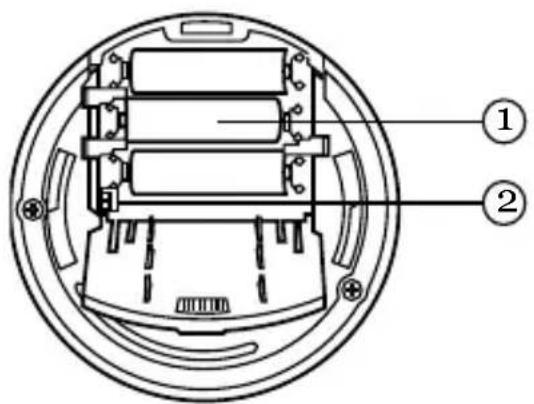
1 = Batteries, 2 = DIP switch
Fig. 2
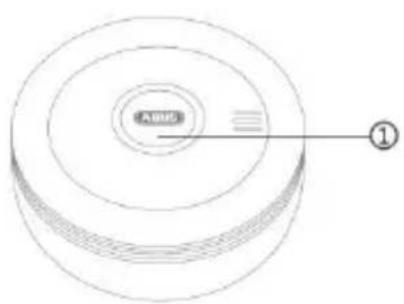
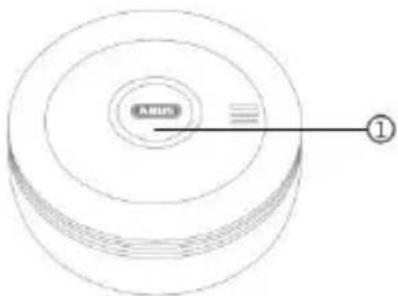
1 = Test button and activity LED
Fig. 3
EN 14 EN
10.2 Learning in
The detector transmits its identity to the receiver either wirelessly or using infrared via the activity LED.
Switch the wireless alarm control panel or the receiver to learning mode. See the relevant receiver instructions for more details.
Wireless option:
Press and hold the test button for 3 seconds. When the alarm sounds, the detector is sending its identity by wireless.
Infrared option:
Hold the detector so that the activity LED is positioned over the receiver's IR learning sensor and is pointing in its direction. Position the activity LED as closely as possible to the IR learning sensor. Press and hold the test button for 3 seconds. When the alarm sounds, the detector is transmitting its identity in the IR section of the light to the receiver's learning sensor.
10.3 LED display
If the detector is working properly, the activity LED flashes once every 60 seconds. The detector is not signalling an alarm.
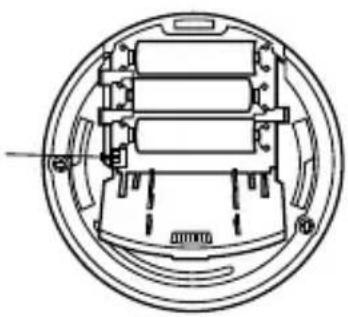
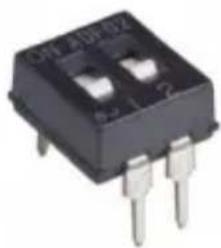
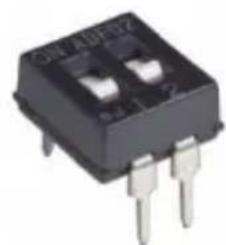
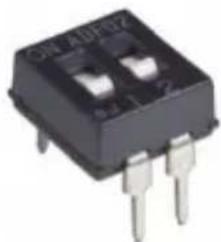
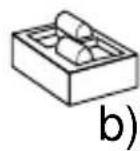
This flashing can be deactivated using a DIP switch. The DIP switch is located in the battery compartment, see Fig 4.
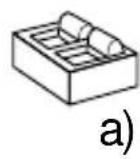
a) The activity LED flashes once every 60 seconds during normal operation
$$ \mathrm{DIP} 1 = \mathrm{ON}, \mathrm{DIP} 2 = \mathrm{ON} $$
b) The activity LED will not flash during normal operation
$$ D I P 1 = O N, D I P 2 = O F F $$
EN 15 EN
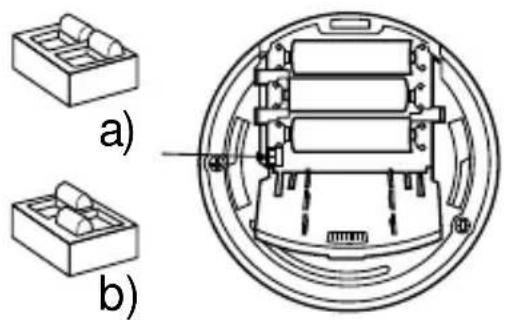
Fig 4
natural_image
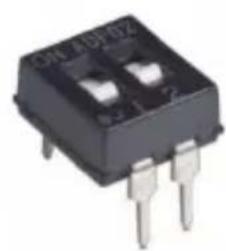
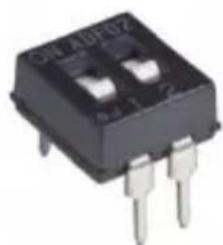
Close-up of a black electronic component with two metallic pins (no visible text or symbols)Fig 4a
Fig 4a shows both DIP switches in the OFF position.
$$ \mathrm{DIP} 1 = \mathrm{OFF}, \mathrm{DIP} 2 = \mathrm{OFF} $$
11. Selecting the location
11.1 Factors influencing performance
The smoke alarm device can do 3 things:
- Detect smoke
- Generate an alarm if it has detected smoke
- Transmit a radio signal to the receiver if it has detected smoke.

Warning
The environmental conditions around the detector can influence all 3 factors.
Smoke detection
The device is an optical smoke alarm device which works using the scattered light principle. This principle is most frequently used in smoke detection.
EN 16 EN

Warning
All optical smoke detectors which work in this way have the following problems:
• They do not detect radiant heat.
• They do not detect heated air.
- Other forms of particles can imitate smoke or cause light to be dispersed (e.g. dust, water droplets, insects or steam)
- They are unable to detect smoke if air movement around the detector is restricted.
However, the benefits of optical smoke alarm devices are:
• They are robust and reliable.
- They do not require large and expensive batteries.
Acoustic alarm
The smoke alarm device uses a piezoelectric sound source, which generates a volume of at least 85 dB (A) at a distance of 3m from the detector.
The volume of the alarm sound is reduced by:
• the distance from the detector
- closed doors
- thick curtains
- locating the detector behind furniture or other objects
Radio signal
The smoke alarm device transmits a radio signal at 868.6625 MHz. This frequency is within the European harmonised frequency band for alarm signalling. These radio signals are designed for compatible ABUS alarm control panels and receivers. Radio signals from smoke alarm devices can be absorbed and
EN 17 EN
reflected by metal constructions, wire grating, heat retaining window foils, wiring, metal piping and other metallic objects.
Electrical devices and other wireless transmitters can also disrupt radio signals.
11.2 Where to locate

Note
Pay attention to all valid fire precaution regulations and recommendations, especially the following guidelines on the standard use of smoke detectors:
The sense of smell is not active whilst sleeping.
- Priority rooms are: living rooms, bedrooms and children's playrooms.
• However, at least one smoke detector should be fitted outside the bedroom. - Due to the especially high risk of fires, entrance halls and corridors with fire loading in certain areas must be monitored using smoke detectors. Long corridors might require several smoke detectors.
• Stairwells are particularly susceptible to fires due to the chimney effect. - In multi-storey buildings, at least one smoke detector should be fitted on each floor.
- In buildings with open connections to several floors, at least one smoke detector should be fitted on the top floor.
To make sure that the detector reliably detects smoke, issues a clearly audible alarm and that a sufficiently strong signal is transmitted and received by each receiver.
Follow the recommendations below
In order to ensure that the detector can detect smoke:
EN 18 EN
- Locate the detector sufficiently high enough in areas where smoke accumulates
- For level ceilings, locate it directly on the ceiling in the centre of the room.
- For sloping ceilings, locate at least 50cm below the apex
- Where the detector cannot be attached to the ceiling, then locate it as high as possible on a wall, but with a distance of at least 30 cm from the ceiling.
- In stairwells locate it on the highest level
- When fitting on the ceiling, make sure that the smoke detectors are at least 50cm from the side walls and 50cm from the corners.
In order to ensure that occupants are able to hear the acoustic signal:
- Make sure that the alarm volume is loud enough in the bedrooms to be able to wake up anybody who is sleeping.
- Locate at least one detector on each floor of the house.
In order to ensure that the radio signal can reach the receiver:
- Locate the detector high enough
- Avoid metal constructions
- Attach the detector far enough away from other radio transmitters
11.3 Where not to locate
Do not attach the detector in areas which smoke will be slow to reach. Avoid "dead" zones. These are corners between wall and ceiling.
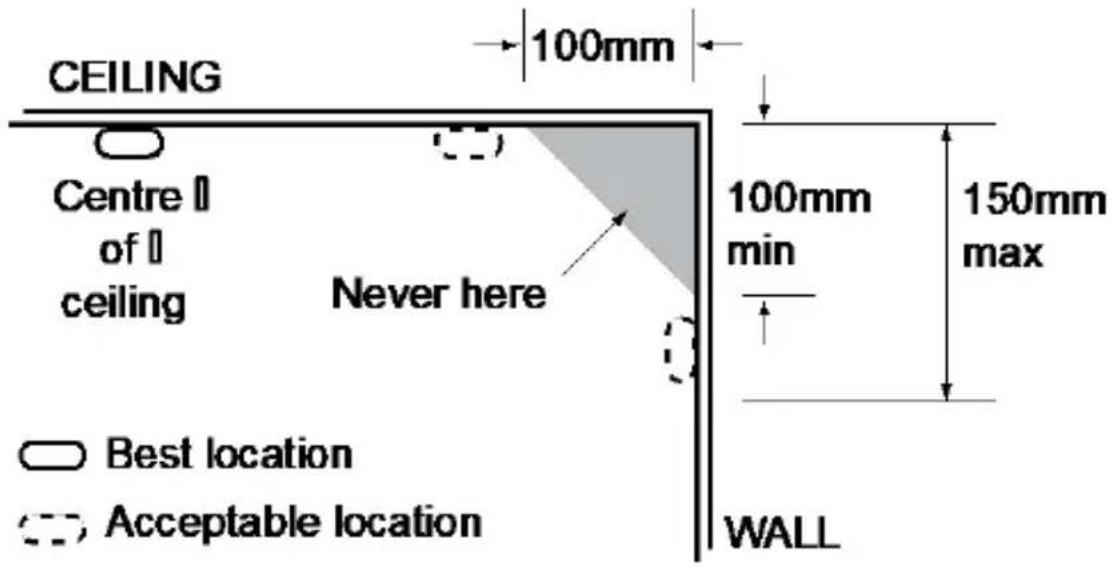
Fig. 5
Avoid the angle at the apex of a steeply sloping ceiling.
EN 20 EN
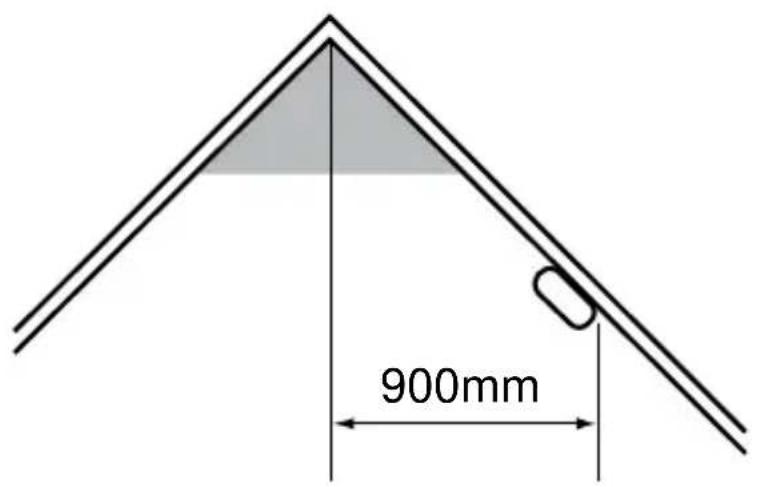
Horizontal distance from peak.
Fig. 6
Avoid areas where there is lots of dust. Dust can also collect both on, and inside, the detector. Smoke might no longer reach the smoke chamber as a result.
Avoid places where draughts can keep smoke away from the detector, such as near windows, doors or ventilation shafts, ventilators or air conditioners.

Warning
In order to avoid false alarms and malfunctions, do not locate the detector in the following areas:
- Places where expected temperature variations are greater than the ambient operating temperature (-10 °C - +65 °C).
- Places where vapour, increased air humidity or exhaust fumes may trigger false alarms, e.g. in kitchens, bathrooms or garages, in areas with central heating boilers, chimneys, ovens, stoves, ash trays or toasters.
EN 21 EN
- Rooms with lots of vapour and steam, e.g. swimming pools and washing areas. Condensation can form both on, and inside, the detector.
- Areas in which there are a lot of insects, e.g. attic space or greenhouses
- Places with a high level of dust or dirt.
- Areas where the air can be contaminated with solvent, e.g due to thinner, petrol or turpentine.
- External areas. Smoke and foreign bodies can carry over great distances.
11.4 Examples
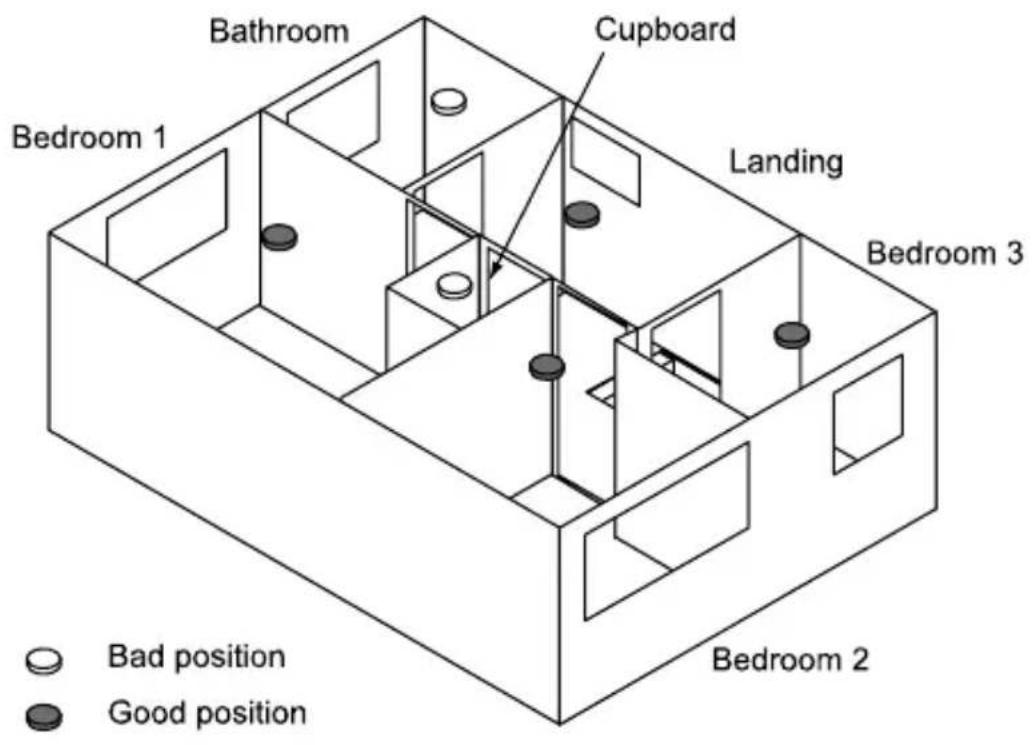
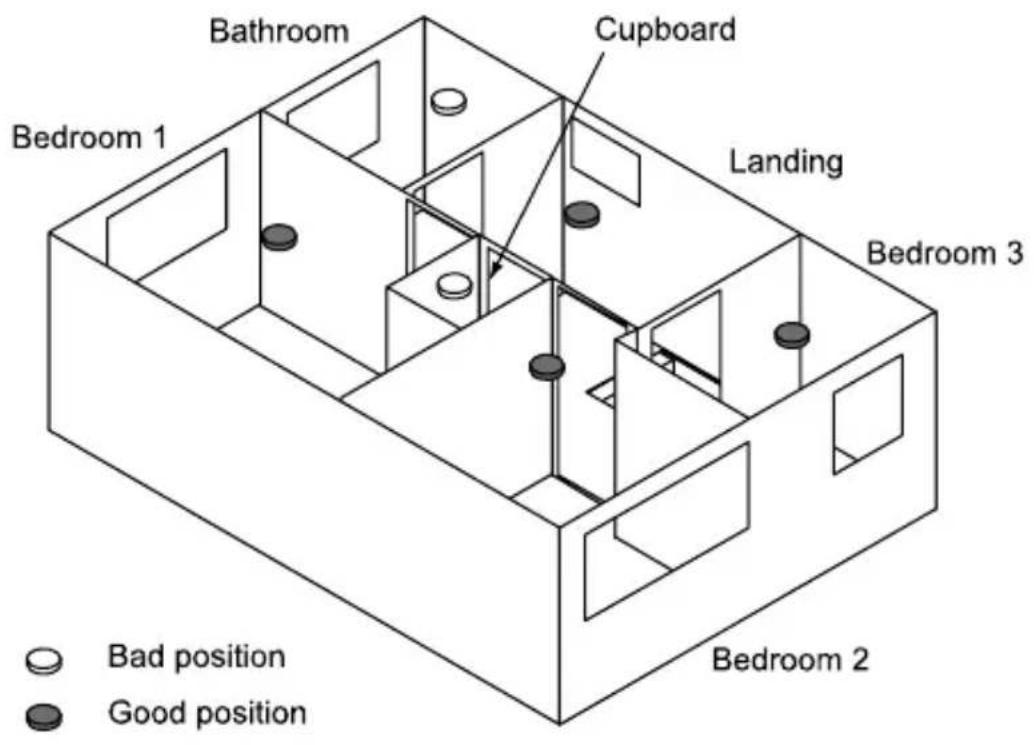
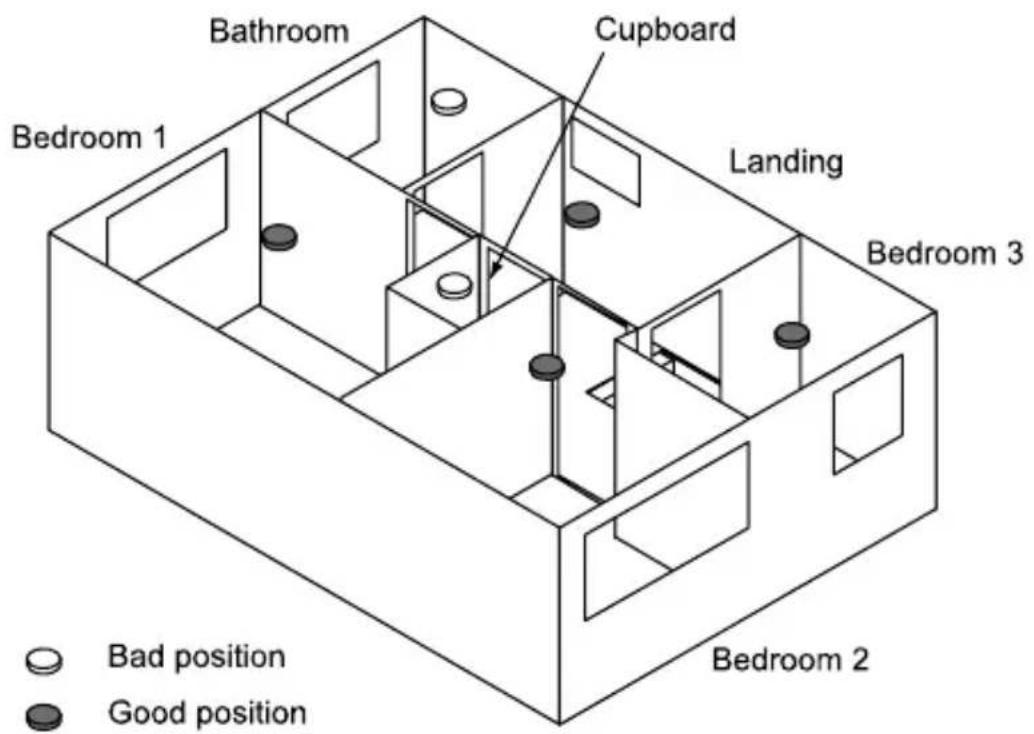
The following images illustrate good and bad positions for smoke alarm devices. Fig. 7 shows an apartment. Figs. 8 and 9 show a small two storey house.
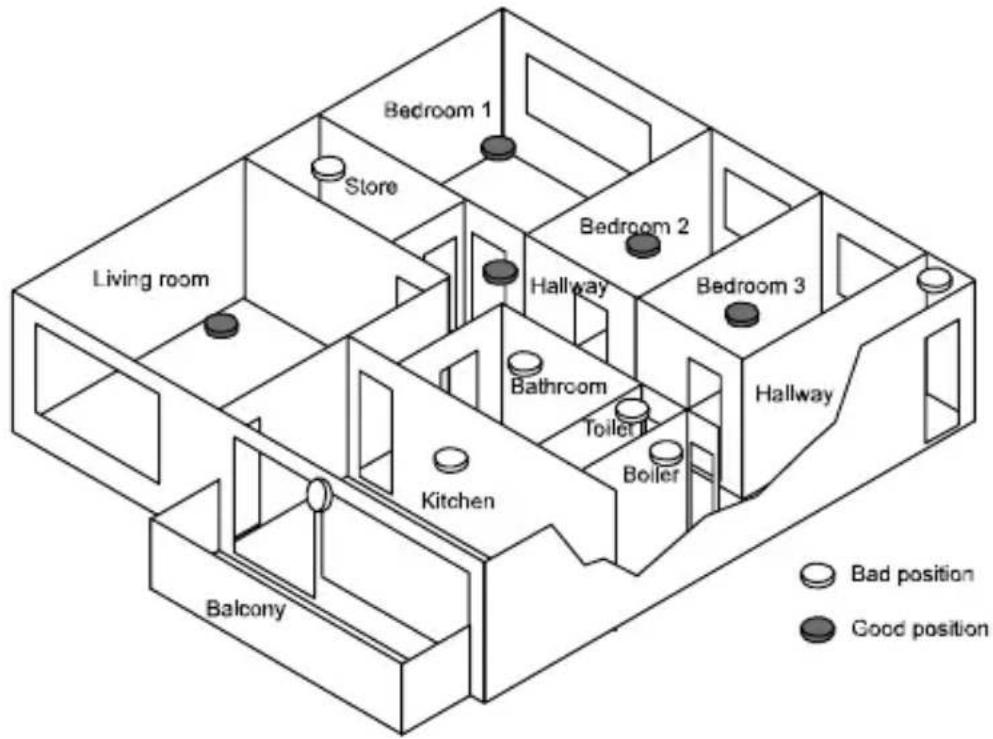
Fig. 7
EN 22 EN
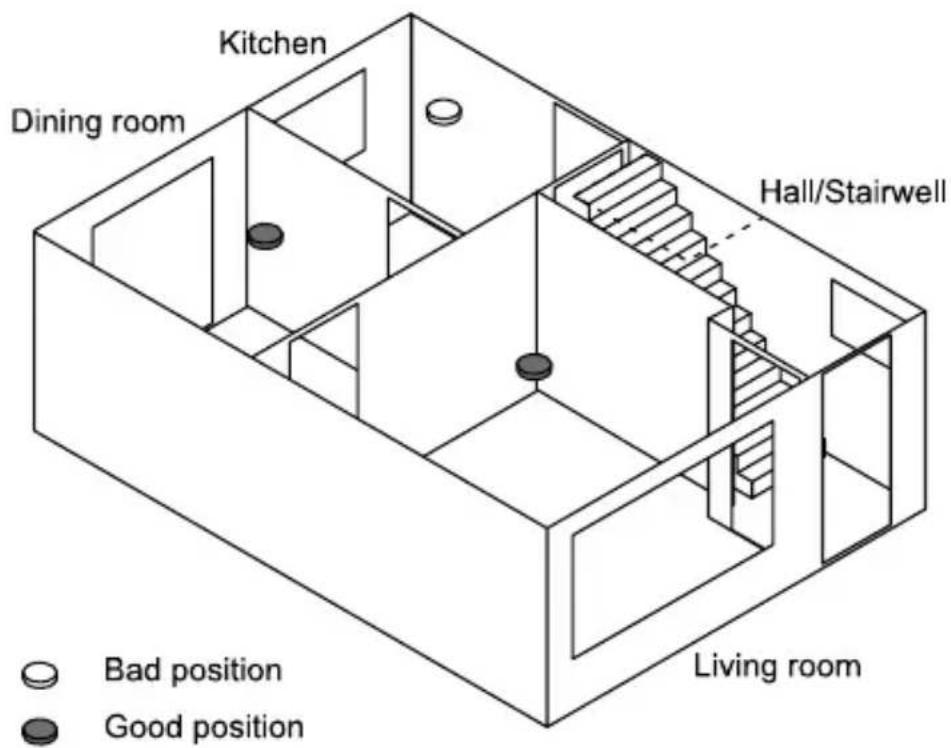
Fig. 8
EN 23 EN
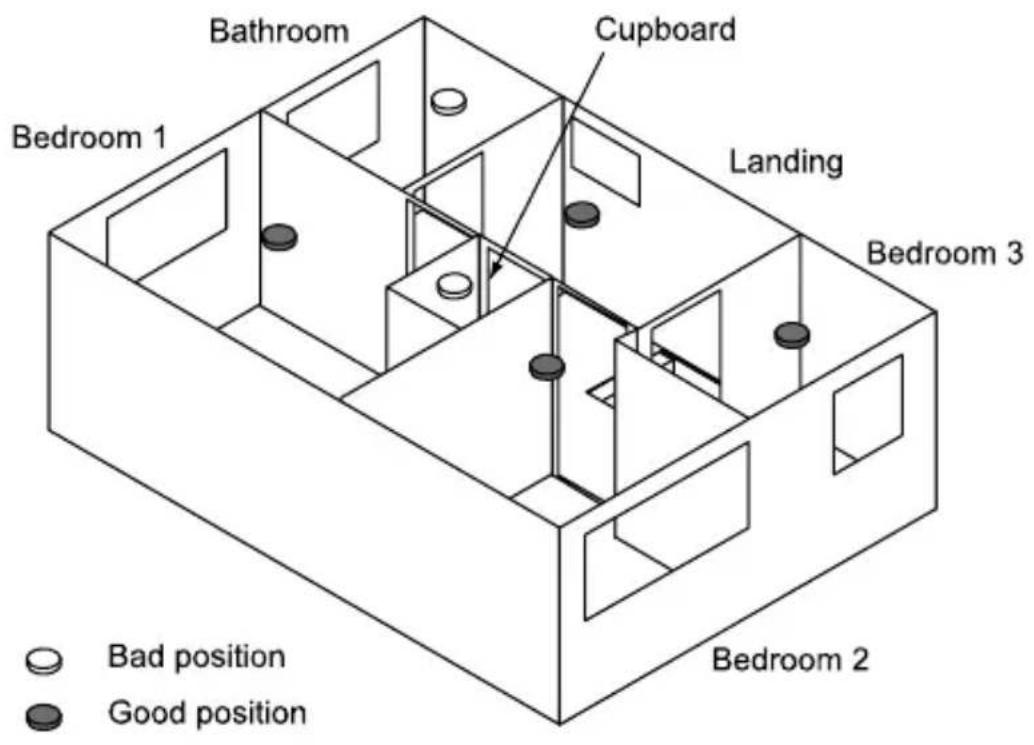
Fig. 9
11.5 Things the detector is not able to do
The smoke alarm device is designed for use in a small house or apartment block, in an apartment or in an office. The following restrictions apply:
The smoke alarm device is not able to detect a fire if smoke does not reach the smoke chamber.
Smoke from fires in walls, in lofts, on roofs or on other floors will not reach the detector quickly enough in order to trigger the alarm in sufficient time to allow the occupants to escape without injury.
Smouldering fires are only detected much later because smoke only rises slowly until the flames catch.
If the detector is covered deliberately, then the smoke will not reach the smoke chamber.
EN 24 EN
If an occupant is hard of hearing, sleeping in another room or under the influence of drugs or alcohol, then they are not able to hear the alarm and are not in a position to react to the alarm.
The detector is not able to warn in a preventative manner. Avoid risks to safety such as smoking in bed, incorrect storage of flammable materials, overloaded circuits and allowing children to play with matches.
12. Installation

Warning
When marking out the drill holes, make sure there are no electrical wires or cables, pipes or other important components behind them.
If in doubt, consult an expert before drilling.
- Use the mounting plate as a template for marking the positions of the drill holes (see Fig. 10) Pay attention to the orientation of the markings which are moulded into the mounting plate.
- Mark the drill holes and mark two holes for the wall plugs.
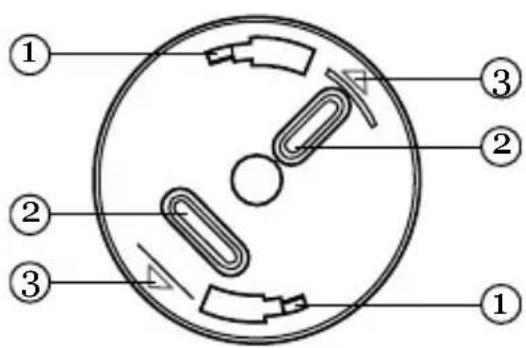
(1) Fixing flange
(2) Mounting opening for screws
(3) Orientation marking
Fig. 10
EN 25 EN
• Fix the mounting plate in place
- Attach the detector on to the mounting plate.
13. Use
During normal operation the detector is silent. When the activity LED is activated (see chapter 10.3 LED display), it flashes once every 60 seconds.
If smoke is present in the atmosphere, then it can take up to 9 seconds before the device detects the smoke, goes into alarm status and activates the sounder. The detector transmits a radio signal to the receiver for every alarm.
If smoke is detected, a loud alarm sounds.
- The alarm continues sounding as long as there is smoke in the smoke chamber.
- The alarm is only switched off when there is no more smoke in the smoke chamber.
If an alarm stops, always check carefully that no fire is present.
If internal monitoring of the detector reveals an error, then the sounder will beep once every ten seconds, the activity LED will flash once per second, and the device transmits a radio signal to the receiver.
Remove the old batteries, wait for 30 seconds and insert new batteries. Check, that the activity LED functions properly.
If, after the batteries are replaced, the sounder continues to beep once every 10 seconds, then the device has an error. If the device is still under warranty contact the supplier.
13.1 Silencing the alarm
In order to silence the sounder on the smoke alarm device, briefly press the test button once (see Fig 3). The detector remains silent for six minutes and then reverts back to normal mode. (If you conduct an alarm test during these six minutes, then the detector reverts back to normal mode after the test.)
EN 26 EN
13.2 Testing
- Place the alarm control panel or the receiver into walk test mode See the relevant receiver instructions for more details.
- Press and hold the test button for three seconds (see Fig 3). The sounder will begin to emit the alarm sound at the end of the three seconds. The detector transmits a radio signal to the alarm control panel or the receiver.
- Check whether the receiver has received the alarm.
- Choose another location for the detector if the alarm control panel was not able to receive the signal.
- Complete the walk test at the alarm control panel or at the receiver.
Alternatively, you can use the test spray available from ABUS to test the wireless smoke alarm device. An alarm will be triggered if the aerosol penetrates the smoke chamber.
Test the smoke alarm device each week, e.g. when doing the cleaning, by pressing the test button.
Always test the detector immediately when returning from holiday, or following an extended period of absence.
14. Cleaning and maintenance
Never remove the batteries, other than when you want to change them!
When the activity LED is activated (see chapter 10.3 LED display), it flashes once every 60 seconds. This indicates that the batteries are correctly connected. If the alarm does not sound when checked, the batteries must be replaced.
The detector will emit a short beep once per minute about one month before the batteries are completely empty. This signals that the batteries have to be changed. The detector continues to work perfectly normally during this period. Use high quality batteries such as Duracell MN1500, Eveready Energizer E91, for example. Always test the detector after changing the batteries.
i Note
Wait for 30 seconds after removing the old batteries before inserting the new batteries.
EN 27 EN
The detector should be regularly dusted and cleaned. Clean the detector carefully when you change the batteries or following a false alarm.
15. Guarantee
- ABUS products are designed and manufactured with the greatest care and tested according to the applicable regulations.
- The warranty only covers defects caused by material or manufacturing errors at the time of sale. If there are demonstrable material or manufacturing errors, the wireless smoke alarm device will be repaired or replaced at the guarantor's discretion.
- In such cases, the warranty ends when the original warranty period of 2 years expires. All further claims are expressly rejected.
- The warranty does not cover the batteries supplied.
- ABUS will not be held liable for defects and damage caused by external influences (e.g. transport, use of force, operating errors), inappropriate use, normal wear and tear or failure to observe the instructions in this manual.
- In the event of a warranty claim, the original receipt with the date of purchase and a short description of the problem must be supplied along with the wireless smoke alarm device.
- If you discover a defect on your wireless smoke alarm device which existed at the time of purchase, contact your dealer directly within the first two years.
16. Declaration of conformity
Hereby, ABUS Security-Center GmbH & Co. KG declares that the radio equipment type FURM50000 is in compliance with Directive 2014/53/EU. The full text of the EU declaration of conformity is available at the following internet address: www.abus.com search: FURM50000/Downloads.
The declaration of conformity can be obtained from the following address: ABUS Security-Center GmbH & Co. KG, Linker Kreuthweg 5, 86444 Affing, GERMANY
17. Disposal
Device
natural_image
Symbol of a trash bin with crossed lines indicating no waste or restriction, and a black rectangular block below (no text or symbols)EU Directive WEEE 2002/96/EC regulates the proper return, handling, and recycling of used electronic devices. This symbol means that in the interest of environmental protection the device must be disposed of separately from household or industrial waste at the end of its service life in accordance with applicable local legal guidelines. Used devices can be disposed of at official recycling centres in your country. Obey local regulations when disposing of material. Further details on returns (also for non-European countries) can be obtained from your local authority. Separate collection and recycling conserves natural resources and ensures that all the provisions for protecting
health and the environment are observed when recycling the product.
Batteries
Your product uses batteries which are subject to the European directive 2006/66/EC and may not be disposed of with domestic waste. Find out about the regulations for the separate collection of batteries which apply in your country. Proper disposal of batteries helps prevent harm to health and the environment. Batteries that contain harmful chemicals are labelled with these signs:
Battery contains Pb = lead, Cd = cadmium, Hg = mercury
EN 29 EN
natural_image
Diagram of a circular electronic device with concentric rings and a central logo labeled 'ABUS' (no text or symbols beyond the label)FR 1 FR

0359
Technical data: see DoP FURM50000#0414 held by ABUS
FR 2 FR
10.1 INTRODUCTION OU REMPLACEMENT DES PILES 14
10.2 APPRENTISSAGE 16
10.3 AFFICHAGE ALED 17
11. SELECTION DU LIEU DE MONTAGE 18
11.1 FACTEURS INFLUENÇANT LA PERFORMANCE 18
11.2 POSITIONNEMENT 19
11.3 POSITIONNEMENT DECONSEILLE 21
11.4 EXEMPLES 23
11.5 CE POUR QUOI LE DETECTEUR N'EST PAS CONÇU 26
12. INSTALLATION 27
13. UTILISATION....28
13.1 ACTIVATION DU MODE SILENCIEUX D'UNE ALARME 29
13.2 TEST.... 29
14. ENTRETIEN ET MAINTENANCE 30
15. GARANTIE 30
FR 4 FR
- DECLARATION DE CONFORMITE ....31
- ÉLIMINATION ....31
FR 5 FR
1 = piles, 2 = interrupteur DIP
Illustration 2
FR 15 FR
natural_image
Technical line drawing of a mechanical assembly inside a circular housing (no text or symbols)Illustration 4
natural_image
Close-up of a black electronic component with three metallic pins (no visible text or symbols)Illustration 4a
Ceiling = plafond, Wall = mur, Centre of ceiling = milieu du plafond, Never here = jamais ici, Best location = meilleur emplacement, Acceptable location = emplacement correct
Illustration 5
FR 21 FR
Horizontal distance from peak.
Horizontal distance from peak = distance horizontale depuis la pointe
Illustration 6
Illustration 8
Bedroom = chambre à coucher, Hallway = couloir, Store = débarras, Bathroom = salle de bain, Toilet = toilette, Boiler = chaufferie, Living room = salon, Kitchen = cuisine, Balcony = balcon, Hall/Stairwell = couloir/escaliers, Dining room = salle à manger, Cupboard = armoire, Landing = palier
Illustration 9
natural_image
Symbol of a trash bin with crossed lines indicating no waste or restriction, and a solid black rectangle below (no text or symbols)natural_image
Diagram of a circular electronic device with concentric rings and a central logo labeled 'ABUS' (no text or symbols beyond the label)NL 1 NL

0359
86444 Affing (Germany)
14
0359-CPR-00297
EN14604:2005+Corr:2008
Draadloze rookmelder
Model No: FURM50000
Technical data: see DoP FURM50000#0414 held by ABUS
NL 2 NL
1. Inhoudsopgave
- INHOUDSOPGAVE....3
- VOORWOORD EN REGLEMENTAIR GEBRUIK ......6
- BEPERKING VAN AANSPRAKELIJKHEID 7
- SYMBOOLVERKLARING ....7
- VEILIGHEIDSINSTRUCTIES 7
5.1 ALGEMEEN 7
5.2 WAARSCHUWINGEN OVER BATTERIJEN 8
5.3 REINIGEN 9
5.4 VERPAKKING 9
5.5 WERKING VAN HET APPARAAT 9
-
LEVERINGSOMVANG 10
-
TECHNISCHE GEGEVENS ....10
7.1 COMPATIBELE APPARATEN 11
7.2 RoHS EG RICHTLIJN 11
-
WERKINGSPRINCIPE EN EIGENSCHAPPEN ...... 11
-
GEDRAG IN GEVAL VAN BRAND 12
NL 3 NL
9.1 WAT TE DOEN, ALS U DE BRAND-ALARMTOON VAN EEN MELDER OF VAN DE CENTRALE HOORT.... 12
9.2 WAT TE DOEN BIJ EEN VALS ALARM? 13
10. VOORBEREIDING ....13
10.1 BATTERIJEN INLEGGEN OF VERVANGEN 13
10.2 INLEREN.... 15
10.3 LED-INDICATIE 16
11. LOCATIE KIEZEN 17
11.1 FACTOREN DIE PRESTATIE BEÏNVLOEDEN 17
11.2 PLAATSING WAAR 18
11.3 PLAATSING WAAR NIET 20
11.4 VOORBEELDEN 22
11.5 WAT DE MELDER NIET KAN.... 25
12. INSTALLATIE 25
13. GEBRUIK 26
13.1 UTSCHAKELEN VAN EEN ALARM 27
13.2 TEST 27
14. REINIGING EN ONDERHOUD 28
15. VRIJWARING 28
NL 4 NL
- CONFORMITEITSVERKLARING ......29
- AFVALVERWERKING 29
NL 5 NL
Locked = vergrendeld, Unlocked = ontgrendeld
Afbeelding 1
NL 13 NL
1 = batterijen, 2 = DIP-schakelaar
Afbeelding 2
NL 14 NL
natural_image
Technical line drawing of a mechanical assembly inside a circular housing (no text or symbols)Afbeelding 4
natural_image
Close-up of a black electronic component with three metallic pins (no visible text or symbols)Afbeelding 4a
Horizontal distance from peak.
Bad position=slechte positie, Good position=goede positie
Bedroom=slaapkamer, Hallway=gang, Store=opbergruimte, Bathroom=badkamer, Toilet=toilet, Boiler=CV-ruimte, Living room=woonkamer, Kitchen=keuken, Balcony=balkon, Hall/Stairwell=gang/trappenhuis, Dining room=eetkamer, Cupboard=kledingkast, Landing=overloop
Afbeelding 9
NL 24 NL
natural_image
Symbol of a trash bin with crossed lines indicating no waste or discharge (no text or labels)natural_image
Diagram of a circular electronic device with concentric rings and a central logo labeled 'ABUS' (no text or symbols beyond the label)DK 1 DK

0359
86444 Affing (Germany)
14
0359-CPR-00297
EN14604:2005+Corr:2008
Trådløs røgalarm
Model nr.: FURM50000
Technical data: see DoP FURM50000#0414 held by ABUS
DK 2 DK
Locked = låst, Unlocked = låst op
Billede 1
1 = batterier, 2 = DIP-kontakt
Billede 2
natural_image
Close-up of a black electronic component with two metallic pins (no visible text or symbols)Billede 4a
Billede 4a viser de to DIP-kontakter i OFF-stilling.
$$ \mathrm{DIP} 1 = \mathrm{OFF}, \mathrm{DIP} 2 = \mathrm{OFF} $$
Ceiling=loft, Wall=væg, Centre of ceiling=loftets midte, Never here=aldrig her, Best location=bedste placering, Acceptable location=egnet placering
Billede 5
Horizontal distance from peak.
Horizontal distance from peak=horisontal afstand fra spidsen
Billede 6
Billede 8
Bad position=dårlig position, Good position=god position
Bedroom=soveværelse, Hallway=korridor, Store=opbevaringsrum, Bathroom=badeværelse, Toilet=toilet, Boiler=fyringsrum, Living room=stue, Kitchen=køkken, Balcony=balkon, Hall/Stairwell=korridor/trappeopgang, Dining room=spisestue, Cupboard=klædeskab, Landing=trappeafsats
Billede 9
natural_image
Symbol of a trash bin with crossed lines indicating no waste or restriction, and a solid black rectangle below (no text or symbols)natural_image
Diagram of a circular electronic device with concentric rings and a central logo labeled 'ABUS' (no text or symbols beyond the label)IT 1 IT

0359
86444 Affing (Germany)
14
0359-CPR-00297
EN14604:2005+Corr:2008
Technical data: see DoP FURM50000#0414 held by ABUS
IT 2 IT
1. Indice
- INDICE....3
- PREFAZIONE E USO CONFORME ......6
- LIMITAZIONE DELLA RESPONSABILITÀ ......7
- SPIEGAZIONE DEI SIMBOLI ......7
- AVVERTENZE DI SICUREZZA ......7
$$ D I P 1 = O N, D I P 2 = O N $$
$$ D I P 1 = O N, D I P 2 = O F F $$
natural_image
Technical line drawing of a mechanical assembly inside a circular housing (no text or symbols)Figura 4
natural_image
Close-up of a black electronic component with two metallic pins (no visible text or symbols)Figura 4a
$$ D I P 1 = O F F, D I P 2 = O F F $$
IT 16 IT
Horizontal distance from peak.
Figura 8
IT 23 IT
natural_image
Symbol of a trash bin with crossed lines indicating no waste or restriction, and a solid black rectangle below (no text or symbols)

- Bild 5
- Horizontal distance from peak.
- Wireless smoke alarm device
- FURM50000
- Contents
- EN 3 EN
- PREPARATION 13
- SELECTING THE LOCATION .... 16
- INSTALLATION 25
- USE....26
- CLEANING AND MAINTENANCE 27
- GUARANTEE 28
- EN 4 EN
- Preface and intended use
- Limitation of liability
- EN 6 EN
- Symbol description
- Safety information
- General
- Warning
- EN 7 EN
- Battery warning
- The device contains alkaline batteries with 0% cadmium (Cd) and 0% mercury (Hg)
- Cleaning
- EN 8 EN
- Packaging
- Functioning of the device
- Scope of delivery
- Compatible devices
- RoHS EC Directive
- Functional principle and features
- EN 11 EN
- Behaviour in case of fire
- What should you do if you hear the fire alarm sound from the detector or from the alarm control panel?
- What should you do in the event of a false alarm?
- EN 12 EN
- Preparation
- Inserting or changing the battery
- i Note
- EN 13 EN
- Important
- Learning in
- Wireless option:
- Infrared option:
- LED display
- EN 15 EN
- Selecting the location
- Factors influencing performance
- Smoke detection
- EN 16 EN
- Acoustic alarm
- Radio signal
- EN 17 EN
- Where to locate
- Note
- The sense of smell is not active whilst sleeping.
- EN 18 EN
- Where not to locate
- EN 21 EN
- Examples
- Things the detector is not able to do
- EN 24 EN
- Installation
- EN 25 EN
- Use
- Silencing the alarm
- EN 26 EN
- Testing
- Cleaning and maintenance
- EN 27 EN
- Guarantee
- Declaration of conformity
- Disposal
- Device
- Batteries
- SELECTION DU LIEU DE MONTAGE 18
- INSTALLATION 27
- UTILISATION....28
- ENTRETIEN ET MAINTENANCE 30
- GARANTIE 30
- Illustration 6
- Illustration 9
- Inhoudsopgave
- NL 3 NL
- VOORBEREIDING ....13
- LOCATIE KIEZEN 17
- INSTALLATIE 25
- GEBRUIK 26
- REINIGING EN ONDERHOUD 28
- VRIJWARING 28
- NL 4 NL
- Billede 1
- Billede 5
- Billede 6
- Billede 9
- Indice
Brand : ABUS
Model : FURM50001
Category : Alarm system