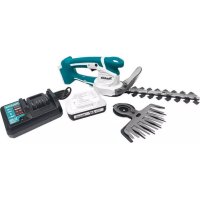
UM110DWYX - Grass trimmer MAKITA - Free user manual and instructions
Find the device manual for free UM110DWYX MAKITA in PDF.


| Product Type | Cordless Grass Shear / Hedge Trimmer |
| Brand | Makita |
| Model | UM110DWYX |
| Rated Voltage | 18 V DC |
| Cutting Width (grass shear) | 110 mm |
| Number of Strokes per Minute | 2,500 min⁻¹ |
| Dimensions (L x W x H) | 331 mm x 120 mm x 130 mm |
| Net Weight (without accessories or battery) | 1.1 kg |
| Weight with Battery (according to EPTA 01/2014) | 1.5 kg |
| Compatible Batteries | BL1815G, BL1820G |
| Compatible Chargers | DC18WA, DC18WB |
| Sound Pressure Level (grass shear) | ≤ 70 dB(A) (uncertainty 3 dB(A)) |
| Sound Power Level (hedge trimmer) | 81 dB(A) measured, 78 dB(A) guaranteed |
| Vibration Level (grass shear) | ≤ 2.5 m/s² (uncertainty 1.5 m/s²) |
| Vibration Level (hedge trimmer) | ≤ 2.5 m/s² (uncertainty 1.5 m/s²) |
| Application | Cutting lawn edges, shoots, hedges (with appropriate blades) |
| Protection System | Protection against overload, overheating, and deep discharge of the battery |
| Safety Features | Safety button and dual-action trigger |
| Blade Maintenance | Regular lubrication with low-viscosity oil |
| Recommended Storage | Dry place, out of reach of children, with blade cover in place |
| Main Accessories (optional) | Grass collector, chip collector, replacement grass shear and hedge trimmer blades |
Frequently Asked Questions - UM110DWYX MAKITA
User questions about UM110DWYX MAKITA
0 question about this device. Answer the ones you know or ask your own.
Ask a new question about this device
Download the instructions for your Grass trimmer in PDF format for free! Find your manual UM110DWYX - MAKITA and take your electronic device back in hand. On this page are published all the documents necessary for the use of your device. UM110DWYX by MAKITA.
USER MANUAL UM110DWYX MAKITA
- Due to our continuing program of research and development, the specifications herein are subject to change without notice.
- Specifications may differ from country to country.
1: Weight without any accessories or battery cartridge(s)
2: Weight, with battery cartridge, according to EPTA-Procedure 01/2014
Applicable battery cartridge and charger
| Battery cartridge BL1815G / BL1820G | |
| Charger DC18WA / DC18WB |
Some of the battery cartridges and chargers listed above may not be available depending on your region of residence.

WARNING: Only use the battery cartridges and chargers listed above. Use of any other battery cartridges and chargers may cause injury and/or fire.
Symbols
The followings show the symbols which may be used for the equipment. Be sure that you understand their meaning before use.

Take particular care and attention.

Read instruction manual.

Danger; be aware of thrown objects.

Keep bystanders away.

Cutting means continues to run after the motor is switched off.

Do not expose to moisture.

Do not expose to rain.

Wear safety glasses.

Wear eye and ear protection.

DANGER - Keep hands away from blade.

Ni-MH Li-ion
Only for EU countries
Due to the presence of hazardous components in the equipment, waste electrical and electronic equipment, accumulators and batteries may have a negative impact on the environment and human health. Do not dispose of electrical and electronic appliances or batteries with household waste! In accordance with the European Directive on waste electrical and electronic equipment and on accumulators and batteries and waste accumulators and batteries, as well as their adaptation to national law, waste electrical equipment, batteries and accumulators should be stored separately and delivered to a separate collection point for municipal waste, operating in accordance with the regulations on environmental protection. This is indicated by the symbol of the crossed-out wheeled bin placed on the equipment.

Guaranteed sound power level according to EU Outdoor Noise Directive.

Sound power level according to Australia NSW Noise Control Regulation.
Intended use
The tool is intended for cutting lawn edges or sprouts.
Noise
The typical A-weighted noise level determined according to EN62841-4-5:
UM110D with shear blade for grass shear installed
| Sound pressure level | |
| LpA (dB(A)) Uncertainty K (dB(A)) | |
| 70 dB(A) or less 3 | |
The noise level under working may exceed 80 dB (A).
The typical A-weighted noise level determined according to EN62841-4-2:
UM110D with shear blade for hedge trimmer installed
| Sound pressure level Guaranteed sound | power level | Measured sound power level | ||
| LpA (dB(A)) Uncertainty K | (dB(A)) L | wA (dB(A)) L | wA (dB(A)) Uncertainty K | (dB(A)) |
| 70 dB(A) or less 3.8 | 1 78 2.8 | |||
The noise level under working may exceed 80 dB (A).
NOTE: The declared noise emission value(s) has been measured in accordance with a standard test method and may be used for comparing one tool with another.
NOTE: The declared noise emission value(s) may also be used in a preliminary assessment of exposure.

WARNING: Wear ear protection.
WARNING: The noise emission during actual use of the power tool can differ from the declared value(s) depending on the ways in which the tool is used especially what kind of workpiece is processed.
WARNING: Be sure to identify safety measures to protect the operator that are based on an estimation of exposure in the actual conditions of use (taking account of all parts of the operating cycle such as the times when the tool is switched off and when it is running idle in addition to the trigger time).
Vibration
The vibration total value (tri-axial vector sum) determined according to EN62841-4-5:
UM110D with shear blade for grass shear installed
Vibration emission (a_h):2.5m / s^2 or less
Uncertainty (K): 1.5m / s^2
The vibration total value (tri-axial vector sum) determined according to EN62841-4-2:
UM110D with shear blade for hedge trimmer installed
Vibration emission (a_h):2.5m / s^2 or less
Uncertainty (K): 1.5m / s^2
NOTE: The declared vibration total value(s) has been measured in accordance with a standard test method and may be used for comparing one tool with another.
NOTE: The declared vibration total value(s) may also be used in a preliminary assessment of exposure.
WARNING: The vibration emission during actual use of the power tool can differ from the declared value(s) depending on the ways in which the tool is used especially what kind of workpiece is processed.
WARNING: Be sure to identify safety measures to protect the operator that are based on an estimation of exposure in the actual conditions of use (taking account of all parts of the operating cycle such as the times when the tool is switched off and when it is running idle in addition to the trigger time).
Declarations of Conformity
For European countries only
The Declarations of conformity are included in Annex A to this instruction manual.
SAFETYWARNINGS
General power tool safety warnings
WARNING Read all safety warnings, instructions, illustrations and specifications provided with this power tool. Failure to follow all instructions listed below may result in electric shock, fire and/or serious injury.
Save all warnings and instructions for future reference.
The term "power tool" in the warnings refers to your mains-operated (corded) power tool or battery-operated (cordless) power tool.
Cordless grass shear safety warnings
- Do not use the grass shear in bad weather conditions, especially when there is a risk of lightning. This decreases the risk of being struck by lightning.
- Keep all power cords and cables away from cutting area. Power cords or cables may be hidden and can be accidentally cut by the blade.
- Wear ear protection. Adequate protective equipment will reduce the risk of hearing loss.
- Hold the grass shear by insulated gripping surfaces only, because the blade may contact hidden wiring. Blades contacting a "live" wire may make exposed metal parts of the grass shear "live" and could give the operator an electric shock.
- Keep all parts of the body away from the blade. Do not remove cut material or hold material to be cut when blades are moving. Blades continue to move after the switch is turned off. A moment of inattention while operating the grass shear may result in serious personal injury.
- When clearing jammed material or servicing the grass shear, make sure the power switch is off and the battery pack is removed or disconnected. Unexpected actuation of the grass shear while clearing jammed material or servicing may result in serious personal injury.
- Carry the grass shear by the handle with the blade stopped and taking care not to operate the power switch. Proper carrying of the grass shear will decrease the risk of inadvertent starting and resultant personal injury from the blades.
- When transporting or storing the grass shear, always use the blade cover. Proper handling of the grass shear will decrease the risk of personal injury from the blades.
Additional safety warnings
General instructions
-
To ensure correct operation, user has to read this instruction manual to make himself familiar with the handling of the equipment. Users insufficiently informed will risk danger to themselves as well as others due to improper handling.
-
Never allow children, persons with reduced physical, sensory or mental capabilities or lack of experience and knowledge or people unfamiliar with these instructions to use the machine, local regulations may restrict the age of the operator.
- Use the equipment with the utmost care and attention.
- Operate the equipment only if you are in good physical condition. Perform all work calmly and carefully. Use common sense and keep in mind that the operator or user is responsible for accidents or hazards occurring to other people or their property.
- Never operate the machine while people, especially children, or pets are nearby.
- The motor is to be switched off immediately in case that the equipment shows any problem or abnormal sign.
- Switch off and remove the battery cartridge when resting and when leaving the equipment unattended, and place it in a safe location to prevent danger to others or damage to the equipment.
- Avoid using the machine in bad weather conditions especially when there is a risk of lightning.
Personal protective equipment
- Wear eye protection and stout shoes at all times while operating the machine.
- Always wear substantial footwear and long trousers while operating the machine.
Starting up the equipment
- Make sure that there are no children or other people nearby, also pay attention to any animals in the working vicinity. Otherwise stop using the equipment.
- Before use always check that the equipment is safe for operation. Check the security of the cutting tool and the guard and the switch trigger/lever for easy and proper action. Check for clean and dry handles and test the function of the start/stop.
- Check damaged parts before further use of the equipment. A guard or other part that is damaged should be carefully checked to determine that it will operate properly and perform its intended function. Check for alignment of moving parts, binding of moving parts, breakage of parts, mounting, and any other condition that may affect its operation. A guard or other part that is damaged should be properly repaired or replaced by our authorized service center unless indicated elsewhere in this manual.
- Switch on the motor only when the hands and feet are away from the cutting tool.
- Before starting make sure that the cutting tool has no contact with any objects.
- Check the grass for foreign objects, such as wire fences or hidden wiring before operating the tool.
- If a long handle attachment is available, make sure that the attachment is secured on the tool before operation.
Method of operation
- Only use the equipment in good light and visibility. During the winter season, be aware of slippery or wet areas, ice and snow (risk of slipping). Always ensure a safe footing on slopes and be sure to walk and never run.
- Take care against injury to feet and hands from the cutting tool.
- Never stand on a ladder and run the equipment.
- Never climb up into trees to perform cutting operation with the equipment.
- Never work on unstable surfaces.
- Remove sand, stones, nails etc. found within the working range. Foreign particles may damage the cutting tool and can cause dangerous kick-backs.
- Should the cutting tool hit stones or other hard objects, immediately switch off the motor and inspect the cutting tool.
- Inspect the cutting tool at short regular intervals for damage (detection of hairline cracks by means of tapping-noise test).
- Before commencing cutting, the cutting tool must have reached full working speed.
- The cutting tool has to be equipped with the appropriate guard. Never run the equipment with damaged guards or without guards in place!
- All protective installations and guards supplied with the equipment must be used during operation.
- Always remove the battery cartridge from the equipment:
whenever leaving the equipment unattended;
before clearing a blockage;
before checking, cleaning or working on the equipment;
after striking a foreign object;
whenever the equipment starts vibrating abnormally.
- Always ensure that the ventilation openings are kept clear of debris.
- Cutting means continues to run after the motor is switched off.
- If the blades stop moving due to the stuck of foreign objects between the blades during operation, switch off the tool and remove the battery cartridge, and then remove the foreign objects using tools such as pliers. Removing the foreign objects by hand may cause an injury for the reason that the blades may move in reaction to removing the foreign objects.
- Never stand on a ladder and run the equipment. Never climb up into trees to perform cutting operation with the equipment. Never work on unstable surfaces.
Cutting Tools
Employ only the correct cutting tool for the job in hand.
Maintenance instructions
- The condition of the equipment, in particular of the cutting tool of the protective devices must be checked before commencing work.
- Turn off the motor and remove the battery cartridge before carrying out maintenance, replacing cutting tools or cleaning the equipment or cutting tool.
- When not in use, store the equipment indoors in dry and high or locked-up place - out of the reach of children. Clean and maintain before storage.
SAVE THESE INSTRUCTIONS.
WARNING: DO NOT let comfort or familiarity with product (gained from repeated use) replace strict adherence to safety rules for the subject product. MISUSE or failure to follow the safety rules stated in this instruction manual may cause serious personal injury.
Cordless hedge trimmer safety warnings
- Do not use the hedge trimmer in bad weather conditions, especially when there is a risk of lightning. This decreases the risk of being struck by lightning.
- Keep all power cords and cables away from cutting area. Power cords or cables may be hidden in hedges or bushes and can be accidentally cut by the blade.
- Wear ear protection. Adequate protective equipment will reduce the risk of hearing loss.
- Hold the hedge trimmer by insulated gripping surfaces only, because the blade may contact hidden wiring. Blades contacting a "live" wire may make exposed metal parts of the hedge trimmer "live" and could give the operator an electric shock.
- Keep all parts of the body away from the blade. Do not remove cut material or hold material to be cut when blades are moving. Blades continue to move after the switch is turned off. A moment of inattention while operating the hedge trimmer may result in serious personal injury.
- When clearing jammed material or servicing the hedge trimmer, make sure all power switches are off and the battery pack is removed or disconnected. Unexpected actuation of the hedge trimmer while clearing jammed material or servicing may result in serious personal injury.
- Carry the hedge trimmer by the handle with the blade stopped and taking care not to operate any power switch. Proper carrying of the hedge trimmer will decrease the risk of inadvertent starting and resultant personal injury from the blades.
- When transporting or storing the hedge trimmer, always use the blade cover. Proper handling of the hedge trimmer will decrease the risk of personal injury from the blades.
Additional safety warnings
Preparation
- Check the hedges and bushes for foreign objects, such as wire fences or hidden wiring before operating the tool.
- The tool must not be used by children or young persons under 18 years of age. Young persons over 16 years of age may be exempted from this restriction if they are undergoing training under the supervision of an expert.
- First-time users should have an experienced user show them how to use the tool.
- Use the tool only if you are in good physical condition. If you are tired, your attention will be reduced. Be especially careful at the end of a working day. Perform all work calmly and carefully. The user is responsible for all damages to third parties.
- Never use the tool when under the influence of alcohol, drugs or medication.
- Work gloves of stout leather are part of the basic equipment of the tool and must always be worn when working with it. Also wear sturdy shoes with anti-skid soles.
- Before starting work check to make sure that the tool is in good and safe working order. Ensure guards are fitted properly. The tool must not be used unless fully assembled.
Operation
- Hold the tool firmly when using the tool.
- The tool is intended to be used by the operator at ground level. Do not use the tool on ladders or any other unstable support.
- Do not simultaneously wear multiple belt harnesses and/or shoulder harnesses when operating the tool.
- DANGER - Keep hands away from blade. Contact with blade will result in serious personal injury.
- Do not use the tool in the rain or in wet or very damp conditions. The electric motor is not waterproof.
- Make sure you have a secure footing before starting operation.
- Do not operate the tool at no-load unnecessarily.
- Immediately switch off the tool and remove the battery cartridge if the shear blades should come into contact with a fence or other hard object. Check the blades for damage, and if damaged, replace the blades immediately.
- Before checking the shear blades, taking care of faults, or removing material caught in the shear blades, always switch off the tool and remove the battery cartridge.
- Never point the shear blades to yourself or others.
-
If the blades stop moving due to the stuck of foreign objects between the blades during operation, switch off the tool and remove the battery cartridge, and then remove the foreign objects using tools such as pliers. Removing the foreign objects by hand may cause an injury for the reason that the blades may move in reaction to removing the foreign objects.
-
Avoid dangerous environment. Don't use the tool in damp or wet locations or expose it to rain. Water entering the tool will increase the risk of electric shock.
Maintenance and storage
- Switch off the tool and remove the battery cartridge before doing any maintenance work.
- When moving the tool to another location, including during work, always remove the battery cartridge and put the blade cover on the shear blades. Never carry or transport the tool with the blades running. Never grasp the blades with your hands.
- Clean the tool and especially the shear blades after use, and before putting the tool into storage for extended periods. Lightly oil the blades and put on the blade cover.
- Store the tool with the blade cover on, in a dry room. Keep it out of reach of children. Never store the tool outdoors.
- Do not dispose of the battery(ies) in a fire. The cell may explode. Check with local codes for possible special disposal instructions.
- Do not open or mutilate the battery(ies). Released electrolyte is corrosive and may cause damage to the eyes or skin. It may be toxic if swallowed.
- Do not charge battery in rain, or in wet locations.
SAVE THESE INSTRUCTIONS.
WARNING: DO NOT let comfort or familiarity with product (gained from repeated use) replace strict adherence to safety rules for the subject product. MISUSE or failure to follow the safety rules stated in this instruction manual may cause serious personal injury.
Important safety instructions for battery cartridge
- Before using battery cartridge, read all instructions and cautionary markings on (1) battery charger, (2) battery, and (3) product using battery.
- Do not disassemble or tamper with the battery cartridge. It may result in a fire, excessive heat, or explosion.
- If operating time has become excessively shorter, stop operating immediately. It may result in a risk of overheating, possible burns and even an explosion.
- If electrolyte gets into your eyes, rinse them out with clear water and seek medical attention right away. It may result in loss of your eyesight.
- Do not short the battery cartridge:
(1) Do not touch the terminals with any conductive material.
(2) Avoid storing battery cartridge in a container with other metal objects such as nails, coins, etc.
(3) Do not expose battery cartridge to water or rain.
A battery short can cause a large current flow, overheating, possible burns and even a breakdown.
- Do not store and use the tool and battery cartridge in locations where the temperature may reach or exceed 50^ (122^) .
- Do not incinerate the battery cartridge even if it is severely damaged or is completely worn out. The battery cartridge can explode in a fire.
- Do not nail, cut, crush, throw, drop the battery cartridge, or hit against a hard object to the battery cartridge. Such conduct may result in a fire, excessive heat, or explosion.
- Do not use a damaged battery.
- The contained lithium-ion batteries are subject to the Dangerous Goods Legislation requirements. For commercial transports e.g. by third parties, forwarding agents, special requirement on packaging and labeling must be observed. For preparation of the item being shipped, consulting an expert for hazardous material is required. Please also observe possibly more detailed national regulations. Tape or mask off open contacts and pack up the battery in such a manner that it cannot move around in the packaging.
- When disposing the battery cartridge, remove it from the tool and dispose of it in a safe place. Follow your local regulations relating to disposal of battery.
- Use the batteries only with the products specified by Makita. Installing the batteries to non-compliant products may result in a fire, excessive heat, explosion, or leak of electrolyte.
- If the tool is not used for a long period of time, the battery must be removed from the tool.
- During and after use, the battery cartridge may take on heat which can cause burns or low temperature burns. Pay attention to the handling of hot battery cartridges.
- Do not touch the terminal of the tool immediately after use as it may get hot enough to cause burns.
- Do not allow chips, dust, or soil stuck into the terminals, holes, and grooves of the battery cartridge. It may cause heating, catching fire, burst and malfunction of the tool or battery cartridge, resulting in burns or personal injury.
- Unless the tool supports the use near high-voltage electrical power lines, do not use the battery cartridge near high-voltage electrical power lines. It may result in a malfunction or breakdown of the tool or battery cartridge.
- Keep the battery away from children. SAVE THESE INSTRUCTIONS.
CAUTION: Only use genuine Makita batteries. Use of non-genuine Makita batteries, or batteries that have been altered, may result in the battery bursting causing fires, personal injury and damage. It will also void the Makita warranty for the Makita tool and charger.
Tips for maintaining maximum battery life
- Charge the battery cartridge before completely discharged. Always stop tool operation and charge the battery cartridge when you notice less tool power.
- Never recharge a fully charged battery cartridge. Overcharging shortens the battery service life.
- Charge the battery cartridge with room temperature at 10^ - 40^ (50°F - 104°F). Let a hot battery cartridge cool down before charging it.
- When not using the battery cartridge, remove it from the tool or the charger.
- Charge the battery cartridge if you do not use it for a long period (more than six months).
FUNCTIONAL DESCRIPTION
CAUTION: Always be sure that the tool is switched off and the battery cartridge is removed before adjusting or checking function on the tool.
Using the tool as cordless hedge trimmer
This tool can be used as a cordless hedge trimmer by installing the shear blades for hedge trimmer.
Installing or removing battery cartridge
CAUTION: Always switch off the tool before installing or removing of the battery cartridge.
CAUTION: Hold the tool and the battery cartridge firmly when installing or removing battery cartridge. Failure to hold the tool and the battery cartridge firmly may cause them to slip off your hands and result in damage to the tool and battery cartridge and a personal injury.
Fig.1: 1. Red indicator 2. Button 3. Battery cartridge
To remove the battery cartridge, slide it from the tool while sliding the button on the front of the cartridge.
To install the battery cartridge, align the tongue on the battery cartridge with the groove in the housing and slip it into place. Insert it all the way until it locks in place with a little click. If you can see the red indicator as shown in the figure, it is not locked completely.
CAUTION: Always install the battery cartridge fully until the red indicator cannot be seen. If not, it may accidentally fall out of the tool, causing injury to you or someone around you.
CAUTION: Do not install the battery cartridge forcibly. If the cartridge does not slide in easily, it is not being inserted correctly.
Tool / battery protection system
The tool is equipped with a tool/battery protection system. This system automatically cuts off power to the motor to extend tool and battery life. The tool will automatically stop during operation if the tool or battery is placed under one of the following conditions:
Overload protection
When the battery is operated in a manner that causes it to draw an abnormally high current, the tool automatically stops. In this situation, turn the tool off and stop the application that caused the tool to become overloaded. Then turn the tool on to restart.
Overheat protection
When the battery is overheated, the tool stops automatically. In this case, let the tool and battery cool before turning the tool on again.
Overdischarge protection
When the battery capacity is not enough, the tool stops automatically. If you turn the tool on, the motor runs again but stops soon. In this case, remove the battery from the tool and charge the battery.
Switch action
WARNING: Before installing the battery cartridge into the tool, always check to see that the switch trigger actuates properly and returns to the "OFF" position when released.
WARNING: For your safety, this tool is equipped with the lock-off button which prevents the tool from unintended starting. Never use the tool if it starts when you pull the switch trigger without pressing the lock-off button. Ask your local Makita Service Center for repairs.
WARNING: Never disable the lock function or tape down the lock-off button.
NOTICE: Do not pull the switch trigger forcibly without pressing the lock-off button. The switch may break.
Fig.2: 1. Switch trigger 2. Lock-off button
To prevent the switch trigger from being accidentally pulled, a lock-off button is provided.
To start the tool, press the lock-off button and pull the switch trigger. Release the switch trigger to stop. The lock-off button can be pressed from either the right or left side.
Indicator lamp
The indicator lamp blinks or lights up when the remaining battery capacity is low or empty. The indicator lamp also lights up when the tool becomes overloaded.
Fig.3: 1. Indicator lamp
Lamp status and action to be taken
| Indicator lamp Status Action to be taken | ||
| The lamp blinks red. | The remaining battery capacity is low. | Charge the battery. |
| The lamp lights up red.* | The tool has stopped because the remaining battery capacity is empty. | Charge the battery. |
| The tool has stopped due to overload. | Turn off the tool. | |
- The time at which the indicator lamp lights up varies depending on the temperature around the work area and the battery cartridge conditions.
Adjusting the shearing height (for grass shear)
Optional accessory
CAUTION: When changing the shearing height, be sure to attach the blade cover and be careful not to trap fingers between the tool and grass receiver.
The shearing height can be set to three levels (15 mm, 20 mm, and 25 mm) by changing the fixed position of the grass receiver. The shearing height without the grass receiver is about 10 mm.
- Slide the grass receiver toward the front of the tool.
Fig.4: 1. Grass receiver - Change the fixed position of the grass receiver by moving it in the direction of the arrow.
Fig.5
NOTE: The shearing height value is a guideline. The actual shearing height may vary depending on the condition of the lawn or the ground.
NOTE: Try a test shearing in a less conspicuous place to get your desired height.
ASSEMBLY
CAUTION: Always be sure that the tool is switched off and the battery cartridge is removed before carrying out any work on the tool. CAUTION: When replacing the shear blades, always wear gloves and attach the blade cover so that your hands and face do not directly contact the blades.
NOTICE: When replacing the shear blades, do not wipe off grease from the gear and crank.
Installing or removing the blade cover for grass shear
CAUTION: Be careful not to touch the blades when installing or removing the blade cover.
To remove the blade cover, pull it slightly, and then slide it sideways. To install the blade cover, perform the steps in reverse.
Fig.6
Installing or removing the grass receiver
Optional accessory
CAUTION: When installing or removing the grass receiver, be sure to attach the blade cover and be careful not to trap your fingers between the tool and grass receiver.
Installing the grass receiver
- Hook the hinge of the grass receiver on the groove of the tool.
Fig.7: 1. Hinge 2. Grass receiver
- Align the protrusions on the grass receiver with the grooves on the tool by sliding the grass receiver toward the front of the tool and moving it in the direction of the arrow.
Fig.8
NOTICE: Do not attach the hinge of the grass receiver to the tool forcibly after aligning the protrusions on the grass receiver with the grooves on the tool.
Removing the grass receiver
- Release the protrusions on the grass receiver from the grooves on the tool while sliding the grass receiver toward the front of the tool.
Fig.9: 1. Grass receiver
- Release the hinge of the grass receiver from the tool.
Installing or removing the shear blades for grass shear
NOTICE: If the parts other than the shear blades such as the crank are worn out, ask Makita Authorized Service Centers for parts replacement or repairs.
Removing the shear blades
- Remove the grass receiver if it's installed. Place the tool upside down.
Fig.10 - While pressing the lock lever, turn the undercover counterclockwise until on the undercover is aligned with on the lock lever.
Fig.11: 1. Undercover 2. Lock lever - Remove the undercover, shear blades, and crank.
Fig.12: 1. Undercover 2. Grass shear blades 3.Crank
Installing the grass shear blades
- Prepare the crank, undercover, and new grass shear blades.
Fig.13: 1. Crank 2. Undercover 3. Grass shear blades - Remove the blade cover from the old grass shear blades, and then attach it to the new ones.
Fig.14: 1.Blade cover - Adjust the three pins so that they are lined up on the alignment line.
Fig.15: 1. Alignment line - Apply a small amount of grease to the periphery of the crank. Attach the crank to the pins with the small and large rounds facing up.
Fig.16: 1. Crank - Adjust the blades and guide plate so that the hole in the guide plate and the two protrusions on the blades are lined up.
Fig.17: 1. Guide plate - Turn the shear blades upside down and install them so that the pins on the tool fit in the hole on the guide plate. Make sure that the shear blades are fixed securely in place.
Fig.18: 1. Guide plate
NOTE: Sliding the blade cover forward slightly makes it easier to install the shear blades.
- Place the undercover so that on the undercover is aligned with on the lock lever.
Fig.19: 1. Undercover 2. Lock lever - While pressing the undercover, turn the undercover clockwise until on the undercover is aligned with on the lock lever.
Fig.20: 1. Undercover 2. Lock lever - Make sure that the lock lever fits in the groove on the undercover.
Fig.21: 1. Lock lever
CAUTION: Never use the tool without installing the undercover.
- Remove the blade cover, and then turn on the tool to check that it works properly.
NOTICE: If the shear blades do not operate properly, the blades are not engaging the crank properly. Remove the blades and install them again.
Installing or removing shear blades for hedge trimmer
CAUTION: Attach the blade cover before removing or installing the shear blades.
NOTICE: If the parts other than the shear blades such as the crank are worn out, ask Makita Authorized Service Centers for parts replacement or repairs.
Removing shear blades
- Place the tool upside down.
Fig.22 - While pressing the lock lever, turn the undercover counterclockwise until on the undercover is aligned with on the lock lever.
Fig.23: 1. Lock lever 2. Undercover - Remove the undercover.
Fig.24: 1. Undercover - Loosen two screws with a screwdriver and remove the shear blades.
Fig.25: 1.Screws
NOTE: The shear blades can be removed without removing the screws.
- Remove the crank from the shear blades.
Fig.26: 1. Crank
NOTE: The crank may remain in the tool.
NOTE: Attach the blade cover and the storage case to the removed shear blades, and then store the blades.
Installing hedge trimmer blades
- Prepare the crank, undercover, and new hedge trimmer blades.
Fig.27: 1. Crank 2. Undercover 3. Hedge trimmer blades - Attach the blade cover to the hedge trimmer blades.
Fig.28: 1.Blade cover - Adjust the three pins so that they are lined up on the alignment line.
Fig.29: 1. Alignment line -
Apply a small amount of grease to the periphery of the crank. Attach the crank to the pins with its small and large rounds facing down.
Fig.30: 1. Crank -
Slide the shear blades so that the hole on the guide plate is positioned at the center of the rings of blades.
Fig.31: 1. Guide plate - Turn the shear blades upside down and install them so that the pin on the tool fits in the hole on the shear blades. Insert the claw of the guide plate into the groove on the tool. Make sure that the shear blades are fixed securely in place.
Fig.32: 1. Claw 2. Guide plate
NOTE: Sliding the blade cover forward slightly makes it easier to install the shear blades.
- Tighten the two screws firmly with a screwdriver.
▶ Fig.33: 1. Screws -
Place the undercover so that on the undercover is aligned with on the lock lever.
Fig.34: 1. Lock lever 2. Undercover -
While pressing the undercover, turn the undercover clockwise until on the undercover is aligned with on the lock lever.
Fig.35: 1. Undercover - Make sure that the lock lever fits in the groove on the undercover.
Fig.36: 1. Lock lever
CAUTION: Never use the tool without installing the undercover.
- Remove the blade cover, and then turn on the tool to check if the tool works properly.
NOTICE: If the shear blades do not operate properly, the blades are not engaging the crank properly. Remove the blades and install them again.
Installing or removing the chip receiver
Optional accessory
CAUTION: When installing or removing the chip receiver, always wear gloves and attach the blade cover so that your hands and face do not directly contact the blade.
The chip receiver gathers discarded leaves and makes clean-up afterward much easier. It can be installed on either side of the tool.
To install the chip receiver, press it against the shear blades so that the hooks fit into the holes of the shear blades.
Fig.37: 1. Hooks 2. Holes
To remove the chip receiver, press the levers on both sides to release the hooks.
Fig.38: 1. Levers
NOTICE: Never try to remove the chip receiver by an excessive force with its hooks locked in the holes of the blades.
OPERATION
WARNING: Before shearing, clear away sticks and stones from the shearing area. Furthermore, clear away any weeds from the shearing area in advance.
Fig.39
WARNING: Keep hands away from blades.
CAUTION: Avoid operating the tool in very hot weather as much as practicable. When operating the tool, be careful of your physical condition.
Shearing (for grass shear)
Turn the tool on after adjusting the shearing height and hold it so that the bottom of the tool rests on the ground. Gently move the tool forward.
Fig.40
When trimming around curbs, fences or trees, move the tool along them. Be careful that the blades do not come into contact with them.
Fig.41
When trimming sprouts or foliage of a small tree, trim little by little.
Fig.42
Trim large branches to the desired height using branch cutters before using this tool.
NOTICE: Do not use the tool in a way that causes the motor to stop or to rotate extremely slowly.
NOTICE: Do not attempt to cut thick branches.
NOTICE: Do not allow the shear blades to contact the ground during operation. The blades will be dulled, causing poor performance.
NOTICE: Do not trim the wet grass or foliage of small trees.
Cutting long lawn
Do not try to cut long grass all at once. Instead, cut the lawn in steps. Leave a day or two between cuts until the lawn becomes evenly short.
Fig.43
NOTE: Cutting long grass to a short length all at once may cause the grass to die.
Trimming (for hedge trimmer)
CAUTION: Be careful not to accidentally contact a metal fence or other hard objects while trimming. The blades may break and cause an injury.
CAUTION: Be careful not to allow the shear blades to contact the ground. The tool may recoil and cause an injury.
CAUTION: Overreaching with a hedge trimmer, particularly from a ladder, is extremely dangerous. Do not work while standing on anything wobbly or infirm.
NOTICE: Do not attempt to cut branches thicker than 10mm in diameter with the tool. Cut branches to 10cm lower than the cutting height using branch cutters before using the tool.
Fig.44: (1) Cutting height (2) 10cm
NOTICE: Do not cut down dead trees or similar hard objects. Doing so may damage the tool.
NOTICE: Do not trim the grass or weeds while using the shear blades. The blades may become tangled in the grass or weeds.
Hold the tool with one hand, pull the switch trigger while pressing the lock-off button, and then move it forward.
Fig.45
For basic operation, tilt the blades toward the trimming direction and move it calmly and slowly at the speed rate of 3 to 4 seconds per meter.
Fig.46
To tie a string at the desired height and to trim along it help you to cut a hedge top evenly.
Fig.47
If the chip receiver is attached to the blades, it gathers discarded leaves and makes clean-up afterward much easier.
To cut a hedge side evenly, cut from the bottom to top.
Fig.48
When trimming to make a round shape (trimming boxwood or rhododendron, etc.), trim from the root to the top for a beautiful finish.
Fig.49
MAINTENANCE
CAUTION: Always be sure that the tool is switched off and the battery cartridge is removed before attempting to perform inspection or maintenance.
To maintain product SAFETY and RELIABILITY, repairs, any other maintenance or adjustment should be performed by Makita Authorized or Factory Service Centers, always using Makita replacement parts.
Cleaning the tool
Clean the tool by wiping off dust with a dry cloth or one dipped in soapy water and wrung out.
NOTICE: Never use gasoline, benzine, thinner, alcohol or the like. Discoloration, deformation or cracks may result.
Blade maintenance
Before the operation or once per hour during operation, apply low-viscosity oil (machine oil, or spray-type lubricating oil) to the blades.
Fig.50
Fig.51
After operation, remove dust from both sides of the blades with a wired brush, wipe it off with a cloth and then apply low-viscosity oil (machine oil, or spray-type lubricating oil) to the blades.
Fig.52
Fig.53
NOTICE: Do not wash the blades in water. Doing so may cause rust or damage to the tool.
NOTICE: Dirt and corrosion cause excessive blade friction and shorten the operating time per battery charge.
Storage
The hook hole in the tool bottom is convenient for hanging the tool from a nail or screw on the wall.
Attach the blade cover to the shear blades so that the blades are not exposed. Store the tool out of the reach of children. Store the tool in a place not exposed to moisture or rain.
Fig.54: 1.Hole
▶ Fig.55: 1. Hole
OPTIONAL ACCESSORIES
CAUTION: These accessories or attachments are recommended for use with your Makita tool specified in this manual. The use of any other accessories or attachments might present a risk of injury to persons. Only use accessory or attachment for its stated purpose.
If you need any assistance for more details regarding these accessories, ask your local Makita Service Center.
- Grass shear blades
- Shear blade cover (for grass shear use)
- Grass receiver (for grass shear use)
- Long handle attachment (for grass shear use)
Hedge trimmer blades - Shear blade cover (for hedge trimmer use)
- Chip receiver (for hedge trimmer use)
Storage case - Makita genuine battery and charger
NOTE: Some items in the list may be included in the tool package as standard accessories. They may differ from country to country.
SPECIFICATIONS
ACCESSIONS EN OPTION
ATTENZIONE: Whenever you are in the office, you will be given a copy of this letter and a copy of the general notice.
VEILIGHEIDSWAAR-SCHUWINGEN
Fig.54:1.Gat
Fig.55:1.Gat
OPTIONELE ACCESSOIRES
Remover as lâminas de corte
Remover as láminas de corte
Trimming (for hæketrimmer)
Aattouvtai 1iaitepn povtriKaai Tpoox.


AiaBaoTe TO EyXeiPioIO oOnyiwv.

Kivouco. Na TPOeXETE YIA EKTOSeUoMeVA aVTiKeijueva.

Na aTOpakpuveTe Tuxov Taepuipokouevouc.

Móvo yia xwpeS ts Eupwnns
Oi Anwosie Scmuoppwan TepiaaavovtaI OTo Iapaptnma A oTo npov Exyxipidio odnyiwv.
IPOEIAOIOIHSEIEA ΣΦΑΛΕΙΑΣ
EvikéπpoeiodoToinoεiασφaλεiaγiaTO nλEKPTpiko εpyaλεio
A PPOEIOONIH Hiaaote oae TIC TPOEI- 0010noei aopaleiac, odnyie, EIKOVoypapnoeic KAI pOdiaypapeoou npexovtaI e auto to nKtpiko epyaleio. H un npon oawv twv odnyiwou avaypapovtai katwepw mTopei va kataanxi e nKtpoTTnigia, tupkayia n/kai obaapo tpaumatioo.
ToTttnou uauoyea ypaoiou
- Tavizwate to evtoe tou ouaoyea ypaoiou oTnv EYKoTn Tou epaaleiou.
Eik.7: 1. Mevtoec2. Uaayea ypaoiou - EuuypaiaTE TIG PPOEoxcOTov OALoyea ypaOIOU PE TIG EYKOTcS OTO EPyaleio Evu OUPETe Tov OALoyea YpaoBDIOU Poc TO MPootivo Mepos Tou EPyaleiou KAI TOV METAKIVEIT POC TNV KAteuOuvon Tou BELouc. EIK.8
EIADONOIHsH: Mny npoaprte e duvaun to
muveTcE Tou oulloyea ypaoioue To epyaieo
muTa Tnv euuypamnTwv poeoxwotov oulaoyea ypaoioue TIG EYKoTc sTo epyaieio.
Apaipoeon tou oulloyea ypaoiou
ToTOnTnnon n aqaipeoan tou oulambdaoyea OpaouoMaTow
PpOaipTeIkoEgApTnma
ANPOEXH:OTavTOnotheTeIe n aphaieite Tov Ouaayea 0paoumuatwv,va 0opate Tavta yavia KAI VA TPOOapATE TO kALUma LAMW,OWTE TA Xepia KAI TO PPOsOTo OAc va mV Epxovtai OE aleon ENaqn ME tN Aua.
O uauoyaeac 0paoua taw y aceuei ta npapattapeva quaa kai kaiaota tov eteinta kaapia oTou TIO EkoAo. Mtopeite va tov totoetnene OE otioa nntote pEupa tou epyaleiou.
Tia va EykataoTe Tov ouAoyea Opaoupatwv, Tnntote ToV eTavw OTIC AueC KOUPEUTIKOu ME TpToT WOTe OYavZoi va Taipiaocuv OTIG OTEC TWV AauW KOUPEUTIKOu.
Eik.37: 1. Favzoi 2. Otic
Iia va aapieoetov ouaoyea Bpaouatuv, nntote touc
poxlous kai ot duo taeupes yia va ataaepaiote touyavrtouc.
Eik.38:1.Moxloi
EIADONOIHs: MnydoikiaTe Tote va aqaipoe Tov oulloyea 0paouaTow y UTEpboAki n duvaun, me Touc yapvzouc aospaiaioevouc otic ontc twv lamwv.
AEITOYPTIA
ANPOEIONOH: PIV TO KOUPEMA, KAtheta Ta SuA kai Tc NTpeC aTTO NTV NEPIOXn Tou Oa KOpEYE. EITIAeov, KAapOTE EK Tuv TPOTePWV TUXOV aypoxptaTO NTV NEPIOXn Tou Oa KOpEYE.
Eik.39
A PPOEIOIHsH: Na biatnpie ta xepia 0aG aKpia aTTO Tc λaueS.
AIIPOOxH: AIOFOUYETn LEIToupyia Tou Epya- Ieiou OTeoLu ZcTo KaIpo, 0o auto eivai EPIKTó. Otav xPNOIOTIOIEITE To EpyaIio, va TPOOExETe Tn OomegaTkiN Oac KATAOtaon.
| Batarya kartuș BL1815G / BL1820G | |
| Şarj aleti DC18WA / DC18WB |
Yukarida listelenb kataryakartuslarinve sarj aleterinin bazilari yaadiginiz bolgeye bagliolarak mevcut olmayabilir.


- Applicable battery cartridge and charger
- Symbols
- Intended use
- Noise
- Vibration
- Declarations of Conformity
- For European countries only
- SAFETYWARNINGS
- General power tool safety warnings
- Save all warnings and instructions for future reference.
- Cordless grass shear safety warnings
- Additional safety warnings
- General instructions
- Personal protective equipment
- Starting up the equipment
- Method of operation
- Maintenance instructions
- SAVE THESE INSTRUCTIONS.
- Cordless hedge trimmer safety warnings
- Preparation
- Operation
- Maintenance and storage
- Important safety instructions for battery cartridge
- Tips for maintaining maximum battery life
- FUNCTIONAL DESCRIPTION
- Using the tool as cordless hedge trimmer
- Installing or removing battery cartridge
- Tool / battery protection system
- Overload protection
- Overheat protection
- Overdischarge protection
- Switch action
- Indicator lamp
- Adjusting the shearing height (for grass shear)
- Optional accessory
- Installing the grass receiver
- Removing the grass receiver
- Installing or removing the shear blades for grass shear
- Removing the shear blades
- Installing the grass shear blades
- Installing or removing shear blades for hedge trimmer
- Removing shear blades
- Installing hedge trimmer blades
- Installing or removing the chip receiver
- Shearing (for grass shear)
- Cutting long lawn
- Trimming (for hedge trimmer)
- MAINTENANCE
- Cleaning the tool
- Blade maintenance
- Storage
- OPTIONAL ACCESSORIES
- ACCESSIONS EN OPTION
- VEILIGHEIDSWAAR-SCHUWINGEN
- OPTIONELE ACCESSOIRES
- Remover as lâminas de corte
- Remover as láminas de corte
- Trimming (for hæketrimmer)
- IPOEIAOIOIHSEIEA ΣΦΑΛΕΙΑΣ
- EvikéπpoeiodoToinoεiασφaλεiaγiaTO nλEKPTpiko εpyaλεio
- ToTttnou uauoyea ypaoiou
- Apaipoeon tou oulloyea ypaoiou
- ToTOnTnnon n aqaipeoan tou oulambdaoyea OpaouoMaTow
- PpOaipTeIkoEgApTnma
- AEITOYPTIA
Brand : MAKITA
Model : UM110DWYX
Category : Grass trimmer