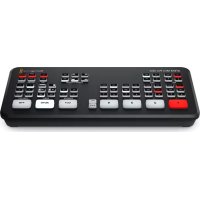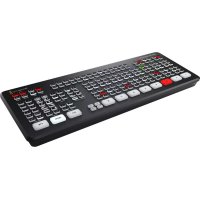
ATEM Mini Extreme - Controller Blackmagic Design - Free user manual and instructions
Find the device manual for free ATEM Mini Extreme Blackmagic Design in PDF.



| Product Type | Live Production Switcher |
| Brand | Blackmagic Design |
| Model | ATEM Mini Extreme |
| Category | Video Production Controller |
| Video Inputs | 8 HDMI inputs |
| Video Outputs | 2 HDMI outputs (program and multi view) |
| USB Webcam Output | 1 x USB-C (recognized as webcam) |
| Network Connectivity | Ethernet for streaming and software control |
| Audio Inputs | 2 x 3.5mm microphone inputs, embedded HDMI audio |
| Headphone Output | 1 x 3.5mm headphone jack |
| Power Supply | 12V power adapter (included) |
| Main Functions | Cut/transition switching, chroma/luma/linear keying, picture-in-picture, SuperSource (4 windows), customizable multi view, camera control (iris/gain/focus/shutter), macros, H.264 recording to USB, direct streaming (YouTube, Twitch), Fairlight audio mixing with EQ and dynamics |
| Control Panel | Dedicated buttons: sources, transitions, keying, streaming, recording, camera control, macros, select bus |
| Included Software | ATEM Software Control (free, available for download) |
| Internal Storage | Media library for 20 still images with alpha |
| Maintenance and Cleaning | Clean with a soft dry cloth. Avoid liquids and aerosols. Unplug before cleaning. |
| Safety | Use only the supplied adapter. Do not expose to moisture or temperatures above 40°C. Max altitude 2000 m. No user-serviceable parts. |
| Spare Parts and Repairability | Repairs must be performed by an authorized Blackmagic Design service center. No spare parts available to the user. |
| Warranty | Limited 12-month warranty (parts and labor) |
| General Information | Compatible with Windows and macOS. Requires USB or Ethernet connection for software control. Supported video formats: 1080p and 720p HD. |
Frequently Asked Questions - ATEM Mini Extreme Blackmagic Design
User questions about ATEM Mini Extreme Blackmagic Design
0 question about this device. Answer the ones you know or ask your own.
Ask a new question about this device
Download the instructions for your Controller in PDF format for free! Find your manual ATEM Mini Extreme - Blackmagic Design and take your electronic device back in hand. On this page are published all the documents necessary for the use of your device. ATEM Mini Extreme by Blackmagic Design.
USER MANUAL ATEM Mini Extreme Blackmagic Design
text_image
Program Camera 2 00:33:45 CAMER 62 OK YouTube REC 00:34:07 125:18 1 2 3 4 5 6 7 8 9 10 11 12 13 14 15 16 17 18 19 20 21 22 23 24 25 26 27 28 29 30 31 32 33 34 35 36 37 38 39 40 41 42 43 44 45 46 47 48 49 50 51 52 53 54 55 56 57 58 59 60 61 62 63 64 65 66 67 68 69 70 71 72 73 74 75 76 77 78 79 80 81 82 83 84 85 86 87 88 89 90 91 92 93 94 95 96 97 98 99 100 BlackmagicdesignInstallation and Operation Manual
ATEM Mini
February 2021
English, 日本語, Français, Deutsch, Español, 中文, 한국어, Русский, Italiano, Português and Türkçe.
Languages
To go directly to your preferred language, simply click on the hyperlinks listed in the contents below.
English 3
日本語 185
Français 368
Deutsch 551
Español 734
中文 917
한국어 1100
Русский 1283
Italiano 1466
Português 1649
Türkçe 1832
natural_image
Circular portrait photo of a smiling man in a dark shirt against a gray background (no text or symbols)Welcome
Thank you for purchasing ATEM Mini for your live production streaming!
If you're new to live production switchers, then you're about to become involved in the most exciting part of the broadcast industry and that's live production! There is nothing like live production and it's so easy to become addicted to the adrenaline rush of editing in real time while the live event unfolds before your eyes.
ATEM Mini is a small live production switcher that automatically converts 720p and 1080p HD video and connects it directly to your computer via USB. The computer sees your ATEM Mini as a webcam so it can be streamed online using your favorite online streaming application like YouTube or OBS Studio.
ATEM Mini switchers use the same internal video processing used in the largest ATEM switchers, so even though the unit is small and portable, you get the same amazing level of control and professional features so it is very powerful. You can use the high quality buttons on the built in control panel, or launch ATEM Software Control and perform more complex switching. For example, you can manage all your graphics, set up keyers, record and run macros, and even mix and enhance your audio using a full audio mixer with faders and advanced EQ and dynamics controls.
ATEM Mini lets you start small, then expand your ATEM workflow as your projects grow. There really is no limit to what you can do! We hope you get years of use from ATEM Mini and have lots of fun with your live production!
This instruction manual should contain all the information you'll need for installing your ATEM Mini and getting started.
Please check the support page on our web site at www.blackmagicdesign.com for the latest version of the ATEM software. When downloading software, please register with your information so we can keep you updated when new software is released. We are constantly working on new features and improvements, so we would love to hear from you!
Grant Petty
Grant Petty
CEO Blackmagic Design
Contents
Getting Started 6
Plugging in Power 6
Plugging in Video Sources 7
Plugging in a Monitor and Testing Inputs 7
Connect a Microphone 8
Cut Transitions 9
Connecting to Skype or Zoom 10
Setting the Webcam Source 10
Switching your Production 12
Using Cuts and Transitions 12
Switching Sources using a Cut 12
Switching Sources using an Auto Transition
Transition Styles and DVEs 13
Controlling Audio 14
Using Picture in Picture 15
Using the Upstream Keyer 16
Fade to Black 17
Using a Still Graphic 17
Additional Features on ATEM Mini Pro and ATEM Mini Extreme 19
Stream Buttons 19
Recording using the Record Buttons 20
Setting the HDMI Output using the Video Out Buttons 21
Direct Streaming via Ethernet 22
Smartphone Tethering 26
Additional Features on ATEM Mini Extreme 27
Connecting Headphones 28
Select Bus 28
Camera Control 29
Macros 31
Using SuperSource 31
Using the Multiview 33
ATEM Software Control 38
Switching Modes 38
Using ATEM Software Control 40
Media Manager 41
Audio Mixer 41
Camera Control 42
Using the Software Control Panel 42
Processing Palettes 46
Media Player Tab 47
Output Tab 48
Recording ISO Files 51
Preparing Media for Recording 57
Preparing Media on a Computer 57 12
Timecode Generator 59
Using the Audio Mixer 60
Shaping your Audio Mix using Advanced Fairlight Controls 62
Using the 6 Band Parametric Equalizer 63
Fairlight Controls Workflow Guide 69
Using the Media Page 69
Navigating the Browse Window 70
ATEM Media Pool 71
Image File Types 72
Creating a TGA File with an Alpha Channel 72
Using Camera Control 75
DaVinci Resolve Primary Color Corrector 79
Using Macros 82
What is a Macro? 82
The Macros Window in ATEM Software Control 82
Changing Switcher Settings 88
Setting Audio Input and Output Behavior 89
Multiview Settings 90
Labels Settings 91
HyperDeck Settings 91
Setting the HDMI Output Source 92
Saving and Restoring
Switcher Settings 92
Preference Settings 94
ATEM Mini Setup Settings 96
Updating your ATEM Mini 97
Configure Page 97
Setting up Open Broadcaster 98
Using Adobe Photoshop with ATEM 100
Using Multiple Control Panels 101
Connecting to a Network 103
Using DHCP and Fixed IP Addresses 103
Manually Setting a Fixed IP Address 104
Changing ATEM Mini Network
Settings 105
Changing the Hardware Panel
Network Settings 106
Setting the Switcher's IP
Location on the Panel 107
ATEM Software Control
via the Network 108
Connecting to an Internet Router 109
Getting a Stream Key 110
Keying using ATEM Mini 111
Understanding Keying 111
Luma Key 111
Linear Key 112
Pre multiplied Key 112
Performing an Upstream
Luma/Linear Key 113
Chroma Key 115
Performing a Chroma Key 116
Pattern Key 119
DVE Key 121
Performing Upstream
Keyer Transitions 124
Creating Video Links with
ATEM Streaming Bridge 126
Direct Connection 126
Network Connection 127
Remote Administration 130
Internet Connection 130
Connection Status 132
Connecting to ATEM Mini Pro or
ATEM Mini Extreme 132
Remote ATEM Mini Pro 134
Broadcast Video Reference 135
Factory Reset 135
HyperDeck Control 136
Introducing HyperDeck Control 136
Controlling HyperDecks with
ATEM Software Control 138
Controlling HyperDecks with
External Hardware Panels 139
HyperDeck Setup with
ATEM 1 M/E Advanced Panel 140
Controlling HyperDecks with
ATEM 1 M/E Advanced Panel 142
Connecting ATEM 1 M/E
Advanced Panel 143
Using ATEM 1 M/E Advanced Panel 144
Performing Transitions using
ATEM 1 M/E Advanced Panel 150
Recording Macros using
ATEM 1 M/E Advanced Panel 161
Using ATEM Camera Control Panel 163
Changing Network Settings 165
Camera Control Panel Layout 167
Controlling Cameras 171
Using Audio 178
Connecting other Audio Sources 178
Using Embedded
HDMI Audio Sources 178
Using a Third Party Audio Mixer
Control Surface 179
Help 181
Regulatory Notices 182
Safety Information 183
Warranty 184
Getting Started
At first glance ATEM Mini might seem intimidating with all the connectors and buttons, however the unit is actually very easy to set up and use. Each feature serves a specific function and it won't take long to get familiar with ATEM Mini and know exactly what each feature does.
This section of the manual will show you how to get started with your ATEM Mini, including how to connect power, connect an HDMI video source, connect a microphone and plug into your computer so you can start broadcasting online.
Plugging in Power
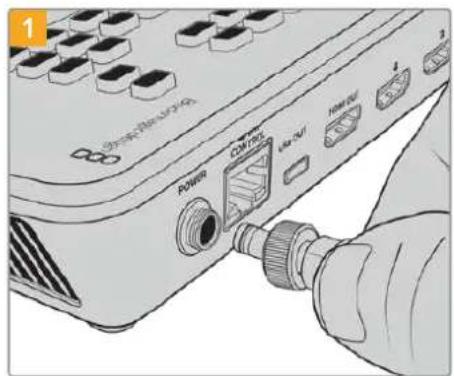
The first step to getting started is to plug in the mains power supply using the supplied power adapter. If your power supply has a locking ring, secure the connection to ATEM Mini by tightening the connector to the unit. This locks the power cable to ATEM Mini preventing it from being accidentally removed.
text_image
Power Control Power Control Power Out Power Out 1 2 3Connect power to ATEM Mini's power input using the supplied cable
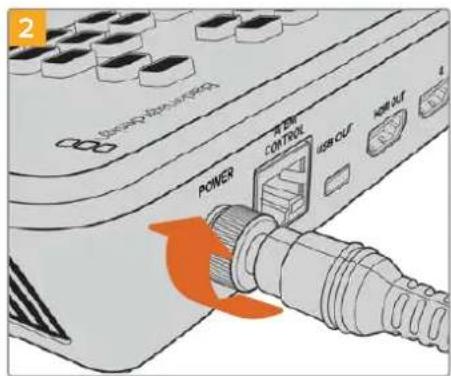
text_image
2 Power USB CONTROL USB OUT USB OUTSecure the connector to ATEM Mini by tightening the connector screw
TIP It's important to note that the power supplies for ATEM Mini are different as the ATEM Mini Pro and Extreme models use a little more power so its power supply can provide more current. However they are both 12 volts. So this means it's important to use the power adapter supplied with each unit. If you have different models of ATEM Mini then it might be a good idea to label each power adapter so you know which adapter is for each unit.
Plugging in Video Sources
Plug your HDMI cameras and other HDMI sources into ATEM Mini's HDMI inputs. The first input you plug in will set the video format, so if the first video source you plug in is 1080p50, all other inputs will automatically be converted to 1080p50.
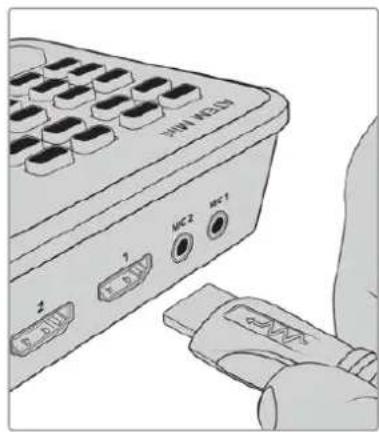
natural_image
Illustration of a device with labeled ports and connectors, showing a hand interacting with a USB port (no text or symbols present)
text_image
4 3 2 1 POWER ITEM CONTROLS LIVEOUT BOOTOUT 4 2 2 1 MOS 2 MAC1Plug HDMI sources into ATEM Mini's four HDMI Inputs
Switch between your sources by selecting the large numbered buttons on the unit.
Plugging in a Monitor and Testing Inputs
With your video sources connected, you can now plug an HDMI television into ATEM Mini's HDMI output and check all the inputs are working. This is also a good opportunity to check sources and see if your shots are smoothly switching between each other.
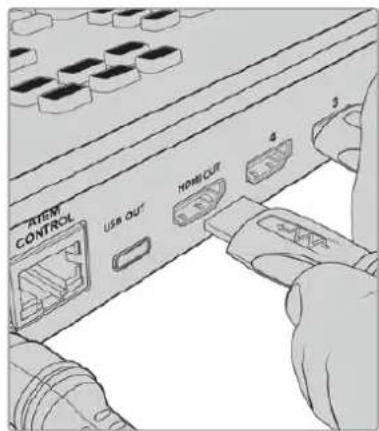
text_image
ITEM CONTROL USB OUT HOMOUT 4 3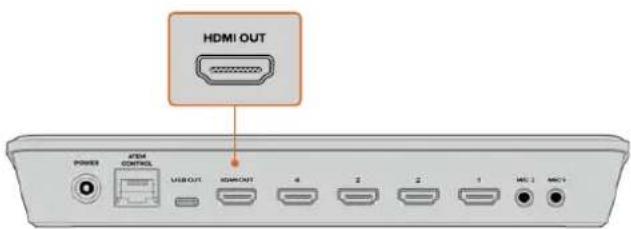
text_image
HDMI OUT POWER AT&T CONTROL USB OUT HDMI OUT 4 2 2 1 MCI 2 MCIPlug an HDMI television or monitor into ATEM Mini's HDMI output so you can monitor your program output and check all your sources are working properly
TIP ATEM Mini Pro and Extreme models have a powerful multiview feature that lets you see all your inputs, plus program and preview outputs simultaneously on one screen. For more information, refer to the 'Using the Multiview' section.
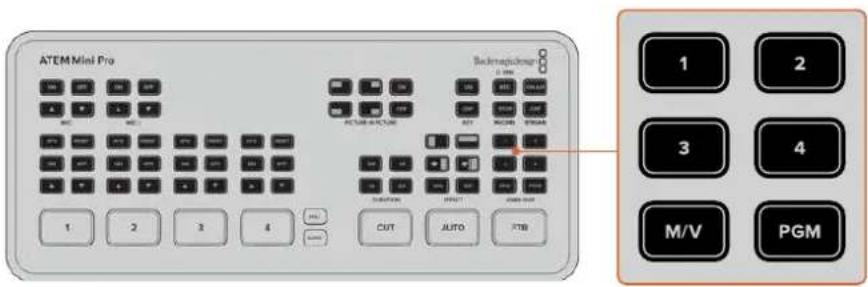
To check your sources, simply press the numbered video out buttons on ATEM Mini's control panel and watch the HDMI television. If your sources are working correctly, you should see them switch between each other. On ATEM Mini Extreme models, the video out buttons select the source for the second HDMI output.
text_image
ATEM Mini Pro Backpropulse 1 2 3 4 M/V PGMConnect a Microphone
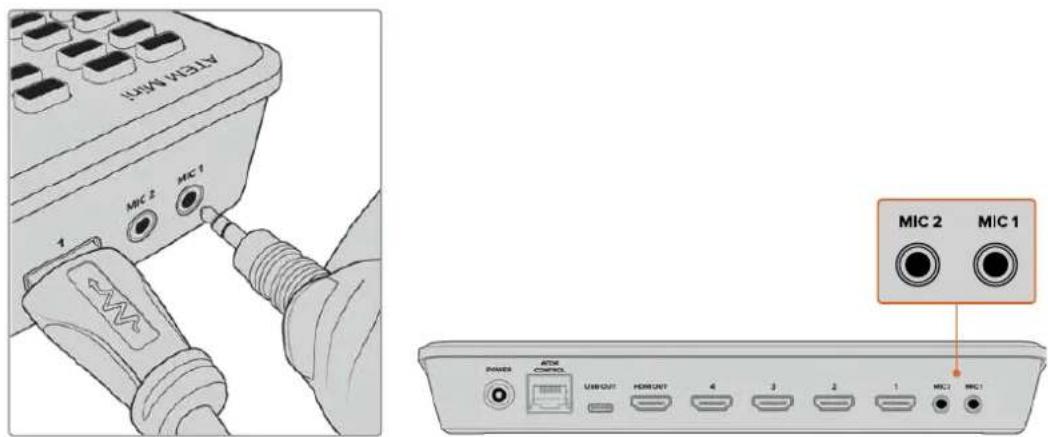
When broadcasting a PowerPoint presentation or a Kickstarter video, you might want to use a microphone so your voice can be heard loud and clear. Plug a microphone, for example a small wireless collar microphone, into one of the 3.5mm audio inputs.
If you are broadcasting an interview, plug the second microphone into the second 3.5mm audio input. You can even plug a music player into one of the audio inputs and mix it into your production.
text_image
MIX VIEW MIC 2 MIC 1 1 MIC 2 MIC 1 POWER INPUTS HOURS 4 3 2 1 MIC1 MIC1Connect microphones to ATEM Mini's mic inputs
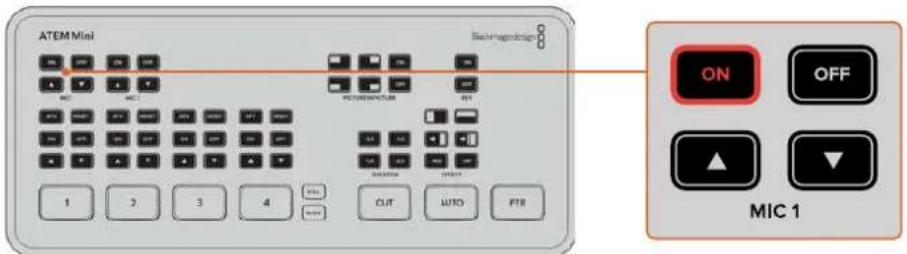
To add the microphone to your audio mix, press the 'on' button. This switches the mic input on air until you press 'off'. The button will illuminate red when on air.
text_image
ATEM Mini Bauinagodog ON OFF MIC 1Cut Transitions
Now that you have your cameras and microphone connected, ATEM Mini is ready to start switching your production. This happens when you switch from one video source in your broadcast to another. A source can be any HDMI video signal connected to the HDMI inputs. It can also be a still graphic, a keyer, or any internal source like a color generator, color bars, or black.
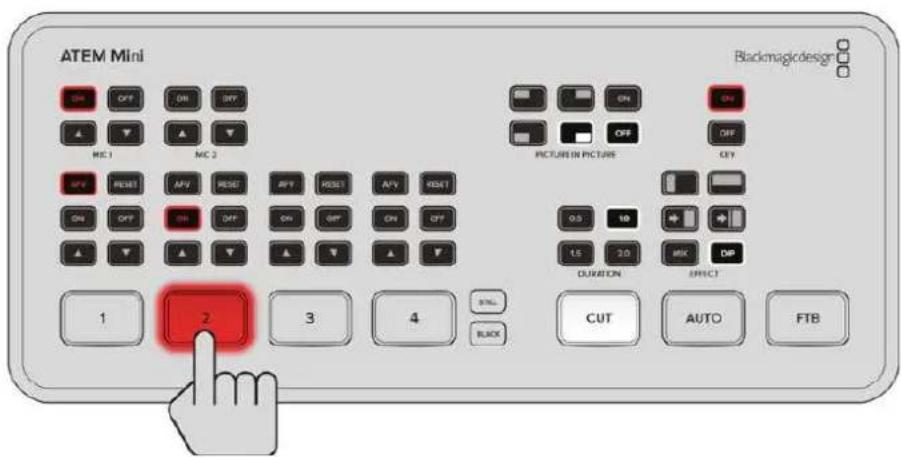
In the demonstration below ATEM Mini will cut from input 1 to input 2.
To perform a cut:
1 Input 1 is illuminated red to indicate input 1 is currently live on air.
2 Select a 'cut' by pressing the 'cut' button. Pressing 'cut' tells ATEM Mini you want to use a straight cut instead of an auto transition.
3 Now press the input 2 button.
Input 1 will now immediately switch to input 2 and you will see input 2 illuminated red, which means input 2 is now live on air. This is known as a cut as you are ‘cutting’ directly from one source to another.
text_image
ATEM Mini Blackmagic design MC1 NC2 PICTURE OR PICTURE CEY OFF ON OFF ON ON RESET RESET OFF RESET APV RESET ON ON OFF ON OFF ON OK 3.0 OUTRUN DIRECT 1 2 3 4 STNL BLACK CUT AUTO FTBConnecting to Skype or Zoom
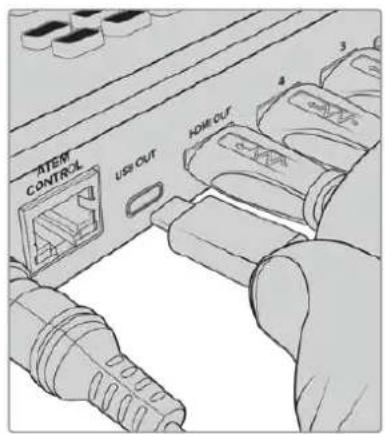
Plug ATEM Mini's webcam output into your computer's USB input. Your computer will recognize ATEM Mini as a webcam and you can select it as the webcam source in your streaming program, such as Skype, Zoom or OBS Studio.
text_image
ATEN CONTROL USB OUT HOME OUT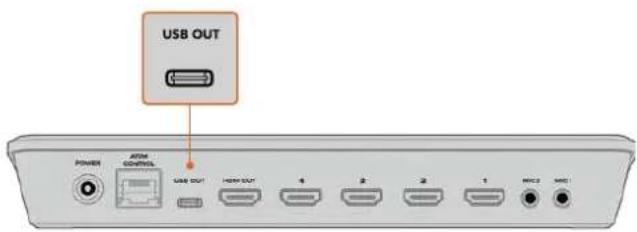
text_image
USB OUT POWER USB OUT HOURS 4 2 2 1 MHzPlug your computer into ATEM Mini's webcam out USB-C connector
Setting the Webcam Source
In most cases, your streaming software will automatically set ATEM Mini as the webcam, so when you launch your streaming software you will see the picture from your ATEM Mini straight away. If your software doesn't select ATEM Mini, simply set the software to use ATEM Mini as the webcam and microphone.
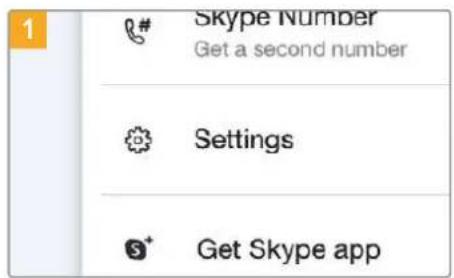
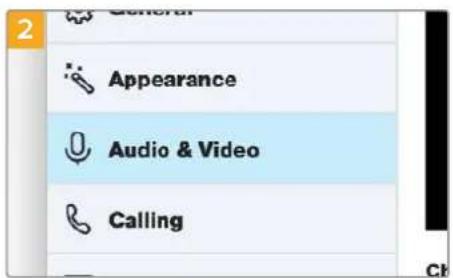
Setting the Webcam on Skype
text_image
1 Skype Number Get a second number Settings S+ Get Skype appClick on the profile picture and select 'settings'.
text_image
2 Appearance Audio & Video CallingSelect 'audio & video' from the sidebar
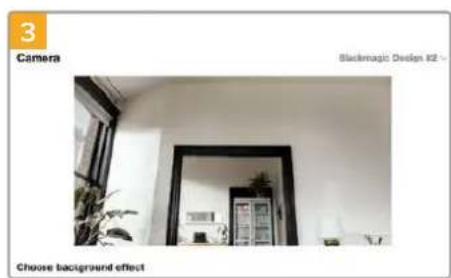
natural_image
Interior view of a room with a framed mirror and window, no visible text or symbolsClick on the 'camera' menu and select Blackmagic Design from the list. You will see the video from ATEM Mini appear in the preview window.
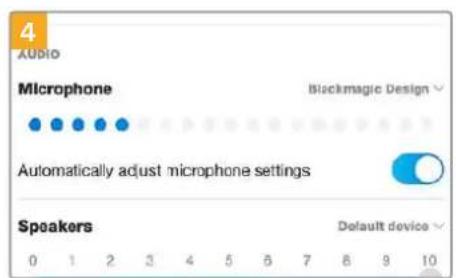
text_image
4 AUDIO Microphone Blackmagic Design Automatically adjust microphone settings Speakers 0 1 2 3 4 5 6 7 8 9 10 Default deviceNow go to the 'microphone' menu and select Blackmagic Design as your audio source.
With your Skype settings set correctly, perhaps try out a Skype call with a friend as a quick test to check your broadcast setup is working.
Setting the Webcam on Zoom
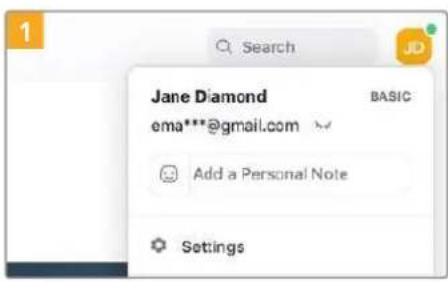
text_image
Jane Diamond BASIC ema***@gmail.com Add a Personal Note SettingsBefore joining a meeting, click your profile picture and select settings.
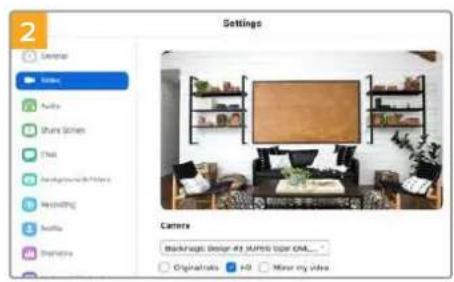
text_image
Settings Carterx Backmagic Design & HUMBO type CAD... Originals +0 None my videoClick the 'video' tab and select Blackmagic Design from the list. The video from ATEM Mini will appear in the preview window.
text_image
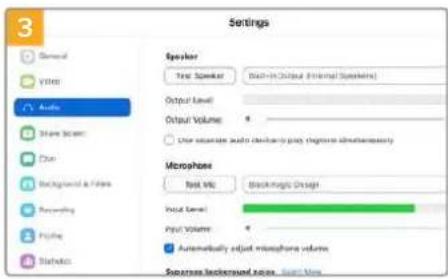
Settings Speaker Text Speaker Dial-in Output (Internal Stephens) Output Level Output Volume: User accurate audio buttonally play, regularly simultaneously Microphone Rest Win Blockings Design Input Level: Input Volume: Automatically adjust microphone volume Suppression background score: 0.01/1.00Now click the 'audio' tab and select Blackmagic Design as the microphone.
With your ATEM Mini now set as your webcam you are now ready to broadcast your video to the world live!
TIP ATEM Mini Pro and Extreme models can also directly stream via Ethernet to any streaming platform including YouTube and Twitch. This means you can stream to YouTube while simultaneously recording your program to a flash disk via the USB-C connection. For more information on direct streaming, see the 'Direct Streaming and Switcher Control via Ethernet' section later in this manual.
Switching your Production
With ATEM Mini, you can switch cleanly using professional cuts or transitions. For example, a cut will instantly change from one source to another and a transition will change sources over a defined duration often using an effect. For more information, refer to the ‘using cuts and transitions’ section later in this manual.
Using Cuts and Transitions
When switching video sources, you can use a straight cut which will immediately change one source to another, or a transition which gradually changes one source to another over a defined duration. Transitions appear as an effect, for example a cross dissolve or mix, a dip to colour, or even a stylized wipe and you have many styles to choose from.
Switching Sources using a Cut
In the demonstration below ATEM Mini will cut from input 1 to input 2.
To perform a cut:
1 Input 1 is illuminated red to indicate input 1 is currently live on air.
2 Select a 'cut' by pressing the 'cut' button. Pressing 'cut' tells ATEM Mini you want to use a straight cut instead of an auto transition.
3 Now press the input 2 button.
Input 1 will now immediately switch to input 2 and you will see input 2 illuminated red, which means input 2 is now live on air. This is known as a cut as you are 'cutting' directly from one source to another.
Switching Sources using an Auto Transition
Transitions let you smoothly switch from one source to another over a defined duration. For example, a mix transition gradually fades the current source into the next until the original source is no longer visible. A wipe transition will move a line across the original source revealing another effectively wiping across the image.
You can add a colored border, or make it soft so the edge is smooth and pleasing. You can even use digital video effects or DVEs, such as a squeeze or push, to move the images as they transition from one to the other.
In the demonstration below ATEM Mini will switch from input 1 to input 2 using a mix transition:
To perform a mix auto transition:
1 Press the 'mix' button to select a mix transition.
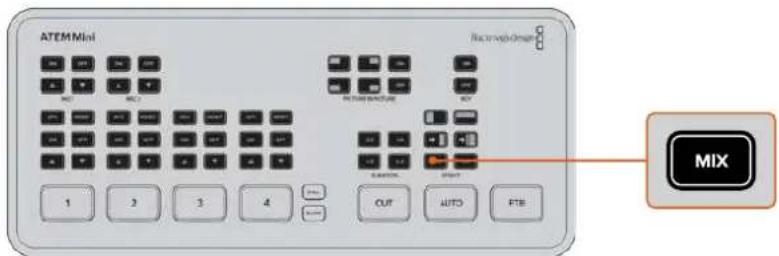
text_image
ATEM Mini MACS v6y0dengt 1 2 3 4 OUT AUTO PTS MIX2 Now press a duration you want for the mix.
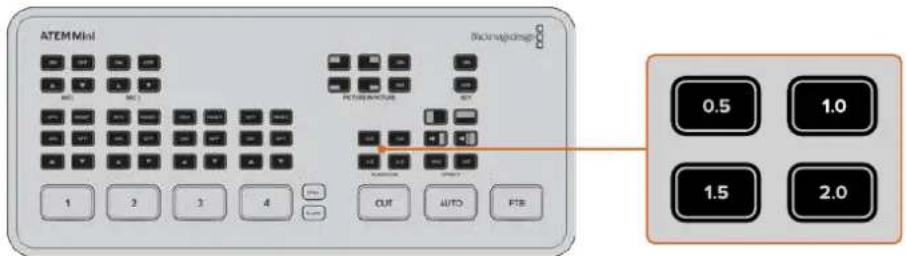
text_image
ATEM Mini ATEM Mini 0.5 1.0 1.5 2.03 Press the 'auto' button to tell ATEM Mini you want to use an automated transition.
4 Press the input 2 button to perform the mix transition.
You will now see inputs 1 and 2 buttons illuminated red while the transition happens and your broadcast changes to input 2. When the transition is complete, input 2 will be illuminated red to indicate it is now live on air.
Transition Styles and DVEs
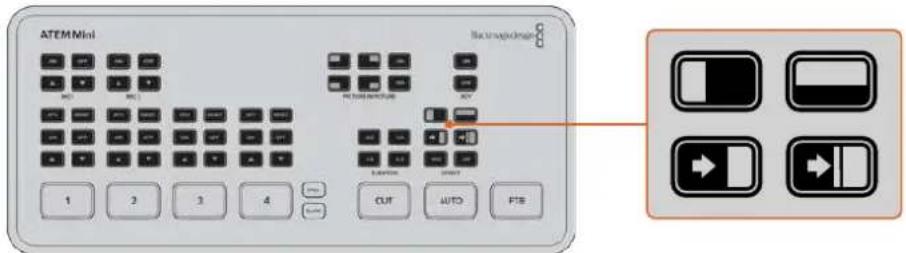
The buttons above the 'auto' button contain different transition styles, including a mix cross dissolve and a dip to color.
You can also select horizontal and vertical wipe transitions by pressing their respective transition style buttons. These also include DVE push and squeeze transitions.
text_image
ATEM Mini No. 100 NO. NO. No. 100 NO. No. 100 No. 100 No. 100 No. 100 No. 100 No. 100 No. 100 No. 100 No. 100 No. 100 No. 100 No. 100 No. 100 No. 100 No. 100 No. No. No. No. No. No. No. No. No. No. No. No. No. No. No. No. No. No. No. No. No. No. No. No. No. No. No. No. No. No. No. No. No. No. No. No. No. No. No. No. No. No. No. No. No. No. No. No. No. No. No.Press the transition type button for the transition you want to use, for example a horizontal or vertical wipe, push or squeeze DVE transition, and mix or dip transition
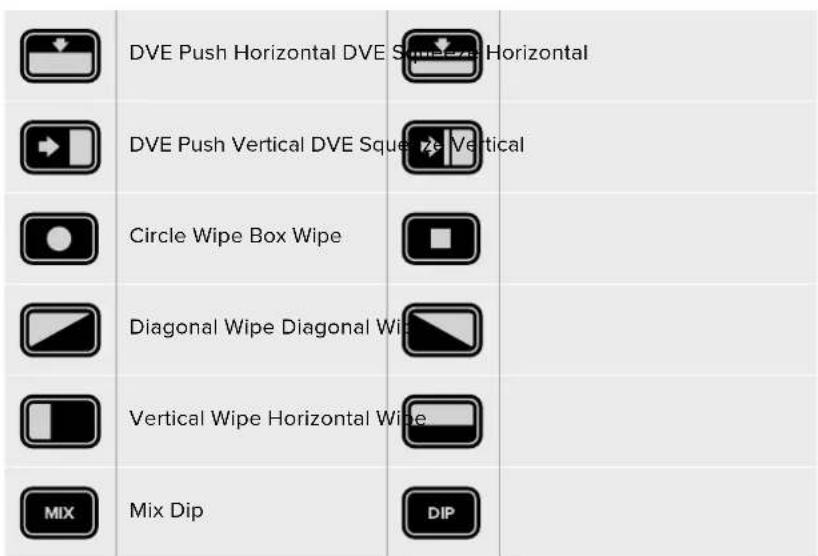
ATEM Mini Extreme models provide more transition types. Below is a table of the different transition types you can select on the control panel.
text_image
DVE Push Horizontal DVE Square Horizontal DVE Push Vertical DVE Squart Vertical Circle Wipe Box Wipe Diagonal Wipe Diagonal Wipe Vertical Wipe Horizontal Wipe Mix Dip DIPControlling Audio
When setting up your production or during your broadcast, you will likely want to control audio levels if the sound is too quiet or too loud.
When an audio level is too loud it will clip. Clipping means the audio has increased beyond the maximum accepted level and when this happens it can distort and sound unpleasant.
Pressing the up and down arrow buttons for each input will increase or decrease the audio level for the respective source. For example, if the presenter's voice is too loud and risks clipping, you can decrease the audio level by pressing the down button incrementally until the level is safe.
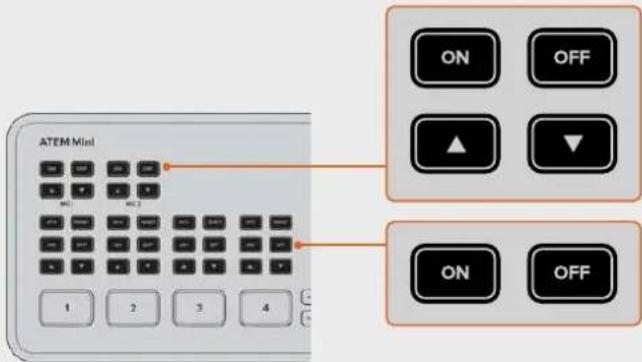
ON OFF
Pressing the on or off buttons will let you permanently enable the audio from the respective input source, or turn its audio off completely.
text_image
ATEM Mini ON OFF ▲ ▼ ON OFF 1 2 3 4ON – When the input's audio is set to 'on', the input audio will be heard permanently, even if the source is not currently on air.
OFF – When the input's audio is set to 'off', the source audio will never be heard even if the source video is on air.
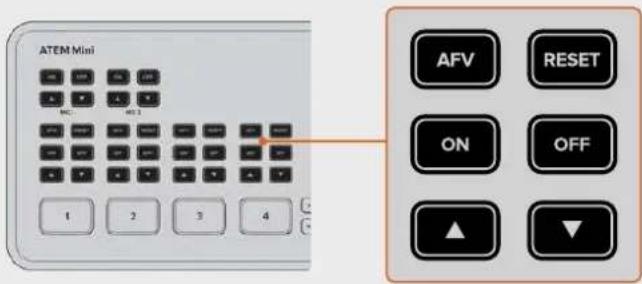
AFV
AFV stands for 'audio follows video' and will let the audio for a respective input be heard whenever the source is switched on air.
text_image
ATEM Mini AFV RESET ON OFF ▲ ▼To enable or disable AFV for each input, simply press its AFV button.
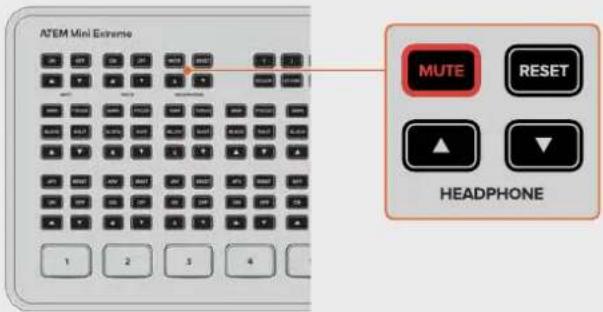
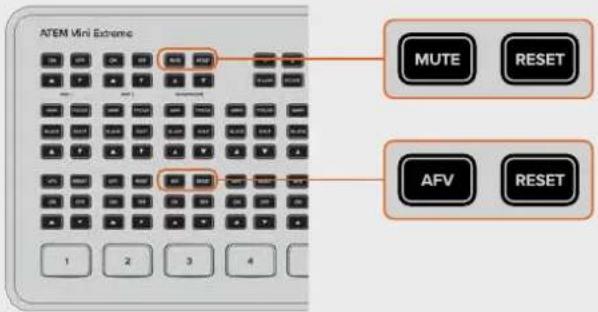
MUTE
Headphone controls include a mute button to silence all audio playback including program audio. This is helpful if a presenter wants to mute program audio while speaking. The button will illuminate red when selected.
text_image
ATEM Mini Extreme MUTE RESET HEADPHONE 1 2 3 4RESET
Pressing the 'reset' button will restore the input audio level to its default position. This is helpful if you want to cancel any adjustments or reference the original level before you made changes.
On ATEM Mini Extreme, pressing the reset button for the headphone input will restore the headphone level to its default setting.
text_image
ATEM Mini Extreme MUTE RESET AFV RESETUsing Picture in Picture
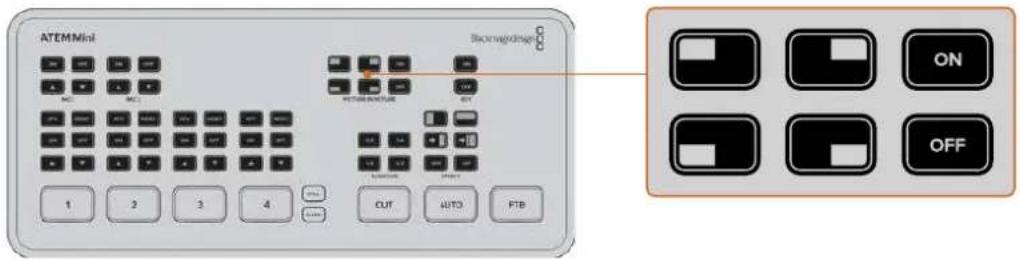
Picture in picture superimposes a second source over your broadcast video source in a small box you can position and customize. Input 1 is the default picture in picture source, so if you're broadcasting gameplay and want to superimpose your reactions, plug your camera into input 1 and it will appear in picture in picture.
text_image
ATEMMini Bisengelding ON OFFTo enable picture in picture:
1 Make sure your video to be inside the box is plugged into HDMI input 1.
2 Plug your main video into one of the other HDMI inputs.
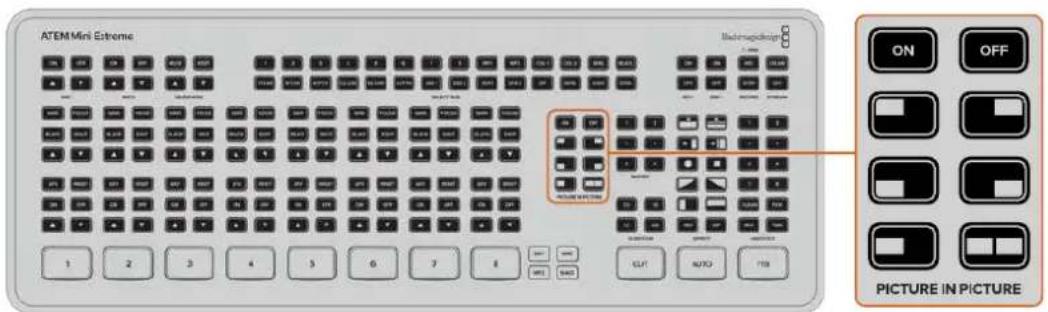
3 In the picture in picture buttons on control panel, press 'on'.
You will now see the picture in picture box appear on the screen. To select a different position, press any of the position buttons.
ATEM Mini Extreme models feature additional picture in picture configurations including a single side box arrangement and the ability to superimpose two sources over the background. HDMI 1 and HDMI 2 are the default sources when dual picture in picture sources are enabled.
text_image
ATEM Mini Extreme Baterapakkauf ON OFF PICTURE IN PICTUREUsing the Upstream Keyer
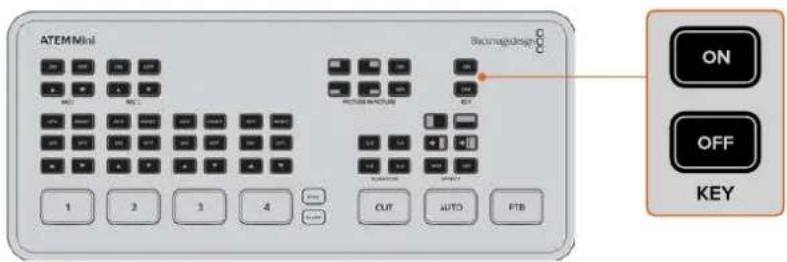
ATEM Mini's upstream keyer is used to superimpose graphics or blend one video layer over another using transparency. This means you can tell ATEM Mini to make an input source's background color invisible using the chroma keyer, or only use a specific section of a graphic using a luma or linear key. Linear keys are great for visual effects, titles and lower third graphics.
text_image
ATEM Mini Submagnidesign ON OFF KEYPress the 'key' on or off buttons to switch the upstream keyer on and off air
TIP ATEM Mini's advanced chroma keyer is perfect for keying graphics from a PowerPoint presentation. For example, you could have a series of graphics designed to be keyed over a background and these can played out directly from a PowerPoint sequence. All you need to do is make any invisible areas green, or any solid color that isn't used in your graphic, then set the chroma keyer to make that color transparent. The images from your computer will be high quality over HDMI so will key very cleanly and look fantastic.
text_image
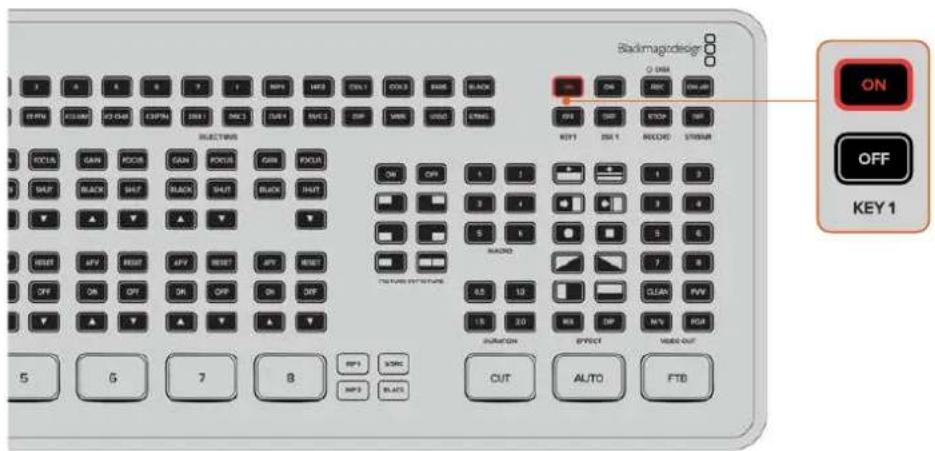
Backmagzdesign ON OFF KEY 1 OK OK OK OK OK OK OK OK OK OK OK OK OK OK OK OK OK OK OK OK OK OK OK OK OK OK OK OK OK OK OK OK OK OK OK OK OK OK OK OK OK OK OK OK OK OK OK OK OK OK ON ON ON ON ON ON ON ON ON ON ON ON ON ON ON ON ON ON ON ON ON ON ON ON ON ON ON ON ON ON ON ON ON ON ON ON ON ON ON ON ON ON ON ON ON ON ON ON ON ON OKATEM Mini Extreme features four upstream keyers. Use the 'key 1' on or off buttons to switch upstream keyer 1 on or off air. To switch to other upstream keyers save them in a macro or use ATEM Software control. For more information on macros, see the 'Using Macros' section later in this manual.
Fade to Black
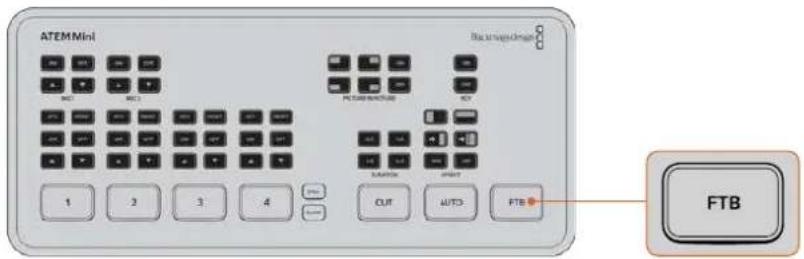
The fade to black button is an easy way to start and end live broadcasts. Fade to black performs a mix to black which happens across all video layers at the same time. This means all video inputs, stills and any upstream or downstream keyers that are visible in your broadcast. When performing a fade to black, the master program audio will also fade out to silence.
Simply press the FTB button to perform the fade to black. The button will flash while enabled.
text_image
ATEMMini Bauwegedgen 1 2 3 4 OUT WTO FTB FTBTo fade up from black, simply press the FTB button again. This is a clean way of starting and finishing a broadcast.
Using a Still Graphic
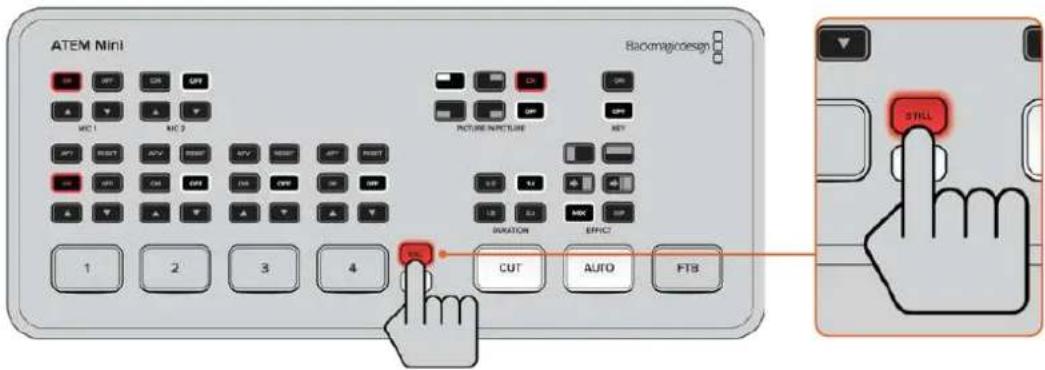
ATEM Mini and Mini Pro switchers' 'still' button is another input source you can switch to in your production. Press the 'still' button to switch a still loaded in the media player to air.
To take the graphic off air, simply switch to a different input source.
The 'still' button will switch a graphic loaded in ATEM Software Control's media pool. ATEM Software Control is an extremely powerful software control panel that opens a world of options and lets you do a lot more with ATEM Mini.
text_image
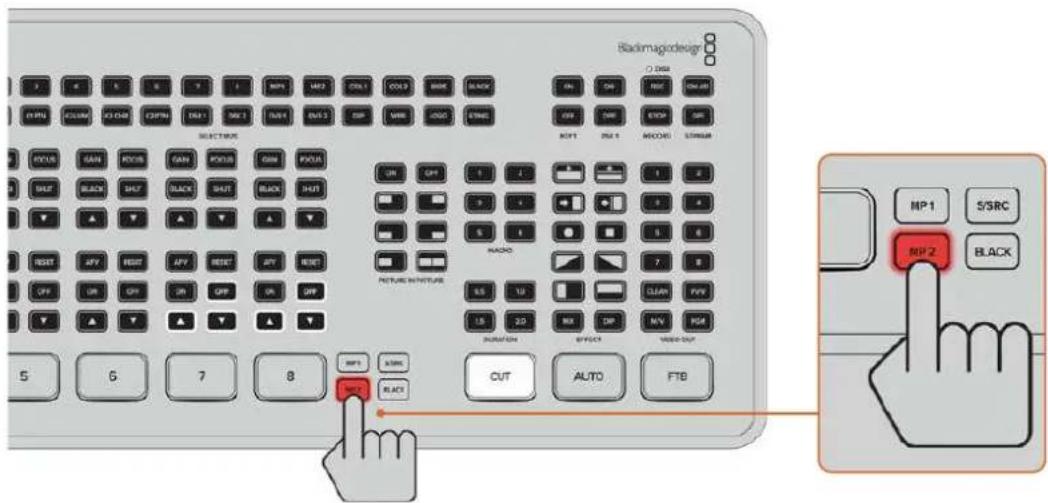
ATEM Mini Bacomagoc design MIC 1 MIC 2 MIC 3 PICTURE INPICTURE KEY 1 2 3 4 CUT AUTO FTS STILLOn ATEM Mini Extreme model switchers, use either of the two media player sources, for example MP1 or MP2, to switch to a loaded still.
text_image
Radimagode design OK DISK RISK ON ON ON ON ON ON ON ON ON ON ON ON ON ON ON ON ON ON ON ON ON ON ON ON ON ON ON ON ON ON ON ON ON ON ON ON ON ON ON ON ON ON ON ON ON ON ON ON ON ON OKT1 OKT1 OKT1 OKT1 OKT1 OKT1 OKT1 OKT1 OKT1 OKT1 OKT1 OKT1 OKT1 OKT1 OKT1 OKT1 OKT1 OKT1 OKT1 OKT1 OKT1 OKT1 OKT1 OKT1 OKT1 OKT2 OKT2 OKT2 OKT2 OKT2 OKT2 OKT2 OKT2 OKT2 OKT2 OKT2 OKT2 OKT2 OKT2 OKT2 OKT2 OKT2 OKT2 OKT2 OKT2 OKT2 OKT2 OKT2 OKT2 OKT2 OKT3 OKT3 OKT3 OKT3 OKT3 OKT3 OKT3 OKT3 OKT3 OKT3 OKT3 OKT3 OKT3 OKT3 OKT3 OKT3 OKT3 OKT3 OKT3 OKT3 OKT3 OKT3 OKT3 OKT3 OKT3 OKT4 OKT4 OKT4 OKT4 OKT4 OKT4 OKT4 OKT4 OKT4 OKT4 OKT4 OKT4 OKT4 OKT4 OKT4 OKT4 OKT4 OKT4 OKT4 OKT4 OKT4 OKT4 OKT4 OKT4 OKT4 OKT5 OKT5 OKT5 OKT5 OKT5 OKT5 OKT5 OKT5 OKT5 OKT5 OKT5 OKT5 OKT5 OKT5 OKT5 OKT5 OKT5 OKT5For more information on how to load stills into the media player, see the 'using the media page' section later in this manual.
Additional Features on ATEM Mini Pro and ATEM Mini Extreme
ATEM Mini Pro and Extreme model switchers have additional features that give you more options for your broadcast and even more ability to control your production directly from the unit without the need for a computer.
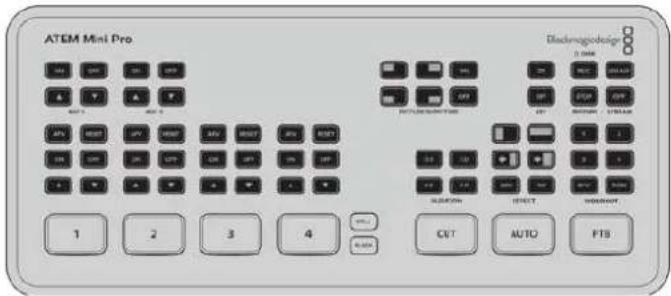
Dedicated buttons on the control panel let you switch sources to the HDMI output, start/stop streaming and start/stop recording.
text_image
ATEM Mini Pro Bladmogodeign 1 ON 2 ON 3 ON 4 ON 5 ON 6 ON 7 ON 8 ON 9 ON 10 ON 11 ON 12 ON 13 ON 14 ON 15 ON 16 ON 17 ON 18 ON 19 ON 20 ON 21 ON 22 ON 23 ON 24 ON 25 ON 26 ON 27 ON 28 ON 29 ON 30 ON 31 ON 32 ON 33 ON 34 ON 35 ON 36 ON 37 ON 38 ON 39 ON 40 ON 41 ON 42 ON 43 ON 44 ON 45 ON 46 ON 47 ON 48 ON 49 ON 50 ON 51 ON 52 ON 53 ON 54 ON 55 ON 56 ON 57 ON 58 ON 59 ON 60 ON 61 ON 62 ON 63 ON 64 ON 65 ON 66 ON 67 ON 68 ON 69 ON 70 ON 71 ON 72 ON 73 ON 74 ON 75 ON 76 ON 77 ON 78 ON 79 ON 80 ON 81 ON 82 ON 83 ON 84 ON 85 ON 86 ON 87 ON 88 ON 89 ON 90 ON 91 ON 92 ON 93 ON 94 ON 95 ON 96 ON 97 ON 98 ON 99 ON 100 ON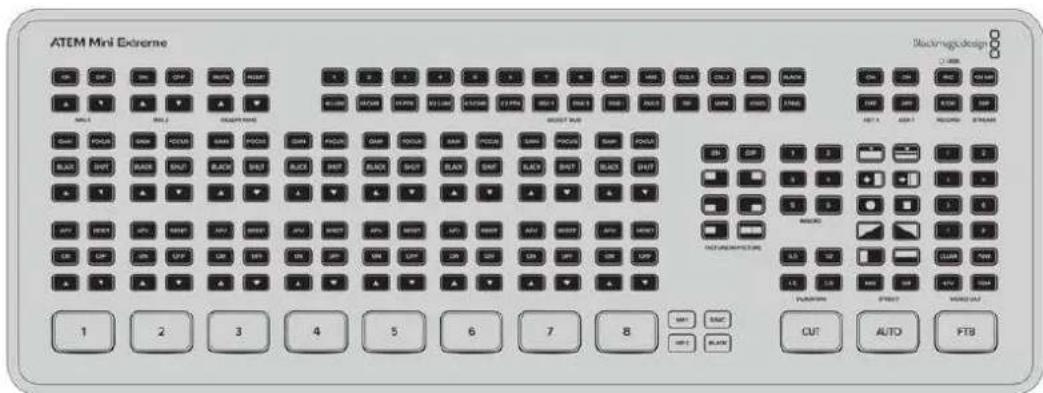
text_image
ATEM Mini Extreme Blacktragsdesign 1 2 3 4 5 6 7 8 9 10 11 12 13 14 15 16 17 18 19 20 21 22 23 24 25 26 27 28 29 30 31 32 33 34 35 36 37 38 39 40 41 42 43 44 45 46 47 48 49 50 51 52 53 54 55 56 57 58 59 60 61 62 63 64 65 66 67 68 69 70 71 72 73 74 75 76 77 78 79 80 81 82 83 84 85 86 87 88 89 90 91 92 93 94 95 96 97 98 99 100ATEM Mini Pro and Extreme model switchers provide more features so you have more control from their built in control panels plus additional streaming options
You also have the choice of streaming via the webcam output or direct streaming via Ethernet. At any time, you can record your broadcast to an external disk via USB-C and use the dedicated record buttons on ATEM Mini Pro to start and stop recording.
One of the most exciting additional features is the multiview. This powerful feature displays a multiview on the HDMI video output that shows a comprehensive overview of your production. All HDMI input sources, the program and preview outputs, plus important recording, streaming and audio status information is presented on one screen so you always know exactly what is happening during your broadcast!
This section describes all the additional features and how to use them.
Stream Buttons
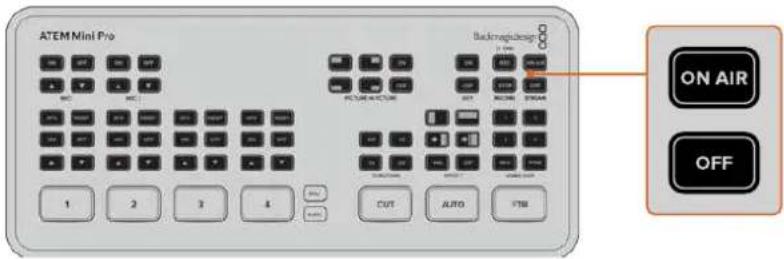
Streaming is built into all ATEM Mini Pro and Extreme model switchers, so you don't need to use any complicated software to get started. Just use the included ATEM Software Control to select what streaming service you intend to use and then enter in the streaming key. Once you have completed this setup, you can simply press On Air to go live! There is more information in the live streaming section of this manual.
text_image
ATEM Mini Pro Backpropulse ON AIR OFFThe stream buttons labeled 'on air' and 'off' let you start and stop streaming directly
When your broadcast has finished, all you need to do is press the 'off' stream button and your stream is stopped. This means once you are set up and streaming, the switcher is completely independent and you don't need to go back to your computer to stop and close your stream.
TIP After your streaming details are entered into the 'output' palette in ATEM Software Control, your streaming setup is now stored in your ATEM Mini Pro or Extreme so you can start streaming again immediately, even after a power cycle. This makes it easy to stream a new broadcast without having to reset your streaming software every time.
On ATEM Mini Pro and ATEM Mini Extreme, it is actually easier and faster to stream via Ethernet. This lets you stream immediately via any internet connection on a computer or internet router, while simultaneously giving you the additional benefits of ATEM Software Control over the same connection.
For information on setting up streaming and control via Ethernet, refer to 'direct streaming and switcher control via Ethernet' later in this section.
Recording using the Record Buttons
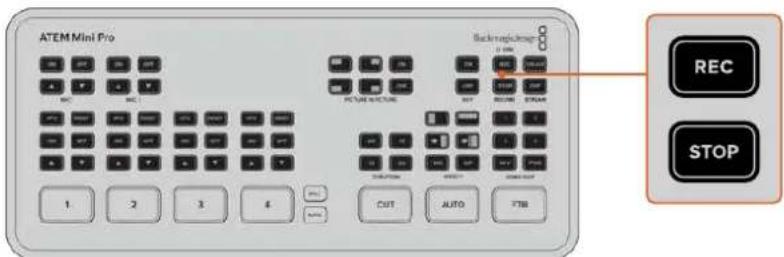
ATEM Mini Pro and Extreme switchers let you record your stream via USB-C using an external disk or flash drive. For example, you can connect a Blackmagic MultiDock 10G and record directly to an SSD. When the disk indicator above your switcher's record button illuminates green, press the record button and you are now recording your broadcast to disk. To stop recording, press the 'stop' button.
ATEM Software Control records your stream using H.264 compression with an optimized compression ratio to provide high quality video without large file sizes.
text_image
ATEM Mini Pro Backup/RESET 1.000 REC STOP 1 2 3 4 CUT AUTO FTP FOR GPS/AVG RESET AUTOPress the record button, marked 'rec', to record your broadcast to an external drive or flash disk via USB-C
Disk Status Indicator
The disk status LED indicator lets you know the status of the recording media. For example, the indicator illuminates green if the current drive is formatted and ready to record and red while recording.
Indicators include:
| Green Formatted disk is detected and ready to record. |
| Red Disk is recording. |
The record button will also indicate the performance of the drive. When the record button is slowly flashing red, this indicates there is low disk space. When the record button flashes red rapidly, the disk performance is poor causing skipped frames.
NOTE To record to an external drive, you first need to format the disk. Refer to the 'preparing media for recording' section for more information.
Setting the HDMI Output using the Video Out Buttons
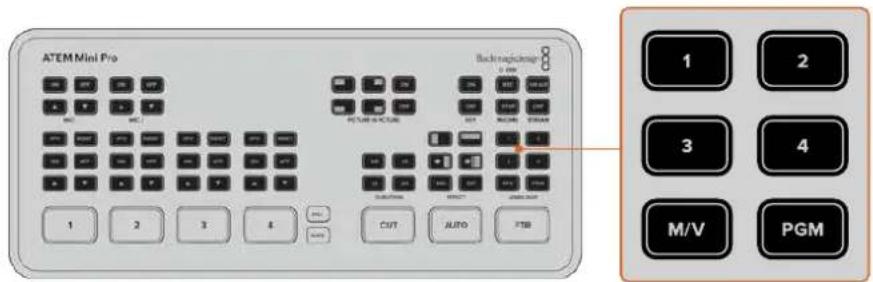
The video out buttons on the right side of the switcher are used to switch sources to the HDMI output on ATEM Mini Pro and HDMI out 1 on ATEM Mini Extreme. The default output source for ATEM Mini Pro is the multiview and you can read more about this powerful feature later in this section. ATEM Mini Extreme's default output is program for output 1 and multiview for output 2.
text_image
ATEM Mini Pro Back rights reserved 1 ON 2 3 4 M/V PGMPress the video out buttons to switch a source to the HDMI output
To change the HDMI output source, press any of the video out buttons. For example you can select the HDMI inputs for isolated camera recordings, or select the program output or multiview. Compared to ATEM Mini, having the buttons built into ATEM Mini Pro and Extreme means you can change the HDMI output directly from the unit itself! In addition to the 8 HDMI inputs, program and multiview, ATEM Mini Extreme lets you select a clean feed or the preview output.
NOTE If you want to switch camera 1 direct or preview to the HDMI output, these sources are available from the 'output' menu in ATEM Software Control.
Direct Streaming via Ethernet
ATEM Mini Pro and Extreme switcher's Ethernet connector lets you stream directly while simultaneously providing the added benefits of ATEM Software Control. You can learn more about this powerful control software in the 'using ATEM Software Control' section.

text_image
POWER AFTER CONTROLS USB OUT HDMI OUT 4 1 3 1 MAC 5 MAC 5Plug into your internet router via Ethernet to stream directly
You can select which platform you want to use in ATEM Software Control and set all the relevant settings for your stream. If you are setting up a broadcast on your channel that you will regularly use, these settings will be stored in your switcher and you can then plug into any internet connection at any time and broadcast directly from the unit.
This section includes how to configure settings for YouTube Studio and Twitch.
TIP As you're setting up your broadcast, it's worth loading a standby graphic into ATEM Software Control's media player and switching it to the program output so you can perform a quick test broadcast before actually going live.
To configure your settings for YouTube Studio:
text_image
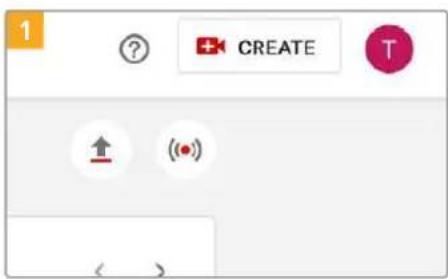
1 CREATE T ↑ (●)Log into your YouTube account. Click the 'go live' icon.
text_image
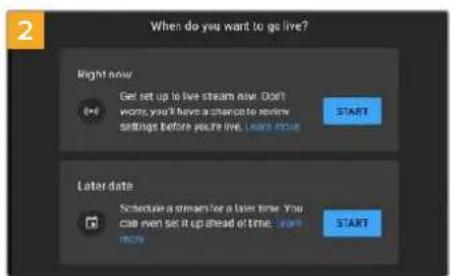
When do you want to go live? Right now Get set up to live stream now. Don't worst you'll have a chance to review settings before your live. Learn Prime START Later date Schedule a stream for a live time. You can even let it up ahead of time. Learn more STARTIf prompted, choose to start your stream 'right now' or at a 'later date' and select 'streaming software' from the options. Otherwise, select Edit
text_image
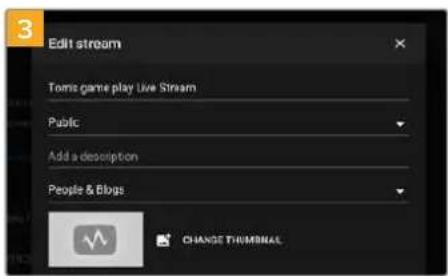
Edit stream Tomio game play Live Stream Public Add a description People & Blogs CHANGE TERMINALEnter your broadcast name and details. Set the broadcast to 'public' so anyone can watch.
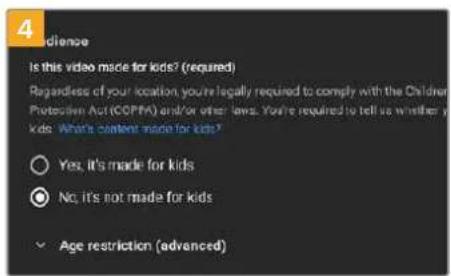
text_image
4 science Is this video made for kids? (required) Regardless of your location, you're legally required to comply with the Children Protection Act (COPPA) and/or other laws. You're required to tell us whether you do. What's content made for kids? ○ Yes, it's made for kids ● No, it's not made for kids ✓ Age restriction (advanced)Set the child protection to the appropriate setting and press save.
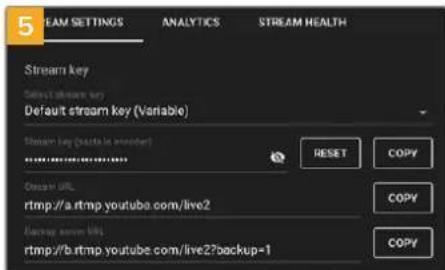
text_image
5 EAM SETTINGS ANALYTICS STREAM HEALTH Stream key Select stream key Default stream key (Variable) Stream key (start in seconds) ............ RESET COPY Cheap url... rtmp//a.rtmp.youtube.com/live2 Backup audio file rtmp//b.rtmp.youtube.com/live2?backup=1 COPYAn auto generated stream key will appear in the stream settings, click 'copy' to copy the stream key.
Now you have copied the stream key for your broadcast, you will need to paste it into the stream details in ATEM Software Control.
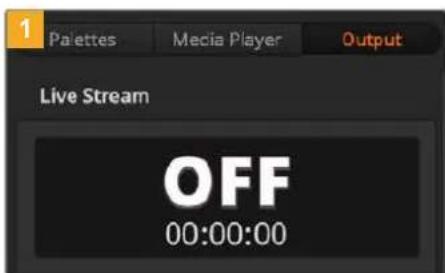
text_image
1 Palettes Media Player Output Live Stream OFF 00:00:00In ATEM Software Control's processing palettes, click on the 'output' tab.
Open the 'live stream' palette.
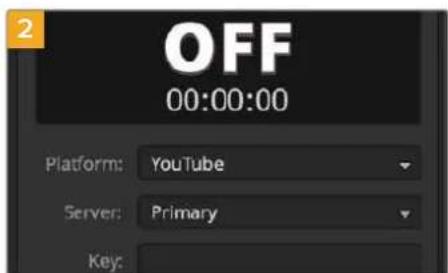
text_image
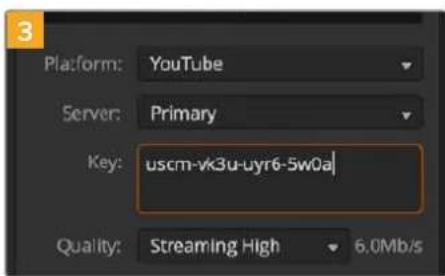
OFF 00:00:00 Platform: YouTube Server: Primary Key:Set the platform to YouTube by clicking in the menu and selecting YouTube from the menu list. Set the server to 'primary'.
text_image
3 Platform: YouTube Server: Primary Key: uscm-vk3u-uyr6-5w0a Quality: Streaming High 6.0Mb/sIn the 'key' setting, paste the stream key you copied from YouTube.
text_image
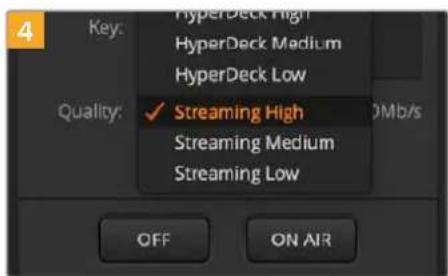
Key: HyperDeck High HyperDeck Medium HyperDeck Low Quality: ✓ Streaming High Streaming Medium Streaming Low OFF ON AIRSet the streaming quality to low, medium, or high. This will also set the quality for the recording output via USB-C.
text_image
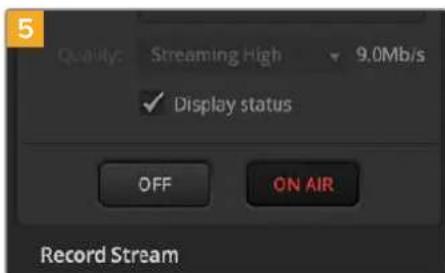
5 Quality: Streaming High 9.0Mb/s ✓ Display status OFF ON AIR Record StreamWith all the streaming details now set, it's worth performing a quick test broadcast to make sure everything is working. Press the 'on air' button on your switcher, or click on the on air button in the live stream palette.
YouTube Studio is now ready to start broadcasting. It may take a few moments for the memory buffer to initiate. When the buffering is complete, the 'go live' button will appear in the YouTube Studio manager and all you need to do is click 'go live'.
You are now broadcasting!
To test that everything is working properly, click the 'share' icon, copy the link and paste it into a new window or tab in your internet browser. You can now monitor your live stream just like a member of your audience.
When your production has finished, press the 'off' streaming button on your switcher to stop your broadcast.
To configure your settings for Twitch:
text_image
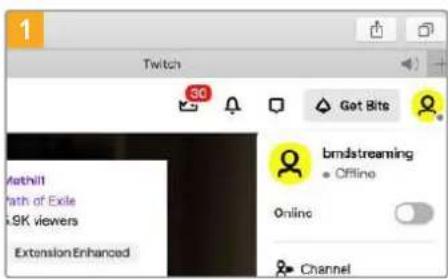
1 Twitch 30 Get Bits Aathilt path of Exle 5.9K viewers ExtensionEnhanced brndstreaming • Offline Online ChannelLog into your Twitch account. Click on your account avatar in the top right corner.
text_image
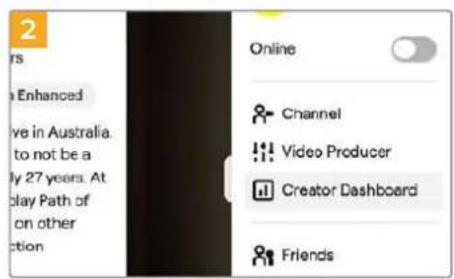
2 Users Enhanced ve in Australia to not be a ly 27 years. At play Path of on other ction Online Channel Video Producer Creator Dashboard FriendsClick on 'creator dashboard'.
text_image
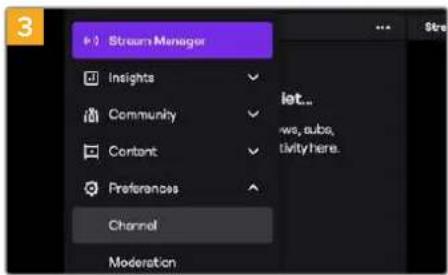
Stream Manager Insights Community Content Preferences Channel ModerationIn the stream manager preferences, select 'channel'.
text_image
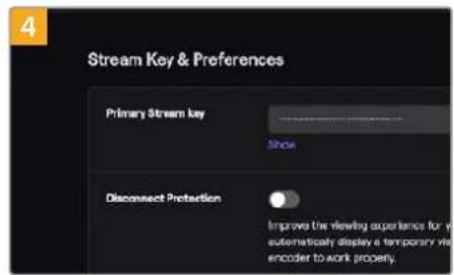
4 Stream Key & Preferences Primary Stream key Show Disconnect Protection Improves the viewing experience for y automatically display a temporary vis encoder to work properly.A primary stream key will be automatically generated.
text_image
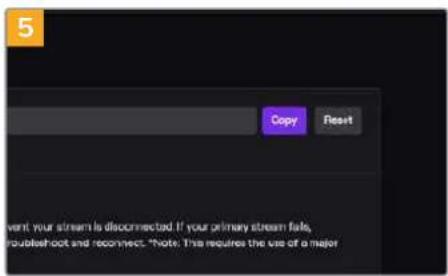
5 Copy Reset want your stream is disconnected if your primary stream fails, troubleshoot and reconnect. "Note: This requires the use of a majorClick 'copy'.
Now you have copied the stream key for your broadcast, you will need to paste it into the stream details in ATEM Software Control.
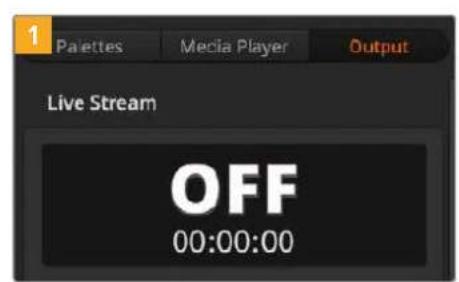
text_image
1 Palettes Media Player Output Live Stream OFF 00:00:00In ATEM Software Control's processing palettes, click on the 'output' tab. Open the 'live stream' palette.
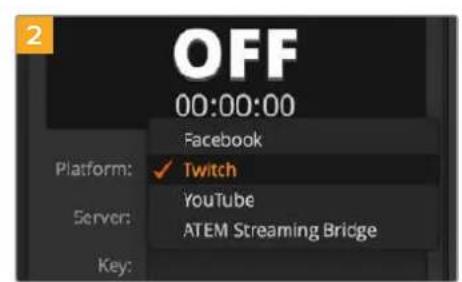
text_image
OFF 00:00:00 Facebook Platform: ✓ Twitch Server: YouTube ATEM Streaming Bridge Key:Set the platform to Twitch by clicking in the menu and selecting Twitch from the menu list.
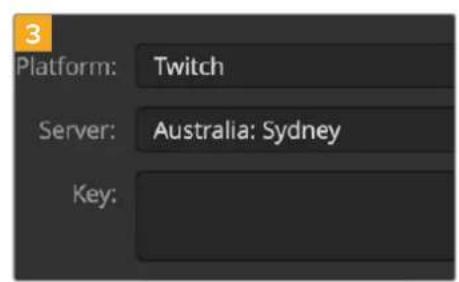
text_image
3 Platform: Twitch Server: Australia: Sydney Key:Click on the 'server' setting menu list and select the server nearest to your location.
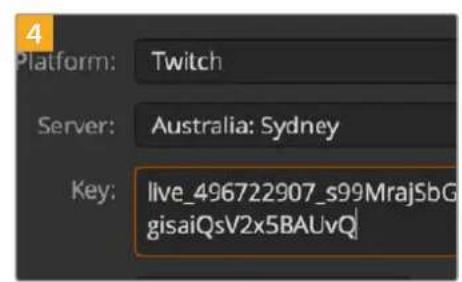
text_image
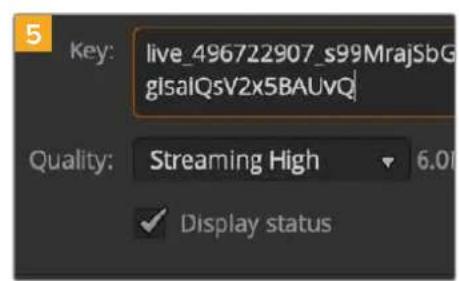
Platform: Twitch Server: Australia: Sydney Key: live_496722907_s99MrajSbG gisaiQsV2x5BAUvQIn the 'key' setting, paste the stream key you copied from Twitch.
text_image
Key: live_496722907_s99MrajSbG glsalQsV2x5BAUvQ Quality: Streaming High 6.01 ✓ Display statusSet the streaming quality to low, medium, or high. This will also set the quality for the recording output via USB-C.
text_image
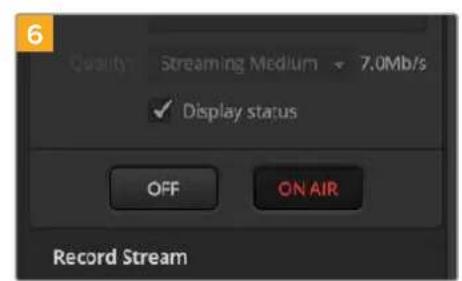
6 Quality Streaming Medium 7.0Mb/s ✓ Display status OFF ON AIR Record StreamWith all the streaming details now set, it's worth performing a quick test broadcast to make sure everything is working. Press the 'on air' button on ATEM Mini Pro or Extreme switcher, or click on the on air button in the live stream palette.
You are now on air! To check your broadcast, click on your account avatar and select 'back to Twitch'. Once in the main Twitch window, click your avatar icon again and select 'channel'. You will now see your broadcast on your channel and the live indicator will appear at the top of the window.
NOTE If you are using additional ATEM control panels with your ATEM Mini, then you might need a dedicated IP address. For more information, refer to the 'connecting to a network' section.
Direct Streaming by Sharing Your Computer Internet
With ATEM Software Control now connected to your switcher, you can set up a direct stream via your computer's internet connection.
To set up your ATEM Mini Pro or ATEM Mini Extreme for software control and direct streaming:
1 Plug your ATEM into your computer's spare Ethernet port. It may take a moment for DHCP to find the unit and assign an IP address.
2 Launch ATEM Software Control.
3 You will see ATEM Mini Pro or ATEM Mini Extreme listed as a connected ATEM switcher on your network. Simply select your switcher from the list.
4 Click 'connect'.
5 Configure your computer to share its internet connection through its Ethernet port.
Mac: in System Preferences, click 'sharing' then select 'internet sharing' from the 'service' list. In the 'share your connection from' menu, choose 'wi-fi' if your Mac is connected to the internet over wifi. In the 'to computers using' list, select 'ethernet'. In the 'service' list, tick the 'internet sharing' checkbox. When you are asked if you are sure you want to turn on internet sharing, click 'start'.
Windows: in the Windows search box, type 'view network connections' and press enter. Right click on the internet connection and select 'properties'. On the 'sharing' tab, tick 'allow other network users to connect through this computer's internet connection'. Select a network connection in the menu then click 'OK'.
ATEM Software Control will now appear with buttons and indicators illuminated. You can now operate your switcher the same way you would via USB-C. Your ATEM switcher is now setup for direct streaming via your computer.
Smartphone Tethering
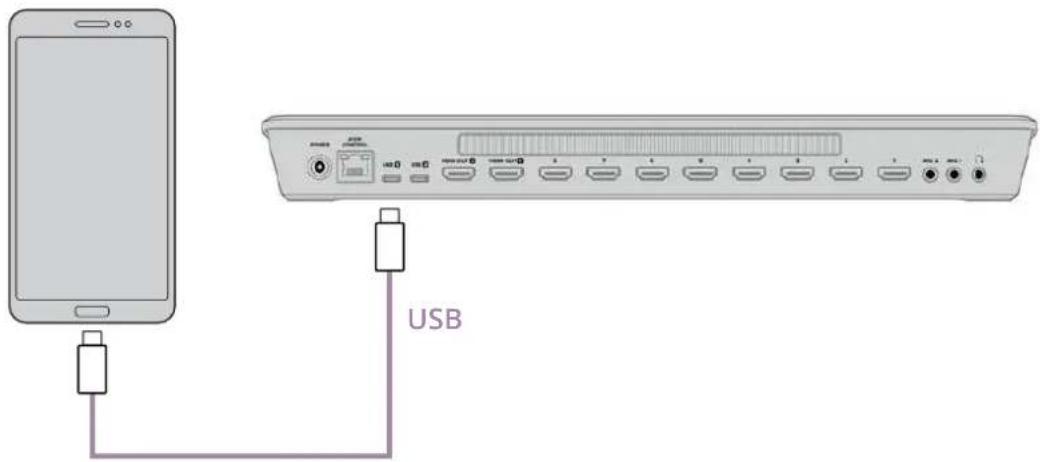
Once you have set up your ATEM Mini Pro or ATEM Mini Pro ISO model switcher to stream to YouTube, Twitch or other platforms, you can now direct stream using your smartphone. This means you can set up fast and be streaming to the world in any location where your smartphone has a 4G or 5G cellular connection or is capable of reverse tethering your WiFi connection.
1 Simply connect a cable from your smartphone to the USB-C port on your ATEM Mini Pro.
2 Once connected, make sure your smartphone device has hotspot activated.
On your iOS device open settings> personal hotspot and make sure 'allow others to join' option is on.
For Android devices, swipe the screen to display the quick menu. Press and hold the hotspot icon and then turn on USB tethering.
Now you can press the On Air button on your ATEM Mini Pro switcher to go live!
text_image
USBTIP Once you've finished streaming, we recommend turning off tethering connections to save battery life.
Additional Features on ATEM Mini Extreme
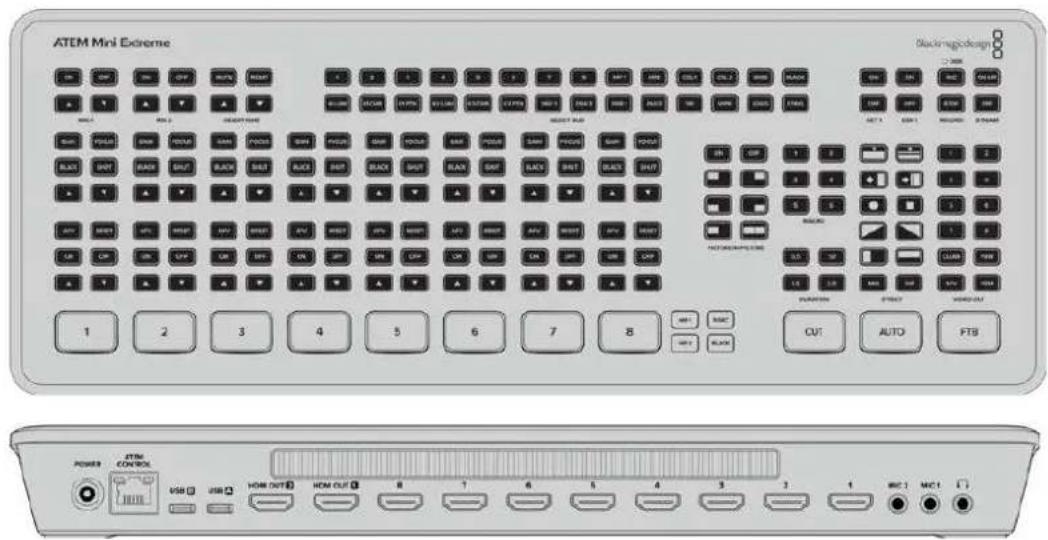
With ATEM Mini Extreme, there are more button options for your broadcast available directly from the control panel. These include dedicated buttons for camera control, a select bus and six direct macro selection buttons.
text_image
ATEM Mini Extreme Black=supc design 1 2 3 4 5 6 7 8 9 10 11 12 13 14 15 16 17 18 19 20 21 22 23 24 25 26 27 28 29 30 31 32 33 34 35 36 37 38 39 40 41 42 43 44 45 46 47 48 49 50 51 52 53 54 55 56 57 58 59 60 61 62 63 64 65 66 67 68 69 70 71 72 73 74 75 76 77 78 79 80 81 82 83 84 85 86 87 88 89 90 91 92 93 94 95 96 97 98 99 100With ATEM Mini Extreme, you can connect two USB-C devices at the same time. This means you can record to USB while streaming to your computer via USB or tethering to a smartphone so you can stream using your smartphone's internet connection.
Connecting Headphones
ATEM Mini Extreme model switchers have a headphone input for monitoring the program output using headphones.

text_image
A134 Mini Ex突出 MIC2 MIC1Select Bus
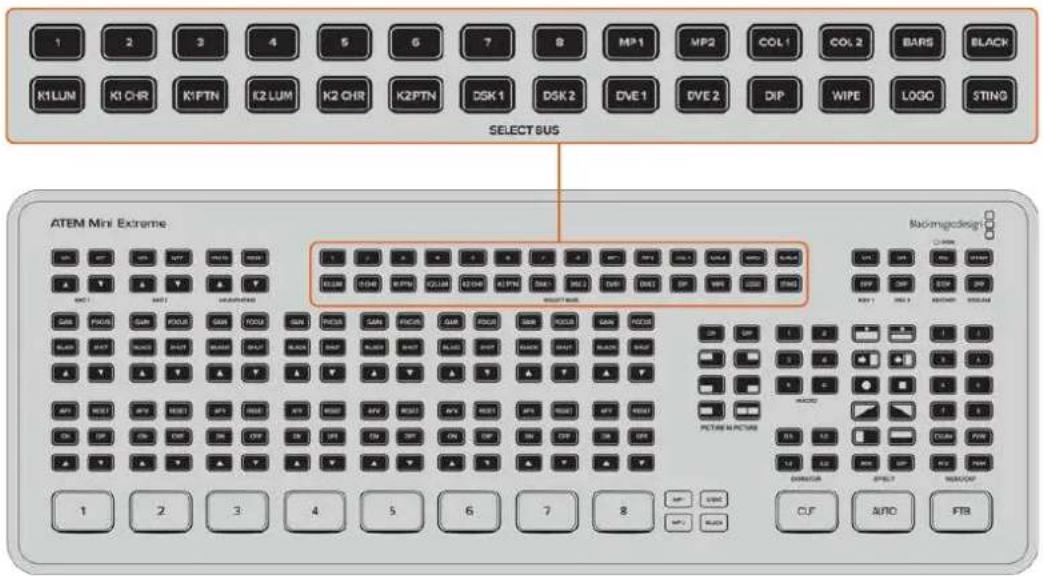
The select bus located at the top of ATEM Mini Extreme is used to assign sources for effects processing and keyers. The select bus is used to select key inputs and can also be used to change your key and fill source to an upstream or downstream keyer while on air. For instance, if there are two angles of weather presenter in front of a green screen, you can use the select bus to cut between the angles while the key is being broadcast.
text_image
1 2 3 4 5 6 7 8 MP1 MP2 COL1 COL 2 BARS BLACK K1 LUM K1 CHR K1 PTN K2 LUM K2 CHR K2 PTN DSK 1 DSK 2 DVE 1 DVE 2 DIP WIPE LOGO STING SELECT BUS ATEM Mini Extreme Black-miglesign 1 2 3 4 5 6 7 8 9 10 11 12 13 14 15 16 17 18 19 20 21 22 23 24 25 26 27 28 29 30 31 32 33 34 35 36 37 38 39 40 41 42 43 44 45 46 47 48 49 50 51 52 53 54 55 56 57 58 59 60 61 62 63 64 65 66 67 68 69 70 71 72 73 74 75 76 77 78 79 80 81 82 83 84 85 86 87 88 89 90 91 92 93 94 95 96 97 98 99 100To assign a source to upstream keyer 1 on ATEM Mini Extreme:
1 Select the upstream luma keyer 1 by pressing K1LUM.
2 Select '2' from the source buttons in the top row. The input connected to input HDMI 2 is now the fill and key source for the key.
When performing a luma key, the same source is used for both fill and key.
To refine your key parameters, such as mask and gain, use the palettes tab in ATEM Software Control.
Camera Control
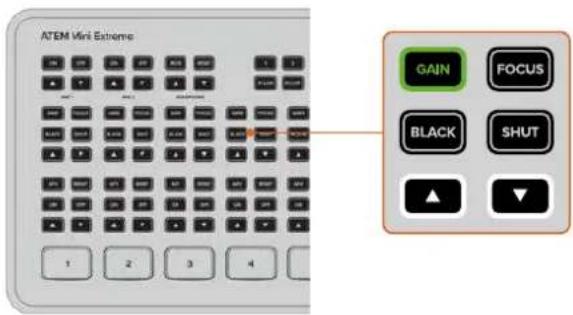
When using Blackmagic Pocket Cinema Camera 4K and 6K, you can adjust camera settings including iris, gain, focus and shutter directly from ATEM Mini Extreme.
text_image
ATEM Mini Extreme GAIN FOCUS BLACK SHUTButtons will illuminate green when selected
These buttons, located above the audio options for each input, adjust the camera much in the same way as the camera control panel in ATEM Software Control. By default, the arrow buttons control iris when no other option is selected.
NOTE ATEM Mini Extreme model switchers can also adjust camera settings on Blackmagic URSA Mini Pro cameras. Connect a Blackmagic BiDirectional SDI/HDMI 3G converter between the camera and switcher to switch and now you can use camera control on both the control panel and ATEM Software Control.
Iris


To set auto exposure on, press both of the arrow buttons simultaneously. This setting automatically adjusts the aperture to maintain a constant exposure while keeping shutter angle consistent. This will keep motion blur unaffected, but may affect your depth of field.
To manually adjust the iris
1 Press the up arrow to increase the aperture.
2 Press the down arrow to decrease the aperture.
TIP The arrow buttons control iris unless another setting, for example gain or shutter, is selected. The selected setting will time out 3 seconds from the last button press.
Gain

The camera gain setting allows you to turn on additional gain in the camera. On Blackmagic Pocket Cinema Cameras, this setting relates to ISO. This is important when you are operating in low light conditions and need extra gain, or ISO, in the front end of the camera to avoid your images being under exposed.
To adjust the gain
1 Press the gain button to highlight it.
2 Press the up arrow to increase the gain or the down arrow to decrease it.
It's worth noting that adding gain will increase noise in your images.
Focus

To use your camera's auto focus feature, hold down the focus button for three seconds.
To manually adjust the focus
1 Press the focus button to select it.
2 Press the up arrows up or down to manual focus while viewing the video feed from the camera to ensure your image is nice and sharp.
Black

To adjust the black level
1 Press the black button to select it.
2 Press the up arrow to increase the black level or the down arrow to decrease.
Shutter

This setting automatically adjusts shutter value to maintain a constant exposure while keeping iris aperture consistent. If you want to maintain a fixed depth of field, this is the setting to choose. It's worth mentioning that the subtle automatic adjustments of the shutter may have an effect on motion blur. It's also worth keeping an eye out for any flicker that may be introduced from various light fixtures on indoor shoots. The auto iris feature is not available when the 'shutter' auto exposure mode is selected.
To adjust the shutter
1 Press the shut button to select it.
2 Press the up arrow to open the shutter or the down arrow to close it.
Macros
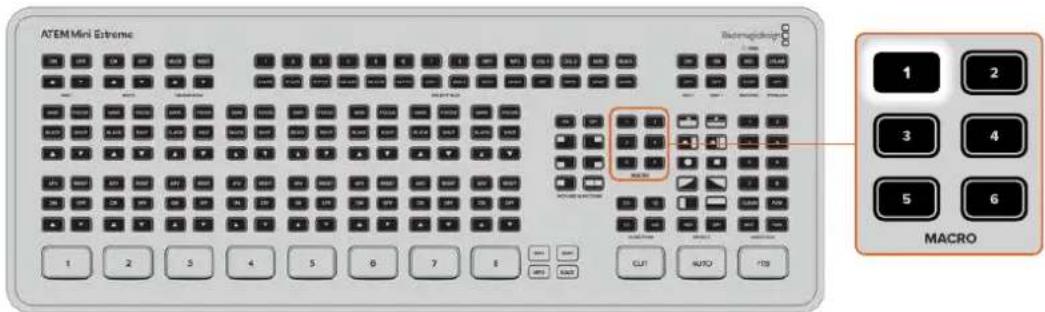
A macro is a recorded series of events you can save and then access when needed. Macro buttons on ATEM Mini Extreme models let you recall the first six recorded macros. This is useful when using repeated sequences, such as transitions in and out of graphics, so you only have to press a single button to play a sequence of elements.
To run a macro, simply press the numbered macro button on the unit and the macro will run immediately. Macros can also be used to recall additional upstream and downstream keyers.
text_image
ATEM Mini Extreme Bateragrisiko 1 2 3 4 5 6 MACROWhen a macro contains a user wait, the button will flash to indicate it needs to be pressed again to resume the sequence.
For more information on recording macros, including naming macros, see the 'Using Macros' section later in this manual.
Using SuperSource
ATEM Mini Extreme switcher models include a feature referred to as SuperSource allows you to arrange multiple sources on the monitor at one time. The SuperSource processor appears on your ATEM switcher as a single video input. For example, if you were broadcasting a discussion between four presenters, you could superimpose them all over a background. It is a similar feature to picture in picture but more powerful as you can add more sources.
text_image
Blackmaglode design O DSA ON ON OFF OFF OFF OFF AUTO AUTO AUTO AUTO AUTO AUTO AUTO AUTO AUTO AUTO AUTO AUTO AUTO AUTO AUTO AUTO AUTO AUTO AUTO AUTO AUTO AUTO AUTO AUTO AUTO AUTO AUTO AUTO AUTO AUTO AUTO AUTO AUTO AUTO AUTO AUTO AUTO AUTO AUTO AUTO AUTO AUTO AUTO AUTO AUTO AUTO AUTO AUTO AUTO AUTO INT1 INT1 INT1 INT1 INT1 INT1 INT1 INT1 INT1 INT1 INT1 INT1 INT1 INT1 INT1 INT1 INT1 INT1 INT1 INT1 INT1 INT1 INT1 INT1 INT1 INT1 INT1 INT1 INT1 INT1 INT1 INT1 INT1 INT1Setting up SuperSource
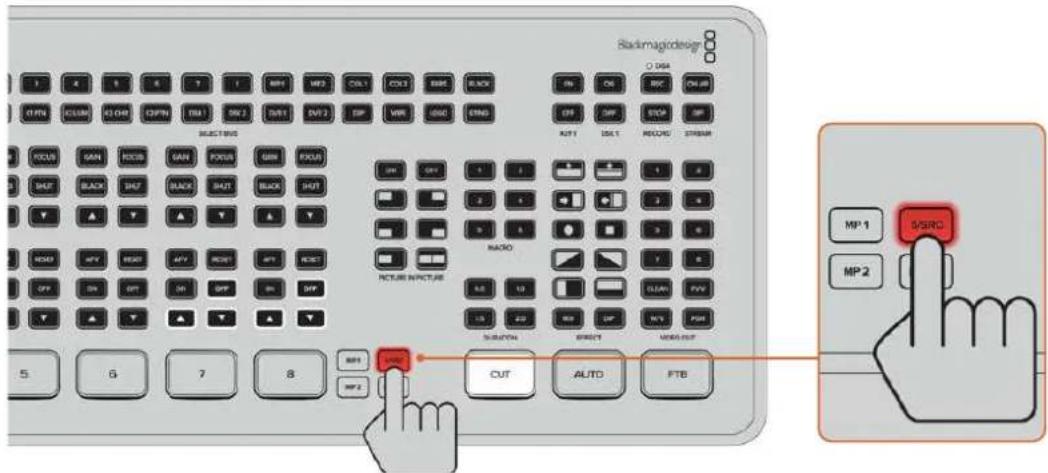
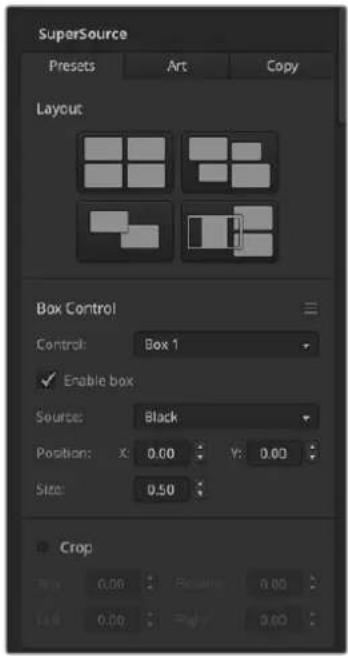
To set up SuperSource, first you need to be able to view it on your monitor. Do this by either assigning SuperSource from the tab in ATEM Software control to a multiview window or by switching to the S/SRC option on ATEM Mini Extreme while a monitor is connected.
text_image
SuperSource Presets Art Copy Layout Box Control Control: Box 1 ✓ Enable box Source: Black Position: X: 0.00 Y: 0.00 Size: 0.50 Crop Yes: 0.00 Round: 0.00 No: 0.00 Pow: 0.00Positioning Sources
In ATEM Software Control open the SuperSource palette and choose from one of the four preset layouts. Click the one that is closest to the look you want, this will automatically arrange the boxes into the preset positions indicated in the software. Make sure the box is enabled. You can then change the position and size via the X Position, Y Position and Size fields. Ticking the Enable Crop check box allows you to crop the image. The crop parameters are Top, Bottom, Left and Right. You may then wish to alter the parameters of boxes 2 to 4 by doing similar steps.
If you make a mistake, click on the menu icon on the right hand side of the Box Control tab and you can easily reset the parameters.
text_image
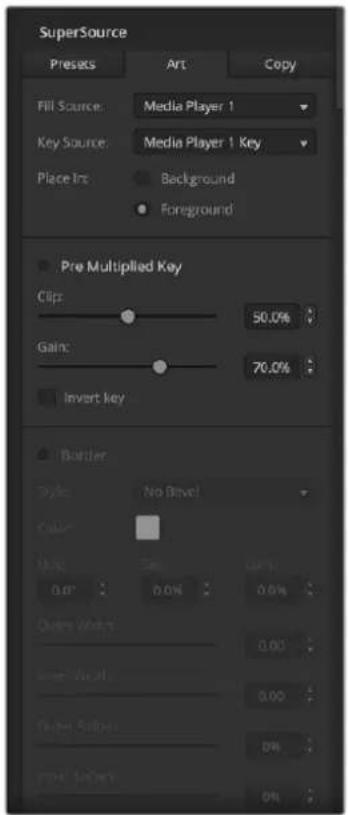
SuperSource Presets Art Copy Fill Source: Media Player 1 Key Source: Media Player 1 Key Place Int: Background Foreground Pre Multiplied Key Clip 50.0% Gain: 70.0% Invert key Border Style: No Level Color: 0.0% 0.0% 0.0% Down Shift 0.0% Up Shift 0.0% Down Satin 0% Up Satin 0%Background and Foreground Art
To use background art, clicking on the 'art' tab in the software to reveal the art settings. To use art as a background source, select the place in background option. Then choose your art fill source via the menu. Assign the source and your choice will be placed behind the on screen boxes.
If you wish to make the art foreground, then select source in foreground and choose whether your graphic is pre multiplied or not. If it is pre multiplied then tick the check box, assign the Art Fill Source and the Art Key Source. This will now allow the art to be placed over the enabled box or boxes. If your art is not pre multiplied then you can use the clip and gain controls as discussed in the Keying section of this manual to achieve the desired result.
text_image
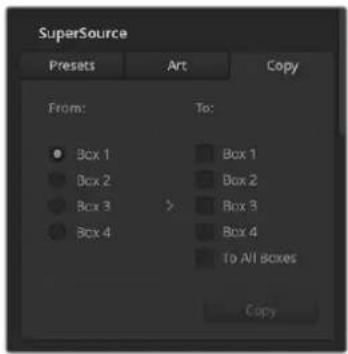
SuperSource Presets Art Copy From: To: Box 1 Box 1 Box 2 Box 2 Box 3 > Box 3 Box 4 Box 4 To All Boxes CopyCopying Settings
To perform the copy function using ATEM Software Control, simply click on the Copy tab and the Copy Box
The settings dialogue will appear. You can quickly & easily copy the settings of the currently selected box to any of the other boxes, making an exact clone in just one click! The copied boxes will appear directly behind the master box and will also share the same source as the master.
Putting SuperSource On Air
The entire SuperSource processor appears on your ATEM Switcher as a video input. Simply select the SuperSource button on ATEM Mini Extreme or in ATEM Software Control to use the composite you have just made!
Using the Multiview
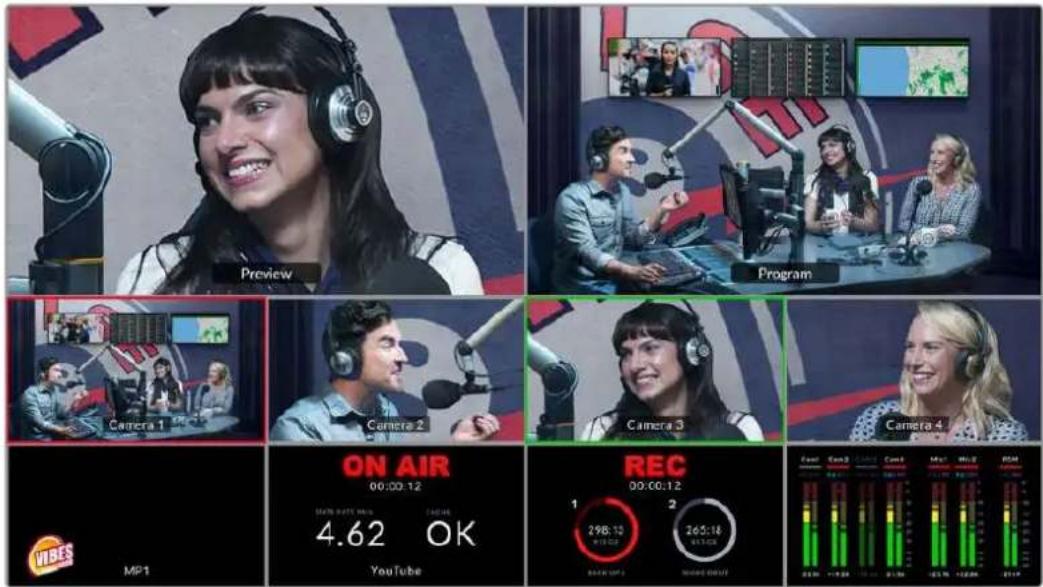
ATEM Mini Pro and Extreme model switchers have a powerful multiview feature that lets you monitor all HDMI inputs, together with the program and preview outputs as a group of views on one screen. The multiview also displays the media player, streaming status, disk recording disk status, audio levels, plus Fairlight EQ and dynamics indicators.
This feature provides a comprehensive overview so you will always know exactly what is happening with your broadcast!
text_image
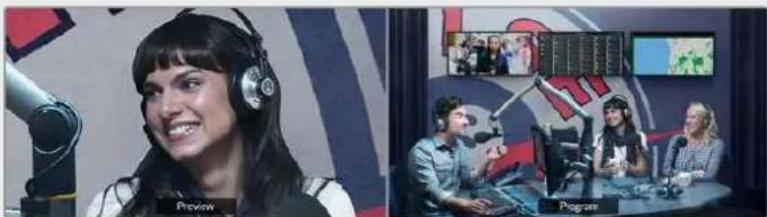
Preview Program Camera 1 Camera 2 Camera 3 Camera 4 ON AIR 00:00:12 STARS BATE MARS 4.62 OK YouTube REC 00:00:12 1 2 298:13 265:18 RICH COOK VIBES MP1 2024-07-23 2024-07-24 2024-07-25 2024-07-26 2024-07-27 2024-07-28 2024-07-29 2024-07-30 2024-07-31 2024-07-32 2024-07-33 2024-07-34 2024-07-35 2024-07-36 2024-07-37 2024-07-38 2024-07-39 2024-07-40 2024-07-41 2024-07-42 2024-07-43 2024-07-44 2024-07-45 2024-07-46 2024-07-47 2024-07-48 2024-07-49 2024-07-50 VIBESThe multiview is a powerful feature that lets you monitor all sources and outputs simultaneously
Below is a description of each view.
text_image
Preview ProgramPreview
The preview view lets you monitor the source currently switched to the preview output. This view is helpful to practice switching between sources, previewing transitions or setting up a keyer so you can see what it will look like before switching to the program output. You need to change the switcher operation to program/preview style switching to make use of the preview view. There is more information about this in later sections of this manual.
Program View
The program view displays what is currently switched to the program output. This view will always show exactly what you are broadcasting.

text_image
Camera 1 Camera 2 Camera 3 Camera 4Input Views
The input views display all the sources connected to the HDMI inputs. Having all inputs on the multiview lets you see the image from every camera so you can make quick decisions. However they don't always have to be cameras as you could also have a computer's video output or a HyperDeck disk recorder connected to the switcher's inputs and you can monitor them in the input views.
When an input is switched to the preview or program output, a green or red tally border will appear around the input's respective view. Green represents the preview output and red represents the program output, or 'on air'.
text_image
UBES MP1Media Player View
This view displays the graphic currently loaded in the media player. To load a graphic, simply go to the media pool in ATEM Software Control and drag a still into the media player. You can read more about how to use the media player and the media pool in the section 'using ATEM Software Control/'using the media page'.
Streaming View
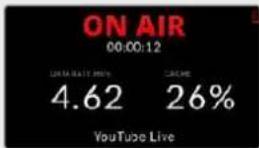
This view displays the streaming on air status, including the broadcast data rate and the cache status. You can also see what streaming platform you are currently broadcasting to as it is displayed at the bottom of the view.
- On Air Indicator Prior to recording, the on air status indicator will display 'off' to let you know the switcher is standing by and ready to broadcast. When streaming begins, the indicator will display a bright red 'on air' status until streaming is stopped.
If there is an interruption during the stream, for example the internet connection speed becomes too slow and the cache is depleted, the on air indicator will begin flashing.
- Broadcast Data Rate The data rate is measured in megabits per second. For ATEM Mini Pro and Extreme switchers to broadcast 1080p60 video without losing frames, the data rate needs to be approximately 5 to 7 Mb per second.
- Cache Status The cache status displays the capacity of the switcher's built in memory buffer. The cache is a small amount of internal memory that continuously records and plays the program output. It acts as a safety measure if the broadcast data rate decreases below a level able to sustain video. The variable nature of the internet is mostly due to network activity or wireless signal strength, so if the broadcast data rate decreases, the buffer data will increase accordingly. If the connection speed becomes slow enough that it cannot support the video stream, the cache will fill with video frames to compensate. However, once the cache is 100% full, the video stream will be compromised, so you will want to avoid a full cache where possible. You can do this by testing the connection speed when you set up your stream. During a broadcast test, watch the cache display in the multiview. If the cache frequently approaches 100% , choose a lower quality in the live stream settings.
- Tethering status The smartphone icon is displayed when ATEM Mini Pro or ATEM Mini Extreme is connected to the internet using mobile tethering. The icon will become red when on air.
gauge
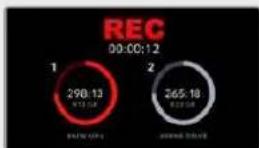
REC 00:00:12 | Time Point | Value | | :--- | :--- | | 1 | 298.13 (TIME OF WORK) | | 2 | 265.18 (SOUND WORK) |Recording View
If you are recording to external drives via USB-C, this view will display the current recording status.
- Recording Indicator Prior to recording, or if there are no disks connected, the indicator will display 'stop'. When disks are connected, you will see them appear as icons below the indicator.
When a disk is recording, the indicator displays 'rec' and will illuminate bright red.
- Duration Counter Underneath the recording indicator is the duration counter. When you press the record button on the switcher, the duration counter will start running.
- Record Status Indicators These indicators provide details on each drive and its recording status. For example, if you are using two drives, their drive names will be displayed along with available space and record time remaining. While a disk is recording, the indicator will illuminate red and shows how much disk space is left.
The disks are ordered by capacity. For example, if you have 4 SSDs connected via a Blackmagic MultiDock 10G, the drive with the largest remaining space will be labeled 1. Drive 2 will be the SSD with the next largest available space. When drives 1 and 2 are full, drive 3 will then assume the disk 1 indicator and disk 2 will become drive 4. You can always see what drives are assigned to the disk numbers by looking at the disk names underneath their icons.
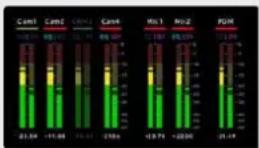
Audio View
During your broadcast you can monitor the audio levels for each source and the levels of the program output using the audio view.
- Audio Meters Each input and the program output has its own audio meter and you can monitor them all simultaneously. If the audio level rises above -10dB the meter will illuminate red to warn you that it is close to the maximum strength of 0dB. Once the level reaches 0dB the audio will clip. Clipping means the audio will distort and you will need to decrease the level using the switcher's audio level buttons or the audio mixer in ATEM Software Control. You can read more about ATEM Software Control in the next section of this manual.
The audio meter is an important tool to monitor your levels so you can make sure your audio always sounds great!
- Fairlight Icons These icons let you know if EQ and dynamics controls are enabled in ATEM Software Control's audio page.
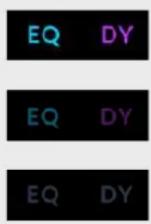
If the Fairlight icons are colored and illuminated, the EQ or dynamics tool is active and the input is on air.
If the icons are colored but dim, it means the tools are active, but the input is not on air.
If the icons are dim and colorless, the tools are inactive or bypassed on the audio page.
ATEM Mini Extreme Enhanced Multiview
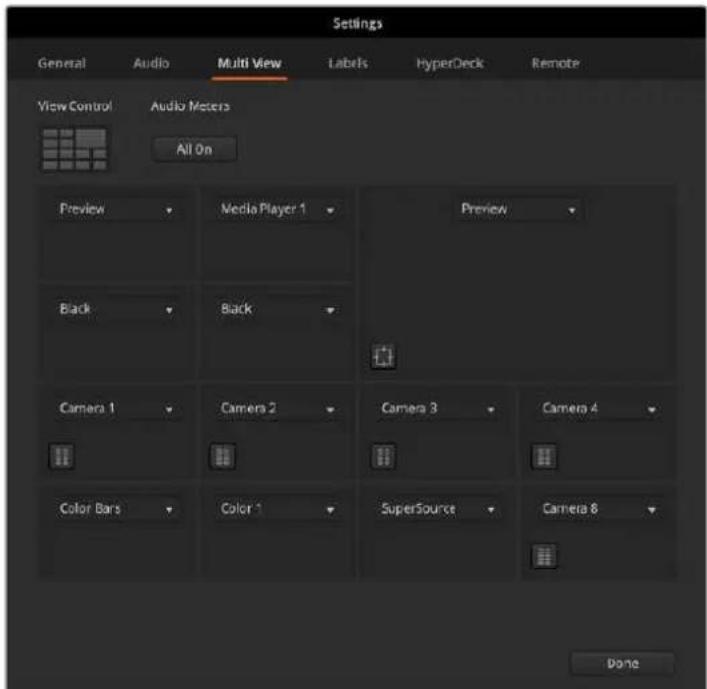
ATEM Mini Extreme switcher models have a customizable multi view layout for 4, 7, 10, 13 or 16 views so you can display a combination of all the inputs available. Click the menus to select what you want on each view. If you don't have enough cameras on your job to fill all input views, you can select other sources such as media players, color generators and streaming and recording status views. It's extremely flexible and you can also change the multi view layout to suit your preference.
Audio meters can be turned on or off within each source view, or all at once, by clicking on the respective icons in each view or the 'all on' button, respectively. Use the view control button to select your preferred layout.
text_image
Settings General Audio Multi View Labels HyperDeck Remote View Control Audio Meters All On Preview Media Player 1 Preview Black Black Camera 1 Camera 2 Camera 3 Camera 4 Color Bars Color 1 SuperSource Camera 6 DoneCustomize the multi view for ATEM Mini Extreme
The multiview is an excellent tool that will let you spot every detail and put you in the moment. For example, it can help you previsualize ideas in the preview window before switching them to the program output. You can monitor each HDMI source and test switching between them, set up a chroma key, or even preview a transition to see what it will look like before switching it to the program output!
ATEM Software Control
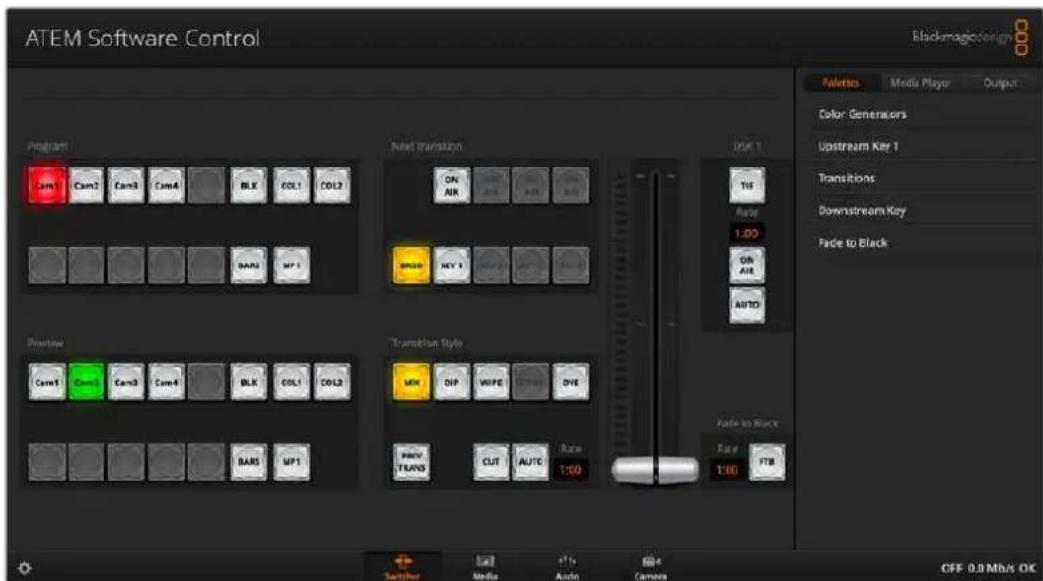
ATEM Software Control is a powerful software control panel that gives you a lot more control over your ATEM Mini. Once you start using ATEM Software Control you will quickly see just how much your ATEM Mini can actually do.
For example, you can manually perform transitions using the fader bar, select internal sources on the program and preview buttons, mix audio using a mixer with channel faders, set up keyers, load graphics in the media pool and much, much more.
text_image
ATEM Software Control Blackmagic design Program Cam1 Cam2 Cam3 Cam4 BLK COL1 COL2 BARS MP 7 Next Transition ON AIR OFF 1:00 ON AIR AUTO Preview Cam1 Cam2 Cam3 Cam4 BLK COL1 COL2 BARS MP1 Transition Style MAX DIP WIPE DIVE HAPP TRANS CUT AUTO Rate T:00 Rate to Back Rate FT8 Switcher Media Audio Camera Fallo Media Output Color Generators Upstream Key 1 Transitions Downstream Key Face to Black OFF 0.0 Mb/s OKATEM Software Control is included in the ATEM software installer and can be downloaded from the Blackmagic Design website. It's free and allows you to control your switcher in a similar way to a full hardware control panel. A range of palettes on the right side shows you all processing features of your ATEM Mini and allows settings to be easily made.
You can also use ATEM Software Control to configure your switcher settings. For more information on how to use ATEM Software Control, refer to 'using ATEM Software Control' in the following sections of the manual.
Switching Modes
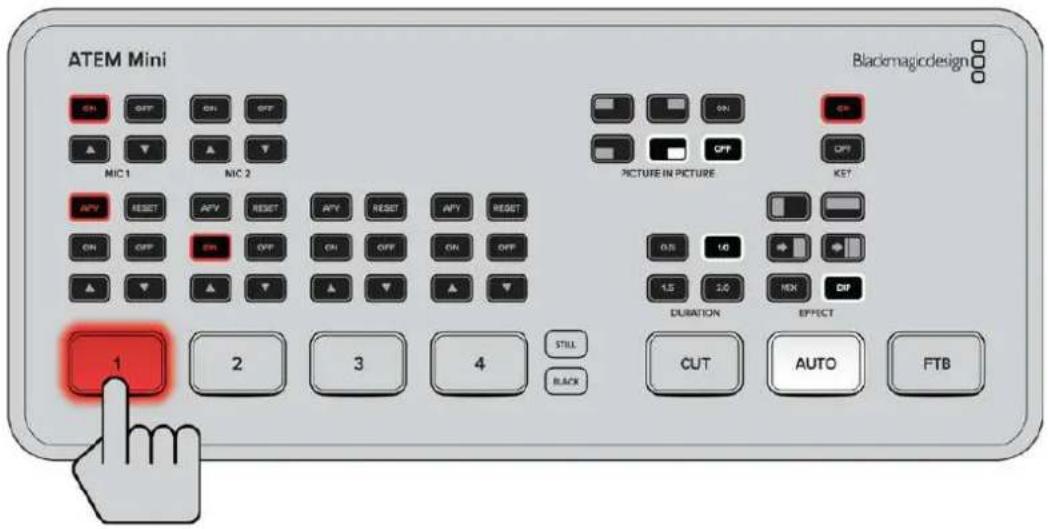
'Cut bus' is the default switching mode which lets you change sources as soon as you press an input button. Setting ATEM Mini to 'program preview' mode lets you preview the source before switching it to air.
Cut Bus
In cut bus mode, as soon as you press an input button, it will immediately switch to air. This is a fast and easy way of switching.
text_image
ATEM Mini Blackmagicdesign ON OFF ON OFF ▲ ▼ ▲ ▼ MIC 1 MIC 2 APV RESET APV RESET APV RESET APV RESET ON OFF ON OFF ON OFF ▲ ▼ ▲ ▼ ▲ ▼ PICTURE IN PICTURE KET 0.5 1.0 1.5 2.0 DIF DURATION EFFECT 1 2 3 4 STILL BLACK CUT AUTO FTBIn cut bus mode, pressing an input button will instantly switch it to air
Program Preview
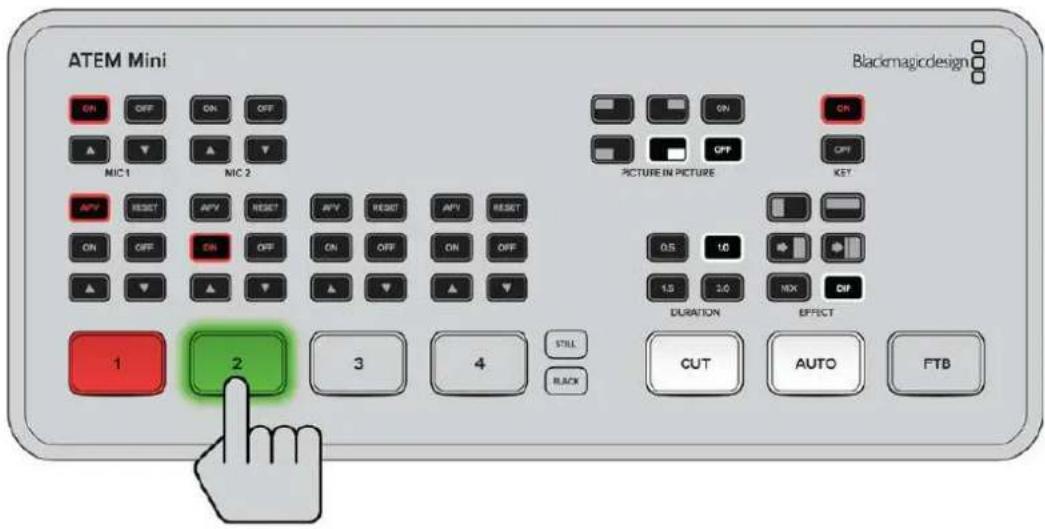
In program preview mode, switching a source is a two step process. This is because pressing an input button puts the source in a preview state so you can decide whether you want to switch it, or perhaps select a different input source. This powerful switching mode is used by professional broadcast switchers across the world.
TIP If you connect an HDMI monitor, for example Blackmagic Video Assist, to ATEM Mini's HDMI output you can output the preview signal and monitor the selected input before switching it to air. For more information, refer to the 'setting the HDMI output source' section later in this manual.
text_image
ATEM Mini Blackmagicdesign ON OFF ON OFF ▲ ▼ ▲ ▼ MIC 1 MIC 2 APV RESET APV RESET APV RESET APV RESET ON OFF ON OFF ON OFF ON OFF ▲ ▼ ▲ ▼ ▲ ▼ PICTURE IN PICTURE KET 0.5 1.0 1.5 2.0 DURATION EFFECT 1 2 3 4 STILL BLACK CUT AUTO FTB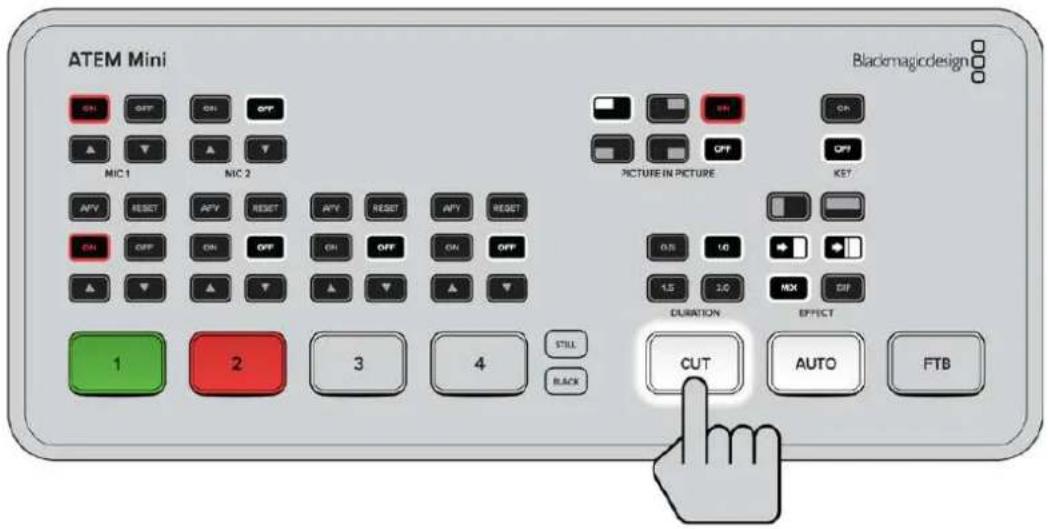
text_image
ATEM Mini Blackmagicdesign MIC 1 MIC 2 PICTURE IN PICTURE KEY 1 2 3 4 STILL BLACK CUT AUTO FTBIn program preview switching mode, press an input button and then press the 'auto' or 'cut' button to switch the source to air
Using ATEM Software Control
ATEM Software Control has four main control windows: Switcher, Media, Audio and Camera. You can open these windows by clicking the three main buttons at the bottom of the interface or by pressing the Shift and left/right arrow hot keys. A general settings window can be opened by selecting the gear icon at the lower left of the interface.
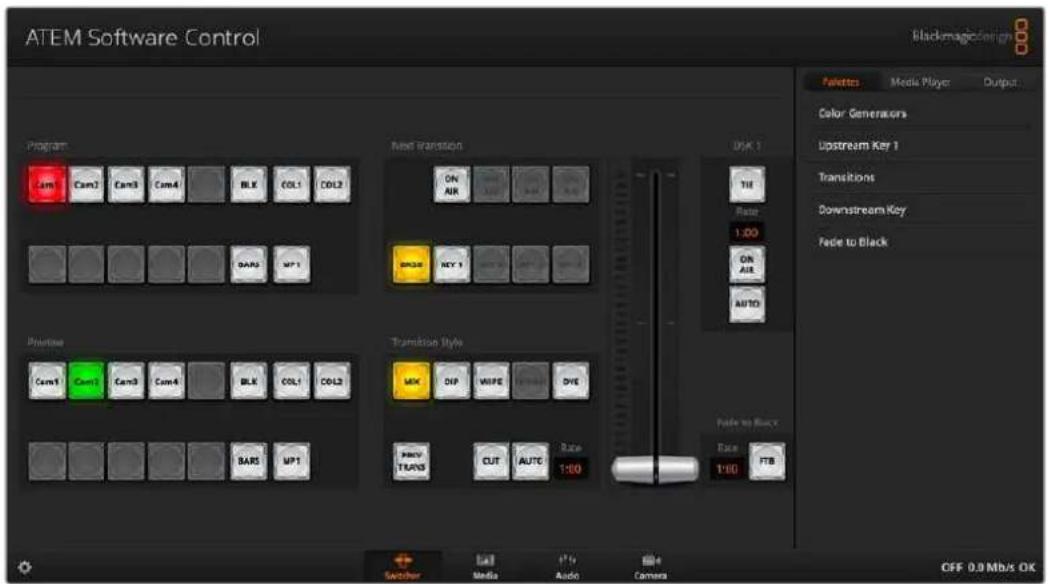
Switcher Panel
When first launched, the switcher screen is selected, which is the main control interface for the switcher. ATEM Mini must be connected to your computer via USB for the software control panel to run.
text_image
ATEM Software Control blackmagicstring Program Cam1 Cam2 Cam3 Cam4 BLK COL1 COL2 New transition ON AIR AIR AIR 1:00 ON AIR AUTO Preview Cam1 Cam2 Cam3 Cam4 BLK COL1 COL2 Transition Style MIX DIP WIPE VNE DVE PHY TRANS CUT AUTO Rate 1:00 Take to Black Face FTB Switcher Media Audio Camera Fallets Media Player Output Color Generators Upstream Key 1 Transitions Downstream Key Fade to Black CFF 0.9 Mbs OKMouse or Trackpad Operation
The virtual buttons, sliders and fader bar on the software control panel are operated using your computer mouse or a trackpad if you're using a laptop.
To activate a button, click once with the left mouse button. To activate a slider, click and hold down the left mouse button while dragging. Similarly, to control the fader bar, click and hold down the left mouse button on the fader bar handle and drag up or down.
Media Manager
The media manager allows you to upload graphics to the media pool in ATEM Mini. Your ATEM Mini has memory for graphics that's called the media pool and holds up to 20 still graphics with alpha channel that can be assigned to a media player for use in your production.
So, for example, you could have the maximum 20 still graphics loaded that will be used on your live production and then assign various stills to the media player as you work. As you take a graphic off air, you can change the media player graphic to the next graphic you want, and then you can put that media player back on air with the new graphic.
When a still is loaded into the media pool, the alpha channel is loaded automatically if one is included in the image. When a still is loaded into a media player, the output of the media player will include both key and fill outputs. If you select the media player as a key source, for example Media Player 1, both the fill and the key are automatically selected so you don't have to select them separately. However the key can still be routed separately so you can use a different key source if you wish. To learn more about keying, refer to the 'keying using ATEM Mini' section of this manual.
Audio Mixer
The audio tab in ATEM Software Control contains a powerful audio mixer interface which becomes active when controlling your ATEM switcher.
ATEM Mini includes a built in audio mixer that lets you use the embedded HDMI audio from your cameras, media servers and other inputs without the need for an external audio mixer. This is perfect when using your ATEM Mini on location or in small spaces within modern OB vehicles as you don't have to find room for an external audio mixer. The audio is mixed in the audio tab of ATEM Software Control and output via the USB webcam and Ethernet outputs. You can also route the program output via HDMI if you want to record your broadcast.
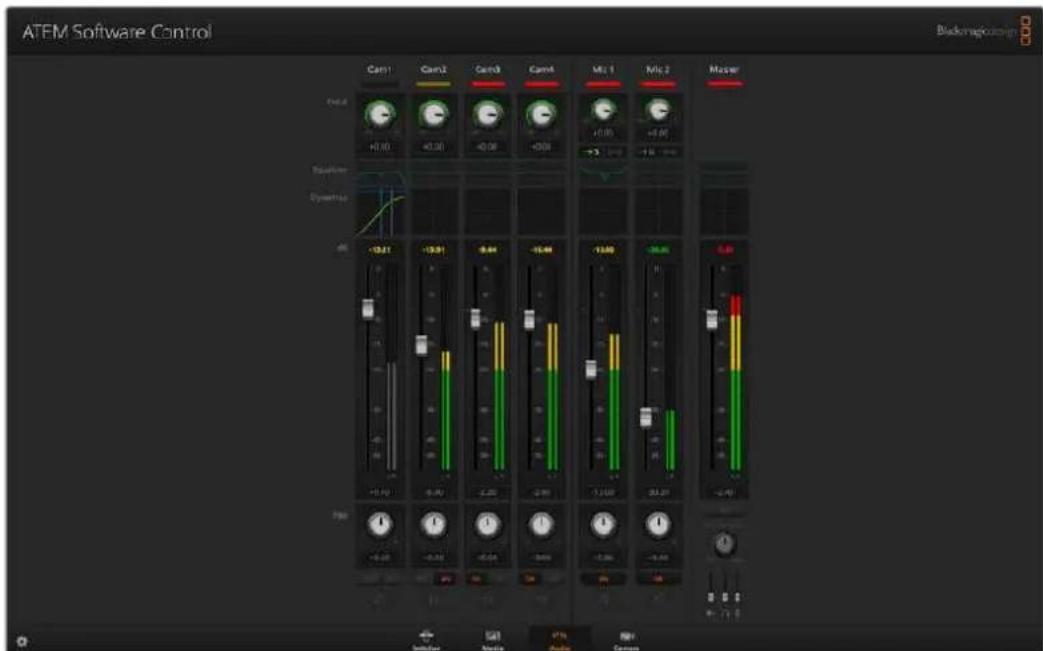
text_image
ATEM Software Control Bio-magic control Cam1 Cam2 Cam3 Cam4 Mg 1 Mg 2 Master Output +0.00 -0.00 +0.00 -0.00 -3 -5 -8 -10 -12 -14 -16 -18 -20 -22 -24 -26 -28 -30 -32 -34 -36 -38 -40 -42 -44 -46 -48 -50 -52 -54 -56 -58 -60 -62 -64 -66 -68 -70 -72 -74 -76 -78 -80 -82 -84 -86 -88 -90 -92 -94 -96 -98 -100 +13.01 +13.01 +13.01 +13.01 +13.01 +13.01 +13.01 +13.01 +13.01 +13.01 +13.01 +13.01 +13.01 +13.01 +13.01 -13.01 -13.01 -13.01 -13.01 -13.01 -13.01 -13.01 -13.01 -13.01 -13.01 -13.01 -13.01 -13.01 -13.01 -12.01 -12.01 -12.01 -12.01 -12.01 -12.01 -12.01 -12.01 -12.01 -12.01 -12.01 -12.01 -12.01 -12.01 -12.51 -12.51 -12.51 -12.51 -12.51 -12.51 -12.51 -12.51 -12.51 -12.51 -12.51 -12.51 -12.51 -12.51 -12.51Your ATEM Mini also features built in mic inputs for mixing external audio.
If you prefer to use an external audio mixer, it's easy to disable the audio for all inputs and you only need to leave the external audio active in the audio mixer interface. More information on how to use the audio mixer is included in the next sections.
Camera Control
ATEM Mini can control Blackmagic Pocket Cinema Camera 4K and 6K models when updated to the latest software and plugged in via the HDMI inputs. Click on the 'camera' tab to open the camera control page. This is where you can control your HDMI camera settings such as iris, gain, focus, detail and zoom control on compatible lenses. Plus you can color balance cameras and create unique looks using the DaVinci Resolve primary color corrector that is built into Blackmagic Pocket Cinema Camera 4K and 6K.
For detailed information on how to use the powerful camera control features, refer to 'Using Camera Control' later in this section.
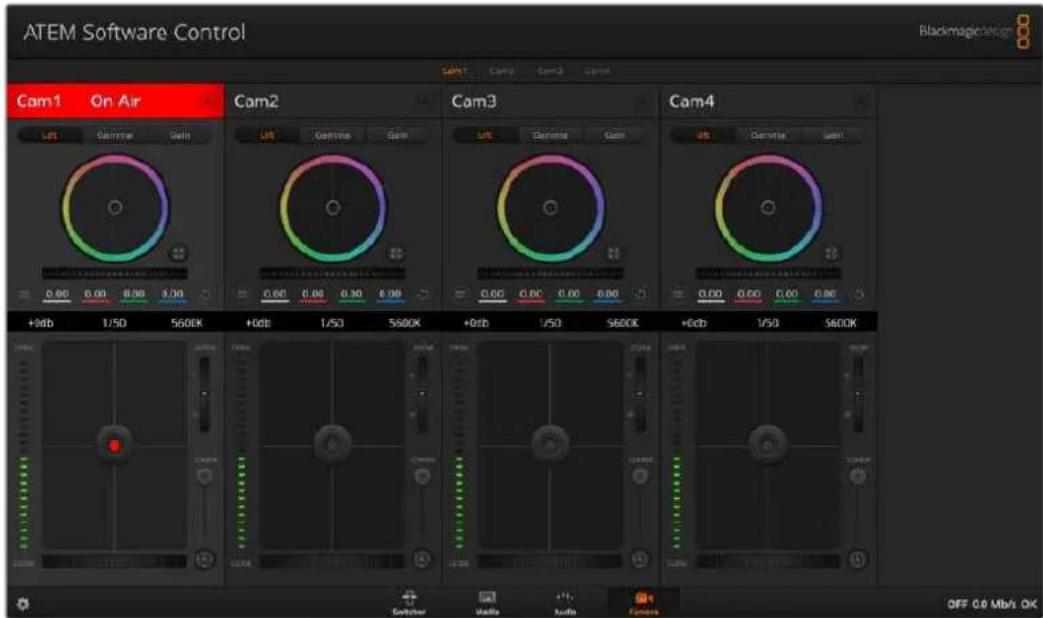
text_image
ATEM Software Control Blackmagic design Cam1 On Air Cam2 Cam3 Cam4 +0db 1/50 5600K +0db 1/50 5600K +0db 1/50 5600K +0db 1/50 5600K OFF 0.0 Mb/s OKCamera control lets you control Blackmagic Pocket Cinema Camera 4K and 6K with ATEM Mini
Using the Software Control Panel
The switcher window is the main control interface for the switcher. During live production, the switcher window can be used to select sources and take them to air.
You can select the transition style, manage upstream/downstream keyers and turn on/off the fade to black. The palettes on the right hand side of the interface are where you adjust transition settings including transition rates, adjust color generators, control the media player, and adjust the upstream and downstream keyer as well as control fade to black rate.
Mix Effects
The Mix Effects block of the switcher tab contains all the source select buttons for the program and preview buses, allowing external inputs or internal sources to be selected for next transition previewing or switching to air.
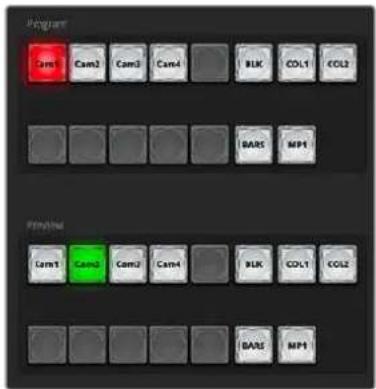
text_image
Program1 Cam1 Cam2 Cam3 Cam4 BLK COL1 COL2 BARS MP1 Program2 Cam1 Cam2 Cam3 Cam4 BLK COLY COL2 BARS MP1ATEM mix effects
Program Bus Source Select Buttons
The program bus source select buttons are used to hot switch background sources to the program output. The source currently on air is indicated by a button that is illuminated red.
Preview Bus Source Select Buttons
In program preview switching mode, the preview bus source select buttons are used to select a background source on the preview output, this source is sent to the program bus when the next transition occurs. The currently selected preview source is indicated by a button that is illuminated green.
The source select buttons for the program bus match the preview bus.
| INPUTS Input buttons match the number of external switcher inputs. |
| BLACK Black color source internally generated by the switcher. |
| BARS Color bars source internally generated by the switcher. |
| COLOR 1 and 2 Color sources internally generated by the switcher. |
| MEDIA 1 Internal media player that display stills stored in the switcher. |
Transition Control and Upstream Keyer
CUT
The CUT button performs an immediate transition of the program and preview outputs, overriding the selected transition style.
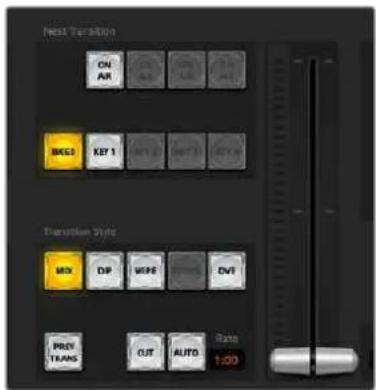
text_image
Next Transition ON AR BSS KEY 1 MIX DP WRITE DVT PREY TRANS OUT AUTO Rate 1:20Transition control
AUTO/RATE
The AUTO button will perform the selected transition at the rate specified in the 'rate' display. The transition rate for each transition style is set in the transition palette for that style and is displayed in the 'rate' window of the transition control block when the corresponding transition style button is selected.
The AUTO button illuminates red for the duration of the transition and the 'rate' display updates to indicate the number of frames remaining as the transition progresses. When you perform a transition using the fader bar on an external ATEM hardware panel, the fader bar indicator on the software panel updates to provide visual feedback on the progress of the transition.
Fader Bar
The fader bar is used as an alternative to the AUTO button and allows the operator to manually control the transition with a mouse. The AUTO button illuminates red for the duration of the transition and the 'rate' display updates to indicate the number of frames remaining as the transition progresses.
Transition Style
The transition style buttons allow the operator to select one of four types of transitions; mix, dip, wipe and DVE. The selected transition style is indicated by a yellow illuminated button. Selection of these buttons will be reflected by the corresponding tab in the 'transitions' processing palette. For example, when you have the transitions processing palette open and click on a transition style button, the transitions palette will match your selection so you can quickly adjust the settings.
PREV TRANS
The PREV TRANS button enables the preview transition mode, allowing the operator to verify a mix, dip, wipe or DVE transition by performing it on the preview output using the fader bar. When the PREV TRANS is selected you will see the preview output match the program output, and then it's simple to practice your selected transition with the fader bar to confirm you are going to get what you want. This is a very helpful feature to avoid mistakes on air!
Next Transition
The BKGD and KEY 1 buttons are used to select the elements which will transition on air or off air with the next transition. More upstream keyers are available on ATEM Mini Extreme model switchers and that is why other upstream keyers appear grayed out. The key can be faded on and off when the main transition occurs, or you can select just the key to transition individually, so the main transition control can be used to fade the key on and off.
When selecting the elements of the next transition, the switcher operator should look at the preview video output because it provides an accurate representation of what the program output will look like after the transition is completed. When only the BKGD button is selected, a transition from the current source on the program bus to the source selected on the preview bus will occur without the keyer. You can also select only keyer to transition, leaving the current background live throughout the transition.
ON AIR
The ON AIR indicator button indicates when the key is currently on air and can also be used to immediately cut the key on or off air.
Downstream Keyer
TIE
The TIE button will enable the downstream keyer, or DSK, on the preview output, along with the next transition effects and tie it to the main transition control so that the DSK can be taken to air with the next transition.
The DSK will transition at the rate specified in the 'rate' display of the transition control block. If the DSK is tied, the signal routing to the clean feed 1 is unaffected.
ON AIR
The ON AIR button is used to cut the DSK on or off air and indicates whether the DSK is currently on or off air. The button is illuminated if the DSK is currently on air.
AUTO
The AUTO button will mix the DSK on or off air at the rate specified in the DSK 'rate' window. This is similar to the main AUTO rate on the transition control block, however it's limited only to the downstream keyer. This can be used to fade up and down bugs and logos, such as live or replay bugs during production, without interfering with the main program production transitions.
Fade to Black
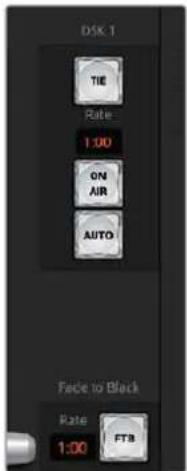
text_image
DSK 1 TIE Rate 1:00 ON AIR AUTO Face to Black Rate 1:00 FTBDownstream key and fade to black
The FTB button will fade the whole program video output to black at the rate specified in the fade to black RATE window. Once the program output has been faded to black, the FTB button will flash red until it is pressed again. Doing so will fade up from black at the same rate, or you can enter a new rate in the fade to black palette in the 'switcher' window. Fade to black is mostly used at the start and end of your production, or when cutting to commercial breaks. It ensures all layers in ATEM Mini are faded down together. A fade to black cannot be previewed. You can also set the audio mixer to fade the audio with your fade to black by selecting the 'audio follow video' checkbox in the fade to black palette, or by enabling the AFV button on the master audio output fader.
Processing Palettes
The software control panel features tabs for the processing palette, media player, and output options.
TIP The palettes also show the order of the processing in the switcher. You can expand and minimize palettes to save space and scroll them up and down to get the adjustments you need to set.
The following processing palettes are available.
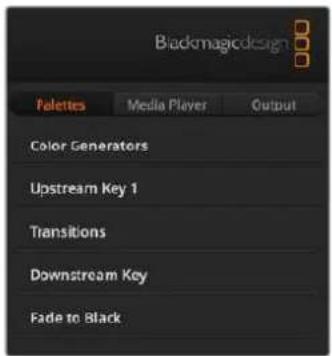
text_image
Blackmagicdesign Polettes Media Player Output Color Generators Upstream Key 1 Transitions Downstream Key Fade to BlackPalettes Tab
The 'palettes' tab contains the following processing controls.
| Color Generators | Your ATEM switcher has two color matte generators which can be configured from the color generators palette using a color picker or by setting hue, saturation, and luminance levels. |
| SuperSource ATEM Mini Extreme model switchers include a feature referred to as SuperSource that will allow you to arrange multiple sources on the monitor at one time. For more information refer to the section ‘Using SuperSource’ later in this manual. | |
| Upstream Key The switcher’s upstream keyer can be configured from the upstream key palette. Within the keyer palette, the keyer can be configured as a luma key, chroma key, pattern key or DVE. The type of key available will also depend on if the DVE is available. The upstream key palette will display all the parameters that are available to configure the keyer. More information on how to use upstream keyer is included later in this manual. | |
| Transitions The transitions palette is where you can configure the parameters of each transition style. For example, for the dip transition the palette has a menu where you can select the dip source and for the wipe transition the palette displays all the available wipe patterns. There are lots of variations of transitions and a large number of transitions can be created by combining settings and features in the transitions palette. | |
NOTE It's worth noting that selecting a specific style of transition in this palette will only adjust the settings for these transitions, and you still need to select the style of transition you want to perform in the transition control section on the software or ATEM Mini's control panel. The software and ATEM Mini's control panel work together and mirror all settings, so you can use any combination you like!
| Downstream Key ATEM | Mini has a downstream keyer which can be configured from the downstream key palette. The palette has menu boxes for selecting the fill and key signals to the keyer, plus sliders to set the pre multiplied key clip and gain values, and mask settings. |
| Fade to Black | The fade to black palette is where you can set the fade to black transition rate. An ‘Audio Follow Video’ checkbox is also provided as a shortcut for the audio mixer’s master fader AFV button. Selecting this feature lets you fade your audio with your fade to black. |
Media Player Tab
The 'media player' tab contains controls for your ATEM Mini's media player and connected HyperDecks.
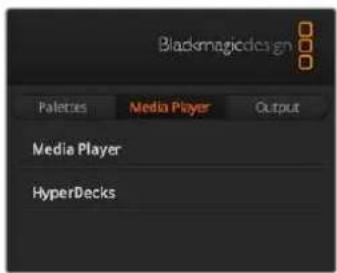
text_image
Blackmagicdesign Palettes Media Player Output Media Player HyperDecks| Media Player | Your ATEM Mini has a media player that plays back the stills that are stored in the media pool memory built into the switcher. The menu list is used to select the still that will be played or made available on the media player input to the switcher. |
| Hyperdecks You can connect up to 4 Blackmagic HyperDeck Studio model disk recorders and control them using ATEM Software Control's HyperDecks palette.For more information refer to the 'HyperDeck Control' section of this manual. | |
Output Tab
The output tab lets you capture a still image from the program output. When using ATEM Mini Pro or Extreme switchers, this tab also contains additional options for you to live stream, record your stream and set the timecode generator. The capture video option supports the original ATEM production switchers that feature legacy USB output recording.
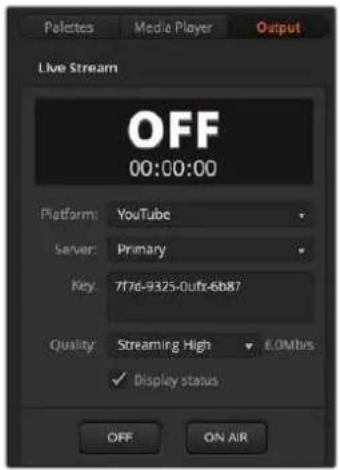
text_image
Palettes Media Player Output Live Stream OFF 00:00:00 Platform: YouTube Server: Primary Key: 7f76-9325-0ufr-6b87 Quality: Streaming High COMbus ✓ Display status OFF ON AIRLive Stream
When using ATEM Mini Pro or Extreme switchers, this important output option lets you set up your live stream by entering the streaming details from your streaming platform. After assigning all the settings, you can start your broadcast by clicking the 'on air' button, then stop the broadcast by clicking 'off'.
The live stream status will clearly show you are on air by displaying a large red 'on air' indicator together with the timecode generator, which you can set using the timecode generator options.
| Platform Click in the 'platform' menu and select the streaming platform for your broadcast. Options include Facebook Live, YouTube Live and Twitch. | |
| Server | Select the server that is closest to your location by clicking in the settings window and using the menu. |
| Key Enter the stream key that has been assigned to your broadcast from the streaming platform. For information on how to obtain a stream key, refer to 'getting a stream key' in the 'connecting to a network' section. | |
| Quality | Select the streaming quality and stream recording quality you want. This setting contains the following options:HyperDeck High 45 to 70 Mb/sHyperDeck Medium 25 to 45 Mb/sHyperDeck Low 12 to 20 Mb/sStreaming High 6 to 9 Mb/sStreaming Medium 4.5 to 7 Mb/sStreaming Low 3 to 4.5 Mb/sMore information about the quality settings is included in this section of the manual. |
For more information on how to use these options when setting up a live stream directly via Ethernet, including getting a stream key, refer to ‘connecting to an internet router.’
Even though the settings are nice and simple and you only need to select the service and a few other options, there is an XML file that has additional settings that knowledgeable users could take advantage of to add other streaming services and customize the streaming menu with low level settings. Refer to the 'changing switcher settings/saving and restoring switcher settings' section for more information on how to save and restore using an XML file.
Streaming and HyperDeck Quality Settings
The data rate used by the quality setting will change depending on the video standard your switcher is running at. For example, if you select Streaming High quality and are running at 1080p24 then it would use the 6 Mb/s data rate.
The data rates used on HyperDeck High are 45 to 70 Mb/s, the rates for HyperDeck Medium are 25 to 45 Mb/s and the data rates used for HyperDeck Low are 12 to 20 Mb/s. The streaming data rates are lower to allow for transmitting the data over the internet, so the data rate for Streaming High is 6 to 9 Mb/s, the data rate for Streaming Medium is 4.5 to 7 Mb/s and the data rate for Streaming Low is 3 to 4.5 Mb/s.
You will notice that each setting has 2 data rates mentioned. The lower number is used for the lower frame rates of 24p, 25p and 30p, while the higher data rates are used when you are running higher frame rates of 50p and 60p. It's also worth noting that the default setting for the streaming quality is Streaming High 6 to 9 Mb/s, as this gives a very high quality streaming channel, and the fairly good recording quality.
If you are not streaming, then you could just pick one of the HyperDeck quality settings. These are the same quality as the settings in HyperDeck Studio Mini and are a good quality data rate when you need broadcast quality recordings. However, with the latest software released for HyperDeck Studio Mini, it will also play the lower quality streaming data rates.
Record Stream
If you are recording your stream via USB-C on ATEM Mini Pro or Extreme, this palette is where you can control your disks and start and stop recording. You can also set a file name and trigger record in all cameras when connected to Blackmagic Pocket Cinema Camera 4K and 6K.
NOTE When your ATEM Mini Pro's USB-C output is connected to an external disk for recording and you want to keep using ATEM Software Control, you will need to connect your ATEM Mini Pro to your computer via Ethernet.
Refer to the ‘connecting to a network’ section for more information.
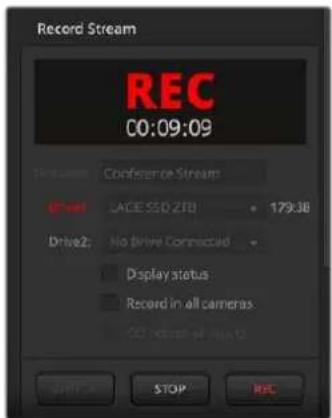
text_image
Record Stream REC 00:09:09 Trackload: Conference Stream Drive1: LACE SSD 278 179.38 Drive2: No Drive Connected Display status Record in all cameras STOP REC| File Name Prior to recording, set a file name by typing it into the file name window.Click anywhere outside the window to confirm. If you stop and start recording,the file name will assign version numbers incrementally. | |
| Drives Formatted drives connected to your switcher will appear as a list in the recordwindow. You can assign drives by selecting them from the menu. The drivewindow displays the disk capacity and record time remaining.Recording will always begin with the disk containing the largest available space,then proceed to the next disk with the largest available space. However, you canmanually switch the drive you are recording to by clicking the 'switch' button. Thisis helpful if there is less than 5 minutes remaining on the current disk and youwant to switch it over to the next disk at a determined moment in your broadcast. | |
| Switch | Click the 'switch' button to change the drive you are currently recording to thenext drive with the largest available space. |
TIP You can also switch drives by holding down the record button on ATEM Mini Pro.
| Record button Click the record button marked 'rec' to start recording. | |
| Stop button Click 'stop' to stop recording. | |
| Display status | Enable this feature by clicking the display status checkbox in the record options. The display status will appear in ATEM Software Control at the bottom right side of the user interface and shows the recording status. When recording, the record indicator will illuminate red and displays the current drive and record time remaining. |
| Record In all cameras | This feature lets you set all Blackmagic Pocket Cinema Cameras to record when you press the record button. This is helpful if you want isolated recordings from each camera for editing later. Cameras will be automatically set to record using Blackmagic RAW at the quality setting the camera was last set to. |
Recording ISO Files
ATEM Mini ISO models can record video files from each of its video inputs, and these are called isolated input files or "ISO" files.
By default, ATEM Mini ISO models will record a program file in exactly the same way as the ATEM Mini Pro model. However if you select to record the ISO files, it will change to recording a whole folder of content that includes the input video files as well as audio files, and a DaVinci Resolve project file.
How to Record ISO Files
To record a folder of ISO files and other items, simply go to the record palette in ATEM Software Control and select the setting "ISO record all inputs". Now ISO switcher will record the folder of contents when you press record in the palette or on the front panel.
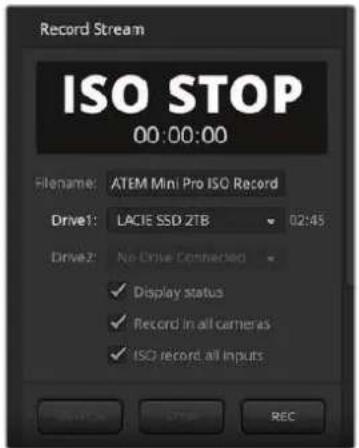
text_image
Record Stream ISO STOP 00:00:00 Filename: ATEM Mini Pro ISO Record Drive1: LACIE SSD ZTB 02:45 Drive2: No Drive Connected ✓ Display status ✓ Record in all cameras ✓ ISO record all inputs RECTo enable ISO recordings, check the 'ISO record all inputs' checkbox in the record stream palette.
It's important to use a disk that's fast enough. A good flash disk is recommended as often mechanical disks cannot work fast enough to record the 5 streams of H.264 HD video that you will record with this setting.
What's in the ISO Folder?
The record folder will take the name of the record palette. Even though this folder will have multiple ISO files, it also has the main program recording. But when ISO recording, it will be placed inside this folder with the other items.
The ISO video files are recorded from each input and placed into a sub folder called Video ISO Files. Each video file is recorded from each input and is an exact recording of the video connected to that specific HDMI input. The ISO files also have synced timecode and camera number metadata, so you can use any edit software's multi-cam feature. To make editing simpler, all ISO files have program audio, the same as the master video file.
Because the ISO files include camera number metadata and synced timecode, you can also use the DaVinci Resolve Sync Bin to quickly select between views and build an edit.
It's worth noting that if you use any graphic from the media pool, these will be automatically saved into a sub folder called Media Files that's located inside the Video
ISO Files folder. This allows you to rebuild the titles in your edit that were used during your live program.
Audio input files from each input as well as the microphone inputs are also recorded. These are placed into a sub folder called Audio Source Files. These files are in broadcast WAV format and are professional stereo audio files that exclude any processing or EQ from the built in ATEM Mini audio mixer.
So this means the files are clean and you can use them to create a whole new audio mix using professional audio software. The audio tiles also include timecode so they are synchronized to the video files.
The most exciting item to be saved into the project folder is the DaVinci Resolve project file. This file will have been built based on the switcher actions that occurred since you started recording. It currently allows several switcher functions to be recorded and then when you double click this file, it will open up DaVinci Resolve with a full timeline of all these edits.
ATEM switcher functions that are currently supported include cut and mix edits between all video inputs and the media player, downstream titles and fade to black. These are the most used functions and these will be restored as the video edit in DaVinci Resolve. Further functions will be added in future updates.
Append Recording
If you don't change the project name, when you record, it will append the edit to the DaVinci Resolve project file you have previously recorded on disk. This is very useful as it means you can stop for mistakes, or lunch, and then start recording again. Both recordings will then open into the same timeline and you can knit the recordings together so they appear seamless to the viewer. If you don't want to append record, be sure to change the project name, or use a new blank USB disk.
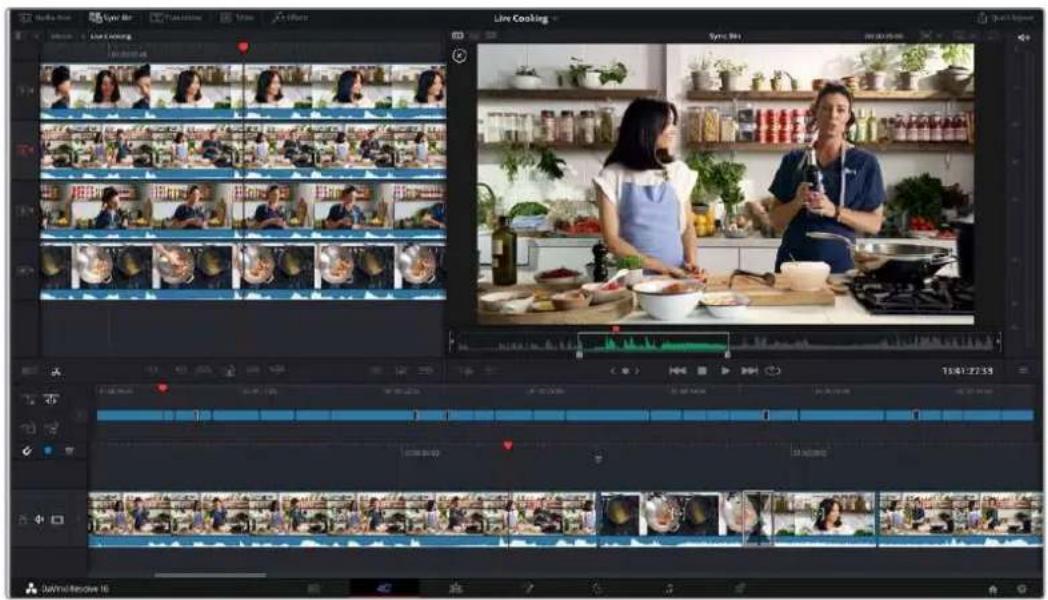
text_image
Screenshot of video editing software interface showing live cooking and video thumbnails with Chinese labelsBenefits of Editing a Live Project
There are multiple benefits of editing a live event. Some of the edits you might need to do can be completed very quickly and then you can render out a new master file before uploading.
It means you don't have to accept the live edit you did while streaming, as now you can make changes to it before uploading it.
You can also use the ISO recording features and editing to create programs faster, because you can just use ATEM Mini ISO switchers as a multi track recorder to feed edit stations with multiple camera views!
If you are importing the DaVinci Resolve project, then you are going to see your live production rebuilt as an edit almost instantly. Now you can make some fast creative adjustments to your event before uploading.
What's on the Layers?
The processing in a switcher normally progresses from the switcher inputs on the left of the control panel to the right where the output features are. That's because a switcher is a live processing pipeline from the video inputs, through all the switcher features and then out to the video output.
Editing works very differently. You get a stack of layers in editing software. The lowest layer is covered by layers above. So this means any clip on layer 2 will cover any clip on layer 1. Normally people edit with cuts and dissolves on layer 1, however then other items are placed on layers above. Any clip placed on layer 3 would cover any clips on layers 1 and 2. You can have dozens of layers in complex edits.
So to understand what DaVinci Resolve does when it imports your project file, just look at the project after it's been imported. You can see the various types of processing that have been placed on different edit layers.
| Layer 1 | Layer 1 has all the main editing between your sources. You will see the clips end to end and sometimes the edit points are cuts and sometimes you can see dissolves. This layer was created from your main input switching. All the edits with the video inputs and the still frame source will be placed on layer 1. |
| Layer 2 | Layer 2 is for the downstream keyer. In the ATEM switcher, the downstream keyer is located after the transition block. In editing this means it's on layer 2 so it can override the main switching that's been placed on layer 1. If you place a graphic with an alpha channel in the downstream keyer and put it on air, it will have added this title to the video output. Now this layer is on layer 2 and it overlays the same graphic with alpha channel over layer 1. |
| Layer 3 | Layer 3 is for fade to black. Fade to black is the last processing in the switcher and it fades all layers in the switcher to black. This is commonly used at the end of the program, or to lead into commercial breaks. Fade to black is on layer 3 because it will override all the layers below it, just like it does in the switcher. Fade to black is a black video generator with a dissolve applied to the front and end. |
Shifting Edit Points
An advantage of editing is you can shift your edit points around. When you do a live production, the action can get very fast and it can be difficult to keep up. Imagine an interview program where multiple people are rapidly talking and interrupting each other. The live switch may have struggled to keep up as the conversation moves from person to person.
So rolling the edit points will allow you to move the edits to before a person starts talking. In a live switch you need to keep up so your edits lag behind the person starting to talk. However now you can shift them back in time and the edit will cut to the person just before they start talking. This will transform the feel of the program.
To roll the edit forward, scroll to the edit point in the timeline and then move your mouse to the edit point in the lower timeline. You will see a double bar tool appear. If you click and drag to the left, the edit point will move to earlier in time. If you click and drag to the right, your edit point will move later in time.
Be sure not to click the half bar tools with the little arrows. These are the trim in and trim out tools. As you move the mouse around the edit point the tools automatically change. So if you use the trim in and trim out tools, you will increase or reduce the duration of your whole video track and the audio will become out of sync with the green audio track below.
Replacing Shots
The sync bin will let you find shots that sync to the point on the timeline where you are currently positioned. This means you can fix situations where you cut to the wrong camera, or you can search for better shots because you have more time to see what alternatives you had.
To use the sync bin, just select it from the top left of the cut page. Once selected, you will see your media pool at the top left and your viewer will change. The media pool will now show a timeline of available clips and the viewer will show a multi view of the shots you have. These are only the shots that sync to the point in the timeline you are positioned on. If you move the timeline, these shots will also track in sync.
Think of the sync bin as an assistant editor that looks for shots for you and displays them in a multiview, so you can use them for editing.
Because ATEM Mini Pro ISO and Extreme ISO knows what input you have connected, plus it's recording those inputs into video files, it will have placed the camera number metadata into the files for you. This means camera 1 in the sync bin is really the video input you had connected to input 1 on the switcher. Camera 2 is input 2 and so on.
To select an alternative edit, you need to follow 2 steps. First you need to select the shot you want and set its in and out point. The next step is to edit it into your timeline, over the shot you currently have.
So scroll to the position in the timeline that has the start of the shot you want to replace. You are going to edit over the top of this clip. You should see the alternative shots displayed in the multiview. These are the other options you have and you see all the input video files that were recorded from the ISO switcher's inputs.
Now click the shot you want. You will see it display full screen. It will also have an in point set for you, and it will be located at the current timeline position. There is an out point also placed at a clip duration of 4 seconds. It's unlikely you want this exact out point, so now all you need to do is scroll along the timeline to find the point you want the new shot to end and press O. The out point will move to this position.
If you did not select the correct shot, just press escape and it will return you to the multi view and you can select another shot.
Now you have your shot selected, you want to place it in the timeline. This is where you need to use the source overwrite edit mode. The edit modes are centered below the media pool, and the right most one is called source overwrite. You can see which edit mode is which, by hovering your mouse over the buttons to display the tool tips with the edit label.
The source overwrite is intelligent, and it will look at the clip you have selected, then look at the timeline and it will edit that clip into the timeline at the exact timecode match. This means all the shots you are editing into the timeline with source overwrite will stay in sync. Not only that, you don't need to set any in and out points in the timeline, as you can just scroll along, look for shots, and add them into the timeline as cutaways.
The source overwrite edit mode will always place the clip on the layer above the current clip in the timeline. If there is no layer, it will add the layer and then place it. This means it's easy to find your cutaways as they will be on the layers above your original edit.
Simply scroll along your timeline, select your cutaways from the sync bin multi view and replace as many shots as you need.
Adding Dissolves
Another great feature for editing is you can add extra dissolves to your timeline. Often when streaming at low bandwidth, dissolves can look blocky. So this means you might not use them for the live stream. But when you upload your program you might want to add more dissolves to make the feel of the program gentler and more elegant.
You can now add the dissolves to smooth out the flow. DaVinci lets you drag transitions from the transition palette onto each edit point, however there is a faster way to add dissolves. At the bottom right of the media pool on the cut page are 3 transition buttons. One will remove any transition and make the edit point a cut, but the middle button will add a dissolve. You can just scroll along and press the middle button and add dissolves.
If you watch the timeline ruler you will see a little triangle marker bouncing up and down. This will show you the edit point that DaVinci thinks you want to add the dissolve to. This means you don't even need to add in points to the timeline as when you press the dissolve button, it will add it to the marked edit for you. It's very fast and you can just scroll along and add dissolves where you need them.
Cutting Out Boring Bits or Mistakes
Sometimes you might have parts of your show that are a bit slow, or you could have stopped because of a mistake. You can cut out these sections by using the split tool. Below the media pool there is a tool on the left side that looks like a pair of scissors. Click this tool and you will split all the layers in your timeline. Now if you click the clips between the cuts, you can just press delete to remove those clips and the gap in the timeline will close up automatically.
You can see how easy it is to do common fixes to your live event. Now select quick export on the top right of the cut page window and you can get a new master file with all these changes applied.
Editing in DaVinci Resolve
To understand how to use DaVinci Resolve, it's best to watch some tutorial videos online and download the free version to use for training. DaVinci Resolve is very sophisticated and is used by high end Hollywood studios on feature films, however the cut page is a lot simpler and is easy to learn. Check online for more information.
Recording in Camera
Blackmagic Pocket Cinema Camera 4K and Blackmagic Pocket Cinema Camera 6K models can be controlled by the ATEM Mini switchers via the HDMI cable that connects from the camera to the ATEM Mini. It does this using some communication wires in the cable.
This means you can do color correction and adjust lens settings via the camera control panel in the ATEM Software Control app. Please check the section in this manual that describes how this works.
Another advantage of this control is you can select the record in camera setting in the record stream palette so you can record in the cameras while recording to a USB disk.
The advantage of recording in camera is that the cameras will record in Blackmagic RAW, which is a film gamma file that's perfect for applying advanced color correction. However even more exciting is that the files in camera are 4K, so by using these files you can master your live production in Ultra HD. Even though these are HD switchers, you can still deliver Ultra HD masters for upload or broadcast.
The connections to the camera will upload timecode as well as camera number and filename information. This means the Blackmagic RAW files will be in sync with the switcher timecode. This makes using them easy.
To use Blackmagic RAW files from the cameras, be sure to select the record in camera setting in the record stream palette. Then once you have completed recording, be sure to copy the camera files into the Video ISO files folder from the switcher. It's important you do this as DaVinci Resolve needs to see these files when you first open the DaVinci Resolve project file.
However one problem with using both ISO files from the switcher and the Blackmagic RAW files from the camera is they will clash. Both files have the same timecode and the same camera number. This is not an issue because DaVinci Resolve, by default will use the ISO files.
To change to use the higher resolution Blackmagic RAW files in your project, just select the camera originals button on the top right of the cut page window. The icon that looks like a little camera. Once you select this icon, you should see your timeline change as it's now selected the Blackmagic RAW files, which are film gamma.
You might need to add color correction to these files to make your cut look good. Blackmagic RAW files are clean without color correction, so you can use the powerful color correction tools in DaVinci Resolve to create an amazingly graded master.
If you want to deliver in Ultra HD, just select the resolution menu next to the camera originals icon and it allows you to select various resolutions and aspect ratios. The top setting is for Ultra HD. Once you select this, your whole project will be changed over to Ultra HD and you should see your images become sharper.
Any non camera inputs such as slide shows from a computer will be upscaled automatically. HD images from the media pool will also be upscaled automatically. You can replace these images in the media folder if you want them to be replaced by higher resolution versions of your media pool graphics.
Now when you do quick export, you will be exporting an Ultra HD master, all from a HD switcher!
Preparing Media for Recording
External disks can be formatted via a Mac or Windows computer. HFS+ is also known as Mac OS X Extended and is the recommended format as it supports 'journaling'. Data on journaled media is more likely to be recovered in the rare event that your storage media becomes corrupted. HFS+ is natively supported by macOS, exFAT is supported natively by Mac and Windows without needing any additional software, but does not support journaling. This can be a good choice if you need to read or write to the disk using both Mac and Windows computers.
Preparing Media on a Computer
Formatting Media on a Mac Computer
The Disk Utility application included with your Mac can format a drive in the HFS+ or exFAT formats. Make sure you back up anything important from your disk as you will lose everything on it when it is formatted.
1 Connect your disk to your computer with an external dock, USB hub, or cable adapter and dismiss any message offering to use your drive for Time Machine backups.
2 On your computer, go to applications/utilities and launch Disk Utility.
3 Click on the disk icon of your drive and then click the erase tab.
4 Set the format to Mac OS Extended (Journaled) or exFAT.
5 Type a name for the new volume and then click erase. Your media will quickly be formatted and made ready for recording.
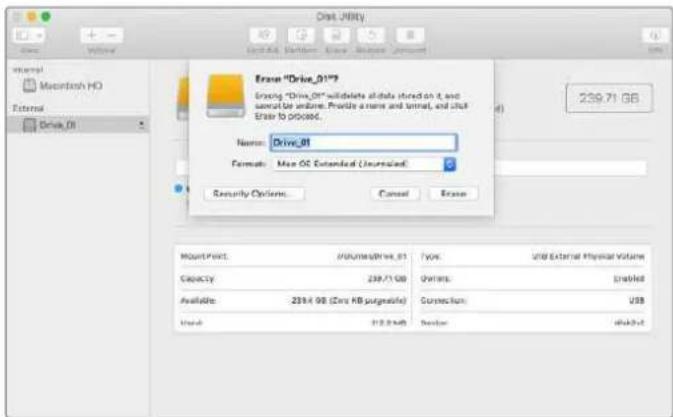
text_image
Drive_01 Erase "Drive_01" Erase: "Drive_01" will delete all data stored on it, and cannot be installed. Provide a name and format, and click Erase to proceed. Name: Drive_01 Format: Max OC Extended (Unrealized) Security Options: Cancel Erase Mount Point: Volumes(Drive_01 Types: USB External Physical Volume Capacity 239.71 GB Parents Enabled Available: 239.4 GB (Any KB pgputable) Correction: USB Used: 112.5 MB Device: UnpaidFormatting Media on a Windows computer
The format dialog box can format a drive in the exFAT format on a Windows PC. Make sure you back up anything important from your drive as you will lose everything on it when it is formatted.
1 Connect the drive to your computer with an external dock, USB hub, or cable adapter.
2 Open the start menu or start screen and choose computer. Right-click on your drive.
3 From the contextual menu, choose format.
4 Set the file system to exFAT and the allocation unit size to 128 kilobytes.
5 Type a volume label, select quick format and click 'start'.
6 Your drive will quickly be formatted and made ready for recording.
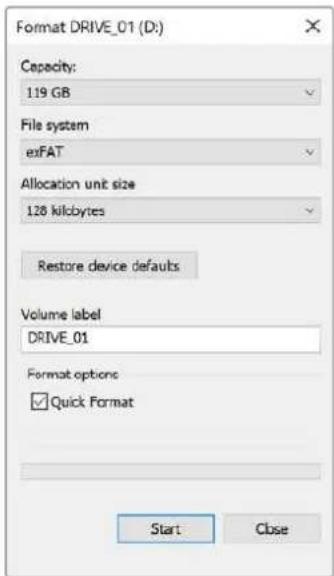
text_image
Format DRIVE_01 (D:) Capacity: 119 GB File system exFAT Allocation unit size 128 kilobytes Restore device defaults Volume label DRIVE_01 Format options ✓ Quick Format Start CloseUse the Format dialog box feature in Windows to format your external disk in the exFAT format
Capture Video
The capture video option supports legacy model ATEM switchers with USB capture features.
Capture Still
If you need to capture a still image from your broadcast simply click on the 'capture still' button. This acts like a still store which lets you add capture files to the media pool. You can then immediately load a still into the media player and use it in your broadcast, or save the media pool to your computer.
To save the media pool:
1 Go to the menu bar at the top of your screen and click on 'file/save as'.
2 Choose the location you want to save to.
3 Click 'save'.
Now that your media pool is saved on your computer, you can access the captured stills and use them in your graphics software.
Timecode Generator
The timecode generator automatically runs time of day timecode from the moment you launch ATEM Software Control. However, you can reset the counter to zero, or manually enter a new timecode value to start from.
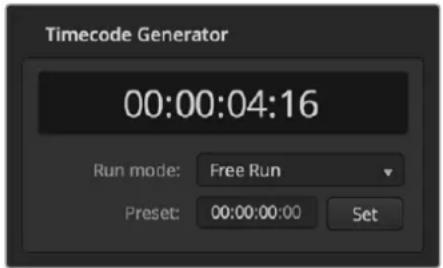
text_image
Timecode Generator 00:00:04:16 Run mode: Free Run Preset: 00:00:00:00 SetWhen using ATEM Mini Pro or Extreme, the timecode generator can be set to time of day, or free run timecode where you can set a manual preset timecode
To manually set a preset timecode value:
1 Click in the 'run mode' menu and select 'free run'.
2 In the smaller timecode counter, type in a defined timecode value. As you type, the new values will appear green.
To confirm the change and set the timecode running, click 'set'.
Time of Day
When ATEM Mini Pro or Extreme switcher is connected to your computer, the unit will sync time of day timecode with your computer. The unit has a built-in clock that can continue running for approximately 6 days, so once you disconnect the switcher from your computer, the time of day timecode will continue until the battery is depleted. The battery will charge while connected to your computer via USB.
NOTE The timecode generator is also crucial when recording isolated files on Blackmagic Pocket Cinema Cameras 4K and 6K. When these cameras are connected to ATEM Mini's HDMI inputs, they will automatically conform to the ATEM timecode generator. That means when all cameras are recording the same timecode, you can edit your broadcast in post production and have all cameras easily synchronized on a multicamera timeline. For example, you can import your isolated camera recordings in DaVinci Resolve and setup a multicamera edit with all cameras synced to the same timecode.
Using the Audio Mixer
The audio tab is used to mix audio sources connected to ATEM Mini via HDMI and mic audio.
Cameras and external mic audio sources are listed along the top of the audio mixer along with the master audio output for the USB webcam program output to your computer.
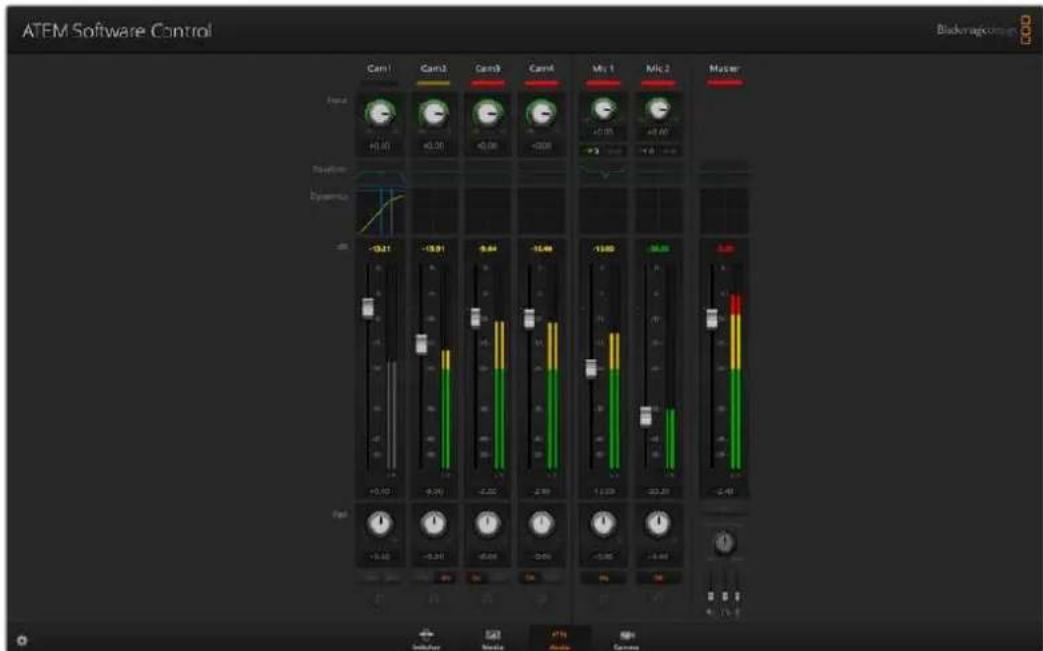
The audio mixer displays tally lights for any audio sources that are currently on air or when AFV is selected, as well as audio level, audio balance and buttons for selecting which audio should be used
Below each audio source is an audio level meter, a fader for setting the maximum audio level, and a knob for setting the left/right audio channel balance. The master fader on the right side of the audio mixer is used to set the gain on the audio level on the USB webcam program output and has its own audio level meter. Next to the master fader are mic faders which let you control the audio level for microphones connected to the mic inputs.
The buttons below each audio level meter determine whether audio is always available for mixing or only when the source is on air.
The solo monitoring feature for each input is grayed out as it supports ATEM Production Studio and Broadcast Studio model switchers.
Tally
Any source whose audio is on air is lit with a red tally light in the software. In the example on this page, camera 3 and camera 4 are lit because their audio is set to be always on. The tally light will be illuminated dull yellow when AFV is selected and the channel's associated camera is off air. This also applies to the master fader tally light when the master fader AFV button is selected. When FTB is activated, the master fader tally light will blink red.
Audio Level
Drag the audio level fader to set the gain on the audio level for each camera and audio source. The numbers under each audio level meter show the maximum audio level set by the fader. The numbers above the audio meter show the peak audio level reached by the audio source. A green number represents low to medium audio levels.
If the audio meter is regularly showing red, and the red number above it is not changing, then you should reduce the audio level to avoid audio distortion. After adjusting the audio level, you may wish to reset the red number by clicking on it once. Observe the new number to make sure it changes for a while and does not immediately shoot up and become stuck on a red number. If it does, you may need to reduce the audio level even further.
Audio Balance
The audio mixer supports stereo audio from each audio source. If you wish to change the left and right audio channel balance for a camera or other audio source, adjust the knob to the desired balance point.
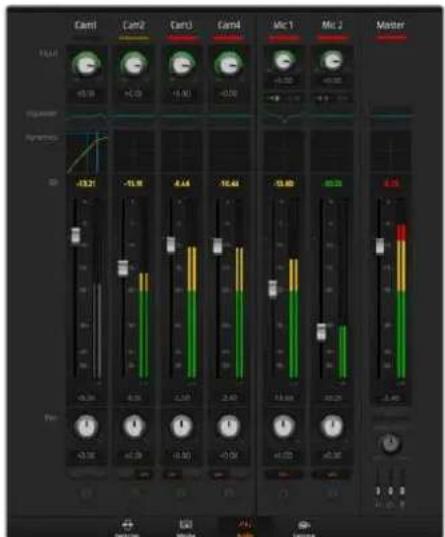
bar
| Category | Amplitude (dB) | | :--- | :--- | | Am1 | -15.18 | | Am2 | -14.03 | | Am3 | -13.90 | | Am4 | -0.70 | | Mic1 | -14.32 | | Mic2 | -14.00 | | Mic3 | -13.21 | | Mic4 | -13.18 | | Mic5 | -13.44 | | Mic6 | -13.48 | | Mic7 | -13.80 | | Mic8 | -13.73 | | Mic9 | -14.00 | | Mic10 | -14.40 | | Mic11 | -14.50 | | Mic12 | -14.50 | | Mic13 | -14.50 | | Mic14 | -14.50 | | Mic15 | -14.50 | | Mic16 | -14.50 | | Mic17 | -14.50 | | Mic18 | -14.50 | | Mic19 | -14.50 | | Mic20 | -14.50 | | Mic21 | -14.50 | | Mic22 | -14.50 | | Mic23 | -14.50 | | Mic24 | -14.50 | | Mic25 | -14.50 | | Mic26 | -14.50 | | Mic27 | -14.50 | | Mic28 | -14.50 | | Mic29 | -14.50 | | Mic30 | -14.50 | | Mic31 | -14.50 | | Mic32 | -14.50 | | Mic33 | -14.50 | | Mic34 | -14.50 | | Mic35 | -14.50 | | Mic36 | -14.50 | | Mic37 | -14.50 | | Mic38 | -14.50 | | Mic39 | -14.50 | | Mic40 | -14.50 | | Mic41 | -14.50 | | Mic42 | -14.50 | | Mic43 | -14.50 | | Mic44 | -14.50 | | Mic45 | -14.50 | | Mic46 | -14.50 | | Mic47 | -14.50 | | Mic48 | -14.50 | | Mic49 | -14.50 | | Mic50 | -14.50 | | Mic51 | -14.50 | | Mic52 | -14.50 | | Mic53 | -14.50 | | Mic54 | -14.50 | | Mic55 | -14.50 | | Mic56 | -14.50 | | Mic57 | -14.50 | | Mic58 | -14.50 | | Mic59 | -14.50 | | Mic60 | -14.50 | | Mic61 | -14.50 | | Mic62 | -14.50 | | Mic63 | -14.50 | | Mic64 | -14.50 | | Mic65 | -14.50 | | Mic66 | -14.50 | | Mic67 | -14.50 | | Mic68 | -14.50 | | Mic69 | -14.50 | | Mic70 | -14.50 | | Mic71 | -14.50 | | Mic72 | -14.50 | | Mic73 | -14.50 | | Mic74 | -14.50 | | Mic75 | -14.50 | | Mic76 | -14.50 | | Mic77 | -14.50 | | Mic78 | -14.50 | | Mic79 | -14.50 | | Mic80 | -14.50 | | Mic81 | -14.50 | | Mic82 | -14.50 | | Mic83 | -14.50 | | Mic84 | -14.50 | | Mic85 | -14.50 | | Mic86 | -14.50 | | Mic87 | -14.50 | | Mic88 | -14.50 | | Mic89 | -14.50 | | Mic90 | -14.50 | | Mic91 | -14.50 | | Mic92 | -14.50 | | Mic93 | -14.50 | | Mic94 | -14.50 | | Mic95 | -14.50 | | Mic96 | -14.50 | | Mic97 | -14.50 | | Mic98 | -14.50 | | Mic99 | -14.50 | | Micro 2 2 2 2 2 2 2 2 2 2 2 2 2 2 2 2 2 2 2 2 2 2 2 2 2 2 2 2 2 2 2 2 2 2 2 2 2 2 2 2 2 2 2 2 2 2 2 2 2 2 3 3 3 3 3 3 3 3 3 3 3 3 3 3 3 3 3 3 3 3 3 3 3 3 3 3 3 3 3 3 3 3 3 3 3 3 3 3 3 3 3The audio meter for Cam1 is shown in gray to indicate that its audio will not be used as neither of its ON or AFV buttons are enabled. Cam2 has AFV selected but its audio is not currently being used as the camera is not on air as is indicated by its dull yellow tally light. Cam3 and Cam4 have their direct mix set to ON so their mixed audio is always used and their tally lights remain lit, even if another camera is currently on air. The audio level meters for mics 1 and 2 are also set to 'on' and therefore always present in the mix.
Audio Source Selection
Below each audio level meter, you will find the ON and AFV buttons that select which audio sources are sent to the program output of the switcher.
| ON Selecting the direct mix to ON allows an audio input to be permanently mixed into the program output, even when the associated video source is not on air. The red tally light will always be lit because the audio is always on air. Selecting this option automatically disables AFV. | |
| Audio Follow Video | Audio follow video allows audio to crossfade when inputs change. The audio will only be sent to the program output when the input is on air, lighting the red tally light above. When off air, the tally light is lit dull yellow. Selecting this option automatically disables the direct mix ON setting. |
| SOLO The solo feature appears as a headphones icon below each input and is available for ATEM Production Studio and Broadcast Studio model switchers. | |
Master Audio Level Output
The master fader on the right side of the audio mixer is used to set the gain on the audio level for the USB webcam program output and has its own audio level meter. Select the AFV button on the master audio output fader to enable the AFV fade to black feature. This lets you fade your master audio when you click on the fade to black button.
Audio Mixer Monitor
The monitor volume knob and buttons appear below the master fader and control the monitoring audio output behavior. You can use these settings to set independent audio levels for monitoring the audio mix without affecting the program output audio. If you've selected a solo input that you want to monitor, these settings let you control the audio monitor levels for the single input without affecting the program output audio. You can enable these settings by going to the settings window and selecting the audio out setting to "monitor audio".
| AFV Select ON to enable audio monitoring via the monitor XLR output. Deselect ON to disable all audio via the monitor XLR output. |
| DIM Select DIM to temporarily reduce the monitor audio level without having to adjust the fader. |
Shaping your Audio Mix using Advanced Fairlight Controls
ATEM Mini has advanced Fairlight audio controls that let you enhance and refine the quality of sound on each input and master output, including input level controls, a 6 band parametric equalizer and powerful dynamics settings.
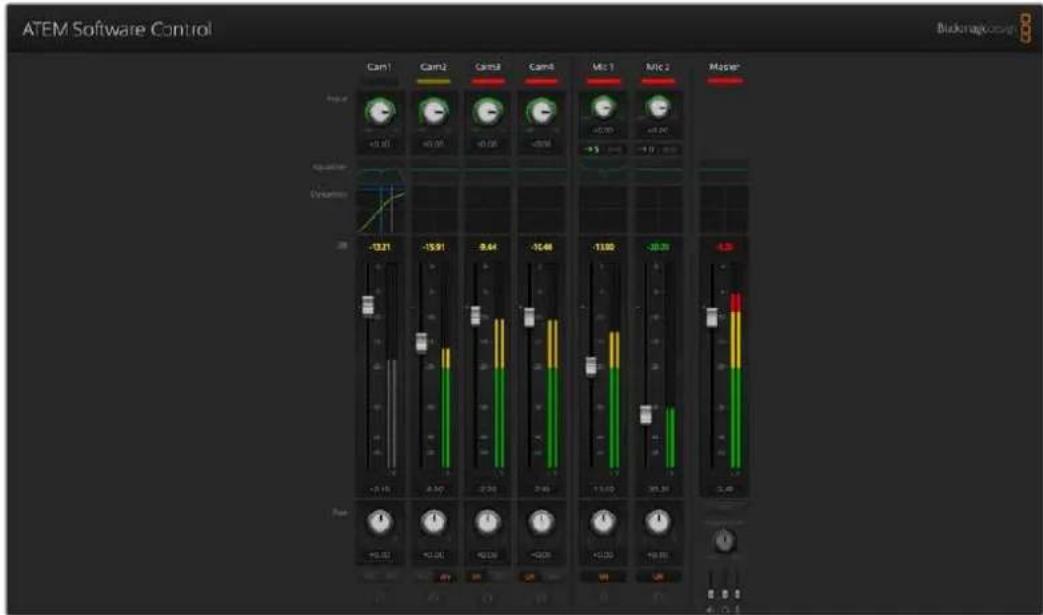
bar
ATEM Software Control | Channel | Value | | :--- | :--- | | Cam1 | -43.80 | | Cam2 | 40.95 | | Cam3 | -43.08 | | Cam4 | -43.08 | | MIC1 | -43.70 | | MIC2 | -43.90 | | Master | -4.20 |This section of the manual shows the different Fairlight audio controls you can use to shape and optimize the audio mix in your live production.
Input Level
Generally, when setting up your audio mix, the first step is to normalize all your inputs. This means adjusting the input level knob on each input so you can optimize all the levels to their highest strength without clipping.
This control is at the top of each track under the tally light. Change the level by clicking on the knob and dragging left to decrease the level, or right to increase. By setting the input control, it brings all the inputs up to a common signal strength so they are all at their strongest without clipping.
After you have normalized all your input levels, you can now begin optimizing and shaping the qualities in each audio input using the 6 band parametric equalizer and dynamics controls.
Delay Control
Sometimes when using analog audio via your ATEM Mini's mic inputs, there may be a slight difference in the sync between analog audio and video. For example, the analog audio may sound slightly ahead of the video. This is because analog audio is independent of the video inputs and is coming directly from an external source, while the HDMI inputs might have some delay depending on upstream equipment, such as some cameras and video processors. Setting the audio delay will ensure the analog audio input is perfectly AV synced to the video inputs from cameras.
To adjust the amount of delay on the selected input:
1 Click on the delay indicator beneath the input audio level control knob on the channel strip.

Click on the delay indicator below the level input knob to open the delay control.
A small popup window will open containing the delay adjustment knob.
2 Click on the delay knob and drag left to decrease the amount of delay, or drag right to increase. The amount of delay is measured in frames. Close the window by clicking on the small 'x' in the top corner, or move the window to a safe place on your desktop if you need to make further adjustments later.
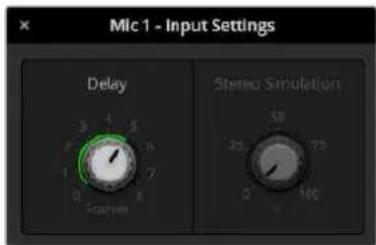
text_image
Mic 1 - Input Settings Delay Stereo Simulation 3 4 5 6 7 0 1 2 3 4 5 6 7 8 9 10 11 12 13 14 15 16 17 18 19 20 21 22 23 24 25 26 27 28 29 30 31 32 33 34 35 36 37 38 39 40 41 42 43 44 45 46 47 48 49 50Click on the delay control and drag left or right to decrease or increase the amount of delay required for an analog input
Using the 6 Band Parametric Equalizer
Each input and the master output has a 6 band parametric equalizer which can be used to control specific frequencies. This could include reducing low frequency hum or noise on a microphone input, or boosting the low frequencies on a thin sounding track, or even to add uniqueness to each input so they are more distinct in the final mix. You have many creative options.
Parametric Equalizer
To open the parametric equalizer for an input or the master output, click on the corresponding equalizer indicator.
Click on an input's equalizer indicator to open a 6 band parametric equalizer
The first item you will notice is the graph along the top of the window with numbered indicators from 1 to 6. These numbered indicators are adjustable handles that correspond to bands 1 to 6.
Each band of the 6 band parametric equalizer has a column of settings. These settings will differ based on which band you are controlling, and what filter type you are using.
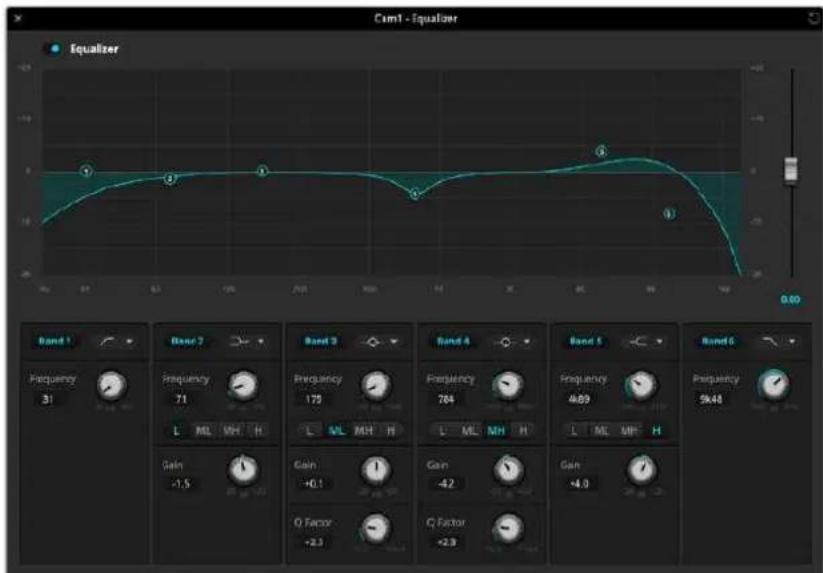
text_image
Cum1 - Equalizer Equalizer Band 1 Frequency 31 Base 2 Frequency 71 L ML MH H Gain -1.5 Band 3 Frequency 175 L ML MH H Gain +0.1 O Factor -2.3 Band 4 Frequency 784 L ML MH H Gain -4.2 O Factor -2.9 Band 5 Frequency 469 L ML MF H Gain -4.0 Band 6 Frequency 5k48Each audio input has its own 6 band parametric equalizer
TIP You can learn more about band filters later in this section.
If you want to make changes to a setting, you will first need to make sure the band is enabled. Click on a band label to enable it. When enabled, the button label is illuminated blue. Now you can change the settings for that band, or click and drag the handles to make fast adjustments.
Handles
Each band handle is positioned along the line curve displayed in the graph. You can click and drag each handle to choose the frequency you wish to adjust for that band, and the gain you want to set. When moving a handle with your mouse, both the frequency and gain settings are affected simultaneously, which gives you a fast way to make quick adjustments to each band across the entire range of frequencies.
NOTE To make changes using a handle, ensure the band is enabled. Simply click on the band you want to adjust. The band label will illuminate blue when enabled.
As you drag a handle left or right, you will notice the frequency and decibels update in the band settings. This will also be reflected by the frequency range preset buttons for low, medium low, medium high, and high.
Frequency Knobs
Alternatively, you can use the frequency knobs for each band to select a specific frequency to adjust.
Range Presets
The frequency range for each band is defined by the range preset buttons. For example, low is labeled 'L' and covers the frequency range from 30 to 395 Hz.
As a quick example of how the range presets define the frequency range, select a notch filter from the band filter menu and then click on each range preset. You will see the filter effect move to a position along the graph curve that corresponds to the range preset you choose. This lets you quickly define a specific range of frequencies you want the filter to affect.
Below is a table showing the range of frequencies for each range preset setting.
| Range Preset Frequency Range | |
| Low 30 Hz to 395 Hz | |
| Mid Low 100 Hz to 1.48 kHz | |
| Mid High 450 Hz to 7.91 kHz | |
| High 1.4 kHz to 21.7 kHz | |
Gain Knobs
Click and drag the gain knob left or right to decrease or increase the volume level for the selected frequency.
Q Factor
The Q factor control is available when the bell filter is applied to bands 2, 3, 4 and 5. This sets the range of frequencies the filter will affect. For example, setting the minimum will allow the filter to affect a wide range of surrounding frequencies and the maximum setting will narrow the effect down to a tiny point. This is important if you have sound qualities in surrounding frequencies that you want to either include or exclude from the change you are making.
As you adjust the Q factor, watch the shape of the effect on the line curve change from a broad, rounded edge to a sharp point. This is a visual representation showing how the regions of frequencies surrounding the target frequency are affected.
TIP Compare the audio with changes against the original unaltered audio by clicking on the bypass button at the very top of the equalizer window. This lets you turn the equalizer on or off.
Band Filters
There are six different types of band filters you can choose from. These filters include bell, high shelf, low shelf, notch, high pass, and low pass. These filters let you control specific zones within the frequency range. For example, a low shelf filter lets you increase or decrease the level of volume for lower frequencies on the graph, and a high shelf filter controls the higher frequencies.
Try setting a low shelf filter to band 3 and make changes to the gain setting. You will see the changes are weighted towards the low end frequencies on the graph.
A description for each filter type is provided below.
Bell High Shelf Low Shelf
This filter is used to increase or decrease a range of frequencies surrounding a defined frequency.
Lets you increase or decrease the level of volume for higher frequencies along the graph.
Lets you increase or decrease the level of volume for lower frequencies along the graph.
Notch High Pass Low Pass
This filter lets you remove, or cut, a defined frequency.
Smoothly removes extreme low end frequencies, allowing the high end frequencies to pass unaffected.
Smoothly removes extreme high end frequencies, allowing the low end frequencies to pass unaffected.
TIP It's not uncommon to have filters on each band overlapping on the graph curve with adjustments working together. For example, you may have a low shelf filter applied to band 4, and a notch filter on band 5 reducing a frequency within the same range.
Dynamics Controls
In addition to the 6 band parametric equalizer, you can also enhance and finesse the input and master output audio using dynamics controls. Where the equalizer lets you control the frequencies within a signal, dynamics controls let you set how various levels behave. Levels within the signal can be adjusted including expanding the dynamic range between low levels and high levels, gating an input so you can choose what is stronger or softer within a signal, or you can even use the compressor and limiter so that audio can be generally lifted and made stronger without clipping.
Combined with equalizer controls, these features are extremely powerful, giving you the ability to precisely shape and define the audio and generally optimize the sound of the master output.
This section describes the expander, gate, compressor and limiter controls.
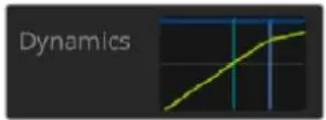
The dynamics controls can be opened for each input and the master output by clicking on its corresponding dynamics indicator
Common Dynamics Settings
The expander/gate, compressor and limiter share common settings that let you shape how each function affects the audio. For example the level at which the function initiates, how long the function is applied, the strength of the function, etc. The settings available differ depending on the dynamics control you are using.
Threshold Sets the sound level at which the function activates. For example, setting the threshold for the compressor to -20dB tells your switcher to activate compression when the signal rises above -20dB. Alternatively, setting the expander to -40dB means the switcher will only initiate the expander once the signal level drops below -40dB.
Range This setting defines the range of decibels affected by the function.
Ratio Defines the maximum strength of the function once initiated.
Attack Sets the smoothness of the function when it initiates. For example, a long attack will allow the function to fade into the signal, blending in better without drawing too much attention, whereas a short attack may be better for complex sound activity with many quick variations where a longer attack may cause artifacts.
Hold Sustains the dynamics function over an adjustable period of time.
Release Similar to attack but occurs at the end of the function activity. For example, lets the dynamics function ease out gradually, or fall away rapidly, once the level moves out of the threshold.
Expander/Gate
The first set of dynamics parameters can be switched between expansion and gating.
Expansion emphasizes differences in volume by lowering the level of soft parts of the signal relative to the level of louder parts. You can use an expander to emphasize the differences between quiet and loud parts of a track, or to increase the dynamic range of a signal and minimize unwanted noise.
Gating is like an exaggerated expander, reducing the level or even silencing parts of a signal that fall below a certain level in order to reduce or eliminate noise in quiet parts of a recording. For example, a range of 15 to 20 dB can reduce breathing in a vocal track but leaves just enough to sound natural.
Gating is extremely effective, but it's also very powerful so requires careful attention. If the gate threshold is set too high it can cause artifacts, such as cutting off the start of a syllable or the quiet end of a word. You can compensate by reducing the threshold slightly, or by increasing the attack or release time.
Compressor
Compression lets you reduce peaks in an audio signal, reducing the dynamic range of a signal, so you can boost the overall level without clipping. This is helpful when you want to make sure the loud elements in a signal don't diminish the strength of quieter sounds, or to smoothen changes in audio levels within the signal.
TIP It's a good idea to apply the compressor after you have set the EQ controls.
Make Up
The make up setting lets you increase the overall signal in combination with compression settings. With loud parts of the audio reduced using compression, you can now use the make up control to boost the overall sound without clipping.
Limiter
The limiter prevents peaks of the signal from exceeding a set maximum level. A limiter is helpful to prevent hard clipping. For example, if you set the limiter to -8 dB, the input signal will never exceed that level. Adjusting the attack, hold and release settings will set how gentle the limiter affects the signal.
Dynamics Controls Characteristics
| Control Minimum Default Maximum | |||
| Expander/Gate | |||
| Expander Controls* | |||
| Threshold -50dB -45dB** 0dB | |||
| Range 0dB 18dB 60dB | |||
| Ratio 1.0:1 1.1:1 10:1 | |||
| Attack 0.5ms 1.4ms 30ms | |||
| Hold 0.0ms 0.0ms 4s | |||
| Release | 50ms | 93ms | 4s |
| Expander/Gate | |||
| Gate Controls* | |||
| Threshold -50dB -45dB** 0dB | |||
| Range 0dB 18dB 60dB | |||
| Attack | 0.5ms | 1.4ms | 30ms |
| Hold 0.0ms 0.0ms 4s | |||
| Release | 50ms | 93ms | 4s |
| Compressor | |||
| Compressor Controls | |||
| Threshold | -50dB | -35dB | 0dB |
| Ratio | 1.0:1 | 2.0:1 | 10:1 |
| Attack | 0.7ms | 1.4ms | 30ms |
| Hold 0.0ms 0.0ms 4s | |||
| Release | 50ms | 93ms | 4s |
| Limiter | |||
| Limiter Controls | |||
| Threshold | -50dB | -12dB | 0dB |
| Attack | 0.7ms 0.7ms 30ms | ||
| Hold 0.0ms 0.0ms 4s | |||
| Release | 50ms | 93ms | 4s |
* Master Dynamics expander/gate controls are unused in Master Dynamics.
** Master Dynamics expander/gate threshold default is -35dB. Mic Dynamics expander/gate threshold default is -45dB.
Fairlight Controls Workflow Guide
This section describes a basic workflow to help you get started using the Fairlight controls to refine and enhance your audio mix.
Generally, the first step to optimizing your mix is to normalize all the inputs so they are all at their maximum strength without clipping. This is normally done by increasing or decreasing the input gain level for each input so their signal peaks just below 0dB on the channel strip's level indicator.
2 If you want to split any mono inputs into two separate channels for stereo output, go to the general switcher settings and navigate to the audio tab. Enable the checkboxes for the mono inputs you want to change to stereo. Click 'done'.
TIP If you want to split mono inputs into two separate channels, it's best to do this before normalizing the input as described in step 1, so that you can normalize both channels after they have been split.
3 Now, click on the EQ indicators below input level controls and make equalization changes to each input. You can move the windows into a better position, or close them if needed.
4 After setting EQ, open the dynamics controls for each input by clicking on their respective dynamics indicator. Make the required dynamics changes to generally improve and refine the input audio.
5 With EQ and dynamics set for each input, you can now open the EQ controls for the master output and sweeten the final audio mix.
6 Now open the master output's dynamics controls and make any required changes to improve the final output.
Once all the Fairlight controls are set, you can then increase or decrease the faders on the audio mixer to set them at their best levels for the live mix and make adjustments where necessary during the production. You can also go back to any of the settings and make further adjustments if needed, but it's best to follow the same order as described above to get the best results from each function. For example, it's important to set EQ controls before making dynamics changes as the processing chain in your switcher applies dynamics to the audio after equalization.
Most important of all is to apply the effects carefully so your audio still sounds natural but exciting too!
Using the Media Page
The media page is where all your graphics or stills are stored and is very easy to use. Simply find the still you want to use with the browse window, then drag and drop the file into a slot in the media pool. From there, you can load any one of those stills into the media player and switch it to air using the media player 1 source button on the software control panel. You can also use stills in the media player with the upstream and downstream keyer.
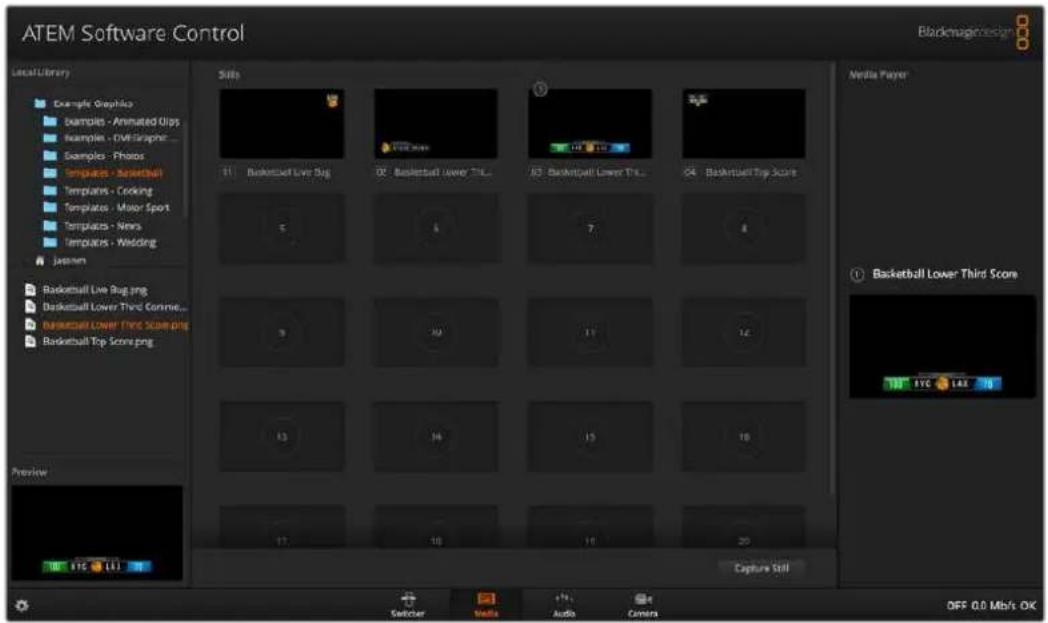
text_image
ATEM Software Control Local Library Examples Graphics Examples - Animated Clips Examples - DVD-Graphic... Examples - Photos Templates - Basketball Templates - Cooking Templates - Motor Sport Templates - Neuro Templates - Wedding Jasonen Basketball Live Bug.png Basketball Lower Third Connect... Basketball Lower Third Scoping Basketball Top Scoping Preview ETC LAX Subs 11 Basketball Live Bug 02 Basketball Lower Thi... 03 Basketball Lower Thi... 04 Basketball Top Score Media Player Basketball Lower Third Score 10 ETC LAX 10 Capture Still Switcher Video Audio Camera OFF 0.0 Mb/s OKKeep reading this section for information on how to use the media page in ATEM Software Control.
Navigating the Browse Window
The browse window is a simplified file browser that lets you navigate your computer to look for graphics files. All attached drives on your computer are displayed, and you can select folders from them. View sub folders by clicking on the arrows next to each folder.
The 'preview' window will show any selected graphics files.
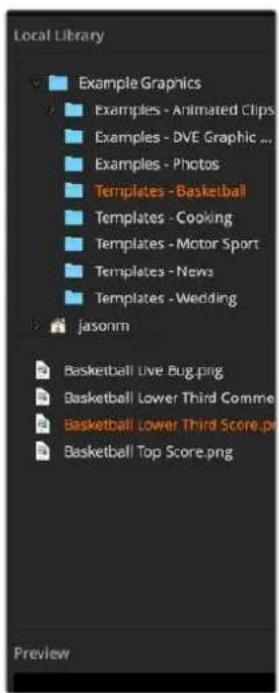
text_image
Local Library Example Graphics Examples - Animated Clips Examples - DVE Graphic ... Examples - Photos Templates - Basketball Templates - Cooking Templates - Motor Sport Templates - News Templates - Wedding Jasonm Basketball Live Bug.png Basketball Lower Third Comme Basketball Lower Third Score.png Basketball Top Score.png PreviewBrowse window
Browsing and loading files
Loading a still is as easy as dragging it from the browse window and dropping it into an empty slot in the media pool.
When dropping a still into a slot, a progress indicator will show the loading status. You can drop multiple files into the media pool, even if the first images have not yet completed loading, as they will continue to load one after the other. If a still is dropped into a window which already has content loaded, the existing content will be replaced.
The ATEM media pool supports PNG, TGA, BMP, GIF, JPEG and TIFF still image formats.
ATEM Media Pool
When files have been loaded into the media pool, the slots will show a thumbnail image. Stills are marked with a slot number so you can identify them when assigning a still image to the media player when using an external ATEM hardware panel.
The file name for each loaded file is displayed underneath the slot so you can easily keep track of files you have loaded. This is very useful as you will see a list of media pool still and clip numbers and their file names in the media player palette on the switcher page.
Numbers are displayed on slots in the media pool to clearly show which slot is assigned to the media player. When a media player slot is switched to the program output, the media player number on the slot changes to red to indicate the slot is on air. When a slot is on the preview output, the media player number changes to green.
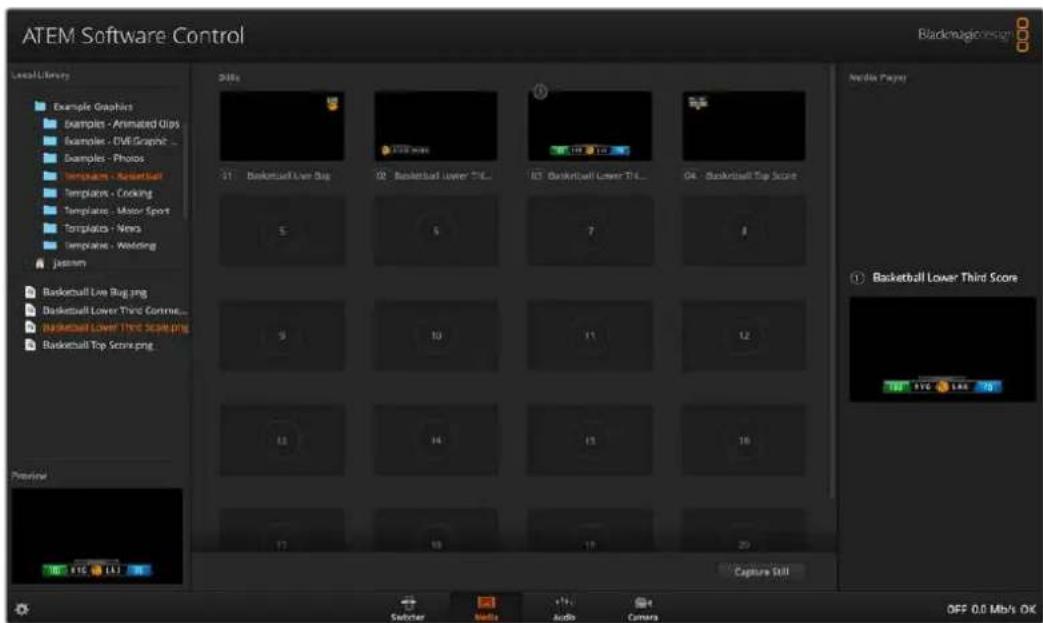
text_image
ATEM Software Control Local Library Example Graphics Examples - Animated Clips Examples - CVE Graphic ... Examples - Photos Templates - Basketball Templates - Cooking Templates - Motor Sport Templates - Nemo Templates - Modeling jussem Basketball Live Bug.png Basketball Lower Third Comment... Basketball Lower Third Scapesing Basketball Top Score.png Timeline Capture Still 300s 21 Basketball Live Bug 02 Basketball Lower 5 mL 03 Basketball Lower 1 mL 04 Basketball Top Score Nedie Player 1 Basketball Lower Third Score 17 EYE LIME 11 OFF 0.0 Mb/s OKATEM Media Pool
On the switcher page, you can change the media player assignment from the media tab by selecting your desired still from the 'media' menu. Simply click on the arrow in the player 'media' list to select from a list of media pool slots.
Image File Types
The ATEM media page can use many different file formats including TGA, PNG, BMP, GIF, JPEG and TIFF.
Formats such as TGA include a separate 'alpha' channel together with the RGB color channels. This lets you embed a matte, or key image, inside that alpha channel. When a TGA image is loaded in the media player, ATEM Software Control will automatically detect the key image in the alpha channel and load it as the linear key source. This means your TGA graphic will key beautifully straight away with perfect transparency.
Creating a TGA File with an Alpha Channel
Below is a demonstration showing how to create a title in Photoshop with an alpha channel.
1 Launch Adobe Photoshop and start a new project. Set the project to use the same horizontal and vertical dimensions used in your broadcast video format. For example, if you are broadcasting 1080p50, set the resolution to 1920 x 1080 pixels.
2 In the layers panel, create a new layer and build the graphic you want to use. In this demonstration, we are using a 'wedding' lower thirds graphic.
3 Hold down the 'command' key on a Mac, or 'control' key for Windows, and click on the layer thumbnail for your graphic. This will generate a selection of the color channels' opacity values in your image. Their opacity determines the transparency of the graphic.
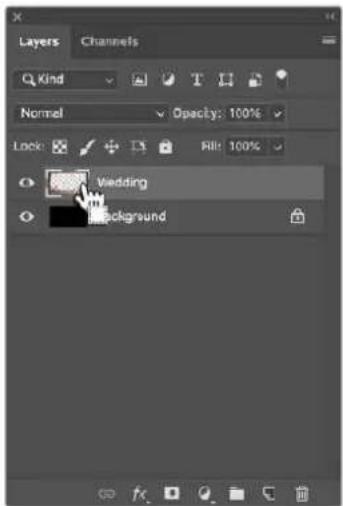
text_image
Layers Channels Kind Normal Opacity: 100% Lock: Fill: 100% Wedding Background4 Go to the adjoining 'channels' panel and click on the 'save selection as channel' tool.
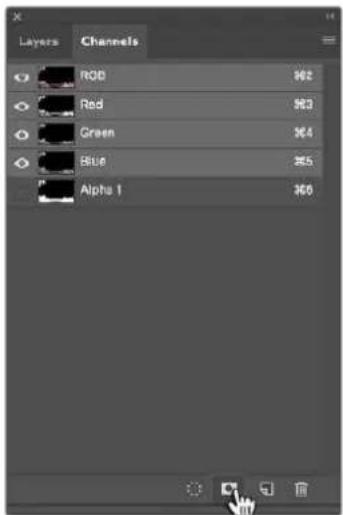
text_image
Layers Channels RGB Red Green Blue Alpha 1 362 363 364 365 360You will now see an alpha channel appear underneath the RGB color channels. The alpha channel contains a grayscale version of the combined color channels in your graphic. Don't forget to click on the alpha channel's 'eye' icon to make sure it is selected so it will be included when the TGA file is saved.
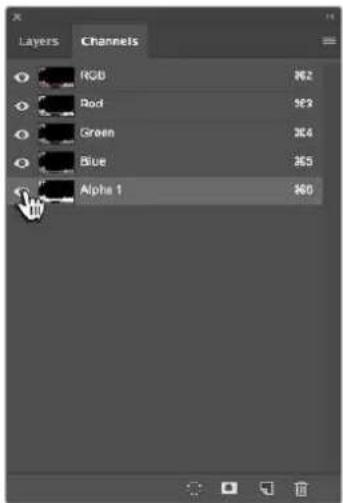
text_image
Layers Channels RGB Red Green Blue Alpha 1 362 362 364 365 3605 Your selection has now been used to create the grayscale matte in the alpha channel. If you want to, you can now go to the 'menu' bar and click 'select/deselect' to remove the selection marquee.
6 Now it's time to save your TGA file.
Go to the file menu and click on 'save as'. Type the file name and select the location for your file. In the format box, select 'targa', which is the full name for a TGA file and make sure the 'alpha channels' checkbox is selected.
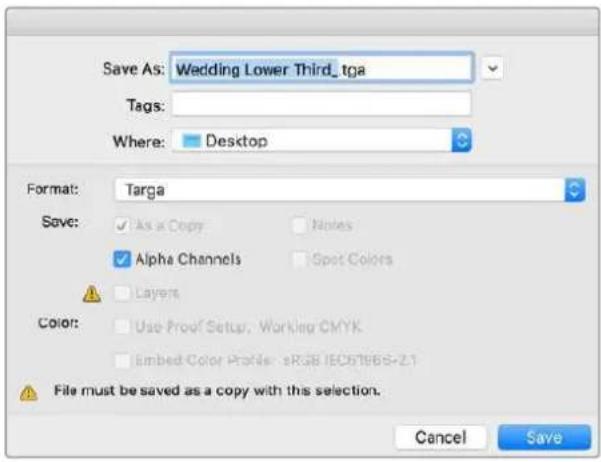
text_image
Save As: Wedding Lower Third_tga Tags: Where: Desktop Format: Targa Save: As a Copy Notes Alpha Channels Spot Colors Layers Color: Use Proof Setup Working CMYK Limbed Color Profile sRGB IEC5786S-2.1 File must be saved as a copy with this selection. Cancel Save7 Click 'save'. A targa options box will appear asking which resolution you want to save. Select '32 bits/pixel'. This provides enough data for four 8 bit channels which includes the red, green and blue color channels, plus the alpha channel. Click 'OK'.
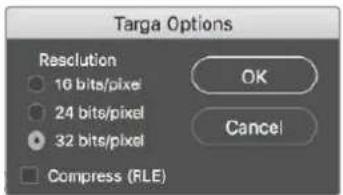
text_image
Targa Options Resolution 16 bits/pixel 24 bits/pixel 32 bits/pixel Compress (RLE) OK CancelYour TGA file is saved.
Now you can open ATEM Software Control and load the file into the media pool. From there, drop the graphic into the media player and the alpha channel you saved will automatically be loaded into the media player key source. The key source uses the grayscale image in the alpha channel to tell the linear keyer transparency values for the graphic.
If you switch the linear key to air, you will now see the graphic keyed over the background with perfect transparency.
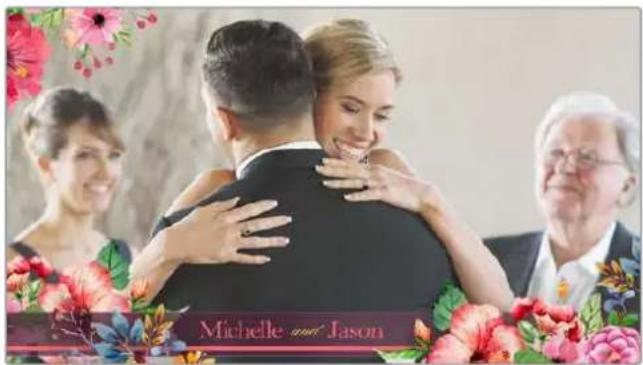
text_image
Michelle and JasonUsing Camera Control
Clicking on the 'camera' button in ATEM Software Control opens the camera control feature that lets you control Blackmagic Pocket Cinema Camera 4K and 6K from your ATEM Mini. Camera settings such as iris, gain, focus, detail and zoom control are easily adjusted using compatible lenses, plus you can color balance cameras and create unique looks using the DaVinci Resolve primary color corrector that's built into the camera.
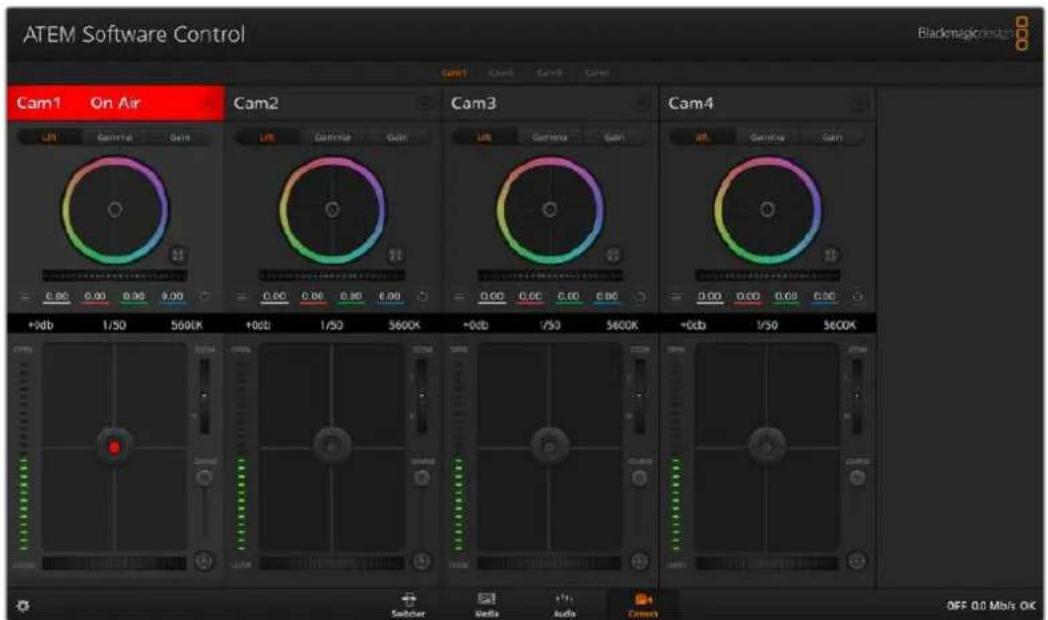
text_image
ATEM Software Control Blackmagic control Cam1 On Air Lift Gamma2 Gain 0.00 0.00 0.00 0.00 Cam2 Lift Gamma2 Gain 0.00 0.00 0.00 0.00 Cam3 Lift Gamma2 Gain 0.00 0.00 0.00 0.00 Cam4 Lift Gamma2 Gain 0.00 0.00 0.00 0.00 +0db 1/50 5600K +0db 1/50 5600K +0db 1/50 5600K +0db 1/50 5600K OFF 0.0 Mb/s OKATEM Camera Control.
When controlling cameras, the ATEM switcher control works by broadcasting camera control packets via all the HDMI inputs of your ATEM Mini. So this means you can connect an HDMI input of your ATEM Mini to the camera's HDMI connector and the camera will detect the control packets in the HDMI signal and allow you to control features in the camera.
ATEM Software Control automatically knows which camera is connected to each input, so the tally signals will always trigger the appropriate cameras. However, if you want to change the button mapping so camera inputs appear on different buttons, you can do that in the button mapping settings in ATEM Software Control's preferences.
Camera Control Panel
Launch ATEM Software Control and click on the 'camera' button located at the bottom of the software window. You'll see a row of labeled Blackmagic camera controllers containing tools to adjust and refine each camera's image. The controllers are easy to use. Simply click the buttons using your mouse, or click and drag features to adjust.
Camera Control Selection
The button row at the top of the camera control page lets you select the camera number you would like to control.
Channel Status
The channel status at the top of each camera controller displays the camera label, On Air indicator and lock button. Press the lock button to lock all the controls for a specific camera. When on air, the channel status illuminates red and displays the On Air alert.
Camera Settings
The camera settings button near the bottom left of the master wheel lets you adjust detail settings for each camera's picture signal.
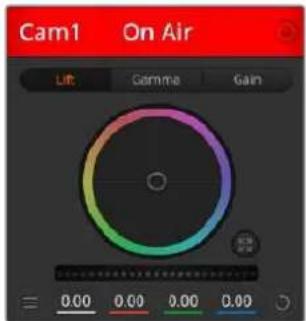
text_image
Cam1 On Air Lift Gamma Gain 0.00 0.00 0.00 0.00Each camera controller displays the channel status so you know which camera is on air. Use the color wheels to adjust each YRGB channel's lift, gamma and gain settings.
Detail
Use this setting to sharpen the image from your cameras live. Decrease or increase the level of sharpening by selecting: Detail off, detail default for low sharpening, medium detail and high detail.
Color Wheel
The color wheel is a powerful feature of the DaVinci Resolve color corrector and used to make color adjustments to each YRGB channel's lift, gamma and gain settings. You can select which setting to adjust by clicking on the three selection buttons above the color wheel.
Master Wheel
Use the master wheel below the color wheel to make contrast adjustments to all YRGB channels at once, or luminance only for each lift, gamma or gain setting.
Reset Buttons
The reset button near the bottom right of each camera controller lets you easily choose color correction settings to reset, copy or paste. Each color wheel also has its own reset button. Press to restore a setting to its default state, or copy/paste a setting. Locked controllers are not affected by the Paste feature.
The master reset button on the bottom right corner of the color corrector panel lets you reset lift, gamma and gain color wheels plus Contrast, Hue, Saturation and Lum Mix settings. You can paste color correction settings to camera controllers individually, or all cameras at once for a unified look. Iris, focus, coarse and pedestal settings are not affected by the Paste feature. When applying Paste to all, a warning message will appear asking you to confirm your action. This is so you don't accidentally paste new settings to any unlocked cameras that are currently on air.
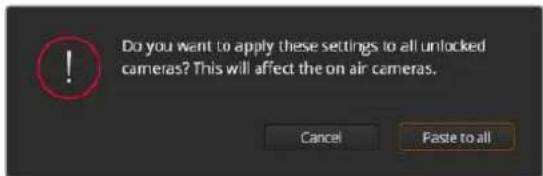
text_image
Do you want to apply these settings to all unlocked cameras? This will affect the on air cameras.When applying 'paste to all', a warning message will appear asking you to confirm your action. This is so you don't accidentally paste new settings to any unlocked cameras that are currently on air.
Iris/Pedestal Control
The iris/pedestal control is located within the cross hairs of each camera controller. The control illuminates red when its camera is on air.
To open or close the iris, drag the control up or down. Holding the shift key allows only iris adjustments.
To darken or lift the pedestal, drag the control left or right. Holding the command key on a Mac, or the Control key on Windows, allows only pedestal adjustments.
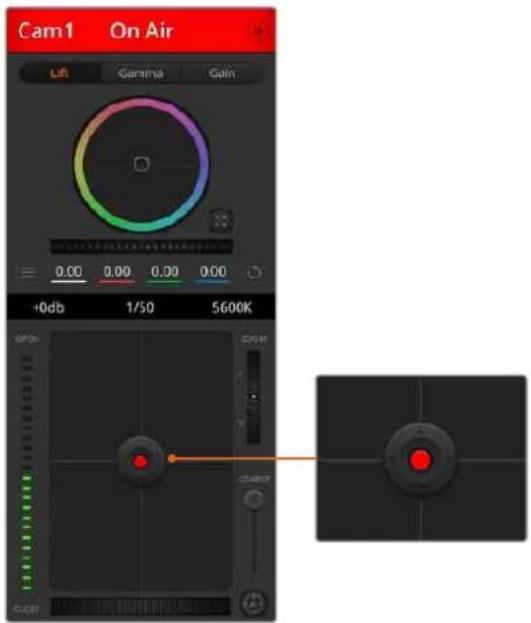
text_image
Cam1 On Air Lift Gamma Gain 0.00 0.00 0.00 0.00 +0db 1/50 5600K OK OK OKThe iris/pedestal control illuminates red when its respective camera is on air.
Zoom Control
When using compatible lenses with an electronic zoom feature, you can zoom your lens in and out using the Zoom control. The controller works just like the zoom rocker on a lens, with telephoto on one end and wide angle on the other. Click on the zoom control, located above the coarse slider and drag up to zoom in, or drag down to zoom out.
Coarse Setting
The coarse setting is located to the right of the iris/pedestal control and is used to limit the iris range. This feature helps you prevent over exposed images from going to air.
To set your coarse threshold, completely open the iris using the iris control, then drag the coarse setting up or down to set optimum exposure. Now when you adjust the iris, the coarse threshold will prevent it from going above optimum exposure.
Iris Indicator
The iris indicator is located to the left of the iris/pedestal control and displays a visual reference so you can easily see how open or closed the lens aperture is. The iris indicator is affected by the coarse setting.
Auto Focus Button
The auto focus button is located at the bottom right corner of each camera controller. Press to automatically set the focus when you have an active lens that supports electronic focus adjustments. It's important to know that while most lenses support electronic focus, some lenses can be set to manual or auto focus modes and so you need to ensure your lens is set to auto focus mode. Sometimes this is set by sliding the focus ring on the lens forward or backward.
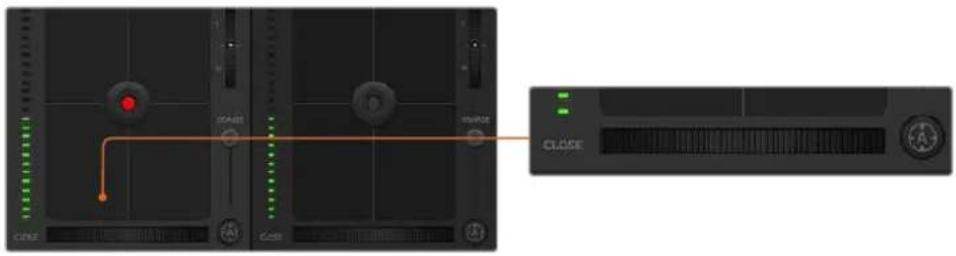
natural_image
Diagram of a computer interface showing two connected modules with control knobs and a close button, no readable text or symbols present.Click on the auto focus button or drag the manual focus adjustment left or right to focus a compatible lens.
Manual Focus Adjustment
When you want to adjust the focus on your camera manually, you can use the focus adjustment located at the bottom of each camera controller. Drag the wheel control left or right to manually adjust focus while viewing the video feed from the camera to ensure your image is nice and sharp.
Camera Gain
The camera gain setting allows you to turn on additional gain in the camera. On Blackmagic Pocket Cinema Cameras, this setting relates to ISO. This is important when you are operating in low light conditions and need extra gain, or ISO, in the front end of the camera to avoid your images being under exposed. You can decrease or increase gain by clicking on the left or right arrows on the dB gain setting.
You can turn on some gain when you need it, such as outdoor shoots when the light fades at sunset and you need to increase your image brightness. It's worth noting that adding gain will increase noise in your images.
Shutter Speed Control
The shutter speed control is located in the section between the color wheel and the iris/pedestal control. Decrease or increase the shutter speed by hovering your mouse pointer over the shutter speed indicator and then clicking on the left or right arrows. On Blackmagic Pocket Cinema Cameras, this setting relates to shutter angle.
If you see flicker in lights you can decrease your shutter speed to eliminate it.
Decreasing shutter speed is a good way to brighten your images without using camera gain because you are increasing the exposure time of the image sensor. Increasing shutter speed will reduce motion blur so can be used when you want action shots to be sharp and clean with minimal motion blur.
White Balance
The white balance setting next to the shutter speed control can be adjusted by clicking on the left or right arrows on each side of the color temperature indicator. Different light sources emit warm or cool colors, so you can compensate by adjusting the white balance. This ensures the whites in your image stay white.
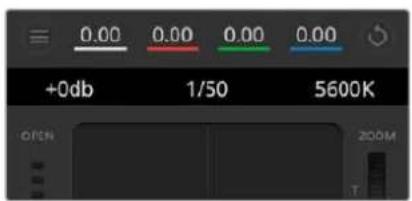
text_image
0.00 0.00 0.00 0.00 +0db 1/50 5600K OPEN 200MHovering your mouse pointer over the gain, shutter speed and white balance indicators reveal arrows you can click on to adjust their respective settings.
DaVinci Resolve Primary Color Corrector
If you have a color correction background, then you can change your camera control from a switcher style CCU interface to a user interface that's more like a primary color corrector on a post production color grading system.
Blackmagic cameras feature a DaVinci Resolve primary color corrector built in. If you have used DaVinci Resolve, then creatively, grading in the Blackmagic camera will be identical so you can use your color grading experience for live production. The color corrector panel can be expanded out of any camera controller and provides expanded color correction control with extra settings and a full primary color corrector interface.
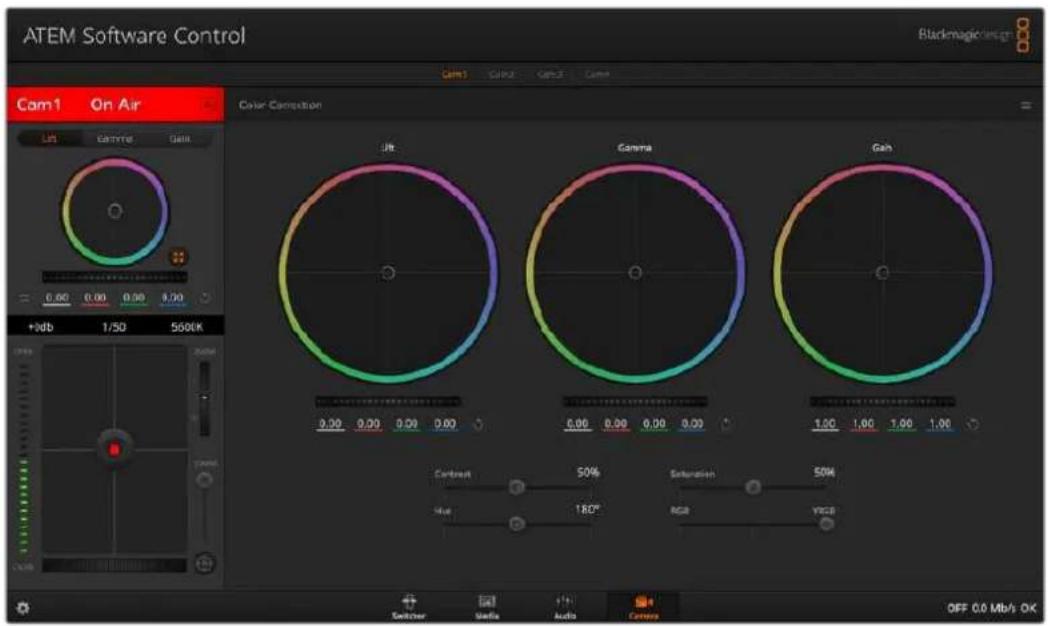
text_image
ATEM Software Control Blackmagic ink Com1 On Air Color Correction Jlt Gamma Gain +3db 1/50 5500K 0.00 0.00 0.00 0.00 0.00 0.00 0.00 0.00 5.00 8.00 9.00 8.00 1.00 1.00 1.00 1.00 Contrast 50% Blue 180° Saturation 50% RGB YRGB Switcher Media Audio Camera OFF 0.0 Mb/s OKClick on the DaVinci Resolve primary color corrector button to expand the color correction window and adjust settings.
You have color wheels and settings such as saturation available and you can see shadows, mid tones and highlight settings all at the same time. Simply switch between cameras using the camera selection controls at the top of the window as you need.
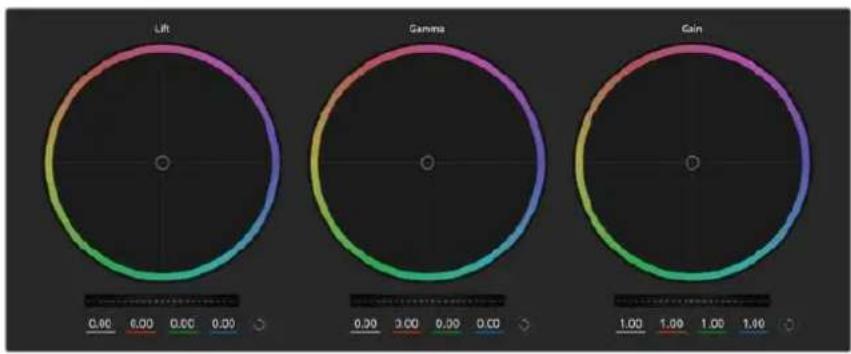
radar
| Metric | Value | |--------|-------| | Lift | 0.00 | | Gamma | 0.30 | | Gain | 1.00 |Lift, gamma and gain color wheels in the color corrector panel.
Color Wheels
Click and drag anywhere within the color ring
Note that you don't need to drag the color balance indicator itself. As the color balance indicator moves, the RGB parameters underneath change to reflect the adjustments being made to each channel.
Shift-Click and drag within the color ring
Jumps the color balance indicator to the absolute position of the pointer, letting you make faster and more extreme adjustments.
Double-click within the color ring
Resets the color adjustment without resetting the master wheel adjustment for that control.
Click the reset control at the upper-right of a color ring
Resets both the color balance control and its corresponding master wheel.
Master Wheels
Use the master wheels below the color wheels to adjust each YRGB channels' lift, gamma and gain controls.
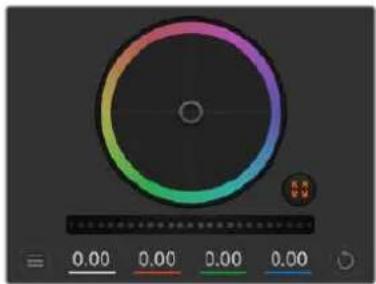
text_image
Digital color picker interface showing a circular progress gauge with a gradient spectrum and control buttonsAdjust the master wheels by dragging the wheel control left or right.
To make adjustments using the master wheel:
Drag the master wheel left or right
Dragging to the left darkens the selected parameter of the image, dragging to the right lightens that parameter. As you make an adjustment, the YRGB parameters underneath change to reflect the adjustment you're making. To make a Y-only adjustment, hold down the ALT or Command key and drag left or right. Because the color corrector uses YRGB processing, you can get quite creative and create unique affects by adjusting the Y channel only. Y channel adjustments work best when the Lum Mix setting is set to the right side to use YRGB processing vs the left side to use regular RGB processing. Normally, most DaVinci Resolve colorists use the YRGB color corrector as you get a lot more control of color balance without affecting overall gain, so you spend less time getting the look you want.
Contrast Setting
The Contrast setting gives you control over the distance between the darkest and lightest values of an image. The effect is similar to making opposing adjustments using the lift and gain master wheels. The default setting is 50%.
Saturation Setting
The Saturation setting increases or decreases the amount of color in the image. The default setting is 50%.
Hue Setting
The Hue setting rotates all hues of the image around the full perimeter of the color wheel. The default setting of 180 degrees shows the original distribution of hues. Raising or lowering this value rotates all hues forward or backward along the hue distribution as seen on a color wheel.
Lum Mix Setting
The color corrector built into Blackmagic cameras is based on the DaVinci Resolve primary color corrector. DaVinci has been building color correctors since the early 1980's and most Hollywood films are color graded on DaVinci Resolve than any other method.
This means that your color corrector built into the camera has some unique and creatively powerful features. The YRGB processing is one of those features.
When color grading, you can choose to use RGB processing, or YRGB processing. High end colorists use YRGB processing because you have more precise control over color and you can independently adjust the channels with better separation and more creative options.
When the Lum Mix control is set to the right side, you have the 100% output of the YRGB color corrector. When you have the Lum Mix control set to the left side, you get 100% output of the RGB corrector. You can set the Lum Mix to any position between the left and right to get a blend of output from both the RGB and YRGB correctors.
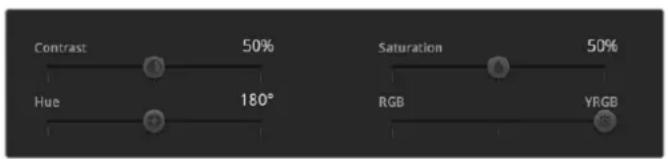
text_image
Contrast 50% Hue 180° Saturation 50% RGB YrGBDrag the sliders left or right to adjust Contrast, Saturation, Hue and Lum Mix settings.
Which is the correct setting to use? That's up to you, as color correction is a pure creative process and there is no right and wrong. The best setting is what you like the most and what you think looks good!
Synchronizing Settings
When connected, camera control signals are sent from your ATEM switcher to the Blackmagic camera. If a setting is accidentally adjusted from your camera, camera control will automatically reset that setting to maintain synchronization.
Using Macros
What is a Macro?
A macro is an easy way to automate a sequence of switcher actions so you can repeat the sequence at the press, or click, of a button. For example, you can record a sequence of transitions between several video sources, including key effects, audio mixer adjustments, camera control settings and more. Record all your actions to a macro button, then when you press that button all your recorded actions will be instantly performed. Macros are recorded using the macros window in ATEM Software Control, and are stored inside your ATEM Mini. You can run all your recorded macros using the software control panel.
The Macros Window in ATEM Software Control
To open the macros window in ATEM Software Control, click on macros in the title bar, or you can also press shift/command/M for Mac, or shift/control/M for Windows. The macros window is a floating window you can move freely about your desktop. This is so you can always access the window when moving between the switcher, media, audio and camera pages. While recording a macro, you can even reduce the size of the window by clicking on the minimize icon at the top right corner.
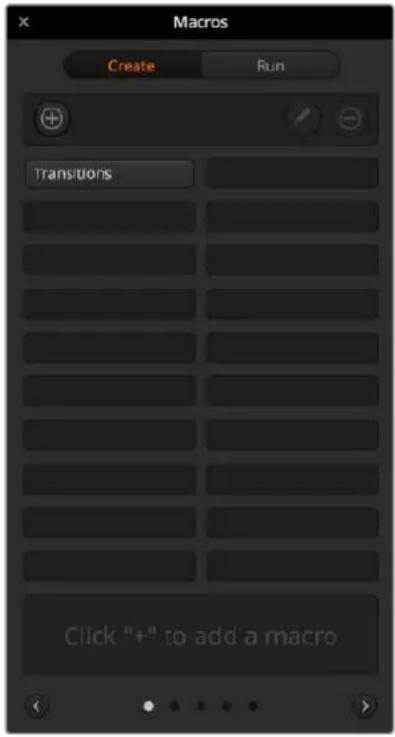
text_image
Macros Create Run Transitions Click "+" to add a macroThe macros window in
ATEM Software Control lets
you record and run macros
so you can easily repeat a
sequence of complex switcher
actions at the click of a button.
Macros can be recorded to any of the 100 macro slots. Up to 20 macro slots are visible on each page. Move forwards and backwards through pages by clicking on the arrows on the bottom sides of the window. Clicking on the create and run buttons lets you swap between the create and run pages so you can record your macros, and then run them during your live production.
Recording Macros
Macros need to be recorded comprehensively, in clearly defined sequences from start to finish without error. This is because your macro will record every setting, press of a button, and switcher action you perform. When you run a macro, all the switcher actions you recorded in that macro will be repeated precisely.
It's worth highlighting that a macro will only record the settings you change. For example, if you want a 3:00 second transition, and your switcher's transition rate is already set to 3:00 seconds, you'll need to change the duration, then set it back to 3:00 seconds to record the setting. If not, your desired transition rate will not be recorded and when the macro is run it will simply use the transition rate your switcher was last set to. So you can see why precision is important!
If settings are changed while recording a macro and you want them restored to a particular state, simply restore those settings while recording the final steps of the macro. You can even record macros to restore settings for various projects. You have lots of choices. The important thing to remember when recording a macro is that you change all the settings you need to so you can create the specific effects you want.
Recording a Macro using ATEM Software Control
In the example below, we're going to create a macro that will set your ATEM switcher to perform a 3 second mix transition from color bars to color 1, pause for 2 seconds, then perform a 3 second mix transition to black. Try building this macro on your ATEM switcher so you can learn the steps in creating macros.
1 Launch ATEM Software Control and open the macros window.
2 Click on the create button in the macros window to select the create page.
3 Click on a macro slot you want to record your macro to. In this example, click on macro slot 1. An orange border will appear around the slot you have selected.
4 Click on the create macro button, which is labeled with a 'plus' icon, to open the create macro popup window.
If you want to, you can enter the name of your macro and type a description. This lets you easily keep track of your macros and quickly see what each macro does. When you click on a macro, your notes will appear in the status window.
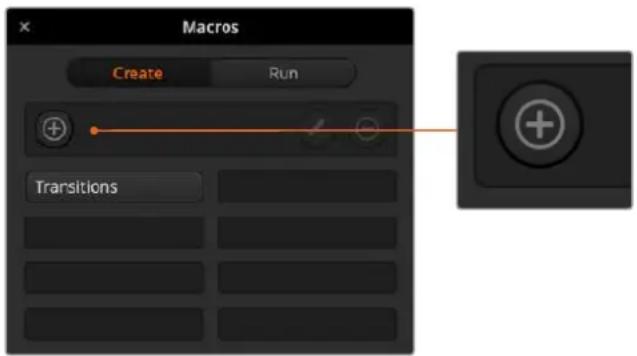
text_image
Macros Create Run TransitionsTo start recording a macro, select a macro slot, then click on the create macro button. Type in your notes and click 'record'.
5 Click the 'record' button.
The popup window will close and a red border will appear around your ATEM Software Control panel indicating your macro is now recording. Notice the red 'add pause' button at the top of the border.
Now that your macro is recording, you can start performing your switcher actions.
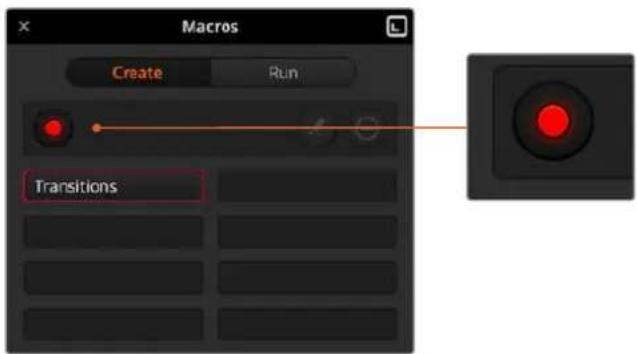
text_image
Macros Create Run TransitionsWhile recording, the create macro button will change to a 'record' button. When you have completed your switcher actions, click on the 'record' button to stop recording.
6 Click on the bars button in the program panel on the switcher page. This sets bars to your switcher's program output.
7 Select color 1 on the preview output.
8 Open the transitions palette and set it to mix.
If mix is already selected, make sure your macro records the setting by selecting a different transition type, for example the wipe transition, then clicking on mix again.
9 Now change the transition Rate to 3:00. This sets the mix transition duration to 3 seconds.
10 Click on the auto button in the transition style panel. Your switcher will perform a mix transition from color bars to color 1.
11 To set the switcher to wait for 2 seconds before applying another transition, click on the add pause button at the top of the red border. The 'insert pause' window will open. Set the pause to 5 seconds and 00 frames and click 'confirm'.
Why set a 5 second pause when you only want a 2 second pause? That's because when the mix transition occurs, it takes 3 seconds to complete. So if you want to add a pause, you need to consider the transition duration, plus the pause you want to happen before the next transition occurs.
In this example, it takes 3 seconds for the transition to complete, then 2 seconds for your 2 second pause, so you should enter a pause of 5 seconds. Another way is to add two separate pauses, one for the duration of the transition, and then another for the pause you want. It's up to you.
12 Now select black on the preview panel, and click the auto button in the transition style panel. Your ATEM switcher will perform a mix transition to black.
13 Click the record icon in the macros window to stop recording your macro.
The macro you just recorded will now appear as a button in your selected macro slot. To preview your macro, click the run button in the macros window to enter the run page. Select recall and run, which sets the macros window to run a macro as soon as you click on a macro button. Now click on your new macro button, named 'Transitions'.
14 If you want your macro to instantly run as soon as you select it, click on the 'recall and run' button. By enabling this feature you can load and play your macros with only one click of a button.
If your macro was successful, you should see your ATEM switcher perform a mix from color bars to color 1 using a 3 second transition, pause for 2 seconds, then perform another 3 second mix transition to black, all by clicking one button in the macros window! Your ATEM switcher will also display an orange border around your software control panel to indicate a macro is playing.
If your macro doesn't perform the way you expect it to, simply rerecord the macro you just created following the previous steps.
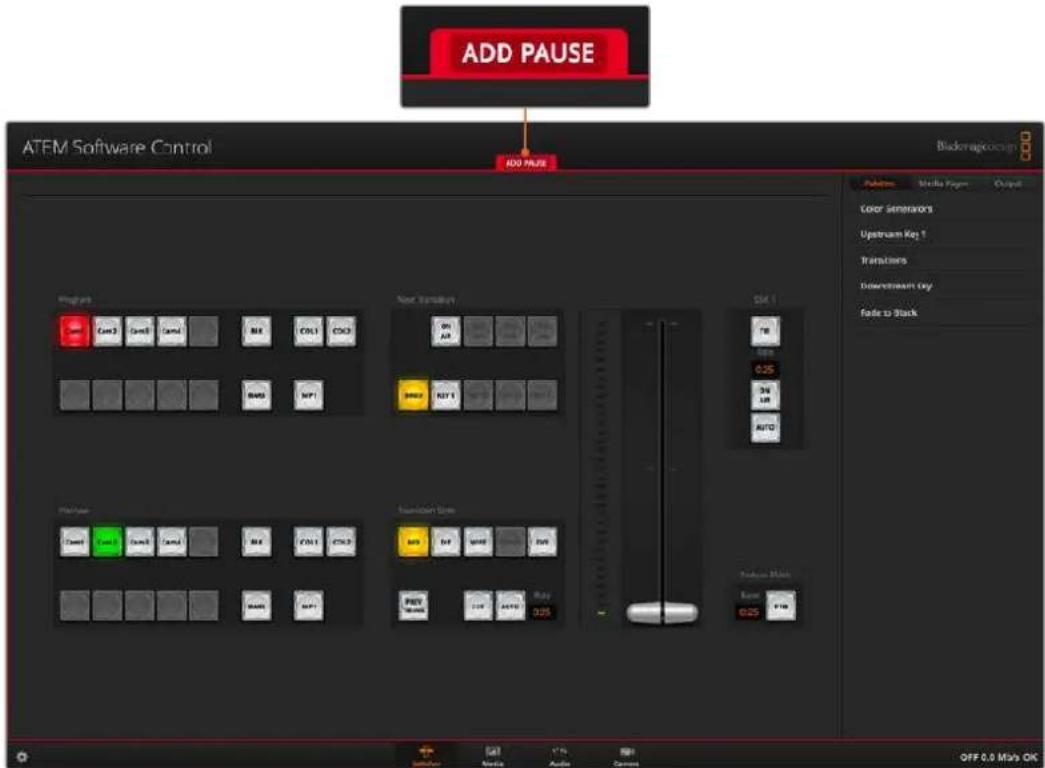
text_image
ADD PAUSE ATEM Software Control Add PAUSE Components Media Pages Output Color Generators Upstream Key 1 Transfers Downstream Key Fade to Stack Programs Cam3 Cam4 Cam5 BEX CBL1 CBL2 BAS MPT New Topkets ON AIR SHEE RST 1 SHEE RST 2 SHEE RST 3 SHEE RST 4 SHEE RST 5 SHEE RST 6 SHEE RST 7 SHEE RST 8 SHEE RST 9 SHEE RST 10 SHEE RST 11 SHEE RST 12 SHEE RST 13 SHEE RST 14 SHEE RST 15 SHEE RST 16 SHEE RST 17 SHEE RST 18 SHEE RST 19 SHEE RST 20 SHEE RST 21 SHEE RST 22 SHEE RST 23 SHEE RST 24 SHEE RST 25 SHEE RST 26 SHEE RST 27 SHEE RST 28 SHEE RST 29 SHEE RST 30 SHEE RST 31 SHEE RST 32 SHEE RST 33 SHEE RST 34 SHEE RST 35 SHEE RST 36 SHEE RST 37 SHEE RST 38 SHEE RST 39 SHEE RST 40 SHEE RST 41 SHEE RST 42 SHEE RST 43 SHEE RST 44 SHEE RST 45 SHEE RST 46 SHEE RST 47 SHEE RST 48 SHEE RST 49 SHEE RST 50 SHEE RST 51 SHEe S### S### S### S### S### S### S### S### S### S### S### S### S### S### S### S### S### S### S### S### S### S### S### S### S### S### S### S### S### S### S### S### S### S### S### S### S### S### S### S### S### S### S### S### S### S### S### S### S### S### S## S## S## S## S## S## S## S## S## S## S## S## S## S## S## S## S## S## S## S## S## S## S## S## S## S## S## S## S## S## S## S## S## S## S## S## S## S## S## S## S## S## S## S## S## S## S## T#N Pulse Mode: Media Keys Output OFF 0.0 MHz OKATEM Software Control displays a red border to indicate when you are recording a macro. The 'add pause' button located at the top of the red border lets you enter durations for pauses between switcher actions.
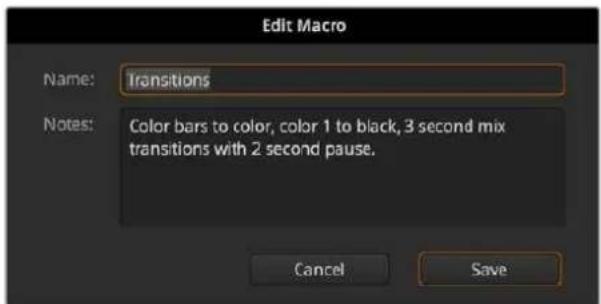
text_image
Edit Macro Name: Transitions Notes: Color bars to color, color 1 to black, 3 second mix transitions with 2 second pause. Cancel SaveEnter a name for your macro and a description so you can keep track of the switcher actions recorded in the macro.
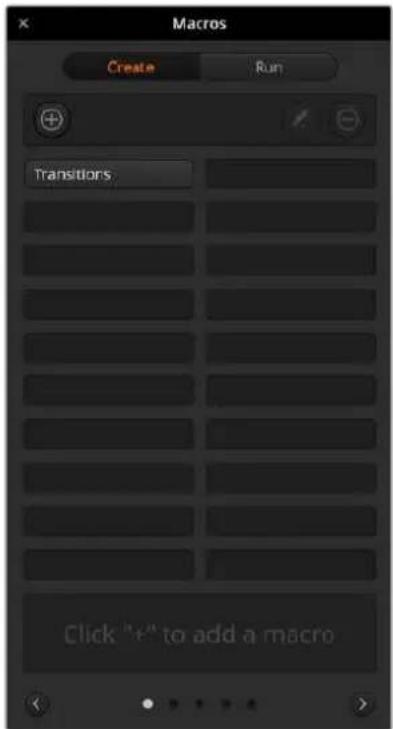
text_image
Macros Create Run Transitions Click "+o" to add a macroThe image shows how a macro button appears in the macros window after it has been recorded. To run a macro, click on the 'run' button to enter the run page. Now you can load and/or run the macro by clicking on the macro button.
Building Large Macros
Macros can even include triggering other macros as part of recording a macro. This lets you easily build larger macros from multiple smaller macros, i.e., recording macros with limited actions, then compiling them into a large macro. This is because if there are any mistakes while recording a large macro in one complete sequence, you'll need to go back to the start of your sequence and rerecord it. It's a lot easier to work with segments containing a small number of actions.
By recording a large macro using small macros, you can also edit your large macro by rerecording only the small macros you want to change, then compiling your small macros back into your large macro.
To compile small macros into a large macro:
1 Start recording a new macro, then while the macro is recording, click on the 'run' button to enter the run page.
2 Select 'recall and run' to automatically run macros at the push or click of a button, or deselect to load a macro and play it manually.
3 Run your sequence of small macros, with pauses between each one to cover the duration of each small macro, until you've completed the large macro.
4 Stop recording. You now have a complex, powerful large macro built from small macros you can easily change later if you need to.
There is no limit to the amount of actions you can perform. You can easily build complex transitions, create unique repeatable effects using keyers, or set up frequently used Blackmagic Studio Camera settings, graphic overlays and DVEs so you don't have to reconstruct them every time you start a new program. Macros are fun and will save you a lot of time!
Macros Window Create Page
Create macro button:
Click this button to open the create macro popup window. From here you can name a new macro to be recorded, write a description of your macro in the notes section, and click record to start recording your macro.
Arrow buttons and page Icons:
To access or record more than 20 macros, simply click on the right arrow at the bottom corner of the macros window to open a new page of macros. To move to the previous page of macros, click on the left arrow, You can see which page of macros you are viewing by observing the page icons between the arrows.
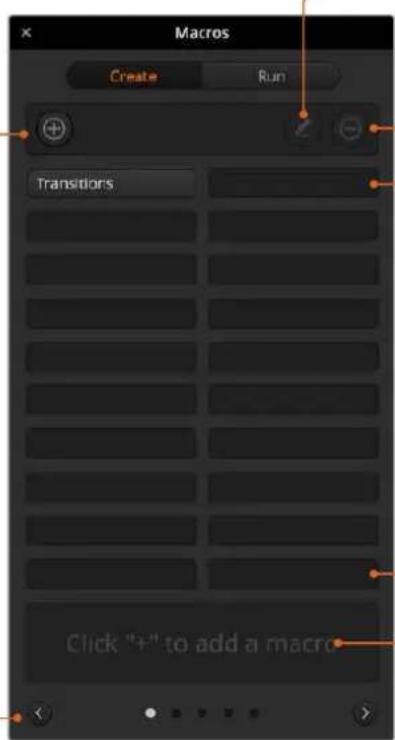
text_image
Macros Create Run Transitions Click "+" to add a macroEdit macro button:
First select the macro you want to edit, then click on the edit macro button to edit the name and description of the macro.
Delete macro button: Select the macro you want to delete, then click on the delete macro button to delete the selected macro.
Macro buttons:
After recording a macro to a selected macro slot, your macro will appear as a macro button. 20 macro buttons can be displayed on one page. If a macro is unnamed when recording, the number of the selected macro slot will be used.
Status window:
This window provides helpful prompts and status messages to help you get started recording and running your macros. When a macro is selected, it also displays any notes you have included.
Macros Window Run Page
Recall and Run:
Selecting the Recall and Run feature lets you instantly run a macro by clicking a macro button. Deselecting the Recall and Run feature lets you load a macro by clicking on your macro button. Run the macro by clicking the play button.
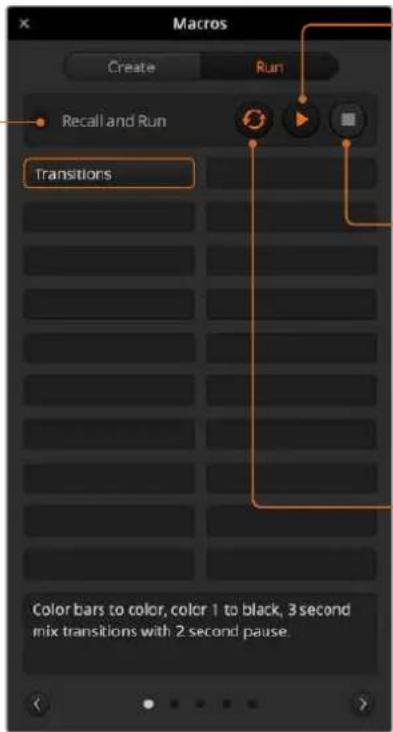
text_image
Macros Create Run Recall and Run Transitions Color bars to color, color 1 to black, 3 second mix transitions with 2 second pause.Play:
When Recall and Run is deselected and you have loaded a macro by clicking on a macro button, click the play icon to start playing the macro.
Stop:
Clicking the stop button will stop the playback of a macro, but will complete the current action first. For example, if you press stop half way into a transition, the switcher will finish the transition and then stop.
Loop:
When the loop button is selected and you run a macro, your macro will run continuously until you click the stop button. When loop is deselected, your macro will run until it is completed.
Changing Switcher Settings
Clicking on the switcher settings 'gear' icon will open the settings window where you can change general switcher settings, audio, label, HyperDeck and remote settings. These settings are divided into tabs. If you are using ATEM Mini Pro or Extreme switchers, you will also have a multiview settings tab.
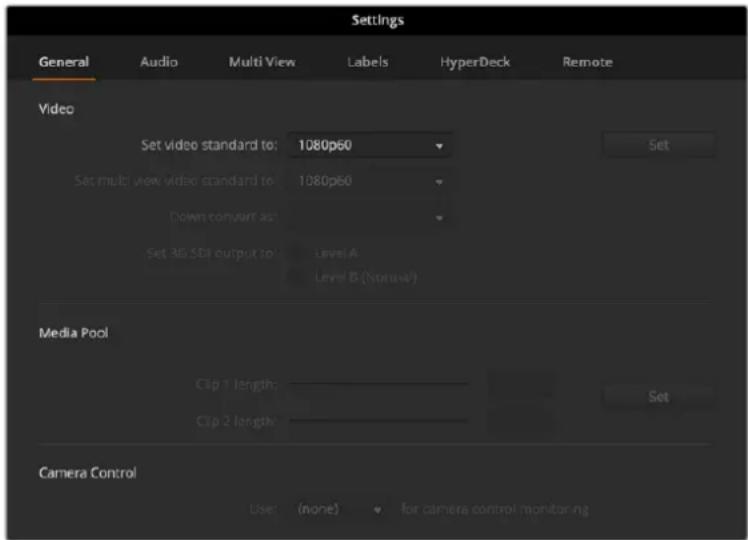
text_image
Settings General Audio Multi View Labels HyperDeck Remote Video Set video standard to: 1080p60 Set multi view video standard to: 1080p60 Down convert as: Set 36.5D output to: Level A Level B (Normal) Media Pool Clip 1 length: Clip 2 length: Camera Control Use: (none) for camera control monitoringChanging switcher settings
General Settings
Setting the Switcher Video Standard
The video setting is used to select the operating video standard of your ATEM Mini. The video standard is set automatically when you plug in the first HDMI source, however if you ever need to change the video standard you can use this setting to do that. All video sources will then be converted to match the set video standard.
If you want to return ATEM Mini to automatically detect the first connected video format, select 'auto mode'.
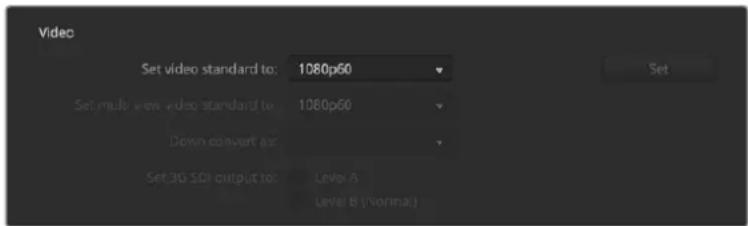
text_image
Video Set video standard to: 1080p60 Set multi view video standard to: 1080p60 Down convert as: Set 3G SUI output to: Level A Level B (Normal)Set video standard
To set the video standard, select the format you want to use from the 'set video standard to' menu and then click on the set button. Any time the video standard is changed, the switcher will remove any stills you have loaded into the media pool, so it's best to set the video standard before loading any media.
Supported Video Input Standards
| 1080p60 1080i60 |
| 1080p59.94 1080i59.94 |
| 1080p50 1080i50 |
| 1080p30 |
| 1080p29.97 |
| 1080p25 |
| 1080p24 |
| 1080p23.98 |
| 720p60 |
| 720p59.94 |
| 720p50 |
Setting Audio Input and Output Behavior
The 'audio' tab lets you control the nature of the audio follow video feature plus set the mic inputs to mic or line level audio. Microphones typically have weaker signals compared to line outputs from other audio devices. This means when mic is selected, the input is boosted slightly to compensate. This also means that if mic is accidentally selected when a line level input is plugged in, the audio will sound unusually loud. If the audio sounds much louder than it should be, check that line is selected instead of mic.
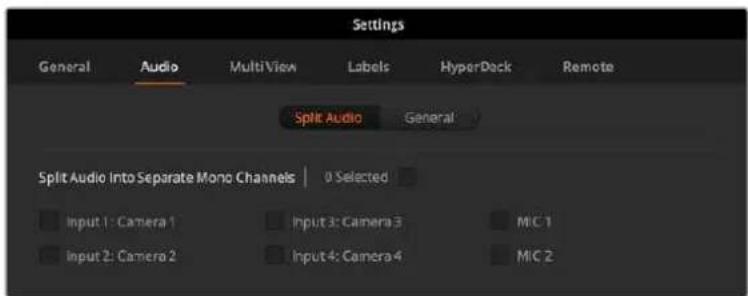
text_image
Settings General Audio Multi View Labels HyperDock Remote Split Audio General Split Audio Into Separate Mono Channels 0 Selected Input 1: Camera 1 Input 3: Camera 3 MIC 1 input 2: Camera 2 Input 4: Camera 4 MIC 2Audio Follow Video Behavior
You can change the nature of the audio follow video feature for when switching sources. For example, select 'hard cut audio when switching' to allow the audio from an input to switch immediately to another. If you want to the audio to smoothly transition over a brief period of time, select 'add a transition to audio when switching'.
Split Audio
Split a mono input signal into two separate mono channels. This is helpful for mixing a mono input into both channels on the stereo master output. You can also add a stereo simulation effect using the advanced Fairlight controls on the audio page.
Click on the desired input checkbox to split the channels for that input.
Multiview Settings
If you are using ATEM Mini Pro or Extreme switchers, the multiview settings allow you to set the multiview orientation. You can swap the position of the multiview preview and program views by clicking on the toggle button located between them.
The multiview settings also include the option to turn the safe area indicators inside the views on or off. Simply click on the safe area icon in the preview window.
Audio meters can be turned on or off for all the switcher sources and program view by enabling the 'all on' button in the multiview settings, or you can turn them on or off individually by clicking the audio meter icon in each view. The opacity of the audio meters can be adjusted by dragging the opacity slider left or right.
The multiview also includes a tally feature, so if any of the sources in the multi view are used in a layer on the program or preview outputs, they will be highlighted red or green. A white border means your source is not currently on the preview output, or on air on the program output. A red border indicates the source is used on the program output and a green border indicates a source is selected on the preview output.
The preview window on the multi view output features safe area markers so you can make sure your program will look great on any monitor. The outer border represents the 16:9 graphics safe area and the inner border represents the 4:3 graphics safe area.
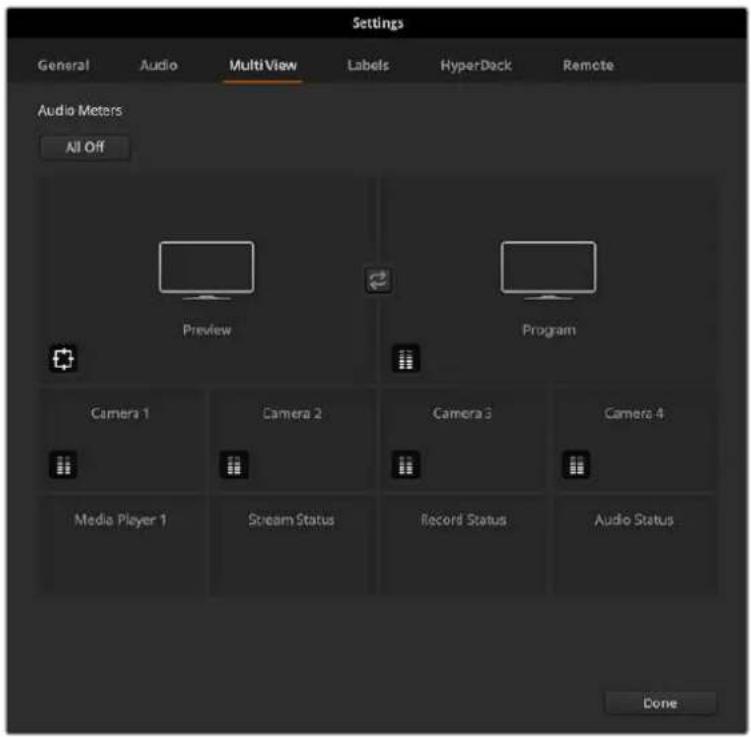
text_image
Settings General Audio MultiView Labels HyperDeck Remote Audio Meters All Off Preview Program Camera 1 Camera 2 Camera 3 Camera 4 Media Player 1 Stream Status Record Status Audio Status DoneCustomizing the multiview
Labels Settings
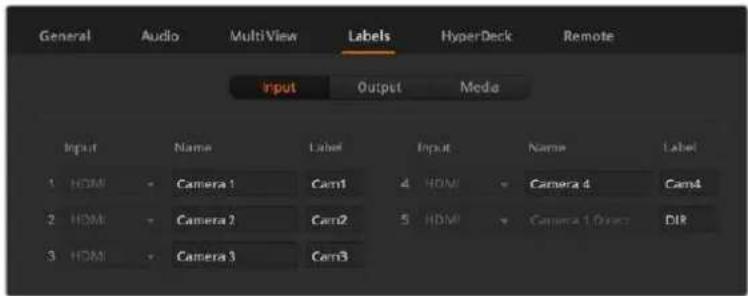
text_image
General Audio MultiView Labels HyperDeck Remote Input Output Media Input Name Label Input Name Label 1 HDMI - Camera 1 Cam1 4 HDMI - Camera 4 Cam4 2 HDMI - Camera 2 Cam2 5 HDMI - Camera 1 Direct DIR 3 HDMI - Camera 3 Cam3Label settings
The input labels settings let you customize the name of each input using a long and short name. The short name will appear on the switcher input buttons on the software panel. The short 4 character name is used to identify the video input on the source names display. The longer input names support up to 20 characters and are displayed in various menu selection boxes on the software control panel and on the ATEM advanced panel displays.
To change an input name, click in the text field, enter the text and click 'save'. The input name will be updated on the software control panel and external hardware panel if one is connected. It's a very good idea to change both the short and long labels at the same time, so they match. For example Camera 1 would be entered in as a long label, and CAM1 as the short label.
HyperDeck Settings
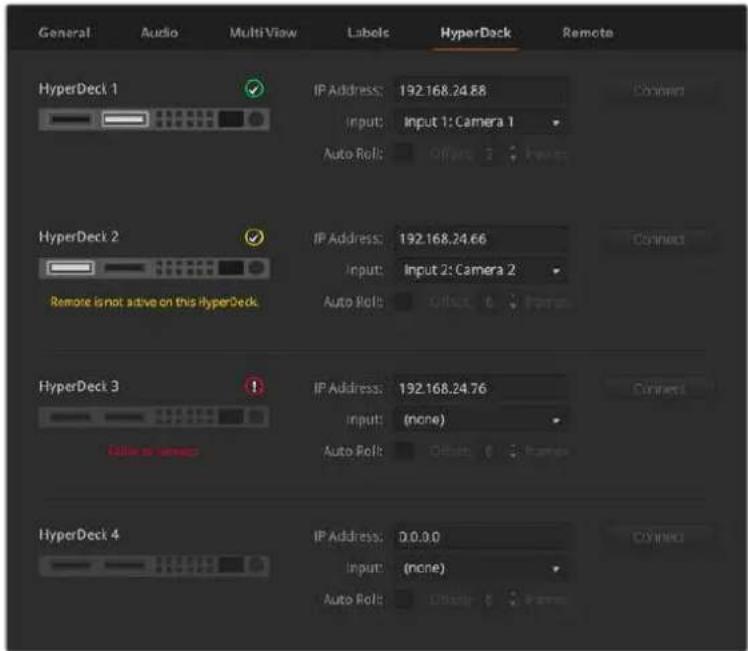
text_image
General Audio Multi View Labels HyperDeck Remote HyperDeck 1 IP Address: 192.168.24.88 Input: Input 1: Camera 1 Auto Roll: Offers 3: Power HyperDeck 2 IP Address: 192.168.24.66 Input: Input 2: Camera 2 Auto Roll: Offset & Power HyperDeck 3 IP Address: 192.168.24.76 Input: (none) Auto Roll: Offset & Power HyperDeck 4 IP Address: 0.0.0.0 Input: (none) Auto Roll: Offset & PowerHyperDeck settings
You can connect up to 4 Blackmagic HyperDeck Studio disk recorders to a network via Ethernet and control them using ATEM Software Control. When connecting HyperDecks, use these settings to configure the IP Address, select the inputs your HyperDecks are connected to, turn the auto roll feature for each deck on or off, and set their frame offset settings so they can switch cleanly.
Status indicators appear above and below each deck so you can easily see if they are successfully connected and if their remote buttons are active.
For detailed information on setting up Blackmagic HyperDecks with your ATEM switcher and setting the 'HyperDeck' configuration settings, refer to the 'HyperDeck control' section of this manual.
Setting the HDMI Output Source
The HDMI output can have various sources routed to it. For example all video inputs, program, preview, plus camera 1 direct for a low latency loop output when gaming.
ATEM Mini Pro and Extreme switchers also have a powerful multiview feature which you monitor all your input sources and outputs on one single screen. This multiview is the default HDMI output source on ATEM Mini, and HDMI 2 on ATEM Mini Extreme. You can read more about the multiview in the ‘additional features on ATEM Mini Pro and ATEM Mini Extreme’ section.
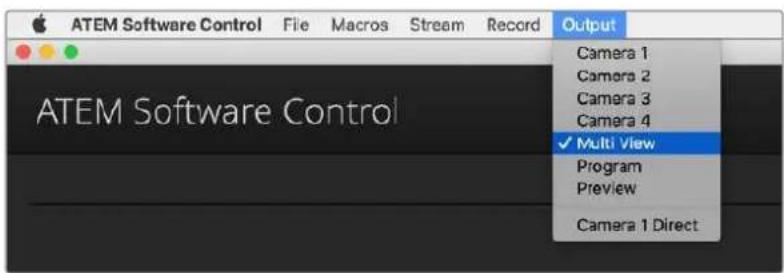
text_image
ATEM Software Control File Macros Stream Record ATEM Software Control Output Camera 1 Camera 2 Camera 3 Camera 4 ✓ Multi View Program Preview Camera 1 DirectHDMI output control menu on Mac OS
To set the HDMI output, simply click on the 'output' option in the menu bar, then scroll the list for the source you want to output. When selected, the HDMI output will change immediately. You can see the current source with a tick in the menu item.
Program/Preview and A/B Direct Transition Control
When you first receive your ATEM switcher, it will be set to program/preview switching which is the current standard for mix/effects switchers. You can change this preference to A/B Direct if you wish to use legacy A/B switching. You'll find the 'transition control' options in the preferences window of ATEM Software Control.
Saving and Restoring Switcher Settings
ATEM Software Control lets you save and restore specific settings, or all of the switcher settings you have created. This powerful feature is incredibly time saving on live productions where regular settings are used. For example, you can immediately restore saved picture in picture settings, lower third graphics and detailed key setups from a laptop or USB drive.
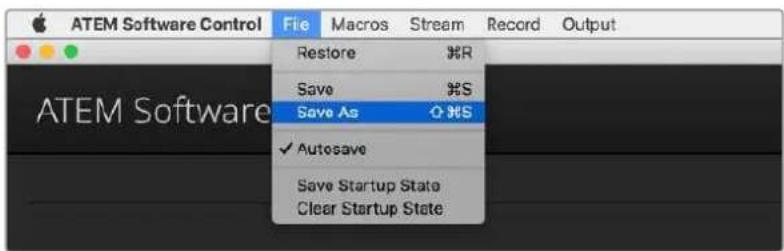
text_image
ATEM Software Control File Macros Stream Record Output Restore %R Save %S Save As %S ✓ Autosave Save Startup State Clear Startup StateSaving settings menu.
Saving your Settings
1 Go to the menu bar in ATEM Software Control and select File>Save As.
2 A window will open asking for a file name and destination folder. After you have made your selection, click Save.
3 You'll now see the Save Switcher State panel containing checkboxes for all the available settings on each block of your ATEM switcher. The Select All checkbox is enabled by default. If you save with Select All enabled, ATEM Software Control saves your entire switcher settings. If you want to choose specific settings to save, you can deselect settings individually, or to remove all settings click Select All once to deselect them. Now you can select specific settings you want to save.
4 Click Save.
ATEM Software Control saves your settings as an XML file together with a folder for ATEM media pool contents.
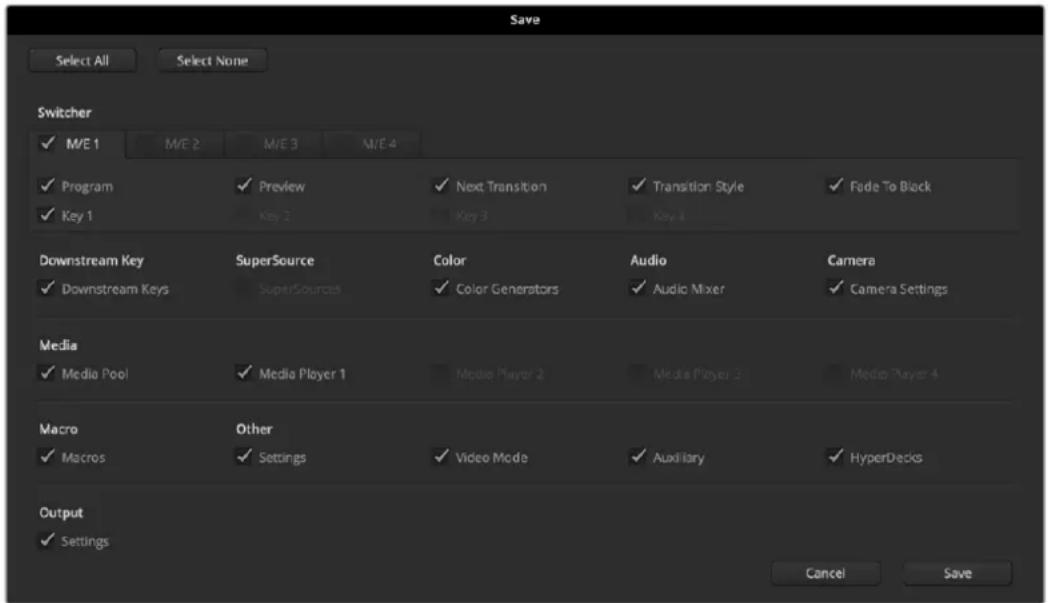
text_image
Save Select All Select None Switcher ✓ M/E 1 M/E 2 M/E 3 N/E 4 ✓ Program ✓ Preview ✓ Next Transition ✓ Transition Style ✓ Fade To Black ✓ Key 1 Key 2 Key 3 Key 4 Downstream Key SuperSource Color Audio Camera ✓ Downstream Keys SuperSources ✓ Color Generators ✓ Audio Mixer ✓ Camera Settings Media ✓ Media Pool ✓ Media Player 1 Media Player 2 Media Player 3 Media Player 4 Macro Other ✓ Macros ✓ Settings ✓ Video Mode ✓ Auxiliary ✓ HyperDecks Output ✓ Settings Cancel SaveWith ATEM Software Control you can save and restore all your switcher settings for your live production, including key settings, transition styles, media pool contents and more
After you have saved your settings you can quick save at any time by selecting File>Save, or by pressing Command S for Mac, or Ctrl S for Windows. Doing so will not overwrite your previous save, but will add a new XML file to your destination folder which is clearly identified with a time and date stamp. This means you can always restore a previous save if necessary.
Restoring your Settings
1 Go to the menu bar in ATEM Software Control and select File>Restore.
2 A window will ask for the file you want to open. Select your save file and click 'restore'.
3 You'll now see a window containing active checkboxes for your saved settings on each block of your ATEM switcher. Leave Select All enabled to restore all your saved settings, or select only the checkboxes for the settings you want to restore.
4 Click Restore.
If your switcher settings are saved on a laptop, it's easy to take all your settings with you on location. Connect your laptop to any ATEM switcher and quickly restore your switcher settings.
Live production can be a busy and exciting time and you're always working in the moment, which means you can easily forget to back up your saved files when the production is over. If you have settings you want to keep, save them to your computer and an external drive, such as a USB drive. This means you can carry your settings with you and have a back up in case your settings are accidentally deleted on your computer.
Saving your Startup State
If you have your switcher set up the way you want it, you can easily save your entire switcher state as your default startup state. Go to the 'file' menu in ATEM Software Control and select 'save startup state'. Now whenever you restart your switcher, it will start up with your saved settings by default. If you want to clear the startup state and revert to the factory settings on restart, go to the 'file' menu and select 'clear startup state'.
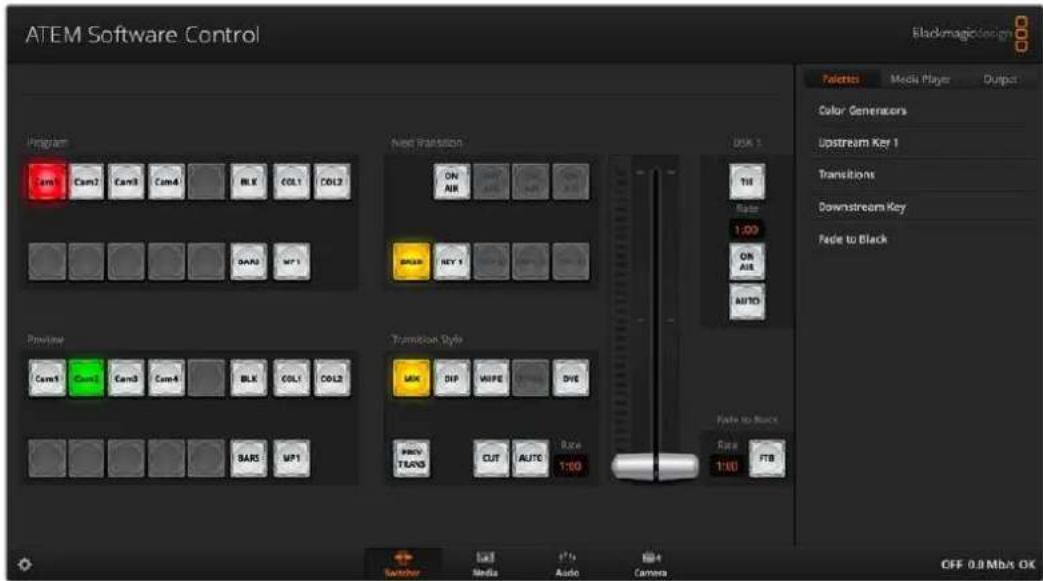
text_image
ATEM Software Control Program Cam1 Cam2 Cam3 Cam4 BLK COL1 COL2 Next Transition ON AIR AIR Rate 1:00 ON AIR AUTO Preview Cam1 Cam2 Cam3 Cam4 BLK COL1 COL2 Transaction Style MX SHP WIPE DVE AUTO TRANS CUT AUTO Rate Rate to Block Rate 1:00 FTB Switch Media Audio Camera Blackmagic.com.cn Folters Media Player Output Color Generators Upstream Key 1 Transitions Downstream Key Fade to Black OFF 0.9 Mb/s OKSaving your switcher settings on a laptop gives you the portability to restore your settings on any ATEM switcher. Saving to a USB drive means you can even carry your settings in your pocket.
Preference Settings
The preferences settings are arranged as 'general' preferences and 'mapping' preferences. The general preferences contain network settings, transition control and language selection options.
General Preferences
ATEM Software Control can be set to display in English, German, Spanish, French, Italian, Japanese, Korean, Portuguese, Russian, Turkish and simplified Chinese languages.
When running ATEM Software Control for the first time after installation, a setup dialog box will prompt you to set the language for the software, but you can change the language of the software at any time.
To change the language:
1 Go to the menu bar at the top of your screen, select 'ATEM Software Control' and open the 'preferences'.
2 Select your desired language from the menu in the 'Software Control Language' in general settings.
A warning will appear asking you to confirm the action. Click 'change'.
ATEM Software control will now close and restart in your selected language.
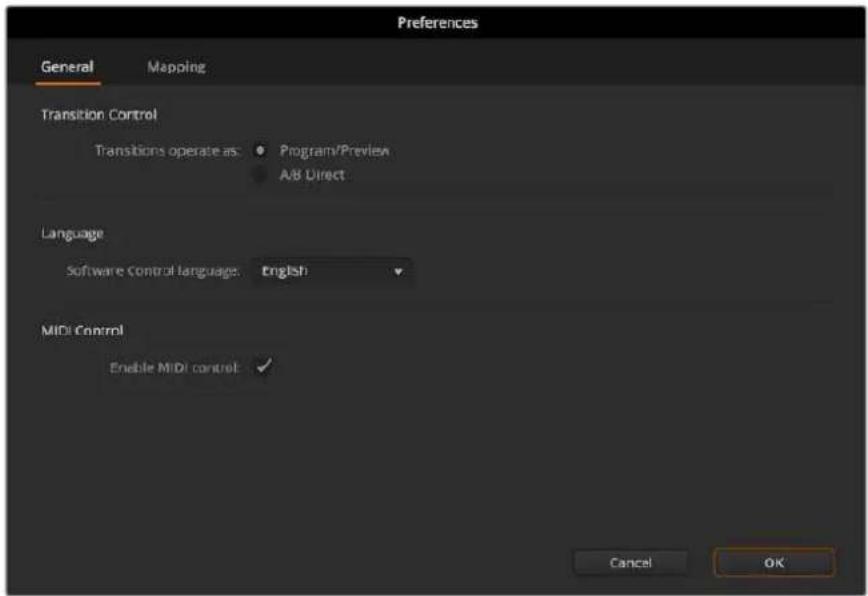
text_image
Preferences General Mapping Transition Control Transitions operate as: Program/Preview A/B Direct Language Software Control language: English MIDI Control Enable MIDI control ✓ Cancel OKYou can change the language for ATEM Software Control in the ATEM Software Control preferences
Button Mapping
In the mapping preferences, you can assign inputs to specific buttons on the preview and program rows.
ATEM Software Control and external ATEM hardware panels support button mapping so you can assign sources to different buttons. For example, occasional sources can be assigned to less prominent buttons. Button mapping is set independently for each control panel so button mapping set on a software control panel will not affect the button mapping set on a hardware control panel.
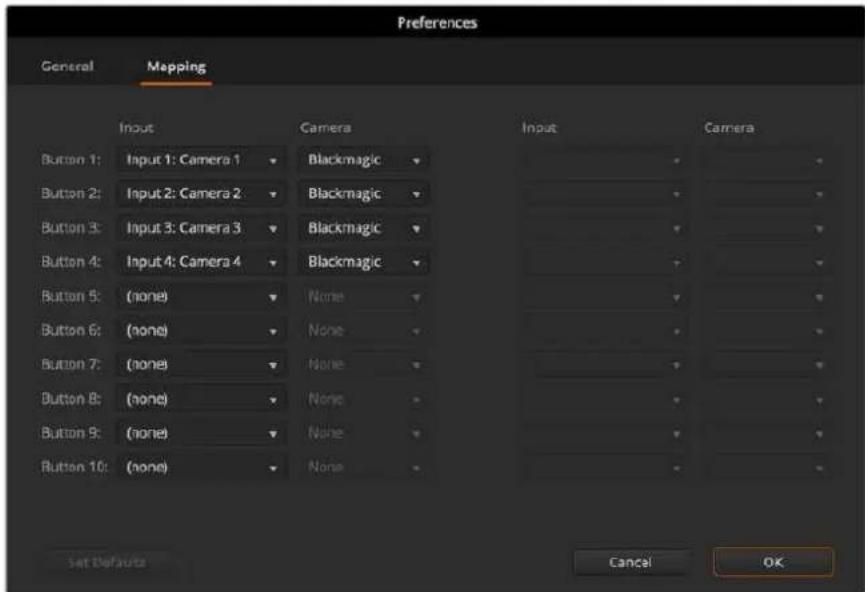
text_image
Preferences General Mapping Input Camera Button 1: Input 1: Camera 1 Blackmagic Button 2: Input 2: Camera 2 Blackmagic Button 3: Input 3: Camera 3 Blackmagic Button 4: Input 4: Camera 4 Blackmagic Button 5: (none) None Button 6: (none) None Button 7: (none) None Button 8: (none) None Button 9: (none) None Button 10: (none) None Set Defaults Cancel OKYou can assign important cameras to more prominent buttons
Using Keyboard Hot Keys
Hot keys can be used allowing convenient control of some switcher functions using a standard QWERTY keyboard as shown in the following table:
| Hot Keys Function | |
| <1> - <0> Previews source on switcher Inputs 1 - 10. 0 = input 10. | |
| <1> - <0> Previews source on switcher Inputs 11 - 20. Shift 0 = input 20. | |
| <1> - <0> Hot switches source on switcher Inputs 1 - 10 to Program output | |
| Press and release, then <1> - <0> | Hot switches source on switcher Inputs 1 - 10 to Program output. Hot switching remains on and the CUT button is lit red. |
| <1> - <0> Hot switches source on switcher Inputs 11 - 20 to Program output | |
| Press and release, then <1> - <0> | Hot switches source on switcher Inputs 11 - 20 to Program output. Hot switching remains on and the CUT button is lit red. |
| Turns off hot switching if currently on. The CUT button is lit white. | |
| CUT | |
| or AUTO | |
ATEM Mini Setup Settings
When ATEM Software Control is installed on your computer, a setup utility called ATEM Setup will also be installed. This setup utility lets you update your ATEM Mini, name the unit, change network settings and provides panel settings including program preview and cut bus switching modes, plus keyer related switching settings.
TIP For information on how to change network settings, refer to the 'connecting to a network' section.
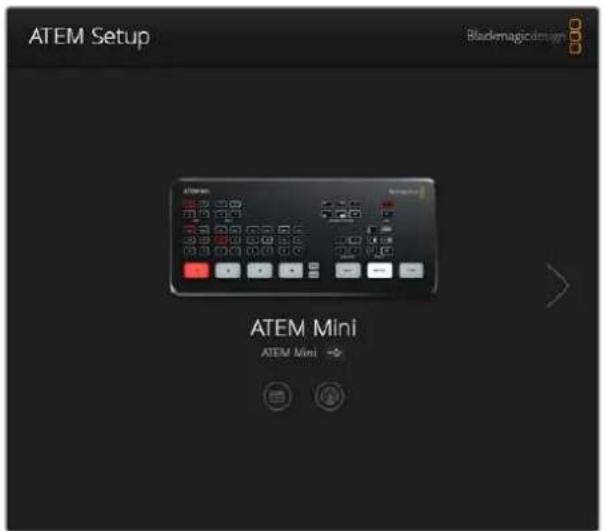
text_image
ATEM Setup Blackmagic design ATEM Mini ATEM MiniUpdating your ATEM Mini
To update your ATEM Mini, simply connect the unit to your computer via USB or Ethernet. Launch ATEM Setup. If the software version installed on your computer is newer than the version installed on your ATEM Mini, a dialogue box will appear notifying you of an update. Simply click on the 'update' button and follow the prompts to update the unit.
A progress bar will appear with a notification to let you know when the update is complete.
Configure Page
Panel Settings
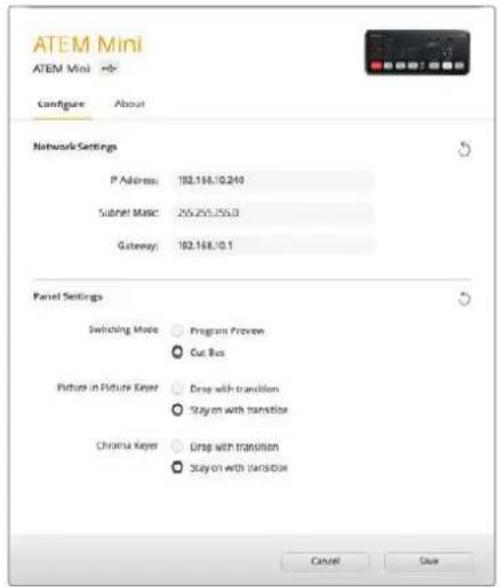
text_image
ATEM Mini ATEM Mini +R Configure About Network Settings P Address: 192.168/10.240 Subnet Magic: 255.255.255.0 Gateway: 192.168/10.1 Panel Settings Switching Mode Programs Preview Cut Bus Picture in Picture Keyer Drop with transition Stay on with transition Chronix Keyer Drop with transition Stay on with Tarcidose Cancel UseSwitching Mode
This setting lets you set ATEM Mini to use program preview or cut bus switching modes. Refer to the 'Switching Modes' section for more information.
Picture in Picture Keyer
This setting lets you choose to keep the picture in picture on screen indefinitely so you can switch content underneath it, or tie it to the next transition so when you perform the transition, picture in picture will transition off screen with it.
| Drop with Transition | Ties picture in picture to the next transition and will transition off screen when the next transition is performed. |
| Stay on with transition Holds | picture in picture on air so you can switch sources without affecting picture in picture. |
TIP Drop with transition lets you smoothly turn off picture in picture by linking it with the transition, however you can always turn picture in picture off at any time by pressing the respective off button on the control panel.
Chroma Keyer
These settings are similar to the picture in picture keyer setting, however it applies to the upstream keyer.
| Drop with Transition Ties the upstream chroma keyer to the next transition and will transition off screen when the next transition is performed. |
| Stay on with transition Holds the upstream chroma keyer on air so you can switch sources without affecting the chroma key. |
About Page
The about page tells you which version of ATEM software is installed on your computer.
To change the name of your ATEM Mini, click in the 'label' edit box, type in a new name and click 'save'
Setting up Open Broadcaster
Even though the ATEM Mini Pro and Extreme switcher models can stream directly using its Ethernet connection, if you want to stream using an external computer then you can connect the USB-C and it will appear as a webcam on your computer. This then lets you use streaming software such as Open Broadcaster for streaming.
This section shows how to use Open Broadcaster to stream via the USB-C webcam output.
Open Broadcaster is an open source application that works as a streaming platform between your ATEM Mini and your favorite streaming software like YouTube, Twitch, Facebook Live, Vimeo Live and others. Open Broadcaster compresses your video to a bit rate that is easily managed by your streaming app.
Below is a demonstration of how to set up Open Broadcaster to stream the webcam output from your ATEM Mini using YouTube as the streaming application.
text_image
1 Genes Sources You don't have any sources. Click the + button below, or right click here to add one. Mir/AltxLaunch Open Broadcaster and click on the plus symbol in the 'sources' box.
text_image
Display Capture Image Image Slide Show JACK Input Client Media Source Scene Syphor Client Text (FreeType 2) Video Capture Device Window Capture GroupSelect 'Video Capture Device'.
text_image
Create new Video Capture Done Add Existing Make source visible Cancel OnName the new source and click 'OK'. In the device menu, select Blackmagic Design and click 'OK'.
text_image
FaceTime HD Camera (Built-In) Develop ✓ Blackmagic Design FaceTime HD Camera (Display) Preset 1200x720 Use Buffering Defaults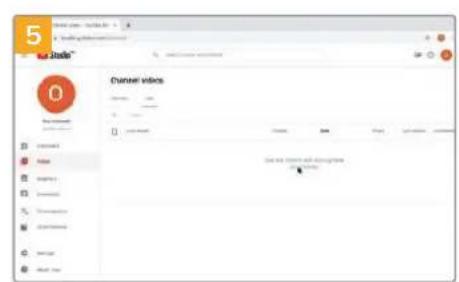
text_image
5 Channel video Channel video Channel video Channel video Channel video Channel video Channel video Channel video Channel video Channel video Channel video Channel video Channel video Channel video Channel video Channel video Channel video Channel video Channel video Channel video Channel video Channel video Channel video Channel video Channel video Channel video Channel video Channel video Channel video Channel video Channel video Channel video Channel video Channel videoNow go to your YouTube account. Navigate to the 'video/live' option and click 'get started'.
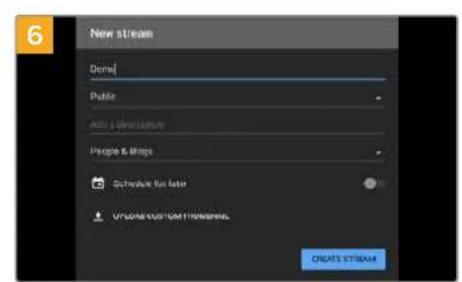
text_image
New stream Profile Public Add a description People & Groups Outlook for later Options: Custom streamIn the YouTube 'stream' options, enter your broadcast details and click 'create stream'.
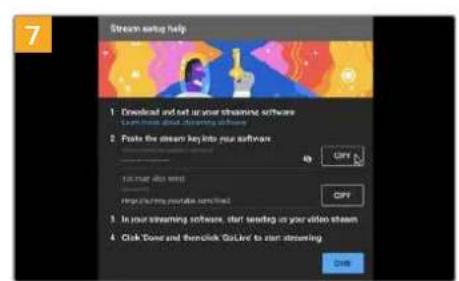
text_image
Stream setting help 1. Download and set in your streaming software Last three days, streaming software 2. Make the stream key into your software OK Yes or less need Cancel 3. In your streaming software, start sending us your video stream 4. Click Tone and thenclick GoLine to start streaming OKYouTube will now generate a stream name/key that will direct Open Broadcaster to your YouTube account.
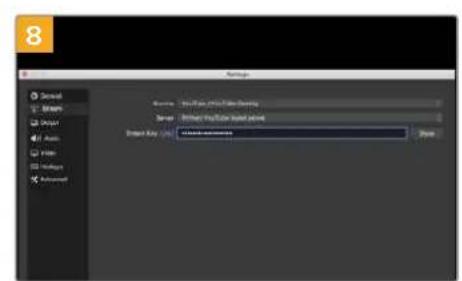
text_image
8 Settings Source: 10.00000000000000000000000000000000000000000000000000000000000000000000000000000 Server: 12.5675-23.4999 Import Key: 12.5675-23.4999 Output: 12.5675-23.4999 Action: 12.5675-23.4999 Auto: 12.5675-23.4999 Background: 12.5675-23.4999 Background: 12.5675-23.4999 Background: 12.5675-23.4999 Background: 12.5675-23.4999 Background: 12.5675-23.4999 Background: 12,5675-23,4999 Background: 12,5675-23,4999 Background: 12,5675-23,4999 Background: 12,5675-23,4999 Background: 12,5675-23,4999 Background: 12,5675-23,4999Return to Open Broadcaster and open the preferences by clicking on 'OBS/preferences' in the menu bar. Select 'stream'. Now paste in the stream key you copied from YouTube and click 'OK'.
Click the 'copy' button next to the stream key. Copy the stream key that you will now paste into Open Broadcaster.
You will now see the video from your ATEM Mini in the Open Broadcaster streaming preview window.
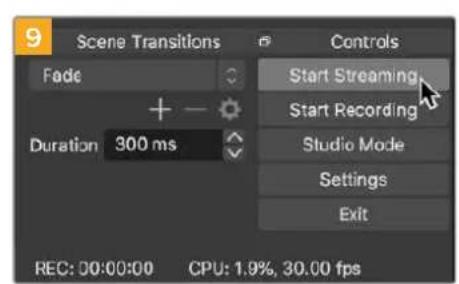
text_image
Scene Transitions Fade Start Streaming Start Recording Duration 300 ms Studio Mode Settings Exit REC: 00:00:00 CPU: 1.9%, 30.00 fpsTo connect Open Broadcaster's broadcast link to YouTube, click 'start streaming' in the bottom right corner of the screen. This establishes the link to YouTube from Open Broadcaster and from here everything will now be set using YouTube Live.

text_image
10 Stream setup help 1. Download and set up your streaming software Select how to access streaming software 2. Paste the stream key into your software OKY You may not read http://www.youlin.com/index/ COPY 3. In your streaming software, start sending your video stream 4. Click Down/and then click "Go Live" to start streamingGo back to YouTube Live and you will see the webcam program output from your ATEM Mini in the background. Click 'done'.
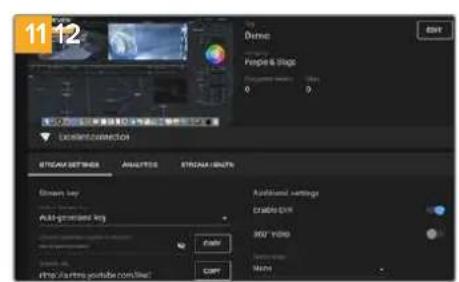
text_image
11 12 Define People & Sites 0 0 STREAM CONNECTION STREAM SETTINGS ANALYSIS STREAM WIDTH Stream bay Audio-generated key Audiovisual settings Enable GIF 300* Video Audio OK OFF http://a.mms.yoube.com/line/ NextWith Open Broadcaster now communicating with YouTube Live, you are ready to begin your broadcast. Now it's time to perform your final checks and make sure everything is good.
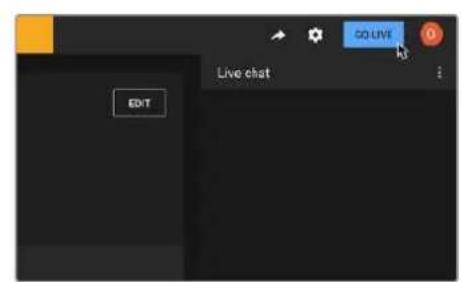
text_image
DO LIVE Edit Live chatIf you are all set, you can now begin your broadcast by clicking 'go live'.
You are now broadcasting live on YouTube with Open Broadcaster. When your broadcast is finished and you have pressed the fade to black button on ATEM Mini, you can end the stream by clicking 'end stream'.
NOTE Due to the nature of internet streaming there can often be a delay, so it's important to watch the stream on YouTube and confirm your program has finished before clicking 'end stream' to make sure you don't accidentally cut the end of your broadcast short.
Using Adobe Photoshop with ATEM
Installing the ATEM software on your computer also installs a Photoshop plug-in that lets you upload Photoshop graphics direct to the ATEM Mini's media pool.
The plug-in connects to your computer via Ethernet the same way as any other computer running ATEM Software Control on your network. For example, another operator can be updating graphics live in Photoshop during your production and uploading them straight to ATEM's media player using the plug-in.
This means you can accept graphics from designers in the application that 100% of the world's designers use, Adobe Photoshop! You can even use the layers in a Photoshop image to keep variations of graphics, such as different titles in a graphic, and then select the layers in Photoshop you want, and then simply upload them at the press of a button. When uploading the layers are automatically flattened in real time before upload. This happens in the background and your document in Photoshop is unchanged by the export.
The ATEM export plug-in requires Adobe Photoshop CS5 or later. Install or reinstall the ATEM software after Photoshop is installed, to ensure the ATEM export plug-in is installed.
TIP If you are not streaming via ATEM Mini's USB webcam output, but switching content over the HDMI output instead, you can upload graphics from the Photoshop plug-in via USB. However, due to the way USB establishes a connection to a single client only, you will need to close ATEM Software Control so the Photoshop plugin can access the USB connection, upload your graphics, then relaunch ATEM Software Control to access the media pool.
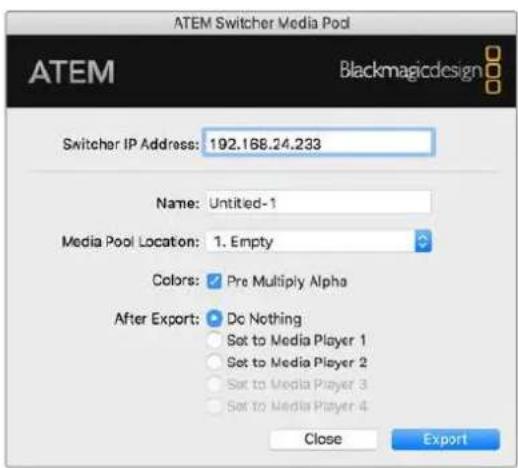
text_image
ATEM Switcher Media Pool ATEM Blackmagicdesign Switcher IP Address: 192.168.24.233 Name: Untitled-1 Media Pool Location: 1. Empty Colors: Pre Multiply Alpha After Export: Do Nothing Set to Media Player 1 Set to Media Player 2 Set to Media Player 3 Set to Media Player 4 Close ExportATEM export plug-in
Setting up Plug-in Switcher Location
The first time the Photoshop export plug-in is run, it will ask you to select your switcher location. This is the IP address of the switcher so the plug-in can find the switcher to communicate with. By default, the IP is set to 192.168.10.240, which is what the switcher IP address is originally set to when first sold. If you want to export several versions of the same Photoshop file, you can use the export plug-in window to name each exported file and also choose whether to set the files to a media player after export.
Preparing Graphics for Upload
For best results, you will want to use a Photoshop document resolution that matches the video standard you're using with your ATEM switcher. For 1080 HD you should use 1920 x 1080 pixels in resolution. For 720p HD formats you should use 1280 x 720 pixels.
When working with Photoshop documents for ATEM, you should not put any content on the background layer, but add all content to the layers above. The background layer should always be plain full frame black, and you should use a pre multiplied key setting in the ATEM keyer for keying graphics from Photoshop.
Using Multiple Control Panels
All ATEM Mini switchers have multiple ways they can be controlled and you can use this software control panel as well as a range of hardware control panels. In fact, if you connect your ATEM Mini to a network that has other computers connected, you can run multiple copies of this software control panel. This means you could have someone operating the switcher, while someone else could be controlling cameras, managing media or mixing audio. It's quite flexible and this means many people can be operating your ATEM Mini all at the same time!
A good example is the relationship between the software control panel, external ATEM hardware control panel and the control panel of ATEM Mini. The software control panel has been designed to be the same as the external ATEM hardware control panel. This is a convention and well understood ME style of layout where you have a program row and preview row of input controls and then a transition block that lets you command the transition.
If you plug in both control panels, you can see them mirror each other and any button pressed on one control panel will be reflected on the other control panels instantly.
However, due to space limitations the control panel of ATEM Mini is a little bit different and it's interesting to see the relationship between how this control panel works and how the software control panel works. A good way to understand this is to watch ATEM Mini's panel control while controlling the switcher via the software control panel.
Because of the limited space on ATEM Mini's control panel, both the program and preview rows have been combined together into a single row of buttons. When running ATEM Mini in program preview switching mode, you can see the source selected on the program row because it's illuminated red and the source selected on the preview row because it's selected green.
These are the same colors as the software control panel, but they are just on the same row of physical buttons.
The following section describes how to connect your ATEM equipment to a network so you can operate your switcher using an ATEM hardware panel and multiple computers running ATEM Software Control.
TIP If you are using 4 Blackmagic Pocket Cinema Camera 4Ks or 6Ks with ATEM Mini, you can even connect an ATEM Camera Control Panel and control all 4 cameras via HDMI using an external hardware control panel.
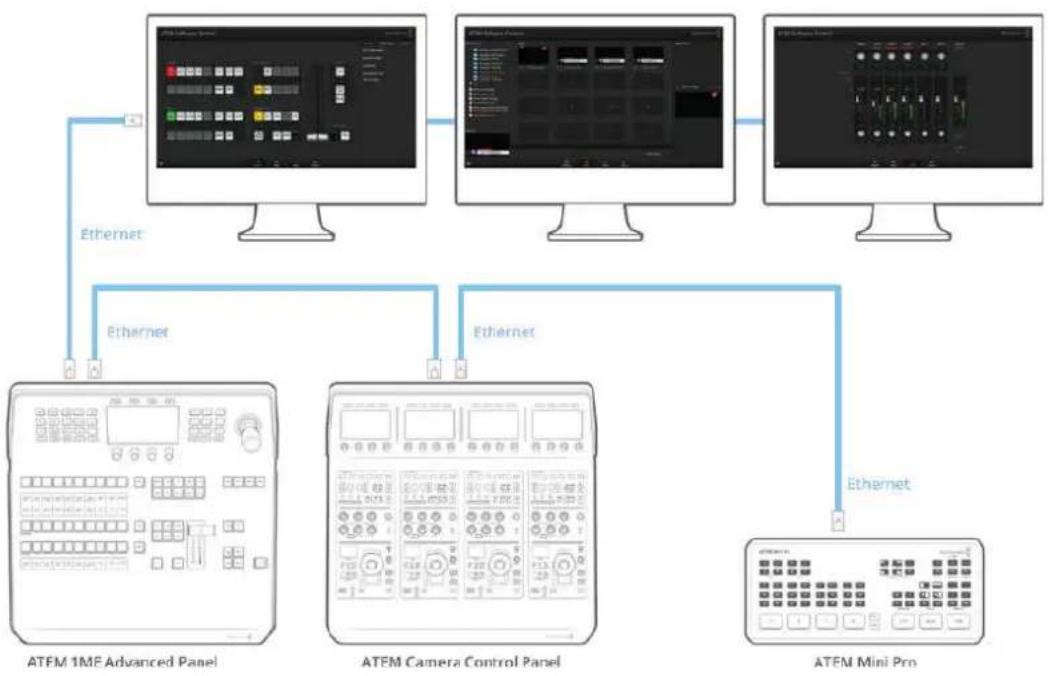
flowchart
graph TD
    A["ATEM 1ME Advanced Panel"] -->|Ethernet| B["ATEM Camera Control Panel"]
    B -->|Ethernet| C["ATEM Mini Pro"]
    A --> D["ATEM Database System"]
    B --> E["ATEM Database System"]
    C --> F["ATEM Database System"]
When connected to a network via Ethernet, multiple computers can run ATEM Software Control simultaneously, which means multiple operators can be dedicated to separate controls on your ATEM Mini. For example, multiple operators can control media management, camera control and audio mixing.
TIP For detailed information about how to control your ATEM Mini using ATEM 1 M/E Advanced Panel refer to the 'using the ATEM 1 M/E Advanced Panel' section.
Connecting to a Network
Most people simply plug their computer and control panel direct to the switcher, however in some situations it can be very powerful to connect via your network!
Your ATEM Mini ships from the factory with settings to allow hardware control panels to simply be connected directly with an Ethernet cable. However your ATEM supports full Ethernet IP protocols so you can place your ATEM Mini and external ATEM control panel on your network or anywhere on the planet using the internet. Connecting to a network means you have enormous flexibility with how you control your switcher. For example, you can connect an ATEM 1 M/E Advanced Panel on the same network to ATEM Mini and have two operators switching content. In addition, you also have the software panel on your computer so you can even have a third operator handling audio, or managing media from the software panel.
However, it's worth noting that if you use your ATEM Mini on a network, then you're also increasing the complexity of the connection between your control panel and the switcher, so there is possibly a greater chance of something going wrong. ATEM Mini can also be used when plugged into a switch, and even via most VPNs and over the internet.
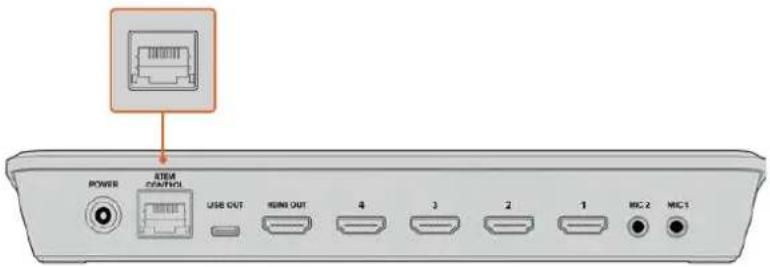
text_image
POWER ITEM CONTROL USB OUT I/O OUT 4 3 2 1 MIC 2 MIC 1Connect ATEM Mini to a network and then you can operate your switcher using ATEM Software Control on any computer connected to the same network
Using DHCP and Fixed IP Addresses
ATEM Mini connects to ATEM hardware panels and your network using a fixed IP address which is set to a default address during manufacture. ATEM Mini Pro, ATEM Mini Extreme and ATEM hardware panels can use a fixed IP address or DHCP.
DHCP
The dynamic host configuration protocol, or DHCP, is a service on network servers that automatically finds your ATEM Mini Pro or Extreme switcher and assigns an IP address. The DHCP is a great service that makes it easy to connect equipment via Ethernet and ensure their IP addresses do not conflict with each other. Most computers and network switchers support DHCP.
Fixed IP Address
All ATEM hardware panels and ATEM switchers except ATEM Mini Pro and Extreme switchers have a default fixed IP address. This is a determined IP address that is set in the unit when manufactured. When connecting an ATEM Mini directly to an ATEM hardware panel, for example ATEM 1 M/E Advanced Panel, the fixed IP addresses let the two units communicate with each other straight away.
NOTE ATEM Mini Pro and Extreme switchers are slightly different as they don't have a set IP address. That is because these switchers are is designed to use the dynamic host configuration protocol and has DHCP set as the default IP setting. Once the DHCP has assigned the unit an IP address, you can see this address in Blackmagic ATEM Setup's network settings. This is helpful when you are connecting an ATEM hardware panel to an ATEM Mini Pro or Extreme switcher so you can tell the hardware panel the switcher's assigned IP address.
If your network doesn't support DHCP, you can change the network settings manually.
Manually Setting a Fixed IP Address
When setting IP addresses manually so all units can communicate, they must share the same subnet mask and gateway settings. In addition, the first three fields of numbers in the panel's IP address also need to match. For example, ATEM Mini's default IP address is 192.168.10.240 and an external ATEM 1 M/E Advanced Panel's default IP address is factory set to 192.168.10.60. This means both units share the first three fields of numbers, but have their own identifying number in the last field so they won't conflict with each other.
This is generally the most important principle to know when working via Ethernet.
Below is an example of fixed IP address settings when ATEM Mini is connected directly to ATEM 1 M/E Advanced Panel.
ATEM Mini IP Settings
IP Address - 192.168.10.240
Subnet Mask - 255.255.255.0
Gateway - 192.168.10.1
ATEM 1 M/E Advanced Panel IP Settings
IP Address - 192.168.10.60
Subnet Mask - 255.255.255.0
Gateway - 192.168.10.1
Notice that all the numbers are the same except for the last field of each IP address. This means they are set correctly and the units will communicate with each other without conflicts.
When connecting to a network, the network will have its own subnet mask, gateway, and IP address settings which every connected device will conform to. You will need to make sure both your ATEM Mini and the ATEM 1 M/E Advanced Panel share those numbers and similarly with regards to the IP address, have their own identifying number in the last field so they won't conflict with each other.
Below is an example showing ATEM Mini and an ATEM 1 M/E Advanced Panel set to conform to a network using a fixed IP address.
Network IP Settings
IP Address - 192.168.26.30
Subnet Mask - 255.255.255.0
Gateway - 192.168.26.250
ATEM Mini IP Settings
IP Address - 192.168.26.35
Subnet Mask - 255.255.255.0
Gateway - 192.168.26.250
ATEM External Hardware Panel IP Settings
IP Address - 192.168.26.40
Subnet Mask - 255.255.255.0
Gateway - 192.168.26.250
If there are other devices on the network that have the same identifying number in their IP address, there will be a conflict and the units won't connect. If you encounter a conflict, simply change the identifying number in the unit's IP address. Refer to the next sections for information on how to change network settings.
NOTE If ATEM 1 M/E Advanced Panel is not connecting to your ATEM Mini and displays a message saying it is looking for the switcher, you will need to tell the panel where your switcher is on the network. This is simply typing your ATEM Mini's IP address into the panel's switcher IP settings. Refer to the next sections for information on how to set the switcher IP location on ATEM 1 M/E Advanced Panel.
Changing ATEM Mini Network Settings
ATEM Mini's network settings are changed using Blackmagic ATEM Setup via USB.
Please follow the steps below:
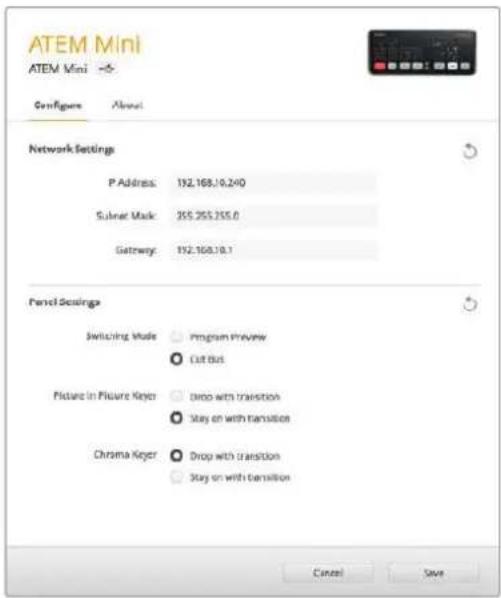
text_image
ATEM Mini ATEM Mini →> Configure About Network Settings P Address: 192.168.10.240 Subset Mask: 355.355.355.0 Gateway: 192.168.10.1 Parcel Settings Switching Mode Program Preview Cut Bus Picture in Picture Keyer Drop with transition Stay on with transition Chroma Keyer Drop with transition Stay on with transition Cancel SaveChange network settings using the
'configure' tab In Blackmagic ATEM Setup.
To change the network settings via Blackmagic ATEM Setup:
1 Connect ATEM Mini via USB to the computer running the setup utility software.
2 Launch Blackmagic ATEM Setup and select your ATEM Mini.
3 ATEM Mini's current IP address, subnet mask and gateway settings will be displayed in 'configure' window. If you only want to check the IP address and not change it, you can simply quit the setup utility by clicking 'cancel'.
4 To change the IP address or any other settings, edit the numbers and then click 'save'.
Changing the Hardware Panel Network Settings
Because ATEM 1 M/E Advanced Panel is also on the network and communicating with the switcher, it also has network settings so it can connect to the network. These settings are different to the switcher IP address, which is just where the panel is looking to find the switcher. The panel network settings can be changed by following the steps below:
Changing Network Settings on ATEM 1 M/E Advanced Panel
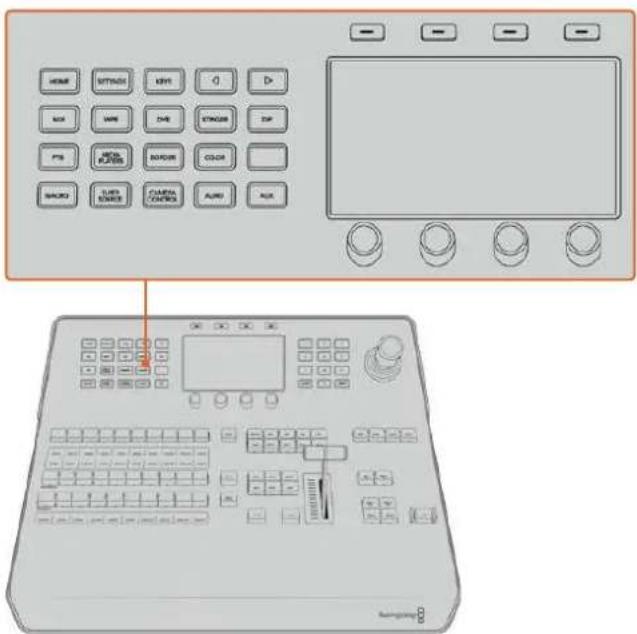
text_image
Diagram of a audio control device with labeled buttons and display screen, showing various function keys and control knobs.Change network settings using the system control buttons and LCD soft controls
1 Press the 'home' button in the system control buttons to open the LCD home menu.
2 In the home menu, press the 'network' soft button to open the network settings.
3 The next step is to decide if you want the panel to use a fixed IP address or to be automatically assigned an IP address from a DHCP server. Set DHCP on or off by pressing the corresponding DHCP ON/OFF soft button.
NOTE If you're connecting direct to a switcher without a network, then you won't have a DHCP server to assign an IP address automatically, so you will want to select 'DHCP off'. ATEM 1 M/E Advanced Panel is delivered with a fixed IP address set to 192.168.10.60 for a direct connection.
However, if your network has lots of computers that automatically assign IP addresses via DHCP, then you can also select 'DHCP on' so the panel can get its network information automatically. This is possible on the panel, and it's only ATEM Mini that always requires a fixed IP, as the switcher needs to be found by the control panels at a known fixed address on your network.
ATEM Mini Pro and Extreme switchers are set to use DHCP by default, so if you are connecting an ATEM hardware panel and the switcher to a network that supports DHCP, you can set the panel to 'DHCP on' and your network settings will be complete because the panel network settings will be obtained from the network automatically.
4 If you have elected to use a fixed IP address, you now need to set this IP address by adjusting the corresponding soft control knobs for each field of the IP address. You can also use the numeric keypad. Changing this IP address may cause the panel to lose communication.
5 If the subnet mask and gateway address need to be set, then press the right arrow button in the system control buttons to progress through each setting menu, and use the knobs or the numeric keypad to edit. If at any time you want to cancel the changes, press 'undo'.
6 When you are happy with your settings, press the 'save changes' soft button to confirm.
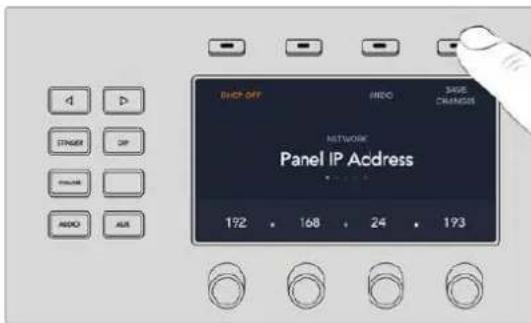
text_image
SHOT OFF FROO SAGE CHANGES NETWORK Panel IP Address 172 168 24 193When you are happy with your network settings, press the 'save changes' button to confirm them
Setting the Switcher's IP Location on the Panel
To set ATEM Mini's IP location on ATEM 1 M/E Advanced Panel so the panel can find ATEM Mini and communicate, simply follow these steps:
Changing the Switcher's IP location on ATEM 1 M/E Advanced Panel
1 When there is no communication with ATEM Mini, the LCD will say 'connecting' and notify you of the IP address it is searching for. If the panel can't find the switcher, the connection will time out and a notification will ask you to check the IP address. Press the 'network' soft button above the LCD to open the network settings.
2 In the network settings, press the right arrow in the system control buttons next to the LCD to move to the 'switcher IP address' setting.
3 Now use the corresponding LCD soft control knobs to set the correct IP address for your switcher.
4 Press the 'save changes' soft button to confirm the setting.
Your panel will now connect with your switcher.
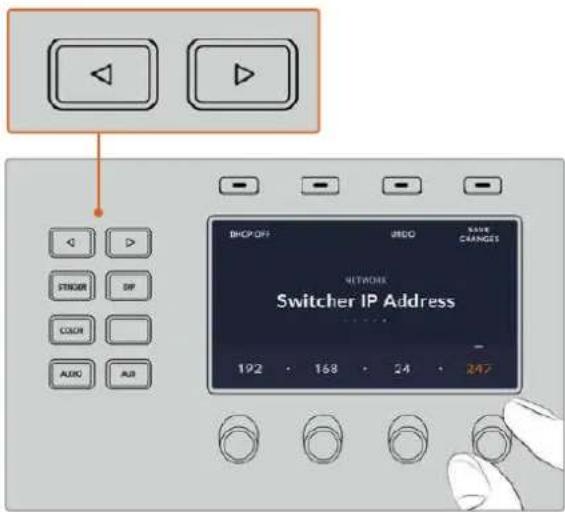
text_image
SHOP OFF STOCKS COLOR AUDIO BROO RBOO RARE CHANGES NETWORK Switcher IP Address 192 • 168 • 24 • 247On the ATEM 1 M/E Advanced Panel, press the 'network' LCD soft button to open the network settings on the LCD, then use the system control arrow buttons to navigate to the switcher IP address setting. Use the soft controls to set the network IP address for your switcher, and don't forget to save the changes.
NOTE Changing the switcher IP address on your panel does not change the IP address of ATEM Mini itself. It just changes where the control panel is looking to find the switcher.
ATEM Software Control via the Network
Lastly, if you want to use ATEM Software Control as well as an ATEM 1 M/E Advanced Panel, you need to ensure your computer is connected and working on your network. Once launched, if ATEM Software Control cannot communicate with ATEM Mini, you will be prompted automatically to select your ATEM Mini from the connected ATEMs list, or enter the unit's IP address manually. Once you have confirmed the switcher from the list or set the IP address, ATEM Software Control can find your switcher and communicate.
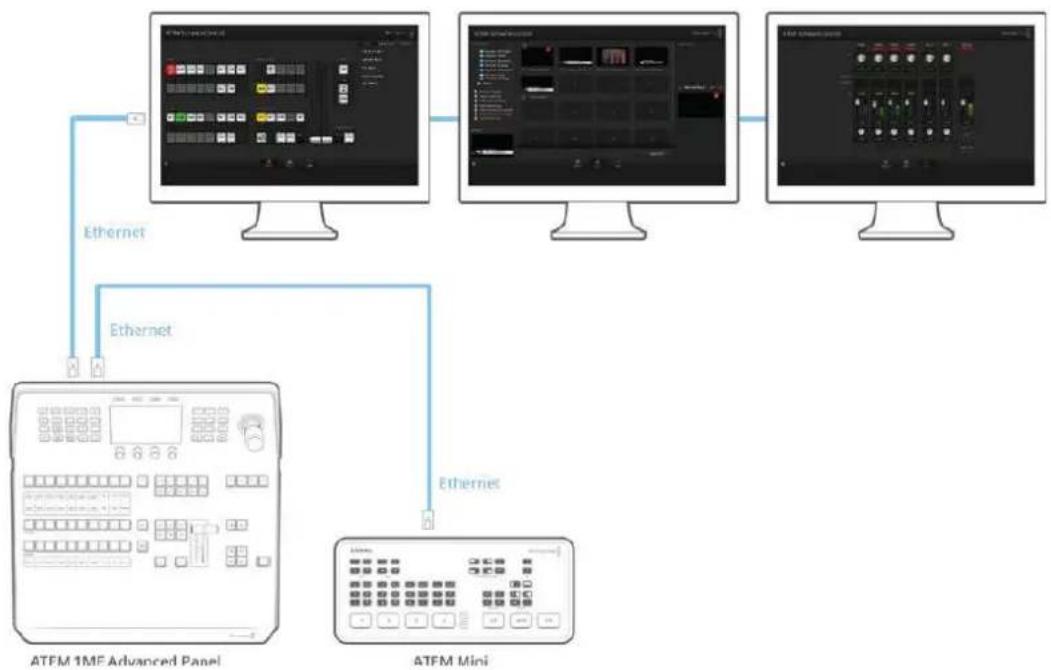
flowchart
graph TD
    A["ATFM 1MF Advanced Panel"] -->|Ethernet| B["ATFM Mini"]
    B -->|Ethernet| A
    A --> C["ATFM Mini"]
    C --> D["ATFM Advanced Panel"]
    D -->|Ethernet| A
Multiple computers can run ATEM Software Control simultaneously, which means multiple operators can be dedicated to separate controls on your switcher, for example media management and audio mixing.
Connecting to an Internet Router
On ATEM Mini Pro or Extreme model switchers, connecting to an internet router via Ethernet lets you stream your broadcast over Ethernet while using the USB-C connector to record to an external drive.
To set up direct streaming via Ethernet, first enter the stream details in ATEM Software Control. This will store the streaming information in the switcher.
1 In ATEM Software Control's processing palettes go to the 'output' settings and select your streaming platform from the platform menu.
2 Enter the server closest to your location in the 'server' menu, then enter your stream key in the 'key' setting. Refer to 'getting a stream key' in the next section for more information.
3 With the details entered into ATEM Software Control, now plug your switcher into the internet router using a CAT 5 network cable. This is usually a wireless router that connects all your home or office devices to the internet. The unit will normally have additional Ethernet inputs and you can plug your switcher directly into one of those.
TIP If your computer is connected to the internet router and has an Ethernet port, you can also connect ATEM Mini Pro or Extreme switcher to your computer via Ethernet and connect to the internet via your computer.
4 It's worth streaming a test to make sure everything is set correctly. You can do this by switching color bars, or a standby graphic in the media player to the program output and checking you can see it on your streaming platform.
Now if you are happy and ready to start, all you need to do is press 'on air' and you are broadcasting live!
NOTE Most internet routers support DHCP, but if yours does not, you can still connect by setting the network settings manually using Blackmagic ATEM Setup.
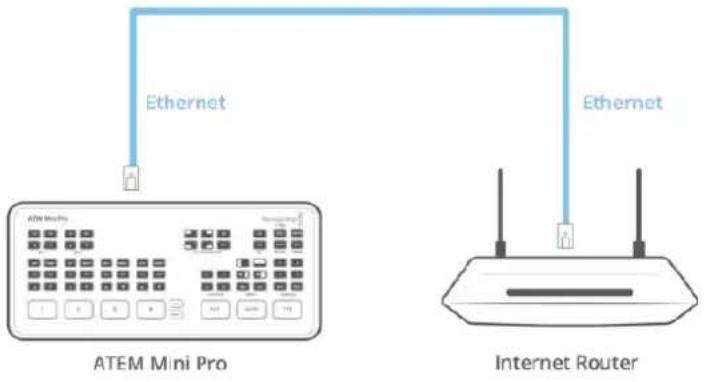
flowchart
graph TD
    A["ATEM Mini Pro"] -->|Ethernet| B["Internet Router"]
    B -->|Ethernet| A
Getting a Stream Key
When setting up your stream, you will need a stream key. This is assigned to your broadcast by your streaming platform, for example YouTube Live, Facebook Live or Twitch.
In the following example you can see how to generate a stream key using Facebook Live, YouTube Live and Twitch.
Facebook Live
1 Go to your Facebook page and click on 'create post'.
2 Select 'live video' from your create post options.
3 Click on the 'connect' tab.
4 Now click on 'use a persistent stream key'.
Facebook will now supply you with a stream key that will be assigned to your Facebook page. All you need to do is copy the stream key and paste it into the 'key' setting in ATEM Software Control's live stream options.
YouTube Live
1 Log into your YouTube account.
2 Click on the camera icon in the top right corner to create a video or post.
3 Select 'go live' from the menu.
4 In the dialogue box, type in a title and add a description.
5 Click on 'create stream'.
6 Copy the stream key.
Now you can paste the stream key into ATEM Software Control's ‘live stream’ options which saves the key in your ATEM Mini Pro or Extreme switcher.
Twitch
1 Log into your Twitch account.
2 Click on your account avatar in the top right corner.
3 Click on 'creator dashboard'.
4 In the left hand menu, click 'preferences', then select 'channel'.
5 Click on the 'copy' button to copy the stream key.
6 Now paste the stream key into ATEM Software Control's 'live stream' options which saves the key in your ATEM Mini Pro or Extreme switcher.
For more detailed information about setting up streaming on a computer, refer to the 'direct streaming and switcher control via Ethernet' section earlier in the manual.
TIP Once streaming settings are applied, ATEM Mini Pro switchers can stream directly to the internet via smartphone tethering. For more information, refer to the 'smartphone tethering' section in this manual.
Keying using ATEM Mini
Keyers are a powerful production tool that allows the arrangement of visual elements from different sources on the same video image.
To do this, multiple layers of video or graphics are stacked on top of the background video. Altering the transparency of various parts of these layers allows the background layer to be visible. This process is called keying. Various techniques are used to create this selective transparency and these correspond to the different types of keyers available on your switcher.
The following section explains luma and linear keyers, which are available either upstream or downstream, and chroma, pattern and DVE keys, which are upstream keyers.
Understanding Keying
A key requires two video sources; the fill signal and the key or cut signal. The fill signal contains a video image which is to be stacked on top of the background, while the cut signal is used to select regions of the fill signal to be made transparent. The fill and cut signals can be selected from any of the switcher's external inputs or internal sources, allowing both still and moving images to be used as fill or cut sources.
Fill and cut signals are selected on the software control panel from menus in the upstream and downstream key palettes. In your switcher's LCD menu, you can select fill and cut signals in the upstream or downstream key menus.
There are two types of keyers used in your switcher; upstream keyers and downstream keyers. One upstream keyer, also known as an effects keyer, plus two downstream keyers are available via the switcher's control panel and LCD menu, or via ATEM Software Control. The upstream keyer can be set up as a luma, linear, pre-multiplied, chroma, pattern or DVE key. Two downstream keyers are available in the dedicated DSK block. Each downstream keyer can be set up as a luma or linear key.
Luma Key
A luma key or self key consists of one video source containing the video image that will be stacked on top of the background. All of the black areas defined by the luminance in the video signal will be made transparent so that the background can be revealed underneath. Since only one image is used to define the areas to be cut out, a luma key uses the same signal for the fill and key. The following images are an example of what background, luma key signals and the resulting combined image might look like.
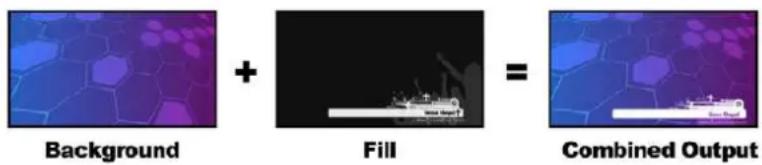
Combining a background and fill/key in a luma key
Background
A full screen image, often a camera source.
Fill
The graphic you plan to display on top of your background video. Notice that the final composition does not retain any black from the graphic because all of the black parts have been cut out of the image.
Linear Key
A linear key consists of two video sources, which are the fill signal and the key or cut signal. The fill signal contains a video image which is to be stacked on top of the background, while the key signal contains a grayscale mask that is used to define regions of the fill signal to be made transparent. Since both the fill and key signals are video inputs, both signals can be in motion while on screen. The following images are examples of what background, fill and key signals, and the resulting combined image might look like.

Combining a background, fill and key in a linear key
Background
A full screen image, often a camera source.
Fill
The graphic you plan to display on top of your background video. Notice that the black parts of the graphic remain intact because the key signal is used to determine the transparency of the fill signal. The fill signal is often provided by a graphics system.
Key
A grayscale image that defines the region in the image that will be removed so that the fill signal can be correctly stacked on top of the background. The key signal is often provided by a graphics system.
Pre multiplied Key
A modern graphics system or character generator that offers fill and key outputs will most likely provide what is known as a pre multiplied or shaped key. A pre multiplied key is a special combination of the fill and key signal where the fill signal has been pre multiplied with the key signal over a black background. Photoshop generated images that contain an alpha channel are pre multiplied.
ATEM switchers have an auto key adjustment for pre multiplied keys so that when the premultiplied key setting is enabled, the clip and gain parameters are automatically set by the system.
When using a Photoshop generated image, generate graphics over a black background layer and place all content on the upper layers. Add an alpha channel in your Photoshop document that the ATEM can use for blending the graphic over the live video. Then, when saved as a Targa image file, or downloaded direct to the media pool, you can select pre multiplied in the keyer and you should have a great key!
Photoshop documents are pre multiplied by nature, so you should always use the pre multiplied settings on the ATEM switcher when keying them.
Performing an Upstream Luma/Linear Key
Since luma and linear keys use the same parameters, they are set up on the software control panel and advanced panel using a common menu, called the luma key menu. What defines the key as being either luma or linear is in the selection of fill and key sources. In a luma key, fill and key sources are the same. For a linear key, fill and key sources are different.
To set up a luma key on the upstream keyer in ATEM Mini Extreme:
1 Select the K1LUM button in the select bus.
2 Select the fill and key source from the select bus.
When performing a luma key, the same source is used for both fill and key.
You can now refine your key using ATEM Software Control.
To set up a luma/linear key on the upstream keyer in ATEM Software Control:
1 Expand the upstream key 1 palette and select luma tab.
2 Select the fill source and key source.
If performing a luma key, select the same source for both fill and key.
Adjust the key parameters to refine the key. For a description of luma key parameters, refer to the table below.
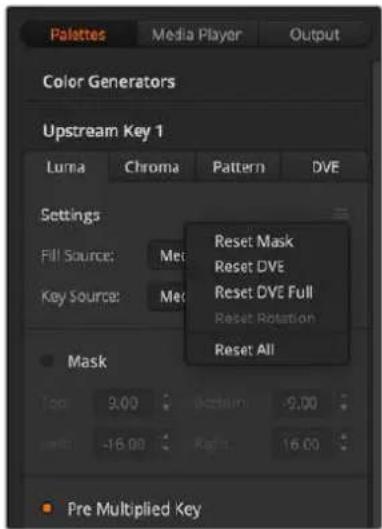
text_image
Palettes Media Player Output Color Generators Upstream Key 1 Luma Chroma Pattern DVE Settings Fill Source: Met Reset Mask Key Source: Met Reset DVE Met Reset DVE Full Reset Rotation Reset All Mask Top 9.00 Bottom -9.00 set to -16.00 Right 16.00 Pre Multiplied KeySelect sections of the Palette you wish to reset from the reset menu
Upstream key luma/linear key parameters:
| Mask Enables a rectangular mask that can then be adjusted using the top, bottom, left and right parameters. |
| Pre-Mult Identifies the key signal as a pre-multiplied key. |
| Clip The clip level adjusts the threshold at which the key cuts its hole.Decreasing the clip level reveals more of the background. If the background video is completely black then the clip value is too low. |
| Gain The gain adjustment | electronically modifies the angle between on and off thereby softening the edges of the key. Adjust the gain value until the edge softness is desirable but the background video luminance or brightness is not affected. |
| Invert Key Inverts the key signal. | |
| Flying Key Enables/disables DVE effects. | |
Setting up a Luma/Linear Key on the Upstream Keyer using ATEM 1 M/E Advanced Panel
1 Press the 'key 1' button to enable the keyer on the preview output. This automatically selects the keyers menu on the system control LCD, but you can also press the 'keyers' button to enter the menu directly.
2 Select the desired M/E keyer by pressing the corresponding soft button along the top edge of the LCD menu.
3 Use the control knob underneath the 'key type' indicator to choose the 'luma' key.
4 Rotate the 'fill source' and 'key source' control knobs to choose a fill and key source. You can also press the corresponding buttons on the source select bus to select the fill and key source.
5 Once you have chosen a key type, fill and source, press the 'right' arrow button to scroll through to the next menu item and use the control knobs to adjust key parameters such as mask, gain, clip, enable or disable pre multiplied key, etc.
To set up a luma key on downstream keyer 1 on ATEM Mini Extreme:
1 Select the DSK1 button in the select bus.
2 Select the fill and key source from the select bus
3 Adjust the key parameters to refine the key in ATEM Software Control.
To set up a luma/linear key on downstream keyer in ATEM Software Control:
1 Select the downstream key 1 palette.
2 Use the menu controls labeled fill source and key source to specify the fill and key sources. If performing a luma key, select the same source for both fill and key.
3 Adjust the key parameters to refine the key.
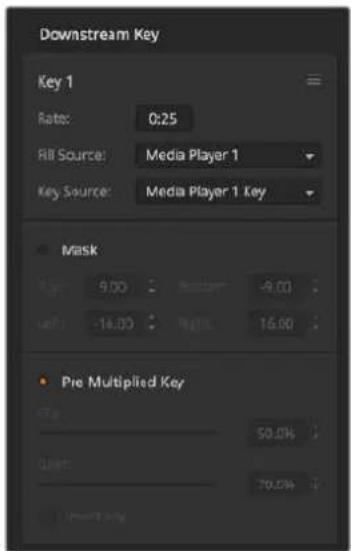
text_image
Downstream Key Key 1 Rate: 0.25 Rill Source: Media Player 1 Key Source: Media Player 1 Key Mask 9.00 -9.00 -14.00 Right 16.00 Pre Multiplied Key 50.0% 70.0%Downstream Keyer Settings
Setting up a Luma/Linear Key on the Downstream Keyer using ATEM 1 M/E Advanced Panel
1 Press the 'DSK 1 tie' button to enable the downstream keyer on the preview output. This automatically selects the downstream key menu on the system control LCD, but you can also press the 'keyers' button and press the right arrow to enter the menu directly.
2 Press the 'DSK 1' or 'DSK 2' soft button to select which downstream keyer you wish to use. You don't have to select the key type as the downstream keyer is always a luma key.
3 Use the control knobs under the LCD menu to select the fill source and key source. You can also use the corresponding source select buttons to select the fill and key source.
4 Once you have chosen the fill source and key source, use the 'left' and 'right' control buttons to scroll through additional menu screens containing key parameters such as mask, gain, clip, pre multiplied key settings, and more.
Chroma Key
Chroma key is commonly used for weather broadcasts, where the meteorologist appears to be standing in front of a large map. In the studio the presenter is actually standing in front of a blue or green background. In a chroma key two images are combined using a special technique and a color from one image is removed, revealing another image behind it. This technique is also referred to as color keying, color-separation overlay, green screen, or blue screen.
A very common use for chroma keys for backgrounds is computer generated graphics. It's simple to connect an external computer to your ATEM switcher using the HDMI output of the computer or a video card such as the Blackmagic Design DeckLink or Intensity range and then play back video clips to your ATEM switcher. If you render a green background on your animations, you can then key this green to create fast and clean animations of any length. Keying is easy as the green is computer generated so it's a very flat color that's easy to key.

text_image
Background + Fill = Key Mask = Combined OutputCombining a background with a fill and chroma key mask
Background
A full screen image; in the case of a chroma key it is often a weather map.
Fill
The image you plan to display on top of your background video. In the case of a chroma key, this is video of the meteorologist in front of the green screen.
Key/Cut
In the case of a chroma key the key/cut signal is generated from the fill signal.
Performing a Chroma Key
ATEM Mini features an advanced chroma keyer with detailed chroma sampling and adjustment options. These controls help you achieve the best key, improving the blend of foreground and background so you can create a more convincing visual effect.
To set up a chroma key on the upstream keyer in ATEM Mini Extreme:
1 Select the K1CHR button in the select bus.
2 Select the fill source from the select bus.
You can now refine your chroma key using ATEM Software Control.
To set up a convincing chroma key using the advanced keyer:
1 In ATEM Software Control, expand the upstream key palette and select 'chroma' from the key types bar.
2 Select the fill source. Typically, this source would be from a camera facing a presenter in front of a green screen, or a graphic loaded in a media player.
3 Click the 'chroma sample' button. With the chroma sample selected, you'll see a new panel appear with a box cursor. This cursor is also visible on the preview output.
4 Click and drag on the box cursor to move it to the position you want to sample.
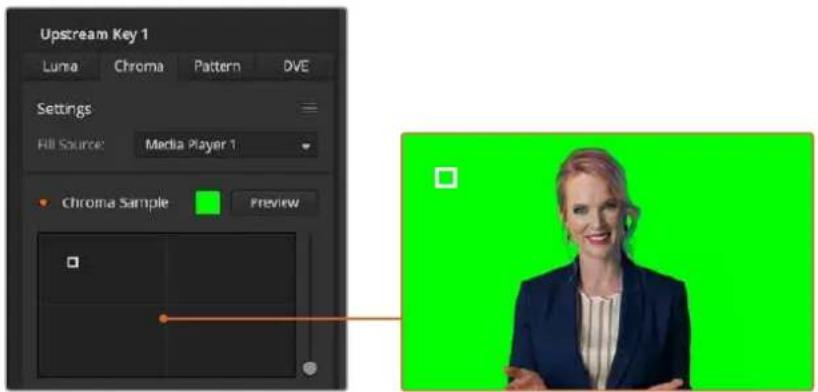
text_image
Upstream Key 1 Luma Chroma Pattern DVE Settings Fill Source Media Player 1 Chroma Sample PreviewThe chroma sample setting lets you position a cursor over the screen area you want to sample
Choose a representative area of your green screen that covers as much of the luminance range of the screen as possible. The default size of the box cursor is well suited to most green screens that are relatively evenly lit, however if there is a lot of variance in your green screen, you can adjust the size of the box by clicking on the slider to the right of the sample window and dragging it up or down.
TIP When sampling uneven green screens, we recommend sampling the darkest area first before increasing the size of the sample box. This can give you a more accurate key.
NOTE You can preview your key on the preview output via HDMI at any time by clicking the 'preview' button above the chroma sample panel. This shows you the final composited version of your chroma key effect on the preview.
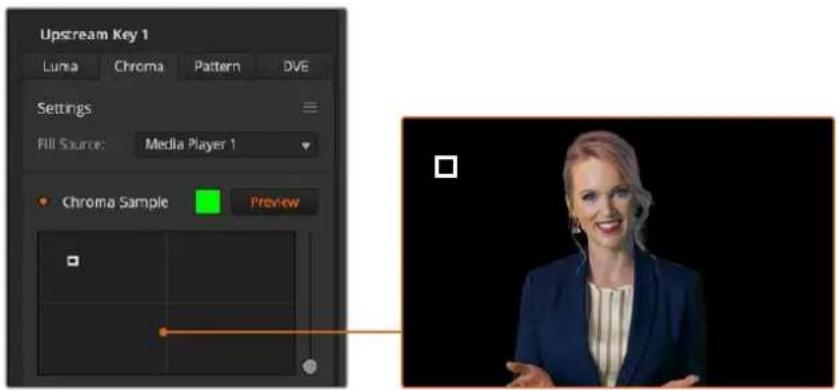
text_image
Upstream Key 1 Lunia Chroma Pattern DVE Settings Fill Source: Media Player 1 Chroma Sample PreviewClick the preview button to check the final composite on the preview output
Fine Tuning your Key using Key Adjustments
Once you have achieved a good chroma sample that removes most of your green screen while generally retaining foreground elements, its time fine tune your key with the 'key adjustments' controls.
Foreground
Use the 'foreground' slider to adjust how opaque the foreground mask is. This determines the strength of the foreground against the background. By increasing the slider, you can fill in any small areas of transparency inside your foreground image. We recommend moving this slider and stopping as soon as the foreground becomes solid.
Background
The 'background' slider adjusts the opacity of the keyed area. Use this slider to fill in any small foreground artifacts left over in the area of the image you want to remove. We recommend moving the slider until your keyed area is consistently opaque.
Key Edge
The “key edge” slider moves the edge of your keyed area in or out, helping to remove background elements from the very edge of your foreground or extending the foreground out a little if your key is too aggressive. This can be especially useful with fine details like hair. We recommend moving this slider until the edge of your key is generally clean, without any background artifacts visible.
Using the key adjustment controls, your foreground elements should be cleanly separated from the background.
Chroma Correction using Color Spill and Flare Suppression
Light bouncing off a green screen can create a green edge to foreground elements as well as a general tint to the foreground, or fill image. This is called color spill and flare. The 'chroma correction' settings let you improve the areas of the foreground that are affected by color spill and flare.
Spill
Adjust the spill slider to remove colored tint from the edges of foreground elements. For example, green reflections bouncing off a green screen.
Flare Suppression
Flare suppression removes overall green tint evenly across all foreground elements.
Matching your foreground and background
Once your foreground is properly separated from your green screen, and you have adjusted spill and flare suppression, use the 'color adjustments' controls to match your foreground with the background. Adjusting the brightness, contrast, saturation, and color balance of your foreground image will help blend it with the background so the effect is more convincing.
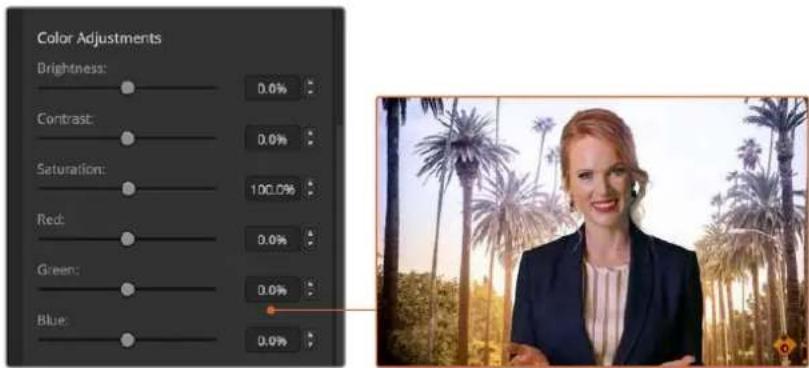
text_image
Color Adjustments Brightness: 0.0% Contrast: 0.0% Saturation: 100.0% Red: 0.0% Green: 0.0% Blue: 0.0%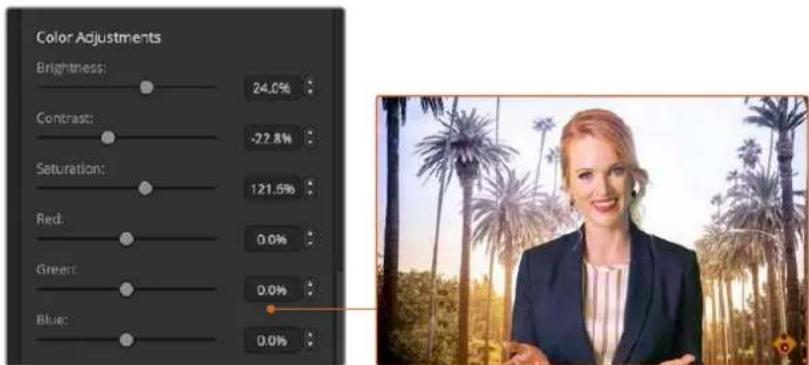
text_image
Color Adjustments Brightness: 24.0% Contrast: .22.8% Saturation: 121.5% Red: 0.0% Green: 0.0% Blue: 0.0%Use the color adjustments controls to match your foreground with the background
TIP When your key is on air, chroma sampling and preview are locked. While most controls are adjustable while on air, we recommend avoiding changes unless absolutely required. For example making defined color adjustments if conditions change unexpectedly.
Pattern Key
A pattern key is used to display a geometric cut out of one image on top of another image. In a pattern key the key or cut signal is generated using the switcher's internal pattern generator. The internal pattern generator can create 18 shapes that can be sized and positioned to produce the desired key signal.

text_image
Background + Fill + Pattern = Combined OutputCombining a background with a fill and pattern key
Background
A full screen image.
Fill
Another full screen image you wish to overlay on top of the background.
Key/Cut
In the case of a pattern key the key/cut signal is generated by the switcher's internal pattern generator.
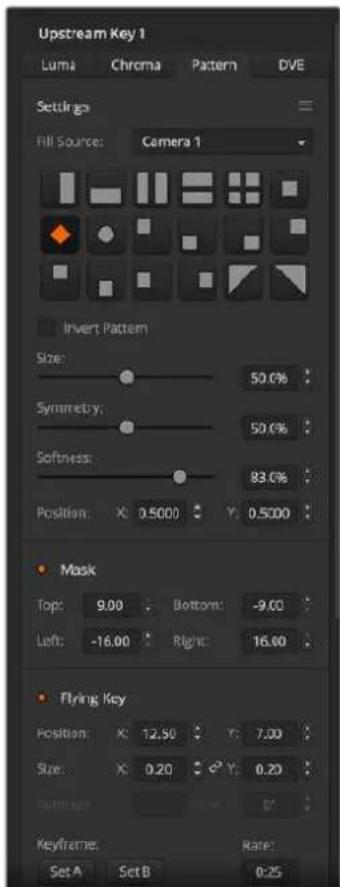
text_image
Upstream Key 1 Luma Chroma Pattern DVE Settings Fill Source: Camera 1 Invert Pattern Size: 50.0% Symmetry: 50.0% Softness: 83.0% Position: X: 0.5000 Y: 0.5000 Mask Top: 9.00 Bottom: -9.00 Left: -16.00 Right: 16.00 Flying Key Position: X: 12.50 Y: 7.00 Size: X: 0.20 Z: 0.20 Keyframe Rate: Set A Set B 0:25Pattern Key Settings
To set up a pattern key on the upstream keyer in ATEM Mini Extreme:
1 Select the K1PTN button in the select bus.
2 Select the fill source from the select bus.
You can now adjust your pattern settings including selecting the key pattern using ATEM Software Control.
To set up a pattern key on the upstream keyer in ATEM Software Control:
1 Expand the upstream key palette and select pattern from the key types bar.
2 Select the fill source.
3 Select the key pattern.
4 Adjust the key parameters to refine the key. For a description of pattern key parameters, refer to the table below.
Pattern key parameters:
Invert Pattern This button inverts which the region is filled with the fill source.
For example, fill a region outside of a circle by positioning the circle wipe as desired and then setting invert pattern to 'on'.
Size Increases and decreases the size of the selected pattern.
| Symmetry Some patterns may have their symmetry or aspect ratio adjusted.Circle patterns may be adjusted to become horizontal or vertical ellipses. |
| Softness Changes the softness of the edge of the key signal. |
| Position X and Y These settings let you change the position of the pattern on the screen. |
| Mask Allows you to mask out sections of the key. For example, if the green screen does not fill the edges of the screen, you can use the mask setting to select only the area of the screen you want to use.To return the mask to its default symmetrical settings, select 'reset mask' and press the set button. |
Setting up a Pattern Key on the Upstream Keyer using ATEM 1 M/E Advanced Panel
1 Press the KEY 1 next transition button to enable the key on the preview output. This automatically selects the keyers menu on the system control LCD. Pressing the KEY 1 next transition button ties the key to the next transition so it will transition to air when the next transition is performed.
2 In the keyers LCD menu, select the 'pattern' key type using the corresponding 'key type' control knob.
3 Select the fill source using the corresponding soft control knob or by pressing a source button on the source select bus.
4 Turn the corresponding soft control knobs to choose the 'pattern' you want for the pattern key and set the 'size' of the pattern.
5 Press the system control left and right arrow buttons to navigate through the pattern key parameters, and adjust settings using the control knobs. Watch the preview output as you refine the key.
TIP Some patterns can have their center point repositioned. Use the joystick to move the position of the pattern. If you need to reset the position, navigate to the 'pattern type' setting, change it to another pattern, and then return to your chosen pattern to rest the position to its default.
DVE Key
DVEs, or digital video effects, are used to create picture-in-picture boxes with borders. ATEM Mini has 1 channel of 2D DVE that allows scaling, rotation, borders and offers a drop shadow.

Combining a background, DVE fill and DVE key/cut
Background
A full screen image.
Fill
Another full screen that has been scaled, rotated or has added borders and will be overlaid on top of the background.
Key/Cut
In the case of a DVE key, the key/cut signal is generated by the switcher's internal DVE processor.
To set up a DVE key on upstream keyer 2 on ATEM Mini Extreme:
1 Select the DVE2 button from the select bus.
2 Select the fill source from the select bus.
3 To adjust the key parameters to refine the key, select upstream keyer 2 in ATEM Software Control and select the DVE tab.
To set up a DVE key on the upstream keyer in ATEM Software Control:
1 Expand the upstream key palette and select the DVE tab.
2 Select the fill source.
3 Adjust the key parameters to refine the key. For a description of DVE key parameters, refer to the information below.
Adjusting the x/y position of the DVE
You can independently adjust the x and y positions of the DVE using the position X and Y settings, or you can tie X and Y parameters together so adjusting one will automatically adjust the other. To achieve this, simply enable the 'tie X and Y' setting.
This also applies to the size parameters.
DVE parameters
| Size X Adjusts the horizontal size of the DVE. |
| Size Y Adjusts the vertical size of the DVE. |
| Reset DVE Resets the DVE to screen. Useful if you lose track of the DVE during adjustment. |
Adding DVE Borders
DVE border parameters
The upstream key LCD menu is used to adjust the border parameters for the DVE and picture in picture.
| Border Enables or disables the border. | |
| Color This item appears | grayed out because it is not a setting, but ratheran indicator to show you the selected border color. You can use thisindicator to quickly verify the color of the DVE border. |
| Hue Changes the border color. The hue value is a location on the color wheel. | |
| Saturation Changes the intensity of the border color. | |
| Luminance Change the brightness of the border color. | |
| Style Sets the bevel style for the DVE border. | |
| Outer Width Adjusts the outside width of the border. | |
| Inner Width Adjusts the inside width of the border. | |
| Outer Soften Outside softness adjusts the outside edge of the border, the edge that touches the background video. | |
| Inner Soften Adjusts inside softness. This softness parameter adjusts the inside edge of the border, the edge that touches the video. | |
| Border/Shadow Opacity | Opacity adjusts the transparency of the border and shadow, use this setting to create interesting colored glass borders. |
| Bevel Position Adjusts the position of the 3D bevel on the border. | |
| Bevel Soften Bevel softness adjusts the overall softness of the 3D border. A high value for this parameter will result in a rounded or beveled border. | |
DVE shadow light source parameters
| Enable Shadow Enables or disables the drop shadow. | |
| Angle Adjusts the direction of the light source on the DVE or picture in picture.Both the border and drop shadow, if available, are affected by changes to this setting. | |
| Altitude Adjusts the distance of the light source from the DVE or picture in picture.Both the border and drop shadow, if available, are affected by changes to this setting. |
Setting up a DVE Key on the Upstream Keyer using ATEM 1 M/E Advanced Panel
1 Press the KEY 1 next transition button to enable the keyer on the preview output.
2 In the keyers LCD menu, select the DVE key type using the corresponding soft control knob.
3 Select the fill source using the corresponding control knob or via the a source button on the source select bus.
4 Press the system control left and right arrow buttons to navigate through the DVE parameters, and use the soft control knobs to adjust settings, such as rotation, position, size, mask settings, light source, border, and key frames for movement.
Key Masking
Both upstream and downstream keyers have an adjustable rectangular mask that can be used to crop out harsh edges and other artifacts in the video signal. The mask consists of left, right, top and bottom crop controls. Masking can also be used as a creative tool to build rectangular cut outs on screen.
The mask can be adjusted using the mask settings in the switcher's LCD menu, or via the upstream and downstream keyer palettes in ATEM Software Control.
Flying Key
Luma, chroma and pattern upstream key types include a flying key setting. If a DVE channel is available the flying key setting allows DVE effects to be applied to the key.
Performing Upstream Keyer Transitions
Performing an upstream keyer transition in ATEM Software Control:
The upstream keyer is taken on and off the program output using the 'next transition' control buttons in ATEM Software Control.
Key 1
Take the upstream keyer on or off the program output by clicking the 'on air' button. You will notice this is also reflected by the 'key' button on ATEM Mini's control panel.
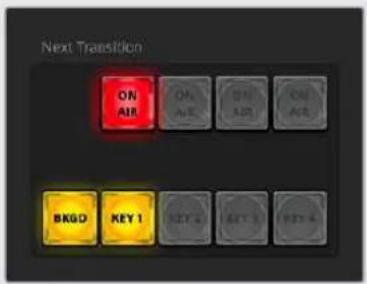
text_image
Next Transition ON AIR ON A/B ON AIR ON AIR BKS0 KEY 1 KEY 4 KEY 3 KEY 4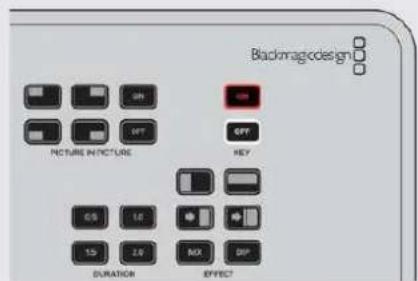
text_image
Blackmagcodegn PICTURE IN PICTURE KEY DURATION EFFECTChanging the 'on air' setting in the LCD menu also changes the state of the 'on air' next transition button in ATEM Software Control
Upstream Key Example
Example 1
In this example the upstream keyer is not currently on air. The next transition is set to 'on', therefore the next transition will change the state of the key and turn it on so that it is visible on the program output. On ATEM Software Control, the corresponding KEY 1 next transition button will also illuminate.
natural_image
Soccer goalkeeper in action at the goal with a soccer ball visible (no text or symbols)
natural_image
Soccer match scene with a goalkeeper diving near the goal, no visible text or symbolsExample 2
In this example, the key is currently on air, indicated by the 'key' setting set to 'on air'. The next transition setting is also selected, therefore the next transition will change the state of the key and turn it off so that it is not visible on the program output.
natural_image
Soccer player in action shot with a goal net, wearing a cap and goggles (no visible text or symbols)
natural_image
Soccer goalkeeper in mid-air hitting the goal, wearing a helmet with red patches (no visible text or symbols)Example 3
In this example, the key is on air, indicated by the software control panel's illuminated ON AIR next transition button. The BKGD and KEY 1 next transition buttons are also illuminated, therefore the background and the upstream key are tied to the next transition. The next transition will transition the background and change the state of the key turning it off so that it is not visible on the program output.
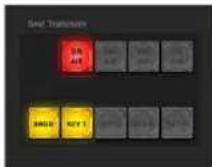
natural_image
Soccer player in action shot with goal net, no visible text or symbols
natural_image
Soccer player standing at the goal with a soccer ball in front (no visible text or symbols)There are multiple ways to transition a key to the program output. The key can be cut on or off, it can be mixed on or off, or it can be mixed along with a background transition. Upstream keys are transitioned to the program output using the next transition controls. Downstream keyers can be transitioned using their own transition buttons or by using the DSK TIE buttons to link the transition with the main transition.
DSK parameters
| Tle Switches the DSK TIE button for the respective keyer on or off. |
| Rate The mix rate at which the downstream keyer transitions on or off. |
| Key Switches the respective DSK CUT button on or off. |
| Auto Enables the respective DSK AUTO button to transition the keyer on air. |
| Fill Source Selects the source to be keyed. |
| Key Source Selects the cut source which masks the fill source. |
| Pre Multiplied Key Identifies the key signal as a pre-multiplied key. |
| Clip The clip level adjusts the threshold at which the key cuts its hole.Decreasing the clip level reveals more of the background. If the background video is completely black then the clip value is too high. |
| Gain The gain adjustment electronically modifies the angle between on and off thereby softening the edges of the key. Adjust the gain value until the edge softness is desirable but the background video luminance, or brightness, is not affected. |
Invert Key Inverts the key signal.
Mask Allows you to mask out sections of the key. For example, if you need to
select only a specific section of a graphic, you can use the mask setting to select only the area of the graphic you want to use. To return the mask to the default settings, select 'reset mask' and press the set button.
Creating Video Links with ATEM Streaming Bridge
The ATEM Streaming Bridge allows you to decode the streaming video from any ATEM Mini Pro or Extreme and convert it back to SDI or HDMI video. It allows you to send video over your local network, or to anywhere in the world via the internet.
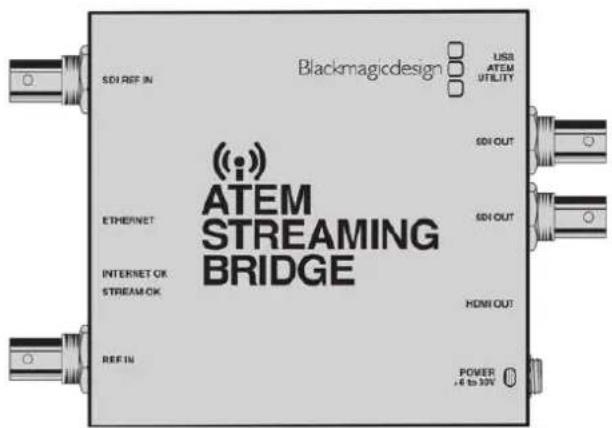
text_image
SDI REF IN Blackmagicdesign USB ATEM UTILITY (S) ATEM STREAMING BRIDGE ETHERNET SDI OUT INTERNET OK STREAM OK SDI OUT HDMI OUT REF IN POWER +6 to 30VYou can connect ATEM Streaming Bridge in 3 different ways. One is to connect it direct to your switcher using a simple Ethernet cable, or you can connect it via your local network, or you can use it anywhere in the world using the Internet.
Direct Connection
The simplest way to get ATEM Streaming Bridge operating is to plug it into an ATEM Mini Pro or Extreme switcher with a simple Ethernet cable. The switcher will see it and automatically send video to it when you press the on air button.
Setting up a direct connection
1 Plug power into ATEM Streaming Bridge
2 Connect an Ethernet cable to the ATEM Streaming Bridge.
3 Connect a television to the HDMI on ATEM Streaming Bridge.
4 Connect the other end of the Ethernet cable to the switcher.
5 Press the On Air button on the switcher.
Now you should see video appear on the HDMI television connected to ATEM Streaming Bridge.
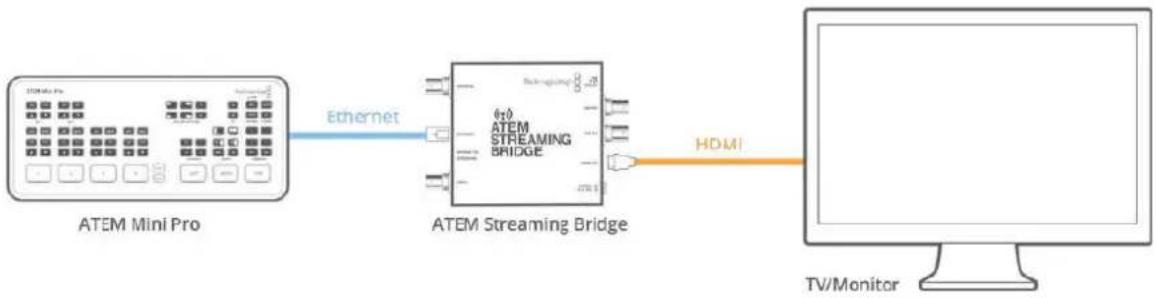
flowchart
graph LR
    A["ATEM Mini Pro"] -->|Ethernet| B["ATEM Streaming Bridge"]
    B -->|HDMI| C["TV/Monitor"]
Network Connection
You can also connect ATEM Streaming Bridge to your network and place it anywhere in your building. This can be useful when you want to live stream to a conference room, or a video projector. As there might be more than one ATEM Streaming Bridge on your network, the main difference is you will need to select the ATEM Streaming Bridge in your ATEM Mini Pro or Extreme switcher's network settings. This will ensure your switcher knows what streaming bridge it needs to send its video data to.
Setting up a network connection
1 Plug power into ATEM Streaming Bridge
2 Connect the ATEM Streaming Bridge Ethernet to your network.
3 Connect a television to the HDMI on ATEM Streaming Bridge.
4 Ensure your ATEM Mini Pro or Extreme switcher is connected to the same Ethernet network.
5 Connect ATEM Software Control to control your switcher.
6 Open the streaming palette and click the platform menu.
7 Confirm the ATEM Streaming Bridge is listed in the menu.
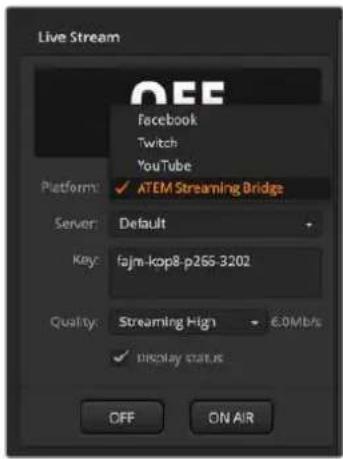
text_image
Live Stream OEE Facebook Twitch YouTube Platform: ✓ ATEM Streaming Bridge Server: Default Key: fajm-kop8-p265-3202 Quality: Streaming High 6.0MHz ✓ display status OFF ON AIR8 Select the ATEM Streaming Bridge in the platform menu.
9 Press On Air button on the ATEM Mini Pro or Extreme switcher.
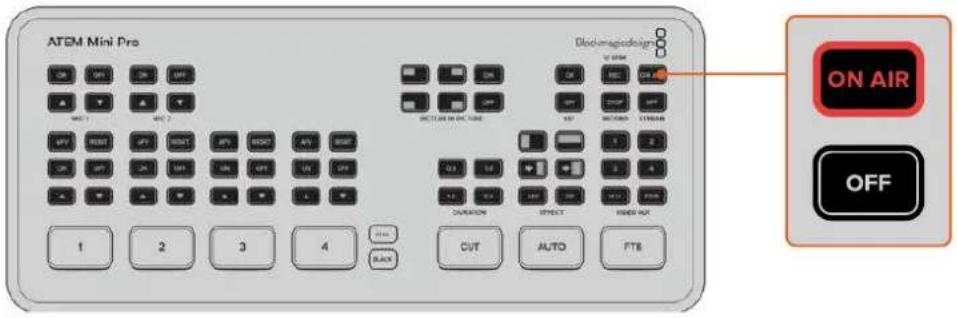
text_image
ATEM Mini Pro On AIR OFFNow you should see video appearing on the HDMI Television.
Network Status Indicators
There are 4 lights on the ATEM Streaming Bridge that provide information on the state of the network connection. The 2 LEDs on the Ethernet connector will show the state of the connection itself. The right orange LED indicates the network is up and connected ok. The left green LED will show network activity.
The INTERNET OK indicator will illuminate when the ATEM Streaming Bridge can see the Internet. It indicates your Internet connection is ok and the port forwarding has been setup correctly.
The STREAM OK indicator shows the ATEM Streaming Bridge is receiving streaming data from an ATEM Mini Pro or Extreme switcher. If you don't see images out of the video connections but this LED is illuminated then you might have a problem with your video connections. Try connecting a monitor direct to the SDI or HDMI outputs of your ATEM Streaming Bridge.
ATEM Streaming Bridge does not appear
If the ATEM Streaming Bridge does not appear in the list, then it's important to confirm both the ATEM Streaming Bridge and the ATEM Mini Pro or Extreme switcher are on the same Ethernet network.
If the ATEM Streaming Bridge still does not appear, then it could be an issue with the network settings in the ATEM Streaming Bridge itself. This can happen if the ATEM Streaming Bridge has been used by someone before you and they could have changed its network settings.
As new from the factory the ATEM Streaming Bridge is set to DHCP so it should connect to your network without any settings changes required, but if it's been changed, then you will need to check its network settings. You can change the ATEM Streaming Bridge settings using the ATEM Setup software.
Connecting ATEM Setup software
The ATEM Setup software is found in the Blackmagic ATEM Switchers folder. It's the same software you can use to set up your ATEM switchers and it also handles updating software in your ATEM switchers as well as the ATEM Streaming Bridge.
Simply plug your ATEM Streaming Bridge USB-C connection to your computer and then run the ATEM Setup software. You should see the ATEM Streaming Bridge as one of the devices you can connect to in the ATEM Setup. Click the ATEM Streaming Bridge icon to open the settings.
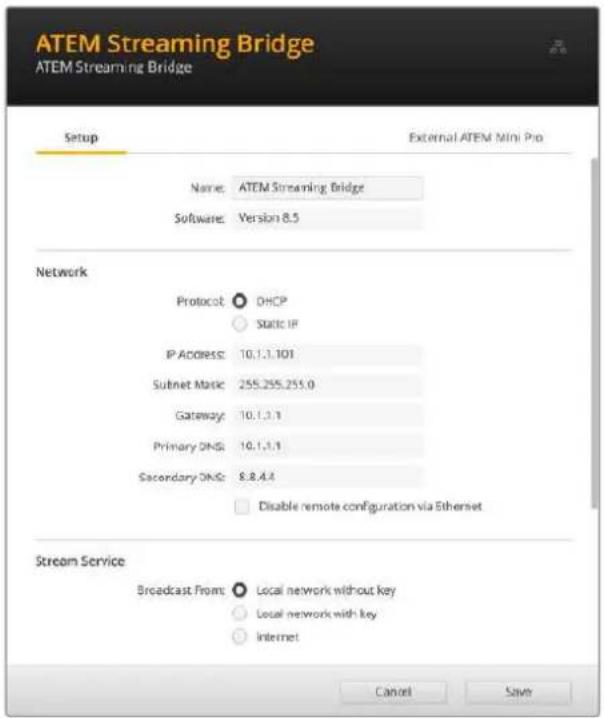
text_image
ATEM Streaming Bridge ATEM Streaming Bridge Setup External ATEM Mini Pro Name: ATEM Streaming Bridge Software: Version 8.5 Network Protocol: DHCP Static IP IP Address: 10.1.1.101 Subnet Mask: 255.255.255.0 Gateway: 10.1.1.1 Primary DNS: 10.1.1.1 Secondary DNS: 8.8.4.4 Disable remote configuration via Ethernet Stream Service Broadcast From: Local network without key Local network with key Internet Cancel SaveClick the ATEM Streaming Bridge icon in ATEM Setup to open the settings
Now you can see information such as the ATEM Streaming Bridge name and the network settings. If you are connecting via the local network, then most of the time you can select DHCP. This will let your ATEM Streaming Bridge find its network address on the network automatically and this is how most people connect their computers to a local network. With DHCP the network itself will take care of the correct network settings for anything connected to it. It's the easiest way to connect.
However if you have a network administrator, it's possible your network might have custom IP addresses for all the equipment connected to it. It's best to check with your network administrator if they are managing your computers and network in your company.
Now you have the ATEM Streaming Bridge set to DHCP, try looking at the platform menu on the ATEM Mini Pro or Extreme switcher again to see if the ATEM Streaming Bridge has appeared in the list. The switcher should automatically see the ATEM Streaming Bridge on your network.
Changing the ATEM Streaming Bridge name
While you are using the ATEM Setup, it's a good idea to give your ATEM Streaming Bridge a custom name. If you are using it on a projector in a public space in your building, perhaps call it "Main Projector" or if you are using it for a large television in a conference room, perhaps call it "Conference Room 3" or similar. This means when you have more than one ATEM Streaming Bridge, you can tell which one is which.
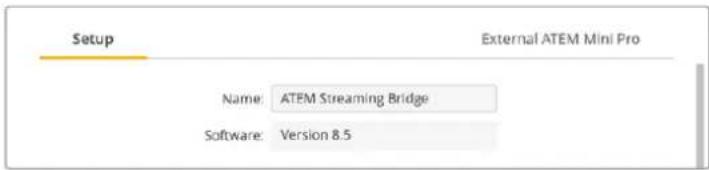
text_image
Setup External ATEM Mini Pro Name: ATEM Streaming Bridge Software: Version 8.5Setting a streaming key
Because anyone can stream to any ATEM Streaming Bridge in the menu, it might be a good idea to set a streaming key to stop anyone crashing into your video link! It's so easy to select any ATEM Streaming Bridge on your network, that it could become chaos of everyone streaming over the top of everyone else.
This is not an issue as you can set a streaming key. This is a password that stops anyone from accessing your ATEM Streaming Bridge. While running the ATEM Setup, you can see the streaming key text entry field. Simply type in a password here, and then only ATEM Mini Pros that have the same streaming key in their streaming settings will be allowed to connect to this ATEM Streaming Bridge.
You can set a password of your choice, but there is also a password generator button in the ATEM Setup so you can ask the computer to generate a good secure password. You can just copy and paste this password to who you want to connect to you. Once they enter it into their ATEM Mini Pro or Extreme switcher, only they will have permission to connect to this ATEM Streaming Bridge.
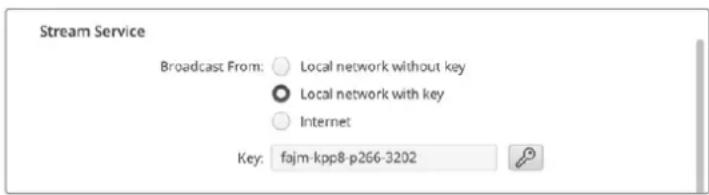
text_image
Stream Service Broadcast From: Local network without key Local network with key Internet Key: fajm-kpp8-p266-3202Clicking the generate key button will automatically generate a password for your stream
Remote Administration
While we are suggesting you connect via USB to update settings in the ATEM Streaming Bridge, you can also connect via Ethernet over your local network. However this can create a security issue where someone could run the ATEM Setup and change the ATEM Streaming Bridge settings. To increase security, there is a setting to disable remote administration via Ethernet so you can only change the ATEM Streaming Bridge via a direct USB connection.

Disable remote configuration via Ethernet
Disable remote configuration via Ethernet if you want to change settings via USB only
Internet Connection
The most exciting way to connect ATEM Streaming Bridge is via the Internet. This is a little more tricky, because you have to make sure an ATEM Mini Pro or Extreme switcher can find the ATEM Streaming Bridge, from anywhere in the world. It's a big world, so there is a few more settings you will need to update to make this work.
However because ATEM Mini Pro and Extreme switchers have a broadcast quality hardware streaming engine built in, we can take advantage of this and get very good quality video links worldwide. This allows you to set up a network of studios who can stream to each other.
What you need
To connect to the Internet, you will need a connection to the Internet from both your ATEM Streaming Bridge and the ATEM Mini Pro or Extreme switcher that will stream to it. You will also need to have a public IP address for your ATEM Streaming Bridge as your switcher needs to connect to it, and you need a fixed address that won't change over time.
The problem is your ATEM Streaming Bridge is on your local Ethernet network, however you need it to be visible on the internet. ATEM Streaming Bridge uses port forwarding in your internet firewall to allow the ATEM Mini Pro or Extreme switcher on the internet to connect via your internet connection to the ATEM Streaming Bridge. If this is not set up, then the ATEM Mini Pro or Extreme switcher won't be able to find the ATEM Streaming Bridge.
What this means is you need to ask an internet provider, or your network administrator to set up port forwarding on your internet connection to "TCP port 1935". They will know what that means!
The good news is the ATEM Streaming Bridge will also attempt to set up this port forwarding feature for you, as most internet connections and firewalls have a protocol for setting up the port forwarding automatically. This means it's possible the ATEM Streaming Bridge will communicate with your network gear and try and set this up for you as you set up using the ATEM Setup utility.
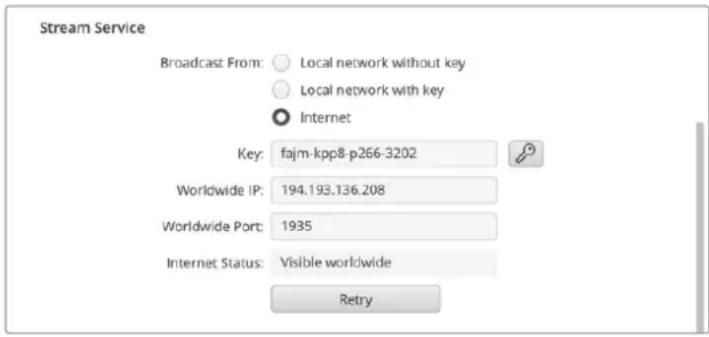
text_image
Stream Service Broadcast From: Local network without key Local network with key Internet Key: fajm-kpp8-p266-3202 Worldwide IP: 194.193.136.208 Worldwide Port: 1935 Internet Status: Visible worldwide RetryConfirming access to the internet
You will notice lower down there is a connection status field. The ATEM Streaming Bridge will attempt to connect to the internet and let you know if everything looks like it's functioning correctly. If it changes to connected, then this is a good sign, as it means the ATEM Streaming Bridge has been able to set up your network equipment with the port forwarding settings and connect to the internet ok.
NOTE Opening up ports in your network for outside traffic could reduce your network security so it is best to check with your internet provider or network administrator if you have any security concerns.
If the connection status does not say visible worldwide you might need to configure the port forwarding on your internet firewall manually. Not all firewalls support the protocol for automatically setting up this kind of information, but they do all support setting it up manually.
You may need to contact your internet service provider if you cannot access the router controls or do not know how to configure port forwarding. On larger networks it is best to speak to your network administrator for setting up port forwarding as this will make sure there are no conflicts on your network.
Connection Status
While setting up the network connection, the connection status feature can help you sort out any problems. Some of the information it can show and the cause of the problem are listed below.
| Visible Worldwide | This is a good sign, and it means everything looks to be working correctly. It means port forwarding is set up and working and ATEM Streaming Bridge is ready to receive a video stream from the Internet. |
| No Internet Access | This indicates the ATEM Streaming Bridge cannot connect to the internet. You will need to check your network settings and internet connection. |
| Port Forwarding Error | This indicates that you could be connected to the internet, but the port forwarding in your internet firewall was not able to be set up via the ATEM Streaming Bridge, so it's not reachable from the internet. You will need to ask your network administrator to set this up for you. |
| UPnP error | This weird error message also means ATEM Streaming Bridge is unable to set up port forwarding on the internet router. You will need to ask your network administrator to set this up for you or you will need to consult the router's documentation to set up port forwarding. |
Connecting to ATEM Mini Pro or ATEM Mini Extreme
The best way to think about the internet connection is to understand that out in the world somewhere, an ATEM Mini Pro or Extreme switcher wants to connect to the ATEM Streaming Bridge you are currently setting up. It could be anywhere in the world and so how do you make sure that remote ATEM Mini Pro or Extreme switcher can connect to this ATEM Streaming Bridge?
It can be complex to try and explain network settings to a remote studio over the phone,or in a message, so we have made this process very easy.
In the ATEM Setup, there is an ATEM Mini Pro tab that allows you to see the settings required in the remote studio and you can set up the remote ATEM Mini Pro right here. Once you have the settings confirmed, you can export and email them to the remote ATEM Mini Pro.
There is not really many settings to do, because most of them are copied across from the main ATEM Streaming Bridge settings. This assumes you have the ATEM Streaming Bridge connected to the internet and everything is working ok with the port forwarding feature of your firewall, as described above.
Creating remote ATEM Mini Pro settings
1 In the ATEM Setup ensure the network settings are correct.
2 Select the ATEM Mini Pro tab in the top right of the window.
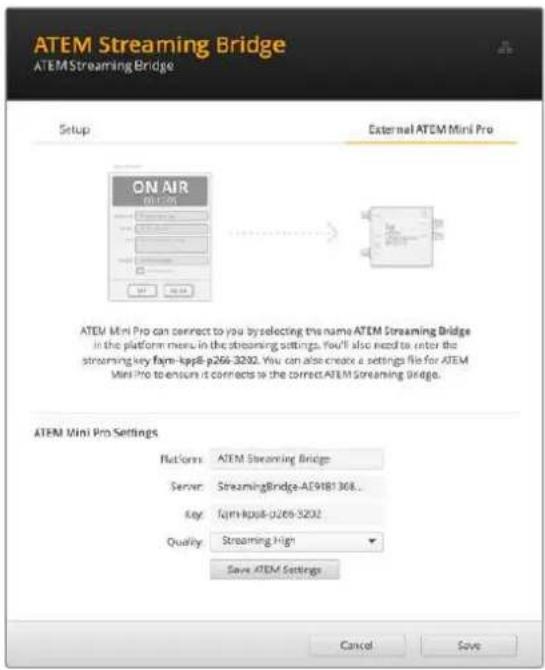
text_image
ATEM Streaming Bridge ATEM Streaming Bridge Setup External ATEM Mini Pro ON AIR ON AIR ATEM Mini Pro can connect to you by selecting the name ATEM Streaming Bridge in the platform menu in the streaming settings. You'll also need to enter the streaming key fqm-kp8-0266-3202. You can also create a settings file for ATEM Mini Pro to ensure it connects to the correct ATEM Streaming Bridge. ATEM Mini Pro Settings Platforms: ATEM Streaming Bridge Server: StreamingBridge-AE9181 368.. Key: fqm-kp8-0266-3202 Quality: Streaming High Save ATEM Settings Cancel Save3 Select a custom name for the service.
4 Select the quality you want to stream.
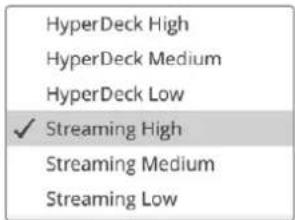
text_image
HyperDeck High HyperDeck Medium HyperDeck Low ✓ Streaming High Streaming Medium Streaming Low5 Select the export settings button to create a settings file.
6 Email this settings file to the person using the remote ATEM Mini Pro.
This settings file is what you will send to the remote ATEM Mini Pro and it has all the settings contained in it so the remote ATEM Mini Pro knows where to find this ATEM Streaming Bridge.

ATEM Streaming
Bridge.xml
It's worth noting that this file is a very similar kind of XML file used on ATEM Mini Pro for its streaming services. More technically qualified people can even open and make changes to this file if you have a unique or custom setup.
The name you give the service will be the name listed in the platform menu in the remote ATEM Mini Pro streaming settings. The quality setting will set the remote quality setting in the ATEM Mini Pro.
Remote ATEM Mini Pro
Now you have this settings file and have emailed it to the person using the remote ATEM Mini Pro, there is a few things they need to do. These steps are quite simple, so it should be very easy for the remote ATEM Mini Pro studio to get these settings loaded.
All the remote studio needs to do is go to the ATEM Software Control and select load streaming settings in the stream menu at the top of their screen.
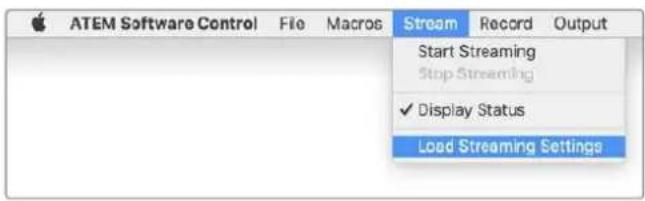
text_image
ATEM Software Control File Macros Stream Record Output Start Streaming Stop Streaming ✓ Display Status Load Streaming SettingsOnce loaded, a new service will be added to the platform menu in the streaming settings. They just need to select this menu and press on air to start streaming.
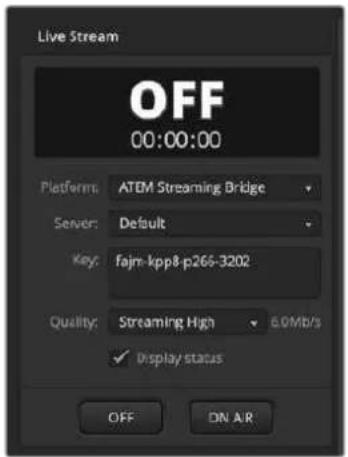
text_image
Live Stream OFF 00:00:00 Platform: ATEM Streaming Bridge Server: Default Key: fajm-kpp8-p266-3202 Quality: Streaming High 5.0MB/s ✓ Display status OFF DN AIRSelect the ATEM Streaming Bridge from the platform menu in ATEM Software Control's live stream palette
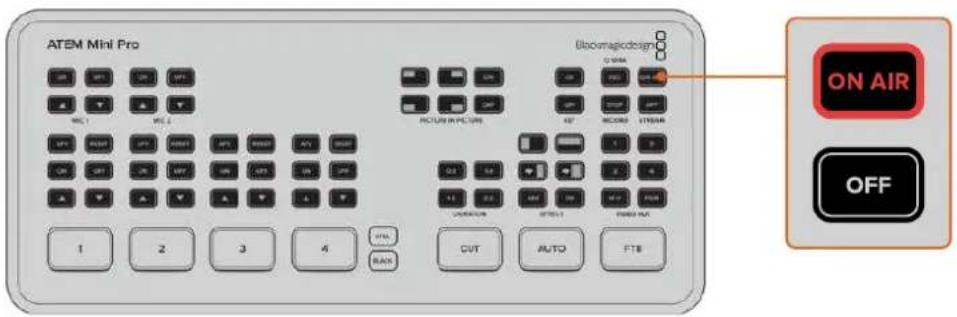
text_image
ATEM Mini Pro Uboomagicdozign ON AIR OFFWhen the ATEM Streaming Bridge has been selected in ATEM Software Control's live stream palette, press the On Air button on the remote ATEM Mini Pro
The on air button should illuminate solid and the remote ATEM Mini Pro should start sending its streaming video data to your ATEM Streaming Bridge. If the on air button is flashing, then it indicates it has not found your ATEM Streaming Bridge or there is a network problem with either the ATEM Mini Pro or ATEM Streaming Bridge end of the link.
Even though a lot of the ATEM Streaming Bridge setup has been designed to be easy and the setups as automatically as possible, such as the port forwarding settings on your internet firewall, the Internet equipment can be horribly complex and it's often so complex it's possible the equipment used on your Internet connection might not have been designed by humans. So don't feel too bad if you cannot make this work! You might need a network administrator or IT person to help if you cannot make it work by yourself.
Broadcast Video Reference
The ATEM Streaming Bridge has both an analog tri-sync and black burst video reference input as well as an SDI input that can be used for reference. Reference is used by large broadcasters who need all the video connections in their facility to be aligned so they can be switched around a large system. There is referencing timing settings in the ATEM Setup.
Factory Reset
If you have become a little lost and you want to reset the ATEM Streaming Bridge back to its default factory settings, then you can select the 'factory reset' button in the ATEM Setup software. This can be useful if you have been using ATEM Streaming Bridge for an internet link and you now want to move it to a new setup using your local network. Just factory reset it and it will be set back to DHCP and you can just connect and find it on your local network.
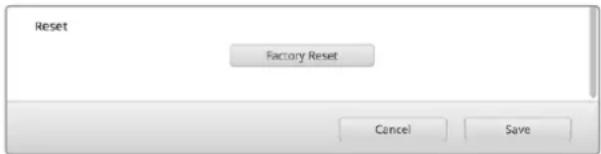
text_image
Reset Factory Reset Cancel SaveClick the reset button to restore ATEM Streaming Bridge to DHCP so it can be found on your network automatically
HyperDeck Control
Introducing HyperDeck Control
When ATEM Mini is connected to a network via Ethernet, you can also connect up to 4 Blackmagic HyperDeck Studio Mini disk recorders and control them using the HyperDecks palette in ATEM Software Control. They can also be controlled from the system control buttons on an external ATEM hardware panel. This is a very powerful feature! With four HyperDecks connected to your switcher, it's like having a portable videotape department able to record outputs from your switcher, play back graphics, or you can even set your switcher to roll prerecorded segments at the press of a button!
Transport controls are located in the HyperDecks palette in ATEM Software Control, or in the system control menu on an external ATEM hardware panel, which let you play back video, jog and shuttle, skip clips, pause and more. You can also record video.
When you combine this feature with ATEM's powerful macros feature, it opens up a world of creative possibilities that can really enhance your live production!
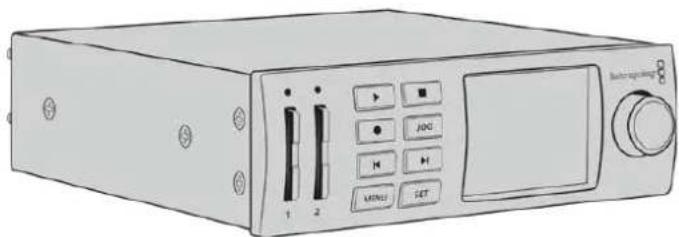
text_image
Line drawing of a portable electronic device with labeled buttons and portsConnecting HyperDecks
Connecting Blackmagic HyperDecks to your ATEM Mini is very similar to connecting cameras and other video sources via your switcher's HDMI inputs. The only additional connection is Ethernet which lets your ATEM Mini communicate with the HyperDeck disk recorder.
1 Using the Ethernet connector, connect your HyperDeck disk recorder to the same network your ATEM Mini is connected to.
2 Enable remote control on HyperDeck Studio Mini by setting the 'remote' setting to 'on' using the LCD menu.
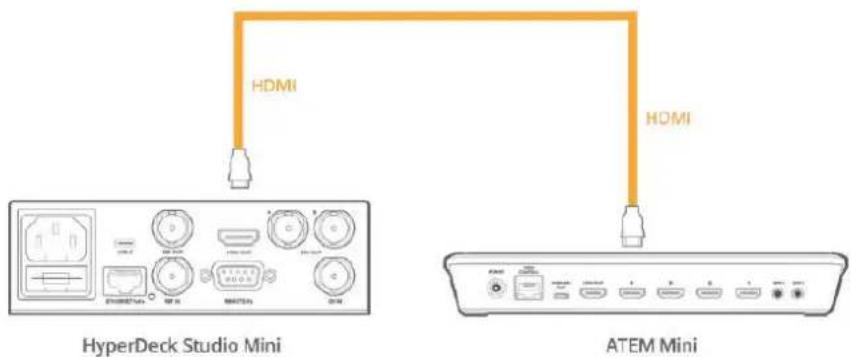
text_image
HDMI HDMI HyperDeck Studio Mini ATEM MiniPlug the HDMI output of a HyperDeck Studio Mini into one of your ATEM Mini's HDMI Inputs
3 Plug the HDMI output of your HyperDeck into one of the HDMI inputs of your ATEM Mini.
4 Repeat the process for each HyperDeck you want to connect.
Now all you have to do is tell ATEM Software Control or ATEM hardware panel which input and IP address each HyperDeck is using. You can do this easily in the HyperDeck tab in ATEM Software Control switcher settings, or using the system control soft buttons or LCD menu on an ATEM hardware panel.
TIP If you want to record the output from your ATEM Mini to a HyperDeck, plug your switcher's HDMI output into the HDMI input of the HyperDeck. Don't forget to route the program output to the HDMI output.
If your HyperDeck only has an SDI input, for example HyperDeck Studio Mini, you can convert ATEM Mini's HDMI output to SDI using a Blackmagic HDMI to SDI converter, such as a Mini Converter HDMI to SDI, or Teranex Mini HDMI to SDI.
HyperDeck Settings
HyperDeck connection settings are located in the 'HyperDeck' tab of the ATEM Software Control switcher settings. Here you'll see setup options for up to four HyperDecks.
Type in your HyperDeck's IP address in the 'IP Address' box and choosing the source it's plugged into from the 'input' menu. Click 'connect' and your HyperDeck is ready to be controlled.
Status indicators appear above and below each HyperDeck icon to let you know the connection status. A green tick means your HyperDeck is connected, in remote and ready to go.
If your HyperDeck is connected and recognized, but does not have its remote button enabled, you will see an indicator letting you know remote is not active.
If your HyperDeck is not recognized, you will see a 'failed to connect' indicator. If you see this indicator, check the HyperDeck's Ethernet port is connected to your network and the IP address is entered correctly.
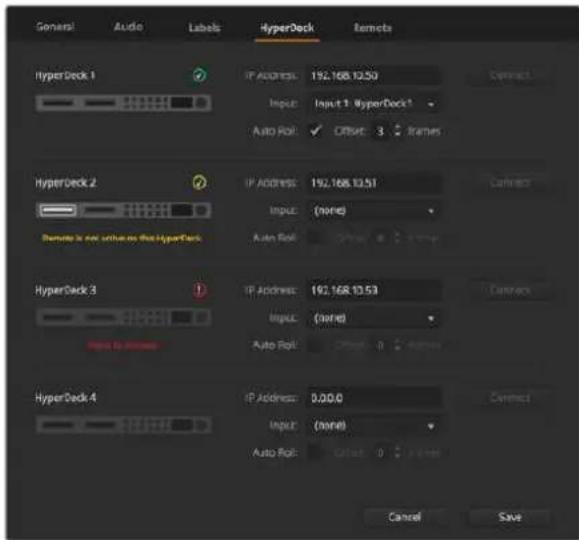
text_image
General Audio Labels HyperDeck Remote HyperDeck 1 IP Address: 192.168.12.50 Input: Input 1 HyperDeck1 Auto Roll: √ Offset: 3 frames HyperDeck 2 IP Address: 192.168.12.51 Input: (none) Auto Roll: None HyperDeck 3 IP Address: 192.168.13.53 Input: (none) Auto Roll: Offset: 0 frames HyperDeck 4 IP Address: 0.00.0 Input: (none) Auto Roll: Offset: 0 frames Cancel SaveAuto Roll
You can set a HyperDeck disk recorder to automatically roll video when it is switched to the program output. For example, you can cue a HyperDeck to the point you want your source to begin, then roll the source by pressing its input button on the mix effects program row.
Auto Roll:

Offset:

frames
As HyperDecks must buffer a couple of frames before commencing playback, the actual cut will be delayed a preset number of frames to ensure a clean transition. This is just like setting a preroll on a videotape machine. You can adjust the length of this delay by changing the number in the 'offset' box. We've found that five frames usually ensures a clean cut.
If you want to cue to a still frame of video or manually trigger video playback on your HyperDeck, you can also deselect the 'auto roll' feature.
Controlling HyperDecks with ATEM Software Control
To control the HyperDecks connected to your switcher, click the 'media player' tab in the software control panel, and choose the 'HyperDecks' palette.
Here you can choose between each of the HyperDecks connected to your system by clicking one of the four buttons along the top of the panel. These are named according to the labels entered in ATEM settings. Available HyperDecks are shown with white text, while the HyperDeck you are currently controlling is shown in orange.
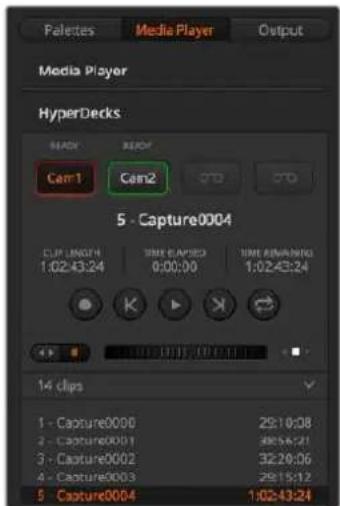
text_image
Palettes Media Player Output Media Player HyperDecks Ready READY Cam1 Cam2 5 - Capture0004 CUP LENGTH TIME CAPSSED TIME REMAINING 1:02:43:24 0:00:00 1:02:43:24 14 clips 1 - Capture0000 29:19:08 2 - Capture0001 30:16:21 3 - Capture0002 32:28:06 4 - Capture0003 29:15:12 5 - Capture0004 1:02:43:24Choose from up to four HyperDecks by clicking their selection buttons in the HyperDecks palette
In addition to the text color, each HyperDeck's selection button also has a tally indicator.
| Green Outline Indicates a HyperDeck that is currently switched to the preview output. |
| Red Outline Indicates a HyperDeck that is currently switched to the program output, meaning it is currently live to air.You may also see one of the following status indicators above the selection buttons for your HyperDecks. |
| Ready HyperDeck is set to remote and a disk is inserted. It is ready for playback and recording if space is available. |
| Record HyperDeck is currently recording. |
| No Disk HyperDeck has no disk inserted. |
| Local HyperDeck is not set to ‘remote’ and cannot currently be controlled by your ATEM switcher. |
When you select a HyperDeck, you'll see information about the currently selected clip such as the name and length, as well as time elapsed and time remaining. Below this you'll see the control buttons.
| Record Click on this button to start recording on your HyperDeck.Click again to stop recording. | |
| Previous Clip Moves to the previous clip in your HyperDeck's media list. | |
| Play Clicking 'play' once initiates playback, clicking it again stops playback. If you have 'auto roll' enabled in your HyperDeck settings, playback will commence automatically when your HyperDeck is switched to the program output. | |
| Next Clip Moves to the next clip in your HyperDeck's media list. | |
| Loop | Click 'loop' once to loop the currently selected clip, and again to loop all of the clips in your HyperDeck's media list. |
To move through a clip use the shuttle/jog slider underneath your HyperDeck's control buttons. This lets you move quickly, or shuttle through a selected clip, or jog frame by frame. You can switch between these modes with the buttons next to the shuttle/jog slider.

natural_image
User interface control bar with playback buttons and volume slider (no text or symbols)Choose between shuttle and jog transport controls with the buttons to the left of the transport slider. Adjust the slider left and right to move forward or backwards through your clip.
The clip list below the transport control shows all of the clips currently available on the selected HyperDeck. You can expand or collapse the list by pressing the arrow to the right of the clip list.
Playback
To play media on your HyperDeck, simply switch the HyperDeck source to the preview output and select the clip you want to show. Use the transport controls to cue to the preferred point in your clip. When you switch your HyperDeck to program output, the 'auto roll' feature will automatically start playback from this point.
If you want to manually trigger the playback, for example holding on a still frame then rolling, simply disable the respective HyperDeck's auto roll checkbox in the 'HyperDeck' tab in ATEM software's 'settings' menu.
Recording
To record to a HyperDeck with a formatted disk inserted, simply press the 'record' button in the HyperDeck palette transport controls. The 'time remaining' indicator in the HyperDeck palette will let you know the approximate recording time remaining in the SSD.
Controlling HyperDecks with External Hardware Panels
If you are using an external ATEM hardware panel, you can control any connected HyperDecks using the hardware panel. Once you have connected your HyperDecks to your ATEM Mini as described in the 'connecting HyperDecks' section, you can use the system control buttons and LED menu on your panel to set up and control each HyperDeck.
HyperDeck Setup with ATEM 1 M/E Advanced Panel
Once you have connected your HyperDeck to your switcher, as detailed in the ‘connecting HyperDecks’ section, use ATEM 1 M/E Advanced Panel’s system control and LCD soft buttons to setup and control your HyperDecks.
To begin, press the system control 'settings' button.
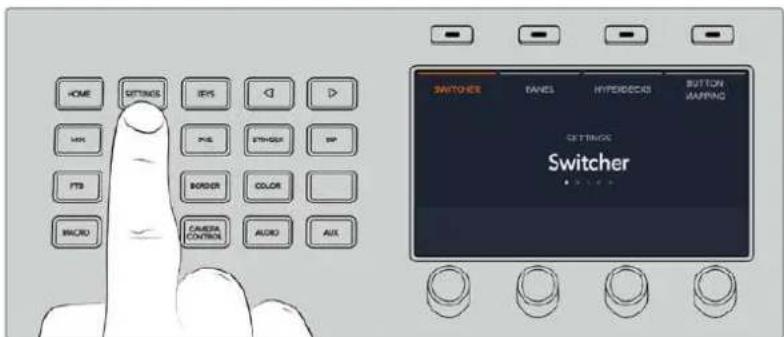
text_image
HOME SETTINGS IPS ◄ ▶ MKS PHL ETPGGR BP PTS BORDER COLOR BACKO CAMERA CONTROL AUDIO AUX SWITCHER FANES HYPERDECAS BUTTON MAPPING OPTIONS SwitcherYou'll notice that ATEM 1 M/E Advanced Panel displays four setup options along to top of the LCD screen. These include 'switcher,' 'panel,' 'HyperDecks,' and 'button mapping.'
Each corresponds to a setup menu. Simply press the LCD soft button above 'HyperDecks' to enter the 'HyperDeck settings' menu.
The HyperDeck settings menu has three pages, which you can select using the 'left' and 'right' arrow buttons in the system control panel, or by pressing the '1,' '2,' and '3' buttons on your ATEM 1 M/E Advanced Panel's numerical keypad.
Assigning an input to a HyperDeck
In the first menu page, you'll see the 'HyperDeck' indicator in the bottom left corner, and an 'input' indicator.
Use the control knob under the 'HyperDeck' indicator to cycle through the available HyperDecks.
Once you have selected a HyperDeck, simply rotate the knob under the 'input' indicator to select which input that HyperDeck is connected to on your switcher. For example, if HyperDeck 1 is connected to input 4 on your switcher, rotate the knob under the 'input' indicator to select 'camera 4.' Press the 'input' knob to confirm your selection.
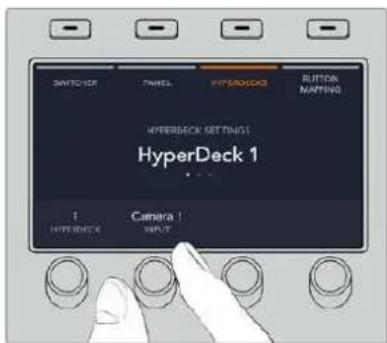
text_image
SWITCHER PANEAL HYPERDECK BUTTON MAPPING HYPERDECK SETTINGS HyperDeck 1 1 HYPERDECK Camera 1 INPUTRepeat this process for any additional HyperDecks you have connected to your switcher by assigning inputs to HyperDeck slots 1, 2, 3 and 4, if required.
Assigning an IP Address
Once you've assigned an input to a HyperDeck, you'll need to enter its IP address. This allows ATEM 1 M/E Advanced Panel to control the HyperDeck via Ethernet.
To enter a HyperDeck's IP address, navigate to the third HyperDeck settings page with the 'left' or 'right' arrow buttons, or pressing '3' on the numeric keypad while in the HyperDeck settings menu.
In this page, you'll see an IP address for the currently selected HyperDeck. Each IP address number corresponds to a rotary knob below it. To change these numbers, you can rotate the corresponding knob, or press the knob once and enter a number using the numeric keypad. Do this for each number in the IP address.
Once you've entered the IP address for your HyperDeck, press the soft button corresponding to the 'save changes' indicator to confirm the address. To cancel, press 'undo'.
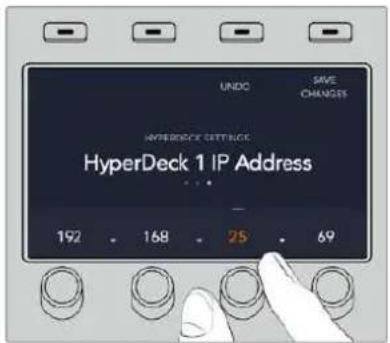
text_image
UNDO SAVE CHANGES HYPERECK SETTING HyperDeck 1 IP Address 192 168 25 69To enter the IP address for subsequent HyperDecks, you'll need to select the HyperDeck using the first page of the HyperDeck settings menu.
Auto Roll
You can toggle your HyperDeck's auto roll function from the second screen of the HyperDeck settings menu. While in the HyperDeck settings menu, use the 'left' or 'right' arrow buttons in the system control panel to navigate to this screen.
While in this menu, press the LCD soft button above the 'auto roll' indicator to turn the auto roll feature on. The indicator text will illuminate blue when auto roll is on.
The auto roll feature lets you set a HyperDeck disk recorder to automatically roll video when it is switched to the program output. For example, you can cue a HyperDeck to the point you want your source to begin, then roll the clip by pressing the HyperDeck's input button on the program row.
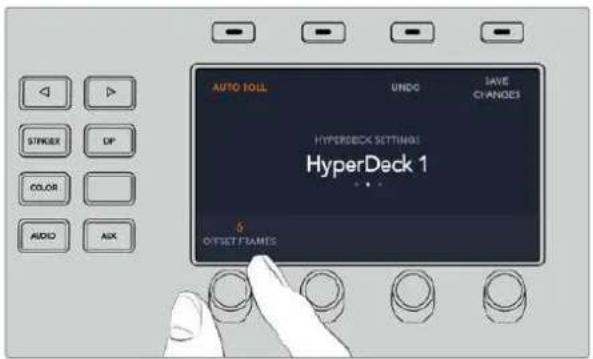
text_image
AUTO TOLL UNDO SAVE CHANGES HYPERDECK SETTINGS! HyperDeck 1 5 OFFSET FRAMESAs HyperDecks must buffer a couple of frames before commencing playback, the actual cut will be delayed a preset number of frames to ensure a clean transition. This is just like setting a preroll on a videotape machine. You can adjust the length of this delay by changing the 'offset' frames number using the control knob under this indicator. Press the soft button above the 'save changes' indicator to confirm your change.
Controlling HyperDecks with ATEM 1 M/E Advanced Panel
HyperDeck controls are available in the 'media players' menu in your ATEM 1 M/E Advanced Panel. To access this menu, simply press the 'media players' control panel button and press the soft button above the 'HyperDecks' indicator to access HyperDeck control. If your switcher has more than two media players, you may need to navigate to the next menu page to access HyperDeck controls.
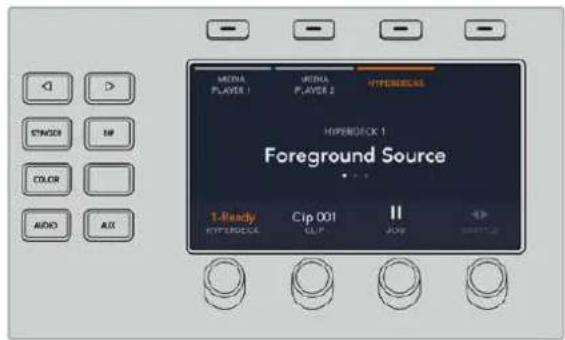
text_image
MENA PLAYER 1 MENA PLAYER 2 HYPERECKS HYPERECKS 1 Foreground Source 1-Ready HYPERECKS Cip 001 GIP II SUP OFFICE 2You can now use the rotating knobs below the 'hyperdeck,' 'clip,' 'jog' and 'shuttle' indicators to select HyperDecks, select clips, and jog and shuttle these clips.
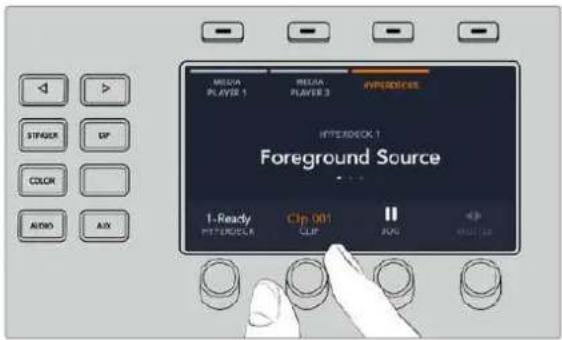
text_image
MELAVA PLAYER 1 MELAVA PLAYER 3 PREDUCEE PREDUCEE 1 Foreground Source 1-Ready PREDUCEE Clip 001 CLIP JPG WELL 128The text in the center of the HyperDeck control menu will change to reflect the HyperDeck and clip that you have selected.
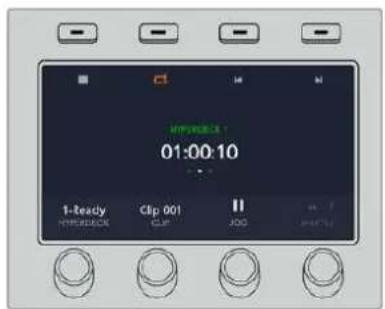
text_image
01:00:10 1-ready Cbp 001 HYPEREBACK CLIP JOOUse the third and fourth pages of the 'media players' LCD menu for more HyperDeck controls, including play, stop, loop playback, and forward and reverse skip for moving between clips.
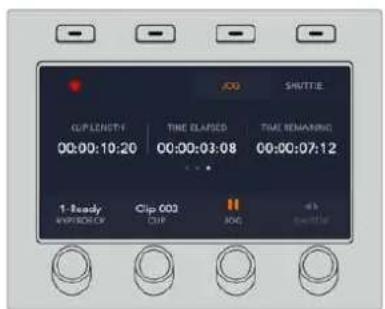
text_image
JOG SHUTTLE GIP LENGTH 00:00:10:20 TIME ELAPSED 00:00:03:08 TIME REMAINING 00:00:07:12 1-Ready Clip 000 IMP/SCR/CK CPIP SOG 45 SwitcherIn the fourth menu page, press the 'record' button to record the program output of your switcher to your HyperDeck. Use the 'jog' and 'shuttle' commands to scrub through recorded footage.
TIP To play all clips, hold down the shift button and press the 'play' soft button.
Connecting ATEM 1 M/E Advanced Panel
ATEM Mini is designed to be controlled using its own built in control panel, but if you have a larger production that is more complex and have many sources, graphics and intricate keys to handle, or you need to operate your ATEM Mini from a separate location, an ATEM 1 M/E Advanced Panel can help you.
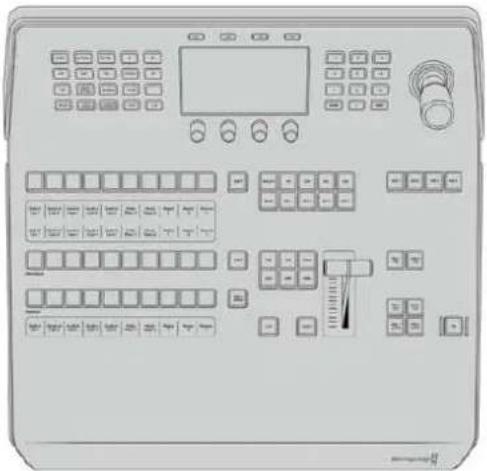
text_image
Front panel of an industrial control panel with labeled buttons, dials, and a central touchscreen display.ATEM 1 M/E Advanced Panel
The ATEM 1 M/E Advanced Panel is designed for switchers with one mix effects panel, but has the ability to control up to 4 M/Es if you decide to expand your production. The control panel provides high quality buttons for fast, comprehensive control over your switcher, plus CCU control. System control is fast and convenient using a centralized LCD menu with soft buttons and controls. When using ATEM 1 M/E Advanced Panel and the software panel together, any change on one panel will be reflected on the other and you can use both panels at the same time.
ATEM 1 M/E Advanced Panel connects directly to your ATEM Mini via Ethernet and is programmed with a default fixed switcher IP address that works with your ATEM Mini. Once plugged in, the panel will instantly recognize ATEM Mini and you can then switch sources and control your ATEM Mini via the external panel.
NOTE When plugged in directly to Pro or Extreme switcher, the panel works using a fixed IP address, but you can also plug into a network and control the switcher from a completely different location. To read more about controlling an ATEM Mini switcher using a network, refer to the 'connecting to a network' section.
To connect ATEM 1 M/E Advanced Panel to your ATEM Mini, simply connect ATEM Mini's Ethernet port to your ATEM 1 M/E Advanced Panel's Ethernet port using a standard CAT5 network cable.
Using ATEM 1 M/E Advanced Panel
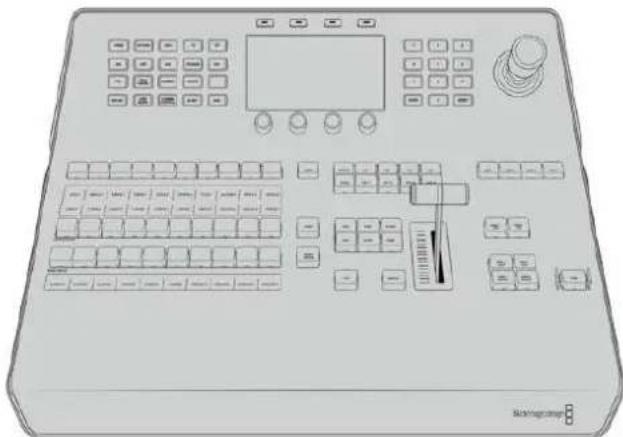
natural_image
Front view of a vintage computer control console with keypad, function keys, and control buttons (no visible text or labels)ATEM 1 M/E Advanced Panel
Using the Control Panel
Mix Effects
The program bus, preview bus and source names display are used together to switch sources on the program and preview outputs.
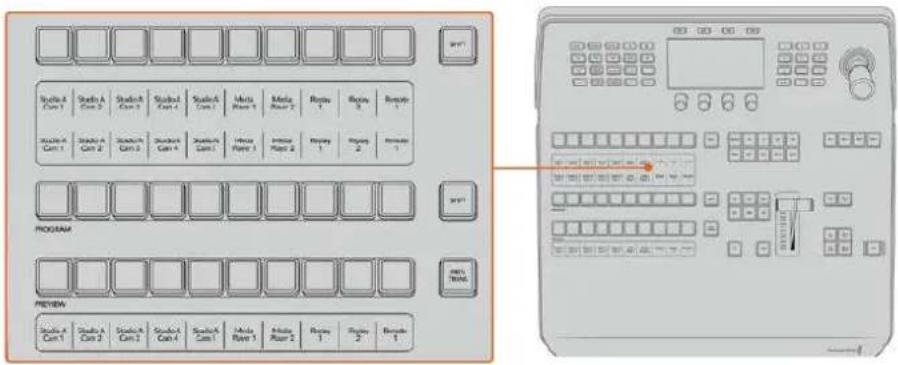
text_image
Audio A Can 1 Studio A Can 2 Studio B Can 3 Studio C Can 4 Studio D Can 5 Media Wave 6 Media Wave 7 Radio 1 Radio 2 Radio 3 Radio 4 Radio 5 Radio 6 Radio 7 Radio 8 Radio 9 Radio 10 Radio 11 Radio 12 Radio 13 Radio 14 Radio 15 Radio 16 Radio 17 Radio 18 Radio 19 Radio 20 Radio 21 Radio 22 Radio 23 Radio 24 Radio 25 Radio 26 Radio 27 Radio 28 Radio 29 Radio 30 Radio 31 Radio 32 Radio 33 Radio 34 Radio 35 Radio 36 Radio 37 Radio 38 Radio 39 Radio 40 Radio 41 Radio 42 Radio 43 Radio 44 Radio 45 Radio 46 Radio 47 Radio 48 Radio 49 Radio 50ATEM Mix Effects
Source Name Displays
The source name displays use labels to represent the switcher's external inputs or internal sources. Labels for the external inputs can be edited on the settings window of the software control panel. Labels for the internal sources are fixed and don't need to be changed.
The displays show the labels for each row of buttons in the source select row, program row, and preview row.
Pressing the SHIFT button will change the source names display to show extra sources, called shifted sources, allowing selection of up to 20 different sources.
Simultaneously pressing both SHIFT buttons next to the source select and program rows will change the source names display to show protected sources, and these are available in the source select row for keyers and routing to auxiliary outputs. Protected sources are program, preview, clean feed 1 and clean feed 2.
Program Bus
The program bus is used to hot switch background sources to the program output. The source currently on air is indicated by a button that is illuminated red. A blinking red button indicates that the shifted source is on air. Pressing the SHIFT button will display the shifted source.
Preview Bus
The preview bus is used to select a source on the preview output. This source is sent to program when the next transition occurs. The selected source is indicated by a button that is illuminated green. A blinking green button indicates that a shifted source is on preview. Pressing the SHIFT button will display the shifted source.
SHIFT
The SHIFT button provides a global shift and is used to shift the program, preview, and select buses along with the label. It also provides a shift for the transition type and joystick and other menu functions.
Double-pressing buttons in the preview and select buses, as well as the transition type buttons, is the same as shift-selecting them and can be a faster way to shift-select buttons. Double-pressing is not implemented for the program bus as it would cause the program output to momentarily show the wrong source.
Source Select Bus
The source select bus works in conjunction with the source names display and is used to assign sources to auxiliary outputs and keyers. When the macro button is enabled, this row of buttons is also used for loading and running macros recorded to the corresponding slots. The buttons will illuminate blue when the macro button is enabled.
The destination display and select bus together show you the routing of sources to keys and auxiliary outputs. The currently selected source is indicated by an illuminated button. A blinking button indicates a shifted source. A green illuminated button identifies a protected source. Protected sources are program, preview, clean feed 1 and clean feed 2.
Transition Control and Upstream Keyers
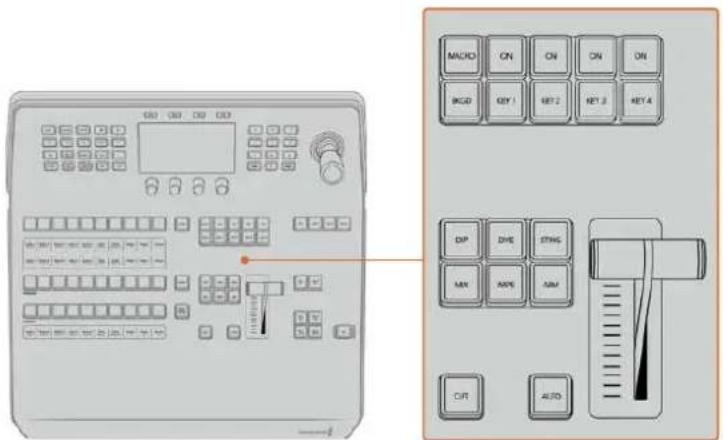
text_image
Technical diagram of an industrial control panel with labeled buttons and function keysTransition Control and Upstream Keyers
CUT
The CUT button performs an immediate transition of the Program and Preview outputs, regardless of the selected transition type.
AUTO
The AUTO button will perform the selected transition at the rate specified in the auto rate setting located in the LCD 'home' menu. The transition rate for each transition type is set in the LCD menu, and is displayed when the corresponding transition style button is selected.
The AUTO button illuminates red for the duration of the transition and the fader bar indicator illuminates with sequential LEDs to indicate the progress of the transition. If the software control panel is active, the virtual fader bar also updates to provide visual feedback on the progress of the transition.
Fader Bar and Fader Bar Indicator
The fader bar is used as an alternative to the AUTO button and allows the operator to manually control the transition. The fader bar Indicator next to the fader bar provides visual feedback on the progress of the transition.
The AUTO button illuminates red for the duration of the transition and the fader bar indicator updates to indicate the progress of the transition. If the software control panel is active, the virtual fader bar updates simultaneously.
Transition Type Buttons
The transition type buttons allow the operator to select one of five types of transitions; mix, wipe, dip, DVE, and stinger, labeled STING. Transition types are selected by pressing the appropriately labeled transition type button. The button will illuminate when selected.
When a transition type is selected, the LCD menu shows the transition rate and provides instant access to all the corresponding settings for that transition type. Use the soft buttons and knobs to navigate through the settings and make changes.
The button marked ARM is currently disabled and will be enabled in a future update.
PREV TRANS
The PREV TRANS button enables the preview transition mode allowing the operator to verify a transition by performing it on the preview output using the fader bar. Once you press this button the preview transition feature is enabled and you can preview your transition as many times as you like. This lets you test the transition before going to air and make changes and corrections as needed. You can even preview stinger transitions! Once adjusted, press the button again to disable the feature and you are ready to send your transition on air.
Next Transition
The BKGD, KEY 1, KEY 2, KEY 3, KEY 4 buttons are used to select the elements which will transition on air or off air with the next transition. Any combination of background and keys can be selected by pressing multiple buttons simultaneously. Double pressing the BKGD button selects all of the next transition upstream keyers that are currently on air and copies them to the Next Transition buttons.
Pressing any of the next transition buttons will clear selection of all others. When selecting the elements of the next transition, the switcher operator should look at the preview output because it provides an accurate representation of what the program output will look like after the transition is completed. When only the BKGD button is selected, a transition from the current source on the program bus to the source selected on the preview bus will occur.
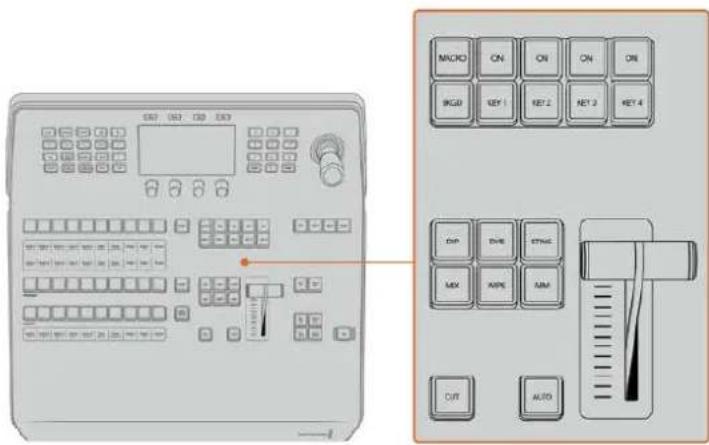
text_image
Diagram of an industrial control panel with labeled buttons and function keys, including a digital display and control buttons.Transition Control and Upstream Keyers
ON AIR
The ON AIR indicator buttons above each keyer are labeled ON and indicate which of the upstream keys are currently on air. These can also be used to immediately cut a key on or off air.
MACRO
The macro button is used to enable the macro feature which changes the source select row of buttons to macro buttons corresponding to macro slots.
TIP There are ten macro buttons in the source select row, so if you have macros recorded to slots greater than ten, you can access these by opening the macro settings in the LCD menu and changing the macro group using the control knob.
For more information on how to record and run macros using the advanced panel, refer to 'recording Macros using ATEM 1 M/E Advanced Panel' later in this section.
Downstream Keyers
DSK TIE
The DSK TIE button will enable the DSK on the preview output, along with the next transition effects, and tie it to the main transition control so that the DSK can be taken to air with the next transition.
Because the tied downstream keyer is now tied to the main transition, the transition will happen at the rate specified in the auto rate setting in the LCD 'home' menu. When the DSK is tied, the signal routing to the clean feed 1 is unaffected.
DSK CUT
The DSK CUT button is used to cut the DSK on or off air and indicates whether the DSK is currently on or off air. The button is illuminated if the DSK is currently on air.
DSK AUTO
The DSK AUTO button will mix the DSK on or off air at the rate specified in the DSK rate LCD menu setting.
M/E Buttons
As some ATEM switchers have multiple M/Es you can select which one you want to control using the M/E buttons. When an M/E is selected, the LCD menu will change to show the settings that correspond to that M/E panel.
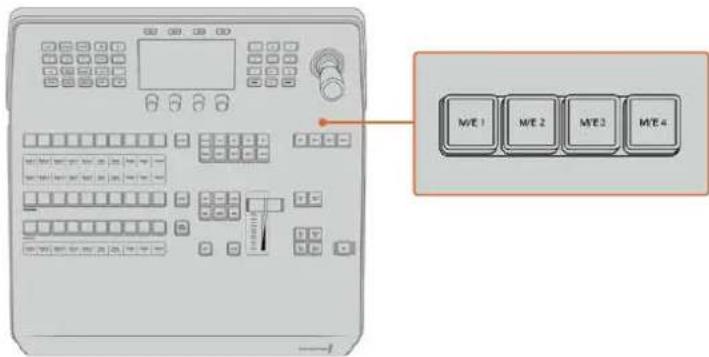
text_image
MVE 1 MVE 2 MVE 3 MVE 4Press the M/E buttons numbered 1 to 4 to select an M/E panel to control
Fade to Black
The FTB button will fade the program output to black at the rate specified in the FTB rate LCD menu setting. Once the program output has been faded to black, the FTB button will flash red until it is pressed again, fading the program output up from black at the same rate. A fade to black cannot be previewed.
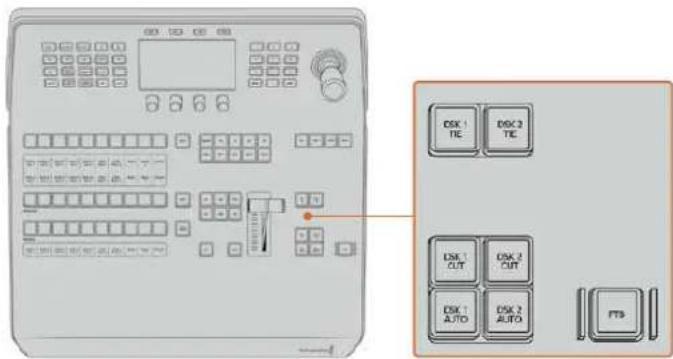
text_image
DSK 1 TIE DSK 2 TIE DSK 1 CUT DSK 2 CUT DSK 1 AUTO DSK 2 AUTO PTSDownstream Keyers and Fade to Black
You can also set your switcher to fade audio together with the fade to black by navigating to the FTB LCD menu and setting AFV to 'on'. This sets the switcher to fade the audio to silence at the rate set for the fade to black. If you want audio to remain on during and after the fade to black, set AFV to 'off'.
System Control Menu Buttons
The buttons on the top left side of your panel, combined with the LCD and its four soft buttons are called the system control. When you press a system control button, for example the 'home' button, the LCD will change accordingly to show the relevant controls and settings. Use the soft buttons and knobs above and below the LCD to make changes.
If there are small dot icons on the LCD menu, this means there is more than one page of settings and you can move through the pages by pressing the left and right arrow buttons.
For example, to change the border softness on a wipe transition
1 Press the 'wipe' button.
2 Press the right arrow button next to the LCD to move to the third page of settings.
3 Rotate the control knob under the 'softness' setting to change the softness of the wipe transition border.
If you want to change the direction of the wipe transition
1 Press the arrow buttons to navigate back to the first page of wipe transition settings, or simply press the 'wipe' button to return to the first page.
2 Press the 'reverse direction' soft button at the top of the LCD to change the direction.
3 Once you are satisfied with the setting, press the 'home' button to return to the home page.
TIP When changing the border softness, you can visually monitor your adjustments in real time. Simply press the PREV TRANS button and move the fader bar while watching the preview output on the multi view to visually monitor your settings.
Remember to press PREV TRANS again to disable the transition preview when you're happy with the settings.
The system control buttons and LCD menu are used to access all the settings for your panel, and you can even set general switcher settings directly from the panel. For example, if you need to change the switcher's video format.
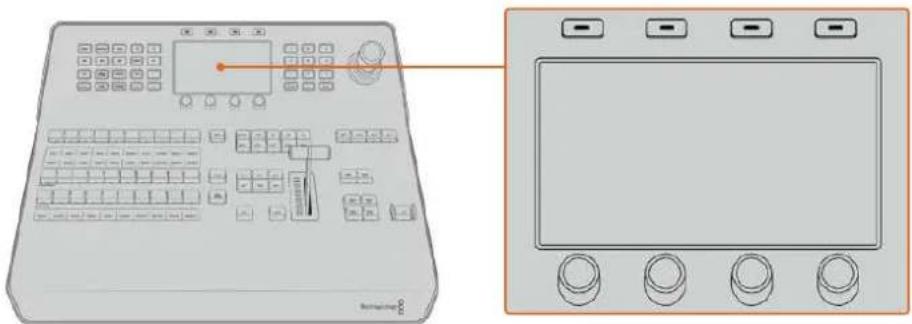
natural_image
Illustration of a beige electronic device with control buttons and a display screen (no text or symbols visible)System Control
Joystick and Numeric Keypad
The number pad is used to enter numerical data. For example, the number pad can be used to enter a numerical value for transition duration. When entering data using the number pad, the soft buttons below each parameter are used to apply the entered data to that parameter.
The Joystick is a 3-axis joystick that is used to size and position keys, DVEs and other elements. On larger ATEM switchers with an RS-422 'remote' port, the joystick can also be used to control VISCA PTZ cameras.
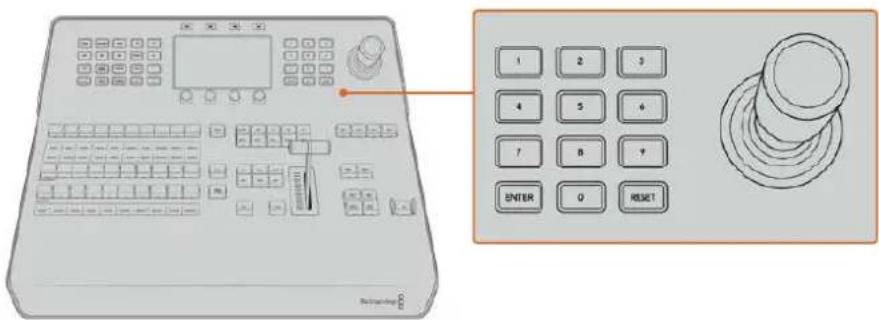
text_image
Diagram of a control panel with labeled buttons and a rotary knob, alongside a schematic view of the device's control panel.Joystick Control
Button Mapping
ATEM software and hardware control panels support button mapping so you can assign your most important sources, especially cameras, to the most accessible buttons in the program and preview rows. Occasional sources can be assigned to less prominent buttons. Button mapping is set independently for each control panel so button mapping set on a software control panel will not affect the button mapping set on a hardware control panel.
ATEM Advanced Panel Button Mapping and Button Brightness Level
To access the button mapping settings, press the 'settings' button to open the general switcher settings LCD menu, then press the 'button mapping' soft button.
Use the control knobs under each LCD setting to select the button you want to map and the input you want to change it to. You can also change the button color and label color that is displayed on the panel if you want to highlight specific sources. For example, you may want to highlight your playback sources a different color so you can instantly identify them on the panel. The button will illuminate on both the preview and program rows until the source is switched to the preview or program output, where it will change to green or red respectively.
Once you have changed the setting, the change is made instantly and you don't have to worry about saving. Simply press the 'home' button to return to the home menu.
If you want to change the brightness of the buttons, press the 'settings' button to open the general switcher settings LCD menu, then press the 'panel' soft button to reveal the panel settings.
Rotate the settings knob under each setting until you see the desired brightness level.
Once you have configured all the button settings, press the 'home' button to return to the home menu.
Performing Transitions using ATEM 1 M/E Advanced Panel
ATEM 1 M/E Advanced Panel shares the same control panel layout as the software control panel, plus a large LCD with soft control knobs and buttons which lets you adjust settings dynamically as you control your switcher. This is a fast and convenient way of working with your panel.
This section describes how to perform the various transition types on your switcher using an external ATEM 1 M/E Advanced Panel.
Cut Transitions
The cut is the most basic transition that can be performed on the switcher. In a cut transition the program output is immediately changed from one source to another.

Program output for a cut transition.
A cut transition can be performed directly from the program bus, or using the CUT button in the transition control block.
Program Bus
When a cut transition is performed from the program bus, only the background will be changed, and all upstream and downstream keys will maintain their current state.
To perform a cut transition from the program bus
On the program bus, select the video source that you want on the program output. The program output will immediately change to the new source.

text_image
PROGRAM SHIFTPress any of the source buttons on the program row to perform a cut transition from the program bus
CUT Button
When a cut transition is performed using the CUT button, any upstream keys that were selected in the next transition and any downstream keys that were tied to the transition control will also change state. For example, a downstream key tied to the transition control will cut ON if off air, or cut OFF if on air. Similarly, any upstream keys selected in the next transition will be cut on if they were off air, or cut off if they were on air.
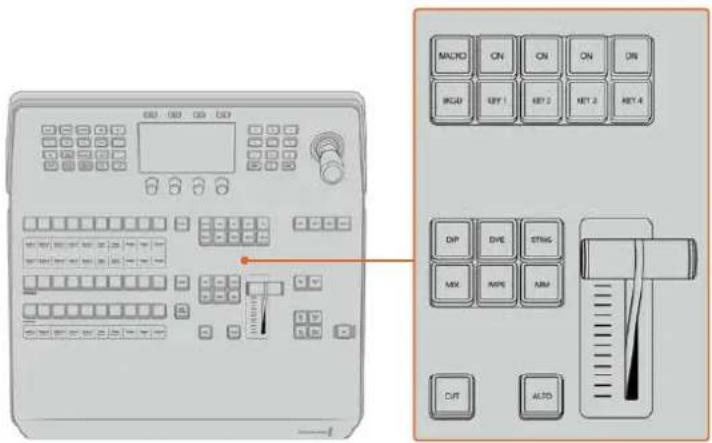
text_image
Diagram of an industrial control panel with labeled buttons and function keys, including ON/OFF/RESET modes and control buttons.Press the button marked CUT in the transition control block to perform a cut transition
To perform a cut transition using the CUT button
1 On the preview bus, select the video source that you want on the program output. The program output will remain unchanged.
2 In the transition control block, press the CUT button. The sources selected on the program and preview buses are exchanged to indicate that the video source that was on preview is now on program and vice versa.
TIP We recommend using the transition control block to perform transitions because it provides the opportunity to verify the video content on the preview output before sending it to the program output, for example to verify that a camera is in focus.
Auto Transitions
An auto transition allows you to automatically transition between program and preview sources at a predetermined rate. Any upstream keys that were selected in the next transition and any downstream keys that were tied to the transition control will also change state. Auto transitions are performed using the auto button in the transition control block. Mix, dip, wipe, DVE and stinger transitions can all be performed as an AUTO transition.
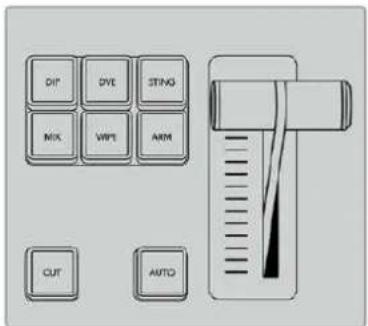
text_image
DIP DVE STING MIX WPPI ARM CUT AUTOThe auto transition button is part of the transition control block
To perform an auto transition
1 On the preview bus, select the video source that you want on the program output.
2 Select the transition type using the transition type buttons in the transition control block.
3 In the system control, set the transition rate and adjust any other parameter for the transition as needed.
TIP On the ATEM 1 M/E Advanced Panel, all transition settings are accessed via the LCD menu.
4 Press the AUTO button in the transition control block to initiate the transition.
5 During the transition, the red and green buttons on the program and preview buses both turn red to indicate that you are in the middle of a transition. The fader bar indicator displays the position and progress of the transition and the transition rate display updates to indicate the number of frames remaining as the transition progresses.
6 At the end of the transition, sources selected on the program and preview buses are exchanged to indicate that the video source that was on preview is now on program and vice versa.
Each transition type has its own independent transition rate allowing you to perform faster transitions by simply selecting the transition type and pressing the AUTO button. The previously used transition rate is remembered for that transition type until it is changed.
A production switcher provides multiple methods of transitioning from one shot to another. Generally, you use a simple cut transition to move from one background source to another. Mix, dip, wipe and DVE transitions allow you to transition between two background sources by gradually phasing out one and phasing in another.
Stinger and Graphic Wipe are special transitions which will be covered in a later section. Mix, dip, wipe and DVE transitions are performed as an auto transition or manual transition using the transition control block.
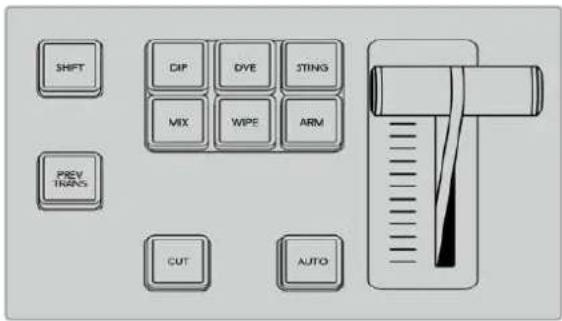
text_image
SHIFT CIP DYE STING MIX WIPE ARM PREV TRANS CUT AUTOOn the ATEM 1 M/E Advanced Panel the transition types, for example dip, mix and wipe, have their own independent selection button.
Mix Transitions
A mix is a gradual transition from one source to another and is achieved by interpolating gradually between two sources, effectively overlapping the sources for the duration of the effect. The length of the transition or length of the overlap can be adjusted by changing the mix rate.

Program output for a mix transition.
To perform a mix transition on the ATEM 1 M/E Advanced Panel:
1 On the preview bus, select the video source that you want on the program output.
2 Press the MIX button to select the mix transition type. The LCD menu will automatically display the transition settings.
3 In the transition settings, use the corresponding LCD control knob to adjust the mix rate. You can also enter a rate duration using the number pad.
4 Perform the transition as an auto transition or manual transition from the transition control block.
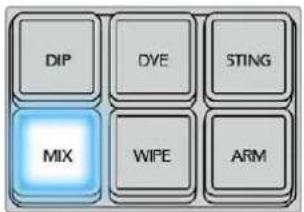
text_image
DIP DVE STING MIX WIPE ARM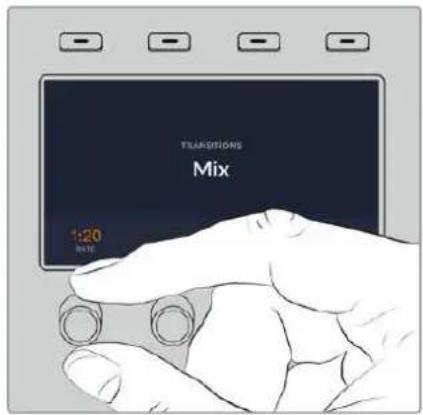
text_image
TRANSITIONS Mix 1:20 0:00Press the 'mix' button and set the transition rate using the LCD menu
Mix Transition Parameters
Rate The mix transition rate in seconds : frames.
Dip Transitions
A DIP is similar to a mix in that it is a gradual transition that transitions from one source to another. However, a dip transition gradually mixes through a third source, the dip source.
For example, the dip transition can be used for a transition that calls for a white flash or a transition that quickly flashes the sponsor logo. The length of the dip transition and the dip source can both be customized.

text_image
A A A C C C B B A C BProgram output for a dip transition.
To perform a dip transition on the ATEM 1 M/E Advanced Panel:
1 On the preview bus, select the video source that you want on the program output.
2 Press the DIP button to select the dip transition type. The LCD menu will automatically display the transition settings.
3 In the transition settings, use the corresponding LCD control knob to adjust the dip rate. You can also enter a rate duration using the number pad. Select a dip source.
4 Perform the transition as an auto transition or manual transition from the transition control block.
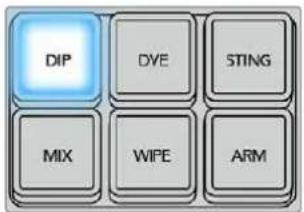
text_image
DIP DVE STING MIX WIPE ARM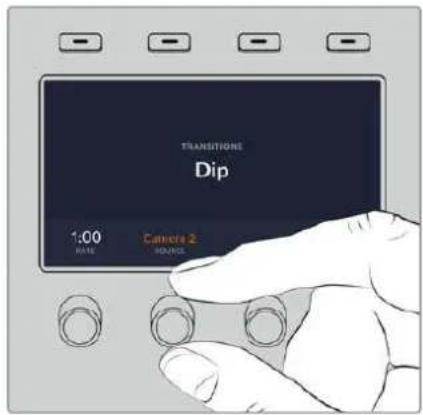
text_image
TRANSITIONS Dip 1:00 Camera 2 RARE NO. 1Press the 'dip' button in the transition control block, then set the dip source and transition rate using the LCD menu
Dip transition parameters
| Rate The dip transition rate in seconds and frames. |
| Dip Source The dip source is any video signal in the switcher that will be used as the intermediate picture for the dip transition, usually a color generator or media player. |
Wipe Transitions
A wipe is a transition from one source to another and is achieved by replacing the current source by another source with a pattern that forms a shape. For example an expanding circle or diamond.




Program output for a wipe transition.
To perform a wipe transition on the ATEM 1 M/E Advanced Panel:
1 On the preview bus, select the video source that you want on the program output.
2 Press the WIPE button to select the wipe transition type. The LCD menu will automatically display the transition settings.
3 Press the desired wipe pattern button on the control panel.
4 In the transition settings, use the corresponding LCD control knobs to adjust the border parameters, the wipe rate, and wipe direction. You can also enter a rate duration and specific setting values using the number pad.
5 Use the select bus to select the border source.
6 Perform the transition as an auto transition or manual transition from the transition control block.
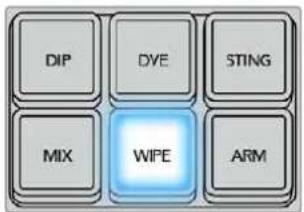
text_image
DIP DVE STING MIX WIPE ARM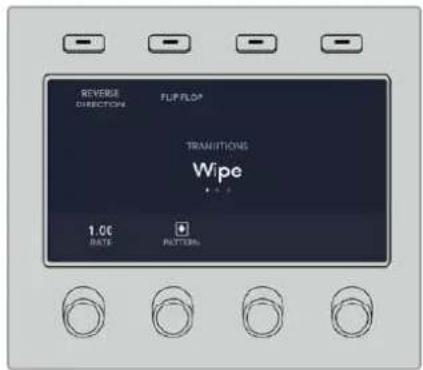
text_image
REVERSE DIRECTION FLIP FLOP TRANSITIONS Wipe 1.0C RATE PATTERNPress a source button in the source select row to select a source for the wipe border, Hold the shift button down to select a shifted source, such as a color generator or media player.
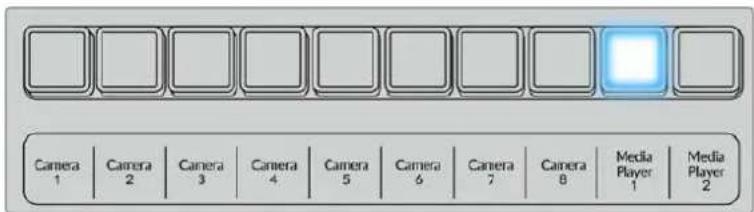
text_image
Camera 1 Camera 2 Camera 3 Camera 4 Camera 5 Camera 6 Camera 7 Camera 8 Media Player 1 Media Player 2Press a source button in the source select row to select a source for the wipe border, such as a camera or media player.
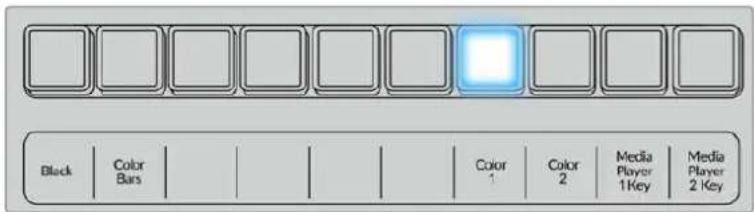
text_image
Block | Color Bars | Color 1 | Color 2 | Media Player 1 Key | Media Player 2 KeyHold the shift button down to select a shifted source, such as color bars or a color generator.
TIP The border source used in a wipe transition can be any source in the switcher. For example, a thick border with the media player as its source can be used for sponsorship or branding.
Wipe transition parameters
| Rate The length of the wipe transition in seconds and frames. | |
| Symmetry Symmetry can be used to control the aspect ratio of the pattern. | |
| Position | If the wipe pattern has positioning then the joystick on the external panel or the x position: and y position: boxes in the transition palette of the software control panel can be used to move the center of the pattern. Moving the joystick dynamically updates the x and y position display in the software control panel. |
| Normal | The normal direction for closed patterns such as circles, diamonds and boxes is to grow from the center of the screen and progress outward. |
| Reverse Reverse | changes the progression of closed patterns such as circles, diamonds and boxes so that the pattern closes in from the edges of the screen toward the center. |
| FlipFlop When FlipFlop mode is toggled on, the transition changes between normal to reverse every time the transition is executed. | |
| Border Width of the border. | |
| Soft The edges of the wipe pattern can be adjusted between sharp and fuzzy by adjusting the softness parameter. | |
DVE Transitions
Your ATEM switcher includes a powerful digital video effects processor for DVE transitions. A DVE transition displaces the image in various ways to transition from one picture to another. For example, a DVE transition can be used to squeeze the current picture off screen revealing a new video under it.
To perform a DVE transition on the ATEM 1 M/E Advanced Panel:
1 On the preview bus, select the video source that you want on the program output.
2 Press the DVE transition type button to select the DVE transition. The DVE settings will appear on the LCD menu.
NOTE If the DVE is already being used in an upstream key, the DVE transition type will not be available for selection until the key is taken off air and off next transition. Refer to 'sharing DVE resources' later in this section for more information.
3 In the DVE LCD menu, use the soft control knobs and buttons to configure the DVE parameters. For example, select the DVE pattern and movement direction, and adjust the DVE transition rate.
4 Perform the transition as an auto or manual transition using the auto button or fader bar.
DVE transition parameters
| DVE Rate The duration of the DVE transition in seconds and frames. Rotate the DVE rate knob to adjust the DVE transition rate. The new rate is immediately displayed in the transition rate window in the transition control block. |
| Symmetry Symmetry can be used to control the aspect ratio of the pattern.For example, adjusting the symmetry will allow you to change a circle into an ellipse.Symmetry can be adjusted using the z axis of the joystick. |
| Position | If the wipe pattern has positioning then the joystick on the external panel or the x position: and y position: boxes in the transition palette of the software control panel can be used to move the center of the pattern. Moving the joystick dynamically updates the x and y position display in the software control panel. |
| Normal | The normal direction for closed patterns such as circles, diamonds and boxes is to grow from the center of the screen and progress outward. |
DVE key parameters
| Enable key Enables/disables the DVE key. The DVE key is enabled when the button is illuminated. | |
| PreMult Select the DVE key as a pre-multiplied key. | |
| Clip | The clip level adjusts the threshold at which the key cuts its hole. Decreasing the clip level reveals more of the background. If the background video is completely black then the clip value is too low. |
| Gain The gain adjustment electronically modifies the angle between on and off thereby softening the edges of the key. Adjust the gain value until the edge softness is desirable but the background video luminance (brightness) is not affected. | |
| Inverse When the key is not pre-multiplied, inverts the key signal. | |
Sharing DVE Resources
ATEM features a DVE channel which can be used to perform DVE transitions or used in an upstream keyer. When you select a DVE transition, if the DVE is used elsewhere in the system, the DVE transition type will not be available and a DVE unavailable message will be displayed. In order to use the DVE transition you must free the DVE from where it is currently used. Verify that the upstream keys currently on program or preview are not DVE keys and do not have flying key enabled. To free DVE from the upstream keyer, change the key type to anything other than DVE or disable flying key. The DVE will be released and therefore available for use as a DVE transition.
The logo wipe transition is a popular transition that uses the DVE and moves a graphic across the screen over a background transition. For example, the logo wipe moves a graphic over a horizontal wipe, essentially replacing the wipe border. A logo mix spins the graphic across the screen over a mix transition. Logo transitions are perfect for wiping the station logo or spinning a football across the screen revealing a new background. Logo transitions use a special keyer built into the transition block, leaving all of the upstream and downstream keyers available for compositing the output.
The following section explains how to build and perform logo transitions.


The above image sequence provides an example of the program output for a graphic wipe transition.
Performing a Graphic Transition
To perform a graphic transition on the ATEM 1 M/E Advanced Panel:
1 Press the DVE transition type button in the transition control block. The DVE settings menu will appear on the LCD.
If the DVE is already being used in an upstream key, the DVE transition type will not be available for selection until the key is taken off air and off next transition. Refer to 'sharing DVE resources' later in this section for more information.
2 Press the 'effect' soft button in the LCD menu to open the effect settings, and set the effect to a graphic wipe by selecting the graphic wipe icon using the 'effect' soft control knob.
The default direction is left to right, but you can change the direction by selecting 'reverse direction'. You can also enable 'flip flop' which will let the effect move forwards and backwards with each performance of the transition, rather than repeating the same movement direction.
3 Press the right arrow in the system control buttons to adjust the key settings. Enable the key, and select the fill and key source. If you need to make adjustments to the key, for example adjusting clip and gain settings, press the right arrow in the system control buttons to access the key parameters.
TIP Typically, for a graphic transition, the source would normally be a graphic loaded in a media player. By default, when you select a media player for the fill source, the key source will automatically select the media player key channel and set pre multiplied key to 'on'. This means a graphic with a key matte embedded in the alpha channel will automatically be selected by the switcher. You can disable pre multiplied key and change the key source if you want to use a separate media file on a different media player, or a different input source.
4 Press the auto button to perform the transition as an auto transition, or use the fader bar for a manual transition.
Graphic wipe parameters
| Rate Rate specifies the length of the transition in seconds and frames. | |
| The rate can be adjusted using the rate knob or by entering a number on the number pad and pressing the set rate button. | |
| Normal The normal direction moves the graphic from left to right. | |
| Reverse Reverse changes the direction so that it moves the graphic from right to left. | |
| FlipFlop When FlipFlop mode is toggled on, the transition changes between normal and reverse every time the transition is executed. The 'Normal' or 'Reverse' light indicates the direction of the next transition. | |
| Fill Source | The fill signal is the graphic used to move across the top of the transition. |
| Key Source | The key signal is a grayscale image that defines the region in the graphic that will be removed so that the fill signal can be correctly stacked on top of the wipe. |
Graphic wipe images
The graphic wipe feature requires a static graphic that is used as a moving border for a horizontal wipe. This graphic should be a vertical 'banner' type graphic that is no more than 25% of the total screen width.
text_image
BMD TV
natural_image
Two vertical black panels with a bright central light source, no text or symbols present.Graphic wipe screen width requirements
| 1080p | If the switcher is operating at 1080p then the graphic should be no wider than 1,920 pixels. |
| 720p | If the switcher is operating at 720p than the graphic should be no wider than 320 pixels. |
Manual Transitions
Manual transitions let you manually transition between program and preview sources using the fader bar in the transition control block. Mix, dip, wipe and DVE transitions can all be performed as a manual transition.
To perform a manual transition
1 On the preview bus, select the video source that you want on the program output.
2 Select the transition type using the transition type buttons in the transition control block.
3 Manually move the fader bar from one end to the other to execute the transition. The next move on the fader bar will begin a new transition.
4 During the transition the red and green buttons on the program and preview buses both turn red to indicate that you are in the middle of a transition. The LED indicator on the fader bar also displays the position and progress of the transition.
TIP You will also see ATEM Software Control mirror the move on the software panel.
5 At the end of the transition, sources selected on the program and preview buses are exchanged to indicate that the video source that was on preview is now on program and vice versa.
Recording Macros using ATEM 1 M/E Advanced Panel
You can record and run macros using an ATEM 1 M/E Advanced Panel independently of ATEM Software Control. All actions on the ATEM Software Control switcher page can be performed using your hardware panel. If you need to arrange graphics in the media pool, or adjust camera settings, simply access those settings using ATEM Software Control.
The buttons used to record and run macros on the ATEM 1 M/E Advanced Panel are located in the system control buttons. The names of your macro buttons are displayed in the source select names display.
Follow the steps below to create the 'transitions' macro demonstrated earlier using ATEM Software Control. This time you will create a macro in macro slot 6.
1 Press the 'macro' soft button to open the macros LCD menu.
2 Using the 'macro' knob under the LCD, select the macro slot you want to record to. For this example, select 'slot 6 - Empty'.
3 Press the 'record' soft button at the top of the LCD to start recording. The record icon appears as a red circle. When recording, this icon becomes a red square.
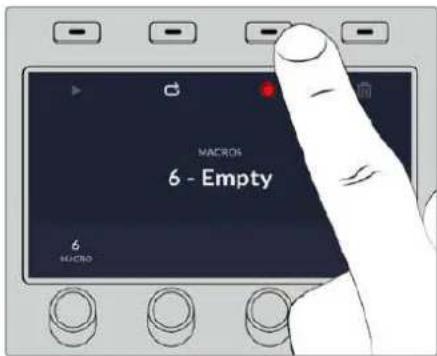
text_image
MACROS 6 - Empty 6 MACROPress the 'record' soft button to start recording your macro

text_image
ADD PAUSE 6 - Empty 6 MACKEDWhile recording, a red border will appear around the LCD
4 Shift select 'color bars' on the program bus. The button will flash indicating it's a shifted source.
5 Shift select 'color 1' on the preview bus. If you wish, you can map buttons such as color bars, black and color generators to any of the main 10 buttons of the program and preview bus for easier access. See the 'button mapping' section of this manual for instructions.
6 Press the wipe button in transition control to ensure the macro records the wipe transition selection.
7 In the 'wipe' LCD menu, set the rate to 2:00 seconds.
8 Press the 'auto' button in transition control to perform the wipe transition from color bars to color 1.
9 Press the 'macro' button to return to the macro screen.
10 To set the macro to wait for 2 seconds before applying the next transition, press the 'add pause' soft button in the LCD menu and set the duration to 2 seconds by rotating the 'seconds' knob. Press the 'confirm' soft button to record the pause.
11 Now shift select 'black' on the preview bus, press the 'mix' button in transition control and press the 'auto' transition button. Your ATEM switcher will perform a mix transition to black.
12 Press the Macro button to navigate back to the Macro menu, then press the 'stop' soft button to stop recording.
You have just recorded a macro using an ATEM 1 M/E Advanced Panel. The macro will appear as a macro button named 'Macro 6' because it is located in macro slot 6. You can name your macro and add notes by clicking on the 'edit macro' button in ATEM Software Control.
To run the macro, press the macro button to set your panel's source select row to macro mode. The buttons will illuminate blue when in macro mode. Now press the macro 6 button. You can easily see when a macro is running because the macro button will flash green and an orange border appears around the LCD menu.
If your macro was successful, you should see your ATEM switcher mix from color bars to color 1 using a 2 second mix transition, pause for 2 seconds, then perform another 2 second mix transition to black, all by pressing one button on your ATEM 1 M/E Advanced Panel. If you want the macro to loop so it keeps running, press the 'loop' soft button to enable loop. Press again to disable loop.
It's worth frequently testing your macros using different switcher settings to make sure the macro performs all the specific functions you intended and doesn't miss any instructions or produce something unexpected.
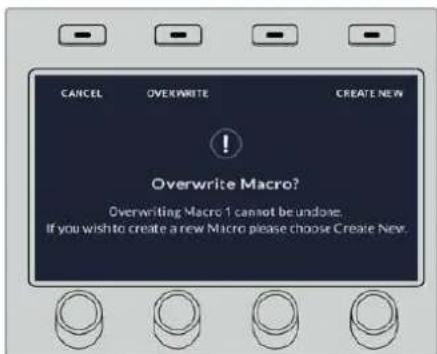
text_image
CANCEL OVERWRITE CREATE NEW Overwrite Macro? Overwriting Macro 1 cannot be undone. If you wish to create a new Macro please choose Create New.If you want to record over a previously recorded macro, or if you made a mistake and want to start recording the macro again, press the record button and confirm the overwrite when prompted
Using ATEM Camera Control Panel
Traditionally, camera control units, or CCUs, have been designed for mounting inside a desk with independent units for each camera. ATEM Camera Control Panel is a portable solution that can be placed on a desk or solid surface with 4 CCUs built in so you can control all four Blackmagic Pocket Cinema Cameras at once.
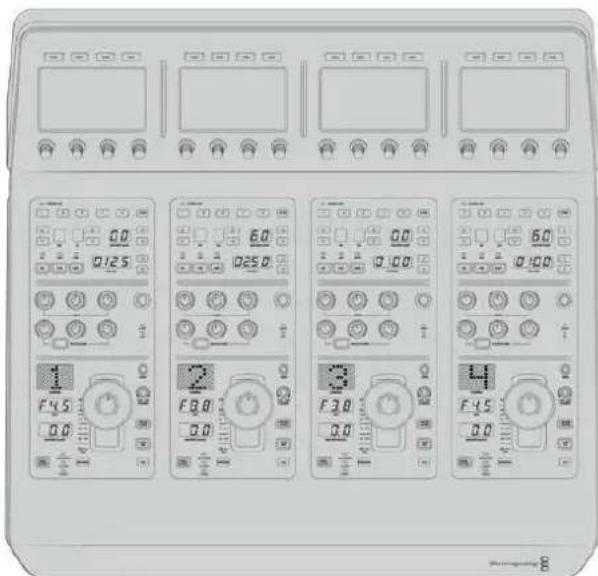
text_image
0.0 0.125 1 F4.5 0.0 6.0 1025.0 2 F8.0 0.0 3 F3.0 0.0 4 F4.5 0.0 BPowering the Panel
To power your camera control panel, connect power via the IEC power input on the rear panel using a standard IEC power cable. You can also use the 12V DC input if you want to connect external power or redundancy via an external power supply, for example a UPS uninterrupted power supply or external 12V battery.
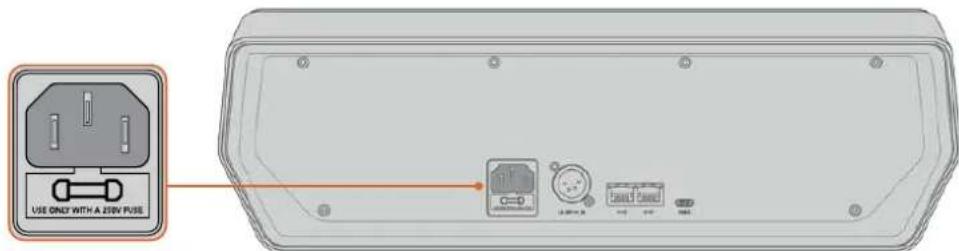
text_image
USE ONLY WITH A ZEW PULSEConnect power via the power input on the rear panel
Connecting the Panel to your Switcher
To connect ATEM Camera Control Panel to your switcher, all you need to do is add the panel into your ATEM Ethernet connection chain.
For example, if you are using an external ATEM hardware panel, such as the ATEM 1 M/E Advanced Panel, remove its Ethernet cable from your computer or network and connect it to one of the camera control panel's Ethernet ports instead. The ATEM hardware panel will then be the middle unit in the chain. Now connect the camera control panel's spare Ethernet port to your computer or network.
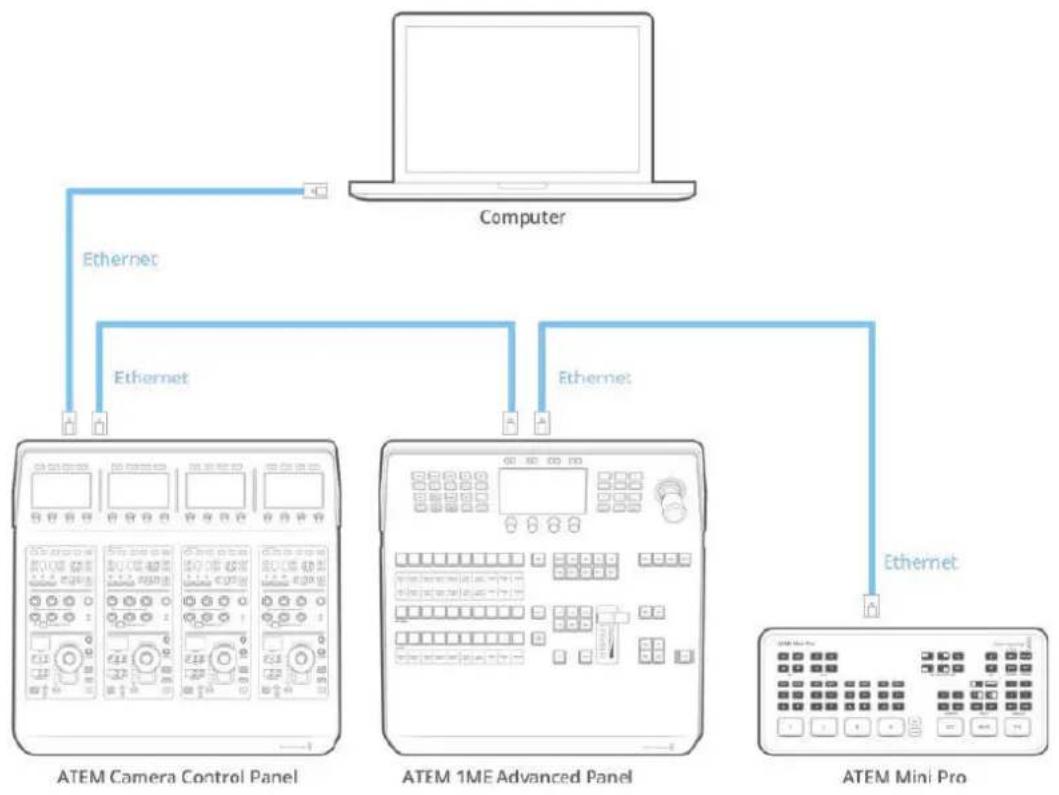
flowchart
graph TD
    A["Computer"] -->|Ethernet| B["ATEM Camera Control Panel"]
    A -->|Ethernet| C["ATEM 1ME Advanced Panel"]
    A -->|Ethernet| D["ATEM Mini Pro"]
    B --> E["Analog Interface"]
    C --> F["Analog Interface"]
    D --> G["Analog Interface"]
If you are using the camera control panel with just your switcher and a computer on a shared network, connect the panel to your switcher, then the spare Ethernet port to your computer.
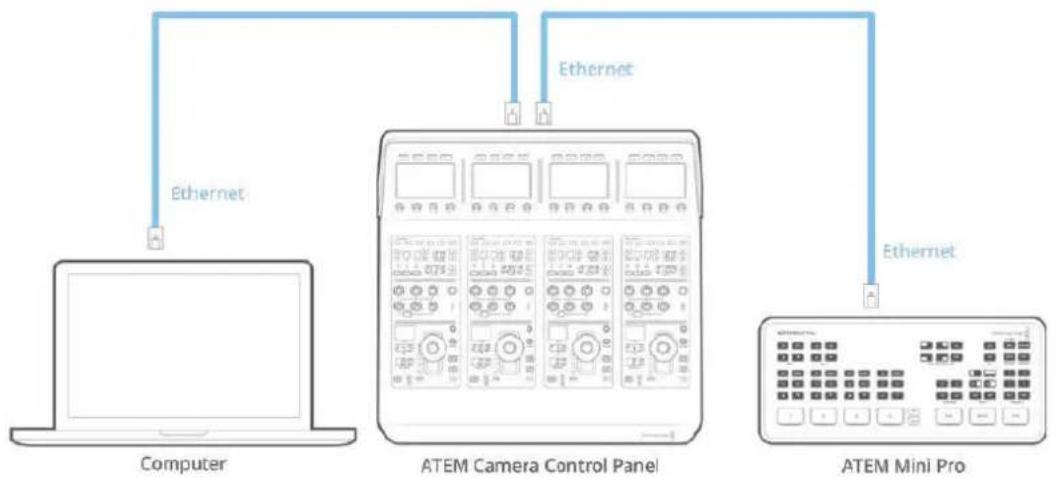
flowchart
graph TD
    A["Computer"] -->|Ethernet| B["ATEM Camera Control Panel"]
    B -->|Ethernet| C["ATEM Mini Pro"]
    B --> D["Computer"]
After connecting the camera control panel to your ATEM equipment, you should see the lights on the panel illuminate and the LCDs on each CCU will display their respectively assigned cameras. The panel is now powered, connected to your switcher and ready to start controlling your cameras!
The connection process is fast because all the network settings for each ATEM unit have a different default IP address when shipped from the factory. This means when you connect them all to each other, their network settings are automatically configured and will work straight away.
However, if you are adding a camera control panel to an already existing system, or you need to manually assign a different IP address to avoid potential conflicts on your network, you can enable DHCP so your panel determines the best IP address, or disable DHCP and set the IP address manually.
NOTE ATEM Mini Pro and Extreme switchers don't have a fixed IP address because it is designed to use the DHCP. When connecting these switchers directly to ATEM Camera Control Panel, we recommend setting a manual IP address.
When connecting to the camera control panel and a network, set the switcher to DHCP. The network server will assign an IP address and you can then set that as the camera control panel's switcher IP address so it can communicate with your switcher. You can read more about this in the following section.
For more information about setting ATEM Mini Pro and Extreme switcher's network settings refer to the 'connecting to a network' section.
Changing Network Settings
Changing network settings means manually setting the panel's IP address so it can join your network, then entering the switcher's IP address on your panel so the switcher can be identified by your panel. These settings are located in your camera control panel's 'settings' LCD menu.
The home screen is the first menu item you will see on the CCU's LCD. To access the network settings, press the 'settings' soft button.
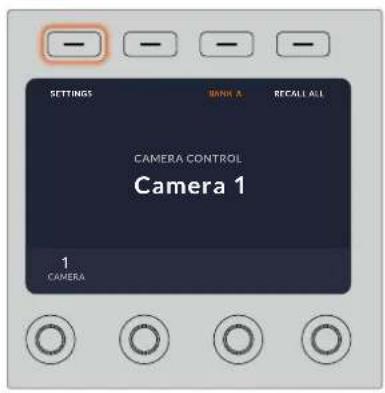
text_image
SETTINGS BANK A RECALL ALL CAMERA CONTROL Camera 1 1 CAMERAPress the 'settings' soft button on the LCD home screen to access all the camera control panel's settings
The DHCP setting is the first setting in the sequence of menu pages. Under this setting is a row of small dot icons. As you press the arrow soft button to navigate through the pages of settings, the dot icons will illuminate to show which page you are on. All your camera control panel settings are available via these pages.
To set the camera control panel's IP address:
1 If you want the panel to automatically set a compatible IP address, select the DHCP setting by pressing the 'on' soft button.
TIP If you know your network's IP address, you can navigate to the next setting page and check the panel's IP address setting to confirm it has selected an address compatible with your network.
2 If you want to set the IP address manually, make sure the DHCP setting is set to 'off', then press the arrow soft button to navigate to the 'panel IP address' setting.
3 Rotate the corresponding knobs to change the IP address fields.
4 Now press the arrow button to move to the subnet mask and gateway settings and make the necessary changes.
5 Once all the subnet mask and gateway number fields are set, press the 'save changes' soft button to confirm your settings.
With your camera control panel's IP address set, the network can now communicate with your panel.
The next step is to assign the switcher's IP address on the camera control panel. By telling your camera control panel your switcher's IP address, the panel can then identify your switcher on the network.
TIP If your switcher is located near the camera control panel, it's helpful to open the network settings menu on the switcher so you can observe your switcher's IP address while entering the IP address number fields on the camera control panel. This is also a good way to cross check your network settings between each unit.
To set the switcher's IP address on your camera control panel:
1 Press the arrow soft button to navigate to the 'switcher IP address' setting.
2 Using the knobs underneath the LCD, set the numbers for each address field.
3 Press 'save changes' to confirm your settings.
Now that your panel has identified the switcher, all the controls on your panel should illuminate. This lets you know the panel is communicating with your switcher and is now able to control your cameras via the program return SDI outputs from the switcher to each camera.
If the lights are not illuminated on your panel, check your network settings and ensure the Ethernet cables are connected correctly.
Camera Control Panel Layout
Each CCU on your camera control panel is exactly the same with the same controls. The menu settings are primarily controlled using the left CCU's LCD and soft buttons.
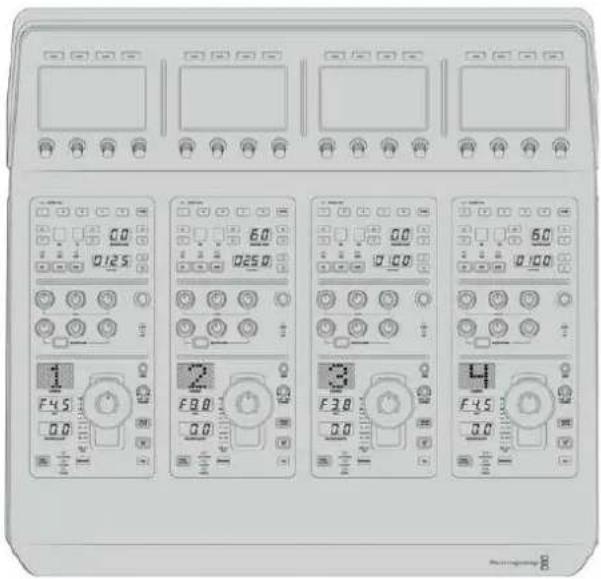
text_image
Front panel of a medical or electrical control device with multiple dials, buttons, and display screens showing measurement ranges.Each CCU has exactly the same controls.
LCD Menu Settings
Pressing the 'home' soft button returns you to main home screen. From the home screen, you can access all your camera control panel's settings including the network settings, auxiliary for camera control, master black enable and disable settings and the brightness settings for adjusting the lights on the various panel controls. You can also identify the software version installed on your camera control panel and the ATEM switcher your panel is connected to.
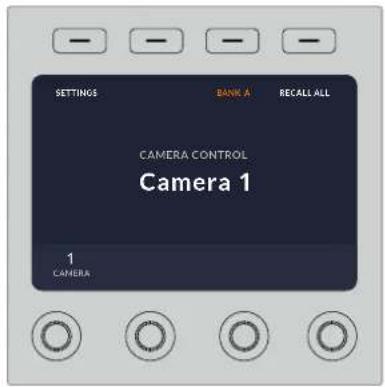
text_image
SETTINGS BANK A RECALL ALL CAMERA CONTROL Camera 1 1 CAMERAThe home screen displays features you may need access to at all times, for example selecting the desired camera bank and recalling scene files for all cameras
Camera Banks A and B
When the LCD is set to the home screen, you will see the camera bank setting at the top of the display. This setting displays which bank of cameras you are controlling, which is an important feature when using larger ATEM switchers controlling up to 20 Blackmagic Design cameras.
For example, imagine you are controlling 8 cameras and you want to have a dedicated CCU assigned to each camera. You can assign cameras 1 to 4 for each CCU on bank A, then assign cameras 5 to 8 to each CCU on bank B.
Now when switching your live production, you can press the 'bank' soft button to swap between banks A and B, which lets you instantly access camera control for cameras that have been assigned to dedicated CCUs. This is a faster and more organized way of controlling cameras compared to swapping between multiple cameras on each CCU during production.
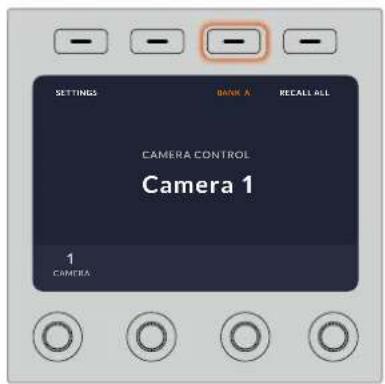
text_image
SETTINGS BANK A RECALL ALL CAMERA CONTROL Camera 1 1 CAMERAPress the bank soft button to cycle between camera banks A and B, or hold the button down to disable or enable camera banks
You can also disable the banks by holding down the bank soft button until the 'bank off' setting appears on the LCD.
Turning the banks off lets you change the CCUs to other cameras when needed, with a defined set of cameras ready on each bank you can access at any time. To enable banks, simply press the bank button again.

flowchart
graph TD
    A["Camera 1"] --> B["1"]
    C["Camera 2"] --> D["3"]
    E["Camera 3"] --> F["2"]
    G["Camera 4"] --> H["4"]
    style A fill:#000,stroke:#fff,color:#fff
    style C fill:#000,stroke:#fff,color:#fff
    style E fill:#000,stroke:#fff,color:#fff
    style G fill:#000,stroke:#fff,color:#fff
    style B fill:#000,stroke:#fff,color:#fff
    style D fill:#000,stroke:#fff,color:#fff
    style F fill:#000,stroke:#fff,color:#fff
    style H fill:#000,stroke:#fff,color:#fff
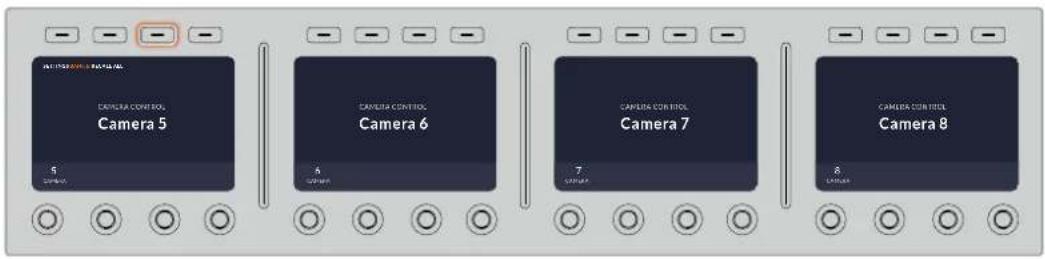
text_image
CAMERA CONTROL Camera 5 CAMERA CAMERA CONTROL Camera 6 CAMERA CAMERA CONTROL Camera 7 CAMERA CONTROL Camera 8The bank setting lets you assign 2 banks of cameras to the four CCUs and then instantly swap between them by pressing the 'bank' soft button
TIP Any camera can be selected on each CCU in both banks. For example, imagine you want to have constant control over camera 1, even after switching to another bank of cameras. All you need to do is make sure one CCU in each bank always has camera 1 selected.
Settings
Pressing the 'settings' button on the home screen opens all settings for your camera control panel. Navigate through the pages of settings by pressing the arrow soft button. The network settings, including DHCP and IP address settings, are the first pages in the sequence. These settings are described in the section that shows how to change network settings when connecting the camera control panel to your ATEM switcher. Keep reading this section for information on the additional settings for your camera control panel.
Auxiliary Select
This setting is important for ATEM switchers that have an auxiliary output.
Master Black
Setting the master black setting to on or off enables or disables the master black control, also known as the pedestal control. This is helpful if you want to lock the pedestal so it cannot be accidentally adjusted during production. The pedestal is controlled by turning the ring wheel on the joystick control knob clockwise or counter clockwise. More information on the joystick control is provided in the following sections.
Brightness
These settings let you adjust the brightness for the buttons, indicators, LEDs and LCDs on your camera control panel. Rotate the corresponding control knobs for each setting clockwise or counter clockwise to brighten or dim the lights.
CCU Panel Controls
The panel controls for each CCU are separated into three general sections. These include:
Scene Files and Camera Settings
Scene files are for storing all the camera parameters for each CCU. Camera settings can be changed such as shutter speed, master gain, white balance and enabling color bars. More information for these settings, plus the relative and absolute mode settings, are described in detail in the following 'controlling cameras' section.
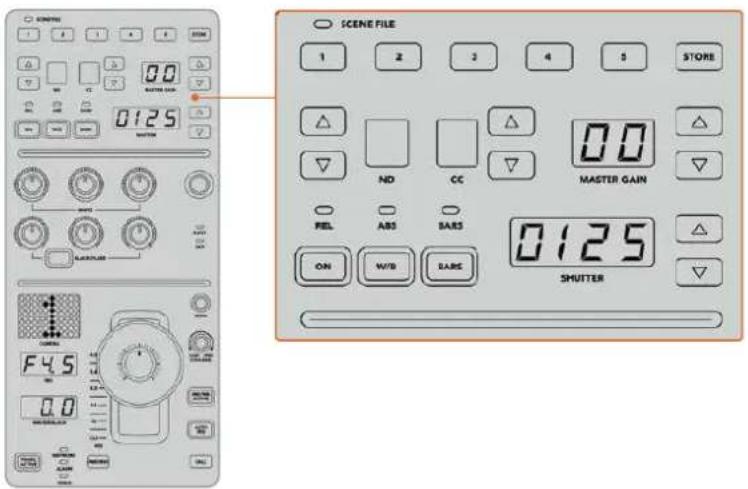
text_image
SCENE FILE 1 2 3 4 5 STORE ND CC 00 MASTER GAIN REL ABS SARS 0125 ON W/B SARS SHUTTERThe upper section of each CCU is used to store and recall scene files, plus control camera settings such as shutter speed, master gain, white balance and color bars
Color Balance Controls
The red, green and blue color balance knobs in the panel's mid section are for adjusting the color balance of the lift, gamma and gain levels. The white controls are for adjusting the RGB values for the gain, or highlights and the black controls are for
adjusting RGB values of the lift, or the shadows. The black/flare button lets you adjust the RGB values for the gamma, or mid tones, by holding down the button and adjusting the lift RGB knobs.
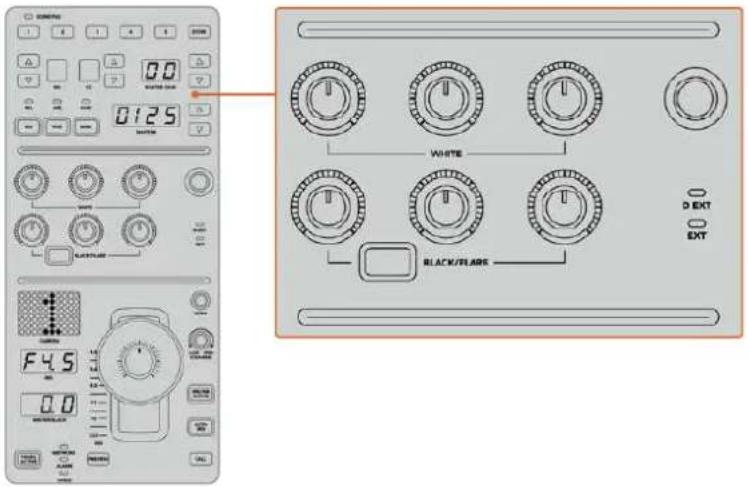
text_image
0.0 0:125 WHITE BLACK/FLARK D EXT EXTThe color balance controls let you make fine adjustments to the red, green, blue channels for the master gain/white, gamma and pedestal/black levels
There is also a custom control that will be uniquely assignable in a future update. Currently, the custom control knob is set to Y gain control. This increases or decreases the overall luminance, or brightness, of the image. More information about color balance control is provided in the following 'controlling cameras' section.
Lens Controls
The lower section of the panel is where most of the control will occur during production.
The first item you will probably notice is the joystick control. This is used to open and close the iris, also known as the white level or gain control and for adjusting the master black level, also known as the pedestal control.
Gain is adjusted by leaning the joystick forwards or backwards to open or close the iris. Increase or decrease the pedestal by rotating the ring wheel underneath the joystick's knob clockwise or counter clockwise. This gives you fine control over both parameters using the same controller.
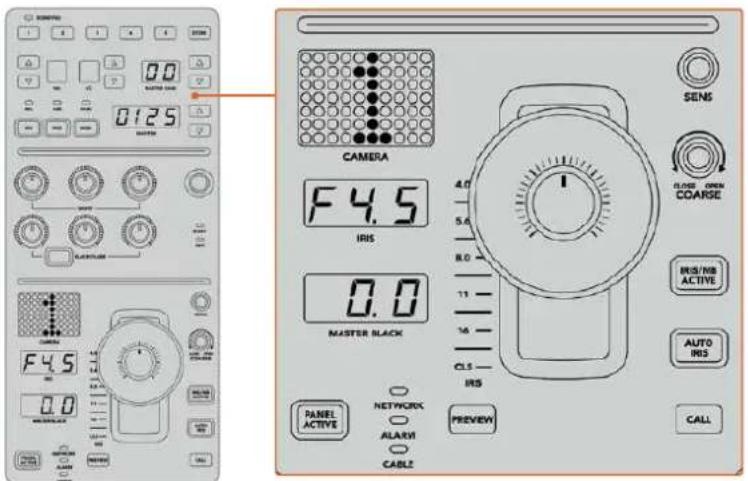
text_image
0125 CAMERA F4.5 IRIS 0.0 MASTER BLACK PANEL ACTIVE NETWORK ALARVI CABLE PREVIEW SENS CLOSD OPEN COARSE IRIS/INS ACTIVE AUTO IRIS CALLThe lower section of the CCU is where most of the camera control occurs during live production
Other buttons and knobs in this section of the CCU are for adjusting the sensitivity of the joystick control, setting the coarse level, locking and unlocking the CCU and more. Details on all the features are provided in the following section.
Controlling Cameras
This section describes all the features on each CCU and a general overview on how to approach camera control.
The first step to controlling cameras is to assign a camera for a CCU.
Assigning a Camera to a CCU
At the bottom of the LCD home screen for each CCU, you will see its camera number displayed and a soft control knob underneath it. Simply turn the knob to change the camera number. You will also see the camera name change on the LCD. The camera name will illuminate red when on air.
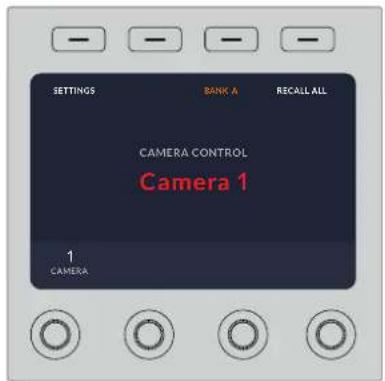
text_image
SETTINGS BANK A RECALL ALL CAMERA CONTROL Camera 1 1 CAMERAThe camera name and number on the LCD home screen shows the camera currently selected for each CCU
TIP The large camera number next to the CCU's joystick control will also change when you assign a camera. This large identifying number is easy to see and will illuminate red when its camera is live on the program output.
text_image
Two pixelated dot patterns: green dots above and red dots below, with vertical lines indicating positions.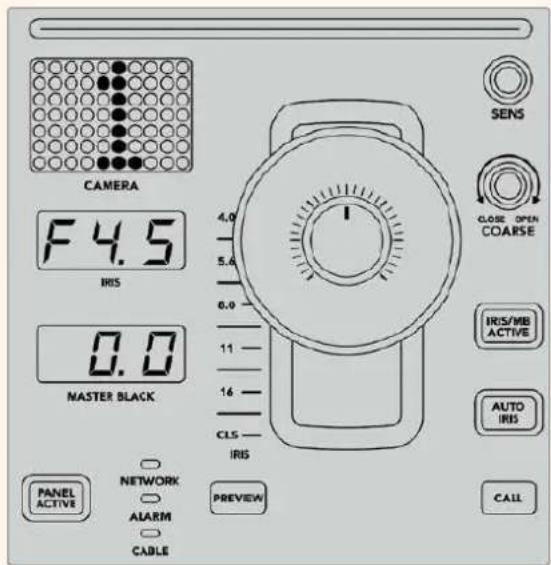
text_image
CAMERA F 4.5 IRIS 0.0 MASTER BLACK PANEL ACTIVE NETWORK: ALARM CABLE 4.0 5.6 0.0 11 16 CLS- IRIS PREVIEW SENS CLOSE OPEN COARSE IRIS/MB ACTIVE AUTO IRIS CALLScene Files
The numbered buttons along the top of each CCU let you quickly store and recall up to 5 scene file presets. For example, once you have arranged all your settings for a camera and you are set up for broadcast, you can then save all the parameters for each camera and recall them later. It's a very fast process!
To store a scene file:
1 Press the 'store' button on a CCU. The button will illuminate red to indicate the panel is ready to store a file.
2 Press a numbered scene file button.
The scene file indicator and buttons will illuminate, indicating when a scene file is stored or recalled.
To recall a scene file:
Press the numbered button for the scene file you want to recall.
That's all you need to do!
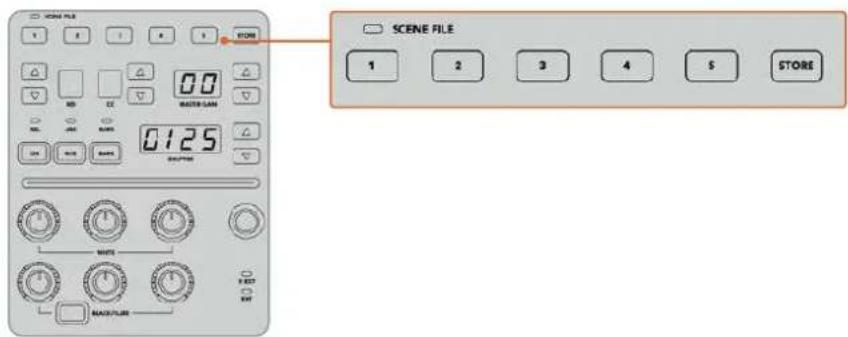
text_image
SCENE FILE 1 2 3 4 5 STOREThe scene file buttons are used for storing and recalling all settings for CCU controls
Recall All
When this feature is enabled, you can recall a stored scene file on all cameras simultaneously when you press the corresponding scene file button on a single CCU.
For example, you may have a specific setup for each camera that is optimized for a set in your live production. This will likely be a large number of settings that you will want to recall later when you return to that set.
The following is an example of how you can recall complex settings for multiple cameras simultaneously.
To recall a scene file to multiple cameras:
1 Once all your cameras are set up, store a scene file for each camera on scene file 1.
2 Enable the 'recall all' setting by pressing the corresponding soft button in the LCD home menu.
3 Now make any changes you want to each camera.
4 Press the scene file 1 button on any CCU. You will notice that all CCUs have recalled the settings stored in scene file 1 for each independent CCU.
NOTE While this feature is very powerful and helpful, please use with care as it affects all cameras, including the camera switched to the program output. We recommend enabling 'recall all' for specific setups prior to air and then immediately disabling the feature until you need it again.
ND
This setting will be enabled in a future update.
CC
This setting will be enabled in a future update.
Master Gain
Blackmagic Design cameras have ISO and gain settings that can be set using the master gain buttons on the camera control panel. To increase the master gain, press the up arrow next to the master gain indicator. To decrease gain, press the down arrow.
Increasing or decreasing the master gain lets you allow for more light in dimly lit shooting conditions, however it's worth being careful with the master gain as electronic noise can appear in the image as it reaches its highest settings.
TIP When a negative gain value is set, the down arrow will illuminate. When positive gain is set, the up arrow will illuminate.
Relative Control and Absolute Control
The camera control panel has two control modes that determine how the panel maintains synchronization between the physical controls and their settings. The two control modes are relative control and absolute control.
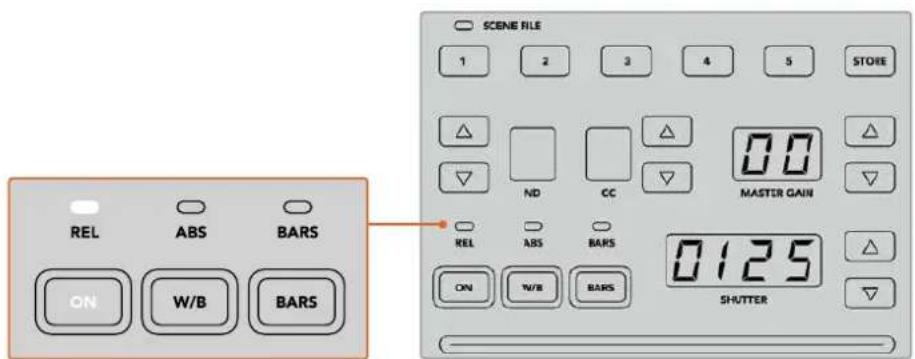
text_image
SCENE FILE 1 2 3 4 5 STORE ▲ △ ND CC 00 MASTER GAIN ▼ ▼ REL ABS BARS REL ABS BARS 0125 ON W/B BARS SHUTTERPressing the 'ON' button repeatedly will cycle between relative and absolute control modes
Relative Control
In relative control mode, when a setting is adjusted externally and becomes out of sync with the original controller, the next time a change is made to the original controller, its setting will gradually return to sync as the new adjustment is performed.
For example, if the camera's iris is set to f2.8 on the camera control panel and then set to f5.6 using ATEM Software Control, the joystick will still be physically placed at f2.8, but the setting is now f5.6. In relative mode, when you then adjust the joystick to decrease the gain level, the setting will continue from f5.6 and gently return to sync with the controller as you make changes. The process is almost invisible and it's likely you won't even notice.
Absolute Control
In absolute control mode, the settings are always synchronized to their corresponding controls.
NOTE When the panel is in absolute control mode, it's worth keeping in mind that if a control's setting is changed using ATEM Software Control or a different CCU, the next adjustment on the original controller will result in an initially harsh settings change as it snaps back to its originally set position.
For example, if the joystick has set the iris to f2.8 on the camera control panel and then the setting is changed to f5.6 using ATEM Software Control, the next time you adjust the gain level using the joystick, the gain level will immediately snap to f2.8 and begin adjusting from there. That is because the joystick is still positioned at f2.8 on the camera control panel.
For this reason, it's important to decide before going to air which control mode you want to use when controlling your cameras so you can be sure there is no risk of unintended changes when live to air.
White Balance
You can adjust the white balance of each camera by holding down the white balance button, marked 'W/B' and pressing the shutter up and down arrow buttons to warm or cool the image. The shutter setting indicator displays white balance values so you can monitor the color temperature in degrees Kelvin. Check the white balance setting at any time by holding down the white balance button and observing the shutter setting indicator.
TIP When changing a white balance or shutter speed setting, you can increase their speed of change by holding down the corresponding up or down arrow buttons.
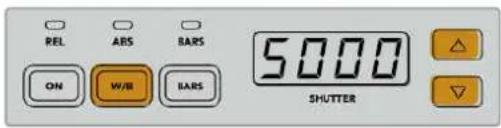
text_image
REL ABS BARS ON W/B BARS 5000 SHUTTERHold down the W/B button and press the shutter up and down arrow buttons to set a white balance in degrees Kelvin
Color Bars
Pressing the 'bars' button will set the camera to display color bars. Press again to turn bars off.
Shutter Speed
The arrow buttons next to the shutter display let you change the camera's shutter speed. Press the up arrow to increase the shutter speed and down to decrease. For general production use, the shutter speed is typically set to 50, meaning 1/50th of a second, which produces a pleasing motion blur. If you want crisper images with reduced motion blur, for example when shooting sport, a faster shutter speed may be preferred.
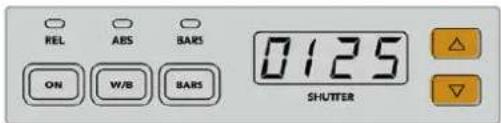
text_image
REL ABS BARS ON W/B BARS 0125 SHUTTERPress the shutter up and down buttons to set the camera's shutter speed
White and Black Balance Controls
The two rows of color balance knobs are used to adjust the color balance of the white and black levels, also known as gain and pedestal. Turn the red, green and blue knobs clockwise or counter clockwise to make changes.
TIP For achieving accurate color settings while adjusting the color balance, it's best to view scopes. For example, a waveform, parade or vectorscope as provided on a Blackmagic SmartScope 4K.
Black/Flare Button
Adjust the color of the gamma or mid tones by holding down the black/flare button and adjusting the black balance RGB controls.
D EXT/EXT
This feature will be enabled in a future update.
Camera Number
Each CCU has its own large camera number that shows you which camera is being controlled. This large display is illuminated green when in a neutral state and red when its camera is switched to the program output.
Gain and Pedestal Level Control
The joystick control lets you make fine adjustments to the gain/iris and pedestal/master black levels.
Leaning the joystick forwards or backwards opens or closes the camera's iris, also known as the gain level. As you lean the joystick forwards and backwards, its indicator strip will illuminate, providing an approximate display of the camera's exposure. For a precise assessment of the exposure f-stop, observe the iris indicator.
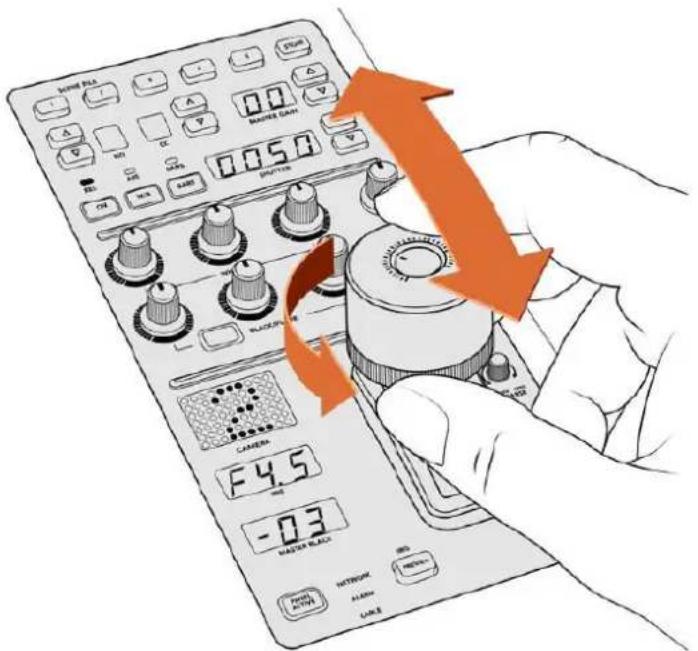
text_image
Illustration of a handheld electronic device with labeled buttons and a hand holding the control panel, showing orange arrows indicating rotation or adjustment.The joystick lets you adjust the gain level by leaning the controller forwards and backwards. The master black level can be adjusted by turning the ring wheel clockwise or counter clockwise. Corresponding indicators are provided for accurate measurement.
Located around the collar of the joystick's handle is a ring wheel that controls the pedestal level. The ring wheel has small ridges built in for firm control and a position indicator is located on the top of the knob to show the physical positioning of the wheel. Turn the wheel clockwise to increase the master black level, or counter clockwise to decrease.
Iris and Master Black Indicators
The indicators for the iris and master black joystick control displays the gain value, shown as the f-stop exposure level for the camera lens and the level of the master black setting.
Sensitivity
The sensitivity setting lets you define a specific range between the highest and lowest gain levels so you can achieve finer control using the joystick. For example, when sensitivity is at its maximum setting, you can lean the joystick all the way forwards or backwards, however it will only affect a narrow range of gain.
You can define how narrow the range is by increasing or decreasing the sensitivity.
Coarse Control Knob
The coarse setting lets you define a limit to the maximum gain control. For example, you may want to ensure your gain never rises higher than a determined exposure.
To do this:
1 Lean the joystick to its highest position to increase the gain setting to its maximum.
2 Now decrease the coarse setting by rotating the coarse knob counter clockwise until the gain reaches the limit you want to set.
You can now lean the joystick all the way up and down and the gain will never rise higher than the limit you have set.
TIP When the coarse control is combined with the sensitivity control, you can define an upper and lower limit to the gain control.
For example, imagine you want to limit the gain so it never rises above f4.0 because gain above that level will clip highlights in your image. You also want to limit the gain so its minimum setting will be f8.0 to maintain the optimum sharpness range for your lens.
To do this:
1 Increase the gain control to its maximum position by leaning the joystick all the way to its top position.
2 Now decrease the coarse setting until it reaches the upper limit you want to set. In this case, f4.0.
3 To set the lower limit, lean the joystick all the way to its bottom position.
4 Now increase the sensitivity setting until the gain reaches the lower limit you want to set. In this case, f8.0.
Now you can lean the joystick all the way from top to bottom and the gain will stay within the limits you have set. This is a powerful way to define your exposure limits, plus gain finer control with the joystick due to allowing its maximum travel forwards and backwards.
Iris and Master Black Active
Once your levels are set and you want to lock them so they are not accidentally changed, press the 'iris/MB active' button. This enables a lock on the gain and master black so that any accidental movements of the joystick will not affect your settings. The 'Iris/MB active' button label will illuminate red when the lock is active. To disable the lock, press the button again.
TIP You can lock the black/pedestal level independently by disabling the 'master black' option in the 'settings' menu. When disabling master black, the black level is locked but the iris/gain level can still be adjusted. Don't forget to enable the master black setting if you want to make changes to the black/pedestal level.
Auto Iris
If your camera is using a compatible lens with electronic iris control via the camera, then you can press the 'auto iris' button for a quick automatic exposure setting. The camera will set exposure based on average brightness, providing an average exposure that is a balance between the brightest highlights and the darkest shadows.
Call
Holding down the 'call' button will flash the tally light on the CCU's selected camera when using Blackmagic URSA Broadcast and Blackmagic URSA Mini Pro 4.6K. This is a helpful way of seeking the camera operators' attention, or to let your operators know you are about to go live.
While holding down the call button, the large camera number next to the joystick will also flash so you can visually confirm the call is being sent.
Panel Active
After you are happy with your camera settings, you may want to lock all the controls so they cannot be accidentally adjusted. Pressing the 'panel active' button enables the CCU lock so all controls cannot be changed. Press the button again to disable the CCU lock. This can be a helpful feature when you are recording a locked off shot and don't want the setting adjusted by accident, for example a wide shot of a stadium filling as the crowd enters.
ATEM Camera Control Panel is an exciting, practical and efficient way to control Blackmagic Design cameras in your live production. We believe you will enjoy the experience of hands on camera control using CCUs, which lets you take control of exposure and other camera settings, freeing up your camera operators so they can concentrate on framing and focus.
Using Audio
Connecting other Audio Sources
Your ATEM switcher features 3.5mm jack inputs so you can connect external microphones and audio sources, for example music players.

text_image
POWER A258 CONTROL A258 SOUT UHUA FLOT 4 3 3 4 MAC 2 MAC 1 MIC 2 MIC 13.5mm jack inputs let you connect external analog audio, for example microphones and music players
Using Embedded HDMI Audio Sources
Your ATEM Mini includes a built-in audio mixer that lets you use the embedded HDMI audio from your cameras, media servers and other inputs without the need for an external audio mixer.
Once you've connected your HDMI cameras to the switcher for vision mixing, there are no other connections to make as the audio mixer uses the embedded audio in the video signal. This saves space and makes setup very fast and low cost as you don't need separate audio connections for every video source, and you don't need an external audio mixer unless you prefer to use one.
The audio is mixed using the control buttons on your ATEM Mini, or via the Audio tab of ATEM Software Control and output over USB webcam and HDMI outputs as embedded digital audio.
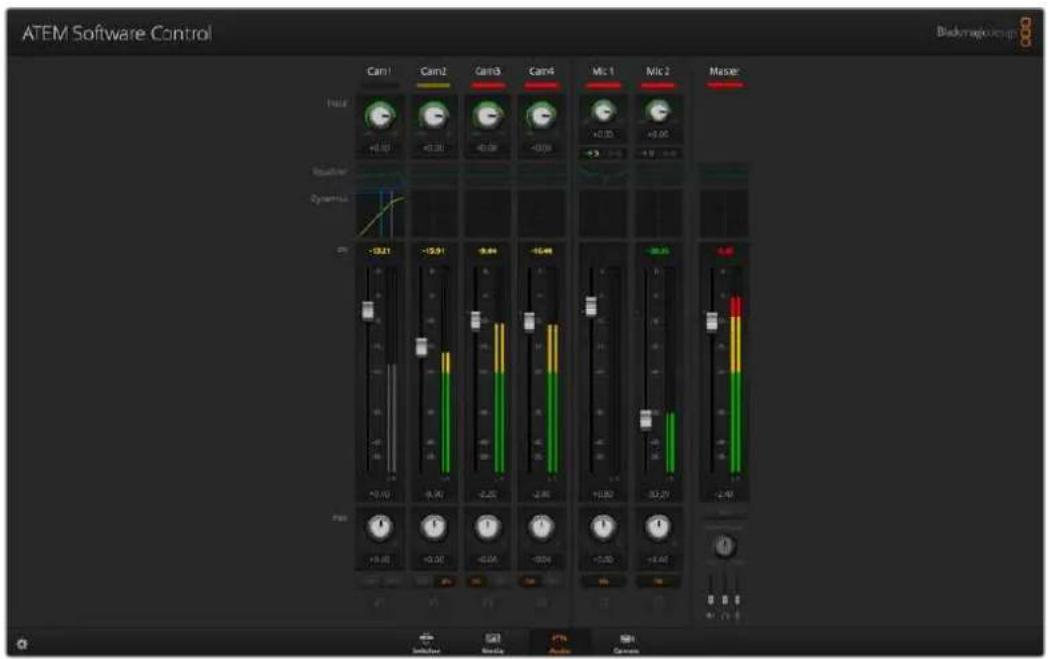
text_image
ATEM Software Control Bikomajor.com Host +0.10 +0.20 +0.30 +0.40 +0.50 +0.60 +0.70 +0.80 +0.90 +1.00 +1.10 +1.20 +1.30 +1.40 +1.50 +1.60 +1.70 +1.80 +1.90 +2.00 +2.10 +2.20 +2.30 +2.40 +2.50 +2.60 +2.70 +2.80 +2.90 +3.00 +3.10 +3.20 +3.30 +3.40 +3.50 +3.60 +3.70 +3.80 +3.90 +4.00 +4.10 +4.20 +4.30 +4.40 +4.50 +4.60 +4.70 +4.80 +4.90 +5.00 +5.10 +5.20 +5.30 +5.40 +5.50 +5.60 +5.70 +5.80 +5.90 +6.00 +6.10 +6.20 +6.30 +6.40 +6.50 +6.60 +6.70 +6.80 +6.90 +7.00 +7.10 +7.20 +7.30 +7.40 +7.50 +7.60 +7.70 +7.80 +7.90 +8.00 +8.10 +8.20 +8.30 +8.40 +8.50 +8.60 +8.70 +8.80 +8.90 +9.00 +9.10 +9.20 +9.30 +9.40 +9.50 +9.60 +9.70 +9.80 +9.90 +10.00Using a Third Party Audio Mixer Control Surface
Using an Audio Mixer Control Surface
Connecting a hardware audio mixer control surface to your ATEM Mini provides you with the ability to use both hands and adjust multiple audio levels at the same time.
An audio mixer control surface can be connected to your Mac or PC as a MIDI device using Mackie Control commands to communicate with ATEM Mini.
Many third party MIDI control surfaces are compatible with your ATEM Mini but please check with the manufacturer of your control surface if in doubt.
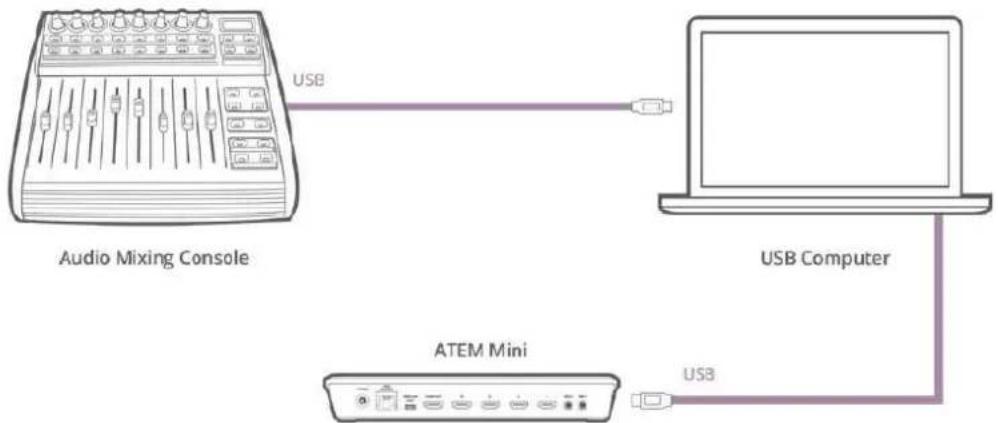
flowchart
graph LR
    A["Audio Mixing Console"] -->|USB| B["USB Computer"]
    C["ATEM Mini"] -->|USB| B
You can adjust multiple audio levels at the same time by connecting a hardware audio mixer to the computer which is running ATEM Software Control
Connecting Your Audio Mixer Control Surface
1 Connect your compatible MIDI control surface to your Mac or PC. Most modern control surfaces use USB.
2 Verify your control surface is recognized by your computer as a MIDI device.
For Mac OS computers, go to Applications/Utilities/Audio MIDI Setup and launch the application. Go to the Window menu and choose Show MIDI Window. Ensure your control surface appears as a MIDI device in this window.
For Windows computers, go to Computer/Properties/Device Manager/Sound, Video and Game Controllers and ensure your control surface appears in the list of icons.
3 The ATEM audio mixer is designed to communicate with your control surface using Mackie Control commands so your control surface will need to support Mackie Control. You'll also need to make sure your control surface is configured to use native Mackie Control or Mackie Control emulation. Please refer to your control surface's user manual for configuration details.
Some control surfaces offer several types of Mackie Control emulation and you should choose the one that activates the most features on your control surface. For example, with the Behringer BCF 2000, choosing "Mackie Control Mapping for Cakewalk Sonar 3 [MCSo]" enables level faders, bank selectors, balance control, AFV and ON/MUTE functions, and also activates the LED screen which displays which bank of faders you have selected for your audio mix. The LED screen will not activate if you choose another Mackie Control emulation.
4 Launch ATEM Software Control and it will automatically look for your control surface using the first port on the first MIDI device that it finds. Click on the Audio tab in ATEM Software Control to display the ATEM audio mixer. Try sliding the gain faders up and down on your hardware control surface and verify that the audio mixer faders show a corresponding increase and decrease in the software on your computer screen. If so, you have successfully configured your control surface to work with the ATEM switcher.
TIP If your midi device is not working as expected, ensure 'enable midi control' is selected in ATEM Software Control's general switcher preferences.
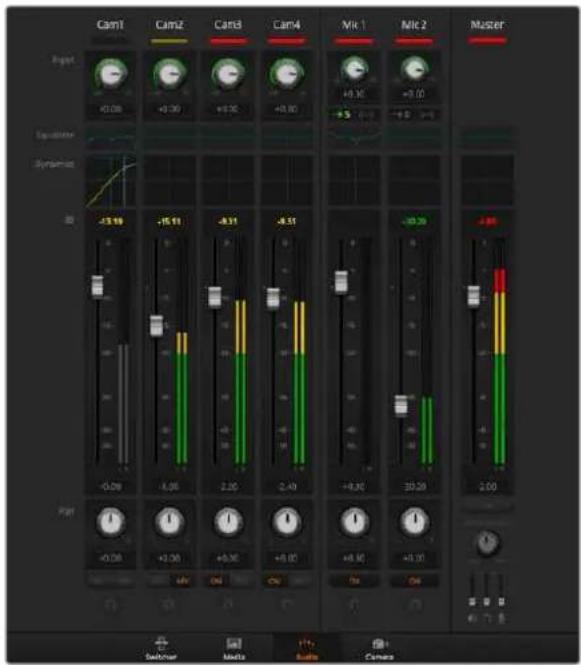
text_image
Cam1 Cam2 Cam3 Cam4 Mix 1 Mix 2 Master Input +0.08 +0.09 +0.10 +0.11 +0.12 +0.13 +0.14 +0.15 +0.16 +0.17 +0.18 +0.19 +0.20 +0.21 +0.22 +0.23 +0.24 +0.25 +0.26 +0.27 +0.28 +0.29 +0.30 +0.31 +0.32 +0.33 +0.34 +0.35 +0.36 +0.37 +0.38 +0.39 +0.40 +0.41 +0.42 +0.43 +0.44 +0.45 +0.46 +0.47 +0.48 +0.49 +0.50 +0.51 +0.52 +0.53 +0.54 +0.55 +0.56 +0.57 +0.58 +0.59 +0.60 +0.61 +0.62 +0.63 +0.64 +0.65 +0.66 +0.67 +0.68 +0.69 +0.70 +0.71 +0.72 +0.73 +0.74 +0.75 +0.76 +0.77 +0.78 +0.79 +0.80 +0.81 +0.82 +0.83 +0.84 +0.85 +0.86 +0.87 +0.88 +0.89 +0.90 +0.91 +0.92 +0.93 +0.94 +0.95 +0.96 +0.97 +0.98 +0.99 +1.00Try sliding the gain faders up and down on your hardware control surface and verify that the audio mixer faders show a corresponding movement in the software on your computer screen
The MUTE button
In the ATEM audio mixer interface, audio is always on, or present in the mix, when the ON button is selected. When the ON button is deselected, audio is not present or is muted. To match the software interface, you'll find the MUTE button on your audio mixer control surface will be lit when audio is always on or present in the mix. The MUTE button will be unlit when audio is not present or is muted.
Decibel Scales
All hardware mixers are made differently, and the scale printed on your control surface may not match the scale in the ATEM audio mixer interface. Always refer to the ATEM audio mixer levels for the true decibel scales.
Help
Getting Help
The fastest way to obtain help is to go to the Blackmagic Design online support pages and check the latest support material available for your ATEM Mini.
Blackmagic Design online support pages
The latest manual, software and support notes can be found at the Blackmagic Design support center at www.blackmagicdesign.com/support.
Blackmagic Design Forum
The Blackmagic Design forum on our website is a helpful resource you can visit for more information and creative ideas. This can also be a faster way of getting help as there may already be answers you can find from other experienced users and Blackmagic Design staff which will keep you moving forward. You can visit the forum at https://forum.blackmagicdesign.com
Contacting Blackmagic Design support
Alternatively, click on the "Find your local support team" button on the support page and call your nearest Blackmagic Design support office.
Checking the version currently installed
To check which version of ATEM software is installed on your computer, open the About ATEM Software Control window.
– On Mac OS, open ATEM Software Control from the Applications folder. Select About ATEM Software Control from the application menu to reveal the version number.
- On Windows, open ATEM Software Control from your 'start' menu. Click on 'help' in the menu bar and select 'about' to reveal the version number.
How to get the latest updates
After checking the version of ATEM software installed on your computer, please visit the Blackmagic Design support center at www.blackmagicdesign.com/support to check for the latest updates. While it is usually a good idea to run the latest updates, it is a wise practice to avoid updating any software if you are in the middle of an important project.
Regulatory Notices

Disposal of Waste of Electrical and Electronic Equipment Within the European Union.
The symbol on the product indicates that this equipment must not be disposed of with other waste materials. In order to dispose of your waste equipment, it must be handed over to a designated collection point for recycling. The separate collection and recycling of your waste equipment at the time of disposal will help conserve natural resources and ensure that it is recycled in a manner that protects human health and the environment. For more information about where you can drop off your waste equipment for recycling, please contact your local city recycling office or the dealer from whom you purchased the product.

This equipment has been tested and found to comply with the limits for a Class A digital device, pursuant to Part 15 of the FCC rules. These limits are designed to provide reasonable protection against harmful interference when the equipment is operated in a commercial environment. This equipment generates, uses, and can radiate radio frequency energy and, if not installed and used in accordance with the instructions, may cause harmful interference to radio communications. Operation of this product in a residential area is likely to cause harmful interference, in which case the user will be required to correct the interference at personal expense.
Operation is subject to the following two conditions:
1 This device may not cause harmful interference.
2 This device must accept any interference received, including interference that may cause undesired operation.
Connection to HDMI interfaces must be made with high quality shielded HDMI cables.

R-R-BMD-20200131005
R-R-BMD-201911001
ISED Canada Statement
This device complies with Canadian standards for Class A digital apparatus.
Any modifications or use of this product outside its intended use could void compliance to these standards.
Connection to HDMI interfaces must be made with high quality shielded HDMI cables.
This equipment has been tested for compliance with the intended use in a commercial environment. If the equipment is used in a domestic environment, it may cause radio interference.
Safety Information
This equipment is suitable for use in tropical locations with an ambient temperature of up to 40^ C.

Use only at altitudes not more than 2000m above sea level.
No operator serviceable parts inside. Refer servicing to your local Blackmagic Design service centre.
State of California statement
This product can expose you to chemicals such as trace amounts of polybrominated biphenyls within plastic parts, which is known to the state of California to cause cancer and birth defects or other reproductive harm.
For more information go to www.P65Warnings.ca.gov.
Singapore Notice
The power adapter supplied with your Blackmagic Design equipment has interchangeable plugs to suit the mains socket outlets in a number of countries. Each plug marked with the model numbers APD2-UK or APD2-EU are approved and suitable for use in Singapore.
Warranty
12 Month Limited Warranty
Blackmagic Design warrants that this product will be free from defects in materials and workmanship for a period of 12 months from the date of purchase. If a product proves to be defective during this warranty period, Blackmagic Design, at its option, either will repair the defective product without charge for parts and labor, or will provide a replacement in exchange for the defective product.
In order to obtain service under this warranty, you the Customer, must notify Blackmagic Design of the defect before the expiration of the warranty period and make suitable arrangements for the performance of service. The Customer shall be responsible for packaging and shipping the defective product to a designated service center nominated by Blackmagic Design, with shipping charges pre paid. Customer shall be responsible for paying all shipping charges, insurance, duties, taxes, and any other charges for products returned to us for any reason.
This warranty shall not apply to any defect, failure or damage caused by improper use or improper or inadequate maintenance and care. Blackmagic Design shall not be obligated to furnish service under this warranty: a) to repair damage resulting from attempts by personnel other than Blackmagic Design representatives to install, repair or service the product, b) to repair damage resulting from improper use or connection to incompatible equipment, c) to repair any damage or malfunction caused by the use of non Blackmagic Design parts or supplies, or d) to service a product that has been modified or integrated with other products when the effect of such a modification or integration increases the time or difficulty of servicing the product. THIS WARRANTY IS GIVEN BY BLACKMAGIC DESIGN IN LIEU OF ANY OTHER WARRANTIES, EXPRESS OR IMPLIED. BLACKMAGIC DESIGN AND ITS VENDORS DISCLAIM ANY IMPLIED WARRANTIES OF MERCHANTABILITY OR FITNESS FOR A PARTICULAR PURPOSE. BLACKMAGIC DESIGN'S RESPONSIBILITY TO REPAIR OR REPLACE DEFECTIVE PRODUCTS IS THE WHOLE AND EXCLUSIVE REMEDY PROVIDED TO THE CUSTOMER FOR ANY INDIRECT, SPECIAL, INCIDENTAL OR CONSEQUENTIAL DAMAGES IRRESPECTIVE OF WHETHER BLACKMAGIC DESIGN OR THE VENDOR HAS ADVANCE NOTICE OF THE POSSIBILITY OF SUCH DAMAGES. BLACKMAGIC DESIGN IS NOT LIABLE FOR ANY ILLEGAL USE OF EQUIPMENT BY CUSTOMER. BLACKMAGIC IS NOT LIABLE FOR ANY DAMAGES RESULTING FROM USE OF THIS PRODUCT. USER OPERATES THIS PRODUCT AT OWN RISK.
© Copyright 2021 Blackmagic Design. All rights reserved. 'Blackmagic Design', 'DeckLink', 'HDLink', 'Workgroup Videohub', 'Multibridge Pro', 'Multibridge Extreme', 'Intensity' and 'Leading the creative video revolution' are registered trademarks in the US and other countries. All other company and product names may be trade marks of their respective companies with which they are associated.
Thunderbolt and the Thunderbolt logo are trademarks of Intel Corporation in the U.S. and/or other countries.
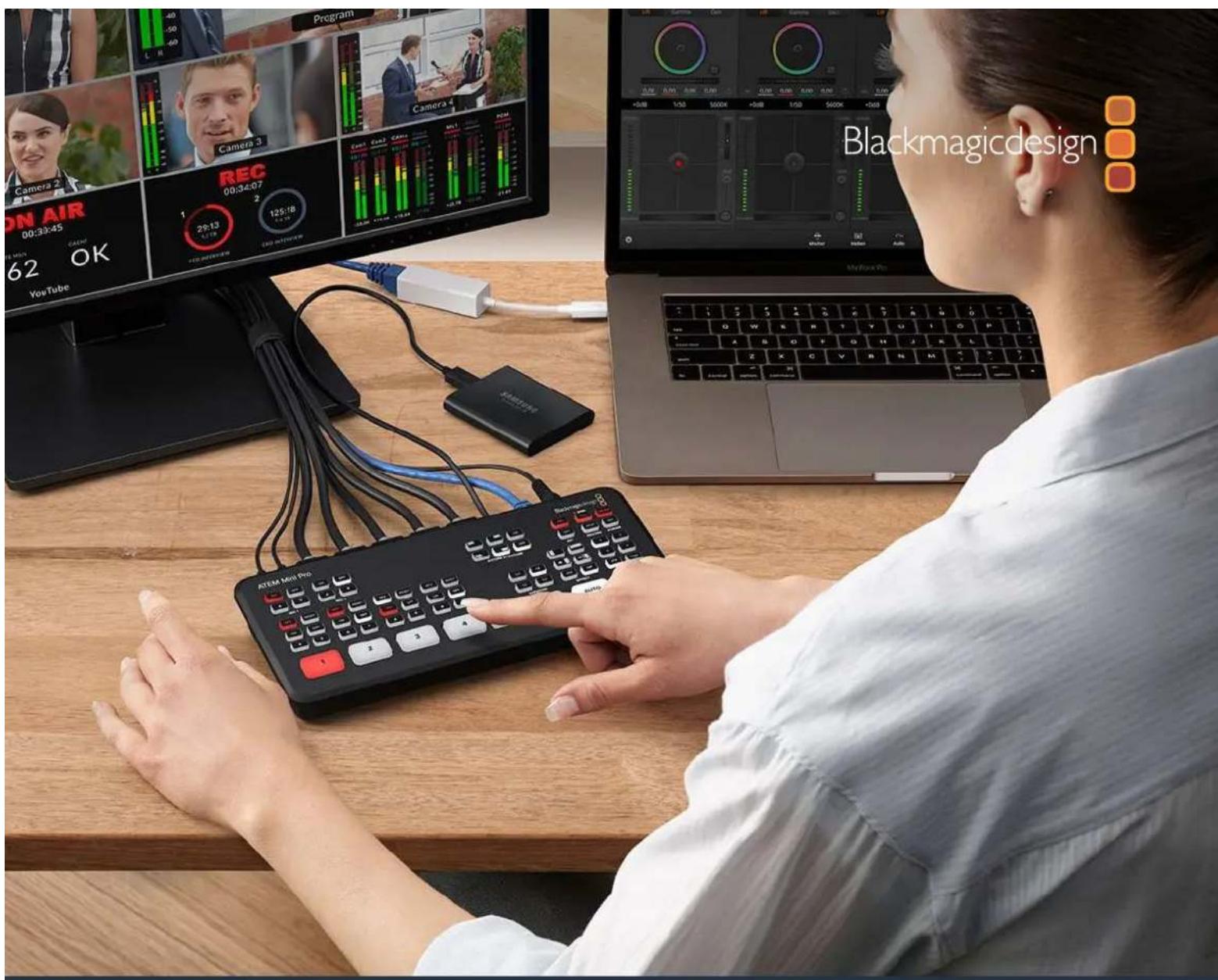
text_image
Program Camera 2 00:33:45 CAMER 62 OK YouTube REC 00:34:07 125:18 1 2 3 4 5 6 7 8 9 10 11 12 13 14 15 16 17 18 19 20 21 22 23 24 25 26 27 28 29 30 31 32 33 34 35 36 37 38 39 40 41 42 43 44 45 46 47 48 49 50 51 52 53 54 55 56 57 58 59 60 61 62 63 64 65 66 67 68 69 70 71 72 73 74 75 76 77 78 79 80 81 82 83 84 85 86 87 88 89 90 91 92 93 94 95 96 97 98 99 100 Blackmagicdesignインストール/オペレーションマニュアル
ATEM Mini
2021年2月
日本語
natural_image
Circular portrait photo of a smiling man in a dark shirt against a gray background (no text or symbols)ようこそ
Blackmagic Design CEO
グ ラント・ペ ティ
目次
始めに 189
電源の接続 189
ビデオソースを接 続 190
モニターを接続し、入力をテスト 190
マイクを 接 続 191
カットトランジション 192
SkypeおよびZoomに接続 193
コンピューターを接 続 193
プロダクションのスイッチング 194
カット/トランジ ション の 使用
カットでのソースの切り替え
オートトランジ ションでのソース
の切り替え 195
トランジションスタイルとDVE 196
オーディオコントロール 197
natural_image
Illustration of a device with labeled ports and a hand holding a USB port (no text or symbols visible)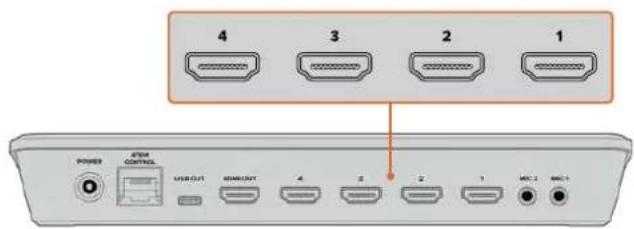
text_image
4 3 2 1 POWER SEM CONTROL USB CUT SEMOUNT 4 2 2 1 MEC 1 MEC 2 MEC 3text_image
USB OUT POWER ATOM CONTROL USB OUT MEMOUNT 4 5 2 1 MEC1 MECtext_image
1 Skype Number Get a second number Settings S* Get Skype apptext_image
2 General Appearance Audio & Video Callingnatural_image
Interior view of a room with a framed mirror and window, no visible text or symbolstext_image
4 AUDIO Microphone Blackmagic Design Automatically adjust microphone settings Speakers Default device 0 1 2 3 4 5 6 7 8 9 10With your Skype settings set correctly, perhaps try out a Skype call with a friend as a quick test to check your broadcast setup is working.
Zoomでウェブカムを設定
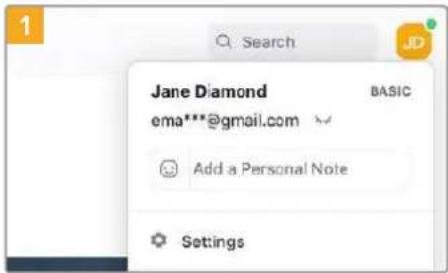
text_image
Jane Diamond BASIC ema***@gmail.com Add a Personal Note Settingstext_image
Settings Camera Background Design #3, MAXO Open ENL... Digitalization: 100 More my videotext_image
Settings Speaker Text Speaker Dali-on Output (Internal Slighting) Output Level: Output Volumes: Use separate audio channels to play right-side simultaneously Microphone Text Mix BlackLogic Design Input Level: Input volume: Automatically adjust microphone volume Source: backwind noise Source: Newtext_image
ATEM Mini Extreme MUTE RESET AFV RESETピクチャー・イン・ピクチャーの使用
text_image
ATEMMini Tecumwedge 1 2 3 4 SET SET SET SET SET SET SET SET SET SET SET SET SET SET SET SET SET SET SET SET SET SET SET SET SET SET SET FTBtext_image
ATEM Mini Pro ON AIR OFFtext_image
1 Twitch sc Get Bits athill path of Exole SK viewers ExtensionEnhanced brndstreaming = Offline Online Channel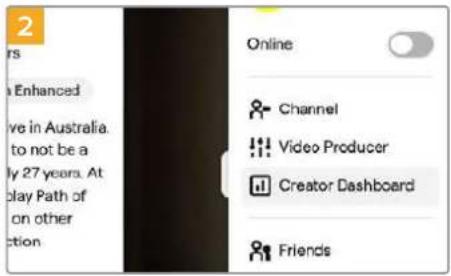
text_image
2 Online Channel Video Producer Creator Dashboard Friendstext_image
Stream Manager Insights Community Content Preferences Channel Moderation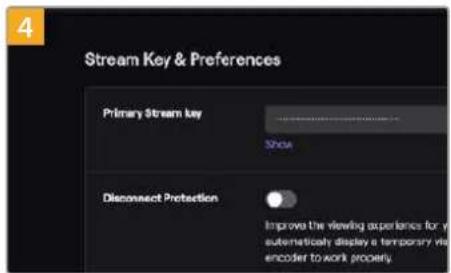
text_image
4 Stream Key & Preferences Primary Stream key Show Disconnect Protection Improve the viewing experience for y automatically display a temporary vis encoder to work properly.text_image
5 Copy Reset Event your stream is disconnected if your primary stream fails, rebuild out and reconnect. *Note: This requires the size of a major「Copy」をクリックします。
text_image
ATEM Mini Extreme Iloctimugodesp 1.0 MB ON ON OFF ON ON ON ON ON ON ON ON ON ON ON ON ON ON ON ON ON ON ON ON ON ON ON ON ON ON ON ON ON ON ON ON ON ON ON ON ON ON ON ON ON ON ON ON ON ON ON ON ON ON ON ON ON ON ON ON ON ON ON ON ON ON ON ON ON ON ON ON On ON On ON On ON On ON On ON On ON On ON On ON On ON On ON On ON On ON On ON On ON On ON On ON On ON On ON On ON On ON On ON On ON On ON On ON On ON On ON On ON On ON On ON On ON On ON On ON On ON On
text_image
POWER USB USB HOME OUT HOME OUT 8 1 6 5 4 3 2 1 I/O 1 I/O 1natural_image
Woman wearing headphones and singing into a microphone (no visible text or symbols)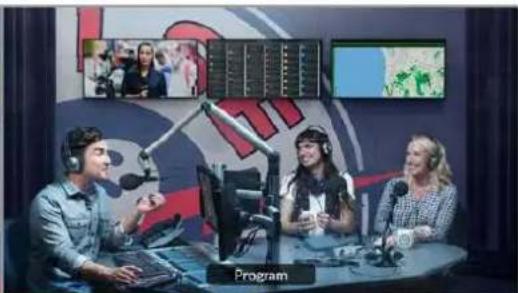
text_image
Program
text_image
Camera 1
text_image
Camera 3
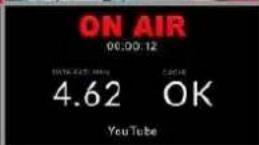
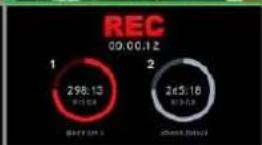
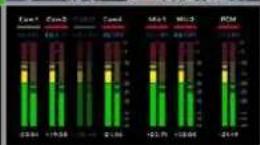
natural_image
Split-screen image showing a female host in headphones and two male speakers at a live audio workstation (no visible text or symbols)プレビュー
text_image
Camera 1 Camera 2 Camera 3 Camera 4入 カビュー
text_image
VIBES MP1メディア プレ - ヤー ビュー
text_image
ON AIR 00:00:12 DATA:RAT RIN 4.62 OK YouTube配信ビュー
bar_stacked
| Category | -25.84 | +19.08 | +10.63 | -25.56 | +23.78 | +21.00 | -21.49 | |---|---|---|---|---|---|---|---| | Can1 | Green | Red | Yellow | Green | Red | Yellow | Green | | Can2 | Green | Red | Yellow | Green | Red | Yellow | Green | | Cdkn | Green | Red | Yellow | Green | Red | Yellow | Green | | Cdk4 | Green | Red | Yellow | Green | Red | Yellow | Green | | Ms1 | Green | Red | Yellow | Green | Red | Yellow | Green | | Ms2 | Green | Red | Yellow | Green | Red | Yellow | Green | | PGM | Green | Red | Yellow | Green | Red | Yellow | Green |オーディオビュー
ATEM Mini Extreme Enhanced Multiview
text_image
ATEM Mini Black-magcsdesign ON OFF ON OFF MIC1 MIC2 PICTUREN PICTURE OK ON OFF OK OFF OFF OK OK OK OK OK OK OK OK OK OK OK OK OK OK OK OK OK OK OK OK OK OK OK OK OK OK OK OK OK OK OK OK OK OK OK OK OK OK OK OK OK OK OK OK OK OK OK OK OK OK 1 2 3 4 FTL. TRACK. CUT AUTO FTB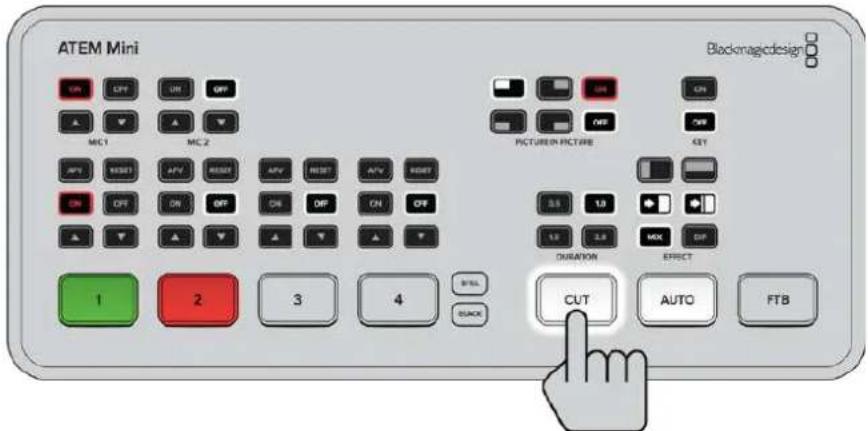
text_image
ATEM Mini Blackmagicdesign ON UPF ON OP MC1 MC2 APV RESET APV RESET APV RESET ON OP ON OP ON OP PICTURE IN PICTURE ON OP ON OP 3.5 1.0 1.0 3.0 MCK OP DURATION EFFECT 1 2 3 4 FULL SLACK CUT AUTO FTBtext_image
Drive 01 Name: Drive_01 Female: Mac OS Extended (Journaied) Security Options... Cancel Brace MountPoint: properties/Drive_01 Type: USB External Physical Volume Capacity: 239.71 GB Users: Enabled Available: 239.4 GB (Cets KB pgmable) Connections: USB Used: 312.5 MB Device: disk2.x2 Internal Macintosh HD External Drive 01 Brace "Drive_01"? Strong "Drive_01" will delete statics stored on it, and cannot be done. Provide a name and format, and click Error to proceed. 239.71 GBtext_image
ATEM Software Control Bio-magricosin -10.00 -10.01 -10.06 -10.08 -5 -13.15 -19.24 -16.22 -937 -13.00 -16.00 +2.00 +2.00 +2.00 +2.00 +2.00 +2.00 +2.00 +2.00 +2.00 +2.00 +2.00 +2.00 +2.00 +2.00 +2.00 +2.00 +2.00text_image
ATEM Software Control Blackmagic.com 1.5% +0.80 Cam1 Cam2 Cam3 Cam4 MC1 MC2 MACS -13.19 -15.24 -60.22 -957 -11.90 -20.28 -4.20 -0.05 -0.05 -0.05 -0.05 -0.05 -0.05 -0.05 -0.05 -0.05 -0.05 -0.05 -0.05 -0.05 -0.05 -0.05 -0.05 -0.05 -0, 0, 1, 2, 3, 4, 5, 6, 7, 8, 9, 10, 11, 12, 13, 14, 15, 16, 17, 18, 19, 20, 21, 22, 23, 24, 25, 26, 27, 28, 29, 30, 31, 32, 33, 34, 35, 36, 37, 38, 39, 40, 41, 42, 43, 44, 45, 46, 47, 48, 49, 50, 51, 52, 53, 54, 55, 56, 57, 58, 59, 60, 61, 62, 63, 64, 65, 66, 67, 68, 69, 70, 71, 72, 73, 74, 75, 76, 77, 78, 79, 80, 81, 82, 83, 84, 85, 86, 87, 88, 89, 90, 91, 92, 93, 94, 95, 96, 97, 98, 99, 100text_image
Layers Channels Kind Normal Opacity: 100% Lock: Fill: 100% Wedding Backgroundtext_image
Save As: Wedding Lower Third_tga Tags: Where: Desktop Format: Targa Save: As a Copy Notes Alpha Channels Spot Colors Layers Color: Use Proof Setup: Working CMYK Embed Color Profile: sRGB IECST965-2.1 File must be saved as a copy with this selection. Cancel Savetext_image
Targa Options Resolution 16 bits/pixel 24 bits/pixel 32 bits/pixel Compress (RLE) OK CancelTGAファイルが保存されます。
natural_image
Wedding scene with a couple embracing, surrounded by floral decorations and an 'Michelle and Jason' nameplate (no readable text in the scene itself)カメラコントロール の 使用
text_image
Digital color picker interface showing a circular progress gauge with sliders and numeric input fieldstext_image
ATEM Mini ATEM Mini Configure About Network Settings IP Address: 192.168.10.240 Subset Mask: 255.256.256.0 Gateway: 192.168.10.1 Panel Settings Switching Mode Program Preview Cut Bus Picture in Picture Keyer Drop with transition Stay on with transition Chrome Keyer Drop with transition Stay on with transition Cancel Saveモード切替
text_image
1 Enes Sources You don't have any sources. Click the + button below, or right click here to add one. Mie/Auxtext_image
3 Creates new Video Capture Data Add Existing Make source visible Cancel OKtext_image
5 Channel video 0 Channel video 0 Channel video 0 Channel video 0 Channel video 0 Channel video 0 Channel video 0 Channel video 0 Channel video 0 Channel video 0 Channel video 0 Channel video 0 Channel video 0 Channel video 0 Channel video 0 Channel video 0 Channel video 0 Channel video 0 Channel video 0 Channel video 0 Channel video 1text_image
New stream Doral Public Auto description People & Jobs Outlook for later OPTIONS CUSTOMERS CREATE STREAMtext_image
Stream setup help 1. Download and set in your streaming software 2. Focus the stream key into your software OK Cancel Take help also next Help them more feed off OK 3. In your streaming software, start needing in your video stream Click Done and then click GoLive to start streaming Canceltext_image
Scene Transitions Fade Duration 300 ms Start Streaming Start Recording Studio Mode Settings Exit REC: 00:00:00 CPU: 1.9%, 30.00 fpstext_image
10 Stream setup help 1. Download and set up your streaming software Search main about streaming software 2. Paste the stream keyinto your software OKY For more than 5 hours http://a.fina.youthia.com/2 OKY 3. In your streaming software, start serving us your video stream 4. Click New/and then click "Go Live" to start streamingtext_image
12 EDIT Go LIVE Live chattext_image
ATEM Switcher Media Pool ATEM Blackmagicdesign Switcher IP Address: 192.163.24.233 Name: Untitled-1 Media Pool Location: 1. Empty Colors: ✓ Pre Multiply Alpha After Export: ✓ Do Nothing ✓ Set to Media Player 1 ✓ Set to Media Player 2 ✓ Set to Media Player 3 ✓ Set to Media Player 4 Close ExportATEMエクス ボートプラ グイン
text_image
ATEM Mini ATEM Mini Configure About Network Settings IP Address: 192.158.10.240 Subnet Mask: 256-259.259.0 Gateway: 192.158.10.1 Panel Settings Switching Mode Program Preview Cut Bus Picture In Picture Keyer Drop with transition Stay on with transition Chrome Keyer Drop with transition Stay on with transition Cancel Saveflowchart
graph TD
    A["ATFM 1MF Advanced Panel"] -->|Ethernet| B["ATFM Mini"]
    B -->|Ethernet| C["ATFM 2000 Advanced Panel"]
    C -->|Ethernet| D["ATFM 3000 Advanced Panel"]
    D -->|Ethernet| E["ATFM 4000 Advanced Panel"]
    E -->|Ethernet| F["ATFM 5000 Advanced Panel"]
    F -->|Ethernet| G["ATFM 6000 Advanced Panel"]
    G -->|Ethernet| H["ATFM 7000 Advanced Panel"]
    H -->|Ethernet| I["ATFM 8000 Advanced Panel"]
    I -->|Ethernet| J["ATFM 9000 Advanced Panel"]
    J -->|Ethernet| K["ATFM 10000 Advanced Panel"]
text_image
Background + Fill = Combined Outputnatural_image
Woman in business attire standing outdoors with palm trees and sunset background (no visible text or symbols)text_image
Background + Fill + Pattern = Combined Outputnatural_image
Panda-themed soccer match scene with a panda on the goal and a net in the background (no visible text or symbols)
natural_image
Soccer player goalpost with a soccer ball in mid-air, no visible text or symbols例2
natural_image
Soccer player goalpost with a panda wearing helmet and goggles, no visible text or symbols
natural_image
Panda bear standing at the goal with a soccer ball in the background (no visible text or symbols)例3
natural_image
Soccer goalkeeper standing at the goal with a goal net in the air, no visible text or symbols
natural_image
Soccer goalkeeper standing at the goal with a goal net in the foreground (no visible text or symbols)text_image
ATEM Mini Pro ON AIR OFFtext_image
ATEM Streaming Bridge ATEM Streaming Bridge Setup External ATEM Mini Pro Name: ATEM Streaming Bridge Software: Version 8.5 Network Protocol: DHCP Static IP IP Address: 10.1.1.101 Subnet Mask: 255.255.255.0 Gateway: 10.1.1.1 Primary DNS: 10.1.1.1 Secondary DNS: 8.8.4.4 Disable remote configuration via Ethernet Stream Service Broadcast From: Local network without key Local network with key Internet Cancel Savetext_image
Stream Service Broadcast From: ○ Local network without key ● Local network with key ○ Internet Key: fajm-kp8-p256-3202text_image
ATEM Streaming Bridge ATEM Streaming Bridge Setup External ATEM Mini Pro ON AIR ON AIR ATEM Mini Pro can connect to you by selecting the name ATEM Streaming Bridge in the platform menu in the streaming settings. You'll also need to enter the streaming key fqm-kp8-0266-3202. You can also create a settings file for ATEM Mini Pro to ensure it connects to the correct ATEM Streaming Bridge. ATEM Mini Pro Settings Platforms: ATEM Streaming Bridge Server: StreamingBridge-AE9181 368.. Key: fqm-kp8-0266-3202 Quality: Streaming High Save ATEM Settings Cancel Savetext_image
HyperDeck High HyperDeck Medium HyperDeck Low ✓ Streaming High Streaming Medium Streaming Lowtext_image
ATEM Mini Pro Blockmagic design ON AIR OFFtext_image
Line drawing of a portable electronic device with labeled ports and control buttonsHyperDeckの接続
natural_image
User interface bar with playback controls and playback buttons (no text or symbols)text_image
AUTO NULL UNDO SAVE CHANGES HYPERDECK SETTINGS HyperDeck 1 5 OFFSET FRANKStext_image
CLIP LENGTH 00:00:10:20 TIME BLAPICS 00:00:03:08 TIME REMAINING 00:00:07:12 1 Ready MAYNDON Clip 003 CUP KOG Next Page4つ目のメニューページでは、収録ボタン
を押してスイッチャーのプログラム出力を
text_image
Front panel of a control panel with labeled buttons, display, and function keysATEM 1 M/E Advanced Panel
natural_image
Front view of a vintage computer control console with keypad, function keys, and control buttons (no visible text or labels)ATEM 1 M/E Advanced Panel
コントロールパネルの使用
ミックス・エフェクト
text_image
Technical diagram of an industrial control panel with labeled buttons and function keystext_image
Diagram of an industrial control panel with labeled buttons and function keys, including a zoomed-in view of the main panel.text_image
Diagram of an industrial control panel with labeled buttons and function keys, showing various function keys and control buttons.natural_image
Illustration of a vintage computer control panel with buttons and display screen (no text or symbols)システムコントロール
text_image
PROGRAM SHIFTtext_image
Technical diagram of an industrial control panel with labeled buttons and function keystext_image
SHIFT CHP DYE STING MIX WIPE ARM PREV TRANS CUT AUTOtext_image
DIP DYE STING MIX WIPE ARM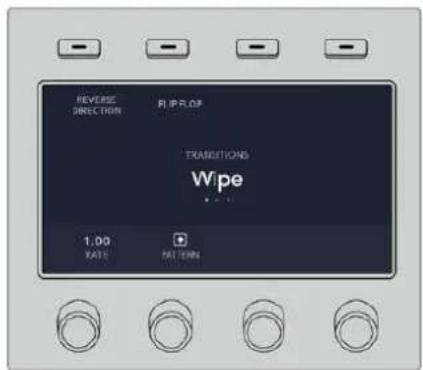
text_image
REVERSE DIRECTION RIP RLOF TRANSITIONS Wpe 1.00 RATE PATTERNtext_image
Camera 1 Camera 2 Camera 3 Camera 4 Camera 5 Camera 6 Camera 7 Camera 8 Media Player 1 Media Player 2text_image
Black | Color Bars | | | | | | Color 1 | Color 2 | Media Player 1 Key | Media Player 2 Keynatural_image
Two vertical black panels with a bright central light source, no text or symbols present.グラフィックワイプのスクリーン幅要件
text_image
CANCEL OVERWRITE CREATE NEW Overwrite Macro? Overwriting Macro 1 cannot be undone. If you wish to create a new Macro please choose Create New.text_image
Front panel of a control panel with multiple dials, buttons, and display screens showing numerical and alphanumeric readings.パネルの電源を入れる
flowchart
graph TD
    A["Computer"] -->|Ethernet| B["ATEM Camera Control Panel"]
    A -->|Ethernet| C["ATEM 1ME Advanced Panel"]
    A -->|Ethernet| D["ATEM Mini Pro"]
    B --> E["Control Panel with multiple ports and icons"]
    C --> F["Control Panel with four ports and icons"]
    D --> G["Control Panel with one port and icons"]
text_image
Front panel of a medical or laboratory instrument with multiple control panels and display indicators showing numerical values and function buttons.natural_image
Abstract pattern of green dots arranged in a vertical column on a gray background (no text or symbols)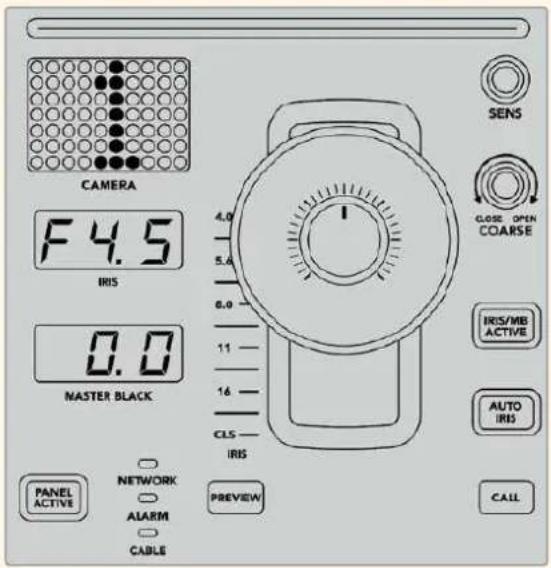
text_image
CAMERA F 4.5 IRIS 0.0 MASTER BLACK PANEL ACTIVE NETWORK ALARM CABLE 4.0 5.0 6.0 11 16 CLS IRIS PREVIEW SENS CLOSE OPEN COARSE IRIS/MB ACTIVE AUTO IRIS CALL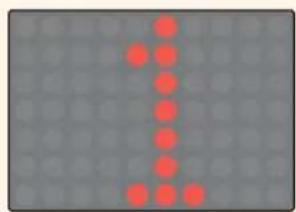
natural_image
Abstract pattern of red dots arranged in a vertical column on a gray grid background (no text or symbols)シーンファイル
text_image
POWER AT&T CONTROL LPGS SOUT LINEAR INPUT 4 3 5 1 MAC 2 MAC 1 MIC 2 MIC 1natural_image
Circular portrait photo of a smiling man in a dark shirt against a gray background (no text or symbols)Chère cliente, cher client,
Incrustation DVE 487
I'ATEM Streaming Bridge 492
I'ATEM 1 M/E Advanced Panel 506
natural_image
Illustration of a device with labeled ports (no text or symbols beyond labels)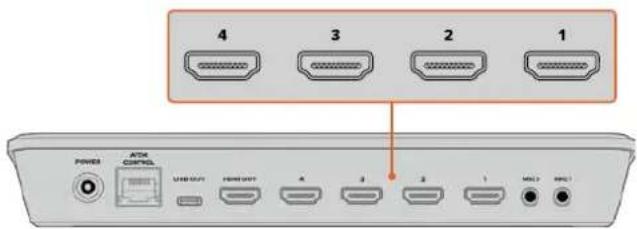
text_image
4 3 2 1 POWER ATX CONTROL USB OUT FND OUT A 2 1 MAX > INTtext_image
1 Skype Number Get a second number Settings S+ Get Skype apptext_image
2 General Appearance Audio & Video Callingnatural_image
Interior view of a room with a framed picture and wall-mounted furniture (no visible text or symbols)text_image
4 AUDIO Microphone Blackmagic Design Automatically adjust microphone settings Speakers 0 1 2 3 4 5 6 7 8 9 10 Default devicetext_image
Settings General Color Facts Share Screen Fleet Background & History Windowing Service Description Centers BlackRock: Design - A3, SUPPS Open XAM... Original Ratio Add Minor my videotext_image
Settings General Video Audio Share Screen Dim Background & Files Recording Profile Similar Speaker Text Speaker Text-to-Output (External Sounders) Output Level: Output Volume: Use separate output decision to play resonance simultaneously Microphone Rest Magic Blackmagic Design Input Level: Input volume: Automatically adjust microphone volume Supervise background noise Source: Nonetext_image
ATEM Mini Extreme MUTE RESET HEADPHONERESET
text_image
A'EM Mini Extreme MUTE RESET AFV RESETtext_image
ATEM Mini Extreme INTEOMISSION ON OFF PICTURE IN PICTUREtext_image
ATEMMini Bus image image ON OFF KEYStreaming via Ethernet
text_image
Clé: HyperDeck High HyperDeck Medium HyperDeck Low Qualité: ✓ Streaming High Streaming Medium Streaming Low OFF ON AIRtext_image
1 Twitch 30 Get Bits Mathitl Path of Exle JSK viewers ExtensionEnhanced brndstreaming Offline Online Channeltext_image
2 rs Enhanced ve in Australia to not be a ly 27 years. At play Path of on other ction Online Channel Video Producer Creator Dashboard Friendstext_image
Stream Manager Insights Community Content Preferences Channel Moderationtext_image
4 Stream Key & Preferences Primary Stream key Show Disconnect Protection Improve the viewing experience for y automatically display a temporary vie encoder to work properly.text_image
5 Copy Reset Event your stream is disconnected if your primary stream fails, roubleshoot and reconnect. *Note: This requires the use of a majorCliquez sur Copier.
text_image
AEM Mini Excessive MIC2 MIC1Bus de sélection
natural_image
Woman wearing headphones and speaking at a recording studio (no visible text or symbols)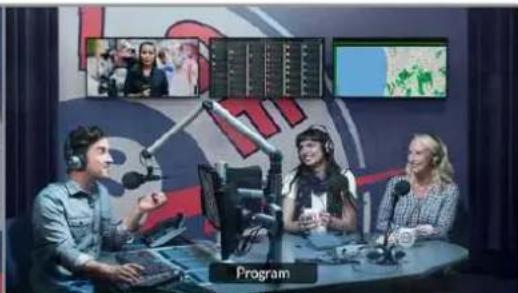
text_image
Program
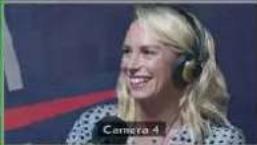
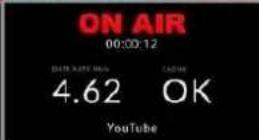
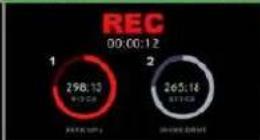
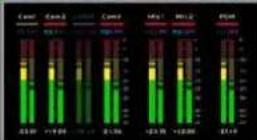
text_image
Preview Programtext_image
Camera 1 Camera 2 Camera 3 Camera 4Vue des entrées
text_image
ON AIR 00:00:12 4.62 OK YouTubeVue du streaming
text_image
Programme Cam1 Cam2 Cam3 Cam4 BLK COLI COL2 BARS MP1 Prink/Latinization Cam1 Cam2 Cam3 Cam4 BLK COLI COL2 BARS MP1Section M/E de l'ATEM
text_image
Live Cooking Syr-Vie 13:41:27:33text_image
Disk JSP Internal Macintosh HD External Drive_OI Erase "Drive_OI" Erase "Drive_OI" will delete all data stored on it, and cannot be installed. Provide a name and format, and click Erase to proceed. Name: Drive_OI Format: Mac OS Extended (Journals) Security Options... Cancel Erase MountPoint: VolumeDrive_OI Type: USB External Physical Volume Capacity 239.71 GB Owners Enabled Available: 2394.95 (Zins KB pg/ml) Correction: USB Used: 312.7 MB Device: (dikhs2)bar
| Level | Channel | Value | | :--- | :--- | :--- | | Cam1 | Amplitude | -0.58 | | Cam2 | Amplitude | -0.32 | | Cam3 | Amplitude | -0.06 | | Cam4 | Amplitude | -0.26 | | Micro1 | Signal | -1.9 | | Micro2 | Signal | -1.7 | | Micro3 | Signal | -1.1 | | Micro4 | Signal | -0.8 | | Micro5 | Signal | -0.7 | | Master | Signal | -0.29 | | Amplitude (Left) | Amplitude (Right) | -58.21 | | Amplitude (Left) | Amplitude (Left) | -55.98 | | Amplitude (Left) | Amplitude (Left) | -4.15 | | Amplitude (Left) | Amplitude (Left) | -10.04 | | Amplitude (Right) | Amplitude (Right) | -15.49 | | Amplitude (Right) | Amplitude (Right) | -89.24 | | Amplitude (Right) | Amplitude (Right) | -0.03 | | Amplitude (Left) | Amplitude (Left) | -0.03 | | Amplitude (Left) | Amplitude (Left) | -0.29 | | Amplitude (Left) | Amplitude (Left) | -1.09 | | Amplitude (Left) | Amplitude (Left) | -1.34 | | Amplitude (Right) | Amplitude (Right) | -18.83 | | Amplitude (Right) | Amplitude (Right) | -40.24 | | Amplitude (Right) | Amplitude (Right) | -0.03 | | Amplitude (Right) | Amplitude (Right) | -0.29 | | Amplitude (Left) | Amplitude (Left) | -0.03 | | Amplitude (Left) | Amplitude (Left) | -0.29 | | Amplitude (Left) | Amplitude (Left) | -1.09 | | Amplitude (Left) | Amplitude (Left) | -1.34 | | Amplitude (Left) | Amplitude (Left) | -18.83 | | Amplitude (Right) | Amplitude (Right) | -0.03 | | Amplitude (Right) | Amplitude (Right) | -0.29 | | Amplitude (Right) | Amplitude (Right) | -1.09 | | Amplitude (Right) | Amplitude (Right) | -1.34 | | Amplitude (Left) | Amplitude (Left) | -0.03 | | Amplitude (Left) | Amplitude (Left) | -0.29 | | Amplitude (Left) | Amplitude (Left) | -1.09 | | Amplitude (Left) | Amplitude (Left) | -1.34 | | Amplitude (Left) | Amplitude (Left) | -18.83 | | Amplitudes [Antimajor] [Mid/Akt] [Peak] [Peak] [Peak] [Peak] [Peak] [Peak] [Peak] [Peak] [Peak] [Peak] [Peak] [Peak] [Peak] [Peak] [Peak] [Peak] [Peak] [Peak] [Peak] [Peak] [Peak] [Peak] [Peak] [Peak] [Peak] [Peak] [Peak] [Peak] [Peak] [Peak] [Peak] [Peak] [Peak] [Peak]Bell High Shelve Low Shelve
text_image
ATEM Software Control Blackmugecosup Blackmugecosup Example Graphics Examples - Animated Clips Examples - DVE Graphic ... Examples - Photos Templates - Basketball Templates - Cooking Templates - Motor Sport Templates - News Templates - Wedding jasnom Basketball Live Bug.png Basketball Lower Third Score... Basketball Lower Third Score.png Basketball Top Score.png Image Sets 11 Basketball Live Bug 02 Basketball Lower Title... 03 Basketball Lower Title... 04 Basketball Top Score Locuser mutational Basketball Lower Third Score 11 5 6 7 8 9 10 11 12 12 13 14 15 16 17 18 19 20 Capture Image Fox BTC L43 Perivocalisation Multigray Multi Audio Camera OFF 0.0 Mb/s OKtext_image
Layers Channels Kind Normal Opacity: 100% Lock Fill: 100% Wedding Backgroundtext_image
Layers Channels RGB Red Green Blue Alpha 1 $62 $62 $64 $65 $60text_image
Save As: Wedding Lower Third_tga Tags: Where: Desktop Format: Targa Save: As a Copy Notes Alpha Channels Spot Colors Layer Color: Use Proof Setup Working CMYK Limbed Color Profile sRGB IEC5196S-2.1 File must be saved as a copy with this selection. Cancel Savetext_image
Targa Options Resolution 10 bits/pixel 24 bits/pixel 32 bits/pixel Compress (FLE) OK Canceltext_image
Michelle and Jasonnatural_image
Diagram of a two-chamber industrial control interface with FERMER device (no text or symbols on main components)text_image
Digital color picker interface showing a circular progress gauge with sliders and numeric input fieldstext_image
ATEM Mini ATEM Mini → Configure About Network Settings P Address: 192.168/0.240 Subnet Magic: 255.255.255.0 Gateway: 192.168/0.1 Panel Settings Switching Mode Program Preview Cut Bus Picture in Picture Keyer Drop with transition Stay on with transition Chrome Keyer Drop with transition Stay on with transition Cancel SaveMode de commutation (Switching mode)
Configurer Open Broadcaster
text_image
1 Genes Sources You don't have any sources. Click the + button below, or right click here to add one. Mir/Auxtext_image
5 Channel video 0 Channel video 0 Channel video 0 Channel video 0 Channel video 0 Channel video 0 Channel video 0 Channel video 0 Channel video 0 Channel video 0 Channel video 0 Channel video 0 Channel video 0 Channel video 0 Channel video 0 Channel video 0 Channel video 0 Channel video 0 Channel video 0 Channel video 0 Channel video 1text_image
New stream Down Public Add instructions People & Image Outlooker list later UPDATE CUSTOM TRANSFER CREATE STREAMtext_image
Stream seeking help 1. Download and set out your streaming software 2. Fakes the stream key into your software OK! To start this user Get your stream video buttons 3. In your streaming software, start sending us your video stream 4. Click Store and then click GoLive to start streaming Canceltext_image
Preview Preview Name: Preview Name Preview Name: Preview Name Preview Name: Preview Name Showtext_image
Scene Transitions Fade Duration 300 ms Start Streaming Start Recording Studio Mode Settings Exit REC: 00:00:00 CPU: 1.9%, 30.00 fpstext_image
10 Stream setup help 1 Download and set stream streaming software 2 Paste the stream keylink your software OKY Preview static mode http://www.youkua.com/ind/ OKY 3 In your streaming software, start sending your video stream 4 Click Done and then click "Go Live" to start streaming OKYtext_image
ATEM Switcher Media Pool ATEM Blackmagicdesign Switcher IP Address: 192.168.24.233 Name: Untitled-1 Media Pool Location: 1, Empty Colors: ✓ Pre Multiply Alpha After Export: ● Do Nothing ○ Set to Media Player 1 ○ Set to Media Player 2 ○ Set to Media Player 3 ○ Set to Media Player 4- Close Exporttext_image
ATEM Mini ATEM Mini >5 Configure About Network Settings P Address: 192.168.10.240 Subnet Mask: 255.255.255.0 Gateway: 192.108.10.1 Panel Settings Switching Mode Program Preview Cut Bus Picture In Picture Keyer Drop with transition Stay on with transition Chroma Keyer Drop with transition Stay on with transition Cancel Savetext_image
Diagram of a device control panel with labeled buttons and display screen, showing function keys and status indicators.text_image
Background + Fill = Combined Outputtext_image
Background + Fill + Pattern = Combined Outputnatural_image
Panda-themed soccer goalpost with a panda in the corner, no visible text or symbols
natural_image
Soccer player in action with goal net and soccer ball visible (no text or symbols)Exemple 2
text_image
Screenshot of a soccer live broadcast interface showing match controls and a close-up of a soccer goal with 'LIVE' branding.Exemple 3
text_image
Screenshot of a soccer live broadcast interface showing a match with a goal and player's hand gesture, alongside a live broadcast preview.text_image
ATEM Mini Pro ON AIR OFFtext_image
ATEM Streaming Bridge ATEM Streaming Bridge Setup External ATEM Mini Pro Name: ATEM Streaming Bridge Software: Version 8.5 Network Protocol: DHCP Static IP IP Address: 10.1.1.101 Subnet Mask: 255.255.255.0 Gateway: 10.1.1.1 Primary DNS: 10.1.1.1 Secondary DNS: 8.8.4.4 Disable remote configuration via Ethernet Stream Service Broadcast From: Local network without key Local network with key Internet Cancel Savetext_image
Stream Service Broadcast From: ○ Local network without key ● Local network with key ○ Internet Key: fajm-kpp8-p266-3202text_image
Stream Service Broadcast From: ○ Local network without key ○ Local network with key ● Internet Key: fajm-kpp8-p266-3202 Worldwide IP: 194.193.136.208 Worldwide Port: 1935 Internet Status: Visible worldwide Retrytext_image
ATEM Streaming Bridge ATEM Streaming Bridge Setup External ATEM Mini Pro ON AIR ON AIR ATEM Mini Pro can connect to you by selecting the name ATEM Streaming Bridge in the platform menu in the streaming settings. You'll also need to enter the streaming key fajm-kpp8-p266-3202. You can also create a settings file for ATEM Mini Pro to ensure it connects to the correct ATEM Streaming Bridge. ATEM Mini Pro Settings Platform: ATEM Streaming Bridge Server: StreamingBridge-AE918130B... Key: fan-m-kpp8-p266-3202 Quality: Streaming-figh Save ATEM Settings Cancel Savetext_image
HyperDeck High HyperDeck Medium HyperDeck Low ✓ Streaming High Streaming Medium Streaming Lowtext_image
ATEM Mini Pro ON AIR OFFtext_image
Line drawing of a portable audio workstation with labeled buttons and portsConnector des HyperDecks
natural_image
User interface control panel with playback buttons and a black tab (no readable text or symbols)text_image
SWITCHER PANEL HYPERDECKS BUTTON MAPPING HYPERDECK SETTINGS: HyperDeck 1 1 HYPERDECK Camera 1 INPUTtext_image
Front panel of a medical or laboratory instrument with labeled buttons, grids, and control panelsATEM 1 M/E Advanced Panel
natural_image
Front view of a vintage computer control console with keypad, function keys, and control buttons (no visible text or labels)ATEM 1 M/E Advanced Panel
Bus programme (Program)
text_image
Diagram of an industrial control panel with labeled buttons and function keys, including a microcontroller interface.text_image
Diagram of an industrial control panel with labeled buttons and function keys, including a thermal input indicator.natural_image
Illustration of a vintage computer control panel with buttons and a central touchscreen display (no text or symbols visible)text_image
Diagram of a control panel with labeled buttons and a separate view of a rotary knob.text_image
PROGRAM SHIFTtext_image
Technical diagram of an industrial control panel with labeled buttons and function keystext_image
SHIFT CIP DYE STRING MIX WIPE ARM PIEV TRANS CUT AUTOtext_image
Camera 1 Camera 2 Camera 3 Camera 4 Camera 5 Camera 6 Camera 7 Camera 8 Media Player 1 Media Player 2text_image
Black | Color Bars | | | | | | | Color 1 | Color 2 | Media Player 1 Key | Media Player 2 Keynatural_image
Two vertical panels showing a bright central light source against a black background, with no visible text or symbols.text_image
CANCEL OVERWRITE CREATE NEW Overwrite Macro? Overwriting Macro 1 cannot be undone. If you wish to create a new Macro please choose Create New.text_image
Front panel of a control panel with multiple dials, buttons, and display indicators showing function keys like F4.5, F8.0, F3.0, and 6.0.flowchart
graph TD
    A["Computer"] -->|Ethernet| B["ATEM Camera Control Panel"]
    A -->|Ethernet| C["ATEM 1ME Advanced Panel"]
    A -->|Ethernet| D["ATEM Mini Pro"]
    B --> E["Control Panel with four buttons"]
    C --> F["Control Panel with four buttons"]
    D --> G["Control Panel with four buttons"]
text_image
Front panel of a control panel with multiple display and rotary switches, labeled with function buttons and numeric displays.natural_image
Abstract pattern of green dots arranged in a vertical column on a gray background (no text or symbols)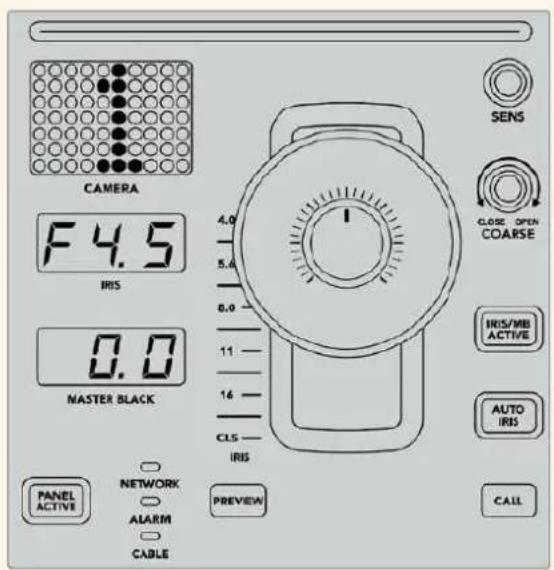
text_image
CAMERA F 4.5 IRIS 0.0 MASTER BLACK PANEL ACTIVE NETWORK: ALARM CABLE 4.0 5.0 0.0 11 16 CLS- IRIS PREVIEW SENS CLOSE OPEN COARSE IRIS/MB ACTIVE AUTO IRIS CALL
natural_image
Abstract pattern of red dots arranged in a vertical column on a gray grid background (no text or symbols)text_image
POWER ATM CONTROL I/O SOUT LINEAR INPUT 4 3 5 1 MIC 2 MIC 1 MIC 2 MIC 1natural_image
Circular portrait photo of a smiling man in a dark shirt against a gray background (no text or symbols)Willkommen!
CEO Blackmagic Design
Inhaltsverzeichnis
Erste Schritte 555
DaVinci Resolve Primary Color Corrector 628
Luma/Linear-Keys 662
Chroma-Key 664
Streaming Bridge 675
natural_image
Illustration of a hand holding a device with labeled ports (no text or symbols visible)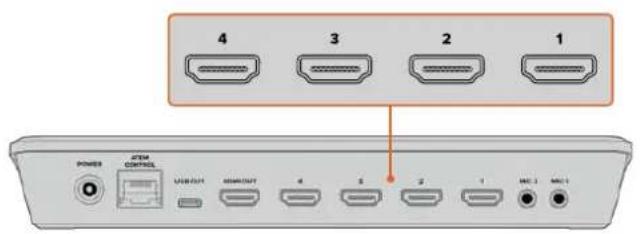
text_image
4 3 2 1 PONE SEM CONTROL USB/OUT OSM/OUT 4 5 2 1 MIL-1 MIL-2text_image
ATEM Mini Blackmagicdesign OFF OR OFF MIC1 MIC2 OFFSET APP RESET APP RESET APP RESET ON OFF ON OR ON OR PICTURE IN PICTURE KEY 1 2 3 4 STILL BUCK CUT ALTO FTBtext_image
1 Skype Number Get a second number Settings Get Skype apptext_image
2 General Appearance Audio & Video Callingnatural_image
Interior view of a room with a framed mirror and window, no visible text or symbolstext_image
4 Microphone Blackmagic Design Automatically adjust microphone settings Speakers Default devicetext_image
Settings General Video Audio Drive Screen Chat Background & Files Recording Playe Statistics Speaker Text Speaker Data-to-Output (External Dimensions) Output Level: Output Volume: Use resource audio device to play radio buttons simultaneously Microphone Text Web Blacklogs Design Input Level: Input Volume: Automatically adjust microphone volume Supervise background noise - Super Noisetext_image
DVE Push Horizontal DVE Squeeze Horizontal DVE Push Vertical DVE Squeeze Vertical Circle Wipe Box Wipe Diagonal Wipe Diagonal Wipe Vertical Wipe Horizontal Wipe Mix Dip DIPAussteuern des Tons
text_image
ATEM Mini Extreme MUTE RESET AFV RESETtext_image
Black-and-white ON OFF KEY 1text_image
OFF 00:00:00 Platform: YouTube Server: Primarytext_image
HyperDeck High HyperDeck Medium HyperDeck Low ✓ Streaming High Streaming Medium Streaming Lowtext_image
1 Twitch 30 Get Bits Mathitl Math of Exole SK viewers ExtensionEnhanced brndstreaming = Offline Online Channeltext_image
2 Online Channel Video Producer Creator Dashboard Friendstext_image
Stream Manager Insights Community Content Preferences Channel Moderationtext_image
4 Stream Key & Preferences Primary Stream key Show Disconnect Protection Improve the viewing experience for y automatically display a temporary vie encoder to work properly.text_image
5 Copy Reset Event your stream is disconnected if your primary stream falls, troubleshoot and reconnect: "Note: This requires the use of a majortext_image
OFF 00:00:00 Facebook Platform: ✓ Twitch YouTube Server: ATEM Streaming Bridgetext_image
AIEA MHI EXTERIOR MIC 3 MIC 1Auswahlbus
text_image
Black language icons MP1 SFP- MP2text_image
SuperSource Presets Art Copy Layout Box Control Control: Box 1 ✓ Enable box Source: Black Position: X: 0.00 Y: 0.00 Size: 0.50 Crop Top 0.00 Rampers 0.60 +11 0.00 Peart 0.00text_image
SuperSource Presets Art Copy Fill Source: Media Player 1 Key Source: Media Player 1 Key Place Int: Background Foreground Pre Multiplied Key Clip: 50.0% Gain: 70.0% Invert key. Border No Bavel Inner Size: 0.0% 0.0% Outer Width: 0.0% Inner Width: 0.0% Outer Shvel: 0% Inner Shvel: 0%natural_image
Woman wearing headphones and singing into a microphone (no visible text or symbols)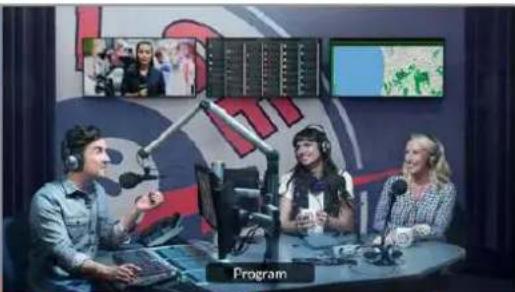
text_image
Program
text_image
Cinema 1
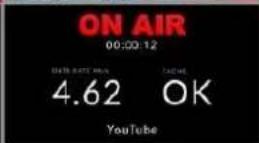
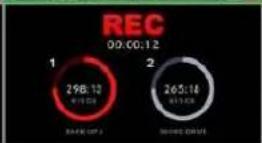
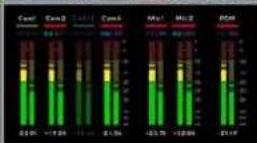
text_image
Preview ProgramVorschau
text_image
Camera 1 Camera 2 Camera 3 Camera 4Eingabe-Ansichten
text_image
VIBES MP1text_image
ON AIR 00:00:12 DATA RATE MIN CACHS 4.62 OK YouTubeStreaming-Ansicht
text_image
Programm Cam Cam2 Cam3 Cam4 BLK COL1 COL2 BAN5 MP1 Vorwchau Cam1 Cam3 Cam2 Cam4 BLK COL1 COL2 BAR3 MP1ATEM Misch-Effekte
Videoschnitt in DaVinci Resolve
text_image
Drive Utility File Edit View Insert Tools Window Help Internal Macintosh HD External Drive_OI Erase "Drive_01" Grasing "Drive_01" will delete assets stored on it, and cannot be entire. Provide a room and format, and call Erase to OI(s) Name: Drive_01 Format: Max OE Extended (Journal) Security Options Cancel Enroll Mount Point: /#A#tes/Drive_01 Type: USB External Physical Volume Capacity: 239.71 GB Owners: Enabled Available: 239.4 00 (Zins KB pg/ml) Connection: USB User: 112.5485 Service: installedtext_image
Can1 Can2 Can3 Can4 iMC 1 iMC 2 Maser Singing Production Volume -15.28 15.28 14.17 9.08 15.09 14.05 -0.27 -0.26 -0.25 -0.24 -0.23 -0.22 -0.21 -0.20 -0.19 -0.18 -0.17 -0.16 -0.15 -0.14 -0.13 -0.12 -0.11 -0.10 -0.09 -0.08 -0.07 -0.06 -0.05 -0.04 -0.03 -0.02 -0.01 0.00 +4.85 +4.86 +4.87 +4.88 +4.89 +4.90 +4.91 +4.92 +4.93 +4.94 +4.95 +4.96 +4.97 +4.98 +4.99 +5.00 +5.01 +5.02 +5.03 +5.04 +5.05 +5.06 +5.07 +5.08 +5.09 +5.10 +5.11 +5.12 +5.13 +5.14 +5.15 +5.16 +5.17 +5.18 +5.19 +5.20 +5.21 +5.22 +5.23 +5.24 +5.25 +5.26 +5.27 +5.28 +5.29 +5.30 +5.31 +5.32 +5.33 +5.34 +5.35 +5.36 +5.37 +5.38 +5.39 +5.40 +5.41 +5.42 +5.43 +5.44 +5.45 +5.46 +5.47 +5.48 +5.49 +5.50text_image
ATEM Software Control Blackmagic.com/ig Lakker Bishkornek Example Graphics Examples - Animated Obs Examples - Disk Graphic ... Examples - Photos Templates - Basketball Templates - Cooking Templates - Motor Sport Templates - News Templates - Wedding Jasahn Basketball Use Bug.org Basketball Lower Third Comm... Basketball Lower Third Score.org Basketball Top Scoring Vorshau 12 Basketball Live Bug 12 Basketball Lower Th... 12 Basketball Lower Th... OK Basketball Top Score 13 14 15 16 17 18 19 20 Bandband aufsichnen Media Player Basketball Lower Third Score 10 ETC 1.00 10 OFF 0,0 Mb/s OKtext_image
ATEM Software Control Blackmagic design Locke Distances Example Graphics Examples - Animated IQS Examples - Disk Graphic... Examples - Photos Templates - Basketball Templates - Cooking Templates - Motor Sport Templates - News Templates - Wedding Jassim Basketball Live Bug.png Basketball Lower Third Scene... Basketball Lower Third Scene.png Basketball Top Scorn.png Vorschau 10 4TC 16T Bandelsier Boskball Live Bug Basketball Lower Third... Basketball Lower Third Scene.png Basketball Top Scorn.png Media Player Basketball Lower Third Score 11 4TC 16R 19 Standbid aufprichnen Master Audio Camera OFF 0.0 Mb/s OKATEM Media Pool
text_image
Layers Channels Kind Normal Opacity: 100% Lock: Fill 100% Wedding Backgroundtext_image
Save As: Wedding Lower Third_tga Tags: Where: Desktop Format: Targa Save: As a Copy Notes Alpha Channels Spot Colors Layer Color: Use Proof Setup Working CMYK Limbed Color Profile sRGB IEC5786S-2.1 File must be saved as a copy with this selection. Cancel Savetext_image
Targa Options Resolution 10 bits/pixel 24 bits/pixel 32 bits/pixel Compress (RLE) OK Canceltext_image
Michelle and JasonDaVinci Resolve Primary Color Corrector
text_image
Makro bearbeiten Name: Transitions Notizen: Color bars to color, color 1 to black, 3 second mix transitions with 2 second pause. Abbrechen Speicherntext_image
ATEM Software Control ATEM Software Control Output Camera 1 Camera 2 Camera 3 Camera 4 ✓ Multi View Program Preview Camera 1 Directtext_image
ATEM Mini ATEM Mini → Configure About Network Settings P Address: 182.168/0.249 Subnet Magic: 256.255.255.0 Gateway: 183.168/0.1 Panel Settings Switching Mode Program Preview Cut Bus Picture in Picture Keyer Drop with transition Stay on with transition Chroma Keyer Drop with transition Stay on with transition Cancel SaveMischmodi
text_image
1 Sources You don't have any sources. Click the + button below, or right click here to add one. Mic/Auxtext_image
Create new Video Capture Device Add Existing Make source visible Cancel OKtext_image
5 Channel video OK Cancel Cancel Cancel Cancel Cancel Cancel Cancel Cancel Cancel Cancel Cancel Cancel Cancel Cancel Cancel Cancel Cancel Cancel Cancel Cancel Cancel Cancel Cancel Cancel Cancel Cancel Cancel Cancel Cancel Cancel Cancel Cancel Cancel Cancel Cancel Cancel Cancel Cancel Cancel Cancel Cancel Cancel Cancel Cancel Cancel Cancel Cancel Cancel Cancel Cancel OKtext_image
New stream Destination Public Add to destination People & Blogs Schedule for later Importing your new streamtext_image
Stream setup help 1 Download and set up your streaming software 2 Paste the dream key into your software 3 In your streaming software, start needing us your video stream 4 Click Done and then click GoLive to start dreamingtext_image
Scene Transitions Fade Duration 300 ms Start Streaming Start Recording Studio Mode Settings Exit REC: 00:00:00 CPU: 1.9%, 30.00 fpstext_image
10 Stream setup help 1. Download and set up your streaming software 2. Paste the stream key into your software 3. In your streaming software, start sending us your video stream 4. Click Done/and then click 'Go Live' to start streamingtext_image
11 12 Stream People & Slings 0 Stream connection STREAM SET MAGE ANALYSIS STREAM INPUTS Stream User Add stream key Additional settings Delete URL 300+ Video Name http://www.psdla.com/Sharetext_image
GO LIVE EDIT Live chattext_image
ATEM Switcher Media Pool ATEM Blackmagicdesign Switcher IP Address: 192.168.24.233 Name: Untitled-1 Media Pool Location: 1. Empty Colors: Pre Multiply Alpha After Export: Do Nothing Set to Media Player 1 Set to Media Player 2 Set to Media Player 3 Set to Media Player 4 Close Exporttext_image
ATEM Mini ATEM Mini → Configure About Network Settings P Address: 192.168.10.240 Subnet Mask: 255.255.255.0 Gateway: 192.168.10.1 Panel Settings Switching Mode Program Preview Cut Bus Failure in Picture Keyer Drop with transition Stay on with transition Chroma Keyer Drop with transition Stay on with transition Cancel Savetext_image
Background + Fill = Combined Outputtext_image
Background + Fill + Pattern = Combined Outputnatural_image
Panda-themed soccer goalpost with net in mid-air, blurred stadium crowd in background (no visible text or symbols)
natural_image
Soccer match scene with a soccer player near the goal, no visible text or symbolsBeispiel 2
text_image
ATEM Streaming Bridge ATEM Streaming Bridge Setup External ATEM Mini Pro Name: ATEM Streaming Bridge Software: Version 8.5 Network Protocol: DHCP Static IP IP Address: 10.1.1.101 Subnet Mask: 255.255.255.0 Gateway: 10.1.1.1 Primary DNS: 10.1.1.1 Secondary DNS: 8.8.4.4 Disable remote configuration via Ethernet Stream Service Broadcast From: Local network without key Local network with key Internet Cancel Savetext_image
Stream Service Broadcast From: ○ Local network without key ● Local network with key ○ Internet Key: fajm-kpp8-p266-3202text_image
Stream Service Broadcast From: ○ Local network without key ○ Local network with key ● Internet Key: fajm-kpp8-p266-3202 Worldwide IP: 194.193.136.208 Worldwide Port: 1935 Internet Status: Visible worldwide Retrytext_image
ATEM Streaming Bridge ATEM Streaming Bridge Setup External ATEM Mini Pro ON AIR 061205 ATEM Mini Pro tan connect to you by selecting the name ATEM Streaming Bridge in the platform menu in the streaming settings. You'll also need to enter the streaming key fajm-kpp8-p266-3202. You can also create a settings file for ATEM Mini Pro to ensure it connects to the correct ATEM Streaming Bridge. ATEM Mini Pro Settings Platform: ATEM Streaming Bridge Server: StreamingBridge-AE918130B... Key: faim-kpp8-p266-3202 Quality: Streaming-figh Save ATEM Settings Cancel Savetext_image
HyperDeck High HyperDeck Medium HyperDeck Low ✓ Streaming High Streaming Medium Streaming Lowtext_image
Line drawing of a portable electronic device with labeled buttons and portsnatural_image
User interface control bar with playback buttons and a black tab (no text or symbols)text_image
WPOCK3 01:00:10 1-ready HYPEROCK Clp 001 CLP JOG (4x7.5)text_image
JOU SWUTTER CLIP LENGTH 00:00:10:20 TIME ELAPSO 00:00:03:08 TIME REMARKING 00:00:07:12 1-Ready Clip 003 WRIP/RESET CLIP JOG 45 QUARTERtext_image
Front panel of a control panel with labeled buttons, display, and function keysATEM 1 M/E Advanced Panel
natural_image
Line drawing of a vintage computer control console with buttons, display screen, and keyboard (no text or symbols)ATEM 1 M/E Advanced Panel
text_image
Studio A Can 1 Studio A Can 2 Studio A Can 3 Studio A Can 4 Studio A Can 5 Media Power 1 Media Power 2 Replay 1 Replay 2 Replay 1 Studio A Can 1 Studio A Can 2 Studio A Can 3 Studio A Can 4 Studio A Can 5 Media Power 1 Media Power 2 Replay 1 Replay 2 Replay 1 PROGRIA PREVIEW Studio A Can 1 Studio A Can 2 Studio A Can 3 Studio A Can 4 Studio A Can 5 Media Power 1 Media Power 2 Replay 1 Replay 2 Replaytext_image
Diagram of an industrial control panel with labeled buttons and function keys, showing front and side views.text_image
Diagram of an industrial control panel with labeled buttons and function keys, including a highlighted section showing a numeric keypad.text_image
Diagram of an industrial control panel with labeled buttons and function keys, including 'TX1', 'TX2', and 'AUTO' indicators.natural_image
Illustration of a control panel with buttons and display screen (no text or symbols)Systemsteuerung
text_image
Diagram of a control panel with labeled buttons and a separate view of a rotary knob.text_image
PROGRAM SHIFTtext_image
Technical diagram of an industrial control panel with labeled buttons and function keystext_image
DIP DYE STING MIX WIPE ARM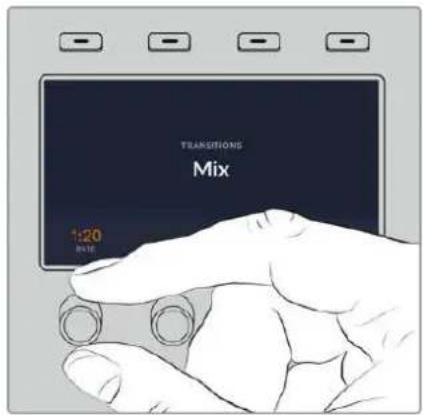
text_image
TRANSITIONS Mix 1:20 DATEtext_image
DIP DYE STING MIX WIPE ARM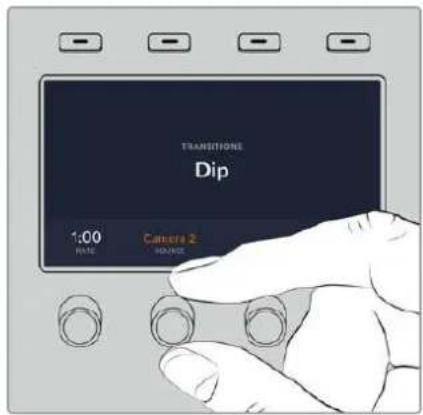
text_image
TRANSITIONE Dip 1:00 Camera 2 NOTE HAZINGtext_image
Camera 1 Camera 2 Camera 3 Camera 4 Camera 5 Camera 6 Camera 7 Camera 8 Media Player 1 Media Player 2text_image
Black | Color Bars | | | | | | Color 1 | Color 2 | Media Player 1Key | Media Player 2 Keynatural_image
Two vertical black panels with a bright central light source, no text or symbols present.text_image
CANCEL OVERWRITE CREATE NEW Overwrite Macro? Overwriting Macro 1 cannot be undone. If you wish to create a new Macro please choose Create New.text_image
Front panel of a control panel with multiple dials, buttons, and display screens showing numerical and symbolic readings.text_image
USE ONLY WITH A 25kV FUSEtext_image
Front panel of a control panel with multiple display and rotary buttons, showing various function keys like F4.5, F8.0, and 6.0.text_image
Two pixelated dot patterns: green dots forming a vertical line and red dots forming a downward arrow, on a gray grid background.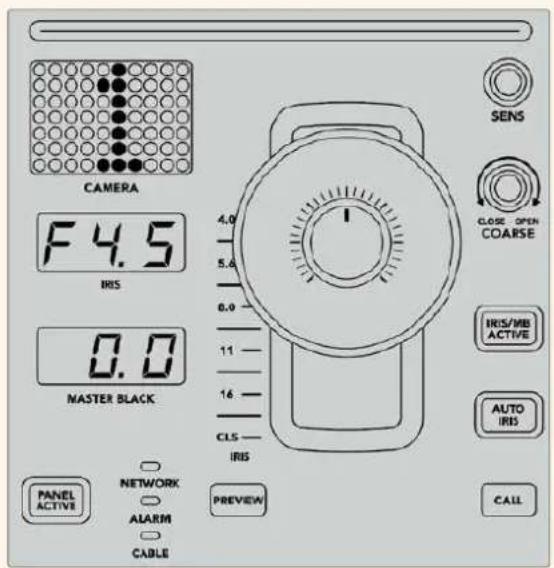
text_image
CAMERA F 4.5 IRIS 0.0 MASTER BLACK PANEL ACTIVE NETWORK: ALARM CABLE PREVIEW 4.0 5.6 6.0 11 16 CLS IRIS SENS CLOSE OPEN COARSE IRIS/MB ACTIVE AUTO IRIS CALLSCENE FILE
text_image
SCENE FILE 1 2 3 4 5 STORE 0.0 MACHINE LIME 0125 MACHINE MACHINE MACHINE MACHINE MACHINE MACHINE MACHINE MACHINE MACHINE MACHINE MACHINE MACHINE MACHINE MACHINE MACHINE MACHINE MACHINE MACHINE MACHINE MACHINE MACHINE MACHINE MACHINE MACHINE MACHINE MACHINE MACHINE MACHINE MACHINE MACHINE MACHINE MACHINE MACHINE MACHINEtext_image
Illustration of a hand operating an electronic device with orange arrows indicating rotation or adjustment, showing control panel and display.California Proposition 65
natural_image
Circular portrait photo of a smiling man in a dark shirt against a gray background (no text or symbols)Bienvenido
text_image
2 Power Control USB OUT USB OUTnatural_image
Illustration of a device's front panel with labeled ports (no text or symbols beyond labels)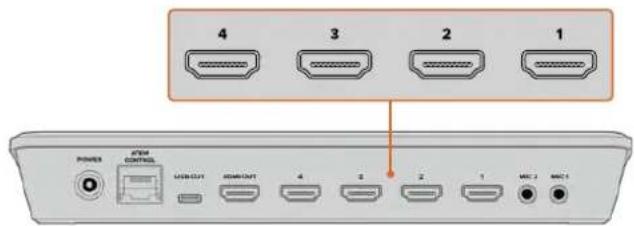
text_image
4 3 2 1 POWER USB CONTROL USB OUT REMOUNT 4 2 2 1 MEC 3 MEC 1text_image
1 Skype Number Get a second number Settings Get Skype apptext_image
2 General Appearance Audio & Video Callingnatural_image
Interior view of a room with a framed mirror and wall-mounted furniture (no visible text or symbols)text_image
4 Microphone Blackmagic Design Automatically adjust microphone settings Speakers 0 1 2 3 4 5 6 7 8 9 10 Default devicetext_image
Settings Camera Shaktage Design #3 MUPON COLOR SALE... Originalize HG Mirror my videotext_image
Settings Speaker Text Speaker Read+Output (Internal Subscribers) Output Level: Output Volume: Use separate audio button to play, recognize simultaneously Microphone Text MC Blackmige Design Input Level: Input Volume: Automatically adjust microphone volume Source background sales - Event Sizetext_image
ATEM Mini Extreme MUTE RESET HEADPHONERESTABLECER
text_image
ATEM Mini Extreme MUTE RESET AFV RESETtext_image
A*EM Mini Extreme ON OFF PICTURE IN PICTUREtext_image
Clave: HyperDeck High HyperDeck Medium HyperDeck Low Callad: ✓ Streaming High Streaming Medium Streaming Low OFF ON AIRtext_image
1 Twitch 3C Get Bits Mathit1 Math of Exilla SK viewers ExtensionEnhanced brndstreaming Offline Online Channeltext_image
2 Online Channel Video Producer Creator Dashboard Friendstext_image
Stream Manager Insights Community Content Preferences Channel Moderationtext_image
4 Stream Key & Preferences Primary Stream key Show Disconnect Protection Improves the viewing experience for automatically display a temporary view encoder to work properly.text_image
5 Copy Reset want your stream is disconnected if your primary stream fails, troubleshoot and reconnect. *Note: This requires the use of a majorHaga clic en Copy (Copiar).
natural_image
Woman wearing headphones and singing into a microphone (no visible text or symbols)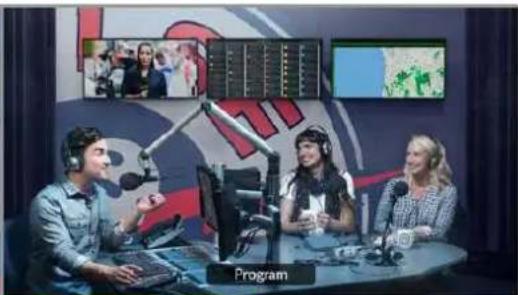
text_image
Program
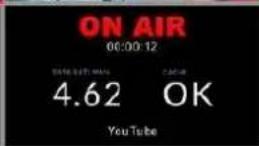
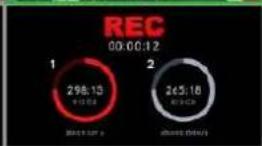
natural_image
Split-screen image: left shows a female audio live stream with headphones, right shows a live studio setup with three women and a monitor (no visible text or symbols)Anticipo
text_image
Camera 1 Camera 2 Camera 3 Camera 4Fuentes
text_image
VIBES MP1text_image
ON AIR 00:00:12 DATA RATE NOW CACRS 4.62 OK YouTubetext_image
ATEM Mini Blackmageddesign ON OFF ON OPT MC1 MC2 PICTUREN PICTURE KEY OFF RESET AFV RESET AFV RESET AFV RESET ON OPT ON OPT ON ON OPT 1 2 3 4 STILL BACK CUT AUTO FTBtext_image
Cam1 Cam2 Cam3 Cam4 BLK COL1 COL2 BARS MP1 Cam1 Cam2 Cam3 Cam4 BLK COL1 COL2 BARS MP1Bancos M/E
text_image
Live Cooking 13:41.27:33 Deluxe Resolution 14text_image
Disk Utility Internal Macintosh HD External Drive DI Name: Drive_01 Format: Hsc OS Extended (Journalled) Security Options: Cancel Erase MountPoint: volumeDrive_01 Type USB External Physical Volume Capacity 239.71 GB Servers Enabled Available: 239.4 GB (less MB pg/mL) Connection: USB Used: 312.2 MB Device: disk2x2 239.71 GBtext_image
ATEM Software Control Backpropagation General Can1 Can2 Can3 Can4 ML 1 ML 2 -0.00 +0.00 -0.00 +0.00 -0.00 -0.00 -0.00 -0.00 -0.00 -0.00 -0.00 -0.00 -0.00 -0.00 -0.00 -0.00 -0.00 -0.00 -0.00 -0.00 -0.01 -0.01 -0.01 -0.01 -0.01 -0.01 -0.01 -0.01 -0.01 -0.01 -0.01 -0.01 -0.01 -0.01 -0.01 -0.01 -0.01 -0, 1, 2, 3, 4, 5, 6, 7, 8, 9, 10, 11, 12, 13, 14, 15, 16, 17, 18, 19, 20, 21, 22, 23, 24, 25, 26, 27, 28, 29, 30, 31, 32, 33, 34, 35, 36, 37, 38, 39, 40, 41, 42, 43, 44, 45, 46, 47, 48, 49, 50, 51, 52, 53, 54, 55, 56, 57, 58, 59, 60, 61, 62, 63, 64, 65, 66, 67, 68, 69, 70, 71, 72, 73, 74, 75, 76, 77, 78, 79, 80, 81, 82, 83, 84, 85, 86, 87, 88, 89, 90, 91, 92, 93, 94, 95, 96, 97, 98, 99, 100text_image
Cam1 Cam2 Cam3 Cam4 Mic 1 Mic 2 General 0.00 -0.00 -0.00 +0.00 +0.00 +0.00 +0.00 +0.00 +0.00 +0.00 +0.00 +0.00 +0.00 +0.00 +0.00 +0.00 +0.00 +0.00 +0.00 +0.01 +0.01 +0.01 +0.01 +0.01 +0.01 +0.01 +0.01 +0.01 +0.01 +0.01 +0.01 +0.01 +0.01 +0.01 +0.01 +0.01 +0. Cancaster CATT F4 Audio Cameratext_image
ATEM Software Control Blackimage design Biotherica local Example Graphics Examples - Animated Clips Examples - DME Graphic... Examples - Photos Templates - Basketball Templates - Cooking Templates - Motor Sport Templates - News Templates - Wedding Jasonm Basketball Live Bug.png Basketball Lower Third Score.png Basketball Lower Third Score.png Basketball Top Screw.png Video preview 10 RTC LLL 9 Im/Games GT Basketball Live Bug GT Basketball Lower Thi... GT Basketball Lower Thi... GT Basketball Top Score 5 9 7 8 6 10 11 12 13 14 15 16 17 18 19 20 Reproducer multimedia ① Basketball Lower Third Score OFF 0.0 Mb's Aceptartext_image
ATEM Software Control Blackmagic design Illustratica local Example Graphics Examples - Animated Clips Examples - DNE Graphic... Examples - Photos Templates - Basketball Templates - Cooking Templates - Motor Sport Templates - News Templates - Wedding Jasonm Basketball Live Bug.png Basketball Lower Third Comment... Basketball Lower Third Scoring Basketball Top Scoring.png Visa prems 10 RTC SLI 9 Imagelves G1 Basketball Live Bug G2 Basketball Lower Thi... G3 Basketball Lower Thi... G4 Basketball Top Score Reproducer multimedia 1 Basketball Lower Third Score 10 RTE + 1.57 5 Capturar Monitor Multimedia Audio Camera OFF 0.0 Mb's AceptarPanel multimedia
text_image
Layers Channels Kind Normal Opacity: 100% Lock: Fill: 100% Wedding Backgroundtext_image
Save As: Wedding Lower Third_tga Tags: Where: Desktop Format: Targa Save: As a Copy Notes Alpha Channels Spot Colors Layers Color: Use Proof Setup, Working CMYK Limbed Color Profile: sRGB IEC5186S-2.1 File must be saved as a copy with this selection. Cancel Savetext_image
Targa Options Resolution 16 bits/pixel 24 bits/pixel 32 bits/pixel Compress (FILE) OK Canceltext_image
Michelle and Jasontext_image
Editar macro Nombre: Transitions Notes: Color bars to color, color 1 to black, 3 second mix transitions with 2 second pause. Cancelar Guardartext_image
ATEM Mini ATEM Mini →+ Configure About Network Settings P Address: 182.168/10.240 Subnet Magic: 255.255.255.0 Gateway: 182.168/10.1 Panel Settings Switching Mode Program Preview Cut Bus Picture in Picture Keyer Drop with transition Stay on with transition Chronix Keyer Drop with transition Stay on with Transition Cancel Savetext_image
1 enes Sources You don't have any sources. Click the + button below, or right click here to add one. Mix/Auxtext_image
Create new Video Capture Device Add Existing Make source visible Cancel OKtext_image
FaceTime HD Camera (Built-in) Previous ✓ Blackmagic Design FaceTime HD Camera (Display) Preset 1200x720 Use Buffering Defaultetext_image
5 Cannel video 0 File Path Name: Date: Time: 12:00:00 Current Web: Cannel video Cannel video: Cannel videotext_image
New stream Destination Public Add instructions People & Groups Outlook for later Options: Custom Streaming CREATE STREAMtext_image
Stream setup help 1. Download and set up your streaming software 2. Finds the stream key into your software OK Cancel For your own text Stop us when you provide something OK 3. In your streaming software, start sending us your video stream 4. Click Done and then click GoLive to start streamingtext_image
Scene Transitions Fade Duration 300 ms Start Streaming Start Recording Studio Mode Settings Exit REC: 00:00:00 CPU: 1.9%, 30.00 fpstext_image
10 Stream setup help 1. Download and set browser streaming software 2. Paste the stream via into your software 3. In your streaming software, start sending us your video stream 4. Click Drive and then click 'Go Live' to start streamingtext_image
ATEM Switcher Media Pool ATEM Blackmagicdesign Switcher IP Address: 192.168.24.233 Name: Untitled-1 Media Pool Location: 1. Empty Colors: Pre Multiply Alpha After Export: Do Nothing Set to Media Player 1 Set to Media Player 2 Set to Media Player 3 Set to Media Player 4 Close Exporttext_image
ATEM Mini ATEM Mini >5 Configure About Network Settings P Address: 192.168.10.240 Subnet Mask: 255.255.255.0 Gateway: 192.168.10.1 Panel Settings Switching Mode Program Preview Cut Bus Picture in Picture Keyer Drop with transition Stay on with transition Chroma Keyer Drop with transition Stay on with Consipation Cancel Savetext_image
Diagram of a device control panel with labeled buttons and display screen, showing various function keys and function keys.flowchart
graph TD
    A["ATEM 1ME Advanced Panel"] -->|Ethernet| B["Data Controller"]
    B -->|Ethernet| C["Data Controller with Ethernet Interface"]
    C --> D["Data Controller with Data Interface Interface"]
    D --> E["Data Controller with Data Interface Interface"]
    E --> F["Data Controller with Data Interface Interface"]
    F --> G["Data Controller with Data Interface Interface"]
    G --> H["Data Controller with Data Interface Interface"]
    H --> I["Data Controller with Data Interface Interface"]
    I --> J["Data Controller with Data Interface Interface"]
    J --> K["Data Controller with Data Interface Interface"]
    K --> L["Data Controller with Data Interface Interface"]
    L --> M["Data Controller with Data Interface Interface"]
    M --> N["Data Controller with Data Interface Interface"]
    N --> O["Data Controller with Data Interface Interface"]
    O --> P["Data Controller with Data Interface Interface"]
    P --> Q["Data Controller with Data Interface Interface"]
    Q --> R["Data Controller with Data Interface Interface"]
    R --> S["Data Controller with Data Interface Interface"]
    S --> T["Data Controller with Data Interface Interface"]
    T --> U["Data Controller with Data Interface Interface"]
    U --> V["Data Controller with Data Interface Interface"]
    V --> W["Data Controller with Data Interface Interface"]
    W --> X["Data Controller with Data Interface Interface"]
    X --> Y["Data Controller with Data Interface Interface"]
    Y --> Z["Data Controller with Data Interface Interface"]
    Z --> AA["Data Controller with Data Interface Interface"]
    AA --> AB["Data Controller with Data Interface Interface"]
    AB --> AC["Data Controller with Data Interface Interface"]
    AC --> AD["Data Controller with Data Interface Interface"]
    AD --> AE["Data Controller with Data Interface Interface"]
    AE --> AF["Data Controller with Data Interface Interface"]
    AF --> AG["Data Controller with Data Interface Interface"]
    AG --> AH["Data Controller with Data Interface Interface"]
    AH --> AI["Data Controller with Data Interface Interface"]
    AI --> AJ["Data Controller with Data Interface Interface"]
    AJ --> AK["Data Controller with Data Interface Interface"]
    AK --> AL["Data Controller with Data Interface Interface"]
    AL --> AM["Data Controller with Data Interface Interface"]
    AM --> AN["Data Controller with Data Interface Interface"]
    AN --> AO["Data Controller with Data Interface Interface"]
    AO --> AP["Data Controller with Data Interface Interface"]
    AP --> AQ["Data Controller with Data Interface Interface"]
    AQ --> AR["Data Controller with Data Interface Interface"]
    AR --> AS["Data Controller with Data Interface Interface"]
    AS --> AT["Data Controller with Data Interface Interface"]
    AT --> AU["Data Controller with Data Interface Interface"]
    AU --> AV["Data Controller with Data Interface Interface"]
    AV --> AW["Data Controller with Data Interface Interface"]
    AW --> AX["Data Controller with Data Interface Interface"]
    AX --> AY["Data Controller with Data Interface Interface"]
    AY --> AZ["Data Controller with Data Interface Interface"]
    AZ --> BA["Data Controller with Data Interface Interface"]
    BA --> BB["Data Controller with Data Interface Interface"]
    BB --> BC["Data Controller with Data Interface Interface"]
    BC --> BD["Data Controller with Data Interface Interface"]
    BD --> BE["Data Controller with Data Interface Interface"]
    BE --> BF["Data Controller with Data Interface Interface"]
    BF --> BG["Data Controller with Data Interface Interface"]
    BG --> BH["Data Controller with Data Interface Interface"]
    BH --> BI["Data Controller with Data Interface Interface"]
    BI --> BJ["Data Controller with Data Interface Interface"]
    BJ --> BK["Data Controller with Data Interface Interface"]
    BK --> BL["Data Controller with Data Interface Interface"]
    BL --> BM["Data Controller with Data Interface Interface"]
    BM --> BN["Data Controller with Data Interface Interface"]
    BN --> BO["Data Controller with Data Interface Interface"]
    BO --> BP["Data Controller with Data Interface Interface"]
    BP --> BQ["Data Controller with Data Interface Interface"]
    BQ --> BR["Data Controller with Data Interface Interface"]
    BR --> BS["Data Controller with Data Interface Interface"]
    BS --> BT["Data Controller with Data Interface Interface"]
    BT --> BU["Data Controller with Data Interface Interface"]
    BU --> BV["Data Controller with Data Interface Interface"]
    BV --> BW["Data Controller with Data Interface Interface"]
    BW --> BX["Data Controller with Data Interface Interface"]
    BX --> BY["Data Controller with Data Interface Interface"]
    BY --> BZ["Data Controller with Data Interface Interface"]
    BZ --> CA["Data Controller with Data Interface Interface"]
    CA --> CB["Data Controller with Data Interface Interface"]
    CB --> CC["Data Controller with Data Interface Interface"]
    CC --> CD["Data Controller with Data Interface Interface"]
    CD --> CE["Data Controller with Data Interface Interface"]
    CE --> CF["Data Controller with Data Interface Interface"]
    CF --> CG["Data Controller with Data Interface Interface"]
    CG --> CH["Data Controller with Data Interface Interface"]
    CH --> CI["Data Controller with Data Interface Interface"]
    CI --> CJ["Data Controller with Data Interface Interface"]
    CJ --> CK["Data Controller with Data Interface Interface"]
    CK --> CL["Data Controller with Data Interface Interface"]
    CL --> CM["Data Controller with Data Interface Interface"]
    CM --> CN["Data Controller with Data Interface Interface"]
    CN --> CO["Data Controller with Data Interface Interface"]
    CO --> CP["Data Controller with Data Interface Interface"]
    CP --> CQ["Data Controller with Data Interface Interface"]
    CQ --> CR["Data Controller with Data Interface Interface"]
    CR --> CS["Data Controller with Data Interface Interface"]
    CS --> CT["Data Controller with Data Interface Interface"]
    CT --> CU["Data Controller with Data Intermediate Panel"]
    CU --> CV["ATEM 1ME Advanced Panel"]
    CV --> CW["ATEM Mini"]
text_image
Background + Fill = Combined Outputtext_image
Background + Fill + Pattern = Combined Outputnatural_image
Panda bear standing at the goal with a soccer ball in the background (no visible text or symbols)
natural_image
Soccer match photo showing a soccer player reaching for the ball with a 'LIVE' logo in the corner (no readable text on player or ball)Ejemplo 2
text_image
Screenshot of a soccer live broadcast interface showing a soccer goal with player's hand and 'LIVE' buttonEjemplo 3
text_image
ATEM Mini Pro Blockmagic design ON AIR OFFtext_image
ATEM Streaming Bridge ATEM Streaming Bridge Setup External ATEM Mini Pro Name: ATEM Streaming Bridge Software: Version 8.5 Network Protocol: DHCP Static IP IP Address: 10.1.1.101 Subnet Mask: 255.255.255.0 Gateway: 10.1.1.1 Primary DNS: 10.1.1.1 Secondary DNS: 8.8.4.4 Disable remote configuration via Ethernet Stream Service Broadcast From: Local network without key Local network with key Internet Cancel Savetext_image
Stream Service Broadcast From: ○ Local network without key ● Local network with key ○ Internet Key: fajm-kpp8-p266-3202text_image
Stream Service Broadcast From: Local network without key Local network with key Internet Key: fajm-kpp8-p266-3202 Worldwide IP: 194.193.136.208 Worldwide Port: 1935 Internet Status: Visible worldwide Retrytext_image
ATEM Streaming Bridge ATEM Streaming Bridge Setup External ATEM Mini Pro ON AIR 601205 ATEM Mini Pro tan connect to you by selecting the name ATEM Streaming Bridge in the platform menu in the streaming settings. You'll also need to enter the streaming key fajm-kpp8-p266-3202. You can also create a settings file for ATEM Mini Pro to ensure it connects to the correct ATEM Streaming Bridge. ATEM Mini Pro Settings Platforms: ATEM Streaming Bridge Server: StreamingBridge-AE918130B... Key: fajm-kpp8-p266-3202 Quality: Streaming-high Save ATEM Settings Cancel Savetext_image
HyperDeck High HyperDeck Medium HyperDeck Low ✓ Streaming High Streaming Medium Streaming Lowtext_image
ATOM Mini Pro Blackmagic design ON AIR OFFtext_image
Line drawing of a portable electronic device with labeled buttons and portsnatural_image
User interface panel with playback controls and a vertical bar chart (no readable text or symbols)text_image
SWITCHER FINGER HYPERDECKS BUTTON MAPPING HYPERDECK SETTINGS: HyperDeck 1 1 Camera 1 HYPERDECKS INPUTtext_image
Front panel of a control panel with labeled buttons, display, and function keysATEM 1 M/E Advanced Panel
natural_image
Front view of a vintage computer control console with buttons, display screen, and keyboard (no readable text or symbols)ATEM 1 M/E Advanced Panel
text_image
Studio A Can 1 Studio A Can 2 Studio A Can 3 Studio A Can 4 Studio A Can 5 Media Plan 1 Media Plan 2 Play 1 Play 2 Remote 1 Studio A Can 1 Studio A Can 2 Studio A Can 3 Studio A Can 4 Studio A Can 5 Media Plan 1 Media Plan 2 Play 1 Play 2 Remote 1 PROBLEM NEW YEAR PREVENT Studio A Can 1 Studio A Can 2 Studio A Can 3 Studio A Can 4 Studio A Can 5 Media Plan 1 Media Plan 2 Play 1 Play 2 Remote 1Bancos M/E
text_image
Diagram of an industrial control panel with labeled buttons and function keys, including a microcontroller interface.text_image
Diagram of an industrial control panel with labeled buttons and function keys, including a close-up view of the main panel.text_image
00 00 00 DSK 1 TIE DSK 2 TIE DSK 1 OUT DSK 2 OUT DSK 1 AUTO DSK 2 AUTO PTSnatural_image
Illustration of a vintage computer control panel with buttons and display screen (no text or symbols)Control del sistema
text_image
Technical diagram of a control panel with labeled buttons and a separate view of the button labeled 'ENTER' and 'RESET'.text_image
PROGRAM SHIFTtext_image
Technical diagram of an industrial control panel with labeled buttons and function keystext_image
DIP DYE STING MIX WIPE ARM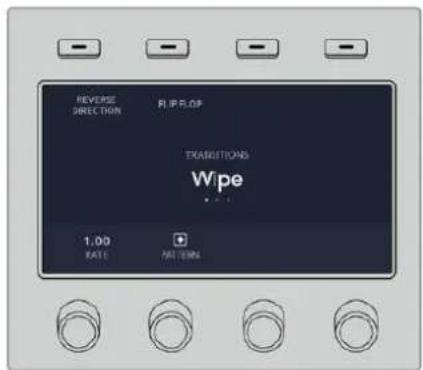
text_image
REVERSE DIRECTION RIP FLOP TRANSITIONS Wpe 1.00 RATE PART NUMBERtext_image
Camera 1 Camera 2 Camera 3 Camera 4 Camera 5 Camera 6 Camera 7 Camera 8 Media Player 1 Media Player 2text_image
Block | Color Bars | | | | | | Color 1 | Color 2 | Media Player 1Key | Media Player 2 Keynatural_image
Two vertical black panels with a central white highlight, no text or symbols present.text_image
CANCEL OVERWRITE CREAT NEW Overwrite Macro? Overwriting Macro 1 cannot be undone. If you wish to create a new Macro please choose Create New.text_image
Front panel of a control panel with multiple display and rotary switches, showing various function buttons and numeric readings.text_image
Front panel of a control panel with multiple display and function buttons, including f45, f80, f30, and F4.5 labels.natural_image
Two vertical dot patterns: green dots on gray background and red dots on dark background, no text or symbols present.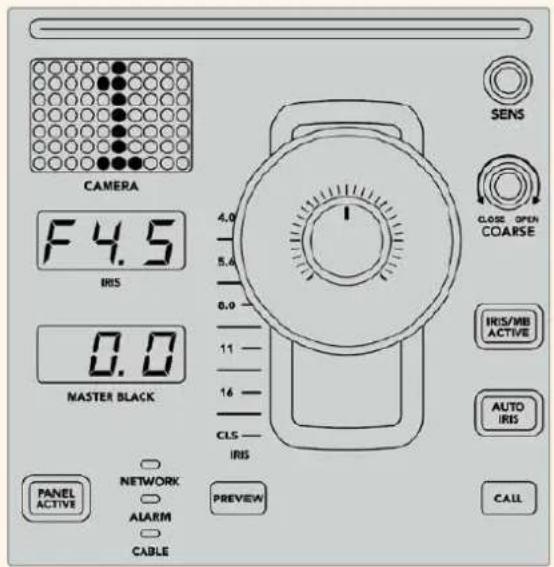
text_image
CAMERA F 4.5 IRIS 0.0 MASTER BLACK PANEL ACTIVE NETWORK: ALARM CABLE 4.0 5.0 0.0 11 16 CLS IRIS PREVIEW SENS CLOSE OPEN COARSE IRIS/MB ACTIVE AUTO IRIS CALLAjustes predeterminados
text_image
Cam1 Cam2 Cam3 Cam4 Mic 1 Mic 2 General Entamo +0.09 +0.06 +0.50 +0.20 +0.16 +0.00 Cleadmeter -13.28 -15.45 -9.66 -9.73 -30.28 -2.89 Distribution +0.08 +0.50 +0.50 +0.85 +0.36 +0.36 +0.36 +0.36 +0.36 +0.36 +0.36 +0.36 +0.36 +0.36 +0.36 +0.36 +0.36 +0.36 +0.36 +0.36 +0.36 +0.natural_image
Circular portrait photo of a smiling man in a dark shirt against a gray background (no text or symbols)欢迎辞
设置Open Broadcaster 1013
text_image
Power Control LED OUT HOTOUTtext_image
4 3 2 1 PONES AT&T CONTROL USS/OUT STMT/OUT 4 3 2 1 HCL 3 HCLtext_image
A250 MHz MIC 2 MIC 1 T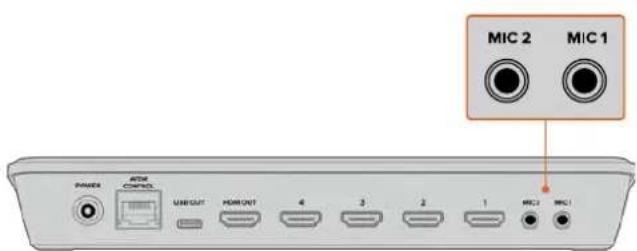
text_image
MIC 2 MIC 1 POWER AUTO COMPACT UNICUT HORIUT 4 3 2 1 MIC1 MIC2将麦克风连接至ATEM Mini的MIC输入
text_image
1 Skype Number Get a second number Settings S+ Get Skype app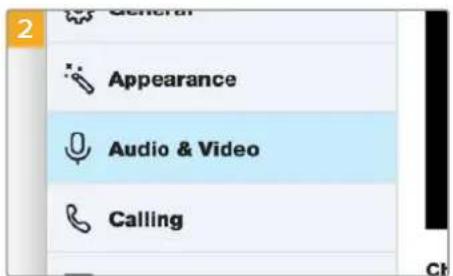
text_image
2 General Appearance Audio & Video Callingnatural_image
Interior view of a room with a framed picture frame and wall-mounted furniture (no visible text or symbols)text_image
4 AUDIO Microphone Blackmagic Design Automatically adjust microphone settings Speakers 0 1 2 3 4 5 6 7 8 9 10 Default devicetext_image
Settings General Share Screen Class Background & Timing Recording Netflix Search Colors BlackMaple, Design: A3, MAPSS Open XML... OriginalNote HB Make my videotext_image
Settings General Volume Audio Share Screen Dsn Background & Files Recording Profile Statistic Speaker Time Speaker Rash-Rash Output (External Systems) Output Level: Output Volume: User accurate audio member to play response simultaneously Microphone Test Info BlackRocking Drive Input Level: Input Volume: Automatically adjust microphone volume Source background ratio - Source Nametext_image
ATEM Mini Extreme MUTE RESET HEADPHONE重置
text_image
ATEM Mini Extreme MUTE RESET AFV RESET使用画中画
text_image
ATEMMini Bacteroidesigner ON OFF KEYtext_image
Backmagic design ON OFF KEY 1text_image
ATEM Nini Biomajodesign MC1 MC2 Picture In Picture NET AVY RESET AVY RESET AVY RESET AVY RESET OUT GM OUT GM AVS M AVS M AVS M AVS M AVS M AVS M AVS M AVS M AVS M AVS M AVS M AVS M AVS M AVS M AVS M AVS M AVS M AVS M AVS M AVS M AVS M AVS M AVS M AVS M AVS M AVS NINI 1 2 3 4 CUT AUTO FTB FULLtext_image
ATEM Mini Pro Backpropickup ON AIR OFFtext_image
ATEM Mini Pro Back-up/stop/stop 1 2 3 4 M/V PGM按下VIDEO OUT对应按钮可将信号切换至HDM输出
text_image
此视频是面向儿童的内容吗?(必选) Regardless of your location, you're legally required to comply with the Children Protection Act (COPPA) and/or other laws. You're required to tell us whether you do. What's content made for kids? ○ 是:内容是面向儿童的 ● 否:内容不是面向儿童的 ▼ 年龄限制(高级)将儿童保护设为恰当的设置并按保存。
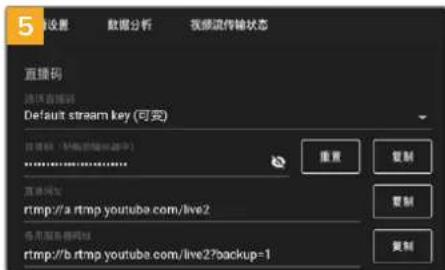
text_image
1 Twitch 3C Get Bits Asthill Path of Exile SK viewers ExtensionEnhanced bmdstreaming Offline Online Channeltext_image
2 Online Channel Video Producer Creator Dashboard Friends点击“Creator Dashboard”。
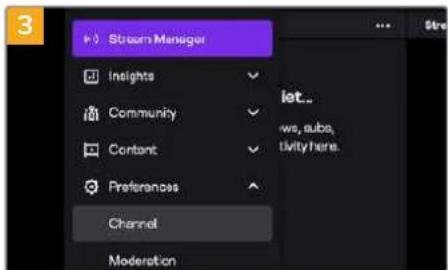
text_image
Stream Manager Insights Community Content Preferences Channel Moderation let... we, auto, tivity here.text_image
4 Stream Key & Preferences Primary Stream key Show Disconnect Protection Improves the viewing experience for y automatically display a temporary vi- encoder to work properly.将自动生成一个主视频流密钥。
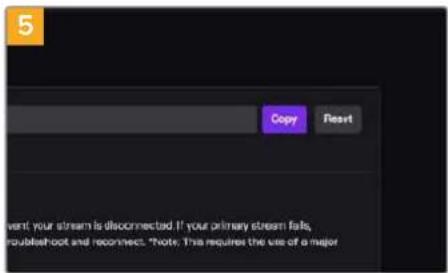
text_image
5 Copy Reset want your stream is disconnected. If your primary stream fails, troubleshoot and reconnect. *Note. This requires the use of a major点击“Copy”。
text_image
ATEM Mini Extreme iRacimugodam 2.3KB ON ON NO ON ON SET 1 SET 2 RESET STRAW ON ON ON ON ON ON ON ON ON ON ON ON ON ON ON ON ON ON ON ON ON ON ON ON ON ON ON ON ON ON ON ON ON ON ON ON ON ON ON ON ON ON ON ON ON ON ON ON ON ON On On On On On On On On On On On On On On On On On On On On On On On On On On On On On On On On On On On On On On On On On On On On On On On On On On
text_image
POWER USB HOME OUT I/O HOME OUT 8 7 6 5 4 3 2 1 REC 2 REC 1text_image
Atem Mini Extensive MIC 2 MIC 1选择母线
text_image
Preview Program Camera 1 Camera 2 Camera 3 Camera 4 ON AIR 00:00:12 4.62 OK YouTube REC 00:00:12 1 2 298:15 265:18 VIBES MP1 RECK UP1 STRAW OUT1 COM 1 COM 2 COM 3 MAY 1 MAY 2 MAY 3 MAY 4 RICH 1 RICH 2 RICH 3 RICH 4text_image
Preview Program预监
text_image
Camera 1 Camera 2 Camera 3 Camera 4输入分割画面
text_image
VIBES MPT媒体播放器分割画面
text_image
ON AIR 00:00:12 OFF AVE YOU 4.62 OK YouTube流媒体分割画面
text_image
图层 CM1 Cam2 Cam3 Cam4 BLK COL1 COL2 BARS MP1 贴板 CM1 CM2 Cam3 Cam4 BLK COL1 COL2 BARS MP1ATEM 混合特效
节目母线源选择按钮
text_image
Screenshot of a video editing software interface showing a live cooking scene with two people in a kitchen, displayed on multiple video frames.剪辑直播项目的优势
text_image
Drive Utility File Edit View Insert Tools Help Window Help Internal Macintosh HD External Drive_OI Brave "Drive_01" Grading "Drive_01" will delete statics stored on 3.5 sec sannot be installed. Provide a new and tomato, and click trade to opened. Name: Drive_01 Format: Mac OS Extended (Journal) Security Options... Cancel Brave Mount Point: /JunctionDrive_01 Type: USB External Physical Volume CaseCity: 239.71 GB Servers: Enabled Available: 239.4 GB (Core KB pgugmable) Connection: USB Used: 112.2 MB Device: disk2.x2在Windows计算机上格式化存储介质
text_image
ATEM Software Control Blackray.com 主声道 Can1 Can2 Can3 Can4 Mic 1 Mic 2 -13.21 -15.16 -9.33 -9.77 -11.80 -20.20 -2.80 声波 1 1 1 1 1 1 +0.00 +0.00 +0.00 +0.00 +0.00 +0.00 +0.00 +0.00 +0.00 +0.00 +0.00 +0.00 +0.00 +0.00 +0.00 +0.00 +0.00 +0, 1, 2, 3, 4, 5, 6, 7, 8, 9, 10, 11, 12, 13, 14, 15, 16, 17, 18, 19, 20, 21, 22, 23, 24, 25, 26, 27, 28, 29, 30, 31, 32, 33, 34, 35, 36, 37, 38, 39, 40, 41, 42, 43, 44, 45, 46, 47, 48, 49, 50, 51, 52, 53, 54, 55, 56, 57, 58, 59, 60, 61, 62, 63, 64, 65, 66, 67, 68, 69, 70, 71, 72, 73, 74, 75, 76, 77, 78, 79, 80, 81, 82, 83, 84, 85, 86, 87, 88, 89, 90, 91, 92, 93, 94, 95, 96, 97, 98, 99, 100text_image
本地素材库 收藏夹 Example Graphics Examples - Animated Clips Examples - DVE Graphic ... Examples - Photos Templates - Basketball Templates - Cooking Templates - Motor Sport Templates - News Templates - Wedding Basketball Live Bug.png Basketball Lower Third Commel Basketball Lower Third Score.pl Basketball Top Score.png 预览浏览窗口
浏览和加载文件
text_image
Layers Channels Kind Normal Opacity: 100% Lock: Wedding Backgroundtext_image
Layers Channels RGB RGB Red Green Blue Alpha 1 $62 $62 $64 $65 $60text_image
Save As: Wedding Lower Third_tga Tags: Where: Desktop Format: Targa Save: As a Copy Notes Alpha Channels Spot Colors Layers Color: Use Proof Setup: Working CMYK Limed Color Profile: sRGB IEC57966-2.1 File must be saved as a copy with this selection. Cancel Savetext_image
Targa Options Resolution 16 bits/pixel 24 bits/pixel 32 bits/pixel Compress (RLE) OK CancelTGA文件就保存好了。
text_image
Michelle and Jason使用摄影机控制
DaVinci Resolve一级调色工具
text_image
Digital color picker interface showing a circular progress gauge with sliders and numeric input fields左右拖动来调整主滚轮。