MS1261M - Sewing machine JUKI - Free user manual and instructions
Find the device manual for free MS1261M JUKI in PDF.



| Product type | Industrial sewing machine |
| Brand | JUKI |
| Model | MS1261M (with fabric feeder V045 or V046) |
| Number of needles | 3 |
| Maximum sewing speed | 3,600 stitches/min (normal use 3,000 stitches/min) |
| Application | Medium-heavy to heavy materials |
| Compatible needle | ORGAN UY x 128GAS-NY #16 to #22 (standard #19) / SCHMETZ UY-128GAS #100 to #140 (standard #120) |
| Adjustable stitch length | 1.4 to 4.2 mm (with fabric feeder) |
| Available needle gauge | 7/32" (5.6 mm), 1/4" (6.4 mm), 9/32" (7.2 mm), 5/16" (8.0 mm), 3/8" (9.5 mm) |
| Lubrication | JUKI New Defrix Oil No.1 |
| Sound level (LpA) at workstation | 78.5 dB(A) (according to ISO 10821) |
| Sound power level (LwA) | 90.5 dB(A) (according to ISO 10821) |
| Motor power supply | Three-phase clutch motor 400 W |
| Drive system | Intermittent drive with single-action versatile clutch |
| Presser foot lift height | 10 mm |
| Cylinder circumference | 194 mm |
| Fabric feeder | V045 (upper roller) or V046 (upper/lower roller) |
Frequently Asked Questions - MS1261M JUKI
User questions about MS1261M JUKI
0 question about this device. Answer the ones you know or ask your own.
Ask a new question about this device
Download the instructions for your Sewing machine in PDF format for free! Find your manual MS1261M - JUKI and take your electronic device back in hand. On this page are published all the documents necessary for the use of your device. MS1261M by JUKI.
USER MANUAL MS1261M JUKI
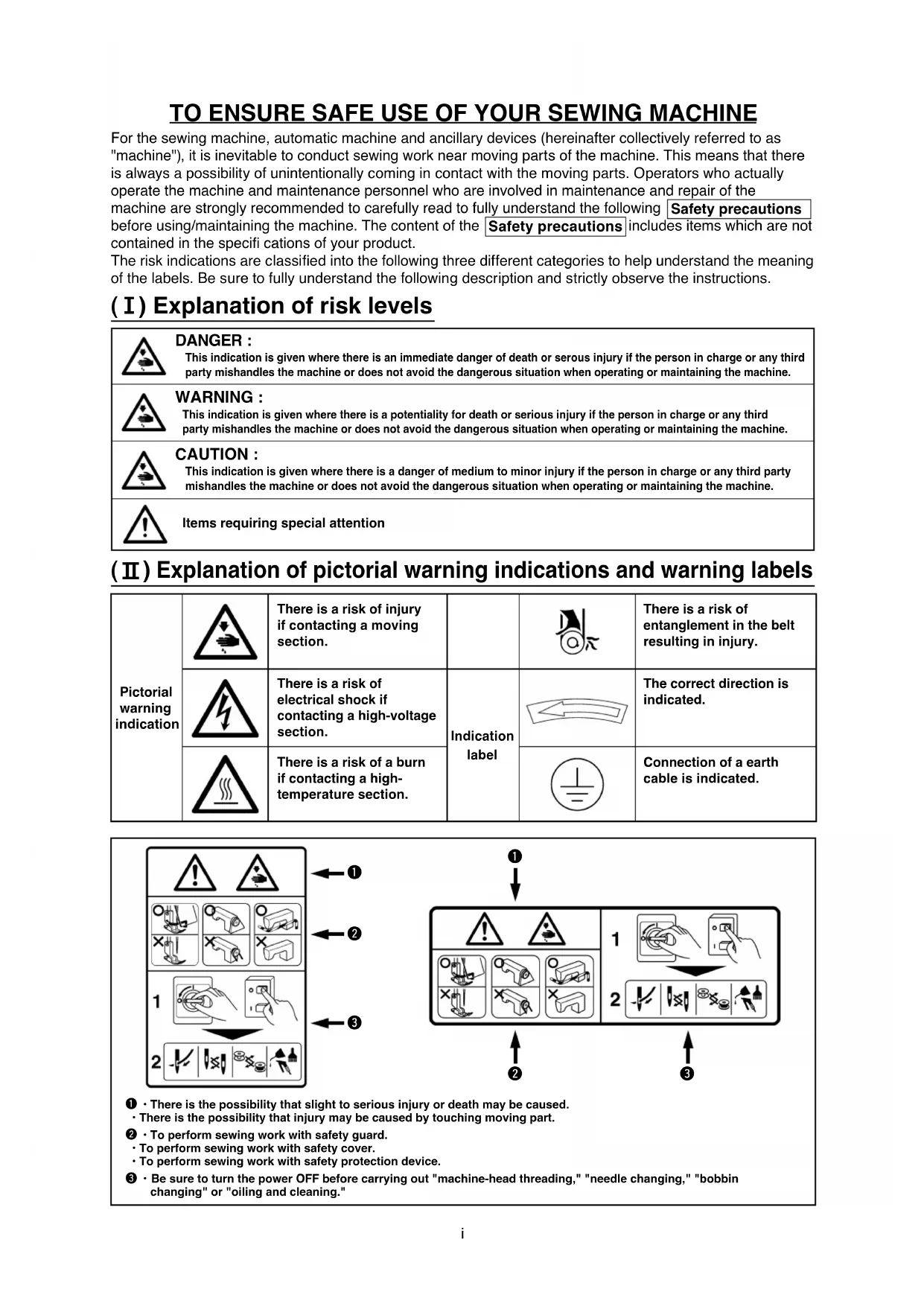
TO ENSURE SAFE USE OF YOUR SEWING MACHINE
For the sewing machine, automatic machine and ancillary devices (hereinafter collectively referred to as "machine"), it is inevitable to conduct sewing work near moving parts of the machine. This means that there is always a possibility of unintentionally coming in contact with the moving parts. Operators who actually operate the machine and maintenance personnel who are involved in maintenance and repair of the machine are strongly recommended to carefully read to fully understand the following Safety precautions before using/maintaining the machine. The content of the Safety precautions includes items which are not contained in the specific cations of your product.
The risk indications are classified into the following three different categories to help understand the meaning of the labels. Be sure to fully understand the following description and strictly observe the instructions.
(I) Explanation of risk levels
| DANGER :This indication is given where there is an immediate danger of death or serous injury if the person in charge or any third party mishandles the machine or does not avoid the dangerous situation when operating or maintaining the machine. |
| WARNING :This indication is given where there is a potentiality for death or serious injury if the person in charge or any third party mishandles the machine or does not avoid the dangerous situation when operating or maintaining the machine. |
| CAUTION :This indication is given where there is a danger of medium to minor injury if the person in charge or any third party mishandles the machine or does not avoid the dangerous situation when operating or maintaining the machine. |
| Items requiring special attention |
(II) Explanation of pictorial warning indications and warning labels
| Pictorial warning indication | There is a risk of injury if contacting a moving section. | There is a risk of entanglement in the belt resulting in injury. | |||
| There is a risk of electrical shock if contacting a high-voltage section. | Indication label | The correct direction is indicated. | |||
| There is a risk of a burn if contacting a high-temperature section. | Connection of a earth cable is indicated. |
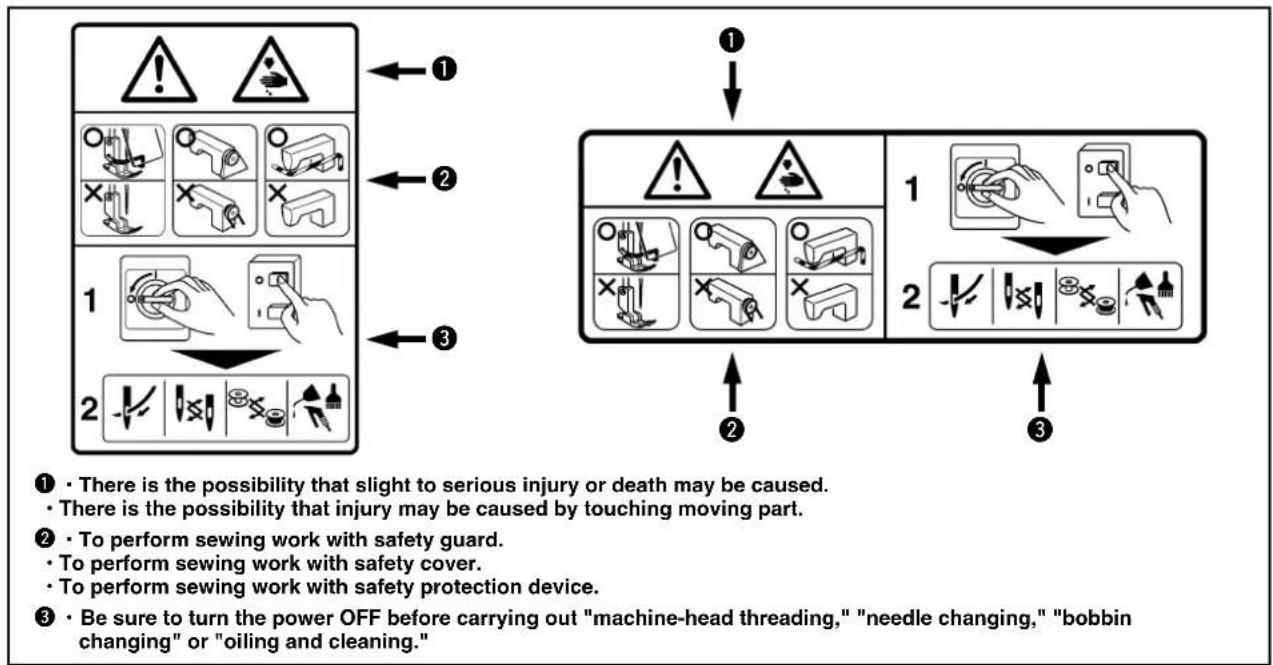

DANGER
- When it is necessary to open the control box containing electrical parts, be sure to turn the power off and wait for five minutes or more before opening the cover in order to prevent accident leading to electrical shock.

CAUTION
Basic precaution
-
Be sure to read the instruction manual and other explanatory documents supplied with accessories of the machine before using the machine. Carefully keep the instruction manual and the explanatory documents at hand for quick reference.
-
The content of this section includes items which are not contained in the specifications of your product.
- Be sure to wear safety goggles to protect against accident caused by needle breakage.
- Those who use a heart pacer have to use the machine after consultation with a medical specialist.
Safety devices and warning labels
- Be sure to operate the machine after verifying that safety device(s) is correctly installed in place and works normally in order to prevent accident caused by lack of the device(s).
- If any of the safety devices is removed, be sure to replace it and verify that it works normally in order to prevent accident that can result in personal injury or death.
- Be sure to keep the warning labels adhered on the machine clearly visible in order to prevent accident that can result in personal injury or death. If any of the labels has stained or come unstuck, be sure to change it with a new one.
Application and modifi cation
- Never use the machine for any application other than its intended one and in any manner other than that prescribed in the instruction manual in order to prevent accident that can result in personal injury or death. JUKI assumes no responsibility for damages or personal injury or death resulting from the use of the machine for any application other than the intended one.
- Never modify and alter the machine in order to prevent accident that can result in personal injury or death.
JUKI assumes no responsibility for damages or personal injury or death resulting from the machine which has been modified or altered.
Education and training
- In order to prevent accident resulting from unfamiliarity with the machine, the machine has to be used only by the operator who has been trained/educated by the employer with respect to the machine operation and how to operate the machine with safety to acquire adequate knowledge and operation skill. To ensure the above, the employer has to establish an education/training plan for the operators and educate/train them beforehand.
Items for which the power to the machine has to be turned off
Turning the power off: Turning the power switch off, then removing the power plug from the outlet. This applies to the following.
- Be sure to immediately turn the power off if any abnormality or failure is found or in the case of power failure in order to protect against accident that can result in personal injury or death.
- To protect against accident resulting from abrupt start of the machine, be sure to carry out the following operations after turning the power off. For the machine incorporating a clutch motor, in particular, be sure to carry out the following operations after turning the power off and verifying that the machine stops completely.
2-1. For example, threading the parts such as the needle, looper, spreader etc. which have to be threaded, or changing the bobbin.
2-2. For example, changing or adjusting all component parts of the machine.
2-3. For example, when inspecting, repairing or cleaning the machine or leaving the machine. - Be sure to remove the power plug by holding the plug section instead of the cord section in order to prevent electrical-shock, earth-leakage or fire accident.
- Be sure to turn the power off whenever the machine is left unattended between works.
- Be sure to turn the power off in the case of power failure in order to prevent accident resulting of breakage of electrical components.
PRECAUTIONS TO BE TAKEN IN VARIOUS OPERATION STAGES
Transportation
-
Be sure to lift and move the machine in a safe manner taking the machine weight in consideration. Refer to the text of the instruction manual for the mass of the machine.
-
Be sure to take sufficient safety measures to prevent falling or dropping before lifting or moving the machine in order to protect against accident that can result in personal injury or death.
-
Once the machine has been unpacked, never re-pack it for transportation to protect the machine against breakage resulting from unexpected accident or dropping.
Unpacking
- Be sure to unpack the machine in the prescribed order in order to prevent accident that can result in personal injury or death. In the case the machine is crated, in particular, be sure to carefully check nails. The nails have to be removed.
- Be sure to check the machine for the position of its center of gravity and take it out from the package carefully in order to prevent accident that can result in personal injury or death.
Installation
(I) Table and table stand
- Be sure to use JUKI genuine table and table stand in order to prevent accident that can result in personal injury or death. If it is inevitable to use a table and table stand which are not JUKI genuine ones, select the table and table stand which are able to support the machine weight and reaction force during operation.
- If casters are fitted to the table stand, be sure to use the casters with a locking mechanism and lock them to secure the machine during the operation, maintenance, inspection and repair in order to prevent accident that can result in personal injury or death.
(II) Cable and wiring
-
Be sure to prevent an extra force from being applied to the cable during the use in order to prevent electrical-shock, earth-leakage or fire accident. In addition, if it is necessary to cable near the operating section such as the V-belt, be sure to provide a space of 30mm or more between the operating section and the cable.
-
Be sure to avoid starburst connection in order to prevent electrical-shock, earth-leakage or fire accident.
- Be sure to securely connect the connectors in order to prevent electrical-shock, earth-leakage or fire accident. In addition, be sure to remove the connector while holding its connector section.
(III) Grounding
- Be sure to have an electrical expert install an appropriate power plug in order to prevent accident caused by earth-leakage or dielectric strength voltage fault. In addition, be sure to connect the power plug to the grounded outlet without exceptions.
- Be sure to ground the earth cable in order to prevent accident caused by earth leakage.
() Motor
- Be sure to use the specified rated motor (JUKI genuine product) in order to prevent accident caused by burnout.
- If a commercially available clutch motor is used with the machine, be sure to select one with an entanglement preventive pulley cover in order to protect against being entangled by the V-belt.
Before operation
- Be sure to make sure that the connectors and cables are free from damage, dropout and looseness before turning the power on in order to prevent accident resulting in personal injury or death.
- Never put your hand into the moving sections of the machine in order to prevent accident that can result in personal injury or death. In addition, check to be sure that the direction of rotation of the pulley agrees with the arrow shown on pulley.
- If the table stand with casters is used, be sure to secure the table stand by locking the casters or with adjusters, if provided, in order to protect against accident caused by abrupt start of the machine.
During operation
- Be sure not to put your fingers, hair or clothing close to the moving sections such as the handwheel, hand pulley and motor or place something near those sections while the machine is in operation in order to prevent accident caused by entanglement that can result in personal injury or death.
-
Be sure not to place your fingers near the surround area of the needle or inside the thread take-up lever cover when turning the power on or while the machine is in operation in order to prevent accident that can result in personal injury or death.
-
The machine runs at a high speed. Never bring your hands near the moving sections such as looper, spreader, needle bar, hook and cloth trimming knife during operation in order to protect your hands against injury. In addition, be sure to turn the power off and check to be sure that the machine completely stops before changing the thread.
-
Be careful not to allow your fingers or any other parts of your body to be caught between the machine and table when removing the machine from or replacing it on the table in order to prevent accident that can result in personal injury or death.
- Be sure to turn the power off and check to be sure that the machine and motor completely stop before removing the belt cover and V-belt in order to prevent accident caused by abrupt start of the machine or motor.
- If a servomotor is used with the machine, the motor does not produce noise while the machine is at rest. Be sure not to forget to turn the power off in order to prevent accident caused by abrupt start of the motor.
- Never use the machine with the cooling opening of the motor power box shielded in order to prevent fire accident by overheat.
Lubrication
-
Be sure to use JUKI genuine oil and JUKI genuine grease to the parts to be lubricated.
-
If the oil adheres on your eye or body, be sure to immediately wash it off in order to prevent inflammation or irritation.
-
If the oil is swallowed unintentionally, be sure to immediately consult a medical doctor in order to prevent diarrhea or vomiting.
Maintenance
-
In prevention of accident caused by unfamiliarity with the machine, repair and adjustment has to be carried out by a service technician who is thoroughly familiar with the machine within the scope defined in the instruction manual. Be sure to use JUKI genuine parts when replacing any of the machine parts. JUKI assumes no responsibility for any accident caused by improper repair or adjustment or the use of any part other than JUKI genuine one.
-
In prevention of accident caused by unfamiliarity with the machine or electrical-shock accident, be sure to ask an electrical technician of your company or JUKI or distributor in your area for repair and maintenance (including wiring) of electrical components.
-
When carrying out repair or maintenance of the machine which uses air-driven parts such as an air cylinder, be sure to remove the air supply pipe to expel air remaining in the machine beforehand, in order to prevent accident caused by abrupt start of the air-driven parts.
-
Be sure to check that screws and nuts are free from looseness after completion of repair, adjustment and part replacement.
-
Be sure to periodically clean up the machine during its duration of use. Be sure to turn the power off and verify that the machine and motor stop completely before cleaning the machine in order to prevent accident caused by abrupt start of the machine or motor.
-
Be sure to turn the power off and verify that the machine and motor stop completely before carrying out maintenance, inspection or repair of the machine. (For the machine with a clutch motor, the motor will keep running for a while by inertia even after turning the power off. So, be careful.)
-
If the machine cannot be normally operated after repair or adjustment, immediately stop operation and contact JUKI or the distributor in your area for repair in order to prevent accident that can result in personal injury or death.
-
If the fuse has blown, be sure to turn the power off and eliminate the cause of blowing of the fuse and replace the blown fuse with a new one in order to prevent accident that can result in personal injury or death.
-
Be sure to periodically clean up the air vent of the fan and inspect the area around the wiring in order to prevent fire accident of the motor.
Operating environment
- Be sure to use the machine under the environment which is not affected by strong noise source (electromagnetic waves) such as a high-frequency welder in order to prevent accident caused by malfunction of the machine.
- Never operate the machine in any place where the voltage fluctuates by more than "rated voltage ± 10% " in order to prevent accident caused by malfunction of the machine.
- Be sure to verify that the air-driven device such as an air cylinder operates at the specified air pressure before using it in order to prevent accident caused by malfunction of the machine.
- To use the machine with safety, be sure to use it under the environment which satisfies the following conditions: Ambient temperature during operation 5^ to 35^
Relative humidity during operation 35% to 85% - Dew condensation can occur if bringing the machine suddenly from a cold environment to a warm one. So, be sure to turn the power on after having waited for a sufficient period of time until there is no sign of water droplet in order to prevent accident caused by breakage or malfunction of the electrical components.
- Be sure to stop operation when lightning flashes for the sake of safety and remove the power plug in order to prevent accident caused by breakage or malfunction of the electrical components.
- Depending on the radio wave signal condition, the machine may generate noise in the TV or radio. If this occurs, use the TV or radio with kept well away from the machine.
- For the worker who is involved in the work to be done in the environment relevant to "noise value in the working environment is 85 dB or more and less than 90 dB", be sure to take appropriate measures, as required, such as the use of ear protection or the like to protect against health hazard. In addition, for the worker who is involved in the work to be done in the environment relevant to "noise level in the working environment is 90 dB or more," be sure to instruct him/her to wear ear protection without exceptions in order to protect against health hazard, and display a sign explaining how to use the ear protection at an easily viewable location for the worker.
- Properly dispose of packages of the sewing machine and used lubricating oil according to the relevant national law(s) in your country.
FOR SAFE OPERATION
| 1. Keep your hands away from the needle when you turn the power switch ON or while the machine is operating. 2. Do not put your fingers into the thread take-up cover while the machine is operating. 3. Keep your fingers, head hair or clothes away from the vicinity of the handwheel and thread take-up lever or keep clean this area while the sewing machine is running. 4. Do not operate the sewing machine with its belt cover and finger guard removed. | |
| 1. To achieve, security, be sure that the power supply earth wire has been connected before operating the sewing machine. 2. Before inserting/removing the power plug, the power switch has to be turned OFF in advance. 3. In time of thunder and lightning, stop your work and disconnect the power plug from the receptacle so as to ensure safety. 4. When you move the unit from a cold place directly to a warm place, dew condensation may result. Turn ON the power to the unit after you have confirmed there is no fear of dew condensation. 5. To prevent fires, periodically draw out the power plug from the plug socket and clean the root of the pins and the space between pins. 6. The looper oscillates at a high speed while you are operating the sewing machine. To protect your hands, keep your hands away from the vicinity of the looper. In addition, be sure to turn the power OFF before threading the machine head. 7. To avoid possible accidents due to abrupt start of the machine, be sure to turn OFF the power to the machine. 8. Be careful of handling this product so as not to pour water or oil, shock by dropping, and the like since this product is a precision instrument. |

CAUTION :
Note that safety devices such as "eye guard", "finger guard", etc. may be omitted from the illustrations in this Instruction Manual for easy explanation. When operating the machine, be sure not to remove these safety devices.
BEFORE OPERATION

CAUTION :
Check the following so as to prevent maloperation of and damage to the machine.
- Before you put the machine into operation for the first time after the set-up, clean it thoroughly. Remove all dust gathering during transportation and oil it well.
- Confirm that voltage has been correctly set.
- Confirm that the power plug has been properly connected to the power supply.
- Never use the machine in the state where the voltage type is different from the designated one.
- The direction of normal rotation of the machine is counterclockwise as observed from the pulley side.
Take care not to allow the machine to rotate in the reverse direction. - Never operate the sewing machine unless the sewing machine is sufficiently lubricated.
- To operate the sewing machine, be sure to install the sewing machine on the table. Then, turn ON the power switch.
- Be sure to remove thread from the machine head and looper before starting a trial run.
- Be sure to use your sewing machine with the speed of stitch lowered to 2,800 sti/min or less for the first month after installation.
- Operate the handwheel after the machine has totally stopped.
DECLARATION OF INCORPORATION OF PARTLY COMPLETED MACHINERY
We hereby declare that the sewing machine (sewing head) described below;
- Must not be put into service until the machinery to which it is incorporated has been declared in conformity with the provisions of the Directive 2006/42/EC, and
- Conforms to the essential requirements of the Directive 2006/42/EC, described in the technical documentation, and
- To be prepared with the above technical documentation compiled in accordance with part B of Annex VII, and
- Relevant information on which should be transmitted in response to a reasoned request by the national authorities, by the electronic method or other according to the request.
Model MS-1261/V045, MS-1261/V046
MS-1261M/V045, MS-1261M/V046
Serial No
Description Industrial Sewing Machine
Function make stitches and sew
Applied harmonized standards, in particular :
EN ISO12100-1, EN ISO12100-2, EN ISO10821
Manufacturer :
JUKI CORPORATION
2-11-1, Tsurumaki, Tama-shi, Tokyo, Japan
CONTENTS
SPECIFICATIONS 1
- SETTING UP THE SEWING MACHINE 1
2.ADJUSTING THE BELT TENSION 2 - INSTALLING THE THREAD STAND 2
- INSTALLING THE KNEE LIFTER 2
- LUBRICATION 3
- ATTACHING A NEEDLE 3
- THREADING THE MACHINE HEAD 4
- THREAD TENSION 4
9.ADJUSTING THE PRESSURE OF THE PRESSER FOOT 5 - ADJUSTING THE STITCH LENGTH 5
- ADJUSTING THE NEEDLE GUARD 6
12.ADJUSTING THE LOOPER LHREAD CAM 7 - HEIGHT OF THE FEED DOG 7
- TIMING TO RELEASE THE NEEDLE THREAD TENSION 8
- ADJUSTING THE TAKE-UP THREAD TENSION CONTROL LEVER 8
- POSITION OF THE INTERMEDIATE THREAD TENSION RELEASING LEVER AND THREAD GUIDE OF THE NEEDLE THREAD TENSION CONTROLLER 8
17.MOTOR PULLEY AND SEWING SPEED 9 - HOW TO ADJUST THE V045, V046 9
- TO USE THE SEWING MACHINE WITH A CLOTH PULLER FOR SEWING HEAVY-TO MEDIUM-WEIGHT MATERIALS 11
- TABLE OF REPLACEABLE GAUGES 12
SPECIFICATIONS
| Model MS-1261/V045 MS | -1261/V046 MS-1261M/V045 MS-1261M/V046 | |||
| Application For heavy-to | extra-heavy-weight materials For medium-to heavy-weight materials | |||
| Number of needle 3 | ||||
| Sewing speed Max. 3,600 | sti/min (normal 3,000 sti/min) | |||
| Needle | ORGAN UYx 128GAS-NY #16 to #22 | ORGAN UYx 128GAS-NY #16 to #22 | ||
| (standard #21) | (standard #19) | |||
| SCHMETZ UY128GAS Nm. 100 to Nm. 140 | SCHMETZ UY128GAS Nm. 100 to Nm. 140 | |||
| (standard Nm. 130) | (standard Nm. 120) | |||
| Feed system | Intermittent feed by means of a one-touch utility clutch Link rate adjustable | |||
| Height of presser foot | 10 mm | |||
| Stitch length | 1.4 to 4.2 mm (with a cloth puller) | |||
| Needle gauge | 7/32", 1/4", 9/32", 5/16", 3/8" | |||
| Circumference of cylinder | 194 mm | |||
| Lubricating oil | JUKI New Defrix Oil No.1 | |||
| Noise | - Equivalent continuous emission sound pressure level (LpA) at the workstation: A-weighted value of 81.5 dB; (Includes KpA = 2.5 dB); according to ISO 10821-C.6.2 -ISO 11204 GR2 at 3,600 sti/min. -Sound power level (LwA); A-weighted value of 90.5 dB; (Includes KWA = 2.5 dB); according to ISO 10821-C.6.2 -ISO 11204 GR2 at 3,600 sti/min. | - Equivalent continuous emission sound pressure level (LpA) at the workstation: A-weighted value of 78.5 dB; (Includes KpA = 2.5 dB); according to ISO 10821-C.6.2 -ISO 11204 GR2 at 3,600 sti/min. | - Equivalent continuous emission sound pressure level (LpA) at the workstation: A-weighted value of 81.5 dB; (Includes KpA = 2.5 dB); according to ISO 10821-C.6.2 -ISO 11204 GR2 at 3,600 sti/min. | - Equivalent continuous emission sound pressure level (LpA) at the workstation: A-weighted value of 78.5 dB; (Includes KpA = 2.5 dB); according to ISO 10821-C.6.2 -ISO11204GR2at3,600sti/min. |
| Model | V045 | V046 |
| Application Cloth puller for light- to extra-heavy-weight materials | ||
| Cloth puller type | Upper roller feed | Upper/ lower roller feed |
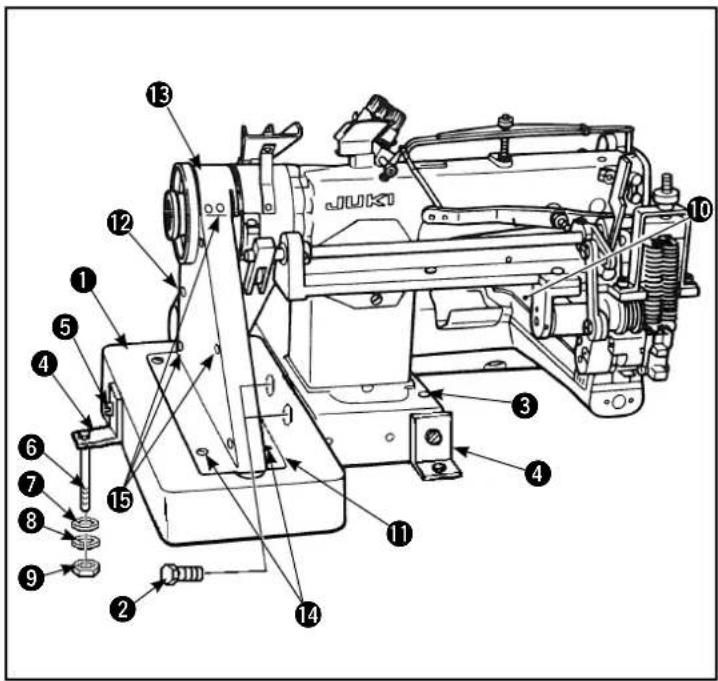
1. SETTING UP THE SEWING MACHINE
1) When carrying the sewing machine, be sure to carry by two people.
(Caution) Do not hold the pulley.
2) Do not place a protruding object, such as a screw driver, at a place where the sewing machine is to be installed.
3) Attach belt dodging base to the sewing machine with hexagon head bolt 2.
4) Put the sewing machine on the table and determine its position (belt groove and through hole 3 for passing the presser bar lifter chain).
5) Attach two machine head support plates to the sewing machine by means of screw ⑤. Fix the plates on the table by means of hexagonal bolt ⑥, washer ⑦, spring washer ⑧ and nut ⑨.
6) Place a level on bed side plate 10 in a lateral direction and a longitudinal direction to check that the sewing machine is properly placed in a horizontal position.
7) Install belt cover 1, V belt, belt cover lid 2, and top cover 3 on the sewing machine and fix them with screws 4 and 5.
When installing the belt over, temporarily tighten the screw first. Then, securely tighten the screw after the installation of all related parts.
2. ADJUSTING THE BELT TENSION

WARNING :
To protect against possible personal injury due to abrupt start of the machine, be sure to start the following work after turning the power off and ascertaining that the motor is at rest.
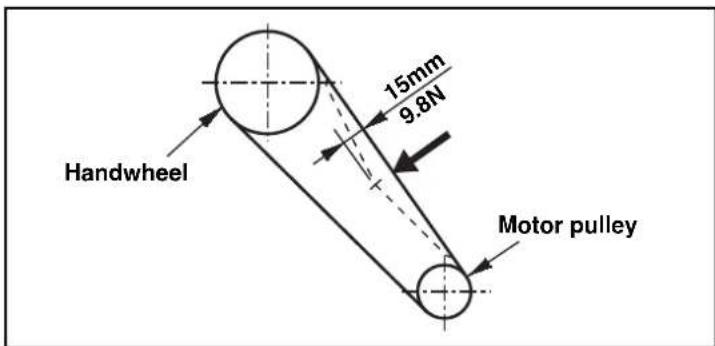
Adjust the belt tension with the height of the motor so that the belt sags 15mm when the center of V belt is applied with a 9.8N load.
3. INSTALLING THE THREAD STAND
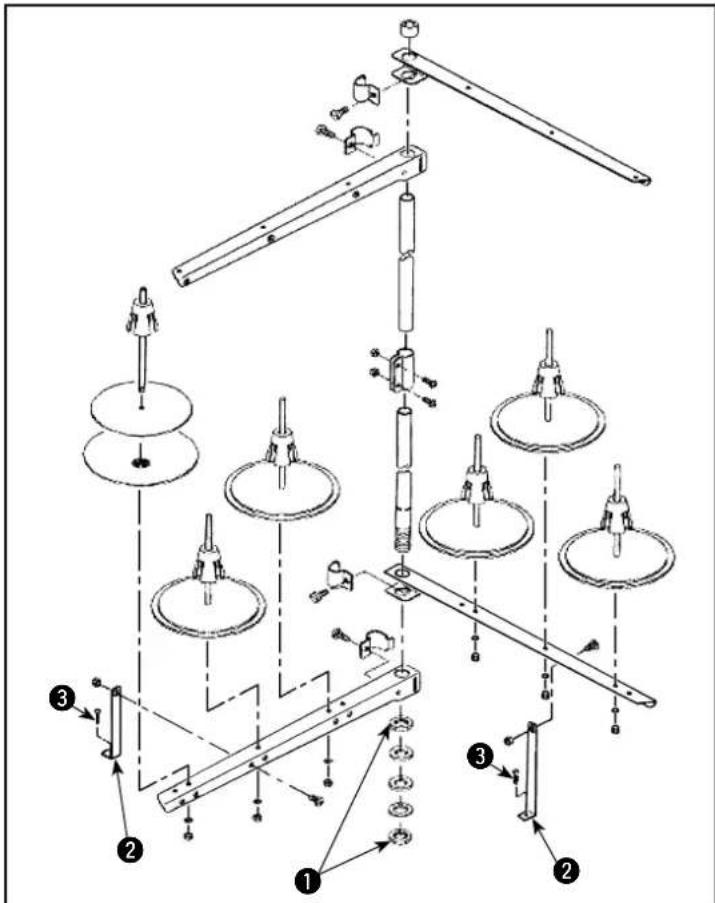
1) Assemble the thread stand device. Fit it in the hole in the table. Tighten locknut so that the thread stand does not fluctuate.
2) Fix thread stand bracket ② on the table with wood screw ③.
4. INSTALLING THE KNEE LIFTER
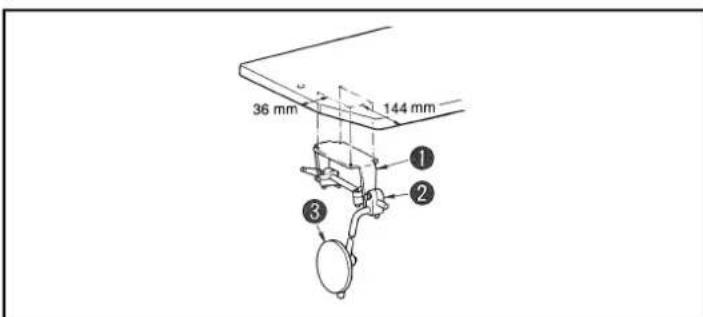
1) Fix knee-lifter mounting base (asm.) ① on the underside of the table using wooden screws.
2) Assemble knee pad vertical shaft (asm.) ③ to knee pad vertical shaft mounting arm ②. Then fix them in the position where you can operate the knee pad with ease.
5. LUBRICATION

WARNING :
To protect against possible personal injury due to abrupt start of the machine, be sure to start the following work after turning the power off and ascertaining that the motor is at rest.
* Before operating the sewing machine
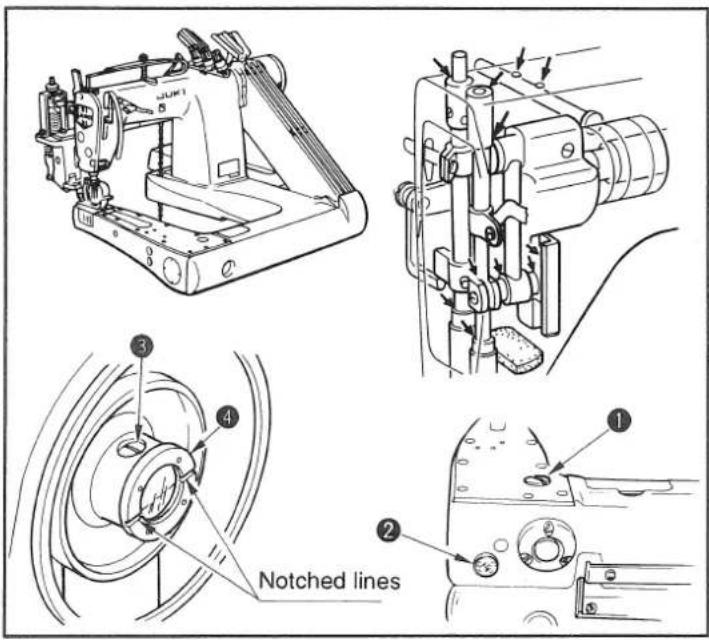
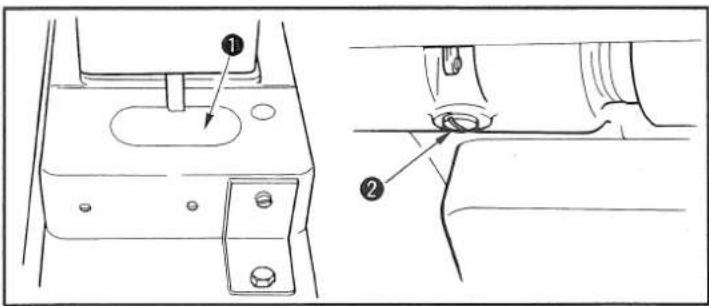
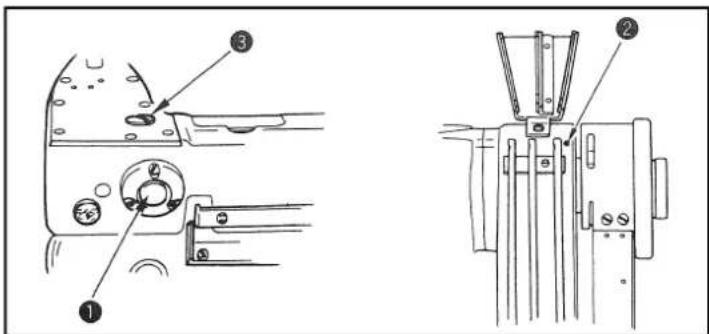
1) Remove screw 1 from the lubrication hole. Pour New Defrix Oil No. 1 from the hole until the oil surface reaches the mark on oil sight window 2
2) Turn the handwheel until the notched lines on the oil cup 4 are leveled. Now, remove screw 3 from the lubrication hole, and pour the oil until the oil surface reaches the notched lines on the oil cup (approx. a half of the oil capacity of the cup).
3) Run the sewing machine for a few minutes, then check the amount of oil again. If the amount of oil is insufficient, pour the oil further until the machine is filled with a proper amount of oil.
4) If the sewing machine has not been used for a long time, lubricate the section marked with an arrow () with a few drops of oil.
(Caution) To operate the sewing machine for the first time after the set-up of the machine or after it has not been used for a long time, fill the oil cup fully with the oil. Check that the oil level is always held within the red marked area on the oil sight window.
Red marked area
* Draining oil
1) If the oil has gathered in groove ① of the oil reservoir, wipe it off with rags.
2) Extract the oil which has gathered in the bed, from time to time, by removing cover ② from the draining hole in the hook driving shaft.
6. ATTACHING A NEEDLE

WARNING:
To protect against possible personal injury due to abrupt start of the machine, be sure to start the following work after turning the power off and ascertaining that the motor is at rest.
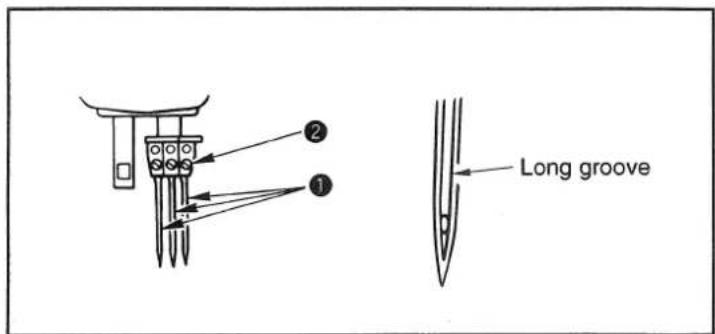
Make a choice of the needle count in accordance with thickness of the thread and type of the material to be used.
1) Turn the handwheel until the needle bar reaches to the highest position of its stroke.
2) Loosen screw ② in the needle clamp, and turn needles ① so that the long groove on the respective needles is brought in front of you.
3) Insert the needles into the needle clamp hole until they will go no further.
4) Securely tighten needle clamp screw
7. THREADING THE MACHINE HEAD

WARNING :
To protect against possible personal injury due to abrupt start of the machine, be sure to start the following work after turning the power off and ascertaining that the motor is at rest.
MS-1261/V045
MS-1261/V046
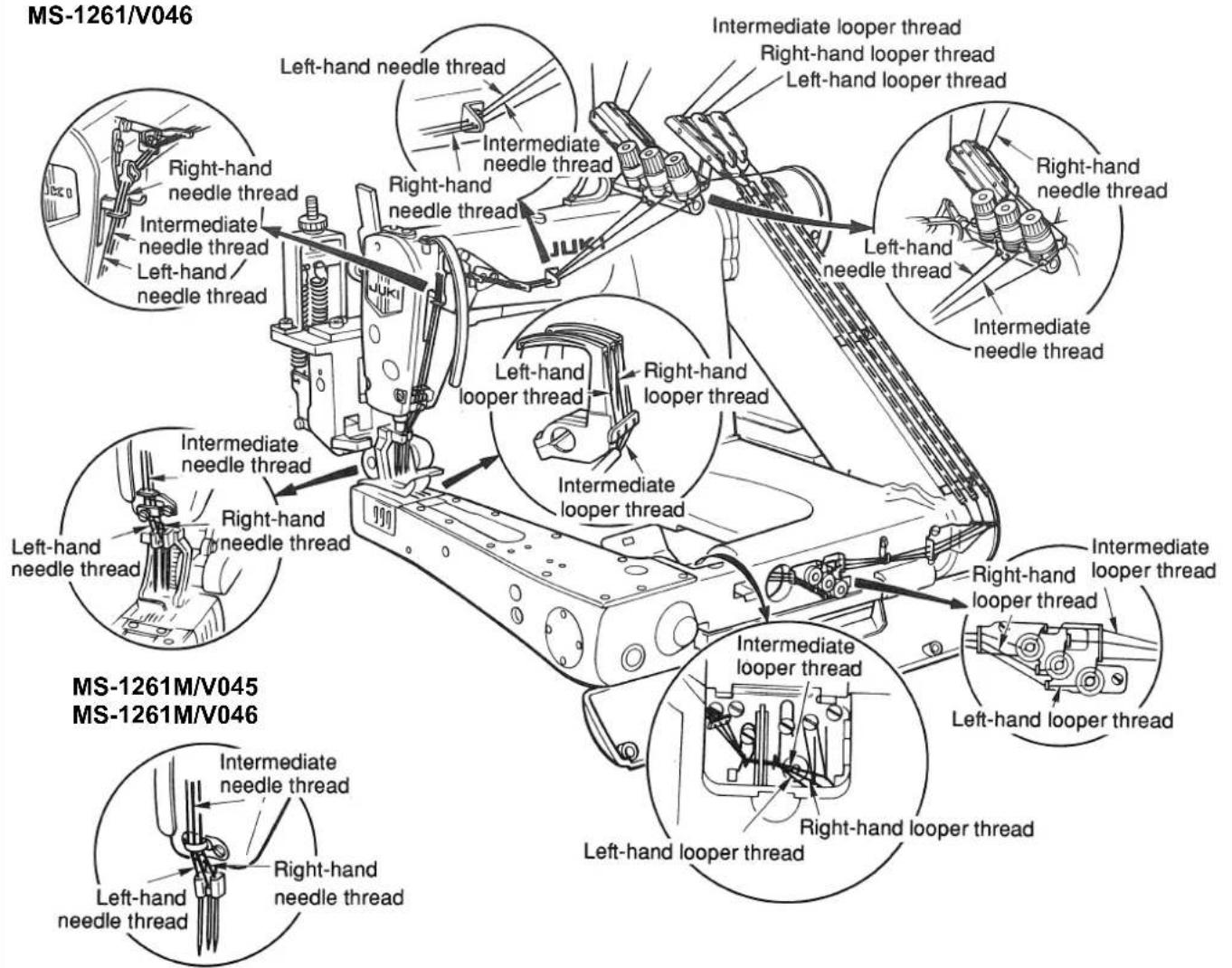
Thread the machine head in the order shown in the figure.
8. THREAD TENSION
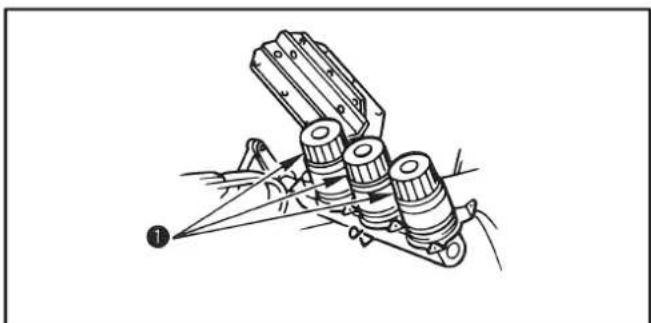
(1) Adjusting the needle thread tension
Turning tension nuts ① clockwise increases the needle thread tension. Turning it counterclockwise decreases the needle thread tension.
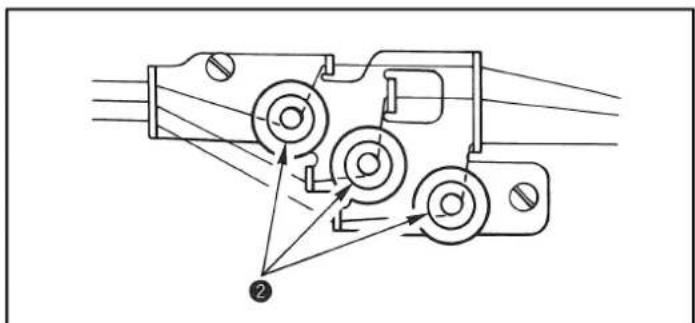
(2) Adjusting the looper thread tension
Turning looper thread tension adjusting knobs clockwise increases the looper thread tension. Turning it counterclockwise decreases the looper thread tension.
9. ADJUSTING THE PRESSURE OF THE PRESSER FOOT
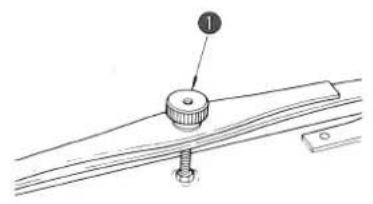
Turning presser spring regulator ① clockwise increases the pressure of the presser foot. Turning it counterclockwise decreases the pressure.
10. ADJUSTING THE STITCH LENGTH

WARNING:
To protect against possible personal injury due to abrupt start of the machine, be sure to start the following work after turning the power off and ascertaining that the motor is at rest.
To adjust the stitch length, set first the stitch length to a value desired on the main unit of the sewing machine. Then, adjust the feed amount of the cloth puller.
The divisions on the scale, showing the feed pitch, of the cloth puller are intended to be used for reference. So, it is necessary to finely adjust the feed amount while checking the actual finished state of the material.
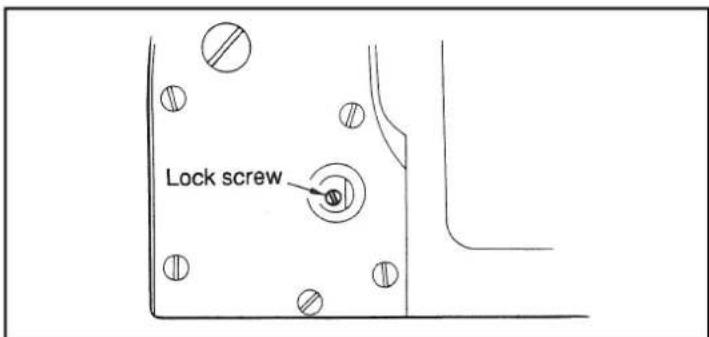
(Caution) 1. Never press the push-button while the sewing machine is in operation.
- Be sure to operate the sewing machine after tightening the lock screw.
- Never operate the machine with screw removed.
- The lock screw has a locking setscrew to prevent the screw from loosening. The lock screw head can be damaged if you forcefully remove it.
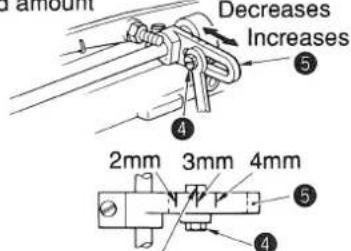
Feed amount
Align the adjusting screw with the marker line engraved on the adjusting rod.
(1) Adjusting the stitch length on the main unit of the sewing machine
1) Remove screw 3, and loosen the lock screw in the feed rock cam.
2) Lightly pressing push-button , turn the handwheel by hand.
3) When push button bites, the sewing machine will stop running.
4) In the aforementioned state, further pressing the pushbutton , turn the handwheel by hand.
5) Align the division (indicating the desired value) with marker dot engraved on the sprocket gear cover. Then, release the push-button.
6) Tighten the lock screw in the feed rock cam.
7) Attach screw in place.
(2) Adjusting the feed amount of the cloth puller
1) Loosen adjusting screw 4.
2) Move the adjustment screw back and forth along the long groove on adjusting rod 5.
3) Tighten adjusting screw 4.
The feed amount of the cloth puller can be adjusted nearly to the value shown in the figure on the left by aligning the adjusting screw with one of the divisions engraved on adjusting rod corresponding to a feed amount desired.
11. ADJUSTING THE NEEDLE GUARD

WARNING :
To protect against possible personal injury due to abrupt start of the machine, be sure to start the following work after turning the power off and ascertaining that the motor is at rest.
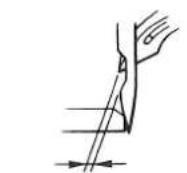
0.1 to 0.15mm
{MS-1261/V045}
{MS-1261/V046}
0.05 to 0.1mm
MS-1261M/V045
MS-1261M/V046
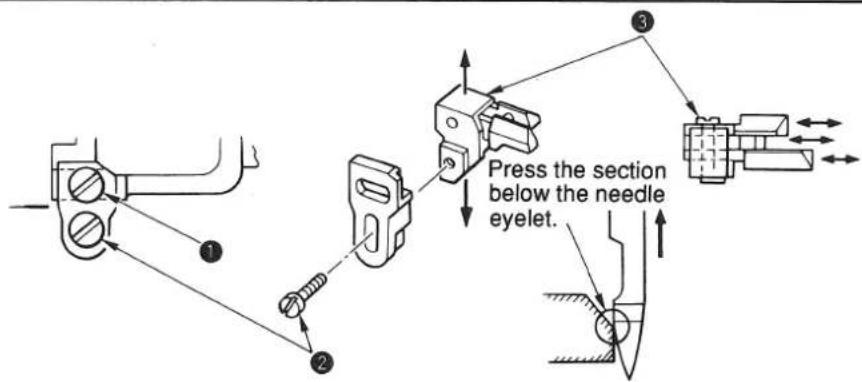
The needle guard has been mounted on the feed dog. It therefore necessary to adjust the needle guard whenever the feed amount is changed.
(Adjusting the clearance provided between the needle and the looper)
1) Turn the handwheel to make the top end of the looper align with the center of the needle.
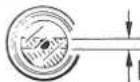
2) Loosen screw 1, move the entire unit of the needle guard to the right or left to make the needle guard press the needle so that the clearance of 0.1 to 0.15mm is provided between the looper and the needle. (0.05 to 0.1mm for MS-1261M/V045, MS-1261M/V046)
(Adjusting the vertical position of the needle guard)
1) Turn the handwheel to bring the needle guard at a position where the needle guard starts pressing the needle.
2) Loosen screw, and move the entire unit of the needle guard up or down so that the needle guard is located at a position where it does not press and deform needle thread loops (just below the needle eyelet).
(Adjusting the clearances between the respective needles and loopers)
If the clearances between the respective loopers and needles are not equal after the clearance between each needle and looper has been adjusted by moving the entire unit of the needle guard, adjust so that the equal clearance is provided between the respective loopers and needles following the steps described below.
1) Turn the handwheel to make the top end of the looper align with the center of the needle.
2) Loosen screw, move the respective needle guards to adjust so that the equal clearance is provided between the respective needles and loopers.
12. ADJUSTING THE LOOPER LHREAD CAM

WARNING :
To protect against possible personal injury due to abrupt start of the machine, be sure to start the following work after turning the power off and ascertaining that the motor is at rest.
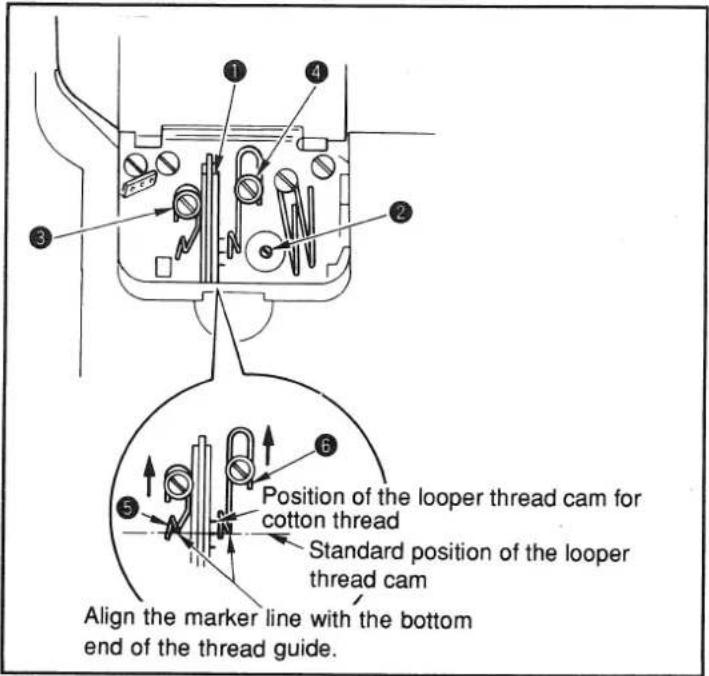
Loosen screw 2, and adjust looper thread cam 1 so that the looper starts drawing the thread when it starts returning to its home position after it has projected the most.
(1) Adjusting the looper thread cam thread guide
1) Align the end face of thread guide 6 to the marker line on thread guide 5. Then adjust thread guide 5 so that its end face is flush with the end face of thread guide 6.
2) The standard position of the thread guide is obtained when the end face of the thread guide is aligned with the center marker line.
3) When using a cotton thread, loosen screws 3 and 4, and align the end faces of thread guides 5 and 6 to the marker line located far side. At this time, it is not necessary to re adjust the looper thread cam timing.
13. HEIGHT OF THE FEED DOG

WARNING:
To protect against possible personal injury due to abrupt start of the machine, be sure to start the following work after turning the power off and ascertaining that the motor is at rest.
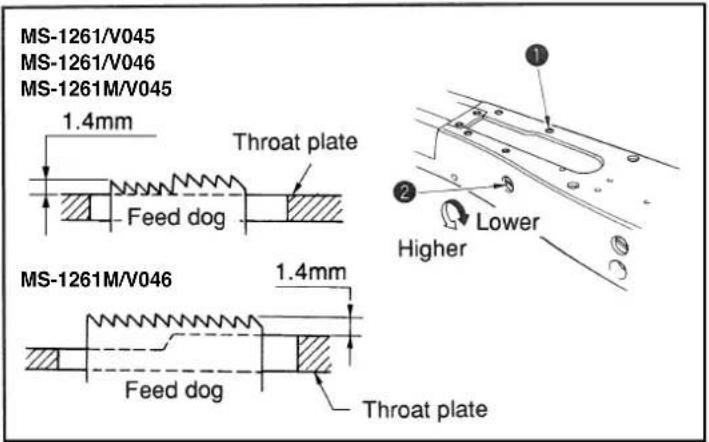
The top end of the feed dog should rise 1.4mm above the surface of the throat plate when the feed dog is in the highest position of its stroke.
(1) Adjusting the feed dog height
1) Loosen screw in the side plate of the bed and remove it.
2) Remove the screw 1, and loosen a hexagon socket head screw under the screw 1 with an L-shaped hexagon wrench key.
3) Adjust the feed dog height by turning feed driving amount adjusting shaft
4) Fix the shaft with the hexagon socket head screw and tighten screw 1.
(Caution) It is not necessary to firmly fix the feed driving amount adjusting shaft
14. TIMING TO RELEASE THE NEEDLE THREAD TENSION

WARNING :
To protect against possible personal injury due to abrupt start of the machine, be sure to start the following work after turning the power off and ascertaining that the motor is at rest.
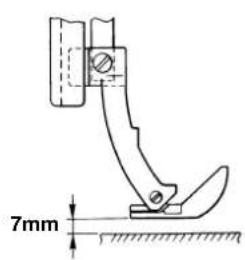
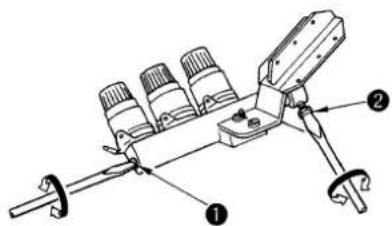
Adjust so that the needle thread tension is released when the presser foot is lifted by 7mm above the surface of the throat plate.
Loosen screw 2 in thread tension releasing shaft 1, and adjust the timing to release the needle thread tension by turning the shaft clockwise or counterclockwise.
Note that the presser foot should be attached to the presser bar so that the presser foot is flush with the bottom end of the presser bar.
(Caution) After the presser foot is fixed, confirm that the presser foot does not rise above the throat plate. If the presser foot rises above the throat plate during sewing, stitch skipping or other sewing trouble will occur.
15. ADJUSTING THE TAKE-UP THREAD TENSION CONTROL LEVER

WARNING:
To protect against possible personal injury due to abrupt start of the machine, be sure to start the following work after turning the power off and ascertaining that the motor is at rest.
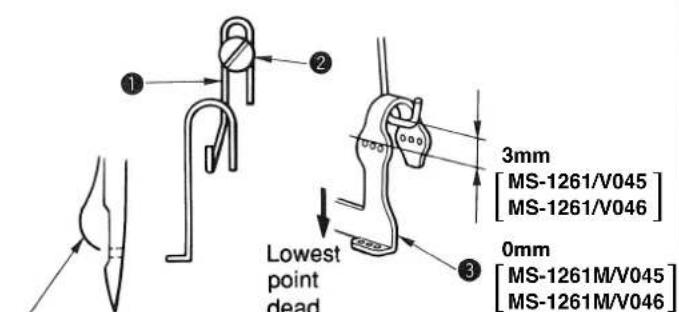
Needle thread loop
Needle thread loop size is determined by adjusting the position of take-up thread tension control lever
The needle thread loop size changes in accordance with the thread and material used. So, adjust the thread loop size upon occasion.
1) Loosen two screws ② , and adjust the position of the thread take-up lever guide by moving it up or down.
2) Adjust so that, when the needle bar is in the lowest dead point, the top end of the thread tension control lever is positioned 3mm above the top end of thread hole in needle bar thread take-up lever 3.
(0 mm for MS-1261M/V045, MS-1261M/V046)
3) Lowering thread tension control lever decrease the loop size. Lifting the lever increases it.
16. POSITION OF THE INTERMEDIATE THREAD TENSION RELEASING LEVER AND THREAD GUIDE OF THE NEEDLE THREAD TENSION CONTROLLER

WARNING:
To protect against possible personal injury due to abrupt start of the machine, be sure to start the following work after turning the power off and ascertaining that the motor is at rest.
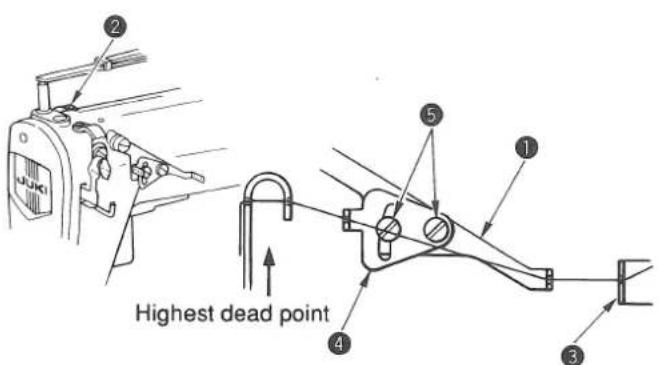
Adjust the position of intermediate thread tension releasing lever 1 and thread guide 4 of the needle thread tension controller as described below.
1) Turn the handwheel to bring the needle bar to the highest dead point.
2) Loosen screw 已 and adjust the position of intermediate thread tension releasing lever 1 so that the thread coming from intermediate needle thread guide 已 is in parallel to the intermediate thread tension releasing lever.
3) Then, loosen two screws 5, and adjust the position of thread guide 4 of the needle thread tension controller so that the thread coming from intermediate thread tension releasing lever 1 makes a beeline.
17. MOTOR PULLEY AND SEWING SPEED
1) Use a clutch motor of 3-phase and 400W (1/2 HP).
For a servo-motor, a synchronizer mounting base is optionally available.
2) Use an M type V-belt.
3) The relation among the motor pulley, the sewing speed of sewing machine is as shown in the table below:
| Model | Number of revolution of sewing machine | Effective diameter of handwheel | Number of poles of motor | Frequency. | Number of revolution of motor | Effective diameter of motor pulley |
| MS-1261/V045 | 3,600 sti/min | 67.4mm 2 | 50Hz 2,860 rpm 85mm | |||
| MS-1261V046 | 60Hz 3,430 rpm 70mm | |||||
| MS-1261M/V045 | 50Hz 2,860 rpm 70mm | |||||
| MS-1261M/V046 | 60Hz 3,430 rpm 60mm | |||||
The effective diameter of motor pulley is obtained by subtracting 5mm from its outside diameter.
The motor should rotate counterclockwise as observed from the handwheel. Take care not to allow the motor to rotate in the reverse direction.
18. HOW TO ADJUST THE V045, V046
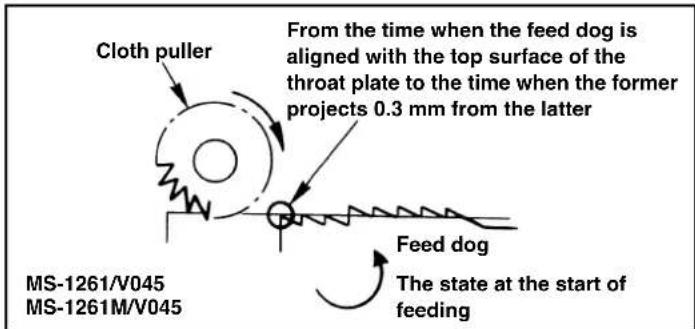
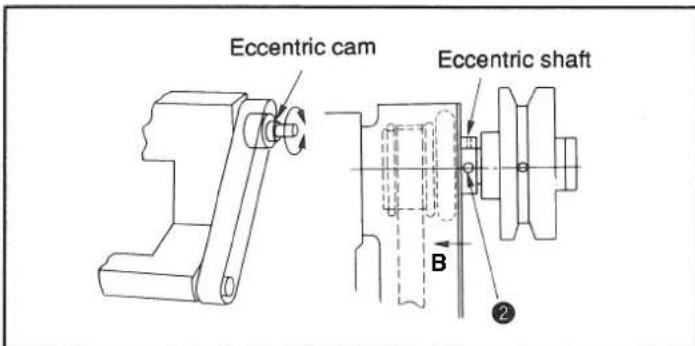
3) Timing relation between the sewing machine and the cloth puller is as described below:
(1) Adjustment of timing between the main body of sewing machine and the V0 device
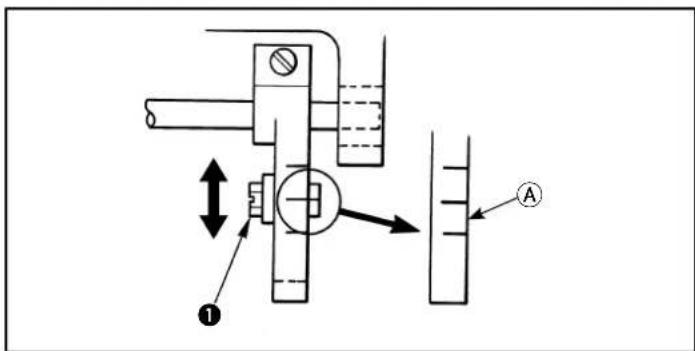
1) Adjust the amount of feed of the main body of sewing machine to 3.5mm . (3.0mm for MS-1261M/V045, MS-1261M/V046)
2) Loosen adjusting scrof the V0 device. Set the adjusting screw at position A (3.5mm) . Then, fix the adjusting screw.
(The following shows the standard values. The timing relation between the sewing machine and the cloth puller may be required to be changed depending on the material to be used.)
(Caution) Be sure to check the timing relation with the presser foot installed.
[MS-1261/V045, MS-1261M/V045]
Turning the handwheel, adjust so that the cloth puller starts rotating from the time when the top end of the feed dog is aligned with the top surface of the throat plate to the time when the former projects 0.3mm above the latter.
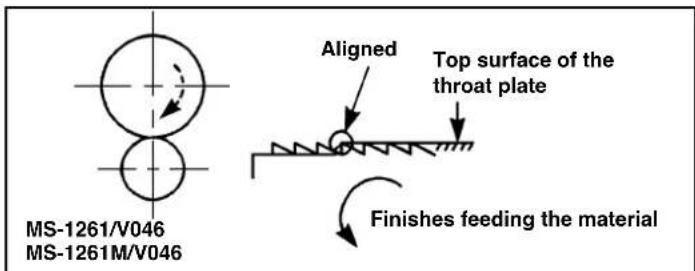
[MS-1261/V046, MS-1261M/V046]
Adjust so that the cloth puller finishes rotating when the feed dog finishes feeding the material and is aligned with the top surface of the throat plate.
4) Loosen two screws in the eccentric cam located inside the handwheel. Then turn the eccentric cam to adjust so that the relation between the cloth puller and the main unit of the sewing machine stated in the aforementioned step 3) is obtained.
5) After the completion of the adjustment, tighten two screws 2 while shifting the eccentric cam in direction B.
![JUKI MS1261M - [MS-1261/V046, MS-1261M/V046] - 1](/content/2026/04/625960/images/1c4df263971c8cc2cd1f1ceb8ea9d234d20af9782837e50521d31d142f5d6b70.jpg)
Align the adjusting screw with the marker line engraved on the adjusting rod.
![JUKI MS1261M - [MS-1261/V046, MS-1261M/V046] - 2](/content/2026/04/625960/images/8ea1097606ef3acf5d2bcf37e64912da183bdd38ba5c0d8f2b07814707310f3f.jpg)
![JUKI MS1261M - [MS-1261/V046, MS-1261M/V046] - 3](/content/2026/04/625960/images/ab086c9e2c766a34cb92ee54c39c4b6a5a2bff0697795139e92dbac52d5cf134.jpg)
A: V045, V046 In the case of the steel roller 0.01 to 0.1mm V045, V046 In the case of the urethane roller No clearance should be provided between the roller and the throat plate.
![JUKI MS1261M - [MS-1261/V046, MS-1261M/V046] - 4](/content/2026/04/625960/images/2c2ebe7bf99b60e1d5e47cbeed29c4e27d1a57727e44215061eeb9d823205483.jpg)
(2) Adjusting the feed amount
1) Loosen adjusting screw ①.
2) Move the adjustment screw back and forth along the long groove on adjusting rod 2.
The feed amount of the cloth puller can be adjusted nearly to the value shown in the figure on the left by aligning the adjusting screw with one of the divisions engraved on adjusting rod corresponding to a feed amount desired.
3) After the completion of the adjustment of feed amount, tighten adjusting screw ①.
(3) Adjusting the pressing pressure of the roller
The pressing pressure provided by the roller is adjusted by turning presser spring regulator
Turn the presser spring regulator clockwise to increase the pressing pressure of the cloth puller or counterclockwise to decrease it.
(Caution) In the case urethane roller is used, set the roller pressure to a lower value than the set value for the steel roller. In the case of an excessively high pressor foot pressure, the cloth puller may deform or an abnormal load may be applied to the device.
(4) Adjusting the clearance provided between the roller and the throat plate
1) Loosen nu. Adjust the clearance by turning adjusting screw.
In the case the steel roller is used:
Adjust the clearance provided between the roller and the throat plate (bottom roller) to 0.01 to 0.1mm .
In the case the urethane roller is used:
Adjust the clearance provided between the roller and the throat plate (bottom roller) to 0mm so that no clearance is provided between them.
2) After the adjustment, fix the roller by tightening 1.
(Caution) Adjust so that an appropriate clearance is provided between the roller and the throat plate in accordance with the type of thread to be used.
(5) Adjusting the longitudinal position of the roller (V045)
1) Maximize the feed amount of the main unit of the sewing machine. Adjust the longitudinal position of the roller by moving it back or forth so that it is spaced 0.2 to 1.0mm from the feed dog when the feed dog approaches the roller the most.
2) To adjust, loosen two screws 1 and move clutch base 2 back or forth.
(Caution) If the roller inclines () , chain-off thread will come off the material. So, be sure to adjust so that the roller is in parallel to the feed dog.
19. TO USE THE SEWING MACHINE WITH A CLOTH PULLER FOR SEWING HEAVY-TO MEDIUM-WEIGHT MATERIALS

WARNING :
To protect against possible personal injury due to abrupt start of the machine, be sure to start the following work after turning the power off and ascertaining that the motor is at rest.
The MS-1261/V045 has been developed to sew extra heavy-weight materials as standard. Various kinds of gauges have been prepared to enable the machine to be used for sewing heavy- to medium-weight materials. Replace the gauge, when sewing heavy- to mediumweight materials, following the procedure described below.
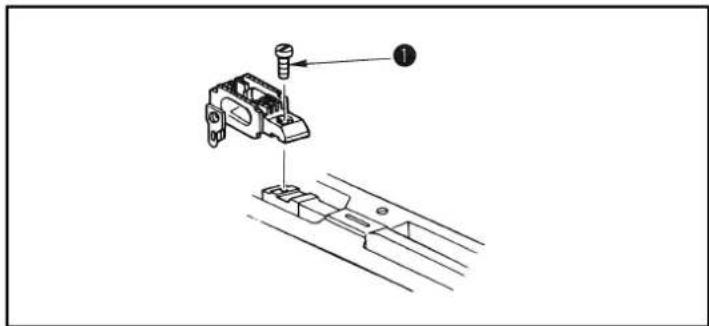
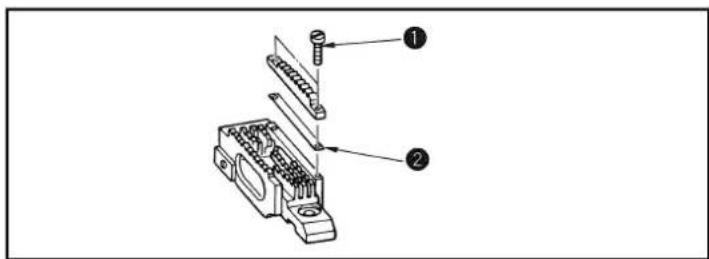
(1) Replacing the feed dog
Remove the throat plate. Loosen screw 1 in the feed dog and remove the feed dog. Then, replace the feed dog with an appropriate one.
(Caution) Each of the feed dogs for heavy- to medium-weight materials has been designed so that it can be used only by replacing it without adjusting the feed dog height. However, it is really necessary to adjust the feed dog height, refer to "13. HEIGHT OF THE FEED DOG."
To change the height in difference on the right-hand side of the feed dog
Loosen two screws 1 in the adjusting feed dog and remove spacer 2 (plate thickness: 0.5mm
Many different types of spacers are available.
(2) Replacing the throat plate
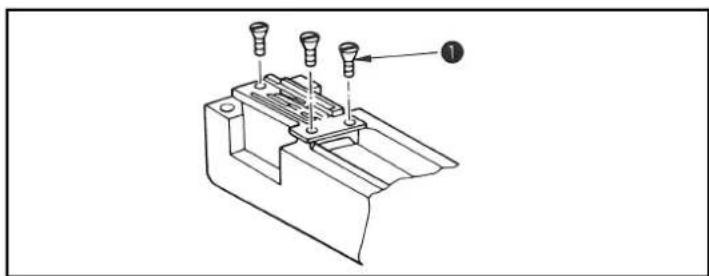
Remove three screws in the throat plate, and replace the throat plate with an appropriate one.
(3) Adjusting the difference in height of the presser foot
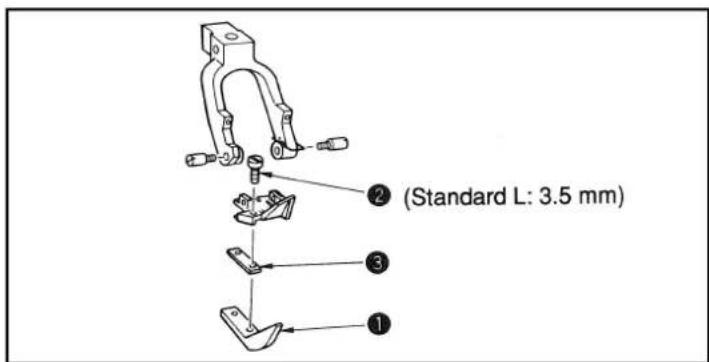
Remove two screws 2 that are used to retain adjusting presser foot 1, and adjust the difference in height of the presser foot by replacing spacer 3.
The plate thickness of the spacer which matches the respective throat plates and feed dogs.
| No. | Plate thickness | Specification |
| 1 | 1.0mm | For extra heavy-weight materials (standard) |
| 2 | 0.5mm | For heavy-weight materials |
| 3 | None | For medium-weight materials |
To replace spacer with a spacer (0.5mm or none), replace screw with a shorter one (L = 3.0mm SS5060310SP).
(4) Replacing the needle thread guide
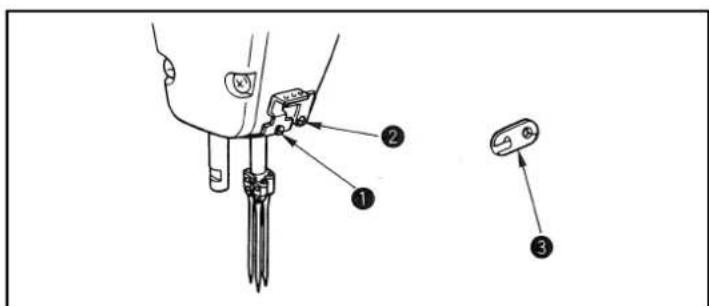
When sewing a medium-weight material using a thin thread, larger needle thread loops will be produced and they will be likely to tilt causing stitch skipping. To prevent the aforementioned trouble, replace thread guide 1 located above the needle clamp with an appropriate one.
Loosen screw 2 that is used to fix thread guide 1, and replace the thread guide with thread guide 3 for medium-weight materials.
20. TABLE OF REPLACEABLE GAUGES
(1) MS-1261/V045, MS-1261M/V045 (for medium- to extra-heavy-weight materials)
| Model | 1 | 2 | 3 | 4 | 5 | |||
| Part name | Gauge set(with fi nger guard) | Throat plate Needle clamp (asm.) | Presser foot (asm.) (with fi nger guard) | Feed dog (asm.) | ||||
| Needle gauge | ||||||||
| Code inch mm | ||||||||
| MS-1261/V045 | E 7/3 | 2 5.6 | 12953360 | 12953303 12956355 | 12960167 12963450 | |||
| F 1/4 | 6.4 | 53261 | 12953204 12956256 | 12960068 12963351 | ||||
| G 9/3 | 2 7.2 | 12953469 | 12953402 12956454 | 12960266 12963559 | ||||
| H 5/1 | 6 8.0 | 12953568 | 12953501 12956553 | 12960365 12963658 | ||||
| K 3/8 | 9.5 | 12953667 | 12953600 12956652 | 12960464 12963757 | ||||
| MS-1261M/V045 | E 7/3 | 2 5.6 | 1297297 | 12972907 12956355 | 12960183 12975058 | |||
| F 1/4 | 6.4 | 72873 | 12972808 12956256 | 12960084 12974952 | ||||
| G 9/3 | 2 7.2 | 12973079 | 12973004 12956454 | 12960282 12975157 | ||||
| H 5/1 | 6 8.0 | 12973178 | 12973103 12956553 | 12960381 12975256 | ||||
| K 3/8 | 9.5 | 73277 | 12973202 12956652 | 12960480 12975355 | ||||
| Model | 6 | 7 | 8 | ||||||
| Part name Looper (L) (asm.) Looper (R) (asm.) Looper (C) (asm.) | |||||||||
| Needle gauge | Mark | Mark | Mark | ||||||
| Code | inch mm | Mark No. | Mark No. | Mark No. | |||||
| MS-1261/V045MS-1261M/V045 | E 7/3 | 2 5.6 | 12968558 1 | 12968 | 855 1 | 12969150 1 | |||
| F 1/4 | 6.4 | ||||||||
| G 9/3 | 2 7.2 | ||||||||
| H 5/1 | 6 8.0 | 12968657 2 | 12968 | 954 2 | |||||
| K 3/8 | 9.5 | ||||||||
(2) MS-1261/V045 (for heavy-weight materials) - Optional
| Model | 1 | 2 | 3 | |||
| Part name Gauge | set Throat plate Feed dog (asm.) | |||||
| Needle gauge | ||||||
| Code inch mm | ||||||
| MS-1261/V045 | E 7/3 | 2 | 5.6 1297225 | 3 12972204 | 1297425 | 9 |
| F 1/4 | 6.4 | 12972154 | 12972105 | 12974150 | ||
| G 9/3 | 2 | 7.2 1297235 | 2 12972303 | 1297435 | 8 | |
| H 5/1 | 6 | 8.0 1297245 | 1 12972402 | 1297445 | 7 | |
| K 3/8 | 9.5 | 12972550 | 12972501 | 12974556 | ||
(3) MS-1261/V045 (for medium-weight materials) - Optional
| Model | 1 | 2 | 3 | 4 | |||
| Part name Gauge | set Throat plate Feed dog (asm.) Needle thread guide | ||||||
| Needle gauge | |||||||
| Code inch mm | |||||||
| MS-1261/V045 | E 7/3 | 2 | 5.6 1297295 | 6 12972907 1297505 | 8 | B1130051000 | |
| F 1/4 | 6.4 | 12972857 | 12972808 12974952 | ||||
| G 9/3 | 2 | 7.2 1297305 | 3 12973004 1297515 | 7 | |||
| H 5/1 | 6 | 8.0 1297315 | 2 12973103 1297525 | 6 | |||
| K 3/8 | 9.5 | 12973251 | 12973202 12975355 | ||||
(4) Options for V045
| 1. Spacer for presser foot 2. Setscrews | |||||
| No. | Plate thickness(mm) | Part No. | Part name | Part No. | Plate |
| ① | 0.3 | 12973509 | Presser foot adjusting plate B | SS5060310SP | 2 |
| ② | 0.5 | 12973608 | Presser foot adjusting plate C | 2 | |
| ③ | 0.8 | 12973707 | Presser foot adjusting plate D | SS5060410SP | 2 |
| ④ | 1.0 | 12962106 | Presser foot adjusting plate A | 2 | |
| ⑤ | 1.2 | 12973806 | Presser foot adjusting plate E | 2 | |
| 3. Spacew for feed dog | |||
| No. | Plate thickness (mm) | Part No. | Part name |
| ① | 0.3 | 12975702 | Feed dog adjusting plate B |
| ② | 0.5 | 12964102 | Feed dog adjusting plate A |
| ③ | 0.8 | 12975801 | Feed dog adjusting plate C |
| ④ | 1.0 | 12975900 | Feed dog adjusting plate D |
- Neither the spacer nor the spacer setscrew is included in the gauge set.
(5) MS-1261/V046, MS-1261M/V046 (for medium- to extra-heavy-weight materials)
| Model | 1 | 2 | 3 | 4 | 5 | |||
| Part name | Gauge set(with f i n g e r guard) | Throat plate Needle | cle clamp (asm.) | Presser foot (asm.) (with f i n g e r guard) | Feed dog (asm.) | |||
| Needle gauge | ||||||||
| Code inch mm | ||||||||
| MS-1261/V046 | E 7/32 5.6 12954061 12954004 12956355 12957163 12965158 | |||||||
| F 1/4 6.4 12953964 12953907 12956256 12957064 12965059 | ||||||||
| G 9/32 7.2 12954160 12954103 12956454 12957262 12965257 | ||||||||
| H 5/16 8.0 12954269 12954202 12956553 12957361 12965356 | ||||||||
| K 3/8 9.5 12954368 12954301 12956652 12957460 12965455 | ||||||||
| MS-1261M/V046 | E 7/32 5.6 12954665 12954608 12956355 12956165 12970059 | |||||||
| F 1/4 6.4 12954566 12954509 12956256 12956066 12969952 | ||||||||
| G 9/32 7.2 12954764 12954707 12956454 12956769 12970158 | ||||||||
| H 5/16 8.0 12954863 12954806 12956553 12956868 12970257 | ||||||||
| K 3/8 9.5 12954962 12954905 12956652 12956967 12970356 | ||||||||
| Model | 6 | 7 | 8 | ||||||
| Part name | Looper (L) (asm.) | Looper (R) (asm.) | Looper (C) (asm.) | ||||||
| Needle gauge | Mark | Mark | Mark | ||||||
| Code inch mm | |||||||||
| MS-1261/V046MS-1261M/V046 | E 7/325.6 | 12968558 1 | 12968 | 855 1 | 12969150 1 | ||||
| F 1/46.4 | |||||||||
| G 9/327.2 | |||||||||
| H 5/168.0 | 12968657 2 | 12968 | 954 2 | ||||||
| K 3/89.5 | |||||||||
(6) Options for V046
| 1. Spacew for feed dog | |||
| No. | Plate thickness (mm) | Part No. | Part name |
| ① | 0.3 | 12976601 | Feed dog adjusting plate B |
| ② | 0.8 | 12976700 | Feed dog adjusting plate C |
| ③ | 1.0 | 12976809 | Feed dog adjusting plate D |
- A spacer is not included in the gauge set.
(7) Folder
| 1 | 2 | 3 | |||
| Part name Folder (asm.) | |||||
| Needle gauge | M297 M298 M299 | ||||
| Code inch mm | |||||
| E 7/32 5.6 MAM2970DDBA MAM2980AA BA MAM2990AABA | |||||
| F 1/4 6.4 MAM2970EEBA MAM2980BBBA MAM2990BBBA | |||||
| G 9/32 7.2 MAM2970FFBA MAM2980CC BA MAM2990CCBA | |||||
| H 5/16 8.0 MAM2970GGBA MAM2980DDBA MAM2990DDBA | |||||
| K 3/8 9.5 MAM2970HHBA MAM2980EEBA MAM2990EEBA | |||||
- A folder is not included in the gauge set.
Code of folder
M297 - For medium-weight materials
(Equipped on MS-1261M/V045 as standard)
(Equipped on MS-1261M/V046 as standard)
M298 - For heavy-weight materials (Optional)
M299 - For extra-heavy-weight materials
(Equipped on MS-1261/V045 as standard)
(Equipped on MS-1261/V046 as standard)
(8) Cloth puller
| 1 | 2 | 3 | 4 | 5 | |||
| Part name Cloth | puller (asm.) V045 Cloth puller (asm.) V046 | ||||||
| Needle gauge | Steel roller | Urethane roller | Steel roller | Urethane roller | Bottom roller | ||
| Code | inch mm | ||||||
| E 7/32 | 5.6 | MAV045450A0 | MAV045500B0 | MAV04640000 | MAV046410A0 | MAV046210B0 | |
| F 1/4 | 6.4 | ||||||
| G 9/32 | 7.2 | ||||||
| H 5/16 | 8.0 | ||||||
| K 3/8 | 9.5 | ||||||
- The cloth puller is not included in the gauge set.
DEUTSCH
[MS-1261/V045, MS-1261M/V045]
[MS-1261/V045, MS-1261M/V045]
[MS-1261/V045, MS-1261M/V045]
[MS-1261/V045, MS-1261M/V045]
SEWING MACHINERY BUSINESS UNIT
2-11-1,TSURUMAKI,TAMA-SHI,
PHONE:(81)42-357-2371
FAX:(81)42-357-2380
http://www.juki.com
Copyright © 2011 JUKI CORPORATION
- All rights reserved throughout the world.
- Alle Rechte weltweit vorbehalten.
Tous droits réservés partout dans le monde. - Reservados todosarethos en el mundo entero.
- Tutti i diritti sono riservati in tutto il mondo.
Please do not hesitate to contact our distributors or agents in your area for further information when necessary.
- The description covered in this instruction manual is subject to change for improvement of the commodity without notice.