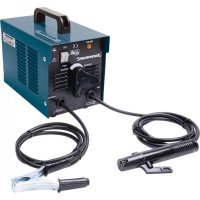
677293 - Welding machine SILVERLINE - Free user manual and instructions
Find the device manual for free 677293 SILVERLINE in PDF.



| Product Type | Arc Welding Machine |
| Brand | Silverline |
| Model | 677293 |
| Supply Voltage | 230 V ~ 50 Hz |
| Nominal Current Range | 40 – 100 A |
| Duty Cycle | 10 % |
| Current at 60% Duty Cycle | 40 A |
| Open Circuit Voltage | 48 V |
| Electrode Diameter | 1.6 – 2.5 mm |
| Max Welding Thickness | 2.5 mm |
| Recommended Fuse | 13 A |
| Protection Class | I (grounded) |
| Protection Rating | IP21S |
| Weight | 13.5 kg |
| Dimensions (L × W × H) | 315 × 170 × 250 mm |
| Main Functions | Current adjustment, thermal protection |
| Included Accessories | Electrode holder, ground clamp, welding mask, wire brush, chipping hammer |
| Intended Use | Arc welding for light-duty work |
| Maintenance and Cleaning | Clean with a dry cloth, check cables regularly |
| Safety | Wear welding mask, gloves, flame-resistant clothing; keep area ventilated; keep fire extinguisher nearby |
| Spare Parts | Available at toolsparesonline.com |
| Warranty | 3 years (register within 30 days at silverlinetools.com) |
| Manufacturer | Silverline, Powerbox International Limited, United Kingdom |
Frequently Asked Questions - 677293 SILVERLINE
User questions about 677293 SILVERLINE
0 question about this device. Answer the ones you know or ask your own.
Ask a new question about this device
Download the instructions for your Welding machine in PDF format for free! Find your manual 677293 - SILVERLINE and take your electronic device back in hand. On this page are published all the documents necessary for the use of your device. 677293 by SILVERLINE.
USER MANUAL 677293 SILVERLINE
natural_image
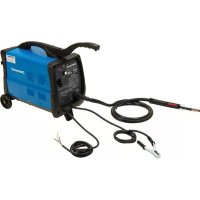
Exterior view of a SilverLineC solar power station with attached black cable and clamp (no visible text or symbols on main body)
English ......04
Français ......10
Deutsch......16
Español......22
Italiano ......28
Nederlands ......34
Polski ......40
Introduction
Thank you for purchasing this Silverline tool. This manual contains information necessary for safe and effective operation of this product. This product has unique features and, even if you are familiar with similar products, it is necessary to read this manual carefully to ensure you fully understand the instructions. Ensure all users of the tool read and fully understand this manual.
Description of Symbols
The rating plate on your tool may show symbols. These represent important information about the product or instructions on its use.

Wear hearing protection.
Wear eye protection.
Wear breathing protection.
Wear head protection.

Wear hand protection.

Read instruction manual.

DO NOT use in rain or damp environments!

Risk of electrocution!

Danger of toxic welding fumes

Danger of ultraviolet radiation

Danger hot Surfaces

Class I construction (protective earth)

Environmental Protection
Waste electrical products should not be disposed of with household waste. Please recycle where facilities exist. Check with your local authority or retailer for recycling advice.

Conforms to relevant legislation and safety standards.

Caution!

Danger of Fire
Technical Abbreviations Key
| V Volts | |
| ~, AC Alternating current | |
| A, mA Ampere, milli-Amp | |
| ^ Degrees | |
| ∅ Diameter | |
| Hz Hertz | |
| ——, DC Direct current | |
| W, kW Watt, kilowatt | |
| Ω Ohms (resistance) | |
| F Farad (capacitance) |
Specification
Voltage: 230V\~50Hz
Rated duty cycle: 10%
Amps @ 60% duty cycle:....40A
Current range: 40 - 100A
No load voltage: 48V
Electrode size: 1.6 - 2.5mm
Max welding thickness: 2.5mm
Fuse rating: 13A
Torch cable length: 2.0m
Earth cable length: 1.5m
Protection class:
Ingress protection: IP21S
Weight: 13.5kg
Dimensions (L x W x H): 315 x 170 x 250mm
As part of our ongoing product development, specifications of
Silverline products may alter without notice.
The sound intensity level for the operator may exceed 85dB(A) and sound protection measures are necessary.
WARNING: Always wear ear protection where the sound level exceeds 85dB(A) and limit the time of exposure if necessary. If sound levels are uncomfortable, even with ear protection, stop using the tool immediately and check the ear protection is correctly fitted and provides the correct level of sound attenuation for the level of sound produced by your tool.
WARNING: User exposure to tool vibration can result in loss of sense of touch, numbness, tingling and reduced ability to grip. Long term exposure can lead to a chronic condition. If necessary, limit the length of time exposed to vibration and use anti-vibration gloves. Do not operate the tool with hands below a normal comfortable temperature, as vibration will have a greater effect. Use the figures provided in the specification relating to vibration to calculate the duration and frequency of operating the tool.
Sound and vibration levels in the specification are determined according to EN60745 or similar international standards. The figures represent normal use for the tool in normal working conditions. A poorly maintained, incorrectly assembled, or misused tool, may produce increased levels of noise and vibration. www.osha.europa.eu provides information on sound and vibration levels in the workplace that may be useful to domestic users who use tools for long periods of time.
General Safety
WARNING! When using electric power tools, basic safety precautions should always be followed to reduce the risk of fire, electric shock and personal injury including the following safety information. Read all these instructions before attempting to operate this product and save these instructions for future use.
WARNING: This appliance is not intended for use by persons (including children) with reduced, physical or mental capabilities or lack of experience or knowledge unless they have been given supervision or instruction concerning use of the appliance by a person responsible for their safety. Children must be supervised to ensure that they do not play with the appliance.
CAUTION: Use the power tool, accessories and tool bits etc. in accordance with these instructions, taking into account the working conditions and the work to be performed. Use of the power tool for operations different from those intended could result in a hazardous situation.
The term "power tool" in the warnings refers to your mains-operated (corded) power tool or battery-operated (cordless) power tool.
1 Keep work area clear - Cluttered areas and benches invite injuries
2 Consider work area environment
Do not expose tools to rain
Do not use tools in damp or wet locations
Keep work area well lit
Do not use tools in the presence of flammable liquids or gases
3 Guard against electric shock - Avoid body contact with earthed or grounded surfaces (e.g. pipes, radiators, ranges, refrigerators)
4 Keep other persons away - Do not let persons, especially children, not involved in the work touch the tool or the extension cord and keep them away from the work area
5 Store idle tools - When not in use, tools should be stored in a dry locked-up place, out of reach of children
6 Do not force the tool - It will perform the job better and safer at the rate for which it was intended
7 Use the right tool - Do not force small tools to do the job of a heavy duty tool Do not use tools for purposes for which they are not intended; for example do not use circular saws to cut tree limbs or logs
8 Dress appropriately
Do not wear loose clothing or jewellery, which can be caught in moving parts
Suitable safety footwear is recommended when working outdoors.
Wear protective covering to contain long hair
9 Use protective equipment
Use safety glasses
Use face or dust mask if working operations create dust
WARNING: Not using protective equipment or appropriate clothing can cause personal injury or increase the severity of an injury.
10 Connect dust extraction equipment - If the tool is provided for the connection of dust extraction and collecting equipment, ensure these are connected and properly used
11 Do not abuse the power cable - Never pull the power cable to disconnect it from the socket. Keep the power cable away from heat, oil and sharp edges. Damaged or entangled power cables increase the risk of electric shock
12 Secure work - Where possible use clamps or a vice to hold the work. It is safer than using your hands
13 Do not overreach - Keep proper footing and balance at all times
14 Maintain tools with care
Keeping cutting tools sharp and clean makes the tool easier to control and less likely to bind or lock in the workpiece
Follow instructions for lubricating and changing accessories
Inspect tool power cables periodically and have them repaired by an authorised service facility if damaged
Inspect extension cables periodically and replace if damaged
Keep handles dry, clean and free from oil and grease
WARNING: Many accidents are caused by poorly maintained power tools.
15 Disconnect tools - Disconnect tools from the power supply when not in use, before servicing and when changing accessories such as blades, bits and cutters
WARNING: The use of accessories or attachments not recommended by the manufacturer may result in a risk of injury to persons.
16 Remove adjusting keys and wrenches - Form the habit of checking to see that keys and adjusting wrenches are removed from the tool before switching it on
17 Avoid unintentional starting - Ensure switch is in "off" position when connecting to a mains socket, inserting a battery pack, or when picking up or carrying the tool
WARNING: Unintended starting of a tool can cause major injuries.
18 Use outdoor extension leads - When the tool is used outdoors, use only extension cords intended for outdoor use and so marked. Use of an extension cable suitable for outdoor use reduces the risk of electric shock
19 Stay alert
Watch what you are doing, use common sense and do not operate the tool when you are tired. Do not use a power tool while you are under the influence of drugs, alcohol or medication
WARNING: A moment of inattention while operating power tools may result in serious personal injury.
20 Check damaged parts
Before further use of tool, it should be carefully checked to determine that it will operate properly and perform its intended function
Check for alignment of moving parts, binding of moving parts, breakage of parts, mounting and any other conditions that may affect its operation
A guard or other part that is damaged should be properly repaired or replaced by an authorised service centre unless otherwise indicated in this instruction manual
Have defective switches replaced by an authorised service centre
WARNING: Do not use the tool if the on/off switch does not switch the tool on and off. The switch must be repaired before the tool is used.
21 Have your tool repaired by a qualified person - This electric tool complies with the relevant safety rules. Repairs should only be carried out by qualified persons, otherwise this may result in considerable danger to the user
WARNING: When servicing use only identical replacement parts.
WARNING: If the power cable is damaged it must be replaced by the manufacturer or an authorised service centre.
22 Power tool mains plugs must match the mains socket - Never modify the plug in any way. Do not use any adapter plugs with earthed (grounded) power tools. Unmodified plugs and matching sockets will reduce risk of electric shock
23 If operating a power tool outside use a residual current device (RCD) - Use of an RCD reduces the risk of electric shock
NOTE: The term "residual current device (RCD)" may be replaced by the term "ground fault circuit interrupter (GFCI)" or "earth leakage circuit breaker (ELCB)".
WARNING: When used in Australia or New Zealand, it is recommended that this tool is ALWAYS supplied via Residual Current Device (RCD) with a rated residual current of 30mA or less.
WARNING: Before connecting a tool to a power source (mains switch power point receptacle, outlet, etc.) be sure that the voltage supply is the same as that specified on the nameplate of the tool. A power source with a voltage greater than that specified for the tool can result in serious injury to the user, and damage to the tool. If in doubt, do not plug in the tool. Using a power source with a voltage less than the nameplate rating is harmful to the motor.
Welding Safety
- Welding produces toxic fumes and can reduce oxygen levels in the work area. Always work in a well-ventilated area. Avoid inhaling welding fumes, use a suitable respirator where appropriate
- Some metal parts may have zinc, lead, cadmium or other coatings. Attempting to weld through these coatings can produce highly toxic fumes. Always remove all coatings before welding
- If you experience irritation to the lungs, throat or eyes whilst welding, STOP IMMEDIATELY and seek fresh air
- Welding produces extremely high levels of UV light. To prevent eye damage, ALWAYS use an approved welding face mask. Under no circumstances look directly at the arc
- The light produced when arc welding can be attractive to look at, especially to children. Always prevent other people from viewing the arc welding light with unprotected eyes
- If there is a possibility of other people approaching the work area, erect suitable screening to protect them from the light / glare
• Always replace the welder face mask glass as soon as it shows any signs of wear or damage
- To prevent skin damage, ALWAYS wear a suitable fire-proof long sleeved jacket, heat proof gloves, and cap. Keep covered up
- Always remove any flammable materials (e.g. cigarette lighter, matches) from your clothing before welding
• Always keep a fire extinguisher nearby when welding
- Sparks generated while welding can ignite flammable materials easily in the welding area, so it is important to remove flammable materials before commencing welding
- Only weld when the work area and all workpieces are dry
- Do not weld sealed containers (e.g. fuel tanks, air tanks, oil drums). The heat generated from welding can cause sealed containers to burst without warning
- Be aware of transferred heat. Metal parts can conduct heat away from the work area and cause ignition of flammable materials
- Be aware that welded parts will remain hot for some time after joining. Allow to cool completely before handling, or leaving unattended
- Never weld where flammable gases, liquids or dust are present
- Ensure that there is always a responsible person nearby to alert you to any fire, or to call help in an emergency
- Use of welding machines will create powerful magnetic fields. This may disturb the operation of sensitive electronic equipment. Pacemaker wearers should consult a doctor before using a welding machine
- Do not overload power supply. Check that your mains wiring is capable of delivering the required current safely (see specification)
Product Familiarisation
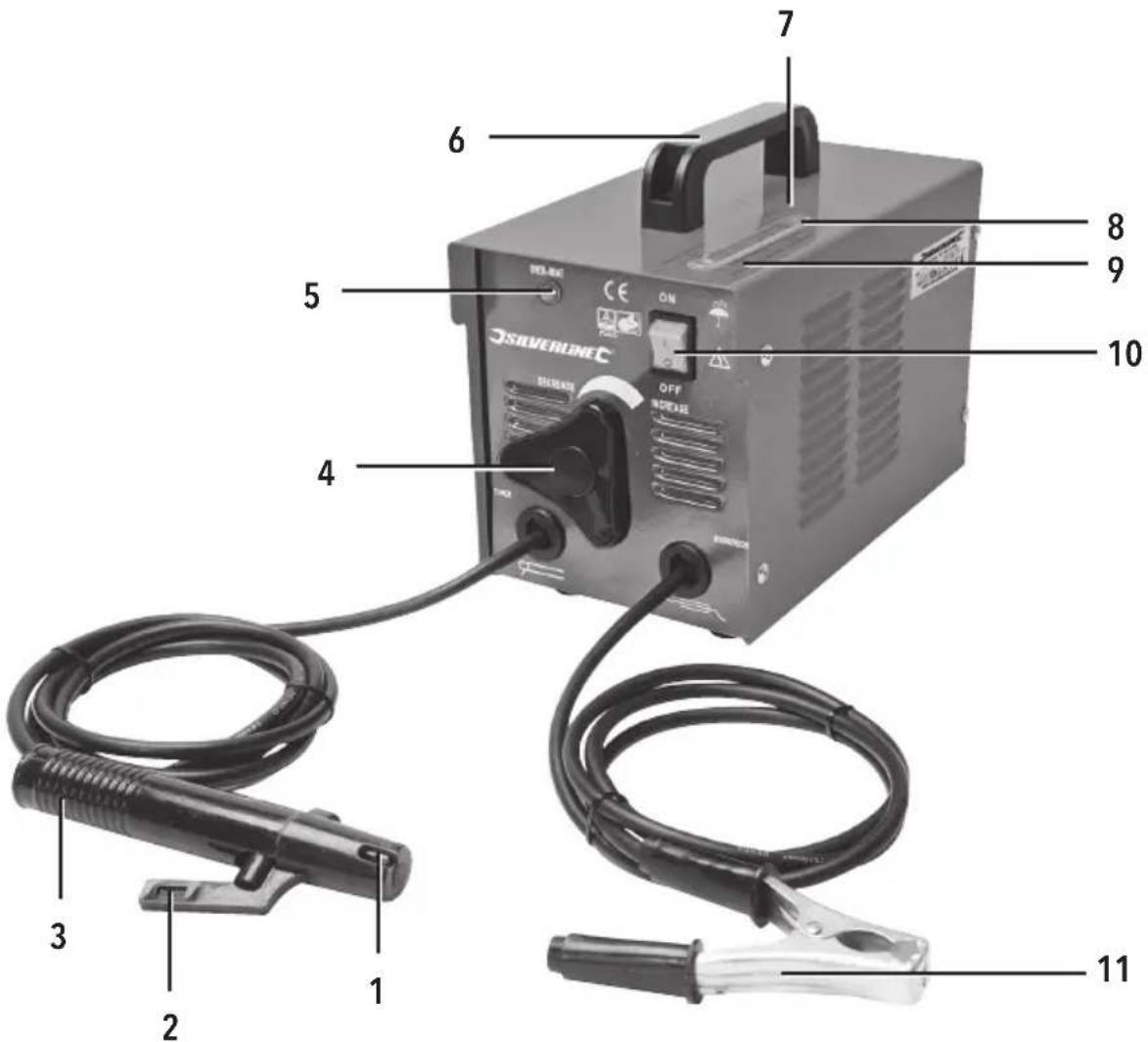
-
Thermal Overload Indicator Light
-
Electrode Clamp
- Clamp Opening Lever
- Electrode Holder
- Current Control Knob
- Handle
- Current Scale
- Current Level Indicator
- Electrode Thickness Scale
- On/Off Switch
- Earth Clamp
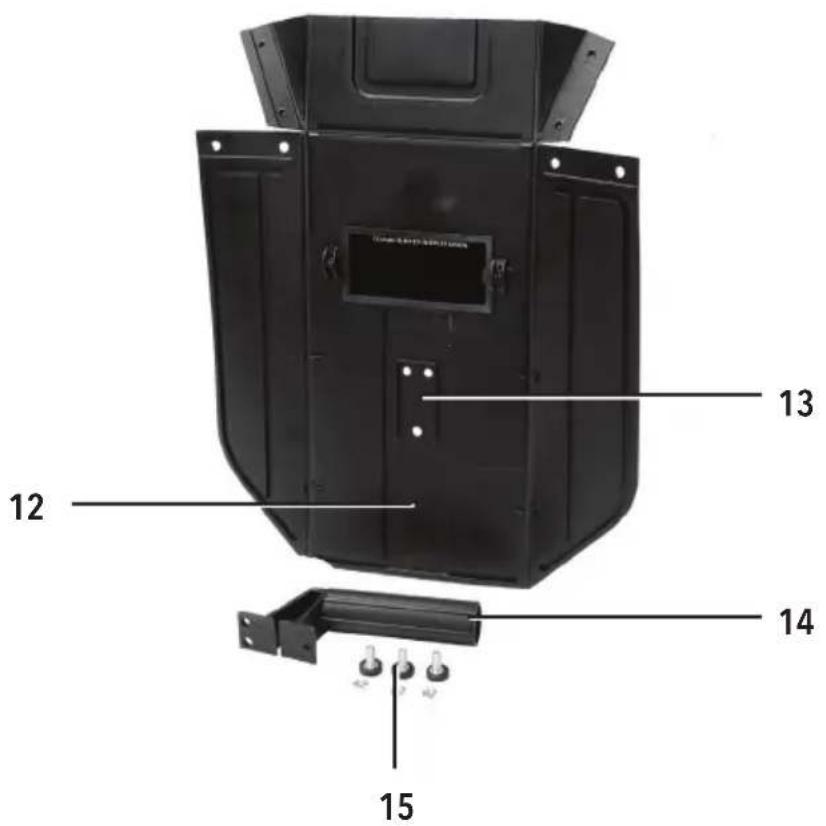
- Face Mask
- Handle Mount
- Mask Handle
- Thumb Screws
Accessories (not shown):
- 1 x Wire Brush
- 1 x Chipping Hammer
Intended Use
Mains-powered shielded metal arc welding machine with adjustable current output. Suitable for light duty welding tasks only.
Unpacking Your Tool
- Carefully unpack and inspect your new tool. Familiarise yourself with all its features and functions
- Ensure that all parts of the tool are present and in good condition. If any parts are missing or damaged, have such parts replaced before attempting to use this tool
Before Use
WARNING: Ensure the tool is disconnected from the power supply and cool before attaching or changing any accessories, or making any adjustments.
WARNING: Always ensure that there is an appropriate fire extinguisher near to the work area.
Mask assembly
- Carefully slot the Mask Handle (14) into the Handle Mount (13) and fasten securely into place using the provided Thumb Screws (15)
- Fold the sides of the Face Mask (12) and clip into place
- Remove the protective film from the lens, taking care not to scratch the lens
Connecting to a Power Supply
- Only connect this machine to a power supply capable of providing the specified voltage and current
- If connecting to a generator, check the specification of the generator first
Welding rod selection
- In order to produce a good quality weld, the correct type of welding rod must be used. Welding rods are available in a variety of thicknesses and materials, and with a range of coatings
- Refer to the rod manufacturer's guidelines to select the correct rod for your requirements
Operation
WARNING: ALWAYS wear a welding mask, gloves and heat-resistant clothing when working with this tool.
WARNING: Always inspect your machine for damage or wear. Pay particular attention to leads and cables. If any damage is found DO NOT USE.
Note: Before use, check that all casings or covers are properly closed and secured.
Note: Position the welder to ensure that it will not move, or tip, in use. Ensure that there is at least 500mm of clear space around the welder, to allow proper ventilation.
Current selection
- In order to achieve a good quality weld, the Current Control Knob (4) must be set correctly
- Turning the Current Control Knob clockwise will increase the welding current; turning the knob anti-clockwise will reduce the welding current
- The selected current is displayed on the Current Scale (7) and is indicated by the Current Level Indicator (8)
- Use the Electrode Thickness Scale (9) as a guide when picking an appropriate current, other factors such as desired weld size and material thickness also need to be considered
Duty Cycle
- This machine is not designed to weld constantly. Excessive continuous welding will cause overheating and damage to internal components
- This machine is equipped with a thermal cut-out. If the machine is overloaded, or used beyond its duty cycle, it will automatically shut down
- The duty cycle (see specifications) defines the number of minutes in every ten minutes that the machine can weld
- For a duty cycle of 30%, the machine may be used for 3 minutes then must be allowed 7 minutes to cool
- If the duty cycle is exceeded, the machine will automatically cut out
- Using the machine at reduced current settings and maintaining good ventilation will maximise the duty cycle
- As the duty cycle limit is reached, the Thermal Overload Indicator Light (5) will illuminate. The light will cut out when the machine has cooled and is ready to be used again
- As a precaution, it is recommended the machine is allowed to cool for a further three minutes after the Thermal Indicator Light has switched off, to ensure the cool-down temperature has been met
Weld preparation
- Ensure the joining surfaces of the workpiece are clean, free from rust, paint, or other finishes
- All parts should be well supported, with a gap of approximately 1 mm where the weld is intended to be formed
- Check that there are no flammable materials in the vicinity of the work area
- Attach the Earth Clamp (11) to a cleaned area of one of the parts, as near as practical to where the joint will be
- Note: Improve connectivity between the Earth Clamp and the workpiece by wrapping a piece of scrap copper wire, with the insulation removed, around the teeth of the clamp.
- Squeeze the Clamp Opening Lever (2), to open the Electrode Clamp (1). Place an electrode into the jaws, and release. The electrode should be firmly gripped, with the clamp contacting the clean metal part of the rod (not the coated part)
- Ensure that there is a qualified bystander with an operable fire extinguisher at hand.
- Connect the machine to the mains power supply
Switching 'ON' and 'OFF'
- Switch the welding machine on by moving the On/Off Switch (10) into the 'I' position
- Switch the welding machine off by moving the On/Off Switch into the 'O' position
Welding
WARNING: Using a welder correctly is a technical skill. An incorrectly-used welder can be highly dangerous. The information below is general guidance only. If you are not entirely confident in your ability to use this tool safely DO NOT USE.
- Move the On/Off Switch (10) into the 'I' position
- Hold the Electrode Holder (3) in one hand, and the Face Mask (12) in the other
- Position the rod at an angle of approximately 80^ to the surface, with the tip approximately 30mm away from the metal
- Hold the Face Mask (12) over your face and tap the rod against the metal
- An arc should strike between the metal and the tip. Try to maintain a distance between the welding rod and the workpiece equivalent to the diameter of the rod. Maintain the arc for one-to-two seconds, then move the rod away
- Allow the weld to cool slightly and move the mask away from your face. If the settings were correct, a round 'spot' weld should have formed
- If the weld has not fully penetrated the metal, increase the current setting. If a hole has been made in the metal, reduce the current setting
- Practice making 'spot' welds until you are confident in using the machine and selecting settings
- In order to form a 'seam' weld, maintain the arc for longer, and slowly move the rod along the path of the join. The speed at which the rod is moved is crucial to achieving a good weld
- If the machine settings are correct, the arc should be steady, and should produce a crackling sound. Be aware that you will have to gradually move the electrode clamp closer to the metal as the rod is used up
- Once the weld bead is complete, remove excess and splatters using a chipping hammer or wire brush. Do not attempt to weld over beads unless properly cleaned
- Creating neat, high quality welds is a skill that takes time to master. Practice and good preparation will help to make satisfactory welds
Accessories
A range of accessories and consumables, including Welders Helmet, Welders Chipping Hammer, Welders Apron and Welders Gauntlets is available from your Silverline stockist. Spare parts can be obtained from toolsparesonline.com
Maintenance
WARNING: ALWAYS disconnect from the power supply before carrying out any inspection, maintenance or cleaning.
General inspection
• Regularly check that all the fixing screws are tight
- Inspect the supply cord of the tool, prior to each use, for damage or wear. Repairs should be carried out by an authorised Silverline service centre. This advice also applies to extension cords used with this tool
Cleaning
- Keep your tool clean at all times. Dirt and dust will cause internal parts to wear quickly, and shorten the machine's service life. Clean the body of your machine with a soft brush, or dry cloth. If available, use clean, dry, compressed air to blow through the ventilation holes
- Clean the tool casing with a soft damp cloth using a mild detergent. Do not use alcohol, petrol or strong cleaning agents
- Never use caustic agents to clean plastic parts
Contact
For technical or repair service advice, please contact the helpline on (+44) 1935 382 222
Web: silverlinetools.com/en-GB/Support
Address:
Powerbox
Boundary Way
Lufton Trading Estate
Yeovil, Somerset
BA22 8HZ, United Kingdom
Storage
- Store this tool carefully in a secure, dry place out of the reach of children
Disposal
Always adhere to national regulations when disposing of power tools that are no longer functional and are not viable for repair.
- Do not dispose of power tools, or other waste electrical and electronic equipment (WEEE), with household waste
- Contact your local waste disposal authority for information on the correct way to dispose of power tools
Silverline Tools Guarantee
This Silverline product comes with a 3 year guarantee
Register this product at www.silverlinetools.com within 30 days of purchase in order to qualify for the 3 year guarantee. Guarantee period begins according to the date of purchase on your sales receipt.
Registering your purchase
Registration is made at silverlinetools.com by selecting the Guarantee Registration button. You will need to enter:-
- Your personal details
• Details of the product and purchase information
Once this information is entered your guarantee certificate will be created in PDF format for you to print out and keep with your purchase.
Terms & Conditions
Guarantee period becomes effective from the date of retail purchase as detailed on your sales receipt.
PLEASE KEEP YOUR SALES RECEIPT
If this product develops a fault within 30 days of purchase, return it to the stockist where it was purchased, with your receipt, stating details of the fault. You will receive a replacement or refund.
If this product develops a fault after the 30 day period, return it to:
Silverline Tools Service Centre
PO Box 2988
Yeovil
BA21 1WU, UK
The guarantee claim must be submitted during the guarantee period.
You must provide the original sales receipt indicating the purchase date, your name, address and place of purchase before any work can be carried out.
You must provide precise details of the fault requiring correction.
Claims made within the guarantee period will be verified by Silverline Tools to establish if the deficiencies are related to material or manufacturing of the product.
Carriage will not be refunded. Items for return must be in a suitably clean and safe state for repair, and should be packaged carefully to prevent damage or injury during transportation. We may reject unsuitable or unsafe deliveries.
All work will be carried out by Silverline Tools or its authorized repair agents.
The repair or replacement of the product will not extend the period of guarantee
Defects recognised by us as being covered by the guarantee shall be corrected by means of repair of the tool, free of charge (excluding carriage charges) or by replacement with a tool in perfect working order.
Retained tools, or parts, for which a replacement has been issued, will become the property of Silverline Tools.
The repair or replacement of your product under guarantee provides benefits which are additional to and do not affect your statutory rights as a consumer.
What is covered:
The repair of the product, if it can be verified to the satisfaction of Silverline Tools that the deficiencies were due to faulty materials or workmanship within the guarantee period.
If any part is no longer available or out of manufacture, Silverline Tools will replace it with a functional replacement part.
Use of this product in the EU.
What is not covered:
Silverline Tools does not guarantee repairs required as a result of:
Normal wear and tear caused by use in accordance with the operating instructions eg blades, brushes, belts, bulbs, batteries etc.
The replacement of any provided accessories drill bits, blades, sanding sheets, cutting discs and other related items.
Accidental damage, faults caused by negligent use or care, misuse, neglect, careless operation or handling of the product.
Use of the product for anything other than normal domestic purposes.
Change or modification of the product in any way.
Use of parts and accessories which are not genuine Silverline Tools components.
Faulty installation (except installed by Silverline Tools).
Repairs or alterations carried out by parties other than Silverline Tools or its authorized repair agents.
Claims other than the right to correction of faults on the tool named in these guarantee conditions are not covered by the guarantee.
CE Declaration of Conformity
The undersigned: Mr Darrell Morris
as authorised by: Silverline
Declares that
This declaration has been issued under the sole responsibility of the manufacturer.
The object of the declaration is in conformity with the relevant Union harmonisation Legislation.
Identification code: 677293
Description: 100A MMA Arc Welder
Conforms to the following directives and standards:
• Low Voltage Directive 2006/95/EC
• EMC Directive 2004/108/EC
• RoHS Directive 2011/65/EU
• EN60974-6: 2011
• EN60974-1:2005
• EN60974-10:2007
Notified body: TÜV Rheinland
The technical documentation is kept by: Silverline
Date: 28/08/2015
Signed:
Mr Darrell Morris
Managing Director
Name and address of the manufacturer:
Powerbox International Limited, Company No. 06897059. Registered address:
Powerbox, Boundary Way, Lufton Trading Estate, Yeovil, Somerset BA22 8HZ, United Kingdom.
Introduction
Silverline Tools Service Centre
PO Box 2988
Yeovil
Silverline Tools Service Centre
PO Box 2988
Yeovil
BA21 1WU, GB
Silverline Tools Service Centre
PO Box 2988
Yeovil
BA21 1WU, GB
Silverline Tools Service Centre
PO Box 2988
Yeovil
BA21 1WU, UK
Powerbox International Limited, Company No. 06897059. Registered address: Powerbox, Boundary
Way, Lufton Trading Estate, Yeovil, Somerset BA22 8HZ, United Kingdom.
natural_image
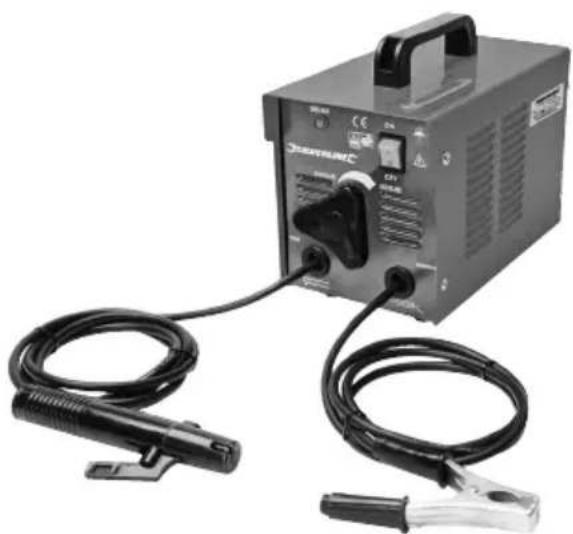
Exterior view of a portable electronic device with two coiled cables and a connector (no visible text or symbols)GB 3 Year Guarantee. Register online within 30 days. Terms and Conditions apply.

- Introduction
- Description of Symbols
- Specification
- General Safety
- Consider work area environment
- Dress appropriately
- Use protective equipment
- Maintain tools with care
- Stay alert
- Check damaged parts
- Welding Safety
- Product Familiarisation
- Accessories (not shown):
- Intended Use
- Unpacking Your Tool
- Before Use
- Mask assembly
- Connecting to a Power Supply
- Welding rod selection
- Operation
- Current selection
- Duty Cycle
- Weld preparation
- Switching 'ON' and 'OFF'
- Welding
- Accessories
- Maintenance
- General inspection
- Cleaning
- Contact
- Address:
- Storage
- Disposal
- Silverline Tools Guarantee
- This Silverline product comes with a 3 year guarantee
- Registering your purchase
- Terms & Conditions
- PLEASE KEEP YOUR SALES RECEIPT
- Silverline Tools Service Centre
- PO Box 2988
- Yeovil
- BA21 1WU, UK
- What is covered:
- What is not covered:
- CE Declaration of Conformity
- BA21 1WU, GB
Brand : SILVERLINE
Model : 677293
Category : Welding machine