TH 16 - Thermostat Maico - Free user manual and instructions
Find the device manual for free TH 16 Maico in PDF.



| Product type | Thermostat for fan control |
| Brand | Maico |
| Model | TH 16 |
| Dimensions (W x H x D) | 115 x 150 x 68 mm |
| Weight | 0.3 kg |
| Power supply | 250 V AC / 400 V 3 Ph, 50/60 Hz |
| Maximum load (resistive, 250 V AC, terminal 1-3) | 16 A |
| Maximum load (inductive, 250 V AC, terminal 1-3) | 4 A |
| Switching differential | 1.5 K |
| Protection type | IP 54 |
| Protection class | I |
| Temperature setting range | 0 to +50 °C |
| Max. ambient temperature | +50 °C |
| Storage temperature | -20 to +50 °C |
| Mounting type | Surface mounting |
| Main functions | Activation/deactivation of fans according to air temperature, adjustment via rotary knob |
| Maintenance and cleaning | Clean the housing and sensor regularly with a dry cloth |
| Safety | Installation by qualified electrician, disconnect all circuits before accessing terminals |
| Spare parts and repairability | Troubleshooting exclusively by electrician; contact the manufacturer for parts |
| General information | Indoor use only, do not use in explosive atmosphere |
Frequently Asked Questions - TH 16 Maico
User questions about TH 16 Maico
0 question about this device. Answer the ones you know or ask your own.
Ask a new question about this device
Download the instructions for your Thermostat in PDF format for free! Find your manual TH 16 - Maico and take your electronic device back in hand. On this page are published all the documents necessary for the use of your device. TH 16 by Maico.
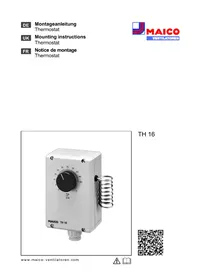
USER MANUAL TH 16 Maico
DE
Montageanleitung
Thermostat
UK
Mounting instructions
Thermostat
FR
Notice de montage
Thermostat

MAICO
VENTILATOREN
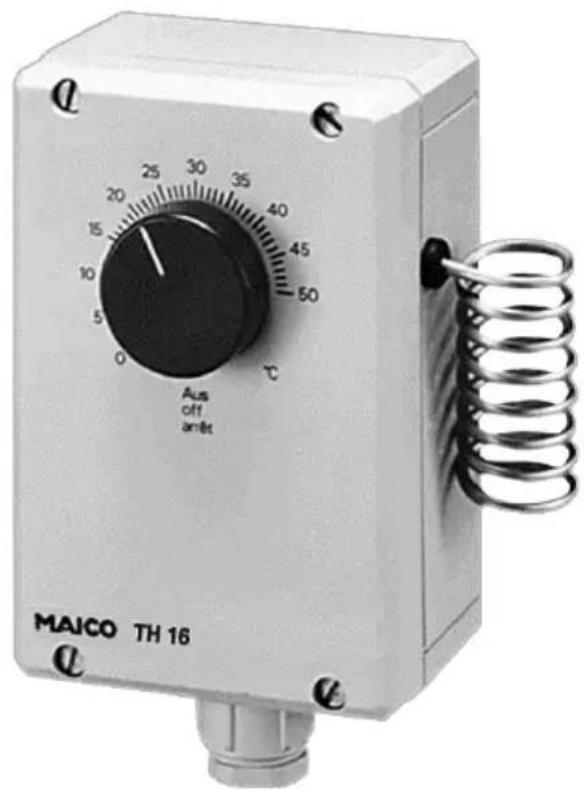
text_image
Q 25 30 35 20 40 15 45 10 50 5 0 °C Aus off anlet MAICO TH 16 QTH 16

text_image
QR code image containing encoded data, no visible human-readable text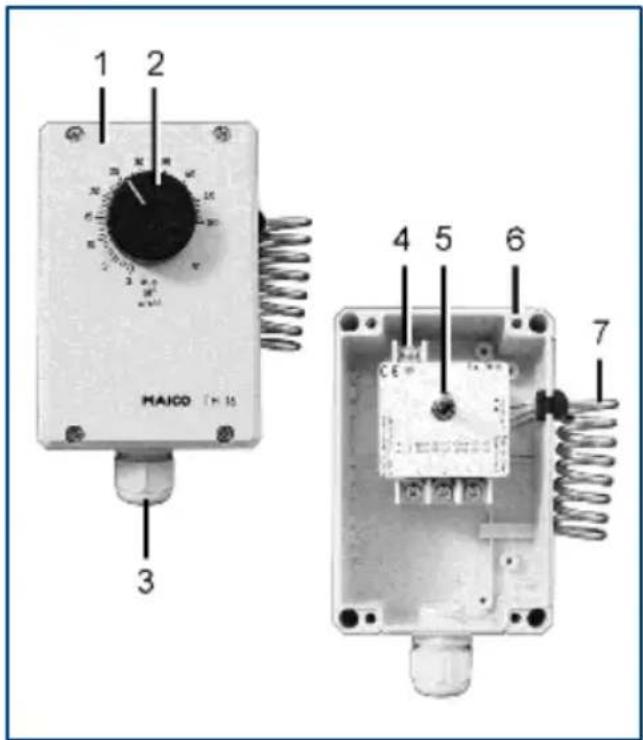
text_image
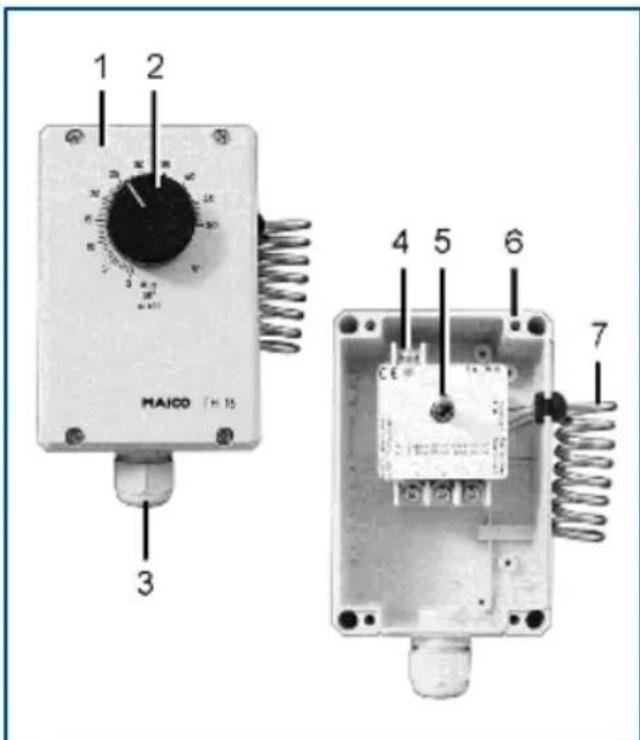
1 2 HAICO T-15 3 4 5 6 7Fig. Unit components
1 Front cover
2 Rotary knob
3 PG screw connection
4 Connection block with connection terminals
5 Rotary knob shaft
6 Housing
7 Temperature sensor
1. General notes

These instructions contain important information. Follow the instructions given. Pass these instructions onto the owner. Keep these instructions somewhere safe.
The warnings provided indicate hazardous situations which, if not avoided, will result in death or serious injury in the case of DANGER or could result in death or serious injury in the case of WARNING. NOTICE indicates potential damage to the product or its surroundings.
2. Scope of delivery
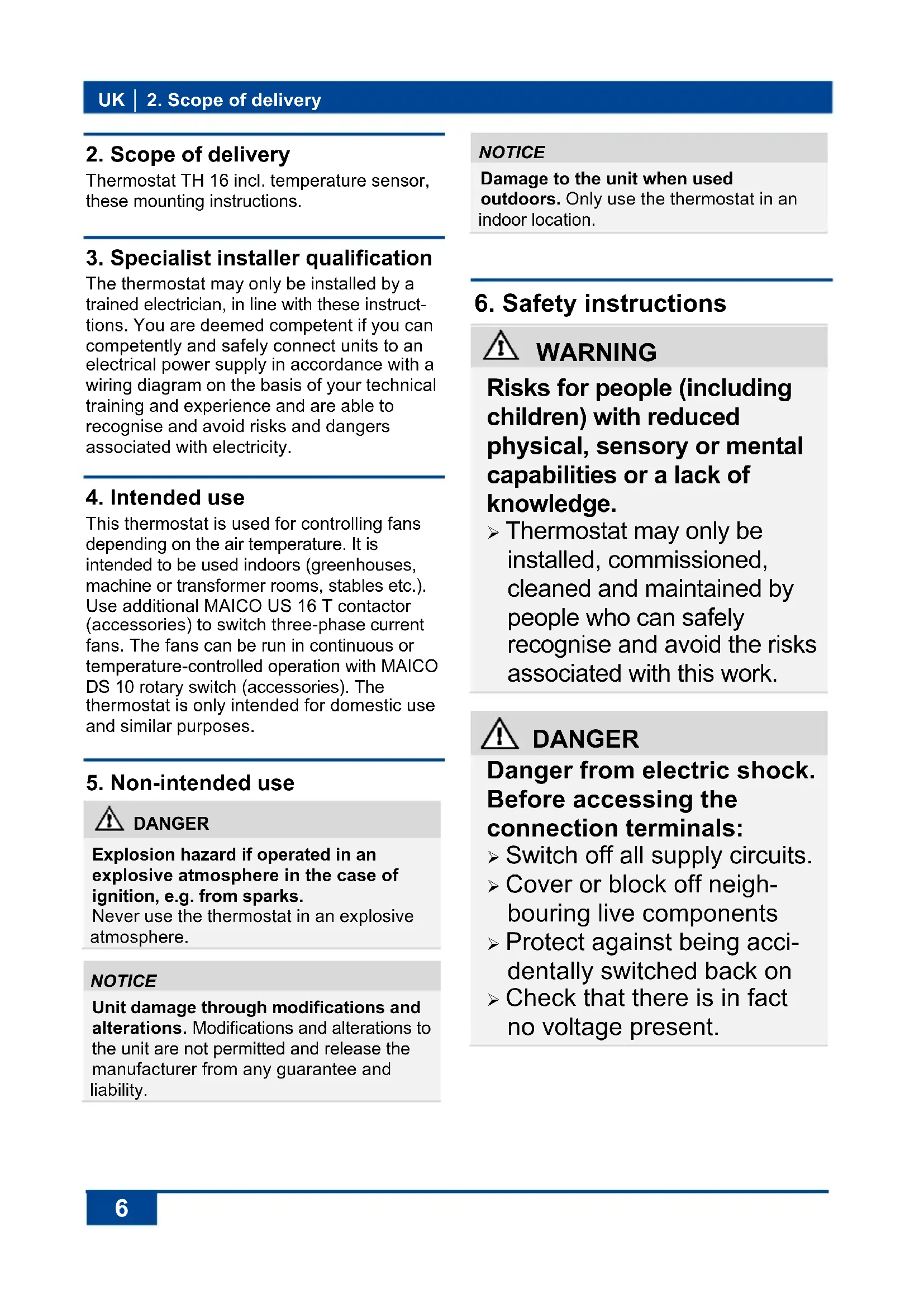
Thermostat TH 16 incl. temperature sensor, these mounting instructions.
3. Specialist installer qualification
The thermostat may only be installed by a trained electrician, in line with these instructions. You are deemed competent if you can competently and safely connect units to an electrical power supply in accordance with a wiring diagram on the basis of your technical training and experience and are able to recognise and avoid risks and dangers associated with electricity.
4. Intended use
This thermostat is used for controlling fans depending on the air temperature. It is intended to be used indoors (greenhouses, machine or transformer rooms, stables etc.). Use additional MAICO US 16 T contactor (accessories) to switch three-phase current fans. The fans can be run in continuous or temperature-controlled operation with MAICO DS 10 rotary switch (accessories). The thermostat is only intended for domestic use and similar purposes.
5. Non-intended use

DANGER
Explosion hazard if operated in an explosive atmosphere in the case of ignition, e.g. from sparks.
Never use the thermostat in an explosive atmosphere.
NOTICE
Unit damage through modifications and alterations. Modifications and alterations to the unit are not permitted and release the manufacturer from any guarantee and liability.
NOTICE
Damage to the unit when used outdoors. Only use the thermostat in an indoor location.
6. Safety instructions

WARNING
Risks for people (including children) with reduced physical, sensory or mental capabilities or a lack of knowledge.
➢ Thermostat may only be installed, commissioned, cleaned and maintained by people who can safely recognise and avoid the risks associated with this work.

DANGER
Danger from electric shock. Before accessing the connection terminals:
▶ Switch off all supply circuits.
➢ Cover or block off neighbouring live components
Protect against being accidentally switched back on
➢ Check that there is in fact no voltage present.
7. Function/Operation
When the temperature exceeds/falls below the setpoint temperature, the thermostat switches one or more fans on/off.
The setpoint temperature can be set using the rotary knob [2].
The differential gap between the switch-on and switch-off temperature is 1.5 K.
8. Technical data
→ Rating plate on the unit.
| Rated voltage | 250 V AC / 400 V 3 Ph |
| Power frequency | 50/60 Hz |
| Maximum loading (inductive load) | |
| 250 V AC, terminal 1-3 | 4 A |
| 250 V AC, terminal 1-2 | 4 A |
| 400 V AC, terminal 1-3 | 4 A |
| 400 V AC, terminal 1-2 | 2 A |
| Maximum loading (ohmic load) | |
| 250 V AC, terminal 1-3 | 16 A |
| 250 V AC, terminal 1-2 | 8 A |
| 400 V AC, terminal 1-3 | 10 A |
| 400 V AC, terminal 1-2 | 4 A |
| Differential gap | 1.5 K |
| Degree of protection | IP 54 |
| Protection class | I |
| Type of installation | Surface-mounted |
| Weight | 0.3 kg |
| Dimensions (WxHxD) | 115x150x68 mm |
9. Environmental conditions and operating limits
| Ambient temperature: | max. + 50°C |
| Temperature setting range | 0 to +50 °C |
10. Storage
Store unit exclusively in a dry location (-20 to +50 °C).
11. Mounting
11.1 Mounting instructions
NOTICE
Incorrect measured values can result from unsuitable installation location. Locate the temperature sensor [7] correctly.
- Avoid disturbing influences.
-
Avoid exposure to direct sunlight.
Do not use in an area prone to draughts, hot or cold air, e.g. near stove, fridge, radiator, refrigerator, air intake, disk valve/internal grille, etc..
Do not install in a unit with other heat-generating devices, e.g. a dimmer switch. -
Only install unit onto a dry, level surface. Any installation position can be selected.
- Only connect the unit to a permanently wired electrical installation after it has been completely mounted.
- The unit may only be operated using the voltage and frequency shown on the rating plate.
- Be sure to observe the relevant regulations for electrical installation; in Germany this is particularly VDE 0100, with the corresponding parts.
- Connection area for the PG screw connection [3] is suitable for connection cables with an external diameter of 6 to 12 mm.
- Connection terminals for cable with a max. cross section of 2.5 mm ^4 .
- A mains isolation device with contact openings of at least 3 mm at each pole is mandatory.
- The degree of protection is only guaranteed if installation is undertaken correctly and if the cables are correctly fed into the housing.
11.2 Unit mounting
- Switch off power supply circuits, position a visible sign warning against being accidentally switched back on.
- Pull the rotary knob [2] off.
- Remove the cover [1] (4 screws).
- Secure housing [6] to wall with 4 screws. Suitable mounting material is to be supplied by the customer.
NOTICE
Danger of short-circuits caused by damp if the connection cable is not inserted in the housing correctly.
➢ Ensure that the rubber seals on the PG screw connection tightly surround the cables.
- Feed the connection cables into the housing through the PG screw connections. Secure the connection cables with the PG screw connection.
- Connect up the connection cables as shown in the wiring diagram ( Chapter 16, page 12). Check the wiring and if necessary, tighten the screws in the connection terminals.
- Remount the cover [1] (4 screws) and refit the rotary knob [2]. Make sure that the rotary knob shaft [5] is not damaged and that the rubber seal fits tightly round the shaft and housing edge.
- Install the fan(s) in accordance with the operating instructions. Switch the mains fuse on.
12. Start-up
- Check that the technical data has been adhered to rating plate.
- Set the setpoint temperature using the rotary knob [2].
- Run function test.
13. Cleaning
- Clean the housing and the temperature sensor regularly using a dry cloth.
Fault rectification should only be carried out by a trained electrician.
15. Disassembly and disposal
Dismantling should only be carried out by a trained electrician.
Old devices and electronic components may only be dismantled by specialists with electrical training. Proper disposal avoids detrimental impact on people and the environment and allows valuable raw materials to be reused with the least amount of environmental impact.

Do not dispose of the following components in household waste!
Old devices, wearing parts (e.g. air filter), defective components, electrical and electronic scrap, environmentally hazardous liquids/oils, etc. Dispose of them in an environmentally friendly manner and recycle them at the appropriate collection points ( Waste Management Act).
- Separate the components according to material groups.
- Dispose of packaging materials (cardboard, filling materials, plastics) via appropriate recycling systems or recycling centres.
- Observe the respective country-specific and local regulations.
Thermostat TH 16