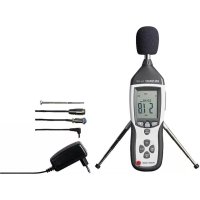
SL100 SE - Sound level meters VOLTCRAFT - Free user manual and instructions
Find the device manual for free SL100 SE VOLTCRAFT in PDF.
Download the instructions for your Sound level meters in PDF format for free! Find your manual SL100 SE - VOLTCRAFT and take your electronic device back in hand. On this page are published all the documents necessary for the use of your device. SL100 SE by VOLTCRAFT.
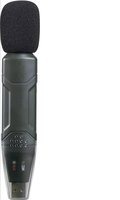
USER MANUAL SL100 SE VOLTCRAFT
Dear customer, Thank you for purchasing this product. If there are any technical questions, please contact: www.conrad.com/contact
2. Explanation of symbols
The icon with an exclamation mark in a triangle is used to highlight important information in these operating instructions. Always read this information carefully. This product is CE-tested and meets the necessary directives.
This sound level detector is a digital meter for measuring the sound level in decibels (dB). The sound level detector meets the requirements of EN 61672-1:2014-07 (IEC 61672:2013). It has the accuracy class 3 for orientation measurements (e.g. to determine whether a particular noise limit has been exceeded). The values detected and the momentary units/functions are displayed digitally on a large LCD (Liquid Crystal Display). Two frequency evaluation lters (A/C) and two time evaluations can be preselected and allow the device to be used universally. The measurement has a range of 31.5 Hz to 8 kHz as well as a sound level of 30 to 130 dB. The maximum value and the details shown on the display can both be stored. To suppress troublesome wind noise, the device is delivered with an attachable windscreen. This does not impair correct measurement of the sound level. A 9 V block battery (type 1604A) is required for operation. Measurements must not be carried out under unfavourable ambient conditions. Unfavourable ambient conditions are:
- Excessive dampness or humidity
- Dust or combustible gases, vapours or solvents
- Electrical storms or stormy conditions and strong electrostatic elds, etc. For safety and approval purposes, you must not rebuild and/or modify this product. Using the product for purposes other than those described above may damage the product. In addition, improper use can cause hazards such as a short circuit, re or electric shock. Read the instructions carefully and store them in a safe place. Only make this product available to third parties together with its operating instructions. All company and product names are trademarks of their respective owners. All rights reserved.
174. Delivery contents
- Sound level detector with windshield
- Compound 9 V battery
- Storage box (order no.: 100679)
- Operating instructions Up-to-date operating instructions Download the latest operating instructions at www.conrad.com/downloads or scan the QR code shown. Follow the instructions on the website.
5. Safety instructions
Read the operating instructions and safety information carefully. If you do not follow the safety instructions and information on proper handling in this manual, we will assume no liability for any resulting personal injury or damage to property. Such cases will invalidate the warranty/guarantee. a) General information
- The device is not a toy. Keep it out of the reach of children and pets.
- Do not leave packaging material lying around carelessly. It may become a dangerous toy for children.
- Protect the product from extreme temperatures, direct sunlight, strong jolts, high humidity, moisture, ammable gases, vapours and solvents.
- If it is no longer possible to operate the product safely, stop using it and prevent unauthorized use. Safe operation can no longer be guaranteed if the product: - is visibly damaged, - is no longer working properly, - has been stored for extended periods in poor ambient conditions or - has been subjected to any serious transport-related stresses.
- Always handle the product carefully. Jolts, impacts or a fall even from a low height may damage the product. 18• In commercial institutions, the accident prevention regulations of the relevant professional insurance association for electrical systems and operating materials are to be observed.
- In schools, training centres, computer and self-help workshops, handling of measuring instruments must be supervised by trained personnel in a responsible manner.
- Do not switch the measuring instrument on immediately after it has been taken from a cold to a warm environment. The condensation water generated could destroy the device. Allow the device to reach room temperature before switching it on.
- Wear suitable ear protection in loud environments. Excessive sound levels may damage your ears.
- Consult an expert when in doubt about the operation, safety or connection of the appliance.
- Maintenance, modications and repairs are to be performed exclusively by an expert or at a qualied shop.
- If you have questions which remain unanswered by these operating instructions, contact our technical support service or other technical personnel. b) Batteries
- Correct polarity must be observed while inserting the (rechargeable) battery.
- A (rechargeable) battery should be removed from the device if it is not used for a long period of time to avoid damage through leaking. Leaking or damaged (rechargeable) batteries might cause acid burns when in contact with skin, therefore use suitable protective gloves to handle corrupted (rechargeable) batteries.
- (Rechargeable) batteries must be kept out of reach of children. Do not leave (rechargeable) batteries lying around, as there is risk that children or pets could swallow them.
- (Rechargeable) batteries must not be dismantled, short-circuited or thrown into re. Never recharge non-rechargeable batteries. There is a risk of explosion!
MAX The highest value is held continuously HOLD The momentary reading is held FAST Fast time evaluation (125 ms/measurement) SLOW Slow time evaluation (1 s/measurement) Hi The upper measurement range is selected Lo The lower measurement range is selected BAT Battery replacement display dBA Evaluation lter for A-curve (= hearing) dBC Evaluation lter for C-curve (= linear) OVER Measured value exceeds the measurement range
208. Initial operation
Inserting the batteries Before the initial operation of this meter, you must rst install a new 9 V block battery. Battery installation is described in the “Maintenance and Cleaning” section.
The sound level detector has various extra functions that ease operation and handling and which extend its range of application. These extra functions are: Auto power OFF function In order to avoid that the operating life of the battery is shortened unnecessarily, an automatic switch-off function has been implemented. The device will be automatically switched off if no button is pressed within a period of about 8 minutes. You can switch the device back on with the “ON/OFF” button. HOLD function The measured value currently being displayed is held in the display. The active function is shown in the display by “HOLD”. Press the “HOLD” button to activate this function. Press again to switch back to the continuous measuring mode MAX function Only the maximum value is shown in the display during continuous measurements. This measurement function makes it easier for you to determine the peak level. The active function is shown in the display by “MAX”. Press the “MAX” button to activate this function. Press again to switch back to the continuous measuring mode. 21Frequency evaluation of A/C-curve The frequency evaluation for the measured signal is done using two evaluation curves. Curve A represents the characteristic hearing curve of the human ear. Lower sounds seem quieter than middle or high frequency sounds to the human ear. Curve C evaluates this frequency range linearly and without a lter (actual sound level). Press the “A/C” button to switch over to this lter. The active lter is shown in the display by “dBA” or “dBC”. Switching-over the measurement range between Hi/Lo The sound level detector has two overlapping measurement ranges. The lower, Lo-range is from 30 to 100 dB and the higher, Hi-range is from 60 to 130 dB. “OVER” is shown in the display if the level falls below or exceeds one of these ranges. In this case, switch-over to the lower/higher range. Press the “Hi/Lo” button to switch between ranges. FAST/SLOW time evaluation The signal can be measured using two different measurement intervals. The time evaluation must be set to “FAST” for sound levels that change rapidly (horns, shots, etc.). The time evaluation must be set to “SLOW” for constant sound levels and sound levels that change slowly (white noise, hums, etc.). Press the “F/S” button to switch between ranges.
10. Making measurements
Make sure you have suitable ear protection for loud sound sources. There is risk of an damage to the ears! Observe the permissible ambient temperatures (see “Technical data”) to avoid faulty measurements. 22Calibration This sound level detector complies with the European Standard EN 61672-1:2014-07 (IEC 61672:2013) for sound level meters. To be able to use it in compliance to the standards, the meter must be calibrated before every measurement using evaluation curve A (dBA) i.e. it must be checked using an optional sound calibrator and adjusted as required. Accuracy must be re-checked after each measurement. To calibrate, proceed as follows:
- Switch the sound level detector on.
- Select the appropriate settings (dBA, Hi or Lo measurement range and FAST time evaluation).
- If required, deactivate the “MAX” and “HOLD” functions.
- Plug the microphone of the sound level detector into the opening of the sound calibrator. Make sure that it sits tightly to ensure that the calibration chamber in the sound calibrator is sealed.
- Set the following parameters at the sound calibrator: 94 dB at 1 kHz.
- The meter should now display a sound level of 94 dBA. If this is not the case then the meter must be adjusted.
- Open the battery compartment at the rear of the device and remove the battery. Do not disconnect the battery!
- You can now see two alignment points in the battery compartment.
- Using a suitable screwdriver, carefully turn the adjustor for your measurement range until the display is set to exactly 94.0 dBA. A(Lo) = Calibration controller for the Lo measurement range A(Hi) = Calibration controller for the Hi measurement range
- Carefully re-close the battery compartment. Making measurements Sound sources must always be measured directly. Make sure that there are no objects or persons located between the microphone and the sound source. Point the sound level detector and the microphone directly at the sound source. To ensure that you do not inuence the sound waves yourself, stretch the meter out with your arm as far away from your body as possible or mount the meter onto a stand. There is a xture for a stand on the rear of the housing. Avoid vibration and movement. 23If there is a wind (>10 m/s) then use the windshield to ensure that the measurement is not invalidated by wind noise. The windshield does not interfere with measurements. When not in use, switch the meter off.
11. Maintenance and cleaning
The power units are maintenance-free apart from the need to replace the batteries and cleaning it once in a while. Use a clean, lint-free, antistatic and slightly damp cloth to clean the device. Do not use any abrasive or chemical agents or detergents containing solvents. Replacing the battery If the battery symbol “BAT” appears in the display, the batteries have to be replaced as soon as possible to prevent inaccurate measurements. Proceed as follows to replace the batteries:
- Switch off the meter.
- Loosen the battery compartment screw on the back of the device, and slide the lid off in the direction of the arrow.
- Replace the at battery with a new one of the same type (e.g. 1604A).
- Carefully close the meter in reverse order to its opening.
In purchasing this device you have acquired a product which has been designed with state- of-the-art technology and is operationally reliable. Problems and malfunctions may, however, still arise. For this reason, the following is a description of how you can eliminate possible malfunctions yourself. Always adhere to the safety instructions! 24Fault Possible cause The measuring unit does not work. Is the battery dead? Check the charge condition of the battery. None Change in measured value. Is the HOLD function active? Repairs other than those just described should only be performed by an authorised electrician.
a) Product This symbol must appear on any electrical and electronic equipment placed on the EU market. This symbol indicates that this device should not be disposed of as unsorted municipal waste at the end of its service life. Owners of WEEE (Waste from Electrical and Electronic Equipment) shall dispose of it separately from unsorted municipal waste. Spent batteries and accumulators, which are not enclosed by the WEEE, as well as lamps that can be removed from the WEEE in a non-destructive manner, must be removed by end users from the WEEE in a non-destructive manner before it is handed over to a collection point. Distributors of electrical and electronic equipment are legally obliged to provide free take-back of waste. Conrad provides the following return options free of charge (more details on our website):
- at the Conrad collection points
- at the collection points of public waste management authorities or the collection points set up by manufacturers or distributors within the meaning of the ElektroG End users are responsible for deleting personal data from the WEEE to be disposed of. It should be noted that different obligations about the return or recycling of WEEE may apply in countries outside of Germany. b) (Rechargeable) batteries Remove batteries/rechargeable batteries, if any, and dispose of them separately from the prod- uct. According to the Battery Directive, end users are legally obliged to return all spent batteries/ rechargeable batteries; they must not be disposed of in the normal household waste. 25Batteries/rechargeable batteries containing hazardous substances are labelled with this symbol to indicate that disposal in household waste is forbidden. The abbrevia- tions for heavy metals in batteries are: Cd = Cadmium, Hg = Mercury, Pb = Lead (name on (rechargeable) batteries, e.g. below the trash icon on the left). Used (rechargeable) batteries can be returned to collection points in your municipality, our stores or wherever (rechargeable) batteries are sold. You thus full your statutory obligations and contribute to environmental protection. Batteries/rechargeable batteries that are disposed of should be protected against short circuit and their exposed terminals should be covered completely with insulating tape before disposal. Even empty batteries/rechargeable batteries can contain residual energy that may cause them to swell, burst, catch re or explode in the event of a short circuit.
Characteristic Accuracy
ManualGo.com