DXH125FAV - Heating DEWALT - Free user manual and instructions
Find the device manual for free DXH125FAV DEWALT in PDF.



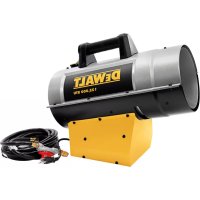
| Product type | Propane gas forced air heater for construction site |
| Brand | DeWalt |
| Model | DXH125FAV |
| Heat output | 75,000 – 125,000 Btu/h (21.9 – 36.6 kW) |
| Gas type | Liquefied propane (LP) only |
| Gas consumption | 1.59 – 2.63 kg/h |
| Power supply | 115 V, 60 Hz, 3 A |
| Ignition | Direct spark |
| Flame control | Thermocouple gas valve |
| Minimum ambient temperature | -17.8 °C (0 °F) |
| Regulator inlet gas pressure (min.) | 137.89 kPa (20 psi) |
| Regulator outlet gas pressure | 137.89 kPa (20 psi) |
| Orifice size | 1.26 mm |
| Minimum clearance – outlet | 2.4 m |
| Minimum clearance – sides | 0.9 m |
| Minimum clearance – top | 1.8 m |
| Minimum clearance – floor | 0 m |
| Ventilation required | Openings of 0.19 m² near ceiling and floor |
| Maintenance | Inspect before each use and annually by a professional |
| Warranty | 1 year |
Frequently Asked Questions - DXH125FAV DEWALT
User questions about DXH125FAV DEWALT
0 question about this device. Answer the ones you know or ask your own.
Ask a new question about this device
Download the instructions for your Heating in PDF format for free! Find your manual DXH125FAV - DEWALT and take your electronic device back in hand. On this page are published all the documents necessary for the use of your device. DXH125FAV by DEWALT.
USER MANUAL DXH125FAV DEWALT
If you have questions or comments, contact us.
Pour toute question ou tout commentaire, nous contacter. Si tiene dudas o comentarious, contéctenos.
a
855-805-5745 • www.dewalt.com
INSTRUCTION MANUAL
GUIDE DE'UTILISATION
Forced Air Propane Construction Heater DXH125FAV, DXH150FAV
Forced Air Propane Chauffe-Construction DXH125FAV, DXH150FAV
READ INSTRUCTIONS CAREFULLY: Read and follow all instructions. Place instructions in a safe place for future reference. Do not allow anyone who has not read these instructions to assemble, adjust or operate the heater.
VEUILLEZ LIRE ATTENTIVEMENT LES INSTRUCTIONS :
Definitions: Safety Guidelines
The definitions below describe the level of severity for each signal word. Please read the manual and pay attention to these symbols.
▲ DANGER: Indicates an imminently hazardous situation which, if not avoided, will result in death or serious injury.
▲ WARNING: Indicates a potentially hazardous situation which, if not avoided, could result in death or serious injury.
▲ CAUTION: Indicates a potentially hazardous situation which, if not avoided, may result in minor or moderate injury.
NOTICE: Indicates a practice not related to personal injury which, if not avoided, may result in property damage.
▲ WARNING: DO NOT OPERATE THIS HEATER UNTIL YOU READ AND UNDERSTAND THIS INSTRUCTION MANUAL FOR SAFETY, OPERATION, AND MAINTENANCE INSTUCTIONS.
▲ WARNING:
Failure to comply with the precautions and instructions provided with this heater, can result in death, serious bodily injury and property loss or damage from hazards of fire, explosion, burn, asphyxiation, carbon monoxide poisoning, and/or electrical shock.
Only persons who can understand and follow the instructions should use or service this heater.
DANGER:
CARBON MONOXIDE CAN KILL YOU
This heater produces carbon monoxide. Do not use in occupied spaces. Ventilate building, room or other enclosed spaces where heater has been used before entering. Never use in a vehicle, camper or tent.
WARNING:
Not for home or recreational vehicle use. Do not use to cook or warm food.
WARNING:
Fire, burn, inhalation, and explosion hazard. Keep solid combustibles, such as building materials, paper or cardboard, a safe distance away from the heater as recommended by the instructions. Never use the heater in spaces which do or may contain volatile or airborne combustibles, or products such as gasoline, solvents, paint thinner, dust particles or unknown chemicals.
▲ WARNING: IF THE INFORMATION IN THIS MANUAL IS NOT FOLLOWED EXACTLY, A FIRE OR EXPLOSION MAY RESULT CAUSING PROPERTY DAMAGE, PERSONAL INJURY OR LOSS OF LIFE.
- Do not use gasoline or other flammable vapors or liquids in the vicinity of this or any other appliance.
- An LP cylinder not connected for use shall not be stored in the vicinity of this or any other appliance.
• WHAT TO DO IF YOU SMELL GAS:
- Do not try to light appliance.
- Extinguish any open flame.
- Shut off gas to appliance.
• Service must be performed by a qualified service agency.
WARNING: THIS PRODUCT CAN EXPOSE YOU TO CHEMICALS INCLUDING LEAD AND LEAD COMPOUNDS, WHICH ARE KNOWN TO THE STATE OF CALIFORNIA TO CAUSE CANCER AND BIRTH DEFECTS OR OTHER REPRODUCTIVE HARM. FOR MORE INFORMATION VISIT WWW.P65WARNINGS.CA.GOV
WARNING: Fuels used in liquefied propane gas appliances, and the products of combustion of such fuel, can expose you to chemicals including benzene, which is known to the state of California to cause cancer and cause birth defects or other reproductive harm, for more information go to www.P65Warnings.ca.gov
▲WARNING: RISK OF ELECTRICAL SHOCK
- Plug power cord into a properly grounded 3-wire receptacle.
- Do not operate in wet or damp conditions.
NEVER LEA
VE THE HEATER UNATTENDED WHILE

▲ WARNING: RISK OF FIRE OR EXPLOSION
- Do not store or use gasoline or other flammable vapors and liquids in the vicinity of this or any other appliance.
• WHAT TO DO IF YOU SMELL GAS: - Open windows.
• DO NOT try to light any appliance. - DO NOT operate any electrical switches.
- DO NOT use any telephone in building. Immediately call the local gas supplier from an outside telephone. Follow the gas supplier's instructions.
- DO NOT touch any electrical switch; do not use any phone in your building.
- If you cannot reach your gas supplier, call the Fire Department.
CONTENTS
WARNINGS....2-3
HEATER SPECIFICATIONS....3
OPERATING PRECAUTIONS....4
SAFETY PRECAUTIONS......4
ODOR FADE WARNING 5-6
OPERATING INSTRUCTIONS....6
MAINTENANCE, STORAGE AND SERVICE ....7
WIRING DIAGRAMS 8
PARTS LISTS/EXPLODED VIEWS.... 9-12
WARRANTY 13
INSTRUCTIONS FOR ORDERING PARTS 13
SPECIFICATIONS
Type of Gas: ......For use with Propane Only
Gas Supply Pressure
to regulator......Max.: Bottle Pressure
to regulator......Min.: 20 psi (137.89 kPa)
regulator out .....20 psi (137.89 kPa)
Electrical Input: 115V, 60 Hz, 1∅, 3a
Min. Operating Voltage: 100V
Ignition: ....Direct Spark
Primary
Flame Control: ....Thermocouple Operated Gas Valve
Min. Ambient Temp. Rating 0°F (-17.8°C)
Specifications
| Model: DXH125FAV DXH | 150FAV | |
| Rating: 75,000 - 125,000 Btu | J/Hr 110,000 - 150,000 Btu | J/Hr |
| (21.9 – 36.6 kW) (32.2 – 43.9 kW) | ||
| Fuel Consumption: 3.5 – 5.8 | #/hr 5.1 – 6.9 #/hr | |
| (1.59 – 2.63 kg/hr) (2.31 – 3.13 kg/hr) | ||
| Fuel Orifice Size 1.26 mm | 1.40 mm | |
NEVER LEA VE THE HEATER UNATTENDED WHILE
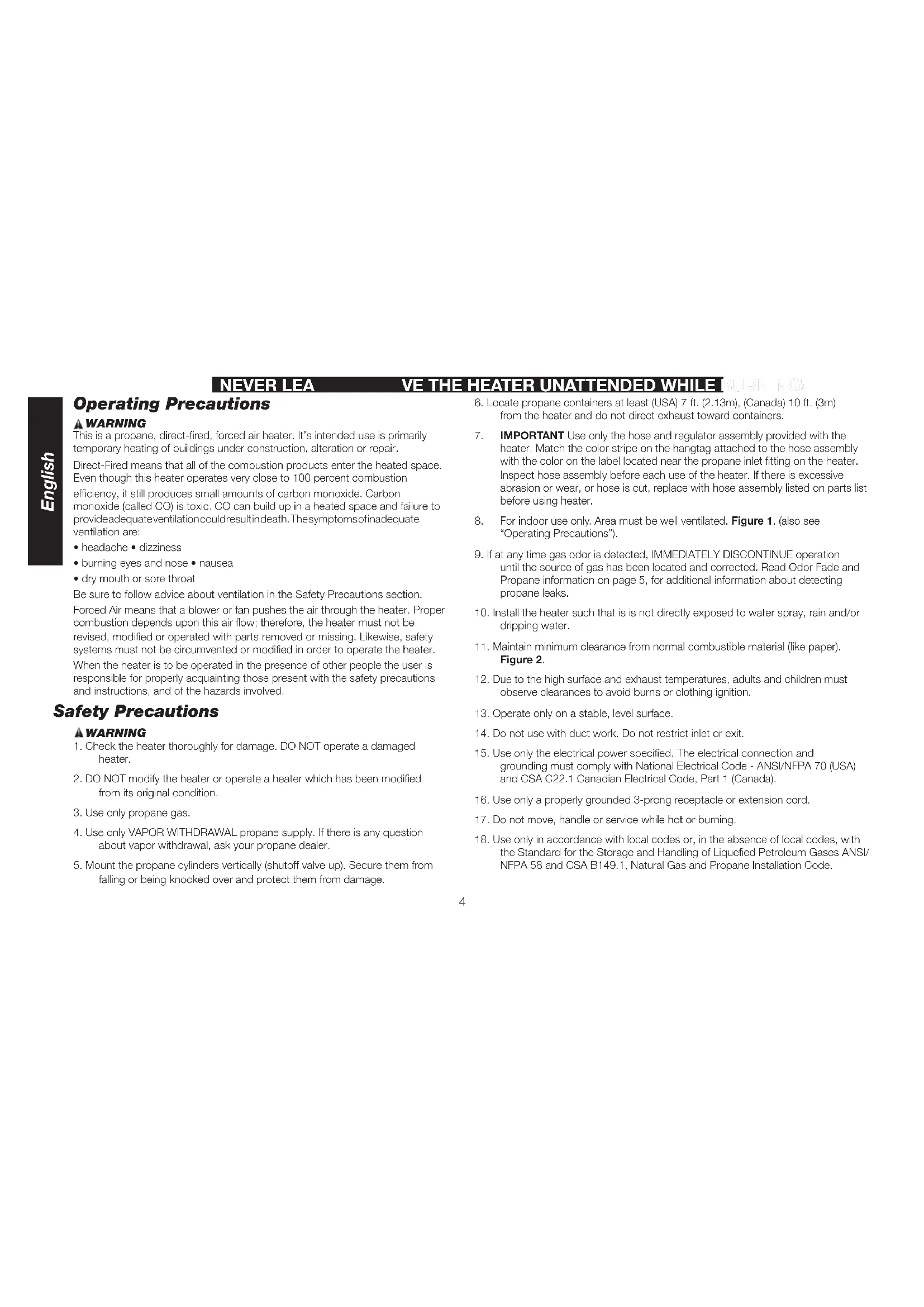
Operating Precautions
▲ WARNING
This is a propane, direct-fired, forced air heater. It's intended use is primarily temporary heating of buildings under construction, alteration or repair.
Direct-Fired means that all of the combustion products enter the heated space. Even though this heater operates very close to 100 percent combustion efficiency, it still produces small amounts of carbon monoxide. Carbon monoxide (called CO) is toxic. CO can build up in a heated space and failure to provide adequate ventilation could result in death. The symptom sofinadequate ventilation are:
- headache • dizziness
- burning eyes and nose • nausea
• dry mouth or sore throat
Be sure to follow advice about ventilation in the Safety Precautions section.
Forced Air means that a blower or fan pushes the air through the heater. Proper combustion depends upon this air flow; therefore, the heater must not be revised, modified or operated with parts removed or missing. Likewise, safety systems must not be circumvented or modified in order to operate the heater.
When the heater is to be operated in the presence of other people the user is responsible for properly acquainting those present with the safety precautions and instructions, and of the hazards involved.
Safety Precautions
WARNING
- Check the heater thoroughly for damage. DO NOT operate a damaged heater.
- DO NOT modify the heater or operate a heater which has been modified from its original condition.
- Use only propane gas.
- Use only VAPOR WITHDRAWAL propane supply. If there is any question about vapor withdrawal, ask your propane dealer.
-
Mount the propane cylinders vertically (shutoff valve up). Secure them from falling or being knocked over and protect them from damage.
-
Locate propane containers at least (USA) 7 ft. (2.13m), (Canada) 10 ft. (3m) from the heater and do not direct exhaust toward containers.
- IMPORTANT Use only the hose and regulator assembly provided with the heater. Match the color stripe on the hangtag attached to the hose assembly with the color on the label located near the propane inlet fitting on the heater. Inspect hose assembly before each use of the heater. If there is excessive abrasion or wear, or hose is cut, replace with hose assembly listed on parts list before using heater.
- For indoor use only. Area must be well ventilated. Figure 1. (also see "Operating Precautions").
- If at any time gas odor is detected, IMMEDIATELY DISCONTINUE operation until the source of gas has been located and corrected. Read Odor Fade and Propane information on page 5, for additional information about detecting propane leaks.
- Install the heater such that is not directly exposed to water spray, rain and/or dripping water.
- Maintain minimum clearance from normal combustible material (like paper). Figure 2.
- Due to the high surface and exhaust temperatures, adults and children must observe clearances to avoid burns or clothing ignition.
- Operate only on a stable, level surface.
- Do not use with duct work. Do not restrict inlet or exit.
- Use only the electrical power specified. The electrical connection and grounding must comply with National Electrical Code - ANSI/NFPA 70 (USA) and CSA C22.1 Canadian Electrical Code, Part 1 (Canada).
- Use only a properly grounded 3-prong receptacle or extension cord.
- Do not move, handle or service while hot or burning.
- Use only in accordance with local codes or, in the absence of local codes, with the Standard for the Storage and Handling of Liquefied Petroleum Gases ANSI/NFPA 58 and CSA B149.1, Natural Gas and Propane Installation Code.
NEVER LEA VE THE HEATER UNATTENDED WHILE
Figure 1
VENTILATION: Minimum openings required
Opening
Opening
Heater near floor near ceiling
Forced air (DXH125FAV, DXH150FAV)....2 ft ^2 ....2 ft ^2
Figure 2
MINIMUM CLEARANCE: From normal combustible material
Clearance DXH125FAV DXH150FAV
From floor....0 ft....0 ft.
From outlet....8 ft....8 ft.
From sides ....3 ft....3 ft.
From top 6 ft. 6 ft.
Locate 10 ft. from canvas or plastic tarpaulins or similar coverings and secure them to prevent flapping or movement due to wind action.
▲ WARNING: RISK OF ASPHYXIATION
- Do not use in unventilated areas.
- The flow of combustion and ventilation air must not be obstructed.
- Proper ventilation air must be provided to support the combustion air requirements of the heater being used.
- Refer to the specification section of the heater's manual, heater dataplate, or contact the factory to determine combustion air ventilation requirements of the heater.
- Lack of proper ventilation air will lead to improper combustion.
- Improper combustion can lead to carbon monoxide poisoning leading to serious injury or death. Symptom of carbon monoxide poisoning can include headaches, dizziness and difficulty in breathing.
Fuel Gas Odor—Fuel Leaks
▲ WARNING
LP gas and natural gas have man-made odorants added specifically for detection of fuel gas leaks. If a gas leak occurs you should be able to smell the fuel gas. Since Propane (LP) is heavier than air you should smell for the gas odor low to the floor. ANY GAS ODOR IS YOUR SIGNAL TO TAKE IMMEDIATE ACTION!
Odor Fade Warning
- Do not take any action that could ignite the fuel gas. Do not operate any electrical switches. Do not plug in or disconnect any power supply or extension cords. Do not light matches or any other source of flame. Do not use your telephone.
- Get everyone out of the building and away from the area immediately.
- Close all propane (LP) gas tank or cylinder fuel supply valves, or the main fuel supply valve located at the meter if you use natural gas.
- Propane (LP) gas is heavier than air and may settle in low areas. When you have reason to suspect a propane leak, keep out of all low areas.
- Use your neighbor's phone and call your fuel gas supplier and your fire department. Do not re-enter the building or area.
- Stay out of the building and away from the area until declared safe by the firefighters and your fuel gas supplier.
- FINALLY, let the fuel gas service person and the firefighters check for escaped gas. Have them air out the building and area before you return. Properly trained service people must repair any leaks, check for further leakages, and then relight the appliance for you.
Odor Fading—No Odor Detected
- Some people cannot smell the odor of the man-made chemical added to propane (LP) or natural gas. You must determine if you can smell the odorant in these fuel gases.
- Learn to recognize the odor of propane (LP) gas and natural gas. Local propane (LP) gas dealers will be more than happy to give you a scratch and sniff pamphlet. Use it to become familiar with the fuel gas odor.
- Smoking can decrease your ability to smell. Being around an odor for a period of time can affect your sensitivity to that particular odor. Odors present in animal confinement buildings can mask fuel gas odor.
NEVER LEA VE THE HEATER UNATTENDED WHILE

- The odorant in propane (LP) gas and natural gas is colorless and the intensity of its odor can fade under some circumstances.
- If there is an underground leak, the movement of gas through the soil can filter out the odorant.
• Propane (LP) gas odor may differ in intensity at different levels. Since Propane (LP) gas is heavier than air, there may be more odor at lower levels. - Always be sensitive to the slightest gas odor. If you continue to detect any gas odor, no matter how small, treat it as a serious leak. Immediately go into action as discussed previously.
- A periodic sniff test around the heater or at the heater's joints; i.e. hose, connections, etc., is a good safety practice under any conditions. If you smell even a small amount of gas, CONTACT YOUR FUEL GAS SUPPLIER IMMEDIATELY.
Operating Instructions
PREPARING FOR OPERATION
- Check the heater for possible shipping damage. If any is found, immediately notify the factory.
- Follow all of the "Precautions".
- Connect the POL fitting of hose and regulator assembly to the propane cylinder by rotating the POL nut counterclockwise into the propane cylinder's valve outlet and securely tighten with a wrench.
- Connect the hose to the heater by rotating the hose fitting clockwise.
- Securely tighten all gas connections.
- Open the cylinder's gas valve and check all gas connections with a soap and water solution. DO NOT USE A FLAME.
- Connect power cord to well-grounded 115V, 60 Hz, 10 source of power.
- When using an extension cord, make certain that it is a 3-wire (grounded) cord of proper wire size.
START
- Before heater ignition, always allow heater fan (blower) to run for 20 seconds to purge fuel.
- Slowly open the main valve at propane cylinder.
- Depress the fuel valve button to light the heater.
- After the heater lights, keep the gas valve button depressed for 15 seconds then release and the heater will continue to operate.
- Adjust burn rate by setting control knob to desired level.
- Igniter continues to fire as long as power cord is plugged in.
- No thermostat can be used with these units.
STOP
- Securely close valve on the propane cylinder.
- Continue to operate heater until all fuel in the hose has burned.
- Unplug the power cord.
RESTART AFTER SAFETY SHUTDOWN
- Securely close valve at propane cylinder. Unplug heater.
- Wait 5 minutes.
- Restart following "Start" procedure.
NEVER LEA VE THE HEATER UNATTENDED WHILE

MAINTENANCE AND STORAGE
- The heater should be inspected before each use, and at least annually by a qualified person.
- Before each use, check the soft "O" ring seal at the bullnose of the POL fitting. If the "O" ring is cut, scuffed, or otherwise damaged, replace it with part number 73786.
- Turn off the gas at the LP-gas supply cylinder(s) when the heater is not in use.
- When the heater is to be stored indoors, the connection between the LP-gas supply cylinder(s) and the heater must be disconnected and the cylinder(s) removed from the heater and stored out of doors and in accordance with Chapter 5 of the standard for Storage and Handling of Liquefied Petroleum Gases ANSI/NFPA 58 and CSA B149.1, Natural Gas and Propane Installation Code.
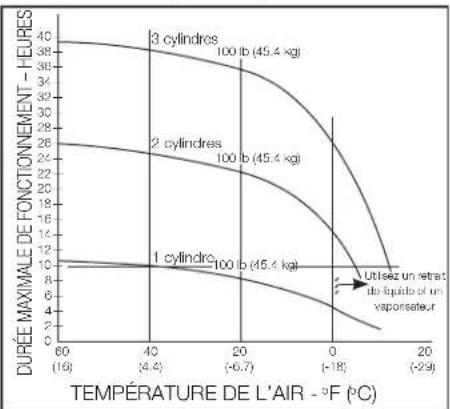
Size and Capacity of Propane Cylinders Required
The charts on the following page show the approximate size of the cylinder required for these heaters. To use the chart:
- Select the lowest air temperature expected (at the bottom of the chart).
- Move straight up to time of operation desired (left side of chart).
- Read the cylinder size required.
All heaters should have:
full cylinders
good air circulation
no frost on cylinders
Servicing
A hazardous condition may result if a heater is used that has been modified or is not functioning properly. When the heater is working properly:
- The flame is contained within the heater.
- The flame is essentially blue with perhaps some yellow tipping.
-
There is no strong disagreeable odor, eye burning or other physical discomfort.
-
There is no smoke or soot internal or external to the heater.
- There are no unplanned or unexplained shut downs of the heater.
The parts lists and wiring diagram show the heater as it was constructed. Do not use a heater which is different from that shown. In this regard, use only the hose, regulator and cylinder connection fitting (called a POL fitting) supplied with the heater. IMPORTANT Match the color stripe on the hangtag attached to the hose assembly with the color on the label located near the propane inlet fitting on the heater. Do not use alternates. For this heater, the regulator must be set as shown in "specifications". If there is any uncertainty about the regulator setting, have it checked.
A heater which is not working right must be repaired, but only by a trained, experienced service person.
In-warranty products will be repaired with no charge for either parts or labor. Please include a brief statement indicating date, place of purchase, the nature of the problem and proof of purchase.
Out-of-warranty products will be repaired with a charge for parts and labor.
NEVER LEA
VE THE HEATER UNATTENDED WHILE
125,000 BTU/HR (36.6 kW)
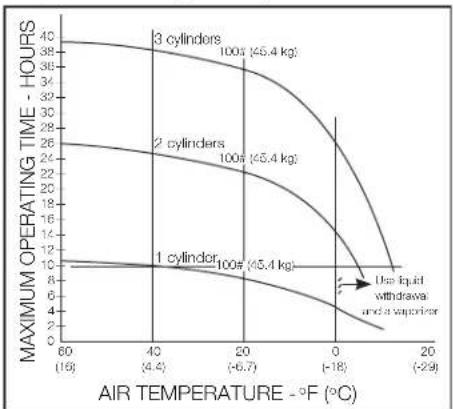
line
| AIR TEMPERATURE - °F (°C) | MAXIMUM OPERATING TIME - HOURS (1 cylinder) | MAXIMUM OPERATING TIME - HOURS (2 cylinders) | MAXIMUM OPERATING TIME - HOURS (3 cylinders) | | ------------------------ | ------------------------------------------ | ------------------------------------------- | ------------------------------------------- | | 60 | 10 | 26 | 38 | | 40 | 10 | 24 | 36 | | 20 | 10 | 22 | 34 | | 0 | 10 | 20 | 32 | | -18 | 10 | 18 | 30 | | -29 | 10 | 16 | 28 |150,000 BTU/HR (43.9 kW)
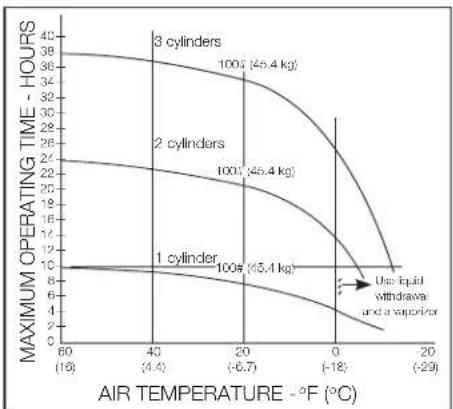
line
| AIR TEMPERATURE - °F (°C) | MAXIMUM OPERATING TIME - HOURS (1 cylinder) | MAXIMUM OPERATING TIME - HOURS (2 cylinders) | MAXIMUM OPERATING TIME - HOURS (3 cylinders) | | ------------------------ | ------------------------------------------ | ------------------------------------------- | ------------------------------------------- | | 60 | 10 | 24 | 38 | | 40 | 10 | 22 | 36 | | 20 | 10 | 20 | 34 | | 0 | 10 | 18 | 32 | | -20 | 10 | 16 | 30 | | -29 | 10 | 14 | 28 |Wiring Diagrams DXH125FAV/DXH150FAV
NOTE: If any original wiring as supplied with the heater, must be replaced, it must be replaced with Type AWG 105°C wire or its equivalent, except as indicated (Type SF 2.200, **SGI-250°C)
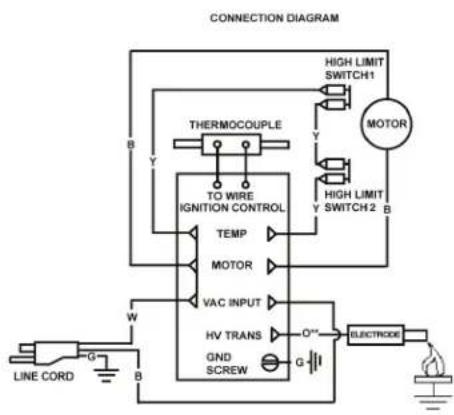
flowchart
graph TD
    A["LINE CORD"] --> B["G"]
    B --> C["B"]
    C --> D["TO WIRE IGNITION CONTROL"]
    D --> E["TEMP"]
    E --> F["MOTOR"]
    F --> G["VAC INPUT"]
    G --> H["HV TRANS"]
    H --> I["GND SCREW"]
    I --> J["O**"]
    J --> K["Electrode"]
    K --> L["MOTOR"]
    L --> M["SWITCH1"]
    M --> N["THERMOCOUPLE"]
    N --> O["Y"]
    O --> P["B"]
    P --> Q["Y"]
    Q --> R["B"]
    R --> S["High Limit SWITCH 2"]
    S --> T["MOTOR"]
    T --> U["Y"]
    U --> V["B"]
| COLOR CODE | LEGEND | |||
| B | BLACK | R | RED | FEMALE CONN. |
| Y | YEL | RING CONN. | ||
| W | WHITE | O | ORG | |
| G | GREEN | |||
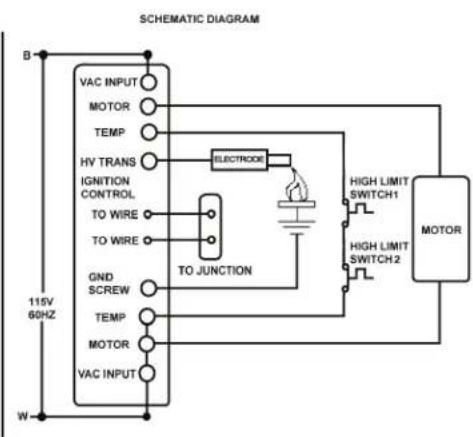
flowchart
graph TD
    A["VAC INPUT"] --> B["MOTOR"]
    B --> C["TEMP"]
    C --> D["HV TRANS"]
    D --> E["IGNITION CONTROL"]
    E --> F["TO WIRE"]
    F --> G["TO WIRE"]
    G --> H["GND SCREW"]
    H --> I["TEMP"]
    I --> J["MOTOR"]
    J --> K["VAC INPUT"]
    K --> L["TO JUNCTION"]
    L --> M["High Limit SWITCH1"]
    L --> N["High Limit SWITCH2"]
    M --> O["MOTOR"]
    N --> O
    O --> P["HIGH LIMIT SWITCH1"]
    O --> Q["HIGH LIMIT SWITCH2"]
NEVER LEA VE THE HEATER UNATTENDED WHILE
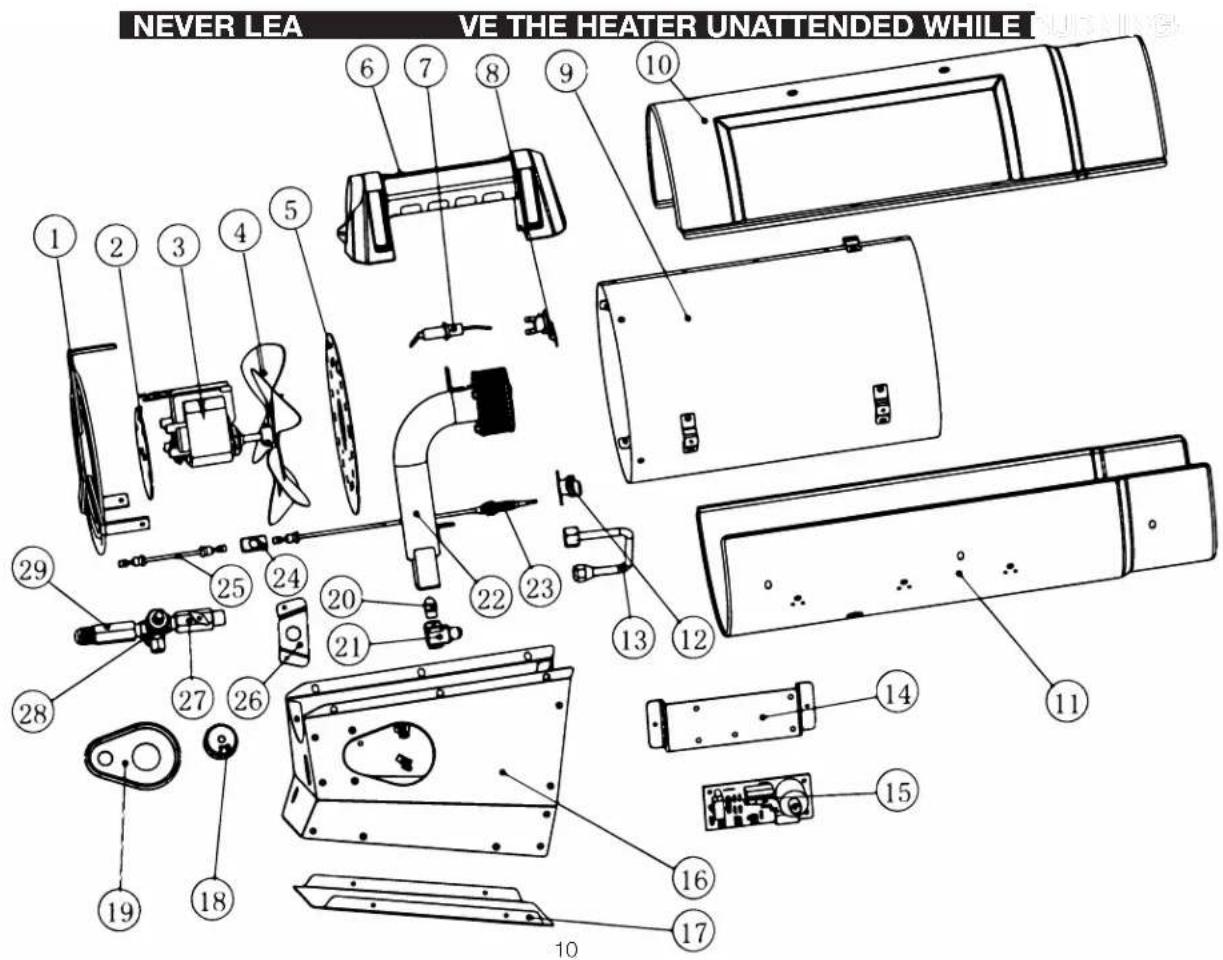
Parts List DXH125FAV
| REF. #......ITEM#......DESCRIPTION | REF. #......ITEM#......DESCRIPTION | |
| 1 | 40896......Guard, rear, assy | 17......N/A ......base, metal, bottom, panel |
| 2 | 40957......Panel, guard, rear | 18......40879 ......Knob, variable, valve |
| 3 | 21652......Motor, assy | 19......N/A ......Insert, plastic, controls |
| 4 | 26086......fan,blade | 20......40899 ......Orifice |
| 5 | 40909......Holder, flame | 21......40900 ......Holder, orifice, assy |
| 6 | 40801......Handle, DEWALT | 22......40898 ......Burner, mesh, assy |
| 7 | 40904......Electrode, ignition, DW, mesh | 23......26655 ......Thermocouple |
| 8 | 40913......High limit control, assy | 24......26134 ......Comperssion block, relay |
| 9 | 40892......Shield, radiation, assy | 25......26656 ......Thermocouple, connector |
| 10 | 40890......Barrel, upper, assy | 26......N/A ......Brkt, plastic, insert |
| 11 | 40891......Barrel, lower, assy | 27......40902 ......Valve, variable, assy |
| 12 | 40914......High limit control, assy | 28......40884 ......Valve, gas, main |
| 13 | 40901......Tubing, gas, burner, assy | 29......40905 ......Fitting, gas, inlet |
| 14 | 23045......bracket ignition/relay | * ......40923 ......Hose and reg. |
| 15 | 23276......board, spark ignition | * ......21036 ......power cord |
| 16 | N/A ......Base, metal, assy | * ......26223 ......strain relief bushing |
| *Not shown | ||
DXH125FAV
text_image
NEVER LEA VE THE HEATER UNATTENDED WHILE ① ② ③ ④ ⑤ ⑥ ⑦ ⑧ ⑨ ⑩ 29 25 24 20 21 22 23 13 12 28 27 26 19 18 10 11 14 15 16 17NEVER LEA VE THE HEATER UNATTENDED WHILE
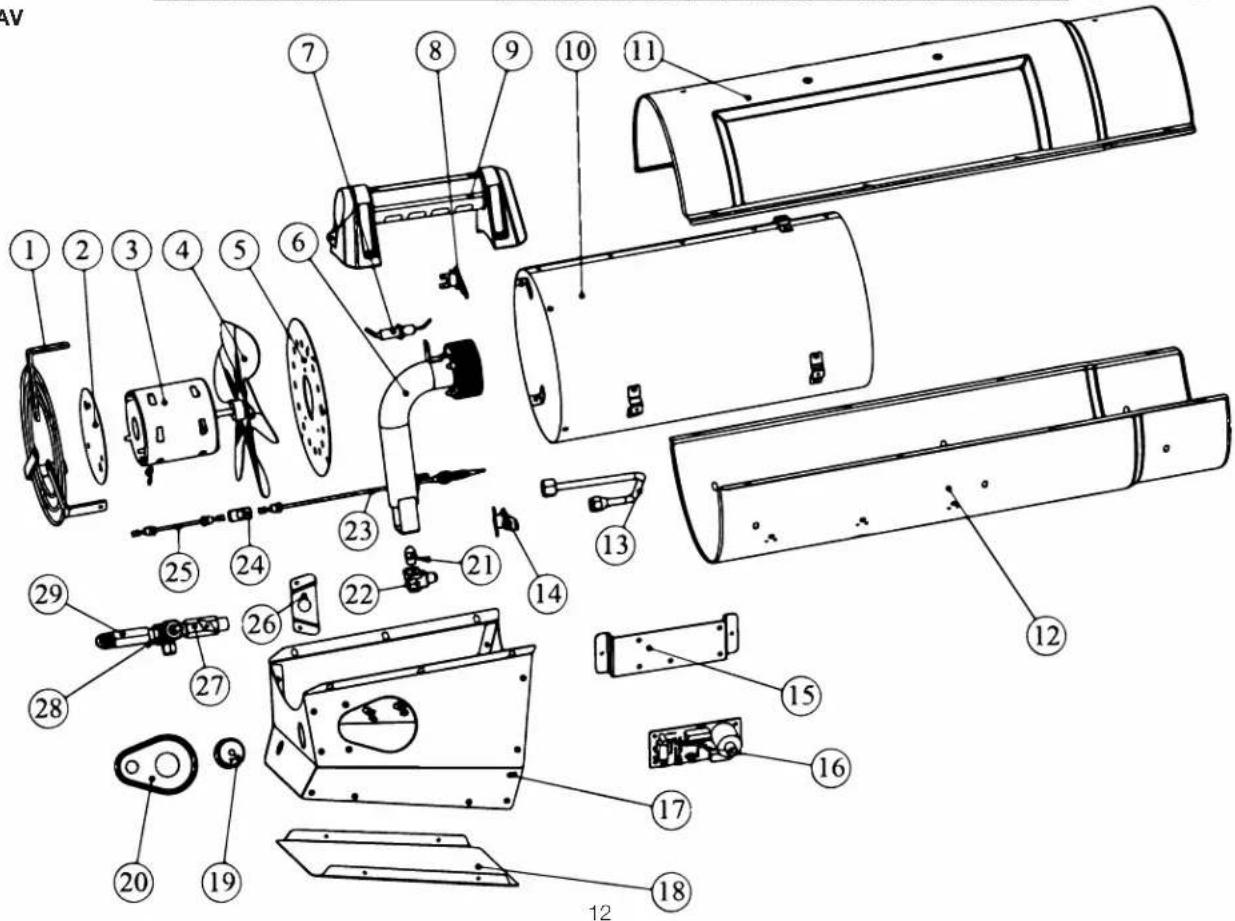
Parts List DXH150FAV
| REF. #......ITEM#......DESCRIPTION | REF. #......ITEM#......DESCRIPTION | |
| 1 ......40896 ......Guard,rear,assy | 17 ......N/A ......Base, metal, assy | |
| 2 ......40897 ......Plate,inlet,cover | 18 ......N/A ......Base, metal, bottom, panel | |
| 3 ......21551 ......Motor, assy | 19 ......40879 ......Knob, variable, valve | |
| 4 ......27898 ......Fan, blade | 20 ......40878 ......Insert, plastic, controls | |
| 5 ......40909 ......Holder, flame | 21 ......40910 ......Orifice | |
| 6 ......40898 ......Burner,mesh, assy | 22 ......40900 ......Holder, orifice, assy | |
| 7 ......40904 ......Electrode, ignition | 23 ......26655 ......Thermocouple | |
| 8 ......40913 ......High limit control, assy, | 24 ......26134 ......Compression block,relay | |
| 9 ......40801 ......Handle, DEWALT | 25 ......26656 ......Thermocouple, connector | |
| 10 ......40908 ......Shield, radiation, assy | 26 ......40876 ......Brkt, plastic, insert | |
| 11 ......40906 ......Barrel, upper, assy | 27 ......40912 ......Valve, variable, assy | |
| 12 ......N/A ......Barrel, lower, assy | 28 ......40884 ......Main, gas valve | |
| 13 ......40911 ......Tubing, gas, burner, assy | 29 ......40905 ......Fitting, gas, inlet | |
| 14 ......40914 ......Brkt, HLS | * ......40923 ......Hose and reg. | |
| 15 ......23045 ......Bracket Ignition / Relay | * ......21036 ......power cord | |
| 16 ......23276 ......board,spark ignition | * ......26223 ......strain relief bushing | |
| *Not shown | ||
DXH150FAV
NEVER LEA VE THE HEATER UNATTENDED WHILE
text_image
Exploded view diagram of an air conditioner with numbered parts for identification- Do not use this heater for heating human living quarters.
- Use of direct-fired heaters in the construction environment can result in exposure to levels of CO, CO2, and NO2 considered to be hazardous to health and potentially life threatening.
- Do not use in unventilated areas.
- Know the signs of CO and CO2 poisoning.
• Headaches, stinging eyes
• Dizziness, disorientation
• Difficulty breathing, feels of being suffocated
- Proper ventilation air exchange (OSHA 29 CFR 1926.57) to support combustion and maintain acceptable air quality shall be provided in accordance with OSHA 29 CFR Part 1926.154, ANSI A10.10 Safety Requirements for Temporary and Portable Space Heating Devices and Equipment used in the Construction Industry or the Natural Gas and Propane Installation Codes CSA B149.1.
- Periodically monitor levels of CO, CO2 and NO2 existing at the construction site – at the minimum at the start of the shift and after 4 hours.
- Provide ventilation air exchange, either natural or mechanical, as required to maintain acceptable indoor air quality.
| USA 8-Hr Time weighted average (OSHA 29 CFR 1926.55 App A) | Canada 8-hr time weighted average WorkSafe BC OHS Guidelines Part 5.1 and Ontario Workplaces Reg 833 | |
| CO 50 ppm 25 ppm | ||
| CO_2 | 5000 ppm 5000 ppm | |
| NO_2 | 3 ppm (Reg 833) | |
| USA - Ceiling Limit(Short Term Exposure Limit = 15 minutes) | Canada STEL (15 minutes Reg 833/1 hour WSBC) WorkSafe BC OHS Guidelines Part 5.1 and Ontario Workplaces Reg 833 | |
| CO 100 ppm | ||
| CO_2 | 15000 ppm (WSBC)30000 ppm (Reg 833) | |
| NO_2 | 5 ppm 1.0 ppm (WorkSafeBC) | 5.0 ppm (Reg 833) |
- Ensure that the flow of combustion and ventilation air exchange cannot become obstructed.
- As the building ‘tightens up’ during the construction phases ventilation may need to be increased.
NEVER LEA VE THE HEATER UNATTENDED WHILE
DEWALT®
INSTRUCTION MANUAL
Forced Air Propane Construction Heater DXH125FAV, DXH150FAV
natural_image
Technical line drawing of a cylindrical device with a side-mounted base and mounting bracket (no text or symbols)Warning:
Use only manufacturer's replacement parts. Use of any other parts could cause injury or death. Replacement parts are only available direct from the factory and must be installed by a qualified service agency.
PARTS ORDERING INFORMATION:
PURCHASING: Accessories may be purchased at any DeWalt ^® local dealer or direct from the factory
FOR INFORMATION REGARDING SERVICE:
Please call Toll-Free 855-805-5745
www.dewalt.com
Our office hours are 8:00 AM – 5:00 PM, EST, Monday through Friday.
Please include the model number, date of purchase, and description of problem in all communication.
LIMITED WARRANTY:
DeWalt ^® warrants its heaters and accessories to be free from defects in material and workmanship for a period of 1 year from date of purchase. DeWalt ^® will repair or replace this product free of charge if it has been proven to be defective within the 1-year period, and is returned at customer expense with proof of purchase to DeWalt ^® within the warranty period.
DEWALT®, GUARANTEED TOUGH® and the yellow and black color scheme are trademarks of the DEWALT Industrial Tool Co., used under license. ©2019 DEWALT. EGI/Enerco Group Inc. Under license from Dewalt Industrial Tool Co.

NE JAMAIS LAISSER LE CHAUFF
AGE SANS SUR
LE BRÛLA
If you have questions or comments, contact us.
Si vous avez des questions ou commentaires, veuillez nous contacter. Llámenos si tiene alguna pregunta o comentario.
INSTRUCTION MANUAL
MANUEL D'INSTRUCTIONS
Forced Air Propane Construction Heater DXH125FAV, DXH150FAV
Fournaise à air pulsé au gaz propane pour chantier de construction DXH125FAV, DXH150FAV Calentador de propano a aire forzado para construcción DXH125FAV, DXH150FAV
40794
READ INSTRUCTIONS CAREFULLY: Read VEUILLEZ LIRE ATTENTIVEMENT LES INSTRUCTIONS :
SPÉCIFICATIONS DE LA FOURNAISE....3
PRÉCAUTIONS LIÉES AU FONCTIONNEMENT .... 4
PRÉCAUTIONS DE SÉCURITÉ 4
MISE EN GARDE LIÉE AUX SUBSTANCES ODORANTES......5-6
CONSIGNES D'UTILISATION.... 6
MAINTENANCE, ENTREPOSAGE ET ENTRETIEN....7
SCHÉMAS DU CÂBLAGE....8
LISTES DES PIÈCES/VUES ÉCLATÉES....9-12
GARANTIE....13
INSTRUCTIONS POUR COMMANDER DES PIÈCES....13
Spécifications
125,000 BTU/HR (36.6 kW)
line
| TEMPERATURE DE L'AIR - °F (°C) | DURÉE MAXIMALE DE FONCTIONNEMENT - HEURES (1 cylinder) | DURÉE MAXIMALE DE FONCTIONNEMENT - HEURES (2 cylinders) | DURÉE MAXIMALE DE FONCTIONNEMENT - HEURES (3 cylinders) | | ----------------------------- | ---------------------------------------------------- | ---------------------------------------------------- | ---------------------------------------------------- | | 0 | 10 | 24 | 38 | | 20 | 8 | 20 | 34 | | 40 | 6 | 16 | 30 | | 60 | 4 | 12 | 26 | | 80 | 2 | 8 | 22 | | 100 | 0 | 4 | 18 | | Utilsez un retract de liquids et un vaponsateur | - | - | - |150,000 BTU/HR (43.9 kW)
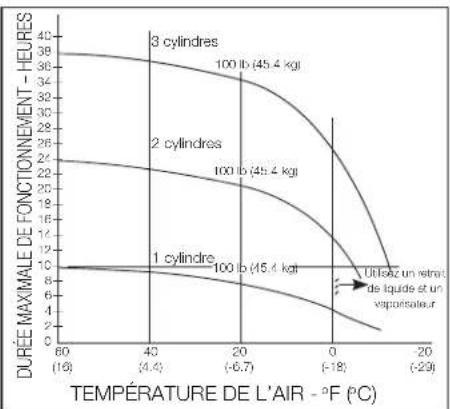
line
| TEMPERATURE DE L'AIR - °F (°C) | DURÉE MAXIMALE DE FONCTIONNEMENT - HEURES | | ----------------------------- | ------------------------------------------ | | 0 | 45.4 | | 20 | 45.4 | | 40 | 45.4 | | 60 | 45.4 |text_image
Exploded view diagram of a refrigerator with numbered parts for identificationNE JAMAIS LAISSER LE CHAUFF
AGE SANS SUR
LE BRÛLAC
text_image
Exploded view diagram of a device with numbered parts for identificationNE JAMAIS LAISSER LE CHAUFFAGE SANS SURVEIKKANCE PEDANT LE BROÜLAGE!
AAVERTISSEMENT
MANUEL D'INSTRUCTIONS
natural_image
Technical line drawing of a cylindrical mechanical device with a base and mounting bracket (no text or symbols)AVERTISSEMENT :
If you have questions or comments, contact us.
Si vous avez des questions ou commentaires, veuillez nous contacter. Llámenos si tiene alguna pregunta o comentario.
INSTRUCTION MANUAL
MANUEL D'INSTRUCTIONS
Forced Air Propane Construction Heater DXH125FAV, DXH150FAV
Fournaise à air pulsé au gaz propane pour chantier de construction DXH125FAV, DXH150FAV Calentador de propano a aire forzado para construcción DXH125FAV, DXH150FAV
40794
READ INSTRUCTIONS CAREFULLY: Read
and follow all instructions. Place instructions in a safe place for future reference. Do not allow anyone who has not read these instructions to assemble, adjust or operate the heater.
VEUILLEZ LIRE ATTENTIVEMENT LES INSTRUCTIONS :
text_image
Exploded view diagram of a household air conditioner unit with numbered parts for identificationDXH125FAV