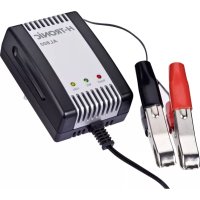
AL 800 - Battery charger H-Tronic - Free user manual and instructions
Find the device manual for free AL 800 H-Tronic in PDF.



| Product type | Automatic battery charger |
| Brand | H-Tronic |
| Model | AL 800 |
| Charging voltages | 6 V and 12 V (lead, gel, lead-acid) |
| End-of-charge voltage | 6.9 V (6 V) / 13.8 V (12 V) |
| Max charging current | 0.8 A (800 mA) |
| Power supply | 230 V / 50 Hz |
| Protection rating | IP 20 |
| Dimensions (approx.) | 160 x 70 x 40 mm |
| Weight (approx.) | 0.3 kg |
| Display | 3 LEDs: mains, charge, polarity |
| Protection | Against reverse polarity, short circuit (<1 min), overload |
| Charging characteristic | I/U (constant current then constant voltage) |
| Charge maintenance | Yes, automatic after full charge |
| Battery compatibility | Lead, gel, lead-acid (6 and 12 V) |
| Safety | Electronic circuit breaker, automatic shut-off |
| Operating temperature | Max. 50 °C |
| Humidity | Dry premises only, avoid condensation |
| Maintenance | Clean with a dry cloth, no water |
| Repairability | Repair by specialist only, original parts |
| Warranty | 2 years |
| Standards | CE, directives 2014/30/EU and 2014/35/EU |
Frequently Asked Questions - AL 800 H-Tronic
User questions about AL 800 H-Tronic
0 question about this device. Answer the ones you know or ask your own.
Ask a new question about this device
Download the instructions for your Battery charger in PDF format for free! Find your manual AL 800 - H-Tronic and take your electronic device back in hand. On this page are published all the documents necessary for the use of your device. AL 800 by H-Tronic.
USER MANUAL AL 800 H-Tronic
- Intended use 15
- General safety instructions 16
- Getting started 16
4.Danger. 18
5.Before initial operation 19 - Charging 20
- Disconnection of charging process 21
8.Warranty 22 - Environmental protection 23
F Mode d'eMPLoi
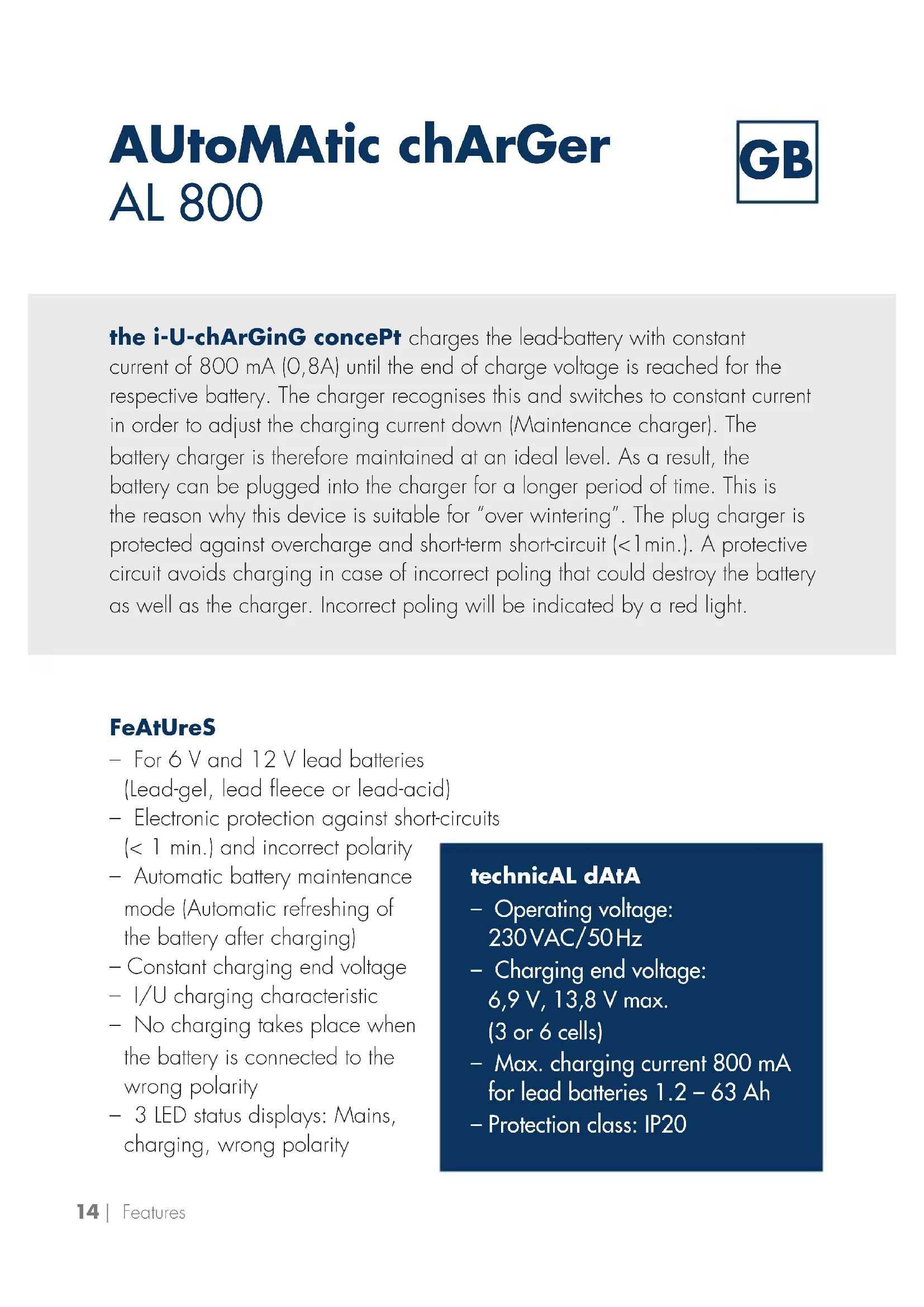
the i-U-chArGinG concePt charges the lead-battery with constant current of 800 mA (0,8A) until the end of charge voltage is reached for the respective battery. The charger recognises this and switches to constant current in order to adjust the charging current down (Maintenance charger). The battery charger is therefore maintained at an ideal level. As a result, the battery can be plugged into the charger for a longer period of time. This is the reason why this device is suitable for "over wintering". The plug charger is protected against overcharge and short-term short-circuit (<1 min.). A protective circuit avoids charging in case of incorrect poling that could destroy the battery as well as the charger. Incorrect poling will be indicated by a red light.
FeAtUreS
- For 6 ~V and 12 ~V lead batteries (Lead-gel, lead fleece or lead-acid)
- Electronic protection against short-circuits (< 1 min.) and incorrect polarity
Automatic battery maintenance mode (Automatic refreshing of the battery after charging) - Constant charging end voltage
- I/U charging characteristic
- No charging takes place when the battery is connected to the wrong polarity
- 3 LED status displays: Mains, charging, wrong polarity
technicAL dAtA
- Operating voltage: 230VAC/50Hz
- Charging end voltage: 6,9 V, 13,8 V max. (3 or 6 cells)
- Max. charging current 800mA for lead batteries 1.2 - 63 Ah
- Protection class: IP20
wArninGS And SAFetY inStrUctionS
The special instructions which outline how to operate this device safely are summarised at the beginning of the operating instructions. Before using this device, please carefully read this manual and follow the instructions in it. It contains important information for the safe operation of the unit. The law requires that this manual contains important information for your safety and describes how the unit can be used safely, avoiding damages to the unit and other installments. The manufacturer cannot be made liable for damages resulting from negligent or intentional disregard of the instructions in this manual!
This device may be used by children from 8 years of age and older and by people with reduced physical, sensory or mental capabilities or a lack of experience and knowledge if they are supervised or have been instructed on how to use the device safely and understand the dangers resulting from this. Children should be supervised in order to ensure that they do not play with the device. Cleaning and user maintenance must not be carried out by children without supervision. This manual is a part of the device and should be kept in a safe place. To avoid malfunctions and damages, please pay attention to the following safety instructions:
- Repairs of the unit should only be performed by a specialist!
- Dispose of the packaging material that is not needed. Children might play with the plastic bags and risk suffocation.
- The unit and its components should not be handled by children and infants.

dAnGer! The unit should only be opened by a specialist. Detach the device from the mains before opening it. Opening the device will reveal
components which have a live current and can be hazardous to your health when touched.
1. intended USe
The device is designed for automatic charge and buffering of lead batteries with 6 or 12V terminal tension. A sliding switch carries out the setup of the battery voltage. Possible battery types are lead-gel, leadfleece or lead-acid-batteries.
Primary batteries (zinc-carbon, alkaline, etc.) or other battery types must not be plugged in or charged. The device is not intended for commercial use. Any other use or modification of the device is deemed to be unintended and harbours considerable risks. The manufacturer accepts no liability for any damage which results from unintended use.
2. GenerAL SAFetY inStrUctionS
When handling electrical items, the VDE regulations need to be followed. Especially VDE 0100, VDE 0550/0551, VDE 0700, VDE 0711 and VDE 0860.
- Before opening the device, make sure that it is disconnected from the mains.
- Tools may only be used on the device or components, if it is ensured, that the device has been disconnected from the mains and that all electric charges, that have been stored within the components, are discharged.
- Cables or leads connecting the device or connecting components within the device should be examined thoroughly for faults in the insulation.
- If a fault in the cables of the device is found, the device should immediately be removed from service until the defective cables have been replaced.
If the following manual does not fully describe function and safety precautions to a layman, or if the technical appliance is not clear, or if it is unclear which external devices may be attached and how to attach them, then it is vital to contact a specialist for advice. Before mounting this device and connecting the accessories, make sure, that this device is suitable for the intended use.
If there is any case of doubt or there are any questions, please contact specialists, experts or the manufacturers of the modules and components. Please note, that operating and connection errors are beyond our influence and that we cannot maintain warranty or be made liable for damages occurring thereof.
3. Getting StArted
The charger may only be connected and used in well-ventilated, dry interiors as well as only in a small alternate current voltage of 230V / 50Hz . The position of operation is optional. The permissible ambient temperature must not exceed 50^ during operation. Please consider that operation and connection faults are beyond our sphere of influence. Understandably, we cannot assume liability for defects resulting from this.
The device may be used for the described purpose, if these operating instructions are observed:
- Before each initial operation, check the charger as well as its leads for damages.
- Do not operate the device during frost or danger of frost to avoid the formation of condensation water.
- Never connect your charger with the mains voltage if it is taken from a cold into
a warm space. The condensation that is brought about may destroy or cause an electric shock under unfavourable conditions. Let the device adjust down to room temperature.
- Do not expose the device to rain or moisture to avoid a fire hazard and the danger of an electric shock.
- Do not allow liquids of any kind to penetrate into the device.
- Never cover the ventilation slots or housing.
- Do not place the device near hot air sources such as radiators or similar.
- Never charge batteries in a boat or watercraft. Take the battery out of the boat or watercraft before charging.
- In case of misuse (e.g. incorrect battery type or too long polarity reversal.) the battery can be overcharged or damaged. In the worst case, the battery can explode and can cause considerable damage.
- Keep the transmitters (mobile phones, transmitters for modelling etc.) away from the charger since the incoming sender radiation can result in the failure of the charging device or destruction of the charger and therefore the batteries.
- Handle the product carefully, thrusts, blows and dropping from even little height will cause damage. A faulty device must no longer be used and must therefore be disposed of.
- Do not expose the device to sunlight, strong dust formation, mechanic vibrations or thrusts.
- Never put or lead the charging cable near to inflammable materials. The charging cable may neither be kinked nor be led over sharp-edged parts.
- Ensure that no inflammable objects (wood, cloths, cleaning rags or similar) are placed near the device. The mains or charger leads must not be modified, extended or shortened. In addition, the leads must neither be bent, squashed nor be guided through square-edged parts.
- Live cables or lines, which are connected to the device, must always be tested before and after use for insulation faults or breakages.
- Immediately discontinue using the device, if an error is determined in the supply cable.
- If necessary, use an appropriate non-inflammable basis (e.g. a big, thick wall tile or flagstone).
- Only use the device outside of the vehicle.
- Only start using the device outside of the vehicle. Ensure that a secure and stable connection is established when connecting the battery charging clamps.
- Never use in the case of adverse ambient conditions. Adverse ambient conditions
are: Ambient temperatures below -25^ or above +50^ , combustible gases, solvents, vapours, dust, air humidity above 80% as well as wetness.
- The device may only be used in dry and closed rooms.
- Do not leave packaging lying around; It can become a dangerous toy for children. Danger of suffocation!
- This product is not meant for playing, it must be kept away from children. Children are not able to estimate the danger when dealing with electric devices.
note: The device may only be used for charging and maintaining of lead-gel, leadfleece or lead-acid-batteries! Non-charcheable batteries can not be charged with this charging device! Do not use the charger to charge dry cell batteries. They may explode and cause injury to people and damage to property. Non-rechargeable batteries cannot be charged using this charger.
MALFunction
If it can be assumed that a safe operation of the device is no longer possible the device must be disconnected, removed and secured against unintentional use immediately. This applies if:
- The device shows any signs of damage.
- The device is no longer functional.
- Parts of the device are loose or disconnected.
- The connecting wires show signs of damage.
- There are smoke emissions or penetration of liquids etc.
If the device needs to be repaired, only the original spare parts may be used. The use of other components or components with different values can cause damages and be hazardous. A repair of the device may only be carried out by a specialist.
4. dAnGer
Danger by reverse polarity, short-circuit and contact with battery acid - always observed the safety instructions of the lead battery manufacturer.
dAnGer of cheMicAL BurnS!
Batteries contain acid which can damage the eyes and skin. When the battery is charged, this also produces gases and vapours which pose a danger to health.
- Avoid any contact with corrosive battery acid. Thoroughly rinse areas of skin and objects which have come into contact with acid immediately with water. If your eyes come into contact with battery acid, bathe them with running water for at
least 5 minutes. Consult your doctor.
- Wear safety goggles and acid-resistant protective gloves. Protect your clothing, e.g. by wearing an apron.
- Do not tilt the battery as acid may escape.
- Make sure there is sufficient ventilation at all times.
- Do not breathe in any gases or vapours which are produced.
5. BeFore initiAL oPerAftion
- Before each initial operation, check the charger as well as its leads for damages.
- Do not start using the device under any circumstances if the protecting insulation of the mains or charger leads is damaged (squashed, ripped down or ripped off).
- Never work with the charger in spaces or unfavourable environment conditions that contain or may contain inflammable gases, smoke or dust.
- Never cover ventilation slots or containers.
- Do not place the device near hot air sources such as radiators or similar. Do not expose the device to sunlight, strong dust formation, mechanic vibrations or thrusts. Do not use the device near or on easily inflammable materials. If necessary, use an appropriate non-inflammable basis (e.g. a big, thick wall tile or flagstone).
- Do not place or guide the mains or charger leads near inflammable materials.
- Ensure that no inflammable objects (wood, cloths, cleaning rags or similar) are placed near the device. The mains or charger leads must not be modified, extended or shortened. In addition, the leads must neither be bent, squashed nor be guided through square-edged parts.
- Current conducting cables or leads that are connected with the device, must be checked for insulation faults such as points of rupture, squashing or bending before and after using the device. In case of fault detection (damage) of the cable, the device must be disposed of immediately.
- Only start using the device outside of the vehicle. Ensure that a secure and stable connection is established when connecting the battery charging clamps.
- Never deep charge the batteries to avoid damage of the batteries.
oPerAtinG note
The device heats up when operating. Make sure there is sufficient ventilation. The case must not be covered. Never charge lead batteries in a closed container. When charging sufficient ventilation must be ensured and open fire must be avoided.
Before charging batteries with liquid acid, open the closing plug of the individual cells.
Air the battery case for 2 minutes so inflammable gases can volatilise. Check the liquid level when charging and, if necessary, refill it. In addition, check the liquid regularly in case of longer charging time (hibernation). Use safety goggles. Do not spill lead-acid-batteries. Avoid any kind of contact with the battery liquid since it can cause serious burns. In case of contact, wash off the contact spot (skin, clothes etc.) immediately with plenty of water to dissolve the battery acid. Always see a doctor in case of skin contact. Keep recharging lead-acid-batteries from time to time, at least every 3 months, if stored for a longer period of time to prevent deep discharge. Never bypass the battery contacts. When connecting the batteries, it is necessary to consider the polarity and the charging instructions of the respective battery manufacturer.
6. chArGing
connectinG the chArGer
The device may be operated and connected to any correctly installed 230 V A/C outlet. Make sure if and how the battery must be disconnected from the electrical system of the car by reading the instruction manual of the vehicle manufacturer.
- If the battery needs to be disconnected from the car, please make sure that the ground clamp (-) is always disconnected first.
- Before charging the battery, make sure that the battery terminals are clean and free of grease and dirt.
- Before connecting the clamps, check the polarity of the battery. The positive pole (+) is usually larger in diameter than the negative pole (-).
- If necessary, refill the battery with distilled water up to the indicated level.
- If maintenance free batteries are charged, please follow the instructions of the battery manufacturer exactly.
chArGinG BAtterieS MoUnted in the Vehicle.
- Connect the charger to the battery before connecting the charger to the mains power outlet.
- Set battery capacity via slide switch on the back of the device to 6V or 12V.
- The battery clamp, which is directly connected to the battery should be the first clamp to connect. The second connection can then be made to the body or engine of the car. Make sure that the connection is not made in the immediate vicinity of the battery or the fuel line.
- If the car has a negative polarity, the red clamp should first be connected to the positive pole (+) of the battery. The black clamp (-) can then be connected to the
body or to the engine block. Make sure that the connection is not made in the immediate vicinity of the battery or a fuel line.
- Do not connect the clamp to the carburetor, to any fuel lines or any other metal clamps which do not have a ground connection to the body.
- Do not place the charger on, over or in the near vicinity of the battery.
- Only connect the charger to the A/C outlet after all the connections have been made. The charging process will begin automatically when the plug is connected to the mains.
- When the charging process is completed, first disconnect the charger from the mains. Then the clamps can be disconnected from the battery/car body.
If the battery is not mounted in the car, connect the clamps directly to the battery. Red is connected to Plus (+) and black to Minus (-). After the clamps have been connected to the battery, the charger can be connected to the mains.
7. diSconnection of chArGinG ProcesS
The charger is provided with an automatic switch-off control that ends the charging process automatically once the charging end voltage is reached and switches automatically to the conservation-charging mode. The yellow charging display switches off in the conservation-charging mode or if the charge current falls under 80mA.
The device is characterised by the following properties:
- short-circuit and reverse-polarity protection
- Constant charging end voltage
- No charging if battery is connected with reverse-polarity
- Charging is only carried out if the battery is connected correctly
- Visual display, for net, charging and reverse-polarity
As opposed to common chargers, the charge current of this automatic charger does not represent a precise value and depends on various factors. This includes e.g. the charge condition of the battery, the battery age, type or capacity. In addition, it is important how much the battery was discharged before. If the battery was extracted a lot of current, a high initial charge current will take place at the beginning (max. 0,8 A) that will diminish after a short time. This means with in crea sing voltage of the battery, the charge current decreases. The charging time, until the charging end voltage is reached, depends on several parameters, e.g.:
- the capacity (Ah, the bigger the longer the charging time)
- the battery type
- the charging condition of the battery (full, partly charged, flat)
- the ambience temperature
- the general condition (age) of the battery.
The charging time is based on the above parameters and can roughly be calculated according to the following formula (for a rough time estimation):
$$ \text {C h a r g i n g} [ \mathrm {h} ]) = \frac {\text {C a p a c i t y o f t h e b a t t e r y i n A h}}{\text {C h a r g e c u r r e n t 0 , 8 A}} $$
Example: Lead-gel-battery 12 Ah, flat
$$ \frac {1 2 \mathrm {A h}}{0 , 8 \mathrm {A}} = \text {t h e c h a r g i n g t i m e a m o u n t s t o a p p r o x .} 1 5 \mathrm {h} $$
Towards the end of the charging process (battery is full), the yellow LED "Charging" usually switches off. Older or high-capacity batteries may show an extremely high self-discharge (approx. 1% of the battery capacity) and the plug connector may not recognize this elevated conservation charge current as a completed charging cycle (yellow LED-display is not switched off). In this case the plug connector works as a buffer to compensate the selfdischarge of the battery.
Generally, as for more recent batteries, the LED switches off once the battery is fully charged. Batteries of different capacities can be charged, bigger batteries have a longer charging time whereas smaller batteries have a shorter one. As far as the charging process is concerned, it does not make any difference whether the battery is partly or fully discharged. The batteries may also remain connected to the charger, the ambience temperature should not exceed approx. 50^ . If by accident the battery is poled incorrectly when being connected to the charger, this will be signaled by a red LED "reversepoled" and the charge current will be switched off automatically.
8. wArrAntY
We grant warranty of 2 year for this product. The warranty includes the repair of defects which result clearly from incorrect materials or manufacturing mistakes. For damages caused by not following the instructions the warranty will be stated void. For consequential damages resulting thereof, no liability can be taken! For safety and licensing reasons (CE) the unauthorized conversion and/or modification the device is forbidden. Further claims are excluded.
In the event of defects which occur as of delivery within the legal guarantee period of two years, you have the legal right of subsequent fulfillment (either: rectification of the defect or
delivery of a new product) and – if the legal prerequisites are met – the legal rights of reduction or withdrawal and additionally compensation for damages. Detected deficiencies are to be reported immediately. Proof of purchase must be provided. For reasons of safety and licensing (CE) it is not allowed to modify the unit. Any additional claims are excluded.
We accept neither responsibility nor liability for any damages or consequential damages in connection with this product. We reserve the right to repair, supply spare parts or return the purchase price. In case of the following criteria the warranty does not apply neither will we repair the product: changing and own repairing of the product, changes of the switches, - during the construction not planned outsourcing of components, destruction of the PCB and soldering spots, overcharging of the product, defects resulting from operations of external persons, defects resulting from not paying attention to the manual or drawings, connection to wrong current and/or connection to wrong polarity, wrong operation or defects from misuse, defects due to wrong or manipulated fuses, using components other than the original components. In all these cases the device will be returned at your expense.
9. enVironMentAL Protection

device: This product must not be disposed of through normal household waste at the end of its durability, but handed in at a collecting point for recycling of electrical and electronic devices. This is shown by the picture on the product, the manual or the packaging. The materials are recyclable according to its labeling. By doing this you are making an important contribution to the protection of our environment.

BAtteries: As an end consumer you are obliged by law (battery regulation) to return all used batteries and chargers, a disposal through household waste is not permitted. Toxic batteries/chargers are characterized with appropriate symbols pointing out the interdiction of the disposal through household waste.
ce MArK And conForMitY

We, the manufacturer (HTRONIC GmbH) hereby declare that this equipment is in compliance with the essential requirements and other relevant provisions of Directive 2014/30/EU and 2014/35/EU. CE conformance has been certified - the relevant records are in the hands of the manufacturer: HTRONIC GmbH | Industriebiet Dienhof 11 | D-92242 Hirschau
This manual is a publication of H-TRONIC GmbH, Industriegebiet Dienhof 11, D-92242 Hirschau. All rights including translation reserved. Information provided in this manual may not be copied, transferred or put in storage systems without the express written consent of the publisher. Reprinting, also for parts only, is prohibited. Any modification of connection or use of other accessories other than the ones specified, terminates the approval. Changes in technique, equipment and design reserved. © Copyright 2018 by H-TRONIC GmbH
chArGeUr AccU PLoMB AL 800

© 2018 by H-Tronic GmbH
cArGAdor de BAterIAS AL 800

© Copyright 2018 by H-TRONIC GmbH




- F Mode d'eMPLoi
- FeAtUreS
- technicAL dAtA
- wArninGS And SAFetY inStrUctionS
- intended USe
- GenerAL SAFetY inStrUctionS
- Getting StArted
- MALFunction
- dAnGer
- dAnGer of cheMicAL BurnS!
- BeFore initiAL oPerAftion
- oPerAtinG note
- chArGing
- connectinG the chArGer
- chArGinG BAtterieS MoUnted in the Vehicle.
- diSconnection of chArGinG ProcesS
- wArrAntY
- enVironMentAL Protection
- ce MArK And conForMitY
- chArGeUr AccU PLoMB AL 800
- cArGAdor de BAterIAS AL 800
Brand : H-Tronic
Model : AL 800
Category : Battery charger