
AL600plus - Battery charger H-Tronic - Free user manual and instructions
Find the device manual for free AL600plus H-Tronic in PDF.

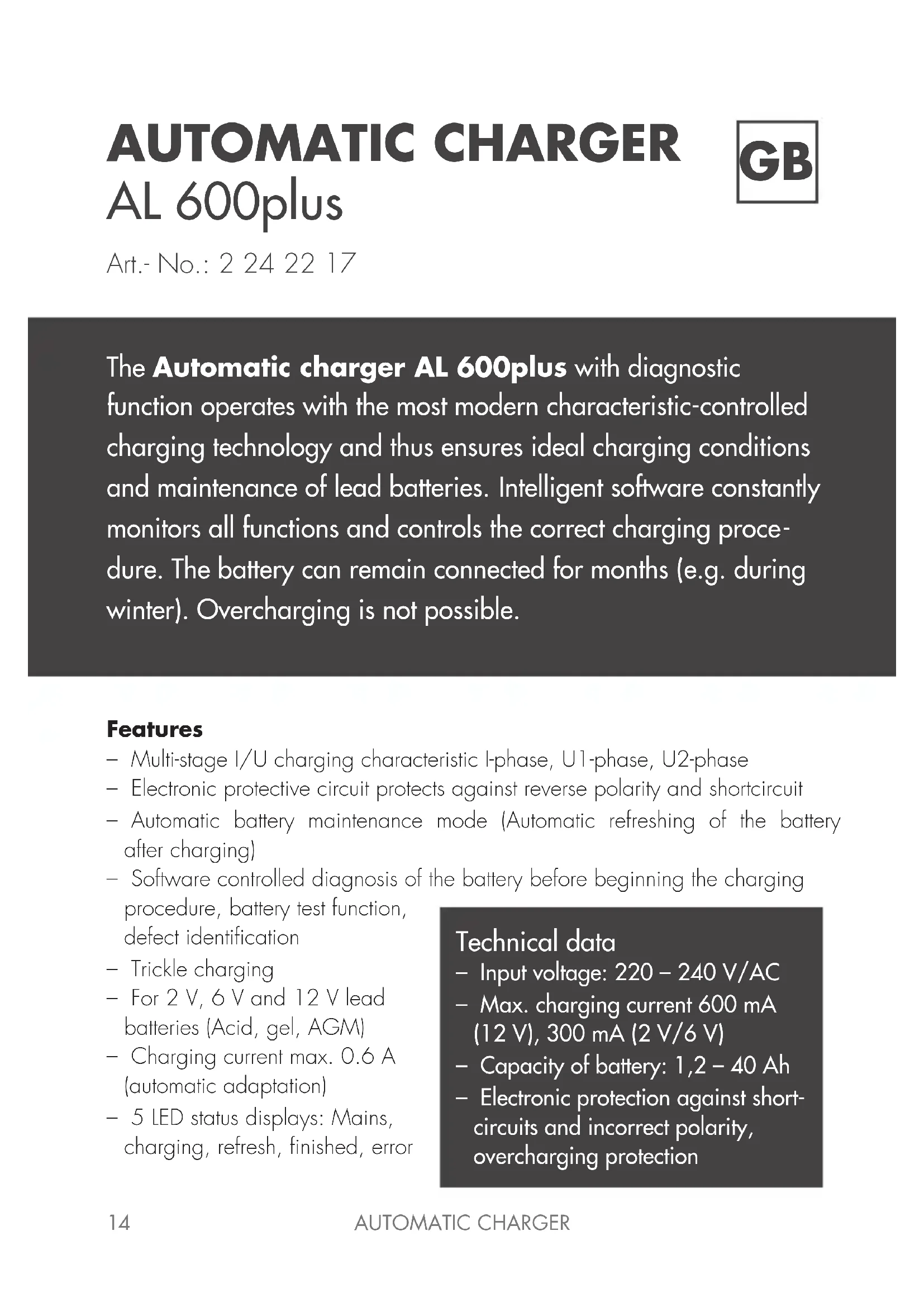


| Product type | Lead-acid battery charger |
| Brand | H-Tronic |
| Model | AL600plus |
| Input voltage | 220-240 V AC, 50 Hz |
| Max charging current (12 V) | 600 mA |
| Max charging current (2/6 V) | 300 mA |
| Battery capacity | 1.2 - 40 Ah |
| Compatible battery voltages | 2 V, 6 V, 12 V |
| Battery types | Acid, Gel, AGM |
| Protection | Reverse polarity, short circuit, overload |
| Display | 5 LEDs: mains, charging, reconditioning, finished, error |
| Charging modes | Phase I (constant current), Phase U1 (constant voltage), Phase U2 (maintenance) |
| Battery test function | Yes, automatic diagnosis before charging |
| Automatic maintenance function | Yes, cyclic maintenance charge |
| Operating temperature range | -25 °C to +45 °C |
| Warranty | 2 years |
| Article number | 2 24 22 17 |
| Included accessories | Red and black battery clamps |
| Use | Indoor, dry |
Frequently Asked Questions - AL600plus H-Tronic
User questions about AL600plus H-Tronic
0 question about this device. Answer the ones you know or ask your own.
Ask a new question about this device
Download the instructions for your Battery charger in PDF format for free! Find your manual AL600plus - H-Tronic and take your electronic device back in hand. On this page are published all the documents necessary for the use of your device. AL600plus by H-Tronic.
USER MANUAL AL600plus H-Tronic
- Intended use.... 15
- General safety instructions....15
- Danger....17
- Preperations 18
- Connection and start-up....18
- Quick introduction (For experienced users)....19
- Detailed description of the charging procedure 20
- General notices and information....22
- Environmental protection 23
The Automatic charger AL 600plus with diagnostic function operates with the most modern characteristic-controlled charging technology and thus ensures ideal charging conditions and maintenance of lead batteries. Intelligent software constantly monitors all functions and controls the correct charging procedure. The battery can remain connected for months (e.g. during winter). Overcharging is not possible.
Features
- Multi-stage I/U charging characteristic I-phase, U1-phase, U2-phase
- Electronic protective circuit protects against reverse polarity and shortcircuit
- Automatic battery maintenance mode (Automatic refreshing of the battery after charging)
- Software controlled diagnosis of the battery before beginning the charging
procedure, battery test function, defect identification
- Trickle charging
- For 2 V, 6 V and 12 V lead batteries (Acid, gel, AGM)
- Charging current max. 0.6 A (automatic adaptation)
- 5 LED status displays: Mains, charging, refresh, finished, error
Technical data
- Input voltage: 220 - 240 V/AC
- Max. charging current 600 mA (12 V), 300 mA (2 V/6 V)
- Capacity of battery: 1,2 - 40 Ah
- Electronic protection against short-circuits and incorrect polarity, overcharging protection
Warnings and safety instructions
Before using this device, please carefully read this manual and follow the instructions in it. It contains important information for the safe operation of the unit. The law requires that this manual contains important information for your safety and describes how the unit can be used safely, avoiding damages to the unit and other installments. The manufacturer cannot be made liable for damages resulting from negligent or intentional disregard of the instructions in this manual! This manual is a part of the device and should be kept in a safe place. To avoid malfunctions and damages, please pay attention to the following safety instructions:
- Repairs of the unit should only be performed by a specialist!
- Dispose of the packaging material that is not needed. Children might play with the plastic bags and risk suffocation.
- The unit and its components should not be handled by children and infants.

Danger! The unit should only be opened by a specialist. Detach the device from the mains before opening it. Opening the device will reveal components which have a live current and can be hazardous to your health when touched.
1. INTENDED USE
The intended use of the battery charger encompasses charging and charge retention of maintenance-free gel batteries, microflies and acid batteries, which are suitable for the voltage and charging current indicated in the technical data. Any other use is not considered as intended. Only the user/operator is responsible for thereby resulting damage.
2. GENERAL SAFETY INSTRUCTIONS
When handling electrical items, the VDE regulations need to be followed. Especially VDE 0100, VDE 0550/0551, VDE 0700, VDE 0711 and VDE 0860.
- Before opening the device, make sure that it is disconnected from the mains.
-
Tools may only be used on the device or components, if it is ensured, that the device has been disconnected from the mains and that all electric charges, that have been stored within the components, are discharged.
-
Cables or leads connecting the device or connecting components within the device should be examined thoroughly for faults in the insulation.
- If a fault in the cables of the device is found, the device should immediately be removed from service until the defective cables have been replaced.
If the following manual does not fully describe function and safety precautions to a layman, or if the technical appliance is not clear, or if it is unclear which external devices may be attached and how to attach them, then it is vital to contact a specialist for advice. Before mounting this device and connecting the accessories, make sure, that this device is suitable for the intended use.
If there is any case of doubt or there are any questions, please contact specialists, experts or the manufacturers of the modules and components. Please note, that operating and connection errors are beyond our influence and that we cannot maintain warranty or be made liable for damages occurring thereof.
This item was tested and manufactured according to EMVG (EG Directive 89/336/EWG/ Electromagnetic Compatibility) and holds the corresponding CE approval. Any change of the circuitry or exchange of components other than specified will make this approval invalid.
The device may be used for the described purpose, if these operating instructions are observed.
- Do not operate the device during frost or danger of frost to avoid the formation of condensation water.
- Do not expose the device to rain or moisture to avoid a fire hazard and the danger of an electric shock.
- Do not allow liquids of any kind to penetrate into the device.
- Never cover the ventilation slots or housing.
- Do not place the device near to warm air sources such as heaters or the like!
- Never put or lead the charging cable near to inflammable materials. The charging cable may neither be kinked nor be led over sharp-edged parts.
- Live cables or lines, which are connected to the device, must always be tested before and after use for insulation faults or breakages.
- Immediately discontinue using the device, if an error is determined in the supply cable.
- The device may only be used on a stable and non-combustible surface.
- Only use the device outside of the vehicle.
- Ensure a safe and stable connection when connecting the battery charging clamps.
- Never use in the case of adverse ambient conditions. Adverse ambient conditions are: Ambient temperatures below -25^ or above +50^ , combustible gases, solvents, vapours, dust, air humidity above 80% as well as wetness.
- The device may only be used in dry and closed rooms.
Malfunction
If it can be assumed that a safe operation of the device is no longer possible the device should immediately be disconnected, removed and secured against unintentional use. This case is applicable if:
– The device shows any signs of damage.
- The device is no longer functional.
- Parts of the device have become loose.
- The connecting wires show signs of damage.
- There are smoke emissions or penetration of liquids etc.
If the device needs to be repaired, only the original spare parts may be used. The use of other components or components with different values can cause damages and be hazardous. Repairs may only be done by a trained specialist!
3. DANGER
Danger by reverse polarity, short-circuit and contact with battery acid – always observed the safety instructions of the lead battery manufacturer.
Caution! Battery acid is extremely corrosive. Immediately treat acid splashes on skin or clothes with a soap solution and rinse with lots of water. Acid splashes in the eye must be immediately rinsed with lots of water; consult a physician immediately.
4. PREPERATIONS
- Provide adequate ventilation in the room during charging.
- Do not open the cell plugs on maintenance-free lead batteries (lead-acid batteries).
- Check the acid level before charging nonmaintenance-free lead batteries.
- Check the acid level occasionally when charging non-maintenance-free lead batteries for a longer charging period.
- Check the charging procedure regularly for safety reasons.
Attention! Always avoid open flames, open lights and sparks in the proximity of batteries being charging (Explosion hazard by detonating gas). Always observe the charging instructions of the battery manufacturer.
5. CONNECTION AND START-UP
Insert the mains cable of the device into an intact socket, which also complies with the VDE regulations. You must ensure that all vehicle power consumers, such as e.g. ignition, radio, light, telephone, mobile phone battery chargers etc. are switched off, if the battery is charged in a built-in state. The lead battery must be dismantled or unclamped if necessary. It is possible that the battery has a leakage current or that the battery is still connected to a consumer, if the battery charger does not indicate „Finished“ (Fertig) or „Full“ (Voll) after a lengthy charging period.
First, connect the red terminal (+) to the positive terminal of the battery and then the black terminal to the negative pole (−) of the battery.
Caution!
- Never clamp connections onto the vehicle body.
- The battery charger works at an ambient temperature of -25^ + 45^ . Please infer at which temperature or with which charging parameters a lead battery must be charged from the technical specifications of the lead battery manufacturer.
- Always observe the warning notes of the battery and vehicle manufacturer before charging.
- The device can reach temperatures of up to 50^ during full load operation.
6. QUICK INTRODUCTION (FOR EXPERIENCED USERS)
Connection to 230 V mains:
First connect the battery charger with the 230 V electricity mains (socket). The green „Mains“ (Netz) LED lights up.
Set battery voltage:
Set the slide switch to 2 V, 6 V and/or 12 V depending on the battery you want to charge.
Connecting to the battery:
Connect the red connecting terminal of the battery charger to the positive terminal (+) of the battery and the black terminal to the negative pole (−) of the battery. The battery can thereby remain connected in the car/motorcycle (see note N3).
Charging procedure
The device starts the charging procedure automatically. The „Charging“(Laden) LED indicates this.
Finished
The battery charger switches the „Finished“ (Fertig) LED on (see note N3) and goes into the refresh mode, if all test criteria have been fulfilled after charging and the battery has been evaluated as „Good“. The „Charging“ (Laden) LED extinguishes simultaneously and the „Refresh“ LED is displayed. The battery is therefore charged and ready for use and can be disconnected from the battery charger.
- Finally, pull the mains cable out of the socket. Always pull the plug and never the cable!
- Check the acid level in non-maintenancefree lead batteries.
- Fill with distilled water, if the acid level is too low.
- Observe the battery manufacturer's operating instructions.
7. DETAILED DESCRIPTION OF THE CHARGING PROCEDURE
The „Mains" (Netz) LED lights up after connecting to the electrical mains (230V/50Hz). The device goes into the check mode after setting of the battery type by means of the slide switch and connecting a 2 V, 6 V or 12 V lead battery (Acid, gel, AGM, EXIDE gel battery). The „Error" (Fehler) LED as well as the „Charging" (Laden) LED flashes, if the voltage of a correctly connected battery is higher than 14.3 V (for a 12 V battery) or more than 7.15 V in the case of a 6 V battery or more than 2.4 V in the case of 2 V battery. The device switches to the charging mode, if the voltage is in the range of 0.5...2.4 V (2 V battery), 0.5...7.15 V (6 V battery) or 0.5...14.3 V (12 V battery).
Charging technology
The device has three different charging phases:
■ I-Phase, the charging current is approx. 0.6A for a 12V battery and approx. 0.3A for a 2V and 6V battery.
■ U1-Phase (= Main charging phase) with a constant voltage of 14.3 V (and/or 2.4 V or 7.15 V)
■ U2-Phase (Trickle charge) with constant voltage of 13.8 V (and/or 2.3 V or 6.9 V).
The battery is first charged with a constant current (I-phase) until the final charge voltage (14.3 V/7.15/2.4 V) has been reached. The voltage is then kept constant (U1-Phase) and the charging current adapts itself to the charge state of the battery. The fuller the battery, the lower the charging current. The charging procedure is terminated and the battery charger switches automatically into the test mode, if a charging current of approx. 100 mA is under run (see note N3). The battery is loaded with a defined current during this test. A large internal resistance and/or a strong sulphation of the battery is indicated, if the voltage of the loaded battery thereby drops back to the rated voltage.
The battery charger evaluates the battery as „defective“, if the test is not passed; the device then switches itself off and the „Error“ (Fehler) and „Finished“ (Fertig) LED’s flash.
The battery charger switches the „Finished“ (Fertig) LED on and goes into the refresh mode, if all test criteria have been fulfilled after charging and the
battery has been evaluated as "Good". The "Charging" LED extinguishes simultaneously and the "Refresh" LED is displayed. The battery is therefore charged and ready for use and can be disconnected from the battery charger. The program discharges for 15 minutes with a current of approx. 30 mA, if the battery however remains connected to the battery charger. The trickle charge procedure is started after 15 minutes or when the battery voltage is lower than the nominal value (appropriate to 2, 6, 12 V). The "Refresh" LED thereby extinguishes and the "Charging" (Laden) LED is turned on. The program now supplies a "Trickle charge" for 15 minutes. The charging current is now adapted in such a way that the battery voltage is automatically kept at 13.8/6.9/2.3 V. The "Refresh" program restarts after 15 minutes. This is repeated cyclically until the battery charger is disconnected from the battery.
The operating modi:
The device can indicate three different operating modes during operation:
-
The „Charging“ (Laden) LED shines. Charging.
-
The „Charging“ (Laden) and „Finished“ (Fertig) LEDs shine: Trickle charge.
-
The „Refresh“ and „Finished“ (Fertig) LEDs shine: Refresh.
Errors:
The device can indicate four different errors:
-
The „Charging“ (Laden) and „Error“ (Fehler) LEDs flash: The voltage setting (with slide switch) and the measured battery voltage do not correspond.
-
The „Finished“ (Fertig) and „Error“ (Fehler) LEDs flash: The battery is recognised as defective.
-
The „Error" (Fehler) LED flashes: The slide switch has an undefined position (Intermediate position).
-
The „Error(Fehler) LED shines continuously: A charging attempt failed. Possible cause: Battery charger or battery defective.
Notes
Note N1: A fully discharging 12V battery is always charged with a current of up to max. 0.3 A.
Note N2: The battery could be defective and has a higher internal resistance, if a refresh procedure takes less than 15 minutes.
Note N3: A final charging condition is never achieved and the battery charger remains in the charging mode „in perpetuity“, if the battery has an age-related leakage current, which is larger than 100 mA, and/or if the battery has a connected load (e.g. the on-board electronics), which consumes more than 100 mA!
9. NOTICES AND INFORMATION
Cleaning
Clean the device with a dry cloth only. If it is very dirty use a slightly dampened cloth. Do not use any solvent based cleaners. Detach the device from the mains before cleaning it.
Warranty
We grant warranty of 2 year for this product. The warranty includes the repair of defects which result clearly from incorrect materials or manufacturing mistakes. For damages caused by not following the instructions the warranty will be stated void. For consequential damages resulting thereof, no liability can be taken! For safety and licensing reasons (CE) the unauthorized conversion and/or modification the device is forbidden. Further claims are excluded.
In the event of defects which occur as of delivery within the legal guarantee period of two years, you have the legal right of subsequent fulfillment (either: rectification of the defect or delivery of a new product) and – if the legal prerequisites are met – the legal rights of reduction or withdrawal and additionally compensation for damages. Detected deficiencies are to be reported immediately. Proof of purchase must be provided. For reasons of safety and licensing (CE) it is not allowed to modify the unit. Any additional claims are excluded.
We accept neither responsibility nor liability for any damages or consequential damages in connection with this product. We reserve the right to repair, supply spare parts or return the purchase price.
In case of the following criteria the warranty does not apply neither will we repair the product:
- changing and own repairing of the product
- changes of the switches
– during the construction not planned outsourcing of components - destruction of the PCB and soldering spots
- overcharging of the product
– defects resulting from operations of external persons
– defects resulting from not paying attention to the manual or drawings - connection to wrong current
- connection to wrong polarity
- wrong operation or defects from misuse
- defects due to wrong or manipulated fuses
- using components other than the original components
In all these cases the device will be returned at your expense.

10. ENVIRONMENTAL PROTECTION
This product must not be disposed of through normal household waste at the end of its durability, but handed in at a collecting point for recycling of electrical and electronic devices. This is shown by
the picture on the product, the manual or the packaging. The materials are recyclable according to its labeling. By doing this you are making an important contribution to the protection of our environment.
This manual is a publication of H-TRONIC GmbH, Industriegebiet Dienhof 11, 92242 Hirschau, Germany. All rights including translation reserved. Information provided in this manual may not be copied, transferred or put in storage systems without the express written consent of the publisher. Reprinting, also for parts only, is prohibited. This manual is according to the technical data when printed. This manual is according to the technical status at the time of printing and is a constituent part of the device. Changes in technique, equipment and design reserved. © Copyright 2012 by H-TRONIC GmbH
CHARGEUR ACCU PLOMB AL 600plus

Copyright © 2012 by H-TRONIC GmbH
© Copyright 2012 by H-TRONIC GmbH

- Features
- Technical data
- Warnings and safety instructions
- INTENDED USE
- GENERAL SAFETY INSTRUCTIONS
- Malfunction
- DANGER
- PREPERATIONS
- CONNECTION AND START-UP
- Caution!
- QUICK INTRODUCTION (FOR EXPERIENCED USERS)
- Connection to 230 V mains:
- Set battery voltage:
- Connecting to the battery:
- Charging procedure
- Finished
- DETAILED DESCRIPTION OF THE CHARGING PROCEDURE
- Charging technology
- The operating modi:
- Errors:
- Notes
- NOTICES AND INFORMATION
- Cleaning
- Warranty
- ENVIRONMENTAL PROTECTION
- CHARGEUR ACCU PLOMB AL 600plus
Brand : H-Tronic
Model : AL600plus
Category : Battery charger