K7500 - Drain cleaning machine RIDGID - Free user manual and instructions
Find the device manual for free K7500 RIDGID in PDF.

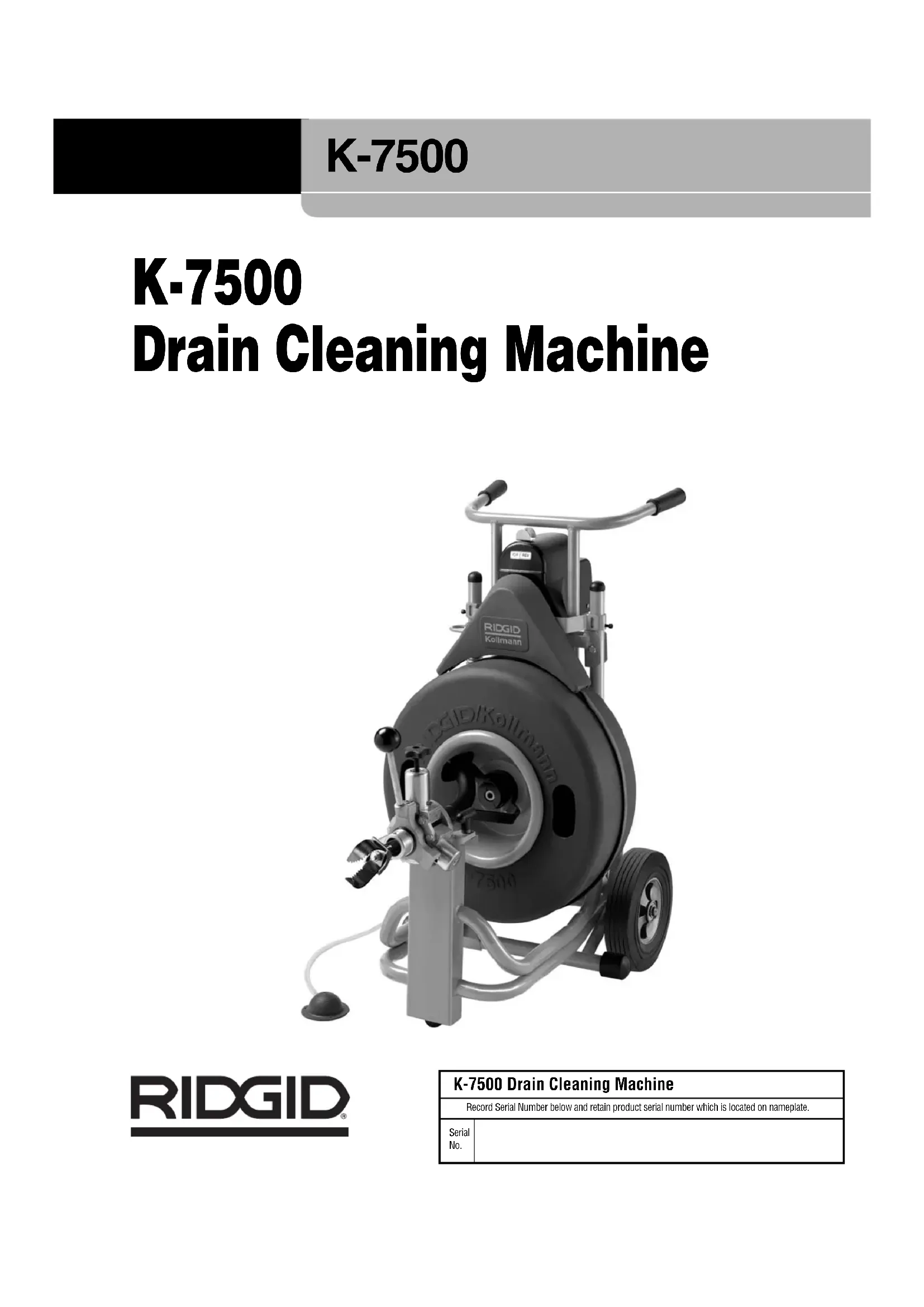


| Product type | Drain cleaning machine |
| Brand | Ridgid |
| Model | K7500 |
| Recommended pipe diameter | 4 to 10 inches (10 to 25 cm) |
| Maximum pipe length | 250 feet (76.2 m) |
| Drum capacity | 125 feet (38.1 m) of 3/4 in cable or 150 feet (45.7 m) of 5/8 in cable |
| Motor | Universal reversible, 115 V, 60 Hz, 6.0 A |
| Power | 4/10 HP (0.4 hp) at 200 rpm |
| Weight (machine only) | 116 lb (52.6 kg) |
| Width | 21 in (53.3 cm) |
| Length | 31 in (78.7 cm) |
| Drive system | Autofeed (automatic) or manual depending on version |
| Control | Pneumatic foot pedal |
| Rotation direction | Forward and reverse (for clearing blockages) |
| Safety | Ground fault circuit interrupter (GFCI) integrated in the power cord |
| Protection | Stabilizing leg |
| Compatible cables | 5/8 in and 3/4 in quick-connect cables |
| Included tools | Sink cutters, spear blades, retrieval drill, double cutters, etc. |
| Optional accessories | Additional drum, cable guide, Autofeed system |
| Maintenance | Rinse with water, lubricate mechanisms, inspect cables |
| Warranty | Ridgid Lifetime Warranty |
| Use | For clogged drains, sewers, septic tanks |
| Storage | Indoors, out of reach of children |
Frequently Asked Questions - K7500 RIDGID
User questions about K7500 RIDGID
0 question about this device. Answer the ones you know or ask your own.
Ask a new question about this device
Download the instructions for your Drain cleaning machine in PDF format for free! Find your manual K7500 - RIDGID and take your electronic device back in hand. On this page are published all the documents necessary for the use of your device. K7500 by RIDGID.
USER MANUAL K7500 RIDGID
Drain Cleaning Machine

WARNING!
Read this Operator's Manual carefully before using this tool. Failure to understand and follow the contents of this manual may result in extensive property damage and/or serious personal injury.
Francais-19
Castellano-pag.39
Table of Contents
Recording Form for Machine Serial Number 1
General Safety
Work Area Safety 2
Electrical Safety 2
Personal Safety 2
Tool Use and Care 3
Service 3
Specific Safety Information
Drain Cleaner Safety 3
Description, Specifications and Standard Equipment
Description 4
Specifications 4
Standard Equipment 4
Cables and Flexible Leaders 5
Tools and Replacement Blades 5
Machine Assembly
Instructions for Installing Handle 5
Instructions For Installing AUTOFEED 6
Instructions for Installing Cable 6
Connecting/Disconnecting 5 / 8 and 3 / 4 Drum Machine Cable Couplings .6
Machine Inspection 7
Machine Set-Up 7
Operating Instructions
Using AUTOFEED Machine 9
Using Manual Feed Machine 10
Special Applications Procedure
Main Sewer or Septic Tank Overrun 11
Reverse Operation 11
Loading the Machine On Vehicle 11
Draining Drum 11
AUTOFEED Adjustment Procedure 12
Operating Machine In Reclined Position 13
Drum Assembly Removal and Installation 13
Installing Extra Drum (Additional Cable) 14
Pigtail Removal and installation 14
Proper Tool Selection. 15
Accessories 15
Maintenance Instructions
AUTOFEED Assembly 15
Lubrication 16
Cables 16
Machine Storage 16
Service and Repair 16
Troubleshooting 17
Wiring Diagram 17
Lifetime Warranty. Back Cover
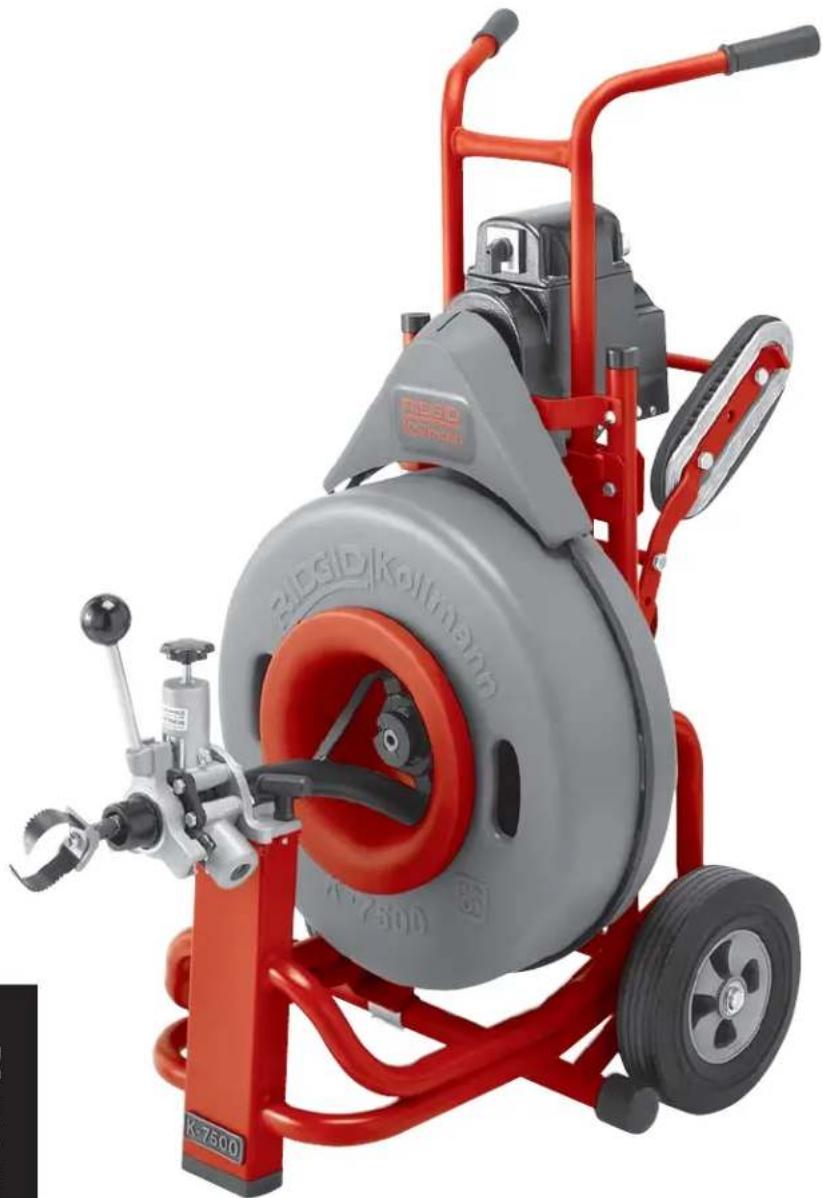
K-7500 Drain Cleaning Machine
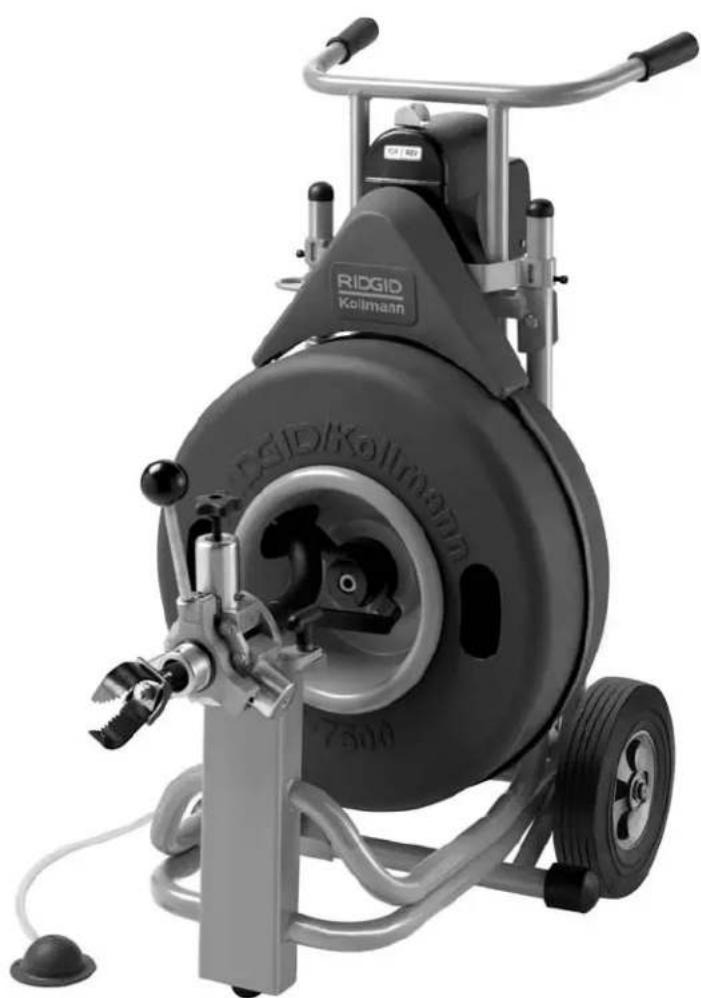
RIDGID
| K-7500 Drain Cleaning Machine | |
| Record Serial Number below and retain product serial number which is located on nameplate. | |
| Serial No. | |
General Safety Information
WARNING! Read and understand all instructions. Failure to follow all instructions listed below may result in electric shock, fire, and/or serious personal injury.
SAVE THESE INSTRUCTIONS!
Work Area Safety
- Keep your work area clean and well lit. Cluttered benches and dark areas invite accidents.
- Do not operate tools in explosive atmospheres, such as in the presence of flammable liquids, gases, or dust. Tools create sparks which may ignite the dust or fumes.
- Keep bystanders, children, and visitors away while operating a tool. Distractions can cause you to lose control.
Electrical Safety
- Grounded tools must be plugged into an outlet, properly installed and grounded in accordance with all codes and ordinances. Never remove the grounding prong or modify the plug in any way. Do not use any adapter plugs. Check with a qualified electrician if you are in doubt as to whether the outlet is properly grounded. If the tools should electrically malfunction or break down, grounding provides a low resistance path to carry electricity away from the user.

- Avoid body contact with grounded surfaces such as pipes, radiators, ranges and refrigerators. There is an increased risk of electrical shock if your body is grounded.
- Don't expose electrical tools to rain or wet conditions. Water entering a power tool will increase the risk of electrical shock.
-
Do not abuse cord. Never use the cord to carry the tools or pull the plug from an outlet. Keep cord away from heat, oil, sharp edges or moving parts. Replace damaged cords immediately. Damaged cords increase the risk of electrical shock.
-
When operating a tool outside, use an outdoor extension cord marked "W-A" or "W". These cords are rated for outdoor use and reduce the risk of electrical shock.
- Use only three-wire extension cords which have three-prong grounding plugs and three-pole receptacles which accept the machine's plug. Use of other extension cords will not ground the tool and increase the risk of electrical shock.
- Use proper extension cords. (See chart.) Insufficient conductor size will cause excessive voltage drop and loss of power.
| Minimum Wire Gauge for Extension Cord | ||
| Nameplate Amps | Total Length (in feet) | |
| 0 - 25 26 - 50 51 - 100 | ||
| 0 - 6 18 AWG 16 AWG 16 AWG | ||
| 6 - 10 18 AWG 16 AWG 14 AWG | ||
| 10 - 12 16 AWG 16 AWG 14 AWG | ||
| 12 - 16 14 AWG 12 AWG | NOT RECOMMENDED | |
- Before using, test the Ground Fault Circuit Interru-. rpter (GFCI) provided with the power cord to insure it is operating correctly. GFCI reduces the risk of electrical shock.
- Extension cords are not recommended unless they are plugged into a Ground Fault Circuit Interru-. rpter (GFCI) found in circuit boxes or receptacles. The GFCI on the machine power cord will not prevent electrical shock from the extension cords.
- Keep all electrical connections dry and off the ground. Do not touch plug with wet hands. Reduces the risk of electrical shock.
Personal Safety
- Stay alert, watch what you are doing and use common sense when operating a power tool. Do not use tool while tired or under the influence of drugs, alcohol, or medications. A moment of inattention while operating power tools may result in serious personal injury.
- Dress properly. Do not wear loose clothing or jewelry. Contain long hair. Keep your hair and clothing away from moving parts. Loose clothes, jewelry, or long hair can be caught in moving parts.
-
Avoid accidental starting. Be sure switch is OFF before plugging in. Carrying tools with your finger on the switch or plugging tools in that have the switch ON invites accidents.
-
Remove adjusting keys or wrenches before turning the tool ON. A wrench or a key that is left attached to a rotating part of the tool may result in personal injury.
- Do not over-reach. Keep proper footing and balance at all times. Proper footing and balance enables better control of the tool in unexpected situations.
- Use safety equipment. Always wear eye protection. Dust mask, non-skid safety shoes, hard hat, or hearing protection must be used for appropriate conditions.
Tool Use and Care
- Use clamp or other practical way to secure and support the workpiece to a stable platform. Holding the work by hand or against your body is unstable and may lead to loss of control.
- Do not force tool. Use the correct tool for your application. The correct tool will do the job better and safer at the rate for which it is designed.
- Do not use tool if switch does not turn it ON or OFF. Any tool that cannot be controlled with the switch is dangerous and must be repaired.
- Disconnect the plug from the power source before making any adjustments, changing accessories, or storing the tool. Such preventive safety measures reduce the risk of starting the tool accidentally.
- Store idle tools out of the reach of children and other untrained persons. Tools are dangerous in the hands of untrained users.
- Maintain tools with care. Keep cutting tools sharp and clean. Properly maintained tools with sharp cutting edges are less likely to bind and are easier to control.
- Check for misalignment or binding of moving parts, breakage of parts, and any other condition that may affect the tool's operation. If damaged, have the tool serviced before using. Many accidents are caused by poorly maintained tools.
- Use only accessories that are recommended by the manufacturer for your model. Accessories that may be suitable for one tool may become hazardous when used on another tool.
- Keep handles dry and clean; free from oil and grease. Allows for better control of the tool.
Service
-
Tool service must be performed only by qualified repair personnel. Service or maintenance performed by unqualified repair personnel could result in injury.
-
When servicing a tool, use only identical replacement parts. Follow instructions in the Maintenance Section of this manual. Use of unauthorized parts or failure to follow maintenance instructions may create a risk of electrical shock or injury.
Specific Safety Information
WARNING
Read this Operator's Manual carefully before using the RIDGID K-7500 Drain Cleaner. Failure to understand and follow the contents of this manual may result in electrical shock, fire and/or severe personal injury.
Call the Ridge Tool Company, Technical Service Department at (800) 519-3456 if you have any questions.
Drain Cleaner Safety
- Wear gloves provided with the machine. Never grasp a rotating cable with a rag or loose fitting cloth glove. Could become wrapped around the cable and cause serious injury.
- Do not overstress cables. Keep one hand on the cable for control when the machine is running. Overstressing cables because of obstruction may cause twisting or kinking or breaking of the cable and result in serious injury.
- Position machine within three feet of inlet. Use Front Guide Hose or properly support exposed cable when it is difficult to locate the machine near the access or clean out. Greater distances can result in cable twisting, kinking or control problems.
-
The K-7500 is designed for one-person operation. Operator must control foot switch and cable.
-
Use foot switch to operate K-7500 while maintaining good footing and balance. Do not operate machine in (REV) reverse. Operating machine in reverse can result in cable damage and is used only to briefly back tool out of an obstruction.
-
Keep hands away from rotating drum and guide tube. Do not reach into drum unless machine is unplugged. Hand may be caught in the moving parts resulting in serious injury.
- Use kickstand during operation. The kickstand stabilizes machine to prevent tipping.
-
Be careful when cleaning drains where cleaning compounds have been used. Avoid direct contact with skin and eyes. Serious burns can result from some drain cleaning compounds.
-
Do not operate machine if operator or machine is standing in water. Will increase the risk of electrical shock.
- Wear safety glasses and rubber soled, non-slip shoes. Use of this safety equipment may prevent serious injury.
- Only use the K-7500 to clean drain lines 4^ to 10^ in diameter. Follow instructions on the use of the machine. Other uses or modifying the drain cleaner for other applications may increase the risk of injury.
Description, Specifications and Standard Equipment
Description
The RIDGID K-7500 Drain Cleaning Machine will clean drain lines 4^ to 10^ in diameter and up to 250 feet in length. The 4 / 10 HP universal motor spins 5 / 8^ and 3 / 4^ cable at 200 RPM. When the cable hits the blockage, the motor gears down automatically to deliver greater power and enhance operator control.
The molded polyethylene drum includes an inner drum that guards against cable flip over. An integral Ground Fault Interrupter (GFCI) is built into the line cord and a "kick-stand" base is provided for machine stability during operation. A pneumatic foot actuator provides ON/OFF control of the motor.
The drum powers a 5 / 8'' or 3 / 4'' cable that has a quick change coupling system for connecting or disconnecting tools. The cable is fed in an out of the drain by a AUTO- FEED^TM assembly at a rate of 0-28 feet/min.
Specifications
Line Capacity.Generally recommended for all drain lines 4^ to 10^ but depends on choice of cable. Refer to the following chart for specifics.
Figure 1
| Cable Size & Type | Recommended Line Size and Reach | |
| Line Size Reach | ||
| 5/8" Hollow-Core | 3" to 4" | 250' |
| 5/8" Inner-Core | 3" to 4" | 250' |
| 5/8" Solid Core | 3" to 6" | 250' |
| 3/4" Hollow-Core | 4" to 6" | 250' |
| 3/4" Inner-Core | 4" to 10" | 250' |
NOTE! 3/4" Inner-core is not recommended for use through P-Trap and severe bends in lines smaller than 4^ .
Drum Capacity 125' of 3 / 4'' Cable, 150' of 5 / 8'' Cable
Motor Type 115V 60Hz Reversible, Universal AC Motor
Rating: HP, 200 RPM
AMPS .6.0
Weight
(Machine Only). 116 lbs.
Width 21
Length 31
Standard Equipment
For 34'' Cable
- K-7500 Machine with AUTOFEED, toolbox and standard tools which include:
-1 Pair Work Gloves
-T-403 P-Trap Cutter, 3^
T-406 Spear Blade
T-407 Retrieving Auger
-T-408 Sawtooth Cutter
-T-411 Double Cutter, 2^
-T-413 Double Cutter, 3^
T-414-B Double Cutter Blade Only, 4^ - T-416-B Double Cutter Blade Only, 6"
-T-468 3/4" Flexible Leader -
4 Spacers for AUTOFEED adjustment
-3/16" Hex Key -
K-7500 Machine with AUTOFEED, toolbox, standard tools and C-100 Cable (3 / 4^ × 100^ Inner-Core)
- K-7500 Machine with AUTOFEED, toolbox, standard tools and C-75 Cable (1 / 4^ × 75^ Inner-Core)
K-7500 Machine with AUTOFEED, toolbox, standard tools and C-100 Cable HC (14'' × 100' Hollow-Core)
K-7500 Machine with manual feed, standard tools
K-7500 Machine with manual feed, toolbox, standard tools and C-100 Cable (14'' × 100' Inner-Core)
K-7500 Machine with manual feed, toolbox, standard tools and C-100 HC Cable (14'' × 100' Hollow-Core)
For 5 / 8'' Cable
-
K-7500 Machine with AUTOFEED, toolbox and standard tools which include:
-1 Pair Work Gloves
-T-403 P-Trap Cutter, 3^
T-406 Spear Blade
T-407 Retrieving Auger
T-408 Sawtooth Cutter
-T-411 Double Cutter, 2^
-T-413 Double Cutter, 3^
T-414-B Double Cutter Blade Only, 4^
T-458 Flexible Leader
-³/16" Hex Key -
K-7500 Machine with AUTOFEED, toolbox, standard tools and C-24 Cable (5 / 8^ × 100^ Inner-Core)
Cables and Flexible Leaders
| Catalog No. | Model No. | Description | |
| 5/8" (16mm) | 92460 | C-25 | 25' I.C. Cable (7,6m) |
| 92465 | C-26 | 50' I.C. Cable (15,2m) | |
| 92470 | C-27 | 75' I.C. Cable (22,9m) | |
| 43647 | C-24 | 100' I.C. Cable (30,5m) | |
| 5/8" (16mm) | 32737 | C-27HC | 75' Hollow-Core (22,9m) |
| 58192 | C-24HC | 100' Hollow-Core (30,5m) | |
| 5/8" (16mm) | 95762 | C-25 IW | 25' I.W. Cable (7,6m) |
| 95757 | C-26 IW | 50' I.W. Cable (15,2m) | |
| 95752 | C-27 IW | 75' I.W. Cable (22,9m) | |
| 95747 | C-24 IW | 100' I.W. Cable (30,5m) | |
| 5/8" (16mm) | 92475 | C-28 | 25' I.C. Cable (7,6m) |
| 92480 | C-29 | 50' I.C. Cable (15,2m) | |
| 41212 | C-75 | 75' I.C. Cable (22,9m) | |
| 41697 | C-100 | 100' I.C. Cable (30,5m) | |
| 4/4" (20mm) | 47427 | C-75HC | 75' Hollow-Core (22,9m) |
| 47432 | C-100HC | 100' Hollow-Core (30,5m) | |
| 3/4" (20mm) | 92555 | T-458 | 5/8" x 2' Leader |
| 92560 | T-468 | 3/4" x 2' Leader | |
| 4/4" (20mm) | 44122 | — | 5/8" Pigtail |
| 44117 | — | 3/4" Pigtail |
Tools and Replacement Blades — Fits C-24, C-25, C-26, C-27, C-28, C-29, C-75, C-100, C-24HC, C-27HC, C-75HC and C-100HC
| Catalog No. | Model No. | Description | Replacement | ||
| Blade(s) | Holder* | ||||
| 92485 | T-403 | P-Trap Cutter, 3" | 92835 | 92900 | |
| 92490 | T-404 | P-Trap Cutter, 31/2" | 92840 | 92900 | |
| 92495 | T-406 | Spear Blade | 92850 | 92915 | |
| 92500 | T-407 | Retrieving Auger | — | — | |
| 92505 | T-408 | Sawtooth Cutter | 92890 | 92915 | |
| 51762 | T-409 | H-D Bulb Auger | — | — | |
| 92510 | T-411 | Double Cutter, 2" | 92815 | 92905 | |
| 92515 | T-412 | Double Cutter, 21/2" | 92820 | 92905 | |
| 92520 | T-413 | Double Cutter, 3" | 92825 | 92910 | |
| 92525 | T-414 | Double Cutter, 4" | 92830 | 92910 | |
| 92530 | T-416 | Double Cutter, 6" | 92855 | 92910 | |
| 92535 | T-432 | 3-Blade Cutter, 2" | 92860 | 92895 | |
| 92540 | T-433 | 3-Blade Cutter, 3" | 92865 | 92895 | |
| 92545 | T-434 | 3-Blade Cutter, 4" | 92870 | 92895 | |
| 92550 | T-436 | 3-Blade Cutter, 6" | 92875 | 92895 | |
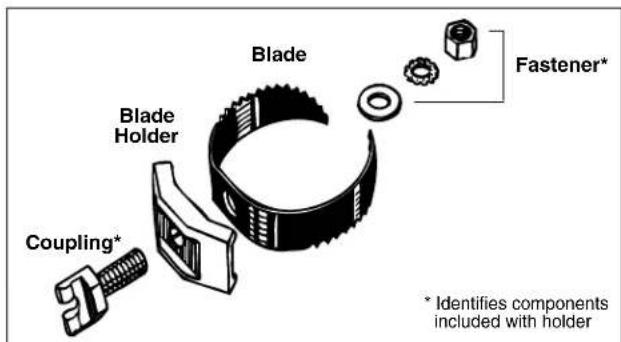
Figure 2 - Tool Assembly
Machine Assembly
WARNING
To prevent serious injury, proper assembly of the Drain Cleaner is required. The following procedures should be followed:
Instructions for Installing Handle
Raise the stair climber to the upper position by pulling out the locking pin and lifting the stair climber by the cross member until the pin locks into the upper position (Figure 3). Insert handle through the motor table rail supports and through the two holes on rear support (Figure 4). Insert the two hairpin cotter fasteners through the holes in the bottom of the handle (Figure 5). Adjust handle to desired height. Securely tighten the two T-shaped mounting knobs on rear support. Lower the stair climber.
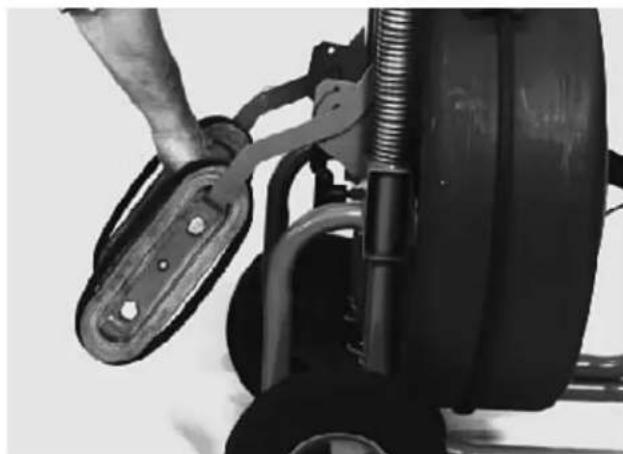
Figure 3 - Raising Stair Climbers

Figure 4-Inserting Handle

Figure 5 - Secure Handles with Cotter Pins. Tighten Two (2) "T" Shaped Knobs
Instructions for Installing AUTOFEED
Loosen the knob on the top bearing housing and slide the AUTOFEED onto the pigtail. Secure the AUTOFEED by tightening the T-shaped mounting knobs.
Instructions for Installing Cable
CAUTION Do not remove bands or staples from cable shipping carton. Cable is under tension and will whip, causing injury.
Retrieve end of cable through the center hole of carton and remove enough cable to connect with drum pigtail. Connect the male coupling of the cable to the pigtail coupling (see Figure 6). Confirm connection is secure. Feed cable into drum.
Connecting/Disconnecting 5/8" and 3/4" Drum Machine Cable Couplings
Keep couplings clean and lubricated. Plunger pin must move freely and fully extend to secure connection.
New style - Plunger pin
Screwdriver required.
Connecting

1
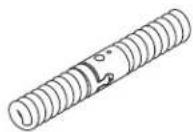
- Slide the couplings together. If needed, depress plunger pin.
- Confirm connection is secure. (plunger pin fully extended).
Disconnecting


2

3a

3b
- Insert the screwdriver to depress the plunger pin.
- Push the couplings apart until the male coupling contacts the screwdriver.
- Remove the screwdriver and push the couplings apart.
Old style - Rotating pin
Screwdriver required.
Connecting
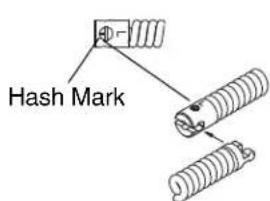

- Slide the couplings together.
- Rotate pin so hash mark is away from end of cable (towards "L" stamped on coupling). Confirm connection is secure.
Disconnecting

Figure 6
- Rotate pin so hash mark is towards end of cable (away from "L" stamped on coupling).
- Push the couplings apart.
Machine Inspection
WARNING

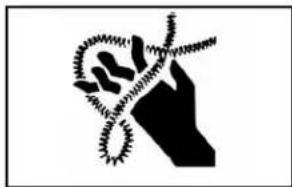
To prevent serious injury, inspect your Drain Cleaning Machine. The following inspection procedures should be performed before each use.
- Make sure the Drain Cleaning Machine is unplugged and the directional switch is set to the OFF position.
- Make sure the foot switch is present and attached to the Drain Cleaning Machine (Figure 10). Do not operate the Drain Cleaning Machine without a foot switch.
- Check the belt guard to ensure that it avoids contact with the drum when drum is rotating. Reposition guard if necessary and tighten bolts. Gap between belt guard and drum should not exceed 1/2'' .
- Inspect the power cord, Ground Fault Circuit Interru-. rpter (GFCI) and plug for damage. If the plug has been modified, is missing the grounding prong drum or if the cord is damaged, do not use the Drain Cleaning Machine until the cord has been replaced.
- Check the rear support bolt that fastens the drum assembly to the machine frame is securely tightened (Figure 7).
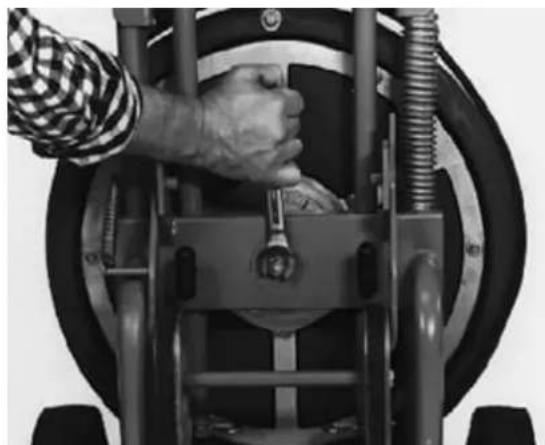
WARNING Unsecured drum assembly could result in serious injury and machine damage.
Figure 7 - Check Bolt to Ensure Tightness
- Inspect the Drain Cleaning Machine for any broken, missing, misaligned or binding parts as well as any
other conditions which may affect the safe and normal operation of the machine. If any of these conditions are present, do not use the Drain Cleaning Machine until any problem has been repaired.
- Lubricate the Drain Cleaning Machine, if necessary, according to the Maintenance Instructions.
- Use tools and accessories that are designed for your drain cleaner and meet the needs of your application. The correct tools and accessories will allow you to do the job successfully and safely. Accessories suitable for use with other equipment may be hazardous when used with this drain cleaner.
- Clean any oil, grease or dirt from all equipment handles and controls. This reduces the risk of injury due to a tool or control slipping from your grip.
- Inspect the cutting edges of your tools. If necessary, have them sharpened or replaced prior to using the Drain Cleaning Machine. Dull or damaged cutting tools can lead to binding and cable breakage.
- Inspect cables and couplings for wear and damage. Cables should be replaced when they become severely worn or corroded. A worn cable can be identified when the outside coils become flat.
WARNING Worn or damaged cables can break causing serious injury.
Machine Set-Up
WARNING


To prevent serious injury, proper set-up of the machine and work area is required. The following procedures should be followed to set-up the machine:
-
Check work area for:
-
Adequate lighting
Grounded electrical outlet - Clear path to the electrical outlet that does not contain any sources of heat or oil, sharp edges or moving parts that may damage electrical cord.
- Dry place for machine and operator. Do not place the machine in water.
-
Flammable liquids, vapors or dust that may ignite.
-
Position the Drain Cleaning Machine within 3^ of sewer inlet.
WARNING If sewer inlet is greater than 3^ from the front of the machine, the cable will have a greater tendency to twist or kink. Use a front guide hose or properly support exposed cable.
3. Set the spring loaded kickstand bar by tilting the machine forward to allow the bar to pivot behind the tires (Figure 8). Make sure the machine rests firmly on the bar before continuing. The tires should not contact the ground.

Figure 8 - Setting Kickstand Bar
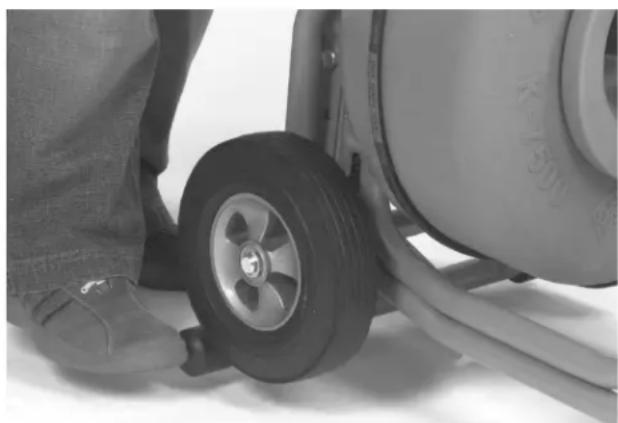
Figure 9 - Releasing Kickstand Bar
WARNING To prevent tipping during use, machine should rest firmly on the kickstand.
- Position the air foot switch pedal for easy operator accessibility. Machine is designed for one person operation (Figure 9).
-
Make sure FOR/OFF/REV switch is in the OFF position.
-
Select and install the proper tool/cutter to the end of the cable. Securely install tool on the end of the cable (See Figure 6). If the connection is not secure, the cutting tool may fall off in use.
NOTE! 3 / 4'' inner core cables are not recommended for use through P- traps and sewer bends in lines smaller than 4^ .For larger lines, flexible leaders should be used to negotiate traps. Failure to use flexible leaders may result in cable damage. - Plug the Drain Cleaning Machine into the electrical outlet, making sure to position the power cord along the clear path selected earlier. If the power cord does not reach the outlet, use an extension cord in good condition.
A WARNING To avoid electric shock and electrical fires, never use an extension cord that is damaged or does not meet the following requirements:
- The cord has a three-prong plug similar to shown in Electrical Safety section.
- The cord is rated as "W" or "W-A" if being used outdoors.
- The cord has sufficient wire thickness (16 AWG below 50^ / 14 AWG 50^ - 100^ ). If the wire thickness is too small, the cord may overheat, melting the cord's insulation or causing nearby objects to ignite.
WARNING To reduce risk of electrical shock, keep all electrical connections dry and off the ground. Do not touch plug with wet hands. Test the Ground Fault Circuit Interrueter (GFCI) provided with the electric cord to insure it is operating correctly. When test button is pushed in, the indicator light should go off. Reactivate by pushing the reset button in. If indicator light goes on, the machine is ready to use. If the GFCI does not function correctly, do not use the machine.
Operating Instructions

Wear gloves provided with machine. Never grasp a rotating cable with a rag or loose fitting cloth glove that may become wrapped around the cable causing serious injury.
Always wear eye protection to protect your eyes against dirt and other foreign objects. Wear rubber soled, non-slip shoes.
Be very careful when cleaning drains where cleaning compounds have been used. Avoid direct contact to the skin and especially the eyes and facial area as serious burns can result.
WARNING Always assume the correct operating posture in order to maintain proper balance (Figure 10). Should an unexpected situation arise, this posture provides you with the opportunity to safely keep control of the machine and cable.
- Be sure you can quickly remove your foot from the foot switch.
- Hand must be on the cable to control its twisting action when it hits an obstruction.
- Keep hands away from rotating guide tube and drum. Do not reach into drum unless machine is unplugged.
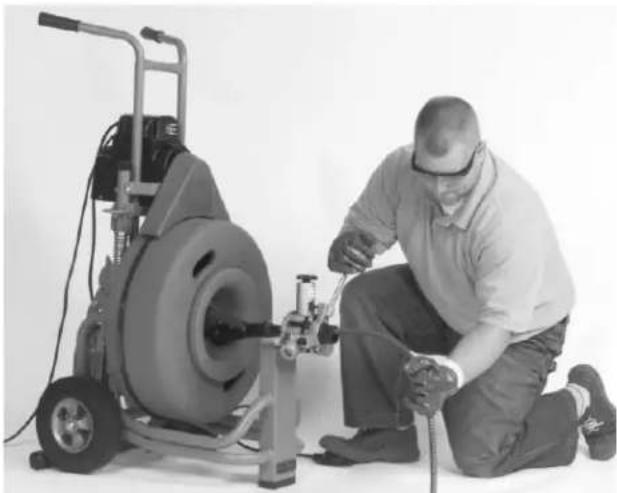
Figure 10 - Proper Operating Position
Using AUTOFEED Machine
- Loosen the feed knob to ensure AUTOFEED is not engaged. Manually pull a sufficient length of cable out of the drum and manually push the tool and cable into the sewer inlet.
- Move FOR/OFF/REV switch into FOR (forward) position. Do not step on the air foot switch pedal at this time.
- To use auto feed, turn feed knob down until top bearing makes contact with the cable; then turn one full additional turn. Do not over-tighten.
WARNING
Before starting machine, operator's gloved hand must be on the cable.
- Exert sufficient downward pressure on cable to keep it in sewer line while depressing air foot switch pedal to start cable rotating.
- Move the feed lever in the opposite direction of the rotating drum to advance the cable (Figure 10). The rate at which the cable is fed (0 - 28' per minute) into the sewer is controlled by the position of the feed lever away from neutral (vertical) position. The further from vertical, the faster the feed rate. Always keep one hand on the cable to feel tension.
- Continue to feed the cable into the line until resistance or obstruction is encountered. This condition will generally become apparent to the operator as the motor will "lug" down and/or the cable will have a tendency to twist sideways in the operator's hands.
If the cable shows signs that the cutter has stopped rotating fully reverse feed lever (move handle in the same direction of the drum rotation) to back the cutter away and to relieve the load. Gradually feed the cable into the obstruction, allowing cutter to advance slowly. Occasionally move AUTOFEED lever to neutral to allow cutter to work through the obstruction. Repeat this process until the obstruction is clear. Remember, make sure the cutters are rotating at all times and never force the cable.
TIP: If cable continues to get hung up in blockage, discontinue use of the auto feed and work cable by hand.
7. Once flow is established, use running water to wash debris and roots down the drain while finishing the job.
WARNING
Do not allow tension to build up in the cable. This will happen if the cutting tool hits a snag and stops turning, but the motor and its drum continue to rotate. Torque builds until the cable suddenly twists, potentially wrapping around your hand or arm. This can happen quickly without warning, so proceed slowly and carefully as you feed the cable into the drain. If tool gets hung up in an obstruction, refer to Reverse Operating Instructions in the "Special Procedures Section".

Figure 11 - Feed Lever Operation
- Several passes at thoroughly blocked drain lines are recommended. Start with a grease cutter or 2^ blade or a blade typically 2^ smaller than the drain size. After establishing drain flow, increase cutter size to thoroughly clean the lines.
TIP: Know approximately where you are going. Over running cable into city sewers septic tanks can cause cable damage and retrieval problems.
NOTE! Additional cable may be added if required. Refer to Special Applications Procedure section. - To retrieve the cable from the sewer line, move the AUTOFEED handle in the same direction of the drum rotation.
CAUTION Do not put the machine in reverse. The machine should be kept running during the retrieval process for thorough cleaning.
NOTE! A continuous flush of water should be used to clean the cable and tool as they are retrieved. - When the tool is inside the sewer inlet, release the air foot switch pedal and allow the machine to come to a complete stop.
WARNING Never retract tool from sewer inlet while cable is rotating. Tool can whip causing serious injury. - Tum FOR/OFF/REV switch to OFF position and remove cord from power source.
- Loosen the feed knob and pull the remaining cable and tool from the sewer. Hand feed the cable into the machine.
- Disengage the spring loaded kickstand bar by tilting the machine forward and forcing the bar forward of the tires (Figure 8).
Using Manual Feed Machine
- Manually pull a sufficient length of cable out of the drum to form a slight loop and push the tool and cable into the sewer inlet. Apply downward pressure with both hands on cable.
NOTE! Do not force cable. Allow it to feed itself into the drain.
2. Move FOR/OFF/REV switch into FOR (forward) position.
WARNING
Before starting machine, operator's gloved hand must be on the cable.
- Exert sufficient downward pressure on cable to keep it in sewer line while depressing air foot switch pedal to start cable rotating.
- Pull cable out of drum and allow cable to feed itself into the line. Always keep hand on the cable to feel the tension.
- Continue to feed the cable into the line until resistance or obstruction is encountered. The condition will generally become apparent to the operator as the motor will "lug" down and/or the cable will have a tendency to twist sideways in the operator's hands.
If the cable shows signs that the cutter has stopped rotating, pull back sharply on the cable to free the cutter and relieve the load on the cable. Slowly advance the cable back into the obstruction. Repeat this process until the obstruction is clear. Remember, make sure the cutter is rotating at all times and never force the cable.
- Once flow is established, use running water to wash debris and roots down the drain while finishing the job.
WARNING
Do not allow tension to build up in the cable. This will happen if the cutting tool hits a snag and stops turning, but the motor and its drum continue to rotate. Torque builds until the cable suddenly twists, potentially wrapping around your hand or arm. This can happen quickly without warning, so proceed slowly and carefully as you feed the cable into the drain. If tool gets hung up in an obstruction, refer to Reverse Operating Instructions in the "Special Procedures Section".
- Several passes at thoroughly blocked drain lines are recommended. Start with a grease cutter or 2^ blade, or a blade typically 2^ smaller than the drain size. After establishing drain flow, increase cutter size to thoroughly clean the lines.
TIP: Know approximately where you are going. Over running cable into city sewers or septic tanks can cause cable damage and retrieval problems.
NOTE! Additional cable may be added if required. Refer to Special Applications Procedure section.
CAUTION Do not put the machine in reverse. The machine should be kept running during the retrieval process for thorough cleaning.
NOTE! A continuous flush of water should be used to clean the cable and tool as they are retrieved.
- When the tool is just inside the sewer inlet, release the air foot switch pedal and allow the machine to come to a complete stop.
WARNING Never retract tool from sewer inlet while cable is rotating. Tool can whip causing serious injury.
9. Turn FOR/OFF/REV switch to OFF position and remove cord from power source.
10. Pull the remaining cable and tool from the sewer and feed into the machine.
11. Disengage the spring loaded kickstand bar by tilting the machine forward, forcing the bar forward of the tires (Figure 9).
Special Procedures
Main Sewer Or Septic Tank Overrun
It is very important to know the approximate distance from inlet to main sewer or septic tank. Over-running cable too far into main sewer or septic tank can allow cables to knot-up and prevent their return through small lines.
Reverse Operation
Running machine in reverse will cause premature failure of cable. Use reverse only to free a tool caught in an obstruction. If this should occur, immediately remove foot from air foot switch pedal and allow machine to come to a full and complete stop. Place FOR/OFF/REV switch to REV (reverse) position. If machine has automatic feed, loosen feed knob. Grasp cable with gloved hands and pull while jogging air foot switch pedal. When tool is dislodged and drum has stopped rotating, place FOR/OFF/REV switch in FOR (forward) position and follow normal operating procedure.
WARNING Never operate this machine in REV (reverse) for any other purpose. Operating in reverse can damage a cable and cause serious injury.
Loading The Machine On Vehicle
The stair climber can be raised from the lower position (used to move the machine up and down stairs) to the upper position (used to load the machine onto truck beds). To place the stair climber in the upper position, raise the stir climber by pulling out the locking pin and lifting the cross member until the pin locks in the upper position. Tip the machine backwards and rest the stair climbers on the truck bed. Lift up on the front of the machine and slide it onto the truck (Figure 12).
WARNING Use proper lifting technique - lift with your legs, not your back!!
NOTE! Take care not to damage electrical cord or air foot switch hose.

Figure 12-Lifting Unit Onto Vehicle
Draining The Drum
Water can be drained from the drum by removing the screw plug located in the rear of the drum (Figure 13) and resting the machine on its back. Be sure the screw drain plug is replaced before transporting the machine.

Figure 13 - Drum Drain Hole
AUTOFEED Adjustment Procedure
- The K-7500 AUTOFEED comes from the factory set-up to run the cable size you selected for your machine (18'' or 14'' ). If the operator wishes to change cable size, adjust the AUTOFEED by following Steps 2-9.
- Make sure FOR/OFF/REV switch is in the OFF position and machine is unplugged from power source.
- Remove tool from cable. Loosen the knob on the top bearing housing until the cable can slide freely in and out of the drum.
- Loosen both T-shaped mounting knobs until the AUTOFEED can slide off the machine.
NOTE! It is not necessary to completely remove the mounting knobs from their base (Figure 14).
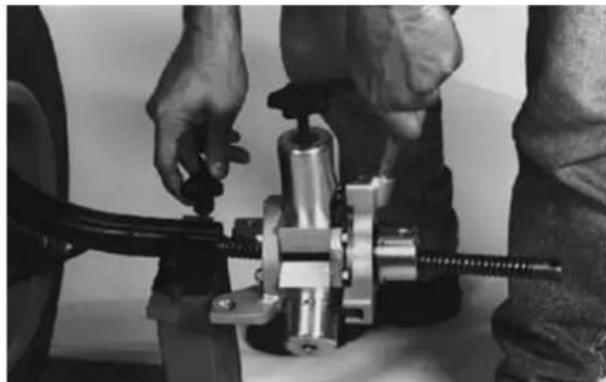
Figure 14 - Removing AUTOFEED
- Put the AUTOFEED handle in the vertical position. Remove the top bolt on one of the lower bearing holder housings (Figure 15).
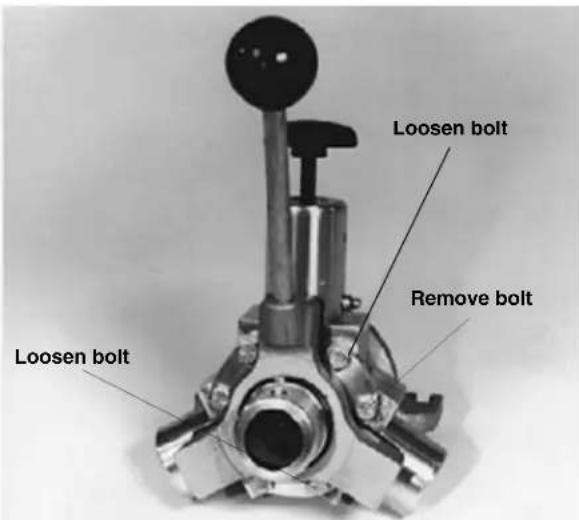
Figure 15 - Removing/Loosening Bolts
Loosen slightly the lower bolt. Pivot the bearing holder housing downward until the actuator pin is free of the actuator plate (Figure 16).
NOTE! The housing will pivot easier if the bolts on the top bearing holder housing are loosened slightly.
6. Unscrew the actuator pin and then remove the bearing holder from the housing.
7A. If changing from 3/4'' to 5/8'' cable: Insert two spacer washers into the bottom of the housing (Figure 17).
7B. If changing from 58'' to 34'' cable: Remove the two spacer washers in the bottom of the housing.

Figure 16 - Pivot Bearing Housing Downward
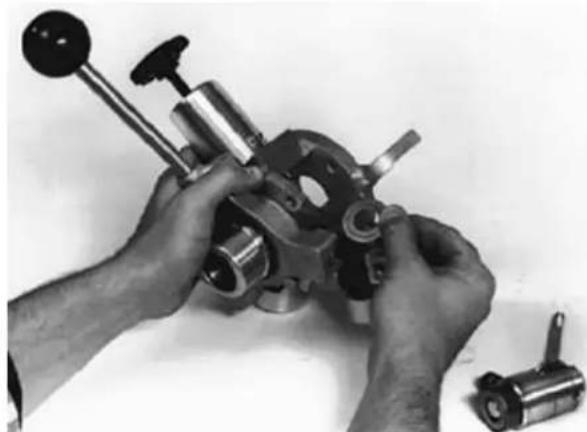
Figure 17 - Insert 2 Spacers for 5 / 8'' Cable
- Insert bearing holder into housing and replace actuator pin. Pivot the housing back into place making sure the actuator pin engages the slot on the actuator plate. Insert/tighten bolts.
- Repeat Steps 5-8 on the other lower bearing holder and housing.
- Grease all bearing housings via the grease fittings.
NOTE! When running 5 / 8'' cable, it is best to use a 5 / 8'' pigtail to avoid premature failure of the AUTO - FEED bearings. To change a pigtail, see Pigtail Removal and Installation section.
Operating Machine in Reclined Position
The machine can be operated in the reclined position to access overhead waste lines. The K-7500 provides two angles of operation. The lowest angle occurs when the machine rests on its handles. A more moderate angle of operation occurs when the machine rests on the stair climber in the upright position.
WARNING If sewer inlet is greater than 3^ from the front of the machine, the cable will have a greater tendency to twist or kink. Use a front guide hose or properly support exposed cable.
Drum Removal & Installation Procedure
WARNING
Make sure FOR/OFF/REV switch is in the OFF position and machine is unplugged from power source.
Removal
- Set kickstand in the operating position to keep the machine from moving.
- Loosen the top AUTOFEED knob to make sure the top bearing is not in contact with the cable and remove the cutter.
- Loosen the two T-shaped mounting knobs located on the drum side of the AUTOFEED assembly. It is not necessary to remove the knobs, just loosen enough to allow the AUTOFEED assembly to slide off the front support. Slide the assembly off the cable also.
- Push down on motor table handle to release belt tension and slip the belt off the drum (Figure 18).

Figure 18 - Release Belt Tension
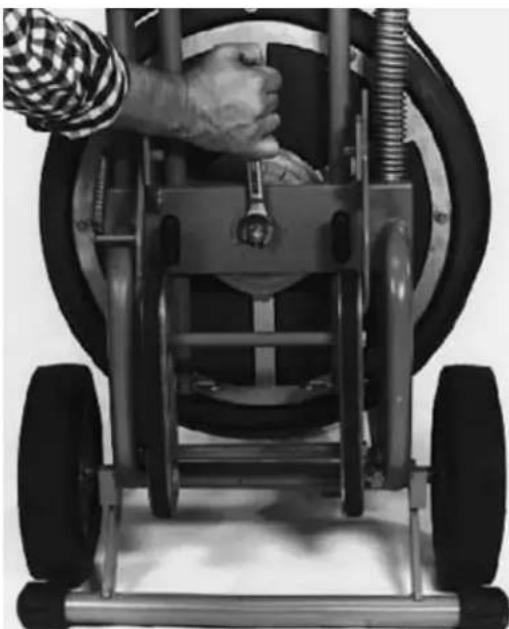
Figure 19 - Removing Rear Support Bolt
- At the back of the machine, remove the rear support bolt located in the center of the rear support. (This fastens the drum assembly to the machine frame) (Figure 19).
- The assembly can now be removed by grasping the drum via the holes on the drum front and sliding the assembly off the mounting boss.
NOTE! If the drum sticks on the mounting boss, tilt the machine forward until the drum slides off the mounting boss.
Installation
- Set the kickstand to keep machine from moving.
- Grasp the drum assembly via the holes on the drum front and lift the assembly onto the mounting boss located on the middle front of the frame.
WARNING Use proper lifting technique - lift with your legs, not your back!
An alternate method is to lift the drum assembly onto the frame with the casting hole near the mounting boss. Lower the machine onto its back. Grasp the drum via the holes and lift onto the mounting boss. Gently raise machine and follow Step 3 below (Figure 20).
- Reverse Steps 4-6 in the Removal Section. Make sure the rear support bolt is securely tightened before beginning operation.
Installing Extra Drum (Additional Cable)
The operator may wish to carry a second drum (minus the guide tube and inner drum) with cable for runs greater than 100' . For this application, the guide tube and inner drum can be removed from the original drum and installed on the extra drum.
- Set the kickstand to keep machine from moving.

Figure 20 - Lifting Drum Assembly Onto Frame
- Disconnect the original cable from the pigtail section. Secure the cable to keep it from falling into the drain.
- Remove the AUTOFEED assembly as described in Steps 3-4 of Drum Assembly Removal section.
- Remove the set screw on the knob on the center shaft. Unscrew knob and pull off shaft (Figure 21).

Figure 21 - Removing Knob From Center Shaft
- Pull the guide tube assembly off the shaft and off the cable (Figure 22).
- Remove the inner drum.
- Push down on motor table handle to release belt tension and slip belt off drum.
- At the back of the machine, remove the rear support bolt.
- Remove the drum from the mounting boss.
- Install the extra drum with cable by lifting it onto the mounting boss.

Figure 22 - Removing Guide Tube Assembly
- Reverse Steps 3-8. Be sure to place the cable through the inner drum before completing Step 6. Make sure the rear support bolt and the set screw on the knob on the center shaft (front of machine) are securely tightened before operation.
- Attach the cable from the extra drum to the cable in the drain.
Pigtail Removal And Installation
- Set the kickstand.
-
Remove all cable from the drum except the pigtail.
-
Remove the AUTOFEED assembly, guide tube, inner drum and main drum as described in Steps 3-9 in Installing Extra Drum (Additional Cable) section.
- Remove the bolt anchoring the pigtail. It is located on the back of the drum (Figure 23).

Figure 23 - Removing Pigtail Anchoring Bolt
- Remove the pigtail from drum and insert new pigtail into the drum.
- Align hole in pigtail fastener with the hole in the back of the drum. Insert bolt, washers and nut and tighten securely. Push the remainder of the pigtail into drum (Figure 24).
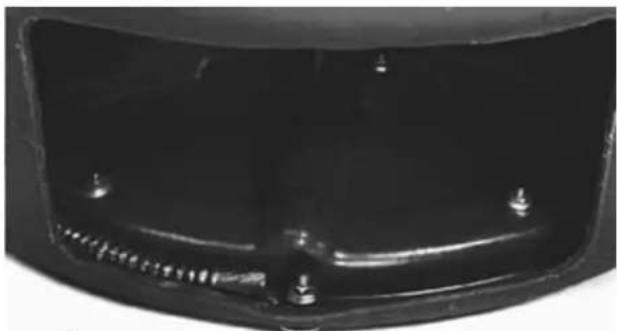
Figure 24 - Anchoring of Pigtail in Drum
- Install drum onto the mounting boss and insert rear support bolt. Securely tighten bolt.
- Grasp the end of pigtail and reverse Steps 3-7 in Installing Extra Drum (Additional Cable) section. Tighten all fasteners, especially the set screw on the knob on the center shaft.
Proper Tool Selection
A good rule of thumb is to make the first pass with either a spear cutter or blade cutter that is 2^ smaller than the drain size. For additional passes, larger tools may be used. However, tools should always be at least 1^ smaller than the drain size.
The style of the tool is determined by the nature of the job and is left to the discretion of the operator.
Flexible leaders should be used to negotiate bends and traps in lines.
Accessories
WARNING Only the following RIDGID products have been designed to function with the K-7500 Drain Cleaning Machine. Other accessories suitable for use with other tools may become hazardous when used on the K-7500. To prevent serious injury, use only the accessories listed below.
| Catalog No. | Description |
| 60042 | Drum Assembly w/ 3/1" Pigtail |
| 61107 | Drum Assembly w/ 5/1" Pigtail |
| 60047 | Drum Only |
| 60032 | AUTOFEED Assembly |
| 31487 | 5/8" Repair Splicer |
| 92805 | 5/8" Male Coupling |
| 92810 | 3/8" Female Coupling |
| 31492 | 3/4" Repair Splicer |
| 92880 | 3/4" Male Coupling |
| 92885 | 3/4" Female Coupling |
| 41937 | Pair of Work Gloves |
| 59360 | Tool Box |
| 49032 | Front Guide Hose Assembly |
| 59982 | Cable Rust Inhibitor, 1 Qt. |
| 59987 | Cable Rust Inhibitor, 1 Gal. |
Maintenance Instructions
WARNING
Make sure machine is unplugged from power source before performing maintenance or making any adjustment.
AUTOFEED Assembly
Proper cleaning and lubrication of the AUTOFEED is advised for long, trouble-free operation. After each use, hose out AUTOFEED with water and grease bearings.
Lubrication
Grease all exposed, moving and rotating parts as required.
Cables
Drain drum after every use. Flush drum periodically, remove sediment that can corrode cable.
Cables should be thoroughly flushed with water to prevent damaging effects of drain cleaning compounds. Periodically lubricate cables and couplings with RIDGID Cable Rust Inhibitor.
When not in use, store cables indoors to prevent deterioration by the elements.
Cables should be replaced when the become severely corroded or worn. A worn cable can be identified when outside coils of cable become flat.
Machine Storage
WARNING Motor-driven equipment must be kept indoors or well covered in rainy weather. Store the machine in a locked area that is out of reach of children and people unfamiliar with drain cleaners. This machine can cause serious injury in the hands of untrained users.
Service and Repair

WARNING
Other service and repair work on this Drain Cleaner must be performed only by qualified repair personnel. Drain Cleaner should be taken to a RIDGID Authorized Service Center or returned to the factory. When servicing this machine, only identical replacement parts should be used. Failure to follow these steps may create a risk of electrical shock or other serious injury.
For information on your nearest RIDGID® Independent Service Center or any service or repair questions:
- Contact your local RIDGID distributor.
- Visit www.RIDGID.com or www.RIDGID.eu to find your local RIDGID contact point.
- Contact Ridge Tool Technical Service Department at rtctechservices@emerson.com or in the U.S. and Canada call (800) 519-3456
Chart 1. Troubleshooting
| PROBLEM CAUSE CORRECTION | ||
| Cable kinking or breaking. | Cable is being forced. | Do Not Force Cable! Let the cutter do the work. |
| Cable used is incorrect pipe diameter. | Use 5/6" cables in 3" to 6" lines and use 1/4" cables in 4" to 10" lines. Use Trap Leader. | |
| Motor switched to reverse. | Use REVERSE only if cable gets caught in pipe. | |
| Cable exposed to acid. | Clean and oil cables routinely. | |
| Cable worn out. | If cable is worn, replace it. | |
| Drum stops while pedal is depressed. Restarts when pedal is re-pressed. | Hole in pedal or hose. | Replace damaged component. |
| Hole in diaphragm switch. | If no problem found with pedal or hose, replace diaphragm switch. | |
| Drum turns in one direction but not the other. | Faulty reverse switch. | Replace switch. |
| Ground fault Interruptions when machine is plugged in or when foot pedal is depressed. | Damaged power cord. | Replace cord set. |
| Short circuit in motor. | Take motor to authorized service center. | |
| Faulty Ground Fault Circuit Interruptions. | Replace cord set that includes a Ground Fault Circuit Interruptions. | |
| AUTOFEED does not work properly. | AUTOFEED is not routinely cleaned and fills with debris. | Disassemble AUTOFEED and clean monthly. |
| AUTOFEED is not greased enough. | Apply grease to fittings weekly. | |
| Machine wobbles or moves when cleaning a drain. | Kickstand not engaged. | Engage kickstand. |
| Set on level surface. | ||

Wiring Diagram
K-7500
CONSERVEZ CES INSTRUCTIONS!
ADVERTENCIA Los cables desgastados o dañadosSEOSEOSEOSEOSEOSEOSEOSEOSEOSEOSEOSEOSEOSEOSEOSEOSEOSEOSEOSEOSEOSEOSEOSEOSEOSEOSEOSEOSEOSEOSEOSEOSEOSEOSEOSEOSEOSEOSEOSEOSEOSEOSEOSEOSEOSEOSEOSEOSEOSEOSEOSEOSEOSEOSEOSEOSEOSEOSEOSEOSEOSEOSEOSEOSEOSEOSEOSEOSEOSEOSEOSEOSEOSEOSEOSEOSEOSEOSEOSEOSEOSEOSEOSEOSEOSEOSEOSEOSEOSEOSEOSEOSEOSEOSEOSEOSEOSEOSEOSEO SEO
RIDGID tools are warranted to be free of defects in workmanship and material.
How long coverage lasts
This warranty lasts for the lifetime of the RIDGID tool. Warranty coverage ends when the product becomes unusable for reasons other than defects in workmanship or material.
How you can get service
To obtain the benefit of this warranty, deliver via prepaid transportation the complete product to RIDGE TOOL COMPANY, Elyria, Ohio, or any authorized RIDGIDINDEPENDENT SERVICE CENTER. Pipe wrenches and other hand tools should be returned to the place of purchase.
What we will do to correct problems
Warranted products will be repaired or replaced, at RIDGE TOOL'S option, and returned at no charge; or, if after three attempts to repair or replace during the warranty period the product is still defective, you can elect to receive a full refund of your purchase price.
What is not covered
Failures due to misuse, abuse or normal wear and tear are not covered by this warranty. RIDGE TOOL shall not be responsible for any incidental or consequential damages.
How local law relates to the warranty
Some states do not allow the exclusion or limitation of incidental or consequential damages, so the above limitation or exclusion may not apply to you. This warranty gives you specific rights, and you may also have other rights, which vary, from state to state, province to province, or country to country.
No other express warranty applies
This FULL LIFETIME WARRANTY is the sole and exclusive warranty for RIDGID products. No employee, agent, dealer, or other person is authorized to alter this warranty or make any other warranty on behalf of the RIDGE TOOL COMPANY.

Parts are available online at RIDGIDParts.com

Ridge Tool Company
400 Clark Street
Elyria, Ohio 44035-6001
U.S.A.
Ce qui est couvert
Commercial & Residential Solutions



- Drain Cleaning Machine
- WARNING!
- Table of Contents
- General Safety
- Specific Safety Information
- Description, Specifications and Standard Equipment
- Machine Assembly
- Operating Instructions
- Special Applications Procedure
- Maintenance Instructions
- K-7500 Drain Cleaning Machine
- General Safety Information
- SAVE THESE INSTRUCTIONS!
- Work Area Safety
- Electrical Safety
- Personal Safety
- Tool Use and Care
- Service
- WARNING
- Drain Cleaner Safety
- Description
- Specifications
- Standard Equipment
- For 34'' Cable
- For 5 / 8'' Cable
- Instructions for Installing Handle
- Instructions for Installing AUTOFEED
- Instructions for Installing Cable
- Connecting/Disconnecting 5/8" and 3/4" Drum Machine Cable Couplings
- New style - Plunger pin
- Connecting
- Disconnecting
- Old style - Rotating pin
- Machine Inspection
- Machine Set-Up
- Be very careful when cleaning drains where cleaning compounds have been used. Avoid direct contact to the skin and especially the eyes and facial area as serious burns can result.
- Using AUTOFEED Machine
- Using Manual Feed Machine
- Special Procedures
- Main Sewer Or Septic Tank Overrun
- Reverse Operation
- Loading The Machine On Vehicle
- Draining The Drum
- AUTOFEED Adjustment Procedure
- Operating Machine in Reclined Position
- Drum Removal & Installation Procedure
- Removal
- Installation
- Installing Extra Drum (Additional Cable)
- Pigtail Removal And Installation
- Proper Tool Selection
- Accessories
- AUTOFEED Assembly
- Lubrication
- Cables
- Machine Storage
- Service and Repair
- K-7500
- CONSERVEZ CES INSTRUCTIONS!
- How long coverage lasts
- How you can get service
- What we will do to correct problems
- What is not covered
- How local law relates to the warranty
- No other express warranty applies
- Ridge Tool Company
- Ce qui est couvert
Brand : RIDGID
Model : K7500
Category : Drain cleaning machine