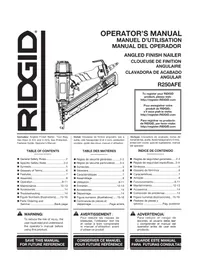
R250AFF - Stapler RIDGID - Free user manual and instructions
Find the device manual for free R250AFF RIDGID in PDF.



| Brand | RIDGID |
| Model | R250AFF |
| Product Type | Pneumatic Angled Finish Nailer |
| Fastener Type Used | 15-gauge finish nails (compatible staples) |
| Fastener Sizes | 25 to 63 mm (1 in to 2-1/2 in) |
| Magazine Capacity | 106 nails |
| Operating Pressure | 4.8 to 8.3 bar (70 to 120 psi) |
| Air Consumption | 0.066 ft³/cycle at 6.9 bar (100 psi) |
| Weight | 1.72 kg (3.8 lb) |
| Power Source | Compressed air (1/4 in NPT quick connect, adaptable to 3/8 in) |
| Sound Level (Emission) | 80.6 dBA |
| Sound Level (Impulse) | 92.9 dBA |
| Air Inlet | 3/8 in NPT |
| Main Features | Adjustable exhaust, angled magazine, reversible belt hook, graduated ruler, depth adjustment, dry-fire lockout, trigger selector (sequential or contact), oil-free mechanism, muffler, piston stop, air filter in handle, protective bumper, swivel quick connector, ACCU-Drive arrows, overmolded handle and trigger |
| Safety | Eye protection required (ANSI Z87.1), do not use with oxygen or combustible gases, always disconnect air before maintenance, dry-fire lockout mechanism |
| Maintenance and Cleaning | Oil-free (occasional lubrication possible), clean with a clean cloth, avoid harsh solvents, check daily according to checklist |
| Spare Parts and Repairability | Rebuild kit (079071001701), drive mechanism service kit (079071001702), key set (079071001703), after-sales service via RIDGID authorized centers |
| Warranty | 3-year limited + 90-day satisfaction policy |
Frequently Asked Questions - R250AFF RIDGID
User questions about R250AFF RIDGID
0 question about this device. Answer the ones you know or ask your own.
Ask a new question about this device
Download the instructions for your Stapler in PDF format for free! Find your manual R250AFF - RIDGID and take your electronic device back in hand. On this page are published all the documents necessary for the use of your device. R250AFF by RIDGID.
USER MANUAL R250AFF RIDGID
OPERATOR'S MANUAL
MANUEL D'UTILISATION
MANUAL DEL OPERADOR
To register your RIDGID
product, please visit:
http://register.RIDGID.com
Includes: Angled Finish Nailer, Tool Bag, Hex Keys (3 mm and 4 mm), Eye Protection, Fastener Guide, Operator's Manual
TABLE OF CONTENTS
**********************************************************************
■ General Safety Rules......2
■ Specific Safety Rules ....3-4
■ Symbols....5
■ Glossary of Terms......6
■ Features....7
■ Assembly......8
■ Operation....8-11
■ Maintenance....12-13
■ Accessories....14
■ Troubleshooting....14
■ Figure Numbers (Illustrations).....15-16
■ Parts Ordering and Service ....Back page

WARNING:
To reduce the risk of injury, the user must read and understand the operator's manual before using this product.
SAVE THIS MANUAL FOR FUTURE REFERENCE
MANUAL. Failure to follow warnings could result in DEATH or SERIOUS INJURY.
SAVE THESE INSTRUCTIONS
WORK AREA
- Keep your work area clean and well lit. Cluttered benches and dark areas invite accidents.
- Do not operate power tools in explosive atmospheres, such as in the presence of flammable liquids, gases, or dust. Power tools create sparks which may ignite the dust or fumes.
- Keep bystanders, children, and visitors away while operating a power tool. Distractions can cause you to lose control.
PERSONAL SAFETY
■ Eye protection which conforms to ANSI specifications and provides protection against flying particles both from the FRONT and SIDE should ALWAYS be worn by the operator and others in the work area when loading, operating or servicing this tool. Eye protection is required to guard against flying fasteners and debris, which could cause severe eye injury.
The employer and/or user must ensure that proper eye protection is worn. We recommend Wide Vision Safety Mask for use over eyeglasses or standard safety glasses that provide protection against flying particles both from the front and side. Always wear eye protection with side shields marked to comply with ANSI Z87.1.
■ Additional safety protection will be required in some environments. For example, the working area may include exposure to noise level which can lead to hearing damage. The employer and user must ensure that any necessary hearing protection is provided and used by the operator and others in the work area. Some environments will require the use of head protection equipment. When required, the employer and user must ensure that head protection conforming to ANSI Z89.1-1997 is used.
■ Stay alert, watch what you are doing and use common sense when operating a power tool. Do not use tool while tired or under the influence of drugs, alcohol, or medication. A moment of inattention while operating power tools may result in serious personal injury.
■ Dress properly. Do not wear loose clothing or jewelry. Contain long hair. Keep your hair, clothing, and gloves away from moving parts. Loose clothes, jewelry, or long hair can be caught in moving parts.
- Keep fingers away from trigger when not driving fasteners to avoid accidental firing.
- Do not overreach. Keep proper footing and balance at all times. Proper footing and balance enables better control of the tool in unexpected situations.
■ Use safety equipment. Always wear eye protection. Dust mask, nonskid safety shoes, hard hat, or hearing protection must be used for appropriate conditions.
■ Do not use on a ladder or unstable support. Stable footing on a solid surface enables better control of the tool in unexpected situations.
TOOL USE AND CARE
- Do not force tool. Use the correct tool for your application. The correct tool will do the job better and safer at the rate for which it is designed.
- Do not use tool if trigger does not actuate properly. Any tool that cannot be controlled with the trigger is dangerous and must be repaired.
- Check operation of the workpiece contact mechanism frequently. Do not use the tool if the workpiece contact mechanism is not working correctly as accidental driving of a fastener may result. Do not interfere with the proper operation of the workpiece contact mechanism.
■ Store idle tools out of the reach of children and other untrained persons. Tools are dangerous in the hands of untrained users.
■ Maintain tools with care. Follow maintenance instructions. Properly maintained tools are easier to control. - Check for misalignment or binding of moving parts, breakage of parts, and any other condition that may affect the tool's operation. If damaged, have the tool serviced before using. Many accidents are caused by poorly maintained tools.
■ Use only fasteners that are recommended for your model. - Keep the tool and its handle dry, clean and free from oil and grease. Always use a clean cloth when cleaning. Never use brake fluids, gasoline, petroleum-based products, or any strong solvents to clean your tool. Following this rule will reduce the risk of loss of control and deterioration of the enclosure plastic.
SERVICE
■ Tool service must be performed only by qualified repair personnel. Service or maintenance performed by unqualified personnel may result in a risk of injury.
■ When servicing a tool, use only identical replacement parts. Follow instructions in the Maintenance section of this manual. Use of unauthorized parts or failure to follow Maintenance instructions may create a risk of injury.
- Know your pneumatic tool. Read operator's manual carefully. Learn its applications and limitations, as well as the specific potential hazards related to this tool. Following this rule will reduce the risk of electric shock, fire, or serious injury.
■ Always wear eye protection with side shields marked to comply with ANSI Z87.1. Failure to do so could result in objects being thrown into your eyes resulting in possible serious injury.
■ Protect your lungs. Wear a face or dust mask if the operation is dusty. Following this rule will reduce the risk of serious personal injury.
■ Protect your hearing. Wear hearing protection during extended periods of operation. Following this rule will reduce the risk of serious personal injury.
■ Make sure the hose is free of obstructions or snags. Entangled or snarled hoses can cause loss of balance or footing and may become damaged.
■ Use the tool only for its intended use. Do not discharge fasteners into open air.
■ Use the pneumatic tool only for the purpose for which it was designed.
■ Use only the fasteners recommended for this tool. Use of the wrong fasteners could result in poor fastener feeding, jammed fasteners, and nails leaving the tool at erratic angles. If fasteners are not feeding smoothly and properly, discontinue their use immediately. Jammed and improperly feeding fasteners could result in serious personal injury.
■ Never use this tool in a manner that could cause a fastener to be directed toward anything other than the workpiece.
■ Do not use the tool as a hammer.
■ Always carry the tool by the handle. Never carry the tool by the air hose.
■ Do not alter or modify this tool from the original design or function without approval from the manufacturer.
■ Always be aware that misuse and improper handling of this tool can cause injury to yourself and others.
■ Never clamp or tape the trigger or workpiece contact in an actuated position.
■ Never leave a tool unattended with the air hose attached.
■ Do not operate this tool if it does not contain a legible warning label.
■ Do not continue to use a tool that leaks air or does not function properly.
OPERATION
■ Always assume that the tool contains fasteners.
■ Do not carry the tool from place to place holding the trigger. Accidental discharge could result.
■ Always handle the tool with care:
- Respect the tool as a working implement.
- Never engage in horseplay.
- Never pull the trigger unless nose is directed toward the work.
- Keep others a safe distance from the tool while tool is in operation as accidental actuation may occur, possibly causing injury.
■ Choice of triggering method is important. Check manual for triggering options.
■ Pneumatic tools are designed for single-hand use. Do not hold the tool by the front of the magazine. Do not put hands, head, or other parts of your body near the bottom of the magazine where the nail exits the tool, as serious personal injury could result.
■ Do not point the tool toward yourself or anyone whether it contains fasteners or not.
■ Do not actuate the tool unless you intend to drive a fastener into the workpiece.
■ Always ensure that the workpiece contact is fully positioned above the workpiece. Positioning the workpiece contact only partially above the workpiece could cause the fastener to miss the workpiece completely and result in serious personal injury.
- Do not drive fasteners near edge of material. The workpiece may split causing the fastener to ricochet, injuring you or a co-worker. Be aware that the nail may follow the grain of the wood, causing it to protrude unexpectedly from the side of the work material.
- Keep hands and body parts clear of immediate work area. Hold workpiece with clamps when necessary to keep hands and body out of potential harm. Be sure the workpiece is properly secured before pressing the nailer against the material. The workpiece contact may cause the work material to shift unexpectedly.
- Keep face and body parts away from back of the tool cap when working in restricted areas. Sudden recoil can result in impact to the body, especially when nailing into hard or dense material.
During normal use the tool will recoil immediately after driving a fastener. This is a normal function of the tool. Do not attempt to prevent the recoil by holding the nailer against the work. Restriction to the recoil can result in a second fastener being driven from the nailer. Grip the handle firmly, let the tool do the work and do not place second hand on top of tool or near exhaust at any time. Failure to heed this warning can result in serious personal injury.
■ Do not drive fasteners on top of other fasteners or with the tool at an overly steep angle as this may cause deflection of fasteners which could cause injury.
■ Do not drive fasteners close to the edge of the workpiece as the wood may split, allowing the fastener to be deflected possibly causing injury.
AIR SUPPLY AND CONNECTIONS
■ Do not use oxygen, combustible gases or bottled gases as a power source for this tool as tool will explode, possibly causing injury or death.
■ Do not use with an air compressor which can potentially exceed 200 psi as tool may burst, possibly causing injury.
■ The connector on the tool must not hold pressure when air supply is disconnected. If an incorrect fitting is used, the tool can remain charged with air after disconnecting and thus will be able to drive a fastener even after the air line is disconnected, possibly causing injury.
■ Always disconnect air supply:
• Before making adjustments
- When servicing the tool
- When clearing a jam
- When tool is not in use
- When moving to a different work area, as accidental actuation may occur, possibly causing injury.
LOADING TOOL
■ Do not load the tool with fasteners when any one of the operating controls is activated.
When loading tool:
■ Never place a hand or any part of body in fastener discharge area of tool.
■ Never point tool at anyone.
■ Do not pull the trigger or depress the workpiece contact as accidental actuation may occur, possibly causing injury.
SAVE THESE INSTRUCTIONS
■ Refer to them frequently and use them to instruct others who may use this tool. If you loan someone this tool, loan them these instructions also.
| The following signal words and meanings are intended to explain the levels of risk associated with this product. SYMBOL SIGNAL MEANING | ||
 | DANGER: | Indicates an imminently hazardous situation, which, if not avoided, will result in death or serious injury. |
 | WARNING: | Indicates a potentially hazardous situation, which, if not avoided, could result in death or serious injury. |
 | CAUTION: | Indicates a potentially hazardous situation, which, if not avoided, may result in minor or moderate injury. |
| NOTICE: | (Without Safety Alert Symbol) Indicates important information not related to an injury hazard, such as a situation that may result in property damage. | |
| Some of the following symbols may be used on this tool. Please study them and learn their meaning. Proper interpretation of these symbols will allow you to operate the tool better and safer. SYMBOL NAME DESIGNATION/EXPLANATION | ||
 | Safety Alert Indicates a potential personal injury hazard | |
 | Read The Operator's Manual | To reduce the risk of injury, user must read and understand operator's manual before using this product. |
 | Eye Protection | Always wear eye protection with side shields marked to comply with ANSI Z87.1. |
 | Eye, Ear and Head Protection | Always wear eye protection with side shields marked to comply with ANSI Z87.1, along with hearing and head protection when needed. |
 | Keep Hands Away Keep hands and body away from the discharge area of the tool. | |
 | Hot Surface | To reduce the risk of injury or damage, avoid contact with any hot surface. |
CALIFORNIA PROPOSITION 65

WARNING:
This product and some dust created by power sanding, sawing, grinding, drilling, and other construction activities may contain chemicals, including lead, known to the State of California to cause cancer, birth defects, or other reproductive harm. Wash hands after handling.
Some examples of these chemicals are:
- lead from lead-based paints,
- crystalline silica from bricks and cement and other masonry products and,
• arsenic and chromium from chemically treated lumber.
Your risk from exposure to these chemicals varies, depending on how often you do this type of work. To reduce your exposure, work in a well-ventilated area and with approved safety equipment, such as dust masks that are specially designed to filter out microscopic particles.
Activate (operating controls)
To move an operating control so that it is in a position that allows the tool to be actuated or that satisfies one requirement for the tool to be actuated.
Actuate (tool)
To cause movement of the tool component(s) intended to drive a fastener.
Actuation system
The use of a trigger, workpiece contact and/or other operating control, separately or in some combination or sequence, to actuate the tool.
- Single sequential actuation
An actuation system in which there is more than one operating control and the operating controls must be activated in a specific sequence to actuate the tool. Additional actuation can occur when a specific operating control, other than a workpiece contact, is released and re-activated.
- Contact actuation
An actuation system in which there is more than one operating control and the operating controls can be activated in any sequence to actuate the tool. Additional actuation can occur when any operating control is released and re-activated.
Air inlet port
In an air tool, the opening to which the compressed air supply is connected, usually by means of a threaded fitting.
Fastener
A staple, pin, brad, nail, or other fastening device which is designed and manufactured for use in the tools within the scope of this standard.
Jam
An obstruction in the feed or drive areas of the tool.
Maximum air pressure
The maximum allowable pressure of the compressed air, as specified by the manufacturer, for operating a tool.
Operating control
A control that separately, or as part of an actuation system, can cause the actuation of a tool.
Trigger
A tool operating control activated by a tool operator's fingers.
Workpiece
The intended object into which a fastener is to be driven by a tool.
Workpiece contact
An operating control element or assembly on the tool intended to be activated by the material to be fastened.
PRODUCT SPECIFICATIONS
Operating Pressure.... 70-120 psi
Fastener Type....15 gauge finish nails
Fastener Range 1 in. to 2-1/2 in.
Magazine Capacity....106 nails
Air Consumption....0.066 ft 3 /cycle at 100 psi
The safe use of this product requires an understanding of the information on the tool and in this operator's manual as well as a knowledge of the project you are attempting. Before use of this product, familiarize yourself with all operating features and safety rules.
ACCU-DRIVE TIP DESIGN
The ACCU-Drive arrows on the nose of the tool allow for accurate placement of fasteners.
ADJUSTABLE EXHAUST
The exhaust can be adjusted to a variety of positions depending on operator preference.
ANGLED MAGAZINE
The angled magazine allows access to tighter areas, and its rear-loading design offers quick two-step reloading of fasteners.
BELT HOOK
The hook will rotate to either side of the tool and can be used to hang the tool from a belt when disconnected and not in use.
CONSTRUCTION RULER
A construction ruler located along the left side of the angled magazine allows the operator to make quick measurements while working.
DEPTH OF DRIVE ADJUSTMENT
The tool-free depth of drive adjustment lets the operator select precise driving depth of the fastener.
DRY-FIRE LOCKOUT
The dry-fire lockout feature keeps the tool from operating when fasteners are low in the magazine to prevent missing fasteners in the nail pattern and extend tool life.
Air Inlet 3/8 in. NPT
Weighted sound impulse power level....109 dBA
Emission sound pressure level....96 dBA
Weight 3.8 lbs.
IN-HANDLE AIR FILTER
The self-cleaning in-handle air filter helps keep debris out to extend the life of the tool.
INTERNAL PISTON CATCH
The internal piston catch delivers consistent driving power.
JAM-CLEARING MECHANISM
The jam-clearing mechanism gives the operator quick access to the nose of the tool to help clear infrequent jams.
MUFFLER
The muffler reduces noise during operation.
NO-MAR PAD
The no-mar pad prevents marring and denting when using the tool on softer woods.
OIL-FREE DESIGN
The oil-free design of the tool eliminates daily oiling and prevents oil splattering on work surfaces.
OVERMOLD GRIP AND TRIGGER
The overmold grip and trigger offer increased comfort and control of the tool.
QUICK-CONNECT SWIVEL CONNECTOR
The quick-connect swivel connector helps prevent hose tangles.
SELECTABLE TRIGGER
The selectable trigger lets the operator choose between Contact Actuation for higher productivity and Single Sequential Actuation for precise fastener placement.
UNPACKING
This product has been shipped completely assembled.
- Carefully remove the tool and any accessories from the box. Make sure that all items listed in the includes list are included.

WARNING:
Do not use this product if it is not completely assembled or if any parts appear to be missing or damaged. Use of a product that is not properly and completely assembled could result in serious personal injury.
■ Inspect the tool carefully to make sure no breakage or damage occurred during shipping.
■ Do not discard the packing material until you have carefully inspected and satisfactorily operated the tool.
■ If any parts are damaged or missing, please call 1-866-539-1710 for assistance.

WARNING:
If any parts are damaged or missing do not operate this tool until the parts are replaced. Use of this product with damaged or missing parts could result in serious personal injury.

WARNING:
Do not attempt to modify this tool or create accessories not recommended for use with this tool. Any such alteration or modification is misuse and could result in a hazardous condition leading to possible serious personal injury.
OPERATION

DANGER:
Do not use oxygen, combustible gases or bottled gases as a power source for this tool. The tool will explode and cause death or serious injury.

WARNING:
Do not allow familiarity with tools to make you careless. Remember that a careless fraction of a second is sufficient to inflict severe injury.

WARNING:
Always wear eye protection with side shields marked to comply with ANSI Z87.1. Failure to do so could result in objects being thrown into your eyes resulting in possible serious injury.

WARNING:
Disconnect the tool from the air supply before leaving the work area, moving the tool to another location, or handing the tool to another person. Failure to do so could result in serious personal injury.
APPLICATIONS
You may use this tool for the purposes listed below:
■ Door & Window Casing
■ Door Jambs
Baseboard
■ Crown Molding
Cabinetry
■ Cap and Shoe Molding
■ Molding
Staircases
■ Door and Window Trim
Chair Rail
Brickmold
■ Hardwood Flooring
■ Paneling
Furniture
■ Finish and Trim (Interior and exterior)

WARNING:
Always wear eye protection. Eye protection does not fit all operators in the same way. Make sure the eye protection chosen has side shields or provides protection from flying debris both from the front and sides.
PREPARING THE TOOL FOR USE
See Figure 2, page 15.
This is an oil-free tool, therefore lubrication is not required. However, the occasional addition of air tool lubrication into the air fitting on the tool will not adversely affect performance or harm the tool.
Before connecting the tool, check the air compressor gauge to be sure it is functioning within the proper range of 70-120 psi.
NO-MAR PAD
See Figure 3, page 15.
The no-mar pad attached to the workpiece contact helps prevent marring and denting when working with softer woods.

WARNING:
Disconnect the tool from the air supply before removing or replacing the no-mar pad. Failure to do so could result in serious personal injury.
The no-mar pad can be removed by pulling it down and away from the workpiece contact. To replace the no-mar pad, fit it into place over the workpiece contact and push up at the back to reseat.
On-board storage for the no-mar pad is located on the magazine of the tool.
ACCU-DRIVE TIP DESIGN
See Figure 4, page 15.
The ACCU-Drive arrows on the nose of the tool are reference points that indicate the location and angle that fasteners will enter the workpiece. Fasteners are driven at approximately the same angle and location as the arrows.
ADJUSTING THE EXHAUST
See Figure 5, page 15.
The adjustable exhaust on the end cap of the tool allows the operator to direct the exhaust according to operator preference. To adjust, turn the exhaust cap in the desired direction.

WARNING:
Disconnect the tool from the air supply before leaving the work area, moving the tool to another location, or handing the tool to another person. Failure to do so could result in serious personal injury.
CONNECTING THE TOOL TO AN AIR SUPPLY
See Figure 6, page 15.

DANGER:
Do not use oxygen, combustible gases or bottled gases as a power source for this tool. The tool will explode and cause death or serious injury.
This tool is designed to operate on clean, dry compressed air at regulated pressures between 70 and 120 psi. The correct air pressure is the lowest pressure that will do the job.
NOTE: Air pressure that is higher than 120 psi may damage the tool.
The tool and air hose must have a hose coupling that allows all pressure to be removed from the tool when the coupling is disconnected.

WARNING:
Always use a coupling that discharges all the compressed air in the tool at the time the fitting or hose coupling is disconnected. Using a coupling that does not discharge the compressed air could cause unintended operation and serious personal injury.

WARNING:
Do not climb rigging or scaffolding while carrying a tool that is connected to an air hose. Doing so could result in serious personal injury.
Connect the tool to the air supply with a 1/4 in. female quick connector. A 3/8 in. female quick connector may be used in situations where a 1/4 in. supply line is not available. For maximum tool performance, a 3/8 in. supply line and fittings are required.
LOADING THE TOOL WITH NAILS
See Figures 7 - 8, page 16.

WARNING:
The tool's driving mechanism may cycle when the tool is first connected to the air supply. Always connect the tool to a pressurized air supply before loading nails to prevent injury from unintended cycling. Always make sure the tool's magazine is empty at the beginning of each work session, before connecting to an air supply.
■ Connect the tool to the air supply.
■ With the nose of the tool pointed away from you, feed a strip of nails into the magazine. Be sure the nails are pointed downward and at the angle shown.

WARNING:
Keep the tool pointed away from yourself and others when loading nails. Failure to do so could result in possible serious personal injury.
■ Slide the pusher all the way to the rear of the magazine. Release the pusher and allow it to push the nails up to the driving mechanism. The pusher will stop when it rests against the end of the nail strip.
NOTE: Do not allow the pusher to snap back into place.

WARNING:
Use only the nails recommended for use with this tool (refer to the Fastener Guide). The use of any other nails can result in tool malfunction, leading to serious injuries.

WARNING:
Never load nails with the workpiece contact or trigger activated. Doing so could result in possible serious personal injury.

WARNING:
Do not use nails smaller than 0.060 in. nail shank diameter. Doing so may cause nails to exit the tool prematurely through the guide track. Do not use hardened nails with pneumatic tools. This could lead to excessive wear of the guide body and allow nails to exit the back of the guide body, leading to serious personal injury.
USING THE SELECTABLE TRIGGER
See Figures 9 - 11, page 16.

WARNING:
Never wedge or hold back the workpiece contact mechanism during operation of the tool. Doing so could result in possible serious injury.
SINGLE SEQUENTIAL ACTUATION MODE
Single sequential actuation provides the most accurate fastener placement.
■ Disconnect the tool from the air supply.
■ Depress the actuation mode selector.
■ Rotate the selector to Position .
■ Release the actuation mode selector.

WARNING:
The nailer will not function properly if the selector is not securely seated in either position (T or IT) Always assure the selector is seated properly to avoid an unexpected fastener discharge and possible serious personal injury.
■ Reconnect the tool to the air supply.
- Grip the tool firmly to maintain control. Position the nose of the tool onto the work surface.
■ Push the tool against the work surface to depress the workpiece contact.
■ Squeeze the trigger to drive a fastener.
- Allow the tool to recoil away from the work surface as the fastener is driven.
■ Always remove your finger from the trigger when the desired number of nails has been driven.
CONTACT ACTUATION MODE
Contact actuation allows very fast repetitive fastener placement.
■ Disconnect the tool from the air supply.
■ Depress the actuation mode selector.
■ Rotate the selector to Position (1).
■ Release the actuation mode selector.
NOTE: The actuation mode selector is spring loaded and held in position by locking tab to prevent movement during operation.
■ Reconnect the tool to the air supply.
■ Grip the tool firmly to maintain control.
■ Squeeze and hold the trigger. Push the tool against the work surface to depress the workpiece contact and drive a fastener.
- Allow the tool to recoil away from the work surface as the fastener is driven.
■ Always remove your finger from the trigger when the desired number of nails has been driven.
NOTE: In Contact Actuation Mode, the tool may also be operated by depressing the workpiece contact against the surface and squeezing the trigger.

WARNING:
During normal use the tool will recoil immediately after driving a fastener. This is a normal function of the tool. Do not attempt to prevent the recoil by holding the nailer against the work. Restriction to the recoil can result in a second fastener being driven from the nailer. Grip the handle firmly, let the tool do the work, and do not place second hand on top of tool or near exhaust at any time. Failure to heed this warning can result in serious personal injury.
SETTING THE AIR PRESSURE
The amount of air pressure required will depend on the size of the nail and the workpiece material.
Begin testing the depth of drive by driving a test nail into the same type of workpiece material used for the actual job.
Drive a test nail with the air pressure set at 90-95 psi. Raise or lower the air pressure to find the lowest setting that will perform the job with consistent results.
It may be possible to achieve the desired depth with air pressure adjustments alone. If finer adjustments are needed, use the drive depth adjustment on the tool.
DEPTH OF DRIVE ADJUSTMENT
See Figure 12, page 16.
The driving depth of the nail may be adjusted. It is advisable to test the depth on a scrap workpiece to determine the required depth for the application.
To determine depth of drive, first adjust the air pressure and drive a test nail. To achieve the desired depth, use the drive depth adjustment on the tool.
■ Disconnect the tool from the air supply.
■ Turn the depth selector left or right to change the driving depth.
■ Reconnect the tool to the air supply.
■ Drive a test nail after each adjustment until the desired depth is set.

WARNING:
Disconnect the tool from the air supply before removing nails or clearing a jammed fastener. Failure to do so could result in serious personal injury.
REMOVING NAILS FROM THE TOOL
See Figure 13, page 16.
■ Disconnect the tool from the air supply.

WARNING:
Disconnect the tool from the air supply before removing nails. Failure to do so could result in serious personal injury.
■ To remove a strip of nails from the tool, hold the finish nailer by the handle with your right hand, and rest your left hand underneath the tool with your left thumb on the pusher.
■ Depress the inside lever on the pusher to release and allow the pusher to slowly slide to the front.
NOTE: Always keep fingers clear of nail track of magazine to prevent injury from unintended release of the pusher.
■ Slide the nails toward the back of the magazine and remove.
CLEARING A JAMMED FASTENER
See Figure 14, page 16.

WARNING:
Disconnect the tool from the air supply before clearing a jammed fastener. Failure to do so could result in serious personal injury.
If a nail or fastener becomes jammed in the tool, disconnect the air hose and keep the tool pointed away from you while clearing the jam.
■ Open magazine and remove fasteners from the tool.
■ Pull up on the latch and open the jam-clearing mechanism.
■ Insert a flat blade screwdriver into the driving mechanism and push the driver mechanism back, freeing the fastener jam.
■ Remove the bent fastener.
■ Close the jam-clearing mechanism and latch.
■ Reconnect the tool to the air supply.
■ Reinstall fasteners and close the magazine.

WARNING:
When servicing use only identical RIDGID replacement parts. Use of any other parts may create a hazard or cause product damage.

WARNING:
Always wear eye protection with side shields marked to comply with ANSI Z87.1. Failure to do so could result in objects being thrown into your eyes resulting in possible serious injury.

WARNING:
Disconnect the tool from the air supply before performing maintenance. Failure to do so could result in serious personal injury.
GENERAL MAINTENANCE
Avoid using solvents when cleaning plastic parts. Most plastics are susceptible to damage from various types of commercial solvents and may be damaged by their use. Use clean cloths to remove dirt, dust, oil, grease, etc.

WARNING:
Do not at any time let brake fluids, gasoline, petroleum-based products, penetrating oils, etc., come in contact with plastic parts. Chemicals can damage, weaken or destroy plastic which may result in serious personal injury.
For cold weather operation, near and below freezing, the moisture in the air line may freeze and prevent tool operation. We recommend the use of air tool lubricant or permanent antifreeze (ethylene glycol) as a cold weather lubricant.
NOTICE:
Do not store tools in a cold weather environment to prevent frost or ice formation on the tools' operating valves and mechanisms that could cause tool failure.
NOTE: Some commercial air line drying liquids are harmful to "O" rings and seals. Do not use these low temperature air dryers without checking compatibility.
AIR SUPPLY PRESSURE AND VOLUME
Air volume is as important as air pressure. The air volume supplied to the tool may be inadequate because of under-size fittings and hoses, or from the effects of dirt and water in the system. Restricted air flow will prevent the tool from receiving an adequate volume of air, even though the pressure reading is high. The results will be a slow operation or reduced driving power. Before evaluating tool problems for these symptoms, trace the air supply from the tool to the supply source for restrictive connectors, low points containing water and anything else that would prevent full volume flow of air to the tool.
REQUIRED DAILY CHECKLIST
See Figures 8 and 9, page 16.
■ Disconnect the air supply from the tool and remove all fasteners.
- Check all screws, nuts, bolts, and pins on the tool. If any of these are loose, they must be tightened with the appropriate size wrench.
If your tool is equipped with a dry-fire lockout mechanism, then you will need to disengage this feature by opening the magazine slightly or retracting the bypass pusher.
With the dry-fire lockout disengaged, perform the steps below:
■ Press the workpiece contact against a workpiece to ensure that it moves smoothly.
■ With the workpiece contact depressed, pull the trigger. The trigger should move smoothly, without binding.
■ Select the single sequential actuation mode ).
■ While the tool is not loaded, connect the appropriate air supply (at 70 psi) to the tool.
■ Begin inspection:
- Without pulling the trigger, press the workpiece contact against a workpiece several times. The tool must not actuate.
- With the workpiece contact not engaged on the workpiece, point the tool down and away in a safe direction and pull the trigger several times. Hold the trigger in this position for a minimum of 5 seconds. The tool must not actuate.
- Press the workpiece contact firmly against the workpiece and pull the trigger. The tool must actuate.
- With the workpiece contact still depressed, release the trigger. The driver must return to its up position.
■ Select the contact actuation mode (T)
■ Begin inspection:
- With the workpiece contact not engaged on the workpiece, point the tool down and away in a safe direction. Pull the trigger. The tool must not actuate.
- Fully depress the trigger and push the workpiece contact against a workpiece. The tool must actuate.
■ Disconnect the air supply from the tool.
If the tool successfully meets all the requirements in this checklist, it is ready for use. Set the trigger on the tool to operate in the manner that best fits your application.
■ Set the depth of drive according to the Depth of Drive Adjustment section in this manual. Repeat this checklist before using the tool each day, or if the tool is dropped or damaged in any way.
To order parts and maintenance kits, call 1-866-539-1710.
Overhaul Kit....079071001701
Driver Maintenance Kit....079071001702
Wrench Kit....079071001703

WARNING:
Current attachments and accessories available for use with this tool are listed above. Do not use any attachments or accessories not recommended by the manufacturer of this tool. The use of attachments or accessories not recommended can result in serious personal injury.
TROUBLESHOOTING
PROBLEM POSSIBLE CAUSE SOLUTION
| Air leak near the top of the tool or in the trigger area | Loose screwsWorn or damaged O-rings or seals | Tighten screwsInstall Overhaul Kit |
| Air leak near the bottom of the tool | Loose screwsWorn or damaged O-rings or bumper | Tighten screwsInstall Overhaul Kit |
| Tool does nothing or operates sluggishly | Inadequate air supplyInadequate lubricationWorn or damaged O-rings or bumper | Verify adequate air supplyLubricate toolInstall Overhaul Kit |
| Tool jams frequently Incorrect fasteners | Verify that fasteners are the correct size | |
| Damaged fastenersReplace fasteners | ||
| Loose magazineTighten screws | ||
| Dirty magazineClean magazine | ||
| Worn or damaged driverInstall Driver Maintenance Kit | ||
NOTE: FIGURES (ILLUSTRATIONS) START ON PAGE 15 AFTER FRENCH AND SPANISH LANGUAGE SECTIONS.
This product has a 90-Day Satisfaction Guarantee Policy, as well as a Three-year Limited Warranty.
For Warranty and Policy details, please go to www.RIDGID.com or call (toll free) 1-866-539-1710.

DANGER :
CONCEPTION D'EMBOUT ACCU-DRIVE
CONCEPTION D'EMBOUT ACCU-DRIVE
Voir la figure 4, page 15.
PROBLÈME CAUSE POSSIBLE SOLUTION
A - Adjustable exhaust (échappement réglable, escape ajustable)
B - Selectable trigger (gâchette à sélecteur, gatillo de modo seleccionable)
C - Belt hook (crochet de ceinture, gancho para el cinto)
D - Quick-connect swivel connector (connecteur rapide pivotant, conector giratorio rápido)
E - Angled magazine (magasin angulaire, cargador angular)
F - Depth of drive adjustment (réglage de profondeur d'enfoncement, ajuste de la profundidad de introducción)
G - Pusher (poussoir, empujador)
H - Nose (tête, punta)
I - Workpiece contact with no-mar pad (contact de déclenchement avec coussinet de protection, disparador de contacto con almohadilla protectora)
J - Jam-clearing mechanism (déblocage, soltador)
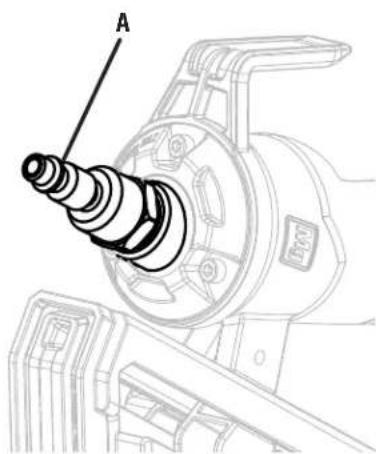
A - Quick-connect air fitting (connecteur de rapide raccord d'air, conexión de aire de conexión rápida)
B - Air hose connector (connecteur de flexible d'air, conector de la manguera de aire)
Fig. 7
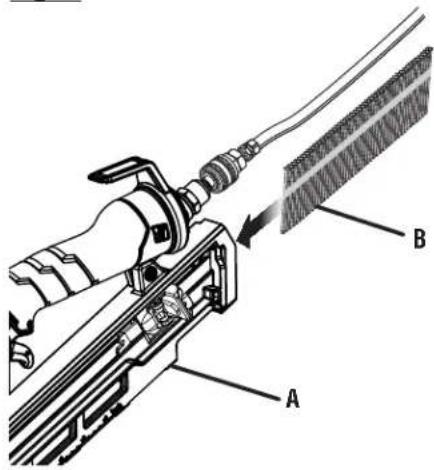
A - Magazine (magasin, cargador)
B - Nails (clous, clavos)
Fig. 8
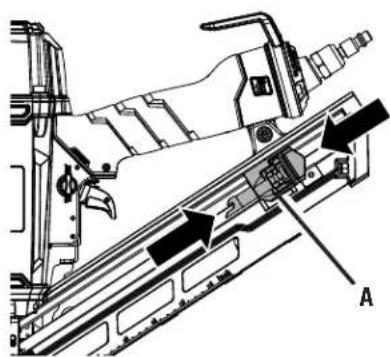
A - Pusher (poussoir, empujador)
Fig. 9
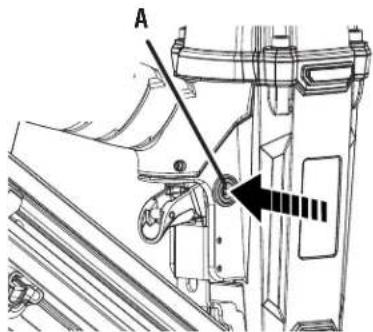
RIGHT SIDE OF TOOL
CÔTÉ DROIT DE L'OUTIL
LADO DERECHO DE LA HERRAMIENTA
Customer Service Information:
For parts or service, contact your nearest RIDGID authorized service center. Be sure to provide all relevant information when you call or visit. For the location of the authorized service center nearest you, please call 1-866-539-1710 or visit us online at www.ridgid.com.
The model number of this tool is found on a plate attached to the motor housing. Please record the serial number in the space provided below. When ordering repair parts, always give the following information:
Model No. ____
Serial No. ____
- OPERATOR'S MANUAL
- MANUEL D'UTILISATION
- MANUAL DEL OPERADOR
- TABLE OF CONTENTS
- WARNING
- SAVE THIS MANUAL FOR FUTURE REFERENCE
- SAVE THESE INSTRUCTIONS
- WORK AREA
- PERSONAL SAFETY
- TOOL USE AND CARE
- SERVICE
- OPERATION
- AIR SUPPLY AND CONNECTIONS
- LOADING TOOL
- CALIFORNIA PROPOSITION 65
- ACTIVATE (OPERATING CONTROLS)
- ACTUATE (TOOL)
- ACTUATION SYSTEM
- SINGLE SEQUENTIAL ACTUATION
- CONTACT ACTUATION
- AIR INLET PORT
- FASTENER
- JAM
- MAXIMUM AIR PRESSURE
- OPERATING CONTROL
- TRIGGER
- WORKPIECE
- WORKPIECE CONTACT
- PRODUCT SPECIFICATIONS
- ACCU-DRIVE TIP DESIGN
- ADJUSTABLE EXHAUST
- ANGLED MAGAZINE
- BELT HOOK
- CONSTRUCTION RULER
- DEPTH OF DRIVE ADJUSTMENT
- DRY-FIRE LOCKOUT
- IN-HANDLE AIR FILTER
- INTERNAL PISTON CATCH
- JAM-CLEARING MECHANISM
- MUFFLER
- NO-MAR PAD
- OIL-FREE DESIGN
- OVERMOLD GRIP AND TRIGGER
- QUICK-CONNECT SWIVEL CONNECTOR
- SELECTABLE TRIGGER
- UNPACKING
- DANGER
- APPLICATIONS
- PREPARING THE TOOL FOR USE
- ADJUSTING THE EXHAUST
- CONNECTING THE TOOL TO AN AIR SUPPLY
- LOADING THE TOOL WITH NAILS
- USING THE SELECTABLE TRIGGER
- SINGLE SEQUENTIAL ACTUATION MODE
- CONTACT ACTUATION MODE
- SETTING THE AIR PRESSURE
- REMOVING NAILS FROM THE TOOL
- CLEARING A JAMMED FASTENER
- GENERAL MAINTENANCE
- NOTICE
- AIR SUPPLY PRESSURE AND VOLUME
- REQUIRED DAILY CHECKLIST
- TROUBLESHOOTING
- CONCEPTION D'EMBOUT ACCU-DRIVE
- CUSTOMER SERVICE INFORMATION
Brand : RIDGID
Model : R250AFF
Category : Stapler