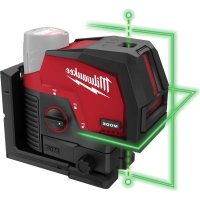
362220 - Laser level MILWAUKEE - Free user manual and instructions
Find the device manual for free 362220 MILWAUKEE in PDF.



| Product type | Self-leveling laser level |
| Brand | Milwaukee |
| Model | 3622-20 |
| Power supply | M12 lithium-ion battery (12 V DC) |
| Battery type | M12 RedLithium |
| Laser class | Class 2 (IEC 60825-1) |
| Wavelength | 510 - 530 nm (green) |
| Maximum power (lines) | ≤ 7 mW (average) |
| Maximum power (points) | ≤ 1 mW (average) |
| Working range (without detector) | 38 m (125 ft) |
| Working range (with detector) | 50 m (165 ft) |
| Accuracy | ± 3 mm at 10 m (33 ft) |
| Leveling time | < 3 seconds |
| Self-leveling | Yes, range of ± 4° |
| Projection modes | Horizontal line, vertical line, plumb points, perpendicular lines |
| Mounting | Tripod (1/4-20, 5/8-11), magnets, wall mount (screw/nail) |
| Protection rating | IP54 (dust and splash water resistant) |
| Operating temperature | -18 °C to 50 °C (0 °F to 125 °F) |
| Storage temperature | -20 °C to 49 °C (-4 °F to 120 °F) |
| Warranty | 5 years (tool), excluding battery and charger |
| Maintenance | Clean lenses with compressed air and damp cotton swab |
| Approximate weight | 0.5 kg (with battery) |
Frequently Asked Questions - 362220 MILWAUKEE
User questions about 362220 MILWAUKEE
0 question about this device. Answer the ones you know or ask your own.
Ask a new question about this device
Download the instructions for your Laser level in PDF format for free! Find your manual 362220 - MILWAUKEE and take your electronic device back in hand. On this page are published all the documents necessary for the use of your device. 362220 by MILWAUKEE.
USER MANUAL 362220 MILWAUKEE
WARNING Read all safety warnings, instructions, illustrations and specifications provided with this power tool. Failure to follow all instructions listed below may result in electric shock, fire and/or serious injury. Save all warnings and instructions for future reference. The term "power tool" in the warnings refers to your mains-operated (cored) power tool or battery-operated (cordless) power tool.
LASER SAFETY
AWARNING The device produces visible laser beams, which are emitted from the tool.
This device complies with 21 CFR 1040.10 and 1040.11 except for conformance with IEC 60825-1 Ed.3., as described in Laser Notice No.56, dated May 8,2019.
- Laser light - Do not stare into beam or view directly with optical instruments. Do not point laser light at others. Laser light can cause eye damage.
WORK AREA SAFETY
- Keep work area clean and well lit. Cluttered or dark areas invite accidents.
- Do not operate power tools in explosive atmospheres, such as in the presence of flammable liquids, gases or dust. Power tools create sparks which may ignite the dust or fumes.
- Keep children and bystanders away while operating a power tool. Distractions can cause you to lose control.
ELECTRICAL SAFETY
- Power tool plugs must match the outlet. Never modify the plug in any way. Do not use any adapter plugs with earthed (grounded) power tools. Unmodified plugs and matching outlets will reduce risk of electric shock.
- Avoid body contact with earthed or grounded surfaces, such as pipes, radiators, ranges and refrigerators. There is an increased risk of electric shock if your body is earthed or grounded.
- Do not expose power tools to rain or wet conditions. Water entering a power tool will increase the risk of electric shock.
- Do not abuse the cord. Never use the cord for carrying, pulling or unplugging the power tool. Keep cord away from heat, oil, sharp edges or moving parts. Damaged or entangled cords increase the risk of electric shock.
- When operating a power tool outdoors, use an extension cord suitable for outdoor use. Use of a cord suitable for outdoor use reduces the risk of electric shock.
- If operating a power tool in a damp location is unavoidable, use a ground fault circuit interrupter (GFCI) protected supply. Use of an GFCI reduces the risk of electric shock.
PERSONAL SAFETY
-
Stay alert, watch what you are doing and use common sense when operating a power tool. Do not use a power tool while you are tired or under the influence of drugs, alcohol or medication. A moment of inattention while operating power tools may result in serious personal injury.
-
Use personal protective equipment. Always wear eye protection. Protective equipment such as a dust mask, non-skid safety shoes, hard hat or hearing protection used for appropriate conditions will reduce personal injuries.
- Prevent unintentional starting. Ensure the switch is in the off-position before connecting to power source and/or battery pack, picking up or carrying the tool. Carrying power tools with your finger on the switch or energizing power tools that have the switch on invites accidents.
- Remove any adjusting key or wrench before turning the power tool on. A wrench or a key left attached to a rotating part of the power tool may result in personal injury.
- Do not overreach. Keep proper footing and balance at all times. This enables better control of the power tool in unexpected situations.
- Dress properly. Do not wear loose clothing or jewelry. Keep your hair and clothing away from moving parts. Loose clothes, jewelry or long hair can be caught in moving parts.
- If devices are provided for the connection of dust extraction and collection facilities, ensure these are connected and properly used. Use of dust collection can reduce dust-related hazards.
- Do not let familiarity gained from frequent use of tools allow you to become complacent and ignore tool safety principles. A careless action can cause severe injury within a fraction of a second.
POWER TOOL USE AND CARE
- Do not force the power tool. Use the correct power tool for your application. The correct power tool will do the job better and safer at the rate for which it was designed.
- Do not use the power tool if the switch does not turn it on and off. Any power tool that cannot be controlled with the switch is dangerous and must be repaired.
- Disconnect the plug from the power source and/ or remove the battery pack, if detachable, from the power tool before making any adjustments, changing accessories, or storing power tools. Such preventive safety measures reduce the risk of starting the power tool accidentally.
- Store idle power tools out of the reach of children and do not allow persons unfamiliar with the power tool or these instructions to operate the power tool. Power tools are dangerous in the hands of untrained users.
- Maintain power tools and accessories. Check for misalignment or binding of moving parts, breakage of parts and any other condition that may affect the power tool's operation. If damaged, have the power tool repaired before use. Many accidents are caused by poorly maintained power tools.
- Keep cutting tools sharp and clean. Properly maintained cutting tools with sharp cutting edges are less likely to bind and are easier to control.
-
Use the power tool, accessories and tool bits etc. in accordance with these instructions, taking into account the working conditions and the work to be performed. Use of the power tool for operations different from those intended could result in a hazardous situation.
-
Keep handles and grasping surfaces dry, clean and free from oil and grease. Slippery handles and grasping surfaces do not allow for safe handling and control of the tool in unexpected situations.
BATTERY TOOL USE AND CARE
- Recharge only with the charger specified by the manufacturer. A charger that is suitable for one type of battery pack may create a risk of fire when used with another battery pack.
- Use power tools only with specifically designated battery packs. Use of any other battery packs may create a risk of injury and fire.
- When battery pack is not in use, keep it away from other metal objects, like paper clips, coins, keys, nails, screws or other small metal objects, that can make a connection from one terminal to another. Shorting the battery terminals together may cause burns or a fire.
- Under abusive conditions, liquid may be ejected from the battery; avoid contact. If contact accidentally occurs, flush with water. If liquid contacts eyes, additionally seek medical help. Liquid ejected from the battery may cause irritation or burns.
- Do not use a battery pack or tool that is damaged or modified. Damaged or modified batteries may exhibit unpredictable behavior resulting in fire, explosion or risk of injury.
- Do not expose a battery pack or tool to fire or excessive temperature. Exposure to fire or temperature above 265°F (130°C) may cause explosion.
- Follow all charging instructions and do not charge the battery pack or tool outside the temperature range specified in the instructions. Charging improperly or at temperatures outside the specified range may damage the battery and increase the risk of fire.
SERVICE
- Have your power tool serviced by a qualified repair person using only identical replacement parts. This will ensure that the safety of the power tool is maintained.
- Never service damaged battery packs. Service of battery packs should only be performed by the manufacturer or authorized service providers.
SPECIFIC SAFETY RULES FOR LASER LEVELS
- Watch out for erroneous results if the tool is defective or if it has been dropped, misused or modified.
- Do not dispose of tool or batteries together with household waste material! Tool and batteries that have reached the end of their life must be collected separately and returned to an environmentally compatible recycling facility.
- Ensure tool magnets are securely mounted to a metal surface. Magnet strength may not hold on thin metal surfaces, causing the tool to fall.
-
Do not use this tool to work on asbestos-containing products. Determine the composition of the workpiece before beginning work. Asbestos should only be removed by a qualified professional.
-
Always use common sense and be cautious when using tools. It is not possible to anticipate every situation that could result in a dangerous outcome. Do not use this tool if you do not understand these operating instructions or you feel the work is beyond your capability; contact Milwaukee Tool or a trained professional for additional information or training.
- Maintain labels and nameplates. These carry important information. If unreadable or missing, contact a MILWAUKEE service facility for a replacement.
- The device conforms to the most stringent requirements of the relevant Electromagnetic Compatibility (EMC) Standards and Regulations. Yet, the possibility of causing interference in other devices cannot be totally excluded.
CAUTION Use of controls or adjustments or performance of procedures other than those specified herein may result in hazardous radiation exposure. - Be sure to power off instrument after use. When instrument will not be used for a long period, place it in storage after removing batteries.
Federal Communications Commission Pursuant to part 15.21 of the FCC Rules, you are cautioned that changes or modifications not expressly approved by the party responsible for compliance could void your authority to operate the product.
This equipment has been tested and found to comply with the limits for a Class B digital device, pursuant to Part 15 of the FCC Rules. These limits are designed to provide reasonable protection against harmful interference in a residential installation. This equipment generates, uses and can radiate radio frequency energy and, if not installed and used in accordance with the instructions, may cause harmful interference to radio communications. However, there is no guarantee that interference will not occur in a particular installation. If this equipment does cause harmful interference to radio or television reception, which can be determined by turning the equipment off and on, the user is encouraged to try to correct the interference by one or more of the following measures:
- Reorient or relocate the receiving antenna.
- Increase the separation between the equipment and receiver.
- Connect the equipment into an outlet on a circuit different from that to which the receiver is connected.
- Consult the dealer or an experienced radio/TV technician for help.
SYMBOLOGY
Volts V

Direct Current

LASER
IMO2019 x2 + 1 ≤ ( x,1) = 1 + 1

LASER RADIATION
DO NOT STARE INTO BEAM PRODUCT


Read operator's manual
SPECIFICATIONS
ASSEMBLY
Cat. No. 3622-20
Volts 12 DC
Battery Type M12TM
Charger Type M12TM
Laser... Class 2
Lines Max Power PAVG ≤ 7 mW
Points Max Power. PAVGwc≤ 1mW
Pulse Frequency. 10 KHz
Pulse Duration Normal Mode. Tp ≤ 80 µs
Pulse Duration Power Save. Tp ≤ 50 µs
Wavelength 510-530 nm
Lines Beam Divergence 1 rad
Points Beam Divergence 0.5 mrad
Storage Temp -4°F to 120°F
Working Range 125
Range with Detector 165
Accuracy.. ± 1 / 8 @33
Settle Time. < 3 Seconds
Tripod Mount 1/4"-20, 5/8"-11
Ingress Protection. IP54
Drop Rating 1 m
Leveling .......Auto ± 4 side to side, front to back
Recommended Ambient
Operating Temperature 0°F to 125°F
FUNCTIONAL DESCRIPTION
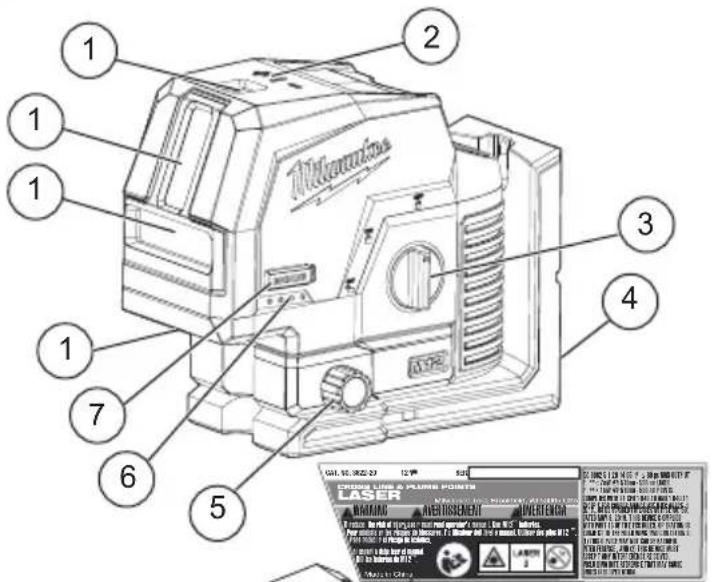
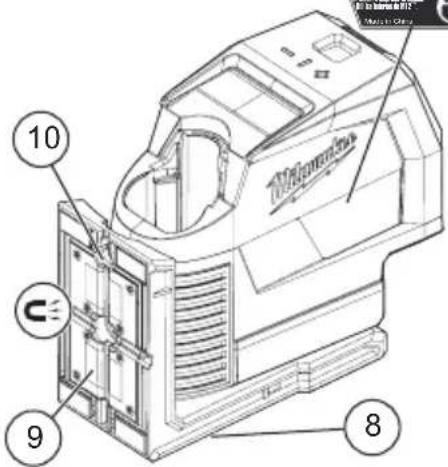
-
Laser apertures
-
Fuel gauge
-
Laser mode indicator
7.Mode button
-
On/Off dial
-
Threaded inserts
-
Pivot Bracket
-
Magnets
-
Micro adjust
-
Nail/Screw hole
WARNING Recharge only with the charger specified for the battery. For specific charging instructions, read the operator's manual supplied with the charger and battery.
Removing/Inserting the Battery
To remove the battery, push in the release buttons and pull the battery pack away from the tool.
AWARNING Remove the battery pack any time the tool is not in use.
To insert the battery, slide the pack into the body of the tool. Make sure it latches securely into place.
AWARNING Only use accessories specifically recommended for this tool. Others may be hazardous.
Power Save
Use power save mode to extend the battery run time. Power save mode is indicated by dimmed laser beams and the Mode indicator pulsing. Visual range is decreased in power save mode. To turn power save mode ON or OFF, press and hold Mode button for 3 seconds. The tool will automatically switch to power save mode if less than 7% of battery charge remains.
Fuel Gauge
To determine the amount of charge left in the battery, turn the tool ON. The Fuel Gauge will light up for 2-3 seconds. When less than 10% of charge is left, 1 light on the fuel gauge will flash 4 times.
To signal the end of charge, 1 light on the fuel gauge will flash 8 times and the tool will not run. Charge the battery pack.
If the battery becomes too hot, the fuel gauge lights will flash and the tool will not run. Allow the battery to cool down.
*When automatically switched to power save mode due to low battery, the tool cannot be switched back to normal mode until the battery is charged/replaced.
AWARNING To reduce the risk of injury or damage, securely mount/attach the laser before starting an operation. Injury/damage may occur if the laser falls.
Mounting/Adjusting the Laser Level
The pivot bracket can be used to mount the laser level in multiple ways:
- Use the embedded magnets to secure the laser level to steel studs, steel beams, etc.
- Use the keyhole slot to hang the laser level on the wall with a nail or screw.
- Set the laser level on a flat surface.
- Position the laser and/or wall mount on a stable surface.
- Use the 1/4"-20 or 5/8"-11 threaded insert to mount on a tripod.
- Once the level is mounted, use the micro adjustment knobs to fine tune the laser line.
OPERATION
WARNING
look directly into the laser when it is on.
CAUTION
Use of controls or adjustments or performance of procedures other
than those specified herein may result in hazardous radiation exposure.
NOTICE
Perform the Accuracy Field Check procedure immediately upon unboxing
of each new Laser Level and before exposure to jobsite conditions. See "Accuracy Field Check" for information.
Turning On/Off
To turn on the laser and unlock the pendulum, rotate the On/Off dial to the desired position. The remaining battery life will be displayed. WARNING! Do not look directly into laser apertures. Laser Mode Indicator LED will display, and horizontal level line will immediately be emitted from aperture in the laser housing.

Turns ON the laser and unlocks the pendulum to enable self-leveling.

ON Turns ON the laser but does not unlock the pendulum (self leveling is disabled). The laser lines will flash once every 8 seconds to indicate that the projected lines are not level or plumb.
NOTICE: The ON mode disables self-leveling and therefore is not intended for projecting a level or plumb line.

Turns OFF the laser and locks the pendulum. When not in use, turn off the tool and store the Laser Level in the protective carrying case.
- Use the MODE button to cycle through the three laser modes:
Horizontal Level Line
Vertical Plumb Line & Plumb Points
- Perpendicular Level & Plumb Points
The green laser mode indicators will display the selected mode.
Using the Laser Level
- For best results, place the tool on a work surface that is:
sturdy
- level (within 4 degrees of true level)
- free of vibrations
90° to the work area
-
Turn on the tool.
-
The tool will self-level when placed on surfaces within 4 degrees of true level when dial is unlocked and on.
- The tool is ready once the emitted lines are continuous and no longer moving on the work surface.
- If the tool cannot achieve a level state (i.e., the work surface is >4 degrees off true level), the laser beams will flash rapidly (3 flashes per second). Relocate or adjust the work surface.
Troubleshooting
If the tool does not turn on:
- Ensure battery is installed properly. Fuel gauge should indicate remaining charge when correctly installed.
- Ensure battery is charged.
- Ensure the tool's internal temperature is within specified operating ranges. If stored in excessive heat or cold, allow at least 2 hours to acclimate to ambient temperature before turning on the tool. If problem persists, please contact a MILWAUKEE service facility for support.
ACCURACY FIELD CHECK
NOTICE Perform the Accuracy Field Check procedure immediately upon unboxing of each new Laser Level and before exposure to jobsite conditions. See "Accuracy Field Check" for information. Should any deviation from listed product accuracy be found, please contact a MILWAUKEE service facility. Failure to do so could result in rejection of warranty claim.
Influences on Accuracy
Ambient temperature gradients can impact laser accuracy. For accurate and repeatable results, the following procedure should be conducted with the laser elevated off the ground and placed in the center of the working area.
Abusive treatment of the Laser Level, such as excessive impacts from drop, can also lead to deviations in product accuracy.
Therefore, it is recommended to conduct the Field Check procedure after any impact or before completing any critical jobs.
Horizontal Height Accuracy
A free measuring distance of approximately 66' on a firm surface between two walls or structures A and B is required for this check.
It is also suggested to mount the Laser Level to a Tripod for easy adjustment.
- Securely mount the tool within 1' of wall A.
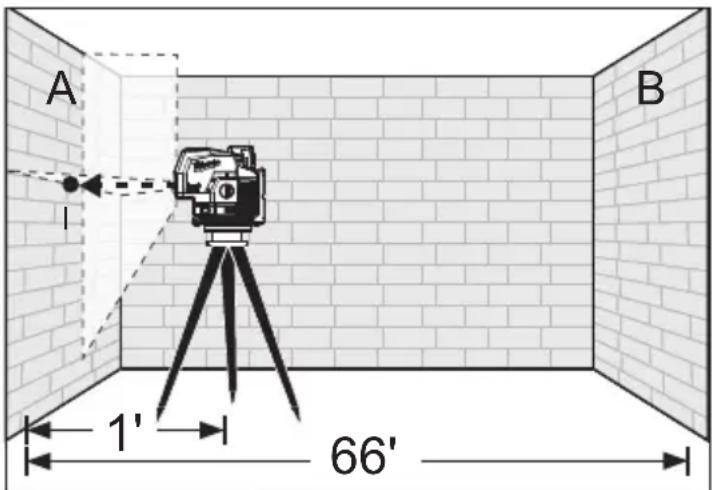
- Turn the tool to ON and to Perpendicular Level & Plumb Points Mode.
-
Direct the front laser beam against the nearest wall A and allow to self-level. Mark the center of the laser cross on the wall (point I).
-
Rotate the tool 180° without changing the height, allow it to self-level, and mark the center of the laser cross on the opposite wall B (point II).
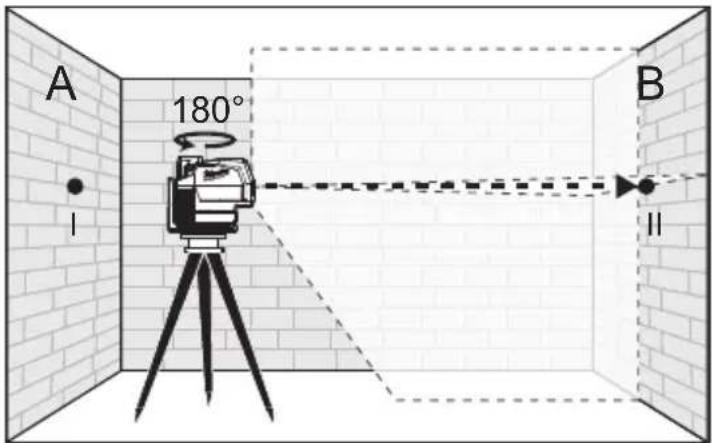
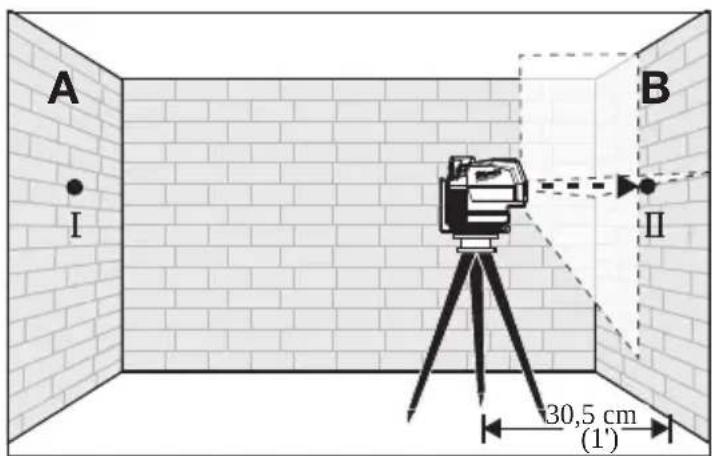
- Move the tool within 1 of wall B. Allow the laser to self level. Align the laser cross in the general direction of point II on wall B.
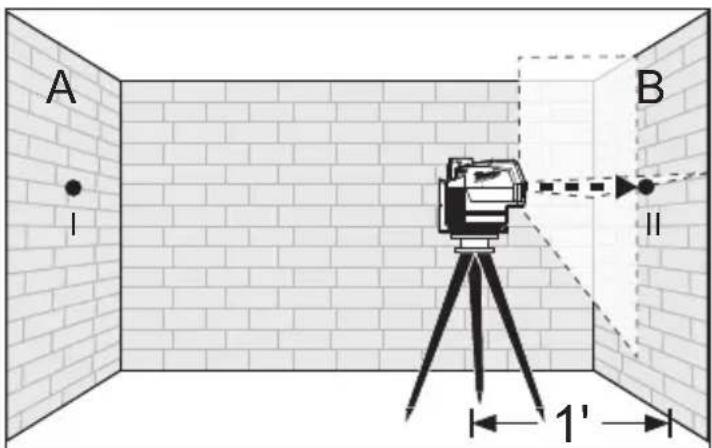
- Adjust the height of the tool (using the tripod or by adding shims, if required) to align the laser cross directly onto point II on wall B. Allow the tool to self-level.
- Rotate the tool 180° without changing the height, allow it to self-level, and mark the center of the laser cross on wall A (point III). Point III should be aligned as vertically above or below point I on wall A as possible.
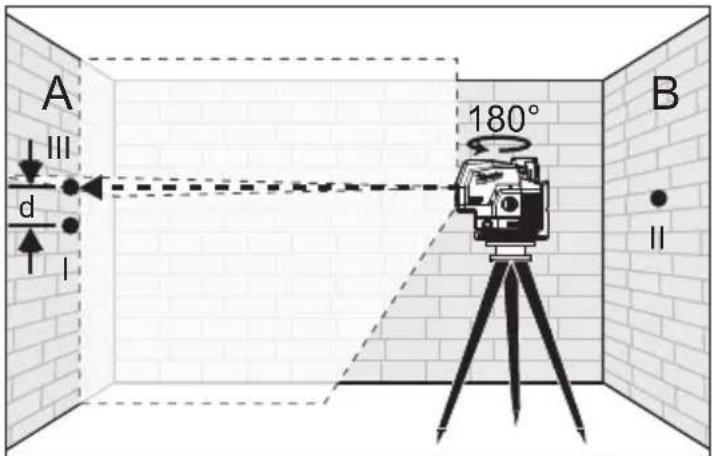
- The distance between points I and III on wall A is the height deviation (d) of the tool. This distance should not exceed 1 / 8'' (max.) at 33' ( 1 / 2'' at 132' ). For the Measuring distance of 2 × 66' = 132' , the maximum allowable deviation (d) is: 132' × ± 1 / 8'' ÷ 33' = ± 1 / 2'' .
Horizontal Leveling Accuracy
A free measuring space of approximately 33x33 on a firm surface between two walls or structures A and B is required for the check.
It is also suggested to mount the Laser Level to a Tripod for easy adjustment.
Securely mount the tool on one side of the room and centered between walls A and B. Direct the laser lines toward the other side of the room such that the horizontal line appears on both walls A and B. Allow the laser to Self-Level.
- Turn the tool to ON and to Horizontal Level Line mode.
- At a distance of 16.5' from the laser, mark the center of the horizontal line on Wall A (Point I). Do the same on Wall B (Point II).
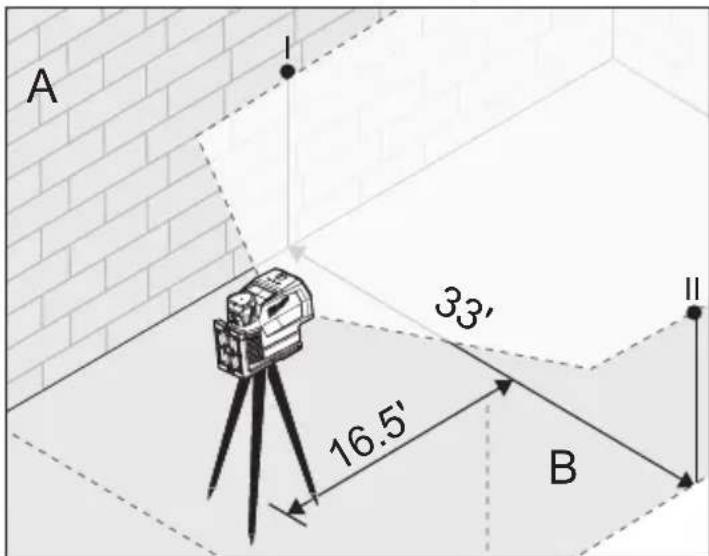
- Move the Laser 33 toward the opposite wall and rotate the laser 180° . Allow the laser to Self-Level.
- Adjust the height of the tool (using the tripod or by adding shims, if required) such that the center of the horizontal line is projected exactly against the previously marked point II on wall B. Ensure the Laser is self-leveled after alignment.
- Mark the center of horizontal line on wall A (point III). Take care that point III is aligned as vertical as possible above or below point I.
- The distance d between marked points I and III on wall A indicates the actual deviation (d) of the tool.
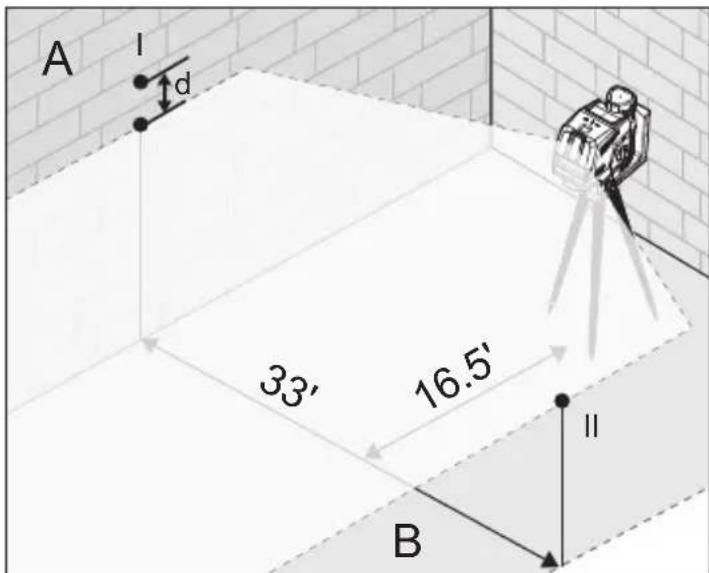
- For the Measuring distance of 2 × 33' = 66' , the maximum allowable deviation (d) is: 66' × ± 1/8'' ÷ 33' = ± 1/4'' . Thus, the difference between points I and III should not exceed 1/4'' (max.) at 66' .
Vertical Leveling Accuracy
A door opening with approximately 8 of space on each side of the opening is required for this check.
- Securely mount the tool 8' from one side of the door opening.
- Turn the tool to ON and to Vertical Plumb Line & Plumb Points Mode or Perpendicular Level & Plumb Point Mode.
- Position the tool with the laser towards the door opening. Allow the tool to self-level.
- Mark the center of the vertical laser line on the floor in the middle of the door opening (point I), at a distance of 8' beyond the door opening (point II), and at the upper edge of the door opening (point III).
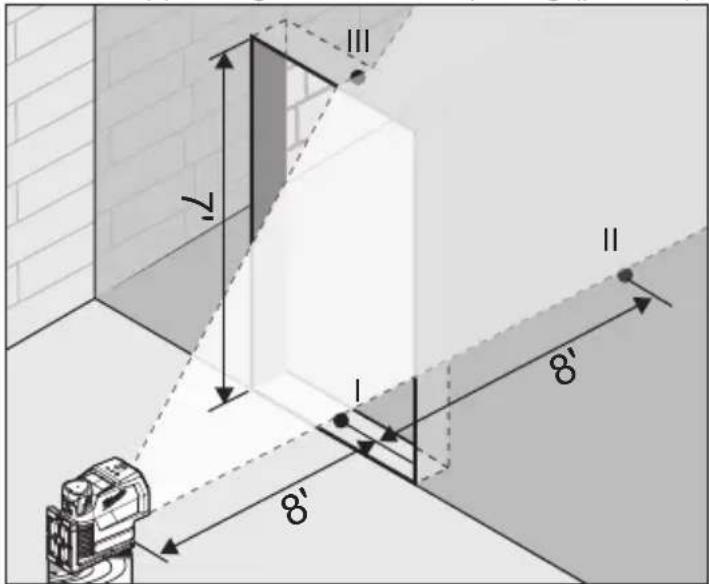
- Move the laser level directly behind point II on the other side of the door. Align the vertical laser line so the center is directly aligned with points I and II.
- Mark the center of the vertical line at the upper edge of the door opening (point IV).
- Measure the height of the door opening.
- The distance between points I and IV on the upper door opening is the vertical deviation (d) of the tool.
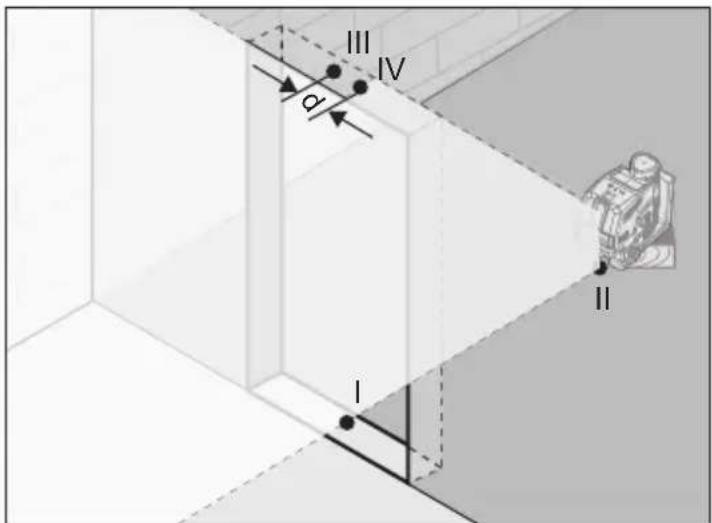
- The maximum vertical deviation (d) is: dmax = 2X H (door opening) x ±1/8" ÷ 33'. Example: for a door opening height of 7', the maximum permitted deviation (d) is: dmax = 2 x 7' x ±1/8" ÷ 33' = ±0.05". Therefore, the measurement between points III and IV on the upper door opening should not exceed 0.05" in a 7' doorway.
Plumb Dot Accuracy
A free measuring distance of approximately 16.5' between floor and ceiling on a firm surface is required for this check. It is suggested to install riser block, if not already equipped.
- Place the tool within 1 of the floor.
- Turn the tool to ON and to Vertical Plumb Line Mode or Perpendicular Level & Plumb Point Mode.
- Set tool on ground and mark the center of the plumb point on the ceiling (point I). Also, mark the center of the plumb point on the floor (point II).
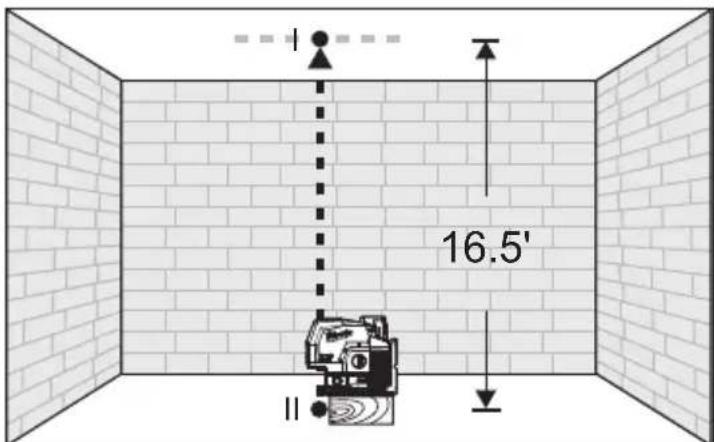
- Rotate the tool 180° . Align the center point of the laser beam directly onto the floor point II.
- Mark the center of the top plumb point on the reference line on the ceiling (point III).
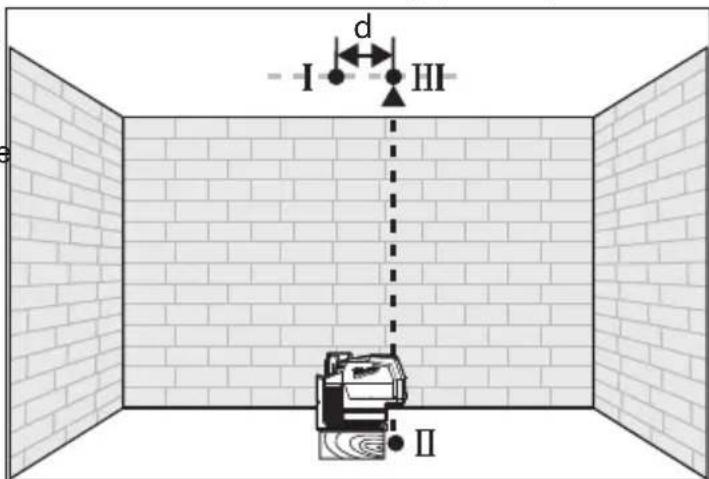
- The distance between points I and III on the ceiling is the deviation (d) of the tool. This distance should not exceed 1 / 8'' (max.) at 33' . For the Measuring distance of 2 × 16.5' = 33' , the maximum allowable deviation (d) is: 33' × ± 1 / 8'' ÷ 33' = ± 1 / 8'' .
MAINTENANCE
WARNING
To reduce the risk of injury, always unplug the charger and remove the
battery pack from the charger or tool before performing any maintenance. Never disassemble the battery pack, charger, or tool, except as provided in these instructions. Contact a MILWAUKEE service facility for all other repairs.
Maintain Laser Level
Maintain tools. If damaged, have the tool repaired before use. Accidents may be caused by poorly maintained tools.
WARNING
To reduce the risk of personal injury and damage, never immerse a back or charger in liquid or allow a inside them.
Cleaning
Clean dust and debris from any vents. Keep tool clean, dry and free of oil or grease. Use only mild soap and a damp cloth to clean, since certain cleaning agents and solvents are harmful to plastics and other insulated parts. Some of these include gasoline turpentine, lacquer thinner, paint thinner, chlorinated cleaning solvents, ammonia and household detergents containing ammonia. Never use flammable or combustible solvents around tools.
Cleaning the Lenses
Blow off loose particles with clean compressed air. Carefully wipe the surface with a cotton swab moistened with water.
Repairs
For repairs, return the tool, battery pack and charger to the nearest authorized service center.
ACCESSORIES
WARNING
Use only recommended accessories. Others may be hazardous.
For a complete listing of accessories, go online to www.milwaukeeetool.com or contact a distributor.
SERVICE - UNITED STATES
1-800-SAWDUST (1.800.729.3878)
Monday-Friday, 7:00 AM - 6:30 PM CST
or visit www.milwaukeetool.com
Contact Corporate After Sales Service Technical Support with technical, service/repair, or warranty questions.
Email: metproductsupport@milwaukeetool.com
Become a Heavy Duty Club Member at www.milwaukeetool.com to receive important notifications regarding your tool purchases.
SERVICE - CANADA
Milwaukee Tool (Canada) Ltd 1.877.948.2360
Monday-Friday, 7:00 AM - 4:30 PM CST or visit www.milwaukeetool.ca
LIMITED WARRANTY USA & CANADA
This MILWAUKEE power tool* is warranted to the original purchaser from an authorized MILWAUKEE distributor only to be free from defects in material and workmanship. Subject to certain exceptions, MILWAUKEE will repair or replace any part on this power tool which, after examination, is determined by MILWAUKEE to be defective in material or workmanship for a period of five (5) years after the date of purchase unless otherwise noted. Return of the power tool to a MILWAUKEE factory Service Center location or MILWAUKEE Authorized Service Station, freight prepaid and insured, is required. A copy of the proof of purchase should be included with the return product. This warranty does not apply to damage that MILWAUKEE determines to be from repairs made or attempted by anyone other than MILWAUKEE authorized personnel, misuse, alterations, abuse, normal wear and tear, lack of maintenance, or accidents.
Normal Wear: Many power tools need periodic parts replacement and service to achieve best performance. This warranty does not cover repair when normal use has exhausted the life of a part including, but not limited to, carriage gears, chucks, brushes, cords, saw shoes, blade clamps, o-rings, seals, bumpers, driver blades, pistons, strikers, lifters, and bumper cover washers.
*This warranty does not cover battery packs or all power tools. Refer to the separate and distinct warranties available for those products. The warranty period for the LED in the LED Work Light (49-24-0171) and the LED Upgrade Bulb (49-81-0090) is the lifetime of the product subject to the limitations above. If during normal use the LED or LED Upgrade Bulb fails, the part will be replaced free of charge.
Warranty Registration is not necessary to obtain the applicable warranty on a MILWAUKEE power tool product. The manufacturing date of the product will be used to determine the warranty period if no proof of purchase is provided at the time warranty service is requested.
ACCEPTANCE OF THE EXCLUSIVE REPAIR AND REPLACEMENT REMEDIES DESCRIBED HEREIN IS A CONDITION OF THE CONTRACT FOR THE PURCHASE OF EVERY MILWAUKEE PRODUCT. IF YOU DO NOT AGREE TO THIS CONDITION, YOU SHOULD NOT PURCHASE THE PRODUCT. IN NO EVENT SHALL MILWAUKEE BE LIABLE FOR ANY INCIDENTAL, SPECIAL, CONSEQUENTIAL, OR PUNITIVE DAMAGES, OR FOR ANY COSTS, ATTORNEY FEES, EXPENSES, LOSSES OR DELAYS ALGEGED TO BE AS A CONSEQUENCE OF ANY DAMAGE TO, FAILURE OF, OR DEFECT IN ANY PRODUCT INCLUDING, BUT NOT LIMITED TO, ANY CLAIMS FOR LOSS OF PROFITS. SOME STATES DO NOT ALLOW THE EXCLUSION OR LIMITATION OF INCIDENTAL OR CONSEQUENTIAL DAMAGES, SO THE ABOVE LIMITATION OR EXCLUSION MAY NOT APPLY TO YOU. THIS WARRANTY IS EXCLUSIVE AND IN LIEU OF ALL OTHER EXPRESS WARRANTY TORIES, WRITTEN OR ORAL. TO THE EXTENT PERMITTED BY LAW, MILWAUKEE DISCLAIMS ANY IMPLIED WARRANTY TIES, INCLUDING WITHOUT LIMITATION ANY IMPLIED WARRANTY OF MERCHANTABILITY OR FITNESS FOR A PARTICULAR USE OR PURPOSE; TO THE EXTENT SUCH WARRANTYER IS NOT PERMITTED BY LAW, SUCH IMPLIED WARRANTY ARE LIMITED TO THE DURATION OF THE APPLICABLE EXPRESS WARRANTY AS DESCRIBED ABOVE. SOME STATES DO NOT ALLOW LIMITATIONS ON HOW LONG AN IMPLIED WARRANTY LASTS, SO THE ABOVE LIMITATION MAY NOT APPLY TO YOU, THIS WARRANTY GIVES YOU SPECIFIC LEGAL RIGHTS, AND YOU MAY ALSO HAVE OTHER RIGHTS WHICH VARY FROM STATE TO STATE.
This warranty applies to product sold in the U.S.A. and Canada only. Please consult the Service Center Search in the Parts & Service section of MILWAUKEE's website www.milwaukeetool.com or call 1.800. SAWDUST (1.800.729.3878) to locate your nearest service facility for warranty and non-warranty service on a MILWAUKEE power tool.
RÉGLES DE SECURITE GÉNÉRALES RELATIVES AUX OUTILS ELECTRIQUES
AVENTISSEMENT
- Move the tool within 1 of wall B. Allow the laser to self level. Align the laser cross in the general direction of point II on wall B.
Milwaukee Tool (Canada) Ltd 1.877.948.2360
Monday-Friday, 7:00 AM - 4:30 PM CST www.milwaukeetool.ca
GARANTIE LIMITEE - AUX ETATS-UNIS ET AU CANADA
Lunes a Viernes (9am a 6pm)
O contactanos en www.milwaukeetool.com.mx
GARANTÍA LIMITADA - E.U.A. Y CANADA
13135 West Lisbon Road
Brookfield, WI 53005 USA
58143622d4 00658143622Q0-04(A)
12/24 Printed in


- LASER SAFETY
- WORK AREA SAFETY
- ELECTRICAL SAFETY
- PERSONAL SAFETY
- POWER TOOL USE AND CARE
- BATTERY TOOL USE AND CARE
- SERVICE
- SPECIFIC SAFETY RULES FOR LASER LEVELS
- SYMBOLOGY
- SPECIFICATIONS
- ASSEMBLY
- FUNCTIONAL DESCRIPTION
- Removing/Inserting the Battery
- Power Save
- Fuel Gauge
- Mounting/Adjusting the Laser Level
- OPERATION
- WARNING
- CAUTION
- NOTICE
- Turning On/Off
- Using the Laser Level
- Troubleshooting
- ACCURACY FIELD CHECK
- Influences on Accuracy
- Horizontal Height Accuracy
- Horizontal Leveling Accuracy
- Vertical Leveling Accuracy
- Plumb Dot Accuracy
- MAINTENANCE
- Maintain Laser Level
- Cleaning
- Cleaning the Lenses
- Repairs
- ACCESSORIES
- SERVICE - UNITED STATES
- 1-800-SAWDUST (1.800.729.3878)
- SERVICE - CANADA
- Milwaukee Tool (Canada) Ltd 1.877.948.2360
- LIMITED WARRANTY USA & CANADA
- RÉGLES DE SECURITE GÉNÉRALES RELATIVES AUX OUTILS ELECTRIQUES
- AVENTISSEMENT
- GARANTIE LIMITEE - AUX ETATS-UNIS ET AU CANADA
- GARANTÍA LIMITADA - E.U.A. Y CANADA
Brand : MILWAUKEE
Model : 362220
Category : Laser level