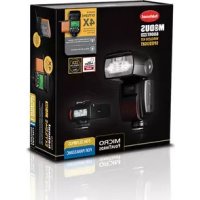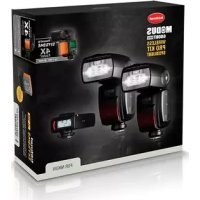
MODUS 600RT MK II (Canon) - Lamp Hähnel - Free user manual and instructions
Find the device manual for free MODUS 600RT MK II (Canon) Hähnel in PDF.



User questions about MODUS 600RT MK II (Canon) Hähnel
0 question about this device. Answer the ones you know or ask your own.
Ask a new question about this device
Download the instructions for your Lamp in PDF format for free! Find your manual MODUS 600RT MK II (Canon) - Hähnel and take your electronic device back in hand. On this page are published all the documents necessary for the use of your device. MODUS 600RT MK II (Canon) by Hähnel.
USER MANUAL MODUS 600RT MK II (Canon) Hähnel
natural_image
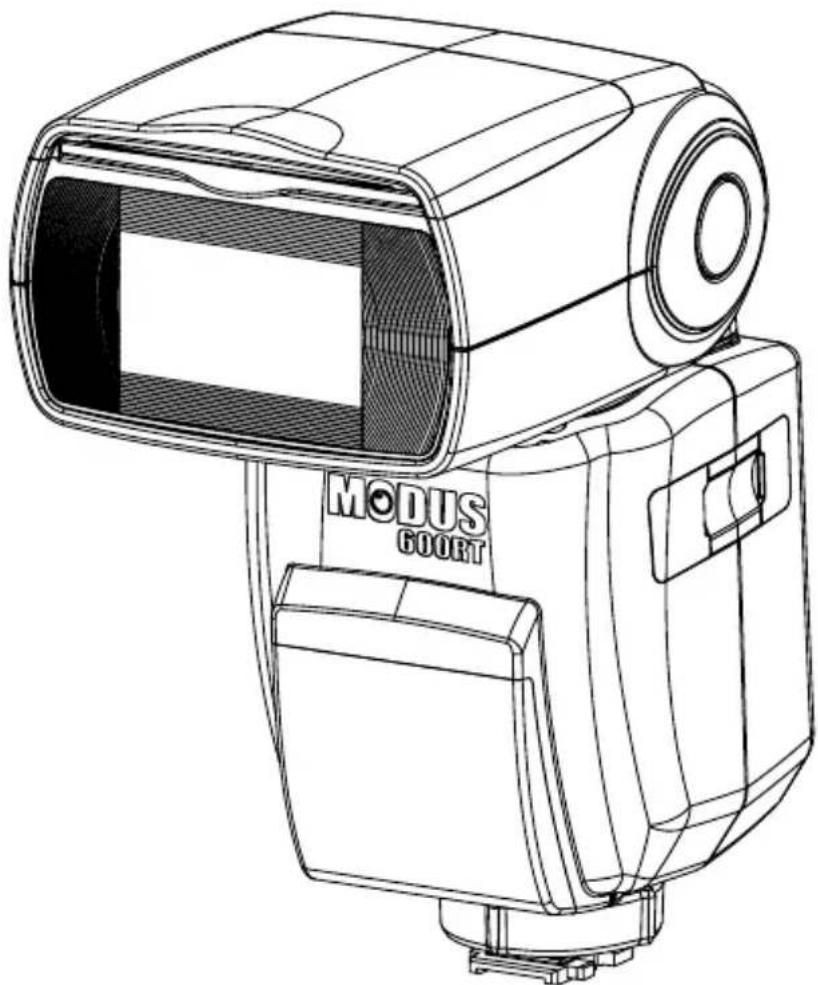
Line drawing of a MODUS 600RT camera module (no text or symbols on the device itself)Wireless Speedlight for Canon
Foreword
Thank you for purchasing the Modus 600RT.
The Modus 600RT is a Speedlight for Canon EOS series cameras and is compatible with the E-TTL II Auto flash system. Older generation E-TTL/TTL Autoflash system and (Type-B camera) will work also with some features not available.
- Before starting to shoot, be sure to read this manual
- When reading this manual also refer to the camera's Instruction Manual
Conventions & assumptions
- The manual is based on the assumption that all devices including camera are turned on
• Reference page numbers are indicated by (page **) - The caution symbol indicates a warning to prevent shooting problems
• The Note symbol gives supplemental information
Contents
1 Introduction
• Safety precaution - Warnings & Cautions 6
- Nomenclature
• Body 8
• Control Panel 9
• LCD Panel in five modes 9
• Nomenclature - Viper TTL Transmitter 12
2 Getting started
- Wireless Kit - Whats in the box 14
- Wireless Pro Kit - Whats in the box 14
- Battery and charger 14
- Attaching to camera 17
• Power Management 17 - Flash Mode - E-TTL Autoflash
• FEC (Flash Exposure Compensation) 18
• FEB (Flash Exposure Bracketing) 19
• FEL (Flash Exposure Lock) 20
• HSS (High Speed Sync) 20 -
2nd Curtain Sync 21
-
Flash Mode - Manual Flash 22
-
Flash output power range 22
• Optical O1 Secondary unit setting 22
• Optical O2 Secondary unit setting 23 -
Flash Mode - Multi: Stroboscopic Flash 23
- Calculating the shutter speed 23
- Number of flashes / flash frequency = shutter speed 24
3 Wireless Flash Photography: (2.4GHz) Control
• Master/Slave wireless flash lighting 25
- Wireless multiple flash shooting 26
- Wireless settings
• Master unit Setting 27
- Slave unit Setting 27
• Master unit flash ON/OFF 27
• DCM (Digital channel matching) 28
• Master - Viper TTL or Modus 600RT 28
- Slave - Modus 600RT 28
- Modus 600RT Reset 29
- ETTL - Fully automatic wireless flash shooting 29
- Using Automatic wireless flash with multiple slave units 31 - Advanced setting with fully automatic wireless flash 31 - Multiple master unit 32
• ETTL shooting Flash Ratio A:B 32
• ETTL shooting Flash Ratio A:B:C 33
• M: Wireless Flash Shooting with Manual Flash 34
- MULTI: Wireless Flash Shooting with Multi Flash 35
- GR - Shooting with a Different Flash Mode for Each Group 35
4 Wireless Flash Photography: Optical Transmission
- Wireless settings 38
• Master unit setting 39
- Slave unit setting 39
• Master unit flash ON/OFF 39
- Setting the optical communication channel 39
• ETTL - Fully automatic wireless flash shooting 40
• Using Automatic wireless flash with multiple slave units 40
• ETTL shooting Flash Ratio A:B 40
• ETTL shooting Flash Ratio A:B:C 40
• M: Wireless Flash Shooting with Manual Flash 41
- MULTI: Wireless Flash Shooting with Multi Flash 41
5 Wireless Flash Photography: (2.4GHz) using Viper TTL Transmitter
- Wirelesssetting 42
- Group Power Control setting for Manual and TTL FEC 42
- Multi Mode 43
- Sync Modes 43
6 Other Applications
- SyncTriggering 44
• Auto Focus Asist Beam 44
- Bounce Flash 44
- Catchlight Panel 45
- Zoom – Setting the Flash Coverage and using Wide Panel 45
• C.Fn – Setting Custom Functions 46
- Setting Camera Flash Functions 47
- Protection Functions 47
• Technical Data 49
- Troubleshooting 50
- Firmware Upgrade 51
- Maintenance 51
⚠️Warnings:
Failure to observe the instructions below may result in loss of life or serious bodily injury. To prevent fire, excessive heat, chemical leakage, explosions, and electrical shock, follow the safeguards below:
- Do not insert any foreign metallic objects into the electrical contacts of the product, accessories, connecting cables, etc
- Do not use any batteries, power sources, or accessories not specified in the instruction Manual. Do not use any deformed or modified batteries, or the product if it is damaged
- Do not short-circuit, disassemble, or modify the product or batteries. Do not apply heat or solder to the batteries. Do not store batteries with metal objects. Do not expose the batteries to fire or water. Do not subject the batteries to strong impact or continuous mechanical shock
- Do not place batteries in microwave, cooker or high-pressure container
- Do not use the product in locations where there is flammable gas
- Do not fire the flash at anyone driving a car or other vehicle
- Do not disassemble or modify the equipment. High-voltage internal parts may cause electrical shock. If you drop the equipment and the casing breaks open to expose the internal parts, do not touch the exposed parts. There is a possibility of an electrical shock
- Do not store the product in dusty or humid places or location with lots of oil smoke. Do not store battery in charger
- Keep the batteries and other accessories out of the reach of children and infants
- Do not drop product or battery in fire or water
- Do not expose product or battery to excessive temperature (below 0°C or above 40°C) or strong direct sunlight
- Battery temperature while on charge or in use should never increase above 60°C/140°F. If higher temperature occurs, stop using and stop charging immediately
- Do not use paint thinner, benzene, or other organic solvents to clean the product
GB
Caution:
- Failure to observe the instructions below may result in serious bodily injury or damage to property
- When the product is not in use for a prolonged period, make sure to remove the batteries before storing
- When disposing of a battery, insulate the electrical contacts with tape. Contact with other metallic objects or batteries may cause a fire or an explosion. Dispose of battery in accordance with the appropriate regulations
- Do not store or leave product or battery in trunk or on dashboard of a vehicle or in direct sunlight or with a high interior temperature as overheating can result in burns if touched leaking, fire or explosion
- Do not fire the flash with the flash head (light-emitting unit) in contact with a human body or any object doing so may result in the risk of burns and fire
- Do not fire the flash near the eyes. Keep the flash unit at least 1m (3.3 feet) away from face. It may hurt or damage the eyes. Using bounce flash to reduce light intensity is also recommended
Nomenclature
GB
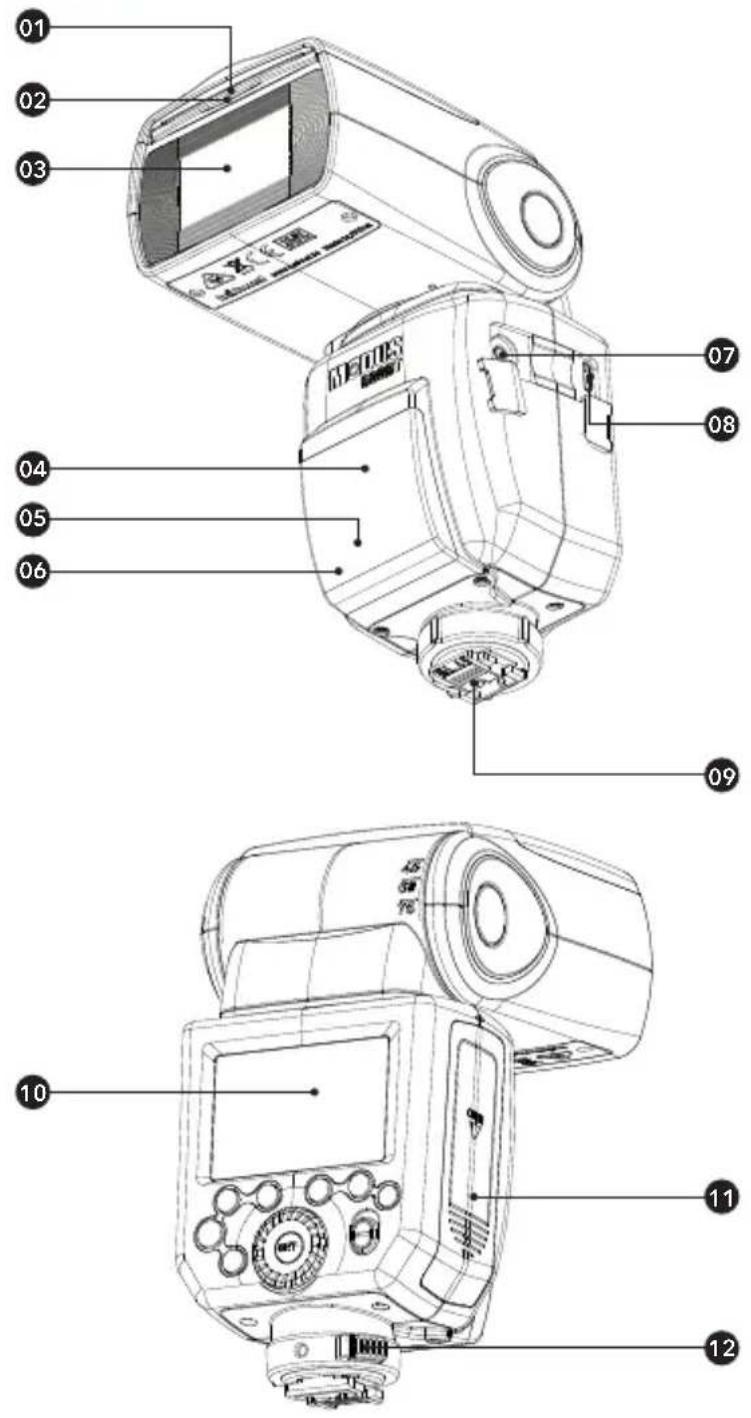
text_image
Technical diagram of a digital camera with numbered parts for identificationNomenclature - Body
- Catchlight Panel
- Built-in Wide Panel
- Flash Head
- Optical Control Sensor
- Focus Assist Beam
-
Slave Flash Ready Indicators
-
Sync Cord Jack
- USB Port
- Hotshoe
- Dot-matrix LCD Panel
- Battery Compartment
- Quick Lock
Nomenclature - Control Panel
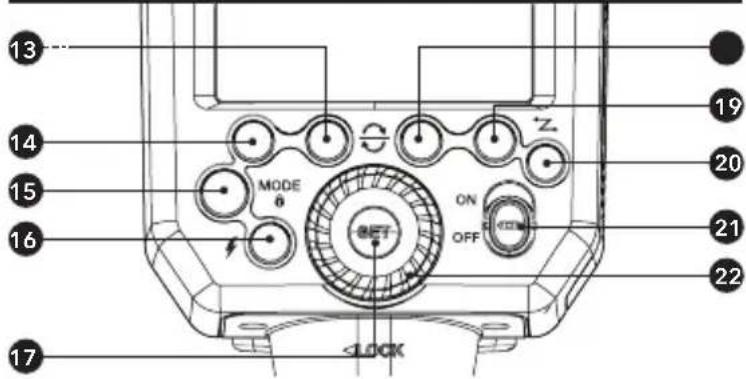
text_image
13 14 15 16 MODE θ ON OFF 20 21 22 17 LOCK-
Function Button 2
-
Function Button 3
-
Function Button 1
-
Function Button 4
-
Mode Selection Button / Lock button -
Wireless Mode/Master/Slave -
<> Test Button / Flash Ready Indicator
-
ON/OFF Power Switch
-
Set Button -
Select Dial
Nomenclature - LCD Panel
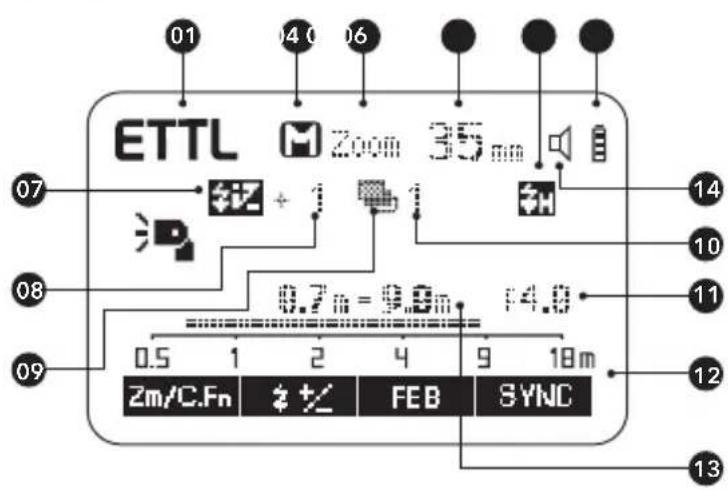
text_image
01 04 06 ETTL Zoom 35 mm 07 + - 0.7 m = 9.0 m +4.0 14 10 11 08 09 0.5 1 2 4 9 18 m Zm/C.Fn # +/ FEB SYNC 12 13(1) E-TTL Autoflash
- ETTL: E-TTL II autoflash
- Automatic
M: Manual
- Zoom: zoom display
- Focus Distance
- : High-speed sync
: Second curtain sync
- Battery level indicator
-
Flash exposure compensation
-
Flash exposure compensation amount
- : Flash exposure bracketing
- Flash exposure bracketing counter
- Aperture
- Distance indicator scale
- Effective flash range
- □ Beep on/off (C. Fn 7)
• The display will only show the settings currently applied.
- The functions displayed above function buttons 1 to 4, such as and change according to settings' status.
- When a button or dial is operated, the LCD panel illuminated.
SYNC
(2) Manual Flash
01: Standard Optical. 02: Preflash Optical
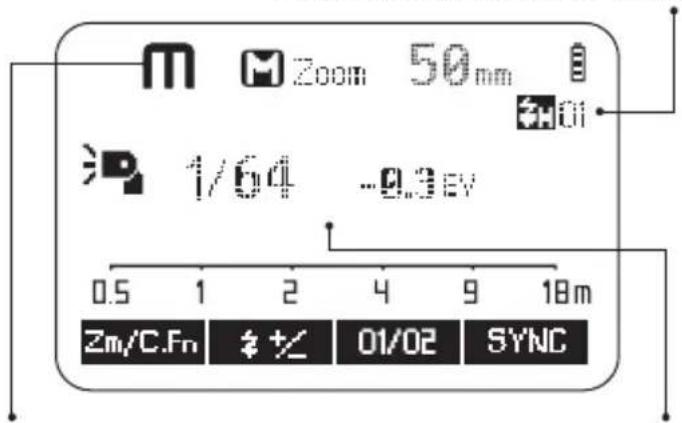
text_image
M M Zoom 50nm +01 1/64 -0.9EV 0.5 1 2 4 9 18m Zm/C.Fn #+/- 01/02 SYNCM : Manual flash Manual flash output power
(3) Multi Flash
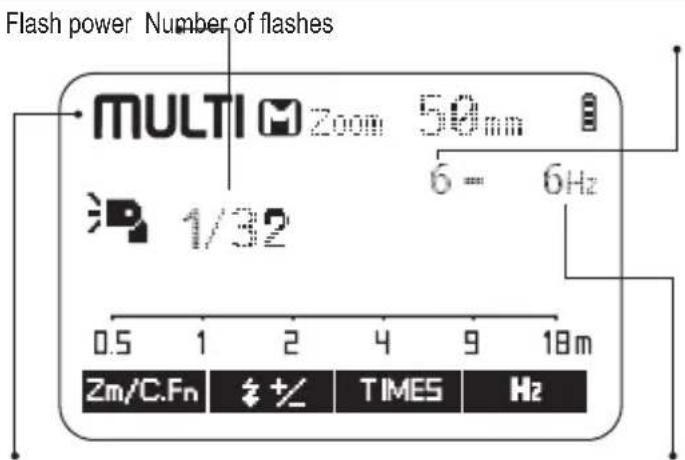
text_image
Flash power Number of flashes MULTI Zoom 50 mm 6 = 6Hz 1/32 0.5 1 2 4 9 18m Zm/C.Fn #+ TIMES HzMULTI : Stroboscopic flash Flash frequency
(4) Radio Control Shooting/Optical Control Shooting
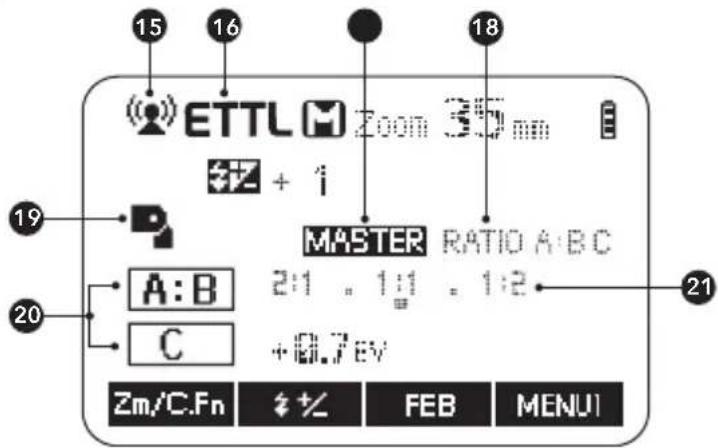
(a) Master Unit - Flash Mode
text_image
15 16 18 ETTL M Zoom 35 mm + i MASTER RATIO A:BC 2:1 . 1:1 . 1:2 A:B C +0.7 EV Zm/C.Fn # # FEB MENU1-
Radio control wireless shooting
: Optical control wireless shooting -
Flash mode : ETTL/M/MULTI/Gr Group (Group flash radio control)
-
MASTER : Master
- RATIO : Flash ratio
-
Master unit flash ON
Master unit flash OFF
:Master unit bounce ON -
Firing group
-
Ratio scale
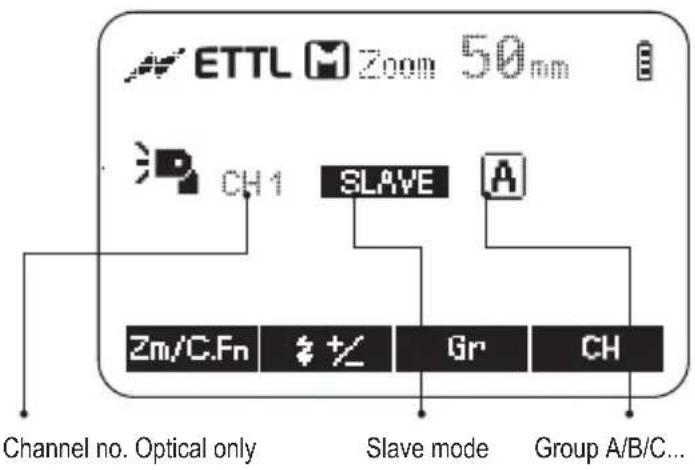
text_image
ETTL Zoom 50nm CH1 SLAVE A Zm/C.Fn #+ Gr CH Channel no. Optical only Slave mode Group A/B/C...LCD Panel in Five Modes
(1) Attached to the Camera
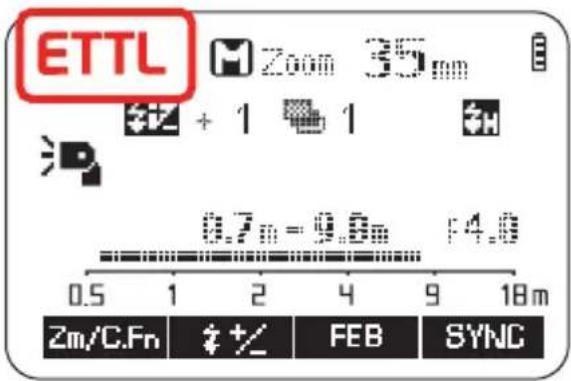
text_image
ETTL Zoom 35nm + 1 1 0.7m = 9.0m F4.0 Zm/C.Fn #+/FEB SYNC(2) 2.4GHz Radio Control: As a Master Unit
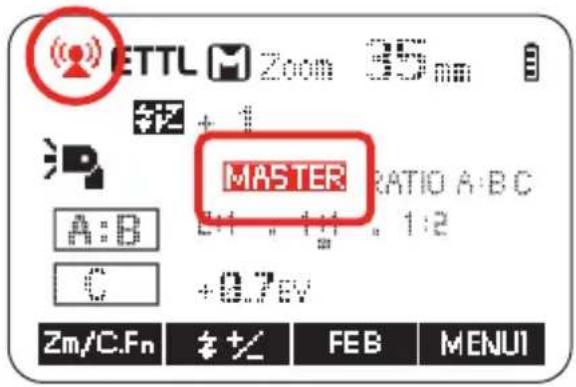
text_image
ETTL Zoom 35 mm +1 MASTER A: B 24. 1:1. 1:2 C +0.7eV Zm/C.Fn # +/- FEB MENU(3) 2.4GHz Radio Control: As a Slave Unit Group A
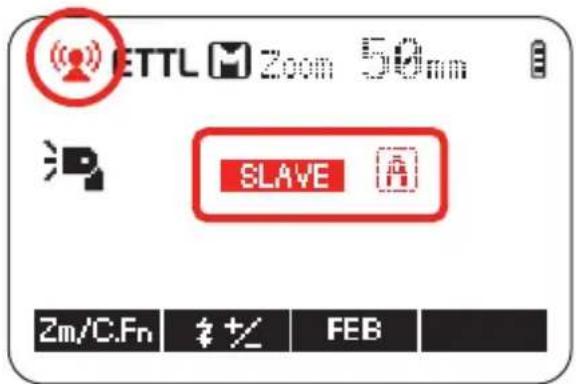
text_image
ETTL M Zoom 50mm SLAVE Zm/C.Fn #+ FEB(4) Optical Control: As a Master Unit
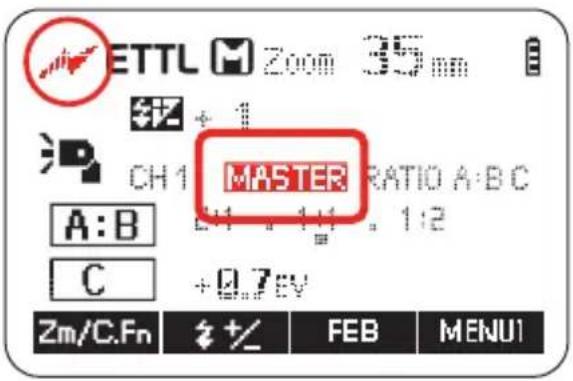
text_image
ETTL Zoom 35 mm CH1 MASTER RATIO A:BC A:B 1:4 1:2 C +0.7 EV Zm/C.Fn FEB MENU1GB
(5) Optical Control: As a Slave Unit
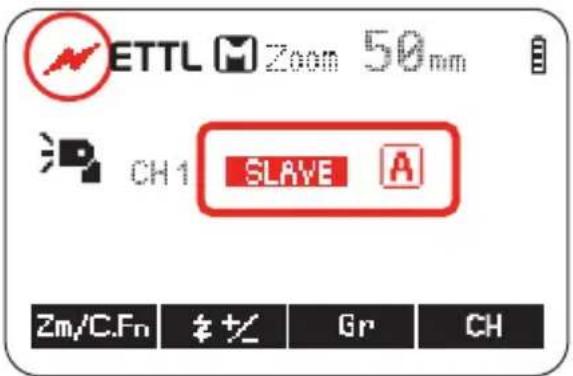
text_image
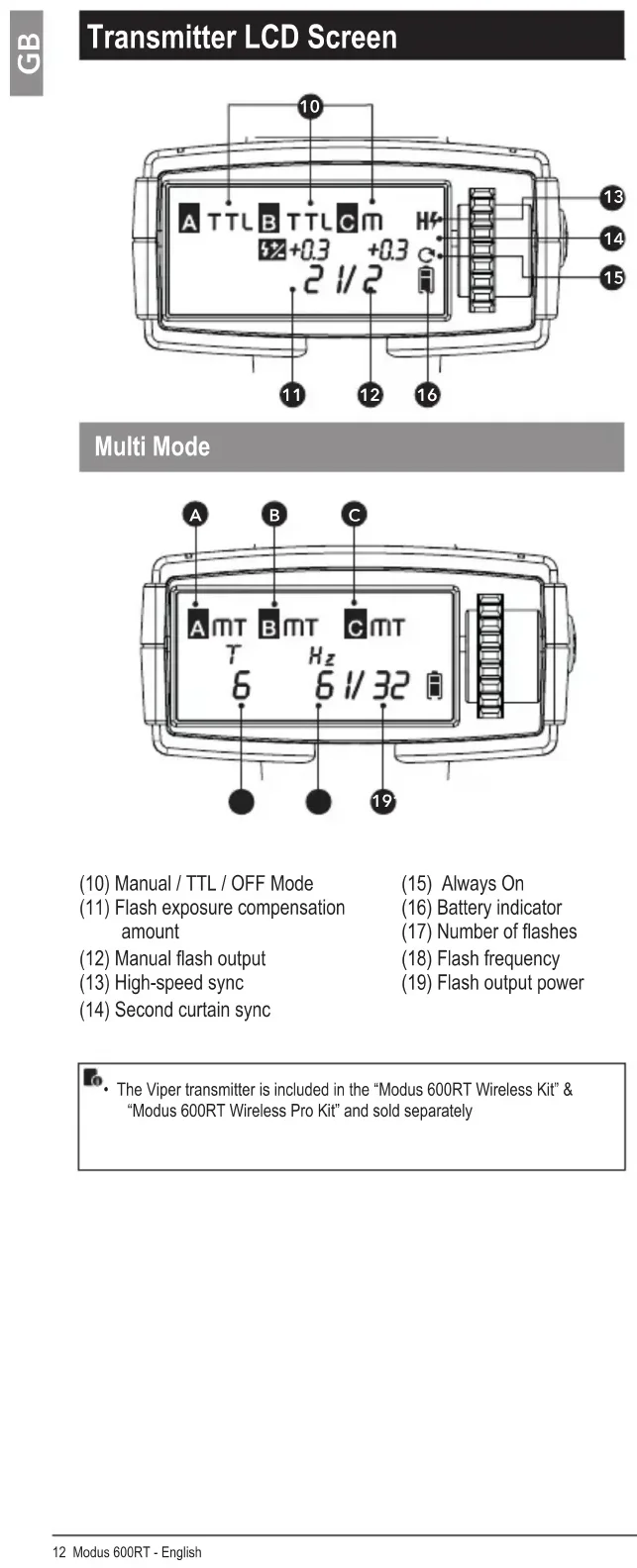
ETTL Zoom 50mm CH1 SLAVE A Zm/C.Fn #+Gr CHNomenclature - Viper TTL
Transmitter
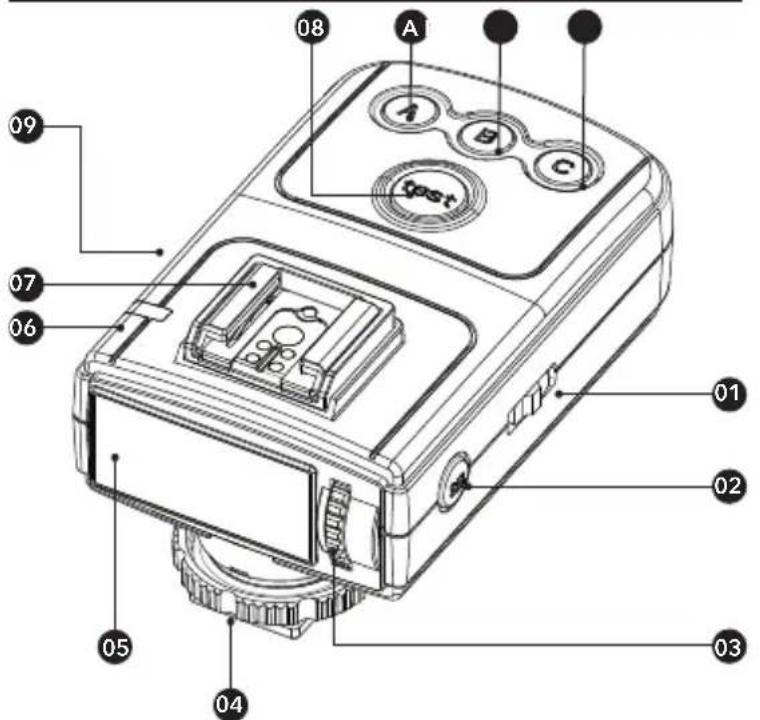
text_image
08 A B C 09 07 06 Sport 01 02 03 05 04(A) Group A
(B) Group B
(C) Group C
(1) ON/OFF - switch
(2) SEL - select button
(3) Adjust Dial - To adjust settings
(4) Lock Wheel
(5) LCD Screen
(6) Power / Status LED
(7) Hot shoe
(8) Test - button
(9) Micro USB - firmware update
text_image
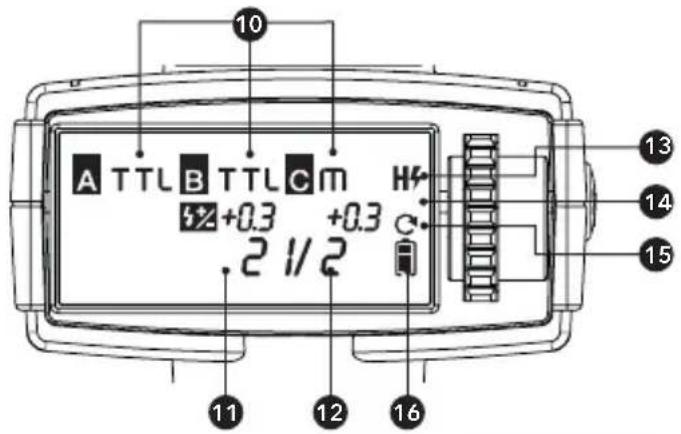
A TTL B TTL C m +0.3 +0.3 .2 1/2 10 13 14 15 11 12 16Multi Mode
text_image
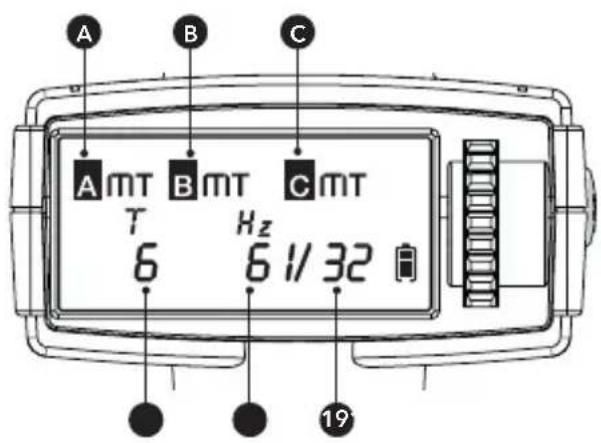
A B C A mT B mT C mT T Hz 6 6 1/32 19(10) Manual / TTL / OFF Mode
(11) Flash exposure compensation amount
(12) Manual flash output
(13) High-speed sync
(14) Second curtain sync
(15) Always On
(16) Battery indicator
(17) Number of flashes
(18) Flash frequency
(19) Flash output power

The Viper transmitter is included in the "Modus 600RT Wireless Kit" & "Modus 600RT Wireless Pro Kit" and sold separately
2
Getting Started
GB
What's in the Modus 600RT?
-
Modus 600RT Speedlight
-
Li-ion Battery Pack
-
Battery Charger
-
Micro USB Cable
-
Mini Stand
-
Protection Case
-
Instruction Manual
What's in the Modus 600RT Wireless Kit?
-
Modus 600RT Speedlight
-
Viper TTL Transmitter
-
Li-ion Battery Pack
-
Battery Charger
-
Micro USB Cable
-
Mini Stand
-
Protection Case
-
Instruction Manual
-
2 x AA Batteries
What's in the Modus 600RT Pro Kit?
-
2 x Modus 600RT Speedlight
-
Viper TTL Transmitter
-
2 x Extreme Li-ion Battery Pack
-
Battery Charger
-
Micro USB Cable
-
2 x Mini Stand
-
2 x Protection Case
-
Instruction Manual
-
2 x AA Batteries
Battery and Charger
- The Modus 600RT uses a lithium ion battery HLX-MD1 and it must be charged before use
- Use only the MD1 MKII charger to charge the battery
- Remove battery from charger when charging is finished and disconnect charger from mains
A fully charged battery will offer approx 500 flashes at full power and even more when power level is reduced. The composition and construction of the MD1 battery pack offers very reliable and fast refresh time for the speedlight.
How to store the battery
When not in use remove battery from the charger or the speedlight and store battery in a cool and dry place. Exposing the battery to higher temperature can shorten the lifetime of the battery. Store the battery almost empty (one bar in the battery level indicator) when not used for a long period of time. For optimum battery life use battery regularly and if not used for more than 6 months charge the battery fully and use it with the Modus 600RT until the battery level is down to 1 bar again before storage.
Battery Lifetime
The lifetime of a recharable battery is limited. The capacity will drop progressively with use and age of battery pack. Replace the battery pack when the flash cycle time becomes longer or the number of flashes reduces noticeably. The battery lifetime can vary substantially depending on storage, operation conditions and exposure to unsuitable environmental conditions
B
Caution
- Do not short circuit the battery
- Do not drop battery into water or fire
- Do not drop or dismantle or subject the batteries to strong impact or continuous mechanical shock
- Stop using the battery if the battery has any signs of damage or bulging to housing and dispose of battery in accordance with the appropriate local regulations
How to charge the battery
The HLX-MD1 battery must be charged before use. Use the supplied MD1 MKII charger to charge the battery. Connect the MD1 MKII charger to a USB adapter (min 5V 2 Amp) with the supplied Micro USB Cable. To start the charge insert the HLX-MD1 battery into the MD1 MKII charger and the green LED bars will illuminate, indicating that the battery is charging. 4 green LED's on indicates full charge. Remove the battery from charger when fully charged.
Fitting and Removing the Battery
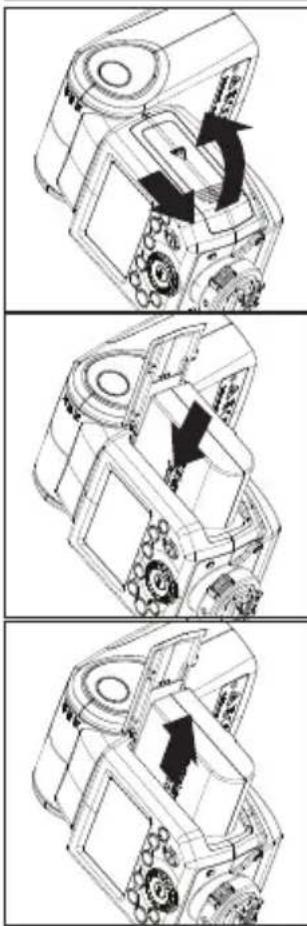
natural_image
Three-panel diagram showing a mechanical device with internal components and directional arrows indicating motion (no text or symbols)-
To fit the battery, push the battery compartment cover downward and open it.
-
According to the triangle sign on the battery pack, insert it into the compartment until a white clip locks the battery with a click sound.
-
To remove the battery, tap the white clip and the battery pack will pop out. Then close the compartment.
Battery Level Indication
Make sure the battery pack is securely fitted in the flash. Check the battery level indication on the LCD panel to see the remaining battery level.
Low Battery Warning
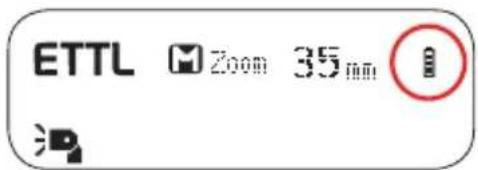
text_image
ETTL Zoom 35 mm| Battery Level Indication | Meaning |
| 3 bars | Full |
| 2 bars | Middle |
| 1 bar | Low |
| No bars | Lower battery, please recharge it |
| Blinking | The battery level is going to be used out immediately.Note: Please recharge the battery as soon as possible (within 10 days). Then, the battery can be used or stored as detailed in the “How to store the battery” section. |
Attaching to Camera
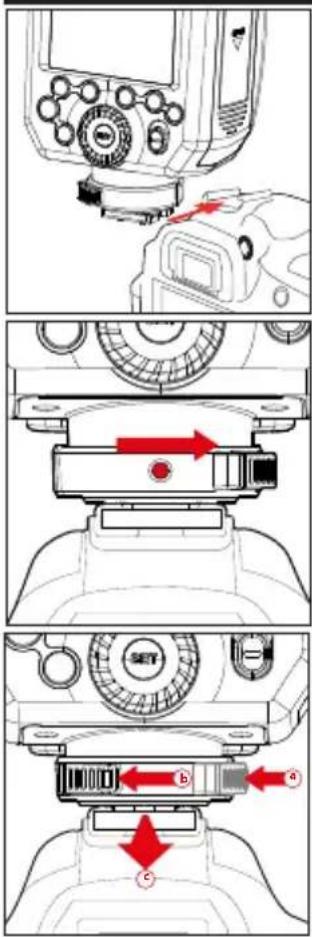
text_image
Technical diagram showing three views of a camera module with labeled components and directional arrows indicating movement or assembly.- Attach the Speedlight to the camera.
Slip the flash's mounting foot into the camera's hotshoe all the way.
-
Secure the Speedlight Push the release button to rotate the lock ring on the mounting foot until it locks in position to the right.
-
Detach the Speedlight:
a) Push the release button.
b) Rotate the lock ring to the left until it is loosened.
c) Slide the speedlight off the camera hotshoe
Power Management
Use ON/OFF Power Switch to power the flash unit on or off. Turn off if it will not be used for an extended period of time. Setting as a master flash, it will turn the power off automatically after a certain period (approx. 90 seconds) of idle use. Pressing the camera shutter halfway or pressing any flash button will wake up the flash unit. Setting as a slave flash, it will enter sleep mode after a certain period (adjustable, 60 minutes by default) of idle use. Pressing any flash button will wake it up.

C.Fn Disabling Auto Power Off function is recommended when the flash is used off camera. (C.Fn-APO)
C.Fn Slave Auto Power Off Timer is set to 60 minutes by default. Another option "30 minutes" is available. (C.Fn-Sv APOT, Page 46)
Flash Mode - E-TTL Autoflash
This flash has three flash modes: E-TTL, Manual (M), and MULTI (Stroboscopic). In E-TTL mode, the camera and the flash will work together to calculate the correct exposure for the subject and the background. In this mode, multiple TTL functions are available: FEC, FEB, FEL, HSS, second curtain sync, modeling flash. These can be controlled with the Modus 600RT or with the camera's menu screen.
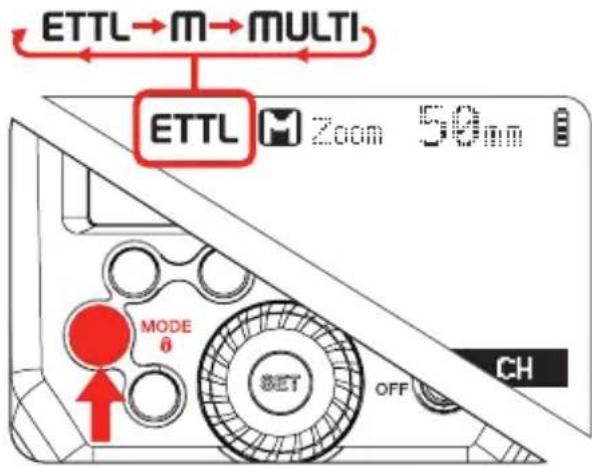
text_image
ETTL→M→MULTI ETTL Zoom 50mm MODE θ SET OFF CH* Press < MODE > Mode Selection Button and three flash modes will display on the LCD panel one by one with each pressing.
ETTL Mode
Press
- Press the camera release button halfway to focus. The aperture and effective flash range will be displayed in the LCD panel.
- When the shutter button is fully pressed, the flash will fire a preflash which the camera will use to calculate the correct flash output power the instant before the photo is taken.

FEC: Flash Exposure Compensation
With FEC function, you can adjust the calculated level from -3 to +3 in 1/3 stops. It is useful in situations where minor adjusting of the TTL system is needed based on the lighting environment.
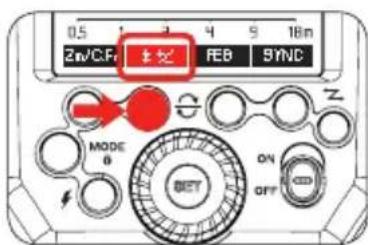
text_image
0.5 1 2 3 4 5 18n 2n/CF ±2 REB 9YNC MODE 6 ON OFF SET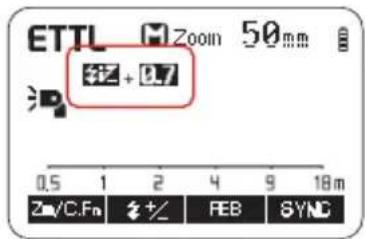
text_image
ETTL Zoom 50mm +Z + 0.7 0.5 1 2 4 9 18m Zn/C.Fn +/- REB SYNCSetting FEC:
- Press Function Button
2 < ± >. The icon < 32 > and flash exposure compensation amount will be highlighted on the LCD panel.
-
Set the flash exposure compensation amount.
-
Turn the Select Dial to set the amount.
• "0.3" means 1/3 step, "0.7" means 2/3 step. - To cancel the flash exposure compensation, set the amount to "+0".
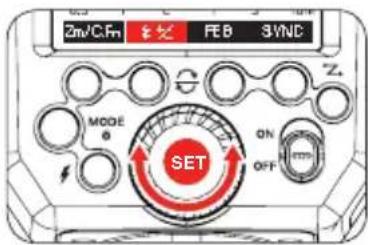
text_image
Zn/C.Fn FEB SYNC MODE SET ON OFF- Press < SET > button again to confirm the setting.
GB

FEB: Flash Exposure Bracketing
You can take three shots while automatically changing the flash output for each shot. The camera will record three images with different exposures: one exposed according to camera calculations, one over-exposed and another under exposed. Over and under exposure amount is user adjustable from -3 to +3. This function helps get correct exposure especially in shooting moving objects or when environmental lights are complex.
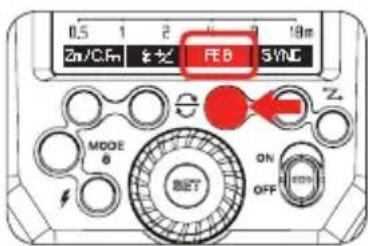
text_image
0.5 1 2 3 18m Zn/C.Fm 线芯 FEB SYNC MODE ON OFF- Press function button 3 <
FEB >. The icon <
and the exposure bracketing amount will be highlighted on the LCD panel
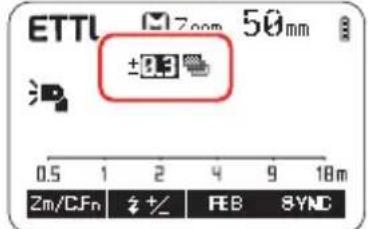
text_image
ETTL 7mm 50mm ±8.3 0.5 1 2 4 9 18m Zm/CFn +/- FEB SYNC- Set the flash exposure compensation amount.
- Turn the Select Dial to set the amount.
- "0.3" means 1/3 step, "0.7" means 2/3 step.
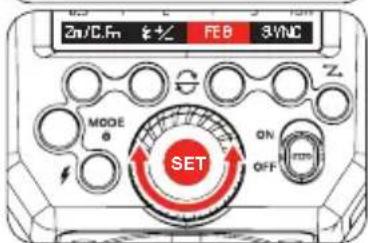
text_image
2n/C.Fm 1/2 FEB 3VNC MODE SET ON OFF- Press < SET > button again to confirm the setting. Then your FEC and FEB settings are displayed on the LCD panel.

FEB will be cancelled after three photos are taken. For best results, set the camera drive mode to "single" and ensure the flash is ready before shooting.
• FEB can be used with FEC and FEL.

You can prevent the FEB from being cancelled automatically after three photos are taken. (C.Fn-FEB ACL, Page 46)

The FEB shooting sequence can be changed. (C.Fn-FEB, Page 46)
FEL: Flash Exposure Lock
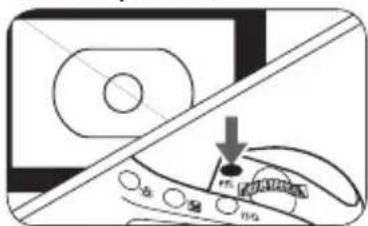
FEL can lock the correct flash exposure setting for any part of the scene. With
text_image
Diagram showing a mechanical or electrical component with a downward arrow and circular symbols, likely indicating a disassembly or repair process.-
Focus the subject.
-
Press the
button
- Aim the centre of the view finder at the required part of the scene and press
• The speedlight will fire a preflash and the required flash output for the subject is
• Each time the
• If the subject is too far away and underexposure, the < >icon will blink in the viewfinder. Move closer to the subject and try the FE lock again.
- If
- If the subject is too small, FE lock might not be very effective.
High-Speed Sync
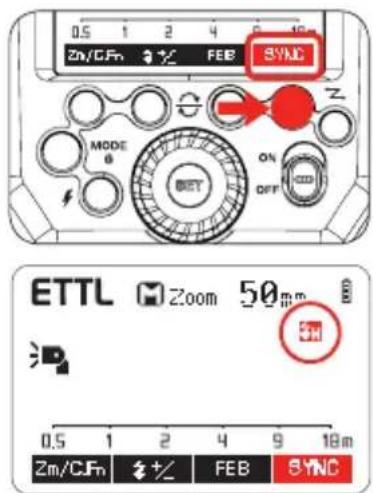
High Speed Sync (FP flash) enables the flash to synchronize with all camera shutter speeds. This is convenient when you want to use aperture priority for fill-flash portraits.
text_image
0.5 1 2 4 5 10 Zn/CFn # 1/2 FEE SYNC MODE ON OFF ETTL Zoom 50 mm 0.5 1 2 4 9 18m Zm/CFn # 1/2 FEB SYNC-
Press Function Button 4 < SYNC > so that < H > is displayed
-
Check that < ms displayed in the viewfinder
-
If you set a shutter speed that is the same as or slower than the camera's maximum flash sync speed, < 50> will not be displayed in the viewfinder
- With high-speed sync, the faster the shutter speed, the shorter the effective flash range
• To return to normal flash, press < SYNC > button twice - Multi flash mode cannot be set in high-speed sync mode
• Over-temperature protection may be activated after 15 consecutive high-speed sync flashes
Second-Curtain Sync
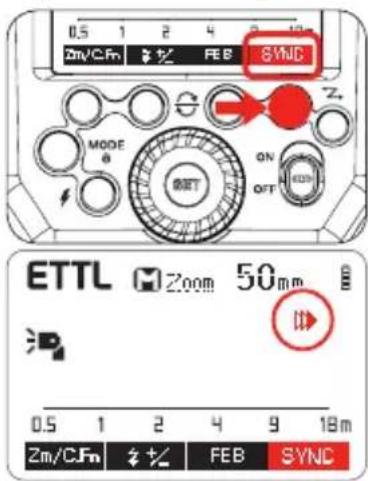
With a slow shutter speed, you can create a light train following the subject. The flash fires right before the shutter closes.
text_image
0.5 1 2 4 2m/C/Fm 静松 FEB SYNC MODE ON OFF ETTL Zoom 50mm 0.5 1 2 4 9 18m Zm/C/Fm 静松 FEB SYNC-
Press function button 4 < SYNC > button so that < DIF is displayed on the LCD panel.
-
To return to normal flash press the function button 4 < SYNC > button.
Flash Mode - Manual Flash
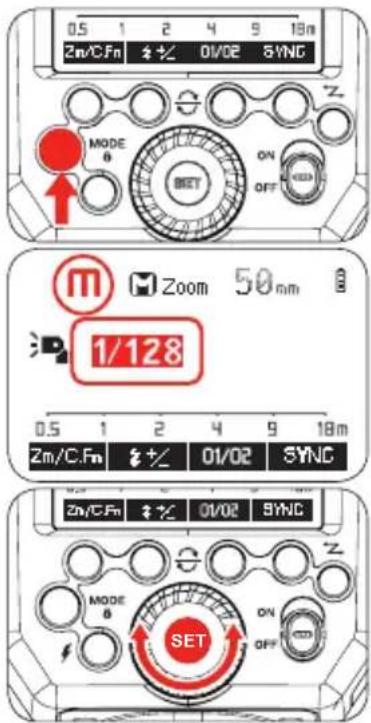
The flash output is adjustable from 1/1 full power to 1/128th power in 1/3rd stop increments. To obtain a correct flash exposure, use a handheld flash meter to determine the required flash output.
text_image
0.5 1 2 4 5 18m Zn/C.Fn 4½ 01/02 SYNC MODE 0 ON OFF Zoom 50nm 1/128 Zm/C.Fn 4½ 01/02 SYNC MODE 0 ON OFF SET-
Press < MODE > button so that < M > is displayed
-
Turn the Select Dial to choose a desired flash output amount
-
Press < SET > button again to confirm the setting
Flash Output Power Range
The following table makes it easier to see how the stop changes in terms of f/stop when you increase or decrease the flash output. For example, when you decrease the flash output: 1/2, 1/2-0.3, or 1/2-0.7, or increase the flash output: 1/2, 1/2+0.3, 1/2+0.7, 1/1.
Figures displayed when reducing flash output level→
| 1/1 1/2 1/4 | 1/1-0.3 | 1/2-0.3 ---- | 1/1-0.7 | 1/2-0.7 | |||
| 1/2+0.7 | 1/4+0.7 ---- | 1/2+ | 0.3 1/4+0.3 |
Optical O1 Secondary Unit Setting
In M manual flash mode, press
Optical O2 Secondary Unit Setting
In M manual flash mode, press

01 and 02 optic triggering is only available in M manual flash mode.
Flash Mode: Multi (Stroboscopic Flash)
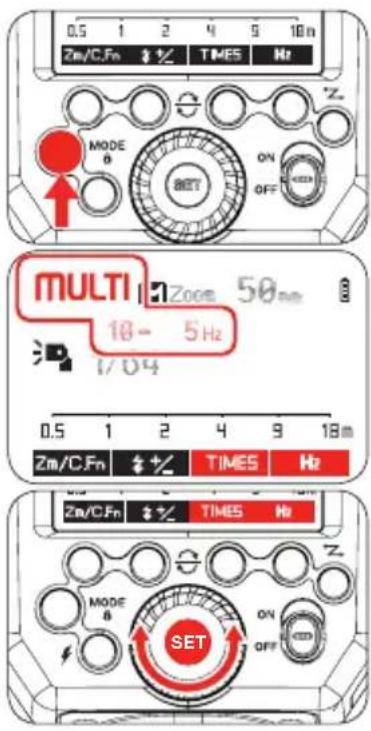
With stroboscopic flash, a rapid series of flashes is fired. It can be used to capture multiple images of a moving subject in a single photograph. You can set the firing frequency (number of flashes per sec.expressed as Hz), the number of flashes, and the flash output power.
text_image
0.5 1 2 4 5 10 m Zm/C.Fn # % TIMES Hz MODE 8 ON OFF MULTI Zoom 50mm 18 - 5 Hz 1/04 0.5 1 2 4 9 18 m Zm/C.Fn # % TIMES Hz Zm/C.Fn # % TIMES Hz MODE 8 ON OFF SET- Press
button so that < MULTI > is displayed -
Turn the Select Dial to choose a desired flash output power
-
Set the flash frequency and number of flashes
-
Press < TIMES > button
- Turn the Select Dial to set the number of flashes
- Press the < Hz >
- Turn the Select Dial to choose a desired flash firing frequency
• After you finish the setting, pressbutton and all the settings will be displayed.
Calculating the Shutter Speed
During stroboscopic flash, the shutter remains open until the firing stops. Use the formula below to calculate the shutter speed and set it on the camera.
Number of Flashes / Flash Frequency = Shutter Speed
For example, if the number of flashes is 10 and the firing frequency is 5 Hz, the shutter speed should be at least 2 seconds.

• To avoid overheating and deteriorating the flash head, do not use stroboscopic flash more than 10 times in succession
- After 10 times, allow the speedlight to rest for at least 15 minutes. If you try to use the stroboscopic flash more than 10 times in succession, the firing might stop automatically to protect the flash head. If this happens, allow at least 15 minutes' rest for the speedlight
- Stroboscopic flash is most effective with a highly reflective subject against a dark background
• Using a tripod and a remote control is recommended.
- A flash output of 1/1 and 1/2 cannot be set for stroboscopic flash
- Stroboscopic flash can be used with "buLb"
- If the number of flashes is displayed as “--”, the firing will continue until the shutter closes or the battery is exhausted. The number of flashes will be limited as shown by the following table.
Maximum Stroboscopic Flashes:
| Flash output\Hz | 1 | 2 | 3 | 4 | 5 | 6-7 | 8-9 |
| 1/4 | 7 | 6 | 5 | 4 | 4 | 3 | 3 |
| 1/8 | 14 | 14 | 12 | 10 | 8 | 6 | 5 |
| 1/16 | 30 | 30 | 30 | 20 | 20 | 20 | 10 |
| 1/32 | 60 | 60 | 60 | 50 | 50 | 40 | 30 |
| 1/64 | 90 | 90 | 90 | 80 | 80 | 70 | 60 |
| 1/128 | 100 | 100 | 100 | 100 | 100 | 90 | 80 |
| Flash output Hz | 10 | 11 | 12-14 | 15-19 | 20-50 | 60-199 |
| 1/4 | 2 | 2 | 2 | 2 | 2 | 2 |
| 1/8 | 4 | 4 | 4 | 4 | 4 | 4 |
| 1/16 | 8 | 8 | 8 | 8 | 8 | 8 |
| 1/32 | 20 | 20 | 20 | 18 | 16 | 12 |
| 1/64 | 50 | 40 | 40 | 35 | 30 | 20 |
| 1/128 | 70 | 70 | 60 | 50 | 40 | 40 |
If the number of flashes is displayed as “--”, the maximum number of flashes will be as shown in the following table regardless of the flash frequency.
| Flash Output | 1/4 | 1/8 | 1/16 | 1/32 | 1/64 | 1/128 |
| Number of Flashes | 2 | 4 | 8 | 12 | 20 | 40 |

Wireless Flash
Photography:
(2.4GHz) Control
Master/Slave wireless flash lighting
When the camera's shooting mode is set to a fully automatic mode or an Image Zone mode, the operations in this chapter are not available. Set the camera's shooting mode to P/Tv/Av/M/B (Creative Zone Mode).
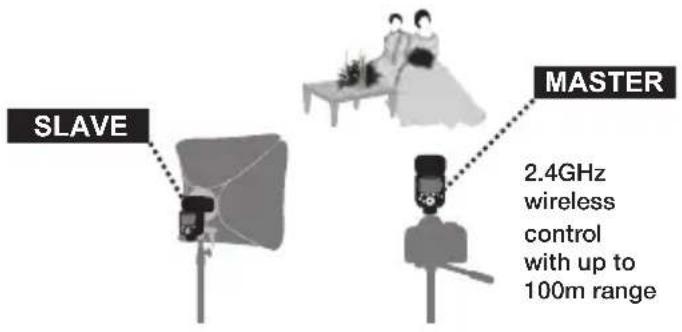
- The "Modus 600RT" attached to the Camera Hot shoe is called the "Master" unit. A second "Modus 600RT" which is wirelessly controlled is called the "Slave" unit - You can also wirelessly control the Modus 600RT as a "Slave" unit using a "Viper TTL" transmitter as a "Master" unit attached to the camera hotsho
Using (Master/Slave) with wireless 2.4GHz control function allows you to easily perform shooting with advanced wireless multiple flash lighting in the same way as E-TTL II autoflash photography. The system is designed so that the setting's of the "Master" attached to the camera are automatically applied to the wireless slave speedlights. Therefore you do not need to operate or adjust the slaves during shooting
Positioning and Operation Range (Example of wireless flash shooting)
• Master/Slave wireless flash lighting
text_image
SLAVE MASTER 2.4GHz wireless control with up to 100m rangeWireless multiple flash shooting
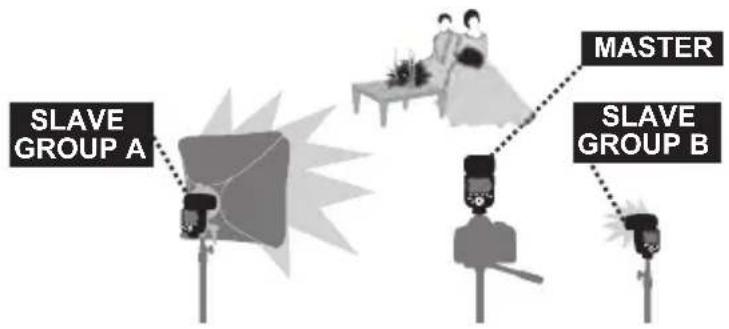
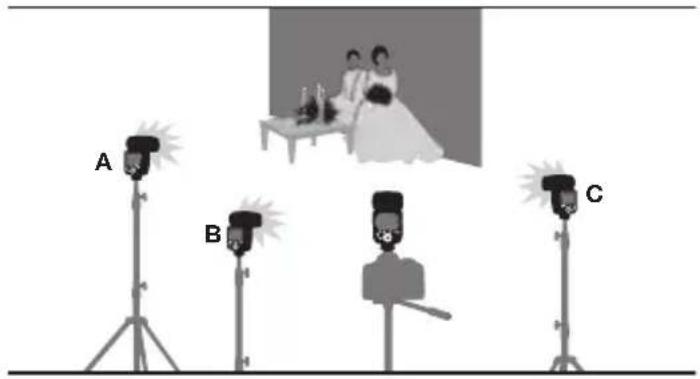
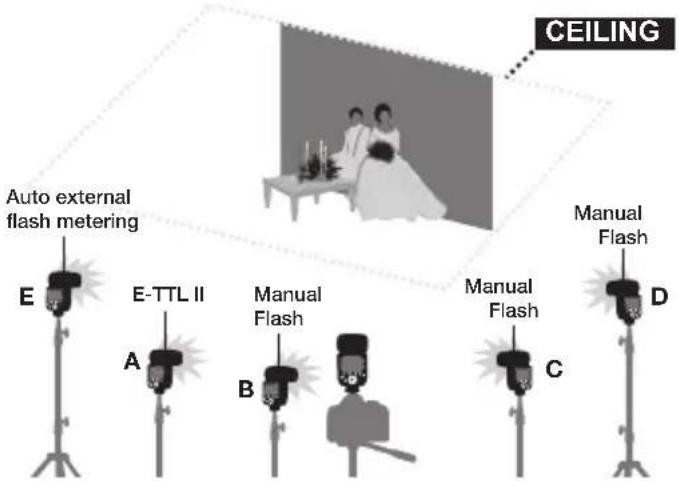
You can divide the slave units into two or three groups and perform E-TTL II autoflash while changing the flash ratio (factor). In addition, you can set and shoot with a different flash mode for each firing group, for up to 5 groups.
• Auto Shooting with Two Slave Groups
flowchart
graph TD
    A["MASTER"] --> B["SLAVE GROUP A"]
    B --> C["SLAVE GROUP B"]
    C --> D["SLAVE GROUP B"]
    style A fill:#f9f,stroke:#333
    style B fill:#ccf,stroke:#333
    style C fill:#cfc,stroke:#333
    style D fill:#fcc,stroke:#333
• Auto Shooting with Three Slave Groups
text_image
A B C- Shooting with a Different Flash Mode set for Each Group
text_image
CEILING Auto external flash metering E E-TTL II A B Manual Flash C Manual Flash D* The flash mode settings are indicated only as an example
Wireless shooting using radio transmission has advantages over wireless shooting using optical control, such as being less affected by obstacles, and not having to point the slave unit's wireless sensor toward the master unit. The main functional differences are as follows:
| Function | Radio Control Optical Control | |
| Distance | 100m | 15m |
| Channel | DCM | 1~4 |
| A/B/C Power | OFF, 1/128~1/1 | 1/128~1/1 |
| Interference | Hard | Easy |
| Group | A/B/C/D/E | A/B/C |
There are four flash modes in wireless radio control: TTL, M, Multi and Gr. Choose one of these modes by pressing the MODE Button.
Wireless Settings
You can switch between normal flash and wireless flash. For normal flash shooting, be sure to set the wireless setting to OFF
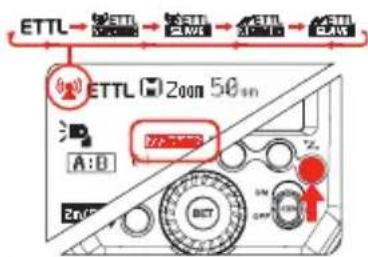
Master Unit Setting
text_image
ETTL 200m 50in A:0 BCT 100m 100m 100m 100m 100m 100m 100m 100m 100m 100m 100m 100m 100m 100m 100m 100m 100m 100m 100m 100m 100n 100n 100n 100n 100n 100n 100n 100n 100n 100n 100n 100n 100n 100n 100n 100n 100n 100n 100n 100n 100k 100k 100k 100k 100k 100k 100k 100k 100k 100k 100k 100k 100k 100k 100k 100k 100k 100k 100k 100k 100nPress < Z button so that < ( ) > and < MASTER > are displayed on the LCD panel.
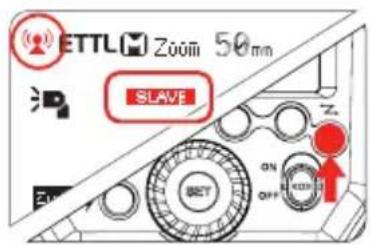
Slave Unit Setting
text_image
ETTL Zoom 50mm SLAVE BETT ON OFF KESH↑Press < Z > button so that < ( ) > and < SLAVE > are displayed on the LCD panel
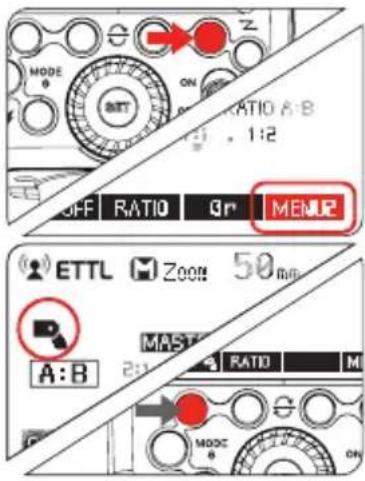
Master Unit Flash ON/OFF
You can switch ON or OFF the "Master" unit flash that is controlling the wireless "Slave" units. When Master flash is ON, it will flash as group A
text_image
MODE ON RATIO A:B 1:2 OFF RATIO On MENU ETTL Zoo# 50mm MAST A:B 2:1 ON RATIO M MODE- Press Function Button 4 so that < MENU2 > is displayed on the LCD panel
• 2. Press Function Button
- < > to control the ON/OFF of the master unit.
- <3> The master unit flash firing is ON.
- < > The master unit flash firing is OFF.
Setting the DCM (Digital Channel Matching)
Initially the Modus 600RT wireless 2.4GHz is set to a general "open channel" and can be used as it is. To avoid interference with other wireless flash systems we recommend to DCM (digital channel match) your Modus 600RT speedlight's and Viper TTL.
Master – Viper TTL or Modus 600RT
text_image
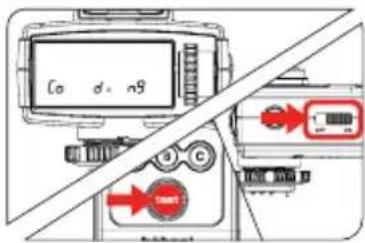
Co d n9 1 2 3 4 5 6 7 8 9 10 11 12 13 14 15 16 17 18 19 20 21 22 23 24 25 26 27 28 29 30 31 32 33 34 35 36 37 38 39 40 41 42 43 44 45 46 47 48 49 50 51 52 53 54 55 56 57 58 59 60 61 62 63 64 65 66 67 68 69 70 71 72 73 74 75 76 77 78 79 80- If you have a Viper TTL, start the DCM matching with the Viper TTL
- Turn
the Viper TTL transmitter whilst holding down the button and release button after 2 seconds
• The Viper LCD will show - If you are not using a Viper TTL and only wish to DCM several Modus 600RT, then use any Modus 600RT as the Master unit
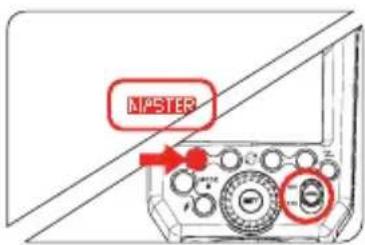
- Press
whilst turning the power to the Modus 600RT
• A green LCD on the Modus 600RT will show
< MASTER >
text_image
MASTERSlave - Modus 600RT
text_image
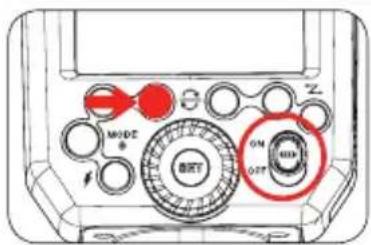
MODE BRT ON OFF Z- Press
whilst turing power to the slave Modus 600RT
text_image
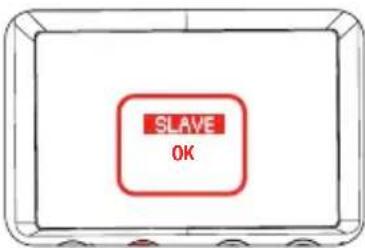
SLAVE OK-
A red LCD will show "Slave OK". This slave Modus 600 RT is now DCM matched
-
DCM match the same way, any additional slave Modus 600RT while the Master is still on
Once all slave units are DCM matched, reboot all master and slave's by turning OFF/ON
- Once all devices are DCM matched they will memorize the unique ID even it power is removed. Therefore you only need to DCM your set once
- If you add more speedlights or Viper TTL units to your range then you need to carry out the DCM matching for all your units again
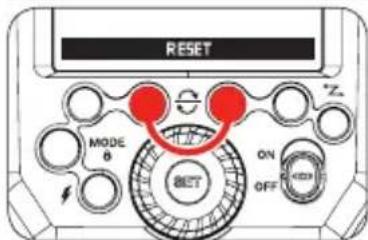
Modus 600 RT - Reset
text_image
RESET MODE 0 ON OFF Z- To reset the Modus 600RT to factory default settings press function buttons 3 & 4 at the same time and hold until the LCD shows RESET > release the buttons
- When the Modus 600RT is reset the DCM is also reset back to open channel and the previous DCM is lost
ETTL Fully Automatic Wireless Flash Shooting
Basic Automatic Wireless Flash shooting with a Single Slave Unit
text_image
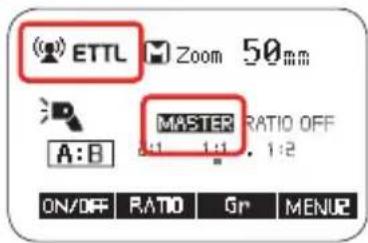
(ETTL Zoom 50mm MASTER RATIO OFF A:B 1:1 1:1 1:2 ON/OFF RATIO Gr MENUE1. Master Unit Setting
- Attach a Modus 600RT to the camera and set it as the master unit (Page 27)
- The Viper TTL Transmitter can also be used as a master unit to control the wireless slave Modus 600RT (Page 42)
text_image
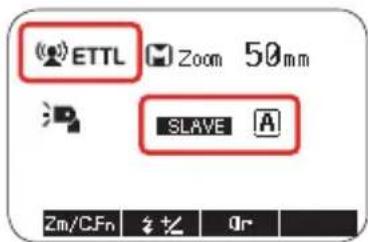
ETTL Zoom 50mm SLAVE A Zm/CFn % Or2. Slave Unit setting
- Set the slave Modus 600RT to
setting (Page 27)
3. Position of camera and speedlight
- Position the camera with the master unit attached and the Modus slave within radio range
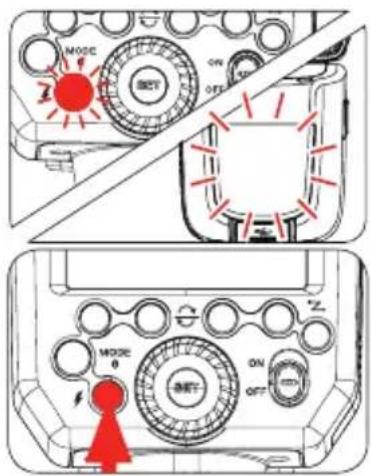
4. Set the master unit flash mode to
- Check that the master unit is set to
text_image
MODE ON OFF MODE ON OFF< MODE > button until
- Check that the slave unit is set automatically to
5 Check Master/Slave units are ready
- Check master speedlight, ready indicator is lighting and that the slave flash ready indicators are blinking
6 Check the Master slave speedlight operation
- Press the master unit's <⚡> test button
• The slave speedlight will flash. If it does not fire, check the position or distance of slave from master - You are now ready to take a photo with the wireless flash lighting
Using Automatic Wireless Flash with Multiple Slave Units
natural_image
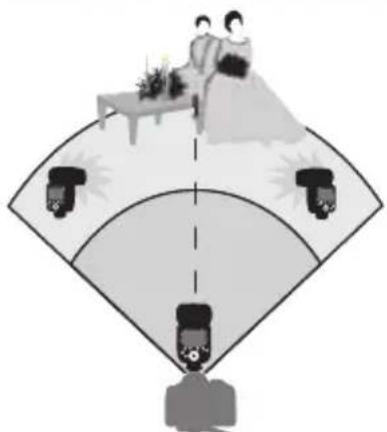
Illustration of a person sitting on a table with flowers, standing above a curved platform and three hanging objects (no text or symbols)When stronger flash output or more convenient lighting operation is needed, increase the number of slave speedlight's. To add slave units, use the same steps as setting "automatic wireless flash with a single slave unit" (Page 23). Any slave speedlight can be set as group (A/B/C).
When the number of slave units is increased or the master flash firing is set to ON, automatic control is performed to fire all flashes at the correct flash output to ensure that the total flash output results in the standard exposure.
If the slave unit's auto power off takes effect, press the master unit's test flash button to turn on the slave unit. Note that the test flash cannot be performed while the camera's metering timer, etc. is operating
- The slave units auto power off setting can be changed (C.Fn-Sv / APOT page 46)
- In the C.Fn settings you can enable a beeper to sound when a Modus 600RT is recharged and ready to fire again
Advanced setting with fully automatic wireless flash
With the wireless system the following functions set on the master unit will automatically be adjusted on the slave unit. For this reason you do not need to operate the slave unit (s) and can operate it from the master in the same way as normal flash photography.
- Flash Exposure Compensation < ± > (Page 18)
- Flash Exposure Bracketing < FEB > (Page 18)
• Flash Exposure Lock (Page 20)
• High-Speed Sync < 📣> (Page 20) - Manual Flash (Page 22)
• Multi / Stroboscopic Flash (Page 23)
Multiple Master Unit
You can use two or more cameras with master flash units on each to change camera shooting while keeping the same lighting setup (slave units) in wireless flash photography.
All Master / Slave devices must be reset to open channel
ETTL: Shooting Flash Ratio A:B
You can divide slave groups into two A and B groups and adjust flash ratio. The total output of A and B will be automatically controlled to a standard exposure.
• Second Curtain Sync - is only enabled when using the Viper TTL Transmitter
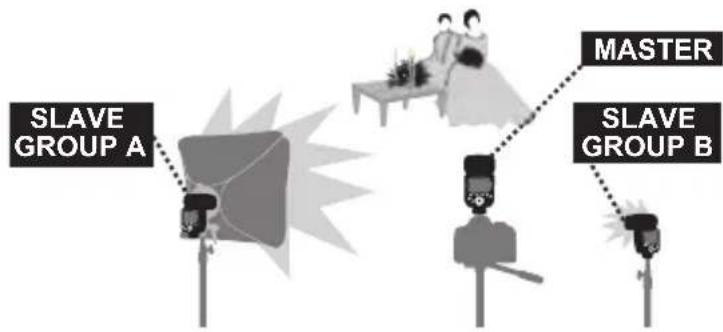
flowchart
graph TD
    A["Master"] --> B["Slave Group A"]
    B --> C["Visual Element 1"]
    C --> D["Slave Group B"]
    D --> E["Visual Element 2"]
    E --> F["Master"]
    style A fill:#f9f,stroke:#333
    style B fill:#ccf,stroke:#333
    style C fill:#cfc,stroke:#333
    style D fill:#fcc,stroke:#333
    style E fill:#cff,stroke:#333
    style F fill:#ffc,stroke:#333
text_image
Zn/C.Fn Br MODE BBS 100mm SAVE A Zn/C.Fn FEB-
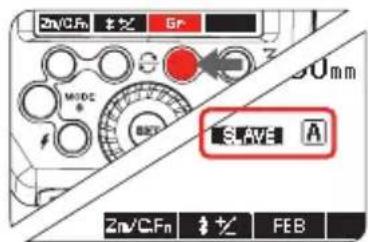
Setting the flash groups of slave unit
-
Set the flash as slave unit
- Press Function Button 3 < Gr > and choose or
- Set one slave unit as <A> , the other as <B>
text_image
DMCn FEB HBMJ MODE RATIO A:E: 1:2 OFF RATIO On MENU2-
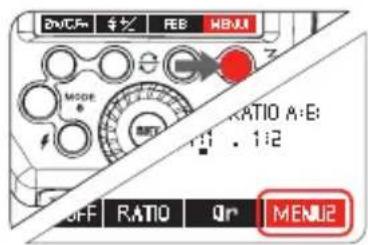
Setting < MENU >
-
Step 2 to Step 4 are set on the master unit.
- Press the Function Button 4
< MENU 1 > on the master unit so that < MENU 2 > is displayed
text_image
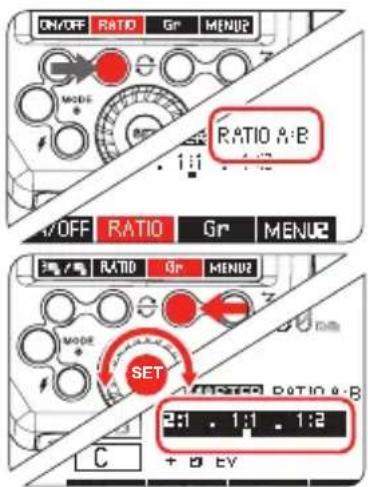
ON/OFF RATIO Gr MENUE MODE 1:1 1:2 RATIO A:B OFF RATIO Gr MENUE 3/5 RATIO Gr MENUE MODE SET 2:1 1:1 1:2 C + B EV- Setting
- Press Function Button 2
- Setting flash ratio
- Press Function Button 3 < Gr>
- Turn the Select Dial to set the amount of flash ratio and press
- Taking the picture
• The slave units will flash according to the flash ratio
ETTL: Shooting Flash Ratio A:B C
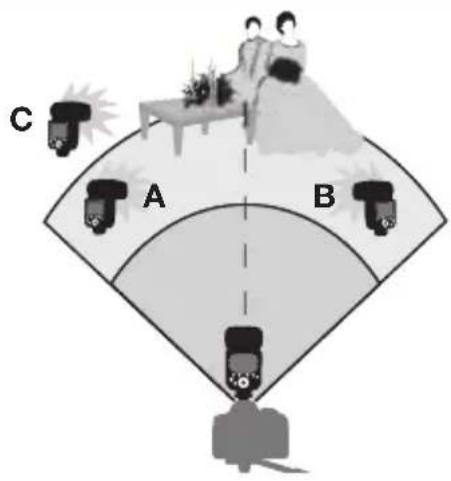
text_image
C A B- Setting the slave group
- Use the same method of step 1 (Page 32) to set a slave unit to flash group
2 Setting
- Use the same method of step 2 and step 3 (Page 32) to set the master unit as
3 Setting flash exposure compensation for group
- Press Function Button 3 < Gr > to select A: B or C then use the select dial to set the amount of flash ratio for groups A and B, and the amount of flash exposure compensation for group C
• You can add a group C to firing groups A and B. C can have separate FEC setting which is useful to eliminate subject shadows or other effect's.
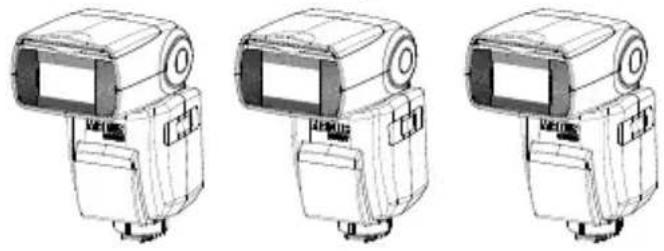
Slave Group A
natural_image
Three identical line drawings of a mechanical device with no visible text or symbolsID=A ID=A ID=A
If three slave units are all set to in terms of slave ID, these slave units will be controlled as if they were one camera flash in slave group A.
When setting < RATIO A:B C >, group A, B and C will fire a flash synchronously; when setting < RATIO A:B >, group C will not fire a flash
- If shooting under the situation that group C is toward the main shooting subject, over exposure might occur
- In some EOS film cameras that support E-TTL autoflash, you cannot perform multiple flash wireless shooting with a flash ratio setting
• The flash ratio of 8:1 to 1:1 to 1:8 is equivalent to 3:1 to 1:1 to 1:3 (1/2 step increment).
- The details of the flash ratio settings are as follows.

text_image
8:1 4:1 2:1 1:1 1:2 1:4 1:8 5.6:1 2.8:1 1.4:1 1:1.4 1:2.8 1:5.6M: Wireless Flash Shooting with Manual Flash
This describes wireless using manual flash. You can shoot with a different flash output setting for each slave unit (firing group). Set all parameters on the master unit.
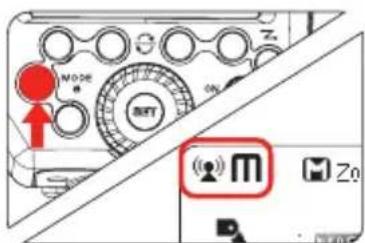
text_image
NODE M m Z0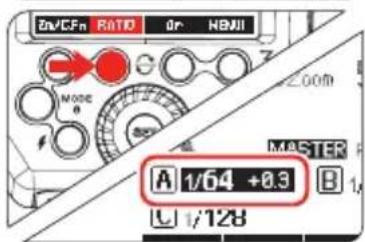
text_image
Zn/CFn RATIO Or HBJII MODE 200m MASTER A 1/64 +0.3 B 1/ U 1/1281 Setting the flash mode
- Press
button until is displayed - Set the manual flash output (Page 22)
2 Setting the number of flash groups
- Press the Function Button 2 < RATIO > to set the groups to fire
- The setting changes as follows each time you press the
ALL(RATIO OFF)→ A/B(RATIO A:B)→ A/B/C(RATIO A:B:C)
3 Setting flash output
Press Function Button 3
< Gr > to select the group.
Turn the Select Dial to set the flash output of the groups. Press
4 Taking the picture
Each group fires at the set flash ratio
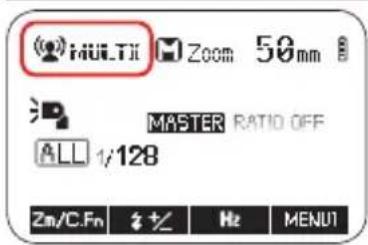
Multi: Wireless Flash Shooting with Multi Flash
text_image
MULTI Zoom 50mm MASTER RATIO OFF ALL 1/128 Zn/C.Fn 3½ Hz MENUSetting stroboscopic flash.
- Press
button on the master unit so that is displayed - Setting the stroboscopic flash parameters as detailed on page 23
• All flash groups have the same number of flashes and firing frequency - You can use the < TIMES > and < Hz > buttons as described earlier to set the power level for each group in < MULTI > mode
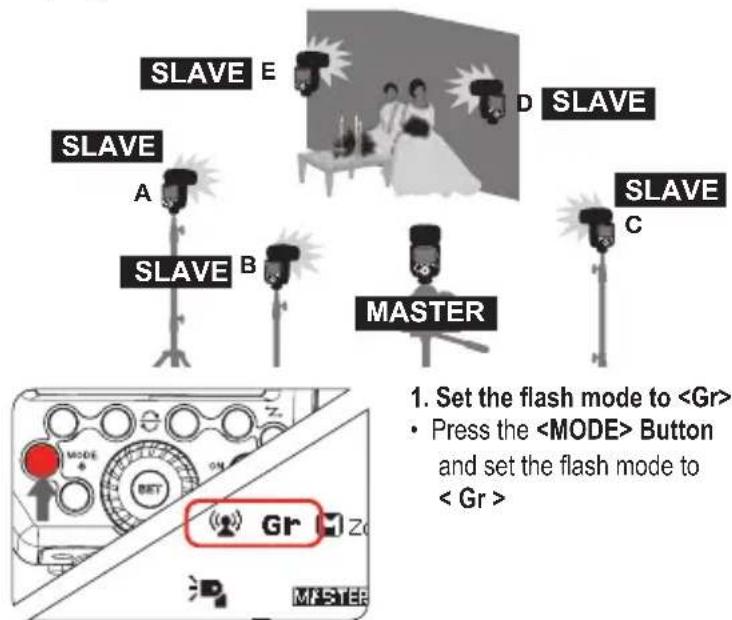
Gr: Shooting with a different Flash Mode for each group
When using an EOS digital camera released since 2012, such as the EOS-1DX (except for EOS 1200D), you can shoot with a different flash mode set for each firing group, with up to 5 groups (A/B/C/D/E).
The flash modes that can be set are E-TTL II autoflash / Manual flash / off. When the flash mode is E-TTL exposure is controlled to result in standard exposure for the main subject as a single group. This function is for advanced users who are very knowledgeable and experienced in lighting.
text_image
SLAVE E SLAVE A SLAVE B MASTER SLAVE C 1. Set the flash mode to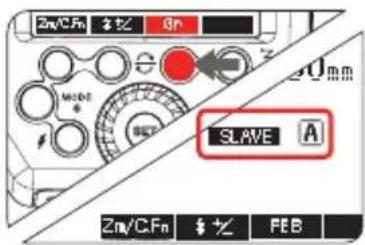
text_image
2m/CFm 3.2 Gr MODE SLAVE A Zm/CFm 1.2 FEB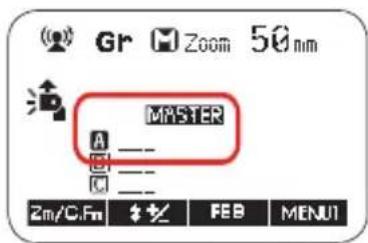
text_image
Gr Zoom 50nm MASTER A -- C -- Zm/C.Fm FEB MENU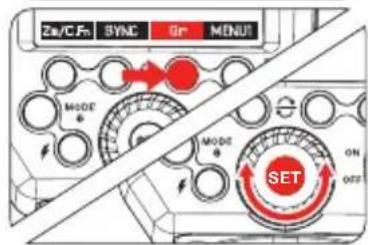
text_image
2a/C-F+ SYNC Gr MINUT MODE MODE ON SET OFF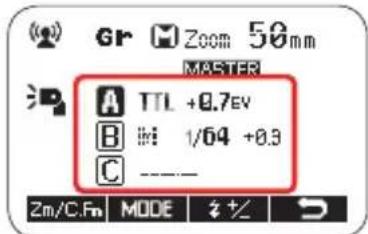
text_image
Gr Zoom 50mm MASTER A TTL +0.7EV B #: 1/64 +0.9 C ---- Zm/C.Fn MODE #+/-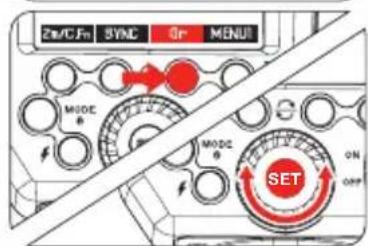
text_image
Zn/CJ-F SYNC Gr MENU MODE MODE SET ON OFF2. Set the firing group of the slave units
• Operate and set the slave units one by one
- Press Function Button 3 < Gr > to assign the flash to group , ,
- Set the firing group (A/B/C/D/E) for all the slave units
3. Set the flash mode
- Set the flash mode of each firing group by operating the master unit
- While < MENU1 > is displayed, press Function Button 3 < Gr > and turn the Select Dial to choose the group
- Press Function Button 2
- Use Function Button 4 to return to previous menu
- Repeat step 3 to set the flash mode of all groups
4. Set the flash output and flash exposure compensation amount.
- While a firing group is selected, press Function Button 3 < ± >
- Turn the Select Dial to set the flash function corresponding to flash mode, and press
- When using the
- When using the
- Repeat step 4 to set the flash function of all groups
- Press Function Button 4 to return to the shooting-ready state
5. Take the picture
• Each slave unit fires in the respective flash modes set.

This product supports optical control wireless flash applications and functions as either a master or a slave unit. As a master unit, it can control Canon speedlites e.g. 580EXII, 600EX-RT optically. As a slave unit, it can receive optical signals from Canon speedlites e.g. 580EXII, 600EX-RT and from Canon cameras built in flashes in wireless mode e.g. 7D/60D/600D.
- You can set up one, two or three slave groups for E-TTL II autoflash shooting. With E-TTL II autoflash, you can easily create various lighting effects.
- Any flash settings (of flash exposure compensation, high-speed sync, FE lock, FEB, manual flash, Multi flash) on the master unit will be automatically sent to the slave units. So the only thing you need to do is to set the master unit to ETTL mode without any operation for the slave units at all during the shooting.
- This flash can work in ETTL autoflash, M manual flash, and Multi stroboscopic flash modes when set as a master unit.
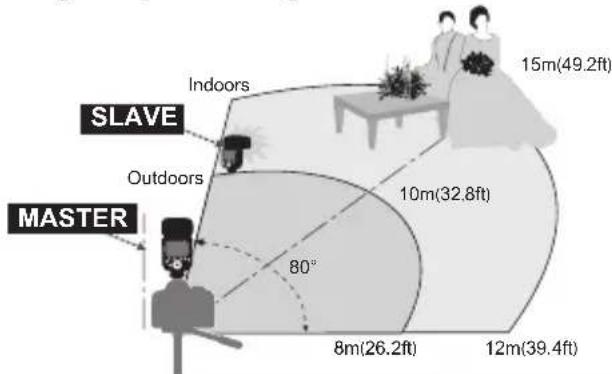
Positioning and Operation Range
text_image
SLAVE MASTER Indoors Outdoors 80° 10m(32.8ft) 15m(49.2ft) 8m(26.2ft) 12m(39.4ft)• Even with multiple slave units, the master unit can control all of them via wireless.
- In this user manual, "master unit" refers to the speedlight attached to the camera and "slave unit" will be controlled by the master unit.
Wireless Settings
You can switch between normal flash and wireless flash. For normal flash shooting, be sure to set the wireless setting to OFF
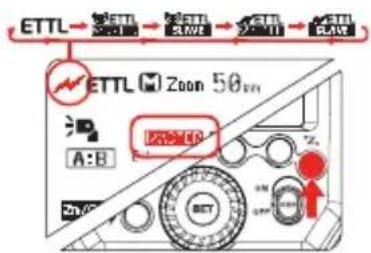
Master Unit Setting
text_image
ETTL Zoom 50mm A:B BET OFF OFF OFF SETT SETT SETT SETT SETT SETT SETT SETT SETT SETT SETT SETT SETT SETT SETT SETT SETT SETT SETT SETT SETT SETT SETT SETT SETT SETT SETT SETT SETT SETT SETT SETT SETT SETTPress < > button so that <
and < MASTER > are
displayed on the LCD panel.
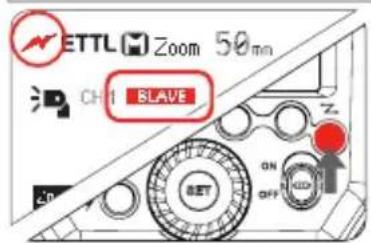
Slave Unit Setting
text_image
ETTL Zoom 50mm CH1 SLAVE ON OFF KLEDPress < Z > button so that < N > and < SLAVE > are displayed on the LCD panel.
Master Unit Flash ON/OFF
You can switch ON or OFF the "Master" unit flash that is controlling the wireless "Slave" units. When Master flash is ON, it will flash as group A.
GB

For more detailed information on this feature see description under 2.4GHz Radio control (Page 27)

Even if the master unit flash firing is disabled, it still fires a preflash to transmit wireless signals
Setting the optical Communication Channel
The Modus 600RT has four optical communication channels. The master and the speedlights must be set to the same channel.
Master
- Press function button 4 until < MENU3 > is displayed
- Press function button 1 < CH > and use the select dial to set the required channel
- Press set to lock selection
- Press function button 4 to return to < MENU1 >
Slave
- Press function button 4 < CH > and use the select dial to set the required channel
- The channel must be set the same as the master speedlight
ETTL Fully Automatic Wireless Flash Shooting
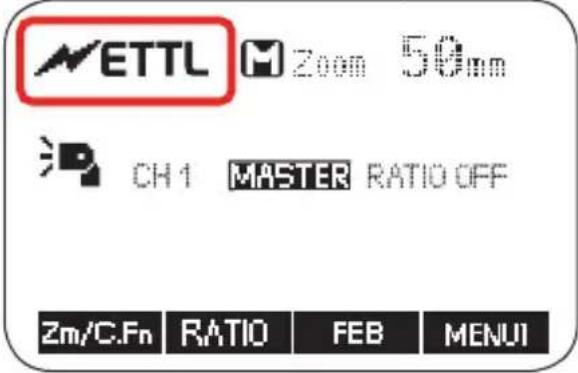
Using Automatic Wireless Flash with a Single Slave Unit
text_image
NETTL Zoom 50mm CH 1 MASTER RATIO OFF Zm/C.Fn RATIO FEB MENU
- For more detailed information on this feature see description under 2.4GHz Radio control (Page 29)
• The Viper TTL transmitter cannot be used for optical control

- All Master / Slave speedlights must be set to the same Optical channel
• Optical range is much shorter than radio range
Using automatic flash with multiple slave units
For more detailed information on this feature see description under 2.4GHz Radio control (Page 31)
• All Master / Slave speedlights must be set to the same Optical channel
ETTL shooting flash ratio A:B
Auto flash shooting with two slave units
For more detailed information on this feature see description under 2.4GHz Radio control (Page 32)
ETTL shooting flash ration A:B C
For more detailed information on this feature see description under 2.4GHz Radio control (Page 33)
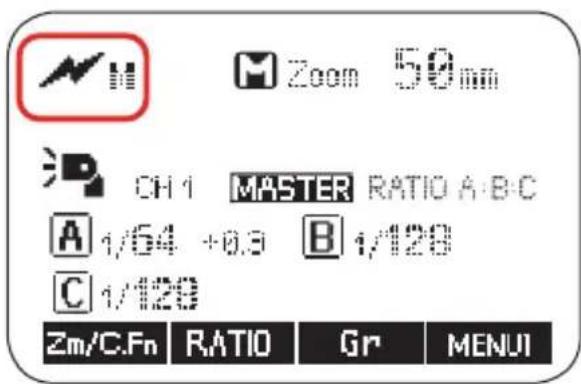
M: Wireless flash shooting with manual flash
text_image
Zoom 50 mm CH 1 MASTER RATIO A:B:C A 1/64 +0.3 B 1/128 C 1/128 Zm/C.Fn RATIO Gr MENUFor more detailed information on this feature see description under 2.4GHz Radio control (Page 34)
MULTI: Wireless flash shooting with multi flash
For more detailed information on this feature see description under 2.4GHz Radio control (Page 35)

Wireless Flash Photography:
(2.4GHz) using
Viper TTL Transmitter
GB
Wireless Settings
DCM (Digital Channel Matching)
- DCM (Digital Channel Matching). Carry out the DCM matching, see page 28
- Set the Modus 600RT to 2.4GHz as Slave Unit - Group A, see page 27
- Press Viper
08 button to confirm that Modus Speedlight is triggered wirelessly
Viper TTL group Mode Setting
Press buttons A or B or C to change the MODE setting of each group to
Take a test photograph now and the Viper transmitter will send a wireless signal to each Modus 600RT and to each 3rd Party Speedlight connected to a Viper TTL receiver. The Speedlight will then be set automatically to the same Viper TTL selected group mode setting.
• The Viper LCD 05 will show the setting of each group
• A group is turned OFF if the LCD is not showing the group
- A group is in Manual mode when
- A group is in TTL mode when
• Each group A, B or C is set independently and it is possible to use simultaneously different setting for each group (e.g. Group A may be in

Group Power Control setting for Manual and TTL FEC
From the Viper TTL transmitter you can adjust the power level and the FEC of each group.
-
Press
02 select button and all three icons , and will flash. -
Press one button A or B or C to select which group you want to adjust the power. Now only the selected group icon will flash
-
Use the adjust dial to set the power output in < M > mode and FEC in TTL mode
-
Press the
button to lock your selection
Multi Mode
- Press and hold the
For more detail on operation of the viper TTL visit www.hahnel.ie
Sync Modes
- Press and hold the
button to select the High Speed sync <图标 will switch on - For 2nd Curtain Press and hold the
button again - <▶> icon will switch on - Press and hold the < Group B > button again to go back to normal sync
6
Other Applications
Sync Triggering
- The Sync Cord Jack is a 2.5mm plug. Insert a trigger plug here and the flash will be fired synchronously with the camera shutter.
• To avoid overheating and deteriorating the flash head, do not fire the modeling flash for more than 10 consecutive times. If you fire the modeling flash 10 consecutive times, allow at least 10 minutes' break for the camera flash.
- The modeling flash cannot be fired with the EOS 300 and Type-B cameras.
Auto Focus Assist Beam
In poorly-lit or low-contrast shooting environments, the built-in auto focus assist beam will automatically switch on to make it easier to autofocus. The beam will light up only when autofocus is difficult and will switch off as soon as the autofocus is set.
If you want to turn off the auto focus assist beam, set "AF" to "OFF" on the C.Fn settings.
• If you find the auto focus assist beam does not light up, this is because the camera has got a correct autofocus.
| Position | Effective Range |
| Center | 0.6~10m / 2.0~32.8 feet |
| Periphery | 0.6~5m / 2.0~16.4 feet |
Bounce Flash
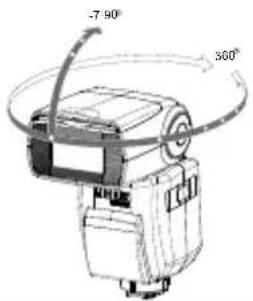
By pointing the flash head toward a wall or ceiling, the flash will bounce off the surface before illuminating the subject. This can soften shadows behind the subject for a more natural-looking shot. This is called bounce flash.
To set the bounce direction, hold the flash head and turn it to the required angle.
text_image
-7.90° 300°If the wall or ceiling is too far away, the bounced flash might be too weak and result in underexposure.
- The wall or ceiling should be a plain, white color for high reflectance. If the bounce surface is not white, a color cast may appear in the picture.
Catchlight
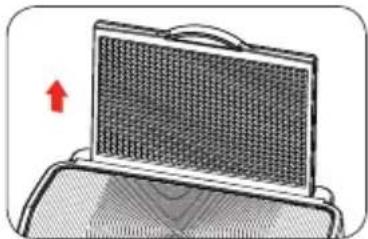
With the catchlight panel, you can create a catchlight in the subject's eyes to add life to the facial expression.
natural_image
Illustration of a mesh fan or grid device with a red arrow pointing to it, placed on a base (no text or symbols)-
Point the flash head upward by 90°
-
Pull out the wide panel. The catchlight panel will come out at the same time
natural_image
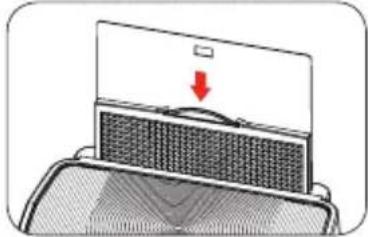
Diagram of a device with a red arrow pointing to a component, no text or symbols present- Push the wide panel back in
- Push in only the wide panel
- Follow the same procedures as for bounce flash
ZOOM: Setting the Flash Coverage and Using the Wide Panel
The flash coverage can be set automatically or manually. It can be set to match the lens focal length from 20 mm to 200mm. Also, with the built-in wide panel, the flash coverage can be expanded for 14mm wide-angle lenses.
text_image
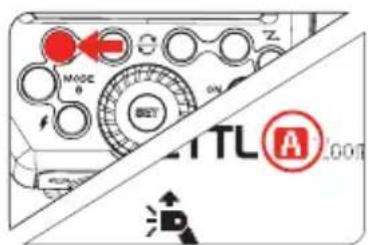
MACE BEET A TTL LOOMIn Manual Zoom mode, press the button.
- Turn the Select Dial to change the flash coverage
- If < > is displayed, the flash coverage will be set automatically
• If you set the flash coverage manually, make sure it covers the lens focal length so that the picture will not have a dark periphery.
Using the Wide Panel
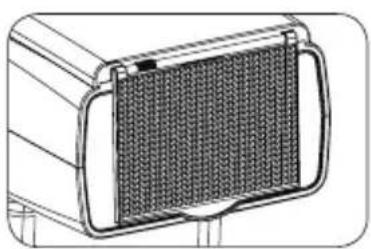
natural_image
Technical line drawing of a mechanical component with a meshed panel (no text or symbols)Pull out the wide panel and place it over the flash head as shown. The flash coverage will then be extended to 14 mm.
- The catchlight panel will come out at the same time. Push the catchlight panel back in.
- The
The following table lists the available and unavailable custom functions of this flash.
1. Software Version
Press
2. Select the Custom Function No
- Turn the Select Dial to select the Custom Function number
3. Change the Setting
- Press
- Turn the Select Dial to set the desired option. Pressing
- After you set the Custom Function and press function button 4, the camera will be ready to shoot.
4. C.Fn Default
In the C.Fn menu, a long press of the "Clear" button for 2 seconds until "OK" is displayed on the panel, which means the values in C.Fn are reset to their default options
Control with the Camera's Menu Screen
If the camera flash is attached to an EOS camera which has a speedlite control function, the flash can be controlled using the camera's menu screen. For the menu operation procedure, refer to your camera's instruction manual.
Setting Camera Flash Functions
GB
The following flash functions are settable according to different flash modes.
- Flash mode
- Shutter sync (1st/2nd curtain, high speed sync)
- FEB
- Flash exposure compensation
-
Flash firing
-
Clear camera flash's settings
- Custom Functions of Camera Flash C.Fn-
00, C.Fn-01, C.Fn-03,
C.Fn-04, C.Fn-08, C.Fn-10,
C.Fn-20 and C.Fn-22.
Clear All Flash Custom Functions
| Flash function settings | |
| Flash mode | E-TTL II |
| Shutter syne. | 1st curtain |
| FEB | -3.2.1.0.1.2 |
| Flash exp. comp | -3.2.1.0.1.2 |
| E-TTL II | Evaluative |
| Flash firing | Enable |
Flash function settings screen
| Flash C.Fn settingsAuto power off |
| 0:Enabled1:Disabled |
Flash C.Fn settings screen
* Screens from the EOS-1D Mark III.
• If flash exposure compensation has already been set with the speedlight, flash exposure compensation cannot be set with the camera. To set it with the camera, the speedlight flash exposure compensation must be set to zero
- If any Flash Custom Functions and flash settings other than flash exposure compensation have been set by both the camera and the flash, the latest settings will take effect.
Protection Function
- Over-Temperature Protection
• To avoid overheating and deteriorating the flash head, do not fire more than 30 continuous flashes in fast succession at 1/1 full power. After 30 continuous flashes, allow a rest time of at least 10 minutes
- If you fire more than 30 continuous flashes and then fire more flashes in short intervals, the inner over-temperature protection function may be activated and make the recycling time over 10 seconds. If this occurs, allow a rest time of about 10 minutes, and the flash unit will then return to normal
- When the over-temperature protection is active, <12 is shown on the LCD display
Number of flashes that will activate over-temperature protection:
| Power Output level | Number of Flashes |
| 1/1 | 30 |
| 1/2 +0.7 | 40 |
| 1/2 +0.3 | 50 |
| 1/2 | 60 |
| 1/4(+0.3,+07) | 100 |
| 1/8(+0.3,+07) | 200 |
| 1/16(+0.3,+07) | 300 |
| 1/32(+0.3,+07) | 500 |
| 1/64(+0.3,+07) | 1000 |
| 1/128(+0.3,+07) |
Number of flashes that will activate over-temperature protection in high-speed sync triggering mode:
| Power Output Times | |
| 1/1 | 15 |
| 1/2(+0.3,+07) | 20 |
| 1/4(+0.3,+07) | 30 |
| 1/8(+0.3,+07) | |
| 1/16(+0.3,+07) | 40 |
| 1/32(+0.3,+07) | |
| 1/64(+0.3,+07) | 50 |
| 1/128(+0.3,+07) | |
2. Other Protections
The system provides real-time protection to secure the device and your safety. The following lists prompts for your reference:
| Prompts on LCD Panel | Meaning |
| E1 | A failure occurs on the recycling system so that the flash cannot firePlease restart the flash unit. If the problem still exists, please send this product to a maintenance center |
| E2 | The system gets excessive heat. Please allow a rest time of 10 minutes |
| E3 | The voltage on two outlets of the flash tube is too high. Please send this product to a maintenance center |
| E9 | There are some errors occurred during the upgrading process. Please use the correct firmware upgrade method |
Technical Data
| Model Modus 600RT | ||
| Compatible Cameras | Canon EDS cameras (E·TTL II autoflash) | |
| Guide No.(1/1 output@ 200mm) | 60 (m ISO 100)190 (feet ISO 100) | |
| Flash Coverage | 20 to 200mm (14mm with wide panel)• Auto zoom (Flash coverage set automatically to match the lens focal length and image size)• Manual zoom• Swinging/titting flash head (bounce flash): O to 360° horizontally and -7° to 90° vertically | |
| FlashDuration | 1/300 to 1/20000 seconds | |
| Exposure control system | E-TTL 11 autoflash and manual flash | |
| Flash exposure compensation (FEC) | Manual. FEB: ±3 stops in 1/3 stop increments(Manual FEC and FEB can be combined.) | |
| FE lock | Withbutton or* > button | |
| Sync mode | High-speed sync (up to 1/8000 seconds),first-curtain sync, and second-curtain sync | |
| Multi flash | Provided (up to 100 times, 199Hz) | |
| • Wireless Flash | ||
| Wireless flash function | Master, Slave, Off | |
| Controllable Opticalslave groups 2.4GHz | 3 (A, B, and C)5 (A, B, C,D and E) | |
| Transmission range(approx.) | Optical | Indoors: 12 to 15 m / 39.4 to 49.2 ft.Outdoors: 8 to 10 m / 26.2 to 32.8 ft.Master unit reception angle: ±40° horizontally,±30° vertically |
| 2.4GHz | Up to 100m | |
| Channels | Optical | 4 (1, 2, 3, and 4) |
| 2.4GHz | Digital Channel Matching | |
| Slave-ready indicator | Two red indicators blink | |
| Modeling flash | Fired with camera's depth-of-field preview button | |
| • Auto Focus Assist Beam | ||
| Effective range (approx.) | Center: 0.6-10m / 2.0-32.8 feetPeriphery: 0.6-5m / 2.0-16.4 feet | |
| • Power Supply | ||
| Power source | 10.8V/2040mAh Li-ion battery | |
| Recycle time | 1.5 seconds. RED LED indicator will light up when the flash is ready | |
| Full power flashes | Approx. 500 | |
| Power saving | Power off automatically after approx. 90 seconds of idle operation. (60 minutes if set as slave) | |
| • Sync Triggering Mode | Hotshoe, 2.5mm sync line, Wireless control | |
| • Color Temperature | 5600±200k | |
| • Dimensions | ||
| W x H xD | 64*76*190 mm | |
| Weight without battery | 430g | |
| Weight with battery | 540g | |
GB
Troubleshooting
If there is a problem, refer to this Troubleshooting Guide. The Camera Flash does not fire.
- The camera flash is not attached securely to the camera.
- Attach the camera's mounting foot securely to the camera.
• The electrical contacts of the Camera Flash and camera are dirty. - Clean the contacts.
- < > or < > is not displayed in the view finder of camera.
- Wait until the flash is fully recycled and the flash ready indicator lights up.
- If the flash ready indicator lights up, but < 3 or < 5 is not displayed in the view finder, check whether this flash unit is securely attached to the camera hotshoe.
- If the flash ready indicator does not light up after a long wait, check whether the battery power is enough. If the battery power is low, <1 will appear and blink on the LCD panel. Please replace the battery immediately.
- After 90 seconds of idle operation, auto power off took effect if the flash is set as master.
- Press the shutter button halfway or press any flash button to wake up.
- After 60 minutes (or 30 minutes) of idle operation, the flash unit will enter sleep mode if it is set as slave.
• →Press any flash button to wake up. - The camera flash is not attached securely to the camera.
- Attach the camera flash's mounting foot to the camera.
- There was a highly reflective object (e.g. glass window) in the picture.
• →Use FE lock (FEL). - You used high-speed sync.
- With high-speed sync, the effective flash range will be shorter. Make sure the subject is within the effective flash range displayed.
- You used Manual Flash mode.
- Set the flash mode to ETTL or modify the flash output.
- The focal length of lens exceeds the flash coverage.
- Check the flash coverage you set. This flash unit has the flash coverage between 20 and 200mm , which fits medium-format cameras. Pull the wide panel out to extend the flash coverage.
Firmware Upgrade
This flash supports firmware upgrade through the USB port. Update information will be released on our official website.
- USB connection cable is not included in this product. The USB port is a standard Micro USB socket. Common USB connection cable is suitable.
Compatible Camera Models
For up to date compatibility of all camera models check www.hahnel.ie
Maintenance
- Shut down the device immediately should abnormal operation be detected
- Avoid sudden impacts and the product should be cleaned regularly
- It is normal for the flash tube to be warm when in use. Avoid
continuous flashes if unnecessary
- Maintenance of the flash must be performed by our authorized maintenance department which can provide original accessories
- This product, except consumables e.g. flash tube, is supported with a one-year warranty
- Unauthorized service will void the warranty
- If the product has malfunctioned or has been damaged by water do not use until it is repaired by a professional
- Changes made to the specifications or designs may not be reflected in this manual
This Product complies with the EU Radio Equipment Directive 2014/53/EU. For compliance data visit www.hahnel.ie

MODUS 60ORT MKII
natural_image
Line drawing of a MODUS GOORT camera module (no text or symbols on the device body)text_image
ETTL Zoom 35mm + 1 1 0.7m = 9.0m F4.0 0.5 1 2 4 9 18m Zm/C.Fn # +/ FEB SYNCnatural_image
Three-panel diagram showing a mechanical device with internal components and directional arrows indicating motion (no text or symbols)text_image
Technical diagram showing mechanical assembly steps with labeled components and directional arrowstext_image
ETTL→M→MULTI ETTL M Zoom 50mm MODE 8 OFF CHtext_image
Zn/CFn FEB SYNC MODE 0 SET ON OFF- Turn the Select Dial to set the amount.
- "0.3" means 1/3 step, "0.7" means 2/3 step.
text_image
Diagram showing a mechanical or electrical component with labeled parts and an arrow indicating direction, likely illustrating a process or assembly.natural_image
Illustration of four photography lighting setups labeled A, B, C, and D, with no visible text or symbols on the devices themselves.natural_image
Illustration of a person standing on a hillside with three figures below, no text or symbols presentnatural_image
Three identical line drawings of a device with no visible text or symbols, labeled 'ID=A ID=A ID=A' below (no other text or symbols)text_image
MODE MT Gr Zn/CFn Gr SLAVE A FEB Zn/CFn FEBtext_image
INNEN SLAVE IM FREIEN MASTER 80° 10m(32.8ft) 15m(49.2ft) 8m(26.2ft) 12m(39.4ft)| ZENTRUM | 0.6~10m / 2.0~32.8 feet |
| PERIPHERIE | 0.6~5m / 2.0~16.4 feet |
Indirektes Blitzen
natural_image
Illustration of a mesh device with a red arrow pointing to it, placed on a mesh tray (no text or symbols)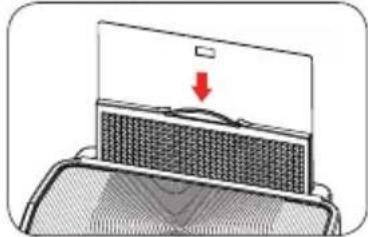
natural_image
Diagram of a device with a red arrow pointing to a component, no text or symbols presenttext_image
MODE ON BUTY A LOCNnatural_image
Technical line drawing of a heat exchanger or cooling unit with mesh insulation (no text or symbols)| Model Modus 600RT | ||
| Compatible Cameras | Canon EDS cameras (E·TTL II autoflash) | |
| Guide No.(1/1 output@ 200mm) | 60 (m ISO 100)190 (feet ISO 100) | |
| Flash Coverage | 20 to 200mm (14mm with wide panel)• Auto zoom (Flash coverage set automatically to match the lens focal length and image size)• Manual zoom• Swinging/titting flash head (bounce flash): O to 360° horizontally and -7° to 90° vertically | |
| FlashDuration | 1/300 to 1/20000 seconds | |
| Exposure control system | E-TTL 11 autoflash and manual flash | |
| Flash exposure compensation (FEC) | Manual. FEB: ±3 stops in 1/3 stop increments(Manual FEC and FEB can be combined.) | |
| FE lock | Withbutton or* > button | |
| Sync mode | High-speed sync (up to 1/8000 seconds),first-curtain sync, and second-curtain sync | |
| Multi flash | Provided (up to 100 times, 199Hz) | |
| • Wireless Flash | ||
| Wireless flash function | Master, Slave, Off | |
| Controllable Opticalslave groups 2.4GHz | 3 (A, B, and C)5 (A, B, C,D and E) | |
| Transmission range(approx.) | Optical | Indoors: 12 to 15 m / 39.4 to 49.2 ft.Outdoors: 8 to 10 m / 26.2 to 32.8 ft.Master unit reception angle: ±40° horizontally,±30° vertically |
| 2.4GHz | Up to 100m | |
| Channels | Optical | 4 (1, 2, 3, and 4) |
| 2.4GHz | Digital Channel Matching | |
| Slave-ready indicator | Two red indicators blink | |
| Modeling flash | Fired with camera's depth-of-field preview button | |
| • Auto Focus Assist Beam | ||
| Effective range (approx.) | Center: 0.6-10m / 2.0-32.8 feetPeriphery: 0.6-5m / 2.0-16.4 feet | |
| • Power Supply | ||
| Power source | 10.8V/2040mAh Li-ion battery | |
| Recycle time | 1.5 seconds. RED LED indicator will light up when the flash is ready | |
| Full power flashes | Approx. 500 | |
| Power saving | Power off automatically after approx. 90 seconds of idle operation. (60 minutes if set as slave) | |
| • Sync Triggering Mode | Hotshoe, 2.5mm sync line, Wireless control | |
| • Color Temperature | 5600±200k | |
| • Dimensions | ||
| W x H xD | 64*76*190 mm | |
| Weight without battery | 430g | |
| Weight with battery | 540g | |
DE
Fehlersuche
natural_image
Line drawing of a MODUS COURT camera module (no text or symbols on the device itself)Flash sans fil
pour Canon
Avant-Propos
text_image
Technical diagram of a DSLR camera with numbered parts for identification and assembly reference.Corps de l'appareil
natural_image
Three-panel diagram showing mechanical assembly steps with arrows indicating motion direction (no text or symbols)text_image
Technical diagram showing mechanical assembly steps with labeled components and directional arrowstext_image
ETTL→M→MULTI ETTL M Zoom 50mm MODE θ SET OFF CHtext_image
Zn/C.Fn FEB SYNC MODE 0 SET ON OFFtext_image
Zn/CFn FEB SYNC MODE 0 SET ON OFFtext_image
Diagram showing a device with labeled ports and a downward arrow indicating a process or operation.text_image
0.5 1 2 4 Zm/C Fn 1.1°C FEB SYNC MODE ON OFF ETTL Zoom 50mm 0.5 1 2 4 9 18m Zm/C Fn FEB SYNCtext_image
2mA/Fn 1/2 0V/02 SYNC MODE θ SET ON OFF ZThe "Master" attached to the camera can be a "Modus 600RT" or "Viper TTL transmitter"
- Use the supplied mini stand to hold the Slave unit in upright position
• Before shooting perform a test falsh and test shooting
- The transmission distance may vary depending on the position of the slave speedlight, environment and weather conditions
Emission de flashes multiples sans fil
natural_image
Illustration of wedding photography lighting setup with three cameras (A, B, C) and a screen showing two women in the background (no text or symbols)text_image
ETTL Zoom 50mm SLAVE A Zm/CFn # # Ornatural_image
Illustration of a person standing on a curved platform with three identical devices, no text or symbols present.text_image
Diagram showing a device control panel with labeled buttons and a red indicator light pointing to a 'MODE' button.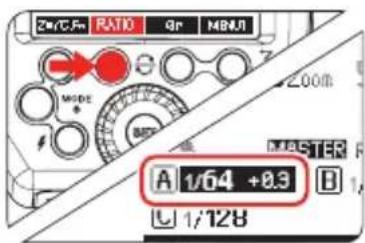
text_image
20°C RATIO 9P MENU MODE A 1/64 +8.3 B 1/128ALL(RATIO OFF) (rapport désactivé) → A/B(RATIO A:B) (rapport A:B) → A/B/C(RATIO A:B:C) (rapport A:B:C)
text_image
Zn/CJn SYNC Gr MENUT MODE MODE ON SET OFF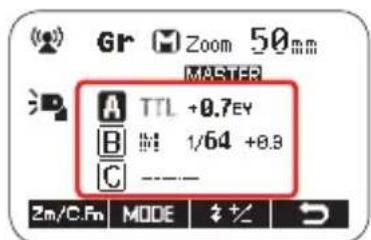
text_image
Gr Zoom 50mm MASTER A TTL +0.7EY B M: 1/64 +0.3 C ---- Zm/C.Fm MODE #+/-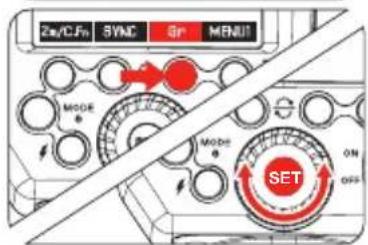
text_image
2u/C.Fn SYNC Sr MENU MODE MODE ON SET OFFDCM (Digital Channel Matching)
| CENTRE | 0.6~10m / 2.0~32.8 feet |
| PERIPHERIE | 0.6~5m / 2.0~16.4 feet |
Flash indirect
natural_image
Illustration of a mesh device with a red upward arrow indicating orientation (no text or symbols)natural_image
Diagram of a device with a red arrow pointing to a component, no text or symbols presenttext_image
MODE ON A A LOOMnatural_image
Technical line drawing of a mechanical component with mesh texture and rounded corners (no text or symbols)| Model Modus 600RT | ||
| Compatible Cameras | Canon EDS cameras (E·TTL II autoflash) | |
| Guide No.(1/1 output@ 200mm) | 60 (m ISO 100)190 (feet ISO 100) | |
| Flash Coverage | 20 to 200mm (14mm with wide panel)• Auto zoom (Flash coverage set automatically to match the lens focal length and image size)• Manual zoom• Swinging/titting flash head (bounce flash): O to 360° horizontally and -7° to 90° vertically | |
| FlashDuration | 1/300 to 1/20000 seconds | |
| Exposure control system | E-TTL 11 autoflash and manual flash | |
| Flash exposure compensation (FEC) | Manual. FEB: ±3 stops in 1/3 stop increments(Manual FEC and FEB can be combined.) | |
| FE lock | Withbutton or* > button | |
| Sync mode | High-speed sync (up to 1/8000 seconds),first-curtain sync, and second-curtain sync | |
| Multi flash | Provided (up to 100 times, 199Hz) | |
| • Wireless Flash | ||
| Wireless flash function | Master, Slave, Off | |
| Controllable Opticalslave groups 2.4GHz | 3 (A, B, and C)5 (A, B, C,D and E) | |
| Transmission range(approx.) | Optical | Indoors: 12 to 15 m / 39.4 to 49.2 ft.Outdoors: 8 to 10 m / 26.2 to 32.8 ft.Master unit reception angle: ±40° horizontally,±30° vertically |
| 2.4GHz | Up to 100m | |
| Channels | Optical | 4 (1, 2, 3, and 4) |
| 2.4GHz | Digital Channel Matching | |
| Slave-ready indicator | Two red indicators blink | |
| Modeling flash | Fired with camera's depth-of-field preview button | |
| • Auto Focus Assist Beam | ||
| Effective range (approx.) | Center: 0.6-10m / 2.0-32.8 feetPeriphery: 0.6-5m / 2.0-16.4 feet | |
| • Power Supply | ||
| Power source | 10.8V/2040mAh Li-ion battery | |
| Recycle time | 1.5 seconds. RED LED indicator will light up when the flash is ready | |
| Full power flashes | Approx. 500 | |
| Power saving | Power off automatically after approx. 90 seconds of idle operation. (60 minutes if set as slave) | |
| • Sync Triggering Mode | Hotshoe, 2.5mm sync line, Wireless control | |
| • Color Temperature | 5600±200k | |
| • Dimensions | ||
| W x H xD | 64*76*190 mm | |
| Weight without battery | 430g | |
| Weight with battery | 540g | |
T
text_image
QR code image with red square highlights, likely for digital scanning and linking to online content
DE

FR

SP

IT

PT

IL

PL

CZ

SE
Scan QR code for more info & other languages
All brands, trademarks and registered trademarks are the property of their respective holders. Copyright © hähnel industries Ltd, Ireland.
www.hähnel.ie