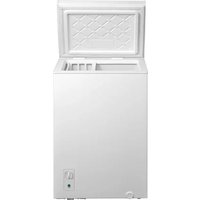
ACU040W - Freezer AYA - Free user manual and instructions
Find the device manual for free ACU040W AYA in PDF.


| Brand | AYA |
| Model | ACU040W |
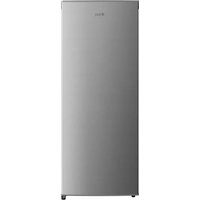
| Product Type | Upright freezer |
| Net Volume | 31 litres |
| Maximum Freezing Capacity | 2 kg / 24 hours |
| Climate Class | N/ST (temperate/subtropical) |
| Rated Voltage | 220-240 V~ |
| Frequency | 50 Hz |
| Current | 0.6 A |
| Refrigerant | R600a (24 g) |
| Insulation | Cyclopentane |
| Electrical Protection | Class I (grounded) |
| Temperature Setting | Rotary thermostat (MIN, NORMAL, MAX, OFF) |
| Defrosting | Manual (recommended once a month) |
| Door Reversal | Possible (instructions provided) |
| Maintenance and Cleaning | Inside with baking soda, outside with soapy water |
| Safety | Use by children aged 8 and above with supervision |
| Spare Parts | Availability 5 years |
| After-Sales Service | BUT (09 78 97 97 97) |
| Warranty | Legal conformity warranty 2 years |
Frequently Asked Questions - ACU040W AYA
User questions about ACU040W AYA
0 question about this device. Answer the ones you know or ask your own.
Ask a new question about this device
Download the instructions for your Freezer in PDF format for free! Find your manual ACU040W - AYA and take your electronic device back in hand. On this page are published all the documents necessary for the use of your device. ACU040W by AYA.
USER MANUAL ACU040W AYA
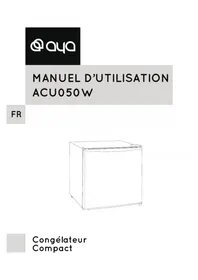
MANUEL D'UTILISATION ACU040W
FR
Congélateur
Compact
TABLE DES MATIERES
Le compartmentengélateur -12-
Information technique
INSTRUCTIONS FOR USE ACU040W
EN

Compact Freezer
TABLE OF CONTENTS
Important Safety Instructions
Proper use of freezers -9
The Freezer Compartment -11-
Hints and Tips - 13 -
Maintenance and Cleaning 14-
Reverse Door -17-
What Happens if Something Goes Wrong -19-
Installation Requirements -20-
THIS PRODUCT IS FOR HOUSEHOLD
USE ONLY!
Please read these instructions carefully before the first use of
this product and save this manual for your future reference.
IMPORTANT SAFETY INSTRUCTIONS
This warning is only for EUROPEAN market only!
When using an electrical appliance, basic precautions should always be followed, including the following:
-
This appliance can be used by children aged from 8 years and above and persons with reduced physical, sensory or mental capabilities or lack of experience and knowledge if they have been given supervision or instruction concerning use of the appliance in a safe way and understand the hazards involved. Children shall not play with the appliance. Cleaning and user maintenance shall not be made by children without supervision.
-
Children aged from 3 to 8 years are allowed to load and unload refrigerating appliances.
-
If the supply cord is damaged, it must be replaced by the manufacturer, its service agent or
similarly qualified persons in order to avoid a hazard.
- WARNING: Keep ventilation openings, in the appliance enclosure or in the built-in structure, clear of obstruction.
- WARNING: Do not use mechanical devices or other means to accelerate the defrosting process, other than those recommended by the manufacturer.
- WARNING: Do not damage the refrigerant circuit.
- WARNING: Do not use electrical appliances inside the food storage compartments of the appliance, unless they are of the type recommended by the manufacturer.
- Do not store explosive substances such as aerosol cans with a flammable propellant in this appliance.
- This appliance is intended to be used in household and similar applications such as
- staff kitchen areas in shops, offices and other working environments;
- farm houses and by clients in hotels, motels and other residential type environments;
- bed and breakfast type environments;
-
catering and similar non-retail applications.
-
Placed the appliance against a wall with a free distance not exceeding 75 ~mm and more than 50 ~mm
- WARNING: When positioning the appliance, ensure the supply cord is not trapped or damaged.
- WARNING: Do not locate multiple portable socket-outlets or portable power supplies at the rear of the appliance.
- To avoid contamination of food, please respect the following instructions:
- Opening the door for long periods can cause a significant increase of the temperature in the compartments of the appliance.
- Clean regularly surfaces that can come in contact with food and accessible drainage systems.
- Clean water tanks if they have not been used for 48h; flush the water system connected to a water supply if water has not been drawn for 5 days.
- Store raw meat and fish in suitable containers in the refrigerator, so that it is not in contact with or drip onto other food.
- Two-star frozen-food compartments are suitable for storing pre-frozen food, storing or making ice cream and making ice cubes.
-
One-, two- and three-star compartments are not suitable for the freezing of fresh food.
-
If the refrigerating appliance is left empty for long periods, switch off, defrost, clean, dry, and leave the door open to prevent mould developing within the appliance.
-
Unplug the appliance from outlet when not in use, before putting on or taking off parts, before cleaning.
- Make sure to place the plug all the way into socket when connecting your appliance.
- Insert the plug into a single grounded socket.
- Never use the appliance in place where combustible and inflammable materials are kept.
- For safety reason, be sure to repair or replace parts at an authorized service dealers.
- The motor is permanently lubricated and will require no oil.
- The appliance must be positioned so that the plug is accessible.
- Please according to local regulations regarding disposal of the appliance for its flammable blowing gas. Before you scrap the appliance, please take off the
doors to prevent children trapped.
- Ensure the refrigerator is unplugged before cleaning or if the product is not in use.
- To clean the appliance use only mild detergents or glass cleaning products. Never use harsh detergents or solvents.
- It is not recommended to use this refrigerator with an extension cord or power board. Please ensure that the appliance is plugged directly into the electrical outlet.
- Do not place hot food or drink into the refrigerator before it cools down to room temperature.
- Close the door immediately after putting in any items so the inside temperature will not rise dramatically.
- Keep appliance away from any heat source or direct sunlight.
-
To fix stably, the appliance must be placed on a flat and solid surface. It should not be laid on any soft material.
-
Do not place any other appliance on top of the refrigerator, and do not wet it.
- To avoid injury or death from electrical shock do not operate the appliance with wet hands, while standing on a wet surface or while standing in water.
- Do not use outdoors or in wet conditions.
- Never pull the cord to disconnect it from the outlet. Grasp the plug and pull it from the outlet.
- Keep the cord away from heated surfaces.
- Check that the voltage of the power supply in your home is the same as the voltage shown on the rating label of this product.
- Connect your refrigerator to an independent electrical socket and use a safe ground wire.
- When the frost in freezer is removed, or when there is no electricity or when refrigerator ceases to be used, it should be cleaned in order to prevent it from smelling.
-
Defrost the freezer at least once a month because too much frost may affect refrigeration.
-
Turn on electricity only 5 minutes later after electricity goes off. Otherwise, the compressor may be damaged.
- Children should be supervised to ensure that they do not play with the appliance.
- The appliance is not intended to be operated by means of an external timer or a separate remote-control system.
- This appliance has been incorporated with a grounded plug. Please ensure the wall outlet in your house is well earthed.
-
It is recommended to check regularly the supply cord for any sign of possible deterioration, and the appliance should not be used if the cable is damaged.
-
Disposal of the appliance: To prevent possible harm to the environment or human health from uncontrolled waste disposal, recycle it responsibly to promote the sustainable reuse of material resources. And the disposal should only be done through public collection points. Old refrigerators can contain CFC that destroy the ozone; contact the waste treatment center nearest your home for more details on the correct procedures for disposal.

-
WARNING! Risk of fire – flammable material. Please keep the product far away fire source during using, service and disposal. There are flammable materials at the back of the appliance.
-
This refrigerating appliance is not intended to be used as a built-in appliance.
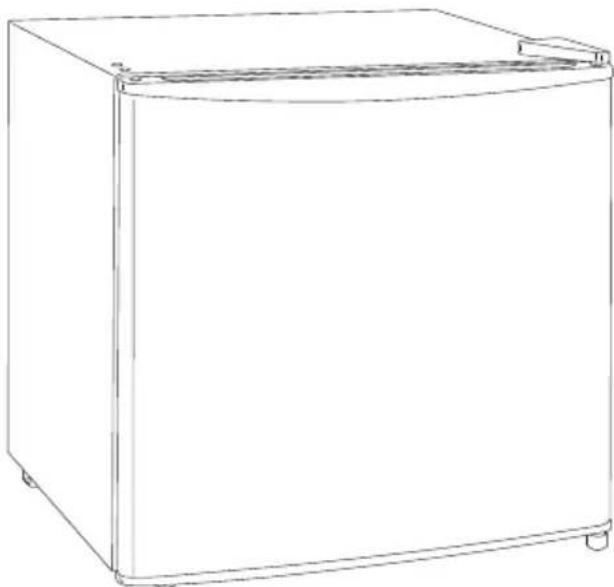
Names of components

(The picture above is only for reference. The actual configuration will depend on the physical product or statement by the distributor.)
- The low temperature of upright freezer may keep food fresh for a long time and it is mainly used to store frozen foods and making ice.
It is the most energy efficient to place food in the position shown in the picture above. - The upright freezer is suitable for storage of meat, fish, shrimp, pastries class and other foods not to be consumed in short term.
- Chunks of meat are preferably to be divided into small pieces for easy access. Please be noted food shall be consumed within the shelf time.
SETTING THE THERMOSTAT KNOB
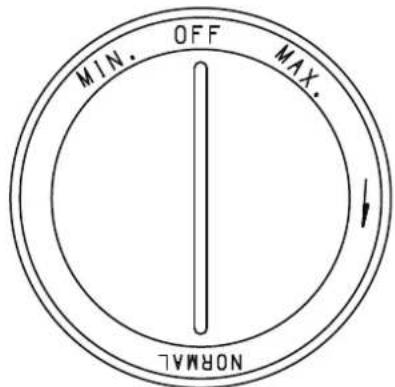
(The picture above is only for reference. The actual configuration will depend on the physical product or statement by the distributor.)
The markings on control knob indicate the "MIN, NORMAL, MAX and OFF" for the different temperature level.
"MIN." is the warmest setting;
"MAX." is the coldest setting;
For normal use, please set the control knob to "NORMAL" position.
Recommended gear : "NORMAL"
Technical information
| Reference: | ACU040W |
| Rated voltage: | 220-240V~ |
| Ampere: | 0.6A |
| Rated frequency: | 50Hz |
| Climate class: | N/ST |
| Refrigerant: | R600a(24g) |
| Protection against electrical shock: | I |
| Insulation foam: | CYCLOPENTANE |
Climate classes
-Extended temperate: 'this refrigerating appliance is intended to be used at ambient temperatures ranging from 10^ to 32^ ;
-Temperate: 'this refrigerating appliance is intended to be used at ambient temperatures ranging from 16^ to 32^
-Subtropical: 'this refrigerating appliance is intended to be used at ambient temperatures ranging from 16^ to 38^
-Tropical: 'this refrigerating appliance is intended to be used at ambient temperatures ranging from 16^ to 43^ ;
Note: More data information, please scan the QR code on the energy label.
THE FREEZER COMPARTMENT
The symbol means that your freezer will store frozen food at -18^ or colder allowing for long term frozen food storage and freezing of fresh food. The freezer temperature is controlled automatically by the thermostat situated in the control panel.
Due to the different installations, methods of usage and weather conditions, adjustments to the temperature settings may be required.
These are best assessed against temperature reading on a thermometer buried in the frozen food. The reading must be taken quickly as the thermometer temperature will rise rapidly after removed.
Freezing Fresh Food
The maximum quantity of food you can freeze in 24 hours is 2kg . Place the fresh food on the freezer compartment. Food may need rearranging to achieve this.
During freezing process the temperature of fresh food should be reduced quickly so that ice crystals are kept as small as possible to prevent damaging the structure of food. If freezing takes place slowly large ice crystals from and these will affect the quality of food once it has defrosted.
Packets to be frozen should be placed in the basket in contact with the baskets surface as far as possible and spaced apart to allow cold air to circulate between them. They should no touch existing packets.
| Freezing chamber | Type of food |
| Freezer drawer(s)/shelf | ·Foods for long-term storage. raw meat, poultry,fish. ice cream, frozen fruit, frozen baked goods. |
! Frozen food should not be refrozen once it has thawed out.
Do not remove items from the freezer if your hands are damp/wet, as this could cause skin abrasions or 'frost/freezer burns'.
- Frozen Food Storage
The appliance has the following net storage volume: 31 liters.
This is a standard measurement and the actual capacity depends upon the density and sizes of the food.
Pre packed commercially frozen food should be stored in accordance with the manufacturer's instructions for a 4 star frozen food compartment and should be put in the freezer as soon as possible after purchase. Your freezer provides for long term storage which generally means up to 3 months but the length of the time can vary and it is important to follow the recommended times shown on packets of commercially frozen food.
Do not place sealed containers or carbonated liquids such as fizzy drinks into the freezer as it creates pressure on the container which may cause it to explode resulting in damage to the freezer. Ice cubes and ice lollies should not be consumed immediately after removal from the freezer as it may result in low temperature skin abrasions.
Manufacturers storage times should be adhered to.
Hints and Tips
-
Any opened packets of frozen food should be rewrapped in airtight materials to prevent surface evaporation which causes drying or 'freeze burn'.
-
Frozen food which is allowed to thaw accidentally should either be used immediately or thrown away. Alternatively if the food is uncooked and has not been completely defrosted it can be cooked and then refrozen.
-
Aim to check dates on packets and rotate food regularly. Although storage longer than recommended is not harmful, flavors and textures begin to change.
- Normal Operating Sounds
- You may hear faint gurgling or bubbling sounds when the refrigerant is pumped through the coils or tubing at the rear, to the cooling plate/evaporator.
- When the compressor is on, the refrigerant is being pumped round, and you will hear a whirring sound or pulsating noise from the compressor.
- A thermostat controls the compressor, and you will hear a faint 'click' when the thermostat outs in and out.
- Food Storage
- To obtain the best results from your appliance, neither hot foods nor liquids which may evaporate, should be placed in the compartment.
- Avoid buying frozen food if you cannot store it straight away. The use of an insulated container is advisable. When you arrive home place the frozen food in the freezer immediately.
- Keep the time between buying chilled food and placing it in your fridge as short as possible.
- Do not push food together too much, try to allow air to circulate around each item.
- Do not store food uncovered.
- Ensure that food placed in the freezer is dated and labeled and used in date, to ensure that food is consumed at its best.
- Remove suspect food from your refrigerator and clean, refer to cleaning and maintenance.
- Energy Saving Advice
- Do not install the appliance close to sources of heat, such as a cooker, dishwasher or radiator.
- Locate the appliance in a cool well ventilated room and make sure that the air openings of the cabinet are not obstructed.
- Avoid unnecessary frosting in the cabinet by packing all foodstuffs into airtight packages before placing them in the freezer.
-
Always leave warm food to cool down to room temperature before placing in the freezer.
-
Food which is to be frozen (when cool) should be placed in the fridge before being transferred to the freezer.
- Thaw frozen food in the fridge. This will ensure safer defrosting of foods and reduce the work of the refrigeration unit.
- Try to avoid keeping the door open for long periods, or opening the door too frequently as warm air will enter the cabinet, and cause the compressor to switch on unnecessarily often.
- Ensure there are no obstructions preventing the door from closing properly.
- It is advisable to periodically clean the refrigeration system at the back of the appliance with a duster or vacuum cleaner.
- In the Event of a Power Failure
If there is a power failure during the storage of frozen foods, keep the door closed. If the
temperature within your freezer should rise do not refreeze the food without checking its condition.
The following guidelines should assist you:
Ice Cream: Once thawed should be discarded.
Bread and Cakes: can be refrozen without danger.
Shellfish: should be refrigerated and used up quickly.
Cooked Dishes: i.e. casseroles, should be refrigerated and used up.
Large Pieces of Meat: can be re-frozen providing there are ice crystals remaining within them.
Small Joints: should be cooked and then re-frozen as cooked dishes.
Chicken: should be cooked and re-frozen as a fresh dish.
MAINTENANCE AND CLEANING
Before any maintenance or cleaning work is carried out disconnect the appliance from the electricity supply
- Internal Cleaning
Clean the inside and accessories with warm water and bicarbonate of soda (5ml to 0.5 liter of water). Rinse and dry thoroughly.
Do not use detergents, abrasive powders, highly perfumed cleaning products, wax polishes or cleaning products containing bleach or alcohol.
- External Cleaning
Wash the outer cabinet with warm soapy water.
Do not use abrasive products.
There are sharp edges on the underside of the product so care should be taken when cleaning.
Once or twice a year dust the compressor at the back of the appliance, with a brush or vacuum cleaner, as an accumulation of dust will affect the performance of the applaicne and cause excessive electricity consumption.
- Cleaning
-
Dusts behind the refrigerator and on the ground shall be timely cleaned to improve the cooling effect and energy saving.
-
The interior of the refrigerator should be cleaned regularly to avoid odor.
-
Check the door gasket regularly to make sure there are no debris.
-
Please turn off the power before cleaning, remove all food, shelves, drawers, etc.
-
Clean the door gasket with mild soap and water.
-
Use a soft cloth or sponge to clean the inside of the refrigerator, with two tablespoons of baking soda and a quart of warm water. Then rinse with water and wipe clean, and open the door and dry it naturally before the power is turned on.
-
For areas that are difficult to clean in the refrigerator (such as narrow sandwiches, gaps or corners), it is recommended to wipe them regularly with a soft rag, soft brush, etc. and when necessary, combined with some auxiliary tools (such as thin sticks) to ensure no contaminant accumulation in these areas.
-
Do not use soap, detergent, scrub powder, spray cleaner, etc., as these may cause odors in the interior of the refrigerator.
-
Clean the bottle frame, shelves with a mild detergent and dry with a soft cloth.
-
Wipe the outer surface of the refrigerator with a soft cloth dampened with soapy water, detergent, etc., and then wipe dry.
- Do not use hard brushes, clean steel balls, wire brushes, abrasives, such as toothpastes, organic solvents (such as alcohol, acetone, banana oil, etc.), boiling water, acid or alkaline items clean refrigerator considering that this may damage the fridge surface and interior. Boiling water and benzene may deform or damage plastic parts.
- Do not rinse with water so as not to affect the electrical insulation properties.
- To Defrost the Freezer
- Wrap any food in layers of newspaper or blankets.
- Switch the appliance off at the wall socket and remove the plug.
- Open the freezer door.
- Place a suitable container to collect the defrost water.
- After defrosting, clean and dry the interior.
- Switch the appliance on and replace any frozen food.
Defrosting can be speeded up by putting bowls of hot (not boiling) water in the freezer and loosening the frost with a suitable plastic scraper.
If the temperature of frozen food is allowed to rise during defrosting, its storage life may be shortened.
- When the Appliance is Not in Use
When the appliance is not in use for long periods, disconnect from the electricity supply, empty all the food and clean the appliance, leaving the door ajar to prevent unpleasant smells.
REVERSE DOOR
Follow the following stages to reverse the door from its initial position.
1) Remove all food from door shelves. Fix the door by tapes.
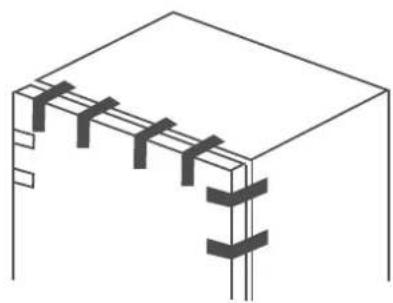
2) Dismantle hole caps, the upper hinge cover, fitting screws of upper hinge, and remove the upper hinge, please keep the door vertical in whole process for avoiding falling down;

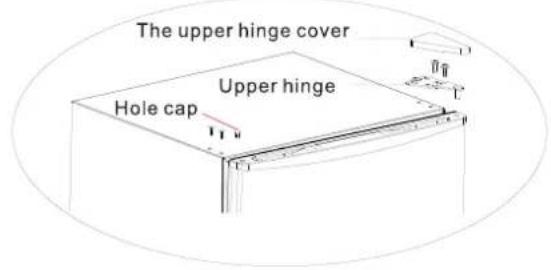
3)Remove the door;

4) Dismantle the lower hinge assembly and adjustable leg;

5) Install the lower hinge and adjustable leg on lower left side of cabinet and lower right side respectively;

6) Put the door on lower hinge vertically, and validate the gas tightness of door gasket, then install the upper hinge by fitting screws and the hinge cover, finally cover the hole caps on upper right side.
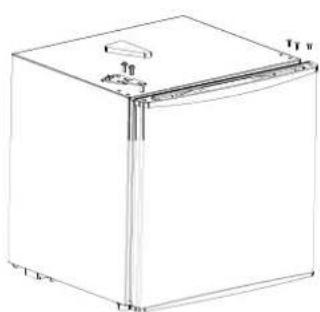
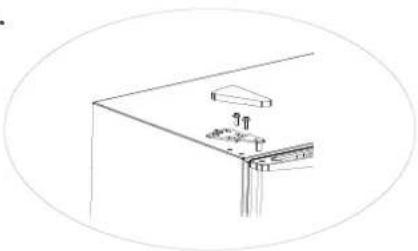
Note :
Ensure the Appliance is unplugged and empty.
Adjust the two leveling feet to their highest position.
We recommend you have someone to assist you.
To take the door off it is necessary to tilt the appliance backward.
The refrigerator inclination angle should be less than 45^
You should rest the Appliance on something solid e.g. a chair just below the top panel.
Do not lay the Appliance completely flat as this may damage the coolant system.
Before contacting your local service force center, check the following points:
| Symptom | Solution |
| No power to the appliance | Check there is power at the socket. |
| Check there is not a power cut by checking the household lights. | |
| Check the fuse has not blown. | |
| The temperature in the freezer section is too high | Check the thermostat is turned to the correct Setting relative to ambient conditions. |
| The freezer door will not open | - Has door just been opened?If so leave for a few minutes to allow the air pressure to equalise. |
| The compressor runs continuously | Adjust the thermostat to give correct temperature control. |
| Check that the door is closed. | |
| Large quantities of food have recently been placed in the cabinet / and or door is frequently opened. | |
| Check that air ventilation is not obstructed. | |
| Ensure the door is not left open. | |
| Excessive frost and ice has built up | Check that nothing is preventing the door from closing. |
| Is the door gasket intact and clean? | |
| Has advised periodic defrosting been carried out? | |
| Noise | Refer to normal operating sounds. |
INSTALLATION REQUIREMENT
Avoid the following locations: unventilated kitchen, outhouse, conservatory, garage.
For Correct operation this appliance must be installed:
- in a dry atmosphere
- out of direct sunlight
- away from extreme temperature (not next to a cooker or other sources of heat).
Your appliance will be heavy when loaded with food and must therefore be stood on a strong firm floor.
- Ventilation Requirements
Gently push into place until the back of the freezer keeps a required distance from wall.
When in position a 50mm clear space above the appliance should be maintained.
If space above the appliance is not available, clearance of 25mm should be maintained on both sides.
Ensure that the appliance does not stand on the electrical supply cable. Parts which heat up should not be exposed. Whenever possible, the back of the appliance should be close to a wall but leaving the required distance for ventilation.

- Levelling
The appliance should be level, to eliminate rocking:
Ensure the appliance is upright and both adjusters are firm contact with the floor so that the cabinet is level.
Adjust the level by screwing out the appropriate level adjuster at the front (use your fingers or a
suitable spanner).
CORRECT DISPOSAL OF THIS PRODUCT
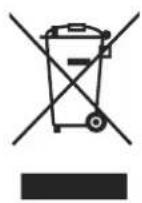
This marking indicates that this product should not be disposed with other household wastes throughout the EU. To prevent possible harm to the environment or human health from uncontrolled waste disposal, recycle it responsibly to promote the sustainable reuse of material resources. To return your used device, please use the ref. n and collection systems or contact the retailer where the product was purchased. They can take this product for environmental safe recycling.
About your product service :
To contact our After-Sales Service, before going to BUT store, call 09 78 97 97 97
From Monday to Saturday from 8:00 a.m. to 8:00 p.m. (Price of a local call).
Period of availability of repair spare parts: 5 years
In accordance with Article L. 217 of the Consumer Code, your product has 2 year legal guarantee of conformity.
- MANUEL D'UTILISATION ACU040W
- TABLE DES MATIERES
- INSTRUCTIONS FOR USE ACU040W
- TABLE OF CONTENTS
- THIS PRODUCT IS FOR HOUSEHOLD
- USE ONLY!
- IMPORTANT SAFETY INSTRUCTIONS
- Names of components
- SETTING THE THERMOSTAT KNOB
- Climate classes
- THE FREEZER COMPARTMENT
- Freezing Fresh Food
- - Frozen Food Storage
- Hints and Tips
- - Normal Operating Sounds
- - Food Storage
- - Energy Saving Advice
- - In the Event of a Power Failure
- MAINTENANCE AND CLEANING
- - Internal Cleaning
- - External Cleaning
- - Cleaning
- - To Defrost the Freezer
- - When the Appliance is Not in Use
- REVERSE DOOR
- INSTALLATION REQUIREMENT
- - Ventilation Requirements
- - Levelling
- CORRECT DISPOSAL OF THIS PRODUCT
- About your product service :
Brand : AYA
Model : ACU040W
Category : Freezer