
CC1005E - Freezer AYA - Free user manual and instructions
Find the device manual for free CC1005E AYA in PDF.
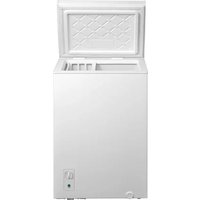


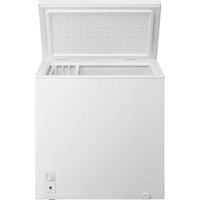
| Product type | Chest freezer |
| Brand | AYA |
| Model | CC1005E |
| Dimensions (H x W x D) | 850 x 547 x 446 mm |
| Total volume | 99 L |
| Supply voltage | 220-240 V |
| Frequency | 50 Hz |
| Current | 0.35 A |
| Energy class | E |
| Annual consumption | 169 kWh/year |
| Refrigerant | R600a (46 g) |
| Freezing capacity | 4.5 kg/24h |
| Defrost type | Manual |
| Climate class | ST/N/SN (Subtropical, Temperate, Extended Temperate) |
| Noise level | 38 dB(A) - Class C |
| Temperature range | Cooling (0-10°C) / Freezing (-12 to -24°C) |
| Installation type | Freestanding |
| Warranty | 2 years |
| Included accessories | Basket, ice scraper, drain plug |
| Electrical safety | Mandatory grounding, dedicated 13 A socket |
| Maintenance | Regular cleaning with baking soda, defrost at 4 mm of frost |
Frequently Asked Questions - CC1005E AYA
User questions about CC1005E AYA
0 question about this device. Answer the ones you know or ask your own.
Ask a new question about this device
Download the instructions for your Freezer in PDF format for free! Find your manual CC1005E - AYA and take your electronic device back in hand. On this page are published all the documents necessary for the use of your device. CC1005E by AYA.
USER MANUAL CC1005E AYA
USER MANUAL CC1005E
EN
Freezer
TABLE OF CONTENTS
SAFETY INSTRUCTIONS .... 1
APPLIANCE DESCRIPTION ....7
ELECTRICAL SAFETY......8
USE....10
TEMPERATURE ADJUSTMENT AND APPLIANCE DESCRIPTION....11
DAILY USE....15
EFFICIENCY OF USE....18
DEFROSTING/FIRST USE AND INSTALLATION....19
TECHNICAL INFORMATION....23
TROUBLESHOOTING....26
DISPOSAL OF THE APPLIANCE'......30
DISPOSAL OF USED HOUSEHOLD APPLIANCES....31


Important installation!

Freezer
CONTENTS
SAFETY AND WARNING INFORMATION .... 1
DESCRIPTION OF THE PRODUCT 6
ELECTRICAL SAFETY 7
BEFORE USE 9
TEMPERATURE ADJUSTMENT AND DESCRIPTION OF APPLIANCE....10
DAILY USE....13
EFFICIENT USE 16
DEFROSTING/FIRST USE AND INSTALLATION ....17
TECHNICAL INFORMATION ....20
TROUBLESHOOTING....23
DISPOSAL OF THE APPLIANCE....27
DISPOSAL OF OLD ELECTRICAL APPLIANCES....28

THIS PRODUCT IS FOR HOUSEHOLD USE ONLY!
Please read these instructions carefully before the first use of this product and save this manual for your future reference.
SAFETY AND WARNING INFORMATION
- IMPORTANT WARNINGS: READ CAREFULLY AND RETAIN FOR FUTURE REFERENCE.
- With regard to information on installation, handling, maintenance and disposal of the product, please refer to the following section of the manual.
- This appliance is intended to be used in household and similar applications such as:
- staff kitchen areas in shops, offices and other working environments,
- farmhouses and by clients in hotels, motels and other residential type environments,
- bed and breakfast type environments,
- catering and similar non-retail applications
- This appliance is NOT intended to be used in household and similar applications such as:
- Catering and other similar applications and retail.
- WARNING: Keep ventilation openings in the appliance enclosure or in the built-in structure, clear of obstruction.
- WARNING: Do not damage the refrigerant circuit.
- WARNING: Do not use electrical appliances inside
the food storage compartments of the appliance unless they are of the type recommended by the manufacturer.
- Children aged from 3 to 8 years are allowed to load and unload refrigerating appliances.
- This appliance can be used by children aged from 8 years and above and persons with reduced physical sensory or mental capabilities or lack of experience and knowledge if they have been given supervision or instruction concerning use of the appliance in a safe way and understand the hazards involved. Children shall not play with the appliance. Cleaning and user maintenance shall not be made by children without supervision.
- If the supply cord is damaged it must be replaced by the manufacturer its service agent or similarly qualified persons in order to avoid a hazard.
- Do not store explosive substances such as aerosol cans with a flammable propellant in this appliance.
- If the refrigerant circuit is damaged:
- Avoid naked flames and sources of ignition.
- Thoroughly ventilate the room in which the appliance is situated.
- WARNING: When positioning the appliance, ensure the supply cord is not trapped or damaged.
- WARNING: Do not locate multiple portable socket outlets or portable power supplies at the rear of the appliance.
- Regarding the information for the installation,
operation, maintenance, and disposal of the device, refer to the following paragraph of the instruction manual.
- To avoid any harm to the environment or human health caused by the uncontrolled disposal of electrical waste, recycle the appliance responsibly to promote the reuse of material resources. Disposal must be done safely at public collection points provided for this purpose.
- Please follow local regulations regarding disposal of the appliance for its flammable blowing gas. Before you scrap the appliance, please take off the doors to prevent children from being trapped.
- Please contact your nearest waste disposal center for more details on the correct disposal procedures.
- The appliance must be installed on the ground on a flat, horizontal surface, ensuring that the vents are not obstructed.
- Never attempt to replace or repair any appliance part or component yourself. Request help from a professional qualified person if needed.
- Always handle the appliance with care in order to avoid damaging it.
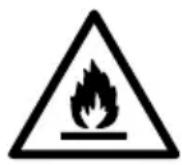
- Warning: risk of fire/flammable materials
- To avoid contamination of food, please respect the following instructions:
- Opening the door for long periods can cause a significant increase in the temperature of the compartments in the appliance.
- Clean regularly surfaces that can come into contact with food and accessible drainage systems.
- Store raw meat and fish in suitable containers in the freezer, so that it is not in contact with or drip onto other food.
- Two-star frozen-food compartments are suitable for storing pre-frozen food, storing or making ice cream and making ice cubes.
- One-, two- and three-star compartments are not suitable for the freezing of fresh food.
- If the refrigerating appliance is left empty for long periods, switch off, defrost, clean, dry, and leave the door open to prevent mold developing within the appliance.
- Extreme caution must be used when moving the appliance.
- Regarding the details for safe storage of food, installation and maintenance, please refer to the relevant sections of the manual.
- WARNING - When positioning the appliance, ensure the supply cord is not trapped or damaged.
- WARNING - Do not locate multiple portable socket outlets or portable power supplies at the rear of the appliance.
- WARNING - Damaged supply cord must be replaced by a special cord or assembly available
from the manufacturer or its service agent.
- If the refrigerant circuit is damaged:
- Avoid naked flames and sources of ignition.
- Thoroughly ventilate the room in which the appliance is situated.
- It is dangerous to alter the specifications or modify this product in any way. Any damage to the cord may cause a short circuit, fire, and/or electric shock.
- Do not insert oversized food as this could cause incorrect operation.
- If you are discarding an old freezer or freezer with a lock / catch fitted to the door, ensure that it is left in a disabled condition to prevent the entrapment of young children when playing.
- Unplug the appliance from the mains socket when not in operation and before cleaning.
- Do not insert oversized food as this could cause incorrect operation.
DESCRIPTION OF THE PRODUCT
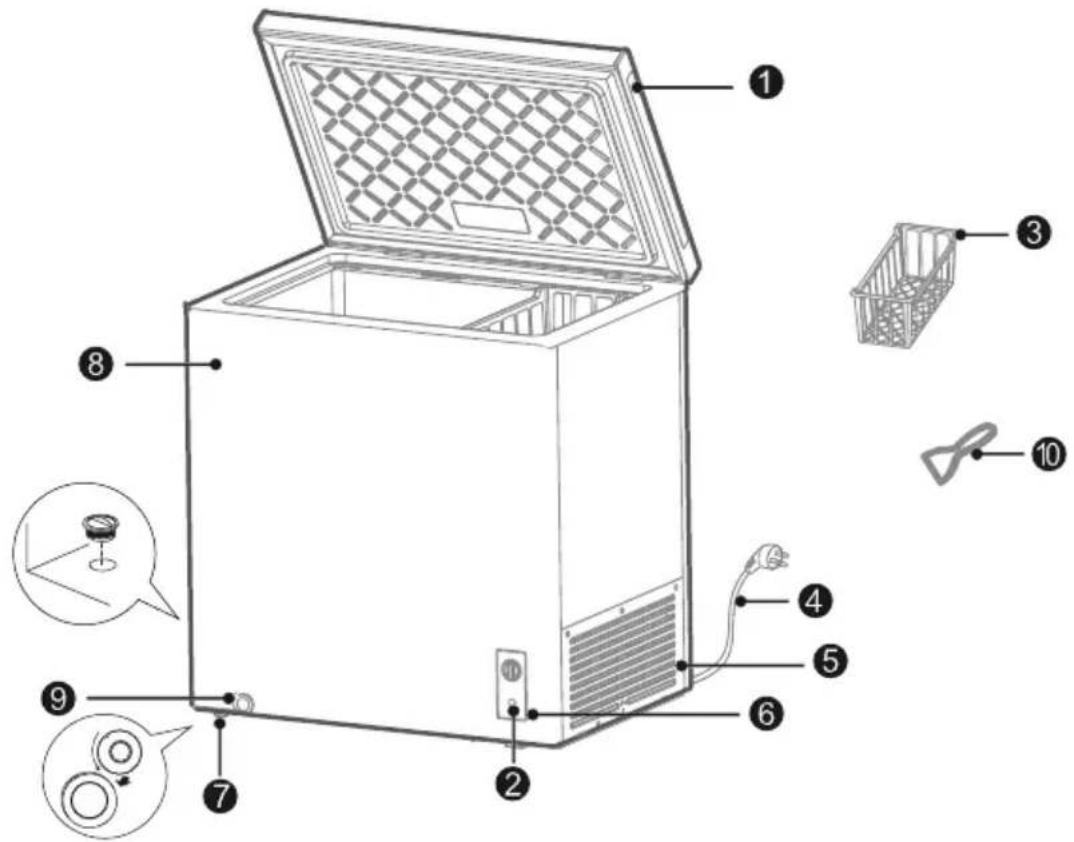
| 1 Door handle 6 | Temperature control panel | |
| 2 thermostat knob (FREEZING - congélation, COOLING - Congélateur) | 7 Levelling foot | |
| 3 Shelving basket 8 Cabinet | ||
| 4 Power cord 9 Drain | ||
| 5 Shutter 10 Ice scraper | ||
ELECTRICAL SAFETY
- The power cord must not be lengthened.
- Make sure the power plug is not crushed or damaged. A crushed or damaged power plug may overheat and cause a fire.
- Make sure that you can access the main plug of the appliance.
- Do not pull the main cable.
- If the power plug socket is loose, do not insert the power plug. Otherwise there is a danger of electric shock.
- You must not operate the appliance without the interior lighting lamp cover.
- The freezer is only supplied with power supply of single phase alternating current of 220 - 240V~50Hz. If fluctuation of voltage in the district of user is so large that the voltage exceeds the above scope, for safety sake, be sure to apply A.C.
- Automatic voltage regulator of more than 350W to the freezer. The freezer must employ a special power socket instead of common one with other electric appliances. Its plug must match the socket with ground wire.
Important!
There must be good ventilation around the freezer to allow heat dissipation, high efficiency and low power consumption.
Therefore, there must be enough space around the freezer. It is recommended to leave a space of 75 mm between the back of the freezer and the wall, at least 200 mm on each side and at least 700 mm above.
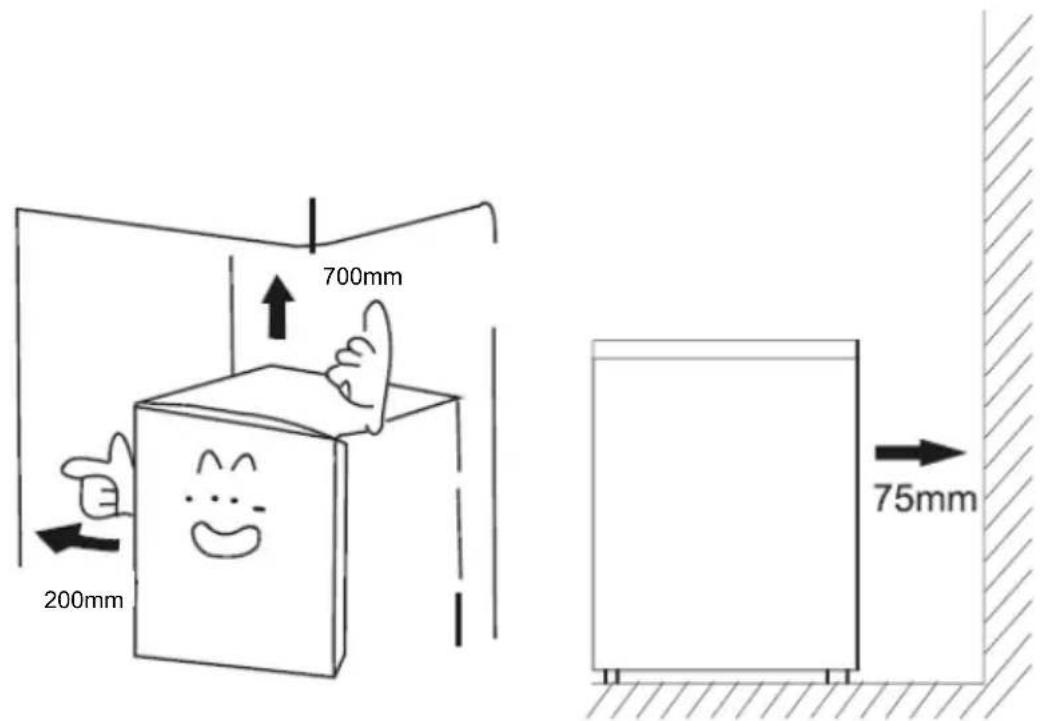
Horizontal mounting
The unit must be set up horizontally to minimize vibration. To set the unit horizontally, it must be standing upright, with its two adjustable feet in stable contact with the floor. You can also adjust the horizontal setting by unscrewing the front adjustable feet in the appropriate position (use your fingers or an appropriate wrench).
BEFORE USE
- Remove all packing materials, adhesive tape, etc. Leave the doors open for a while to ventilate the unit.
- The unit is cleaned before shipping. Nevertheless, we recommend cleaning the inside of the compartment once after delivery.
- Plug into an earthed wall socket supplying 220-240 V ~ single-phase current.
- Let the appliance run for about 1 hour for the compartment to cool down before placing items in the appliance.
WAIT 5 MINUTES OR MORE BEFORE RE-STARTING
Restarting the unit immediately after it has been turned off may cause fuses to blow and activate the circuit breaker the compressor may become overloaded and/or other damage may occur.
TEMPERATURE ADJUSTMENT AND DESCRIPTION OF APPLIANCE
TEMPERATURE ADJUSTMENT
Please electrify the chest freezer, the “POWER” lamp will shine (green light).
Rotate the thermostat knob clockwise, the temperature inside the chest freezer will be lower and lower.
“COOLING” means cooling zone, “FREEZING” means the freezing zone.
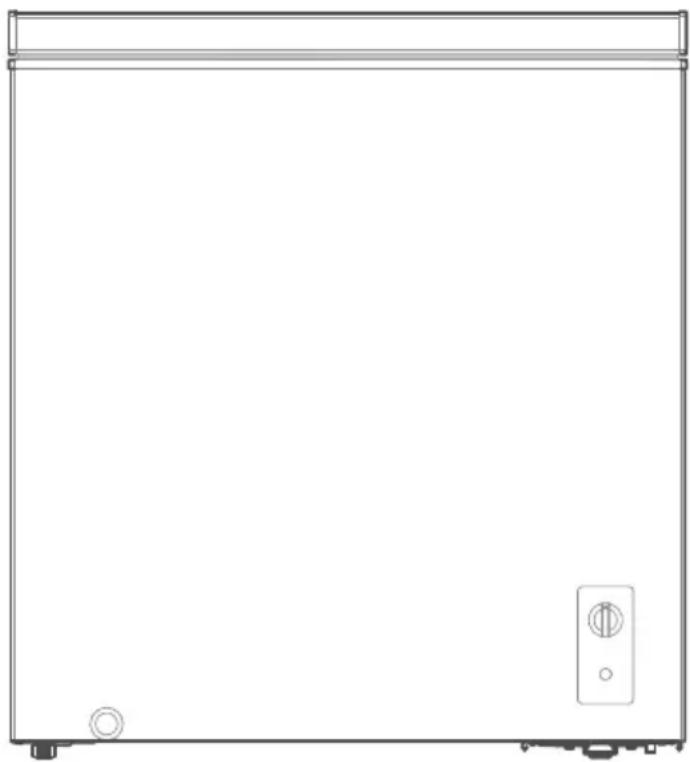
Recommended gear see the schematic marking position.
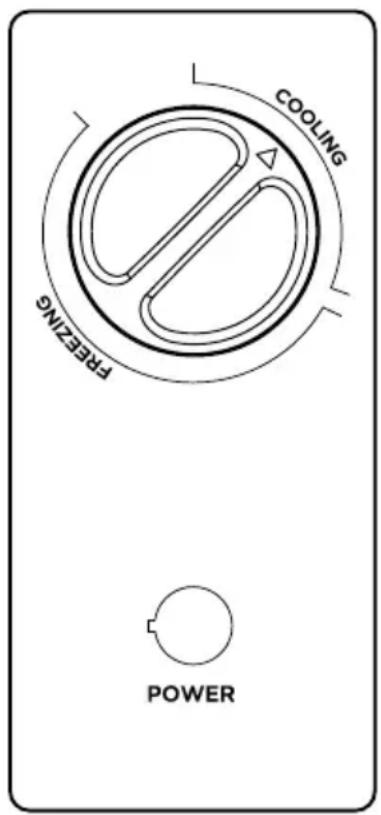
The temperature of the cooling position is 0-10 °C. It is suitable for short-term storage of vegetables, fruits and
Other foods that do not need to be frozen for 1-2 days. Tips: This temperature range is not suitable for long-term storage of meat and other foods that need to be placed, otherwise they are easy to spoil. The temperature of the side wall of the refrigerator is low. Do not store food against the wall.
The freezing temperature is -12 to -24°C, suitable for long-term storage of meat and other foods.
For daily use, store at -18°C or colder (middle position of the freezing gear area). Avoid opening the freezer compartment door unnecessarily.
Tips: Do not place vegetables, fruits, and other food that does not need to be frozen in this position, otherwise the food will be frostbitten.
The freezing mode can generally store: Meat, dumplings, ice cream (3-6 months), fish and shrimp (1-3 months).
In order to improve the efficiency of the cooling system and save energy, it is necessary to maintain good ventilation around the appliance for the dissipation of heat. For this reason, sufficient clear space should be available around the freezer. Please load your food according to the method below, and close the door of the freezer as soon as you have finished storing food. This can help you reduce energy consumption.
Food should not be stored in the freezer for too long.
Generally, fish and meat foods that need to be frozen should be stored for a maximum of one year. Foods that need to be refrigerated (including cooked food) such as: milk and yogurt for 2-3 days, bread for 3-5 days, fish and meat sausages for 1-3 days, vegetables for 3-5 days, green leafy vegetables (such as spinach) for 1-2 weeks, stems (radish, celery) for 1-2 weeks, and apples for 1-3 weeks.
Frozen meat and fish are placed in the lower layer of the freezer compartment, and foods that are directly imported such as cold drinks are placed in the upper layer of the freezer compartment.
To avoid food waste, adjust to COOLING mode for fresh meat and fish, vegetables, and dairy. Set to FREEZING mode for long-time storage like frozen meat and fish.
Never touch the interior of the freezer chamber or frozen foods in the compartment with wet hands, as this could result in frostbite.
The above image is for reference only. Configuration is subject to the actual product.
DESCRIPTION OF APPLIANCE
Installation: Any electrical work that is required to install this appliance MUST be carried out by a qualified electrician.
Replacing certain parts of your household electrical appliance may lead to danger. Please ensure that you have the necessary skills and own all tools required to carry out the self-repair operations safely. Otherwise, please contact a qualified professional.
Warning: THIS APPLIANCE MUST BE GROUNDED
Before making any electrical connections, ensure the following: Electrical connection
Electrical safety is only guaranteed when the grounding system of your house is in accordance with the related local regulations.
Do not bend, stretch, or pull the supply cable to avoid electric shock.
Do not use electrical appliances inside of food storage compartments of the appliance unless they are of the type recommended by the manufacturer.
Ensure the power socket is suitable for the maximum power of the machine. Fuses in the power circuit must be 13 amps.
The supply voltage should be the same as that indicated in the technical specifications and the appliance rating plate.
The appliance should be grounded and in compliance with the applicable laws.
When installed, the power socket must be within easy reach.
If the socket outlets in your home are not suitable for the plug supplied with this unit, check with a qualified electrician for replacement.
The use of adapters, multiple connectors, or extension cables is not recommended.
The plug contains a removable fuse cover that must be refitted when the fuse is replaced. If the fuse cover is lost or damaged, the plug must not be used until a replacement cover has been fitted or the plug is replaced.
A damaged plug should be cut off as close to the plug body as possible, the fuse should be removed, and the plug disposed of safely.
DAILY USE
Do not store flammable gas or liquids in the appliance. There is a risk of an explosion.
Do not operate any electrical appliances in the appliance (e.g., electric ice cream makers, mixers, etc.).
When unplugging, always pull the plug from the mains socket, do not pull on the cable.
Do not place hot items near the plastic components of the freezer.
Do not place food products directly against the air outlet on the rear wall.
Store pre-packed frozen food in accordance with the frozen food manufacturer's instructions.
The manufacturer's storage recommendations should be strictly adhered to. Refer to relevant instructions for storage.
Do not place carbonated or fizzy drinks in the freezer compartment as it creates pressure on the container, which may cause it to explode, resulting in damage to the appliance.
Frozen food can cause frost burns if consumed straight from the freezer compartment.
Do not place the appliance in direct sunlight.
Keep lit candles, lamps, and other items with open flames away from the equipment to avoid igniting it.
The appliance is intended for keeping food and/or beverages in normal households as explained in this instruction booklet. The appliance is heavy. Care should be taken when moving it.
Do not remove or touch items from the freezer compartment if your hands are damp/wet, as this could cause skin abrasions or frost/freezer burns.
Never use the base, drawers, doors, etc. to stand on or as supports.
Frozen food must not be refrozen once it has been thawed out.
Do not consume ice popsicles or ice cubes straight from the freezer as this can cause freezer burn to the mouth and lips.
To avoid items falling and causing injury or damage to the appliance, do not overload the door racks or put too much food in the crisper drawers.
Gentle Reminder
When the ambient temperature and relative humidity are very high, there may be frost or water condensed on the breaker of the freezer. This is a normal phenomenon. Please wipe it with a dry towel.
Caution!
Care and Cleaning
Before maintenance, switch off the appliance and disconnect the mains plug from the mains socket.
Do not clean the appliance with metal objects, steam cleaners, ethereal oils, organic solvents, or abrasive cleansers.
Do not use sharp objects to remove frost from the appliance. Use a plastic scraper.
Installation Important!
For electrical connection, carefully follow the instructions given in this manual.
Unpack the appliance and check if there are any damages on it.
Do not connect the appliance if it is damaged. Report possible damages immediately to the place you bought it. In this case, retain the packing.
It is advisable to wait at least four hours before connecting the appliance to allow the oil to flow back into the compressor.
Adequate air circulation should be allowed around the appliance to reduce the risk of overheating. To achieve sufficient ventilation, follow the instructions relevant to installation.
Wherever possible, the back of the product should not be close to a wall to avoid touching or catching warm parts (compressor, condenser) and to prevent the risk of fire. Follow the instructions relevant to installation.
The appliance must not be located close to radiators or cookers.
Make sure that the mains plug is accessible after the installation of the appliance.
Service
Any electrical work required to do the servicing of the appliance should be carried out by a qualified electrician or competent person. This product must be serviced by an authorized Service Center, and only genuine spare parts must be used.
EFFICIENT USE
Please follow the following instructions in order to save energy consumption.
- To prevent cold air escaping from the chest freezer, open and close the door quickly and keep the door opened for as short a time period as possible.
- Please install the unit in a well-ventilated location.
- Do not use the unit to store water or food that requires water as a storage medium. Never place fresh seafood containing water directly in to the unit.
- This refrigerating appliance is not intended to be used as a built-in appliance.
CHECKS
To ensure safety, perform the following checks after cleaning the unit:
- Is the power cord plug firmly inserted into a dedicated wall outlet? Confirm that the plug is not abnormally hot.
- Check the power cord for cracks and damage. Should the slightest irregularity be observed, contact the dealer from whom you purchased this unit or our customer service department.
DEFROSTING/FIRST USE AND INSTALLATION
You should defrost the freezer compartment two or three times a year when the ice is about 4mm thick. To defrost, follow these steps:
- Remove the plastic plug on the rear panel and fit a drain in the hole to drain water.
- Set the thermostat to "Cooling" at least 12 hours before defrosting.
- After this period has elapsed, switch off the freezer compartment by removing the plug from the main power supply.
- Remove all food from the freezer, wrap it in paper, and store it in a cold place. Leave the door open.
- Remove the plastic cap on the back panel and put a drain in the hole to evacuate water.
- When the defrosting is finished, the compartment must be cleaned and wiped dry.
- Switch the appliance back on using the thermostat set to "Cooling" and wait at least one hour before replacing the foodstuffs. Thermostat dams as position origin.
- After a few hours, the thermostat can be set back to the original position.
WARNING: Do not use mechanical devices or other artificial means to accelerate defrosting other than those recommended by the manufacturer.
WARNING: Do not use electrical appliances in food storage compartments of the appliance unless they are of the type recommended by the manufacturer.
Cleaning before use
Before using the appliance for the first time, clean the inside of the appliance and all internal accessories with lukewarm water and a small amount of neutral soap to eliminate the smell typical of new appliances. Then dry them thoroughly.
CLEANING
- Unplug the appliance.
- Remove all substances
- Clean the inside and outside walls with a clean sponge or soft cloth using warm water or a solution of 1 teaspoon of bicarbonate of soda to 1.2 liters of water.
- Rinse well and wipe dry with a clean soft cloth. If the appliance is not to be used for a long period of time, it is recommended to remove all items and leave the door open to allow air to circulate, thus avoiding unpleasant odors.
- Dust behind the freezer and on the ground should be cleaned timely to improve cooling efficiency and save energy.
- The interior of the freezer should be cleaned regularly to avoid odors.
- Check the door gasket regularly to ensure there is no debris.
- Please turn off the power before cleaning, and remove all food, shelves, drawers, etc.
- Clean the door gasket with mild soap and water.
- Use a soft cloth or sponge to clean the inside of the freezer with two tablespoons of baking soda and a quart of warm water.
- Then rinse with water, wipe clean, and open the door to let it dry naturally before turning the power back on.
- For areas that are difficult to clean in the freezer (such as narrow gaps or corners), it is recommended to wipe them regularly with a soft rag, soft brush, etc., and when necessary, use auxiliary tools (such as thin sticks) to ensure no contaminant accumulation in these areas.
- Do not use soap, detergents, scouring powder, spray cleaners, etc., as these may cause odors in the interior of the freezer.
- Clean the bottle frame, shelves and drawers with a mild
Use a mild detergent and dry with a soft cloth. Wipe the outer surface of the freezer with a soft cloth dampened with soapy water or detergent, then wipe dry.
- Do not use abrasives such as hard brushes, cleaning steel balls, wire brushes, or organic solvents such as alcohol, acetone, banana oil, or other oils, boiling water, acidic or alkaline items to clean the freezer, as these may damage the surface and interior of the freezer.
- Boiling water and benzene may deform or damage plastic parts.
- Do not rinse with water as not to affect the electrical insulation properties.
- It is advisable to clean the appliance regularly and to remove any food deposits or splashes, in particular clean the door seals, recesses, and adjacent parts.
- Don't overlook parts of the appliance such as the humidity controller, light casing, racks, egg and butter compartments, ice cube tray, and all of the storage areas, etc.
- If the appliance is not kept clean and in good condition, its surface could deteriorate and inexorably affect the length of its service and could lead to a dangerous situation.
- The appliance must not be steam cleaned.
- Use only a non-abrasive sponge, rinse with clean water, then dry thoroughly before putting the parts back in place.
- Never use abrasive cleaning products or hard metal scrapers to clean the appliance as they could scratch the surfaces and break down the coating.
- After cleaning leave the inside of the appliance to dry with the door open before plugging it into the mains again.
- When re-stocking the appliance be especially careful not to hit, scratch, crack or break the internal surfaces.
TECHNICAL INFORMATION
| Product Information Sheet COMMISSION DELEGATED REGULATION (EU) 2019/2016 | ||||
| Supplier's name or trademark: AYA | ||||
| Supplier's address: BUT INTERNATIONAL, 1 AVENUE SPINOZA 77184 EMERAINVILLE, FRANCE | ||||
| Model identifier:CC1005E | ||||
| Type of refrigerating appliance: | ||||
| Low-noise appliance: | No | Design type: | freestanding | |
| Wine storage appliance: | No | Other refrigerating appliance: | yes | |
| General product parameters: | ||||
| Parameter Value Parameter Value | ||||
| Overall dimensions (millimeter) | Height | 850 | Total volume (dm3 or l) 99 | |
| Width 547 | ||||
| Depth 446 | ||||
| EEI | 100 | Energy efficiency class | E | |
| Airborne acoustical noise emissions (dB(A) re 1 pW) | 38 | Airborne acoustical noise emission class | C | |
| Annual energy consumption (kWh/a) 169 Climate class: | Extended temperate Temperate Subtropical | |||
| Minimum ambient temperature (°C), for which the refrigerating appliance is suitable | 10 | Maximum ambient temperature (°C), for which the refrigerating appliance is suitable | 38 | |
| Winter setting NO | ||||
| Compartment Parameters: | |||||
| Compartment type | Compartment parameters and values | ||||
| Compartment volume (dm3 or l) | Recommended temperature setting for optimized food storage (°C) These settings shall not contradict the storage conditions set out in Annex IV, Table 3l'Annexe IV, Tableau 3 | Freezing capacity (kg/24h) | Defrosting type (auto-defrost=A, manual defrost=M) | ||
| Pantry No - - - - | |||||
| Wine storage | No - - - - | ||||
| Cellar No - - - - | |||||
| Fresh food No - - - - | |||||
| Chill No - - - - | |||||
| 0-star or ice making | No - - - - | ||||
| 1-star No - - - - | |||||
| 2-star No - - - - | |||||
| 3-star No - - - - | |||||
| 4-star No - - - - | |||||
| 2-star section No - - - - | |||||
| Variable temperature compartment | compartment types | 99 +4 or -18 4.5 M | |||
| For 4-star compartments | |||||
| Fast freeze facility No | |||||
| Light source parameters: | |||||
| Type of light source | No | ||||
| Energy efficiency class | NA | ||||
| Minimum duration of the guarantee offered by the manufacturer: 2 YEARS | |||||
| Additional information: | |||||
| Weblink to the manufacturer's website, where the information in point 4(a) Annex of Commission Regulation (EU) 2019/2019 is found: www.but.fr | |||||
| Reference: CC1005E | |
| Rated voltage: 220-240V~ | |
| Ampere: 0.5A | |
| Rated frequency: 50Hz | |
| Climate class: ST/N/SN | |
| Refrigerant: R600a(46g) | |
| Protection against electrical shock: | I |
| Insulation foam: CYCLOPENTANE |
Climate class:
Extended temperate: 'this refrigerating appliance is intended to be used at ambient temperatures ranging from 10°C to 32°C'.
Temperate: 'this refrigerating appliance is intended to be used at ambient temperatures ranging from 16°C to 32°C'.
Subtropical: 'this refrigerating appliance is intended to be used at ambient temperatures ranging from 16°C to 38°C'.
Tropical: 'this refrigerating appliance is intended to be used at ambient temperatures ranging from 16°C to 43°C'.
Flash the QR code on your appliance to access its main information.
TROUBLESHOOTING

Warning: Before troubleshooting, disconnect the power supply. Only a qualified electrician or other person must carry out the troubleshooting that is not in the manual.
Important!
Repairs to the appliance may only be performed by competent service engineers. Improper repairs can give rise to significant hazards for the user.
If your appliance needs repairing, please contact your specialist dealer or your local Customer Service Center.
| Problem Solution | |
| POWER FAILURE | Keep the opening and closing of the door for a minimum time to prevent cold air from escaping. |
| Avoid placing new items in the cooler as this will raise the temperature inside the compartment | |
| In the event of a prolonged power cut, place ice in the freezer. | |
| POWER CORDPROBLEMS | If the supply cord is damaged. It must be replaced by a special cord or assembly available from the manufacturer or the service agent. |
| The showcase must be positioned so that the plug inaccessible to the wall outlet. | |
| WHEN NOTUSED FORA LONG PERIOD | Remover all items from the compartment and disconnect the power cord plug from the wall outlet. |
| Clean the compartment interior and wipe away all water. | |
| To prevent mold formation and foul odors,leave the door open to dry the compartment completely. |
Please check the following if you encounter problems with the unit. If the problem continues after taking the proper remedial actions, disconnect the power cord plug from the wall outlet.
Transfer the items stored in the cooler to a box or other container. Then contact the dealer from whom you purchased this unit and be ready to provide information as listed in the “REQUIRED INFORMATION” below. To prevent any electrical shock hazards, do not disconnect the power cord plug from the wall outlet with wet hands.
| No function at all. | Is the power supply interrupted? |
| Is the power cord plug disconnected from the wall outlet? | |
| Are the shops power fuses blown and/or the circuit breaker activated? | |
| Is the temperature control turned to OFF? | |
| Inadequate function | Inadequate refrigeration Is the place of installation ventilated? |
| Is the freezer exposed to direct sunlight placed near a heater or stove? | |
| Are the lids opened and closed frequently? | |
| Are items stoked beyond the load line? | |
| Is the temperature control dial in the direction of Colder.Ifit is too cold turn dial in direction of Cold. | |
| Is a lot of frost forming in the freezer compartment? | |
| Excessive noise. | Is the floor underneath the freezer sturdy enough?Is the unit shaking and/or rattling?Is the rear panel of the uniting contact with a wallet?Is there a container or something behind the freezer?The compressor will generate rather loud sound for a while after operation is started. The noise will cease together with refrigeration. |
| Condensation on cooler exterior | Condensation may condense on the exterior of the unit and the door during hot and humid days or depending on the place of installation. This occurs when the humidity is high and water particles in the cold surfaces This is normal.Wipe away condensation with a dry cloth. |
| The circumference of chest freezer feels hot | Especially in summer or in the period of starting running the circumference of the chest freezer feels hot because the chest freezer inside has a pipe for radiating and preventing condensation.The heat does not affect inside goods. |
DISPOSAL OF THE APPLIANCE
It is prohibited to dispose of this appliance in domestic household waste.
For disposal there are several possibilities:
a) The municipality has established collection systems, where electronic waste can be disposed of at least free of charge to the user.
b) The manufacturer will take back the old appliance for disposal at least free of charge to the user.
c) As old products contain valuable resources, they can be sold to scrap metal dealers. Wild disposal of waste in forests and landscapes endangers your health when hazardous substances leak into the groundwater and find their way into the food chain.
The refrigerating gas contained in the circuit of this appliance is isobutene (R600a); it causes a low level of pollution but is inflammable.
Please contact your local disposal department for advice on the correct method of disposal.
DISPOSAL OF OLD ELECTRICAL APPLIANCES
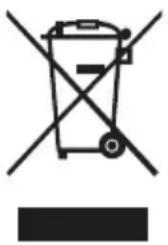
European directive 2012/19/EU on Waste from Electrical and Electronic Equipment (WEEE) requires that used household appliances are not thrown into the normal municipal waste stream.
Used appliances must be collected separately in order to optimize the rate of recovery and recycling of materials that compose them, and to reduce the impact on human health and on the environment.
The crossed bin symbol is affixed to all the products to remind you of the obligations of separated collection.
We decline liability for any damage or accident derived from any use of this product which is not in conformity with the instructions contained in this booklet.
About your product service : To contact our After-Sales Service, before going to BUT store, call 09 78 97 97 97
From Monday to Saturday from 8:00 a.m. to 8:00 p.m. (Price of a local call).
Period of availability of repair spare parts: 10 years
In accordance with Article L. 217 of the Consumer Code, your product has 2 year legal guarantee of conformity.


- USER MANUAL CC1005E
- TABLE OF CONTENTS
- IMPORTANT INSTALLATION
- CONTENTS
- THIS PRODUCT IS FOR HOUSEHOLD USE ONLY
- SAFETY AND WARNING INFORMATION
- DESCRIPTION OF THE PRODUCT
- ELECTRICAL SAFETY
- IMPORTANT
- HORIZONTAL MOUNTING
- BEFORE USE
- WAIT 5 MINUTES OR MORE BEFORE RE-STARTING
- TEMPERATURE ADJUSTMENT AND DESCRIPTION OF APPLIANCE
- DESCRIPTION OF APPLIANCE
- WARNING: THIS APPLIANCE MUST BE GROUNDED
- DAILY USE
- GENTLE REMINDER
- CAUTION
- INSTALLATION IMPORTANT
- EFFICIENT USE
- CHECKS
- DEFROSTING/FIRST USE AND INSTALLATION
- CLEANING
- TECHNICAL INFORMATION
- TROUBLESHOOTING
- DISPOSAL OF THE APPLIANCE
- DISPOSAL OF OLD ELECTRICAL APPLIANCES
Brand : AYA
Model : CC1005E
Category : Freezer