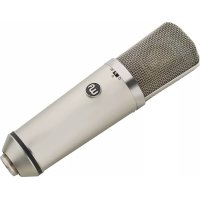
WA67 - Microphone Warm Audio - Free user manual and instructions
Find the device manual for free WA67 Warm Audio in PDF.



| Product Type | Tube Condenser Microphone |
| Capsule | Replica of vintage K67 capsule, large brass diaphragm with 6-micron gold-sputtered mylar membrane |
| Tube | EF86 Pentode |
| Transformer | Lundahl (Sweden), large core |
| Polar Patterns | Cardioid, omnidirectional, figure-eight |
| Frequency Response | 20 Hz - 20 kHz |
| Nominal Impedance | 200 ohms |
| Minimum Load Impedance | 1 kΩ |
| Equivalent Noise (A-weighted) | 17 dB-A |
| Signal-to-Noise Ratio (A-weighted) | 78 dB |
| Maximum SPL (0.5% THD) | 138 dB |
| High-Pass Filter | Switchable |
| Pad | -10 dB switchable |
| Power Supply | External power supply with 115 V / 230 V voltage selector |
| Microphone Cable | Gotham Audio GAC-7 7-pin cable |
| Audio Output | Male XLR 3-pin |
| Materials | Nickel-plated brass body and grille |
| Included Accessories | Wooden box, shock mount, microphone clip, power supply, 7-pin cable, IEC cable |
| Dimensions (approximate) | Approximately 200 mm long, 50 mm diameter (microphone only) |
| Weight (approximate) | Approximately 0.8 kg (microphone only) |
| Warranty | 2 years, parts and labor |
| Care and Cleaning | Clean the grille with a soft dry cloth; avoid moisture and dust; use a protective cover. |
| Safety | Use only the supplied power supply; check voltage before connection; do not expose to extreme temperatures. |
| Spare Parts and Repairability | Contact Warm Audio or an authorized dealer for repairs; tube and cable are replaceable with original parts. |
Frequently Asked Questions - WA67 Warm Audio
User questions about WA67 Warm Audio
0 question about this device. Answer the ones you know or ask your own.
Ask a new question about this device
Download the instructions for your Microphone in PDF format for free! Find your manual WA67 - Warm Audio and take your electronic device back in hand. On this page are published all the documents necessary for the use of your device. WA67 by Warm Audio.
USER MANUAL WA67 Warm Audio
Thank you for purchasing the Warm Audio WA-67 tube condenser microphone! It's an all vacuum tube, large diaphragm, transformer balanced, multi-pattern microphone, based on a classic design that has been used on countless hit records for the last 50+ years by artists as varied as The Beatles, Led Zeppelin, The Four Tops and Nirvana. The WA-67 was designed for professional applications and sounds great on vocals, acoustic/electric guitars, acoustic/electric bass, drums, piano, strings, brass/woodwind instruments, and an array of other sources.
The classic '67 microphone is still widely used today in top professional recording studios, but it hasn't been made in 50 years and has become extremely expensive to acquire on the used market. We are very excited to offer this amazing microphone at such an affordable price, and we're confident you will enjoy a lifetime of beautiful recordings with it. Enjoy your new WA-67!
Bryce Young and Team Warm
Austin, Texas USA
REGISTER YOUR WA-67!
Before we begin, please take the time to visit www.warmaudio.com to register your product. To ensure you receive proper and uninterrupted warranty support, please register your unit within 14 days from the time of purchase.
WARRANTY STATEMENT
Warm Audio warranties this product to be free from defect in materials and workmanship for one year from the date of purchase, for the original purchaser to whom this equipment is registered. This warranty is non-transferrable.
This warranty is void in the event of damage incurred from unauthorized service to this unit, or from electrical or mechanical modification. This warranty does not cover damage resulting from abuse, accidental damage, misuse, improper electrical conditions such as mis-wiring, incorrect voltage or frequency, unstable power, disconnection from earth ground (for products requiring a 3 pin, grounded power cable), or from exposure to hostile environmental conditions such as moisture, humidity, smoke, fire, sand or other debris, and extreme temperatures.
Warm Audio will, at its sole discretion, repair or replace this product in a timely manner. This limited warranty extends only to products determined to be defective and does not cover incidental costs such as equipment rental, loss of revenue, etc. Please visit us at www.warmaudio.com for more information on your warranty, or to request warranty service.
This warranty applies to products sold in the United States of America. For warranty information in any other country, please refer to your local Warm Audio distributor. This warranty provides specific legal rights, which may vary from state to state. Depending on the state in which you live, you may have rights in addition to those covered in this statement. Please refer to your state laws or see your local Warm Audio retailer for more information.
NON-WARRANTY SERVICE
If you have a defective unit that is outside of our warranty period or conditions fear not - we are still here for you and can get your unit working again for a modest service fee. Please visit us at www.warmaudio.com to contact us about setting up a repair or for more information.
With the proper care, your Warm Audio gear should last a lifetime and provide a lifetime of enjoyment. We believe the best advertisement we can have is a properly working unit being put to great use. Let's work together to make it happen!
IMPORTANT SAFETY INSTRUCTIONS.
- Read these instructions - All of the safety and operating instructions should be read before this product is operated.
- Keep these instructions - The safety and operating instructions should be retained for future reference.
- Heed all warnings - All warnings on the appliance and in the operating instructions should be adhered to.
- Follow all instructions - All operating and use instructions should be followed.
-
Do not use this apparatus near water - The appliance should not be used near water or moisture (for example, in a wet basement or near a swimming pool).
-
Clean only with dry cloth.
- Do not block any ventilation openings. Install in accordance with the manufacturer's instructions.
- Do not install near any heat sources such as radiators, heat registers, stoves, or other apparatus (including amplifiers) that produce heat.
- Do not defeat the safety purpose of the polarized or grounding plug. A polarized plug has two blades with one wider than the other. A grounding plug has two blades and a third grounding prong. The wide blade or the third prong is provided for your safety. If the provided plug does not fit into your outlet, consult an electrician for replacement of the obsolete outlet.
- Protect the power cord from being walked on or pinched particularly at the plugs, convenience receptacles, and at the point where they exit from the apparatus.
-
Only use attachments/accessories specified by the manufacturer.
-
Use only with the cart, stand, tripod, bracket, or table specified by the manufacturer, or sold with the apparatus. When a cart or rack is used, use caution when moving the cart/apparatus combination to avoid injury from tip-over.
- Unplug the apparatus during lightning storms or when unused for long periods of time.
- Refer all servicing to qualified personnel. Servicing is required when the apparatus has been damaged in any way, such as when a power supply cord or plug is damaged, liquid has been spilled or objects have fallen into the apparatus, it has been exposed to rain or moisture, does not operate normally or has been dropped.
- CAUTION: These servicing instructions are for use by qualified service personnel only. To reduce the risk of electric shock, do not perform any servicing other than that contained in the operating instructions unless you are qualified to do so.
LET'S GET STARTED
The classic '67 became extremely popular as a vocal microphone in the 1960's and early seventies, famous for its chewy character and distinctive midrange. Based around an EF86 pentode tube and having the same smooth and creamy tone of the original, the WA-67 excels at recording just about anything that you put it in front of, and it may immediately become your go-to choice for vocals, guitars, drum toms and overheads, pianos, brass and strings.
At Warm, we're passionate about killer equipment and we take our responsibility to our customers very seriously. That means that we don't make "look-alike" gear that doesn't deliver, and we take considerable time and effort to get as close as possible to both the heart and the soul of an original design. We went to great lengths to recreate the discrete circuit of the original microphone, using boutique components throughout to ensure that nothing got in the way of pure tube magic. The sound and vibe of the original '67 is recreated in our WA-67, and we take great pride in being able to make such a high-quality microphone available to everyone at an unheard-of price.
A LOOK INSIDE THE WA-67
THE CAPSULE
The WA-67 utilizes a custom re-production of the vintage '67-style (K67) capsule that was used in the classic microphone - complete with the same hole pattern and frequency response. We even went the extra mile to ensure that our capsule adheres precisely to the vintage specs, evidenced by the fact that the assembly is made entirely out of brass, including the tensioning hoops. The capsule is one of the most important pieces of the classic '67 formula, and we're ecstatic at how it turned out.
THE TUBE
The EF86 vacuum tube is well known in the audio industry for having characteristics that are seriously flattering to audio sources - in fact there are a number of boutique manufacturers that use it in their ultra-expensive microphones and preamps. The tube has a unique character that is both vibey and hyper-accurate at the same time, and even though that sounds a bit odd to say, you'll understand when you hear it. Offering a microphone of this quality, based around an EF86 tube - at this price - is unheard of in our industry, and we couldn't be happier to make it available to recordists everywhere!
THE TRANSFORMER
The WA-67 utilizes a custom large-core transformer made by Lundahl in Sweden, a company well-known for making killer transformers for some of the top names in audio. The transformer is another component that is critical to the sound and performance of the WA-67, and it helps provide the creamy smooth high frequency response and girth that this mic will undoubtedly become famous for.
THE CABLE
The quality of the 7-pin cable that connects a tube mic to its power supply is also of paramount importance - it carries both audio and voltage for the tube on different pins, which means that it plays an integral role in the performance of the microphone. That's why we've partnered with high-end manufacturer Gotham Audio of Switzerland to use their high-end GAC-7 cable with the WA-67. This special cable adds the finishing touch to the WA-67 system, and is integral to the sound and performance of the microphone.
THE CAPACITORS
The WA-67 proudly uses high-bandwidth polystyrene capacitors, as well as boutique capacitors from Wima throughout, and an imported Solen French capacitor on its output.
FEATURES
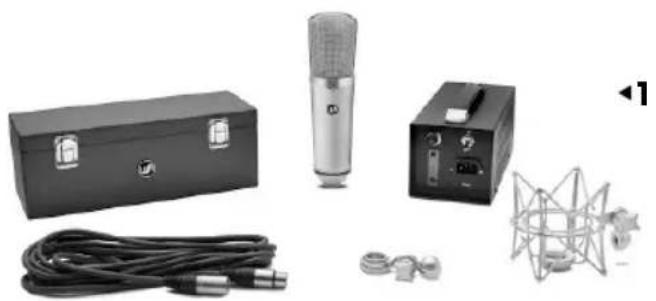
1. CONTENTS
Your WA-67 package includes the WA-67 microphone, power supply, IEC power cable, shockmount, 7-pin Gotham Audio cable and a wood storage box.
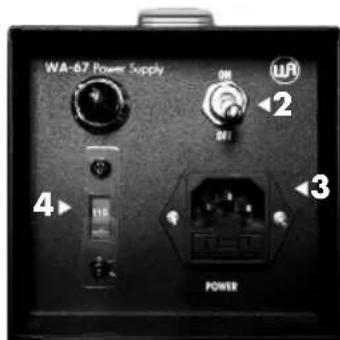
2. POWER SWITCH
The power switch is located on the power supply.
3. IEC POWER INLET
The IEC power inlet is located on the rear side of the power supply and allows for connecting the standard IEC cable to a wall socket.
4.115V/230V VOLTAGE SELECTOR SWITCH
A voltage selector switch is located near the IEC inlet on the power supply and allows the user to set the appropriate voltage for the country in which they are operating the microphone. Please be careful with this switch, as connecting the unit to power with the wrong
voltage setting will likely damage the WA-67 and its power supply, or even cause injury or death. Typically the voltage selector switch will be pre-set to the proper voltage of the country where the product was purchased and should not be changed.
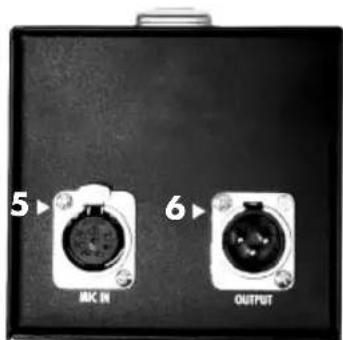
5.7-PIN MICROPHONE CABLE CONNECTOR (FEMALE)
A 7-pin female microphone cable connector is located on the power supply, and this cable carries both the voltage going to the microphone and the audio signals coming back from the capsule. Connect the appropriate end of the included 7-pin Gotham cable to this connector, and connect the other end to the connector on the WA-67 itself.
6. XLR OUTPUT
A standard 3-pin XLR male connector is located on the power supply. The signal from the WA-67 will exit via this connector, so it should be connected to a preamp's input via a standard 3-pin XLR cable.
TECHNICAL SPECIFICATIONS
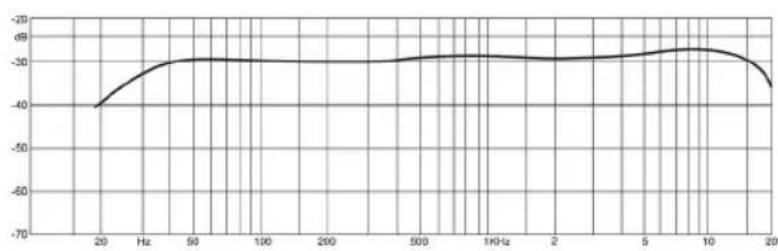
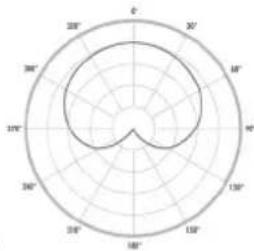
Cardioid at 1kHz
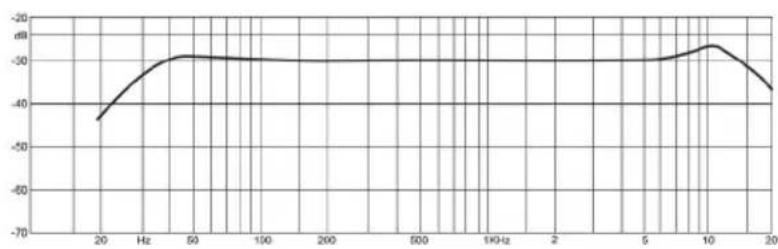
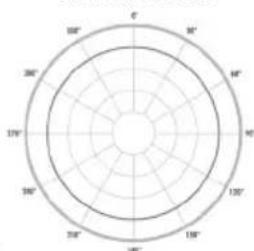
Omni at 1kHz
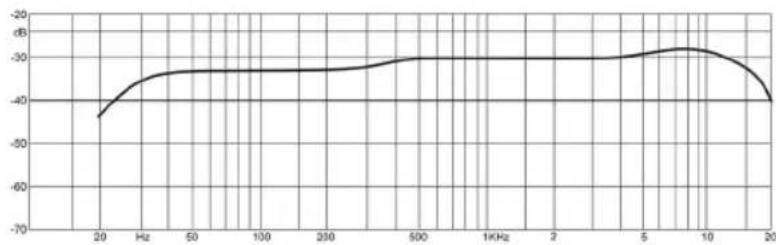
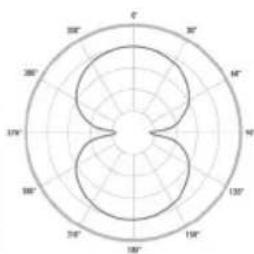
Figure - 8 at 1kHz
Large diaphragm studio condenser microphone
- Faithful re-creation of the classic 67-style pentode tube circuit
EF86 pentode tube for creamy smooth clarity and brilliance
- Custom large-core transformer from Lundahl, Sweden
- Custom all-brass large K67-style vintage capsule re-creation
Gold-sputtered Mylar diaphragm, 6 microns thick
High-bandwidth polystyrene capacitors
- Boutique capacitors from Wima and Solen
Nickel-plated brass microphone body and headbasket for ultimate acoustic performance
- Premium 7-pin tube cable from Gotham Switzerland
- Polar Patterns: Cardioid, Omni, Figure-of-Eight
- Switchable hi-pass filter
- Switchable -10 db pad
Frequency response: 20Hz - 20kHz - Rated impedance: 200 ohms
- Rated load impedance: 1 kilohms
- Equivalent noise level (A-weighted): 17 dB-A
Maximum SPL for THD 0.5% : 138 dB - Signal to noise ratio (A-weighted): 78 dB
- Microphone includes: wood box, shockmount, hardmount, power supply, 7-pin mic cable
TIPS AND INSTRUCTIONS
GENERAL USES IN CARDIOID MODE
The classic '67-style microphone quickly became known for capturing amazing nuance in vocal performances, where it shines at adding importance and weight. Using two '67-style microphones for drum overhead recording (either in an X-Y configuration or as a spaced pair) was also a popular choice. Likewise, a pair of '67-style microphones in an X-Y configuration is a great way to achieve a big acoustic guitar sound that has a ton of body, and a single '67-style microphone can be great for capturing guitar amps, whether it be used alone or in conjunction with additional dynamic or ribbon microphones. In the last thirty years 'close mic'ing' a sound source has become the norm in most genres outside of classical music, as it can provide greater flexibility at the mix stage due to its lack of ambience, and this has made cardioid pattern-only recording a fairly common practice.
USES IN OMNIDIRECTIONAL MODE
The omnidirectional pattern is most often associated with a recording scenario where you want to capture the sound of the space you're recording in. Whether it be a room mic on a drum kit, an ambient mic placed farther out from a guitar or bass cabinet, or a group of instruments playing at once, omnidirectional recording can give tracks space and air in a mix (if the room sounds nice). On another note, omnidirectional patterns tend to yield the most linear frequency response and suffer the least from proximity effect.
USES IN FIGURE-OF-EIGHT MODE
Figure-of-eight patterns are more flexible than they may seem at first, to the uninitiated. This pattern can be used with pairs of the same microphone for advanced recording techniques like a Blumlein Pair, or in a mid-side arrangement in conjunction with another cardioid mic; but it has several applications that only require a single microphone, which makes them somewhat more practical. An example of a single figure-of-eight application would be to record a 'duet' or group vocal with a single microphone, where two or more vocalists can stand on either side of the mic.
There are two additional aspects of the behavior of this pattern that are important to know as well: the first is that the mic is nearly deaf at the sides of the capsule when set to Figure-of-eight, and the second is that the back side is out of phase with the front. This means that you can use both of these attributes to "hide" sounds that you don't want to bleed into the main performances. Either position the mic so that the troubling sounds are on the sides of the capsule, or point the out-of-phase side at them, be they another vocalist, an instrument or an ugly-sounding corner of the room.
TIPS AND INSTRUCTIONS
MICROPHONE PLACEMENT & SPACING
When it comes to choosing the distance to position a microphone from its sound source, one may think of this process as choosing a desired ratio of dry original sound source to reflections and acoustic space. The closer the mic is to the source, the less space and ambience will be captured. In some cases this is fully desirable; as ambience is often added later at mixdown in modern production workflows. In other cases, natural acoustics are critical to getting a realistic or expected result. A great illustration of this is the recording of a gunshot or cannon fire: at very close range, the sound is surprisingly thin; but at a distance the sound becomes more full and explosive. This is a great reference to keep in mind; as this phenomenon holds true with anywhere natural acoustics are an important part of the sound of the instrument you're recording, most notably with percussion.
A BRIEF WORD ON ROOM TREATMENT
Room acoustics can be just as important as the microphone you choose when recording, as even the best microphone on the planet won't sound great in a poorly-treated room: unwanted reflections can smear or add comb-filtering to the sound you're recording, turning a great take into something that's unusable in the final mix. Though a proper walk-in vocal booth is hardly necessary for most situations, a good quality 'vocal shield' type of product can make the difference between demo quality and professional quality recordings when tracking vocals. Likewise, when recording combo amps and other instruments using gobos or other acoustic isolation products can be hugely beneficial - correcting excessive amounts of room ambience is nearly impossible to do in the best scenarios, and that's why it is hyper-important to take the time to set your recording scenario up properly the first time.
TIPS AND INSTRUCTIONS
SIGNAL INTEGRITY
When recording vocals, it's usually a good idea to use the nicest pop filter you can find. This not only protects the microphone from moisture and spittle; it also protects the recorded tracks by keeping plosives (a sound that occurs when the capsule is hit with a sudden burst of air and overloads, commonly seen when singing words that begin with "p" or a similar consonant) to a minimum. Pop filters can also be creatively used in other situations where sudden air pressure changes can occur, including large loudspeaker movement, plugging in a guitar when the amp is already turned on, the sound hole of a kick drum or even the gap between the two brass pieces of a hi-hat cymbal.
Microphone placement is as much an art as it is a science, and takes a great deal of patience, attentive listening, and trial and error to get it right. The more music you record, the more you'll gain instinct for knowing which microphones to try first for given situations, and how to place them. One thing to keep in mind is that what a microphone placed close to a source hears will be radically different from what a casual observer hears when standing several feet back. It's good practice to get down and put your ear close to a speaker cabinet or right in front of a bass drum's resonator head (but be careful not to hurt your ears on loud sources!), to hear what a microphone would hear if it were put in the same place. Notice how a small change in position can make a huge difference in the character of what is being recorded, and experiment with mic positions until the sound you're hearing in the control room is the sound that you want to hear.
ILLUSTRATIONS
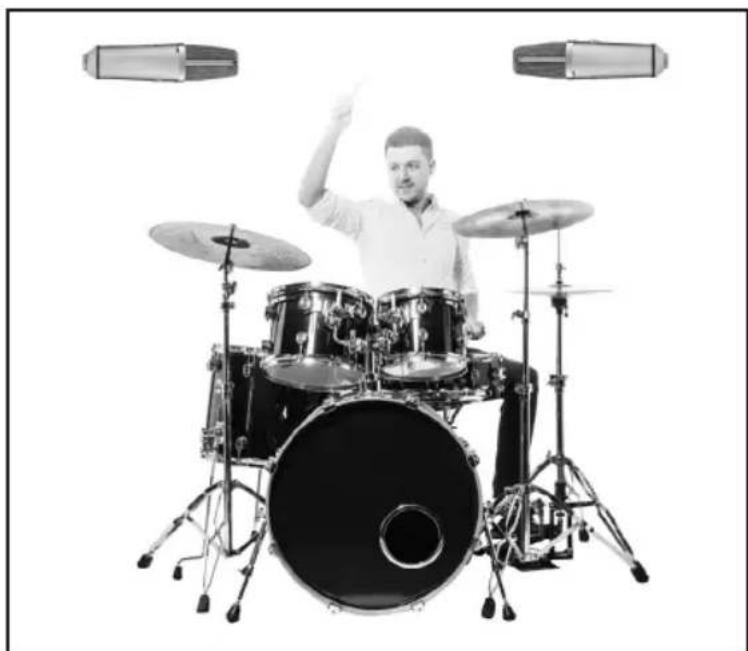
In this diagram, two WA-67's are used in a spaced pair configuration to record stereo drum overheads.
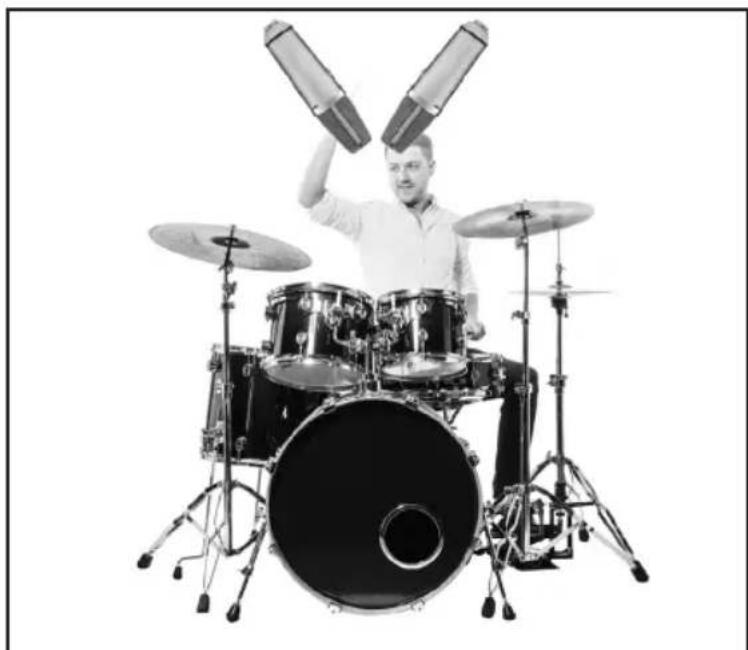
In this diagram, two WA-67's are used in a coincident pair, also known as an XY configuration, to record stereo drum overheads.
ILLUSTRATIONS

In this image, aologist performs into the WA-67 at a distance of 12 in cardioid pattern.
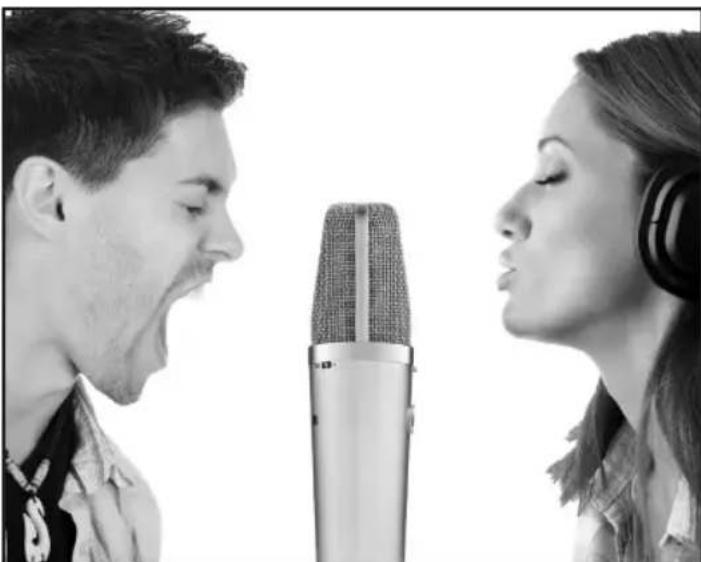
In this image, two vocalists perform at the same time on either side of the WA-67 using a figure-of-eight pattern.
FRANÇAIS
© 2020 Warm Audio ™ LLC.


- REGISTER YOUR WA-67!
- WARRANTY STATEMENT
- NON-WARRANTY SERVICE
- IMPORTANT SAFETY INSTRUCTIONS.
- LET'S GET STARTED
- A LOOK INSIDE THE WA-67
- THE CAPSULE
- THE TUBE
- THE TRANSFORMER
- THE CABLE
- THE CAPACITORS
- FEATURES
- CONTENTS
- POWER SWITCH
- IEC POWER INLET
- 4.115V/230V VOLTAGE SELECTOR SWITCH
- 5.7-PIN MICROPHONE CABLE CONNECTOR (FEMALE)
- XLR OUTPUT
- TECHNICAL SPECIFICATIONS
- TIPS AND INSTRUCTIONS
- GENERAL USES IN CARDIOID MODE
- USES IN OMNIDIRECTIONAL MODE
- USES IN FIGURE-OF-EIGHT MODE
- MICROPHONE PLACEMENT & SPACING
- A BRIEF WORD ON ROOM TREATMENT
- SIGNAL INTEGRITY
- ILLUSTRATIONS
- FRANÇAIS
Brand : Warm Audio
Model : WA67
Category : Microphone