R3031 - Saw RIDGID - Free user manual and instructions
Find the device manual for free R3031 RIDGID in PDF.



| Product Type | Reciprocating Saw |
| Brand | RIDGID |
| Model | R3031 |
| Power Supply | 120 V, 60 Hz, 6 A (AC only) |
| No-Load Speed | 0-3,500 r/min |
| Stroke Length | 12.7 mm (1/2 in) |
| Net Weight | 2.0 kg (4.4 lb) |
| Orbital Action Selector | Yes (linear or orbital) |
| LED Work Light | Yes, integrated |
| Tool-Free Blade Change | Yes, tool-less locking |
| Double Insulation | Yes (Class II) |
| Power Cord | With polarized plug, length not specified |
| Box Contents | Saw, blade, carrying bag, user manual |
| Applications | Wood, metal, plastic, drywall, masonite |
Frequently Asked Questions - R3031 RIDGID
User questions about R3031 RIDGID
0 question about this device. Answer the ones you know or ask your own.
Ask a new question about this device
Download the instructions for your Saw in PDF format for free! Find your manual R3031 - RIDGID and take your electronic device back in hand. On this page are published all the documents necessary for the use of your device. R3031 by RIDGID.
USER MANUAL R3031 RIDGID
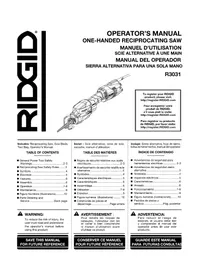
OPERATOR'S MANUAL
ONE-HANDED RECIPROCATING SAW
MANUEL D'UTILISATION
SCIE ALTERNATIVE À UNE MAIN
MANUAL DEL OPERADOR
SIERRA ALTERNATIVA PARA UNA SOLA MANO
R3031
To register your RIDGID
product, please visit:
http://register.RIDGID.com
Includes: Reciprocating Saw, Saw Blade, Tool Bag, Operator's Manual
TABLE OF CONTENTS
**********************************************************************
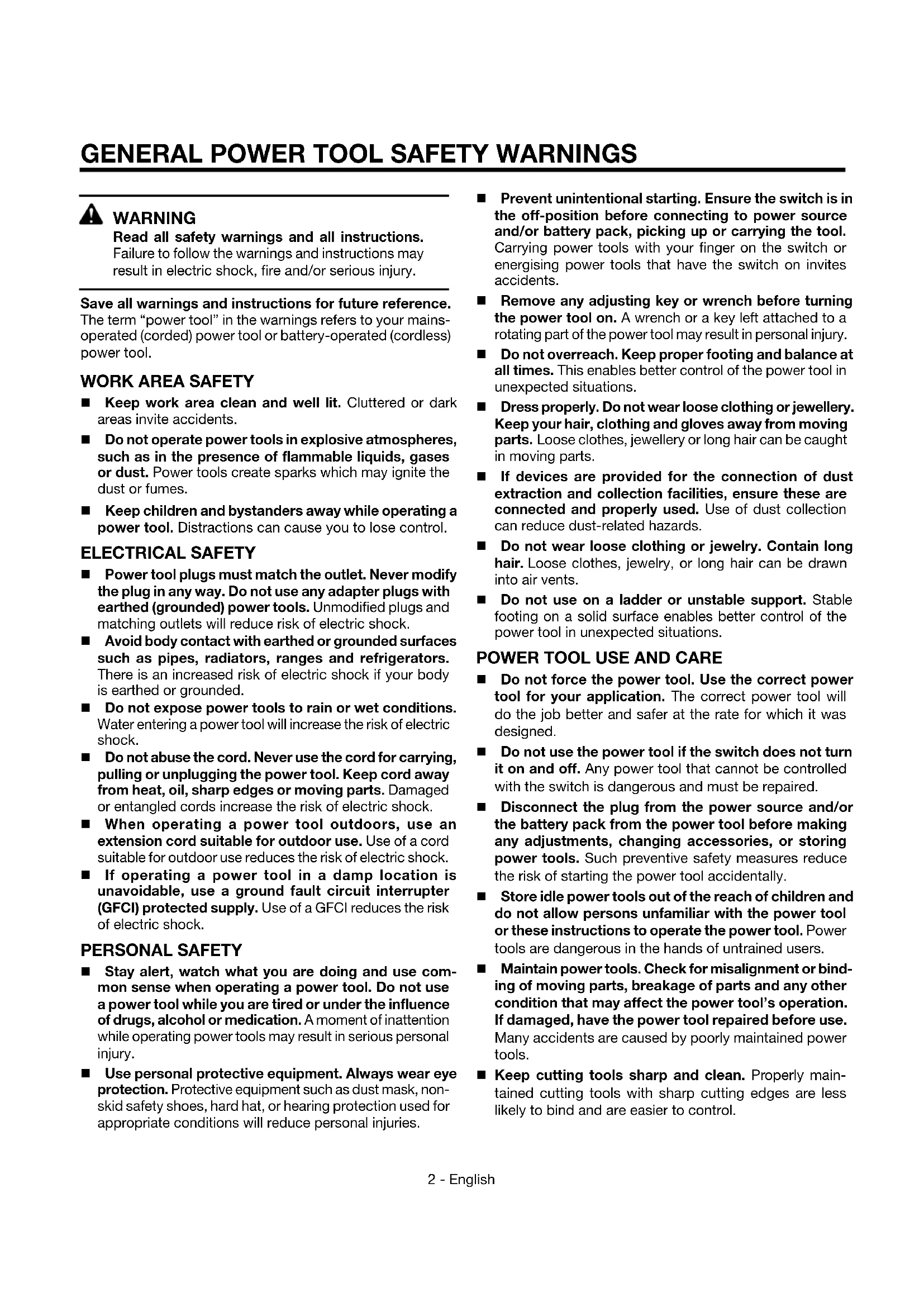
■ General Power Tool Safety Warnings....2-3
■ Reciprocating Saw Safety Rules......3
■ Symbols....4
■ Electrical....5
■ Features......6
■ Assembly......6
■ Operation....7-8
■ Maintenance....9
■ Figure Numbers (Illustrations)......10
■ Parts Ordering and Service....Back page

WARNING:
To reduce the risk of injury, the user must read and understand the operator's manual before using this product.
SAVE THIS MANUAL FOR FUTURE REFERENCE
Read all safety warnings and all instructions.
Failure to follow the warnings and instructions may result in electric shock, fire and/or serious injury.
Save all warnings and instructions for future reference. The term “power tool” in the warnings refers to your mains-operated (corded) power tool or battery-operated (cordless) power tool.
WORK AREA SAFETY
- Keep work area clean and well lit. Cluttered or dark areas invite accidents.
■ Do not operate power tools in explosive atmospheres, such as in the presence of flammable liquids, gases or dust. Power tools create sparks which may ignite the dust or fumes. - Keep children and bystanders away while operating a power tool. Distractions can cause you to lose control.
ELECTRICAL SAFETY
■ Power tool plugs must match the outlet. Never modify the plug in any way. Do not use any adapter plugs with earthed (grounded) power tools. Unmodified plugs and matching outlets will reduce risk of electric shock.
■ Avoid body contact with earthed or grounded surfaces such as pipes, radiators, ranges and refrigerators. There is an increased risk of electric shock if your body is earthed or grounded.
■ Do not expose power tools to rain or wet conditions. Water entering a power tool will increase the risk of electric shock.
- Do not abuse the cord. Never use the cord for carrying, pulling or unplugging the power tool. Keep cord away from heat, oil, sharp edges or moving parts. Damaged or entangled cords increase the risk of electric shock.
■ When operating a power tool outdoors, use an extension cord suitable for outdoor use. Use of a cord suitable for outdoor use reduces the risk of electric shock.
If operating a power tool in a damp location is unavoidable, use a ground fault circuit interrupter (GFCI) protected supply. Use of a GFCI reduces the risk of electric shock.
PERSONAL SAFETY
■ Stay alert, watch what you are doing and use common sense when operating a power tool. Do not use a power tool while you are tired or under the influence of drugs, alcohol or medication. A moment of inattention while operating power tools may result in serious personal injury.
■ Use personal protective equipment. Always wear eye protection. Protective equipment such as dust mask, non-skid safety shoes, hard hat, or hearing protection used for appropriate conditions will reduce personal injuries.
■ Prevent unintentional starting. Ensure the switch is in the off-position before connecting to power source and/or battery pack, picking up or carrying the tool. Carrying power tools with your finger on the switch or energising power tools that have the switch on invites accidents.
■ Remove any adjusting key or wrench before turning the power tool on. A wrench or a key left attached to a rotating part of the power tool may result in personal injury.
■ Do not overreach. Keep proper footing and balance at all times. This enables better control of the power tool in unexpected situations.
■ Dress properly. Do not wear loose clothing or jewellery. Keep your hair, clothing and gloves away from moving parts. Loose clothes, jewellery or long hair can be caught in moving parts.
If devices are provided for the connection of dust extraction and collection facilities, ensure these are connected and properly used. Use of dust collection can reduce dust-related hazards.
■ Do not wear loose clothing or jewelry. Contain long hair. Loose clothes, jewelry, or long hair can be drawn into air vents.
■ Do not use on a ladder or unstable support. Stable footing on a solid surface enables better control of the power tool in unexpected situations.
POWER TOOL USE AND CARE
■ Do not force the power tool. Use the correct power tool for your application. The correct power tool will do the job better and safer at the rate for which it was designed.
■ Do not use the power tool if the switch does not turn it on and off. Any power tool that cannot be controlled with the switch is dangerous and must be repaired.
■ Disconnect the plug from the power source and/or the battery pack from the power tool before making any adjustments, changing accessories, or storing power tools. Such preventive safety measures reduce the risk of starting the power tool accidentally.
■ Store idle power tools out of the reach of children and do not allow persons unfamiliar with the power tool or these instructions to operate the power tool. Power tools are dangerous in the hands of untrained users.
- Maintain power tools. Check for misalignment or binding of moving parts, breakage of parts and any other condition that may affect the power tool's operation. If damaged, have the power tool repaired before use. Many accidents are caused by poorly maintained power tools.
- Keep cutting tools sharp and clean. Properly maintained cutting tools with sharp cutting edges are less likely to bind and are easier to control.
■ Use the power tool, accessories and tool bits etc. in accordance with these instructions, taking into account the working conditions and the work to be performed. Use of the power tool for operations different from those intended could result in a hazardous situation.
SERVICE
■ Have your power tool serviced by a qualified repair person using only identical replacement parts. This will ensure that the safety of the power tool is maintained.
■ When servicing a power tool, use only identical replacement parts. Follow instructions in the Maintenance section of this manual. Use of unauthorized parts or failure to follow Maintenance instructions may create a risk of shock or injury.
RECIPROCATING SAW SAFETY WARNINGS
- Hold power tool by insulated gripping surfaces, when performing an operation where the cutting accessory may contact hidden wiring or its own cord. Cutting accessory contacting a “live” wire may make exposed metal parts of the power tool “live” and could give the operator an electric shock.
■ Use clamps or another practical way to secure and support the workpiece to a stable platform. Holding the work by hand or against your body leaves it unstable and may lead to loss of control. -
Know your power tool. Read operator's manual carefully. Learn its applications and limitations, as well as the specific potential hazards related to this tool. Following this rule will reduce the risk of electric shock, fire, or serious injury.
■ Always wear eye protection with side shields marked to comply with ANSI Z87.1. Following this rule will reduce the risk of serious personal injury.
■ Protect your lungs. Wear a face or dust mask if the operation is dusty. Following this rule will reduce the risk of serious personal injury.
■ Protect your hearing. Wear hearing protection during extended periods of operation. Following this rule will reduce the risk of serious personal injury.
■ Inspect tool cords periodically and, if damaged, have repaired at your nearest authorized service center. Constantly stay aware of cord location. Following this rule will reduce the risk of electric shock or fire. -
Check damaged parts. Before further use of the tool, a guard or other part that is damaged should be carefully checked to determine that it will operate properly and perform its intended function. Check for alignment of moving parts, binding of moving parts, breakage of parts, mounting, and any other conditions that may affect its operation. A guard or other part that is damaged should be properly repaired or replaced by an authorized service center. Following this rule will reduce the risk of shock, fire, or serious injury.
■ Make sure your extension cord is in good condition. When using an extension cord, be sure to use one heavy enough to carry the current your product will draw. A wire gauge size (A.W.G.) of at least 14 is recommended for an extension cord 50 feet or less in length. A cord exceeding 100 feet is not recommended. If in doubt, use the next heavier gauge. The smaller the gauge number, the heavier the cord. An undersized cord will cause a drop in line voltage resulting in loss of power and overheating.
■ Inspect for and remove all nails from lumber before using this tool. Following this rule will reduce the risk of serious personal injury.
If the power supply cord is damaged, it must be replaced only by the manufacturer or by an authorized service center to avoid risk.
■ Save these instructions. Refer to them frequently and use them to instruct others who may use this product. If you loan someone this product, loan them these instructions also.
| The following signal words and meanings are intended to explain the levels of risk associated with this product. | ||
| SYMBOL | SIGNAL | MEANING |
 | DANGER: | Indicates an imminently hazardous situation, which, if not avoided, will result in death or serious injury. |
 | WARNING: | Indicates a potentially hazardous situation, which, if not avoided, could result in death or serious injury. |
 | CAUTION: | Indicates a potentially hazardous situation, which, if not avoided, may result in minor or moderate injury. |
| NOTICE: | (Without Safety Alert Symbol) Indicates important information not related to an injury hazard, such as a situation that may result in property damage. | |
| Some of the following symbols may be used on this product. Please study them and learn their meaning. Proper interpretation of these symbols will allow you to operate the product better and safer. SYMBOL NAME DESIGNATION/EXPLANATION | ||
 | Safety Alert Indicates a potential personal injury hazard. | |
 | Read Operator's Manual | To reduce the risk of injury, user must read and understand operator's manual before using this product. |
 | Eye Protection | Always wear eye protection with side shields marked to comply with ANSI Z87.1. |
 | Wet Conditions Alert Do not expose to rain or use in damp locations. | |
 | No Hands Symbol | Failure to keep your hands away from the blade will result in serious personal injury. |
| V | Volts Voltage | |
| A Amperes Current | ||
| Hz Hertz Frequency (cycles per second) | ||
| min | Minutes Time | |
| ~ | Alternating Current Type of current | |
| no | No Load Speed Rotational speed, at no load | |
| ☐ | Class II Tool Double-insulated construction | |
| .../min | Per Minute | Revolutions, strokes, surface speed, orbits etc., per minute |
DOUBLE INSULATION
Double insulation is a concept in safety in electric power tools, which eliminates the need for the usual three-wire grounded power cord. All exposed metal parts are isolated from the internal metal motor components with protecting insulation. Double insulated tools do not need to be grounded.

WARNING:
The double insulated system is intended to protect the user from shock resulting from a break in the tool's internal wiring. Observe all normal safety precautions to avoid electrical shock.
NOTE: Servicing of a product with double insulation requires extreme care and knowledge of the system and should be performed only by a qualified service technician. For service, we suggest you return the tool to your nearest authorized service center for repair. Always use original factory replacement parts when servicing.
ELECTRICAL CONNECTION
This tool has a precision-built electric motor. It should be connected to a power supply that is 120 volts, AC only (normal household current), 60 Hz. Do not operate this tool on direct current (DC). A substantial voltage drop will cause a loss of power and the motor will overheat. If the tool does not operate when plugged into an outlet, double-check the power supply.
EXTENSION CORDS
When using a power tool at a considerable distance from a power source, be sure to use an extension cord that has the capacity to handle the current the product will draw. An undersized cord will cause a drop in line voltage, resulting in overheating and loss of power. Use the chart to determine the minimum wire size required in an extension cord. Only round jacketed cords listed by Underwriter's Laboratories (UL) should be used.
When working outdoors with a product, use an extension cord that is designed for outside use. This type of cord is designated with "W-A" or "W" on the cord's jacket.
Before using any extension cord, inspect it for loose or exposed wires and cut or worn insulation.
**Ampere rating (on product data plate) 0-2.0 2.1-3.4 3.5-5.0 5.1-7.0 7.1-12.0 12.1-16.0
| Cord Length | Wire Size (A.W.G.) | |||||
| 25' | 16 | 16 | 16 | 16 | 14 | 14 |
| 50' | 16 | 16 | 16 | 14 | 14 | 12 |
| 100' | 16 | 16 | 14 | 12 | 10 | — |
**Used on 12 gauge - 20 amp circuit.
NOTE: AWG = American Wire Gauge

WARNING:
Keep the extension cord clear of the working area. Position the cord so that it will not get caught on lumber, tools, or other obstructions while you are working with a power tool. Failure to do so can result in serious personal injury.

WARNING:
Check extension cords before each use. If damaged replace immediately. Never use tool with a damaged cord since touching the damaged area could cause electrical shock resulting in serious injury.
PRODUCT SPECIFICATIONS
Switch......Variable Speed
Stroke Length....1/2 in.
No Load Speed 0-3,500 r/min. (RPM)
KNOW YOUR RECIPROCATING SAW
See Figure 1, page 10.
The safe use of this product requires an understanding of the information on the product and in this operator's manual as well as a knowledge of the project you are attempting. Before use of this product, familiarize yourself with all operating features and safety rules.
BARREL-STYLE GRIP
The barrel-style grip of this saw is designed for one-handed use only.
LED LIGHTS
The saw has built-in LED worklights that illuminate when the switch trigger is depressed. This feature is convenient when working in close or tight areas where additional light is needed.
Input 120 V, AC only, 60 Hz, 6 Amps
Net Weight....4.4 lbs.
ORBITAL ACTION SELECTOR
Use the orbital action selector to select either a linear stroke or orbital cutting action. A linear stroke is best for making smooth cuts or when cutting metal while orbital action is best for making a faster cut in wood.
Your saw has a blade clamp design that does not require the use of a tool (blade wrench) when installing or removing the blade.
VARIABLE SPEED SWITCH TRIGGER
The variable speed switch delivers higher speed with increased trigger pressure and lower speed with decreased trigger pressure.
ASSEMBLY
UNPACKING
This product has been shipped completely assembled.
- Carefully remove the product and any accessories from the box. Make sure that all items listed in the packing list are included.

WARNING:
Do not use this product if it is not completely assembled or if any parts appear to be missing or damaged. Use of a product that is not properly and completely assembled could result in serious personal injury.
■ Inspect the product carefully to make sure no breakage or damage occurred during shipping.
■ Do not discard the packing material until you have carefully inspected and satisfactorily operated the product.
■ If any parts are damaged or missing, please call 1-866-539-1710 for assistance.

WARNING:
Do not attempt to modify this product or create accessories not recommended for use with this product. Any such alteration or modification is misuse and could result in a hazardous condition leading to possible serious personal injury.

WARNING:
Do not connect to power supply until assembly is complete. Failure to comply could result in accidental starting and possible serious personal injury.

WARNING:
Do not allow familiarity with this product to make you careless. Remember that a careless fraction of a second is sufficient to inflict serious injury.

WARNING:
Always wear eye protection with side shields marked to comply with ANSI Z87.1. Failure to do so could result in objects being thrown into your eyes resulting in possible serious injury.

WARNING:
Do not use any attachments or accessories not recommended by the manufacturer of this product. The use of attachments or accessories not recommended can result in serious personal injury.
APPLICATIONS
You may use this product for the purposes listed below:
■ Cutting all types of wood products (lumber, plywood, paneling, composition board, and hard wood)
■ Cutting masonite and plastic
■ Cutting drywall
■ Cutting metals such as sheet steel, pipe, steel rods, aluminum, brass, and copper
SELECTING BLADES
Selecting the correct type of blade is important in order to obtain the best performance from the saw. Select the blade based on the application and on the material you wish to cut. Selecting the right blade will give you a smoother, faster cut and prolong the life of the blade.
Blades with fewer teeth, 10 teeth per inch (TPI) are typically used for cutting wood, while blades with more teeth are better for cutting metal or plastic. We recommend 14 TPI for plastics and soft metals and 18 TPI for hard metals.

WARNING:
This saw should not be used for pruning or with a pruning blade. Failure to heed this warning could cause loss of control and can result in possible serious injury.
INSTALLING/REMOVING BLADE
See Figure 2, page 10.
■ Unplug the saw.
■ Rotate the blade clamp counterclockwise and hold to open.
■ Insert saw blade until it is fully seated.
NOTE: Blade can be installed with teeth facing either up or down.
■ Release the blade clamp to secure.
■ To remove the blade, rotate the blade clamp counterclockwise.
■ To turn the saw on: Depress the switch trigger.
■ To turn the saw off: Release the switch trigger.
VARIABLE SPEED
See Figure 3, page 10.
The variable speed switch trigger delivers higher speed with increased trigger pressure and lower speed with decreased trigger pressure.

WARNING:
Cutting into electrical wiring in walls can cause metal surfaces of the saw to become electrically live. Do not touch metal parts when cutting into a wall; grasp only the insulated gripping surfaces provided on the tool. Make sure hidden electrical wiring, water pipes, and mechanical hazards are not in the blade path when cutting into a wall.
ORBITAL ACTION SELECTOR
See Figure 4, page 10.
Use the orbital action selector to select either a linear stroke or orbital cutting action.
NOTE: Do not use the orbital action setting when using a metal cutting blade.
■ For linear cutting, turn the selector to the "OFF" position.
■ For orbital cutting action, turn the selector to the "ON" position.
NOTE: To prevent damage to the tool, always allow motor to come to a complete stop before using the orbital action selector.
OPERATING THE SAW
See Figures 5 - 6, page 10.
- Secure the workpiece to a work bench or table with a vise or with clamps.
■ Mark the line of cut clearly.
■ Make sure the saw blade is clear of any foreign material and that the power cord and extension cord are out of the blade path.
■ Hold the saw firmly in front of and clearly away from you.
NOTE: The barrel-style grip of this saw is designed for one-handed use only. Keep your other hand away from the saw and the cutting area of the workpiece.
■ Depress the switch trigger to start the cutting action.
■ Set the shoe assembly against the workpiece.
■ Move the blade into the workpiece.
NOTE: Do not force. Use only enough pressure to keep the saw cutting. Let the blade and saw do the work. Keep pressure on the base, against the workpiece.
PLUNGE CUTTING WOOD OR WALL BOARD
See Figure 7, page 10.
- Secure the workpiece to a work bench or table with a vise or with clamps.
■ Mark the line of cut clearly.
■ Make sure the saw blade is clear of any foreign material and that the power cord and extension cord are out of the blade path.
■ Hold the saw firmly in front of and clearly away from you. - Choose a convenient starting point inside the cutting area and place the tip of the blade over that point.
■ Rest the front edge of the shoe assembly on the workpiece and hold it firmly in position during the cut.
■ Depress the switch trigger and allow the saw blade to reach full cutting speed.

WARNING:
Make sure the blade does not touch the workpiece until the motor reaches full speed. Failure to heed this warning can cause you to lose control of the saw and result in serious injury.
■ Tilt the saw downward until the tip of the blade starts cutting the workpiece.
■ Allow the saw to penetrate the workpiece.
■ Tilt the saw until the blade is perpendicular to the workpiece.

WARNING:
Blades longer than 6 in. can whip and should not be used for plunge cutting. Failure to heed this warning can result in serious personal injury.

WARNING:
Cutting into electrical wiring can cause the blade, the blade clamp, and the saw bar assembly to become electrically live. Do not touch metal parts when cutting into a wall; grasp only the insulated surfaces on the tool. Make sure hidden electrical wiring, water pipes, and mechanical hazards are not in the blade path when cutting into a wall.
METAL CUTTING
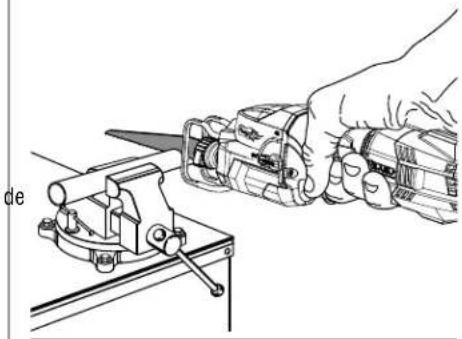
See Figure 8, page 10.
You may cut metals such as sheet steel, pipe, steel rods, aluminum, brass, and copper with the saw.
Observe the following tips when metal cutting:
■ Be careful not to twist or bend the saw blade.
■ Do not force the tool and use a slow speed setting.
■ Use cutting oil when cutting soft metals and steel. Cutting oil also keeps the blades cool, increases cutting action, and prolongs blade life.
■ Never use gasoline since normal sparking of motor could ignite fumes.
- Clamp the workpiece firmly and cut close to the clamping point to eliminate any vibration of the work. When cutting conduit pipe or angle iron, clamp the workpiece in a vise if possible and cut close to the vise. To cut thin sheet material, “sandwich” the material between hardboard or plywood and clamp the layers to eliminate vibration and material tearing.
■ Always keep firm pressure on the shoe assembly to hold it securely against the workpiece.
NOTE: FIGURES (ILLUSTRATIONS) START ON PAGE 10 AFTER FRENCH AND SPANISH LANGUAGE SECTIONS.

WARNING:
When servicing use only identical replacement parts. Use of any other parts can create a hazard or cause product damage.

WARNING:
Always wear eye protection with side shields marked to comply with ANSI Z87.1 during product operation. If operation is dusty, also wear a dust mask.
GENERAL MAINTENANCE
Avoid using solvents when cleaning plastic parts. Most plastics are susceptible to damage from various types of commercial solvents and may be damaged by their use. Use clean cloths to remove dirt, dust, oil, grease, etc.

WARNING:
Do not at any time let brake fluids, gasoline, petroleum-based products, penetrating oils, etc., come in contact with plastic parts. Chemicals can damage, weaken or destroy plastic which can result in serious personal injury.
Electric tools used on fiberglass material, wallboard, spackling compounds, or plaster are subject to accelerated wear and possible premature failure because the fiberglass chips and grindings are highly abrasive to bearings, brushes, commutators, etc. Consequently, we do not recommend using this product for extended work on these types of materials. However, if you do work with any of these materials, it is extremely important to clean the product using compressed air.
LUBRICATION
All of the bearings in this product are lubricated with a sufficient amount of high grade lubricant for the life of the unit under normal operating conditions. Therefore, no further lubrication is required.
POWER SUPPLY CORD REPLACEMENT
If replacement of the power supply cord is necessary, this has to be done by the manufacturer or his agent in order to avoid a safety hazard.
CALIFORNIA PROPOSITION 65

WARNING:
This product and some dust created by power sanding, sawing, grinding, drilling, and other construction activities may contain chemicals, including lead, known to the State of California to cause cancer, birth defects, or other reproductive harm. Wash hands after handling.
Some example of these chemicals are:
- lead from lead-based paints,
- crystalline silica from bricks and cement and other masonry products and,
• arsenic and chromium from chemically treated lumber.
Your risk from exposure to these chemicals varies, depending on how often you do this type of work. To reduce your exposure, work in a well-ventilated area and with approved safety equipment, such as dust masks that are specially designed to filter out microscopic particles.
This product has a 90-Day Satisfaction Guarantee Policy, as well as a Three-year Limited Warranty.
For Warranty and Policy details, please go to www.RIDGID.com or call (toll free) 1-866-539-1710.
RÈGLES DE SÉCURITÉ RELATIVES AUX OUTILS ÉLECTRIQUES

AVERTISSEMENT
REEMPLACEMENT DU CORDON D'ALIMENTATION
One World Technologies, Inc.
P.O. Box 35, Hwy. 8
Pickens, SC 29671, ÉTATS-UNIS
One World Technologies, Inc.
P.O. Box 35, Hwy. 8
Pickens, SC 29671, USA
NOTES / NOTAS
Fig. 1
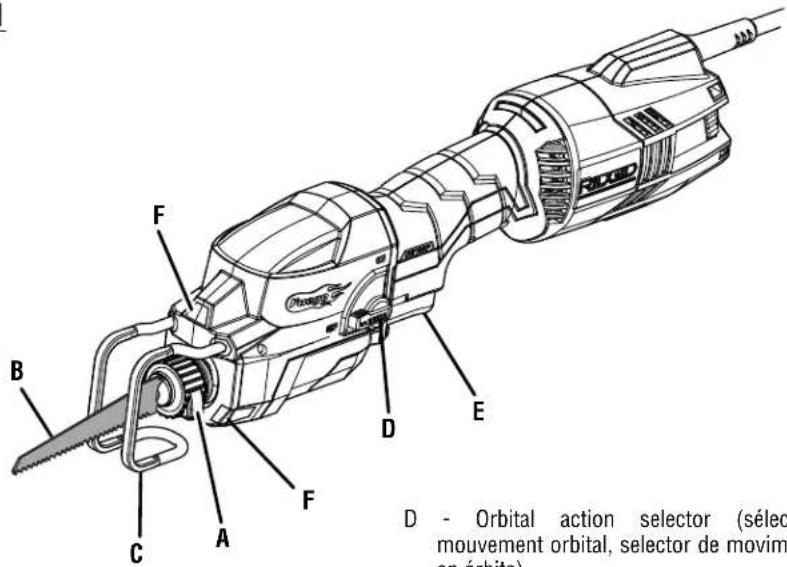
A - Toolless blade clamp (verrouillage de lame sans outil, mordaza de la cuchilla de apriete sin herramienta)
B - Saw blade (lame de scie, hoja de la sierra)
C - Shoe (sabot, zapata)
A - Variable speed switch trigger (gâchette de vitesse variable, gatillo del interruptor de velocidad variable)
Fig. 4
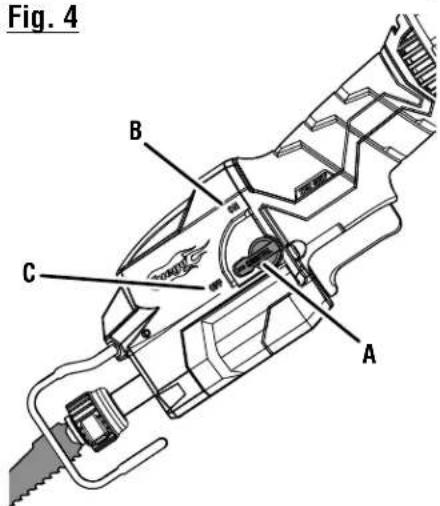
Fig. 6
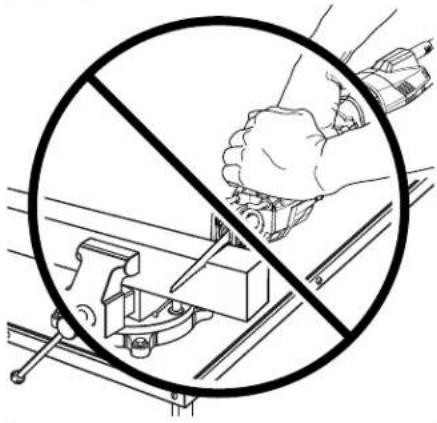
Fig. 7
de
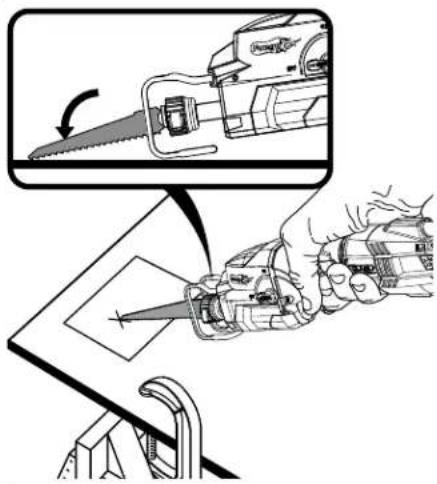
Fig. 8
OPERATOR'S MANUAL
ONE-HANDED RECIPROCATING SAW
VARIABLE SPEED
MANUEL D'UTILISATION
SCIE ALTERNATIVE À UNE MAIN
VITESSE VARIABLE
MANUAL DEL OPERADOR
SIERRA ALTERNATIVA PARA UNA SOLA MANO
VELOCIDAD VARIABLE
R3031

Customer Service Information:
For parts or service, do not return this product to the store. Contact your nearest RIDGID® authorized service center. Be sure to provide all relevant information when you call or visit. For the location of the authorized service center nearest you, please call 1-866-539-1710 or visit us online at www.ridgid.com.
The model number of this tool is found on a plate attached to the motor housing. Please record the serial number in the space provided below. When ordering repair parts, always give the following information:
Model No. ____
Serial No. ____

- OPERATOR'S MANUAL
- ONE-HANDED RECIPROCATING SAW
- MANUEL D'UTILISATION
- SCIE ALTERNATIVE À UNE MAIN
- MANUAL DEL OPERADOR
- SIERRA ALTERNATIVA PARA UNA SOLA MANO
- TABLE OF CONTENTS
- WARNING
- SAVE THIS MANUAL FOR FUTURE REFERENCE
- WORK AREA SAFETY
- ELECTRICAL SAFETY
- PERSONAL SAFETY
- POWER TOOL USE AND CARE
- SERVICE
- RECIPROCATING SAW SAFETY WARNINGS
- DOUBLE INSULATION
- ELECTRICAL CONNECTION
- EXTENSION CORDS
- PRODUCT SPECIFICATIONS
- KNOW YOUR RECIPROCATING SAW
- BARREL-STYLE GRIP
- LED LIGHTS
- ORBITAL ACTION SELECTOR
- VARIABLE SPEED SWITCH TRIGGER
- ASSEMBLY
- UNPACKING
- APPLICATIONS
- SELECTING BLADES
- INSTALLING/REMOVING BLADE
- VARIABLE SPEED
- OPERATING THE SAW
- PLUNGE CUTTING WOOD OR WALL BOARD
- METAL CUTTING
- NOTE: FIGURES (ILLUSTRATIONS) START ON PAGE 10 AFTER FRENCH AND SPANISH LANGUAGE SECTIONS
- GENERAL MAINTENANCE
- LUBRICATION
- POWER SUPPLY CORD REPLACEMENT
- CALIFORNIA PROPOSITION 65
- RÈGLES DE SÉCURITÉ RELATIVES AUX OUTILS ÉLECTRIQUES
- AVERTISSEMENT
- REEMPLACEMENT DU CORDON D'ALIMENTATION
- NOTES / NOTAS
- CUSTOMER SERVICE INFORMATION
Brand : RIDGID
Model : R3031
Category : Saw