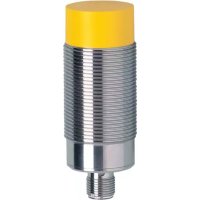
GI701S - Inductive sensor IFM - Free user manual and instructions
Find the device manual for free GI701S IFM in PDF.



| Product type | Safety inductive sensor |
| Brand | IFM |
| Model | GI701S |
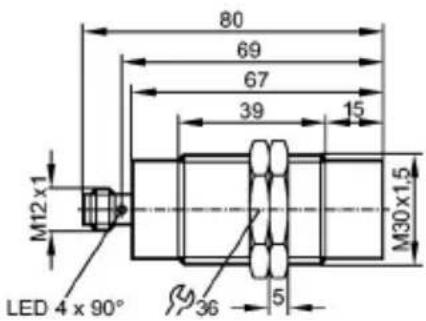
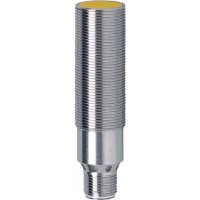
| Dimensions | Thread M30 x 1.5, length 80 mm, M12 connector |
| Weight | 0.255 kg |
| Power supply | 24 V DC (19.2…30 V) |
| Current consumption | < 30 mA |
| Sensing range | 6…12 mm (for FE360 target 45x45x1 mm) |
| Safe switching distance | > 30 mm |
| Outputs | 2 x OSSD (PNP), max current 100 mA |
| Safety level | PL e (EN ISO 13849-1), SIL 3 (IEC 61508), SILcl 3 (IEC 62061) |
| Safety response time | ≤ 50 ms |
| Readiness response time | ≤ 200 ms |
| Ambient temperature | -25…70 °C (operation ≤ 87600 h) or 10…40 °C (≤ 175200 h) |
| Protection | Short-circuit, reverse polarity, overvoltage |
| Mounting | Non-flush mountable, tightening torque ≤ 50 Nm |
| Housing material | Stainless steel (1.4404 / 316L), PBT |
| Connection | M12 connector, gold-plated contacts |
| Display | Yellow LED (signal) and green LED (power) |
| Maintenance | No maintenance required under normal operation |
| Spare parts / repairability | Repair only by the manufacturer; supplied with 2 fixing nuts |
| General information | Manual available in French, German, English; certified by TÜV Nord |
Frequently Asked Questions - GI701S IFM
User questions about GI701S IFM
0 question about this device. Answer the ones you know or ask your own.
Ask a new question about this device
Download the instructions for your Inductive sensor in PDF format for free! Find your manual GI701S - IFM and take your electronic device back in hand. On this page are published all the documents necessary for the use of your device. GI701S by IFM.
USER MANUAL GI701S IFM
natural_image
Pure mechanical component diagram without any text, numbers, or symbolsBG български
- According to the machine directive 2006/42/EC the original operating instructions and a translation of these operating instructions into the language or languages of the EU user country must be provided when a unit or protective system is put into operation within the member countries of the European Union (EU).
- If no operating instructions or EC declaration of conformity is supplied with this product in the language of the EU user country, these can be requested from your dealer (see delivery note) or manufacturer (see cover sheet / back).
- Only qualified personnel is allowed to set up the product. Furthermore, we expressly point out that any liability is excluded resulting from putting the unit into operation without the corresponding operating instructions in the language of the EU user country.
ES Español
1: Testimpulsdauer
2: Testimpulsintervall T(Impulspaket)
3: Testimpulsintervall T

Testimpulsintervall T (Wiederholung Impulspaket) min. 30 ms
max. 50 ms
9.4 LED-Anzeige
1 Preliminary note ....3
1.1 Symbols used ....3
1.2 Warning signs used ....3
2 Safety instructions ....4
2.1 Safety-related requirements regarding the application ....4
3 Items supplied....5
4 Functions and features ....5
5 Function....6
5.1 Enable zone 6
5.2 Protection against simple defeating ....7
6 Installation....8
7 Electrical connection ....8
8 Set-up....9
8.1 Setting aid ....9
8.2 Determine the enable zone ....9
8.3 Deactivate setting aid ....10
9 Operation....10
9.1 Switching state of the outputs .....10
9.1.1 The safe state ....10
9.1.2 The switched state ....10
9.1.3 Output characteristics ....10
9.1.4 Cross fault / short circuit 11
9.2 Operating mode 11
9.2.1 Delayed switching of the LED 12
9.2.2 Switching of the LED without delay 12
9.3 Response times ....13
9.4 LED display ....14
10 Technical data ....15
11 Troubleshooting ....17
12 Maintenance, repair and disposal ....17
13 Terms and abbreviations .... 18
2
1 Preliminary note
The instructions are part of the unit. They are intended for authorised persons according to the EMC, Low Voltage and Machinery Directives and safety regulations. The instructions contain information about the correct handling of the product.
Read the instructions before use to familiarise yourself with operating conditions, installation and operation.
Follow the safety instructions.
1.1 Symbols used
▶ Instructions
→ Cross-reference

Important note
Non-compliance can result in malfunction or interference.

Information
Supplementary note.
LED on
○ LED off
LED flashes (2 Hz)
LED flashes quickly (5 Hz)
1.2 Warning signs used

WARNING
Warning of serious personal injury.
Death or serious irreversible injuries may result.

2 Safety instructions
- Follow the operating instructions.
- Improper use may result in malfunctions of the unit. This can lead to personal injury and/or damage to property during operation of the machine. For this reason note all remarks on installation and handling given in this document. Also adhere to the safety instructions for the operation of the whole installation.
- In case of non-observance of notes or standards, especially when tampering with and/or modifying the unit, any liability and warranty is excluded.
- If the sensor is damaged, the safety function cannot be guaranteed.
- Errors caused by damage cannot be detected by the sensor.
- The unit must be installed, connected and put into operation by a qualified electrician trained in safety technology.
- The applicable technical standards for the corresponding application must be complied with.
- For installation the requirements according to EN 60204 must be observed.
- In case of malfunction of the unit please contact the manufacturer. Tampering with the unit is not allowed.
- Disconnect the unit externally before handling it. Also disconnect any independently supplied relay load circuits.
- After installation, maintenance or repair of the system perform a complete function check.
- Use the unit only in specified environmental conditions ( 10 Technical data). In case of special operating conditions please contact the manufacturer.
• Use only as described below ( 4).
2.1 Safety-related requirements regarding the application
It must be ensured that the safety requirements of the respective application correspond to the requirements stated in these instructions.

WARNING
Failure of the safety function
When used outside of the defined environmental conditions, the safety-related function of the sensor cannot be guaranteed.
▶ Use only in accordance with the defined environmental conditions ( 10 Technical data).
Use of the sensor in the vicinity of chemical and biological media (solid, liquid, gaseous) as well as ionising radiation is not permitted.
UK
Observe the following requirements:
▶ Take measures to avoid metallic objects being placed on the sensing face unintentionally.
▶ Adhere to EN 14119 for interlocking devices associated with guards.
▶ Adhere to the principle of normally closed operation for all external safety circuits connected to the system.
In case of faults within the fail-safe sensor which result in the defined safe state: take measures to maintain the safe state when the complete control system continues to be operated.
▶ Replace damaged units.
3 Items supplied
1 fail-safe sensor GI701S with 2 M30 fixing nuts,
1 original operating instructions GI701S, ident no. 11491856.
If one of the above-mentioned components is missing or damaged, please contact one of the ifm branch offices.
4 Functions and features
The fail-safe inductive sensor GI701S detects metal without contact.
Safety function SF: the safe state (output stage switched off; logic "0") is achieved when undamping greater than or equal to the safe switch-off distance s_ar . ( 10 Technical data).
Also observe the notes on installation of the sensor ( 6 Installation).
The fail-safe inductive sensor is a proximity device with defined behaviour under fault conditions (PDDB) to IEC 60947-5-3.
The fail-safe sensor conforms to Performance Level e according to EN ISO 13849-1 as well as to the requirements SIL 3 to IEC 61508 and meets SILcl 3 to IEC 62061.
The unit corresponds to the classification I2A30SP2 to IEC 60947-5-2 for non-flush installation ( 6 Installation).
The fail-safe inductive sensor has been certified by TÜVNord.
5 Function
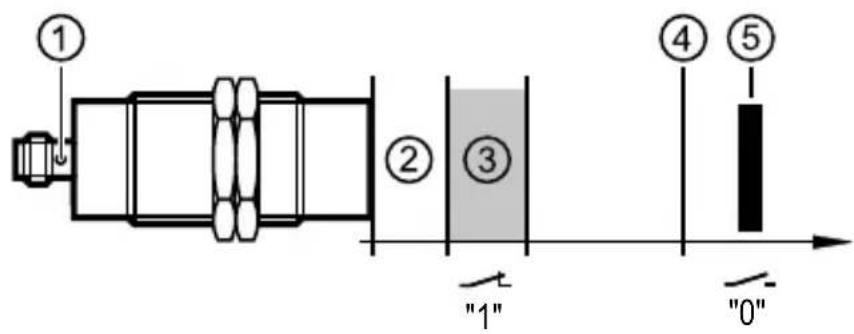
1: dual LED: signal (yellow); power (green)
2: close zone
3: enable zone
4: safe switch-off distance s_ar
5: target
5.1 Enable zone
The outputs (OSSD) are only enabled when a damping target is present in the enable zone. Outside this enable zone the outputs remain switched off.
The safe switch-off distance s_ar is > 30 mm.

The enable zone is different if damping elements which deviate from the standard target plate in terms of material, form and size are used.
Enable zone for selected materials*:
| Material Enable zone |
| FE360 (= mild steel) 6...12 mm |
| Stainless steel 3.8...8.8 mm |
| AIMg3G22 0.7...4.8 mm |
| CuZn37 1...5.2 mm |
| Copper 0...3.7 mm |
* Typical values for damping with a reference target of 45 x 45 x 1 mm and non-flush installation to IEC 60947-5-2 at an ambient temperature of 20 °C.

Depending on the characteristics of the damping element there may be no close zone.
5.2 Protection against simple defeating
The fail-safe sensor reacts to metal objects, e.g. the frame of a safety door. Other metal objects that are not intended to enable the sensor must not be allowed to enable the fail-safe sensor unintentionally.

▶ Take measures to prevent metal objects, except the designated target, from being placed on the sensing face or in the enable zone unintentionally.

In addition, the sensor has the following switching characteristics to make simple defeating of its safety function more difficult:
- By slowly introducing a metallic object into the enable zone, the outputs are immediately switched, but displayed by the LED with a delay of approx. 3 s ( 9.2.1 Delayed switching of the LED). By doing so, the object is generally in the close range before the LED indication is lit. The technical instructions concerning the restart of the installation must be observed.
- If the object remains in the close zone for over approx. 2 s, the outputs are completely disabled and no longer enabled in case of damping in the enable zone. If the object stays in the close range for longer than approx. 5 s, the setting aid is activated ( 8.1).
Release of the enable zone can be carried out
- either by undamping (> 30 mm) for a time of more than 2 s
- or by a voltage interruption (→ 8.3 Deactivate setting aid).
6 Installation
The unit can be non flush mounted according to IEC 60947-5-2, type I2A30SP2.
▶ Ensure the unit cannot work loose (tightening torque ≤ 50 Nm).
▶ Adhere to the installation conditions in accordance with the figures 1 to 3:
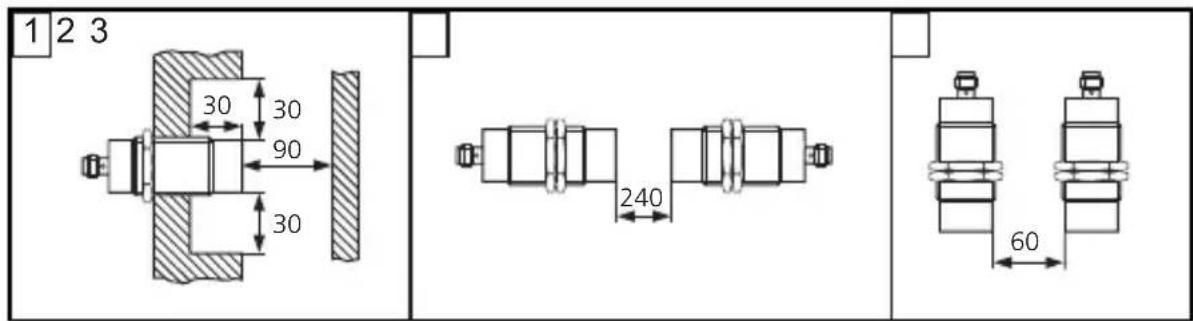
▶ Tighten the socket according to the manufacturer's indications. Observe the tightening torque for the ifm socket (e.g. EVxxxx: 0.6...1.5 Nm).
Flush installation of the fail-safe sensor is not permitted since this can result in an increase of the sensing range up to enabling of the outputs (OSSDs).
7 Electrical connection
Wiring diagram → 10 Technical data
▶ Disconnect power. Also disconnect any independently supplied relay load circuits.
▶ Supply voltage: connect L+ to pin 1 and L- to pin 3 of the connector.
The nominal voltage is 24 V DC. This voltage may vary between 19.2 V and 30 V incl. 5 % residual ripple to EN 61131-2.
In case of one fault the supply voltage must not exceed 60 V DC for more than 0.2 s up to a max. value of 120 V DC. (This requires the safe separation between power supply and transformer.)
8 Set-up
8.1 Setting aid
For easy and reliable installation the sensor features an optical setting aid to visualise the enable zone.
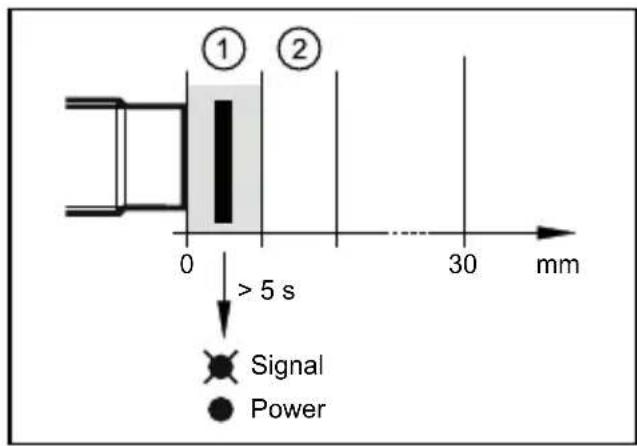
The setting aid is activated by placing a metal object in front of the fail-safe sensor (close range).
After approx. 5 s the yellow LED starts to flash: the setting aid is active.
While this mode is active, the output remains in the safe state ("0").

1: close zone
2: enable zone
8.2 Determine the enable zone
When the setting aid is active, the enable zone can be determined by moving the target (or the sensor if the target is fixed).
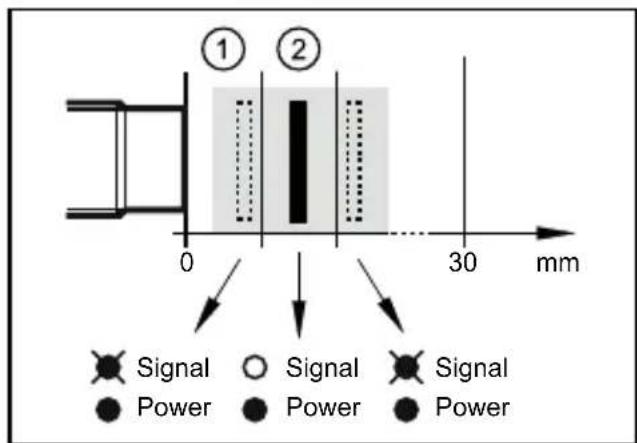
As soon as the target enters the enable zone, the yellow LED goes out. If the target is just outside the enable zone in either direction the LED starts to flash again.
1: close zone
2: enable zone
8.3 Deactivate setting aid
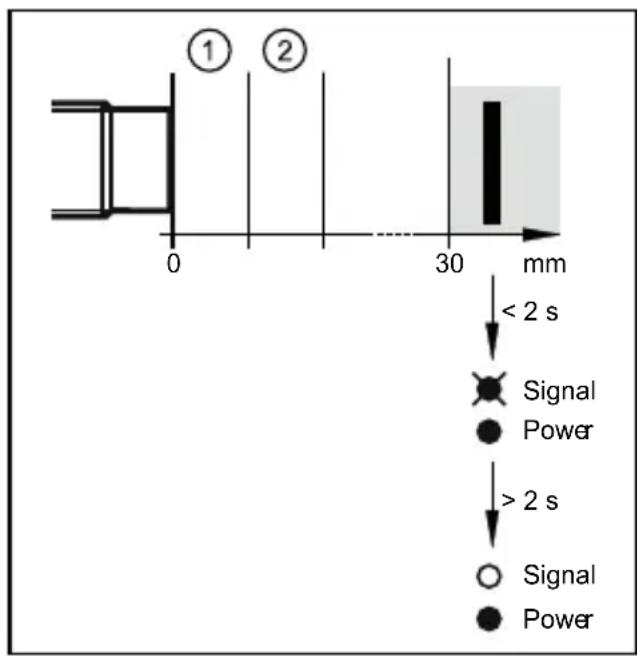
If the sensor is undamped for more than 2 s (> 30 mm), the setting aid is switched off and the yellow LED goes out.
This can also be achieved by power off.
1: close zone
2: enable zone
9 Operation
9.1 Switching state of the outputs
9.1.1 The safe state
The safe state is when at least one of the outputs A1 or A2 (OSSDs) is switched off (zero-current state: logic "0").
If one of the outputs A1 or A2 is switched off, the subsequent safety-related logic unit must bring the complete system into the state defined as safe.
9.1.2 The switched state
If the damping element is in the enable zone and if there is no sensor error, both outputs A1 and A2 (OSSDs) are enabled (logic "1").
9.1.3 Output characteristics
The output characteristics are compatible with the input characteristics to EN 61131-2 type 1 or 2:
Logic "1" ≥ 15 V 2...15 mA
≥ 11 V 15...30 mA
Logic "0" ≤ 5 V leakage current 0.2 mA *)
*) pull-down current typ. 30 mA
9.1.4 Cross fault / short circuit
- A cross fault between both outputs (A1 and A2) is detected by the fail-safe sensor and results in the outputs (OSSD) being switched off at the next safety request. The outputs A1 and A2 remain switched off until the error has been removed or a voltage reset has been carried out.
- A cross fault (short circuit) between one of the two outputs (A1 or A2) and the supply voltage results in the other output (A2 or A1) being switched off in case of a safety request.
9.2 Operating mode
The length of the preceding undamping determines whether the yellow LED comes on with a delay ( 9.2.1) or without delay ( 9.2.2) when a target moves into the enable zone. In any case, the outputs switch on without delay.
In case of undamping the outputs switch off and the yellow LED goes out without delay.
In case of damping in the close range the outputs switch off immediately whereas the yellow LED goes out with a delay of approx. 2 s.
When the LED goes out the outputs are maintained in the safe state ("0"). Thus, switching on again in the enable zone is not possible. Enabling is done by undamping (> 30 mm) of more than 2 s or by interrupting the voltage ( 5.2 Protection against simple defeating).
9.2.1 Delayed switching of the LED
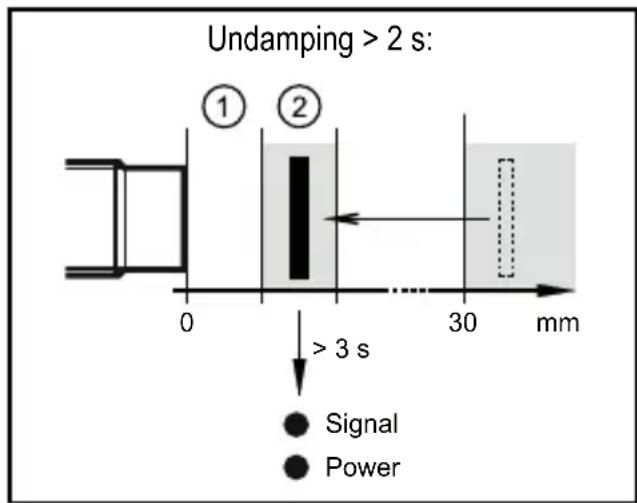
If the target was away from the sensor for more than approx. 2 s (>30 mm), the yellow LED goes on with a delay of approx. 3 s in case of damping in the enable zone.
This is also the case if the target is in the enable zone when the voltage is switched on.
1: close zone
2: enable zone
9.2.2 Switching of the LED without delay
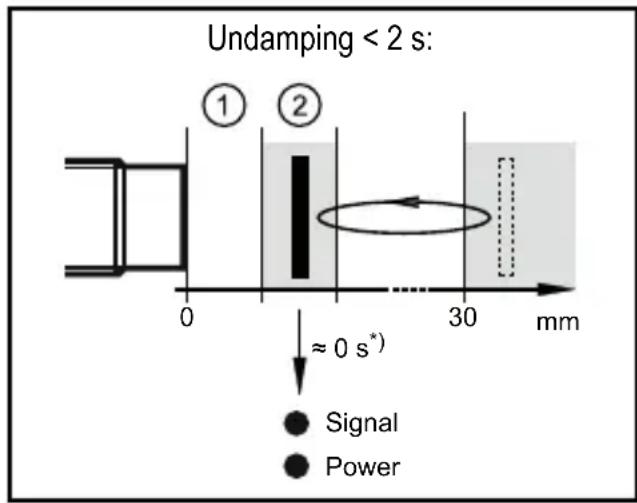
If the target was away from the sensor for less than 2 s (> 30 mm), the yellow LED comes on without delay in case of damping in the enable zone.
1: close zone
2: enable zone
*) except for the first start-up
9.3 Response times
| Response time on safety request (removal from the enable zone) | ≤ 50 ms |
| Response time when approaching the enable zone (enable time) | typ. 100 ms ≤ 200 ms |
| Risk time / response time for safety-related faults ≤ 100 ms | |
| Permissible dwell time in the close range < 2 s | |
| Delay time to activate the setting aid (→ 8.1) approx. 5 s | |
| Dwell time in the undamped state (> 30 mm) to return into the operating mode (→ 8.3 Deactivate setting aid) approx. 2 s | |
| Simultaneity of switching on and off of the outputs in case of a safety request | ≤ 50 ms |
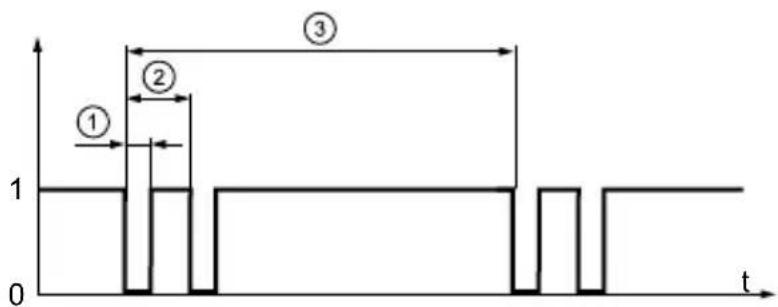
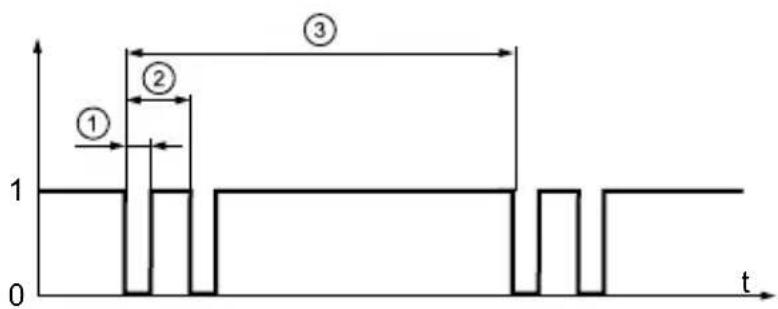
| Test pulse duration t_max on A1/A2(1) max. 1 ms | |
| Test pulse interval Tp(2) [pulse package] min. 2 ms | max. 5 ms |
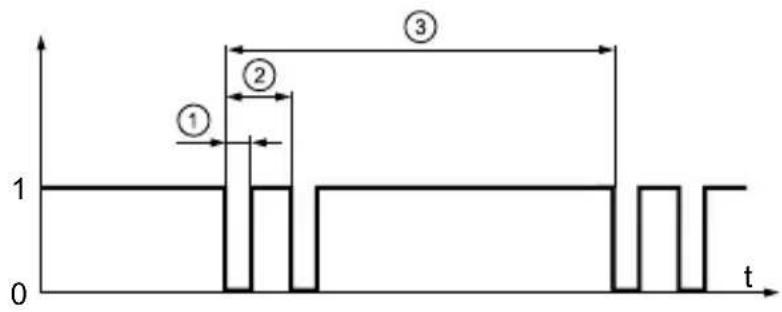
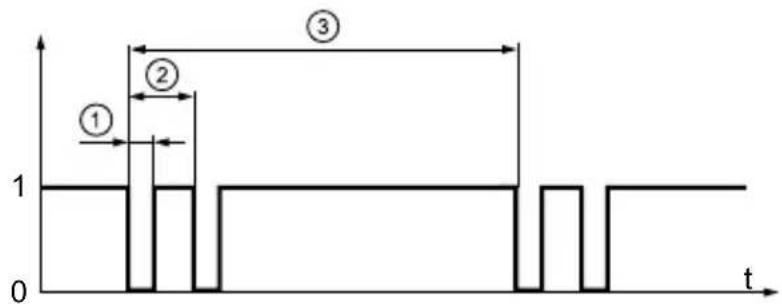
1: Test pulse duration
2: Test pulse interval T_p (pulse package)
3: Test pulse interval T
Test pulse interval T (repetition pulse package) min. 30 ms
max. 50 ms
9.4 LED display
| LED Operating status Outputs A1 | A2(OSSD) (OSSD) | |||
| ○○ | Signal Power | No voltage supply Both outputs switched off 0 0 | ||
| ○※ | Signal Power | Undervoltage 0 0 | ||
| ○※ | Signal Power | Overvoltage Both outputs switched off 0 0 | ||
| Sensor fault(→ 11 Troubleshooting) | One output or both outputs switched off | 0 11 00 0 | ||
| ○● | Signal Power | a) Operating mode:damping element at safe switch-off distance from the sensor (> 30 mm)b) Setting aid:damping element in the enable zone | Both outputs switched off 0 | 0 |
| ※● | Signal Power | Setting aid:damping element in the enable zone or in the immediate vicinity of the enable zone | Both outputs switched off 0 | 0 |
| ●● | Signal Power | Operating mode:damping element in the enable zone | Both outputs enabled 1 1 | |
10 Technical data
CE

TEV NORD
Product characteristics
| Fail-safe inductive sensor |
| Metal thread M30 x 1.5 |
| M12 connector |
| Enable zone 6...12 mm; [nf] non-flush mountable |
| Complies with the requirements:EN ISO 13849-1: 2015 category 3 PL eIEC 61508: SIL 3IEC 62061: SILcl 3 |
Application
Type of operation continuous operation (maintenance-free)
Electrical data
| Electrical design DC PNP | |
| Operating voltage 24 DC (19.2...30 [Ω]) | |
| Rated insulation voltage 30 | [V] |
| Current consumption < 30 | [mA] |
| Protection class III | |
| Reverse polarity protection yes | |
Outputs
| Output function 2 x OSSD (A1 and A2) | |
| Output data Interface type C class 0 | |
| Output voltage at 24 V compatible with EN 61131-2 inputs type 1, 2, 3 | |
| Voltage drop < 2.5; (100 mA) [V] | |
| Current rating 100 [mA] | |
| Short-circuit protection yes | |
| Max. capacitive load CL_max 20 [nF] | |
Range
| Enable zone 6...12 | [mm] |
| Safe switching off distance s(ar) | [mm] |
Reaction times
| Power-on delay time | [s] |
| Response time to safety request | [ms] |
UK

Response time when approaching [ms] the enable zone (enable time) ≤ 200 Risk time (response time for safety [ms] -related faults) ≤ 100
Environment
Applications Class C to EN 60654-1 weatherproof application
Ambient temperature -25...70, for science life ≤ 87600 h
10...40, for service life ≤ 175200 h
Rate of temperature change 0.5 [K/min]
Max. relative air humidity 5...95, briefly
5...70, permanently
Air pressure 80...106 [kPa]
Height above sea level ≤ 2000 [m]
Ionising radiation not permissible
Salt spray no
Protection IP 68 / IP 69K
Tests / approvals
| EMC | IEC 60947-5-2 | |
| IEC 60947-5-3 | ||
| EN 61000-4-2 ESD: 6 kV CD / 8 kV AD | ||
| EN 61000-4-3 HF radiated: 20 V/m | ||
| EN 61000-4-4 Burst: 2 kV | ||
| EN 61000-4-6 HF conducted: 10 V | ||
| EN 61000-4-8: 30 A/m | ||
| EN 55011: | class B | |
| Shock resistance IEC 60947-5-2 | ||
| Vibration resistance | IEC 60947-5-2 | |
Safety classification
| Mission time TM | [h] | ≤ 175200, (20 years) |
| Safety-related reliability PFHd | [1/h] | 1E-08 |
Mechanical data
| Mounting | non-flush mountable | |
| Housing materials | stainless steel 316L / 1.4404; PBT | |
| Weight | [kg] | 0.255 |
Displays / operating elements
| Display | LED yellow (signal), LED green (power) |
Electrical connection
| Connection | M12 connector; Gold-plated contacts |
| Wiring |

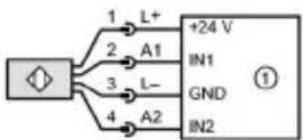
flowchart
graph TD
    A["Component"] -->|1 L+| B["+24 V"]
    A -->|2 A1| B
    A -->|3 L-| B
    A -->|4 A2| B
    B --> C["IN1"]
    B --> D["GND"]
    B --> E["IN2"]
    C --> F["①"]
1: Safety-related logic unit

| Accessories | |
| Accessories (included) 2 lock nuts | |
| Remarks | |
| Remarks | Unless stated otherwise, all data refer to the 45x45x1 mm reference target plate to IEC 60947-5-2 (FE360 = mild steel) over the whole temperature range. |
| Pack quantity 1 [piece] | |
11 Troubleshooting
LED display → 9.4
| Problem Possible cause Troubleshooting | ||
| No LED display No voltage | supply Apply voltage | |
| Power LED flashes and sensor does not switch | UndervoltageOvervoltage | Correct the voltage(→ 10 Technical data) |
| Sensor does not switch, not even after undamping and redamping | Sensor was brought into the safe state (logic "0"). Cause:cross fault between both outputs A1 and A2cross fault between one output (A1 or A2) and the supply voltageerror in the sensor detected | Remove the cross faultReplace the unit |
| No close zone Due to its char | characteristics(material, form, size), the damping element displacsthe enable zone until directly in front of the sensing face | If possible, change the material, form or size of the damping element(→ 5.1 Enable zone) |
UK
12 Maintenance, repair and disposal
If used correctly, no maintenance and repair measures are necessary.
Only the manufacturer is allowed to repair the unit.
After use dispose of the unit in an environmentally friendly way in accordance with the applicable national regulations.
13 Terms and abbreviations
| OSSD Output Signal Switch Device | ||
| PDDB Proximity devices with definedbehaviour under fault conditions | ||
| PFH(PFH _D ) | Probability of (dangerous)Failure per Hour | |
| PL Performance Level PL to EN ISO 13849-1 | ||
| SIL Safety | Integrity Level SIL 1-4 to IEC 61508. The higher the SIL, the lower the probability that a safety function will fail. | |
| SIL _cl | Safety Integrity Level _claim limit | According to IEC 62061 |
| T_M | Mission time Lifetime to IEC 60947-5-3(= max. service life) | |


Contenu
Protection IP 68 / IP 69K
Tests / Homologations
EU declaration of conformity
The EU declaration of conformity applies to the following units:
This declaration of conformity is issued under the sole responsibility of the manufacturer.
We confirm the conformity to the applicable regulations of the European directive(s):
2006/42/EC – to article 12 (3) a)
2006/42/CE – selon article 12 (3) a)
Reference to the standard(s) used:
Person authorised for the compilation of the technical documents
(Place and date of issue)
Klaus Unger / Managing Director
Declaration of Conformity
ifm electronic gmbh
Friedrichstraße 1
45128 Essen
Germany
Telefon: +49 (0)201 / 24 22 - 0
Telefax: +49 (0)201 / 24 22 · 1200
Internet: www.ifm.com
The declaration of conformity applies to the following units:
G.70.S
This declaration of conformity is issued under the sole responsibility of the manufacturer.
We confirm the conformity to the essential requirements of the UK Regulation(s):
The Restriction of the Use of Certain Hazardous Substances in Electrical and Electronic Equipment Regulations 2012, 2012 No. 3032 Electromagnetic Compatibility Regulations 2016, 2016 No. 1091 Supply of Machinery (safety) Regulations 2008, 2008 No. 1597 to PART 3 - 11(2)(a)
The following standard(s) was (were) applied:
Person authorised for the Compilation of the technical documents
Mr. R. Birkett, ifm electronic ltd, Efector House Kingsway Business Park Oldfield Road, TW12 2HD, Hampton, GB
Tettnang, 06.10.2022
(Place and date of issue)
7da

(Signature) (name, function) Klaus Unger / Managing Director
Document No.: 9000208

- BG български
- ES Español
- Preliminary note
- Symbols used
- Warning signs used
- WARNING
- Safety instructions
- Safety-related requirements regarding the application
- Items supplied
- Functions and features
- Function
- Enable zone
- Protection against simple defeating
- Installation
- Electrical connection
- Set-up
- Setting aid
- Determine the enable zone
- Deactivate setting aid
- Operation
- Switching state of the outputs
- The safe state
- The switched state
- Output characteristics
- Cross fault / short circuit
- Operating mode
- Delayed switching of the LED
- Switching of the LED without delay
- Response times
- Technical data
- Troubleshooting
- Maintenance, repair and disposal
- Contenu
- EU declaration of conformity
- Declaration of Conformity
- G.70.S
Brand : IFM
Model : GI701S
Category : Inductive sensor