RMDN 184 G - Fridge ROSIERES - Free user manual and instructions
Find the device manual for free RMDN 184 G ROSIERES in PDF.



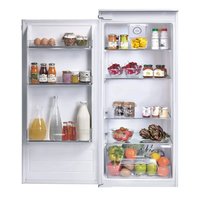
| Product type | Combined refrigerator-freezer |
| Brand | Rosieres |
| Model | RMDN 184 G |
| Climate class | N (16 °C to 38 °C) |
| Refrigerant | R600a (isobutane) |
| Insulation | Cyclopentane |
| Freezer star rating | 4 stars |
| Refrigerator temperature range | 2 °C to 8 °C |
| Freezer temperature range | -24 °C to -16 °C |
| Main functions | LED display, Eco mode, quick freezing, refrigeration OFF, open door alarm, temperature sensor alarm |
| Defrost | Automatic (No Frost) |
| Interior lighting | LED |
| Ice maker | Yes (built-in) |
| Included accessories | Vegetable bins, shelves, freezer drawers, door balconies |
| Power supply | 220-240 V, 50 Hz |
| Number of doors | 2 (refrigerator + freezer) |
| Child safety | Control lock (not specified, but mention of monitoring) |
| Maintenance and cleaning | Interior cleaning with baking soda, exterior with non-abrasive detergent, condenser with vacuum cleaner |
| Repairability | Original spare parts recommended, intervention by qualified technician |
| Warranty | Manufacturer's warranty (conditions according to manual) |
Frequently Asked Questions - RMDN 184 G ROSIERES
User questions about RMDN 184 G ROSIERES
0 question about this device. Answer the ones you know or ask your own.
Ask a new question about this device
Download the instructions for your Fridge in PDF format for free! Find your manual RMDN 184 G - ROSIERES and take your electronic device back in hand. On this page are published all the documents necessary for the use of your device. RMDN 184 G by ROSIERES.
USER MANUAL RMDN 184 G ROSIERES
USER MANUAL FRENCH DOOR
INSTRUCTION MANUAL
LANGUAGES
Italiano 5
Thank you for purchasing this product.
Before using your refrigerator, please carefully read this instrucon manual in order to maximize its performance. Store all documentaon for subsequent use or for other owners. This product is intended solely for household use or similar applicaons such as:
-
the kitchen area for personnel in shops, oces and other working environments
-
on farms, by clientele of hotels, motels and other environments of a residential type
-
at bed and breakfasts (B & B)
-
for catering services and similar applicaons not for retail sale.
This appliance must be used only for purposes of storage of food, any other use is considered dangerous and the manufacturer will not be responsible for any omissions. Also, it is recommended that you take note of the warranty conditions. Please, to obtain the best possible performance and trouble free operaon from your appliance it is very important to carefully read these instrucons.
Failure to observe these instrucons may invalidate your right to free service during the guarantee period.
SAFETY INFORMATION
This guide contains many important safety informaon. Please, we suggest you keep these instrucons in a safe place for easy reference and a good experience with the appliance.
The refrigerator contains a refrigerant gas (R600a: isobutane) and insulngas (cyclopentane), with high compatibility with the environment, that are, however, inammable.
Cauon: risk of re
If the refrigerant circuit should be damaged:
- Avoid opening ames and sources of ignion.
Thoroughly venlate the room in which the appliance is situated
WARNING!
- Care must be taken while cleaning/carrying the appliance to avoid touching the condenser metal wires at the back of the appliance, as you might injure your ngers and hands or damage your product.
This appliance is not designed for stacking with any other appliance. Do not aempt to sit or stand on top of your appliance as it is not designed for such use. You could injure yourself or damage the appliance.
- Make sure that mains cable is not caught under the appliance during and aer carrying/moving the appliance, to avoid the mains cable becoming cut or damaged.
- When posioning your appliance take care not to damage your ooring, pipes, wall coverings etc. Do not move the appliance by pulling by the lid or handle. Do not allow children to play with the appliance or tamper with the controls. Our company declines to accept any liability should the instrucons not be followed.
-
Do not install the appliance in humid, oily or dusty places, nor expose it to direct sunlight and to water.
-
Do not install the appliance near heaters or inammable materials.
- If there is a power failure do not open the lid. Frozen food should not be aected if the failure lasts for less than 20 hours. If the failure is longer, then the food should be checked and eaten immediately or cooked and then refrozen.
-
If you nd that the lid of the chest freezer is difficult to open just aer you have closed it, don't worry. This is due to the pressure dierence which will equalize and allow the lid to be opened normally aer a few minutes.
-
Do not connect the appliance to the electricity supply unall packing and transit protectors have been removed.
- Leave to stand for at least 4 hours before switching on to allow compressor oil to sele if transported horizontally.
- This freezer must only be used for its intended purpose (i.e. storing and freezing of edible foodstu).
-
Do not store medicine or research materials in the Wine Coolers. When the material that requires a strict control of storage temperatures is to be stored, it is possible that it will deteriorate or an uncontrolled reacoon may occur that can cause risks.
-
Before performing any operacon, unplug the power cord from the power socket.
- On delivery, check to make sure that the product is not damaged and that all the parts and accessories are in perfect condition.
- If in the refrigeration system a leak is noted, do not touch the wall outlet and do not use open ames. Open the window and let air into the room. Then call a service center to ask for repair.
- Do not use extension cords or adapters.
- Do not excessively pull or fold the power cord or touch the plug with wet hands.
-
Do not damage the plug and/or the power cord; this could cause electrical shocks or res.
-
If the supply cord is damaged, it must be replaced by the manufacturer, its service agent or similarly qualified person in order to avoid a hazard.
- Do not place or store inammable and highly volale materials such as ether, petrol, LPG, propane gas, aerosol spray cans, adhesives, pure alcohol, etc. These materials may cause an explosion.
- Do not use or store inammable sprays, such as spray paint, near the Wine Coolers. It could cause an explosion or re.
- Do not place objects and/or containers lled with water on the top of the appliance.
-
We do not recommend the use of extension leads and mul-way adapters.
-
Do not dispose of the appliance on a re. Take care not to damage, the cooling circuit/pipes of the appliance in transportaon and in use. In case of damaged do not expose the appliance to re, potenaiignion source and immediately venlate the room where the appliance is situated.
- The refrigeraoon system posioned behind and inside the Wine Coolers contains refrigerant. Therefore, avoid damaging the tubes.
- Do not use electrical appliances inside the food storage compartments of the appliance, unless they are of the type recommended by the manufacturer.
-
Do not damage the refrigerant circuit.
-
Do not use mechanical devices or other means to accelerate the defrosng process, other than those recommended by the manufacturer.
- Do not use electrical appliances inside the food storage compartments, unless they are of the type recommended by the manufacturer.
- Do not touch internal cooling elements, especially with wet hands, to avoid cracks or injuries.
- Maintain the venlaon openings in the appliance enclosure or in the built-in structure, free of obstrucon.
-
Do not use pointed or sharp-edged objects such as knives or forks to remove the frost.
-
Never use hairdryers, electrical heaters or other such electrical appliances for defrosng.
- Do not scrape with a knife or sharp object to remove frost or ice that occurs. With these, the refrigerant circuit can be damaged, the spill from which can cause a re or damage your eyes.
- Do not use mechanical devices or other equipment to hasten the defrosng process.
- Absolutely avoid the use of open ame or electrical equipment, such as heaters, steam cleaners, candles, oil lamps and the like in order to speed up the defrosng phase.
-
Never use water wash the compressor position, wipe it with a dry cloth thoroughly aer cleaning to prevent rust.
-
It is recommended to keep the plug clean, any excessive dust residues on the plug can be the cause re.
- The product is designed and built for domesc household use only.
- The guarantee will be void if the product is installed or used in commercial or non-residential domesc household premises.
- The product must be correctly installed, located and operated in accordance with the instrucons contained in the User Instrucons Booklet provided.
The guarantee is applicable only to new products and is not transferable if the product is resold. -
Our company disclaims any liability for incidental or consequential damages.
-
The guarantee does not in any way diminish your statutory or legal rights.
- Do not perform repairs on this Wine Coolers. All intervenons must be performed solely by qualified personnel.
SAFETY CHILDREN!
If you are discarding an old product with a lock or latch ed to the door, ensure that it is le in a safe condion to prevent the entrapment of children.
This appliance can be used by children aged from 8 years and above and by persons with reduced physical, sensory or mental capabilities or with a lack of experience and knowledge; provided that they have been given adequate supervision or instrucon concerning how to use the appliance in a safe way and understand the hazards
involved.
Children should not play with the appliance.
Cleaning and user
maintenance should not
be made by children
without supervision.
INTRODUCTION
Before use
Please read these instrucons and the Safety guidelines on page 1 carefully before using your new Refrigerator. The Refrigerator is for indoor, domesc use only.
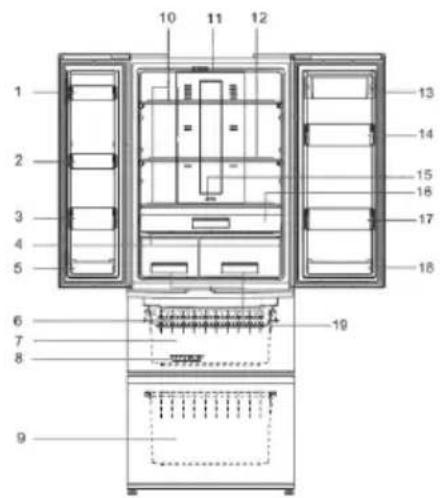
| No | Description | No | Description |
| 1 | Left-hand upper bottle | 11 | LED light |
| 2 | Left-hand middle bottle | 12 | Two-piece sliding shelves |
| 3 | Left-hand middle bottle | 13 | Storage box |
| 4 | Crisper cover | 14 | Right-hand middle bottle |
| 5 | Left-hand lower bottle | 15 | Temperature setting pole |
| 6 | Upper freezer drawer tray | 16 | Chilling room |
| 7 | Upper freezer drawer | 17 | Right-hand middle bottle |
| 8 | Ice maker | 18 | Right-hand lower bottle |
| 9 | Lower freezer drawer | 19 | Crisper |
| 10 | Refrigerator shelf |
INSTALLATION
Locaon
When selecng a posion for your Refrigerator you should make sure the oor is at and rm,
and the room is well ventilated with an average room temperature of between 16^ and 38^ . Avoid locang your Refrigerator near a heat source, eg, cooker, boiler or radiator. Also avoid direct sunlight in out-buildings or sun lounges. If you are placing your Refrigerator in an out-building such as a garage or annex ensure that the Refrigerator is placed above the damp course, otherwise condensaoi will occur on the Refrigerator cabinet. Never place the Refrigerator in a wall recessed or into ed cabinets or furniture when your Refrigerator is working, the grille at the back may become hot and the sides warm. It must therefore be installed so that the back of the Refrigerator has at least 9cm(31/2^ ) of free space and the sides have 3cm(3/4^ ) . Do not drape the Refrigerator with any covering.
Leveling the Refrigerator
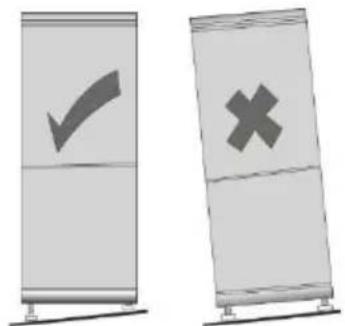
If the Refrigerator is not level, the door and magnec seal alignment will be affected and may cause you Refrigerator to work incorrectly. Once the Refrigerator is placed in its nal locaon, adjust the leveling feet at the front by turning them.
Cleaning before use
Wipe the inside of the Freezer with a weak soluon of bicarbonate of soda. Then rinse with warm water using a damp sponge or cloth. Wash the baskets and shelves in warm soapy water and dry completely before replacing in the Freezer. The external parts of the Freezer can be cleaned with wax polish. See page 9 for more details on cleaning.
Before plugging in YOU MUST
Check that you have a socket which is compatible with the plug supplied with the Freezer. If not see the secon called ELECTRICAL INFORMATION.
Before switching on!
DO NOT SWITCH ON UNTIL FOUR HOURS AFTER MOVING THE FREEZER.
The coolant uid needs me to sele. If the appliance is switched o at any me, wait 30 minutes before switching back on to allow the coolant uid to sele.
Before lling your Freezer
Before storing foods in your Freezer, turn the Freezer on and wait for 24 hours, to make sure it is working properly and to allow the Freezer to fail to the correct temperature.
START
Display panel
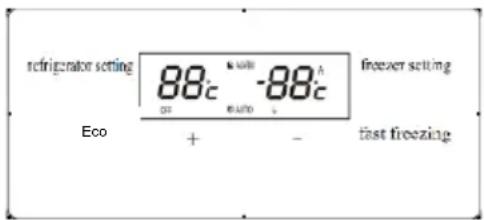
The display control panel is in the middle of refrigerator door. Please see the below for the details:
Eco
Press the buon "Eco" and it is 4^ in the refrigerator compartment and -18^ in the freezer compartment. Press "Eco" again to quit this funcon and the "AUTO" icon will turn o.
Fast freezing
With this funcon, the food in the freezer
compartment will get cold fast. Click " and then "-or "+"to adjust the me for fast freezing. The fast freezing me can be as long as 26 hours. When the set me is up, fast freezing will automatically stop and the "fast freezing" will turn o.
Refrigeraon o
Press and hold the "refrigerater seng" buon unl the "refrigerater seng" icon is o and the refrigerator compartment will stop cooling. "OFF" icon turns on.
Press and hold the "refrigerater seng" buon again to resume refrigereraon and "OFF" icon turns o.
Temperature seng in the refrigerator
Press "refrigerater seng" and the refrigerator temperature will ash. Press "+" or "-" to adjust the temperature.
The refrigerator temperature ranges from 2^ to 8^ . With refrigereraon o, temperature seng is not available.
Temperature seng in the freezer
Press "freeze seng" and the freezer temperature will ash. Click "+" or "-" to adjust the freezer temperature.
The freezer temperature ranges from -24^ to -16^ .
Temperature seng is not available under fast cooling.
Alarm:
When the door is open over 3 minutes and the display is connuously on, the buzzer will buzz until the door is shut and the display restore to stand by start. Faulty
temperature transducer will cause alarm until the fault is removed.
TIPS FOR KEEPING FOOD PERFECT IN THE FRIDGE
Take extra care with meat and sh
Cooked meats should always be stored on a shelf above raw meats to avoid bacterial transfer. Keep raw meats on a plate which is large enough to collect juices and cover it with cling lm or foil.
Leave space around food
This allows cold air to circulate around the Fridge, ensuring all parts of the Fridge are kept cool.
Wrap up food!
To prevent transfer of avors and drying out, food should be separately packed or covered. Fruit and vegetables need not be wrapped.
Pre-cooked food should be cooled properly
Allow pre-cooked food to cool down before
placing in the Fridge. This will help to stop the internal temperature of the Fridge from rising.
Shut the door!
To prevent cold air escaping, try to limit the number of mes you open the door. When retuning from shopping, sort foods to be kept in your Fridge before opening the door. Only open the door to put food in or take it out.
TIPS FOR SHOPPING FOR FROZEN FOODS
Your Freezer is 4 star
When you are buying frozen food, look at the Storage Guidelines on the packaging. You will be able to store each item of frozen food for the period shown against the 4 star rang. This is usually the period stated as "Best, Before", found on the front of the packaging.
Check the Fridge/Freeze temperature
Check the temperature of the frozen food cabinet in the shop where you buy your frozen foods. It should show a temperature lower than -18^ .
Choose packs carefully
Make sure the frozen food package is in perfect condition.
Purchase frozen food last
Always buy frozen products last on your shopping trip or visit to the supermarket.
Keep frozen foods together
Try to keep frozen food together whilst shopping, and on the journey home as this will help to keep the food cooler.
Store food straight away
Don't buy frozen food unless you can freeze it straight away. Special insulated bags can be bought from most supermarkets and hardware shops. These keep frozen food cold for longer.
Thawing frozen food
For some foods, thawing before cooking is unnecessary. Vegetables and pasta can be added directly to boiling water or steam cooked. Frozen sauces and soups can be put into a saucepan and heated gently until thawed.
FREEZING FRESH FOODS, USEFUL TIPS
Use quality food and handle it as life as possible. Freeze food in small quanes, it freezes faster, takes less me to thaw and enables you to eat it in the quantity you need.
Freezing fresh foods
First, emate the amount of food you will be freezing. If you are freezing large amounts of fresh food, remember to turn the control dial to Max. This will lower the temperature in the Freezer (approx -30^ ), freezing your food quicker and helping to keep the goodness in. However you should do this sparingly to conserve energy.
Preparaons for freezing
- Leave cooked food to cool completely.
- Chill food in a Fridge before freezing if possible.
- Consider how you want to cook the food before freezing it.
- Don't freeze food in metal containers as you may want to microwave it straight from the Freezer.
- Use special Freezer bags available from supermarkets, Freezer Im, polythene bags, plasc containers, aluminum foil for acidic foods(such as citrus fruits).
Do not use thin cling lm or glass. Do not use used food containers (unless cleaned thoroughly rst).
- Exclude as much air from the container as possible. You could buy a special vacuum pump which sucks excessive air out of the packaging.
- Leave a small amount of "air space" when freezing liquids, to allow for expansion.
- You can use the space in the Freezer most ecently if you freeze liquids (or solids with liquids, such as stew) in square blocks.
This is known as "performing" Pour the liquid into a polythene bag which is inside a square sided container. Freeze it like this, then remove it from the container and seal the bag.
Defrosng
This appliance is designed as automac defrosng, no need to defrost by hand.
Recommended storage periods
For recommended food storage me, refer to the informaon given on your food packaging.
Cleaning inside the Fridge/Freeze
You should clean the Fridge/Freezer internally with a weak soluon of bicarbonate of soda. Then rinse with warm water using a damp sponge or cloth and wipe dry. Wash the baskets in warm soapy water and ensure they are completely dry before replacing in the Fridge/Freezer.
Cleaning outside the Fridge/Freezeer
Use standard non-abrasive detergent diluted in warm water to clean the Fridge/Freeze exterior.
The grille of the condenser at the back of the Fridge/Freeze and the adjacent components can be vacuumed using a so brush aachment. Do not use harsh cleaners, scouring pads or solvents to clean any part of the Fridge/Freeze
SIMPLE FAULT ANALYSIS AND ELIMINATION
Not every failure requires technical service personnel to solve the following simple small problem; you can try to solve the problem.
| Case | Inspecon | Soluons |
| Completely non refrigeracao n | Is power plug o? Are breakers and fuses a broken? No electricity or line trip? | Re-plug. Opening the door and checking whether the lamp is lit. |
| Abnormal noise | Is refrigerator | Adjustng refrigerator' |
| stable? Does refrigerator reach the wall? | s adjustable feet. O the wall. | |
| Poor refrigeration eciency | Do you put hot food or too much food? Do you open the door frequently? Do you clip food bag to the seal of door? Direct sunlight or near a furnace or stove? Is it well-venlated? Temperature seng in too high? | Pung food into refrigerator when hot food becomes cool. Checking and closing the door. Removing the refrigerator from the heat source. Emptying the distance to maintain good venlaon. Seng to the appropriate temperatur e. |
| Peculiar smell in refrigerator | Any spoiled food? Do you need to clean refrigerator? Do you packed food of strong avors? | Throwing away spoiled food. Cleaning refrigerator. Packing food of strong avors. |
MOVING THE FRIDGE/FREEZER
Locaon
Do not place your Fridge/Freezer near a heat source, eg. Cooker, boiler or radiator. Also avoid direct sunlight in out-buildings or sun lounges.
Leveling the Fridge/Freezer
Make sure the Fridge/Freeze is level. Use the rotang leveling feet at the front. If the Fridge/Freeze is not level, the doors and magnec seal alignments will be aected and may cause your Fridge/Freeze to work incorrectly.
Do not turn on the Fridge/Freezer for 4 hours
Aer the Fridge/Freezer is in place it needs to be le for 4 hours. This allows me for the coolant to sele.
Installaon
Don't cover or block the vents or grilles of your appliance.
If you're not at home for a long me
- Turn o the refrigerator rst and then unplug the unit from the wall outlet.
- Remove all the food.
- Clean the refrigerator.
- Leave the lid open slightly to avoid possible formaon of condensaon, mold, or odors.
- Use extreme caution in the case of children. The unit should not be accessible to child's play.
- Short vacaons: Leave the refrigerator operang during vacaons of less than three weeks.
- Long vacaons: If the appliance will not be used for several months, remove all food and unplug the power cord. Clean and dry the interior thoroughly. To prevent odor and mold growth, leave the door open slightly: blocking it open if necessary or have the door removed.
HOW TO SAVE ENERGY
- Install the refrigerator in the coolest part of the room, out of direct sunlight and away from heang ducts or registers. Do not place the refrigerator next to heat-producing appliances such as a range, oven or dishwasher.
- The refrigerator door should remain open only as long as necessary; do not place hot food inside the refrigerator.
- Organize the refrigerator to reduce door openings. Remove as many items as needed at one me and close the door as soon as possible.
- The refrigerator door should be properly closed to avoid increased energy consumption, and the formula of excess ice and/or condensaoon inside.
- Constantly circulang cold air keeps the temperature homogenous inside the refrigerator. For this reason, it is important to properly distribute the food, to facilitate the ow of air.
- Cover foods and wipe containers dry before placing them in the refrigerator. This cuts down on moisture build-up inside the unit.
- Do not overcrowd the refrigerator or block cold airvents. Doing so causes the refrigerator to run longer and use more energy. Shelves
should not be lined with aluminum foil, wax paper or paper toweling. Liners interfere with cold air circulaon, making the refrigerator less ecient, which could cause food spoilage.
- During prolonged absences (example: vacaons), it is advisable to disconnect the refrigerator, remove all the food, and clean it. The door should be le slightly open to avoid mold and unpleasant odors. This will not aect the refrigerator when it is reconnected.
- During short absences (example: holidays), the refrigerator can remain on. However, remember that prolonged power outages may occur while you are gone.
SERVICING
This product should be serviced by an authorized engineer and only genuine spare parts should be used.
Under no circumstances should you aempt to repair the appliance yourself.
Repairs carried out by inexperienced persons may cause injury or serious malfunctioning.
Contact the local store where your purchase was made.
When the appliance is not in use for long periods, disconnect from the electricity supply, empty all foods and clean the appliance, leaving the door ajar to prevent unpleasant smells.
SCRAPPING OLD APPLIANCES
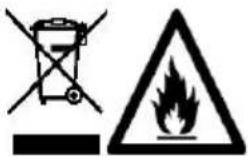
This appliance is marked according to the European direcve 2012/19/EU on Waste Electrical and Electronic Equipment (WEEE).
WEEE contains both pollung substances (which can cause negative consequences for the environment) and basic components (which can be re-used). It is important to have WEEE subjected to specic treatments, in order to remove and dispose properly all pollutants, and recover and recycle all materials.
Individuals can play an important role in ensuring that WEEE does not become an environmental issue; it is essenai to follow some basic rules:
WEEE should not be treated as household waste.
WEEE should be handed over to the relevant collecon points managed by the municipality or by registered companies. In many countries, for large WEEE, home collecon could be present.
In many countries, when you buy a new appliance, the old one may be returned to the retailer who has to collect it free of charge on a one-to-one basis, as long as the equipment is of equivalent type and has the same funcons as the supplied equipment.
Conformity
By placing the mark on this product, we are conrming compliance to all relevant European safety, health and environmental requirements which are applicable in legisllaon for this product.

- USER MANUAL FRENCH DOOR
- LANGUAGES
- SAFETY INFORMATION
- WARNING!
- SAFETY CHILDREN!
- INTRODUCTION
- Before use
- INSTALLATION
- Locaon
- Leveling the Refrigerator
- Cleaning before use
- Before plugging in YOU MUST
- Before switching on!
- Before lling your Freezer
- START
- Display panel
- Eco
- Fast freezing
- Refrigeraon o
- Temperature seng in the refrigerator
- Temperature seng in the freezer
- Alarm:
- TIPS FOR KEEPING FOOD PERFECT IN THE FRIDGE
- Take extra care with meat and sh
- Leave space around food
- Wrap up food!
- Pre-cooked food should be cooled properly
- Shut the door!
- TIPS FOR SHOPPING FOR FROZEN FOODS
- Check the Fridge/Freeze temperature
- Choose packs carefully
- Purchase frozen food last
- Keep frozen foods together
- Store food straight away
- Thawing frozen food
- FREEZING FRESH FOODS, USEFUL TIPS
- Freezing fresh foods
- Preparaons for freezing
- Defrosng
- Recommended storage periods
- Cleaning inside the Fridge/Freeze
- Cleaning outside the Fridge/Freezeer
- SIMPLE FAULT ANALYSIS AND ELIMINATION
- MOVING THE FRIDGE/FREEZER
- If you're not at home for a long me
- HOW TO SAVE ENERGY
- SERVICING
- SCRAPPING OLD APPLIANCES
- Conformity
Brand : ROSIERES
Model : RMDN 184 G
Category : Fridge