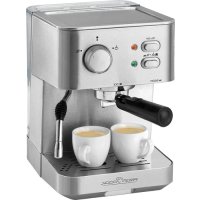
PCES 1109 - Coffee machine PROFICOOK - Free user manual and instructions
Find the device manual for free PCES 1109 PROFICOOK in PDF.
Download the instructions for your Coffee machine in PDF format for free! Find your manual PCES 1109 - PROFICOOK and take your electronic device back in hand. On this page are published all the documents necessary for the use of your device. PCES 1109 by PROFICOOK.
USER MANUAL PCES 1109 PROFICOOK

- The appliance is designed exclusively for private use and for the envisaged purpose. This appliance is not t for commercial use.
- Do not use it outdoors. Keep it away from sources of heat, direct sunlight, humidity (never dip it into any liquid) and sharp edges. Do not use the appli- ance with wet hands. If the appliance is humid or wet, unplug it immediately.
- When cleaning or putting it away, switch off the ap- pliance and always pull out the plug from the socket (pull the plug itself, not the lead) if the appliance is not being used and remove the attached accesso- ries.
- Do not operate the machine without supervision. If you leave the room you should always turn the de- vice off. Remove the plug from the socket.
- The device and the mains lead have to be checked regularly for signs of damage. If damage is found the device must not be used.
- Use only original spare parts.
- In order to ensure your children’s safety, please keep all packaging (plastic bags, boxes, polystyrene etc.) out of their reach.
Do not allow small children to play with the foil. There is a danger of suffocation!57 PC-ES1109_IM 21.04.16 Special Safety Instructions for this Appliance
WARNING: Risk of burns!
Group head, lter holder, steam nozzle and cup tray get very hot during operation.
- Take hold of the lter holder only at the handle.
- Do not touch group head, steam nozzle and cup tray! Let these parts cool down before cleaning.
- Do not point the steam jet towards yourself or other persons. Place a bowl under the steam nozzle (4).
Ensure that no humidity enters the casing. Risk of electric shock. CAUTION:
- Fill the water tank (2) only with cold water.
- Only use potable water. Do not use carbonated water (sparkling mineral water).
- Ensure that the lter holder (15) is secure and properly locked dur- ing operation, since this appliance works under pressure.
- Use the appliance only on a level work surface.
- Only use the appliance when water is lled into the water tank.
- Do not move the appliance when it is in operation.
- This appliance can be used by children aged from 8 years and above if they have been given supervision or instruction concerning the safe use of the appliance understand the hazards involved.
- Cleaning and maintenance by the user shall not be made by chil- dren unless they are older 8 years and supervised.
- Keep the appliance and its cord out of reach of children less than 8 years.
- Children shall not play with the appliance.58 PC-ES1109_IM 21.04.16
- Appliances can be used by persons with reduced physical, sensory or mental capabilities or lack of experience and knowledge if they have been given supervision or instruction concerning use of the appliance in a safe way and if they understand the hazards involved.
- Do not try to repair the appliance on your own. Always contact an authorized technician. If the supply cord is damaged, it must be replaced by the manufacturer, its service agent or similarly qualied persons in order to avoid a hazard.
- This appliance is intended to make espresso and cappuccino.
- Only use the appliance in a dry, indoor area. It is intended for do- mestic use and similar areas of use such as e.g. - In staff kitchens in shops, ofces and other commercial areas. It is not intended for use in farm accommodation or Bed & Breakfast establishments or by guests in hotels, motels and other accommo- dation facilities. CAUTION: The appliance must not be immersed in water for cleaning. Refer to the instructions provided in the chapter “Cleaning”. Supplied Parts 1 Espresso machine 1 Removable water tank 1 Screwed-on steam nozzle 1 Filter holder 1 1-cup lter insert 1 2-cup lter insert 1 Drip tray grid 1 Drip tray 1 Measuring spoon / tamper Unpacking the Appliance
1. Remove the device from its packaging.
2. Remove all packaging materials like foils, lling
materials, cable holders, and carton packaging.
3. Check the scope of deliveries for completeness.
4. If there are missing parts or obvious damage,
do not use the device. Return it to your retailer immediately. NOTE: There may still be dust or production remains on the device. We recommend that you clean the device as described under “Cleaning”. Controls Figure A 1 Water tank lid 2 Removable water tank 3 Rotary switch 4 Steam tube with screwed-on steam nozzle 5 Drip tray compartment 6 Drip tray 7 Drip tray grid59 PC-ES1109_IM 21.04.16 8 Heater indicator lamp (green) 9 push button (Espresso / Steam) 10 On- / off button (ON / OFF) 11 Status indicator lamp (red) 12 Warming plate / cup tray 13 Filter insert for 1 cup 14 Filter insert for 2 cups 15 Filter holder 16 Filter safeguard 17 Measuring spoon / tamper (1 part, 2 functions) Notes on Use Placement
- Place the appliance on a stable and level surface.
- Due to rising heat and vapours do not operate the appliance under wall cabinets.
- Do not place the appliance in close proximity to a gas or electric stove or any other heat source. Push Button (9) This control is a push-button switch with the following functions when pressed or not pressed: Push Button Disengaged Engaged
(Espresso) (Steam) Rotary Switch (3) Left Center Right Brew espresso Off Steam Electric Connection
1. Ensure that your mains power corresponds with the
specications of the appliance. The specications are printed on the type label.
2. Check the push button settings! The
push-button switch must not be pressed, and the rotary switch must be at the center position.
3. Connect the mains cable to a properly installed and
earthed wall outlet. On / Off
- Press the on / off button (10) briey to switch the ap- pliance on. The status indicator lamp (11) lights up. The appliance starts heating up. The warming plate (12) heats up.
- The Indicator lamp (8) lights up as soon as the nec- essary brewing temperature is reached. NOTE: The indicator lamp (8) turns on and off during oper- ation. This is normal and indicates that the temper- ature is thermostat-controlled and maintained.
- In order to switch the appliance off, press and hold the on / off button (10) for 4 seconds. Then discon- nect the mains plug from the socket. European Regulations on Energy Saving NOTE: The European Directive 2009/125/EC (Ecodesign Directive) incorporates measurements for energy saving. The following applies to coffee makers: The keep- warm period is limited to max. 30 minutes after which the appliance turns off automatically. You benet from better safety and lower energy consumption. Operation
Before use, always check the button settings! Before you connect the appliance to a correctly installed grounded socket, the push-button switch must not be pressed, and the rotary switch must be at the position! Attach / Detach Filter Holder
- Hold the handle at the left edge of the appliance to attach the lter holder (see Fig. B on page 3). In- sert the three guide tabs in the group head recess- es. With the handle pull the lter holder to the right hand side to the middle of the appliance. Ensure that the lter holder is well secured in the group head.
- Pull the lter holder to the left to detach from the group head.
WARNING: Danger of burns!
After brewing the metal parts of lter holder and lter insert are hot. Inserting the Drip Tray / Drip Tray Grid
- Slide the drip tray for the residual water (6) into the compartment (5).
- Place the drip tray grid (7) onto the compartment as a cover. The recessed edge must face the appli- ance housing.60 PC-ES1109_IM 21.04.16 First Use / Bleeding CAUTION: Bleed the appliance before rst use and after a longer period of non-use. Do not use coffee grounds during this process!
1. Make sure that the drip tray (6) and the drip tray
grid (7) are inserted.
2. Fill the water tank with clean, fresh water to the
MAX marking. Close the lid again.
3. Set the lter holder (15).
4. Press the on / off button (10) briey to switch the
appliance on. The status indicator lamp (11) lights up. The appliance starts heating up. The warming plate (12) heats up.
5. Set a suitable bowl (heat-resistant / approx. 500 ml)
under the brewing head.
6. Make sure that the push-button switch in the
position is not pressed.
7. Set the rotary switch to the position to turn on
the pump. Let 2 to 3 cups run through. For this, set the rotary switch to the position.
8. Swivel the steam tube upwards. Make sure that the
steam nozzle has been screwed on.
9. Empty the bowl and set it under the steam nozzle.
10. Make sure that the push-button switch in the
position has been pressed. NOTE: When you press the push-button switch, you may have to wait until the pilot lamp (8) turns on again.
WARNING: Danger of scalding!
Hot steam escapes from the steam nozzle. To generate steam, set the rotary switch to the position. Generate steam for approx. 5 seconds, so that the steam nozzle is cleaned from the inside.
12. Set the rotary switch to the
WARNING: Danger of burns!
- When you move the steam nozzle after the steam process, always hold it on the black, ribbed surface!
- The water inside the bowl is hot.
13. The appliance now is vented and ready for oper-
ation. Making Espresso CAUTION: Do not brew an espresso when the appliance is still under pressure (for example when milk has been frothed earlier). With too much pressure in the appliance, espresso leaks at the edge of the brewing head. That may lead to a faster wearing of the rubber seal.
1. Switch the appliance on. The status indicator lamp
(11) lights up. The appliance starts heating up. The warming plate (12) heats up. NOTE:
- Use the warming plate to pre-heat your cup(s).
- If you want to pre-heat the cup(s) more rapidly, rinse them with hot water.
2. Make sure that the drip tray (6) and the drip tray
grid (7) are inserted.
3. Fill the water tank with the desired amount of clean,
fresh water. The water level must be between the MIN and MAX markings. Close the lid again.
4. If you frothed milk earlier, completely release the
pressure from the appliance: 4.1. Always make sure that the push-button switch is not pressed and that the rotary switch is in the position. 4.2. Set a suitable vessel under the steam nozzle. 4.3. Keep the rotary switch in the position until no more steam escapes. 4.4. Return the rotary switch to the position.
5. Select a lter insert (13 / 14). Place the insert in the
lter holder. Ensure that the lter safeguard is not upright.
6. Fill the lter insert with espresso grounds. Use the
supplied measuring spoon (17). Observe the MAX marking in the lter insert. Spread the espresso grounds evenly and push down slightly with the tamper (17). Clean the edge of the lter holder.
7. Attach the lter holder to the group head. Ensure
that the lter holder is properly attached in the group head.
8. The necessary brewing temperature is reached as
soon as the indicator lamp (8) lights up. Place your pre-heated cup(s) under the group head exactly on the two holes you can see in the drip tray grid.
9. Make sure that the push-button switch in the
position is not pressed. Set the rotary switch to the position . The hot water is forced through the lter.61 PC-ES1109_IM 21.04.16 NOTE: This process does not end automatically!
10. Stop the brewing process by turning off the pump
when the desired amount of espresso is in your cup(s): Set the rotary switch to the position.
11. Remove the cup(s).
NOTE: Remove the lter holder every time after making espresso. In this way you extend the lifetime of the group head’s rubber seal.
12. Remove the lter holder from the group head.
13. Empty and rell the lter to brew another cup of
Metal parts of lter holder and lter insert are hot. a) Flap the lter safeguard (16) up. Push the lter safeguard with your thumb towards the lter insert while turning the lter holder around (see Fig.). b) Tap the coffee grounds out of the lter insert. Use a spoon, if necessary. Rinse the remaining coffee grounds with hot water out of the lter insert.
14. To prepare the next cup / cups of espresso, pro-
ceed as described above. Making Cappuccino Generally cappuccino consists of one-third coffee, one-third hot milk and one-third frothed milk. The milk froth should not be rm enough to be shaped with a spoon. It should be creamy, such as not com- pletely whipped cream, of a viscous texture. For the preparation you need in addition
- a larger, bellied cup (approx. 180 ml), in which you make the espresso,
- a small frothing jug with spout (e.g. 0.3 ℓ),
- a small, heat-resistant bowl,
- cold milk with at least 3.5 % fat content. CAUTION: Observe the sequence!
For preparation of cappuccino, proceed as described under “Making Espresso”. Froth the milk as follows:
WARNING: Danger of scalding!
Escaping steam can cause injuries. During the heating process hot steam / water can escape from group head and / or steam nozzle!
- Before turning on the steam function, make sure that the rotary switch is in the position.
- Do not direct the steam nozzle towards persons.
- Always place a bowl under the steam nozzle (4).
1. Make sure that the steam nozzle has been
2. Place a heat-resistant bowl under the steam
3. Fill the jug half with cold milk.
4. Make sure that the push-button switch in the posi-
tion has been pressed. Wait until the indicator lamp (8) lights up.
5. Before each foaming, set the rotary switch momen-
tarily to the position to discharge accumulated condensation. The appliance is ready to use if only steam escapes.
6. Place your milk jug with the milk under the steam
7. Lift the jug so that the steam nozzle sits just under
the milk surface. NOTE: Do not place the steam nozzle in the centre of the jug but close to the inner wall. This position is important for the milk to get into whirling motion. We recommend using the spout as guide for the steam nozzle.
8. Set the rotary switch to the
position. Slightly move the jug up and down. Set the rotary switch to the position when the milk has reached the desired volume (approx. 50 %). NOTE:
- To further heat up the milk insert the steam nozzle all the way to the bottom of the jug. En- sure that the milk does not start boiling. In this case the foam will collapse.
- The water is no longer hot enough if the indi- cator lamp (8) turns off during frothing. Set the rotary switch to the position. Wait until the in- dicator lamp (8) lights up again. Now continue frothing the milk.62 PC-ES1109_IM 21.04.16
9. To remove the last coarse air bubbles knock the
milk jug after frothing carefully on the tabletop (as if you would set it down a bit hard). Swivel the milk jug slightly around. This helps to mix the foam after frothing. Now waste no time. Pour the frothed milk slowly into the espresso.
10. Swivel the milk jug slightly around while pouring the
frothed milk slowly into the espresso. NOTE:
- With a few artful movements you can draw de- signs into the foam.
- Sprinkle cocoa powder or cinnamon to taste on the foam.
11. IMPORTANT: Clean the steam nozzle immediately
after each foaming! The reason for this is that a vacuum is generated in fractions of a second when the rotary switch is closed, so that a little milk is sucked into the steam nozzle. Set your heat-re- sistant bowl under the steam nozzle. Momentarily set the rotary switch again to the position for a short steam jet, so that the milk residue is ushed from the steam nozzle.
12. Turn off the steam function by disengaging the
push-button switch in the position. Cleaning
- Before cleaning, always remove the mains plug and wait until the device has cooled down.
- Do not immerse the device in water. Otherwise this might result in an electric shock or re.
- The steam nozzle is hot immediately after use! CAUTION:
- Do not use a wire brush or any abrasive items.
- Do not use any acidic or abrasive detergents. Clean the casing with a slightly damp cloth without detergents. Group Head and Rubber Seal Wipe group head and rubber seal with a damp cloth. Use a soft nylon brush to remove stubborn residues. Dry with a soft cloth. Accessories You can clean the lter holder, lter inserts, the drip tray grid, drip tray, the measuring spoon, the water tank, and the steam nozzle in a warm rinsing bath. Use a soft nylon brush, if necessary. Rinse with clean water. Dry all parts with a soft cloth. CAUTION: These parts are not dishwasher-safe. Heat and aggressive detergents can cause distortion and decolouration. Water Tank
1. Open the lid to remove the water tank. Pull the tank
with both hands up and out. Replace the tank after cleaning and drying. NOTE: The water tank has two hooks.
2. Hook the water tank into the two eyelets of the
3. Press the water tank slightly down for the valve to
open. Steam Nozzle Clean the steam tube and the screwed-on steam noz- zle immediately after each preparation of milk foam. Dry milk residue is difcult to clean.
1. Unscrew the steam nozzle. Leave it for some time
in the warm rinsing bath. In this way milk residue is easily removed.
2. Wipe the steam nozzle on the appliance with a
damp cloth.63 PC-ES1109_IM 21.04.16 NOTE: Fill a bowl with hot water to remove dry residue. Set it so under the steam tube that it is immersed in the rinsing bath.
3. After the cleaning, screw the steam nozzle again
onto the steam tube. Place a heat-resistant empty bowl under the steam nozzle. Operate the appli- ance as instructed under “Making Cappuccino” points 4 and 5. After cleaning the steam nozzle is again ready to use. Decalcication Scale deposits put the functionality of your appliance at risk. It is necessary to decalcify the appliance regularly. The intervals depend on use frequency and water hardness. Decalcify with a commercial decalcier for coffee machines.
1. Dose as instructed on the packaging or on the
2. Operate the appliance as instructed for making
espresso until the tank is empty. Let the solution ow through the group head (without lter holder).
- Rinse the water tank and let one full tank fresh water ow through the group head to rinse out the decalcier residues.
- Do not use this water for making espresso. Storage
- Clean the appliance as instructed. Let the accesso- ries dry completely.
- We recommend that you keep the appliance in the original packaging if the appliance will be not used for long periods.
ManualGo.com