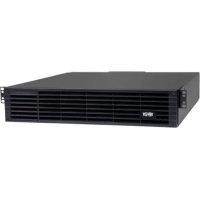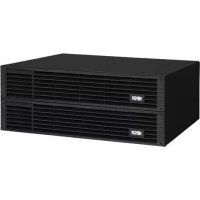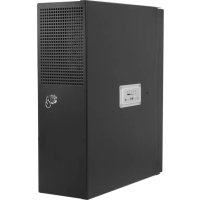
DMBB110V - Battery Tripp Lite - Free user manual and instructions
Find the device manual for free DMBB110V Tripp Lite in PDF.


User questions about DMBB110V Tripp Lite
0 question about this device. Answer the ones you know or ask your own.
Ask a new question about this device
Download the instructions for your Battery in PDF format for free! Find your manual DMBB110V - Tripp Lite and take your electronic device back in hand. On this page are published all the documents necessary for the use of your device. DMBB110V by Tripp Lite.
USER MANUAL DMBB110V Tripp Lite
HC350S, HC350S1 Series Power Module Application Guidelines
Series AGSM5396
SAVE THESE INSTRUCTIONS - This manual contains IMPORTANT SAFETY INSTRUCTIONS for that should be followed during installation and maintenance of the UPS and batteries.
The HC350S and HC350S1 series of hospital cart power modules are designed to provide AC voltage output power from either utility provided AC input voltage or from inverting 12VDC power from a sealed lead acid battery. To ensure proper operation the following guidelines should be observed:
-
The power module can support AC loads up to a maximum of 400VA or 300W.
-
The power module charger is intended to be used with a 12V sealed lead acid absorbed glass mat (AGM) battery with a 33AH to 66AH rating. Batteries rated at less than 33AH are not recommended since the charger current of 12A would reduce the battery cycle life of smaller batteries.
-
Adequate provision for airflow needs to be provided at both the inlet and outlet vents of the power module. There should be at least 0.5 inches of clear space on the fan end and on the vented end of the power module. A baffle or air deflector is recommended at the fan end so that the air intake is raised at least 6 inches above floor level to prevent dust accumulation inside the power module.
-
The power module may be mounted in any orientation. Four 8-32 threaded inserts are provided on the surface with the AC input cord to facilitate mounting.
-
The AC voltage input and output connections are made with user supplied cables to the IEC input and output connectors on the power module. Use only with approved plug/cord sets according to the equipment electrical ratings. No external fusing is needed since safe operation is assured by internal non-replaceable 10A fuses. However, if a customer wishes to prevent the internal fuses from blowing in the event of an extreme overload, then an external fuse or circuit breaker rated at 6A to 10A (120VAC models) or 3A to 5A (230V models) should be provided on the AC voltage input.
-
The 12V battery input is made with a user supplied cable to the Anderson DC connector on the power module. Proper polarity must be observed. The recommended wire size is 8 AWG in order to keep the voltage drop in the cable to less than 0.1V. The length of cable between the battery and the power module should be less than 30 inches. A user supplied 40A to 50A automotive style fuse is required in the positive lead of the battery (within 18 inches of the battery positive terminal).
-
Additional bonding is needed to connect the battery negative terminal to the case of the power module. The wire (or metal frame of the cart) should be short (less than 18 inches) and preferably of the same gauge as the other battery wires
(although a minimum gauge of 16 AWG has been acceptable). This bonding connection is necessary to prevent internal damage to the power module in the event of any accidental reversed polarity connections or accidental connections between the battery positive wiring and the case of the power module.
-
A Remote User Interface (RUI) module must be connected to the power module using two CAT-5 cables. The COMM1 jacks should be connected together and the COMM2 jacks should be connected together. If the cables are not connected or if they are interchanged, the power module will not operate. The RUI may be either a Tripp Lite RUI or a customer designed RUI that meets Tripp Lite specifications.
-
The power module includes a low voltage cutoff (LVC) function that will remove any load on the battery when the battery is depleted. The LVC level is about 10.5V to assure optimum battery cycle life. If any other DC loads are present in the system, they need to include their own LVC function in order to prevent damage to the battery due to over discharge.
-
The power module will not turn on unless connected to a battery that has a voltage greater than 9.6V. If the battery voltage is less than 9.6V, it is assumed to be defective and the charger is inhibited in order to prevent possible outgassing of the battery.
-
The power module reports % Battery Capacity through its USB port. For HC350S, this data is most accurate when a 55Ah sealed lead acid absorbed glass mat (AGM) battery is used. For HC350S1, this data is most accurate when two 33AH sealed lead acid absorbed glass mat (AGM) batteries are used. Batteries of other capacities may be used, but the accuracy of the % Battery Capacity report will be reduced.
-
After connecting a battery to the power module, the power module should be allowed to charge the battery to full capacity in order to initialize the % Battery Capacity report and the % Battery Capacity LED's (on the RUI). This will take at least 4 hours, even with fresh battery. The % Battery Capacity report and LEDs will not be accurate until after the initial charge has been completed. After initialization, the power module will properly indicate the % Battery Capacity as the battery is repeatedly discharged and recharged. However, each time the battery is replaced, the initialization will need to be repeated.
-
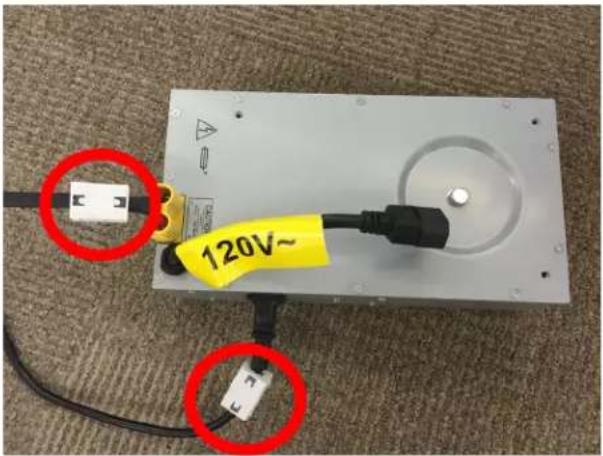
For IEC 60601-1 4^th edition compliance, external clamps as circled (shipped loose with the power module) need to be installed to the DC input and the AC output as shown:

1111 W. 35th Street • Chicago, IL 60609
Tel:773.869.1111Fax:773.869.1329
www.triplite.com