GEX 346N Professional - Sander BOSCH - Free user manual and instructions
Find the device manual for free GEX 346N Professional BOSCH in PDF.




| Product type | Random orbital sander |
| Brand | Bosch |
| Model | GEX 346N Professional |
| Sanding disc diameter | 150 mm (6 inches) |
| Orbit diameter | 2 mm (5/64 inch) |
| Variable speed | Yes (6 positions, from 1 (slow) to 6 (fast)) |
| Abrasive attachment system | Hook-and-loop (Velcro) |
| Dust extraction | Integrated micro-filter dust container; compatible with external vacuum |
| Removable front handle | Yes |
| Lock-on button | Yes |
| Dial speed variator | Yes |
| Backing pad damping ring | Yes, integrated |
| Compatible backing pads | Soft, medium, hard (multi-hole, 150 mm) |
| Power supply | Mains (cable with plug) |
| Protection class | Class II (double insulation) |
| Included accessories | Micro-filter dust container, sanding disc, 5 mm hex key, adapter for vacuum cleaner VAC024 |
| Optional accessories | Additional backing pads (RSM6044 soft, RSM6045 medium, RSM6046 hard), polishing foam pad, polishing bonnet, replacement damping ring, vacuum hoses |
| Maintenance | Regular cleaning of the container and micro-filter; do not wash the micro-filter with water; check brushes every 2 to 6 months; lubricate gears when changing brushes |
| Safety | Disconnect before changing any accessory or cleaning; use PPE (safety glasses, dust mask, hearing protection); do not wet sand |
| Warranty | 1 year (parts and labor) for the original purchaser; limited warranty |
Frequently Asked Questions - GEX 346N Professional BOSCH
User questions about GEX 346N Professional BOSCH
0 question about this device. Answer the ones you know or ask your own.
Ask a new question about this device
Download the instructions for your Sander in PDF format for free! Find your manual GEX 346N Professional - BOSCH and take your electronic device back in hand. On this page are published all the documents necessary for the use of your device. GEX 346N Professional by BOSCH.
USER MANUAL GEX 346N Professional BOSCH
| Safety Symbols The definitions below describe the level of severity for each signal word. Please read the manual and pay attention to these symbols. | |
| This is the safety alert symbol. It is used to alert you to potent personal injury hazards. Obey all safety messages that follow this symbol to avoid possible injury or death. | |
| DANGER | DANGER indicates a hazardous situation which, if not avoided, will result in death or serious injury. |
| WARNING | WARNING indicates a hazardous situation which, if not avoided, could result in death or serious injury. |
| CAUTION | CAUTION indicates a hazardous situation which, if not avoided, could result in minor or moderate injury. |
General Power Tool SafetyWarnings
WARNING
Read all safety warnings, instructions, illustrations and specifications provided with this power tool. Failure to follow all instructions listed
below may result in electric shock, fire and/or serious injury.
SAVE ALL WARNING AND INSTRUCTIONS FOR FUTURE REFERENCE
The term "power tool" in the warnings refers to your mains-operated (corded) power tool or battery-operated (cordless) power tool.
1. Work area safety
a. Keep work area clean and well lit. Cluttered or dark areas invite accidents.
b. Do not operate power tools in explosive atmospheres, such as in the presence of flammable liquids, gases or dust. Power tools create sparks which may ignite the dust or fumes.
c. Keep children and bystanders away while operating a power tool. Distractions can cause you to lose control.
2. Electrical safety
a. Power tool plugs must match the outlet. Never modify the plug in any way. Do not use any adapter plugs with earthed (grounded) power tools. Unmodified plugs and matching outlets will reduce risk of electric shock.
b. Avoid body contact with earthed or grounded surfaces such as pipes, radiators, ranges and refrigerators. There is an increased risk of electric shock if your body is earthed or grounded.
c. Do not expose power tools to rain or wet conditions. Water entering a power tool will increase the risk of electric shock.
d. Do not abuse the cord. Never use the cord for carrying, pulling or unplugging the power tool. Keep cord away from heat, oil, sharp edges or moving parts. Damaged or entangled cords increase the risk of electric shock.
e. When operating a power tool outdoors, use an extension cord suitable for outdoor use. Use of a cord suitable for outdoor use reduces the risk of electric shock.
f. If operating a power tool in a damp location is unavoidable, use a Ground Fault Circuit Interruption (GFCI) protected supply. Use of an GFCI reduces the risk of electric shock.
3. Personal safety
a. Stay alert, watch what you are doing and use common sense when operating a power tool. Do not use a power tool while you are tired or under the
influence of drugs, alcohol or medication. A moment of inattention while operating power tools may result in serious personal injury.
b. Use personal protective equipment. Always wear eye protection. Protective equipment such as dust mask, non-skid safety shoes, hard hat, or hearing protection used for appropriate conditions will reduce personal injuries.
c. Prevent unintentional starting. Ensure the switch is in the off-position before connecting to power source and / or battery pack, picking up or carrying the tool. Carrying power tools with your finger on the switch or energizing power tools that have the switch on invites accidents.
d. Remove any adjusting key or wrench before turning the power tool on. A wrench or a key left attached to a rotating part of the power tool may result in personal injury.
e. Do not overreach. Keep proper footing and balance at all times. This enables better control of the power tool in unexpected situations.
f. Dress properly. Do not wear loose clothing or jewelry. Keep your hair, clothing and gloves away from moving parts. Loose clothes, jewelry or long hair can be caught in moving parts.
h. Do not let familiarity gained from frequent use of tools allow you to become complacent and ignore tool safety principles. A careless action can cause severe injury within a fraction of a second.
4. Power tool use and care
a. Do not force the power tool. Use the correct power tool for your application. The correct power tool will do the job better and safer at the rate for which it was designed.
b. Do not use the power tool if the switch does not turn it on and off. Any power tool that cannot be controlled with the switch is dangerous and must be repaired.
c. Disconnect the plug from the power source and/or the battery pack from the power tool before making any adjustments, changing accessories, or storing power tools. Such preventive safety measures reduce the risk of starting the power tool accidentally.
d. Store idle power tools out of the reach of children and do not allow persons unfamiliar with the power tool or these instructions to operate the power tool. Power tools are dangerous in the hands of untrained users.
e. Maintain power tools. Check for misalignment or binding of moving parts, breakage of parts and any other condition that may affect the power tool's operation. If damaged, have the power tool repaired before use. Many accidents are caused by poorly maintained power tools.
f. Keep cutting tools sharp and clean. Properly maintained cutting tools with sharp cutting edges are less likely to bind and are easier to control.
g. Use the power tool, accessories and tool bits etc. in accordance with these instructions, taking into account the working conditions and the work to be performed. Use of the power tool for operations different from those intended could result in a hazardous situation.
h. Keep handles and grasping surfaces dry, clean and free from oil and grease. Slippery handles and grasping surfaces do not allow for safe handling and control of the tool in unexpected situations.
5. Service
a. Have your power tool serviced by a qualified repair person using only identical replacement parts. This will ensure that the safety of the power tool is maintained.
a. Hold power tool by insulated gripping surfaces, when performing an operation where the sanding disk may contact its own cord. Sanding disk contacting a "live" wire may make exposed metal parts of the power tool "live" and could give the operator an electric shock.
b. Unplug the sander before changing accessories. Accidental start-ups may occur if sander is plugged in while changing an accessory.
c. If your tool is equipped with a dust bag, empty it frequently and after completion of sanding. Be extremely careful of dust disposal, materials in fine particle form may be explosive. Do not throw sanding dust on an open fire. Spontaneous combustion may, in time, result from mixture of oil or water with dust particles.
d. Always wear eye protection and a dust mask for dusty applications and when sanding overhead. Sanding particles can be absorbed by your eyes and inhaled easily and may cause health complications.
e. Use special precautions when sanding chemically pressure treated lumber, paint that may be lead based, or any other materials that may contain carcinogens. A suitable breathing respirator and protective clothing must be worn by all persons entering the work area. Work area should be sealed by plastic sheeting and persons not protected should be kept out until work area is thoroughly cleaned.
f. Do not wet sand with this sander. Liquids entering the motor housing is an electrical shock hazard.
g. Do not use PSA pad on random orbit sanders whose speed exceeds 12,000/min. Exceeding the maximum operating speed of pad may cause pad to rupture or fly apart during use striking user or bystanders.
h. Do not use sandpaper intended for larger sanding pads. Larger sandpaper will extend beyond the sanding pad causing snagging, tearing of the paper or kick-back. Extra paper extending beyond the sanding pad can also cause serious lacerations.
i. Be aware of the location and setting of the Switch "Lock-ON" Button. If the switch is locked "ON", be ready for emergency situations to switch it "OFF", by first pulling the trigger then immediately releasing it without pressing the "Lock-ON" button.
j. Clamp or secure workpiece when sanding. Clamping the workpiece prevents it from being ejected from under the sander and leaves both hands to control the tool.
k. Keep the cord away from the spinning pad and sandpaper. The cord can become entangled with the pad.
GFCI and personal protection devices like electrician's rubber gloves and footwear will further enhance your personal safety.
Do not use AC only rated tools with a DC power supply. While the tool may appear to work, the electrical components of the AC rated tool are likely to fail and create a hazard to the operator.
Keep handles dry, clean and free from oil and grease. Slippery hands cannot safely control the power tool.
Develop a periodic maintenance schedule for your tool. When cleaning a tool be careful not to disassemble any portion of the tool since internal wires may be misplaced or pinched or safety guard return springs may be improperly mounted. Certain cleaning agents such as gasoline, carbon tetrachloride, ammonia, etc. may damage plastic parts.
Risk of injury to user. The power cord must only be serviced by a Bosch Factory Service Center or Autho rized Bosch Service Station.
WARNING Some dust created by power sanding, sawing, grinding, drilling, and other construction activities contains chemicals known to cause cancer, birth defects or other reproductive harm. Some examples of these chemicals are:
- Lead from lead-based paints,
- Crystalline silica from bricks and cement and other masonry products, and
- Arsenic and chromium from chemically-treated lumber.
Your risk from these exposures varies, depending on how often you do this type of work. To reduce your exposure to these chemicals: work in a well ventilated area, and work with approved safety equipment, such as those dust masks that are specially designed to filter out microscopic particles.
Symbols
Important: Some of the following symbols may be used on your tool. Please study them and learn their meaning. Proper interpretation of these symbols will allow you to operate the tool better and safer.
| Symbol Designation/Explanation | |
| V Volts (voltage) | |
| A Amperes (current) | |
| Hz Hertz (frequency, cycles per second) | |
| W Watt (power) | |
| kg Kilograms (weight) | |
| min Minutes (time) | |
| s Seconds (time) | |
| ∅ | Diameter (size of drill bits, grinding wheels, etc.) |
| n0 | No load speed (rotational speed at no load) |
| n Rated | speed (maximum attainable speed) |
| ../min | Revolutions or reciprocation per minute (revolutions, strokes, surface speed, orbits etc. per minute) |
| 0 Off position (zero speed, zero torque...) | |
| 1, 2, 3, ... I, II, III, | Selector settings (speed, torque or position settings. Higher number means greater speed) |
| 0 | Infinitely variable selector with off (speed is increasing from 0 setting) |
| → | Arrow (action in the direction of arrow) |
| ~ | Alternating current (type or a characteristic of current) |
| - | Direct current (type or a characteristic of current) |
| ~ | Alternating or direct current (type or a characteristic of current) |
| □ | Class II construction (designates double insulated construction tools) |
| ⊕ | Earthing terminal (grounding terminal) |
Symbols
Important: Some of the following symbols may be used on your tool. Please study them and learn their meaning. Proper interpretation of these symbols will allow you to operate the tool better and safer.
| Symbol Designation / Explanation | |
| Alerts user to read manual | |
| Alerts user to wear eye protection | |
| Alerts user to wear respiratory protection | |
| Alerts user to wear hearing protection | |
| This symbol designates that this tool is listed by Underwriters Laboratories. | |
| cULUS | This symbol designates that this tool is listed by Underwriters Laboratories, to United States and Canadian Standards. |
| SA | This symbol designates that this tool is listed by the Canadian Standards Association. |
| CSUS | This symbol designates that this tool is listed by the Canadian Standards Association, to United States and Canadian Standards. |
| CUTTER | This symbol designates that this tool is listed by the Intertek Testing Services, to United States and Canadian Standards. |
| Intertek | This symbol designates that this tool complies to NOM Mexican Standards. |
| NOMANCE | Designates Li-ion battery recycling program |
Functional Description and Specifications

Disconnect the plug from the power source before making any assembly, adjustments or changing accessories. Such preventive safety
measures reduce the risk of starting the tool accidentally.
Random Orbit Sander
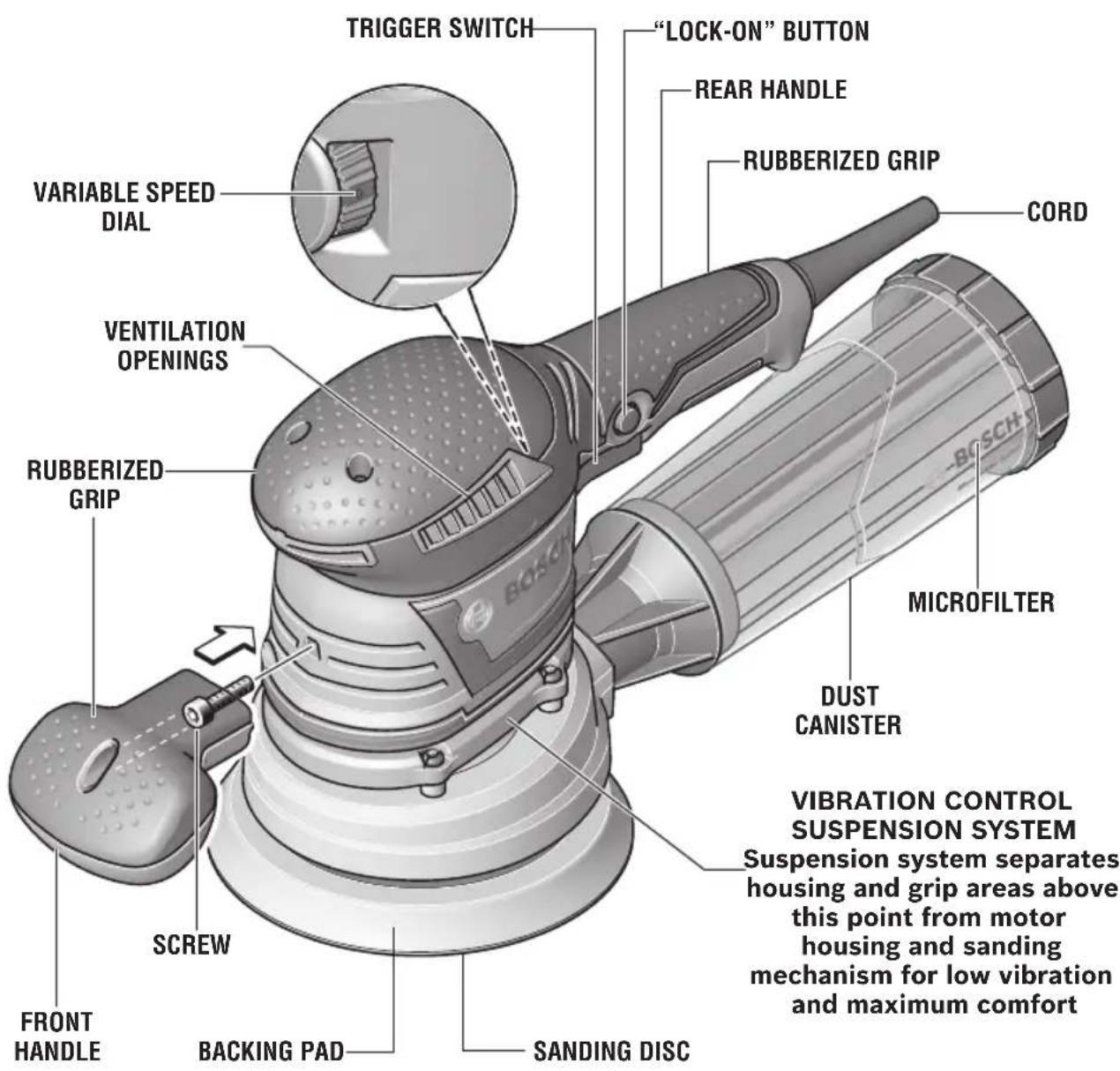
FIG.1
MAXIMUM CAPACITIES
Pad diameter 6" (150 mm) Sanding disc diameter 6" (150 mm)
NOTE: For tool specifications refer to the nameplate on your tool.
Backing Pad Installation
The random orbit sander is equipped with a backing pad of medium hardness, which is suitable for general service. Hard and extra-soft pads are available for other purposes, and in general are used as follows;
Soft pad - Polishing or sanding large or curved surfaces.
Medium pad - All purpose general sanding and polishing.
Hard pad - Heavy sanding on flat surfaces, especially with coarser abrasives.
This sander is unique in that it can accept either 5'' or 6'' (Bosch) pads.
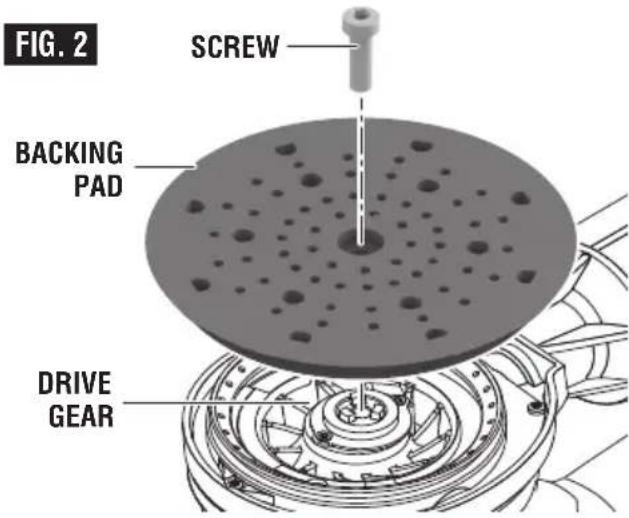
To change backing pad, hold pad firmly and remove the screw using a 5mm hex wrench that secures the backing pad and remove old pad. Align new pad over drive gear on drive spindle. Attention: always be sure the teeth on the drive gear engage into the openings on the backing pad. Replace screw and securely tighten. Damaged or worn backing pads must be replaced immediately (Fig. 2).
Installing Accessories
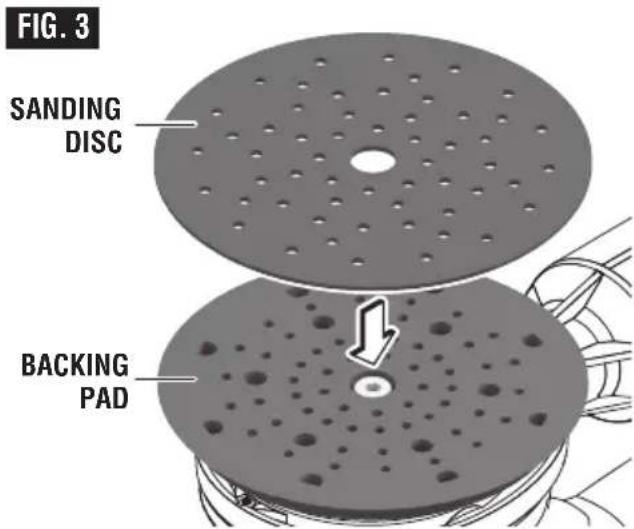
The random orbit sander uses hook-and-loop backed accessories, which firmly grip the pad when applied with moderate pressure. To change the accessory, merely peel off the old accessory, remove dust from the pad if necessary, and press the new accessory in place (Fig. 3). Be sure to align the sanding disc holes with the holes in the backing pad to allow the dust extraction system to function.
After considerable service the pad surface will become worn, and the pad must be replaced when it no longer offers a firm grip. If you are experiencing premature wearout of the pad hooks, it may be due to pressure being applied to the tool during operation.
Front Handle
Your sander is equipped with a removable front handle when sanding in tight quarters. To remove handle, remove screw with 5mm hex wrench. Always reinstall handle for normal operation (Fig. 1).
Depending on the task, you may grip the rear handle alone, the rear handle and the front handle, or the rear handle and the top of the ergonomically contoured soft grip motor housing, which is designed for that purpose.
Assembly
Backing Pad Damper
Your tool is equipped with an integrated backing pad damper ring. This damper reduces the no-load speed, which helps prevent swirl marks on the workpiece surface and provides uniform finishing.
NOTE: If you notice steadily increasing no-load speed, this indicates that the damper ring is worn and needs to be replaced.
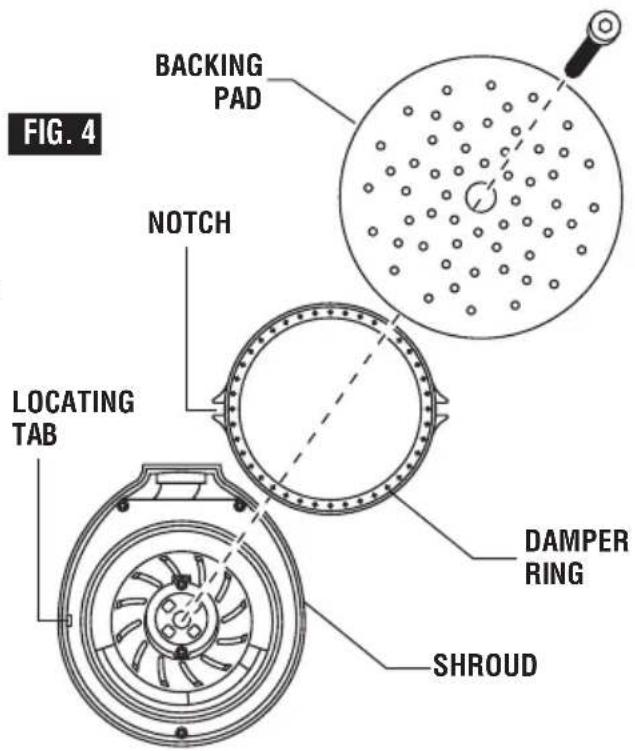
To replace damper ring, remove backing pad as described in "Backing Pad Installation" and remove worn damper ring by pulling firmly out of locating groove. Align notch on damper ring with locating tab on shroud and depress ring with thumbs until shroud seats into groove completely around ring (Fig. 4).
Re-attach backing pad as described in "Backing Pad Installation".
IMPORTANT: Ring should not have bends or ripples when correctly seated.
Dust Collection
Microfilter Dust Canister
The integral dust extraction system collects sanding dust in canister supplied with your sander. For maximum efficiency, the dust canister should be emptied frequently during operation.
WARNING
Your tool is equipped with a dust canister;
empty it frequently after completion of sanding and before storing the sander. Be extremely careful of dust disposal, materials in fine particle form may be explosive. Do not throw sanding dust on an open fire. Combustion from mixture of varnishes, lacquers, polyurethane, oil or water with dust particles can occur if there is a static discharge, spark introduced in the box, or excessive heat.
Dust Collection
REMOVING AND INSTALLING DUST CANISTER
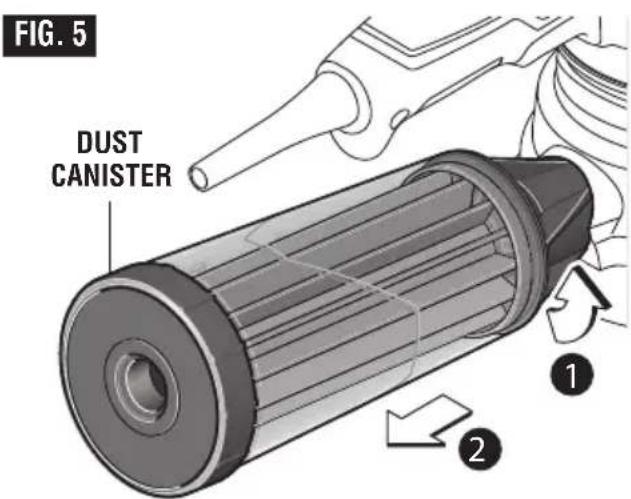
To remove dust canister: Twist the dust canister and simply pull away from the tool (Fig. 5).
To install dust canister: align dust port with hole in canister and push canister onto tool until it locks into place (Fig. 6).
CLEANING AND EMPTYING THE DUST CANISTER
The dust canister is transparent which will allow you to easily see when empting and cleaning is requires.
To empty dust the canister: screw off and remove microfilter from the dust canister. Empty dust canister (Fig. 7).
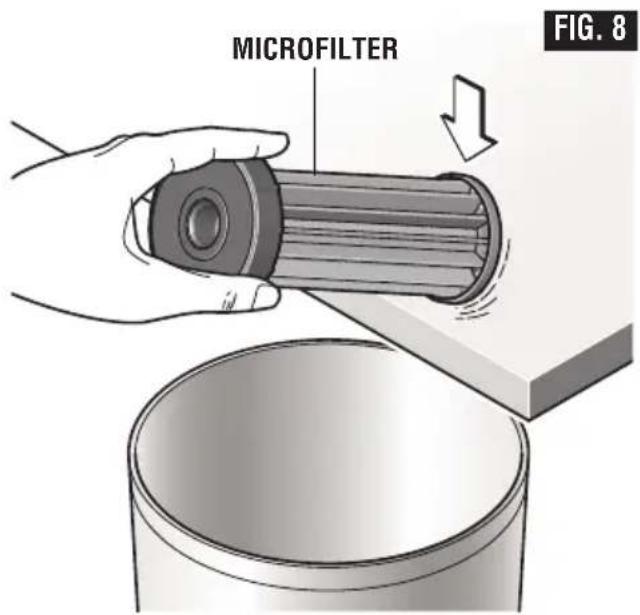
It is recommended to loosen dust from the microfilter by gently striking it against a solid surface (Fig. 8).
Knock excess dust out of the microfilter, or remove dust with your fingers or a soft brush. You may notice that all the dust may not come out of the canister. This will not affect sanding performance but will reduce dust collection efficiency.
NOTE: Do not wash the microfilter with soap and water. Dust may become more firmly lodged in the pores, which will reduce dust collection, and damage the micro filter.
To ensure optimum dust extraction, empty and clean the canister and microfilter frequently.


Attaching a vacuum cleaner
Dust collection can also be achieved by attaching the tool to a vacuum cleaner / dust extractor, hose and adapter, if necessary (all sold separately).
- Attach the hose to the vacuum cleaner / dust extractor.
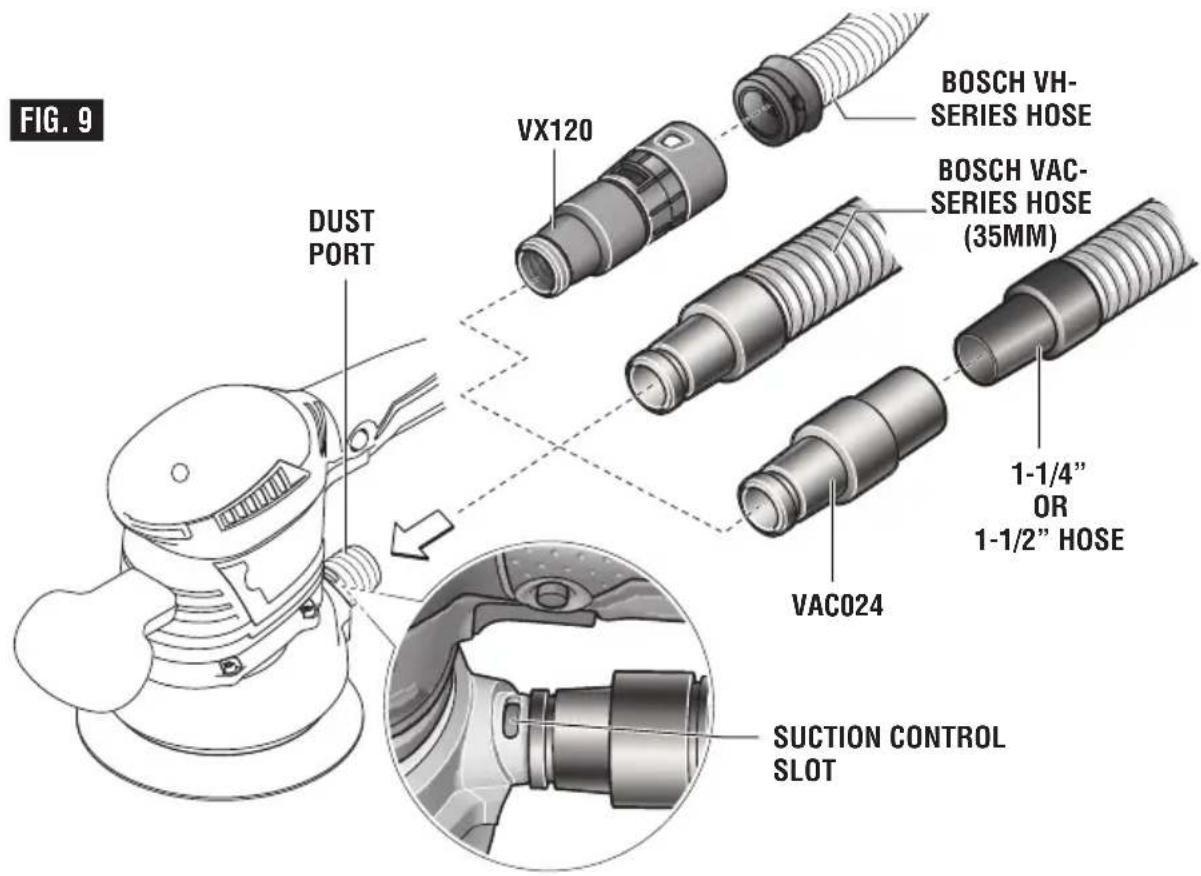
- Attach the hose to the tool's dust port in one of the following ways (Fig. 9):
- Bosch VH-series hoses - The VX120 hose adapter is required (included with VH-series hoses).
- Other 35mm and 22mm hoses, such as the Bosch VAC-series hoses - Connect hose directly to the tool.
- Common 1-1/4" or 1-1/2" hoses - The Bosch VAC024 adapter is required.
Suction control
When using a vacuum hose with this sander the amount of suction can be adjusted by sliding the hose over or off the open slot in the hose port area on the sander.
The vacuum cleaner must be suitable for the material being sanded.
When vacuuming dry dust that is especially detrimental to health or may be carcinogenic, use a special vacuum cleaner.
When sanding on vertical surfaces, hold the power tool in such a manner that the vacuum hose faces downward.
Operating Instructions
Trigger "ON-OFF" Switch
To turn the tool "ON" squeeze the trigger switch. To turn the tool "OFF", release the trigger switch, which is spring loaded and will return to the "OFF" position automatically (Fig. 1).
See START OF SANDING on page 14.
"LOCK-ON" BUTTON
The "Lock-ON" button, located near the trigger allows for continuous operation at maximum OPM without holding the trigger (Fig. 1).
TO LOCK TRIGGER "ON": squeeze trigger, depress button and release trigger.
TO UNLOCK THE TRIGGER: squeeze trigger and release it without depressing the "LockON" button.
WARNING
If the "Lock-ON" button is continuously being
depressed, the trigger can not be released.
VARIABLE SPEED WITH DIAL SETTING
Your sander is also equipped with a variable speed dial (Fig. 1). The sander's orbital pad speed can be preset from zero to maximum nameplate OPM by rotating the dial in the housing. The dial may be set on or between any of six positions (1=low through 6=high). The following table may be used as a general guide for abrasive and backing pad selection, but the best results will be obtained by sanding a test sample of the workpiece first.
Material
Switch setting
Backing pad
Grit size
rough/finish rough/finish
Woods:
softwoods 4/6 soft 60/240
hardwoods 4 / 6 medium 60 / 180
veneers 4 medium 240/320
Metals:
steel 4 medium 60 / 240
stainless 4 medium 120/240
aluminum 4/6 medium 80/240
rust spots 6 soft 60/120
Paintwork:
sanding 2/3 medium 180/400
scratches 4/6 hard 120/240
stripping 4 medium 40/60/80
Tool Tips
Selecting Sanding Discs
Open-coat aluminum oxide sanding discs are recommended for most wood or metal sanding applications, as this synthetic material cuts quickly and wears well. Some applications, such as plastics, glass, or stone require silicon carbide discs, which have a very sharp cutting edge. For best results, use Bosch sanding and polishing accessories, which are of superior quality and are carefully selected to produce professional quality results with your sander.
An alternative to standard sanding discs is to use a SandNet™ connection pad and SandNet™ mesh sanding discs.
Start of Sanding
With the workpiece firmly secured, first place the sander's pad on the work surface, then switch the tool on.
DO NOT start the tool and bring it up to speed before applying to the work
DO NOT apply excessive pressure when switch the tool on (or at any other time)
Either method will likely create swirl marks.
Applying excessive pressure upon start-up will also shorten the life of the switch.
Sanding Action
This sander has optimized random sanding action. The pad orbits and rotates freely, duplicating natural hand sanding action for aggressive stock removal and smooth, well-blended surface finish. The orbit offset for this tool is 2mm (5/64")
In general, higher speeds will give the best results. If faster removal is desired, DO NOT APPLY PRESSURE ON THE TOOL; use a coarser grade of abrasive. Move the sander in long sweeping strokes, parallel to the grain using some lateral motion to overlap the strokes by as much as 75% . The random orbit action allows cross-grain sanding, but be careful not to tilt the sander near edges, or undesirable rounding may result.
Sanding Sequence
If the surface is rough, begin with coarser grits and then complete the surfacing with
medium and fine abrasives. Because the random orbit action is so effective, it is often possible to begin sanding with a medium grit disc and go directly to fine finishing. To avoid uneven results, do not skip more than one grit size when going from coarser to finer, and do not sand in one area for too long.
Removal of Sander
To help prevent swirl marks when the job is completed, gently lift the tool from the work surface, then switch the tool off.
Operating in this manner will also prolong the switch life.
Polishing
For most polishing, the extra-soft backing pad will give the best results. The random orbit sander may be fitted with an optional foam buffing pad or polishing bonnet to polish or remove scratches from painted or finished surfaces, plastics, and even glass. The tool is operated in much the same way as when sanding, but the following points should be observed;
Apply the compound to the surface, and use the sponge applicator pad with light pressure and a circular motion to remove scratches and restore weathered finishes. Use only as much compound as necessary, and clean the sponge frequently during use. When initial polishing is completed, wipe away any excess compound with a soft towel, and then polish the surface to its final finish with the polishing bonnet. Use smooth overlapping strokes for best results. It is important to note that the orbit speed of the random orbit sander is not the same as the RPM of a standard right-angle polisher. The random orbit action is much like a powerful hand polishing action, and therefore does not have the high speeds at the edge of the pad which can burn the work surface. For this reason, it is possible to select a higher OPM for the random orbit sander than the recommended RPM for a standard polisher. Practice on a hidden area or test surface until you have determined the tool is suitable for your polishing application.
Clean the buffing pad and polishing bonnet with mild detergents and warm water. DO NOT use solvents.
Maintenance

To avoid accidents always dis connect the tool from the power supply before cleaning or performing any main tenance.
Service
WARNING
Preventive maintenance performed by
unauthorized per so n nel may result in misplacing of internal wires and components which could cause serious hazard. We recommend that all tool service be performed by a Bosch Factory Service Center or Autho rized Bosch Service Station.
Tool Lubrication
Your Bosch tool has been properly lubricated and is ready to use. It is recommended that tools with gears be regreased with a special gear lubricant at every brush change.
Carbon Brushes
The brushes and commutator in your tool have been engineered for many hours of dependable service. To maintain peak efficiency of the motor, we recommend every two to six months the brush es be examined. Only genuine Bosch replace ment brushes specially designed for your tool should be used.
Bearings
Bearings which become noisy (due to heavy load or very abrasive material cutting) should be replaced at once to avoid overheating or motor failure.
Cleaning
CAUTION
Certain cleaning agents and sol vents damage
plastic parts. Some of these are: gasoline, carbon tetrachlo ride, chlo rinated cleaning solvents, ammonia and house hold detergents that contain ammonia.
Ventilation openings and switch levers must be kept clean and free of foreign matter. Do not attempt to clean by inserting pointed objects through openings.
Extension Cords
WARNING
If an extension cord is necessary, a cord with
adequate size conductors that is capable of carrying the current necessary for your tool must be used. This will prevent excessive voltage drop, loss of power or overheating. Grounded tools must use 3-wire extension cords that have 3-prong plugs and receptacles.
NOTE: The smaller the gauge number, the higher the cord capacity.
RECOMMENDED SIZES OF EXTENSION CORDS 120 VOLT ALTERNATING CURRENT TOOLS
| Tool's Ampere Rating | Cord Size in A.W.G. | Wire Sizes in mm2 | ||||||
| Cord Length in Feet Cord | Cord Length in Meters | |||||||
| 25 | 50 | 100 | 150 | 15 | 30 | 60 | 120 | |
| 3-6 | 18 | 16 | 16 | 14 | 0.75 | 0.75 | 1.5 | 2.5 |
| 6-8 | 18 | 16 | 14 | 12 | 0.75 | 1.0 | 2.5 | 4.0 |
| 8-10 | 18 | 16 | 14 | 12 | 0.75 | 1.0 | 2.5 | 4.0 |
| 10-12 | 16 | 16 | 14 | 12 | 1.0 | 2.5 | 4.0 | - |
| 12-16 | 14 | 12 | - | - | - | - | - | - |
Accessories and Attachments
WARNING
The use of any other attachments or acces so ries not specified in this manual may create a hazard.
Store accessories in a dry and temperate environment to avoid corrosion and deterioration.
- Attach the hose to the vacuum cleaner / dust extractor.
-
Attach the hose to the tool's dust port in one of the following ways (Fig. 9):
-
Bosch VH-series hoses - The VX120 hose adapter is required (included with VH series hoses).
- Other 35mm and 22mm hoses, such as the Bosch VAC-series hoses - Connect hose directly to the tool.
- Common 1-1/4" or 1-1/2" hoses - The Bosch VAC024 adapter is required.
Robert Bosch Tool Corporation ("Seller") warrants to the original purchaser only, that all BOSCH portable and benchtop power tools will be free from defects in material or workmanship for a period of one year from date of purchase. SELLER'S SOLE OBLIGATION AND YOUR EXCLUSIVE REMEDY UNDER this Limited Warranty and, to the extent permitted by law, any warranty or condition implied by law, shall be the repair or replacement of parts, without charge, which are defective in material or workmanship and which have not been misused, carelessly handled, or misrepaired by persons other than Seller or Authorized Service Station. To make a claim under this Limited Warranty, you must return the complete portable or benchtop power tool product, transportation prepaid, to any BOSCH Factory Service Center or Authorized Service Station. For Authorized BOSCH Power Tool Service Stations, please refer to your phone directory.
THIS LIMITED WARRANTY DOES NOT APPLY TO ACCESSORY ITEMS SUCH AS CIRCULAR SAW BLADES, DRILL BITS, ROUTER BITS, JIGSAW BLADES, SANDING BELTS, GRINDING WHEELS AND OTHER RELATED ITEMS.
ANY IMPLIED WARRANTYSHALL BE LIMITED IN DURATION TO ONE YEAR FROM DATE OF PURCHASE. SOME STATES IN THE U.S., SOME CANADIAN PROVINCES DO NOT ALLOW LIMITATIONS ON HOW LONG AN IMPLIED WARRANTY LASTS, SO THE ABOVE LIMITATION MAY NOT APPLY TO YOU.
IN NO EVENT SHALL SELLER BE LIABLE FOR ANY INCIDENTAL OR CONSEQUENTIAL DAMAGES (INCLUDING BUT NOT LIMITED TO LIABILITY FOR LOSS OF PROFITS) ASING FROM THE SALE OR USE OF THIS PRODUCT. SOME STATES IN THE U.S. AND SOME CANADIAN PROVINCES DO NOT ALLOW THE EXCLUSION OR LIMITATION OF INCIDENTAL OR CONSEQUENTIAL DAMAGES, SO THE ABOVE LIMITATION OR EXCLUSION MAY NOT APPLY TO YOU.
THIS LIMITED WARRANTY GIVES YOU SPECIFIC LEGAL RIGHTS, AND YOU MAY ALSO HAVE OTHER RIGHTS WHICH VARY FROM STATE TO STATE IN THE U.S., PROVINCE TO PROVINCE IN CANADA AND FROM COUNTRY TO COUNTRY.
THIS LIMITED WARRANTY APPLIES ONLY TO PORTABLE AND BENCHTOP ELECTRIC TOOLS SOLD WITHIN THE UNITED STATES OF AMERICA, CANADA AND THE COMMONWEALTH OF PUERTO RICO. FOR WARRANTY COVERAGE WITHIN OTHER COUNTRIES, CONTACT YOUR LOCAL BOSCH DEALER OR IMPORTER.