Bead - Fan Kichler - Free user manual and instructions
Find the device manual for free Bead Kichler in PDF.


| Product type | Ceiling fan with LED lighting |
| Brand | Kichler |
| Model | Bead |
| Dimensions | Diameter 54 inches (137 cm), height not specified |
| Weight | Approximately 15 kg (35 lb) - max support 50 lb |
| Power supply | 120 V, 60 Hz |
| Number of blades | 3 |
| Speeds | 3 speeds (low, medium, high) |
| Reversible rotation | Yes, via switch on receiver |
| Remote control | Yes, with CR2032 batteries (2 included) |
| Lighting | Integrated LED kit, dimmable via remote |
| Blade material | Not specified (likely composite or wood) |
| Mounting type | Ceiling, with safety cable required in Canada |
| Warranty | Not specified |
| Maintenance | Dry or slightly damp cloth; do not use water or detergent |
| Safety | Disconnect before installation; do not insert objects into blades; keep batteries out of reach of children |
Frequently Asked Questions - Bead Kichler
User questions about Bead Kichler
0 question about this device. Answer the ones you know or ask your own.
Ask a new question about this device
Download the instructions for your Fan in PDF format for free! Find your manual Bead - Kichler and take your electronic device back in hand. On this page are published all the documents necessary for the use of your device. Bead by Kichler.
USER MANUAL Bead Kichler
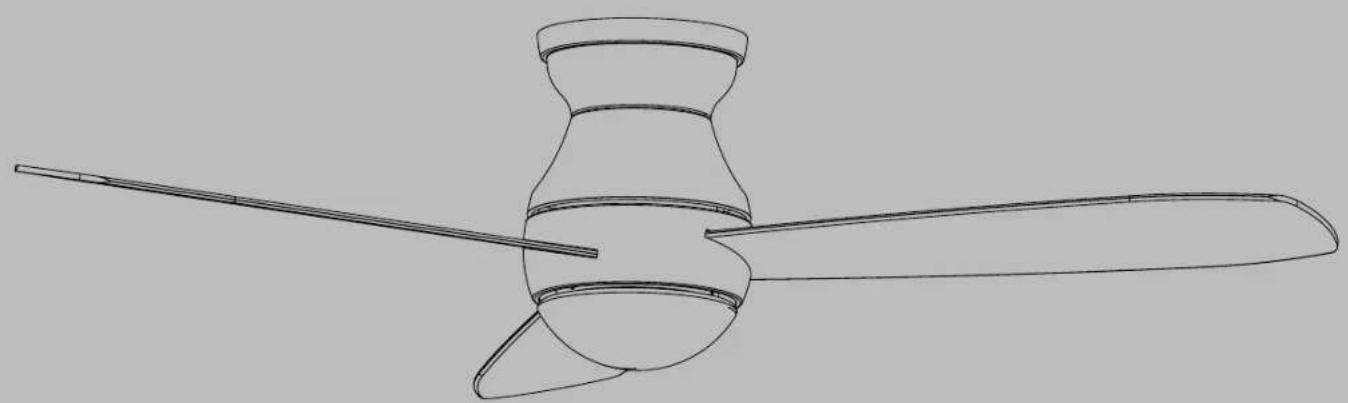
Product images may vary slightly from actual product.
INSTRUCTION MANUAL

TABLE OF CONTENTS
SAFETY RULES 4
TOOLS REQUIRED 5
PACKAGE CONTENTS 5
MOUNTING OPTIONS 6
HANGING THE FAN 7
INSTALLATION OF SAFETY SUPPORT 8
ELECTRICAL CONNECTIONS. 9
FINISHING THE MOTOR INSTALLATION. 10
ATTACHING THE FAN BLADES. 11
INSTALLING THE SWITCH HOUSING. 11
INSTALLING THE LIGHT KIT AND GLASS. 12
OPERATINGINSTRUCTIONS 15
TROUBLESHOOTING 16
FCC INFORMATION 17
SAFETY RULES
READ AND SAVE THESE INSTRUCTIONS
- CAUTION - RISK OF SHOCK - Disconnect Power at the main circuit breaker panel or main fuse box before starting and during the installation.
- WARNING: WARNING: This fixture is intended for ins accordance with the National Electrical Code (NEC) and all local code specifications. If you are not familiar with code requirements, installation by a certified electrician is recommended.
- WARING: WARING: To reduce the risk of fire or electric shock, Do not use water or detergents when cleaning the fan or only the control provided with the fan. fan blades. A dru dust cloth or lightly dampened cloth will
- WARNING:WARNING: To reduce the risk of fire, electric Personal Injury, mount directly to a structural framing member or to an outlet box marked "Acceptable For Fan Support of 15.9kg(35 lbs) or less". For outlet box mounting, use mounting screws provided with the outlet box.
- WARNING: WARNING: Chemical Burn Hazard. Keep batt from children. This remote contains a lithium button cell battery. If a new or used lithium button/coin cell battery is swallowed or enters the body, it can cause severe internal burns and can lead to death in as little as 2 hours. Always completely secure the battery compartment. If the battery compartment does not close securely, stop using the product, remove the batteries, and keep it away from children. If you think batteries might have been swallowed or placed inside any part of the body, seek immediate medical attention. Dispose of cells properly and keep away from children. Even used cells may cause injury.
- WARNING:WARNING: Do not operate reversing switch while blades are in motion. Fan must be turned off and blades stopped before reversing blade direction.
- Avoid placing objects in the path of the blades.
- To avoid personal injury or damage to the fan and other items, be cautions when working around or cleaning the installation.
- Make sure the installation site you choose allows a minimum clearance of 7 feet from the blades to the floor and at least 30 inches from the ends of the blades to any obstruction.
10s do not use water or detergents when cleaning the fan or fan blades. A dry dust cloth or lightly dampened cloth will block persuitable for most cleaning. - After making the electrical connections, spliced conductors should be turned upward and pushed carefully up into outlet box. The wires should spread apart with the ground wire and white(common) wire to one side with the black (load) wire to the other side of the outlet box.
Fig. 1. Electrical diagrams are for reference only. Light kits that are not packed with fan must be ETL Listed and marked suitable for use with the model fan you are installing. Switches must be ETL General Use Switches. Refer to the instructions packaged with the light kits and switches for proper assembly.
TO REDUCE THE RISK OF PERSONAL INJURY. DO NOT BEND TO THE BLADE BRACKETS (ALSO REFERRED TO AS FLANGES) DURING ASSEMBLY OR AFTER INSTALLATION. DO NOT INSERT OBJECTS IN THE PATH OF THE BLADES.
WARNING
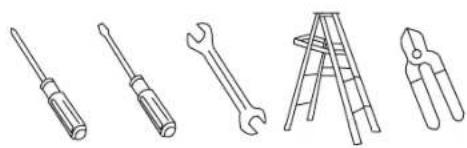
TOOLS REQUIRED
- Phillips screwdriver
- Blade screwdriver
- 11mm wrench
- Step ladder
Wire cutters
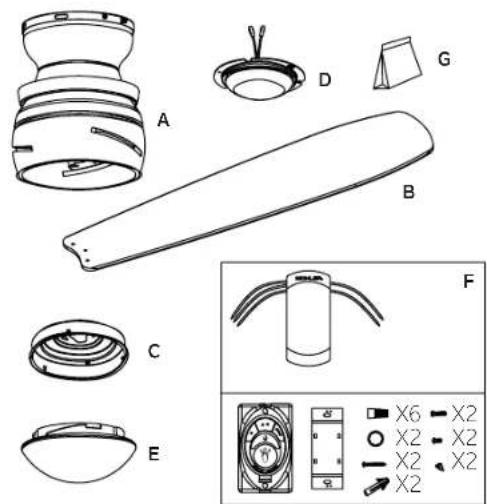
PACKAGE CONTENTS
Unpack your fan and check the contents. You should have the following items:
A. Motor Assembly
G. Package hardware
B. Fan Blade (3)
1) Mounting hardware :
C. Switch Housing
Wire Connector (3)
D.Light Kit
2)Blade attachment hardware :
E. Glass
Screws (9), Washers (9)
F. Remote Control Kit
3) Safety cable hardware:
Wood screw (1), Spring washer (1),
Flat washer (1)
MOUNTING OPTIONS
If there isn't an existing UL (cUL for Canadian Installation) listed mounting box, then read the following instructions. Disconnect the power by removing fuses or turning off circuit breakers.
Secure the outlet box directly to the building structure. Use appropriate fasteners and building materials. The outlet box and its support must be able to fully support the full weight of the fan (up to 50 lbs). Do not use plastic outlet boxes.
Figure 1 and 2 are examples of different ways to mount the outlet box.
NOTE: Depending on the location you have selected for installation, you may need to purchase and install a "Joist Hanger" for the support of the outlet box. Make sure the joist hanger you purchase has been designed for use with ceiling fans. (Fig.3)
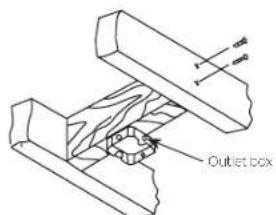
Fig.1
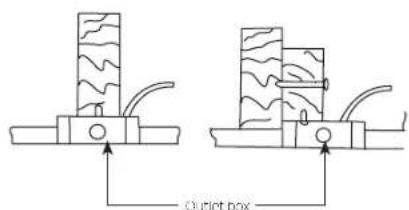
Fig. 2
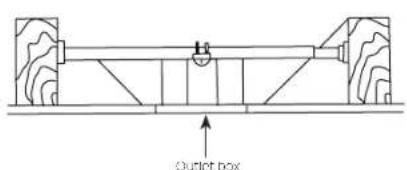
Fig. 3
HANGING THE FAN
REMEMBER to turn off the power before you begin installation. This is necessary for your safety and also the proper programming of the control system. To properly install your ceiling fan, follow the steps below.
Step1.Step 1. Loosen two (one of each across) of the four screws from the ceiling mounting bracket, and remove the other two and keep for later use, then release the ceiling mounting bracket from the motor assembly. (Fig. 4)
Step 2. Step 2. Before attaching fan to outlet box (not included), ensure the outlet box is securely fastened to at least two points to a structural ceiling member (a loose box will cause the fan to wobble). Pass the 120 volt supply wires from the ceiling outlet box through the center of the ceiling mounting bracket. Install mounting bracket to outlet box in ceiling using the screws and washers included with the outlet box. (Fig. 5)
Step 3 Step 3. Hook the motor body onto the ceiling mounting bracket as shown. You can now proceed with the electrical wiring of your fan (Fig. 6)
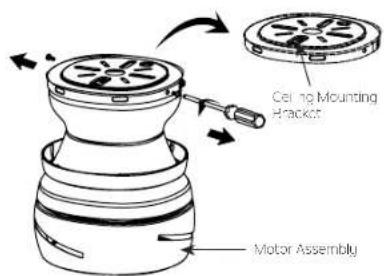
Fig.4
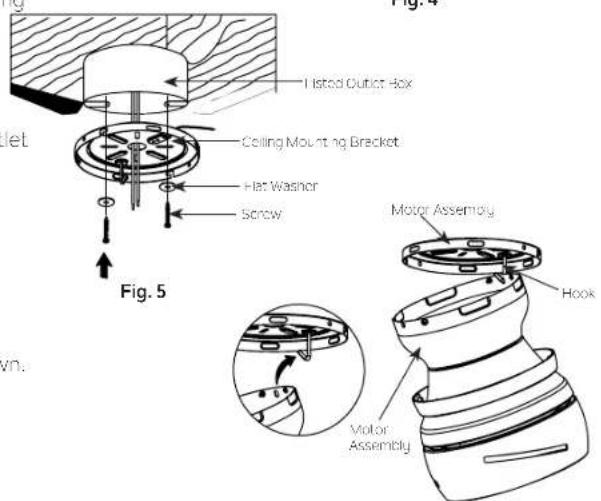
Fig.6
INSTALLATION OF SAFETY SUPPORT (required for Canadian installation ONLY)
A safety support cable is provided to help prevent the ceiling fan from failing, please install it as follows, please install it as follows.
Step 1. Drive a wood screw and washers into the side of the brace that holds the outlet box. Leave 3mm (1/8^ ) of space between the support brace and the washer. (Fig. 7)the washer. (Fig. 7)
Step 2. Insert the safety cable through the mounting bracket and one of the holes in the outlet box into the ceiling. Adjust the length of the safety cable to reach the screw and washers by pulling the extra cable through the cable clamp until the overall length is correct, put the end of the cable back through the cable clamp, forming a loop at the end of the cable. Tighten the cable clamp securely. Now, put the loop in the end of the safety cable over the wood screw and under the washer. Tighten the wood screw securely. (Fig. 8)
NOTE: Although the safety support cable is required for Canadian installations only. It's a good idea to make the attachment with any installation.
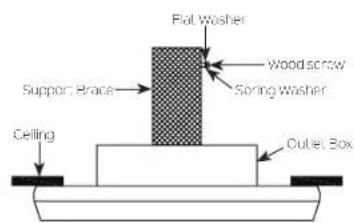
Fig.7
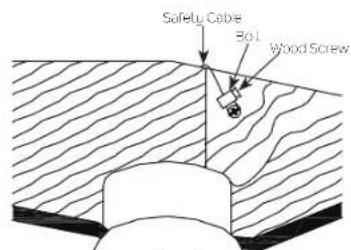
Fig.8
MAKE THE ELECTRICAL CONNECTIONS
WARNING: To avoid possible electrical shock, be sure you have turned off the power at the main circuit panel before wiring. Follow the steps below to connect the fan to your household wiring. Use the wire connecting nuts supplied with your fan. Secure the connector with electrical tape. Make sure there are no loose wire stands or connections.
WARNING: If your house wires are different colors than referenced in this manual, stop immediately. A professional electrician is recommended to determine proper wiring.determine proper wiring.
Step 1. Insert the receiver into the motor assembly, and keep flat in opposition of ceiling. (Fig. 9) of ceiling. (Fig. 9)
Step 2. Motor to Receiver Electrical Connections: Connect the BLACK wire from the fan to BLACK wire marked "TO MOTOR L" from the receiver. Connect the WHITE wire from the fan to the WHITE wire marked "TO MOTOR N" from the receiver. Connect the BLUE wire from the fan to the BLUE wire marked "FOR LIGHT" from the receiver. Secure all the wire connections with the plastic wire connectors provided. (Fig. 10)
Step 3. Remote Receiver to Outlet Box Electrical Connections: Connect the BLACK (hot) wire from the ceiling to the BLACK wire marked "AC IN L" from the receiver. Connect the WHITE (Neutral) wire from the ceiling to the WHITE wire marked "AC IN N" from the receiver. Secure all the wire connections with the plastic wire connectors provided. (Fig. 10)
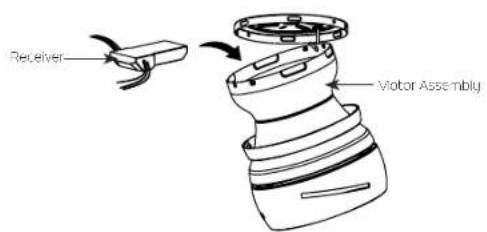
Fig. 9
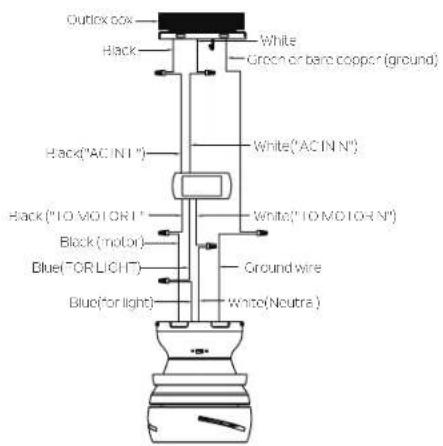
Fig. 10
MAKE THE ELECTRICAL CONNECTIONS
Step 4. If your outlet box has a ground wire (green or bare copper) connect it to the fan ground wires : otherwise connect the fan ground wire to the mounting bracket. Secure the wire connection with a plastic nut provided. After connecting the wires, spread them apart so that the green and white wires are on one side of the outlet box and black and blue wires are on the other side, other side.
NOTE: Carefully tuck the wire connections up into the outlet box.
NOTE: Fan must be installed at a maximum distance of 30 feet from the transmitting unit for proper signal transmission between the transmitting unit and the fan's receiving unit. Unit and the fan's receiving unit.
FINISHING THE MOTOR INSTALLATION
Step 1. Remove the motor assembly from the hook of the ceiling mounting bracket and push up the motor assembly until the two screws on the ceiling mounting bracket are engaged with the slot holes on the canopy of the motor assembly. Rotate the motor assembly slightly until the two screw heads are in the slot holes. Install the two screws previously removed and tighten all four screws. (Fig. 11)
Step 2. Push the canopy trim ring up until it locks into place at the top of the canopy. (Fig. 12)
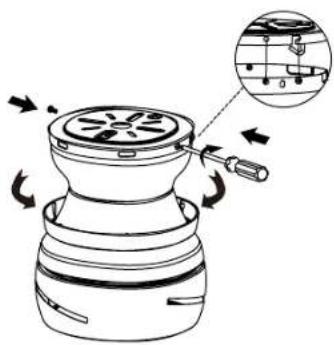
Fig.11
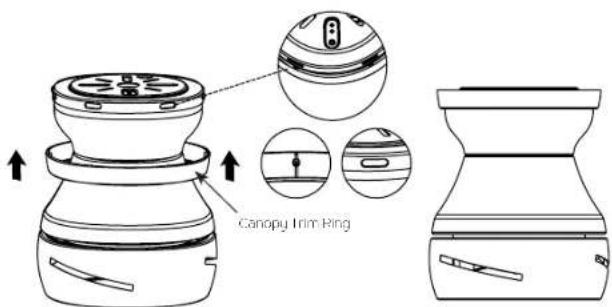
Fig. 12
ATTACHING THE FAN BLADES
Step 1. Insert the blade through the slot on the motor housing, align the holes on the blade and blade bracket, secure with the screws and washers provided. Repeat process with the other blades. (Fig. 13)
INSTALLING THE SWITCH HOUSING
Step 1. Remove the screw marked with a dot label on the mounting plate and save for later use, and slightly loosen the other two screws. Attach the switch housing to mounting plate using the two key slots in the switch housing. Replace the previously removed screw and securely tighten all 3 screws. (Fig. 14;14)
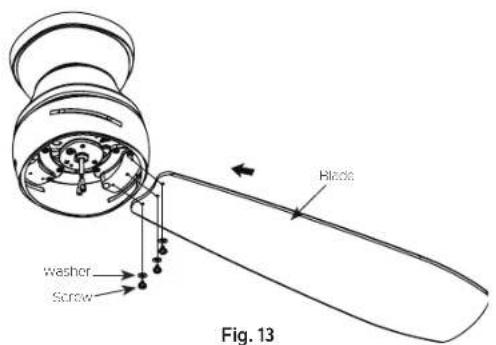
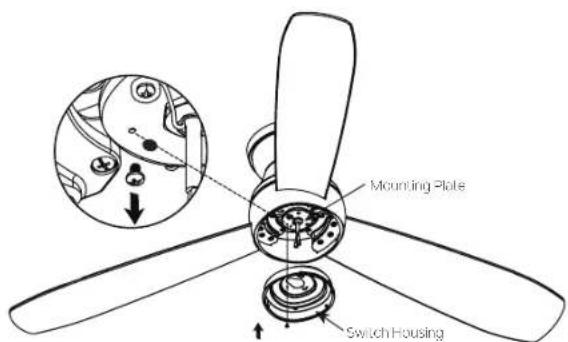
Fig.14
INSTALLING THE LIGHT KIT AND GLASS
NOTE: Before continuing installation, confirm that the power is still turned off at the main circuit breaker or by removing the circuit fuse. Turning the power off using a wall switch is not sufficient to prevent electrical stock.
Step 1. Hold the light kit close to the switch housing and connect the WHITE wires from the light kit and fan by pushing the connectors together. Follow the same procedure with the BLACK wires. (Fig. 15)
Step 2. Tuck the connections neatly into the light kit. Remove one of three screws pre-installed on the switch housing and keep for later use. Loosen the other two (do not remove). Place the two slot holes on the light kit over the 2 screws previously loosened from the switch housing. Rotate the light kit until it locks in place at the narrow end of the key holes. Secure by tightening the 2 screws previously loosened and the one previously removed. (Fig. 15)
Step 3. Secure the glass to light kit assembly and twist clockwise. Do not over-tighten.(Fig.16)
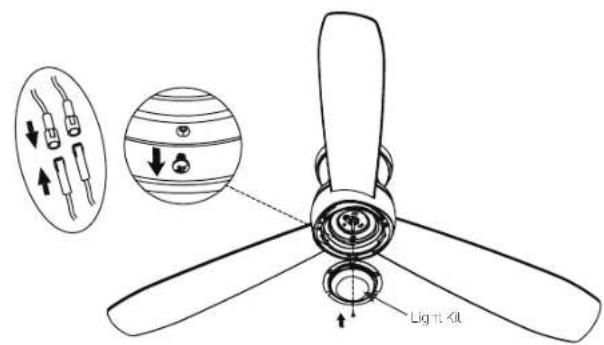
Fig. 15
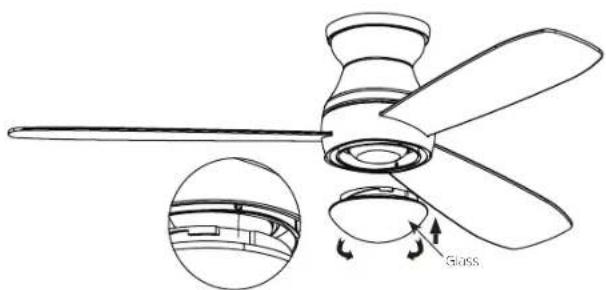
Fig.16
OPERATING INSTRUCTIONS
Step 1. Select a location to install your handset control holder, you could install the holder as shown. (Fig. 17) install the holder as shown. (Fig. 17)
Step 2. Remove the battery cover from the handset control by screwdriver. (Fig.26)(Fig.26)
Step 3. To make fan operational, install two 3V CR2032 batteries (included). (Fig. 19)(Fig. 19)
WARNING: Chemical Burn Hazard. Keep batteries away from children.
NOTE: If not used for long periods of time, remove batteries to prevent damage to the handset control. Store the control away from excessive heat or humidity.
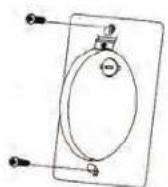
Fig. 17

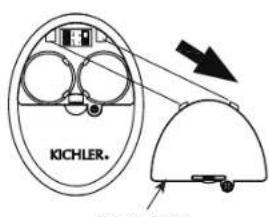
Fig. 18

Fig. 19
OPERATING INSTRUCTIONS
NOTE: Each handset control carries a unique ID code to facilitate communication between paired devices. The ID code is set by factory and is not user changeable. However, you will be required to perform an "ID code learning" process manually under these circumstances:
If you have multiple fans install within a close proximity and want to control all fans using a same handset control, same handset control.
NOTE: Each fan requires its own receiver.
- When your remote control is not responding (make sure battery is not flat)
After you have replaces a faulty transmitter or receiver with a new one.
Otherwise the remote control will not work. To perform this process manually, follow steps below below:
After installing and wiring the unit, restore power to your fan, press and hold the LEARN key for 1-3 seconds, the fan will turn on at medium speed and light (if installed) will turn on. This confirms that the learning process have been completed. This operation must be completed within 30 seconds after restore power to the fan. (Fig. 20)
NOTE: If the fan has fluorescent lighting, slide to "O" position. If the fan is with incandescent or halogen lighting or LED, slide to "D" position. Factory set is on "D" position. (Fig. 20)
Step 4. Replace the battery cover and tighten with screwdriver. (Fig. 20)
Step 5. The buttons control the fan speed and light as follows: (Fig. 21)
| ● | Low speed |
| ●● | Medium speed |
| ●●● | High speed |
| ● | Fan OFF |
| ●● | a.) Light ON/OFF. b.) Press and hold to dim or brighten light to desired level |
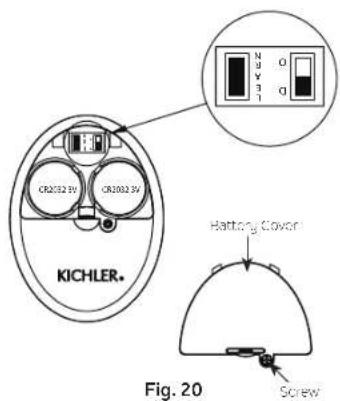
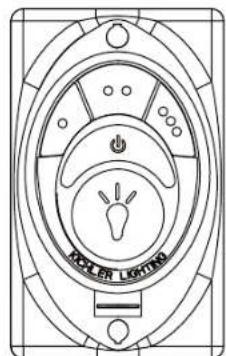
Fig. 21
OPERATING INSTRUCTIONS
REV switch: Controls direction, forward or reverse. (Fig. 22)
WARNING: do not operate reversing switch while fan blades are in motion. Fan must be turned off and blades stopped before reversing blade direction.
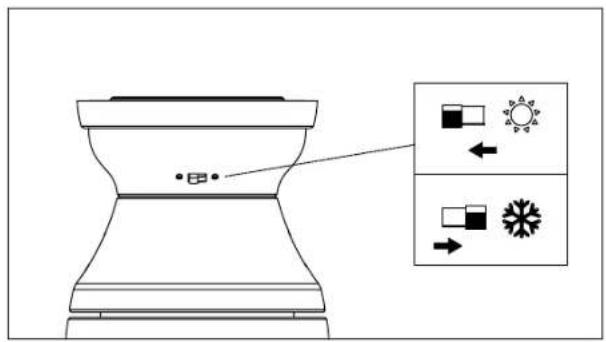
Fig. 22
Warm Weather Operation: Forward (counter clockwise). A downward airflow creates a cooling effect (Fig.23). This allows you to set your air conditioner on a warmer setting without affecting your general comfort.
Cool Weather Operation: Reverse (clockwise). An upward airflow moves warm air off the ceiling areas (Fig.24). This allows you to set your heating unit on a cooler setting without affecting your general comort.
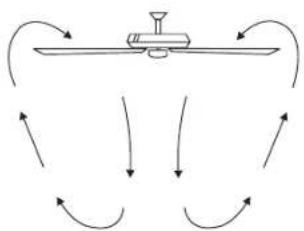
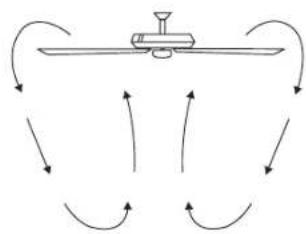
Fig.23 Fig.24
TROUBLESHOOTING
ProblemProblem SolutionSolution
Fan will not start. Fan will not start circuit fuses or breakers.1. Check circuit fuses or breakers.
- Check all electrical connections to ensure proper contact. CAUTION: Make sure the main power is OFF when checking any electrical connection. any electrical connection.
- Make sure the transmitter batteries are installed properly. Positive (+) side facing out.
- Ensure the batteries have a good charge.
Fan sounds noisy. Fan shaking all motor housing screws are snug.
- Make sure the screws that attach the fan blade brackets to the motor are tight.
- Make sure wire nut connections are not rubbing against each other or the interior wall of the switch housing. CAUTION: Make sure main power is off.
- Allow a 24-hour "breaking-in" period. Most noise associated with a new fan disappears during this time.
- If using an optional light kit, make sure the screws securing the glassware are tight. Make sure the light bulbs are not touching any other component.
- Do not connect this fan to a wall mounted variable speed control(s). They are not compatible with ceiling fan motors or remote controls.
- Make sure the upper canopy has a short distance from the ceiling. It should not touch the ceiling.
Fan wobble.Fan wobble1. Check that all blade and blade arm screws are secure.
- Most fan wobbling problems are caused when blade levels are unequal. Check this level by selecting a point on the ceiling above the tip of one of the blades. Measure this distance. Rotate the fan until the next blade is positioned for measurement. Repeat for each blade. The distance deviation should be equal within 1/8 .
- If the blade wobble is still noticeable, interchanging two adjacent (side by side) blades can redistribute the weight and possibly result in smoother operation.
Remote control Remotegrillers with remote control systems CAN NOT be operated in conjunction with any other control system EXCEPT a malfunction.malfunctiobasic On/off wall switch, if desired.
FCC Information
This device complies with part 15 of the FCC Rules. Operation is subject to the following two conditions:
1.)This device may not cause harmful interference, and
2. This device must accept any interference received, including interference that may cause undesired operation.
Note: This equipment has been tested and found to comply with the limits for a Class B digital device, pursuant to part 15 of the FCC Rules. These limits are designed to provide reasonable protection against harmful interference in a residential installation. This equipment generates, uses and can radiate radio frequency energy and, if not installed and used in accordance with the instructions, may cause harmful interference to radio communications. However, there is no guarantee that interference will not occur in a particular installation. If this equipment does cause harmful interference to radio or television reception, which can be determined by turning the equipment off and on, the user is encouraged to try to correct the interference by one or more of the following measures:
Reorient or relocate the receiving antenna.
- Increase the separation between the equipment and receiver.
- Connect the equipment into an outlet on a circuit different from that to which the receiver is connected.
- Consult the dealer or an experienced radio/TV technician or help.
KICHLER
www.kichler.com
KICHLER LIGHTING
7711 EAST PLEASANT VALLEY ROAD
CLEVELAND, OHIO 44131-8010
CUSTOMER SERVICE 866.558.5706
8:00 AM TO 5:00 PMEST, MONDAY - FRIDAY
© Kichler Lighting LLC. All Rights Reserved.
KICHLER
54" Bead LED
MANUEL D'INSTRUCTION

TABLE DES MATIÈRES
RÉGLES DE SECURITÉ 4
OUTILS NÉCESSAIRES. 5
CONTENU DE L'EMBALLAGE 5
OPTIONS DE MONTAGE. 6
ACCROCHAGE DU VENTILATEUR. 7
INSTALLATION DU SUPPORT DE SECURITE. 8
CONNEXIONS ELECTRIQUES. 9
TERMINER L'INSTALLATION DU MOTEUR. 10
FIXATION DES PALES DU VENTILATEUR. 11
INSTALLATION DU BOITIER DU COMMUTATEUR. 11
INSTALLATION DU KIT D'ÉCLAIRAGE ET DU VERRE. 12
INSTRUCTIONS D'UTILISATION 15
DEPANNAGE. 16
INFORMATIONS CCF. 17
RÉGLES DE SECURITÉ
LIRE ET CONSERVER CES INSTRUCTIONS
CLEVELAND, OHIO 44131
SERVICIO AL CLIENTE 866.558.5706
8:00 AM A 5:00 PM EST, DE LUNES A VIERNES