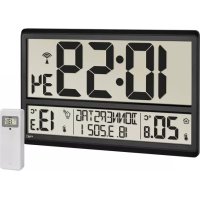
60.4521.01 - Clock TFA - Free user manual and instructions
Find the device manual for free 60.4521.01 TFA in PDF.



| Product type | Radio-controlled clock with indoor and outdoor temperature |
| Brand | TFA |
| Model | 60.4521.01 |
| Base station dimensions | 360 x 235 x 28 (84) mm |
| Base station weight | 869 g |
| Outdoor transmitter dimensions | 40 x 105 x 26 mm |
| Outdoor transmitter weight | 41 g |
| Base station power supply | 4 alkaline batteries 1.5 V AA (not included) |
| Outdoor transmitter power supply | 2 alkaline batteries 1.5 V AAA (not included) |
| Indoor temperature measurement range | -10 °C to 50 °C |
| Outdoor temperature measurement range | -50 °C to 70 °C |
| Transmission frequency | 433 MHz |
| Radio range | Approximately 100 meters in open field |
| Main functions | DCF radio-controlled clock, indoor/outdoor temperature, alarm with snooze, weekday display (6 languages), date, adjustable time zone |
| Maximum number of transmitters | 3 (channels 1, 2, 3) |
| Display | LCD |
| Mounting | Tabletop (fold-out stand) or wall (hanging eyelet) |
| Maintenance and cleaning | Soft, damp cloth, no solvents or abrasives |
| Safety instructions | Keep batteries out of reach of children, do not throw into fire, replace immediately if leaking, use protective gloves |
| Repairability | Do not disassemble or repair yourself, contact the seller |
| Disposal | Dispose of device and used batteries according to regulations (WEEE) |
Frequently Asked Questions - 60.4521.01 TFA
User questions about 60.4521.01 TFA
0 question about this device. Answer the ones you know or ask your own.
Ask a new question about this device
Download the instructions for your Clock in PDF format for free! Find your manual 60.4521.01 - TFA and take your electronic device back in hand. On this page are published all the documents necessary for the use of your device. 60.4521.01 by TFA.
USER MANUAL 60.4521.01 TFA
Operating Instructions
Mode d'emploi
Thank you for choosing this instrument from TFA.
Before you use this product
- Please make sure you read the instruction manual carefully.
• The operating instructions are enclosed with the device or can be downloaded at www.tfa-dostmann.de/en/service/downloads/instruction-manuals - This product should only be used as described within these instructions.
- Following and respecting the instructions in your manual will prevent damage to your instrument and loss of your statutory rights arising from defects due to incorrect use.
- Please take particular note of the safety advice!
- Please keep this instruction manual safe for future reference.
F
Radio-controlled clock with outdoor and indoor temperature

1. Delivery contents
• Radio-controlled clock • Outdoor transmitter (Cat.-No. 30.3248.02)
• Instruction manual
2. Range of application and all the benefits of your new instrument at a glance
• Highest precision radio-controlled clock
• Outdoor temperature wireless (433 MHz), distance range up to 100 m (open field)
- Expandable up to 3 outdoor transmitters, also for the temperature control of remote rooms, e.g. children's room, wine-cellar etc.
- Indoor temperature
• Alarm with snooze function
• Weekday written in full letters in 8 languages and date
- Manual setting option and time zone
- Ideal for home, office, waiting room, entrance or reception area and as a gift
• Wall mounting or table stand
3. Safety notices
- This product is exclusively intended for the range of application described above.
• This product should only be used as described within these instructions.

WARNING
- Keep these devices and the batteries out of reach of children.
- Small parts can be swallowed by children (under three years old).
- Batteries contain harmful acids and may be hazardous if swallowed. If you suspect a battery could have been swallowed or otherwise caught in the body, seek medical help immediately.
- Batteries must not be thrown into a fire, short-circulted, taken apart or recharged. Risk of explosion!
- Low batteries should be changed as soon as possible to prevent damage caused by leaking. Make sure the polarities are correct. Never use a combination of old and new batteries together, nor batteries of different types. Remove the batteries if the device will not be used for an extended period of time. Wear chemical-resistant protective gloves and safety glasses when handling leaking batteries.

CAUTION
- Unauthorized repairs, alterations or changes to the product are prohibited.
- Do not expose the device to extreme temperatures, vibrations or shocks.
Radio-controlled clock with outdoor and indoor temperature

- Clean the instrument with a soft damp cloth. Do not use solvents or scouring agents.
- The base station is only suitable for indoor use. Protect it from moisture!
• The transmitter is splashproof, but not watertight.
4. Elements
Radio-controlled clock (base station)
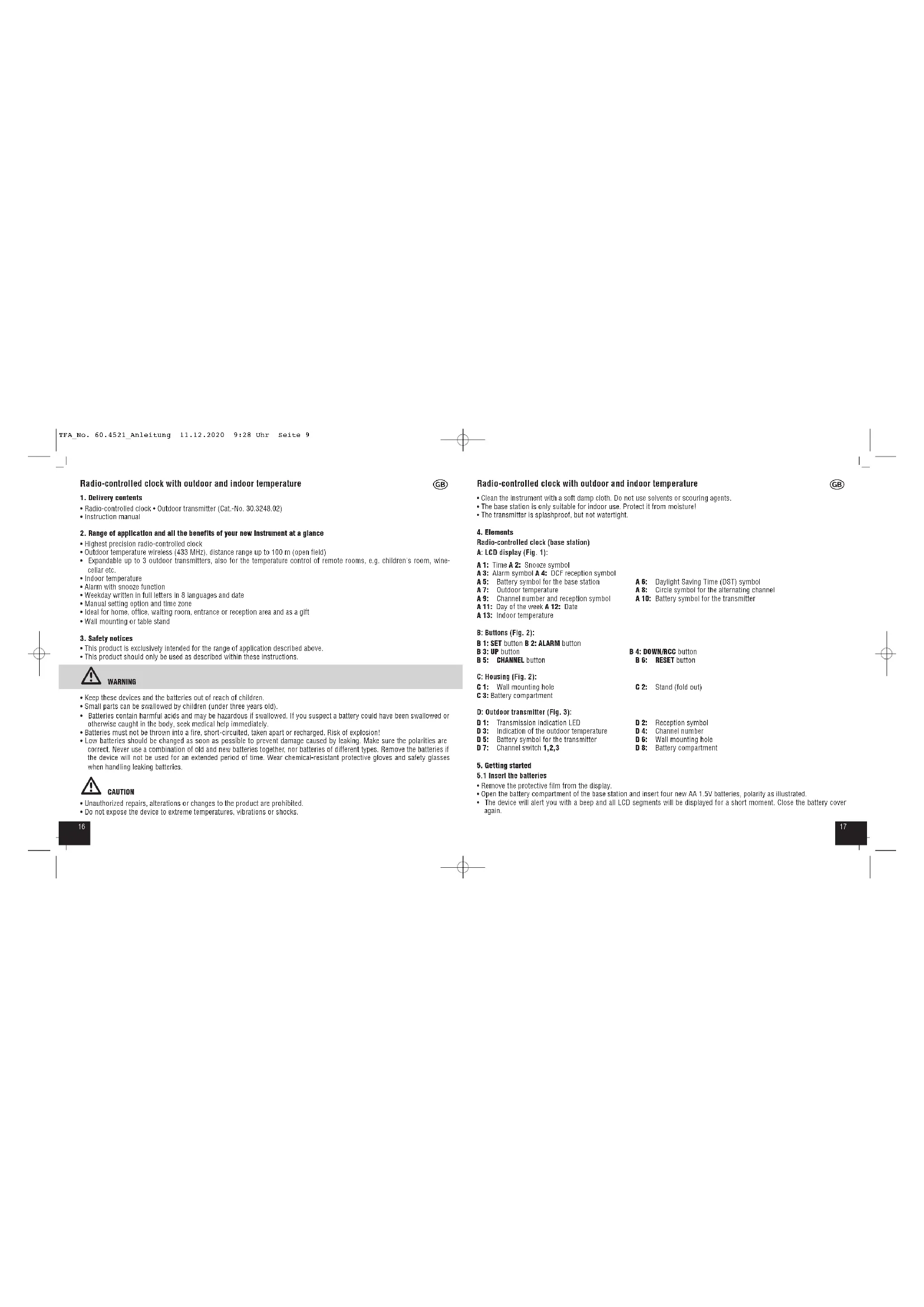
A: LCD display (Fig. 1):
A 1: Time A 2: Snooze symbol
A 3: Alarm symbol A 4: DCF reception symbol
A 5: Battery symbol for the base station
A 7: Outdoor temperature
A 9: Channel number and reception symbol
A 11: Day of the week A 12: Date
A 13: Indoor temperature
A 6: Daylight Saving Time (DST) symbol
A 8: Circle symbol for the alternating channel
A 10: Battery symbol for the transmitter
B: Buttons (Fig. 2):
B 1: SET button B 2: ALARM button
B 3: UP button
B 5: CHANNEL button
B 4: DOWN/RCC button
B 6: RESET button
C: Housing (Fig. 2):
C 1: Wall mounting hole
C 3: Battery compartment
C 2: Stand (fold out)
D: Outdoor transmitter (Fig. 3):
D 1: Transmission Indication LED
D 3: Indication of the outdoor temperature
D 5: Battery symbol for the transmitter
D7: Channel switch 1,2,3
D 2: Reception symbol
D 4: Channel number
D 6: Wall mounting hole
D 8: Battery compartment
5. Gelting started
5.1 Insert the batteries
- Remove the protective film from the display.
- Open the battery compartment of the base station and insert four new AA 1.5V batteries, polarity as illustrated
- The device will alert you with a beep and all LCD segments will be displayed for a short moment. Close the battery cover again.

Radio-controlled clock with outdoor and indoor temperature

- Open the battery compartment of the transmitter and insert two new AAA 1.5 V batteries, polarity as illustrated. The switch is set to channel 1.
- The indicator light lights up briefly. The outdoor temperature is shown. Close the battery cover again.
5.2 Outdoor values reception
- The base station will scan the outdoor temperature and the reception symbol flashes
- If the reception of outdoor temperature falls, “--” remains on the display. Check the batteries and try it again.
- You can also start the outdoor transmitter search manually later (e.g. if the transmitter is lost or if the batteries are changed). Press and hold the CHANNEL button on the base station for three seconds. The last registered transmitter (channel) will be cancelled and “--” appears on the display.
5.3 Radio-controlled time reception
- The clock will now scan the DCF frequency signal and the DCF symbol flashes on the display. When the time code is successfully received after some minutes, the radio-controlled time and the DCF symbol will be shown steadily on the display. In Daylight Saving Time DST is shown on the display.
- If there is no reception, you can start the initialisation manually. Press and hold the DOWN/RCC button for 3 seconds.
• The DCF symbol flashes. - Interrupt the reception by pressing the DOWN/RCC button again for three seconds. The DCF reception symbol disappears.
• The DCF reception always takes place daily at 1:00. 2:00, 3:00, 4:00 and 5:00 o'clock in the morning.
• There are three different reception states:
flashing – Reception is active remains – Reception is successful disappears – No reception
- If the clock cannot detect the DCF-signal (e.g. due to interference, transmitting distance, etc.), the time can be set manually.
5.4 Note on radio-controlled time
- The time is transmitted from an atomic clock near Frankfurt am Main by a DCF-77 (77.5 kHz) frequency signal with a range of about 1,500 km. Your radio-controlled clock receives the signal, converts it and always shows the exact time. The adjustment of Daylight Saving Time and Standard Time is also automatic.
- During night-time, the atmospheric interference is usually less severe. A single daily reception is adequate to keep the accuracy deviation under 1 second. In extreme cases, please place the unit close to a window to improve reception.
6. Operation
6.1 Manual settings
- Press and hold the SET button for three seconds to enter the setting mode.
• The first adjustable value flashes on the display.
Radio-controlled clock with outdoor and indoor temperature

- Use the UP or DOWN button to make the desired setting.
- Confirm with the SET button and go to the next setting.
• The sequence is shown as follows:
- Time zone -12/+12 (default: ZONE 00)
– Day-of-week language: (default: German)
- Year, month, day
- Hours, minutes
- DCF reception on/off (default: RCC ON)
- Press and hold the UP or DOWN button in the respective setting mode for quick setting. The device will automatically quit the setting mode if no button is pressed for 15 seconds.
6.1.1 Time zone setting
- In the setting mode you can make the time zone correction
- The time zone correction is needed for countries where the DCF signal can be received but the time zone is different from the DCF time (e.g. +1=one hour plus).
6.1.2 Day-of-the-week language
• In the setting mode you can set the day-of-the-week language: GERMAN, FRENCH, SPANISH, ITALIAN, DANISH, DUTCH, SWEDISH and ENGLISH.
6.1.3 DCF reception
- By default, the DCF reception is activated (RCC ON) and after successful reception of the DCF signal no manual adjustment
is necessary. - Once the DCF time reception is deactivated (RCC OFF), the clock and date must be manually set.
- If the DCF reception is activated, the manually set time will be overwritten by the DCF time when the signal is received successfully.
7. Alarm time setting
- Press the ALARM button in normal mode to enter the alarm mode. AL and the last adjusted alarm time appear on the display.
- Press and hold the ALARM button for three seconds to enter the setting mode.
• The hour digits flash.
- Press the UP or DOWN button to adjust the hours.
- Confirm the setting with the ALARM button and set minutes in the same way.
- Press the ALARM button again to return to the current time.
Radio-controlled clock with outdoor and indoor temperature

• The alarm is activated and the alarm symbol appears on the display.
- To deactivate/activate the alarm, press the UP button
- The alarm symbol disappears/appears on the display.
- When the alarm is activated, the alarm starts to ring when the set alarm time is reached. The alarm symbol flashes.
- Press any button (except SET) and the alarm will stop.
- Press the SET button to activate the snooze function.
- The alarm will be interrupted for about 5 minutes.
• The alarm will be interrupted for about 5 minutes.
• The snooze symbol flashes.
• Press any button to stop the snooze function.
6. Installation
- When placed outdoors, choose a shady and dry place for the transmitter. Direct sunlight may trigger incorrect measurement and continuous humidity damages the electronic components needlessly.
- Before the final installation, make sure that the measured values are transmitted from the transmitter at the desired installation site to the base station in the living area.
- Do not use the base station in the vicinity of radiators, other sources of heat or in direct sunlight.
- Make sure to avoid the vicinity of any source of interference such as computer screens, TV sets or solid metal objects. Within solid walls, especially ones with metal parts, the transmission range (max. 100 m) can be reduced considerably.
9. Battery replacement
- As soon as the corresponding battery symbol appears in the display, please change the batteries of the base station or transmitter
- Please note: When the batteries are changed, the contact between the outdoor transmitter and the base station must be restored – so always restart both devices or start a manual transmitter search.
10. Additional outdoor transmitters
- For having more than one transmitter, select different channels for each transmitter with the 1,2,3 switch. The new transmitter will be received automatically by the base station.
- The outdoor values will be shown on the display of the base station. If you have installed more than one transmitter, press the CHANNEL button to change between the outdoor transmitters (1-3).
- You can also choose an alternating channel display. Press the CHANNEL button. After the last registered channel, a circle symbol C will appear.
- To cancel an unused channel, hold the CHANNEL button for 3 seconds. “--; -” appears on the display.
Radio-controlled clock with outdoor and indoor temperature

11. Troubleshooting
Problem Solution
No indication on Ensure the batteries' polarities are correct
the base station or → Change the batteries
the outdoor transmitter
No DCF reception → Activate DCF reception in setting mode (RCC ON)
→ Start the initialization manually
→ Wait for an attempt reception during the night
→ Choose another place for your device
→ Set the clock manually
No reception of the → No outdoor transmitter is installed
outdoor transmitter → Check the outdoor transmitter's batteries (do not use rechargeable batteries!)
Display *--,-* → Start manual search for the outdoor transmitter
→ Choose another place for the transmitter and/or the base station/reduce the distance
Incorrect display on → Change the batteries
the base station or → Base station: Use a pin to press the RESET button
the outdoor transmitter
If your device fails to work despite these measures, contact the retailer where you purchased the product.
12. Waste disposal
This product has been manufactured using high-grade materials and components which can be recycled and reused.
Never dispose of empty batteries and rechargeable batteries with ordinary household waste.
As a consumer, you are required by law to take them to your retail store or to an appropriate collection site depending on national or local regulations in order to protect the environment.
The symbols for the contained heavy metals are:
Cd=cadmium, Hg=mercury, Pb=lead
This product is labelled in accordance with the EU Waste Electrical and Electronic Equipment Directive (WEEE). Please do not dispose of this product in ordinary household waste. As a consumer, you are required to take end-of-life devices to a designated collection point for the disposal of electrical and electronic equipment, in order to ensure environmentally-compatible disposal.
Radio-controlled clock with outdoor and indoor temperature

13. Specifications
Base station
Power consumption 4 x AA 1.5 V batteries (not included)
Use alkaline batteries
Measuring range
temperature -10°C ... 50°C
Housing dimension 360 x 235 x 28 (84) mm
Weight 869 g (device only)
Outdoor transmitter
Power consumption Batteries 2 x AAA 1.5 V (not included)
Use alkaline batteries
Measuring range
temperature -50°C ... 70°C
Range max. 100 m (open field)
Transmission frequency 433 MHz
Maximum
radio-frequency power < 10mW
Display LL.L /HH.H Temperature is outside measuring range
Housing dimension 40 x 105 x 26 mm
Weight 41 g (device only)
No part of this manual may be reproduced without written consent of TEA Destinam. The technical data are correct at the time of going. In print and may change without prior notice. The latest technical data and information about this product can be found in our homepage by simply entering the product number in the search box.
EU Declaration of conformity
Hereby, TFA Dostmann declares that the radio equipment type 60.4521 is in compliance with Directive 2014/53/EU. The full text of the EU declaration of conlurnity is available at the following internet address: www.the-dostmann.de/service@downsample
www.lfa-dostmann.de
E-Mail: info@ftie-dosstrann.co
TFA Dostmann GmbH & Co.KG, Zum Ollersberg 12, D-97877 Werheim, Germany 32/20
Cd = cadmium, Hg = mercure, Pb = plomb

Alimentation Piles 4 x 1.5 V AA (non incluses)
Alimentation Piles 2 x 1.5 V AAA (non incluses)
A 11: Weekdag A 12: Datum


- Before you use this product
- F
- Radio-controlled clock with outdoor and indoor temperature
- Delivery contents
- Range of application and all the benefits of your new instrument at a glance
- Safety notices
- WARNING
- CAUTION
- Elements
- Radio-controlled clock (base station)
- A: LCD display (Fig. 1):
- B: Buttons (Fig. 2):
- C: Housing (Fig. 2):
- D: Outdoor transmitter (Fig. 3):
- Gelting started
- Radio-controlled time reception
- Note on radio-controlled time
- Operation
- Manual settings
- Time zone setting
- Day-of-the-week language
- DCF reception
- Alarm time setting
- Installation
- Battery replacement
- Additional outdoor transmitters
- Troubleshooting
- Problem Solution
- Waste disposal
- Specifications
- Outdoor transmitter
Brand : TFA
Model : 60.4521.01
Category : Clock