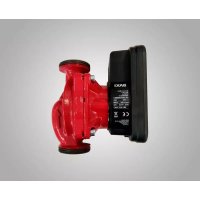
Quantum Maxi - Pump Baxi - Free user manual and instructions
Find the device manual for free Quantum Maxi Baxi in PDF.



| Product type | High-efficiency circulator |
| Brand | Baxi |
| Model | Quantum Maxi |
| Category | Heating pump |
| Power supply | 1 ~ 230 V ±10 %, 50 Hz |
| Water temperature range | -10 °C to +95 °C |
| Max. ambient temperature | +40 °C |
| Max. operating pressure | 6 bars (600 kPa) |
| Min. inlet pressure at 95 °C | 0.3 bar (30 kPa) |
| Nominal connection diameter | DN 25 (Rp 1) or DN 30 (Rp 1 1/4) |
| IP protection class | See rating plate (typically IP44) |
| Energy efficiency index EEI | ≤ 0.20 (see plate) |
| Temperature class TF | 95 |
| Control modes | Variable differential pressure (Δp-v), constant (Δp-c), 3 fixed speeds |
| Display | LED: power consumption (W) or head (m) or speed |
| Bleeding | Automatic after a few minutes of operation |
| Frost protection | Do not expose to temperatures outside -10 °C to +50 °C |
| Electrical protection | Residual current device (RCD) recommended |
| Max. fuse rating | 10 A, inert |
| Authorized fluids | Heating water (VDI 2035) or water/glycol mixtures 1:1 |
| Material | Pump body and motor with canned rotor and permanent magnet |
| Mounting position | Horizontal motor only (horizontal shaft) |
| Maintenance | No regular maintenance required; automatic bleeding |
| Spare parts | Only original Baxi parts |
| Repairability | Do not open the motor; intervention by qualified personnel only |
Frequently Asked Questions - Quantum Maxi Baxi
User questions about Quantum Maxi Baxi
0 question about this device. Answer the ones you know or ask your own.
Ask a new question about this device
Download the instructions for your Pump in PDF format for free! Find your manual Quantum Maxi - Baxi and take your electronic device back in hand. On this page are published all the documents necessary for the use of your device. Quantum Maxi by Baxi.
USER MANUAL Quantum Maxi Baxi
natural_image
Technical line drawing of a mechanical device with no visible text or symbolsQuantum MAXI
es Instrucciones de instalación y funcionamiento
pt Manual de Instalação e funcionamento
en Installation and operating instructions
fr Notice de montage et de mise en service
Fig.1:

Fig. 2a: Fig. 2b:

line
| Q | H | H max | Hs | ½Hs | H min | |-------|------|-------|------|------|-------| | Low | High | High | High | Low | Low | | Mid | Medium| Medium| High | Low | Low | | High | Low | Low | Low | Low | Low |
line
| Q | H | H max | Hs | H min | |------|-------|-------|------|-------| | Low | High | High | High | High | | Mid | High | High | High | High | | High | Low | Low | Low | Low |Fig. 2c: Fig. 3:
line
| Q | H (Curve 1) | H (Curve 2) | H (Curve 3) | |------|-------------|-------------|-------------| | min | max | max | max | | max | max | max | max |
natural_image
Collection of mechanical component symbols with no text or labels, including cross and plus signs (no readable text or labels)Fig. 4a: Fig. 4b:


Fig. 4c: Fig. 4d:

natural_image
Technical line drawing of a mechanical component with no visible text or symbols
Fig. 4e: Fig.5:

natural_image
Technical line drawing of a mechanical component with a rotating shaft and housing (no text or symbols)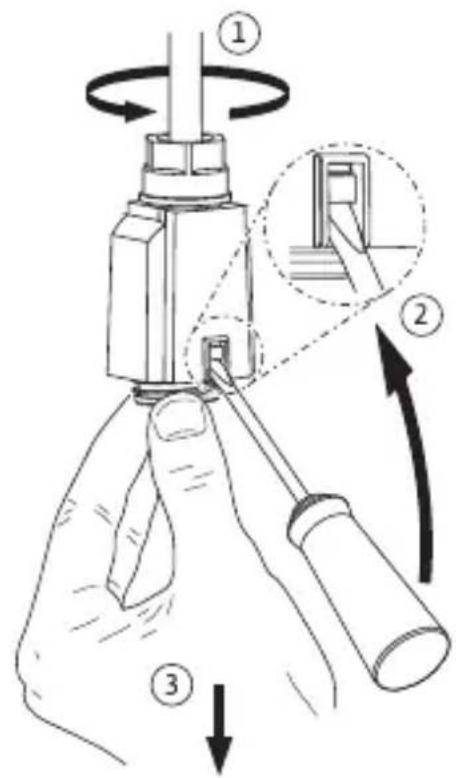
en Installation and operating instructions 32
Em E04, E05, E10, E23, E25, E30, E36:
1.1 About these instructions
- Read these instructions through completely before installation.
Not following these instructions can result in injury to persons or damage to the pump. - Once installation work is complete, pass the instructions on to the end user.
- Keep the instructions near the pump. They can be used for reference if problems occur later.
- No liability will be accepted for damages resulting from failure to follow these instructions.
1.2 EC-Declaration of conformity
This product complies with European directives in terms of design and performance characteristics, as well as to supplementary national requirements. Conformity has been certified with the CE mark. Further information on the declaration of conformity for this product can be found online at www.baxi.es or requested from the relevant BAXI branch.
1.3 Safety information
Important safety information is indicated as follows:

DANGER: Indicates a risk of fatal injury due to electrical current.

WARNING: Indicates a possible danger to life or risk of injury.
CAUTION: Indicates a possibility of property damage.
NOTICE: Highlights tips and information.
1.4 Qualifications
- The pump may only be installed by qualified personnel. The electrical connection may only be established by a qualified electrician.
- This device can be used by children from 8 years old as well as by persons with limited physical, sensory, or mental capabilities or lack of experience and knowledge provided they are supervised or have been instructed in the safe use of the device and understand the dangers that may arise. Children must not be not allowed to play with the device. Cleaning and maintenance by the user must not be carried out by children without supervision.
1.5 Regulations
The current versions of the following regulations must be observed during installation:
- Accident prevention regulations
• VDE 0700/Part 1 (EN 60335-1) - Other local regulations (e.g. IEC, VDE)
1.6 Modification and spare parts
Unauthorised modification and manufacture of spare parts will impair the safety of the product/personnel and void the manufacturer's declarations regarding safety.
- The pump must not be technically modified or converted.
- Opening the pump motor by removing the plastic cover is not permitted.
- Only use original spare parts.
1.7 Transport/storage
Unpack and check the pump and all accessories upon receipt. Report any damage sustained in transit immediately. Only ship the pump in its original packaging. The pump is to be protected from moisture, frost, and mechanical damage and must not be exposed to temperatures outside the range of -10 °C to +50 °C.
1.8 Electrical current
There is a danger of electric shock when working with electrical current. For this reason:
- Switch off the power before beginning work on the pump, confirm that the system is voltage-free, and ensure that it cannot be switched on again accidentally.
- Do not kink or pinch the power cable or allow it to come into contact with sources of heat.
- Never open the control module and never remove operating elements.
- The pump is protected against drips in accordance with IP protection class (see rating plate). Protect the pump from water spray. Do not immerse in water or other fluids.
- The connection must be secured by means of a residual-current device (RCD).
2 Technical data
2.1 Data
| Quantum MAXI | |
| Connection voltage | 1~230 V ±10%, 50 Hz |
| Temperature class TF 95 | |
| Protection class IP See rating plate | |
| Energy Efficiency Index EEI * See rating plate | |
| Nominal connection diameter(screwed connection) | DN 25 (Rp 1),DN 30 (Rp 1 14 ) |
| Water temperatures at a max. ambient temperature of +40 °C | -10 °C to +95 °C |
| Max. ambient temperature -10 °C to +40 °C | |
| Max. operating pressure 6 bar (600 kPa) | |
| Minimum inlet pressure at +95 °C 0.3 bar (30 kPa) |
* Reference value for the most efficient circulators: EEI ≤ 0.20
2.2 Scope of delivery
- Pump
- Screwed connections
- Seal rings
- Plug included
• Installation and operating instructions
3 Description and function
3.1 Intended use
The circulators in this series are designed for warm water heating systems and similar systems with constantly changing flows.
The approved fluids are heating water in accordance with VDI 2035, and water/glycol mixture at a mixing ratio of 1:1.
If glycol is added, the delivery data of the pump must be corrected according to the higher viscosity depending on the mixing ratio.
Intended use includes the observation of these instructions as well as of specifications and labelling on the pump.
Any other use is regarded as improper use.
3.2 Product description
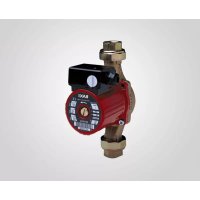
The pump (Fig. 1/1) consists of a hydraulic system, a glandless motor with a permanent magnet rotor, and an electronic control module with integrated frequency converter.
The control module has both an operating button together and an LED display (Fig. 1/2) for setting all parameters and for displaying the current power consumption in W.
3.3 Functions
All functions can be set, activated, or deactivated using the operating button.

When in operating mode, the current power consumption in W is displayed.

When the button is turned, the LED display shows the delivery head in "m"

or the speed stage.
Control modes

Variable differential pressure ( p-v ):
If the volume flow in the pipe network decreases, the pump reduces the delivery head by half (Fig. 2a).

Constant differential pressure ( p-c ):
The control keeps the set delivery head constant irrespective of the volume flow delivered (Fig. 2b).
c1, c2, c3
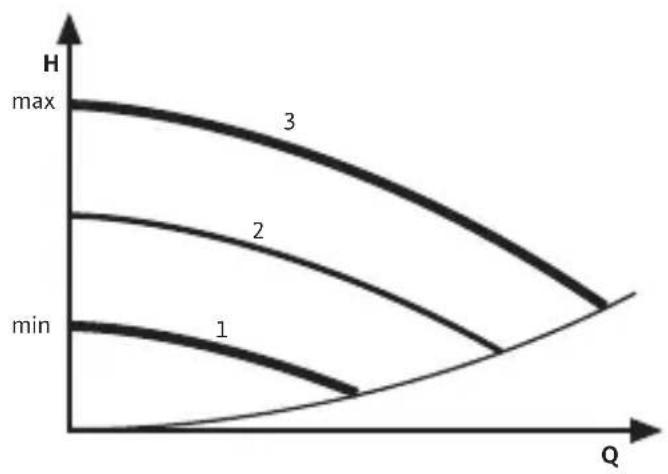
3 speed stages (c1, c2, c3):
The pump runs uncontrolled in three prescribed fixed speed stages (Fig. 2c).
4 Installation and electrical connection
4.1 Installation

DANGER: Before starting work, make sure that the pump is disconnected from the power supply.
Installation site
- Provide a weatherproof, frost-free, dust-free, and well-ventilated room for the installation. Choose an easily accessible installation site.

- Prepare the installation site so that the pump can be installed without being subjected to mechanical stresses. If necessary, support or secure piping on both sides of the pump.
NOTICE: Provide shut-off devices upstream and downstream of the pump to facilitate potential future pump replacement. Perform the installation in a way that prevents leaking water from dripping onto the control module. To do this, align the upper gate valve laterally if necessary.
- Complete all welding and soldering work near the pump prior to the installation of the pump.
CAUTION: Dirt can cause the pump to fail. Flush the pipe system before installation.
- Choose the correct installation position, with the pump motor in a horizontal position, from only the positions shown in (Fig. 3). Direction arrows on the pump housing indicate the direction of flow.
- If heat insulation work is necessary, only the pump housing may be insulated. The pump motor, module, and condensate drainage openings must remain uncovered.
Turning the motor head
If the installation position of the module is changed, the motor housing must be turned as follows:
- Loosen the interior hexagonal head screws.
- Turn the motor housing, including the control module.

NOTICE: In general, turn the motor head before the system is filled. When turning the motor head in a system that has already been filled, do not pull the motor head out of the pump housing. Turn the motor head with a small amount of pressure on the motor unit so that no water can come out of the pump.
CAUTION: Do not damage the housing seal.
Replace damaged gaskets.
- Turn the motor head in such a way that the plug corresponds to the permitted installation position (Fig. 3).
CAUTION: If the position is wrong, water can penetrate and destroy the pump.
- Tighten the interior hexagonal head screws again.
4.2 Electrical connection

DANGER: Work on the electrical connection must be performed only by a qualified electrician and in accordance with national and local regulations.
Before making the connection, ensure that the connecting cable is not live.
- The mains voltage and current type must correspond to the rating plate specifications.
-
Connect the plug (Fig. 4a to 4e).
-
Mains connection: L, N, PE.
- Max. back-up fuse: 10 A, slow-blow.
- Earth the pump in accordance with instructions.
Dismantle the plug in accordance with Fig. 5. A screwdriver is required to do this.
- The electrical connection is to be established via a fixed connecting cable equipped with a connector device or an all-pole switch with a contact opening width of at least 3 mm.
- To ensure drip protection and strain relief at the PG screwed connection, a connecting cable with an adequate outer diameter is required (e.g. H05VV-F3G1.5).
-
For pumps in systems with water temperatures above 90 °C, install a suitably heat-resistant connecting cable.
-
The connecting cable is to be laid in such a way that it can under no circumstances come into contact with the pipe and/or the pump and motor housing.
- The switching of the pump using triacs / solid-state relays must be tested on a case-by-case basis.
CAUTION: Voltage pulsing during phase angle control or external control can cause damage to electronic components.
- Only operate the pump with sinusoidal AC voltage as stated on the rating plate.
- The switching of the pump using triacs / solid-state relays must be tested on a case-by-case basis.
5 Commissioning/operation

WARNING: Depending on the pump or the system operating conditions (fluid temperature), the entire pump can become very hot. There is a risk of burns upon coming into contact with the pump! Commissioning by qualified personnel only!
5.1 Operation
The pump is operated using the operating button.
Turning

Selection of the control mode and setting of the delivery head or speed stage.
5.2 Venting
- Fill and vent the system appropriately.
- The pump rotor space vents automatically after a short time in operation. This may cause noises. If necessary, switch off and on again repeatedly to speed up the venting process. The pump will not be harmed by dry running for short periods.
5.3 Setting the pump
By turning the button, the control mode symbol can be selected and the desired delivery head or speed stage set.
Selecting the control mode

Variable differential pressure ( p-v ): see also Fig. 2a The pump is continuously adjusted within the p-v control mode.

Variable differential pressure ( p-c ): see also Fig. 2b The pump is continuously adjusted within the p-c control mode.
c1, c2, c3
3 speed stages: see also Fig. 2c
The pump is set at a fixed speed within the 3 speed stages control mode.

NOTICE: If a standard heating pump is replaced with this high-efficiency pump, the button can be set on the first, second, or third characteristic curve (c1, c2, c3) on the 3 speed stages scale as a reference point for adjusting the pump set-point.
Setting the delivery head / speed stage
The setpoints / speed stages can be increased or decreased by turning the button to the left or right within the selected control mode. In the p-v or p-c control mode, the setting can be carried out in 0.1 m steps.
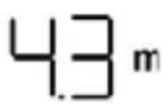
When the button is turned in the p-v or p-c control mode, the display changes to the set pump setpoint. The “m” symbol will light up.

In the 3 speed stages mode, c1, c2, or c3 is shown for the relevant pump characteristic curve.
If the button has not been turned for a duration of 2 seconds,
the display will change back to the current power consumption after flashing 5 times. The “W” symbol will light up.
Factory setting: p -v, 1/2 H _max

NOTICE: All settings and displays are retained if the mains supply is interrupted.
6 Maintenance/faults

DANGER: Before starting any maintenance and repair work, disconnect the pump from the power supply and make sure it cannot be switched back on by unauthorised persons.
- Damage to the connection cable must always be repaired by a qualified electrician.
- Faults must only be remedied by qualified personnel!

WARNING: Risk of burns when touching the pump!
Depending on the pump or the system operating conditions (fluid temperature), the entire pump can become very hot.
When removing the motor head or pump, hot fluid may be expelled under high pressure.
- Allow the pump to cool down first.
- Close the stop valves before removing the pump. There is always a strong magnetic field inside the motor. The permanent magnet rotor installed in the pump can pose mortal danger to people with medical implants (e.g. pacemakers) during dismantling.
- Never open the motor and never remove the rotor.
| Fault Cause Remedy | ||
| Pump is not running although the power supply is switched on | Electrical fuse defective | Check fuses |
| No voltage supply to the pump | Resolve the interruption to the power supply | |
| Pump is noisy Cavitation due to insufficient suction pressure | Increase the system supply pressure within the permissible range | |
| Check the delivery head setting and set it to a lower height if necessary | ||
| Building does not warm up | Thermal output of the heating surfaces is too low | Increase setpoint (see 5.3) |
| Set control mode to Δp-c | ||
Fault messages
| Code | Fault Cause Remedy | ||
| E 04 | Undervoltage | Power supply too low on mains side | Check mains voltage |
| E 05 | Overvoltage | Power supply too high on mains side | Check mains voltage |
| E 07 | Generator operation | Water is flowing through the pump hydraulics but there is no mains voltage to the pump | Check mains voltage |
| E 10 | Blocking The rotor is | blocked Contact specialist technician | |
| E 11 | Pump running dry | Air in the pump Check volume flow / water pressure | |
| E 21 | Overload Sluggish motor | motor Contact specialist technician | |
| E 23 | Short-circuit Motor current too high Contact specialist technician | ||
| E 25 | Contacting/ winding | Winding defective Contact specialist technician | |
| E 30 Excessive module temperature | Module interior too warm | Check operating conditions as described in section 2 | |
| E 36 Module defective | Electronic components defective | Contact specialist technician | |

NOTICE:
In E07, E11, and E21:
The pump will continue to run with limited output.
In E04, E05, E10, E23, E25, E30, and E36:
The pump will switch off (depending on the error code) and attempt a cyclical restart.
7 Disposal
Information on the collection of used electrical and electronic products
Proper disposal and recycling of this product prevents damage to the environment and risk to personal health.

NOTICE:
Disposal in domestic waste is forbidden!
Electrical and electronic products with this marker must not be disposed of in domestic waste.
- Use public or private disposal organisations when disposing of the product or parts of the product.
- For more information about proper disposal, please contact your local council or waste disposal office or the supplier from which you obtained the product.
Subject to technical modifications without prior notice.
1 Sécurité
1.7 Transport/stockage
c1, c2, c3 3 vitesses (c1, c2, c3) :

- Quantum MAXI
- About these instructions
- EC-Declaration of conformity
- Safety information
- Qualifications
- Regulations
- Modification and spare parts
- Transport/storage
- Electrical current
- Technical data
- Data
- Scope of delivery
- Description and function
- Intended use
- Product description
- Functions
- Control modes
- Variable differential pressure ( p-v ):
- Constant differential pressure ( p-c ):
- c1, c2, c3
- speed stages (c1, c2, c3):
- Installation and electrical connection
- Installation
- DANGER: Before starting work, make sure that the pump is disconnected from the power supply.
- Installation site
- CAUTION: Dirt can cause the pump to fail. Flush the pipe system before installation.
- Turning the motor head
- CAUTION: Do not damage the housing seal.
- Replace damaged gaskets.
- CAUTION: If the position is wrong, water can penetrate and destroy the pump.
- Electrical connection
- DANGER: Work on the electrical connection must be performed only by a qualified electrician and in accordance with national and local regulations.
- Before making the connection, ensure that the connecting cable is not live.
- Commissioning/operation
- Operation
- Venting
- Setting the pump
- Selecting the control mode
- Setting the delivery head / speed stage
- Maintenance/faults
- NOTICE:
- Disposal
- Information on the collection of used electrical and electronic products
- Disposal in domestic waste is forbidden!
- Sécurité
- Transport/stockage
- c1, c2, c3 3 vitesses (c1, c2, c3) :
Brand : Baxi
Model : Quantum Maxi
Category : Pump