IAN 337956 - Straps ULTIMATE SPEED - Free user manual and instructions
Find the device manual for free IAN 337956 ULTIMATE SPEED in PDF.



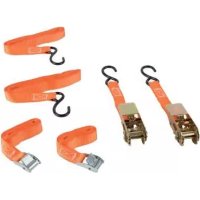
| Product type | Tightening and lashing straps |
| Model | IAN 337956 (HG06692A-1 and HG06692A-2) |
| Length (fixed end) - HG06692A-1 | 0.5 m |
| Length (free end) - HG06692A-1 | 3.5 m |
| Total length - HG06692A-2 | approx. 2.54 m |
| Rated capacity (LC) | 250 daN (2500 N) |
| Material | Polyester (PES) |
| Package contents | 2 ratchet straps (0.5 m) + 2 hook straps (3.5 m) + 2 tensioning straps (2.5 m) + instruction manual |
| Intended use | To lash, secure and protect loads on vehicles |
| Operating temperature | -40°C to +120°C |
| Maintenance | Clean with warm water and pH-neutral cleaner, lightly lubricate the ratchet, store in a dry and ventilated place |
| Warranty | 3 years from date of purchase |
| After-sales service (France) | Tel.: 0800904879, E-mail: owim@lidl.fr |
| After-sales service (Belgium) | Tel.: 080071011, E-mail: owim@lidl.be |
Frequently Asked Questions - IAN 337956 ULTIMATE SPEED
User questions about IAN 337956 ULTIMATE SPEED
0 question about this device. Answer the ones you know or ask your own.
Ask a new question about this device
Download the instructions for your Straps in PDF format for free! Find your manual IAN 337956 - ULTIMATE SPEED and take your electronic device back in hand. On this page are published all the documents necessary for the use of your device. IAN 337956 by ULTIMATE SPEED.
USER MANUAL IAN 337956 ULTIMATE SPEED
SPANN- UND ZURRGURT- SET / Luggage STRAP SET / SET DE SANGLES DE SERRAGE ET D'ARRIMAGE (MODEL NO. HG06692A-1) SPANNGURTE MIT SCHNELLVERSCHLUSS / RATCHET STRAPS WITH QUICK-RELEASE FASTENING /SANGLES AVEC FERMETURE RAPIDE (MODEL NO. HG06692A-2)
DE AT CH
Operation and safety notes
FR BE
SET DE SANGLES DE SERRAGE ET D'ARRIMAGE / SANGLES AVEC FERMETURE RAPIDE
List of pictograms used. 16
Introduction 16
Intended use. 16
Technical data. Page 16
Scope of delivery . 17
Safety instructions. 17
General safety instructions. Page 17
Safety instructions for lashing straps. Page 17
Practical information regarding the use and care of lashing straps. Page 19
Use 21
Attaching the lashing strap . Page 21
Releasing the lashing strap . 22
Cleaning and maintenance 23
Disposal 23
Warranty.. 23
| List of pictograms used | |||
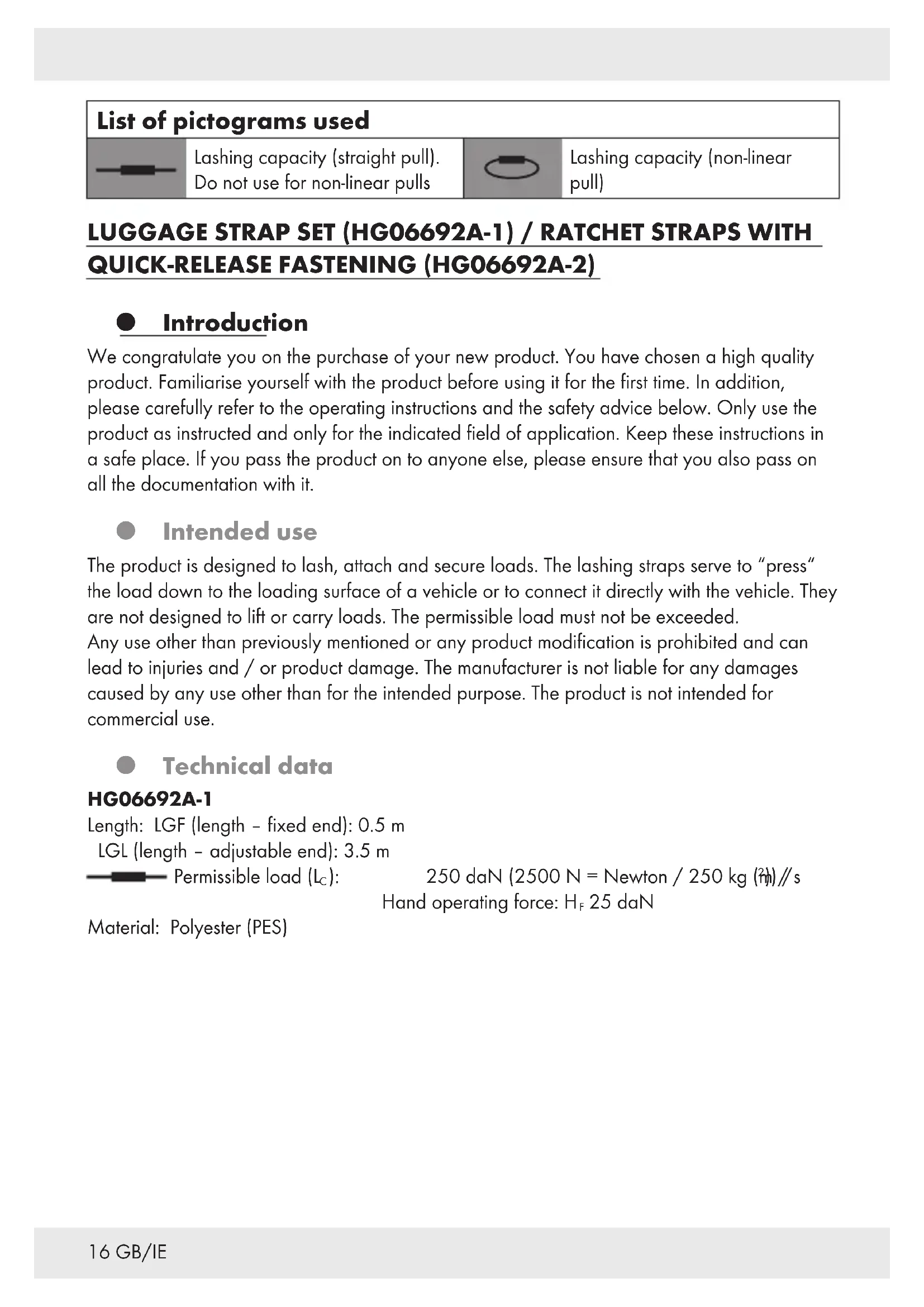
| Lashing capacity (straight pull). Do not use for non-linear pulls | Lashing capacity (non-linear pull) | ||
Luggage STRAP SET (HG06692A-1) / RATCHET STRAPS WITH QUICK-RELEASE FASTENING (HG06692A-2)
Introduction
We congratulate you on the purchase of your new product. You have chosen a high quality product. Familiarise yourself with the product before using it for the first time. In addition, please carefully refer to the operating instructions and the safety advice below. Only use the product as instructed and only for the indicated field of application. Keep these instructions in a safe place. If you pass the product on to anyone else, please ensure that you also pass on all the documentation with it.
Intended use
The product is designed to lash, attach and secure loads. The lashing straps serve to "press" the load down to the loading surface of a vehicle or to connect it directly with the vehicle. They are not designed to lift or carry loads. The permissible load must not be exceeded.
Any use other than previously mentioned or any product modification is prohibited and can lead to injuries and / or product damage. The manufacturer is not liable for any damages caused by any use other than for the intended purpose. The product is not intended for commercial use.
Technical data
HG06692A-1
Length: LGF (length - fixed end): 0.5 m
LGL (length - adjustable end): 3.5 m
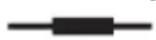
Permissible load (LC) ..
250 daN (2500 N = Newton / 250 kg (m) //s
Hand operating force: HF25 daN
Material: Polyester (PES)
HG06692A-2
Total length: approx. 2.54m
Length LG:

Permissible load
Lashing capacity LC :
approx.
2.5 m
250 daN (2500 N = Newton)/250 kg (m /
Looped: 250 daN
Material: Polyester (PES)
Scope of delivery
Check the delivery for completeness and condition of the product immediately after opening and ensure all parts are included.
2 x Lashing strap with ratchet tensioner and S hook, approx. 0.5 m (HG06692A-1)
2× Lashing strap with S-hook, approx. 3.5m (HG06692A-1)
2× Lashing straps with clamping lock, approx. 2.5m (HG06692A-2)
1 x Directions for use
Safety instructions
KEEP ALL THE SAFETY ADVICE AND INSTRUCTIONS IN A SAFE PLACE FOR FUTURE REFERENCE!

General safety instructions


WARNING! DANGER TO LIFE AND RISK OF ACCIDENTS FOR
INFANTS AND CHILDREN! Never leave children unattended with the packaging material. The packaging poses a risk of suffocation and danger of no strangulation. Children often underestimate this danger. Always keep children in this product. This product is not a toy.
Do not use the product if you see it is damaged in any way.
Check that all parts have been assembled correctly. Improper assembly may result in injury.

Safety instructions for lashing straps
Always check the lashing strap for damage before using it. On no account use the lashing strap if the strap is damaged.
Carefully check dirty straps or straps that have been contaminated with corrosive or other materials that may damage them. You may have to ask the manufacturer to check them.
- Have the lashing straps and all components checked by an expert at least once a year. In accordance with the conditions of use and the operational circumstances, further checks by a professional may be necessary from time to time.
On no account use the lashing strap if:
- there are broken threads or cuts in the thread, especially if the edges have been nicked or there are other alarming cases of damage
the labelling is missing or is no longer legible - there is damage to the connections, or deformation due to exposure to heat (friction, radiation)
- there is damage due to the effect of corrosive substances.
On no account use the ratchets if:
- there are incipient tears, breakages or considerable cases of or damage from corrosion
- there is widening > 5% (5% in the hook mouth or general deformation)
-there is visibly permanent deformation of load-bearing parts
Repairs to the lashing straps may only be carried out if the information regarding the manufacturer, material and maximum permissible tensile load is clearly designated on the label. They may only be carried out by the manufacturer or a person specified by him. Following repair, the manufacturer or the person designated by the manufacturer must ensure that the maximum permissible tensile load of the lashing straps as originally specified on the label is maintained.
- Never exceed the permissible tensile load of the lashing strap as stated on the label (see also "Technical data").
Choose the most suitable lashing strap in accordance with the intended load that needs to be lashed down, the tensile load and loading surface (see label).
CAUTION! DANGER OF ACCIDENT! When lashing using additional fittings and lashing devices, make sure that they are suitable for the lashing strap.
Check that the vehicle parts you wish to strap the load to are sturdy enough.
CAUTION! In addition to the accelerating forces, wind may cause lateral forces to arise during the journey.
- Never pull the lashing strap over rough surfaces or sharp edges if they are not furnished with suitable protection.
Make sure that the lashing straps are not twisted and that the load is distributed across their entire width.
- Do not place any objects onto the lashing strap if this may damage it.
- Keep lashing strap away from hot surfaces.
Evenly distribute the lashing straps on the load to be secured.
Never use the lashing straps to lift loads.
Make sure you do not put any load on the tip of the S hook unless it is a hook that is designed for such a purpose. To avoid detachment of a lashing hook without a lock in a lashing point on the loading surface, suspend from the inside outwards.
Never attach S hooks and ratchets to edges.
- Never extend the ratchet handle to achieve greater tensioning forces if this is not expressly allowed by an instruction.
CAUTION! DANGER OF ACCIDENT! Always choose suitable lashing straps, lashing points and lashing methods. The size, shape and weight of the cargo as well as the intended mode of use, the transport environment and the type of cargo determine the correct choice.
To ensure the load is secured properly, the webbing needs to be wrapped around the ratchet at least 1.5 times.
- Tighten the webbing manually as far as possible so that the belt does not need to be wrapped more than 3 times around the ratchet to tighten the load.
Do not exceed the roof load indicated by the vehicle manufacturer.
CAUTION! DANGER OF ACCIDENT! When lashing down, pay attention to the required preload force. At least 2 lashing straps are required. For reasons of stability, at least two lashing straps of the same kind must be used for lashing down and two pairs of lashing straps of the same kind used for diagonal lashing.
CAUTION! DANGER OF ACCIDENT! During transportation, regularly check that the cargo is correctly lashed and tighten the lashing strap if necessary.
- Practical information regarding the use and care of lashing straps
- In selecting and using lashing equipment, you must consider the required lashing force, the mode of use and the type of cargo to be lashed. The size, shape and weight of the cargo as well as the intended mode of use, the transport environment and the type of cargo determine the correct choice. For stability reasons, at least two lashing straps must be used for lashing down and two pairs of lashing straps used for diagonal lashing.
-
Due to different characteristics and because of different changes in length under load, only identical lashing device combinations (e.g. lashing chains and lashing strap made of synthetic fibres) may be used in parallel for lashing the same load. When using additional fittings and lashing devices, make sure that they fit the lashing strap.
-
During use, flat hooks must engage over the entire width of the bearing surface of the hook.
- Opening the lashing: Before opening, make sure that the cargo is stable even without being secured and does not endanger unloading personnel by falling down. If necessary, attach blocking devices to the cargo that has been planned for further transport beforehand in order to prevent the load falling or tipping over. This also applies if one uses tensioning elements that make safe removal possible.
- Before starting to unload, you must loosen the lashing until the load is free.
- During loading and unloading, attention has to be paid to proximity of any low overhead power lines.
- The materials from which lashing straps are made have selective resistance to chemical attacks. Seek the advice of the manufacturer or supplier if exposure to chemicals is anticipated. It should be noted that the effects of chemicals may increase with rising temperatures. The resistance of synthetic fibres to chemical reactions is summarised below:
Polyester is affected less by mineral acids but is attacked by alkaline solutions. - Harmless acid solutions or alkalis can become so concentrated through evaporation that they cause damage. Contaminated lashing straps should immediately be taken out of use, rinsed in cold water and dried in the open air.
- This lashing straps are suitable for the following temperature ranges:
--40°C to +120°C for Polyester (PES);
These temperature ranges may alter depending on the chemical environment. In this event, you must seek the advice of the manufacturer or supplier. A change in the environmental temperature during transport may affect the forces in the webbing. Check the lashing force after entering warm regions. - Lashing straps must be taken out of use or returned to the manufacturer for repair if they show any signs of damage. The following points are considered to be signs of damage:
- for webbing (that must be taken out of use): tears, cuts, nicks and breaks in load-bearing fibres and stitches; deformations resulting from exposure to heat.
-
with end fittings and tensioning devices: deformations, cracks, pronounced signs of wear, signs of corrosion. Only lashing straps bearing identification labels shall be repaired. If there is any accidental contact with chemical products, the lashing strap must be removed from service and the manufacturer or supplier consulted.
-
Care should be taken that the lashing strap is not damaged by the sharp edges of the load on which it is used. Regular visual inspection before and after each use is recommended.
- Only legibly marked and labelled lashing straps may be used.
- Lashing straps must not be overloaded: The maximum hand force of 250N (25 daN on the label; 1 daN ≈ 1 kg) may be applied with only one hand. Mechanical aids such as bars or levers etc. may not be used unless they are part of the tensioning device. (HG06692A-1)
- Lashing straps may not be used when knotted.
- Damage to labels must be prevented by keeping them away from sharp edges of the load and, if possible, from the load.
- Webbing must be protected against friction, abrasion and damage from loads with sharp edges by using protective sleeves and / or corner protectors.
Use
Lashing down (HG06692A-1, HG06692A-2):
With lashing straps stretched over it, the load is pressed down onto the loading area (see Fig. 1).
Diagonal lashing (HG06692A-1):
The load is secured by 4 lashing straps and directly connected to the vehicle (see Fig. II).
- Attaching the lashing strap
The selected lashing equipment must be strong and long enough for the intended purpose and have the correct length for the type of lashing. Responsible users plan cargo security in advance: they plan the attachment and removal of the lashing devices before the start of the journey. With longer trips, partial unloading must be considered. Calculate the number of lashing devices according to EN 12195-1. Only lashing systems labelled for lashing down with STF (standard tension force) may be used for friction lashing.
HG06692A-1:
Use the S hook to securely attach the lashing strap to the load.
- Open the ratchet handle 1 and place the slotted shaft 3 into the position so that the webbing 4 can be inserted into it (see Fig. A III).
Insert the webbing 4 into the slotted shaft 3 of the ratchet. Carefully pull it through the slotted shaft 3 until the webbing 4 lies snug against the load.
- Tighten the lashing strap by moving the handle of the ratchet backwards and forwards (see Fig. A I - III). Tighten the lashing strap until you have obtained the tension you wish to have.
Note: Make sure that webbing 4 is wound at least 1.5 times to a maximum of 3 times around the slotted shaft 3 .
Bring the ratchet handle 1 into the basic position (see Fig. A I). The load is now secure.
HG06692A-2:
Loop the lashing strap around the load.
Press the clamping lock 5 down and pass the webbing 6 through the clamping lock from below (see Fig. C).
- Carefully pull the webbing 6 through the clamping lock until you get the tension you want. Then release the clamping lock 5 .
Releasing the lashing strap
CAUTION! Check before releasing the strap that the load is stable. Make sure that the load is stable even without the lashing strap and that it cannot fall down.
CAUTION! RISK OF INJURY! Make sure that nobody is near the load when you release the lashing strap. Falling parts could cause injuries.
CAUTION! RISK OF INJURY! When opening the lashing equipment, the preload force is released at a stroke. That is why you should open the lashing strap with the utmost caution.
Note: Before starting to unload, make sure that the lashing equipment is released so that the load can be lifted freely.
HG06692A-1:
Open the ratchet handle 1 into the maximum position (see Fig. A III).
Press the ratchet lock 2 and open the ratchet handle 1 until the end stop (see Fig. B).
Pull the webbing 4 completely out of the slotted shaft 3.
Release the S hook and thus the lashing strap from the load.
HG06692A-2:
Press the clamp 5 down (see Fig. C).
Pull the webbing 6 out of the clamping lock completely.
- Cleaning and maintenance
Note: Regular care will maintain the quality and functionality of the lashing strap.
Clean the lashing strap with lukewarm water and pH-neutral cleaning agents. Avoid corrosive detergents.
The ratchet tensioner should be regularly cleaned and then lightly greased. When greasing it, make sure that parts that come into contact with the webbing are not greased.
Store the lashing strap in a dry, well-ventilated cool place.
- Avoid contact with chemicals, acids and alkalis as they may damage the lashing strap.
Disposal
The packaging is made entirely of recyclable materials, which you may dispose of at local recycling facilities.
Contact your local refuse disposal authority for more details of how to dispose of your worn-out product.
Warranty
The product has been manufactured to strict quality guidelines and meticulously examined before delivery. In the event of product defects you have legal rights against the retailer of this product. Your legal rights are not limited in any way by our warranty detailed below.
The warranty for this product is 3 years from the date of purchase. Should this product show any fault in materials or manufacture within 3 years from the date of purchase, we will repair or replace it - at our choice - free of charge to you.
The warranty period begins on the date of purchase. Please keep the original sales receipt in a safe location. This document is required as your proof of purchase. This warranty becomes void if the product has been damaged, or used or maintained improperly.
The warranty applies to defects in material or manufacture. This warranty does not cover product parts subject to normal wear, thus possibly considered consumables (e.g. batteries) or for damage to fragile parts, e.g. switches, rechargeable batteries or glass parts.
Warranty claim procedure
To ensure quick processing of your case, please observe the following instructions:
Please have the till receipt and the item number (e.g. IAN 123456_7890) available as proof of purchase.
You will find the item number on the rating plate, an engraving, on the front page of the instructions for use (bottom left), or as a sticker on the rear or bottom of the product.
If functional or other defects occur, please contact the service department listed either by telephone or by e-mail.
You can return a defective product to us free of charge to the service address that will be provided to you. Ensure that you enclose the proof of purchase (till receipt) and information about what the defect is and when it occurred.
Service
GB
Service Great Britain
Tel.:08000569216
E-Mail: owim@lidl.co.uk
IE
Service Ireland
Tel.:1800200736
E-Mail:owim@lidl.ie
Arrimage plaquant (HG06692A-1, HG06692A-2):
250 daN (2500 N = Newton/
250 kg (m / s2) / na tase: 250 daN
Material: Poliester (PES)
Zakres dostawy
250 daN (2 500 N = Newton/2504)g/
fázná sila HF : 25 daN
Material: Polyester (PES)
HG06692A-2


- List of pictograms used. 16
- Introduction 16
- Safety instructions. 17
- Practical information regarding the use and care of lashing straps. Page 19
- Use 21
- Cleaning and maintenance 23
- Disposal 23
- Warranty.. 23
- Luggage STRAP SET (HG06692A-1) / RATCHET STRAPS WITH QUICK-RELEASE FASTENING (HG06692A-2)
- Introduction
- Intended use
- Technical data
- HG06692A-1
- HG06692A-2
- Scope of delivery
- Safety instructions
- General safety instructions
- WARNING! DANGER TO LIFE AND RISK OF ACCIDENTS FOR
- Safety instructions for lashing straps
- - Practical information regarding the use and care of lashing straps
- Use
- Lashing down (HG06692A-1, HG06692A-2):
- Diagonal lashing (HG06692A-1):
- - Attaching the lashing strap
- HG06692A-1:
- HG06692A-2:
- Releasing the lashing strap
- - Cleaning and maintenance
- Disposal
- Warranty
- Warranty claim procedure
- Service
- Service Great Britain
- Service Ireland
- Arrimage plaquant (HG06692A-1, HG06692A-2):
- Zakres dostawy
Brand : ULTIMATE SPEED
Model : IAN 337956
Category : Straps