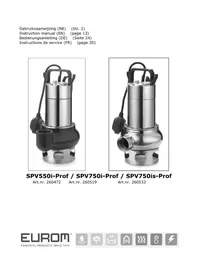
SPV750is Prof - Pump Eurom - Free user manual and instructions
Find the device manual for free SPV750is Prof Eurom in PDF.



| Product type | Submersible pump |
| Brand | Eurom |
| Model | SPV750is Prof |
| Nominal power | 750 W |
| Power supply | 230 V ~ 50 Hz |
| Max flow rate | 367 l/min |
| Max delivery head | 10 m |
| Max immersion depth | 5 m |
| Max particle diameter | 35 mm |
| Max water temperature | 40 °C |
| Water pH | 4 – 10 |
| Outlet connection | Female thread 2" (50 mm) and hose nipple 2" |
| Power cable | H07RN-F 3G1.0 mm², length 10 m |
| Housing material | Stainless steel (combined with cast iron) |
| Dimensions (L x W x H) | 23 x 20 x 46.5 cm |
| Weight | 10.9 kg |
| Operating mode | Automatic (adjustable float switch) and manual |
| Protection | Overheating protection, automatic air vent |
| Maintenance | Regular visual inspection, rinse with clean water, frost-free storage |
| Included accessories | Float switch, plastic elbow (for SPV750is) |
Frequently Asked Questions - SPV750is Prof Eurom
User questions about SPV750is Prof Eurom
0 question about this device. Answer the ones you know or ask your own.
Ask a new question about this device
Download the instructions for your Pump in PDF format for free! Find your manual SPV750is Prof - Eurom and take your electronic device back in hand. On this page are published all the documents necessary for the use of your device. SPV750is Prof by Eurom.
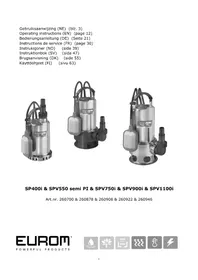
USER MANUAL SPV750is Prof Eurom
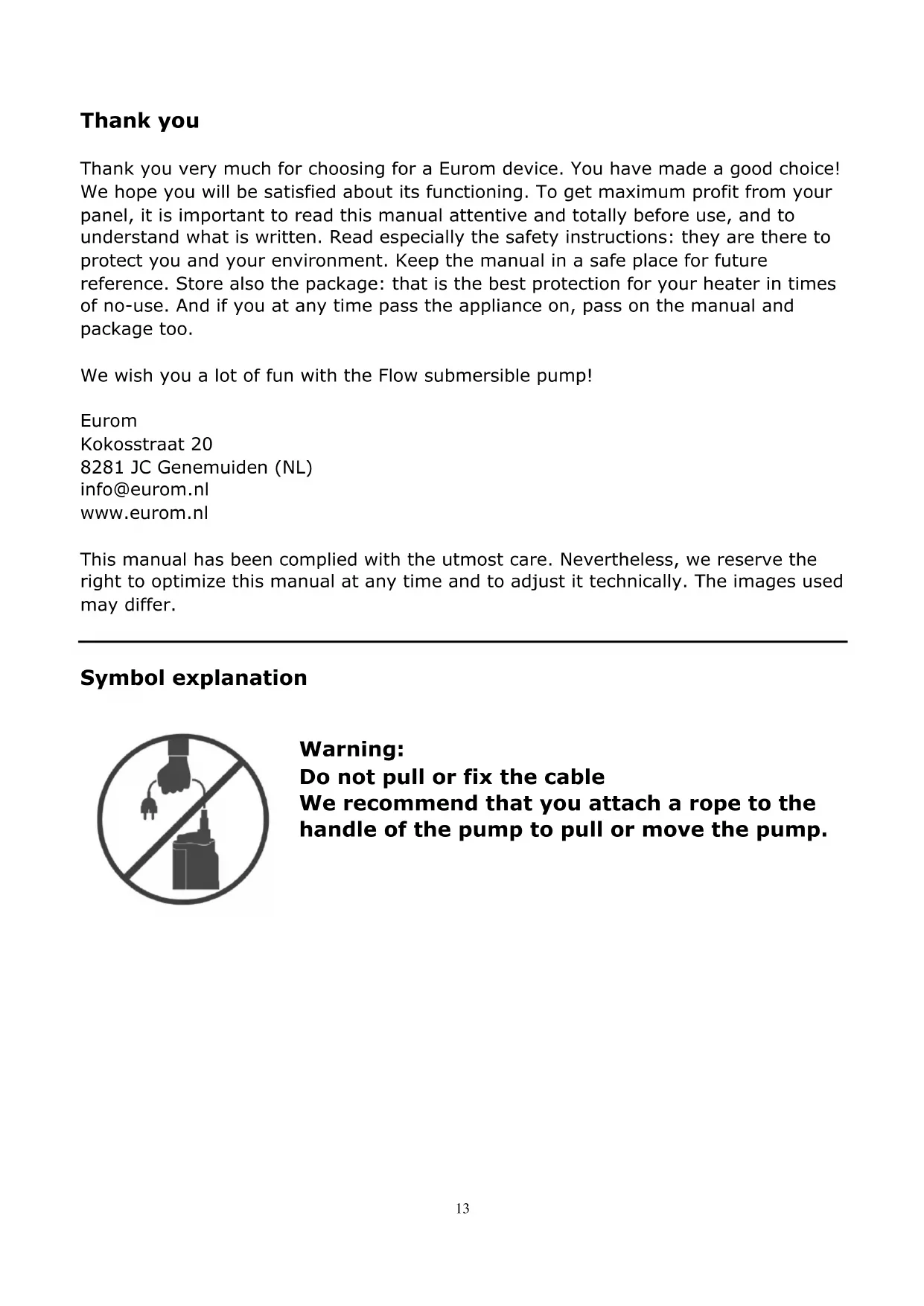
Thank you very much for choosing for a Eurom device. You have made a good choice! We hope you will be satisfied about its functioning. To get maximum profit from your panel, it is important to read this manual attentive and totally before use, and to understand what is written. Read especially the safety instructions: they are there to protect you and your environment. Keep the manual in a safe place for future reference. Store also the package: that is the best protection for your heater in times of no-use. And if you at any time pass the appliance on, pass on the manual and package too.
We wish you a lot of fun with the Flow submersible pump!
Eurom
Kokosstraat 20
8281 JC Genemuiden (NL)
info@eurom.nl
www.eurom.nl
This manual has been complied with the utmost care. Nevertheless, we reserve the right to optimize this manual at any time and to adjust it technically. The images used may differ.
Symbol explanation

Warning:
Do not pull or fix the cable
We recommend that you attach a rope to the handle of the pump to pull or move the pump.
Technical details
| SPV550i | SPV750i | SPV750is | |
| Output capacity | 550W | 750W | 750W |
| Electrical connection | 230V~50Hz | 230V~50Hz | 230V~50Hz |
| Maximum voltage deviation | 10% | 10% | 10% |
| Maximum output | 300 l/min | 367 l/min | 367 l/min |
| Maximum pump head | 8 m | 9.5 m | 10 m |
| Maximum under water | 5 m | 5 m | 5 m |
| Maximum contaminating substances | 35 mm | 35 mm | 35 mm |
| Maximum water temperature | 40°C | 40°C | 40°C |
| Average Ph value | 4 - 10 | 4 - 10 | 4 - 10 |
| Ø water drain | 2" female thread & 2" tulle | 2" female thread & 2" tulle | 2" female thread & 2" tulle |
| Cable | H07RN-F 3G1.0mm² | H07RN-F 3G1.0mm² | H07RN-F 3G1.0mm² |
| Cable length | 10 m | 10 m | 10 m |
| Dimensions | 23 x 20 x 46.5 cm | 23 x 20 x 46.5 cm | 23 x 20 x 46.5 cm |
| Weight | 12.5 kg | 14 kg | 10.9 kg |
Safety Guidelines
- For reasons of safety, your submersible pump must always be connected to an earthed socket, which has been installed as part of the electricity grid according to the national regulations. It is minimum 16A fused and has an earth leakage circuit breaker (nominal current ≤ 30 mA).
- Before each use, check your pump, electrical cable, plug and socket. Do NOT use any of them, if you detect damage, but have a certified electrician repair them. The cable is a type H07RN-F cable.
- At all times, make sure that electrical connections (plugs, etc.) are dry and remain dry.
- Before use, check whether the socket to which you want to connect the pump is suitable for the pump (230V/50Hz; see the type plate).
- Protect the electrical cable and plug against heat, oil and sharp corners.
-
First, clean the drain hose before use.
-
Before use, check whether the pump head or suction height do not exceed the capacity of the pump.
- Do NOT use the electrical cable to hang, lower or move the pump. To do these things, attach a piece of rope to the handle. Do NOT pull the plug from the socket using the cable, but hold the plug with your hand!
- When the pump is operating, do NOT bang/press/wring/pull the cables and do NOT put something heavy on them. Do NOT use the electrical cable as a hanging cord. All of these things can cause an electric shock.
- If the pump is used far away from the socket, make sure to use a thicker cable (thicker than the standard pump cable) depending on the distance.
- NEVER let the plug or socket come in contact with water. If an extension cable is used, you should check that the extension cable and all connections are waterproof and cannot come in contact with water.
- After you have pumped water to which chloride was added or which contains a certain deposit, you should flush the pump using clean water. Take into account that sand and all other abrasive and corrosive substances accelerate the wear & tear and affect the capacity of the pump.
- ALWAYS switch off the current, if you want to change the position of the pump or want to touch it for some other reason in order to prevent accidents.
- Prevent the pump from operating, while it cannot discharge the water for whatever reason: blocked drain, a too high head, etc. This damages the pump!
- Do NOT use the pump when there are people in the cellar, the pit or whichever reservoir you want to empty of water.
- Sand (and similar material) in the liquid that should be pumped out have an abrasive effect and result in more rapid wear & tear.
- Letting the pump run dry speeds up the wear & tear and causes overheating. Therefore, always prevent the pump from operating while water is no longer displaced; immediately switch off the pump when this happens.
- Children and/or persons who are physically, mentally of sensory disabled are NOT allowed to operate the pump. Keep them and pets away from an operating pump.
- You should NEVER repair the pump, cable and/or plug yourself, but leave this to an authorised professional. The importer and
manufacturer are NOT liable for unprofessional repairs and/or modifications to the pump. Such activities cancel the warranty.
Product Description
Submersible pumps are mainly used for water draining, displacing liquids, emptying water reservoirs/cellars/etcetera, pumping water out of wells and ducts, and emptying boats and yachts as well as circulating water.
The pumps are completely waterproof and can be submerged in liquids up to a maximum depth of five (5) metres.
Submersible pumps are suitable for the following liquids:
- Clean or slightly contaminated (contaminating substances may not be larger than maximum 35mm )
- Swimming-pool water (on condition that the maximum dosage of additions is not exceeded)
- Soapy water
Corrosive, highly flammable or explosive liquids (such as petrol, diesel, petroleum, thinner, etc.), fats, oil, salt water, contaminated toilet water, etcetera are not allowed to be pumped!
The temperature of the pumped liquid may not exceed 40^ .
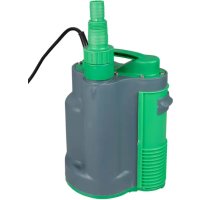
The SPV550i and SPV750i(s) pumps have an internal one-phase and asynchronous engine and a water pump under the engine. The pump drives the recessed impeller. The pump has a stainless steel housing (combined with cast iron in the SVP750is), has excellent capacity and is suitable for transporting large granules and lumps. Depending on the required water level, the float switch can either start or stop the pump automatically.
The dirty-water pumps are used in the industrial, construction, agricultural and mining sector, in an urban environment, etc. They are the ideal device to pump waste water or sewage that contain granules, short fibres, paper residue, mud or sand as well as to drain or irrigate in the agricultural sector, to dredge ditches and ponds, etc. The pump is not allowed to be used in environments that have a risk of fire or explosion.
Description
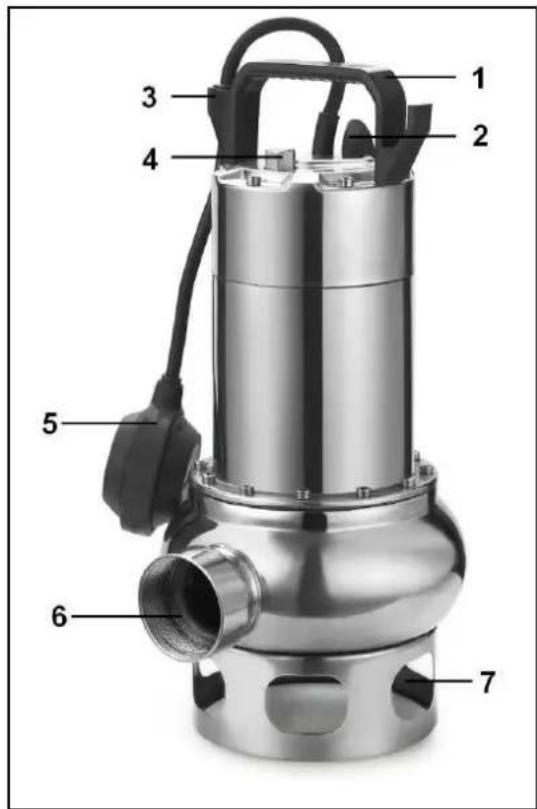
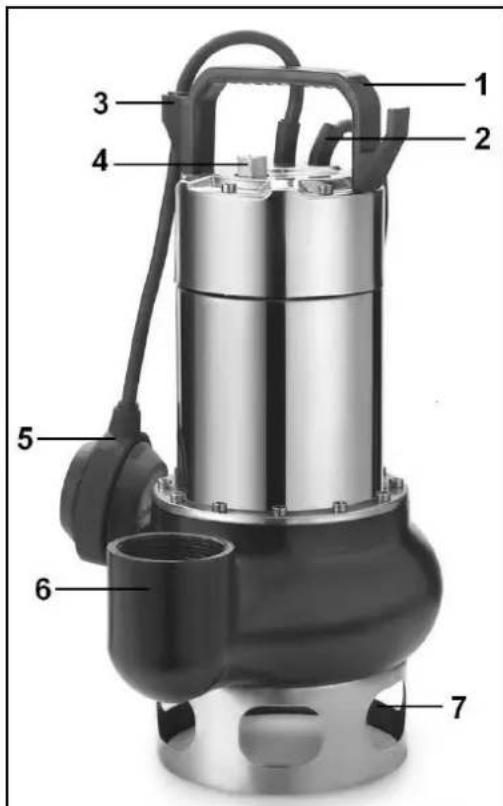
SPV750is SPV550i/SPV750i
- Handle
- Electrical cable including plug
- Connection of the float switch
- Bleeding valve
- Float switch
- Hose connection (SPV750is includes a synthetic bend)
- Suction opening
Before Using the Pump
Check all the components of the pump. Determine that damage has not occurred during transport or storage. A qualified electrician should carry out all the electrical work activities in which all the national and local regulations should be observed. Before using the pump, measure the insulation value between the earth wire and each phase of the engine. This value should be more than 2M at a working temperature. The socket (and any extension cord) must have an earth wire and a 30 mA earth leakage circuit breaker.
Hose Connection
The diameter of the hose should be equal to the drain of the pump: 2^ / 50mm
Connect the hose to the pump outlet; you may use a hose clamp for a flexible hose. The SPV750i(s) has also a 2^ female thread. In addition, the SPV750is has a two-inch (50 mm) tulle.
Connection of the Float Switch
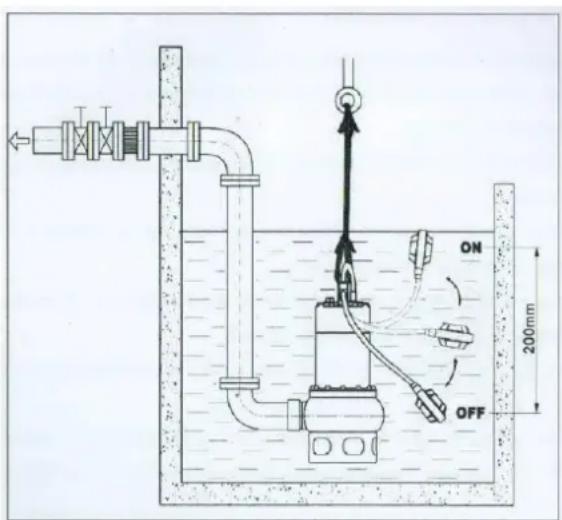
The pump has an adjustable float switch. This float switch will automatically switch on the pump, when the water reaches a level of approx. 25cm , and will automatically switch off the pump, when the water reaches a level of approx. 15cm . The points at which this switch switches on and off can be adjusted by giving the float slightly more or less space by shortening/loosening the float cable using the clamp on the handle. Before using the pump, you should check the following:
- The float switch should be set in such a manner that the float can reach the points at which it switches on and off easily and without effort. To check this, you put the pump in a barrel filled with water. Carefully, lift and lower the float switch manually. You can then feel when the pump switches on and off and you can adjust these points by slightly shortening/loosening the float cable using the clamp.
- Make sure that the distance between the float and the cable clamp on the handle is not too short. The float switch needs some space to operate smoothly.
- If you set the float switch, make sure that it does not touch the bottom before you switch off the pump. Also prevent the pump from hanging on to something. If the float does not signal 'OFF', the pump will continue to pump and ultimately, run dry or burn.
Putting in Place and Moving
- Make sure that the pump is positioned sturdily, especially if you let it operate automatically.
- Make sure that the float can move freely, especially in case of automatic operation.
- Make sure that the pump is positioned in a manner that does not block / partially block the suction openings at the bottom of the pump. We recommend putting the pump on a tile (for example), if it is going to stand on a soft underground (e.g.,
sand).
- Do NOT use the electrical cable or the float switch to lift or hang the pump. If you want to lower the pump into a well or shaft (for example), use a piece of rope that you attach to the handle.
- Your pump is constructed to include automatic bleeding through which air in the pump can be released if you submerge it in water. Therefore, the air bubbles that appear do not indicate a malfunction but are normal.
- The pump should not be submerged more than 5 metres. Do not put it into mud: this might cause blockage due to plant
growth or other causes that put the pump out of operation. Regularly, check the water level to determine that the pump does not sink to such an extent that it cannot suck up water while it is still operating.
- The pump can also be installed permanently but then, use a flexible hose instead of a hard pipe for the drainage (see the figure at the right-hand side). In that case, the pump must be positioned at minimum 0.5 metre above the bottom.
Operation
Before using the pump, check whether the values of the socket to which you want to connect the pump correspond with the values indicated on the type plate of the pump (230V/50Hz). Make sure that there are no persons in the area (cellar/boat/pond/etc.) that you want to pump empty.
Automatic Operation
After you insert the plug into the socket, the pump will automatically switch on when the water reaches the level above the set minimum, and will automatically switch off when the water reaches the set minimum level.
This way, the pump can be active continuously and maintain the water level in a cellar or boat, for example.
Notwithstanding the fact that the pomp operates automatically, regular supervision is a requirement to determine that no problems occur during operation, no damages emerge, etc. (Also see the section about Overheating Protection.)
Manual Operation
In case of manual operation, the pump will start to operate when you insert the plug into the socket and you manually set the float switch in the 'in operation' position. You do the latter by keeping the float switch vertically (electrical cable at the bottom side). The pump will continuously operate as long as you keep or fix the float in this position. However, stop the operation immediately, when the pump no longer pumps any liquid. The pumped liquid also cools the engine, which can overheat without cooling and get damaged! Therefore, constantly keep an eye on the pump when using it manually; running dry results in increased wear & tear!
If the pump has run dry for a few seconds, it does not automatically bleed. Switch it off (remove the plug from the socket) and move the pump to and fro, so that the air can escape. You can use the pump normally after this. Manual operation is recommended only for short-term work activities, while you constantly keep an eye on the pump.
During automatic operation, the pump will switch off when there is quite a bit of water still in your pit/cellar/boat/pond/etcetera, because the automatic float switch needs time to switch. If you want to pump the remaining water, we recommend switching to manual operation. You can reach the remaining water by placing the pump at the lowest point or in a hallowing. However, watch out for running dry! If you want to stop the operation of the pump, you have to disconnect the power supply and let the pump cool off completely in the water before you take the pump out of the water in order to avoid explosions and accidents.
Overheating Protection
Your submersible pump has overheating protection. This device automatically switches off the pump, if the engine becomes too hot. When the engine has cooled off sufficiently, the pump will automatically switch on again.
However, overheating always has a reason: the impeller might be jammed, a bearing might be worn out, etc. If the reason has not been remedied, overheating will reoccur and this causes severe damage to your pump, if this process repeats itself too frequently. Therefore, try to determine what the reason is and solve this problem. If the pump has to be opened for this, you should contact your supplier or an authorised professional.
Therefore, if too little monitoring was carried out during the automatic operation of the pump, the pump can fail in spite of the overheating protection. At all times, the user is responsible for monitoring!
Maintenance
You must switch off the pump and remove the plug from the socket before you carry out checking or cleaning activities.
Your submersible pump hardly requires any maintenance. The only things you have to do are:
- Regularly carry out a visual inspection. Are the pump, electrical cable, plug and float switch, including its cable, not damaged? If you observe any damage, you should contact your supplier or an authorised professional. NEVER try to carry out repairs yourself and do NOT open the pump!
- Regularly check the operation of the float switch, certainly if you have installed the pump for automatic operation.
- Regularly remove any deposit on the float using clean water.
- Using your fingers through the suction openings, regularly check whether dirt (fibres, residue) has not accumulated around the vane. If so, remove this dirt. If you do not manage, you should contact your supplier or an authorised professional and let them open the pump and remove the dirt.
- If you use the pump regularly in different places, you should flush and rinse the pump with clean water after each use.
- Make sure that the bottom of the pit or the tile on which the pump stands has no mud and/or deposits.
- Make sure that the remaining water in the pump does not freeze. Let the pump completely empty out by the time winter sets in and store the pump frost-free.
- Regularly check the insulation resistance between the turns of the pump (both phases) and the housing (the earth wire) to determine that the insulation resistance is not less than 1M . If not, you should contact your supplier or service station and make sure that the required norm is achieved before you put the pump into operation.
Maintenance to the pump should be carried out after 2,000 operation hours at normal use. Do NOT carry out maintenance yourself, but contact an authorised service station and check whether at least the following points were carried out:
Housing of the pump and check all important components such as ball bearings, mechanical seals and the vane. These should be replaced if they are damaged or worn out.
Pressure test: A pressure test should be carried out after a repair or replacement. The pressure should be 0.2MPa during 3 minutes without causing leakage or 'sweating'.
Changing oil: The oil plug of the oil tank should be removed for this. Subsequently, fill the tank up to 95% using 10# mechanical oil.
If you do not use the pump for a long time, it should be removed out of the water. Let the pump operate for 10 minutes in clean water to remove hard sediments at the inside and outside of the pump. Remove the plug from the socket, clean the outside of the pump and let it dry thoroughly. Store the pump in a dry and safe place.
Faults - cause - remedy
| Faults | Cause | Remedy |
| Pump does not start or is difficult to start. | No power Too low voltage Vane is full of garbage. Power loss in the cable The coil of the stator has burnt out. Float does not switch. | Check the power supply and wiring. Voltage may deviate maximum 10% from 230V. Clean the vane. Use a thicker cable. Rewind and overhaul the coil. Put the float in a higher position. |
| Pump runs but does not produce water. | Inlet opening(s) is/are blocked. Bend in the water drain hose or the hose is blocked. Air around the vane Vane is jammed. Water level is too low (manual operation). | Clean the inlet opening(s). Straighten the hose or remove the blockage. Switch off the pump and move it to and fro. Wait until the air has escaped and restart. Try to remove the impediment or contact a professional. Submerge the pump deeper in the water. |
| Pump does not stop. | Float cannot drop down. | Provide more space for the float. |
| Insufficient water | Outlet is too high. Inlet openings are blocked or partially blocked. Water drain, hose/tube is partially blocked. Vane is worn out. Air is sucked in. | Adjust its position. Clean the inlet opening(s). Remove the dirt. Replace the vane. Submerge the pump minimum 50 cm under water. |
| Too little pump capacity due to dirt or sandy | Clean the pump and have worn-out parts replaced. | |
| Pump does not start or suddenly stops during operations. | Thermal protection stops the pump due to overheating. The water is too hot. Power outage Plug out of the socket Dirt or little stones in the water supply Vane is blocked. The coil of the stator has burnt out. | See Overheating Protection section. Maximum water temperature is 40°C. Check the fuses and the earth leakage circuit breaker. Insert the plug. Remove dirt and little stones. Remove the dirt. Rewind and overhaul the coil. |
| Turns of the stator is burnt out. | Short-circuit, possibly due to a leak Blocked vane Pump is started too frequently. Pump is overloaded. | In all cases: Remove the reason and have the stator rewound. Send the pump for repair to your supplier or service station. |
| Pump produces suddenly less water. | Suction openings are blocked. | Clean the openings. |
Warranty
A normal warranty for production & material errors apply to the submersible pump you purchased.
The following damages and faults are excluded from the warranty:
- Wear & tear and defects of rotating mechanical seals due to dry-run or the presence of certain substances and/or objects in the water
- Blockage of the vane due to strange objects
- Transport damage
- Damage due to incompetent use
- Faults that unprofessional people tried to repair in vain or are caused by incompetent repair
- Damage due to overheating
Opening the pump by unauthorised people as well as making changes or additions to the pump will cancel the warranty and the liability of the supplier, importer and manufacturer.
Removal

In the EU this symbol indicates that this product may not be disposed of as ordinary household waste. Old equipment contains valuable materials, suitable for recycling. These materials should be made suitable for reuse in order to prevent any adverse effects to health and the environment caused by unregulated waste collection. Therefore, please make sure that you bring old equipment to a designated collection point. Alternatively, contact the original supplier, who can make sure that as many of the components as possible can be recycled
CE-declaration
See page 46.
Dank
declares the following device in sole responsibility:
Product: submersible pump
Brand name: EUROM
Model: SPV550i PROF & SPV750i PROF & SPV750iS PROF
Item number: 260472 & 260519 & 260533
Complies with the following harmonization rules:
Low Voltage Directive: LVD 2014/35/EU
Electromagnetic compatibility Directive: EMC 2014/30/EU
Restriction of Hazardous Substances RoHS Directive: 2011/65/EU&(EU)2015/863
Machinery Directive: 2006/42/EC
Applied harmonized standards:
EN ISO 12100:2010, EN 809:1998+A1:2009+AC:2010
EN 60204-1:2006+A1 :2009+AC :2010
EN 60335-1:2012+AC :2014, EN 62233:2008+AC :2008
EN 60335-2-41:2003+A1:2004+A2:2010
EN 60034-1:2010+AC:2010
EN 55014-1:2006+A1:2009+A2 :2011
EN 55014-2:1997+A1:2001+A2:2008
EN 61000-3-2:2014
Genemuiden, 30-11-2020
W.J. Bakker, alg. Dir.

Eurom
Kokosstraat 20
8281 JC Genemuiden
The Netherlands
info@eurom.nl
www.eurom.nl
301120
- Symbol explanation
- Technical details
- Safety Guidelines
- Product Description
- Description
- Before Using the Pump
- Hose Connection
- Connection of the Float Switch
- Putting in Place and Moving
- Operation
- Automatic Operation
- Manual Operation
- Overheating Protection
- Maintenance
- You must switch off the pump and remove the plug from the socket before you carry out checking or cleaning activities.
- Warranty
- Removal
- CE-declaration
- Dank
- Eurom
Brand : Eurom
Model : SPV750is Prof
Category : Pump