Flow Pro 550DW - Pump Eurom - Free user manual and instructions
Find the device manual for free Flow Pro 550DW Eurom in PDF.

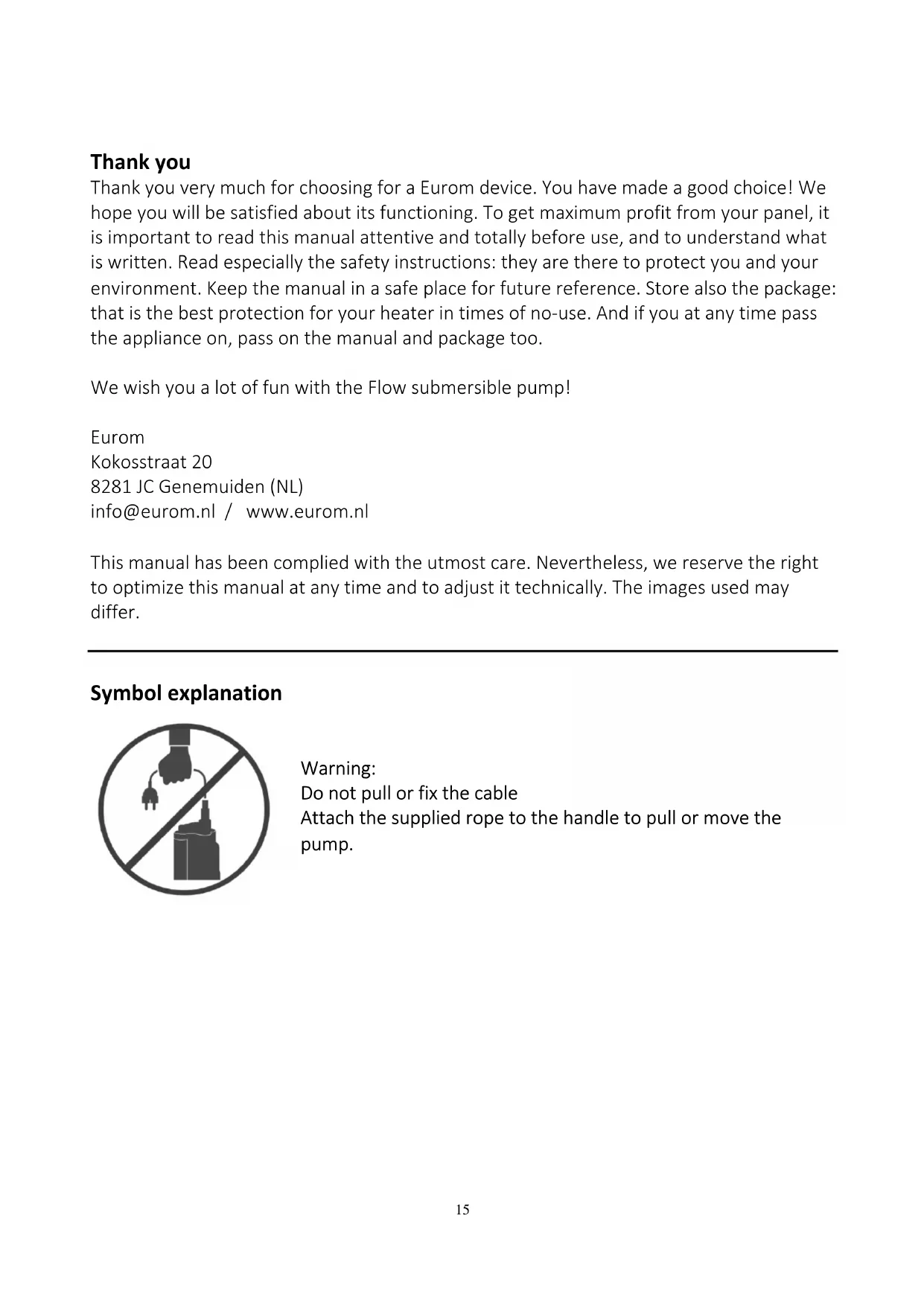


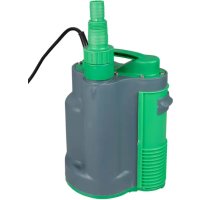
| Brand | Eurom |
| Model | Flow Pro 550DW |
| Product type | Submersible pump for clean or slightly dirty water |
| Electrical supply | 230 V ~ 50 Hz |
| Power consumption | 550 W |
| Maximum capacity | 11 000 l/h |
| Maximum suction height | 7 m |
| Maximum immersion depth | 5 m |
| Maximum water temperature | 40 °C |
| Protection rating | IP68 (waterproof) |
| Hose connection | 25 mm (1") et 32 mm (1 1/2") |
| Maximum impurity passage | 16 mm |
| Residual water level | 16 mm |
| Automatic start level | 140 mm |
| Automatic stop level | 30 mm |
| Noise level | ≤ 70 dB(A) |
| Cable length | 10 m |
| Dimensions (L x W x H) | 22 x 18,5 x 28,5 cm |
| Weight | 4 kg + 1 kg (cable and accessories) |
| Housing material | Plastic |
| Operation | Automatic (float switch) or manual |
| Overload protection | Yes, automatic thermal shutdown |
| Recommended use | Draining basements, tanks, boats; rainwater |
| Maintenance | Rinse with clean water after use; clean the float switch regularly |
| Warranty | Standard warranty against manufacturing defects (excluding wear and misuse) |
Frequently Asked Questions - Flow Pro 550DW Eurom
User questions about Flow Pro 550DW Eurom
0 question about this device. Answer the ones you know or ask your own.
Ask a new question about this device
Download the instructions for your Pump in PDF format for free! Find your manual Flow Pro 550DW - Eurom and take your electronic device back in hand. On this page are published all the documents necessary for the use of your device. Flow Pro 550DW by Eurom.
USER MANUAL Flow Pro 550DW Eurom
Operating instructions (EN) (page 15)
natural_image
Exterior view of a modern industrial water filter device (no visible text or symbols on body)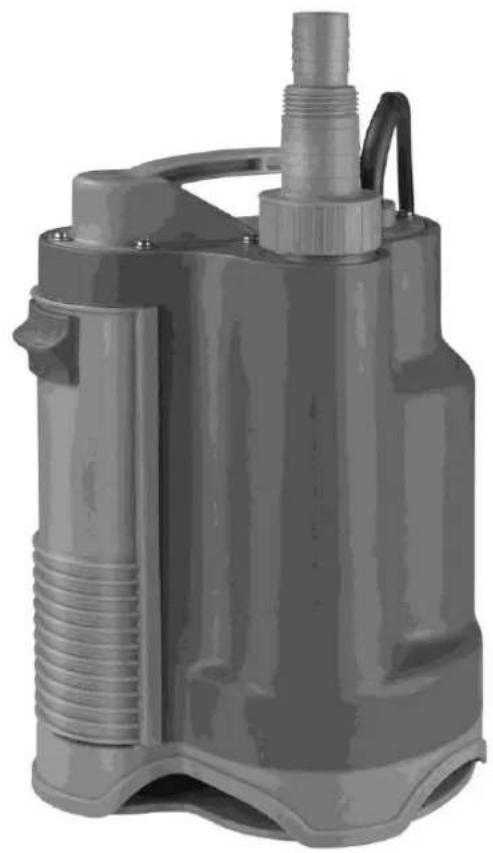
natural_image
Exterior view of a gray industrial pump device with threaded inlet and side ports (no visible text or symbols)Flow Pro 550CW & 550DW
Art.nr. 261493 & 261523
H (m)
FLOW-PRO 550CW
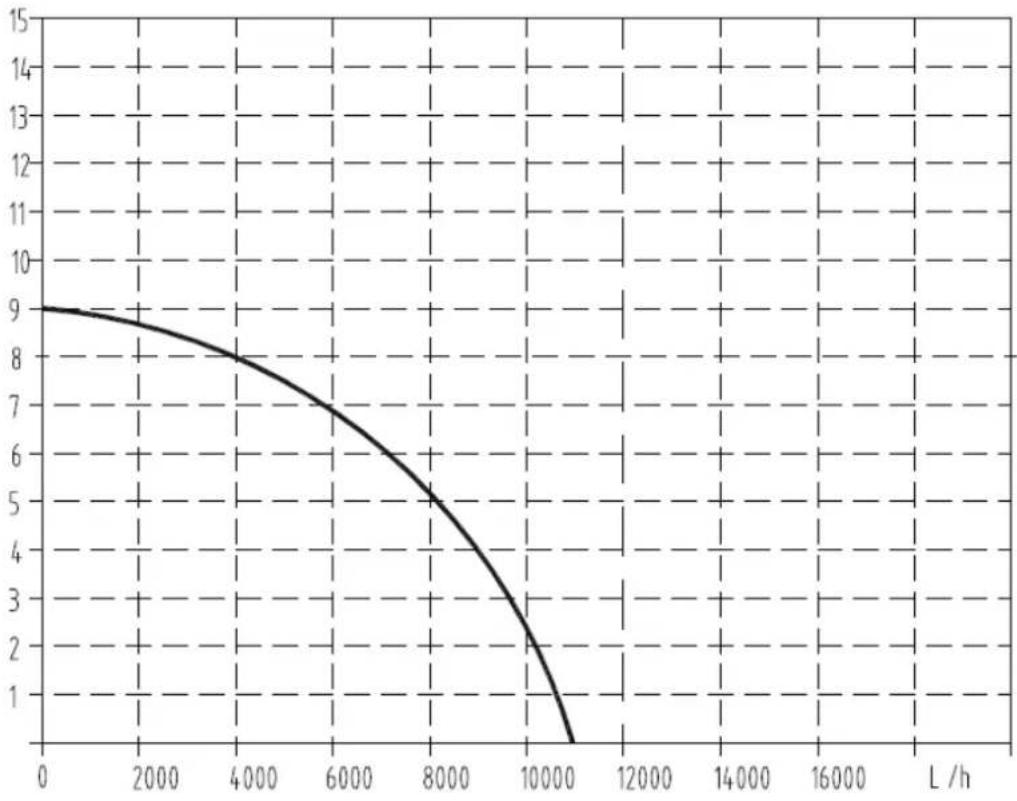
line
| L /h | Value | |------|-------| | 0 | 9 | | 2000 | 8.5 | | 4000 | 7.5 | | 6000 | 6.5 | | 8000 | 5.0 | | 10000| 3.0 | | 12000| 1.0 |H(m)
FLOW-PRO 550DW
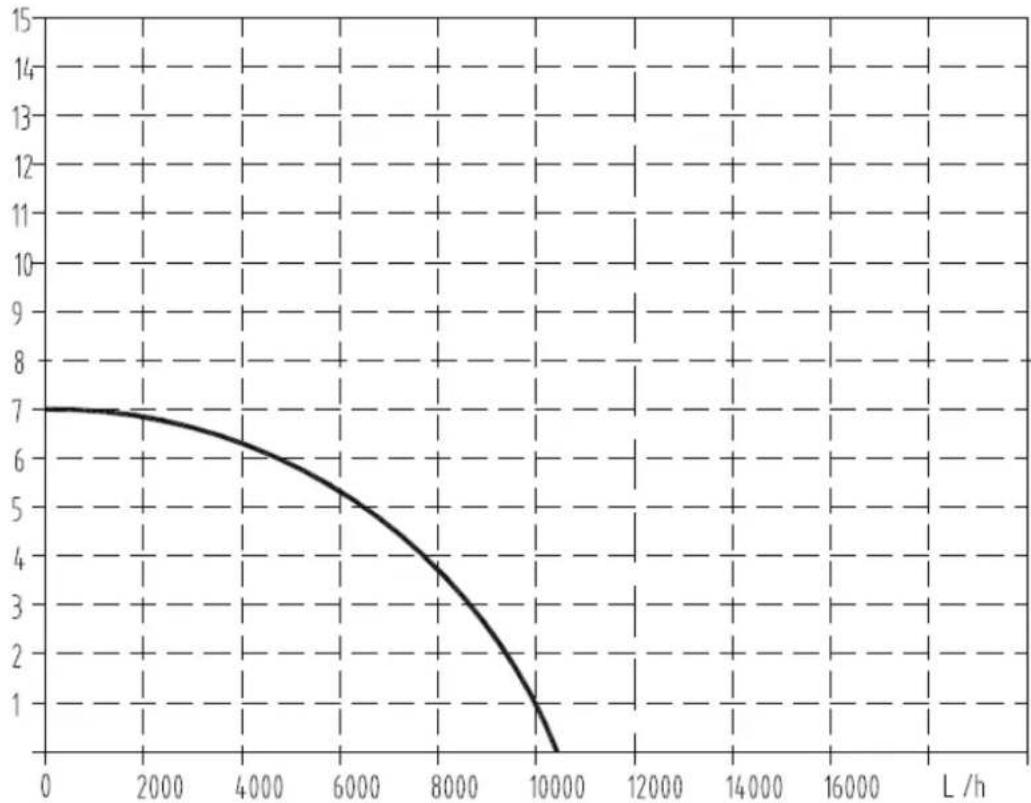
line
| L /h | Value | |------|-------| | 0 | 7 | | 2000 | 6.5 | | 4000 | 5.5 | | 6000 | 4.5 | | 8000 | 3.5 | | 10000| 1 |Dank
natural_image
Prohibition sign showing a hand holding an electrical plug above a bottle, enclosed in a circle (no text or symbols)Waarschuwing:
natural_image
Close-up of a metallic cylindrical object with a label and handle, no visible text or symbols.Thank you very much for choosing for a Eurom device. You have made a good choice! We hope you will be satisfied about its functioning. To get maximum profit from your panel, it is important to read this manual attentive and totally before use, and to understand what is written. Read especially the safety instructions: they are there to protect you and your environment. Keep the manual in a safe place for future reference. Store also the package: that is the best protection for your heater in times of no-use. And if you at any time pass the appliance on, pass on the manual and package too.
We wish you a lot of fun with the Flow submersible pump!
Eurom
Kokosstraat 20
8281 JC Genemuiden (NL)
info@eurom.nl / www.eurom.nl
This manual has been complied with the utmost care. Nevertheless, we reserve the right to optimize this manual at any time and to adjust it technically. The images used may differ.
Symbol explanation
natural_image
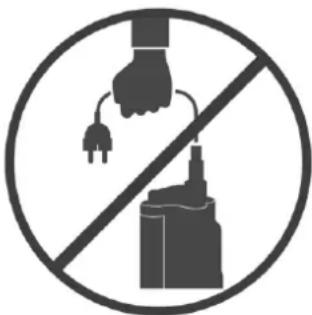
Prohibition sign showing a hand holding an electrical plug above a bottle, crossed out by a diagonal line (no text or symbols)Warning:
Do not pull or fix the cable
Attach the supplied rope to the handle to pull or move the pump.
Technical specifications
| Type | Flow Pro 550CW | Flow Pro 550DW |
| Connection voltage | 230V – 50Hz | 230V – 50Hz |
| Power consumption | 550W | 550W |
| Cap. max. | 11.000 l/h | 11.000 l/h |
| Class of insulation | IP68 | IP68 |
| Max. supply depth | 9m | 7m |
| Max. submersion depth | 5m | 5m |
| Max. water temp. | 40°C | 40°C |
| Hose connection | 25mm – 1” – 32mm - 1 12 ” | 25mm – 1” – 32mm - 1 12 ” |
| Max. size of contamination | 3mm | 16mm |
| Residual water (Manual) | 5mm | 16mm |
| Start level (auto-setting) | 140mm | 140mm |
| Stop level (auto-setting) | 30mm | 30mm |
| Noise level Lpa | ≤70dB(A) | ≤70dB(A) |
| Cable | H05RN-F 3G 1.00mm ^2 | H05RN-F 3G 1.00mm ^2 |
| Cable length | 22x16x31 | 21x16x33 |
| Dimensions | 22x18,5x26 | 22x18,5x28,5 |
| Weight | 4 + 1 kg | 4 + 1 kg |
Mandatory submersible pump warnings
- The submersible pumps are designed for a maximum water temperature of 40^ C.
- Always stand the submersible pump upright when in use.
- Before use, check whether the submersible pump head or suction height do not exceed the capacity of the submersible pump. The maximum total head in meters from the submersible pump is 9 meter (Flow Pro 550CW) or 7 meter (Flow Pro 550DW)
- Pollution of the liquid could occur due to leakage of lubricant.
- If the supply cord is damaged, it must be replaced by manufacturer, its service agent or similarly qualified persons in order to avoid a hazard.
- This appliance is not intended for use by persons with limited physical, sensory or mental capacities or lacking experience and/or skills, unless such persons are accompanied and supervised by a person in charge if their safety or they have received precise instructions on the use of this appliance and have understood the resulting risks.
• Children must not use the device. - Supervise children to prevent them from playing with the appliance.
- Cleaning and user maintenance may not be carried out by children.
Safety Guidelines
- Before each use, check the submersible pump, electrical cable, plug and socket. A damaged submersible pump must not be used but have a certified electrician repair them.
- Before use, check whether the socket to which you want to connect the submersible pump is suitable for the submersible pump (230V/50Hz; see the type plate).
- Before use, first clean the drain hose.
- Only use the submersible pump with the elbow mounted on the discharge side of the submersible pump, so that it is not possible to touch the moving parts of the submersible pump.
- Only water may be transported with the Eurom submersible pump.
- Clean water submersible pumps: clean to slightly contaminated water with a maximum grain size of 3mm (Flow Pro 550CW) or 16mm (Flow Pro 550DW)
- Dirty water submersible pump : contaminated water with a maximum grain size of : 3mm (Flow Pro 550CW) or 16mm (Flow Pro 550DW).
- This submersible pump is not suitable for salt water, corrosive, highly flammable or explosive substances. (e.g. petrol, petroleum, nitro dilution), oils, fuel oil and foodstuffs.
• Water that has been delivered with this submersible pump is no drinking water.
- After you have pumped water to which chloride was added or which contains a certain deposit, you should flush the submersible pump using clean water. Take into account that sand (and similar material) and all other abrasive and corrosive substances accelerate the wear & tear and affect the capacity of the submersible pump.
- Do not operate the submersible pump in fire or explosion-en-dangered surroundings.
- The submersible pump is not suitable for long-term working in pumping conditions (permanent circulation).
- Do not operate the submersible pump during frost conditions.
- The submersible pump must not be used when persons are in the water. Do NOT use the submersible pump when there are people in the cellar, the pit or whichever reservoir you want to empty of water.
- Keep everyone away from the water as much as possible.
- If people are in the water or come into contact with the water surface, the submersible pump must be unplugged immediately.
- Do not touch the water, the rope attached to the carrying handles as well as objects that are in contact with the water (e.g. pipelines extending into the water, railings etc.)
- A cord/rope must be used to submerge or hook up and secure the submersible pump. Do NOT use the electrical cable to hang, lower or move the submersible pump. Attach a piece of rope to the handle. Do not pull the plug by the cable, but by the plug from
the socket. The electrical cord must not be used to secure or transport the submersible pump.
- The end of the drain hose must be lower than the maximum head.
- Note the minimum residual water level in accordance with the submersible pump data.
- Do not let the submersible pump run against the closed pressure side for longer than 10 minutes.
- Prevent the submersible pump from operating, while it cannot discharge the water for whatever reason: blocked drain, a too high head, etc. This damages the submersible pump.
- Letting the submersible pump run dry speeds up the wear & tear and causes overheating. Therefore, always prevent the submersible pump from operating while water is no longer displaced; immediately switch off the submersible pump when this happens.
- The float switch may only be operated outside the water.
- To ensure that the float switch can be switched on and off, the cable length between the float switch and the float switch interlock must be at least 10 cm.
- The drain hose must not be pulled off the pump during use.
• Regularly check the drain hose. - Unplug the submersible pump from the wall socket before mounting the submersible pump.
- Unplug the submersible pump before connecting, adjusting, or transporting the submersible pump or want to touch it for some other reason.
- Unplug the submersible pump before troubleshooting the product.
Unplug the submersible pump before performing maintenance or replacing parts. Make sure the power socket is within your field of vision.
- In the event of overload, the submersible pump is switched off by the built-in thermal motor safety switch. After the motor has cooled down sufficiently, the submersible pump is ready for use again.
- When the submersible pump is operating, do NOT bang/press/wring/pull the cables and do NOT put something heavy on them. Do NOT use the electrical cable as a hanging cord. All of these things can cause an electric shock.
- Create stability for the submersible pump prior to any work on or on or with the submersible pump to prevent accidents or damage.
- In order to prevent accidents or injuries, mind the weight of the submersible pump during transport and choosing storage location.
- For reasons of safety, your submersible pump must always be connected to an earthed socket, which has been installed as part of the electricity grid according to the national regulations. It is minimum 16A fused and has an earth leakage circuit breaker with a nominal earth leakage current of maximum 30 mA.
- At all times, make sure that electrical connections (plugs, etc.) are dry and remain dry.
- The mains plug and the coupling of an extension cord must be watertight and must never lie on the ground. The use of cable reels that ensure that the sockets are at least 60 mm above the ground is recommended. Make sure that the electrical plug connections cannot come into contact with water. NEVER let the plug or socket come in contact with water. All connections need to be waterproof and cannot come in contact with water.
- All electric sockets should be fixed in an area that is protected against floods.
- Protect the electrical cable and plug against heat, oil and sharp edges.
- Danger of electric shock: If you cut the plug, moisture can enter the electrical part through the cord and cause a short circuit. Never cut the plug, for example to put the cord through a wall.
- When extension cords are used, they must comply with the minimum cross-sections below
- max 20 meter 1,5 mm2
- 20-50 meter 2,5 mm2
- You should NEVER repair the submersible pump, cable and/or plug yourself, but leave this to an authorised professional. The importer and manufacturer are NOT liable for unprofessional repairs and/or modifications to the submersible pump. Such activities cancel the warranty.
- Do not clean the submersible pump with a jet of water (especially not under high pressure).
- Do not clean with chemicals, including gasoline or solvents. some substances can damage important plastic parts.
- This submersible pump generates an electromagnetic field during operation. Under certain circumstances, this field can influence the operation of active or passive medical implants. To avoid the risk of situations that could lead to serious or fatal injuries, persons with a medical implant should consult their doctor and the implant manufacturer before using this product.
- WARNING: Plastic bags can be dangerous. To avoid danger of suffocation, keep this bag away from babies and children.
Where can the pump be used?
This submersible pump has been designed for private usage in or around the home and garden. Submersible pumps are primarily used for draining water, moving liquids and emptying water reservoirs, cellars, boats etc., and also for temporary circulation of water. The pumps are completely watertight and can be submerged in liquid with a maximum depth of 5 metres. These pumps are not suitable for table fountains or aquariums. If the pump is used in a pond containing fish, you must take measures to prevent the fish being sucked into the pump. This pump can be used to pump clean and lightly polluted, non-aggressive liquids. The liquid may contain particles of max. 3mm (Flow-Pro 550CW) or max. 16mm (Flow-Pro 550DW) diameter. Sand (and similar materials) in the liquid that is to be pumped will have a corrosive effect and will lead to increased wear and tear. Corrosive, lightly flammable or explosive liquids (such as petrol, diesel, paraffin, thinners etc.), seawater, fats, oil, salty or contaminated water from toilets etc. cannot be pumped! The temperature of the pumped liquids must not exceed 40°C. Always prevent the pump from running if no water is being moved.
Note: these pumps may not be used in a swimming pool!
This pump is not suitable for continuous use, such as the continual circulation of water. This type of use will substantially shorten the pump's life expectancy.
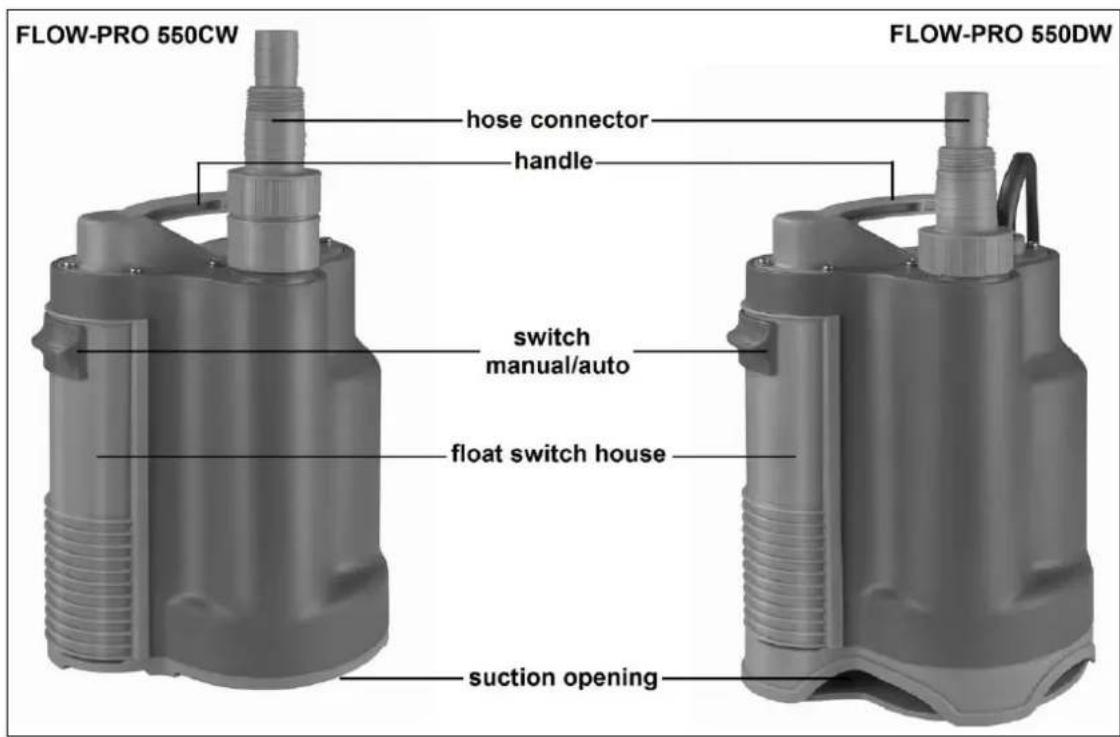
Description
Before use
When preparing the device for use, take the plug out of the electrical socket!
Hose connection
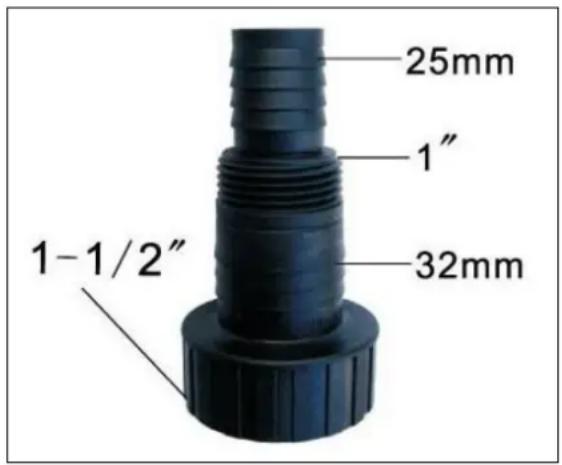
Connect the hose connector to the fitting.
The hose connector goes from 25 to 32 mm (or 1" to 1½"). If you are exclusively using a more wide hose, you can remove the remaining piece of the fitting with a sharp knife or saw. Attach the hose to the appropriate part of the connector with a hose clamp (or turn it on it). The best results of pumping efficiency are achieved with a 32 mm hose.
Locating and moving
- Make sure the pump is positioned at a stable location, particularly if you want it to work automatically.
- Ensure that the suction openings are not blocked (not even partially). If the pump is positioned on a soft surface (e.g. a sand bed), place it on a tile or something similar.
- Do not use the electrical cable to lift the pump or hang it up. If you wish to locate the pump in a water source or shaft, use a rope that is attached to the handle to do so.
- If the pump is being installed into a permanent location, with a fixed drainage system, you are advised to install a connection point at a handy location in order to simplify cleaning and maintenance.
- If you are using the pump temporarily, you may use a flexible hose that is connected to the pump using a hose clamp.
Operation
The electrical cable must be at least a HO5RN-F 3x0.75mm ^2 , with a length of at least 10 metres. Any extension cable must be of the type HO5RN-F 3x1.5mm ^2 .
Before use, check that the values of the socket to which you wish to connect the pump correspond to those on the type plate on the pump itself (230V-50Hz) and that the socket is earthed and has an earth leakage circuit breaker (nominal voltage ≤ 30 mA). Make sure that no people present in the space to be pumped out (cellar/boat/pond etc).
Ensure that electrical connections stay dry at all times.
Automated function
The Flow Pro 550 has an integrated float.
Set the switch to the AUTO position (see diagram). Once you have plugged the device into the socket, the pump will switch on automatically when the water exceeds the start-level (140 mm) and switch off when the stop-level (30 mm) has been obtained.
This means that the pump can be left on at all times and will keep the water in a cellar or boat, for example, at the required level. Bear in mind that this pump is not designed to be used continuously; it must be switched off at regular intervals.
Despite the fact that the pump works automatically, regular supervision is required in order to ascertain that it has not encountered any functional problems and that it has not been damaged (see also: overheating safeguard).
natural_image
Close-up of a metallic cylindrical object with a curved handle and label (no readable text or symbols)Manual function
Set the switch to the MANUAL position. The pump will now not automatically switch off but carry on pumping, even if the remaining water level (CW: 3mm – DW: 16mm.) is reached and the pump runs dry. Switch it off immediately!
You must always supervise the pump during manual operation.
Overheating safeguard
Your submersible pump is equipped with an overheating safeguard. This switches the pump off automatically if the motor gets too hot. Once it has cooled down sufficiently, the pump will automatically switch on again.
There is always a cause for overheating: the fan may have become jammed, a bearing may be worn, the pump can run dry etc. and if the cause is not removed, the device will overheat once again. If this process is repeated too often it may cause serious damage to your pump. Try to establish what is wrong and resolve the problem. If the pump needs to be opened up you must take it to your supplier or an accredited professional.
If there is insufficient supervision of a pump that is functioning automatically, the pump may break down despite the presence of the overheating safeguard. The user is always responsible for supervising the device!
Maintenance
Before you carry out checking or cleaning tasks on the pump you must switch it off by taking the plug from the socket.
Your submersible pump is more or less maintenance-free. The only tasks you must carry out are as follows:
- Carry out a regular visual inspection. Make sure the pump is not damaged. Check the electrical cable, the plug, the float switch and the float cable for damage too. If you
discover damage, you must take the device to your supplier or an accredited professional. Never attempt to carry out repairs yourself and never open the pump!
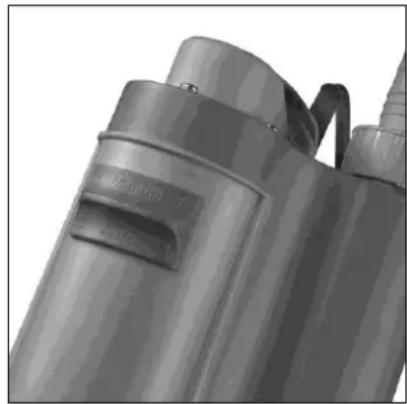
- Regularly check that the float switch is working effectively, particularly if you have set the pump to work automatically (every 3 months). Regularly remove residues from the float with clean water. Turn the pump upside-down, open the side-panel with a pin or similar and remove (see diagram). Take the pin and float out and clean the float and the magnet. Prevent damage or incorrect assembly and do not remove the float from the pin!
- Regularly check whether any dirt (fibres, residues) has accumulated around the blade. Remove it if this is the case by cleaning the pump with clean water. If you cannot do so,
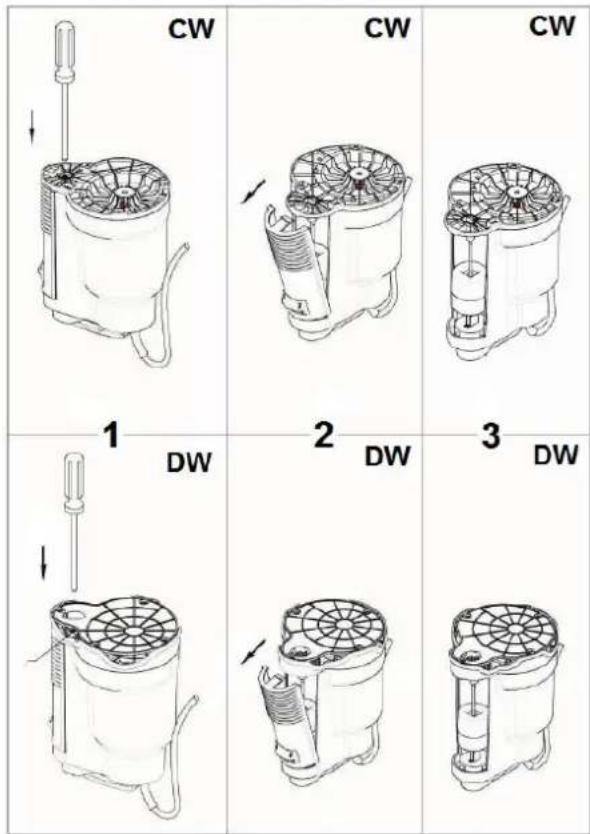
take the pump to your supplier or to an accredited professional to open the device and remove the residue.
- If you regularly use the pump at different locations, you must rinse with clean water (inside and out) after each use.
- Keep the base of the well (or the tile on which the pump is positioned) free from mud and residue.
- Ensure that the pump does not freeze. Before winter sets in, run the pump dry and store it in a frost-free location.
Defects – causes – solutions
| Defects | Causes | Solutions |
| Pump does not start | - No electricity- Overheating safeguard activated- Pump is stuck | - Check electrical supply- See: overheating safeguard.- Clean float and float axle |
| Pump runs but does not pump water | - Inlet openings are clogged- Water drainage pipe is bent or hose is blocked- Air around the blade- Blade is jammed- Water level is too low (manual usage)- CW: return valve in pump outlet is blocked | - Clean them- Straighten the hose or remove the blockage- Switch the pump off and move it from side to side. Wait until the air has escaped and switch on again- Try to remove the blockage or ask a professional to do so- Submerge the pump in deeper water- Remove blockage |
| Insufficient water | - Inlet openings are (partially) blocked- Outlet drain (partially) blocked- Broken fan | - Clean them- Remove blockage- Replace the fan |
| Pump does not start or suddenly switches off while functioning | - Thermal safeguard stops pump due to overheating- Water is too hot- Power outage- Dirt or stones in the water supply- Blade is stuck- Problem with the motor | - See: overheating safeguard- Max. water temperature 35°C- Check fuses and earth leakage- Remove dirt and stones- Remove blockage if possible or consult service point- Consult service point |
| Pump does not start and stop in AUTO setting | - Pump is not vertical- The float is stuck | - Make sure the pump is standing up straight- Clean the float |
If these tips do not provide a solution, contact your supplier or service point.
Guarantee
The submersible pump you have purchased comes with the usual guarantee which applies to production and material defects.
The following damage and defects are not covered by the guarantee:
- Wear and tear and defects in relation to mechanical seals caused by drying out or the presence of specific substances and/or objects in the water.
- Blockage of the blade by foreign objects
- Transport damage
- Damage caused by unreasonable use
- Defects that unauthorised persons have attempted to resolve or which have been caused by improper repairs
• Damage due to overheating
The guarantee and liability of the supplier, importer and manufacturer will be nullified if the pump is opened by unauthorised persons or modifications or additions are made to the pump.
Disposal

At its end of life, discard the device according to the local laws and regulations, or deliver the device to your supplier.
Attachments
The CE declaration can be found at the end of this manual.
Dank
natural_image
Prohibition sign showing a hand holding an electrical plug and a bottle, crossed out by a diagonal line (no text or symbols)Warnung:
natural_image
Close-up of a metallic cylindrical object with a label showing 'Hemoral 7' and '2014' (no other text or symbols visible)natural_image
Prohibition sign showing a hand holding an electrical plug above a bottle, crossed out by a diagonal line (no text or symbols)Attention:
natural_image
Close-up of a metallic mechanical component with curved surfaces and a handle (no visible text or symbols)natural_image
Prohibition sign showing a hand holding an electrical plug above a bottle, crossed out by a diagonal line (no text or symbols)Advarsel:
Ikke trekk eller bind kabelen
natural_image
Close-up of a gray industrial device with visible branding and handle (no readable text or symbols)natural_image
Prohibition sign showing a hand holding an electrical plug and a bottle, crossed out by a diagonal line (no text or symbols)Varning:
Placera och flytta
natural_image
Close-up of a metallic cylindrical device with visible internal components and a label (no readable text or symbols beyond branding)natural_image
Prohibition sign showing a hand holding an electrical plug above a bottle, crossed out by a diagonal line (no text or symbols)Advarsel:
Obligatoriske advarsler – Dykpumper
natural_image
Close-up of a metallic cylindrical device with a label on its side (no readable text or symbols beyond the label)Manuel betjening
Indstil afbryderen til MANUEL-tilstand (manuel).
natural_image
Prohibition sign showing a hand holding an electrical plug above a bottle, crossed out by a diagonal line (no text or symbols)Varoitus:
natural_image
Close-up of a metallic cylindrical device with a label on its side (no readable text or symbols)Manuaalinen käyttö
declares the following device in sole responsibility:
Product: submersible pump
Brand name: EUROM
Model: Flow Pro 550CW & Flow Pro 550DW
Item number: 261493 & 261523
Complies with the following harmonization rules:
Machinery Directive: MD 2006/42/EC
Electromagnetic compatibility Directive: EMC 2014/30/EU
Restriction of Hazardous Substances RoHS Directive: 2011/65/EU&(EU)2015/863
Applied harmonized standards:
EN 60335-1:2012+A11+A13+A1+A14+A2+A15
EN 60335-2-41:2021+A11
EN 62233:2008
AfPS GS 2019:01 PAK
EN 55014-1:2021
EN 55014-2:2021
EN 61000-3-2:2019+A1
EN 61000-3-3:2013+A1
Genemuiden, 21-02-2024
W.J. Bakker, alg. Dir.

EUROM
Kokosstraat 20
8281 JC Genemuiden
The Netherlands
info@eurom.nl
www.eurom.nl
160224
- Flow Pro 550CW & 550DW
- Dank
- Symbol explanation
- Mandatory submersible pump warnings
- Safety Guidelines
- Where can the pump be used?
- Before use
- Hose connection
- Locating and moving
- Operation
- Automated function
- Manual function
- Overheating safeguard
- Maintenance
- Guarantee
- Disposal
- Attachments
- Placera och flytta
- Obligatoriske advarsler – Dykpumper
- Manuel betjening
- Manuaalinen käyttö
- EUROM
Brand : Eurom
Model : Flow Pro 550DW
Category : Pump