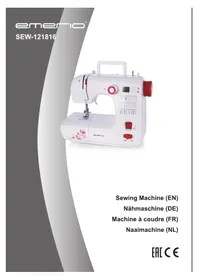
SEW121816 - Sewing machine Emerio - Free user manual and instructions
Find the device manual for free SEW121816 Emerio in PDF.



| Product Type | Sewing Machine |
| Brand | Emerio |
| Model | SEW121816 |
| Power Supply | AC adapter: 100-240 V AC, 50/60 Hz, 800 mA max; Output: 12 V DC, 2000 mA |
| Power | 24 W (12 V × 2 A) |
| Control Type | Variable speed pedal |
| Number of Stitches | Multiple patterns (selection via +/- button, digital display) |
| Useful Stitches | Straight stitch, zigzag stitch, manual buttonhole, button sewing, reverse sewing |
| Thread Tension Adjustment | Upper thread tension selector |
| Stitch Length Adjustment | Stitch length selector (positions A to E) |
| Needle Type | Standard needle with flat side |
| Bobbin | Metal bottom bobbin (included, 2 pieces) |
| Presser Feet Included | Standard foot, buttonhole foot, button foot |
| Accessories Provided | Pedal, bobbins (×2), spools (×2), needle threader, needles, buttonhole foot, button foot, adapter |
| Lighting | Integrated work lamp (non-user replaceable) |
| Thread Cutter | Integrated on the left side |
| Sewing Arm | Yes, for sleeve sewing |
| Storage | Removable accessory drawer |
| Safety | Automatic shut-off in case of overload; turn off and unplug before any maintenance |
| Care and Cleaning | Clean with a dry cloth; do not use solvents; unplug before cleaning |
| Warranty | 2 years (excluding improper use and wear parts) |
| Dimensions (approx.) | Approx. 40 × 20 × 30 cm (estimate) |
| Weight (approx.) | Approx. 5 kg (estimate) |
Frequently Asked Questions - SEW121816 Emerio
User questions about SEW121816 Emerio
0 question about this device. Answer the ones you know or ask your own.
Ask a new question about this device
Download the instructions for your Sewing machine in PDF format for free! Find your manual SEW121816 - Emerio and take your electronic device back in hand. On this page are published all the documents necessary for the use of your device. SEW121816 by Emerio.
USER MANUAL SEW121816 Emerio
Instruction manual - English
Before use make sure to read all of the below instructions in order to avoid injury or damage, and to get the best results from the appliance. Make sure to keep this manual in a safe place. If you give or transfer this appliance to someone else make sure to also include this manual.
In case of damage caused by user failing to follow the instructions in this manual the warranty will be void. The manufacturer/importer accepts no liability for damages caused by failure to follow the manual, a negligent use or use not in accordance with the requirements of this manual.
- This appliance can be used by children aged from 8 years and above and persons with reduced physical, sensory or mental capabilities or lack of experience and knowledge if they have been given supervision or instruction concerning use of the appliance in a safe way and understand the hazards involved.
- Children shall not play with the appliance.
- Cleaning and user maintenance shall not be made by children without supervision.
- The appliance is only to be used with the power supply unit provided with the appliance.

- Always switch off the appliance, disconnect from the power supply and remove foot pedal when:
changing the needle;
threading the needle;
changing bottom bobbin;
changing any parts;
inserting or removing batteries;
cleaning the machine;
after each use.
- Never run the machine when there's thread in the needle, but no fabric on the machine. This could damage the machine.
- Always keep your hands away from the needle, hand wheel, upper thread tension dial and pattern selection dial when the appliance is running.
- Never attempt to open the housing of the appliance, or to repair the appliance yourself. This could cause electric shock.
- Never leave the appliance unattended during use.
- Switch off or unplug the appliance when leaving it unattended.
- Unplug the appliance before carrying out maintenance.
- This appliance is not designed for commercial use.
- Do not use the appliance outdoors.
- Do not use the appliance for other than intended use.
- Never use the appliance if damaged in anyway.
- Whenever the sewing machine is not in use make sure it is switched off and unplugged from the power supply and remove the foot pedal.
- Keep the machine in a dry and ventilated place.
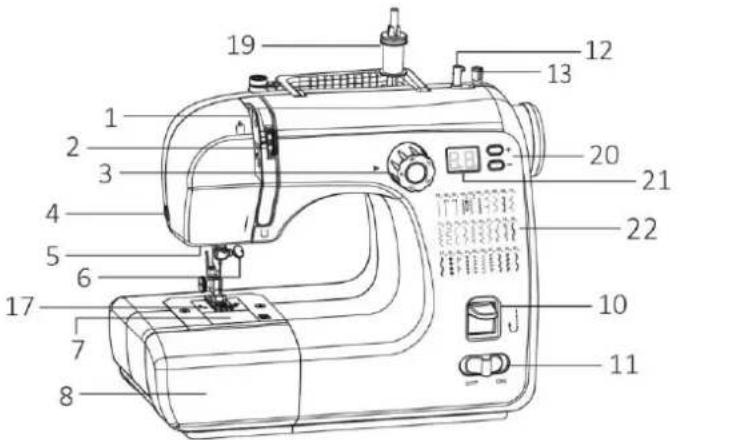
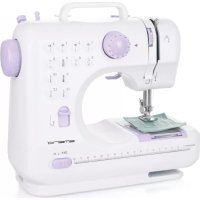
PARTS IDENTIFICATION
- Take-up lever
- Thread tension dial
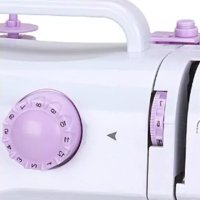
- Stitch density dial
- Thread cutter
- Light
- Needle clamp screw
- Bottom bobbin
- Drawer
- Hand wheel
- Reverse button
- Power switch
- Bobbin winder pin
- Bobbin winder stop
- Foot pedal input
- Bobbin winder tension disk
- Presser foot lifter
- Presser foot
- DC input
- Spindle
- Stitch selection button ( +) / -)
- Digital display of stitch selected
- Stitch panel
Note - The hand wheel should always be turned counterclockwise as the arrow directed on the wheel.
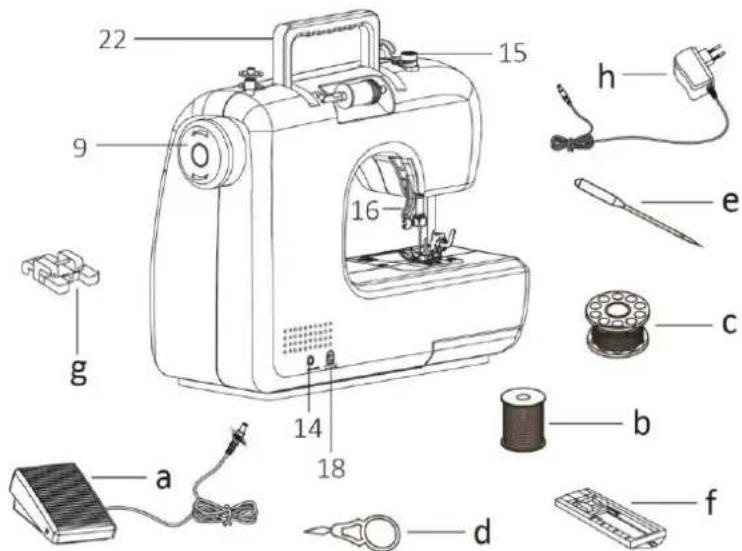
Accessories:
a) Foot pedal with speed control
b) Thread spool (X 2)
c) Bobbin (X 2)
d) Needle threads
e) Needle
f) Presser foot for buttonhole sewing
g) Presser foot for button sewing
h) Adapter
HOW TO START THE MACHINE
- Before use, make sure the power switch is placed at the position "OFF".
- Connect the foot pedal by inserting the jack into the foot pedal input socket.
- Connect the adapter's jack to the DC input socket on the back of the machine, and connect the plug to the main power supply.
- Turn the power switch to the position "ON", and then step on the foot pedal, the machine starts working. You can adjust the machine's running speed by the foot pedal. The more force you step on with, the faster the machine sews. When the foot pedal is pressed down to the bottom, the machine gets the fastest speed.
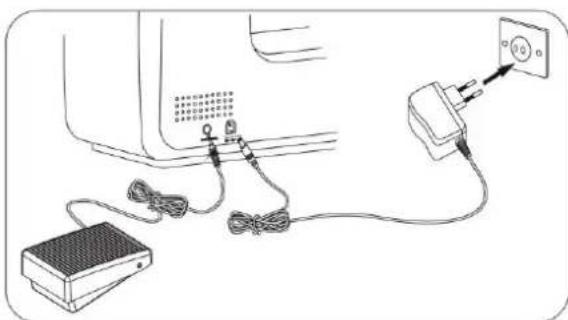
Caution: Make sure the plug is disconnected from mains power supply when you are not using it, so the sewing machine won't accidentally start up.
Note: The machine works only when its power switch stays at the position "ON" and simultaneously the connected foot pedal is pressed.
NEEDLE REPLACEMENT
If the needle breaks, or you need a different needle to sew a different kind of fabric, just follow these steps:
Caution: To prevent injury from accidentally starting up the machine, make sure to turn off the switch, remove the foot pedal and the adapter plug first.
- Turn the hand wheel to raise the needle to its highest position. Hold the old needle and loosen the needle clamp screw. Remove the old needle and discard it properly. (Fig.1)
- Insert the new needle into the clamp with the flat side toward the correct direction (to the back). Be sure to push the needle completely into the clamp before tightening the needle clamp screw. Tighten the needle clamp screw. (Fig.2)
Caution: Needle direction must be correct, and be sure to tighten the thimble screw, to avoid needle falling by accident.
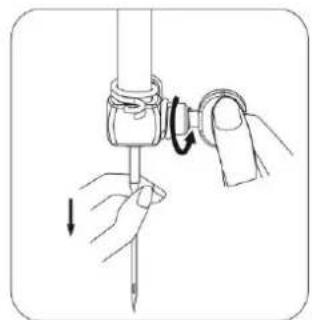
Fig.1

Fig.2
PRESSER FOOT REPLACEMENT
1. Removing the presser foot
Turn the hand wheel counterclockwise to raise the needle to its highest position. Raise the presser foot lifter, and press the presser foot locking lever. The presser foot will drop off automatically from the locking device. (Fig.3)
2. Installing the presser foot
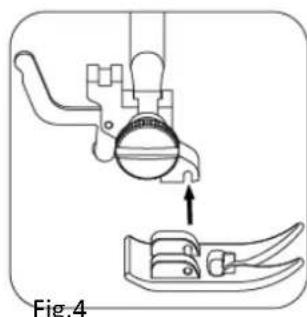
Put the presser foot under the presser foot locking device, lower the presser foot lifter, press the presser foot locking device to reset the foot, and lift the presser foot lifter. (Fig.4)
Caution:
Always switch off the appliance and disconnect it from the power supply when replacing the presser foot.
- When replacing the presser foot, please place the machine on a stable platform.
- When putting down the presser foot, please do not put your hand or finger under it to avoid injuring fingers.

Fig.3
3. Removing and Installing the presser foot locking device
Use a screwdriver to turn the thumb screw counterclockwise, the screw is loosened and the presser foot locking device can be removed. (Fig.5)
To install the presser foot locking device back, just align the locking device to the pole and fit the thumb screw into the hole on the pole. Tighten the screw by turning it clockwise with a screwdriver. (Fig.6)

Fig.5
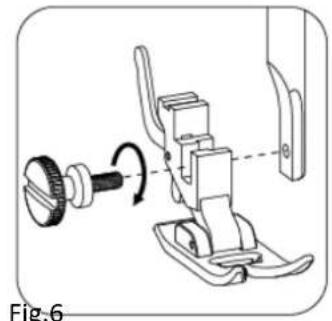
Fig.6
THREADING THE SEWING MACHINE
1. Threading upper thread
Caution: Always switch off the appliance and disconnect the appliance from the power supply when threading the machine.
1) Turn the hand wheel to raise the needle to its highest position.
2) Put a spool on the thread spindle, put on the thread spindle cover and then pull out the thread.
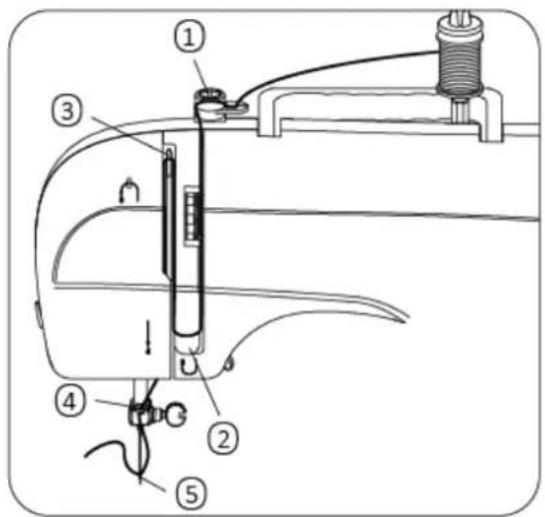
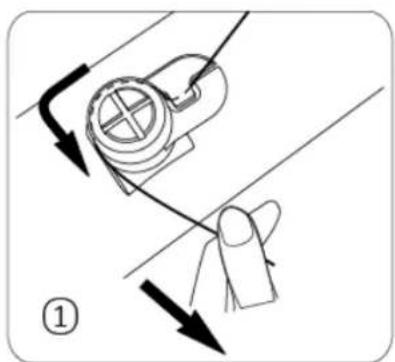
3) Pull the thread and let it pass through the bobbin winder tension disk. (mark ① in the pic. below)
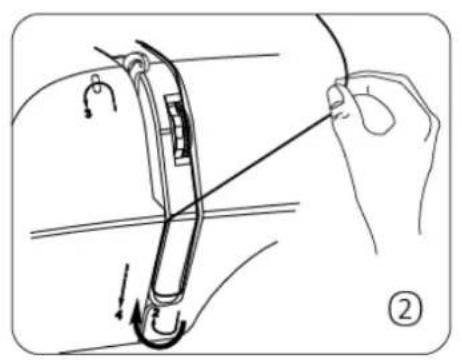
4) Guide the thread through the groove and pull it up towards the chromed take-up lever. (mark ② in the pic. below)
5) Feed the thread through the hole in the chromed lever and pull it straight down towards the needle. (mark ③ in the pic. below)
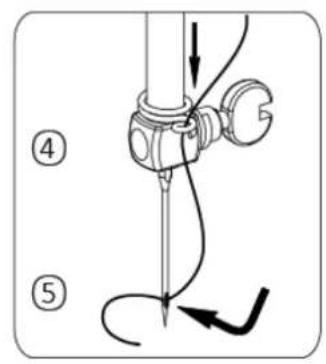
6) Feed the thread through the hole in the needle holder, then through the eye of the needle from the front side to the back and pull out 10cm to the back. (marks (4) & (5) in the pic. below)

Note:
Needle threader can help the thread pass through the needle eye. First get the ring of needle threader goes across the needle eye from back to front, then put the thread into the ring. Draw back the needle threader and the thread will be pulled through the needle eye. (Fig.7 & Fig.8)
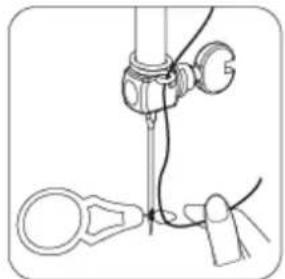
Fig.7
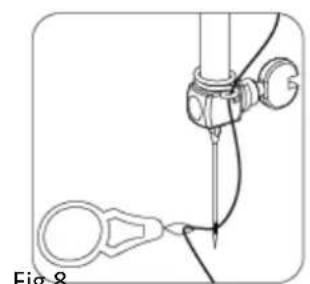
Fig.8
2. Replacing the bottom bobbin
1) Slide the release button besides the bobbin cover to the right and remove the bobbin cover (Fig.9).
2) Put the new bobbin in the holder. Leave 10cm of thread hanging out (Fig.10 & Fig.11).
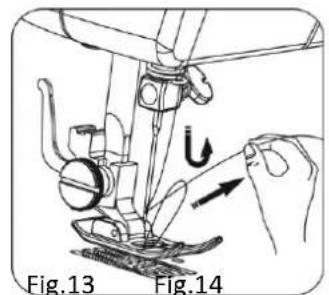
3) Lift up the presser foot lifter. Hold the end of the upper thread with one hand, and turn the hand wheel counterclockwise a round with the other hand to make the needle go down and up, the needle thread will pick up the bobbin thread and pull it up through the hole under the needle (Fig.12 & Fig.13).
4) Replace the bobbin cover. Separate the two threads and pull them to the back of the machine under the presser foot, leaving about 15cm hanging there. (Fig. 14)
Caution:
Always switch off the appliance and disconnect it from the power supply when replacing the bottom hobbin.
- Please use metal bobbins, otherwise the magnetic holder cannot tense the bobbin thread and work rightly.

Fig.9
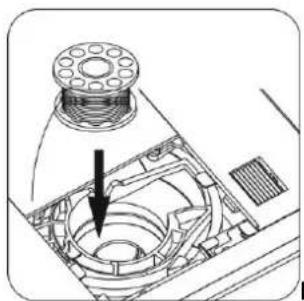
Fig.10
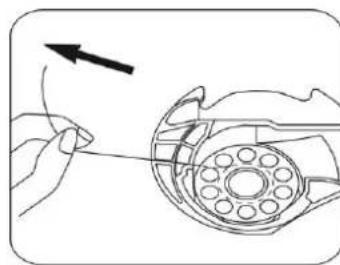
Fig.11

Fig.12

SEWING
- Turn the hand wheel counterclockwise to raise the needle to its highest position.
- Raise the presser foot lifter and place the fabric you want to sew under the presser foot (Fig.15).
- Lower down the presser foot. (Fig.16).
- Press the stitch selection button to select the stitch pattern you want, you can see the number of stitch you select on the digital display. Every stitch has its recommended stitch density, which is listed besides the stitch number on the stitch panel. Rotate the stitch density dial to select the stitch density according to the stitch you select.
Caution:
Before you change the stitch pattern, please turn off the switch and turn the hand wheel to raise the needle all the way up so it doesn't get stuck and bent.
- Changing the stitch pattern is not allowed when the machine is running, otherwise the needle and/or machine may damage.
- Turn the hand wheel several times to make sure there is no jamming in the stitches.
- Slide the power switch to the position "ON", and step on the foot pedal. The machine will start sewing. Adjust the sewing speed through the force you step on with. We recommend the low speed for beginners.
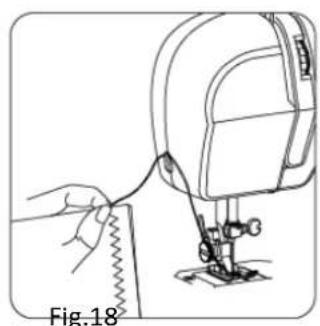
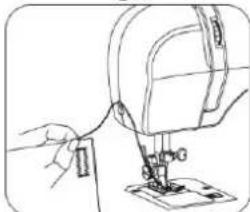
- When you finish the sewing, turn off the switch, unplug the adapter, turn the hand wheel to raise the needle all the way up, lift the presser foot, and then gently remove the fabric from the sewing machine, and cut the thread with the thread cutter (Fig.17 & Fig.18).
Tips:
Please turn the hand wheel if it is difficult to remove the fabric, and then pull out the fabric gently.
- If the thread had tangled or jammed, please turn the hand wheel and simultaneously pull the thread slightly to release the thread. Bottom bobbin mechanism is a more precise part, inappropriate actions may damage it. Please to not push or pull it by finger or any tools.
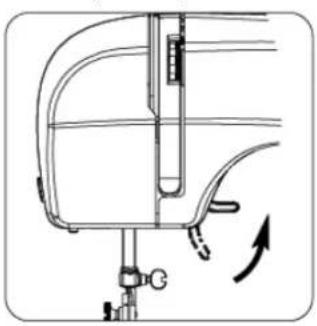
Fig.15
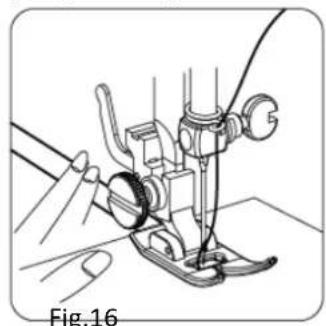

Fig.17
FEATURES
1. Selection of stitch pattern
Use the stitch selection button to select one stitch you want from the stitch patterns. Check the stitch panel and select the corresponding stitch density by the 5 gears (A/B/C/D/E) of the stitch density dial.
Caution:
Before you change the stitch pattern, please turn off the switch and turn the hand wheel to raise the needle all the way up so it doesn't get stuck and bent.
- Changing the stitch pattern is not allowed when the machine is running, otherwise the needle and/or machine may damage.
2. Reverse sewing
Reverse sewing (back stitching) is useful for reinforcing the beginning and end of seams. To use this function proceed as follows:
1) Sew forwards as normal, and then press and hold down the reverse stitch button on the front of the sewing machine to sew backwards.
2) To sew forwards again simply release the reverse stitch button.
Note: Reverse sewing is applicable only to stitch patterns 1 to 3.

3. Working lamp
If additional light is needed, press the light switch to turn the light on. Press the switch again to turn it off. The working lamp cannot be replaced yourself.
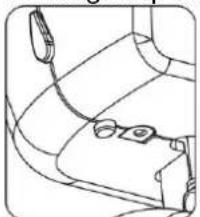
4. Thread cutter
The machine has a thread cutter on the central left side of the machine, it can cut off the thread after sewing or winding thread.
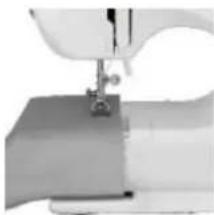
5. Sewing sleeves
This sewing machine has been designed to sew sleeves or any narrow openings in garment. Lift the presser foot. Position the garment over the sewing arm. Lower the presser foot and follow the regular sewing instructions.
6. Manual buttonhole
1) Pull the cloth under the presser foot and lower the presser foot on the cloth where you need to sew buttonhole, then select stitch 05 and turn the stitch density dial to the position E.
2) Turn on and sew 5-6 stitches by foot pedal, then stop. (Fig.19)
3) Select the stitch 04 and turn the stitch density dial to the position D, turn on and use foot pedal to sew on the cloth in suitable length, then stop. Note that try to keep sewed stitches in straight line. (Fig.20)
4) Select stitch 05 and turn the stitch density dial to the position E, turn on and sew 5-6 stitches by foot pedal, then stop. (Fig.21)
5) Raise the presser foot, rotating the cloth for 180^ (Fig.22).
6) Select the stitch 04 and turn the stitch density dial to the position D. Turn on and use foot pedal to sew till buttonhole is fully sewed. (Fig.23)

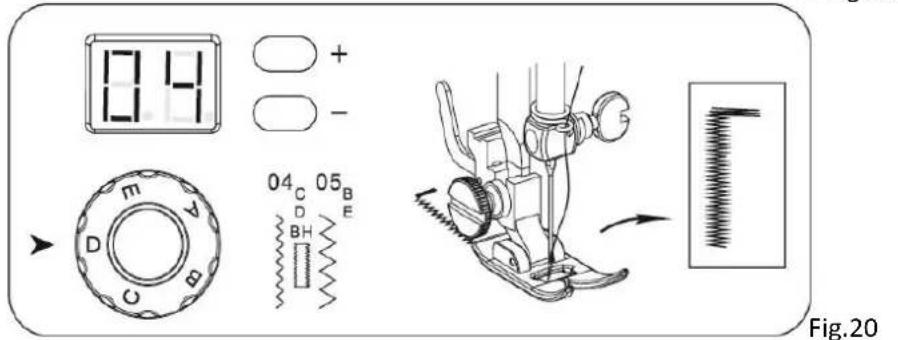
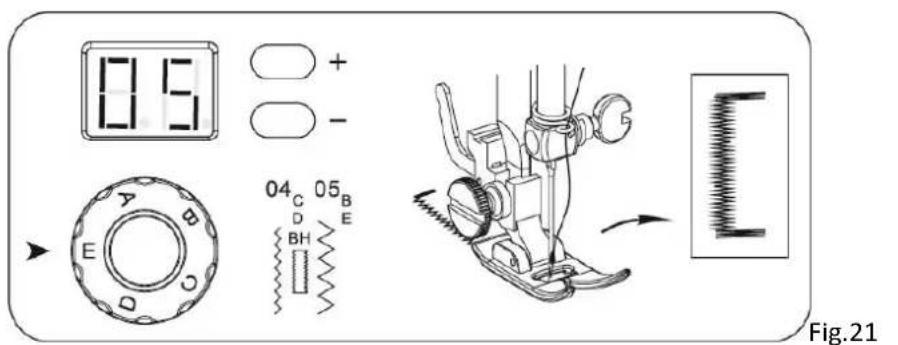
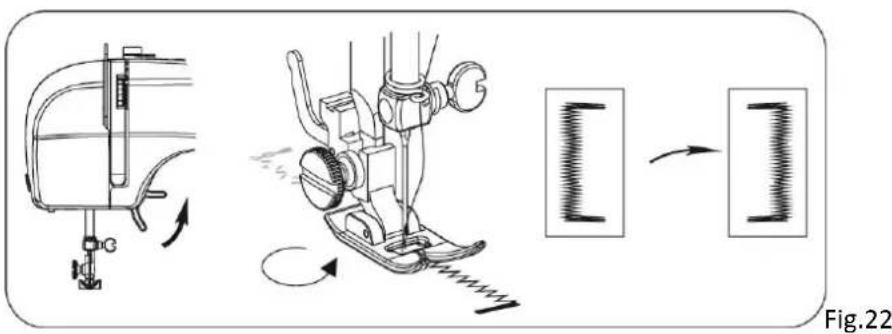
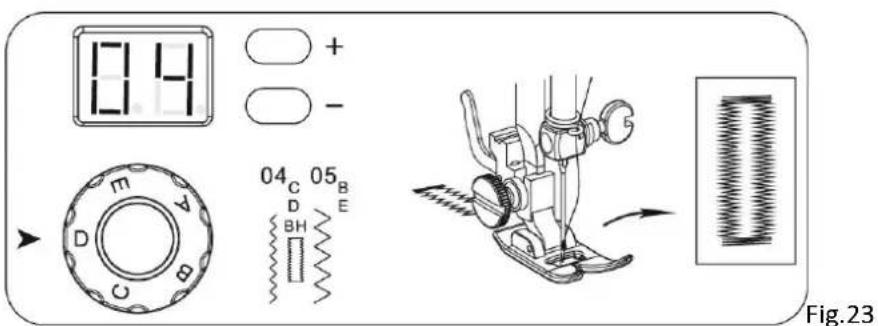
Fig.18
Fig.19
Note:
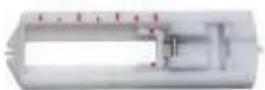
The presser foot shown as below can facilitate the buttonhole sewing. It has scale marks to follow.
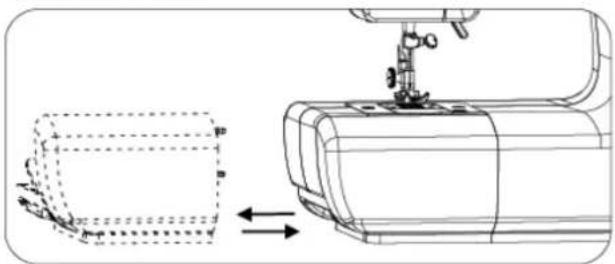
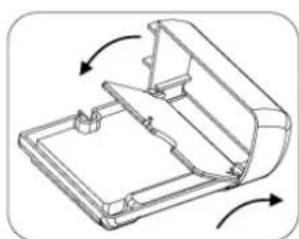
7. Drawer
This drawer is an accessory storage compartment, which can be slid out and you can store spare bobbins, needles, etc. in it.
SEWING A BUTTON
- Put the button on the fabric, keeping the buttonhole in align with the needle exactly. Lay down the presser foot.
- Select stitch 04 / 05 / 06, which depends on the inside length of the buttonhole (normally we select 05), and turn the stitch density dial to the position E. Turn the hand wheel slowly to see if the needle runs properly through the holes of the button from left to right. Operate carefully to avoid damage to the needle or button.
- Guide the thread through the needle correctly before starting to sew a button. Turn on and use the foot pedal to sew the button slowly. (Fig. 24)
- Sewing about 5-6 stitches is enough for one button. If the button has four holes, you can change to the other 2 holes when having finished sewing one side. (Fig. 25)
Note: The metal foot presser may slip, so it's recommended to use the presser foot for button sewing. (Fig.26)
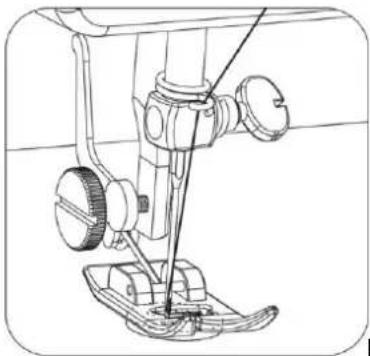
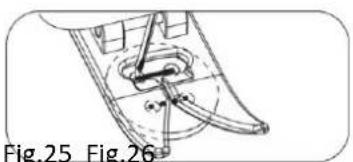
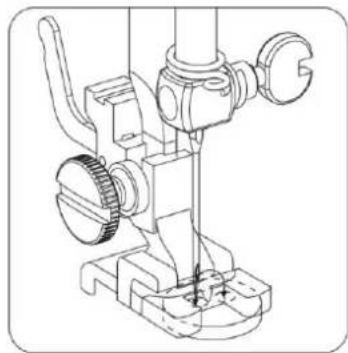
Fig.24 Fig.25 Fig.26
WINDING THE BOBBIN
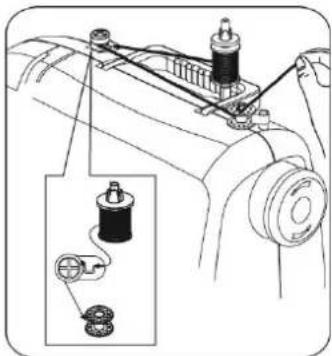
- Put a spool of thread on spool pin. (Fig.27)
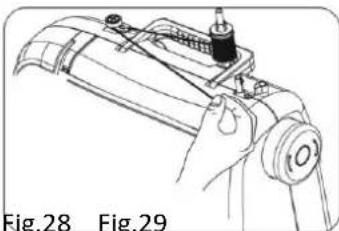
- Guide the thread through the bobbin winder tension disk on the upper side of the machine. (Fig.28 & Fig.29)
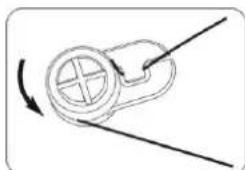
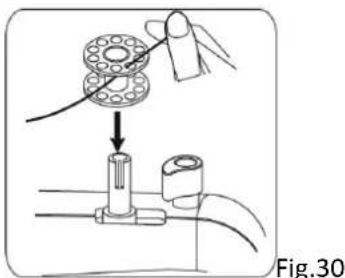
- Lead the thread through the small hole of the empty bobbin and hold the thread on hand. Put the bobbin on the bobbin winder pin. (Fig.30)
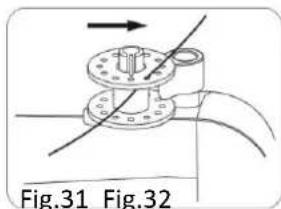
- Push the bobbin winder pin towards the bobbin winder stop. (Fig.31)
- Turn on the machine and use foot pedal to wind the bobbin. Hold the thread end on hand for several seconds in case the thread break away from the bobbin. When the thickness of thread on the bobbin gets close to the bobbin winder stop, the machine will stop automatically.(Fig.32)
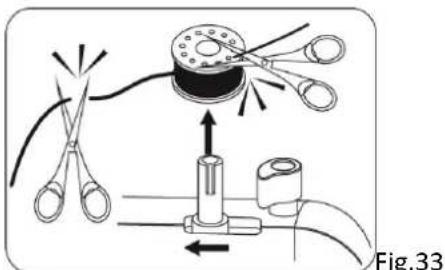
- Release the foot pedal and turn off the machine. Remove the bobbin and cut off the thread. Slide the thread winder pin to the left. (Fig.33)
Note:
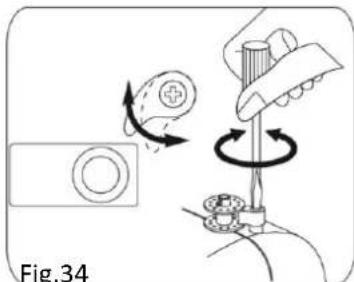
You can adjust a little the position of the bobbin winder stop with a screwdriver, to change the thickness of bobbin thread. Use the screwdriver properly. Just turn the screw a little, never rotate the screw off! (Fig.34)
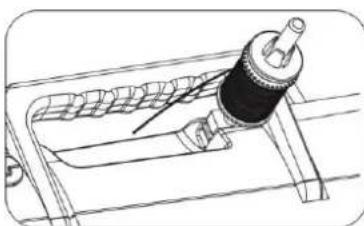
Fig.27
ADJUSTING STITCHING
- As shown in the Fig.A, normal stitching shall have top and bottom threading evenly, neither over tight nor loose. (① = Top thread; ② = Cloth; ③ = Bottom thread)
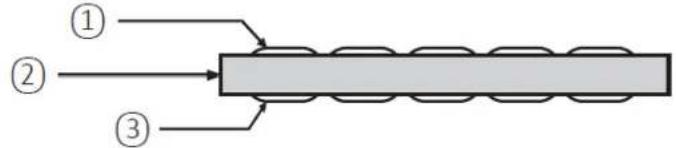
Fig.A
- If the bottom threading looks like a straight line (Fig.B), which indicates the top thread is too loose. Please turn upper thread tension dial to direction with bigger number to increase pressure until the stitching returns to normal.

Fig.B
- If the top thread looks like a straight line (Fig.C), which indicates an over-tight top thread. Please turn the upper thread tension dial to the direction with smaller number to reduce pressure until the stitching back to normal.

Fig.C
APPLICABLE CLOTH FOR SEWING
| Sewing Cloth Presentation Fabric specification | Cotton/Linen | Silk/Wool | Polyester | Elastic |
| Regular | ✓ | × | ✓ | △ |
| Thick | ✓ | × | ✓ | △ |
| Thin | ✓ | × | × | × |
| Hard | ✓ | ✓ | ✓ | △ |
| Soft | × | × | × | × |
Sewing effective:
V : means easy to sew
x: means difficult to sew
: means not smooth to sew
Note:
- The definition of the fabric thickness:
Thin (fabric): two layers of the fabric thickness < 0.35mm
Thick (fabric): two layers of the fabric thickness >0.8mm
Regular (fabric): two layers of the fabric thickness ≥ 0.35mm and ≤ 0.8mm .
- The definition of elastic cloth:
If the cloth, which size is "100mm x 30mm", is extending to over 106mm under 0.5KG tension force, then the cloth is defined elastic, otherwise it is inelastic. - Hard fabric: such as Jeans, fine canvas, etc.
- Soft fabric: such as towel, duster, etc.
MORE TIPS
- Make sure there is fabric under the needle when the machine is working and needle is moving, otherwise the machine will get stuck and the thread will be jammed.
- Turn the hand wheel for 2 to 3 circles by hand to test if it goes smoothly or not before starting the machine. Direction to turn the hand wheel should be the same as the arrow's direction on the hand wheel.
- Make sure the machine was threaded correctly (do not forget any step or have wrong threading).
- Do not sew the cloth with too much elasticity, neither too thin (like silk) nor too thick cloth, please follow the IM for the applicable cloth.
- If the machine gets stuck or jammed due to wrong operation, release the foot pedal and turn off the power switch immediately.
TECHNICAL DATA:
Adapter input: 100-240 V AC, 50/60 Hz, 800 mA Max
Adapter output: 12 V DC, 2000 mA
Sewing Machine: 12 V DC, 2000 mA
GUARANTEE AND CUSTOMER SERVICE
Before delivery our devices are subjected to rigorous quality control. If, despite all care, damage has occurred during production or transportation, please return the device to your dealer. In addition to statutory legal rights, the purchaser has an option to claim under the terms of the following guarantee:
For the purchased device we provide 2 years guarantee, commencing from the day of sale. If you have a defective product, you can directly go back to the point of purchase.
Defects which arise due to improper handling of the device and malfunctions due to interventions and repairs by third parties or the fitting of non-original parts are not covered by this guarantee. Always keep your receipt, without the receipt you can't claim any form of warranty. Damage caused by not following the instruction manual, will lead to a void of warranty, if this results in consequential damages then we will not be liable.
Neither can we hold responsible for material damage or personal injury caused by improper use if the instruction manual is not properly executed. Damage to accessories does not mean free replacement of the whole appliance. In such case please contact our service department. Broken glass or breakage of plastic parts is always subject to a charge. Defects to consumables or parts subjected to wearing, as well as cleaning, maintenance or the replacement of said parts are not covered by the warranty and are to be paid.
ENVIRONMENT FRIENDLY DISPOSAL

Recycling - European Directive 2012/19/EU
This marking indicates that this product should not be disposed with other household wastes. To prevent possible harm to the environment or human health from uncontrolled waste disposal, recycle it responsibly to promote the sustainable reuse of material resources. To return your used device, please use the return and collection systems or contact the retailer where the product was purchased. They can take this product for environmental safe recycling.
Emerio Holland B.V.
Zomervaart 1A
2033 DA Haarlem
The Netherlands
Customer service:
T: +31(0)23 3034369
E: info.nl@emerio.eu
SICHERHEITSHINWEISE
GEPASTE KLEDING OM TE NAAIEN
- PARTS IDENTIFICATION
- Accessories:
- HOW TO START THE MACHINE
- NEEDLE REPLACEMENT
- PRESSER FOOT REPLACEMENT
- Removing the presser foot
- Installing the presser foot
- Caution:
- Removing and Installing the presser foot locking device
- THREADING THE SEWING MACHINE
- Threading upper thread
- Note:
- Replacing the bottom bobbin
- SEWING
- Tips:
- FEATURES
- Selection of stitch pattern
- Reverse sewing
- Working lamp
- Thread cutter
- Sewing sleeves
- Manual buttonhole
- Drawer
- SEWING A BUTTON
- WINDING THE BOBBIN
- ADJUSTING STITCHING
- APPLICABLE CLOTH FOR SEWING
- Sewing effective:
- MORE TIPS
- TECHNICAL DATA:
- GUARANTEE AND CUSTOMER SERVICE
- ENVIRONMENT FRIENDLY DISPOSAL
- SICHERHEITSHINWEISE
Brand : Emerio
Model : SEW121816
Category : Sewing machine