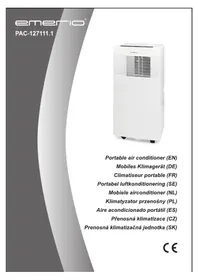
PAC125152 - Air Conditioning Emerio - Free user manual and instructions
Find the device manual for free PAC125152 Emerio in PDF.



User questions about PAC125152 Emerio
0 question about this device. Answer the ones you know or ask your own.
Ask a new question about this device
Download the instructions for your Air Conditioning in PDF format for free! Find your manual PAC125152 - Emerio and take your electronic device back in hand. On this page are published all the documents necessary for the use of your device. PAC125152 by Emerio.
USER MANUAL PAC125152 Emerio
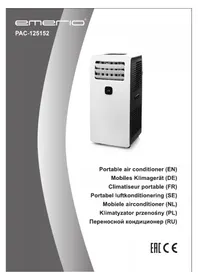
Portable air conditioner (EN)
Mobiele airconditioner (NL)
Thank you very much for purchasing our products. In order to ensure correct operation, please read this manual and instruction carefully before use.
IMPORTANT INSTRUCTIONS
When using electrical appliances, basic precautions should always be followed to reduce the risk of fire, electric shock, burns and other injuries.
- Read and save these instructions. Attention: pictures in the IM are for reference only.
- This appliance can be used by children aged from 8 years and above and persons with reduced physical, sensory or mental capabilities or lack of experience and knowledge if they have been given supervision or instruction concerning use of the appliance in a safe way and understand the hazards involved.
- Children shall not play with the appliance.
- Cleaning and user maintenance shall not be made by children without supervision.
- If the supply cord is damaged, it must be replaced by the manufacturer, its service agent or similarly qualified persons in order to avoid a hazard.
- Indoor use only.
- Do not use the unit in an area: near to source of fire; where oil is likely to splash; exposed to direct sunlight; where water is likely to splash; near a bath, a laundry, a shower or a swimming pool.
- Never insert your fingers, rods into the air outlet. Take special care to warn children of these dangers.
- Keep the unit upward while transport and storage, for the compressor locates properly.
- Before cleaning or moving the appliance, always turn off and disconnect the power supply.
-
To avoid the possibility of fire disaster, the appliance shall not be covered.
-
All the air-conditioner sockets must comply with the local electric safety requirements. If necessary, please check it for the requirements.
- The appliance shall be installed in accordance with national wiring regulations.
- Details of type and rating of fuses: T, 250V AC, 3.15A.
- Contact authorized service technician for repair or maintenance of this unit.
- Do not pull, deform or modify the power supply cord, or immerse it in water. Pulling or misuse of the power supply cord can result in damage to the unit and cause electrical shock.
- Compliance with national gas regulations shall be observed.
- Servicing shall only be performed as recommended by the equipment manufacturer. Maintenance and repair requiring the assistance of other skilled personnel shall be carried out under the supervision of the person competent in the use of flammable refrigerants.
- Do not operate or stop the unit by inserting or pulling out power plug, it may cause electric shock or fire due to heat generation.
- Unplug the unit if strange sounds, smell, or smoke comes from it.
- Always plug the appliance into an earthed plug socket.
- In case of any damage, please turn off the switch, disconnect the power supply, and contact an authorized service center for repair.
- Do not use means to accelerate the defrosting process or to clean, other than those recommended by the manufacturer.
- The appliance shall be stored in a room without continuously operating ignition sources (for example: open flames, an operating gas appliance or an operating electric heater.)
-
Do not pierce or burn.
-
Be aware that refrigerants may not contain an odour.
- This appliance contains R290 refrigerant gas. R290 is a refrigerant gas that complies with the European directives on the environment. Do not puncture any part of the refrigerant circuit.
- If the appliance is installed, operated or stored in an unventilated area, the room must be designed to prevent to the accumulation of refrigerant leaks resulting in a risk of fire or explosion due to ignition of the refrigerant caused by electric heaters, stoves, or other sources of ignition.
- The appliance must be stored in such a way as to prevent mechanical failure.
- Individuals who operate or work on the refrigerant circuit must have the appropriate certification issued by an accredited organization that ensures competence in handling refrigerants according to a specific evaluation recognized by associations in the industry.
- Repairs must be performed based on the recommendation from the manufacturing company. Maintenance and repairs that require the assistance of other qualified personnel must be performed under the supervision of an individual specified in the use of flammable refrigerants.
- Regarding the instructions for repairing appliances containing R290, please kindly refer to below paragraphs.
- Always let the appliance rest for at least 2 hours after moving it from one location to another.
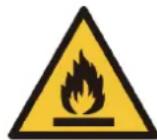
Warning: Risk of fire / Flammable materials.

Read instruction manuals.

Operator's manual; operating instructions.

Service indicator; read technical manual.
Warning: Keep ventilation openings clear of obstruction.
Warning: The appliance shall be stored in a well-ventilated area where the room size corresponds to the room area as specified for operation.
The required distance around the unit should be at least 30cm .
Appliance shall be installed, operated and stored in a room with a floor area larger than 7.9m^2
PARTS DESCRIPTION
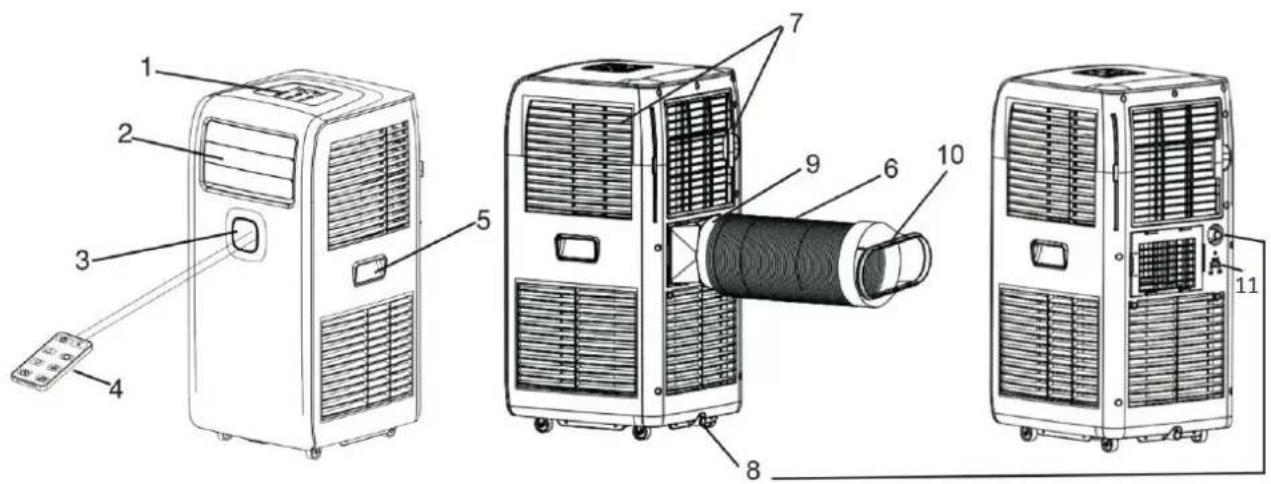
- Control panel
- Air outlet & louvers
- Signal receptor
- Remote control
- Handle
- Air exhaust hose
- Air inlet and air filter
- Drain port (inserted by a stopper)
- Hose connector
- Window adaptor
- Universal socket hole (used to store plug)
Control panel
- Power button
- Temperature/timer increasing button
- Temperature/timer decreasing button
4.Mode button - Fan speed button
- Timer button
- Sleep button
- Dehumidifying button
- Auto mode indicator light
- Cooling mode indicator light
- Dehumidifying mode indicator light
- Fan mode indicator light
- Low speed indicator light
- Middle speed indicator light
- High speed indicator light
- Timer indicator light
- Sleep indicator light
- Digital display

Remote control
This unit has a remote control. One piece of CR2025 battery will be provided with the remote control. Before starting to use the remote control, remove the plastic protection from the battery. If you want to change the battery, please refer to the instruction behind the remote control. If it is not in use for a long time, please take the battery out of the remote control. Keep button cell batteries out of reach of small children.
The functions of the buttons in the remote control are the same as the functions of the buttons on the control panel.
INSTALLATION
- The unit shall be installed on a flat surface where the air outlet would not be blocked. The required distance around the unit should be at least 30cm .
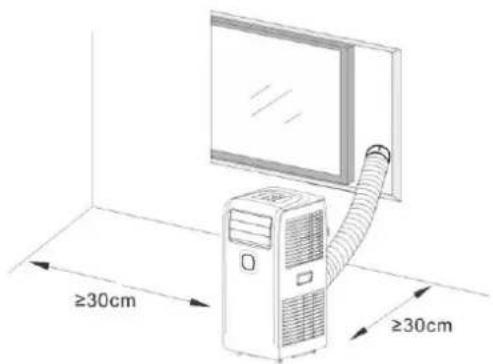
The unit shall not be installed in a laundry room.
- Extend the air exhaust hose by drawing out the two ends of the hose.

- Screw the air exhaust hose into the hose connector.

Screw the other end of air exhaust hose into the window adaptor.
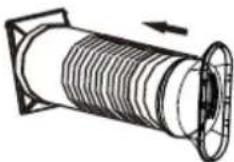
- Insert the hose connector into the bracket on the back of the unit.

OPERATION
*Always let the appliance rest for at least 2 hours after moving it from one location to another.
Before use, check up whether the exhaust hose has been mounted properly. Plug in the appliance. Open the louvers before turn on the appliance.
1. Power button
Press the power button to turn on the appliance. The room temperature will show on the display. The appliance will start to work.
Press the button again, the appliance will be turned off.
2. Temperature/timer increasing button & temperature/timer decreasing button
Press the button "▲"/"▼" to set your desired room temperature from 15^ to 31^ . The buttons can also be used for timer adjustment during timer setting. The value will be increased/decreased by 1 ( ^ /hour) for each press.
3. Fan speed button
Press the fan speed button to switch the fan speed between low, middle, high. The corresponding
indicator light 日 _ 1 ^ 日 /“/”will illuminate.
4. Mode button
Press the mode button to choose your desired working mode among AUTO, cooling, and fan. The corresponding indicator light will turn on when the specific mode is selected.
- Auto mode
In AUTO mode, the indoor temperature sensor operates automatically to select the desired operation with cooling or fan: when the room temperature is no less than 24^ , the unit automatically selects cooling mode, and when the room temperature is less than 24^ , the unit automatically selects fan mode.
Cooling mode
When the room temperature is higher than the set temperature, the compressor starts to run.
When the room temperature is lower than the set temperature, the compressor stops and the fan operates at the original set speed.
Note: When the compressor is working, the unit will vibrate slightly. This is normal and harmless.
- Fan mode
When the fan runs at the set speed, the compressor does not run.
The adjustment of temperature in Fan mode is not effective.
5. Dehumidifying
- Press the dehumidifying button to turn on the function. The fan runs at a low speed. The fan speed and temperature cannot be adjusted.
- The compressor will stop after 8 minutes of running and then run again after 6 minutes.
- Press the mode button to switch to AUTO / cooling / fan mode.
6. Timer button
Auto-ON setting
- When the appliance is OFF, press the timer button, the timer indicator light will flash.
- Press the timer increasing or decreasing button to select a desired auto-ON time from 1 to 24 hours. The timer indicator light will flash for several seconds, then illuminate still; The digital display will be off. The timer setting is confirmed.
- You can choose the fan speed and mode at the same time.
- The appliance will automatically turn on once the select time passed.
Auto-OFF setting
- When the appliance is ON, press the timer button, the timer indicator light will flash.
- Press the timer increasing or decreasing button to select a desired auto-OFF time from 1 to 24 hours.
The timer indicator light will flash for several seconds, then illuminate still; The digital display will show the room temperature. The timer setting is confirmed.
The appliance will automatically turn off once the select time has passed.
To cancel the timer, set the time to 0 hour, or press into the timer setting, and when the digital display flashes, press the timer button again. The timer indicator light will then turn off.
7. Sleep button (only active in cooling mode)
Press the sleep button to activate the sleep mode. The sleep indicator light turns on.
In sleep mode, the fan turns to low speed automatically. The set temperature will increase 1^ after one hour, and increase 2^ after two hours. After six hours, the appliance stops running automatically.
NOTE:
The protective device may trip and stop the appliance in the conditions listed below.
| Cooling | Room temperature is over 43℃. |
| Room temperature is below 15℃. | |
| Dehumidifying | Room temperature is below 15℃. |
- If the appliance runs in cooling or dehumidrying mode with door or window opened for a long time when relative humidity is above 80% , dew may drip down from the air outlet.
Drain water
1) Special reminder: There is condensing water recycling hidden in this appliance. The condensing water is partly kept recycling between the condenser and the water tray. When the water level rises to the upper level, the water-full code "E4" will be shown on the digital display to remind of draining water.
2) Please cut off the power supply, move the appliance to a suitable place, pull out the stopper in the drain port to drain the water completely. If conditions permitted, you can also connect the drain hose to the drain port for the water draining. This appliance has two drain ports.
3) After the draining, insert back the stopper to the drain port, otherwise the appliance may leak and make your room wet.
CLEANING AND MAINTENANCE
Before cleaning, be sure to disconnect the appliance from any electric supply outlet.
- Do not use gasoline or other chemicals to clean the appliance.
- Do not wash the appliance directly.
If the appliance is damaged, please contact the dealer or repair shop.
Air Filter
If the air filters become clogged with dust/dirt, they should be cleaned once every two weeks.
- Pull out the air filters by the pull tab.
Clean the air filters with neutral detergent in lukewarm water (< 40^) and dry it up in the shade. - Reinstall the air filter.
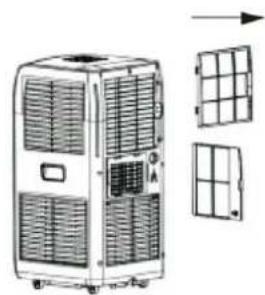
Clean the Surface
First clean the surface with a neutral detergent and wet cloth, and then wipe it with a dry cloth.
TROUBLESHOOTING
| Troubles | Possible Causes | Solutions |
| Not cool enough | The doors or windows are not closed. | Make sure all the windows and doors are closed. |
| There are heat sources inside the room. | Remove the heat sources if possible. | |
| The hot air exhaust hose is not connected or blocked. | Connect or clean the hot air exhaust hose. | |
| Temperature setting is too high. | Reset the temperature. | |
| Air inlet / outlet is blocked. | Clean the air inlet / outlet. | |
| Noisy | The ground is not level or not flat enough. | Place the appliance on a flat, level surface if possible. |
| The sound comes from the flowing of the refrigerant inside the appliance. | It is normal. | |
| Code “E2” on the digital display | Room temperature sensor failed. | Replace the room temperature sensor. Contact authorized service technician for repair. |
| Code “E3” on the digital display | Evaporator temperature sensor failed. | Replace evaporator temperature sensor. Contact authorized service technician for repair. |
| Code “E4” on the digital display | Water-full warning | Drain out the water. |
TECHNICAL DATA
Below data for your operating reference
| Model | PAC-125152 |
| Rated voltage | 220-240V |
| Rated frequency | 50Hz |
| Rated input | 950W |
| Rated current | 4.3A |
| Cooling capacity | 9000BTU |
| Moisture removal (L/H) | 1.0 |
| Air flow | 300m³/h |
ERP INFORMATION
| Value | |
| Trademark | Emerio |
| Model identification | PAC-125152 |
| Sound power (cooling) | 64.3dB(A) |
| Name of refrigerant | R290 |
| Rated power input for cooling (kW) | 0.95 |
| Rated energy efficiency ratio | 2.6 |
| GWP (kgCO2eq) | 3 |
| Energy efficiency class | A |
| Energy consumption for double ducts appliances (kWh/h) | - |
| Energy consumption for single duct appliances (kWh/h) | 0.96 |
| Power consumption in thermostat-off mode (W) | - |
| Power consumption in stand-by mode (W) | 0.43 |
| Cooling capacity | 9000BTU |
| Refrigerant leakage contributes to climate change. Refrigerant with lower global warming potential (GWP) would contribute less to global warming than a refrigerant with higher GWP, if leaked to the atmosphere. This appliance contains a refrigerant fluid with a GWP equal to 3. This means that if 1 kg of this refrigerant | |
fluid would be leaked to the atmosphere, the impact on global warming would be 3 times higher than 1kg of CO2, over a period of 100 years. Never try to interfere with the refrigerant circuit yourself or disassemble the product yourself and always ask a professional.
Energy consumption 0.96 kWh for model PAC-125152 in 60 minutes of use under standard test conditions. The actual energy consumption depends on how the device is used and where it is located.
For any additional information, please contact:
Emerio Holland B.V.
Zomervaart 1A
2033 DA Haarlem
The Netherlands
Customer service:
T: +31(0)23 3034369
E: info.nl@emerio.eu
GUARANTEE AND CUSTOMER SERVICE
Before delivery our devices are subjected to rigorous quality control. If, despite all care, damage has occurred during production or transportation, please return the device to your dealer. In addition to statutory legal rights, the purchaser has an option to claim under the terms of the following guarantee:
For the purchased device we provide 2 years guarantee, commencing from the day of sale. If you have a defective product, you can directly go back to the point of purchase.
Defects which arise due to improper handling of the device and malfunctions due to interventions and repairs by third parties or the fitting of non-original parts are not covered by this guarantee. Always keep your receipt, without the receipt you can't claim any form of warranty. Damage caused by not following the instruction manual, will lead to a void of warranty, if this results in consequential damages then we will not be liable.
Neither can we hold responsible for material damage or personal injury caused by improper use if the instruction manual is not properly executed. Damage to accessories does not mean free replacement of the whole appliance. In such case please contact our service department. Broken glass or breakage of plastic parts is always subject to a charge. Defects to consumables or parts subjected to wearing, as well as cleaning, maintenance or the replacement of said parts are not covered by the warranty and are to be paid.
ENVIRONMENT FRIENDLY DISPOSAL

Recycling - European Directive 2012/19/EU
This marking indicates that this product should not be disposed with other household wastes. To prevent possible harm to the environment or human health from uncontrolled waste disposal, recycle it responsibly to promote the sustainable reuse of material resources. To return your used device, please use the return and collection systems or contact the retailer where the product was
purchased. They can take this product for environmental safe recycling.


BATTERY MUST BE RECYCLED OR DISPOSED OF PROPERLY. DO NOT OPEN. DO NOT
DISPOSE OR IN FIRE OR SHORT CIRCUIT.
Emerio Holland B.V.
Zomervaart 1A
2033 DA Haarlem
The Netherlands
Customer service:
T: +31(0)23 3034369
E: info.nl@emerio.eu
INSTRUCTIONS FOR REPAIRING APPLIANCES CONTAINING R290
1. Servicing
1) Checks to the area
Prior to beginning work on systems containing flammable refrigerants, safety checks are necessary to ensure that the risk of ignition is minimised. For repair to the refrigerating system, the following precautions shall be complied with prior to conducting work on the system.
2) Work procedure
Work shall be undertaken under a controlled procedure so as to minimise the risk of a flammable gas or vapour being present while the work is being performed.
3) General work area
All maintenance staff and others working in the local area shall be instructed on the nature of work being carried out. Work in confined spaces shall be avoided. The area around the workspace shall be sectioned off. Ensure that the conditions within the area have been made safe by control of flammable material.
4) Checking for presence of refrigerant
The area shall be checked with an appropriate refrigerant detector prior to and during work, to ensure the technician is aware of potentially flammable atmospheres. Ensure that the leak detection equipment being used is suitable for use with flammable refrigerants, i.e. non-sparking, adequately sealed or intrinsically safe.
5) Presence of fire extinguisher
If any hot work is to be conducted on the refrigeration equipment or any associated parts, appropriate fire extinguishing equipment shall be available to hand. Have a dry powder or CO_2 fire extinguisher adjacent to the charging area.
6) No ignition sources
No person carrying out work in relation to a refrigeration system which involves exposing any pipe work that contains or has contained flammable refrigerant shall use any sources of ignition in such a manner that it may lead to the risk of fire or explosion. All possible ignition sources, including cigarette smoking, should be kept sufficiently far away from the site of installation, repairing, removing and disposal, during which flammable refrigerant can possibly be released to the surrounding space. Prior to work taking place, the area around the equipment is to be surveyed to make sure that there are no flammable hazards or ignition risks. "No Smoking" signs shall be displayed.
7) Ventilated area
Ensure that the area is in the open or that it is adequately ventilated before breaking into the system or conducting any hot work. A degree of ventilation shall continue during the period that the work is carried out. The ventilation should safely disperse any released refrigerant and preferably expel it externally into the atmosphere.
8) Checks to the refrigeration equipment
Where electrical components are being changed, they shall be fit for the purpose and to the correct specification. At all times the manufacturer's maintenance and service guidelines shall be followed. If in doubt consult the manufacturer's technical department for assistance.
The following checks shall be applied to installations using flammable refrigerants:
- The charge size is in accordance with the room size within which the refrigerant containing parts are installed;
- The ventilation machinery and outlets are operating adequately and are not obstructed;
- If an indirect refrigerating circuit is being used, the secondary circuit shall be checked for the presence of refrigerant;
-
Marking to the equipment continues to be visible and legible. Markings and signs that are illegible shall be corrected;
-
Refrigeration pipe or components are installed in a position where they are unlikely to be exposed to any substance which may corrode refrigerant containing components, unless the components are constructed of materials which are inherently resistant to being corroded or are suitably protected against being so corroded. 9) Checks to electrical devices
Repair and maintenance to electrical components shall include initial safety checks and component inspection procedures. If a fault exists that could compromise safety, then no electrical supply shall be connected to the circuit until it is satisfactorily dealt with. If the fault cannot be corrected immediately but it is necessary to continue operation, an adequate temporary solution shall be used. This shall be reported to the owner of the equipment so all parties are advised. Initial safety checks shall include:
- That capacitors are discharged: this shall be done in a safe manner to avoid possibility of sparking;
- That there no live electrical components and wiring are exposed while charging, recovering or purging the system;
- That there is continuity of earth bonding.
2. Repairs to sealed components
1) During repairs to sealed components, all electrical supplies shall be disconnected from the equipment being worked upon prior to any removal of sealed covers, etc. If it is absolutely necessary to have an electrical supply to equipment during servicing, then a permanently operating form of leak detection shall be located at the most critical point to warn of a potentially hazardous situation.
2) Particular attention shall be paid to the following to ensure that by working on electrical components, the casing is not altered in such a way that the level of protection is affected. This shall include damage to cables, excessive number of connections, terminals not made to original specification, damage to seals, incorrect fitting of glands, etc.
Ensure that apparatus is mounted securely. Ensure that seals or sealing materials have not degraded such that they no longer serve the purpose of preventing the ingress of flammable atmospheres. Replacement parts shall be in accordance with the manufacturer's specifications.
NOTE: The use of silicon sealant may inhibit the effectiveness of some types of leak detection equipment. Intrinsically safe components do not have to be isolated prior to working on them.
3. Repair to intrinsically safe components
Do not apply any permanent inductive or capacitance loads to the circuit without ensuring that this will not exceed the permissible voltage and current permitted for the equipment in use. Intrinsically safe components are the only types that can be worked on while live in the presence of a flammable atmosphere. The test apparatus shall be at the correct rating. Replace components only with parts specified by the manufacturer. Other parts may result in the ignition of refrigerant in the atmosphere from a leak.
4. Cabling
Check that cabling will not be subject to wear, corrosion, excessive pressure, vibration, sharp edges or any other adverse environmental effects. The check shall also take into account the effects of aging or continual vibration from sources such as compressors or fans.
5. Detection of flammable refrigerants
Under no circumstances shall potential sources of ignition be used in the searching for or detection of refrigerant leaks. A halide torch (or any other detector using a naked flame) shall not be used.
6. Leak detection methods
The following leak detection methods are deemed acceptable for systems containing flammable refrigerants.
Electronic leak detectors shall be used to detect flammable refrigerants, but the sensitivity may not be adequate, or may need re-calibration. (Detection equipment shall be calibrated in a refrigerant-free area.) Ensure that the detector is not a potential source of ignition and is suitable for the refrigerant used. Leak detection equipment shall be set at a percentage of the LFL of the refrigerant and shall be calibrated to the refrigerant employed and the appropriate percentage of gas (25% maximum) is confirmed. Leak detection fluids are suitable for use with most refrigerants but the use of detergents containing chlorine shall be avoided as the chlorine may react with the refrigerant and corrode the copper pipe-work. If a leak is suspected, all naked flames shall be removed/ extinguished. If a leakage of refrigerant is found which requires brazing, all of the refrigerant shall be recovered from the system, or isolated (by means of shut off valves) in a part of the system remote from the leak. Oxygen free nitrogen (OFN) shall then be purged through the system both before and during the brazing process.
7. Removal and evacuation
When breaking into the refrigerant circuit to make repairs - or for any other purpose - conventional procedures shall be used. However, it is important that best practice is followed since flammability is a consideration. The following procedure shall be adhered to:
- Remove refrigerant;
- Purge the circuit with inert gas;
Evacuate; - Purge again with inert gas;
- Open the circuit by cutting or brazing.
The refrigerant charge shall be recovered into the correct recovery cylinders. The system shall be "flushed" with OFN to render the unit safe. This process may need to be repeated several times. Compressed air or oxygen shall not be used for this task. Flushing shall be achieved by breaking the vacuum in the system with OFN and continuing to fill until the working pressure is achieved, then venting to atmosphere, and finally pulling down to a vacuum. This process shall be repeated until no refrigerant is within the system. When the final OFN charge is used, the system shall be vented down to atmospheric pressure to enable work to take place. This operation is absolutely vital if brazing operations on the pipe-work are to take place. Ensure that the outlet for the vacuum pump is not close to any ignition sources and there is ventilation available.
8. Charging procedures
In addition to conventional charging procedures, the following requirements shall be followed.
- Ensure that contamination of different refrigerants does not occur when using charging equipment. Hoses or lines shall be as short as possible to minimise the amount of refrigerant contained in them.
Cylinders shall be kept upright.
- Ensure that the refrigeration system is earthed prior to charging the system with refrigerant.
- Label the system when charging is complete (if not already).
- Extreme care shall be taken not to overfill the refrigeration system.
Prior to recharging the system it shall be pressure tested with OFN. The system shall be leak tested on completion of charging but prior to commissioning. A follow up leak test shall be carried out prior to leaving the site.
9. Decommissioning
Before carrying out this procedure, it is essential that the technician is completely familiar with the equipment and all its detail. It is recommended good practice that all refrigerants are recovered safely. Prior to the task being carried out, an oil and refrigerant sample shall be taken in case analysis is required prior to re-use of reclaimed refrigerant. It is essential that electrical power is available before the task is commenced. a) Become familiar with the equipment and its operation.
b) Isolate system electrically.
c) Before attempting the procedure ensure that:
- Mechanical handling equipment is available, if required for handling refrigerant cylinders;
- All personal protective equipment is available and being used correctly;
- The recovery process is supervised at all times by a competent person;
- Recovery equipment and cylinders conform to the appropriate standards.
d) Pump down refrigerant system, if possible.
e) If a vacuum is not possible, make a manifold so that refrigerant can be removed from various parts of the system.
f) Make sure that cylinder is situated on the scales before recovery takes place.
g) Start the recovery machine and operate in accordance with manufacturer's instructions.
h) Do not overfill cylinders. (No more than 80% volume liquid charge).
i) Do not exceed the maximum working pressure of the cylinder, even temporarily.
j) When the cylinders have been filled correctly and the process completed, make sure that the cylinders and the equipment are removed from site promptly and all isolation valves on the equipment are closed off.
k) Recovered refrigerant shall not be charged into another refrigeration system unless it has been cleaned and checked.
10. Labelling
Equipment shall be labelled stating that it has been de-commissioned and emptied of refrigerant. The label shall be dated and signed. Ensure that there are labels on the equipment stating the equipment contains flammable refrigerant.
11. Recovery
When removing refrigerant from a system, either for servicing or decommissioning, it is recommended good practice that all refrigerants are removed safely. When transferring refrigerant into cylinders, ensure that only appropriate refrigerant recovery cylinders are employed. Ensure that the correct number of cylinders for holding the total system charge is available. All cylinders to be used are designated for the recovered refrigerant and labelled for that refrigerant (i.e. special cylinders for the recovery of refrigerant). Cylinders shall be complete with pressure relief valve and associated shut-off valves in good working order. Empty recovery cylinders are evacuated and, if possible, cooled before recovery occurs. The recovery equipment shall be in good working order with a set of instructions concerning the equipment that is at hand and shall be suitable for the recovery of flammable refrigerants. In addition, a set of calibrated weighing scales shall be available and in good working order. Hoses shall be complete with leak-free disconnect couplings and in good condition. Before using the recovery machine, check that it is in satisfactory working order, has been properly maintained and that any associated electrical components are sealed to prevent ignition in the event of a refrigerant release. Consult manufacturer if in doubt. The recovered refrigerant shall be returned to the refrigerant supplier in the correct recovery cylinder, and the relevant Waste Transfer Note arranged. Do not mix refrigerants in recovery units and especially not in cylinders. If compressors or compressor oils are to be removed, ensure that they have been evacuated to an acceptable level to make certain that flammable refrigerant does not remain within the lubricant. The evacuation process shall be carried out prior to returning the compressor to the suppliers. Only electric heating to the compressor body shall be employed to accelerate this process. When oil is drained from a system, it shall be carried out safely.
Competence of service personnel
General
Special training additional to usual refrigerating equipment repair procedures is required when equipment with flammable refrigerants is affected.
In many countries, this training is carried out by national training organisations that are accredited to teach the relevant national competency standards that may be set in legislation.
The achieved competence should be documented by a certificate.
Training
The training should include the substance of the following:
Information about the explosion potential of flammable refrigerants to show that flammables may be dangerous when handled without care.
Information about potential ignition sources, especially those that are not obvious, such as lighters, light switches, vacuum cleaners, electric heaters.
Information about the different safety concepts:
Unventilated - Safety of the appliance does not depend on ventilation of the housing. Switching off the appliance or opening of the housing has no significant effect on the safety. Nevertheless, it is possible that leaking refrigerant may accumulate inside the enclosure and flammable atmosphere will be released when the enclosure is opened.
Ventilated enclosure - Safety of the appliance depends on ventilation of the housing. Switching off the appliance or opening of the enclosure has a significant effect on the safety. Care should be taken to ensure a sufficient ventilation before.
Ventilated room - Safety of the appliance depends on the ventilation of the room. Switching off the appliance or opening of the housing has no significant effect on the safety. The ventilation of the room shall not be switched off during repair procedures.
Information about the concept of sealed components and sealed enclosures according to IEC 60079-15:2010.
Information about the correct working procedures:
a) Commissioning
- Ensure that the floor area is sufficient for the refrigerant charge or that the ventilation hose is assembled in a correct manner.
- Connect the pipes and carry out a leak test before charging with refrigerant.
- Check safety equipment before putting into service.
b) Maintenance
- Portable equipment shall be repaired outside or in a workshop specially equipped for servicing units with flammable refrigerants.
- Ensure sufficient ventilation at the repair place.
- Be aware that malfunction of the equipment may be caused by refrigerant loss and a refrigerant leak is possible.
- Discharge capacitors in a way that won't cause any spark. The standard procedure to short circuit the capacitor terminals usually creates sparks.
- Reassemble sealed enclosures accurately. If seals are worn, replace them.
- Check safety equipment before putting into service.
c) Repair
- Portable equipment shall be repaired outside or in a workshop specially equipped for servicing units with flammable refrigerants.
- Ensure sufficient ventilation at the repair place.
- Be aware that malfunction of the equipment may be caused by refrigerant loss and a refrigerant leak is possible.
- Discharge capacitors in a way that won't cause any spark.
-
When brazing is required, the following procedures shall be carried out in the right order:
-
Remove the refrigerant. If the recovery is not required by national regulations, drain the refrigerant to the outside. Take care that the drained refrigerant will not cause any danger. In doubt, one person should guard the outlet. Take special care that drained refrigerant will not float back into the building.
Evacuate the refrigerant circuit.
- Purge the refrigerant circuit with nitrogen for 5 min.
Evacuate again.
- Remove parts to be replaced by cutting, not by flame.
- Purge the braze point with nitrogen during the brazing procedure.
- Carry out a leak test before charging with refrigerant.
- Reassemble sealed enclosures accurately. If seals are worn, replace them.
- Check safety equipment before putting into service.
d) Decommissioning
- If the safety is affected when the equipment is putted out of service, the refrigerant charge shall be removed before decommissioning.
- Ensure sufficient ventilation at the equipment location.
- Be aware that malfunction of the equipment may be caused by refrigerant loss and a refrigerant leak is possible.
- Discharge capacitors in a way that won't cause any spark.
- Remove the refrigerant. If the recovery is not required by national regulations, drain the refrigerant to the outside. Take care that the drained refrigerant will not cause any danger. In doubt, one person should guard the outlet. Take special care that drained refrigerant will not float back into the building.
Evacuate the refrigerant circuit. - Purge the refrigerant circuit with nitrogen for 5 min.
Evacuate again. - Fill with nitrogen up to atmospheric pressure.
- Put a label on the equipment that the refrigerant is removed.
e) Disposal
- Ensure sufficient ventilation at the working place.
- Remove the refrigerant. If the recovery is not required by national regulations, drain the refrigerant to the outside. Take care that the drained refrigerant will not cause any danger. In doubt, one person should guard the outlet. Take special care that drained refrigerant will not float back into the building.
Evacuate the refrigerant circuit. - Purge the refrigerant circuit with nitrogen for 5 min.
Evacuate again. - Cut out the compressor and drain the oil.
Transportation, marking and storage for units that employ flammable refrigerants
Transport of equipment containing flammable refrigerants
Attention is drawn to the fact that additional transportation regulations may exist with respect to equipment containing flammable gas. The maximum number of pieces of equipment or the configuration of the equipment, permitted to be transported together will be determined by the applicable transport regulations.
Marking of equipment using signs
Signs for similar appliances used in a work area generally are addressed by local regulations and give the minimum requirements for the provision of safety and/or health signs for a work location.
All required signs are to be maintained and employers should ensure that employees receive suitable and sufficient instruction and training on the meaning of appropriate safety signs and the actions that need to be taken in connection with these signs.
The effectiveness of signs should not be diminished by too many signs being placed together.
Any pictograms used should be as simple as possible and contain only essential details.
Disposal of equipment using flammable refrigerants
See national regulations.
Storage of equipment/appliances
The storage of equipment should be in accordance with the manufacturer's instructions.
Storage of packed (unsold) equipment
Storage package protection should be constructed such that mechanical damage to the equipment inside the package will not cause a leak of the refrigerant charge.
The maximum number of pieces of equipment permitted to be stored together will be determined by local regulations.
Varning: Risk for brand/Brandfarlicht material.

CleyuT co6IouaTb paCCToHne co BceX cTOpOH npi6opa He meHee 30 cm.
HaKMnTe NOBTOPO DnToro, Yo6bI BbIKHouHTb np6Op.
- Khonkn ybeHueHn m yMeHbSeHn TempeaTpyb/taMepa (Temperature/timer increasing/decreasing)
Hajmte KhoNk " " /" "Дя установи hyжнь Bam tempepatby B dnaana3ohe ot 15C do 31^. IaHHbIe KhoNk TaKJKe MoXHo IcNoJIb3OBAt bДя установи BpeMeHn TaMepa. 3HaueHne 6yJeT yBeJIuHbAtbc nIуMeHbIaTbc Ha 1 (°C/uaC)Дя кakdoRo hKaTaTHa.
3. Khonka ckopoctn BeHTnIaTopa
HaXMMTe KhoNky ckOpocTn BeHTnlaTopa dIra TORO, YTo6bl nepeKluoyaTb ckOpocTb MeJdy Hn3koi, cpeHne n BbICOKo. Nocle Bblbopa ckOpocTn 3aRopTcra COOTBETCTBYUOnne CBeTOBBie NHdNKaTopbl
4. Khonka Bbl6opa peXmAs
Haxmte KhoKy Bb6opa peKMa dIra TORo, YTO6bl Bb6paTb peKm pa60tbi np6opa Meky ABToMaTHueckm (ATO), OxJaKeHem (cooling) n PeKmOM BeHTnlaTopa (fan). Nocle Bb6opa peKMa 3aRopITc COOTBeTCTBvUOuN CBeTOBOc HnA1.
- ABTomatnueckn pekum (Auto)
B aBTOMaTnueckom pexHMe daTnK TempepaTypb pa6oTaET B aBTOMaTnueckom pexHMe n camocToTeIbHO BbIbpaet nporpammy oxlaJdeHn Hn BeHTnIaTopa: eCIn TempepaTypa B IomeeHHn Bblwe 24^ , np6op aBTOMaTnueckn BbIbpaet pexHm oxlaJdeHn, a eCIn TempepaTypa B IomeeHHn MeHee 24^ , np6op aBTOMaTnueckn BbIbpaet pexHm BeHTnIaTopa.
YcTaHOBKn ABToMaTHueCKOrO BKIIIOUeHnA (Auto-ON)
- Ecπn np6op BbIKIoueH, HαKMnte Ha KHOKNy TaMepa, NocJIe Yero 3amNraET COOTBETCTBYUOιn CBetOBoN INDnKAtOp.
- Haxmte Ha KONky yBeneHn IIN yMeNbSeHn 3NaeHn dIyTO, yTo6bI BbIpaTb HyXHoe BpeMa aBTOMaTnueckoro BKIOUeHn B dHaNpA0He oT 1 Do 24 cAcOB. CBeTOBOu INDnKaTOp TaMepa 6ydt MIRaTB TeueHne HeCKoJIbKnx CeKHyd, a 3aTeM NaHET ropetb NoCTOARHNO. UΦpoBOu DInCnJIe BbIKIOuHTc. HAcTPOka TaMepa NODTBePxJdeHa.
BbIMoKeTe BbI6paTb ckOpocTb pa60Tb BEHTINJTopa n peKHM B OJHO n To Jx E BpeM. - Pnp6op aBtOMaTnueckn 6ydt BkIoohe, KaK ToIbKO HAcTynnr YcTaHOBLeHHOe Bpem.
YcTaHOBKn ABToMaTHueCKOrO OTKIOUChENn (Auto-OFF)
- Ecnn npnbop BbIKIOueH, HAKMITE Ha KHOIky TaIMepa, NocJe Yero 3AMnraet COOTBeTCTBYIOUncn CBETOBOn INDNKATOp.
- Haxmnte Ha KhONky yBelenueHn nn yMeNbSeHn 3NaeHn nIra TOrO, YTo6bl Bb16paTb HyXHoe Bpem aBTOMaTnueckoro BKnUoyehn B dHaapanoHe oT 1do 24 cAcob. CBeTOBOu INDnKaTOp TaMepa 6ydt MngtB TeueHne HeckolbKnx ceKynd, a 3aTeM NaHET ropetb noCToRnHO. Ha zNΦpOBom Dncnlee OTo6pa3ntc kOMHaTHna Tempeatypa. HAcTroKa taMepa noDTBepKdeHa.
- Pnp6op aBtOMaTnueckn 6yJeT BbIKIooHe, KaK ToJIbKO HacTyNt YcTaHOBJIeHHOe BpeM.
ДяТОВ,чTOбI OTMeHNTb yCTaHOBKN taIMepa,yCTaHOBnTe BpeMЯ Ha 3HaueHne O JIn6o HaxMnTe Ha KhoNky NaCTpoKn TaIMepa B TOT MOMENT, KOrda UΦpOBoI dncJIe8 bYeTe MnRaTb, HaxMnTe Ha KhoNky TaIMepa eue pa3. CBetOBO INdNKaTOP TaIMepa OTKnIOuHTc.
7. Khonka CoH (Sleep) (aKTbHa ToIbKO bpeXnme OxlaJeHHa)
HaKMMTe Ha daHHyIO KONky Ira TORO, yTO6bI aKTINBnPOBaTb peXIM cHa. 3arOpNTcra CBeTOBOHdNKaTOP CoH.
B pexnme cna BeHTnIaTOp aBTOMaTnueckn nepexoNT Ha pa60Ty Ha MaJeHbKoN ckopocTu. YcTaHOBLeHHa TeMnepaTpya uepe3 oINH ac nobbcntcra Ha 1°C nHa 2°C -pee3 dBa yaca. Upees 6 uacob np60p aBTOMaTnueckn npekpatnt pa60Ty.
ПРИМЕЧАНО:
3aunTHbI npeOxpanTeB MoKeT cpaOtaTb N ocTaHOBnB npnbop npn co6JIOdeHN nCneDyUoXu ycNoBn:
| Охлajдени | Temперараза в помени в�ие 43℃. |
| Temперараза в помени наже 15℃. | |
| ОсUALене воздуна | Temперараза в помени наже 15℃. |
- Ecni npnbop pa6oTaET B pexKme oxlaJdeHn nn ocUeHn BO3dyxa C OTkpblTOI DBepbIO nn OKHom B TeueHne IInTeBHorO BpeMeHn Pn OTHocTebHO BnaXHoCTn BbiJe 80%, n3 BBiYCKHO OTBepCTn MOKeT Haatb Kaatb KOHeHCaT.
CnB BOdi
1) Oco6oe HanomnHaHHe: HactoI npnbop ochaueh cncteMoR peuipkyIaun KOHNecata. KoHNecat YactNuHO peuipKynpyet MeJdy KOHNecHcTopOM I NOdoHom Ira BODbl. KOrda ypoBeB BODbl NOHMaeTcdoBepxHero ypoBna, Ha uΦpOBom dncnlee OTo6paKaetc Ka 3anolHeHHa BDOJ «E4», HanomnHaOuN O cInBe BObl.
2) OtklouHTe 3JIekTpOHTaHHe, nepemecHTe npnbop B noDxoJaee MeTo N BbTaunTe 3aIyUky B CInBHom OTBepCTn IN DIA TORO, YTO6bl NOHocTbIO CInTb BOy. EcIn No3BOJIoT yCIOBna, Bbl TaKke
MOKeTe NODKIOHTb CINBHOI ⅢaHr K OTBepCTIO DnA CnBa BObl. DaHHbI npN6Op IMeet dBa DpeHaXhBix nopTa.
TEXHNUECKNEXAPAKTEPNCNI
PnBedeHHbe Hxke daHHbe ABJIOTc CnpaBOOHbIMN
Cnyk6a noepKKn KIneHTOB
T: +31(0)23 3034369
E: info.nl@emerio.eu
HCHTPKUNI NO PEMOHTY IPNBOPOB, CODEPXAUX XIAADAEHT
R290
1.06cnyxnbHne
1)Поверка
Ipeed haayalom pa6oTbI c cnCTeMaMn, coedejkaumm BocnlaemeHIOUnece XnaadereHTbl, Heo6xoDIMO npOBepntb 6e3oNaChOcTB, yTo6bl MInHMn3npoBaTb pNCK BOCnlaMeHENHa. Ipn peMOte xoIoJNbHO cnCTeMbI Heo6xOdmo co6bIaTb CLeyUOuJe MEPbl npedocTopoKHOCTn Do hauana pa6oTcCnCTeMoN.
2)PoprdoKpa6oTbI
Pa60TbI DOLJHn BbINOHHTbcB COOTBeCTBnC KOHTpOInpyEmo npoueDpyo Ira TOrO, TTo6bl MNHMn3HPOBaTb PnCK nPncyTCTBnR rOpUeRo Ra3a Hnnpa BO BpeM BbINOnHeHna pa60TbI.
3)O6ua pa6o7a 30Ha
Obcnyknaoui nepcoHa n HbIe Iuca, pa6oTaOuIne Ha daHHO TeppHTOpHn, doJXHbI 6bITb npOHCTpyKTHPOBaHbIO xapaKTepe BbINOHLaEMbIX pa6OT. CneDuYe NT36eRaTb pa60TbB 3AMKHyTOM npocTpaHCTBe. Oblactb BOKpyr pa6oHero Mecta DoJXHa 6bITb OTdJIeHa. Y6eINTEcb B 6e3ONaCHocTn pa60Tb, KOHTpOJIpyaJeRKOBOcPImaMeHraUOIIuec MaTePnAbl.
6. CnocobI O6hApyKeHn yTeHek
Yka3aHHbIe HnKe cNooc6bl 06hApXeHn yTeueK cHTaOTc npHeMJIeMbIMn IJr CnCTeM, coJePkaunx JERKOBocJIaMeHryIOUneC XlaJaTaREHTbl.
3JIeKToHHbI DeTeKTopbI yTeKn IOnJHbI IcNoJIb3OBaTbCЯ IyO6HApUKeHn BocJIaMeHIOxxCy XlaJaTeHTOB, HO INx YUvCTBnTEbHOCb MoKeT 6bITb HeIOCTaTOOH JInbO MoKeT NOTpe6oBaTcNOBtOpHa KALnbPoBka (obOpuDobAHne IyIb O6HApUKeHn DOLXHO 6bITb OTKaIb6pOBAHO B 30He, CBO6OHDnO T XlaJaTeHTa).Y6eIITcB, YTO DaTcHK He AINrEeTcN ToTeHuaJIbHbIM NcTOOHKOM BocJIaMeHEn Hn NOxOHT Iy IcNoJIb3yEmoR O XlaJaTeHTA.ObOpUDoBAHne IyIb O6HApUKeHn yTeek DOLXHO 6bITb HAcTPOEHO Ha npoent ot LFL xlaJaTeHTa n DOJXHO 6bITb OTKaIb6pOBAHO Iy IcNoJIb3yEmoR XlaJaTeHTa, a COOTBeTCTByUoUsn IpoeHT ra3a (MaKcImyM 25%) DoJXeH 6bITb NODTBePjDeH. XnDKoCTn Iy O6HApUKeHn yTeek NDOxOaTn Iy cNoJIb3OBaHn C 6OlBuHNCTBOM XlaJaTeHTOB, HO CLeDuET N36eRaT b NcNoJIb3OBaHn MOIOuX CpeDCTB, CoDEpKaaUnx XlOp, NoCKoJIbKy XlOp MoKeT BCTynITB B peAKUIO C XlaJaTeHTOM N Bbl3BaTb KoppO3HIO MeNDhIX Tpy6oPBoOBoB. Ecln NOrABLaETcN PNO3peHne Ha yTeKY, BCE NcTOOHKN OTKpbIToro ORHa DOLXHB IsyIeHb/IIoraWeHb. Ecln O6HApUKeHa yTeUKa XlaJaTeHTA, Tpe6yUo7a naKn, BeCb XlaJaTeHT DOLXEN 6bITb N3BLeueH n3 CnCTeMbI IIn I3OJInpOBaH (c NOMOuIb 3aOpNbIX KlaNaHOB) B cactN CnCTeMbI, YdaJIeHHoN OT yTeKN. 3aTeM CnCTeMy Heo6xoJIMO npOdyTB beckncloPoiDbim a3OTom (OFN) KaK Do, TaK n BO Bpem npocecca naKn.
7.ydaJIeHHe n 3BaKaUaIyA
При Всрьтей КОТура xладагента дя ремонта лдя Любо Дру政府采购 сеи сеует co6л�дат b CTандартные поцедурbl. Tem He Mehee, BaxHo сеюват b Hanluyшew MeToDnke, nockoIbky cSeуet yuHTbВaTB BOCNlaMeHЯЕмocstb. Heo6xOДmo co6л�дат сeуюши пояdoK deiCTBn:
-УдалпгхладагНТ;
-Подун Te KoHTyp ИнepTHbIM ra30m;
- PpOu3BvEeIte 3BaKyaauHIO;
- NOBTOPO npOdyTe KOHTyp INHeptHbIM r3OM;
- Pa3OMKHNTe ζεnb nyTem pe3KN nn NaŋKn.
3a npabky xnaadarehta cneyuET c6bnpaB B COOTBeTcByUOme 6aIIOHbI dIra c6opa xnaadareHTa. CnCTema doJxHa 6bItb «PpombyTa» OFN (6ecknclopodhbim a3OTOM) IJIa oecneueHHa 6e3oNaCHocTH yCTaHOBKn. DAnHbI npoucc MoKet Notpe6obatbcra NobTopntb Heckolbko pa3. IJIa BbIIOHeHHa 3To3aDaun HeJIb3r NcNoIb3OBaTb cKaTbI B03dyX nII KscLOpod. Ipombibka npOn3BODITcra PyTeM ChrTna BAKyyMa B CnCTeme C nOMoCbTO OFN IN ppoJIoKeHHa 3aONHeHHa DO DocInKeHHa pa6oeryo daBLeHHa, 3aTeM c6poca B aTMocΦepy H, HakoHeu, c6poca Do BAKyyMa. 3TOT npoucc cneDuET NobToprtb Do Tex nop, noka B CnCTeme He octaHETc XlaJaAreHT. Ppi noCleJeHne 3aprabke OFN Heo6xoDImo c6pocntb DaBLeHHe B CnCTeme Do aTMocΦepHoro dIra TORO, YTObl MOxHo 6blIO npOBectn pa6oty. DaHHa Onerpaunr Heo6xoDIma dIra naIKn Tpy6. Y6eINTEcb, YTO BBInyCKHoe OTBepCTne BAKyyMHoro Haocca He HaxoDITcR 6Ii3KO K nCTOUYHKam BO3ROPaHHa, a TaKke ImMeetcA DOCTaTOUHaeBHTnlaucia.
8. Праздура задкн
BdoonHeHnK cTaHapThbIM npoJeypam 3apAkn DOnJkHbI coBIOaTbcra CneDyUOuNe Tpe6oBaHn.
- Y6eIntecb,уTo npn nCnoB3OBAHn 3apJdHoro obopyoBaHn He npocxOHT 3aqr3HeHn pa3nUHbIMn XlaDareHTamN. LlAHN DoJIXHbI 6bTb KaK MoXHO KOpOe IJr TORO, UTObI MInHMn3nPoBaTb KOJIueCTBO coepKaIeROc B Hnx XlaDareHTa.
-Балноы седует держаь В Бертукальном noLOXeHHN. - Npeed 3anpaBkoCnCTeMbI XlaDareHTo y6eDntecb, YTO XoJIoDnIbHaa CnCTema 3a3emJIeHa.
-Пометътсистему, когда зараздka завершега (eclin有很大е He ьл). - Cnejdyet npoBnTb 0c6yIO octopoxHocTb dIyTOO, yTo6bI He nepenolHHTb cnCTeMy oxlaJdHn.
pepei peep3apAkoCnCTema DOJIxHa 6bITb IcNbTAHa DaBLeHnEM c NOMOuBO OFN (Becknclopodoro a3Ota). CnCTema DOJIxHa 6bITb IcNbTAHa Ha repMeTuHocTb NO 3aBepseHn 3apAKn, Ho Do BBODa B
Ekcnnyatauio. Pepei TeM, kak 3aBepunTB pa6Otbl, Heo6xoDIMO npOBecTI nCnbTAHne Ha repMeTuHocTb.
9. BbIOd n3 3KcNlyatauH
Ipeed BbINOJIHeHEm DaHHo IpoueDpybI BaxHo, YTO6bl TexHk 6bl 3HaKOM C o6OpydoBaHem N BCEMn erO detaAMn. PekomeHdyTeC8 bezOnachra yTuIN3aunxlaJaAreHTOB.Ipeed BblIOJIHeHEm DaHHo 3aDaun Heo6xoJIMo B3rB np6by Macna n XlaJaAreHTa B TOM clyuae, ecIn aHaIn3 Tpe6yeTc8 Do nobTopHoro nCpOJB3OBaHnpeHepnpOBaHHOrO xlaJaAreHTa.BaKHO HauNue 3JeKtpo3Heprn Do hauJa pa60tbl.
a) O3HaKoMbTeCb c o6OpyDoBaHnem n ero pa6Toi.
b)ИЗолири Te систу му Злковпческ.
c) Npeed nonbIKo npoueDpybl y6eDntecb, qTO:
-ДocунноMexahnueckoe norpy30uHo-pa3rpy30uHoe obopydOBaHne,ecnOHO Tpe6yETcIpa6oTbIC 6aannohmncxnaadareHTOM;
Bce cpeIcTBa HINDbUdyaJIbHOJ 3aunTbI IMeIOTcN INCNOJIb3yIOTc npaBnJIbHO;
- Piocecc BocTaHOBLeHHa NOCToHHO KOHTpOInpyeTcKOMnTeHTbIM IINOM;
- CnacateBHeOobopyoBaHne 6aIIOhBi COOTBeTCTBYIOT DeiCtByIOUIM CTaHApTaM.
d) IIO BO3MOXHOCTN OTKauaTe CnCTeMy XlaJaTaReHtA.
e) Ecnn co3dahne BaKyyMa HeBO3MOxHo, cdeJaTe TaK, YTO6bl XlaDareHr MOxHO 6bIIO ydaNtB n3 pa3JIuHbIX qAcTei CNCTeMbI.
f) Ipeed BocctaHOBJIeHNem y6eIITecb, YTO 6aIIIOH HxOJNTcHa Becax.
g) 3aynctnte 3BaKaYauHNoHHy MaunHy n pa6oTaIte B COOTBcTcBnC INCTpyKuJMy N pOn3BoDInTeJIa.
h) He nepenonHnre 6aJIIOHbI (He 6oJee 80% oBema JxNdkoro 3apra).
i) He npeBbIaTe MaKcImalbHoe pa6ooye daBJIeHne B 6aIIIOHe, daJe BpeMeHHO.
j) Nocne toro, kak 6aIIOHO bIIN npabInbHO 3anolHeHb I npOeCC 3aBepWeH, y6eITecb, YTO 6aIIIOHbI n o6OpydoBaHHe HemeJeHHO y6paHb I Bce 3anopHbIE KlaPahbHa o6OpydoBaHH 3akpbItbl.
k) BocstahOBHeHbI XlaDareHT HeIb3a 3aPpABTb B DpyryIO CnCTeMy OxJaXDeHna, ecn OHa He 6bla Ounueta n npOBepHa.
10. Mapknipobka
O6opydoBaHne doJHKHO ImeTb 3TNKeTKy, yka3bIBaIOUyIO, yTO OHO 6blIO BbIEDeHO n3 3KcNlyatauHN B HEM He octalocb xlaIaIaIeHTa. 3TNKeTKa doJHKHa 6bl T daTnpOBaHa n noDncaHa. y6eIITecb, yTO Ha o6opydoBaHIn ecTb npblIKN, yka3bIBaIOUne, yTO OHO cOedePKT BOCIIaMeHIOUssnCra XlaIaIaIeHT.
11. BoccaHOBJIeHne
Пи удалеленхладаrentаизсnteMbI Или ппьвбдеиЗжкллуataци pekomehdyeetca,чтобыхладаerteHT 6bl ydaileh 6e3onacno. ПиpekaunBaHn xlaadaerta B 6aillOnbI y6eInTeCb,чTo nCNoB3yHotcT OJIbKO cneuaNbIe 6allOnbI Dny ytlin3aunx xlaadaerta.Y6eInTeCb B TOM,чTo DoctynHO HJXHoe KOJNueCTBO 6allOnobДЯ NOHoro obbeMa cnTeMbI. Bce 6aIIOnbI, KOTOpbIe 6ydyT nCNoB3ObaTbc,doJHKbI 6bltb npedHa3NaYeHbДЯ peKynepnpoBaHnro xlaadaerta N MapKnpoBaHb Iry Hero (t.e. DOLKHb IncNoB3OBAcbc sceuaNBbIe 6aillOnbI Dny c6opa xlaadaerta). BaIIOnbI doJHKbI b6bltb YKOMPLeKTOBaHb I npedoxpaHnTeNbHbIM Klaanahom IN COOTBeTCTByUOzIMM 3aOpNbIMN KlaanahmB XOPOWeM pa6oWeM coCToAHn. PycIbe 6aIIOnbI Dny yTLIN3aunn BAKyUmpyIOT N,ecNI BO3MOxH0,oxJaJDAOT DO TOrO,Kak npo3oJET BOCSTAHOBLeHne.ObopyDobAHne Dny peKynepaunn DOJXHO 6bltb XOPOWeM pa6oWeM coCToAHn C Na6opom INCTpykUnn IO MeIOSeMycs OBpOyOBaHnIO IOXODHT Dny peKynepaunn rOpiOHyX XlaadareHtOB.KpomeTO,doJKeH 6bltb B HAIuHN IN BCIPABHom COCToAHN KOMPLeKT KALIN6pOBaHbIX BecOB. UJAHn DOLJKNbI 6bltb YKOMPLeKTOBaHbI repMeTuHbIMN pa3BeDNHTeAMN IN 6bltb B XOPOWeM coCToAHN. NpeED nCNoB3OBAHnem peKynepauonHHo MaunHbI y6eInTeCb,чTO OHa HaxOOnTCB YDDLTBOPHTelhOM pa6oWeM coCToAHN,OBcljxHBaeTc HADJeKaUIm M Opa3OM IN TO BCE CBZ3AHbIE C He JLeKTPoHNbIe KOMNoHeTbI repMeTu3nPoBaHbI Dny ppeOToBpaUeHnR BO3rOpAHHB IN Clyuae Bbl6poc AXLDAreHtA. B Clyuae NOBHeHn COMHeHn IpOKOHcylbTupyTeCb C pOON3BOIDTeMe. BocstaHOBLeHNBik XlaadareHt DOJLKeH 6bltb BO3BpaUeH noCTabUzIKy XlaDAreHTA B COOTBeTCTByUOzEM BoJIoNe IN Ha Hero DOJLHa 6bltb OΦOpMlHa COOTBeTCTByUOzA HA KlaJHaNA HApEduy OTXODOB.He CmeuBaTe XlaDAreHTb VcTaHOBkax peKynepaunn,OC6eHHO B 6aJIIOhAX.EcNI KOMPpeccorpHbIe MacLa Heo6xoDmO ydaJIITb, y6eInTeCb,чTO OHI 6bltb OTKaUaHbI Do npiEmleMoR YoOBN,чTOblrTopuoyn XlaDAreHT He octalcnB CMA3ke.PpeD Bo3BpaTOM KOMPeeCoppa noCTabUzIKam Heo6xoDmO npOn3BeCTN OTKaUY.DJIy YCKopeHn ETO prouceC CleDuYer NCNoB3OBA Tb Tolfko 3JIeKTPnuCeckn HarpeB KopnyCa KOMPpeccopa.CInB Macna n3 CSCTeMbI DOLJEN BblNOJIHTbc 6e3onacHo.
KomneTeHTHOCTb 06cIyXHbAIOUoJero nepcoHaJa
06nne noJoxeHna
JIIO6bIe IcnoJIb3yeMbI INKTOrpaMMbl OJXHbI 6bITb MaKcMaJIbHO nPoCTbIMN I COJepeKaTb TOnbKO BaXHbIe DeTaJI.
Ytlln3aun o6opydoBaHn C nCnoB3oBaHHeM IerKOBocnIaMeHraUxxCy XlaDareHTOB
CM. NaCIOHAbHbIe npaBnla
XpaHeHne o6OpydoBaHnra/TexHnKn
XpaHeHne o6OpyDoBaHn yOJxHO OcyIeCTBnBcB C COOTBeTCTBnC HnCTpyKuYMaN m npOn3BoDntEJI.
XpaHeHne ynaKoBaHHoro (HenpoaHHoro) o6OpydoBaHHra
3aunTa ynaKOBKn DnI XpaHEnn DaJnxHa 6bItb cKOHCTpynpoBaHa TaKIM o6pa3OM, TTo6bl MexaHneckoe NobpeJeHHe O6OpyDoBaN HByTpN yNaKOBKn He npINBOdIno K YTeUke 3aNPaBLeHHoro XlaJaareHTa.
MaKcImaJIbHoe KOJIueCTBO eINHnC, oBOpyIDOBAHn, KOTOpoe pa3peWaeTcXpaHnTb BMeCTe, 6yJeT onpeJelra TbcMecTHbIMn npabInamn.